Nejat Society
  • Home
  • Articles
  • Media
    • Cartoons
    • NewsPics
    • Photo Gallery
    • Videos
  • Publications
    • Books
    • Nejat NewsLetter
    • Pars Brief
  • About Us
  • Contact us
  • Editions
    • عربي
    • فارسی
    • Shqip
Nejat Society
Nejat Society
  • Home
  • Articles
  • Media
    • Cartoons
    • NewsPics
    • Photo Gallery
    • Videos
  • Publications
    • Books
    • Nejat NewsLetter
    • Pars Brief
  • About Us
  • Contact us
  • Editions
    • عربي
    • فارسی
    • Shqip
© 2003 - 2024 NEJAT Society. nejatngo.org
40th anniversary of Iranian Revolution
Iran

No; Islamic Republic Not Months Away from Collapse

Iran celebrated the 40th anniversary of its revolution on Monday, with people marching to honour an unexpected victory that birthed the Islamic Republic.

40th anniversary of Iranian Revolution

Packed crowds of Iranians were on the streets in Iranian cities to commemorate the sweeping away of the US-backed rule of Shah Mohammad Reza Pahlavi, defying a prediction that few in Iran are in celebration mood considering rising unemployment and inflation exacerbated by US sanctions.
But this was not the only prediction proven false. The celebrations left unfulfilled the latest prophecy of the hawkish US national security advisor John Bolton, who hoped last year “the Ayatollah Khomeini’s 1979 revolution will not last until its fortieth birthday.”
In his speech to a conference of the Mujahedin-e Khalq Organization (MKO), the notorious group behind biggest terror attacks in Iran, Bolton also said they would hold celebrations in Tehran before 2019.
Even at that time, the statement appeared more like a case of wishful thinking.

It’s All Illusion

In fact, the US politicians have long been talking of the Islamic Republic’s imminent demise.
The US pressure campaign against Tehran was launched just months into the revolution, after US officials were convinced the Islamic Republic was not something they could stand.
Western governments could live without Iran’s petrodollars and its highly profitable economic opportunities, but they couldn’t afford to see Mideast people ruled by similar dictatorships to follow in Iranians’ footsteps and copy this model in the region’s oil kingdoms.
Throughout the years since the 1979 revolution, US officials and their propaganda mouthpieces have periodically asserted the Islamic Republic is merely months away from collapse.
In fact, Bolton’s friends at MKO are a big victim of such mentality, losing thousands of forces in a plainly ridiculous operation to take Tehran and other Iranian cities in 1988.
Before them, the former Iraqi dictator Saddam Hussein had tried to bring an end to the Islamic Republic in weeks, taking advantage of Iran’s post-revolutionary chaos in the 1980s.
However, despite generous financial and arms support provided by wealthy Arab governments and the west, the Iraqi war machine failed to achieve tangible achievements after eight years of relentless war.

40th anniversary of Iranian Revolution

Manufactured Revolution

The last time we were told the end is near for the Islamic Republic was 2009, when allegations of widespread fraud in the presidential elections that year ignited street protests in Tehran and other cities.
Such claims could hardly be credible, as the victor, Mahmoud Ahmadinejad, had won by an 11-million lead over his nearest rival and it was impossible for him to collude with hundreds of thousands of election organisers to steal so many votes.
But facts were no important to western media and politicians, who portrayed a nation tired of the revolution which had stood up to finish off a decaying regime.

For a few months, the uprising was heroically advancing, and the so-called Green Movement was to take over the country soon.
However, despite the hopes of overexcited commentators in the western press, things didn’t go as their audience would have expected.
With the predictions of the western dreamers proven untrue, then US president Barack Obama appeared to start admitting the reality about Iran, beginning with the recognition of Iran’s right to peaceful atomic energy.
The Obama administration concluded the nuclear deal with Iran and exchanged prisoners with the country, believing that the experience of decades of US hostility towards Tehran provided the Iran problem is not just another nail to be tapped by the strong US hammer.

Illusions Make Comeback

Then Donald Trump came to power and pulled out of the nuclear deal, alleging that his predecessors had not been tough enough with Tehran, mocking Obama for being too soft on Iran.
People inside the new US administration claimed there are many parallels between Iran and the former Soviet Union, believing the current president could play a part similar to former president Ronald Reagan by taking an uncompromising position towards Iran.
Soon, western governments’ propaganda mouthpieces took up the Soviet analogy as their watchword and started repeating a nearly forgotten mantra: Iranians want change.
The narrative was set up skilfully: Iran’s youth, particularly the army of the unemployed, have been hit hard by the economic downturn and other challenges and are fed up with a regime full of mischief.
The western mainstream media’s audience were endlessly told that Iranians have grown wary of the regime’s corruption and are yearning from within for transformation.
According to this narrative, the US and other western governments have a humanitarian duty to intervene and help Iranians realize their hope.

blank

Soviet Analogy in Action

Before the 40th anniversary of the revolution, western media were publishing mountains of commentary and strident headlines raising the familiar theme of Iran’s need for change.
Reuters ran the story of a former judge who is frustrated with the revolution; the Daily Telegraph remembered “horrors” of the post-revolution Iran; and Bloomberg assertedIranians have endured 40 years of “terror, deprivation and cruelty” under the Islamic Republic.
Moreover, the Wall Street Journal said the Revolution has failed to fulfil promises; The Washington Post believed the “decaying” Islamic Republic is “showing its age” and the Christian Science Monitor claimed the country has reached a turning point.
Likewise, Financial Times reported many of those born since the 1979 Revolution want reform, France 24 quoted an expert saying the Iranian state represses its people and deprives them of the country’s wealth, and Deutsche Welle predicted the Islamic Republic is likely to be toppled in the near future.
But the noisy celebrations on Monday showed once again that the stories by narrated the dreamers in the western press and fantasies woven by hawks in the US government have little to do with reality.
The case was too big to ignore, and the western agencies had no choice but to cover the celebrations, although they sought to play down the annual event.
The celebrations were frequently referred to as “state-organized” marches that saw tens of thousands or at best hundreds of thousands of people in Iran’s 31 provinces in attendance.

Pipe Dreams

The reaction of the US government was even more interesting.
Presumably, the size of crowds in the February 11 celebrations could be the first indicator of the success of the so-called “maximum pressure” campaign, designed to bring Iran to its knees.
Trump and Bolton were so annoyed by the popular celebrations that they issued separate messages hours later, with the advisor denouncing the “Iranian regime” which “has failed to fulfil its promises.”
They seem to be convinced that the Iranian government is vulnerable to collapse and tough US sanctions could hasten its demise.
But Iran has been under sanctions for over forty years. Why should we believe the new round of US sanctions will bring a collapse of the Islamic Republic now?
The reason why the Islamic Republic survives such undue pressure is a story for another day, but it seems safe to conclude that the current US pressure campaign is doomed.
There is no doubt that the Iranian government faces a series of unnerving domestic and foreign challenges. But the 40-year-old Islamic Republic is different from the one that emerged in 1979.
Iran has now secured itself, boosted its regional influence and established a buffer zone between its borders and hostile powers.
It has grown domestically, too, trying to keep up with a dynamic society.
More importantly, many Iranians are now convinced they have to stand on their feet and bear US pressures, having experienced first-hand that the US is a hopeless case.

Alireza Hashemi, Iran Front Page,
Alireza Hashemi is an Iranian political journalist with several years of experince working for Iran’s English and Persian-Language media who regularly contributes to IFPnews. He previosly served as a staff writer at Financial Tribune.
February 16, 2019 0 comments
FacebookTwitterPinterestWhatsappTelegramSkypeEmail
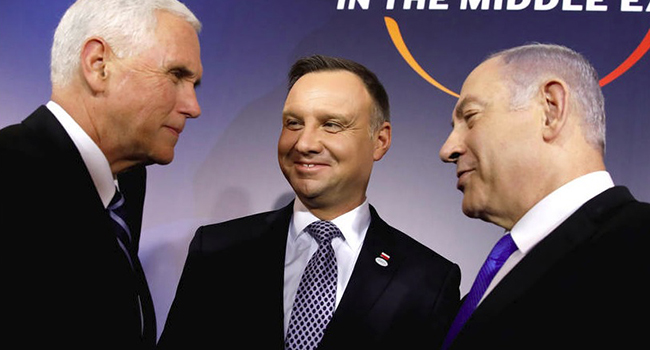
Former US Vice President Mike Pence
Mujahedin Khalq; A proxy force

Trump allies hijack Warsaw summit with calls for Iran war, regime change

WASHINGTON — An international conference US officials had insisted was not about demonizing Iran got off to an awkward start in Warsaw today thanks to two close allies of US President Donald Trump.

First, Rudy Giuliani, Trump’s personal lawyer in the Russia investigation, called for Iran regime change at a rally in Warsaw of the controversial Mujahedeen-e-Khalq (MEK), an Iranian opposition group until recently designated as a terrorist group by the United States, and widely reviled by Iranians both inside and outside of Iran as a cult that fought with Saddam Hussein during the Iran-Iraq war.
Then, Israeli Prime Minister Benjamin Netanyahu and his spokesman tweeted comments whose English translation said the Warsaw meeting was important for bringing Israel together with Arab countries “to advance their common interest of war with Iran.” Those tweets were subsequently deleted and reposted with the translation of Israeli-Arab common interest being in “combatting” Iran, but not for over an hour from the Israeli prime minister’s official Twitter account.
State Department officials had already had a hard time convincing other allied nations to send their foreign ministers to the two-day supposedly ministerial conference on promoting peace and stability in the Middle East. (Netanyahu also serves as Israel’s foreign minister.) In the end, only two foreign ministers came from Western Europe to Warsaw.
British Foreign Secretary Jeremy Hunt came for one day to chair a “quad” meeting on Yemen, with his counterparts from the United States, Saudi Arabia and the United Arab Emirates, along with UN Yemen envoy Martin Griffiths. But Hunt was expected to depart before the proceedings Thursday. France and Germany, the other two European nations that helped negotiate the Iran nuclear deal that Trump withdrew from last year, sent their political directors.
Israel’s Netanyahu was the only head of state who came from abroad to the conference; US Vice President Mike Pence also attended. That made for an awkward “family photo” of the attendees in which the Polish president and foreign minister, Pence, US Secretary of State Mike Pompeo and Netanyahu were some of the only recognizable figures in the front row of some 50 nations’ representatives.
US envoy on Iran Brian Hook, in an interview with the BBC Persian service, said repeatedly that the United States does not have a relationship with the MEK, and said Giuliani does not represent the US government. But the fact that the president’s personal lawyer, as well as his national security adviser John Bolton, are or have been longtime lobbyists for the controversial group has made many other countries wary of the Trump administration’s hard-line policies on Iran and where they are heading.
“I don’t think there’s any hiding the fact that despite the label being changed, the US very much has an agenda here in terms of creating this alliance that is anti-Iran,” Ellie Geranmayeh, deputy director of Middle East programs at the European Council on Foreign Relations, told Al-Monitor.
“The messaging from European capitals has been so clear that they don’t want to be associated with that kind of meeting,” Geranmayeh said. “It’s a big snub that the German and the French foreign ministers haven’t gone. And the only reason Hunt’s going can be put down to Brexit next month and the country being in limbo.”
On the agenda for Thursday, the US undersecretary of the Treasury for terrorism and financial intelligence, Sigal Mandelker, is expected to lead discussions at a special session on finance and terrorism.
“To be honest, even today, speaking to some of the Europeans, they have no clue what is coming out of this tomorrow,” Geranmayeh said. “The impression they had is the agenda is still a mess.”
“I think the US has still been pushing for follow-up working groups to continue on some of these issues,” she said. “But one diplomat said it really depends on how the US handles the discussions in Warsaw. If they really go into full Iran-bashing mode, it is going to be so unhelpful.”
The fact that Trump’s personal lawyer is meeting with the MEK “makes everyone in Europe very skeptical of the intent behind this meeting,” Geranmayeh said.
Laura Rozen, Al Monitor
Laura Rozen is Al-Monitor’s diplomatic correspondent based in Washington, DC. She has written for Yahoo! News, Politico and Foreign Policy. On Twitter: @LRozen

February 16, 2019 0 comments
FacebookTwitterPinterestWhatsappTelegramSkypeEmail
Newt Ginrich
Mujahedin Khalq; A proxy force

Gingrich considered registering as a lobbyist for Iran regime change

The former House speaker sought advice late last year on whether to register as a foreign agent for the Iranian opposition.

Newt Ginrich

Former Speaker of the House Newt Gingrich attends the”Free Iran 2018 — the Alternative”event organized by the National Council of Resistance of Iran, an exiled Iranian opposition group, on June 30, 2018, in Villepinte, north of Paris.
Former US House speaker and Donald Trump ally Newt Gingrich asked the Justice Department for advice last year on whether he should register as a foreign agent amid deepening involvement with groups seeking regime change in Iran.
Gingrich asked the department in mid-September whether he should register under the Foreign Agents Registration Act (FARA) after an undisclosed person asked him to urge a foreign ambassador in Washington to seek funding from that ambassador’s country to “promote democracy” in Iran. Gingrich declined to respond to Al-Monitor’s requests for comment and it’s not clear if he ever went through with the person’s request.
The request is spelled out in an Oct. 19 advisory opinion posted to the FARA web site. While Gingrich isn’t named in the redacted document, descriptive details are a perfect match for his Virginia-based Gingrich Productions firm (Al-Monitor was able to independently confirm the request came from Gingrich).
In his letter to the Justice Department, Gingrich also seeks guidance on whether he should register as a lobbyist for a “foreign political party” after making “a number” of “paid appearances” sponsored by the group’s US affiliate both inside and outside the United States. While the foreign party isn’t named, it appears to be a clear reference to the pro-regime change National Council of Resistance of Iran (NCRI-US); Gingrich has attended the group’s annual gathering just outside of Paris several times.
In its advisory opinion, the Justice Department says Gingrich, who has not registered as a foreign agent, may need to do so if the US affiliate “is acting in any way on behalf of” the parent party. Interestingly, the NCRI’s US office itself has been registered under FARA as a foreign agent of the NCRI since 2012. A spokesman for the group said it had nothing to do with Gingrich’s potential outreach to the unnamed foreign ambassador.
Gingrich was an adviser to Trump’s 2016 presidential campaign and remains close to the president, who sought his advice on how to avoid a Democratic “blue wave” ahead of the 2018 mid-term elections. His wife, Callista Gingrich, was tapped as ambassador to the Vatican in May 2017.
But he isn’t the only Washington insider in the president’s orbit who’s close to the Iranian opposition. Trump lawyer Rudy Giuliani has also long been a fixture at NCRI events. And Al-Monitor first reported that national security adviser John Bolton had disclosed being paid $40,000 for his appearance at the group’s rally in France in 2017 before he joined the government.
Gingrich’s stepped-up political activity on behalf of the Iranian opposition is particularly noteworthy as the Donald Trump administration sponsors a Middle East conference in Poland this week that was originally billed as an anti-Tehran summit. Giuliani is slated to appear at an NCRI rally in Warsaw coinciding with the summit.
Julian Pecquet , Al-Monitor
Julian Pecquet is Al-Monitor’s Washington Editor. He was previously Congressional Correspondent from 2014 through May 2017 and most recently before that headed up The Hill’s Global Affairs blog. On Twitter: @JPecquet_ALM, Email: jpecquet@al-monitor.com.

February 16, 2019 0 comments
FacebookTwitterPinterestWhatsappTelegramSkypeEmail
blank
Mujahedin Khalq; A proxy force

As Giuliani Calls for Regime Change in Iran, Netanyahu Raises the Specter of “War”

RUDY GIULIANI, the former mayor of New York City who now serves as President Donald Trump’s personal lawyer, called for the overthrow of Iran’s government on Wednesday during a rally in Poland staged by a cult-like group of Iranian exiles who pay him to represent them.
Speaking outside the Warsaw venue for an international conference on the Middle East attended by U.S. Secretary of State Mike Pompeo and Israeli Prime Minister Benjamin Netanyahu, Giuliani said that his message for the 65 governments discussing ways to confront Iran was simple. “The theocratic dictatorship in Tehran,” Giuliani said, “must end and end quickly.”

Former NY Mayor @RudyGiuliani in Warsaw:
In order to have peace & security in the Mid-East there has to be a major change in the theocratic dictatorship in #Iran. It must end & end quickly in order to have stability#FreeIranWithMaryamRajavi#PolandSummit#IStandWithMaryamRajavi pic.twitter.com/aKafMjxq4k
— NCRI-FAC (@iran_policy) February 13, 2019

Giuliani went on to suggest that peace in the region would only come when Iran was ruled instead by his clients, the National Council of Resistance of Iran, an exile group of former terrorists also known as the Mojahedin-e Khalq, or People’s Mujahedin. The group’s leader, Maryam Rajavi, already refers to herself as “President-elect.”

.@RudyGiuliani: We have seen regime change work & fail. In #Iran’s case we don’t have to worry. There is a viable alternative. Maryam Rajavi’s 10-point plan stands for a #FreeIran w/ a democratically-elected Gov instead of a tyrant/monarch.#FreeIranWithMaryamRajavi #WarsawSummit pic.twitter.com/EFJHIw2WUV
— NCRI-FAC (@iran_policy) February 13, 2019

Off-stage, the U.S. president’s lawyer admitted that he was paid by the exile group, but stressed to reporters that he was in Warsaw on behalf of the MEK in his personal capacity and would not be attending the diplomatic conference organized by the State Department.
Even before the conference began, the Israeli prime minister appeared to shrug off efforts by the State Department and the Polish government to portray the gathering as broadly focused on Middle East peace, describing it as primarily a meeting of Iran’s enemies.
In video posted on the prime minister’s official Twitter feed, Netanyahu characterized a meeting with Oman’s foreign minister as “excellent,” and one focused on “additional steps we can take together with the countries of the region in order to advance common interests.”
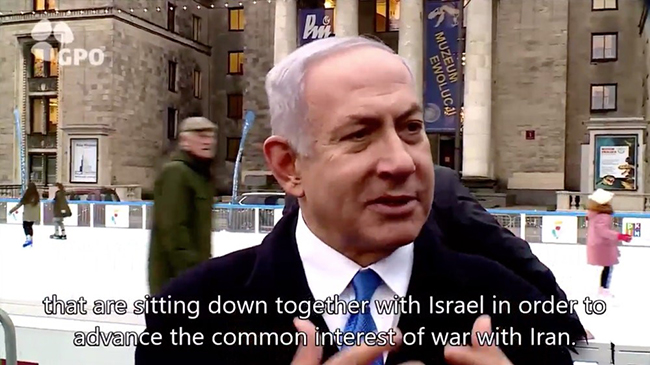
According to the English translation of Netanyahu’s remarks in Hebrew prepared by his office, the prime minister then added: “What is important about this meeting — and it is not in secret because there are many of those — is that this is an open meeting with representatives of leading Arab countries that are sitting down together with Israel in order to advance the common interest of war with Iran.”

Netanyahu’s use of the word “war” seemed to throw Israel’s diplomatic corps into chaos. Within minutes, as journalists speculated that the prime minister’s office might have mistranslated his comment, Netanyahu’s spokesperson to the Arab media, Ofir Gendelman, wrote that the Israeli leader had described his nation’s common interest with Arab nations as “combatting Iran,” not “war with Iran.”
The subtitled video produced by the prime minister’s office was then deleted from his Twitter feed and replaced with the text of Gendelman’s alternative translation.
As my colleague Talya Cooper explains, however, Netanyahu did in fact use the Hebrew word for “war” in the video, which has not yet been deleted from his Hebrew-language YouTube channel. In a separate video, posted by Netanyahu’s office on Facebook earlier in the day, the prime minister had used the Hebrew word for “combat.”
Aron Heller, an Associated Press correspondent based in Jerusalem, also filmed the remarks and reported that although Netanyahu had mentioned “war,” his office said later that he was referring to “combatting Iran.”

Did @netanyahu really say “war” with Iran? I was there and the word was ”milchama” = war. pic.twitter.com/ZzhrDs2lWA
— Aron Heller (@aronhellerap) February 13, 2019

Iran’s foreign minister, Mohammad Javad Zarif, seized on the Israeli leader’s apparent Freudian slip as evidence that Netanyahu’s true aim of provoking a war with Iran was now out in the open

We’ve always known Netanyahu’s illusions. Now, the world – and those attending #WarsawCircus – know, too pic.twitter.com/0TSDzIak9e
— Javad Zarif (@JZarif) February 13, 2019

Zarif also suggested that the Trump administration and the exiles of the MEK might have been behind a suicide bombing on a bus in southeastern Iran on Wednesday, which killed 41 members of the Islamic Revolutionary Guards Corps.

“Is it no coincidence that Iran is hit by terror on the very day that #WarsawCircus begins?” Zarif tweeted. “Especially when cohorts of same terrorists cheer it from Warsaw streets & support it with twitter bots? US seems to always make the same wrong choices, but expect different results.”

The foreign minister was clearly referring to the MEK, which spent three decades trying to achieve regime change in Iran through violence, including terrorist attacks. The well-funded exile group was also suspected of being behind social media trickery discovered by the BBC, which reported that Twitter bots had been deployed “to artificially create a trend which hints at popular support for the summit and — by extension — widespread resentment towards the Iranian establishment.”
The Iranian exiles have been caught in the past paying nonsupporters to fill out its crowds at rallies, a tactic reportedly used at the event in Warsaw on Wednesday, according to journalists on the ground.

The MEK is having a rally in Warsaw where as usual about a third of the crowd is random non-Iranians who’ve been bussed in from Slovakia and can’t read the signs they’re holding pic.twitter.com/NnJyqMxnEY
— Gregg Carlstrom (@glcarlstrom) February 13, 2019

Spoke to journalist in #WarsawSummit. He had attended the MEK terrorist org’s rally. Many of the”demonstartors”were Slovak high school kids who couldnt really provide an answer as to why they were there.

Just as the MEK buys bots on Twitter, they do so in real life as well…
— Trita Parsi (@tparsi) February 13, 2019

Members of the MEK helped foment the 1979 Iranian revolution, in part by killing American civilians working in Tehran, but the group then lost a struggle for power to the Islamists. With its leadership forced to flee Iran in 1981, the MEK’s members set up a government-in-exile in France and established a military base in Iraq, where they were given arms and training by Saddam Hussein as part of a strategy to destabilize the government in Tehran that he was at war with.
In recent years, as The Intercept has reported, the MEK has poured millions of dollars into reinventing itself as a moderate political group ready to take power in Iran if Western-backed regime change ever takes place. To that end, it lobbied successfully to be removed from the State Department’s list of foreign terrorist organizations in 2012. The Iranian exiles achieved this over the apparent opposition of then-Secretary of State Hillary Clinton, in part by paying a long list of former U.S. officials from both parties hefty speaking fees of between $10,000 to $50,000 for hymns of praise.

Despite the claims of paid spokespeople like Giuliani and John Bolton — who predicted regime change would come at a lavish MEK rally in Paris just months before being named Trump’s national security adviser — the MEK appears to be as unprepared to take power in Iran as Ahmad Chalabi’s exiled Iraqi National Congress was after the American invasion of Iraq.

#JohnBolton 8 months ago among MEK supporters tells them they will overthrow #Iran’s regime and celebrate in #Tehran with Bolton himself present, “before 2019” pic.twitter.com/H7oaaU3faU
— Bahman Kalbasi (@BahmanKalbasi) March 22, 2018

Ariane Tabatabai, a Georgetown University scholar, has argued that the “cult-like dissident group” — whose married members were reportedly forced to divorce and take a vow of lifelong celibacy — “has no viable chance of seizing power in Iran.”

If the current government is not Iranians’ first choice for a government, the MEK is not even their last — and for good reason. The MEK supported Saddam Hussein during the Iran-Iraq War. The people’s discontent with the Iranian government at that time did not translate into their supporting an external enemy that was firing Scuds into Tehran, using chemical weapons and killing hundreds of thousands of Iranians, including many civilians. Today, the MEK is viewed negatively by most Iranians, who would prefer to maintain the status quo than rush to the arms of what they consider a corrupt, criminal cult.
Despite such doubts, spending lavishly on paid endorsements has earned the MEK a bipartisan roster of Washington politicians willing to sign up as supporters. At a gala in 2016, Bolton was joined in singing the group’s praises by another former U.N. ambassador, Bill Richardson; a former attorney general, Michael Mukasey; the former State Department spokesperson P.J. Crowley; the former Homeland Security adviser Frances Townsend; the former Rep. Patrick Kennedy, D-R.I.; and the former Vermont Gov. Howard Dean. That Paris gala was hosted by Linda Chavez, a former Reagan administration official, and headlined by Newt Gingrich, the former speaker who was under consideration to be Trump’s running mate at the time.
Fears about Bolton’s apparently open desire to start a war with Iran have been exacerbated by his boosting of the MEK and his steadfast denial of the catastrophe unleashed by the invasion of Iraq that he worked for as a member of the Bush administration. Last year, when Fox News host Tucker Carlson pointed out that Bolton had called for regime change in Iraq, Libya, Iran, and Syria, and the first of those had been “a disaster,” Bolton disagreed.
“I think the overthrow of Saddam Hussein, that military action, was a resounding success,” Bolton insisted to Carlson. The chaos that followed in Iraq, he said, was caused by a poorly executed occupation that ended too soon. On the bright side, Bolton said, the mistakes the U.S. made in Iraq offered “lessons about what to do after a regime is overthrown” in the future.
Earlier this week, Sen. Chris Murphy warned that Bolton appeared to be laying the groundwork for war in a belligerent video message from the White House to mark the 40th anniversary of the Iranian revolution.

Here Bolton says Iran is seeking nuclear weapons. This simply isn’t true. The intelligence says the opposite and he knows it. He is laying the groundwork for war and we all must be vigilant. https://t.co/1zHR5vaEGn
— Chris Murphy (@ChrisMurphyCT) February 12, 2019

Another strong supporter of the disastrous U.S. invasion of Iraq was Netanyahu, who, between terms as prime minister, testified to Congress on Sept. 12, 2002 as a private citizen, and advised lawmakers that attacking Iraq would be wise.
A review of Netanyahu’s 2002 testimony — in which he said, “I think the choice of Iraq is a good choice, it’s the right choice” — reveals that he linked his strong support for a United States invasion of Iraq to topple Saddam Hussein with the possibility of inspiring the implosion of the ruling theocracy in neighboring Iran.

“It’s not a question of whether Iraq’s regime should be taken out but when should it be taken out; it’s not a question of whether you’d like to see a regime change in Iran but how to achieve it,” Netanyahu said then. “If you take out Saddam, Saddam’s regime, I guarantee you that it will have enormous positive reverberations on the region. And I think that people sitting right next door in Iran, young people, and many others, will say the time of such regimes, of such despots is gone.”

“If you take out Saddam,”Netanyahu told Congress in 2002,”I guarantee you that it will have enormous positive reverberations on the region. And I think that people sitting right next door in Iran… will say the time of such regimes, of such despots is gone.”pic.twitter.com/ZNTxpSP3a2
— Robert Mackey (@RobertMackey) February 14, 2019

Updated: Feb. 14, 2019
This article was updated to include Congressional testimony from Benjamin Netanyahu on Sept. 12, 2002, in which he advocated a U.S. invasion of Iraq.
Robert Mackey, The Intercept,

February 16, 2019 0 comments
FacebookTwitterPinterestWhatsappTelegramSkypeEmail
Massoud Rajavi
The cult of Rajavi

Whether Massoud Rajavi Is Dead or Alive, Big Brother Is Alive

Although it is thought that the dictatorship of communism was perished with the collapse of the Soviet Union, the monster is still alive. One may find it strange that the symbolic world that George Orwell depicted in “1984” is still practiced in some communities. As a former member of the Mujahedin Khalq Organization (the MKO/ MEK/ PMOI/ the Cult of Rajavi), the book might astonish you with the huge similarity of the real world inside the MKO and the fictional world in Oceania – the fictional country in the book.

“I was in Turkey in 1992 when a friend recommended me reading “1984” of George Orwell,” writes Mehdi Khoshal, ex-member of the MKO.
“I read the book three times in six months because it was very similar to the situation inside the Cult of Rajavi that I had personally experienced.”

Creating the fictional world of a dictatorship in 1984, George Orwell coined some words and expressions that are called ‘Orwellian’, defined by the Oxford English Dictionary as “Characteristic or suggestive of the writings of George Orwell, esp. of the totalitarian state depicted in his dystopian account of the future, Nineteen Eighty-four”.
It’s the dystopian substance of Oceania which fits so accurately with the Mujahedin Khalq Organization. It is 2019 and members of the MKO are living in an Oceania-like world. This means that ruling system in Oceania is not only a government but also a life style that removes individuality from human beings and make them follow the community and its ruler.
The parallel of the term “Big Brother”—referring to the absolute leader of Oceania—is “Brother Massoud” referring to the co-leaders of the MKO.

Using the terms brother or sister is a successful attempt to diminish the notion of family in the minds of members of the community. Big Brother and Brother Massoud neglect the identity of members. Under their rule, mother and father are taboos. Members should revolt against the opposite sex.

According to the symbolic world that George Orwell creates in “Animal Farm” and “1984”, totalitarians can be communists, fascists or terrorist extremist like ISIS and the MKO. The leaders of the MKO were the leftist Islamists in 1970s but turned out to extremist cultists who rule their rank and file by their propaganda that launches lie, hatred, war and hypocrisy among the public.
George Orwell also created the word “doublethink” in his dystopian novel. “Doublethink is the act of holding, simultaneously, two opposite, individually exclusive ideas or opinions and believing in both simultaneously and absolutely”, based on Oxford dictionary.
In “1984”, the three slogans of the party —”War Is Peace; Freedom Is Slavery; Ignorance Is Strength”— are obvious examples of doublethink. The act of doublethink also occurs in more subtle details throughout the novel. In the MKO, members are called “freedom fighters” but they are not free. They are not allowed to leave the group. They are called “unique gems” but they bear sever verbal and physical abuses under brainwashing programs imposed by the group leaders everyday.
The novel explicitly shows people learning doublethink and newspeak due to peer pressure and a desire to”fit in”, or gain status within the Party—to be seen as a loyal Party Member. In the novel, for someone to even recognize—let alone mention—any contradiction within the context of the Party line was akin to blasphemy, and could subject that person to disciplinary action and to the instant social disapproval of fellow Party Members. This is exactly what the MKO members have been enduring in their everyday life at least for the past three decades. Amir Yaghmaiee who once has been one of the MKO militia recently recounted the very contradictions he experienced inside the MKO. He ultimately could manage to leave the group after the American invasion of Iraq. He was under a 24-hour-long brainwashing session just because he had declared his willingness to leave the group. [link of the video]
1984 demonstrates the rule of ignorance instead of the rule of wisdom. Isolation and brainwashing of members of the community leads to the ignorance of the public opinion. In Oceania, technology in form of telescreens and televisions brainwashes people. In the MKO, the group’s satellite TV and its websites together with the bots in the social media deviate the realities, cover the truth and launch misinformation.
Big brother is alive even if brother Massoud is dead. Brother Massoud is a notion that rules the minds of victims of the MKO.
Mazda Parsi

February 14, 2019 0 comments
FacebookTwitterPinterestWhatsappTelegramSkypeEmail
Michael Pompeo meets Masih Alinejad
Mujahedin Khalq Organization's Propaganda System

The Proof of US Cold Shoulder for Rajavi

Secretary of State Mike Pompeo meets with Iranian women’s rights activist Masih Alinejad

Masoumeh (Masih) Alinejad-Ghomi, an Iranian American journalist, author and activist who currently works as a presenter at VOA Persian Service, met with Secretary of State Michael R. Pompeo in the White House on February 4, 2019.

I am not sure about the significance of this meeting – there have been different and even opposite points of views expressed in the Iranian communities both inside and outside Iran.

But something I am quite sure of is that Maryam Rajavi, the so-called leader of the Iranian Resistance and self-proclaimed President of Iran in exile, has been dreaming for many years to get a visa to visit the United States. But let alone not even getting near to the White House or the Secretary of State she has had no luck whatsoever with getting her visa.

Rajavi tries to give the false impression that her so-called alternative to the Islamic Republic of Iran, the Mojahedin-e Khalq Organization (MEK, MKO, NCR, or the Rajavi Cult), has close ties with the US and has the support of the west, but her well paid lobbyists such as Rudi Giuliani and John Bolton did not even manage to get a visa for her to enter the States despite their extensive and expensive efforts.

I also know that for many years her well known British lawyers and parliamentary lobbyists in London didn’t succeed in getting a visa for her to visit the UK despite opening a lawsuit in the Judiciary and spend a lot of money on it.

The open meeting of Masih Alinejand and Mike Pompeo clearly proves the cold shoulder the US officials have always shown to the MEK and its leaders through the years. But why?

The answer is quite simple. For the very fact that everyone in the west and especially the United States clearly knows how this cult is hated by Iranians. Personalities such as the Secretary of State are well aware that getting near to this notorious cult will not only bring them no credit, but on the contrary would cost their own credibility.

The Trump administration might not mind using the MEK covertly for various purposes against the Islamic Republic of Iran, but surely not at the cost of losing its international reputation.

Ebrahim Khodabandeh

February 13, 2019 0 comments
FacebookTwitterPinterestWhatsappTelegramSkypeEmail
Bolton and Maryam Rajavi in Albania
Mujahedin Khalq Organization as a terrorist group

More than $180,000 to speak in favor of MKO terrorists

Twitter Removes Leader’s Anti-Trump Remarks

Twitter removed a post on the Arabic account of Iran’s Leader Ayatollah Seyed Ali Khamenei where the Leader had said that chants against the US are aimed at Washington’s officials like Donald Trump, John Bolton, and Mike Pompeo.
Twitter has removed one of the Friday’s tweets of Ayatollah Khamenei’s Arabic account which was aimed at US top officials, including its President Donald Trump.
The tweet was addressed to US President Donald Trump and two other American top officials, reading “Down with USA means down with Donald Trump, John Bolton and Mike Pompeo,” and not the American nation.
The tweet had tagged Donald Trump’s Twitter account, as well as the other two American officials’ mentioned in the tweet.
The Leader had made the remarks yesterday in a meeting with Army Air Force commanders and staff in Tehran.
The tweet, meanwhile, is still available in the English version of Leader’s Twitter account.
This is not the first time the social network platform of Twitter is behaving in a biased maaner against Tehran, as earlier on September, Iranian Foreign Minister Mohammad Javad Zarif strongly blasted the social network for blocking the accounts of Iranians while overlooking the”regime change”propaganda fueled by the US.

“Twitter has blocked the accounts of real Iranians, but overlooks the ‘regime change’ propaganda spewing out of Washington,”the Iranian foreign minister wrote on his Twitter account while addressing co-founder and CEO of Twitter Jack Patrick Dorsey.

He said the accounts of real Iranians, including TV presenters and students, have been shuttered for allegedly being part of an”influence operation”.
“How about looking at actual bots in Tirana used to prop up ‘regime change’ propaganda spewed out of DC?”Zarif asked while alluding to the anti-Iran Mojahedin-e Khalq Organization (MKO, also known as the MEK, PMOI and NCRI) terrorist group whose members are currently based in Albanian capital city.
Iranian Ambassador to UK Hamid Baeedinejad also took to Twitter noting that according to news outlets, there are 1,500 members of the MKO in Camp Ashraf in Albania, who produce millions of fake messages over online social media all of which seek regime change in Iran.
The Iranian diplomat noted that as demanded by Zarif, Twitter must take action to shutter these fake accounts as well.
In a relevant development in August, Google removed 39 YouTube channels linked to the Iranian state broadcaster. Google terminated those accounts, along with six blogs on its Blogger service and 13 Google+ accounts linked with Iran. The move came after Twitter and Facebook also blocked hundreds of accounts on suspicion of possible ties with Iran.
Google and Facebook claimed those social media channels and accounts were tied to Iran and Russia and disseminated “disinformation.”
The MKO (MEK), founded in the 1960s, blended elements of Islamism and Stalinism and participated in the overthrow of the US-backed Shah of Iran in 1979. Ahead of the revolution, the MKO conducted attacks and assassinations against both Iranian and western targets.
The group started assassination of the citizens and officials after the revolution in a bid to take control of the newly-established Islamic Republic. It killed several of Iran’s new leaders in the early years after the revolution, including the then President, Mohammad Ali Rajayee, Prime Minister, Mohammad Javad Bahonar and the Judiciary Chief, Mohammad Hossein Beheshti who were killed in bomb attacks by the MKO members in 1981.
The group fled to Iraq in 1986, where it was protected by Saddam Hussein and where it helped the Iraqi dictator suppress Shiite and Kurd uprisings in the country.
The terrorist group joined Saddam’s army during the Iraqi imposed war on Iran (1980-1988) and helped Saddam and killed thousands of Iranian civilians and soldiers during the US-backed Iraqi imposed war on Iran.

Since the 2003 US invasion of Iraq, the group, which now adheres to a pro-free-market philosophy, has been strongly backed by neo-conservatives in the United States, who argued for the MKO to be taken off the US terror list.
The US formally removed the MKO from its list of terror organizations in September 2012, one week after Secretary of State Hillary Clinton sent the US Congress a classified communication about the move. The decision made by Clinton enabled the group to have its assets under the US jurisdiction unfrozen and do business with the American entities, the State Department said in a statement at the time.
In September 2012, the last groups of the MKO terrorists left Camp Ashraf, their main training center in Iraq’s Diyala province. They have been transferred to Camp Liberty. Hundreds of the MKO terrorists have now been sent to Europe, where their names were taken off the blacklist even two years before the US.
The MKO has assassinated over 12,000 Iranians in the last 4 decades. The terrorist group had even killed large numbers of Americans and Europeans in several terror attacks before the 1979 Islamic Revolution.
Some 17,000 Iranians have lost their lives in terror attacks in the 35 years after the Revolution.

Rumors were confirmed in September 2016 about the death of MKO ringleader, Massoud Rajavi, as a former top Saudi intelligence official disclosed in a gaffe during an address to his followers.
Rajavi’s death was revealed after Turki al-Faisal who was attending the MKO annual gathering in Paris made a gaffe and spoke of the terrorist group’s ringleader as the”late Rajavi”twice.

Faced with Faisal’s surprising gaffe, Rajavi’s wife, Maryam, changed her happy face with a complaining gesture and cued the interpreter to be watchful of translation words and exclude the gaffe from the Persian translation.
After the Islamic Revolution in Iran in 1979, the MKO was exiled first to Iraq and then to Albania. Albania houses 3,000 MKO members.
Since last year, a slew of US politicians have visited the MKO in Albania, often without any public announcement, or under cover of meeting some Albanian politicians. These include former FBI director Louis J. Freeh, US Senator John McCain (who addressed a MKO conference), and a delegation of US Senators Thom Tillis, Roy Blunt, and John Cornyn.
A few months later, US Congressman Ted Poe introduced a bill in the House of Representatives calling upon the government of Iraq “to compensate the former residents of Camp Ashraf (the former MKO camp) for their assets seized by groups affiliated with the Government of Iraq.”
Media reports said in June 2018 that US National Security Adviser John Bolton received $40,000 to participate and address the audience in a gathering of the MKO terrorist group in Paris in July 2017.

According to documents released by al-Monitor news website, the US Public Financial Disclosure Report in January 2018 for Bolton indicated that he has received $40,000 from the MKO as speaking fee in Paris gathering.
The date of speaking is July 1, 2017, and the event was titled ‘Globe Events–European Iranian Events’.

Bolton had in the same date attended the MKO gathering in Paris, stressing during his address that the Islamic Republic should not be allowed to celebrate the 40th anniversary of Revolution in Iran.
During his address, he said that new US President Donald Trump is fully opposed to the”regime in Tehran”.
“The outcome of the president’s policy review should be to determine that the Ayatollah Khomeini’s 1979 revolution will not last until its 40th birthday,” Bolton said.

Recently, Joanne Stocker, of the US portal Defense Post, told NBC that Bolton had received more than $180,000 from the MKO to speak in their favor. Bolton’s office has so far refused to comment on it.

February 12, 2019 0 comments
FacebookTwitterPinterestWhatsappTelegramSkypeEmail
blank
Maryam Rajavi

Maryam Rajavi just doesn’t get it does she

US Secretary of State Mike Pompeo has invited several of what are known as Iran’s ‘fake opposition’ to his Middle East summit in Warsaw on 13-14 February. (A thinly disguised Iran bashing fest!). But Rajavi is being kept at arms’ length, a barge pole’s length even. She has not been invited.

To be clear, Maryam Rajavi is notorious inside the MEK to be jealous and throw tyrannical temper tantrums. No doubt she reacted similarly to the photograph of Pompeo posing alongside the much younger controversial ‘activist’ Masih Alinejad circulating in social media.

Though, apparently, these days just about anybody except Rajavi can have their picture taken with Pompeo.

Rajavi’s actions indicate that she really doesn’t understand why this is. Her desperate efforts to stay visible – parading on stage in glamorous outfits before paid speakers and audience – expose her ego rather than her leadership. As de facto leader of the MEK, Rajavi has successfully carved out a niche for the mercenary MEK in the anti-Iran front – acting out the silent wishes of America, Israel and Saudi Arabia, who might proclaim an interest in regime change against Iran, but who cannot necessarily do the dirty deeds.

By continually insisting on her propaganda events she is overstepping her mandate: the MEK’s role is to get paid, do the work, then disappear.

Rajavi is not invited to Warsaw because, quite frankly, she and her organization stink. The smell of terrorism, murder, crime and corruption cling to the MEK in spite of all the group’s efforts to whitewash, re-write, lobby and otherwise hide their past and present. No other fake opposition is as dirty and untrustworthy as the MEK. No other fake opposition keeps its members as slaves and kills dissenters. No other fake opposition commits false flag ops to blame on Iran and destroy trust.

So, while western media is reluctant to delve deeper into what the MEK are actually capable of, the security services which advise those governments who turn a blind eye to this activity are fully aware of Maryam Rajavi’s weaknesses. The fact she is prepared to sell her homeland for dollars means she is just as easily capable of selling another country for Rials when the time comes!

February 12, 2019 0 comments
FacebookTwitterPinterestWhatsappTelegramSkypeEmail
blank
Maryam Rajavi

Maryam Rajavi’s protest is more about being left in the cold by Pompeo in Warsaw

Maryam Rajavi headed a ‘protest’ in Paris yesterday using paid participants to promote her regime change agenda against Iran. Rajavi is afraid of being overlooked by US Secretary of State Mike Pompeo’s Iran Action Group run from inside the State Department. Pompeo will hold a summit in Warsaw next week where it is predicted Iranian opposition groups will feature. Sadly for Rajavi, she has not been invited. Wonder why? Here’s a timely reminder of just who the Mojahedin-e Khalq are. In 2012, Owen Bennett-Jones from the BBC conducted an in-depth investigation into the group, including interviews with top MEK members, as well as critics and victims. This is his reporting.

US-Iran relations

February 10, 2019 0 comments
FacebookTwitterPinterestWhatsappTelegramSkypeEmail
Malek Shara’i
Mujahedin Khalq Organization as a terrorist group

Latest testimony on the murder of an MKO member

A former member of the Mujahedin Khalq Organization (the MKO/MEK/PMOI/Cult of Rajavi) Nabi Ahmadi states new dimensions on the death of Malik Sharaei in the group’s camp in Albania.
Malik Sharaei, 47, was one of the few remaining witnesses of the mysterious death of 53 MKO members in Camp Ashraf, Iraq.
Nabi Ahmadi asserts that Malik was on of his intimate friends when he was in the MKO.

“Before my departure we used to talk a lot, “Nabi writes. “Malik said he wanted to leave the group but he didn’t know how he would be able to do that.”

According to Nabi, Malik had two problems. One was his fear of the outside world and the second was his involvement in the clashes of Camp Ashraf.
Nabi tried to convince him that the world outside the MKO is not a problem but he could not help him with his concerns on his presence in the clashes in Camp Ashraf. Malik was concerned about all the information he had about the last days in Camp Ashraf.

“After my escape from the MKO, Malik could not tolerate the group anymore,” Nabi states. “He asked to leave the group but in response he was jailed in a quarantine and then he was physically eliminated by the MKO leaders.”

Malik’s death was declared by the MKO news media as he was drowned in the irrigation channel after he got into it to help a comrade who was at risk of drowning. “Malik was a professional swimmer.” Nabi wonders. ”it’s not logical that he was drowned after he rescued another person!”

February 10, 2019 0 comments
FacebookTwitterPinterestWhatsappTelegramSkypeEmail
Newer Posts
Older Posts

Recent Posts

  • The black box of the torture camps of the MEK

    December 24, 2025
  • Pregnancy was taboo in the MEK

    December 22, 2025
  • MEPs who lack awareness about the MEK’s nature

    December 20, 2025
  • Why did Massoud Rajavi enforce divorces in the MEK?

    December 15, 2025
  • Massoud Rajavi and widespread sexual abuse of female members

    December 10, 2025
  • Facebook
  • Twitter
  • Instagram
  • Youtube

© 2003 - 2025 NEJAT Society . All Rights Reserved. NejatNGO.org


Back To Top
Nejat Society
  • Home
  • Articles
  • Media
    • Cartoons
    • NewsPics
    • Photo Gallery
    • Videos
  • Publications
    • Books
    • Nejat NewsLetter
    • Pars Brief
  • About Us
  • Contact us
  • Editions
    • عربي
    • فارسی
    • Shqip