Nejat Society
  • Home
  • Articles
  • Media
    • Cartoons
    • NewsPics
    • Photo Gallery
    • Videos
  • Publications
    • Books
    • Nejat NewsLetter
    • Pars Brief
  • About Us
  • Contact us
  • Editions
    • عربي
    • فارسی
    • Shqip
Nejat Society
Nejat Society
  • Home
  • Articles
  • Media
    • Cartoons
    • NewsPics
    • Photo Gallery
    • Videos
  • Publications
    • Books
    • Nejat NewsLetter
    • Pars Brief
  • About Us
  • Contact us
  • Editions
    • عربي
    • فارسی
    • Shqip
© 2003 - 2024 NEJAT Society. nejatngo.org
US Rajavi lobby
Missions of Nejat Society

The Baffling Relationship between American Politicians and the MEK

It’s no secret that most American politicians want political change in Iran. Whether it be President Donald Trump, Barack Obama, or George W. Bush, regime change (or a significant change in the regime’s behavior) has been a goal of U.S. administrations since the dawn of the Islamic Republic in 1979. Nor have U.S. politicians attempted to hide this: Congressmen across the aisle, for example, have met with Reza Pahlavi, the former Iranian prince whose father was ousted from power during the Islamic Revolution, to discuss regime change. Pahlavi, among many others in the Iranian diaspora, has called on all American politicians to support a democratic, liberal Iran.

American calls for regime change have certainly focused on this idea of a democratic, liberal Iran. Secretary of State Mike Pompeo, Senator Ted Cruz, and National Security Advisor John Bolton (among many others) have openly advocated for such change. But it’s not just Republicans: both House Minority Leader Nancy Pelosi and Senate Minority Leader Chuck Schumer have also called for Iranians to be freed from the chains of the Islamic Republic. These politicians have decried the lack of human rights in Iran, the lack of democracy, and the suffering of the Iranian people.

Given this context, the relationship between some American politicians and the Mujahedin-e Khalq, or MEK, is baffling. The MEK, guided by an undemocratic fusion of Marxism and Islamism, has conducted terrorist attacks against Americans and Iranians alike yet has support from a plethora of U.S. conservative and liberal politicians (including many who advocate for the democratization of Iran), such as Rudy Giuliani, Bolton, Pompeo, Pelosi, and Edward Rendell. Given the MEK’s inability to meaningfully change Iran, the support of U.S. politicians for the Mujahedin will only have negative effects for the United States, namely that it will alienate the Iranian people and give hardliners in the Islamic Republic a chance to capitalize on this support.

What is the MEK?

The MEK was established in 1965 as a leftist organization staunchly opposed to the American-backed Shah of Iran. Until the Islamic Revolution of 1979, the MEK, originally founded upon the ideals of Marxism and Islamism, engaged in a plethora of terrorist attacks, targeting Americans civilians and government workers. Many of its members were either imprisoned or executed while the Shah was in power.

During the Revolution, the MEK helped supporters of Ayatollah Khomeini overthrow the Shah. Yet after a few years of rule by the Islamic Republic, [Ayatollah ]Khomeini saw that the MEK’s ideology was at odds with his vision for the country, and he ordered his forces to arrest and execute Mujahedin members. The Mujahedin responded by assassinating members of the Islamic government, including the Prime Minister in a 1981 bombing.

In 1980, Saddam Hussein, sensing instability in Iran, decided to invade. The MEK, seeing an opportunity to destabilize the Islamic government joined him in fighting their own countrymen. Saddam’s use of chemical weapons, and his bombing of Iranian cities, did not deter the MEK in their support of him, which continued throughout the war. Saddam even helped arm the MEK, allowing them to conduct suicide attacks in Iran. The MEK’s support of Saddam, along with the earlier attacks against American officials, led the U.S. government to designate it as a Foreign Terrorist Organization (FTO).

After the war, the MEK largely focused on assassinations: the Mujahedin have targeted senior officials of the Revolutionary Guard, clerics, and even former Iranian President Mohammad Khatami. Further, they continue to call for regime change in Iran, hosting an annual “Free Iran” rally, at which many Western politicians speak. In the most recent years, however, the MEK, which now calls itself the National Council of Resistance of Iran, has shifted its focus from bombing campaigns to lobbying Western politicians for support.

American Support

In spite of the MEK’s recent history of terrorism, then Secretary of State Hillary Clinton in 2012 removed the organization from of the FTO list, unfreezing its assets and allowing it to engage in financial interactions with those in the United States. The organization, however, in spite of its claim to want democracy in Iran, remains internally undemocratic and is monumentally unpopular among those living in Iran. One can go so far as to say that it is a personality-based cult: Iran scholar Ervand Abrahamian stated that if “[MEK leader] Massoud Rajavi got up tomorrow and said the world was flat, his members would accept it.”

That hasn’t stopped American politicians—the same ones who claim to support a liberal, democratic Iran—from backing the MEK. And while this is not to say that supporting the MEK is enshrined in U.S. policy, the high level of support that it maintains among many American politicians is alarming. Rudy Giuliani is a regular at the MEK’s Free Iran conference. John Bolton gave a jarring speech at last year’s conference, claiming that the group would be celebrating the downfall of the Islamic Republic in Tehran the next year (which didn’t happen). Even Pelosi, a Democrat who supported the Nuclear Deal, put out a statement in support of the group. This does not seem to be a partisan issue: influential American politicians, whether in Congress or in the administration, have supported a group that has conducted terrorist attacks, not only against Iranian government officials but also against American civilians.

There seems to be one of two implications for this support: either the politicians supporting the MEK do not understand that it remains a domestically unpopular and undemocratic terrorist organization, or they acknowledge this but believe that regime change in Iran should be encouraged at any cost.

Though it is true that there has been a change in the MEK’s behavior since the early 2000s, the first possibility is nonetheless laughable. There have been no significant leadership changes since the MEK’s support of Saddam Hussein: Maryam Rajavi is still the leader of the organization and has been (along with her husband who disappeared in 2003) since 1985. Further, there have been no ideological changes in the group since Rajavi took leadership.

Their change in behavior is not due to a change in ideology; rather, it is due to circumstances. During the American invasion of Iraq, the MEK was forcibly disarmed, and its camps were destroyed. Since then, the MEK has simply not had the ability to conduct bombing campaigns in Iran as it did during the Shah’s reign, the Islamic Revolution, and the Iran-Iraq war. Thus, they have shifted their focus to lobbying western politicians for change in Iran, which seems thus far to be working: speakers at this year’s conference, who have given rousing addresses in support of the MEK’s mission, include Giuliani, Newt Gingrich, former Canadian Prime Minister Stephen Harper, and former French Foreign Minister Bernard Kushner. As a result of this lobbying, they’ve probably also realized that bombing campaigns will not help their case with the West.

It would thus be irresponsible to suggest that the MEK has changed. It remains an undemocratic organization under the leadership of the same people who ordered terrorist attacks against Iranians and Iraqis alike: there is a reason that Massoud Rajavi has been wanted in Iraq since 2010 for Crimes Against Humanity. The only change is the method that they use to gain power—they’ve shifted from violence to intense lobbying.

Thus, even if regime change is the ultimate goal, given that the MEK has not undergone significant ideological changes, why would U.S. politicians support a group that has conducted terrorist attacks against its own government officials and civilians?

The first reason is money. The Mujahedin pays a lot of money to secure Western politicians’ attendance at their annual conference. Giuliani, for example, has received tens of thousands of dollars from the group to speak and advocate for the group.

Secondly, it’s entirely possible that these politicians support the MEK, not with the ultimate goal of seeing them take over Iran, but rather, with the goal of instigating instability. Domestic instability and upheaval in Iran would force the government to address its own internal problems at the expense of other concerns, such as maintaining a strong presence in Syria or arming proxies in the region (e.g. Hizbollah, Houthi rebels). This would allow the United States, and its Middle Eastern allies in Saudi Arabia and Israel, to lessen the Islamic Republic’s influence in the region. Perhaps they view the Mujahedin as the group most able to and most willing to sow these seeds of unrest.

Implications of American Support

Despite its talk of freeing Iran and the friends that it has made in the West, the Mujahedin is hated among the Iranian people. For many Iranians, the MEK’s decision to fight alongside Saddam, and its indiscriminate attacks on Iranian civilians, destroyed any possible sympathetic feelings. Further, according to a poll taken by George Mason University, less than one percent of Iranian-Americans—the largest group in the Iranian diaspora—support the MEK.

Thus, wide American support comes at an extremely high cost. Firstly, the MEK does not have nearly enough support to foment a revolution in Iran. As of 2011, the State Department estimated that the MEK has between five thousand and 13,500 members, scattered across Iraq, Europe, and the United States—hardly a group numerous or unified enough to stand up to the Islamic Republic of Iran or meaningfully change the country in any way.[..]

Perhaps more importantly, however, U.S. support of the MEK will only alienate the people of Iran, the very people to whom Western politicians, from Trump to Pelosi to the conference’s speakers, have tried to appeal. Any American call for freedom in Iran—any message in support of the Iranian people—will be marred by this widespread support of a terrorist organization. The only people who will be strengthened by this support are Iranian hardliners, whose ultimate message is that the United States despises Iran, wants the country to fail, and is not a reliable partner. Supporting the MEK will only strengthen that narrative.

Although supporting the MEK provides a way for American politicians to ostensibly advocate for a democratic revolution in Iran, the costs of supporting a terrorist group far outweigh any benefits. To weaken the Iranian government and gain the support of the Iranian people, the United States should attempt to act as a friend to the Iranian people, instead of supporting a terrorist organization, banning Iranians from entering the country, and putting crippling sanctions on Iran, which hurt civilians more than the government. But given the immense amount of lobbying from anti-Iran groups—from America-Israel Public Affairs Committee (AIPAC) to the Foundation for Defense of Democracies (FDD)—it is highly unlikely that such a change in the mindset of American politicians will occur.

By Ashton Hashemipour, uchicagogate.com

Ashton Hashemipour is a second-year Political Science major interested in international relations and foreign policy. This summer, he interned at Congresswoman Robin Kelly’s district office here in Chicago. On campus, he’s the Director of Publication at EUChicago, a Chair for the Model UN Conference the university hosts, and on the International Policy Program at the Institute of Politics.
July 18, 2018 0 comments
FacebookTwitterPinterestWhatsappTelegramSkypeEmail
MEK Terrorists
Albania

Albanians angry that America dumps its terrorists on them

Iran-Interlink – The following article is a critique by Samet Vata of a summer school organized by the Albanian Institute for International Studies (AIIS) as part of the NATO Summit in London. The article is Google translated into English.

In relation to MEK, Vata criticises statements by interim American ambassador in Albania, David Muniz. Muniz first says that Iran was in breach of the JCPOA, which it wasn’t. He then blames Iran for ‘exporting radicalism which scares Europe and the Balkans’. Vata explains that US foreign policy “forced” Albania to host 3000 Mojahedin Khalq terrorist extremists, thus imposing a direct security risk on Albania. Thus, Albania should accept that MEK is a problem for Albania’s relations with Iran because MEK threatens the Islamic Republic of Iran.

Based on an announcement by National Coordinator of the Office for Violent Extremism, Agron Sojati, Vata believes this risk would be extended by the arrival in Albania of 6,000 ISIS terrorists from Syria. Participants in the summer school were confused when Sojati said the numbers were exaggerated but that Albania ‘should be prepared to shelter terrorists who come from the war in Syria’. Vata questions how they will be dealt with, asking ‘will they be left alone and given a camp as we have done with MEK?’

Gazeta Impakt

The Albanian Institute for International Studies is unilateral in the issue of radicalism

from Gazeta Impakt – By: Samet Vata – July 14, 2018


Within the NATO Summit in London, a summer school was organized by the Albanian Institute for International Studies, AIIS, regarding the security environment in the Western Balkans, part of which I was also. The purpose of the school was to inform the strategy that the Atlantic Alliance (NATO) has in the Balkans region, especially Albania, and to build a tense reality of the “danger” of violent extremism.

So things are fine. But when you look at the articulations of the referral characters in this summer school, two ideas are built on the head. First, because of the internal problems the Atlantic Alliance does not have a unified policy for dealing with the Western Balkans. Second, these internal issues require to motivate them with extreme radicalism, which is attempting to undermine the order in the Balkans. This is like dictatorship, which sometimes failed in its ideology, blame for capitalism, but in this case the danger comes from the “dictators” and “imperialists” of the Near, Middle, and Far East. Briefly, Albania and NATO are facing three concrete dangers: Russian economic expansion, Turkish neo-Ottomanism, and “radicalism” in the breeding countries.

At the opening session of the school was the former Defense Minister, Mimi Kodheli, who in her opinion stated that Russia was a real danger for Albania, as her offensive geo-politics also enabled the election result to be changed in favor of the current president Trump. So, if the US that is superpower is vulnerable to Russia, this should make us more alert and cautious to the Albanians in the reports that we are building on the state level, but also in the ideological framework with such countries. Being vigilant and caring will serve to preserve the current stability in the Balkans, she said. Kodheli. We can do this by talking to one another, sharing our thoughts, treating these things together. So united to withstand the risk. She closed her conversation with an expression of John Lennon “Give Peace a Chance”. But I have the impression that such a risk is more cluttered than real and all this story is nothing more than an excuse to justify the sanctions against Russia. The head of Russian diplomacy Lavrov recently said that Russia is not an enemy, but a friend of Europe, and the latter must leave the spirit that has remained since the Cold War. It is true that peace should be given an opportunity, but objectively treated who is hindering this.

Of particular importance in the summer school was the speech of the interim American ambassador in Albania, David Muniz, who replaces the ambassador to fleeing LU until the appointment of the new ambassador. Muniz said Trump’s coming to power has caused little fear because of statements and controversial behavior that the latter had on his domestic and foreign policies. He said that despite these strong statements that Trump has given about withdrawing US from NATO, it is certain that the role of the United States in the alliance is definitely unchanged and there is no discussion of a second case in Brex. Alongside this, the ambassador said that two of the factors that, apart from Russia, are extending their influence on the Balkans, are Turkey and Iran. Turkey, Muniz said, is pursuing a controversial policy with regard to the Alliance and its heart seems to be no longer beheaded by NATO. It has never happened that a NATO member country has bought sophisticated weapons from a non-member country and this has caused a major debate within member states that Turkey does not have to sell more NATO armaments. The case is about buying the Russian S-400 anti-tank system. But I think the ambassador’s word is somewhere else. The US finds it hard to accept Turkey as a self-determining factor in domestic politics and the region as Turkey has been knocking on EU gates for a long time and has been inferior to US supremacy in the region. I say this because another member of the alliance, Greece, has its anti-missile S-300 system in its arsenal, which is an older version of these weapons that Turkey wants to buy. Western powers find it difficult to admit that Turkey, which has always been used as a flesh in the Middle East conflicts, is fleeing from your hands and pursuing a policy that is in line with its domestic interests in the first place, but on the other hand increases the influence and dominance of the Muslim factor in the region.

With regard to Iran, Mr. Muniz said that the withdrawal of the Trump administration from the nuclear pact with Iran was a move to a certain extent, though the deal was very good. That is because Iran has repeatedly violated certain points of the deal by expanding its nuclear activity and producing dangerous weapons for the stability of the region. He also said that Iran is a country that is exporting radicalism and this scares much Europe, but also the Balkans, which are below its range of action. For this reason, Albanian politics and citizens must also give up relations with such dangerous places.

The ambassador is right when he says Iran is exporting radicalism, but not by his will. The ambassador must know very well that his country’s foreign policy “forced” the Albanian state to import over 3000 Iranian mujahideen of the terrorist organization MEK. So, Albania is really endangered by Iranian radicalism, but this is not to blame for the policies of the Islamic Republic of Iran in the Balkans, but as a consequence of the US mid-term interests and as a consequence of the government of Albania’s handling of security issues. Perhaps we should be given a fair share of our country’s interest in the Islamic Republic of Iran, because this Albanian-dominated military group (MEK) directly risks the security of their country.

Seminars were also discussed about the Syrian refugee crisis. National Coordinator of the Office for Violent Extremism Agron Sojati launched his announcement saying that “a rumor is circulating as if 600,000 terrorists are expected to come alive in Albania” and immediately after that made the interpretation of this rumor saying that the numbers are in fact little hyperbolized, though their number will be reduced. According to Agron Soyati, we should be prepared to shelter terrorists who come from the war in Syria in our country that may be the cause of destabilization in the country. But this sentence of Mr. Sojate in some ways confused the participants in the summer school. On one side, Albania seeks to fight the violent radicalism, but on the other hand do we radical shelter? How will Albania behave with the radicals of ISIS going to Albania? Will we leave it in the camp as if we have left the MEK radicals?

Another element I would like to mention from the summer school discussions is the conversation of the executive director of the Albanian Media Institute, Remzi Lani. Among other things Lani said Russia is one of the third factors that are seeking influence in the Balkans not for geo-strategic purposes, but with the sole purpose of alerting and breaking the tranquility of the EU and NATO, while China has only economic intent on its part. He said that the EU’s last EU summit noted a weak will for further enlargement of the Union and that the Berlin process is nearing the end. Regarding Turkey, Lani used tougher and extremist tones. He said Turkey is not a country from which we should take the example of democracy or state leadership, as democracy has died in Turkey. Erdogan with his policy carries a dangerous Islamic agenda that affects the security of our country. However, Turkish investment and their success in the economy should welcome and take the lead – he says. In short, Mr. Lani says that the bread we eat is turkey, and the duet we have. I do not know why Mr. Lani says Turkey has no democracy when in the last election the turnout was much higher than in many EU countries or even the US. In addition, it has not been seen in any dictatorial country to become a democratic election, and the opposition mayor accepts the defeat and welts the winner, as Muharrem Ince did a month ago. In addition, Mr. Lani should be well aware that in the Western ambience there is a great debate about liberal democracy as a model of governance, as it has shown a lack of stability and security of its citizens. This is also noted in the electoral elections of EU countries, which are seeing an increase in left and right extremist electorates. Hungary and Austria are increasingly applying strong politics, the first refusing refugees because they are Muslims, and the second is closing the mosque with the justification that they endanger stability in the country. On the other hand, Trump raises walls with neighboring countries and forbids the entry of citizens of some Muslim countries and this is not seen as a violation of democratic principles, but as security issues. Also, Mr. Lani must bear in mind that we Albanians are a Muslim majority, and the stability that Turkey has shown in its model of regulating religious life should be taken as an example of us, which was also highlighted by Ergys Muzhaqi- expert on security in the country. The Albanian government and civil society must understand that religion (in this case Islam) is auxiliary and contributory to the secularity of the country and to give up once and for all from an atheistic mindset that sees religion as a danger.

Lastly, I would like to conclude with a critique linked to an AIIS study on religious radicalism. In the study that was presented at the seminar, it was noted that although the topic was related to the problems brought by extremist and religiously rooted radicalism, the study represented only “Islamic radicalism” and methods to prevent or cure it. After a replica made with the preparers of the study where I suggested that here the risks of Catholic extremists or other missionaries of the other religions are of a higher degree, I realized that the studies made a portion of their information hold confidential and only specific sections of the studies are presented.

I have also felt this problem in seminars organized by other institutes who are willing to present the risk of “Islamic radicalism” at all costs and present it as a present fact among our society. Europeans should have a standard of extremism and radicalism if they want to establish stability. When speaking of anti-extremism measures, all kinds of extremism must be taken into account, starting with the mass-propagating Catholic in Europe and all other types. When Turkey as a NATO member states that terrorist organizations like FETO operate in Albania, or when our government hosts the MEK, this should be looked at with seriousness and work to resolve these issues, unlike the way in which the word of the Turkish state has fallen into the deaf ears, believe that we have double standards. When Catholic radicalism violates the public sphere, serious measures must be taken to cure this problem. If double policies are to continue, balances will break down in the region and credibility with the international factor will come down.

I think that this policy will have a boomerang effect, which instead of solving it will create unresolved problems in our public sphere. Building a tense environment that feeds fear, xenophobia, Islamophobia and religious radicalism makes society feel less secure and more in panic. Albania is a European country with Ottoman culture and heritage and this should be taken into account in order to maintain the balance and the current fragile peace.

Iran Interlink reporting from Gazeta Impakt, Tirana Albania,


July 17, 2018 0 comments
FacebookTwitterPinterestWhatsappTelegramSkypeEmail
Iran
Mujahedin Khalq; A proxy force

Meet the Organization Pushing Regime Change in Iran—and Its Willing American Accomplices

Will the U.S. media learn from when they supported the invasion of Iraq?

It is customary for pundits to lament how partisanship is destroying U.S. policy making, but one area remains curiously bipartisan: Democrats and Republicans alike are quick to show their support for an organization publicly dedicated to regime change in Iran.

Late last month in Paris, for example, thirty-three senior U.S. officials and military officers, including Rudy Giuliani and former United Nations Ambassador Bill Richardson, attended a meeting convened by the National Council for Resistance in Iran (NCRI), an offshoot of the Mujahedin-e-Khalq (MEK) .

The MEK was founded in 1965 as a hard-left opponent of the secular Shah of Iran. They gained attention in the early 1970s for several acts of terrorism, including attacks against the Shah’s primary patron, the United States. Civilians working for American companies operating in Iran in the 1970s, including Pepsi, PanAm, General Motors and Rockwell International, were all among the MEK’s victims. Unsurprisingly, the MEK was listed as a terrorist organization by the U.S. State Department in 1997.

But, in recent years, the MEK has managed to rehabilitate its image. It switched sides after Saddam Hussein’s overthrow in Iraq, hoping that the United States would perform a similar service in neighboring Iran. The MEK also successfully lobbied the Obama administration to be removed from the terrorist list. Today, the organization routinely feeds information to build support for regime change in Tehran.

This state of affairs is eerily reminiscent of a period in the late 1990s when a bipartisan coalition in Congress—responding to a concerted pressure campaign by Bill Kristol and Robert Kagan’s Project for a New American Century—passed legislation calling for regime change in Iraq. The Iraq Liberation Act, signed into law by President Bill Clinton on October 31, 1998, also provided Iraqi exile groups direct financial assistance from the U.S. government. One of the leading beneficiaries of U.S. taxpayers’ largesse was the Iraqi National Congress (INC). In 2004, the New Yorker’s Jane Mayers concluded that the U.S. government steered more than $100 million to the group over a twelve-year period, with the Bush administration responsible for at least $39 million.

The INC and its leader, Ahmed Chalabi, proved to be one of the leading sources of false information that hawks deployed via a too-credulous media to build support for war with Iraq.

What America Wants from Iran Can’t Be Achieved by Regime Change

Years later, after U.S. troops had dislodged Saddam Hussein from power, and Chalabi and his cadre of followers were back in the country he had fled as a teenager, he famously boasted “we are heroes in error…What was said before is not important.”

But Chalabi and the INC were more popular in Washington, DC than in Baghdad—or anywhere else in Iraq, for that matter. When Iraqis went to the polls in December 2005, his party secured only 0.5 percent of the vote.

So, to recap, U.S. taxpayers funded the organization whose primary objective was to feed misleading information about the nature of the threat posed by Saddam Hussein. The resulting war claimed over 4,400 American lives and has cost, so far, $2 trillion , with some estimates of the eventual costs approaching $6 trillion. And Chalabi and his INC weren’t able to implement the pleasing, pluralist, vision for Iraq, that they promised. Instead, many tens of thousands of Iraqis have been killed, and millions driven from their homes.

That doesn’t seem like a very good return on investment.

The source of the MEK’s funding is murkier, but the organization is flush with cash. MSNBC’s Richard Engel determined that Bolton was paid $40,000 for one speech in 2017. Others report that speakers at MEK gatherings receive up to $50,000 per speech.

At last year’s gathering in Paris, Bolton stated categorically “There is a viable opposition to the rule of the ayatollahs, and that opposition is centered in this room today.” “The declared policy of the United States of America,” he continued, “should be the overthrow of the mullahs’ regime in Tehran.”

Bolton skipped the meeting this year, but Giuliani’s work on behalf of the organization has caught people’s attention—and not for the first time. Daniel Benjamin, who coordinated counterterrorism efforts for the Obama administration explained to The Washington Post, “Plenty of us…found just the appearance of support for [an] organization that had American blood on its hands to be outrageous.”

There is a tendency to dismiss the MEK as a fringe group. Ervand Abrahamian, a professor of Iranian history and politics at Baruch College, described it as “a cult organization.” “It’s like the Moonies,” he said to McClatchy.

Except that the Moonies aren’t trying to get the U.S. government to overthrow a foreign government, and John Bolton sits a few doors down from the President of the United States. Ahmed Chalabi would have lusted after the level of access that the MEK’s Maryam Rajavi now has.

That means that Americans might have to rely on the news media to do its job. It could begin by questioning information provided by expatriate advocates of regime change in Iran.

When the New York Times reviewed its coverage of the Iraq War in 2004, the editors called out Chalabi by name as a source for many inaccurate or misleading articles. They noted that”information”in their stories”that was controversial then, and seems questionable now, was insufficiently qualified or allowed to stand unchallenged.”The worst instances”shared a common feature,”the Times editors continued. “They depended at least in part on information from a circle of Iraqi informants, defectors and exiles bent on ‘regime change’ in Iraq.”

Rob Reiner’s feature film, “Shock and Awe, ” tells the story of the Knight Ridder DC news bureau, one of the few outfits who, when presented with similar information from Iraqi exiles, and Bush administration officials, had the good sense to ask”Is it true?”Equally important, Knight Ridder reporters and editors dared to stand by their reporting when post-9/11 bloodlust cast full-throated support for the war as synonymous with patriotism—and skepticism as akin to treason.

Americans must wait to see which direction the U.S. news media will go in 2018, but I hope that they will be more like John Walcott, Jonathan Landay, Warren Strobel, and Joe Galloway, and less like Judith Miller.

Christopher Preble is the vice president for defense and foreign policy studies at the Cato Institute and blogs for The Skeptics at The National Interest.

Image: The national flag of Iran is seen on top of the Austrian Chancellery during the visit of President Hassan Rouhani in Vienna, Austria July 4, 2018. REUTERS/Lisi Niesner​

by Christopher A. Preble , National Interest

July 17, 2018 0 comments
FacebookTwitterPinterestWhatsappTelegramSkypeEmail
blank
Mujahedin Khalq; A proxy force

Liberty Report: MEK are US ‘Terrorists of Choice’ for Regime Change in Iran

This week we learned how US national security establishment and its neocon conclave have anointed a shady terrorist organization, the notorious MEK, to assume the reigns of power in Iran after the CIA overthrows its current government. What could possibly go wrong…?

Liberty Report hosts Dr Ron Paul and Daniel McAdams are joined by guest Patrick Henningsen to discuss Washington’s renewed effort to destabilize Iran.

As the Neocons and national security establishment set their sights on regime change in Iran, they see a group once recognized as a terrorist organization by the US, Mojahedin-e Khalq (MeK), as their best shot.

By : 21WIRE.TV

July 16, 2018 0 comments
FacebookTwitterPinterestWhatsappTelegramSkypeEmail
blank
Mujahedin Khalq; A proxy force

Who Are Washington’s “Revolutionaries” in Iran?

The US backed Iranian opposition are neither “revolutionary,” nor even “in” Iran. Yet they have been designated as Washington’s proxies of choice, and an alternative government they seek to place into power in Tehran.

As the US-led proxy war in Syria reaches a relative stalemate and with time on Damascus and its allies’ side, Washington’s wider agenda of using the conflict as a stepping stone toward regime change in Iran is leading into a much larger conflict.

Geopolitical expert F. William Engdahl has pointed out the means through which Western oil corporations have orchestrated global schemes to raise oil prices to make American shale oil production profitable. At the same time, the US has for years now used sanctions against Iran, political subversion in Venezuela, war in Libya, and proxy war in Ukraine to prevent Tehran, Caracas, Libya’s opposition, and Moscow from benefiting long-term from higher oil prices.

For Iran, undermining its oil revenues and reintroducing sanctions and secondary sanctions on nations that refuse to recognize America’s withdrawal from the so-called Iran Nuclear Deal, is done in tandem with direct, covert subversion inside Iran itself.

Together, these efforts seek to cripple Iran as a functional nation state, as well as reduce its influence through the Middle Eastern and Central Asian regions.

US Portrays Terrorist Cult as “Iranian Opposition”

Just as the US has done in Libya and Syria, it is using terrorist organizations to attack and undermine the Iranian state.

With Iranian-backed militias already fighting Al Qaeda and its multitude of affiliates including the self-proclaimed “Islamic State” (ISIS) in Syria and Iraq, the likelihood of these militant forces being exported into Iran itself – should Iranian-backed militias be pushed out of Syria and Iraq and destabilization inside of Iran itself reach that threshold – is high.

But there is another, lesser known group the US is portraying as the voice of Iran’s opposition, a group that is – by its own US sponsors’ admission – undemocratic, terroristic, and cult-like.

It is the People’s Mojahedin Organization of Iran, also known as the Mojahedin-e Khalq (MEK).

Until 2012, MEK was listed by the US State Department as a foreign terrorist organization. Only through immense lobbying was MEK delisted. Since being delisted, no evidence suggests the fundamental aspects of MEK that make it a terrorist organization have changed. In fact, US-based corporate-financier policy think tanks that have advocated MEK’s use as a proxy against Iran have admitted as much.

The Brookings Institution in a 2009 policy paper titled, “Which Path to Persia? Options for a New American Strategy Toward Iran” (PDF), would openly admit (emphasis added):

    Perhaps the most prominent (and certainly the most controversial) opposition group that has attracted attention as a potential U.S.  proxy  is  the  NCRI  (National  Council of Resistance of  Iran),  the  political  movement  established  by  the  MeK  (Mujahedin-e  Khalq). Critics believe the group to be undemocratic and unpopular, and indeed anti-American.

Brookings would elaborate regarding its terrorist background, stating (emphasis added):

    Undeniably, the group has conducted terrorist attacks—often excused by the MeK’s advocates because they are directed against the Iranian government. For example, in 1981, the group bombed the headquarters of the Islamic Republic Party, which was then the clerical leadership’s main  political organization, killing an estimated 70 senior officials. More recently, the group has claimed  credit for over a dozen mortar attacks, assassinations, and other assaults on  Iranian civilian and  military targets between 1998 and 2001.

    American-Killing Terror Cult: US Delists Mujahedeen e-Khalq (MEK)

Brookings also mentions MEK’s attacks on US servicemen and American civilian contractors, noting:

    In the 1970s, the group killed three U.S. officers and three civilian contractors in Iran.

Brookings would also emphasize (emphasis added):

    The group itself also appears to be undemocratic and enjoys little popularity in Iran itself. It has no  political base in the country, although it appears to have an operational presence. In particular, its  active participation on Saddam Husayn’s side during the bitter Iran-Iraq War made the group widely  loathed. In addition, many aspects of the group are cultish, and its leaders, Massoud and Maryam Rajavi, are revered to the point of obsession.

Brookings would note that despite the obvious reality of MEK, the US could indeed use the terrorist organization as a proxy against Iran, but notes that:

    …at the very least, to work more closely with the  group (at least in an overt manner), Washington would need to remove it from the list of foreign  terrorist organizations.

And in 2012, after years of lobbying, that is precisely what the US did. Regarding that decision, the US State Department’s 2012 statement titled, “Delisting of the Mujahedin-e Khalq” would claim:

    With today’s actions, the Department does not overlook or forget the MEK’s past acts of terrorism, including its involvement in the killing of U.S. citizens in Iran in the 1970s and an attack on U.S. soil in 1992. The Department also has serious concerns about the MEK as an organization, particularly with regard to allegations of abuse committed against its own members.

The Secretary’s decision today took into account the MEK’s public renunciation of violence, the absence of confirmed acts of terrorism by the MEK for more than a decade, and their cooperation in the peaceful closure of Camp Ashraf, their historic paramilitary base.

Nothing in the US State Department’s statement indicates that MEK is no longer a terrorist organization. It simply notes that it has publicly – as a means of political expediency – renounced violence. It should be noted that the Brookings Institution’s 2009 policy paper’s mention of MEK is under a chapter titled, “Inspiring an Insurgency,” inferring armed violence all but guaranteeing MEK militants will indeed be one of several fronts carrying out that violence in their capacity as US proxies.

It would be the “cultish” MEK leader, Maryam Rajavi, whom prominent American politicians and political lobbying groups would work with for years before MEK was removed from the US list of Foreign Terrorist Organizations in 2012. This includes prominent pro-war advocates – particularly war with Iran – now current National Security Adviser John Bolton, Newt Gingrich, and current legal adviser for US President Donald Trump, Rudy Giuliani.

This year at the annual “Free Iran” conference held in Paris, US State Department-funded and directed Radio Free Europe/Radio Liberty would report in its article titled, “Trump Allies Tell Paris Rally ‘End Of Regime’ Near In Iran,” that:

    Close allies of U.S. President Donald Trump have told a “Free Iran” rally in Paris that the end of the Iranian regime is near and that sanctions against the country will be “greater, greater, and greater.”

“We are now realistically being able to see an end to the regime in Iran,” legal adviser Rudy Giuliani said on June 30 at the rally, organized by exiled opponents including the former rebel People’s Mujahedin, which is banned in Iran.

Giuliani pointed to recent protests that have erupted in Iran amid continued financial hardships following Trump’s decision to pull out of the 2015 nuclear deal and reimpose sanctions on Tehran.

Thus, virtually every aspect of the 2009 Brookings paper is being openly pursued as a matter of US foreign policy, including US support for MEK – an organization that has previously killed US servicemen and American civilian contractors, and by its own supporters’ admissions, is still involved in terrorism.

The ultimate irony is that these same US MEK supporters claiming the MEK and its political NCRI wing will overthrow the “dictatorial ayatollahs,” admit the MEK itself is “undemocratic” and “cultish,” everything Iran’s government is accused of by US politicians and pundits.

The MEK May Help Destroy Iran, But Will Never Rule It

Just as other “pro-democracy” groups have been promoted by Washington amid previous regime change efforts, “Iranian” MEK terrorists will be used to destabilize, pressure, and possibly even overthrow the Iranian government, but Iran will be left in fractured ruins.

MEK and its NCRI political wing will never rule a functional and unified Iranian nation-state, just as US-backed terrorists in Libya preside – and only tenuously so – over fractions of Libya’s territory and resources.

This further exposes what the US intends to do regarding Iran, and that it has nothing to do with improving the lives or prospects of the Iranian people – especially considering Iran’s collective plight is owed not to Iran’s current leadership, but to America’s decades-long policy to encircle, contain, undermine, and overthrow Iran’s institutions.

America’s foreign policy in regards to Iran must be understood in this context – that it is merely a continuation of Washington’s use of violent, terrorist fronts to divide and destroy targeted nations to eliminate competitors and their influence from regions of the globe US special interests seek to reassert themselves in – and nothing more.

The high costs continued conflict with Iran will represent will be paid by the American taxpayers, and should this conflict be allowed to escalate, by the blood of American service members. The result – should this foreign policy continue forward, will not be in the interests of either Americans or Iranians – who will collectively suffer the consequences of future conflict, just as the American people and nations invaded by the US have suffered in the past.

Tony Cartalucci is Bangkok-based geopolitical researcher and writer, especially for the online magazine “New Eastern Outlook” where this article was originally published.

Tony Cartalucci, New Eastern Outlook

July 16, 2018 0 comments
FacebookTwitterPinterestWhatsappTelegramSkypeEmail
blank
Mujahedin Khalq; A proxy force

US Is Helping ‘Bloodthirsty Cult’ – the MEK – to Overthrow Iran’s Government

In pursuit of regime change in Iran, the Trump administration and prominent Republicans and Democrats alike are supporting the Mojahedin-e Khalq (MEK), which former top US official Larry Wilkerson says is a “bloodthirsty cult.” Ben Norton reports

Story Transcript

BEN NORTON: The Donald Trump administration has made regime change in Iran one of its top foreign policy priorities, and some of the extreme warhawks Trump has willingly surrounded himself with are supporting a fanatical cult in hopes of toppling Iran’s government. The president’s personal lawyer, Rudy Giuliani, has been a keynote speaker at multiple conferences held by the Iranian opposition group the Mujahideen-e-Khalq, known popularly as the MEK. At a summit in Washington, D.C. in May, Giuliani declared that Trump is committed to regime change. Weeks later in June, Giuliani again spoke as a keynote speaker at the MEK’s conference in Paris.

RUDY GIULIANI: We are now, I believe, very realistic in being able to see an end of the regime in Iran. We can see it.

BEN NORTON: The MEK was considered a terrorist organization by the United States government until 2012. Larry Wilkerson, a former top George Bush administration official, told The Real News Network that the MEK is a bloodthirsty cult that is widely considered by Iranians to be full of traitors.

LARRY WILKERSON: I mean, this is a group that, when I was chief of staff of the State Department, Donald Rumsfeld and Colin Powell actually worked together, one of the few times they did, to keep them out of our hair in Iraq. And that was primarily because, number one, they were on the top of our list of terrorist organizations. Number two, they were a bloodthirsty cult, and we knew that. All of us knew that. The intelligence people knew that. The diplomats knew that. Everyone who ever had any dealing with Mujahideen-e-Khalq knew that they were a cult, first and foremost, and a brutal, bloody, ruthless cult all together.

I have never met in all my time and dealing in track two diplomacy and other diplomacy with Iran, and with dealing with the Iranian people in general, and Iranians in this country, for that matter, other than those around the royal group in this country, or in Iran, who thought they were anything other than traitors. Traitors and terrorists. Because they joined Saddam Hussein in what to most Iranians was the most seminal period in their lifetime, and that was the brutal eight years of war between Iraq and Iran, started, of course, by Iraq. So they see these people as traitors.

BEN NORTON: The MEK is one of several terrorist organizations that the U.S. government has allied with on and off, supporting it when it is politically convenient. Trump’s hyper-hawkish neoconservative national security adviser John Bolton is a staunch supporter of the MEK, and has previously spoken at its annual conferences. President Trump’s lawyer even took credit for helping to lead a global campaign to get the group unlisted as a terrorist organization.

RUDY GIULIANI: We fought a worldwide battle to shed the unfair label of terrorism in the United States, the United Kingdom, the European Union. That label is now gone, and you are seen as defenders of human rights.

BEN NORTON: Larry Wilkerson, a retired U.S. Army colonel who previously served as chief of staff to Secretary of State Colin Powell, says the MEK has spent large sums of money and carefully undergone a rebranding to portray itself as democratic, secular, and moderate. Wilkerson argues that the U.S. has helped to facilitate this rebranding to push for regime change in Iran.

LARRY WILKERSON: This is the group that has become for the neoconservatives, and for some of those associated with Trump, the Iraqi National Congress. The Ahmad Chalabi/Iraqi National Congress. But it was, for the war with Iraq, fomenting that war, leading the United States to that war. The MEK is now serving as that entity for the coming war with Iran.

And I think what you see, in order to use them, to employ them as a Chalabi-like tool in this march to war with Iran, they have been refurbished. I think Saudi money’s been in there. I think U.S. money has been in there. I think big-time money has been spent with largely U.S. European marketing entities that refurbished their name to make them look good. And I’ve even been told, I assume- this is coming from some of my intelligence community contacts- I’ve been told that they are keeping what was the more radical leadership in the shadows. They’re not letting them be exposed so much, because they realize they still are the same people they were before.

But they’ve got new people to interface with the public, as it were. And they’ve got a new image, as you pointed out. And that image is being marketed by these very good marketers who are being paid enormous sums of money in order to do this. So it’s not quite as easy as it was with Chalabi and the Iraqi National Congress. I mean, we had all kinds of reports about their wasting money and being useless. Secretary Powell even turned them over the Pentagon because he was fed up with them. But I think this group is even worse. But at the same time, they have better marketers. They have people who are really good at advertising them and making them look good.

BEN NORTON: Rudy Giuliani, in fact, bolstered this explanation when he boasted at the MEK’s conference in Paris that the U.S.-backed cult is allegedly coordinating the protests that are rocking Iran.

RUDY GIULIANI: Those protests were not happening accidentally. Those protests are happening because they’re being coordinated now, unlike in 2009, they’re being coordinated by many of our people in Albania, and many of our people here, and all throughout the world.

BEN NORTON: Although the MEK has become largely associated with ultraconservative hawks from the Republican Party, it also has increasing support among corporate Democrats. Nancy Pelosi, the leader of the Democratic Party in the House of Representatives, also issued a statement of warm greetings to the MEK conference, which she described as a gathering of the, quote, friends and supporters of a free Iran.

Wilkerson argues that the growing bipartisan U.S. support for this Iranian opposition called is the result of the dangerous idea that the enemy of the enemy is your friend. And he warns that the Trump administration’s belligerent aggression against Iran eerily reminds him of the Bush administration’s policy on Iraq.

LARRY WILKERSON: Well, you’ve got people like Nancy Pelosi and other Democrats, and certainly people like you’ve named, and others in the Republican Party, who subscribe to the very simplistic proposition that the enemy of my enemy is my friend. Even if that enemy has been my enemy for a long time.

And that’s the case for the MEK. And as I said before, this is a very very similar situation to Ahmad Chalabi and the Iraqi National Congress in 2002, a situation with which I’m very familiar, because what’s been happening is there’s been this desperate search by everyone from the Foundation for the Defense of Democracy, which is really the replacement for Doug Feith’s Office of Special Plans at the Pentagon, which manufactured the intelligence for the war with Iraq, including connections with Al-Qaida and 9/11, and the weapons of mass destruction, which were nonexistent. This is the group FDD, now, that outside the Pentagon, outside the formal government structures doing the same thing that Doug Feith’s group was doing, manufacturing intelligence.

Now, I think, I’ve sensed of late that what the administration really wants, and what it would prefer- and this is probably, I have to say this, it’s probably because of Donald Trump’s influence on this situation, if he has any at all. They’re trying to bring so much pressure to bear on the Ayatollah, on Rouhani, and Zarif, and others that the regime collapses of its own weight. And they’ve interpreted the recent disturbances in Tehran, in particular. And I think this is a misinterpretation of those disturbances. But nonetheless, they’ve interpret them as an indication that it’s working.

So they think tightening the sanctions, making everything effective by November, getting Iran’s oil off the market, ceasing that method of their making any money in the world and so forth, is going to topple the regime. So I think Donald Trump thinks he’s going to do all this without war, that we’re going to wind up with the regime crashing of its own weight. I think that’s rather naive. I don’t think that’s going to happen. And I think in that not happening, John Bolton’s going to try others, and we’re going to wind up on a war track with Iran.

RUDY GIULIANI: Will it happen? Yes. When will it happen? Now. And I want next year at this time, I want us to have this convention in Tehran.

BEN NORTON: Reporting for The Real News I’m Ben Norton.

The real News

July 14, 2018 0 comments
FacebookTwitterPinterestWhatsappTelegramSkypeEmail
Bahram Qassemi
Iran

Iran Foreign Ministry dismisses US implicating of Iranian embassies in terror acts

Iran’s Foreign Ministry Spokesman Bahram Qassemi has dismissed as ludicrous a recent US allegation that Iranian embassies are involved in terror attacks in Europe.

Qassemi on Wednesday rejected the allegation by US Secretary of State Mike Pompeo as baseless, preposterous and part of a targeted propaganda campaign and psychological warfare against the activities of the Iranian embassies, which he said were in line with international conventions and aimed at promoting bilateral friendly relations with other countries.

Qassemi said that bringing up such allegations was “another attempt by the United States to destroy our country’s foreign relations.”

Pompeo on Tuesday accused Iran of using its embassies to plot terrorist attacks in Europe.

“Just this past week there were Iranians arrested in Europe who were preparing to conduct a terror plot in Paris, France. We have seen this malign behavior in Europe,” Pompeo said in an interview with Sky News Arabia during a short trip to the United Arab Emirates.

“Pompeo levels such groundless claims against our country while different types of evidence of spying and acts of sabotage by the American embassies with hundreds of military and security personnel [involved]… have been published in various sources, and contemporary history is full of such types of illegitimate activities which are in contravention of international regulations,” Qassemi said.

This came after Belgian authorities claimed earlier this month that an Iranian diplomat had been arrested along with a 38-year-old man and a 33-year-old woman, suspected of plotting a bomb attack on a meeting of the notorious anti-Iran terrorist group the Mujahedin-e Khalq Organization (MKO) in the French capital Paris. The meeting was attended by US President Donald Trump’s lawyer, Rudy Giuliani, and several former European and Arab ministers.

The authorities added that Belgian police had intercepted the two suspects in Belgium on June 30 with 500 grams of the homemade explosive TATP and a detonation device found in their car.

The diplomat, 46-year-old Assadollah A, was arrested in Germany, suspected of having been in contact with the two arrested in Belgium.

Three other people were also arrested in France in connection with the case, two of whom were released.

Iranian officials have denied any involvement in any plot to blow up the MKO meeting and Foreign Minister Mohammad Javad Zarif has condemned the arrests as a “sinister false flag ploy.”

The allegations about the involvement of the Iranian diplomat in the suspected bomb attack on the MKO meeting were designed as Iranian President Hassan Rouhani paid a visit to Switzerland and Vienna and held talks with senior officials of the two European countries.

The Iranian Foreign Ministry said the allegations aimed to damage Iran-Europe relations during the visit.

July 14, 2018 0 comments
FacebookTwitterPinterestWhatsappTelegramSkypeEmail
Albania
Albania

Open letters to Albanian Government

Mr. Davood Arshad’s letter to the Albanian Government handed over to Albanian embassy officials in Germany on the participation of the Minister of Immigration of Albania Mr. Pandeli Mijko in Mujahidin-e-Khagq’s (Mek) gathering in Villepin-Paris

Dear Albanian Government

I am Mr. Davood Baghervand Arshad a senior and high ranking officials of the Mek (Rajavi Sect) and members of the National Council for Resistance who has been defected from this sect because of its totalitarianism and terrorism.

I was deeply saddened by the news of Mr. Pandeli Mijko, the Minister of immigration affairs of  Albania taking part in Mek’s gathering show in Paris.

It is most unfortunate that a terrorist group with well-known mafia tricks can deceive a Minister of a European Government to participate in the showcase of diverse population of refugees gathered from different refugee camps in Europe plus homeless Eastern Europeans, which have been bussed in return for an all-inclusive free three day trip to Paris plus pocket money in order to pretend to have Iranians supporting their gathering with the aim of deceiving and influencing their audience and some already deceived politicians in the gathering as a strongly supported Iranian opposition.

It is also unfortunate to see the extent that Mek if prepared to deceive the Iranians and their audience by insulting their conscience.   This is despite the fact that Mek’s dirty trick has been disclosed by the Western media for hundreds of times. One of the last but not least, was the Guardian newspaper Mon 2 Jul 2018, that wrote:

Many in the crowd of about 4,000 that Giuliani was addressing were eastern Europeans bussed in to attend the event in return for a weekend trip to Paris

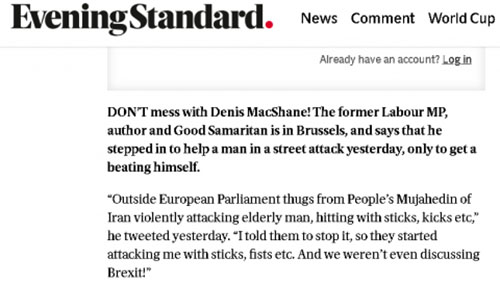
I would like to add that Mr. Pandeli Mijko took part in its gathering, committed a terrorist act by beating up two of its critics in front of EU Parliament in Brussels in December 2017 during which Mr. Denis MacShane a former Labour MP was also beaten up by Maryam Rajavi’s agents.

The incident raised the EU Parliamentarian’s serious concerns to the point that MEP Ana Gomes raised the issue as a barbaric act and a treat to EU and EU MEP members and asked Ms. Mogerini to expel all the MEK’s agents from EU Parliament.

English Standard newspaper mentioned the incident as:

DON’T mess with Denis MacShane! The former Labor MP, author and Good Samaritan is in Brussels, and says that he stepped in to help a man in a street attack yesterday, only to get a beating himself. “Outside European Parliament thugs from People’s Mujahedin of Iran violently attacking elderly man, hitting with sticks, kicks etc,” he tweeted yesterday. “I told them to stop it, so they started attacking me with sticks, fists etc. And we weren’t even discussing Brexit!”

Evening Standard

With regards to the above case and the methods Mek deals with its dissident members in broad day light in front of EU Parliament, would it be difficult to imagine MEK’s reaction to the opposition of its members inside their close cult?

Let me also add that the situation of human right abuse in Mek is so grave that even the son of Masoud Rajavi, Mohammad Rajvi one of the victims of this organization having defected MEK announced that will disclose all his father’s atrocities.

Does this raise enough concern not to take part in the empty shows of strength of Mek?

If the above said is not enough, as an ex-high ranking member of Mek and it National Council of Resistance, may I bring to the attention of the honorable Minister of immigration Mr. Pandeli Majko that:

Masoud and Maryam Rajavi hired about 2000 young Iraqis and trained them militarily and ideologically to be utilized throughout Iraq to collect information about coalition forces movements resulting in many deathly attacks on them, also to destabilize Iraq in order to topple the Iraqi government, so the Ex-Baath party leaders active in ISIS could take power in Iraq again, giving Masoud and Maryam Rajavi a free hand as before at the Saddam’s time? Mek officers who have been involved in training the 2000 terrorists are present for testimony.

Furthermore Mek created false Arab-Iraqi organizations by paying some villagers anxious for money under total embargo and aftermath of Golf war, to issue and release support communiques about MEK. All these atrocities were of course later disclosed by Iraqi Government officials in the media.

In this regards may I also share with you some of the experience of only two governments that have been very closely dealing with Mek for four decades such as Saudi Arabia and Franc, may that prevent the future backlash of overlooking the nature of MEK in your country by their host country.

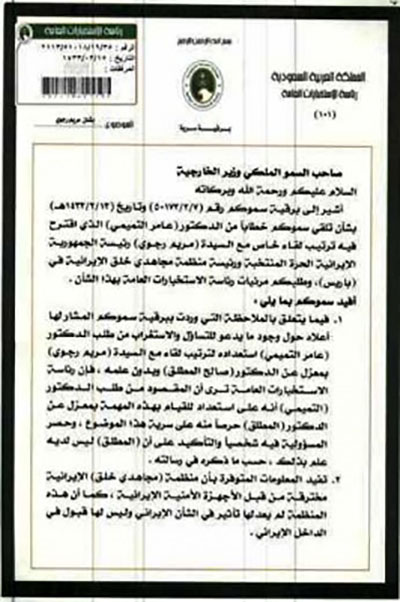
The first document is how Saudi Arabia that is a strong financial and political supporter of MEK evaluates Mek.

The translation of the Arabic  WikiLiks document is as follows:

In the Name of God the Merciful

The Head Saudi Intelligence

Ref No. 2113/510-18/12/35

Date: Jan 9, 2012; 15/02/1433

Kingdom of Saudi Arabia

Head of Saudi Intelligence (101)

Confidential Letter

Subject: About Maryam Rajavi

His Royal Highness the Prince, the of Secretary of State

Peace, mercy and blessings be upon you

With regards to the letter of the Prince ref, 51173/2/7 , on 13/02/1433 AH 7/2/50173 (equivalent to the January 7, 2012 AD – Translator),with regards to the message you received from  Dr. Amer al-Tamimi, which in that message, he suggested to arrange a private meeting with Mrs. Maryam Rajavi, President-elect of the Iranian head of MKO in Paris, and following that your Highness demanding the view point of the head of information Organization with regards to this request, we would like to inform His Highness as follows:

With regards to His Highness’s question and surprise in relation to the request letter of Dr. Amer Al Tamaimi stating that he is prepared to arrange a meeting with Maryam Rajavi apart from Dr. Saleh AL Motlaq and without his knowledge; the Head of Saudi Intelligence believes that, Dr. Al Tamimi’s request means that he is prepared to arrange an independent meeting without the knowledge of Dr. Al Motlaq, because he wishes to keep this meeting a secret and he also bears the responsibility for the meeting, also stating that Dr. Al Motlaq has no knowledge about it.

All the existing information tells us that, the Iranian Intelligence Services has infiltrated the Iranian Mojahedine Khalq Organization (MKO). Also this organization (MKO) has no role and effect in Iranian affairs and has no acceptance within Iran.

The second document is how French government considers Mek.

At the end my main concern are our family members and friends still enslaved by Mek in Tirana as the basic human rights to be facilitated the basic needs of free choice, free communications, and contact with parents and family members.

Sincerely yours

Davood Baghervand Arshad

Copy to:

Albanian Embassy

Albanian Embassy France,

Albanian Embassy Belgium

Albanian Embassy Holland

Albanian Embassy England

Albanian Embassy Italy

Albanian Embassy USA

United Nations High Commissioner for Refugees UNHCR Geneva

(End)

Baghervand Arshad, Ali Hossein Nejad and Homayoun Kohzadi

July 14, 2018 0 comments
FacebookTwitterPinterestWhatsappTelegramSkypeEmail
Ggary Leupp
Missions of Nejat Society

Bolton, MEK and Trump Iran Strategy

The MEK’s dirty past includes the anti-Imperialist inspired murder of six Americans in pre-revolution Iran which it later celebrated in songs and publications

Bolton, MEK and Trump Iran Strategy (aka Maryam Rajavi cult, MKO, NCRI, Saddam’s Private Army)

There are growing indications that the Trump administration plans to use the Mojahedin-e Khalq (People’s Mojahedin of Iran, or MEK) as a key element in its strategy to destabilize Iran preparatory to regime change.

On June 30 Trump’s personal lawyer Rudolph Giuliani told the group in Paris: “We are now realistically being able to see an end to the regime in Iran. Trump doesn’t turn his back on freedom fighters.”

On July 1, 2017 John Bolton, former State department official and Trump supporter, addressed a large gathering of MEK supporters in Paris.

“There is a viable opposition to the rule of the ayatollahs,” he told the enraptured crowd, “and that opposition is centered in this room today…I have said for over 10 years since coming to these events that the declared policy of the United States should be the overthrow of the regime in Tehran. The behavior and the objectives of the regime are not going to change. And therefore the only solution is to change the regime itself. And that’s why before 2019 we here will celebrate in Tehran!”

Yes, the man who has been U.S. National Security Advisor since April 9 predicted to MEK that he would celebrate with them the downfall of the Iranian regime by next year. On May 8 of this year Bolton’s boss withdrew from the Joint Comprehensive Plan of Action (JCPOA).

So it’s virtually official. MEK freedom fighters will be chief U.S. proxy in the coming confrontation, or rather the ongoing confrontation renewed when Trump withdrew the U.S. from the Iran deal, threatening all countries with sanctions if they so much as buy Iranian oil. They are comparable to the peshmerga of Syria, or the Northern Alliance warlords in Afghanistan, or the motley array of militia that overthrew Gaddafi in Libya with U.S.-NATO support—willing accomplices in a regime-change effort directed from Washington.

Who are these people? MEK was founded in Iran in 1965 as a revolutionary anti-capitalist, anti-imperialist organization dedicated to the violent overthrow of the U.S.-backed regime of the Shah. It sought to produce a synthesis of Shiite Islam and Marxism, an inherently problematic project that has been more or less abandoned, especially as MEK has in recent years courted U.S. officials like Bolton. (A huge number of prominent U.S. officials and former officials have spoken in recent years, often for large fees, at MEK events. They include Howard Dean. Gen. Wesley Clark, Rudolph Giuliani, Porter Goss, Gen. Michael Hayden, Gen. Richard Myers, Bill Richardson, and Gen. Anthony Zinni.)

Embracing urban guerrilla warfare tactics in the 1970s, MEK targeted the regime and the U.S. military presence, conducting many attacks on U.S. personnel and gunning down Lt. Col. Louis Lee Hawkins, a U.S. Army comptroller, in 1973. Its members trained with the PLO and al-Fateh and the Popular Front for the Liberation of Oman.

During the revolution of 1979 that toppled the Shah, MEK was the largest of the radical left parties (if we exclude the Tudeh or Communist Party founded in 1941, dismissed by MEK as “revisionist”). It worked with smaller communist groups, notably Sardedaran (Union of Iranian Communists) founded in the U.S. by Iranian students in 1976 under the strong influence of the Revolutionary Communist Party, USA.

Initially, MEK aligned itself with Ayatollah Ruhollah Khomeini, whose triumphant return from French exile had met with a rapturous response. They perceived him as a popular nationalist leader. But when he denied its leaders input into the writing of a constitution, and forbade them from running for political office, they revolted. Results of their uprising were disastrous; about 10,000 perished and thousands of its members including the leadership fled to Iraq or France. Hosted by Saddam Hussein, they fought alongside the Iraqi Army against their countrymen throughout the 1980s. This is one reason they are generally, according to plausible reports, despised in Iran even by those who chafe under the mullah’s rule.

Camp Ashraf in Iraq was created by the MEK to accommodate its 3500 soldiers in the country. This camp was taken over by the U.S. following the 2003 invasion. Indeed the U.S. protected MEK from the Iraqis’ intention to deport them and indeed housed them at Camp Fallujah and arranged for some to be relocated to Albania.

In 1975 MEK split into its component parts; that is, a faction arguing rather simply that Marxism, not Islam, is the revolutionary path, and the dominant faction arguing the opposite. This is the MEK that hosts the most reactionary U.S. officials and—after inveighing against Zionism for decades—now cultivates ties with Israeli intelligence. In 1997 it was listed as a “terrorist” organization by the U.S. State Department. The UK and EU soon followed suite. But MEK was delisted as terrorist by Britain in 2008, the EU in 2009, and the U.S. in 2012.

Why? Hillary Clinton determined that MEK had changed its ways and given up terrorism. Plus, MEK was so useful, cooperating as it was and is with U.S. and Israeli intelligence, smuggling intelligence out of Iran, abetting U.S.-Israeli disinformation schemes, maintaining an underground presence in Iran that will be useful (some suppose) when the regime-change moment comes.

Analysts agree that MEK is a very unusual organization. Led by a married couple, Massoud Rajavi and his wife Maryam Rajavi, it imposes strict discipline including life-long celibacy on its members. It forbids them to entertain sexual thoughts. It punishes rules infractions with public shaming and sleep deprivation. It is often termed a cult.

That this group should become a key U.S. ally—as Secretary of State Mike Pompeo virtually declares war on Iran—is truly perplexing. Surely U.S. officials know that MEK is hated in Iran, and that its tactics in Iran have not produced mass support. Other underground opposition parties, such as the National Front of Iran, founded by Mohammed Mossadegh (toppled by the CIA in 1953), will not likely cooperate with them in producing a second regime change. The idea is as wild as Bolton’s idea that Cuba’s pharmaceutical plants are producing biological weapons.

Can it be that Pompeo does not understand the enduring outrage felt among Iranians about that 1953 coup? The U.S. didn’t just “interfere” in somebody else’s election, it toppled a democratically elected prime minister because he had the temerity to try to nationalize the nation’s petroleum industry. The world knows the U.S. interferes in other nations’ politics and electoral processes habitually, and that the “bi-partisan” National Endowment for Democracy “NGO” funnels billions into pro-U.S. forces in countries targeted for “color revolutions.” Onl the cable anchors on CNN, MSNBC and Fox seem clueless, wide-eyed, indignant and outraged at the thought that “Russia interfered in OUR election!” As though we, as a people, ever had a real election in 2016.)

Bolton resembles his boss in that he cares nothing for the truth; lies boldly with angry, smug confidence, daring his audience to differ; is a loud bully with an ego and an agenda to which he hopes to commit the president. His main project is the Iranian regime change, much as Iraqi regime was Paul Wolfowitz’s preoccupation from 9/11/2001 to March 2003 when the plot to conduct a war-based-on-lies was finally consummated. (Bolton continues to say: “I still think the decision to overthrow Saddam was correct,” and that the U.S. has the right to overthrow sovereign states at will.)

Bolton has told reporters (who note his changing stance on war with North Korea) that anything he may have said in print or on television in the past is irrelevant now since he is in the service of the president and committed to his policies. But he happily realizes his boss is an air-head, ignorant and impressionable, generally Islamophobic, committed to a hawkish anti-Iran policy because (1) he wants to reverse any Obama policy; (2) he made a campaign promise; (3) he’s slavishly deferential to Binyamin Netanyahu, who wants the U.S. to bomb Iran; and (4) hostility towards Iran invites little opposition in Netanyahu’s fan club, Congress. Bolton has lots to work with there.

Congressional attitudes could change if U.S. secondary sanctions applied on European allied nations further strain the Atlantic Alliance already stressed by the trade wars Trump has unleashed. The EU, Russia and China all need to unite in demanding that the U.S. not only end its threats to attack Iran but respect other nations’ rights to trade with that great, large, relatively wealthy nation. (The IMF ranks Iran as 27th of 191 nations in terms of GDP; that is, it’s among the world’s top 15%. China, UAE, Germany and India are main trade partners.)

As U.S. Secretary of State Mike Pompeo provokes Iran with his arrogant demands—“preconditions” for a U.S. return to the deal, which essentially demand that it grovel at America’s feet—the U.S. provokes the rest of the world too, for multiple reasons. Its demand for allies’ cooperation in its efforts to undermine Tehran conflict with their efforts to improve both diplomatic and trade relations, to say nothing of their hopes for more stability in the region flooding Europe with refugees.

Thus Trump chooses the re-designated terrorist group MEK over Paris; Israel over Europe; Saudi Arabia and its anti-Iran Arab coalition against Russia and China. It demands that Japan (once Iran’s largest oil purchaser, now the sixth largest) and South Korea (currently the third largest, after China and India) end imports to abet regime-change efforts. These demands are outrageous, especially spouted by mouths that the whole world knows routinely spew lies without shame.

So it’s Trump, Bolton, Pompeo, Netanyahu, Prince Mohammed bin Salman, and the Rajavis—-versus Iran and the world which, while it may not be terribly fond of Iran, are becoming even less fond of Trump’s U.S.A.

Oh, and now Pompeo comes back from Pyongyang boasting of “progress” while the Koreans call the visit “regrettable.” The whole world is hoping that the U.S. work methodically with the DPRK to achieve the denuclearization goal. That will take time and require a schedule of coordinated steps, like the Iran deal that Pompeo has been trying to sabotage since 2015, as Kansas congressman, CIA director, and in his present post, required.

One should not suppose Pompeo more predisposed to promote peace with North Korea than peace with Iran. Imagine the DPRK rapprochement collapsing just as the joint U.S.-Saudi-U.S. missile barrage strikes Iran. There are sober people in Washington thinking carefully about multiple scenarios, amorally planning for all contingencies.

One of these might be a general Manichaean apocalypse in which the issue is not Good versus Evil (which would have been the case under George W. Bush) but Trump and His Base versus the World.

The latter he attacks by trade policy, a diplomacy of irrational insults, an almost impish desire to undermine existing international agreements and institutions (not so much to the objective advantage of U.S. imperialism so much as the advantage of his own frozen prepubescent ego), missile strikes at his generals’ discretion, and shameless voicing of racist, bigoted, uneducated views. The former he pleases by such policies and bombast. The U.S. mainstream media and the bulk of the political class deplore Trump in favor of the world, or at least criticize Trump’s “America First” populist nationalism as threatening to the postwar international order which has hitherto been very good to the imperialist U.S.A. They look askance at MEK and, to the extent they engage the issue, they question the wisdom an alliance with it.

Still, Trump proceeds on a confrontational course with Iran, and with any having deals with Iran, joining in the process with the most unsavory henchmen from the Saudis to the Likudists to these Iranian cultists. One hopes this strategy will only further isolate the U.S. from its allies and unintentionally help produce a more multi-polar world.

Gary Leupp is Professor of History at Tufts University, and holds a secondary appointment in the Department of Religion. He is the author of Servants, Shophands and Laborers in in the Cities of Tokugawa Japan; Male Colors: The Construction of Homosexuality in Tokugawa Japan; and Interracial Intimacy in Japan: Western Men and Japanese Women, 1543-1900. He is a contributor to Hopeless: Barack Obama and the Politics of Illusion, (AK Press). He can be reached at: gleupp@tufts.edu

Professor Gary Leupp, Counter Punch

July 14, 2018 0 comments
FacebookTwitterPinterestWhatsappTelegramSkypeEmail
weekly digest
Iran Interlink Weekly Digest

Iran Interlink Weekly Digest – 235

++ The MEK’s Villepinte event has been their most costly to date by provoking a severely negative reaction from just about everyone. Practically every opposition head and personality has condemned the MEK for working as mercenaries for the Americans. Since Trump boasted that Iran will come to ask me to negotiate, most critics are pointing out that ‘even Trump himself is saying he’s only using the MEK to bring Iran to the negotiating table’. A few comments compare the MEK with Chalabi. Well-known Iranian personalities, musicians and film stars, etc., say although they are not political, they condemn this open mercenary work against Iran. The main theme is that Villepinte was a gathering of a coalition of Iran’s enemies.

++ In Albania, Hassan Heyrani has announced his separation from MEK. This has prompted fear in MEK. They worry when people publicize their leaving. According to ex members who are not ‘out’ MEK is asking them to swear against Heyrani, even paying some. MEK threatens them by saying both they and the CIA are in charge of the country so they must not publish their names. If they do, they will disappear, and their body will not be found (a clear reference to Malik Shara’i).

++ Ex-members in Albania published an article titled ‘Mossad-Mojahedin coalition in Albania’. The article raises the alarm that Mossad has opened another office in Tirana and Israel is moving into Albania. Israel announced two extra flights per day from Tel Aviv to Tirana. Albania’s PM also boasted that Albania is now the first holiday destination for Israelis. Ex-members are raising the alarm that Mossad is openly in charge of Albania and MEK are openly able to threaten ‘we’ll kill you and Mossad will protect us’.

++ MEK claimed that the body of Malek Shara’i has been found. But the Albanian authorities are not able to confirm or deny this. They are not in control of their own country.

In English:

++ The MEK attracted reports and articles from a diverse range of English language media over the past week – NBC News, Capitol Hill Outsider, Middle East Eye, Lobe Log Bahrain News, Washington Post, Alberta Politics, The Real News Network, Counter Punch. None of it did the MEK any favours. Some raised questions about the bomb plot aimed against the MEK, was it a ‘red flag’ operation to besmirch Iran. Others examined why former politicians give support to the MEK, aside from the financial reward. The conclusion of many was that MEK do play a role in the coalition of Iran’s enemies, but are never really taken seriously.

++ Eldar Mamedov in Lobe Log exposed MEP Gerard Deprez (ALDE) attempting to disrupt European efforts to safeguard Europe’s relations with Iran after Trump pulled out of the JCPOA, revealing that “Deprez acted on behalf of MEK rather than his political faction”. In spite of this, “MEK and other anti-Iranian lobbies, like the right-wing pro-Israeli groups and their Saudi and Emirati allies, did not manage even to table an objection, let alone win it. Mamedov puts this down to the fact that “The clout of MEK has been on the wane in recent years. It has lost some influential backers. More MPs are willing to speak up against MEK abuses, as evidenced by hearings recently held in the EP. Overall, the group has been reduced to obstructing and delaying the normalization of ties between the EU and Iran, rather than shaping outcomes. When it truly mattered, the vote on the EIB exposed its real weight.”

++ Reporting on MEK, English language media have reiterated the facts, MEK is a cult, MEK is widely regarded as a terrorist group, MEK killed Americans and 12,000 Iranians – mostly civilians, MEK have virtually no support inside Iran and none outside among exiles, MEK pay both speakers and audience to attend their rallies, MEK exaggerate attendance – The Guardian reported under 4,000 at Villepinte while MEK claim 100,000, MEK are being used by Western regime change pundits but will be side-lined should this ever come about.

July 13, 2018

July 14, 2018 0 comments
FacebookTwitterPinterestWhatsappTelegramSkypeEmail
Newer Posts
Older Posts

Recent Posts

  • Rebranding, too Difficult for the MEK

    December 27, 2025
  • The black box of the torture camps of the MEK

    December 24, 2025
  • Pregnancy was taboo in the MEK

    December 22, 2025
  • MEPs who lack awareness about the MEK’s nature

    December 20, 2025
  • Why did Massoud Rajavi enforce divorces in the MEK?

    December 15, 2025
  • Facebook
  • Twitter
  • Instagram
  • Youtube

© 2003 - 2025 NEJAT Society . All Rights Reserved. NejatNGO.org


Back To Top
Nejat Society
  • Home
  • Articles
  • Media
    • Cartoons
    • NewsPics
    • Photo Gallery
    • Videos
  • Publications
    • Books
    • Nejat NewsLetter
    • Pars Brief
  • About Us
  • Contact us
  • Editions
    • عربي
    • فارسی
    • Shqip