
The ideological revolution within MKO seems to be the organization’s greatest theoretical and political approach to the time. Of its great importance, Mojahedin believe that it is hardly possible to grasp all aspects and merits of this internal revolution even years after its nascence. In their opinion,
the change is considered to be the lost-ring of Mojahedin through its four-decade long initiation. Talking of its importance, Mehdi Abrishamchi states:
If you see that we could advance to this standing, before being the outcome of political tactics and vigilance, organizational or military potentialities, or anything else, it refers to the main chapters of the ideological choices all adopted under the leadership of Massoud. [1]
Also, in accentuating the importance of the ideological revolution he adds:
The ideological issue is the issue of existence of a revolutionary organization, that of being or not to be. If in the theological philosophy of the theologians the issue of God is the crux of existence, for a revolutionary organization, too, the issue of ideology is a matter of existence. The existence of an organization and its how-to be is sourced out of its ideology. [2]
It should be added that MKO and its insiders’ emphasis on the importance of the ideological revolution is cantered on internal relations. So far, none of the internal meetings of the organization discussing the revolution’s paragraphs has ever been revealed for the world outside. Also, Mojahedin never publicize reports on the ideological divorces which is the main key into such an internal change. On inevitable occasions, Mojahedin equivocally consent to such an ideological phenomenon but advert it to be the outcome of the insiders’ individual will rather than an organizational command.
Ali Safavi, a political member of MKO who has registered to set himself afire at the order of Massoud Rajavi the leader of the organization, in a documentary made by BBC on MKO claims that the propaganda over the ideological revolution is a product of the Islamic Republic’s propaganda machine. But, in response to the reporter’s question that if the insiders were obliged to divorce says:
– Never, each member of Mojahedin on his own will decided to relinquish the marriage life, of course, the married ones.
In response to the question that if all decided to divorce their wife he says:
– Yes, all of them.
The reporter amazed by such answers asked:
– Don’t you think that it is illogical that hundreds of members on their own will decide to divorce their wives?
And Ali Safavi says definitely:
– No, not at all. [3]
He meant to say it was logical altogether. The double-edged answers indicate that Mojahedin dodge to mirror information on their claimed historical and ruling change. The question is why Mojahedin shun delineating the principles and contents of such a great revolution that they believe to be the securer of the organization’s existence.
The media generally function for any establishment to implant its thought and political approaches. In other words, they are potential means at the service of the political organizations to recruit new members. There is a question here that why Mojahedin, in spite of getting advantage of this potentiality, withhold its application to transmit their greatest political and ideological approach? No doubt, political organizations for some security measures stop communicating some of their internal information to the world. Can it be also the same with MKO that considers its ideological revolution as the no-pass red line? If so, then it can no longer be considered an internal and ideological evolution because it can never turn into the red lines.
From its very initiation, any reference to the ideological revolution outside of the organization is limited to the title with no further explanation. Really, why the organization refuses to unveil it for the world? Regardless of any viewpoint considering the contents of the ideological revolution, its very cover up is the them for the discussion, an occurrence that concerns the destiny of Mojahedin and , in some respects, that of the coming generation.
Notes
[1]. Mehdi Abrishamchi’s speech on the ideological revolution within the organization made for a community of sympathizers in France. Published in 1995, Taleqani Publications, pp. 24-25.
[2]. Ibid, 18.
[3]. BBC interview with Ali Safavi on MKO.
Mojahedin.ws – Bahar Irani – March 23, 2007

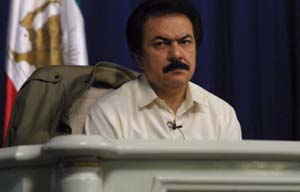
 MKO’s early central cadre and intimates of Hanifnejad. Soon after the victory of Iranian revolution, they criticized Rajavi for his egotistic, ambitious, and totalitarian ideals in a statement issued in an Iranian newspaper, Keyhan. Instead of giving a convincing answer to the criticisms, Rajavi took a hostile stance and asserted that they were no longer MKO members while he had introduced them as the official representatives of the organization abroad a few weeks before. Finally, they published a book entitled “The process of separation” and therein they openly declared their separation from the organization and Rajavi. In this regard, Mohammad Mehdi Jafari states:
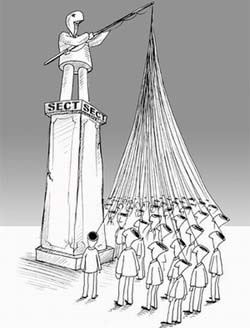
  social issues, the main blunder of Rajavi is that he hews not to the organizational principles and ideology of MKO; rather he has made an attempt to replace the ideology with himself representing the ideology and the one in the focus of attention. Rajavi has manipulated MKO ideology for justifying his wrongdoings and cultic behaviors imposed on the members under his command a number of which can be enumerated as self-immolation, conducting terrorist attacks, Machiavellian relations, procuring a god-like status, undermining religious norms and values, spying for alien powers, threatening the dissidents and plotting their physical annihilation, assuming an authoritarian leadership and many more.