
A senior Iranian lawmaker cautioned against the attempts made the terrorist Mojahedin-e Khalq Organization (MKO, also known as MEK, PMOI and NCRI) to prevent Iran and the six world powers from striking a final nuclear deal.
 “The MKO is trying to cause tension in Iran’s nuclear talks by different means,” member of the parliament’s National Security and Foreign Policy Commission Javad Jahangirzadeh told FNA on Monday.
The lawmaker said the MKO agents in their latest move have paid cash to Cal Thomas, the columnist of the Washington Times newspaper to write an article to allege that Iran cannot be trusted for striking a final agreement with the world powers.
Thomas wrote in his recent article in Washington Times that Iran has always maintained that it is seeking nuclear power for peaceful purposes; “if that were true, there would be no need for negotiations, how do you negotiate with someone who has lied from the start and is told in the Quran that lying to infidels is permissible in pursuit of the Islamic goals?”
The MKO, founded in the 1960s, blended elements of Islamism and Stalinism and participated in the overthrow of the US-backed Shah of Iran in 1979. Ahead of the revolution, the MKO conducted attacks and assassinations against both Iranian and western targets.
The group started assassination of the citizens and officials after the revolution in a bid to take control of the newly-established Islamic Republic. It killed several of Iran’s new leaders in the early years after the revolution, including the then President, Mohammad Ali Rajayee, Prime Minister, Mohammad Javad Bahonar and the Judiciary Chief, Mohammad Hossein Beheshti who were killed in bomb attacks by the MKO members in 1981.
The group fled to Iraq in 1986, where it was protected by Saddam Hussein and where it helped the Iraqi dictator suppress Shiite and Kurd uprisings in the country.
The terrorist group joined Saddam’s army during the Iraqi imposed war on Iran (1980-1988) and helped Saddam and killed thousands of Iranian civilians and soldiers during the US-backed Iraqi imposed war on Iran.
Since the 2003 US invasion of Iraq, the group, which now adheres to a pro-free-market philosophy, has been strongly backed by neo-conservatives in the United States, who argued for the MKO to be taken off the US terror list.
The US formally removed the MKO from its list of terror organizations in early September, one week after Secretary of State Hillary Clinton sent the US Congress a classified communication about the move. The decision made by Clinton enabled the group to have its assets under the US jurisdiction unfrozen and do business with the American entities, the State Department said in a statement at the time.
In September 2012, the last groups of the MKO terrorists left Camp Ashraf, their main training center in Iraq’s Diyala province. They have been transferred to Camp Liberty. Hundreds of the MKO terrorists have now been sent to Europe.
Iranian Parliamentarians Discover Brussels
In 2010, when Iran´s then-minister of foreign affairs Manouchehr Mottaki visited the European Parliament in Brussels, he was greeted by protests from MPs. Some of them, known for their close links with the exiled Iranian dissident group Mojaheddeen-e Khalk (MEK), carried the picture of Neda Soltan, a young Iranian woman killed during the protests following the fraudulent presidential elections of 2009. They also tried to block the minister from entering the meeting room and even briefly scuffled with security guards.
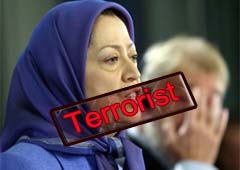 The contrast with a visit of a delegation from the Iranian Majles to Brussels on May 6-7 could not be greater. Sure enough, the MEK tried to derail the visit by lobbying the MPs to adopt a resolution on capital punishment in Iran, which would have almost certainly led to the cancellation of the visit. When that plan failed, they called on Euro MPs to boycott the delegation.
In the end, however, the five member-strong delegation led by the leader of the “principlist” faction of the Majles Kazem Jalali did make it to Brussels, in the first such parliamentary visit in seven years. Apart from holding sessions with their counterparts from the EP delegation for relations with Iran, Majles members were received by the President of the EP Martin Schultz (a German Social Democrat) and the Chairman of the Foreign Affairs Committee Elmar Brok (a German Christian Democrat).
Regional Concerns
A growing realization of the converging interests between the EU and Iran accounts for this dramatic change. This time, the discussions in Brussels were not so much focused on traditional European concerns, such as Iran´s nuclear program and human rights, as on the situation in the Middle East. In a scenario of rapidly disintegrating states and spreading terrorist threats, European officials are discovering that Iran is among the most stable and predictable state actors in the region.
In fact, privately many of them are uneasy, to say the least, with Saudi Arabia’s newfound regional efforts to consolidate a Sunni front against the “Iranian threat.” In a curious twist, it is Saudi Arabia, and not Iran, that is increasingly emerging as a revolutionary Middle Eastern power. Its refusal to take up a seat in the UN Security Council in 2013, alleging the structure´s inability to take action against Syria´s president Bashar Assad and confront Iran, was already a harbinger. Now, many in Brussels view with apprehension the departure of the cautious King Abdullah and a newly assertive policy of rolling back ” Iranian influence” in Yemen and Syria.
The EU´s foreign policy supremo Federica Mogherini definitely doesn´t share the Saudi narrative of Iran being the root of all tumult in the Middle East. In fact, she sees the nuclear deal with Iran as a gate opener for engaging Iran on the regional issues, including in Syria and Yemen, which is an anathema to Saudis. Officials from the Mogherini-led European External Action Service (EEAS) now discuss the possibility of a regional dialogue with Iran, which is a sharp departure from her predecessor Catherine Ashton, who approached Iran as an exclusively nuclear problem.
The Problem with the Gulf States
A major obstacle to this re-alignment is, of course, the position of some EU member states. Shortly before the group of Iranian MPs arrived in Brussels, French President Francois Hollande visited Saudi Arabia and Qatar, two major buyers of the French arms. As the French-Saudi joint declaration makes it clear, both countries are looking to consolidate their cooperation, notably in the defence sphere. This explains why France is also the toughest of the P5+1 group of powers in nuclear negotiations with Iran, its positions closest to the Saudis and Israelis. The French government, of course, is looking for ways to boost the country´s struggling economy. But massive arms sales to the Gulf monarchies may carry a considerable strategic cost, namely in the fight against the so-called Islamic State (IS or ISIS) and al-Qaeda.
Iranian MPs are upset that no major steps have been taken to combat IS and al-Qaeda terrorism. There is some truth to these claims.
Although Saudi Arabia and its Gulf allies are formally part of the anti-ISIS coalition, their real actions seem to go in an opposite direction. Operation “Decisive Storm” in Yemen contrasts sharply with Saudi Arabia´s and its allies´ notorious lack of enthusiasm in the fight against IS. Bombing Yemen (including with cluster munitions, which are prohibited by international law) not only leads to numerous civilian deaths but also takes the heat off al-Qaeda, enabling it to regroup and liberate dangerous terrorists from prisons. And the anti-Shiite, anti-Christian, and anti-Jewish hate campaigns emanating from Saudi Arabia, Qatar, and United Arab Emirates show no sign of abating. These countries are providing pulpits for firebrand clerics and hosting “debates” on the convenience of committing genocide against Alawites (a heterodox offshoot of Shia Islam), like the one organised by al-Jazeera Arabic in Doha.
Iranian MPs also rejected the interpretation of the current strife in the Middle East as a Sunni-Shiite conflict. They pointed out that Sunnis and Shiites have co-existed peacefully for centuries and blamed Saudi Arabia for stoking the sectarian conflict in the region through its aggressive promotion and financing of Wahhabism. Supporting Saudi Arabia and its Gulf allies is, in this reading, a recipe for a strategic disaster in the region.
Overall, this narrative lacks self-criticism as regards Iran´s own role in region´s woes—from its staunch support of Bashar Assad´s regime in Syria to the failure to rein in more effectively Shiite militias in Iraq, some of which have been accused of war crimes. But that does not mean that the Iranian narrative should be rejected out of hand. If the West is serious about the security of the Middle East, and its own security as well, it would be wise to use its close ties with Saudi Arabia and other Gulf regimes to confront them over their destabilizing activities, even at the cost of some lucrative arms deals.
The visit of the Iranian MPs to Brussels is another sign of changing times in the Middle East. Although a wholesale rapprochement between the EU and Iran may still be some way off, inter-parliamentary diplomacy has the potential to build trust, bridge differences, and eventually make a re-alignment possible. There is a need for more, not less, of such contacts. US Congress members would do well to join their European counterparts in a direct dialogue with Iran. The West, after all, does not have the luxury of choice in picking its interlocutors in the Middle East these days.
***
About the Author
Eldar Mamedov has degrees from the University of Latvia and the Diplomatic School in Madrid, Spain. He has worked in the Ministry of Foreign Affairs of Latvia and as a diplomat in Latvian embassies in Washington D.C. and Madrid. Since 2007, Mamedov has served as a political adviser for the social-democrats in the Foreign Affairs Committee of the European Parliament (EP) and is in charge of the delegation for inter-parliamentary relations between the EP and Iran.
Eldar Mamedov
Follow the Money
Why Argentina is in the War Party’s sights
The brouhaha  over an alleged 1994 Iranian plot to bomb a Jewish community center in Argentina, of all places, has been in and out of the news for years. Hysterical headlines, fantastic allegations, simmering intrigue, a mysterious suicide that some are claiming was a murder – it all sounds like a fourth-rate made-for-television thriller. That may be because its source – the weird neo-Marxist cult known as the Mujahideen-e-Khalq (MEK), which seems to have bought half the Congress and any number of well-known political figures and pundits – is prone to melodrama of the crudest sort.
An Iranian exile group headed up by a woman who calls herself the “President” of Iran, the MEK has an extensive international network, with its fanatic members running a bewildering array of frontgroups – the Iranian American Community of North Texas, the National Council of Resistance, Iran Zamin Cultural Association, the Organizing Committee for Convention for Democracy in Iran, the Human Rights Center in Wisconsin, Association of Iranian Women in America, to name a few. These groups ceaselessly lobby for two main causes: 1) Getting the group delisted as a terrorist organization, and 2) Moving the West to attack Iran.
They succeeded in their first goal, at least here in the US, with Hillary Clinton’s decision to take the MEK off the list of terror groups after a very well-financed and persistent campaign. MEK was listed in the first place because they had launched attacks on US assets and personnel in the late 1970s, murdering six Americans. MEK supported the Iranian revolution that brought the Ayatollah Khomeini to power, only breaking with the regime when Tehran decided to release the US embassy hostages – and after being decisively defeated in subsequent elections.
MEK launched terrorist attacks on the Islamist regime, killing scores of civilians in bombings, and establishing a base in Saddam Hussein’s Iraq, whose regime sheltered and supported them. They played a key role in suppressing revolts against Saddam’s rule, brutally suppressing a Shi’ite rising in the south and a Kurdish rebellion that resulted in the death of thousands.
After Saddam’s fall, they began their rebirth into a “pro-democracy” exile group, reportedly with aid from the Israelis. When a number of neoconservative organizations in the US took up their cause, MEK became the Iranian analogue of the Iraqi National Congress, the group headed up by international intriguer Ahmed Chalabi who provided the Bush administration – and New York Times reporter Judith Miller – with much of the erroneous “intelligence” that led the US to invade Iraq.
Over the years, MEK has carried out a persistent campaign to foment a similar US invasion of Iran, their mainstay being various attempts to document Iran’s alleged nuclear weapons program. Virtually all of these attempts have been debunked as either outright forgeries or else half-truths based on outdated and dubiously sourced information. Their only success has been the revelation of the Iranian nuclear facility at Natanz, and even there they didn’t garner the intelligence on their own: it was reportedly given to them by the Israelis.
Now they have tried a different tack: accusing Tehran of sponsoring an international terrorist conspiracy, one tentacle of which is the alleged 1994 plot to bomb a Jewish community center in Argentina. And their neoconservative cheerleaders have taken up the cry, with the Foundation for the Defense of Democracies (FDD), the American Enterprise Institute (AEI), the Israel Project, and the American-Israel Public Affairs Committee (AIPAC), the powerful pro-Israel lobbying group, all promoting MEK’s indictment.
That indictment was summarized and published by Argentina’s chief prosecutor, Alberto Nisman, who relied exclusively on MEK “experts” to justify his charges against top Iranian officials supposedly involved in the attack on the Jewish center. The head of the National Council of Resistance “intelligence” division, Reza Zakeri Kouchaksaraee, testified that a 1993 two-hour meeting resulted in a decision to bomb the center: he gave the meeting date as August 14. Another National Council of Resistance official, Hadi Roshanravani, gives the date as August 12.
How did MEK know about this alleged meeting, and even the precise agenda, when none of these “experts” were in Iran at the time, nor did they work for or have any contact with the Iranian government when the alleged plot was hatched? Nisman does not say in his report: he only cites MEK-affiliated “defectors” who defected well before the bombing took place. MEK has long traded on its supposed secret connections to mysterious sources inside Iran, but this claim has worn rather thin over the years as their “revelations” turn out to be utter junk. Nisman, however, swallowed them whole in this case, citing no evidence for his charges other than MEK’s bare assertions.
Nisman cites yet another Iranian defector, Aboghasem Mesbahi, who repeats MEK’s claims. Mesbahi’s credibility may be measured by his statements to the 9/11 Commission averring that Iran was behind the attacks on the World Trade Center and the Pentagon: he knew this because he read secret messages in newspapers.
So what’s really behind the international campaign trying to link Iran to the bombing, which killed 85 people and injured 300?
The evidence points to hedge fund chief Paul Singer, one of the richest men in the world, whose financial interests and devotion to Israel combine to produce what can only be characterized as a singular obsession.
In 2001, Argentina defaulted on its debt payments, the inevitable result of years of big government programs, incompetence, and outright corruption. But that didn’t deter Singer from buying up Argentina’s bonds on the cheap. His plan: to pursue Argentina in court and demand full payment. A court victory – which he achieved in the summer of last year, when the Supreme Court ruled in Singer’s favor – would reward him with over $2 billion in pure profit. The “vulture,” as financial publications like Forbes describe Singer and other investors who buy up bonds of desperately poor countries in hopes of making a killing, is now free to seize Argentine’s assets around the world. Argentina is also forbidden to settle with other bondholders who may be willing to accept partial payment until Singer and his fellow vultures are paid in full.
Singer helped found the American Task Force Argentina (ATFA), which has been running newspaper ads in support of Singer’s legal efforts as well as demonizing Argentina as part of a vast Iranian terrorist network operating throughout South America. Singer gave half a million dollars to The Israel Project, which has been frenetically promoting this conspiracy theory. FDD, which has signed on to the anti-Argentina campaign in a big way, received over $3 million from Singer. A whole panoply of Republican members of Congress in the forefront of the anti-Argentina jihad – including presidential candidate Marco Rubio,who introduced a resolution in the Senate demanding an investigation into Argentina’s alleged ties to Iran — have been beneficiaries of Singer’s largesse. AIPAC, which has been more circumspect in is promotion of the Jewish center bombing “connection” to Iran, has been similarly rewarded: its fundraising arm was given over $1 million by Singer and his associates.
A $2 billion payoff – and the smiting of Israel’s principal enemy: that’s the double-barreled motive behind Singer’s anti-Argentina holy war.
Ideology and moolah have always coincided in the world of the neoconservatives: remember Richard Perle’s Trireme Partners, a “security” firm set up to profit off the Iraq war? And of course, as Rand Paul pointed out, Dick Cheney’s connection to Halliburton – and the windfall profits they made off the invasion of Iraq – are emblematic of the neocons’ ability to make mucho dineros off their penchant for conquest. The links of key neoconservative activists with big military contractors like Lockheed-Martin are a matter of longstanding public record.
Not that these people aren’t sincere in their belief that war is indeed the answer: they just aren’t averse to making a few billion in profit along the way.
When prosecutor Nisman committed suicide a day before he was supposed to formally present his charges of a “cover up” by Argentina of Iran’s alleged culpability in the bombing plot, the hysterics in neoconservative circles reached fever pitch. The same people who denounce any arguments that they are trying to push us into war as a kooky “conspiracy theory” were quick to evoke a conspiracy by the Argentine government to commit murder. Yet Nisman’s death was clearly self-inflicted: a gun he had borrowed from an associate was found next to his body, and there were no signs of a struggle or forced entry. No evidence has emerged to show that he was killed by something other than his own hand: but evidence, or the lack of it, has never stopped the neocons from constructing elaborate arguments touting their own “theories.”
And they have no lack of means to publicize these theories: the campaign to tar Iran with the “terrorist” brush is fueled by the multi-millions of billionaires like Singer, Sheldon Adelson, and Norman Braman, whose insistence on 100 percent loyalty to Israel in the candidates and causes they support is remaking the political discourse in the US when it comes to foreign policy.
The forces driving us to war with Iran have billions of dollars to spend. They represent a minority of the population – but that doesn’t deter them. Their strategy is to present both sides of the same coin to the American people, come election time, and then ask them to make a “choice” – a Republican who will take us to war against Iran, or a Democrat who will take the same road.
So what can stop them? If the deck is stacked, how can we prevent the next war in the Middle East – which promises to make the Iraq war look like a mere skirmish?
The answer is a mass mobilization by the American people against the drive to war – and, no, that’s not a pipedream. We did it when President Obama decided he wanted to bomb Syria and then gave Congress the last word. Congressional switchboards were soon inundated with calls opposing a new war one-hundred-to-one. Members of Congress who said they would vote yes for war backed down, and those on the fence came over to our side – until it was clear the administration wouldn’t have the votes. Obama backed off in the face of massive opposition: and, yes, Antiwar.com was a big part of that memorable mobilization.
We did it before – and we can and will do it again.
But we can’t do it without your help.
You can see, from the above, how outgunned we are when it comes to financial resources. The War Party has billions, and money is no object. But I’ll let you in on a little secret: they need those billions, and more, because they represent nothing and no one but themselves. Their support is almost exclusively in Washington, D.C., and New York City, the political and media centers that profit from perpetual war. We, on the other hand, have the overwhelming majority of the American people on our side – if only we can rally them to the banner of peace in time.
Paul Singer’s billions are feeding America a diet of lies. Our answer to him and his confreres is the unalloyed truth – and we don’t need billions, or even millions, to educate the American people about the forces pushing us into war. We just need a basic minimum to keep this web site going.
We’ve been fighting the War Party’s lies since 1995, with the invaluable help of our readers and supporters – and we’ve been doing it on a shoestring budget! What we spend in an entire year is what groups like the Foundation for the Defense of Democracies and the American Enterprise Institute spend in less than a week.
We need your help to counter the well-financed lies that are poisoning the national discourse around foreign policy issues. Your tax-deductible donation goes to counter the Paul Singers, the Sheldon Adelsons, and their friends in what Dwight Eisenhower called “the military-industrial-congressional” complex – and every penny counts.
Today is the first day of our Spring fundraising campaign, and I’m on pins-and-needles, as I am every time we have to go through this process. We’re asking for your vote of confidence – your vote for a more peaceful world. And I believe we deserve that vote of affirmation – because this is the one and only self-sustaining and relatively successful institution the peace movement has. Please help us continue our work on behalf of the cause of peace and liberty. Please make your tax-deductible donation today.
NOTES IN THE MARGIN
You can check out my Twitter feed by going here. But please note that my tweets are sometimes deliberately provocative, often made in jest, and largely consist of me thinking out loud.
I’ve written a couple of books, which you might want to peruse. Here is the link for buying the second edition of my 1993 book, Reclaiming the American Right: The Lost Legacy of the Conservative Movement, with an Introduction by Prof. George W. Carey, a Foreword by Patrick J. Buchanan, and critical essays by Scott Richert and David Gordon (ISI Books, 2008).
You can buy An Enemy of the State: The Life of Murray N. Rothbard (Prometheus Books, 2000), my biography of the great libertarian thinker, here.
by Justin Raimondo,
Although the Mujahedin Khalq Organization (the MKO) and the United States have fundamentally different interests in Iran, the group makes efforts to get in line with the anti-diplomacy party of the United States. The MEK’s ideas of Iran’s nuclear programs — illusionary and absolutely fabricated — in order to build support for regime change in Tehran. Reaching a deal with Iran through diplomacy eradicates one of the MEK’s most effective tools for bombing Iran. However, Manipulated US politicians who are in bed with this formerly designated terrorist group may be able to derail the US diplomatic efforts.
The case seems a little complicated. On one hand, there are reports on covert support of the US government for the MKO. In 2008, Seymour Hersh revealed it in his “Preparing the Battlefield,” in the New Yorker. “The M.E.K. has been on the State Department’s terrorist list for more than a decade, yet in recent years the group has received arms and intelligence, directly or indirectly, from the United States’’, Hersh wrote. “Some of the newly authorized covert funds, the Pentagon consultant told me, may well end up in M.E.K. coffers.” [1]
On the other hand, following the recently published framework of nuclear deal, the US administration’s engagement in diplomacy with Islamic Republic seems constructive and effective.
Meanwhile, the MKO’ propaganda and lobbies are active. They continue to take advantage of partisan division in the Congress. They actively advocate for Congressmen such as Bob Corker, Chairman of Foreign Relations Committee, Robert Menendez who co-sponsored a bill to obstruct a nuclear deal with Iran.
The MKO cannot conceal its joy over such oppositions against the nuclear deal. The group’s propaganda favors any kind of opposition from any ordinary official all over the world, let alone the powerful Republicans of the US.
But the MKO’s joy may not last so long. The Huffington Post reported that Nancy Pelosi the leader of the Minority of the US House of Representatives may save negotiations for Obama:
“Senate Republicans on Tuesday reached a deal with the White House to require an Iran agreement to go through Congress for final approval. But even if they can come up with the two-thirds vote they would need to make a potential rejection of that agreement veto-proof, opponents would still need the same fraction in the House. Finding those votes will be difficult, given the ability of House Minority Leader Nancy Pelosi (D-Calif.) to hold her caucus together. To stop naysayers’ efforts to override a possible veto by President Barack Obama, Pelosi would need to hold only 145 of her 188 Democrats. “ [2]
To our surprise, It is interesting to notice that Nancy Pelosi has once been misled by the MKO despite her pro-diplomacy stance. This is a part of an open letter to Mrs. Pelosi written by Ann Singleton, former Member of the MKO, member of Middle East Strategy Consultants and the author of the book “Saddam’s Private Army”:
“It will come as some surprise to you therefore, that a group of Iranian war-mongering regime change proponents, the terrorist Mojahedin Khalq (MEK), claim to have your support.
“In an astounding act of hubris, the MEK has not only appropriated your good name and attached it to a stance which is in contradiction to what you have always stated, but the group has also apparently fooled many of your opponents in Congress whose presence in this event has also been misrepresented as specific support for the MEK.
“The MEK’s website Iran News Online reported as a news item a celebration held in Congress on March 17 to mark the Iranian New Year or Norouz. According to this news item, the event was attended by several advocates and lobbyists of the MEK – those named include Ileana Ros-Lehtinen, Ted Poe and Jackson Lee, all of whom advocate the MEK’s regime change stance. As well as around 300 Congressional staff, many, but not all, of the attendees have been Neoconservatives whose anti-diplomacy stance is overtly expressed by people like John Bolton who so recently exhorted America to ‘bomb Iran’.” [3]
As a person who has experienced living in the cult-like MKO, Mrs. Singleton correctly warns the US official to beware of the MKO’s deceitful tactics to mislead, manipulate and misuse politicians so as to reach their violent ambitions:
“I write to you as an expert on the MEK who has been campaigning for over a decade to help free the residents of Camp Ashraf and Camp Liberty, and to expose the lies and deceit of the MEK’s leaders Massoud and Maryam Rajavi. I would urge you to investigate the matter of your name and reputation being hijacked by this group. But further, I would urge you also to alert your colleagues in Congress – including those who are your political opponents – to the duplicitous methods of this group. The MEK’s unchallenged interference in the political process of America is not only very much against your country’s national interests, it is a slap in the face of those peaceful Iranians and Americans who, like yourself and President Obama have invested so much time and energy into allowing diplomacy to work.” [4]
By Mazda Parsi
References:
[1]Hersh, Seymour, Preparing the Battlefield The Bush Administration steps up its secret moves against Iran, The NewYorker , July 7th, 2008
[2] Grim, Ryan & Barron-Lopez, Laura, Nancy Pelosi May Save The Iran Negotiations For Obama, The Huffington Post, April14, 2015
[3] Singleton, Ann, Open Letter to Nancy Pelosi: Don’t allow the MEK to hijack your name, Iran Interlink, April 14, 2014
[4] ibid
The United States and Iran may have agreed on a vague framework for resolving remaining issues between them, including the lifting of sanctions, but the final stage of the negotiations will bring a diplomatic  confrontation over the sequence and timing of lifting sanctions.
And the most difficult issue in the coming talks will be how the "Possible Military Dimensions" or "PMD" – the allegations of Iranian nuclear weapons work that have been at the center of the entire Iran nuclear crisis for several years – is to be linked to lifting certain UN Security Council sanctions.
On that linkage Iran will insist that its cooperation in providing access to the International Atomic Energy Agency must be reciprocated with the lifting of certain sanctions on an agreed-upon timetable, regardless of how long the International Atomic Energy Agency (IAEA) takes to make up its mind and what judgment it renders, according to a source in close contact with the Iranian negotiating team.
The US "fact sheet" on the "parameters" of an agreement says, "All past United Nations Security Council resolutions on the Iran nuclear issue will be lifted simultaneously with the completion by Iran of nuclear related activities addressing all key concerns," and the list that follows includes "PMD."
However, nothing was officially agreed on in Lausanne on how Iranian cooperation with the International Atomic Energy Agency (IAEA) on the PMD issue would be linked to sanctions relief, according to the source close to the Iranian negotiators. But the source said that an informal understanding was reached that the linkage would involve the lifting of UN Security Council sanctions directly involving Iran’s imports for its nuclear and missile programs.
Iran is prepared to cooperate to complete the IAEA investigation of past allegations, the source said, but will demand concrete limits that provide assurances that the process will not be prolonged indefinitely.
Iran continues to insist that the evidence being used to impugn its intentions was "manufactured." Nevertheless, Iran "would be ready to give access to the IAEA on PMD even though that goes beyond NPT [Nonproliferation Treaty]," the source told Truthout.
But the source said Iran would not agree to make the lifting of those UN sanctions contingent on any IAEA judgment about the PMD issue. Instead, Iran will demand a list in advance of everything the IAEA wants. "We would give the IAEA access to everything on the list," said the source.
Once the IAEA completed its visits and its environmental sampling, however, Iran will consider that the process is finished. "We don’t care what the IAEA analysis would be or how long it took," the source said. "What Iranians cannot accept is that [the PMD issue] becomes an indefinite instrument for the Israelis, because they want to find out about Iranian capability and ask for this or that military site and a new inspection."
The negotiations on the PMD-sanctions linkage will be part of a broader set of negotiations in which Iran will insist on a detailed set of arrangements on sanctions relief in return for each of its concessions in the agreement, according to the source. "Each of the elements listed in the US fact sheet must have a step-by-step plan with a timetable and proportionate reciprocation," said the source.
Obama Under Pressure He Helped Create
The Obama administration has been under heavy pressure from the Israelis and their supporters in Washington to insist that Iran confess to having carried out nuclear weapons research and development as a condition for sanctions relief.
That pressure is the result of several years of news media coverage that has treated allegations that Iran carried out research and development on nuclear weapons, published by the IAEA in 2011, as established fact. The media have constantly repeated the theme that Iran has been "stonewalling" the IAEA to cover up its past nuclear weapons experiments.
Absent from the media narrative is the fact that the allegations that the IAEA is demanding that Iran explain are all based on intelligence that is now known to have come from Israel and which the IAEA itself suspected of being fabricated, from 2005 to 2009.
But the Obama administration itself helped to make PMD a hot button issue in American politics. It made Iran’s alleged refusal to cooperate with the IAEA investigation of the purported intelligence alleging an Iranian nuclear weapons research and development program the rationale for imposing punishing sanctions on Iran.
The administration has been wary of demanding an actual admission of guilt, which it knew was unrealistic, but it has been unwilling to completely dismiss the position of the Israelis and their followers either. Last November a "senior Western official" told Reuters that the United States and the other five powers would try to "be creative" in finding a formula to satisfy both those who were insisting that Iran must "come clean" about its nuclear past and those who said it was not realistic to expect a confession.
In an April 8 interview with Secretary of State John Kerry, the host of "PBS NewsHour" Judy Woodruff asserted that the IAEA wanted Iran to "disclose past military-related activities" but that Iran was "increasingly looking like it’s not going to do this." Woodruff then asked, "Is the US prepared to accept that?"
Without challenging the premise that Iran is expected to "disclose past military activities," Kerry responded, "No. They have to do it. It will be done."
Fabricated Intelligence and IAEA Investigation
The George W. Bush administration pressed documents supposedly from the laptop computer of an Iran scientist involved in an Iranian nuclear weapons research program on the IAEA in mid-2005. But Mohamed ElBaradei, then IAEA director general, refused to regard the documents as legitimate evidence because they had never been authenticated, and Bush administration officials refused to answer questions about their origins. In his memoirs published in 2011, ElBaradei writes, "The problem was, no one knew if any of this was real.
Information now available shows that the documents were created in Israel. According to a senior German office official, those documents were given to Germany’s foreign intelligence service, the BND, in 2004 by the Mujahedin e-Khalq (MEK), the armed exile Iranian opposition group that had been an Israeli client organization for several years.
A popular Israeli history of the most successful covert operations by Israel’s Mossad, originally published in Hebrew in Israel, asserts that Mossad provided some of the documents to the MEK that later become the centerpiece of the case against Iran.
ElBaradei also reveals in his memoirs that the IAEA received another series of purported Iranian documents directly from Israel in summer 2009. Among them was a two-page document in Farsi describing a four-year program to produce a neutron initiator for a fission chain reaction. The former IAEA chief inspector in Iraq, Robert Kelley has recalled that ElBaradei found that document to be lacking credibility because it had no chain of custody, no identifiable source, and no official markings or anything else that could establish its authenticity. But ElBaradei’s successor as IAEA director general, Japanese diplomat Yukiya Amano, gave the IAEA’s imprimatur to the entire collection as well as the earlier set of documents in an annex to the November 2011 report. After his election, Amano assured US officials that he was "solidly in the US court" in his handling of the Iran file.
The IAEA has never revealed that Israel was the source of the latter set of documents. The IAEA justified its decision to keep the identity of the member states that provided intelligence secret by citing the alleged necessity to protect "sources and methods." The decision to maintain silence on the source has served to shield both Israel and the IAEA itself from questions about the obvious political motives behind the purported intelligence.
The other major purported intelligence find published by the IAEA was the claim from Israel that Iran had installed a large steel explosives containment cylinder at its military base in Parchin in 2000 for nuclear weapons-related testing. But no corroborating evidence has ever been produced, and Robert Kelley has challenged the IAEA’s adoption of the Israeli intelligence claim on the grounds it was technically implausible.
Relations between Iran and the IAEA on cooperation over the PMD issue have gone through three major phases. In a series of meetings in early 2012, Iran and the IAEA were close to reaching agreement on a framework for Iranian cooperation. Iran agreed on an IAEA visit to Parchin, where the bomb test cylinder was said to have been located, as part of the process. But the talks broke down over the IAEA’s insistence that the investigation would never have an end point, and that the Agency would have the right to return to any question or site, even after Iran had provided the necessary access and other cooperation.
A second phase of relations began when Iran and the IAEA reached agreement on a "Framework for Cooperation" in February 2014. Iran agreed to provide information and access in regard to a list of PMD issues, starting with the "Exploding Bridgewire" (EBW) issue.
But after Iran provided documentary evidence to show that its research in the field was for its oil and gas industry and not for nuclear weapons, Amano refused to acknowledge publicly that Iran had discredited one of the arguments about the intelligence documents.
The head of Iran’s Atomic Energy Organization, Ali Akhbar Salehi, claimed that the IAEA had promised in the agreement to close issues once Iran had provided required information, and the IAEA did not challenge his claim. Amano insisted, however, that the IAEA would not issue any assessment until it had completed its investigation of all of the issues.
Iran apparently concluded from that experience that the IAEA would keep Iran on the hook as long as the United States and its allies wanted to maintain leverage over Iran. The Obama administration has now confirmed that conclusion by holding the lifting of sanctions hostage to Iran’s "cooperation" on PMD.
US officials have never explained how they would expect Iran to satisfy the IAEA if the intelligence at issue was indeed fabricated.
Truthout,
Constructive negotiations between Iran and the six world powers finally resulted in an agreement on Wednesday March 31 despite deep concern expressed by Israel, US hardliners, and the enemy of their enemy, the Mujahedin Khalq Organization (the MKO/ MEK).
Such a common stance between the MKO, Zionists, and American hardliners is justified by the long record of cooperation amongst these three parties whose reactions to the nuclear deal shared on main term: Concern.
Why the alliance between Zionist regime, war mongers and the MKO is so deep?
At the first place that’s money that ”talks”. A large number of US Congressmen and former high profiles are paid big amounts of money by the MKO to back up the group in the US government. Former US ambassador to at the UN, John Bolton has been a vocal cheerleader of the MKO. “He has been consistently misrepresenting a totalitarian cult as a “democratic” Iranian opposition group,” according to Daniel Larison of the American Conservative. “When Bolton or someone else with this record talks about “vigorous American support for Iran’s opposition,” we can be fairly sure that he means that the U.S. should be backing the MEK in its quest for seizing power in Iran.” [1]
While the nuclear negotiations between the U.S. and Iran was in its crucial phase, the New York Times published an op-ed by John Bolton titled “To Stop Iran’s Bomb, Bomb Iran.”[2] As it is widely reported, Bolton has received enormous amounts of money just for speaking on behalf the MKO and is seeking to overthrow the Islamic Republic.
Jon Schwarz of The Intercept who analyzed former UN ambassador’s “factual errors” in his Op-ed, asserted,” Bolton did not respond to questions about how much he has been paid by the MEK. However, the Financial Times reported in 2011 that speakers such as Bolton received from $20,000 to $100,000 per speech, with four-speech packages being “common.” [3]
“This confirms Bolton’s extremely poor judgment and underscores how truly crazy his overall argument for war with Iran is. It also reminds us how oblivious Iran hawks such as Bolton are to the political realities inside Iran,” Daniel Larison suggests. [4]
Furthermore, John Bolton is a senior fellow at the neoconservative American Enterprise Institute and the chairman of the Gatestone Institute, a right-wing "pro-Israel" activist group that has been accused of fomenting anti-Muslim sentiment. He is a steadfast supporter of the right-wing Israeli government of Prime Minister Benjamin Netanyahu. Exactly like the MKO and its Israeli ally Netanyahou, he is a vocal opponent of President Obama’s diplomatic approach regarding Iran.
About the MKO-Israeli alliance it is worth mentioning that terrorist attacks against the Iranian nuclear scientists that ended in with the death of five of them was actually done in collaboration with a team of MKO operatives who were all trained by Mossad Intelligence Service. “Deadly attacks on Iranian nuclear scientists are being carried out by an Iranian dissident group that is financed, trained and armed by Israel’s secret service, “NBC News cited from U.S. officials. [5]
John Bolton is hardly alone in his Zionist-MKO stance against Islamic Republic. Democrat Senator Robert Menendez has been another voiced figure in the mainstream media for his anti-diplomacy, pro-MKO and pro-Israel stances. New Jersey Sen. Bob Menendez is among those who back congressional quest to vote for more sanctions against Iran. He shares his foreign policy ideas with republicans. Why?
“Menendez received more campaign contributions from the MEK and its allies than any other member of Congress,” write Ali Gharib of the Nation. Gharib describes Menendez’s efforts to derail diplomacy with Iran:
“The constant efforts, in cahoots with Republicans, to constrain the Obama administration’s diplomacy with Iran, for instance, have divided Democrats bitterly. In January of 2014, Menendez, along with rapacious anti-Iran Senator Mark Kirk (Ill.), introduced a new sanctions bill backed by the powerful anti-diplomacy American Israel Public Affairs Committee (AIPAC). Critics said the bill would kill the interim agreement struck by Iran and world powers—the framework that just today bore fruit as negotiations toward a comprehensive pact advanced—leading to widespread opposition among the Democratic Senate leadership. When liberal grassroots groups rallied enough Democrats to sustain a promised presidential veto, the bill failed to come to a vote.
“This year, Menendez introduced another sanctions measure with Kirk, but it too has so far stalled without the necessary Democratic support. He also sponsored a bill with Republican Foreign Relations Chair Bob Corker to empower Congress to vote on any deal with Iran—earning another veto threat from Obama. And working with Republicans came back to bite Menendez when Majority Leader Mitch McConnell couldn’t restrain his partisan impulses and sought to bring the bill to a quick vote; even Menendez himself had to object.”[6]
As Jim Lobe declared in Loblog, “Sen. Robert Menendez (D-NJ) was the top congressional recipient of “pro-Israel” campaign funding in the 2012 election cycle, the last time he ran for office, according to the Center for Responsive Politics.”
Lobe quotes from the recent investigated article of Ali Gharib and Eli Clifton in The Intercept that” Menendez has been also a top recipient of campaign funding from donors with ties to the Mojahedin-e Khalq (MeK), the cultish group that was until recently included on the State Department’s terrorism list.” [7]
Menendez accepted more than $25,000 from donors with ties to the MEK, making him the largest recipient from 2012, when the MeK was delisted that September, to the present. That’s not much compared to the well over $300,000 Menendez received from pro-Israel groups during the 2012 election cycle, but it was more than twice what was provided to the next biggest recipients, Sen. John McCain (R-AZ) and Rep. Dana Rohrabacher (R-CA). [8]
It might be crystal clear now, why the three groups oppose any deal with the Iranian Government. Once the historical statement of agreement was published by the EU high representative and Iranian Foreign Minister, the disappointed opponents of the deal particularly the MKO launched its propaganda to convince its limited audience that a deal with Iran is bad in any case.
The MKO and its American and Israeli supporters are false prophets. They all have “an interest in creating a panic about Iran’s nuclear capabilities”.
Mazda Parsi
Sources:
[1]Larison, Daniel, Bolton and the MEK, the American Conservative, March 27, 2015
[2]Bolton, John, To Stop Iran’s Bomb, Bomb Iran, The New York Times, March 26, 2015
[3] Schwarz, Jon, The Factual Errors in John Bolton’s “Bomb Iran!” Op-Ed in the New York Times — and Why You Should Care, The Intercept, April 4, 2015
[4] Larison, Daniel, Bolton and the MEK, the American Conservative, March 27, 2015
[5] Engel, Richard & Windrem, Robert, Israel teams with terror group to kill Iran’s nuclear scientists, U.S. officials tell NBC News, NBC News, February 9, 2015
[6] Gharib, Ali, Good Riddance to Bob Menendez?, The Nation, April 06 2015
[7] Lobe, Jim, Sen. Menendez Top Recipient of MEK-Related Campaign Funding, Lobelog, February 27, 2015
[8]Gharib, Ali & Clifton, Eli, Long March of the Yellow Jackets: How a One-Time Terrorist Group Prevailed on Capitol Hill, The Intercept, February 26, 2015
The MeK announced today that they have more evidence of Iranian nuclear intransigence. According to news reports, a site in northeastern suburban Tehran houses a secret underground facility where uranium enrichment has occurred for nearly a decade.
The MeK press release is available on DropBox, and details their history in revealing information about Iran’s nuclear facilities. Strangely enough, in this history they neglect to include another ‘revelation’ made a mere 16 months ago. At this time it was claimed that an underground facility around 70 km northeast of Tehran under a mountain near the town of Damavand housed more illegal Iranian nuclear activities, though the details were unclear.
I noted a few problems with the claims, notably the notorious unreliability of the MeK, as well as the very suspicious timing. Less than a month prior, the most left-leaning candidate, Hassan Rouhani, was elected president of Iran in a shockingly uncompetitive landslide. This ‘revelation’ was no doubt intended to ruin any possible good will or potential rapprochement between Iran and the West.
Today as well, the timing is suspicious. Rumblings from both Iranian and international press seem to indicate an optimism that a nuclear deal is imminent. The MeK is trying to remain relevant, while also scuttle any possibility for a nuclear deal while alleging that Iran’s actions are so terrible that a nuclear deal would be a terrible thing for the West. They may have been right in the past, but this is not always the case, and the example of July 2013 shows, they are not reliable.
UPDATE:
I should have trusted my gut and checked the image used for the safe door. Others have noted that it is in fact copied from the website an Iranian company that sells safes. The MeK’s website put forward a bizarrely fitting rambling refutation which makes them look like liars, and incompetent ones at that.
While the color appears slightly different in the background it is clear that the image is the exact same as the one on the company sales website. The major difference is that there are horizontal white lines across.
Here is a comparison of the images
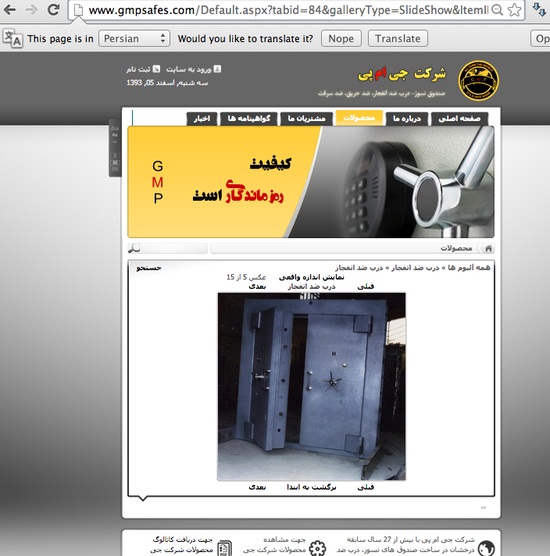
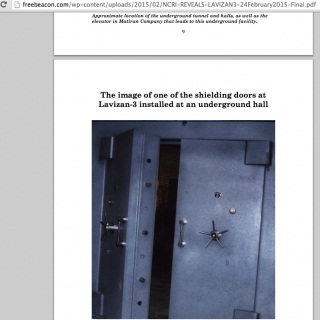
It is clear that the coloration and saturation are nearly identical. The image used is clearly the same.
The MeK claim that this image is taken from one of their sources, yet they have no explanation for why the EXACT same photo, with the same detailed bricks, and spots are used. For this to have happened naturally the picture would have to have been taken from the exact same spot and the camera would have had to have been held at the exact same height.
The complexities of creating this exact same situation make the MeK claims laughable. Furthermore, the image posted on the Iranian companies’ site is dated to February 12 of this year so it would have to be a hell of a coincidence for them to have posted photo that is now suddenly relevant.
As I’d mentioned before the MeK is of questionable reliability and this merely serves to reinforce my previous statements.
by Morgan Carlston,Persophilia.blogspot.com
Mojahedin Khalq, Rajavi cult, claims Fabricated
State Dept. Rules Out Iran “Secret Nuclear Facility” Lavizan-3 Allegations Pushed By Congressmen–Claims  Appear Fabricated By M.E.K.
The State Department said Friday that controversial claims made earlier this week by a often-criticized dissident group about a “secret nuclear facility” in Iran will not affect ongoing multilateral negotiations over Tehran’s nuclear program.
The allegations–established about a facility called “Lavizan-3” by a group tied to the Mujahhedin-e-Khalq (MEK), an organization that used to be considered terrorists by the US government–were definitively called baseless by the State Department, days after Congressmen grilled Secretary of State John Kerry about the accusations.
“We have seen these claims and while we take all such reports seriously, we do not believe that this allegation has merit or that it impacts our ongoing negotiations over Iran’s nuclear program,” a State Department official told The Sentinel.
“We have examined the report and have no information to support the conclusion reached by the group that made the allegations,” the official added, noting that the multilateral nuclear negotiations involving Iran and the five permanent members of the UN Security Council “are taking into account the possible pathways to enough fissile material for a nuclear weapon, and a comprehensive agreement will address those pathways.”
Yesterday, when questioned by reporters about the MEK claims, State Department spokesperson Jen Psaki said that department officials didn’t “have any information at this time to support the conclusion of the report,” but didn’t directly answer a question about whether or not it was “inaccurate.”
The State Department also said that it has “a robust team of experts across the US government” examining Iran’s nuclear program who are involved in the so-called P5+1 negotiations.
A “robust team of experts,” however, was not needed to cast doubts on the allegations that were made by the MEK-tied National Council of Resistance of Iran. They seem to have been fabricated in the most casual of manners.
Shortly after its report was made public on Tuesday, a Daily Kos blogger with the pseudonym “Florida Democrat” pointed out how a simple reverse image search showed that what the NCRI claimed was an “image of one of the shielding doors at Lavizan-3 installed at an underground hall” appeared to be a photograph lifted from an Iranian safe company’s website.
“I first became suspicious when I read the original report and saw the picture. They said this was for ‘radiation,’” the blogger wrote, referring to a “steel door” mentioned in The Washington Post’s coverage of the allegations. “But why would a radiation resistant door be made out of stainless steel? Shouldn’t it be covered completely by lead?”
Nonetheless, the accusations were reported without much scrutiny by Fox News, The Washington Times, and the Washington Free Beacon, in addition to The Post.
On Wednesday, at a House Foreign Relations Committee hearing, at least one Congressman accepted the allegations as being true and another stated they had merit. Rep. Dana Rohrabacher (R-Calif.) said that “our friends in the MEK” had tipped us off and asked Secretary Kerry if “the Mullah regime” informed US negotiators “about the existence of this nuclear facility.” Rep. Brad Sherman (D-Calif.) meanwhile, said that “the MEK sometimes gives us accurate information” and asked Kerry about International Atomic Energy Agency inspections in the context of Lavizan-3.
Kerry disagreed with Rohrabacher’s characterization of Lavizan-3 as a “nuclear facility,” saying its status “is yet to be determined” and that “these things are going to have to be resolved as we go forward.” He told Sherman that “we’re well aware of the allegations regarding that facility” and said “any questions would have to be answered to have any kind of an agreement.”
Those questions, for now, appear to have been answered by Kerry’s charges.
The offices of Reps. Rohrabacher and Sherman did not respond to requests for comment about evidence that the MEK report included fabrications.
The NCRI, however, issued a 9-point statement denouncing “an article written by an unidentified individual [that] claimed that the image of the 40 cm thick and radiation-proof doors of the four-hall underground Lavizan-3 site…was fabricated and was actually taken from the website of a company in Iran called Ganjineh Mehr Pars (GMP).”
“At the news conference on Tuesday, the NCRI showed the image of the door and identified it as one of the doors that had been installed at one of the underground halls at Lavizan-3 site,” the statement said. “The NCRI, through its sources within Iran, was fully aware that these doors had been built by GMP Company for the purpose of being installed at Lavizan-3.”
As The Sentinel noted in its report on the Wednesday hearing, the MEK was listed as a foreign terrorist organization (FTO) between 1997 and 2012 by the State Department. The group was removed from the FTO list after it launched a thorough lobbying campaign that gained the support of many prominent former officials, including ex-Vermont Governor and Democratic presidential candidate Howard Dean, and former Speaker of the House and Republican presidential candidate Newt Gingrich (R-Ga.).
It rose to prominence in Washington after hawkish officials sought to export Iraq War-style regime change to Tehran. A Fox News report on a 2005 Congressional push to foment instability in Iran said the move involving the MEK was similar to “US support of exiles like Ahmad Chalabi and the Iraqi National Congress.”
The MEK had previously figured in US-engineered regime change plans, albeit in a very different way. Before launching its invasion of Iraq, the Bush administration said that Baghdad should be attacked, in part, for sheltering the MEK, as journalist Glenn Greenwald pointed out in 2012.
The group has found an ability to bend ears in Washington due to accurate public claims it made in 2002 about covert Iranian uranium enrichment—allegations based on information provided to the group by Israeli intelligence officials, according to New Yorker journalist Sy Hersh, who spoke to then-IAEA Director General Mohammed El-Baradei.
In recent years, the State Department has played down MEK assessments about Iran’s nuclear program. In 2010, in response to claims made by the group about a supposed nuclear facility in Qazvin, then-State Department spokesperson PJ Crowley said that “the MEK has made pronouncements about Iranian facilities in the past–some accurate, some not.”
The District Sentinel,
In the wake of the embarrassing new revelations that the top Israeli intelligence agency is contradicting Bibi Netanyahu on his alarmist Iran intelligence, the well known liars, the "dissident" group NCRI (aka MEK), has jumped into damage control action and has released a suspiciously timed report that claims Iran has a new secret site. Countless media outlets including of course Faux News, have jumped on this as well.
|
| Screen shot from GMP Safe Company Website |
But it’s a total fabrication. The image included in the NCRI report is actually a product shot from the Iranian safe company.
|
| Page 10 of NCRI Report, Feb 24, 2015 |
Original report as republished by the rabid pro-war site "Washington Free Beacon" and linked in their over-hyped story.
GMP Safe company "explosion resistant doors" product shot.
This is truly amateur hour. It took only a Google "search by image" to find it. Actually, I first became suspicious when I read the original report and saw the picture. They said this was for "radiation". To quote Washington Post’s coverage:
Satellite images the group culled from Google showed a large, walled complex of buildings at the foothills of the mountains outside Tehran. They also exhibited photographs purportedly taken inside the tunnel showing a steel door that they said was lined with lead to prevent radiation leaks.
But why would a radiation resistant door be made out of stainless steel? Shouldn’t it be covered completely by lead?
Also, these clowns supposedly infiltrated this large underground nuclear bunker, but only had like a 1990’s camera phone on them? Why not more pictures or videos?
Well, once you see the real picture they stole (the product shot from GMP Safe Company), you see that the original shows windows with sunlight coming in from behind the safe. It’s clearly not in a secret underground bunker, but rather a warehouse which makes perfect sense for a safe.
Here’s a partial shame list of the irresponsible and complicit media reporting on the report as fact without even a pretense of verification.
Faux
Washington Times
NewMax
Washington Post
Washington Free Beacon (Adam Kredo)
World Net Daily (Jerome Corsi)
Source: Daily KOS, by Florida Democrat
At A SENATE Forei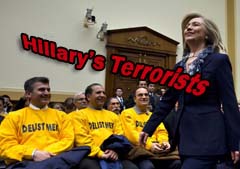 gn Relations Committee hearing on Iran’s nuclear program in October 2013, more than a dozen men and women in yellow rain jackets sat in the gallery seats of the wood-paneled room, a bright presence amid the standard-issue dark suits of Washington. It wasn’t raining.
They were supporters of the Iranian exile opposition group the Mojahedin-e Khalq, often referred to as the MEK, but known to most Iranians as the Mojahedin. Activists distribute all manner of yellow paraphernalia at the group’s demonstrations: hats, banners, flags, inflatable rubber clapper sticks, and, most of all, the jackets. The yellow jackets — often emblazoned with portraits of the group’s two co-leaders, Massoud and Maryam Rajavi — have become its calling card.
During the hearing, the powerful then-Foreign Relations Chairman Bob Menendez, a Democrat from New Jersey, spoke out for the Mojahedin. About an hour and a half into the proceedings, Menendez issued an explicit threat to Undersecretary of State Wendy Sherman over attacks against the group’s members in Iraq.
Another assault had been lodged against a camp in the Iraqi desert where former Mojahedin fighters were holed up — dozens of the unarmed, expatriate Iranians had died in the raid, with conflicting accounts of who was responsible. Menendez, a hard-line opponent of the Iranian regime and skeptic of nuclear negotiations led by Sherman, blamed Iran’s allies, the Iraqi government, for letting the attacks happen. He expressed preparedness to use his clout as chairman of the committee to pressure the Iraqis.
“One thing that this committee can do,” Menendez said, wagging his pencil at Sherman, “since it has jurisdiction over all weapons sales, is that I doubt very much that we are going to see any approval of any weapons sales to Iraq until we get this situation in a place in which people’s lives are saved.”
The threat sounded like a hypothetical, but it wasn’t: as Menendez spoke, he was blocking a major weapons deal with Iraq — a sale that would eventually be worth more than $6 billion in Apache helicopters and associated equipment and support, marking, perhaps, the first major Capitol Hill achievement for the Mojahedin since being removed from the U.S. list of designated terrorist organizations the year before.
On Capitol Hill, Mojahedin sympathizers clad in yellow jackets frequently appear at hearings dealing with Iran — or Iraq, where thousands of the groups’ fighters ended up in the 1980s, and where, beginning in the late 2000s, they came under a series of attacks that killed dozens. “You couldn’t show up at an Iraq hearing without lots of people wearing yellow jackets,” one former Congressional staffer said.
The group’s supporters try to arrive early to take their seats in hearing rooms, but “because people didn’t want every Iraq hearing to be a U.S. Ambassador with 40 people in yellow jackets sitting behind them,” the former staffer recalled, offices would dispatch interns to arrive before the Mojahedin followers “to fill those seats and push the MEK back.”
Not least because of the yellow jackets, the group’s many critics — including foreign policy-oriented Hill staffers — view the Mojahedin as “wacky”; they remain obscure beyond the Beltway and battle persistent criticisms that the group is a cult of personality, with adherents prone to blindly following the directives of the Rajavis. Already unpopular with Iranians, the Mojahedin’s international stock plummeted when the U.S. government officially designated them as a terrorist group in 1997, due to their history of attacks against Iranian government targets and, dating back to the Shah’s era, American civilian and military personnel stationed there. In the intervening years, even while constrained by their terrorism designation, the group and its affiliates poured millions of dollars into a sophisticated effort to rehab their image, creating an influential lobbying effort on Capitol Hill. Via an opaque network of Iranian-American community organizations, supporters circumvented anti-terrorism laws to garner many fans in Washington, at least in some quarters, where they quietly pressed their case for hard-line policies against the Iranian regime through meetings with sympathetic members of Congress. “It’s their Hill outreach strategy that accomplishes nearly everything they’re able to do,” the former staffer explained. “Given how small they are and how marginal they actually are, the amount of influence they wield is actually kind of amazing.”
Congressional hawks like Ileana Ros-Lehtinen, R-Fla., and the frequently eye-roll-worthy Dana Rohrabacher, R-Calif., and Ted Poe, R-Texas, could be counted on to bring up the Mojahedin again and again. But not everyone on the Hill was initially convinced. As long as the terrorist designation was in place, many influential members of Congress wouldn’t speak out for the group. In 2012, after that steady drumbeat and an intense public relations effort, the Mojahedin successfully overturned the terrorist designation.
Since being legitimized, the Mojahedin’s influence on Capitol Hill spread from the fringes of Congress to include more mainstream and respected Republicans and Democrats. Most of the group’s lobbying focuses on its members’ well-being in Iraq, said a current Hill staffer, who works in foreign policy. But, the staffer added, “undergirding this is all this neocon-friendly warmongering, this intense push for regime change, this intense hatred for [Iranian president Hassan] Rouhani — they’re not subtle about this at all.”
Menendez’s advocacy for the Mojahedin at the October hearing wasn’t new, but it signaled that by 2013 the group had come full circle: from an outlaw terrorist outfit to a player on Capitol Hill. How that happened is a classic story of money, politics and the enduring appeal of exile groups promising regime change.
T HROUGHOUT ITS 50-YEAR struggle, the Mojahedin has operated by the principle that the enemy of its enemy is its friend, giving rise to a past littered with ill-conceived alliances, tactical missteps and eventually, its designation as a terrorist group.
The group’s origins date to the mid-1960s, when a small circle of mostly middle class university students pored over revolutionary and religious tracts, creating a unique Islamo-Marxist ideology and eventually forming the Mojahedin-e Khalq, meaning “Holy warriors of the people.” After recruiting among young intellectuals, the Mojahedin sent some of its members to train in desert camps in Jordan and Lebanon belonging to the Palestinian Liberation Organization. In 1971, the group sought to launch its revolution by bombing a major power plant that supplied Tehran with electricity. But the Shah’s notorious security services foiled the plot, and around half the group’s early membership ended up in the Shah’s prisons. The next year, nine leaders were executed.
Yet the group continued its small-scale strikes against the monarchist regime and its allies. Between 1973 and 1976, the Mojahedin assassinated six Americans in Iran: three military men and three civilian contractors with the American manufacturing conglomerate Rockwell International. “Widely credited in Tehran for these attacks at the time, the Mojahedin themselves claimed responsibility for these murders in their publications,” said a 1994 State Department report on the group’s activities.
Initially, a “leadership cadre” ran the Mojahedin by committee, according to a 2009 Rand Corp. report about the group. By the late 1970s, however, the Mojahedin rallied around Massoud Rajavi, a charismatic figure sporting a thick mustache and coiffed black hair who was one of the group’s only surviving early leaders. YouTube videos of his old speeches capture a rousing orator, with thoughtful, soft-spoken passages punctuated by intense stem-winding that brings the crowd to applause, often chanting “Rajavi, Rajavi!”
With unrest percolating in Iran, Rajavi sought to cooperate with Ayatollah Ruhollah Khomeini, the revolution’s leader, but shortly after the Shah fell, Khomeini, a conservative cleric not fond of lay radicals, carried out a ruthless crackdown against the group. Rajavi and his followers fled into exile, initially to Paris, where his sway grew more authoritarian and he married his third wife, Maryam, appointing her co-leader.
By 1986, Rajavi began forging his next alliance, with Saddam Hussein. He relocated to Iraq and reorganized the 7,000 members who followed into an army, which Hussein supplied with heavy weapons and tracts of land, including a desert base that would be called Camp Ashraf. The group joined the Iraqi dictator’s bloody war against Iran, engendering much antipathy among Iranians. Out of favor with Khomeini and isolated in the Iraqi desert, the Marxism of the group’s early years began to dissipate, replaced by the singular goal of overthrowing the Islamic Republic and installing the Rajavis as Iran’s leaders. The group also turned further into cultish behavior; Rajavi and Maryam mandated divorces and celibacy for their soldiers, even as they elevated their own partnership. After the First Gulf War, Hussein reportedly used the Mojahedin as a militia to quell sectarian and ethnic uprisings, alienating many Iraqis. “Take the Kurds under your tanks, and save your bullets for the Iranian Revolutionary Guards,” Maryam Rajavi told her followers during the attacks, according to the The New York Times Magazine.
In the meantime, the Mojahedin turned to attacking the Iranian regime abroad. “In April 1992 the MEK carried out attacks on Iranian embassies in 13 different countries, demonstrating the group’s ability to mount large-scale operations overseas,” said a 1997 State Department report.
That year, then-Secretary of State Madeleine Albright designated the Mojahedin a Foreign Terrorist Organization, among 29 other groups, barring it from fundraising in the U.S. “We are aware that some of the designations made today may be challenged in court,” Albright said. “But we’re also confident that the designations are fully justified.”
Under pressure, Maryam Rajavi eventually sought to remake the Mojahedin’s image by renouncing violence; after being linked to 350 attacks between 2000 and 2001, according to Rand Corp., the group has not claimed responsibility for any subsequent violent offenses. That about-face did little good, at least in the eyes of the U.S. government. In the run-up to the 2003 invasion of Iraq, the White House cited the group’s presence in the country to buttress claims that Saddam Hussein was harboring terrorists.
But when the U.S. arrived at the Mojahedin’s camps, after conflicting reports of an initial skirmish, the group’s leadership waved a white flag, then signed a ceasefire — paving the way for its members to receive protection under the Geneva Conventions. Massoud Rajavi has not been publicly seen since, and Maryam Rajavi became the sole face of the group to the outside world.
For years, the Mojahedin languished at Camp Ashraf — guarded by U.S. forces — and refused to be moved, except en masse. The U.S. military eventually handed over control of its perimeter to the Iraqi government, and in July 2009, Iraqi security forces raided the camp, resulting in the deaths of at least nine refugees, according to Amnesty International. Dozens more were allegedly detained and tortured. Another raid took place in April 2011. The Mojahedin claimed 34 were killed and more than 300 injured. “With the threat of another Srebrenica looming in Ashraf, intervention is absolutely essential,” Maryam Rajavi said at the time. But no intervention came.
In September 2012, the U.S. agreed to remove the Mojahedin from the terrorist list; a key factor would be the group’s cooperation in relocating to a former U.S. military base called Camp Liberty, closer to Baghdad. The United Nations facilitated the move to Liberty, with plans for eventual third-country resettlement. Most of the few thousand remaining ex-fighters relocated, but about 100 stayed behind. In September 2013, according to Foreign Policy, Iranian-backed Shia militias reportedly killed at least 50 unarmed Mojahedin, about half of those still at Ashraf.
Pro-Mojahedin activists were outraged. Their exact numbers can be hard to divine: the Mojahedin themselves often won’t declare their membership. In the U.S. today, an umbrella organization of groups declaring allegiance to Maryam Rajavi — the innocuously named Organization of Iranian-American Communities — claims its network covers over 30 states. That does not include a bevy of small Washington-based pro-Mojahedin groups, or the organization’s official office, which, long-dormant, reopened near the White House after the 2012 de-listing. After the slaughter at Ashraf, the activists sprang into action.
“I remember the day of the attack at Camp Ashraf,” said Shirin Nariman, a pro-Mojahedin activist based in the Washington area. “Three of us, we just went to the Senate. We started going door to door. Nobody told us to do it. We were upset.” Not all the offices welcomed the activists. But “Menendez responded very well,” Nariman said, adding that Sen. John McCain, R-Az., also gave them time. “At least they are opening their ears and hearing us. But [the] White House is closing its ears and doesn’t want to hear.”
Not all Capitol Hill overtures by the group’s supporters have worked, however. In late 2013, Sen. Lindsey Graham, R-S.C., returned $2,600 from a supporter of the Mojahedin in Virginia. “During routine due diligence by campaign staff, it was discovered that a few donors had associations the campaign was uncomfortable with,” a spokesman for Graham’s campaign told Politico. “In an abundance of caution, the contributions were refunded.”
And some Hill staffers, while sympathetic to the Mojahedin’s plight in Iraq, remain wary of their broader agenda. “We should be concerned about human rights violations anywhere,” explained the Congressional staffer who works on foreign policy. “But a key tenet of President Obama’s foreign policy has been de-escalating our relationship and to get a peaceful resolution to the nuclear issue with Iran. And the MEK has been working against that agenda on the Hill.”
The staffer went on: “They lead with Camp Ashraf. Back in the day it was an immediate pivot to lets get them off the terrorist list.” Now, he said, they segue from the group’s situation at Camp Liberty into regime change in Iran.
While many Congressional aides may have viewed the yellow vest-wearing activists as shrill voices for regime change in Iran and an annoyance at hearings, the Mojahedin, over the course of nearly two decades, had cultivated a valuable relationship with Menendez, one of the Senate’s most influential foreign-policy voices.
IN THE EARLY days of the group’s efforts to be removed from the U.S. terrorist list, the most vocal support came from a few members of Congress who viewed the Mojahedin as a cudgel to use against the Islamic Republic, such as Poe and Rohrabacher, who joined longtime stalwart Ros-Lehtinen. (In 2011, a Congressional delegation chaired by Rohrabacher was reportedly asked by the Iraqi government to leave the country after raising the massacres against Mojahedin members in a meeting.)
Menendez remained largely silent on the Mojahedin while it was on the State Department’s terrorism list; during his first term as a Senator, from 2006 through 2012, he rarely, if ever, brought the group up.
Since the State Department took the Mojahedin off the list, however, Menendez has raised and defended the group, highlighting its efforts against the Iranian regime. Menendez spoke out most forcefully after the September 2013 attack on Camp Ashraf: “I hold the Iraqi government directly responsible to protect the community, to investigate this matter thoroughly, and to prosecute the perpetrators of this heinous act,” he said in statement. In June 2014, Menendez delivered a video address to a Mojahedin rally in Paris. He reassured Maryam Rajavi and her followers that aid to Iraq would depend on the country’s treatment of the several thousand former Mojahedin fighters left stranded there. “I told [then-Iraqi] Prime Minister Maliki in person last year that his commitment to the safety and security of the MEK members at Camp Liberty is a critical factor in my future support for any assistance to Iraq,” he said in the video, to the cheering, yellow-clad Mojahedin throngs.
The outspoken advocacy for the group coincided with the rise of campaign contributions from Mojahedin supporters to Menendez, according to an analysis conducted by The Intercept. Assisted in part by the work of independent researcher Joanne Stocker, The Intercept compiled a cross-section of political giving by supporters of the organization in the U.S. between 2009 — when the campaign to de-list the Mojahedin ramped up — and the present. The Intercept’s study examined giving by people listed by the pro-Mojahedin OIAC network, as well as supporters and activists identified by other news articles, and a former Congressional staffer who has tracked the group.
Never a pronounced player in campaign donations, Mojahedin supporters have nonetheless put hundreds of thousands of dollars into American electoral politics. Since 2009, those included in The Intercept study sent around $330,000 into politicians’ and election committees’ coffers.
Before de-listing, from the start of 2009 until September 2012, John McCain and Rep. Judy Chu, D-Calif., topped The Intercept’s survey of Mohajedin-related campaign contributions, receiving $11,350 and $11,150, respectively.
Menendez only received two donations from supporters tracked by The Intercept before September 2012, but after the State Department removed the group from the terrorist list, the money started to flow. In the past two years, Menendez took in more than $25,000 from donors with ties to the Mojahedin, making him the largest recipient in the study over this period. (The next two top recipients received less than half of Menendez’s total during the same period. McCain, still top recipient of the study’s Mojahedin-related donations after de-listing, received $10,800, and Rohrabacher received $10,300.)
But the campaign contributions alone don’t explain Menendez’s advocacy for the Mojahedin. The first former Hill staffer, who described efforts to move the Mojahedin back at hearings, said some Congressional offices were wary of the group, but described an alternative approach where “even if your constituent is crazy, you take the meeting and you listen carefully and you try to help them.”
The former staffer said of Menendez, “Sometimes it gets him into trouble when his staff doesn’t vet people well enough.” He also noted another dynamic at play: “Menendez is sort of known for these immigrant minority groups. He has a special place in his heart for them, based on his Cuban background, and I think sometimes it clouds his judgment — sometimes he doesn’t make the best decisions.”
Former U.S. Sen. Robert Torricelli (D-NJ) participates in a protest of the visit of Iraqi Prime Minister Nouri al-Maliki to the White House, November 1, 2013 in Washington, DC.
EVEN BEFORE THE group was put on the terrorist list, another prominent senator got involved with the Mojahedin. During the 1990s, first as a Democratic House member and then a Senator from New Jersey, Robert Torricelli had been an outspoken opponent of Iran’s Islamic regime and a supporter of the Mojahedin, hoping the latter would deliver a deadly blow to the former, an enemy government of the United States.
The advocacy attracted the attention of a Congressional staffer named Kenneth Timmerman, who had followed Iran issues before his time on the hill. “Torricelli was already one of a handful of people who were notorious for their support of the MEK,” Timmerman told The Intercept. “Torricelli’s involvement as a supporter of the MEK was very well known, certainly to people who work on the Hill.”
Timmerman described a robust Mojahedin lobbying operation at the time. “They would come to Congressional offices in a very intimidating fashion, to young staffers who were inexperienced and didn’t know who they were,” he said. The support they received rested on three pillars, Timmerman added: ignorance about the group, a handful of campaign contributions, and “a kind of widespread view that we really don’t like the Iranian regime, so let’s help anybody that’s against the Iranian regime.”
Timmerman’s description of yesteryear matched that of the current Congressional staffer who works on foreign policy. “They’ll send grassroots staffers to meet with you and then just wait in your office to ambush you,” the current staffer said. “They’d basically filibuster you for an hour.” He added that the “the lack of institutional knowledge on the Hill and turnover in staffs” left an opening for the group’s supporters.
Timmerman, for his part, wholeheartedly supports regime change in Iran, but nonetheless rejects the Mojahedin, whom he considers terrorists. When he left the House, Timmerman launched a foundation dedicated to democracy in Iran and wrote extensively on the subject, mostly for right-of-center outlets (his other writing has included raising questions about President Obama’s birth certificate). One of his pieces, published in 1998 in The American Spectator, focused on contributions to Torricelli’s campaigns from “MEK officers, supporters and sympathizers.” Using FEC records listing campaign contributions, Timmerman recalled, he compiled his own database and then queried it for people known to be affiliated with the Mojahedin, as well as those named by his sources.
According to Timmerman’s analysis, Torricelli received some $136,000 between April 1993 and November 1996 — before the Mojahedin was designated as a terrorist group. (In a 2002 Newsweek report, Torricelli’s aides dismissed the alleged amount as exaggerated.)
“In his House days,” Timmerman wrote in the American Spectator, Torricelli “sponsored more than a half-dozen resolutions and letters of support for the organization.” Timmerman also cited Mojahedin promotional materials that claimed Torricelli introduced several of the group’s members to President Bill Clinton during a fundraising dinner in late 1997.
Support for the Mojahedin caught up with Torricelli during his failed 2002 bid for reelection to the Senate. His Republican challenger, Douglas Forrester, attacked Torricelli during a debate for supporting the group’s removal from the terrorist list, and for taking money from the Mojahedin’s supporters. The embattled incumbent defended himself — justifying his support for “Iranians who oppose the Iranian government” — but backed down the next day. Torricelli told the New Jersey newspaper, The Star-Ledger that he wouldn’t continue to advocate for the group’s de-listing. “If the organization is engaging in activities against civilians that are of terrorist nature, the State Department has every right to ban their activities and have no contact with them,” he told the paper.
In an interview the following day with The New York Times, Torricelli elaborated. “Sometimes the enemy of my enemy is my friend,” he said.
Timmerman responded dryly when asked by The Intercept about Torricelli’s change of heart: “I’m not sure how sincere it was.”
By 2011, the law firm Mayer Brown retained Torricelli as part of the team working on the Mojahedin’s legal challenges to its place on the terrorist list. And Torricelli again took up vocal and active support for the Mojahedin, calling for the group to be de-listed at public forums organized by pro-Mojahedin American groups. “Does it have benefit that we continue to ostracize and label opponents of the regime as terrorists, when the facts say otherwise?” Torricelli said at a 2011 event on U.S. policy toward Iran. “Is it even possible to oppose a terrorist state, and be a terrorist yourself?”
The Intercept made several attempts to contact Torricelli for this article. When reached by phone, Torricelli declined to answer any questions about his relationship with the Mojahedin, and hung up the phone.
Dozens of former American officials, ranging from politicians to bureaucrats, have spoken at events organized by Mojahedin supporters. Some received staggering sums — as much as $40,000 — to give an address, and many called for the Mojahedin’s removal from the terrorism list, praising the organization as a viable democratic government in exile of Iran. According to data collected by the Huffington Post, the pro-Mojahedin roster included former New York mayor Rudy Giuliani, former Bush White House chief of staff Andy Card, former Vermont governor Howard Dean and former Rep. Patrick Kennedy, D-R.I., among many others.
By early 2013, after the Mojahedin was wiped from the terrorist list, Torricelli found new employment with the group — as its Washington lobbyist. Rosemont Associates LLC, the ex-Senator’s consulting firm, took up a contract with the Mojahedin’s Paris-based political wing, the National Council of Resistance of Iran. According to federal filings, Torricelli’s Capitol Hill lobbying for other clients ended between 2012 and 2013; only the Mojahedin were left. Disclosures for foreign lobbies indicate his firm planned to take in $35,000 per month for its work on behalf of the organization.
Most of Torricelli’s interactions with Washington, according to the filings, involved State Department offices that dealt with the Mojahedin or its areas of interest, frequently revolving around the refugees’ security in Iraq. But Torricelli also, however, made contact on Capitol Hill on the group’s behalf, though he didn’t cast a wide net: the lobbying disclosures reveal that as of late 2014, Torricelli had only reached out to a single Congressional office about the Mojahedin: that of former Senate Foreign Relations Chairman Bob Menendez.
“For 20 years,” Menendez said at a recent Senate hearing, “I have been working on the issue of Iran, when people were not paying attention.” Back in 1998, the two New Jersey politicians appeared at a Mojahedin demonstration at the U.N.’s New York headquarters, a year after the group was designated a terrorist organization. Torricelli was still in the Senate, and Menendez held a seat in the House. “At the rally,” the Associated Press reported at the time, Torricelli, Menendez and another lawmaker “supported the group’s call for a new democratic regime in Tehran.”
Between April 2013 and January 2014, Torricelli reached out to Menendez’s then-Chief of Staff Dan O’Brien seven times. Three separate contacts, however, were with Menendez himself: phone calls in April and August of 2013, and an in-person meeting last January — at the same time Menendez was coming under administration pressure to release his hold on the Apache helicopters.
DURING THE SUMMER of 2013, the Iraqi government faced growing sectarian strife. The militant group Islamic State — a Sunni radical outfit formed during the spring, and still going by the moniker Islamic State of Iraq and Syria (ISIS) — organized camps in Iraqi territory to expand their presence in the country and regroup for the fight in Syria.
The Mojahedin, perhaps chastened by their own labeling as terrorists, rely heavily on the word “extremism” in conjunction with ISIS, warning that the Iranian regime, with its “puppet” government in Iraq, represents the most significant terrorist threat.
Iraq, meanwhile, had been pushing its main military supplier, the United States, for more weapons to combat ISIS, specifically advanced attack helicopters called Apaches. The Obama administration advanced a proposal to supply Iraq with the Apaches — a deal that would eventually involve 24 by a sale and six by a lease that would allow the Iraqis to field the equipment more quickly.
When it comes to foreign military sales, the executive branch gives the Senate Foreign Relations and the House Foreign Affairs committees advance notification, and chairs and ranking members can object. After Obama officials apprised the relevant committees of its proposal, in July, several members blocked the sale over skepticism of then-Iraqi Prime Minister Nouri al-Maliki.
The administration launched a back-room offensive on Capitol Hill to clear the way for the deal. Officials from the Departments of State and Defense “in their briefings before Congress made it very clear that sending these Apaches to the Iraqis was crucial to beating back the threat coming from ISIS to Iraq from Syria,” said another former Hill aide, who attended the briefings. “State was terrified that without these helicopters,” the Iraqis “didn’t have the capability to kill these guys.”
Most would eventually be convinced to lift their holds, but Menendez held firm, creating palpable tension with the administration. Anonymous sniping between the Senator’s aides and White House officials appeared in the press, with Senate staffers telling Defense News the administration was failing to make Iraq a priority, and an administration official calling the accusation “offensive and incorrect.” Menendez’s public explanation centered around Maliki’s record of attacks against civilians and tacitly allowing Iran’s use of Iraqi airspace to support the Syrian regime; many in Washington at the time were sour on Maliki’s growing authoritarianism, sectarian patronage and failure to professionalize the Iraqi military.
“There are a lot of good reasons they” — Congress — “might have held up a sale,” said Sam Brannen, recently a fellow with the Center for Strategic and International Studies and a former Pentagon employee. But Brannen, who said he has no special insight into Menendez’s reasoning, added, “That there might be some more parochial reasons, that aren’t as good, would not surprise me.”
A U.S. official, who also wouldn’t speak to Menendez’s motivations, confirmed Congress’s focus on the Mojahedin. “The MEK issue was clearly a concern for members of Congress,” the official said. “Whether that played a role holding up the arms sales, I don’t know. But it was certainly an issue for Congress.”
Senators “raised lots of issues — among them the MEK — with the Apaches,” Lukman Faily, the Iraqi Ambassador to the U.S., told The Intercept. “The issue of the MEK,” Faily said, “came up in most of my meetings with the House and Senate, especially the Foreign [Relations Committee].”
Six months into the hold on the helicopter sale, in January 2014, ISIS forces swarmed Iraqi cities in the Sunni west, at least briefly holding two major urban areas. It’s doubtful the Apaches could have been in action soon enough to stave off ISIS’s territorial gains. “It would have taken months and months to train the Iraqis to use them,” said Brannen, the former CSIS fellow, of the helicopters intended for lease.
Michael Wahid Hanna, an expert at the Century Foundation with extensive experience on Iraq, explained, “I don’t know if [the Apaches] would have had a strategic effect, maybe a tactical one. Hitting, basically, IS camps obviously would’ve helped.”
After ISIS’s battlefield successes, Menendez consulted with the administration and received a letter from the Iraqi government. “He was looking for an out,” recalled the former Hill aide who attended the briefings. Menendez said he got assurances from the Obama administration promising oversight of the Apaches — and lifted his objections on January 25, leaving the Mojahedin in Camp Liberty under the ultimate control of the Iraqi government.
Adam Sharon, a spokesman for Menendez, did not respond to any questions about the senator’s relationship with the Mojahedin. “The direct concern with the Apaches was what safeguards were in place to ensure that minorities weren’t being attacked,” Sharon said.
The Apache deal, however, eventually stalled. The ISIS advances amplified Maliki’s largely self-induced political crisis. A State Department official, who asked not to be identified because he was not authorized to speak officially, cited fiscal and capacity issues on Iraq’s end, and said the U.S. was working it over with the new Iraqi government. (In August, Maliki’s party ousted him as prime minister.) “While we’re still supportive of the sale,” the State Department official told The Intercept, “Iraq hasn’t been in a position to accept the sale.”
ISIS took over more Iraqi cities starting last June, and the United States began its own air war to beat the group back in August. In October, the U.S. military ended up using its own Apache attack helicopters in raids against ISIS positions.
FOR THE MOJAHEDIN, stalling the Iraq Apache deal was just a small victory. The real goal has always been regime change in Tehran. Last September, the moderate Iranian president Hassan Rouhani arrived in New York for his second U.N. General Assembly, accompanied by nuclear negotiators to engage in another round of the now-extended talks. Mojahedin supporters organized a protest against Rouhani’s appearance.
Several hundred braved a sporadic rain in yellow ponchos distributed by organizers, holding aloft yellow umbrellas. (Mojahedin supporters have been known to recruit volunteers on expense-paid trips for such events.) The pro-Mojahedin demonstrators — some of them non-Iranian, with cursory knowledge of the group — listened to a morning of speeches at Dag Hammarskjold Plaza, nestled between demonstrations against the ouster of former Egyptian president Mohamed Morsi, and by devotees of the persecuted Chinese spiritual movement Falun Gong.
Along the barricades that sectioned off the protesters from the dignitaries on stage — which included former Democratic Senate Majority Leader Tom Daschle, and former U.N. Ambassador John Bolton, a frequent speaker at Mojahedin events — demonstrators held up a pair of cut-out placards. One, in black, read, “No 2 Rouhani”; the other, naturally in yellow, said, “Yes to Rajavi.” Massoud Rajavi still hasn’t been seen publicly since 2003.
For his part, Torricelli’s advocacy for the Mojahedin has only become more fervent. “My name is Bob Torricelli and I am a soldier in the liberation of Iran,” he thundered at a Mojahedin conference in Paris during the summer of 2014, to a huge crowd of yellow-clad supporters who interrupted his speech with applause and chants.
“First we gathered in Frankfurt, in London and Paris and New York by the hundreds. Then we came to Paris by the thousands. Hear me well, soon we will come to the streets of Tehran by the millions, and take back the future of the people of Iran.”
“The mullahs may talk to Merkel, or Obama or Hollande,” Torricelli continued, referring to three of the heads of state — Germany’s Angela Merkel, Obama and France’s François Hollande — now in nuclear negotiations with Iran. “They can talk all they want. We as a people of those nations know: There’s nothing left to say. The regime must go.”
Photo: Jose Luis Magana/AP; Jonathan Ernst/Reuters/Landov; Chip Somodevilla/Getty Images; Mark Wilson/Getty Images
– Ali Gharib and Eli Clifton are reporting fellows with The Investigative Fund at The Nation Institute