After the fall of Saddam Hussein in 2003, leaders of the Cult of Rajavi, departed from home country and stuck in the home donated to them by Saddam, started their efforts to get rid of the new cul-de-sac
Saddam Hussein who was called “landlord” by Massoud Rajavi was no more in power. So, his financial and military support was cut by the newly established Iraq government that hated the Mujahedin Khalq as ”Saddam’s private Army” who suppressed Iraqi Kurds’ and Shiites’ uprisings during the 1990s.
Since the early days of the new government, there was news about expulsion of the MKO from Iraqi territory. The group leaders, in response, put the entire anti-Imperialist background of the group, behind and began compromising with American forces. Gradually, the Cult of Rajavi turned into the operational and spying arm of the US and Israel in Iran. The peak of such compromise was the assassination of the Iranian nuclear scientists that was carried out by the MKO agents funded and trained by Mossad.
However, the services MKO offered the West could not prevent the shutdown of Camp Ashraf, the town granted to Rajavi by the former Iraqi dictator. Ashraf was closed. Its residents were relocated in the temporary transit Camp, Liberty near Baghdad. Then, the UN ICRC supervised the process of the relocation of Liberty residents to third countries.
Although the relocation process was constantly obstructed by the cult leaders, a number of residents were transferred to European countries, particularly Albania.
In Albania, the only Muslim country of Europe, a large number of MKO members left the group’s controlling system. Thus, the group leaders organized new tactics to maintain the group’s survival in Tirana, Albania.
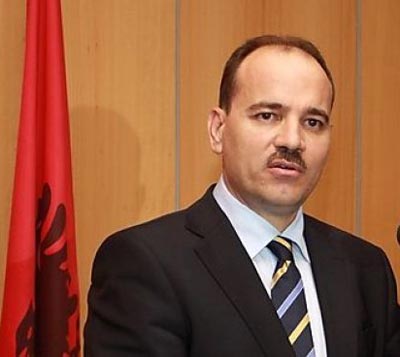
Inviting the President of Albania to speak at the MKO’s yearly propaganda show in Villepint, Paris, is the proof that the MKO leaders are counting on Albania as the new landlord. This time, the group leaders launch new propaganda tactic to run their agenda.
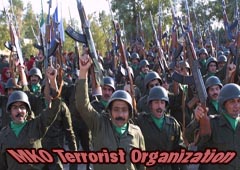
During the Iran-Iraq war, terrorist nature and violence – based strategy of the MKO was focused by Saddam Hussein. He used Rajavi and his cult to run his ambitions againt Iran and to suppress Iraqi people’s uprisings. Today the MKO hopes that it would be able to have the support of the President of the democratic government of Albania by its democratic slogans and Islamic hijab of Maryam Rajavi. Therefore, the new landlord, should know about the true face of the Cult of Rajavi.
Massoud Rajavi was proud of his history of terror and violence in Saddam’s era; he used the whole capacity of his group to work with Iraqi Baath regime. But today he has to conceal his violent past under the cover of fraudulent slogans of democracy so as to decrease the speed of its declining fate.
Mazda Parsi
 Albanian government has accepted.
 not, for decades, the group has strained to take opportunities of regional and political ups and downs into its aim, even though in most cases there is no true relation between what is going on in the region and what the group is trying benefit from. It seems the group is confused.
 The contrast with a visit of a delegation from the Iranian Majles to Brussels on May 6-7 could not be greater. Sure enough, the MEK tried to derail the visit by lobbying the MPs to adopt a resolution on capital punishment in Iran, which would have almost certainly led to the cancellation of the visit. When that plan failed, they called on Euro MPs to boycott the delegation.
 over an alleged 1994 Iranian plot to bomb a Jewish community center in Argentina, of all places, has been in and out of the news for years. Hysterical headlines, fantastic allegations, simmering intrigue, a mysterious suicide that some are claiming was a murder – it all sounds like a fourth-rate made-for-television thriller. That may be because its source – the weird neo-Marxist cult known as the Mujahideen-e-Khalq (MEK), which seems to have bought half the Congress and any number of well-known political figures and pundits – is prone to melodrama of the crudest sort.
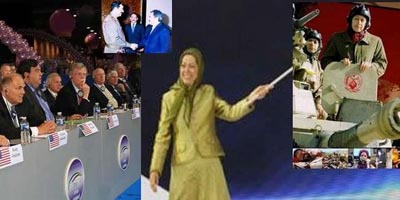 end of June, opponents of diplomacy and potential détente have intensified their efforts to derail any accord.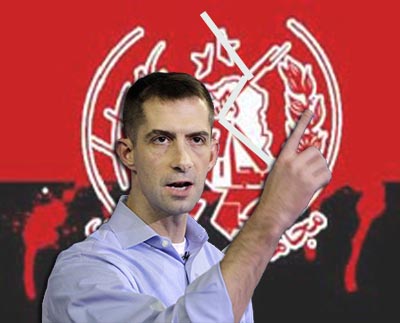
 invited the cult’s leader, Maryam Rajavi, to testify remotely as part of a panel on ISIS. That prompted one former State Department official to withdraw from the meeting entirely. Robert Ford, the former ambassador to Syria, has also said he won’t take part in a panel that includes Rajavi:
 considered a dangerous cult by many, and until three years ago was labeled a terrorist organization by the U.S. government. But after years of concerted lobbying, it enjoys a surprising amount of support on Capitol Hill. And yesterday the MEK displayed its growing influence in U.S. foreign policy debates.