
Legal Measures to Combat Cult Violence: Taking advantage of security-information measures against the cults’ ploys It remains a matter of controversy to what extent security-information systems and measures can be productive against the cults’ threats and ploys. But, no doubt, it calls upon any country’s security apparatus to be alert to cults’ menacing activities and, in the government’s words, to smash them rigorously. It is only in these cases of destructive groups engaging in threatening social and national security that does the state security forces might have the permission to intervene. As not all the established cults are destructive and some are peacefully religious cults with regular religious rituals, the security apparatus can be advised to adopt measures against cults that might pose any harm under a peaceful guise. In the US, for example, the FBI agents trained to negotiate in hostage and armed standoff confrontations have rethought their tactics following the 1993 debacle at the Branch Davidian cult’s compound near Waco, Texas. The tragedy, a 51-day siege of followers of David Koresh, ended in the deaths of more than 80 people after cult members set fire to their fortress-like structure when federal agents tried to storm the building. Although freedom of religion is guaranteed in France by the constitutional rights set forth in the 1789 Declaration of the Rights of Man and of the Citizen, however, in recent years, some legislation and government actions were taken against some groups and cults considered to be dangerous or criminal. Officials and associations fighting excesses of such groups justified these measures by the need to have appropriate legal tools and the need to fight criminal organizations masquerading as legitimate religious groups. With a little modification, it has been the same with active political groups particularly those with a history of violence and practice of terrorism.  Taking refuge in France, the Iranian Mojahedin-e Khalq Organization has shown its cult potentiality and to mobilize people for multiple protest demonstrations. In the course of Iran-US football match in Lyon in 1998, for example, and the visits of Iranian key officials to France, notably that of President Khatami in 1999 and Iranian members of parliament in February, 2001, the organization demonstrated the degree of its mass mobilizing threats that alarmed France. Reported by Associated Press, 21 June 1998, quoting some French authorities talking about some taken security measures before Iran-US football match, we read: Several Iranian opponents were not permitted to cross the Franco-Belgium border and prevented from entering French territory when the Iran-United States match was about to played Sunday night in Lyon, Interior Ministry sources stated. These Iranians, coming from Germany and the Netherlands, whose number was not given, are linked to the opposition group, the People’s Mojahedin, according to the same sources. They went on to point out that most of them had no tickets to the match and ‘did not meet the requirements for visiting France’. They were refused entry, because they represented a ‘threat to public order’. 1 The raid on MKO’s headquarters in Paris was also the result of intelligence and security preventive measures: The raid, carried out under a search warrant issued by the Paris-based anti-terrorism investigative magistrate, Jean-Louis Bruguiere, mobilised more than 1200 officials, including 80 members of the elite GIGN: France’s SWAT team. It was carried out by the Directorate for National Internal Security (DST or French counter-intelligence) with the support of the Central Command of the Judiciary Police and under the technical direction of the RAID (France’s specialised unit for hostage and terrorist incidents). Thirteen targets were surrounded in the Val d’Oise and Yvelines departments, with a particular focus on the Auvers-sur-Oise camp which was suspected to be a refuge for many active PMOI members. 2 Not only MKO in France were engaged in activities that disrupted the environment and injured public sentiments, but also severely confronted the critics and opponents as well as carrying out operations against Iranian objectives in Europe, that is to say, embassies, consulates and etc. They even considered the physical elimination of former members of movements working with Iranian intelligence (Vevak). 3 Similar preventive measures were taken in Germany in the course of the World-Cup 2006 and the German security system warned Mojahedin about any troublesome activity before the plays started. In another case, the German police raided and arrested a number of suspect MKO members: The police stated that they detained 50 persons for criminal enquiries and searched dozens of homes belonging to opposition members. The border guards prevented Iranians resident in other countries from entering Germany. Thirty Swiss members of the opposition had tried to enter Germany, according to the press release of the NCIR". 4 Long known as a globally blacklisted terrorist group, MKO is transformed into a destructive cult and a cult of personality as proscribed by the US state Department report in May 2007. In many cases, MKO is referred to as second to al-Qaeda for its globally threatening features and, in spite of being expelled from Iraq, majority of Western countries’ security apparatus are cautious about the entry of its members since they know they would have a hard task to deal with the organization if settled: In any case, there is no sanctuary for the PMOI and governments who do open their borders to them will have to exert a constant vigilance. If not, their national territory could become bases for action in violation of host countries. 5 The killing of a Brazilian man by armed plainclothes Metropolitan police who chased him into London’s Underground and killed him with shots to the head because they thought he might be a suicide bomber was only a preventive measure against further possible violent operations of al-Qaeda cult in England. It has to be taken into consideration that MKO is not an exception and security systems have to be necessarily more watchful of the organization since terrorism and cultism are interrelated features of the organization. Although its activities banned in Western countries, MKO has proved to carry destructive cult potentialities that ignore decrees of law and principles as it did in Self-immolation episodes. Unremitting surveillance of MKO as a destructive cult will be the best preventive measure to minimize its threats that jeopardizes the Western societies among whom it resides and plots cult-like activities. References: 1- Antoine Gessler; Autopsy of an Ideological Drift, “Des opposants iraniens empéchés de pénétrer en France”, Associated Press, 21 June 1998. 2- Antoine Gessler; Autopsy of an Ideological Drift, “Pierre de Bousquet: les Moudjahidin ont bascule dans une derive sectaire” interviewed by Le Figaro, 20 june 2003. 3- Antoine Gessler; Autopsy of an Ideological Drift, “Debut en Allemagne de Ia visite de Khatarni sous haute surveillance”, Reuters and Agence France-Presse, 10 July 2000 239.- Delphine Minoui, op. cit. 4- ibid. 5- Antoine Gessler; Autopsy of an Ideological Drift, p. 179. Research Bureau – Mojahedin.ws – April 24, 2008
There are many different types of destructive cults, and the diversity of cult beliefs and practices sometimes makes it hard for family members and friends to decide whether their loved one is in trouble or not. Although there are still groups whose followers cut their hair short and wear identical clothing, like the member of Heaven’s Gate, this is by no mean the case with most modern-day cults group. Today, for example, many cults require their members to wear business suits so that they blend in with their environment. All cult members may not look alike, but I have found that destructive cults follow specific behavior patterns that set them apart from other groups. By learning to identify the these patterns you will be better qualified to determine if someone you care about is actually involved with a cult. A group should not be considered a “cult” merely because of its unorthodox belief or practices. Instead, destructive cults are distinguished by their use of deception and mind control techniques to determine a person’s free will and make him dependent on the group’s leader. Authoritarian Leadership In essence a destructive cult is an authoritarian group that is headed by a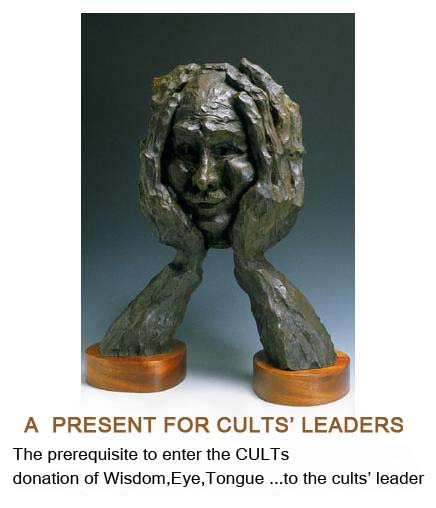 person or group of people that has near-complete control. Charismatic cult leaders often make extreme claims of divine or “otherworldly” power to exercise influence over their members. Many legitimate religions have had powerful figures who have inspired enormous dedication in people. Being a powerful leader is not inherently wrong , though it carries a high potential for abuse. A group becomes destructive when its leader actively uses such power to deceive members and to rob them of their individuality and free will. For example, I was told to surrender my free will (viewed as Satanic) to God’s representative, Moon, and his subleaders. Marshall Applewhite told followers that an alien entity was speaking through him, and used his message to justify his absolute control over their lives. Deception Destructive cults also use deception to recruit new members. When I was first approached by Moonie recruiters, they told me they were part f the “One World Crusade,” which I later learned was one of many front groups for the Unification Church . They claimed to be students who were involved with a small community of young people struggling to overcome cultural barriers. It was not until much later that I found what its members really believed, and what would be expected of me. What makes this all so insidious is that members often speak and act with the greatest sincerity because they have been subjected to the same mind control techniques that they used to recruit others.
 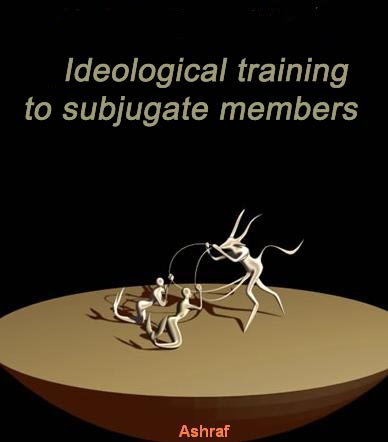 Destructive Mind Control Finally, destructive cults use mind control techniques to keep members dependent and obedient. You will learn the specific criteria that define mind control in later but, generally, speaking, cult mind control can be understood as a system of influence that is designed to disrupt a person’s authentic identity and replace it with a new identity. By immersing people in a tightly controlled, high pressure social environment, destructive cults gain control of their members’ behavior, thoughts, emotions and access to information. They take over their mind.
A cult, particularly a destructive one, is almost any kind of organization whose followers have been deceptively and unethically recruited and retained. They use manipulative techniques, which are imposed without the informed consent of the recruit and are designed to alter personality and behavior. These groups are only concerned about advancing the mission or business of the group, and not the well being of the individual members. They pose great dangers not only against the society among whom they live but also against their own followers. Our modern history contains records of cults’ threats and human tragedies that have shaken the world. Talking on the tragic end the followers of a destructive cult might be led to Margaret Thaler Singer has said: Twice in less than fifteen years we have been shown the deadly ends to which cult followers can be led. In 1978, aerial photos of 912 brightly clad followers of Jim Jones, dead by cyanidelaced drinks and gunshots in a steamy Guyanese jungle, were shown in magazines and on television, reappearing with each subsequent anniversary of the end of Jonestown. And in early 1993, television news programs showed the Koresh cult’s shoot-out, then several weeks later its flaming end on the Texas plains. 1 They are only an example of many countless instances. As reported recently, Texas police raided a gated compound outside the tiny Texas cattle town of Eldorado built and run by the Fundamentalist Church of Jesus Christ of Latter Day Saints. Reportedly, more than 400 children and teens had been rescued and taken into temporary state custody while the authorities continued investigating allegations that girls at the compound were being sexually abused by men. The number of active cults only in the US is estimated to range from 3,000 to 5,000. It is hard to get a precise number as cults change their names, splinter off into other groups, or shut down in one area only to open back up in another. Unfortunately, there are approximately 180,000 new cult recruits every year and the cults are developing more sophisticated techniques to form and establish new aliases. They originally start under religious and political covers and it is only after getting totally involved in the cults that the followers come to recognize the real intention of the cults. One way to avoid being entrapped by the cults is to learn to recognize common cult-recruitment tactics and situations. The people who have suffered tensions or are in search of Utopia are most vulnerable to be recruited by the cults. In general, cults follow nearly the same tactics for deception and misrepresentation to recruit, retain and achieve cult-related ends. Today, it is really a hard task to distinguish a cult from another legal group but in the past decades there have been attempts to help people in cult prevention. There are identical factors shared by majority of cults which can be of great help to recognize a cult. Referring to important characteristics of a cult Robert Jay Lifton observes: First, all cults have a charismatic leader, who himself or her- self increasingly becomes the object of worship, and in many cases, the dispenser of immortality. Spiritual ideas of a general kind give way to this deification of the leader. Second, in cults there occurs a series of psychological processes that can be associated with what has been called”coercive persuasion”or”thought reform,”as described in some detail in this book. And third, there is a pattern of manipulation and exploitation from above (by leaders and ruling coteries) and idealism from below (on the part of supplicants and recruits). 2 Thus, the characteristics to mark a cult are three: 1. Charismatic and self-appointed leader who claims divinity or special knowledge and demands his followers unquestioning and total loyalty and obedience. 2. An organized structure of totalitarian hegemony with the leader at the top
3. Planned thought reform and brainwashing techniques to induce a state of high suggestibility and dependency on the group and self-alienation.
To determine how dangerous a cult might be, Bonewits draws a Cult Danger Evaluation Frame which can be a good help to determine just how dangerous a cult or group might be in comparison with other groups. The factors indicated by Bonewits include:
1. INTERNAL CONTROL 2. WISDOM CLAIMED by leader(s3. WISDOM CREDITED to leader(s) by members 4. DOGMA 5. RECRUITING6. FRONT GROUPS 7. WEALTH 8. POLITICAL POWER 9. SEXUAL MANIPULATION 10. CENSORSHIP11. DROPOUT CONTROL 12. VIOLENCE13. PARANOIA 14. GRIMNESS 15. SURRENDER OF WILL16. HYPOCRISY 3
It seems that Bonewits has developed a good understanding of cults’ menace in the modern world which is shared with other researchers. A look at Dr. Robert Jay Lifton’s criteria for a destructive cult is a precise approbation:
1. Authoritarian pyramid structure with authority at the top
2. Charismatic or messianic leader(s) (Messianic meaning they either say they are God or that they alone can interpret the scriptures the way God intended.
3. Deception in recruitment and/or fund raising
4. Isolation from society — not necessarily physical isolation, but this can be psychological isolation.
5. Use of mind control (Mileu Control, Mystical Manipulation, Demand for Purity, Confession, Sacred Science, Loading the Language, Doctrine Over Person, Dispensing of Existence) 4
Considering signs that distinguish a destructive cult, a precise evaluation of MKO well crystallizes it as one of the most destructive and visible examples of a cult that jeopardizes the security and thought well-being of the people among whom it takes refuge under the cover of a pro-democratic, political group. Far beyond being recognized as an alternative to Iranian regime as MKO claims, it is an alternative to a destructive cult sharing their characteristics. For sure, no sensible people consent to a dangerous cult to steer the country.
References: 1- Thaler Singer, Margaret; Cults in Our Midst: The Continuing Fight Against Their Hidden Menace, p. 3.
2- Ibid, XII.
3- www.qed.net/bonewits/ABCDEF.HTML
4- www.refocus.org Research Bureau, Mojahedin.ws, April 9, 2008
The main goal of producing a new identity in cults is to make insiders dependant on the cult and to be obedient. The mechanisms the cults exploit to achieve the goal are interrelated but each can be discussed separately since they are all prerequisites for insiders’ persuasion and control and the final transformation of the recruits into real cultists. It will not be wrong to say that whatever the cults do is to cut the members off from the outside world to produce a new identity and belief totally different from what the members previously held as right and dear. The process finished, the insiders will adopt a new and reborn personality as Singer states: 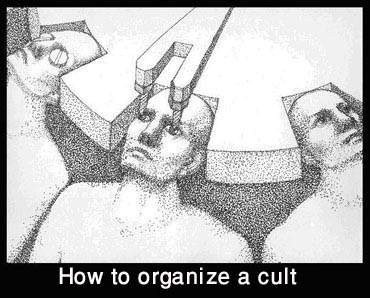 As part of the intense influence and change process in many cults, people take on a new social identity, which may or may not be obvious to an outsider. When groups refer to this new identity, they speak of members who are transformed, reborn, enlightened, empowered, rebirthed, or cleared. The group’ approved behavior is reinforced and reinterpreted as demonstrating the emergence of "the new person." Members are expected to display this new identity. 1 The new personality totally split from the outside world is manipulated for a variety of group tasks based on the objectives of the group and cult that consider the outsiders as the enemies who have to be confronted: The conflicts a mass movement seek and incites serve not only to down its enemies but also to strip its followers of their distinct individuality and render them more soluble in the collective medium. 2 As Hoffer asserts, a cultist personality is formed to be submissive to the inner-cultic relations that have priority to outwardly demonstrated ambitions and goals. The members undergoing overall identity change easily consent to any means of changing behaviour and conduct. Thus, cults can successfully accomplish their goal of binding new members to the group. Considering the stages people will go through as their attitudes are changed by the group environment and the thought reform processes, Singer points to psychologist Edgar Schein’s second stages of three: During this second stage, you sense that the solutions offered by the group provide a path to follow. You feel that anxiety, uncertainty, and self-doubt can be reduced by adopting the concepts put forth by the group or leader. Additionally, you observe the behavior of the longer, term members, and you begin to emulate their ways. As social psychology experiments and observations have found for decades, once a person makes an open commitment before others to an idea, his or her subsequent behavior generally supports and reinforces the stated commitment. That is, if you say in front of others that you are making a commitment to be "pure," then you will feel pressured to follow what others define as the path of purity. 3 There are also the eight psychological themes that psychiatrist Robert Lifton has identified as central to totalistic environments and cults invoke these themes for the purpose of promoting behavioral and attitudinal changes in the members. The third theme, demand for purity, depicts two opposite world of black and white; the cult being an absolutely white and clean world versus the black and evil world of outside. Of course, the members with a new personality have no other choice but to think and act according to cult’s ideology and drawn strategy: An us-versus-them orientation is promoted by the all-or-nothing belief system of the group: we are right; they (outsiders, nonmembers) are wrong, evil, unenlightened, and so forth. Each idea or act is good or bad, pure or evil. Recruits gradually take in, or internalize, the critical, shaming essence of the cult environment, which builds up lots of guilt and shame. Most groups put forth that there is only one way to think, respond, or act in any given situation. There is no in between, and members are expected to judge themselves and others by this all-or-nothing standard. 4 The process of producing identity within MKO follows the same mechanism in the cults and its orientation began with the start of the internal ideological revolution. All the members undergoing the revolution process admitted their identity change, that there does exist a long distance between their organizational and personal identities. It was instilled into them that their identity would be prompted based on the extent of adherence to the ideological system of the group and denial of any personal identity. In a text written by a member of MKO in self-denial we read: Personality, egocentrism, self-reliance and individualism are all souvenirs of the bourgeoisie’s worthless humanism that distanced me from the organization as far as its degree of its impact on me. It was like a chaff that barred me to drink the pure, life-giving instructions of the organization and was leaving me alone in a desolate waste-land with no way out. I was enslaved by dominant ambiguities within me. When I failed to overcome the ongoing struggle inside me, I was even more vulnerable to the outside misfortunes and could not even face them. 5 The member’s confession well depicts his identity destabilization and what psychologists call an identity crisis. He looks back at his own world and values to find out that he has been wrong in the past. This process makes him uncertain about what is right, what to do, and which choices to make and of course, as he admits, only the cult-like instructions of the organization can lead him to what is inspired to be the right path. Consequently, he takes on a new organizational identity which he considers a change for the better. In the process, he, as the member of a cult, detaches from his most dear ideas and attachments which he discovers to have been nothing beyond a barren waste-land for the identity reborn, a utopia in the horizon he fails to dismiss easily. Masoud Banisadr, another separated member of MKO, in his memoir relates of the time when sat tearing whatever attached him to the past under the commands of the organization: This time I attacked my old photographs from my own childhood till marriage and up to then, my parents photographs as I wanted to deny all of them, my father who was perhaps responsible for my bourgeois tendencies and my mother who was responsible of my own ‘mild’ and ‘gentle’ behaviour known as liberal ones. Anna seeing me taking all those photographs and albums, with anger, was quietly crying, then when I attacked our marriage Album she start crying louder, and asked me to stop it. She said those are not just yours . . . but I was not listening to her and took everything and put them in a rubbish bag. 6 Quoting Lifton’s forth theme, through a cult’s instructions, members are told whatever connects them to their former lives is wrong and has to be avoided, a fact well affirmed by MKO’s ex-members: Through the confession process and by instruction in the group’s teachings, members learn that everything about their former lives, including friends, family, and nonmembers, is wrong and to be avoided. Outsiders will put you at risk of not attaining the purported goal: they will lessen your psychological awareness, hinder the group’s political advancement, obstruct your path toward ultimate knowledge, or allow you to become stuck in your past life and incorrect thinking. 7 That is why MKO refer to members’ solubility in the organizational identity as a “reborn” or “identity salvation”. The organization, being transformed into a cult, pursues the same cult mechanism of altering the members’ personal identity to produce a new identity. References: 1. Margaret Thaler Singer; Cults in Our Midst, JOSSEY-BASS, 2003, p. 78. 2. Eric Hoffer; The true believer, Harper &. Row, Publishers, New York, 1966, p. 112. 3. Margaret Thaler Singer; Cults in Our Midst, JOSSEY-BASS, 2003, p. 76. 4. Ibid, 71. 5. Mojahed, no. 252; Abdol-ali Maasoumi’s letter to the ideological revolution. 6. Masoud Banisadr; Memoirs of an Iranian Rebel. 7. Margaret Thaler Singer; Cults in Our Midst, JOSSEY-BASS, 2003, p. 72.
Translation: Nejat Society Pesnot: I want to talk about Mujahedin-e-Khalq who are probably better spies for George Bush. MEK are the opponents to the Ayatollahs and President Ahmadinejad of Iran. They claim that they have revealed the Iranian military nuclear programs in 2002. After the American security agencies reported that Iran has interrupted its program for bomb fabrication, MEK refused the report and claimed that Tehran is still seeking nuclear weapon secretly. And this is exactly what Bush claimed after the reports issued. There is a question here: how does the MKO know that Tehran is seeking nuclear weapon while MKO’s intelligence network has been destroyed and has no function now? How could the MKO’s intelligence network understand it but American Intelligence Agencies were not able to find out? united State, contrary to its interests ,use MKO’s misinformation and no one asks if MKO tries to make Americans involved in a battle against Iran, by giving such misinformation. You can’t help thinking about what happened before American invasion to Iraq. Saddam Hussein’s opponents including Ahmad Chalabi didn’t stop saying that Iraq has weapons of mass destruction. But there was nothing of them in Iraq. These intoxication acts doubled by the American neo-conservatives who had no objective except justifying the American invasion to Iraq. Therefore, Mr. X tries to clarify the issue describing Mujahedin of whom a large number reside in France. The group is still on the FTO list of Department of State that has prevented the American government from helping them or probably contributing them financially. Mr. X: MKO is a cult. In fact they share most of cult-like practices. For example the forced divorce of spouses and their absolute dedication to their favorite leader Maryam Rajavi, the self- assigned president in exile of Iran and also the absolute dependence of fighters on the organization, military cooperation and even members sacrifice so as they self-immolated to protest the arrest of Maryam Rajavi following the French Police raid to MKO’s base in 2003. Of course that was a spectacular, ridiculous and also useless act. MKO was founded in 1969’s by a small group of young students who opposed the Shah’s tyranny and their ideology was inspired by both Islam and Marxism. Pesnot: it’s not simple to mix these two. Mr. X: at least both shared anti-imperialism view. Pesnot: and of course anti-Americanism. Mr. X: Naturally, because the US supported Shah and cooperated to return the Shah to Iran after the coup-d’at against Mosaddeq. The first Mujahedin were the students and intellectuals who entered the armed struggle exploding the electricity lines in the 2500th anniversary of Persian Empire. Pesnot: Ah, Persepolis. Mr. X: Savak was terrified and executed the key leaders of the organization except one: Masud Rajavi who was offered favor and got amnesty. His brother also protested in an international movement. Pesnot: why the others weren’t released? Mr. X: Rajavi accepted to cooperate with the police. After the organization was damaged from head, the activities continued so slowly and the attempts and terrors started in 1972 when the American advisors were assassinated. Pesnot: then the organization recovered its force again. Mr. X: yes, it formed its clandestine units and got close to two other movements: the clerics of Qom and the laics, the former supporters of Mosadeq. Pesnot: and they were mostly left-wing. Mr. X: most of the organization ‘s members were oppressed and defections appeared in the organization. Pesnot: thus the cultism you mentioned existed in the group from the beginning. Mr. X: the defection of Marxists from MKO was a heavy beat for the Mujahedin and Mr. Khomeini did not welcome the case. Pesnot: didn’t he appreciate Rajavi so well? Mr. X: this is the least thing you can say. Rajavi obeyed and accepted the superiority Of Khomeini and called him the leader of the revolution in the early days after the revolution, MEK supported the revolution and pretended that they were not strangers to the hostage taking of American Embassy. But they soon set off for protests. Pesnot: why? Mr. X: because of Khomeini’s absolute power. Pesnot: Rajavi wanted to have a share of the power? Mr. X: well, naturally .Khomeini didn’t like and Rajavi wanted to reach an agreement with Khomeini but following the deposal of Banisadr, they became more isolated until they got refugee in France and MKO’s armed struggle against the ayatollahs started. They burned up the office of Islamic Republic Party and assassinated 74 of high ranking officials of regime. was a real massacre. revolutionary Guard began to fight against MKO and Rajavi’s wife was killed. In 1981,Rajavi fled his country and inhabited in Auversur-O’ise and formed National Council of Resistance but after a time his allies left the council. Pesnot: and soon the MKO was listed as terrorist. Mr. X: yes, by the Americans and the Europeans. Most of MKO supporters remained in Iran gathering intelligence for French intelligence agencies and received French favor until the Iran-Iraq war began. Pesnot: and France was on Iraqi side. Mr. X: France supported Saddam Hussien and Mujahedin fed French Intelligence Service with precious information. Pesnot: Mr. X is talking about a cult-like organization that seems to use bizarre practices. Firstly we’ll discuss the third marriage of Masud Rajavi. I’ve extracted a few lines of the French journalist. Patric Lestruan’s writings:”in 1984, Rajavi who previously had married twice, fell in love with Maryam who was the wife of the man No.4 of the organization. Rajavi could make his dream true due to his power of retorique and following his wedding, his political office published a text. In fact the text talked of a new epical victory and was considered as a qualified mutation in MKO’s history and the husband whose wife was taken to marry Rajavi, even sent public congratulations to Maryam and Masud Rajavi. Under the cover of women’s promotion Mujahedin forbid sexual relations and forced all married members to divorce. And also their daily reports that everybody was supposed to produce on his activities Mujahedin had to write their sexual fantasies and submit to their authorities’’ Mr. X: Jacqe Shirac wanted to normalize the diplomatic relations between Iran and France and to show his good will expelled Rajavi and his supporters out of French territory. Then the French government threw the Mujahedin in hands of Saddam Hussein. It had nothing for the Iranians except treason during Iran-Iraq war. Rajavi went to Iraq and Saddam Hussein was so pleasant because the enemy of my enemy can’t be anything but friend and Rajavi paid a heavy cost for this treason. Saddam used chemical weapons against Iranian soldiers and provided Rajavi with everything to establish his army. In July 1988,Rajavi used the opportunity provided by the ceasefire between Iran and Iraq and sent his army to fight Iranians but after it advanced for only 50 km, the National Liberation Army was demolished by the Iranian Forces and lost too many of its members. Pesnot: It was a terrible failure and an actual humiliation for Rajavi and I guess that Saddam’s delusions were also broken. Mr. X: definitely, he hoped that with the MKO’s operation he could continue the war while respecting the cease-fire. Pesnot: a replacing war. Saddam Hussein’s generosity was without any expectation from the counterpart? Mr. X: Of course not. He asked MKO to oppress Iraqi Kurds what is still causing bad reputation for Rajavi and his group. In any case, France conciliate with MKO in condition that they respect a really neutral policy and let them return to France. Pesnot: and they did so. Mr.X: obviously. Despite all Saddam Hussein’s considerations, the fighters are more comfortable in a Western democratic country. We forget them when it is needed. The French government closes his eyes. Pesnot: did the military confrontation between Iran and MKO finish? Mr. X: no, but after the failed invasion of 1988, they could never find the tranquility yes, Mujahedin went on heir attempts. Despite the first allies’ invasion against Hussein in 1991, MEK maintained their bases in Iraq that allowed them to launch operations against Iranian interests once in a while. Pesnot: around the borders. Mr. X: sometimes the operation led to reactions. For example, in 1992 the Iranian aircrafts bombed MKO’s camps in Iraq and immediately MKO operated a series of attempts against Iranian Embassies in Europe and military industries while some changes were placing in the head of the organization. Pesnot: what changes? Mr. X: Maryam Rajavi became No.1. Pesnot: she took her husband’s position? Mr. X: yes. Pesnot: what happened? Mr. X: no one knows exactly. Some imagine that the couple had no more mutual understanding. Even some say that there were some links between Maryam and Saddam Hussein. But I don’t believe in such things so much. The promotion of Maryam Rajavi to the first position like what Masud was previously is the main objective of a cult of personality! Pesnot: what happened to Masud? Mr. X: this is one of the mysteries of the affairs. No one really knows what happened. Pesnot: from the American view, MEK who were once Saddam’s allies were on the bad side of battle. Mr. X: it really started badly for them but I have to notice that MEK took the wind out of their sail. Pesnot: because they knew that sooner or later the Americans would take over in Iraq. Mr. X: yes. They knew well. they have created secret links with the officials since long ago, so they can keep four of their camps in the South of Iraq and concentrate their forces in the Camp Ashraf, in 90 km. North of Bagdad near Iranian border. A territory with 36 km square that was granted to them by Iraqi surrounded with barbed wire. . Pesnot: an Iranian property in Iraq. Mr. X: Since the beginning of 2003 MEK or in better words their legal front organization NCRI gather together in Camp Ashraf. Pesnot: two weeks after American invasion to Iraq. Mr. X: this is not accidental. They enter a crucial relation with the US. Pesnot: what are they seeking? Mr. X: first of all, they are trying to draw American’s attention to themselves to prove that they are not terrorists but democrat fighters who oppose Mullah’s absolutism, thus they shouldn’t be on the terror list any more. They find 150 of American congressmen to sign an appeal for their cause. From the other side, they also try to demark themselves from Saddam Hussein. Finally there is an MKO’s member who is installed in US and reveals research site of Iranians on nuclear weapons. Pesnot: a kind of gift which is handed to Americans. Mr. X: something like this. Pesnot: therefore the will of Mujahedin requires approaching Americans . Despite all you said, at the beginning, the war stared badly for MEK. Mr. X: yes, because Al Badre Bridges that are formed of devotee Shiites in Iran, attack them at the time the Americans aircrafts bombs the MEK Camps. But nothing more happens. However there are whispers in Bagdad that MEK has WMD in their camps. Pesnot: American forces do not try to get ride of Saddam Hussein’s former allies. Besides, the disarming agreement was signed between Iranian fighters and American officials. Mujahedin deliver their tanks and canons, but they are allowed to keep their light arms. Finally all of them are invited to join Camp Ashraf. They are not considered as war prisoners but as fighters detained in their camp. Pesnot: a normal detain but they are still considered as terrorist by the Americans. Mr. X: yes and they can be imprisoned in Guantanamo. Pesnot: surely, there are some neo-conservatives around George Bush who have already compelled the idea that MKO could be a precious ally for America. Therefore I read a part of Eric Laurent’s writings titles “Bush, Iran, Bombâ€:â€Maryam Rajavi and her movement that has assassinated several Americans in the past and served Saddam Hussein as his oppressors, has become an arm in the hands of Mr. President’s surroundings the only obstacle against the free cooperation between MEK and US is the existence of their name on terrorists list since 1997. The designation that curiously didn’t prohibit the MEK from possessing an office and activities in American capital. John Ashcroft Justice Minister and an extremist neo-conservative supports the group actively. The mere designation of a group as a foreign terrorist organization doesn’t illegalize it and also this organization has been recorded as a lobbyist, the activity in which they are skilled†said a co-worker of Ashcroft to explain the juridical ambiguity . Laurant’s book was published by PLON. Mr. X: I have to say why the Department of State where Powell is ruling, acts so conservatively in confronting MKO. Firstly because it is listed as terrorist and also he doesn’t want to dissatisfy Tehran. Either of these reasons might be true but the contradiction has an important echo for us. In June 2003, under the order of anti-terrorist Judge Brugiere, 1200 policemen and officers of DST raided MKO’s base in Ouver -Sur d’Oise. Pesnot: I remember that usually when such forces mobilize the case is serious. Mr. X: yes. Well, meanwhile this operation with the code name”Teo”, the interrogations were done and a large amount of money was found but that’s all; no arms and no explosives. But it didn’t prevent judge Brugiere from arresting 160 of Mujahedin including Maryam Rajavi, MEK’s Saint Mary. The protestations of Iranian opponents are harsh and some are dramatic. Pesnot: yes, the self-immolations of which we have talked. But what was MKO accused of? Mr. X: because of their clandestine activities and money-laundering in our territory. Pesnot: is it true? Mr. X: well, clandestine activities! But which activities? DST is completely incapable to prove it and couldn’t present any document. About money“laundering yes, it is probable. The organization has a complex network of foreign associations which are so complicated that the experts are not able to distinguish this financial network. In the network the associations are allowed to access each others accounts and pay the members’ salaries from them. The result: Mujahedin are released one after the other. This happened after the visit made by our foreign affair minister in Tehran, two months earlier. Mr. Villepin had been hosted so warmly. The other congratulations were sent by Washington.”Teo” operation was considered as a right line in the war on terror. But in reality, it was only in official speech. In fact the White House showed hypocrisy. Pesnot: but why?because it contradicts the neoconservatives’ plan to use MEK against Tehran? Mr.X: definitely. They turned against France and implicitly suspect France to having the intention to give the green light to Iranian regime in order to sign oil and industrial contracts with Tehran. This is what some American parliamentarians think accusing French authorities appeasing Iran, a terrorist state. Pesnot: therefore Teo operation . Mr.X: and maybe DST tried to fire a counter attack. Pesnot: what do you mean? Mr.X: the publication of a book with the author’s name: Victor Charbinnier. Pesnot: a pseudonym. Mr.X: which includes the names of two authors of whom one is a high ranking international activist. Pesnot: why did they use the pseudonym? Due to cautiousness? Mr.X: Officially, they wanted to protect the two authors. Pesnot: because the book is as explosive as that? Mr.X: it’s not so kind to Mujahedin-e-Khalq. Pesnot: ok, what’s it about? Mr. X : the book is inspired by a group of dissidents and the official version denounces the practices used by MKO seriously physical violence, brainwashing, extra chantage against their own members. Briefly the organization has become a neo-stalinian nest. Pesnot: but you also spoke of sectarist practices of MKO at the beginning and your words were not far from what these dissidents say. Mr. X: yes, I know the group well. That’s right. But I didn’t go further. Well, listen to the conclusion of the two authors:”this Islamist-communist organization is one of the most dangerous terror organizations of the world:” I think that today “Pesnot: and you think that our counter Intelligence Service could intervene in composing the book? Mr. X: DST that didn’t have the power to bring MKO to justice could well give some information to the two authors. Pesnot: the information that came from good sources, therefore it was a sort of revenge? Mr. X: this is what I think of but I’m not sure at all. The Simple coincidence of the book and the operation Teo intrigues me. I have to confess that these terrible Mujahedin live in a perfect harmony with the population of Ouver Sur d’Oise, who were glad to see them again after their short detention. Pesnot: Let’s get back to the case of US-MKO relations. Mr. X: you are right because at the present time this is essential. Although they are still on the famous terror list, MEK are going to make their relations with the US more and more. Pesnot: Explain. Mr. X: following the big mistake made by American security agencies three weeks ago, CIA found out that its intelligence network are completely ruined. Consequently, American services are certain to make themselves closer to MKO, since it seems that MKO is well informed of Iran’s advancements in its nuclear researches on the bomb. Pesnot: yes, but it is a risk to rely on only one source. Mr. X: I completely agree with you. In the world of intelligence as well as the world of press. These opponents to ayatollahs perhaps will launch a large campaign, exaggerating about the threat of the ayatollahs, to intoxicate the atmosphere of Washington what the American neo-conservatives are really desirous to hear. Pesnot: it exactly recalls us what the Iraqi opponents including Ahmad Chalabi did a few years ago. He pretended that saddam Hussein owned WMDs. Mr. X: of course the dictator had already got rid of them under the pressure of UN inspectors. Thus we are seeing a kind of repetition. And we never should forget that they might make the same manipulations and exaggeration when they speak about Iranian bomb. Bush incontestably gave them the green light. For example, in August 2004, the White House leader declared that he will pardon some of Saddam Hussein allies. Pesnot: and one of them is MKO. Mr. X: yes, they are a part of that. He even went further stressing that Mujahidin are under the protection of American forces. Pesnot: you mean those who gathered in Camp Ashraf. Mr. X: about 3800. Pesnot: there is a question here: doesn’t it make the Iraqi government, which is mainly composed of Iranian Shiites, unsatisfied? Mr. X: consequently, the important thing to Washington is the exceptional source of information that MKO represents. And you can even see the role of MKO among the strategists who surround American President, the role that once was played by the alliance of the North in Afqanistan when Taliban took over Kabul. Pesnot: the North Alliance was the movement formed by commandant Masud. Mr. X: and it is in the hypotheses of an American war against the ayatollahs. Pesnot: but what do they do with unpopularity of MKO because of its alliance with Saddam Hussein. Mr. X: I agree totally. But this idea really looks nice in the minds of White house authorities. The last word if I’m allowed. American Intelligence Services should be very suspicious to the information provided by Mujahidin since they sometimes get their information from another source. Pesnot: which source? Mr. X: the Israeli Mossad which has still a severe intelligence network in Iran. And therefore who is more interested than Israel in the intervention of the United States in Iran?
Researchers and the scientists of humanities have identified similar features in all contemporary cults one of which is application of mental and psychological control techniques mainly aimed at persuading cult members, and making them more and more obedient and passive. Considering the significance of the matter, finding out the nature and extent of members’ obedience in cults is one of the major issues in internal cultist relations. The reasons why a person submits to be subjected to mental, physical , psychological, and financial misuse to the extent that he/she gives up job, family, and the individual freedom are very important issues for those interested in investigating cultist mechanisms and levers. In simple words, those outside cults, out of curiosity, strive for public awareness and preventing people’s deviation as well as discovering how in an age of scientific development and communication there people who easily fall in the cults’ trap and are are hoodwinked by their tricks. In order to understand such an issue we must look at the social and psychological techniques used by cults and cultic groups. This process of planned, convert coordinated influence-popularly called brainwashing or mind control or, more technically, thought reform-is the means by which the cult leader subjugates the followers.
The fact is that at first such mechanisms are raw materials based on psychological theories and assumptions and are to be put into action. Our discussion is around the brief study of such mechanisms by which people undergo full obedience and control and also comparing the programs exercised in cults like that of Mojahedin-e Khalq Organization (MKO) initially blacklisted as a terrorist organization. Mojahedin stand opposed to the allegations of being a cultist group abusing sophisticated scientific procedures to expand its hegemonic domination over the members. However, such a position taken by them does not affect theoretical and academic challenges put against them. What is of importance is the extent to which their relations and techniques are adaptable to that of other cults. First we’d better develop an understanding of through what mechanisms cults manage to survive.
Cults aim at creating drastic mental and psychological changes in all aspects of members’ life. They insist on saying that cultist values are significantly above those admired in the society and the first step to enter a cult is cutting all those values repelled by the cult. That is the prerequisite to prepare members to easily consent to cultist teachings that implant a completely different life-style. As Margaret Singer explains:
Cults tend to require members to undergo a major disruption or change in lifestyle. Many cults put great pressure on new members to leave their families, mends, and jobs to become immersed in the group’s major purpose. This isolation tactic is one of the cults’ most common mechanisms of control and enforced dependency. (1)
For the techniques to be accomplished in internal relation of Mojahedin, three stages has to be met; cleansing the mind of any non-organizational mental drifts, taking the individual mental, behavioral, and psychological functions under the control, and finally impose it on the individuals to be in a constant conflict of facing permanent contradiction between his/her personal values and the organization’s ideal world. The finally process results in full metamorphosis of members and molded as desired by the cult. They are under a never-ceasing watch to be found with the flaws they had hardly noticed in themselves for which they will be reproached in the presence of other members whom will have no escape from the strict criticism. They all try to adapt themselves to the new conditions to find a new identity and gain organizational legitimacy. Such procedures opted for as the mechanism of overcoming non-revolutionary features result in a total dependence of the individuals to cult. The main theme of all cults is mind control and gradual self-alteration, a factor that is explicitly observable in internal relations of Mojahedin under different pretexts as organizational discipline. Cults are known to dictate what members have to wear and eat and when and where they work, sleep, and bathe as well as what they should believe in, think, and say and even dream. Although such factors comprise the primary cultist instructions, they may set the ground for further destructive direction.
Most former MKO members as well as Mojahedin themselves acknowledge the implementation of these mind-control techniques. The main difference between Mojahedin and other cults is that the techniques are phased that are vehemently glorified and celebrated as unmatched turning points. Mojahedin’s internal ideological revolution is the best example. It is most likely that Mojahedin, because of feeling close strategic and ideological affinities, have been influenced by Mao’s Cultural Revolution in China. However, according to Singer, Mao resorted to thought-reform programs under the influence of cultist relations:
Then in the late 1940s and early 1950s, the world witnessed personnel at Chinese revolutionary universities implement a thought-reform program that changed the beliefs and behaviors of the citizens of the largest nation in the world. This program, which Mao Tse-tung wrote about as early as the 1920s, was put into place when the Communist regime took power in China on October 1, 1949. Chairman Mao had long planned how to change people’s political selves-to achieve "ideological remolding," as he called it-through the use of a coordinated program of psychological, social, and political coercion. As a result, millions of Chinese citizens were induced to espouse new philosophies and exhibit new conduct (2).
Mao’s "Red Book" refers openly to the significance of such procedures for achieving what he calls revolution. Mehdi Abrishamchi defines it as adaptation and mental and conceptual balance. the mechanisms aim at reforming the basic values of a person distancing him from individual identity, persuasion and also absolute submission to organizational commands. In this regard, Eric Hofer writes:
To ripen a person for self-sacrifice he must be stripped of his individual identity and distinctness. He must cease to be George, Hans, van, or Tadao- a human atom with an existence bounded by birth and death. The most drastic way to achieve this end is by the complete assimilation of the individual into a collective body. The fully assimilated individual does not see himself and others as human beings. When asked who he is, his automatic response is that he is a German, a Russian, a Japanese, a Christian, a Moslem, a member of a certain tribe or family, He has no purpose, worth and destiny apart from his collective body; and as long as that body lives he cannot really die. (3)
Mojahedin identify the individual identity to sealed boxes and believe that the main theme of the ideological revolution is to unlock these boxes:
To unlock the boxes (minds of members) is the main theme and the first stage of ideological revolution. (4)
By opening these boxes the first step is taken to change members’ attitudes and standpoints to adapt them to organizationally adopted values and principles that are in contradiction with the outside world.
References:
1. Singer, M. Cults in our midst. Coordinated programs of persuasion.
2. ibid.
3. Hofer, E. The True believer.
4. Niyabati, B; A different look at the internal ideological revolution within MKO, p.36
Research Bureau-Mojahedin.ws-February 22, 2008
Researchers and the scientists of humanities have identified similar features in all contemporary cults one of which is application of mental and psychological control techniques mainly aimed at persuading cult members, and making them more and more obedient and passive. Considering the significance of the matter, finding out the nature and extent of members’ obedience in cults is one of the major issues in internal cultist relations. The reasons why a person submits to be subjected to mental, physical , psychological, and financial misuse to the extent that he/she gives up job, family, and the individual freedom are very important issues for those interested in investigating cultist mechanisms and levers. In simple words, those outside cults, out of curiosity, strive for public awareness and preventing people’s deviation as well as discovering how in an age of scientific development and communication there people who easily fall in the cults’ trap and are are hoodwinked by their tricks. In order to understand such an issue we must look at the social and psychological techniques used by cults and cultic groups. This process of planned, convert coordinated influence-popularly called brainwashing or mind control or, more technically, thought reform-is the means by which the cult leader subjugates the followers.
The fact is that at first such mechanisms are raw materials based on psychological theories and assumptions and are to be put into action. Our discussion is around the brief study of such mechanisms by which people undergo full obedience and control and also comparing the programs exercised in cults like that of Mojahedin-e Khalq Organization (MKO) initially blacklisted as a terrorist organization. Mojahedin stand opposed to the allegations of being a cultist group abusing sophisticated scientific procedures to expand its hegemonic domination over the members. However, such a position taken by them does not affect theoretical and academic challenges put against them. What is of importance is the extent to which their relations and techniques are adaptable to that of other cults. First we’d better develop an understanding of through what mechanisms cults manage to survive.
Cults aim at creating drastic mental and psychological changes in all aspects of members’ life. They insist on saying that cultist values are significantly above those admired in the society and the first step to enter a cult is cutting all those values repelled by the cult. That is the prerequisite to prepare members to easily consent to cultist teachings that implant a completely different life-style. As Margaret Singer explains:
Cults tend to require members to undergo a major disruption or change in lifestyle. Many cults put great pressure on new members to leave their families, mends, and jobs to become immersed in the group’s major purpose. This isolation tactic is one of the cults’ most common mechanisms of control and enforced dependency. (1)
For the techniques to be accomplished in internal relation of Mojahedin, three stages has to be met; cleansing the mind of any non-organizational mental drifts, taking the individual mental, behavioral, and psychological functions under the control, and finally impose it on the individuals to be in a constant conflict of facing permanent contradiction between his/her personal values and the organization’s ideal world. The finally process results in full metamorphosis of members and molded as desired by the cult. They are under a never-ceasing watch to be found with the flaws they had hardly noticed in themselves for which they will be reproached in the presence of other members whom will have no escape from the strict criticism. They all try to adapt themselves to the new conditions to find a new identity and gain organizational legitimacy. Such procedures opted for as the mechanism of overcoming non-revolutionary features result in a total dependence of the individuals to cult. The main theme of all cults is mind control and gradual self-alteration, a factor that is explicitly observable in internal relations of Mojahedin under different pretexts as organizational discipline. Cults are known to dictate what members have to wear and eat and when and where they work, sleep, and bathe as well as what they should believe in, think, and say and even dream. Although such factors comprise the primary cultist instructions, they may set the ground for further destructive direction.
Most former MKO members as well as Mojahedin themselves acknowledge the implementation of these mind-control techniques. The main difference between Mojahedin and other cults is that the techniques are phased that are vehemently glorified and celebrated as unmatched turning points. Mojahedin’s internal ideological revolution is the best example. It is most likely that Mojahedin, because of feeling close strategic and ideological affinities, have been influenced by Mao’s Cultural Revolution in China. However, according to Singer, Mao resorted to thought-reform programs under the influence of cultist relations:
Then in the late 1940s and early 1950s, the world witnessed personnel at Chinese revolutionary universities implement a thought-reform program that changed the beliefs and behaviors of the citizens of the largest nation in the world. This program, which Mao Tse-tung wrote about as early as the 1920s, was put into place when the Communist regime took power in China on October 1, 1949. Chairman Mao had long planned how to change people’s political selves-to achieve”ideological remolding,”as he called it-through the use of a coordinated program of psychological, social, and political coercion. As a result, millions of Chinese citizens were induced to espouse new philosophies and exhibit new conduct (2).
Mao’s”Red Book”refers openly to the significance of such procedures for achieving what he calls revolution. Mehdi Abrishamchi defines it as adaptation and mental and conceptual balance. the mechanisms aim at reforming the basic values of a person distancing him from individual identity, persuasion and also absolute submission to organizational commands. In this regard, Eric Hofer writes:
To ripen a person for self-sacrifice he must be stripped of his individual identity and distinctness. He must cease to be George, Hans, van, or Tadao- a human atom with an existence bounded by birth and death. The most drastic way to achieve this end is by the complete assimilation of the individual into a collective body. The fully assimilated individual does not see himself and others as human beings. When asked who he is, his automatic response is that he is a German, a Russian, a Japanese, a Christian, a Moslem, a member of a certain tribe or family, He has no purpose, worth and destiny apart from his collective body; and as long as that body lives he cannot really die. (3)
Mojahedin identify the individual identity to sealed boxes and believe that the main theme of the ideological revolution is to unlock these boxes:
To unlock the boxes (minds of members) is the main theme and the first stage of ideological revolution. (4)
By opening these boxes the first step is taken to change members’ attitudes and standpoints to adapt them to organizationally adopted values and principles that are in contradiction with the outside world. References: 1. Singer, M. Cults in our midst. Coordinated programs of persuasion. 2. ibid. 3. Hofer, E. The True believer. 4. Niyabati, B; A different look at the internal ideological revolution within MKO, p.36
Research Bureau-Mojahedin.ws-February 22, 2008
"Just as most soldiers believe bullets will hit only others, not themselves, most citizens like to think that their own minds and thought processes are invulnerable. ‘Other people can be manipulated, but not me,’ they declare." — Margaret Singer, Ph.D.
Many groups use unethical persuasion tactics in recruiting and retaining members. These methods can range from love bombing to scare tactics (imposing high exit costs, e.g. convincing a person that leaving the group means losing one’s salvation).
According to Wikipedia, the free encyclopedia, brainwashing, also known as thought reform or re-education, is the application of persuasive techniques to change the belief or behavior of one or more people usually for political or religious purposes. Whether any techniques at all exist that will actually work to change thought and behavior to the degree that the term "brainwashing" connotes is a controversial and at times hotly debated question.
In F.A.C.T.net (Fight Against Coercive Tactics Network) you can consider mind control or brainwashing is defined as all coercive psychological systems, such as brainwashing, thought reform, and coercive persuasion. Mind control is the shaping of a person’s attitudes, beliefs, and personality without the person’s knowledge or consent. Mind control employs deceptive and surreptitious manipulation, usually in a group setting, for the financial or political profit of the manipulator. Mind control works by gradually exerting increasing control over individuals through a variety of techniques, such as excessive repetition of routine activities, intense humiliation, or sleep deprivation.
Coercion is defined as, "to restrain or constrain by force…" Legally it often implies the use of PHYSICAL FORCE or physical or legal threat. This traditional concept of coercion is far better understood than the technological concepts of "coercive persuasion" which are effective restraining, impairing, or compelling through the gradual application of PSYCHOLOGICAL FORCES.
A coercive persuasion program is a behavioral change technology applied to cause the "learning" and "adoption" of a set of behaviors or an ideology under certain conditions. It is distinguished from other forms of benign social learning or peaceful persuasion by the conditions under which it is conducted and by the techniques of environmental and interpersonal manipulation employed to suppress particular behaviors and to train others. Over time, coercive persuasion, a psychological force akin in some ways to our legal concepts of undue influence, can be even MORE effective than pain, torture, drugs, and use of physical force and legal threats.
On June 23, 2003 Steven Halley in his article titled “Brainwashing and thought control in the news but far from new’’ mentions an excellent book by William Sargant entitled "Battle for the Mind." In this book, Sargant explains clearly that we all are capable of falling victim to alterations in our thinking through specific techniques …
Sargant is clear that brainwashing and thought control occur in many arenas. Sure it can occur in the religious world, but it also can occur in the political world. For example, a political prisoner is not allowed to sleep or eat much for a lengthy period of time. During this time, he is being intensely confronted with the "evils of democracy." Finally, as the stress grows to an intolerant level, the prisoner becomes willing to denounce democracy, and accept his captors’ point of view. A dramatic, but genuine thought shift occurs.
Dick Sutphen has also his own interpretation of how a cult is build through brainwashing in his book “The Battle for Your Mind: Persuasion and Brainwashing Techniques Being Used On The Public Today” : Conversion is a “nice” word for brainwashing…and any study of brainwashing has to begin with a study of Christian revivalism in eighteenth century America. Apparently, Jonathan Edwards accidentally discovered the techniques during a religious crusade in 1735 in Northampton, Massachusetts. By inducing guilt and acute apprehension and by increasing the tension, the “sinners” attending his revival meetings would break down and completely submit. Technically, what Edwards was doing was creating conditions that wipe the brain slate clean so that the mind accepts new programming. The problem was that the new input was negative. He would tell them, “You’re a sinner! You’re destined for hell!”
… I want to state the most basic of all facts about brainwashing: In the entire history of man, no one has ever been brainwashed and realized, or believed, that he had been brainwashed. Those who have been brainwashed will usually passionately defend their manipulators, claiming they have simply been "shown the light" …or have been transformed in miraculous ways.
The way to achieve conversion are many and varied, but the usual first step in religious or political brainwashing is to work on the emotions of an individual or group until they reach an abnormal level of anger, fear, excitement, or nervous tension.
The progressive result of this mental condition is to impair judgment and increase suggestibility. The more this condition can be maintained or intensified, the more it compounds. Once catharsis, or the first brain phase, is reached, the complete mental takeover becomes easier. Existing mental programming can be replaced with new patterns of thinking and behavior.
Brainwashing is a system of befogging the brain so a person can be seduced into acceptance of what otherwise would be abhorrent to him. He loses touch with reality. Facts and fancy whirl round and change places…. However, in order to prevent people from recognizing the inherent evils in brainwashing, the Reds pretend that it is only another name for something already very familiar and of unquestioned respect, such as education or reform." Edward Hunter, Brainwashing (New York: Pyramid Books, 1956).
What this means is that an organized entity which, for any stated reason, attempts to physically eliminate its opponents (as opposed to engaging with them in any other way) will be assumed to be employing mind control techniques (often referred to in common parlance as "brainwashing") in order to attract, recruit and maintain its recruits and to exert power over every aspect of their lives. Again, many scientists of human and social studies who have extensively studied this phenomenon agree that any cult, because of its unique characteristics, is potentially capable of using violence and physically eliminating not only its own members but also its opponents if it deems this necessary. Any cult will, in theory at least, believe this to be an absolute right.
Many relatively well-educated and affluent young people have been involved with new religious movements-sometimes pejoratively called "cults"—over the past two or three decades in America and other Western countries. Controversy has erupted about the meaning of this participation, as parents, friends, political leaders, and others have attempted to understand why this has occurred. An example of these well-educated people captured in a cult was “Ann Singleton” who got involved with one of the religious cults using psychological manipulation and mind control: MKO (Mojahedin Khalq Organization), the Iranian opposition group which is designated as a foreign terrorist organization by US ,EU and Canada.
“Ann Singleton” is a British woman who spent twenty years in MKO, cites her experiences with them. She was recruited by MEK when she was studying at Manchester University. She left the group when the leaders forced the married members to divorce and prevented the single ones from marriage. She defines the way she was influenced by the recruiters:’’ What happened to me could happen to anyone. These groups entice concerned activists then persuade them to commit terrorist atrocities. They convinced me to give up my life to follow them. Now I see their methods were identical to the ones cults use to brainwash people… They flatter you in a way that
you don’t even realize they are doing it. They really put themselves on a pedestal so that when they want you to join them, you feel special. I thought I was a savior of the world and would have done anything for the Mujahidin.”
In her book Saddam’s Private army Ann Singleton writes:
By the time he [Masud Rajavi] announced the Ideological Revolution, he had already transformed his supporters into a highly disciplined force, ready to act on his command. Now he had to set about changing their minds, or rather, numbing their minds, so those small matters such as politics, ideology or principle would not hinder or interfere with this discipline. He shifted the benchmark for devotion from discipline to obedience, a subtle, but highly significant change. It became necessary for anyone joining the Mojahedin to first accept that they were entering a pyramid system, in which all the decisions came from the very top…Meetings are the mainstays for Rajavi as his means of indoctrination. Through the means of meetings, he is able to send his ideological messages into the hearts of all the members. First he starts by speaking personally to three or four hand picked people and gives them hints on what he expects from them. He then sends them away to think. He brings them back into these small, discrete meetings, again and again until they come back with matching stories. Then in a bigger meeting of ten or twenty people, he does the same thing using the first three or four people to speak and create the example, while requiring that the others catch up with them. This works because for the second group of people, the first people seem to be more ideologically aware and tuned in since they are talking about things that the others have no clue about and have never heard of.
These secondary meetings go on as the first, until these further twenty people are ‘cooked’. Rajavi notes the contribution of these individuals and their stories, plus all the reports that they have been made to write. This pattern is repeated and grows up to the big meeting. By this time, some more hints have been given out through these twenty people to all the ordinary members, who after the big general meeting, are then expected to come out with their own stories of how they have understood the new ideological development. After that comes the time for a reshuffle in the organization so that those who have shown themselves most loyal are promoted – until the next time.
The meetings after Forouq-e Javidan (Rajavi’s failed military coup of 1988, and his second bid for power) were no different, except that after suffering such losses and emotional damage, the members were more willingly looking for some justification which would allow them to be forgiven by their ideological leader. This was in the hope that if they could get past this phase, the next time would give them a victory. It is taboo to even think about blaming the ideological leader, even in your mind.
Parvin Haji is another ex-member of MKO. She explains: ‘’as a former member of the Mojahedin cult, I wonder why the public does not know more about destructive cults and the warped motives of their leaders.
While experts may argue the finer points about what actually makes a cult or whether or not mind control or brainwashing keeps members in thrall, former members like me struggle to put their lives back together. But, it certainly isn’t easy: being in a cult is not something you walk away from and forget, it is like a disease and needs a long term cure.
There is no doubt that the Mojahedin-e Khalq is a destructive cult. But, when the claim of such an entity to be a democratic, freedom-loving political force which respects human rights, is not subjected to real scrutiny based on the evidence of former members, then I believe the tolerance of such destructive cults will be far more detrimental to society than anyone can imagine they are.’’
According to their methods of brainwashing or in other words mind control all the cults use the same techniques. Since you know Al-Qaida is another group working with mind control methods very similar to what MKO uses on its members.
Masud khodabande an ex-member of MKO describes the similarity comparing the two organization (in his interview with Alen Chevalrias the writer of a book on MKO titled Burned Alive):’’ The both organizations use the same system of psychological training to recruit their members and send them to death. This is their weak point and strength point at the same time. The strength point; since in this way they have individuals who follow them to the death. The weak point; because they must keep the members, isolated, in a definite situation for a long time. Therefore they need a territory. In the case of Al Qaida this territory was Afghanistan and for Mujahedin it was Iraq. Nor this one and neither that one could train their members in a free country with regulations and morals restrictions and organize their operations… None of them have principals. They consider themselves over rules…Al-Qaida also uses Islam as a means to lead its goals, just like Mujahedin. Ben Ladeen and Masud Rajavi claim that they are Muslims but they often don’t follow Islam. When they send people to death, it’s not for religion but it’s for their avidity for power. Do you think that all Muslims are convinced with Masud Rajavi and Osama Ben Laden declarations? …
Bahar Irani also compares the two organizations in an article on Mujahedin.ws:
“…The view point induces that unpredicted parameters and catalysts work as aspects of influential material laws and thus, it is required to advance according to these laws. The practical and fundamental difference between al-Qaeda and Mojahedi-e Khalq is exactly the same difference between a rebel and a revolutionary, that is, to best control, organize and conduct terrorist operations. Parallel to these precepts, Mojahedin, in regulation of their relations with the members, strive to infuse them with ideological teachings rather than engaging them in practical orders. Accordingly, it might be a rightly made claim by Mojahedin that the organization never enforced orders on the members to commit self-immolations in June 2003 following the arrest of Maryam Rajavi in France and they were deliberate actions.
The people who commit these loathsome acts are no doubt the byproducts of MKO’s adopted ideology. Explicitly putting in the words, they are slaves of a deeply imbued ideology that can be put into practice even in the absence of the leaders. “
Masud’s brother Ebrahim Khodabande who is also a former member of MKO and is spending his imprisonment period in Iranian Evin prison describes the mind control system as ‘’Development of mental prison’’ and writes: In the new phase of the organization’s history, under the phenomenon of the Internal Ideological Revolution, not only had people to leave their homes and families but they also had to consider their parents, spouses and even children as enemies; obstacles on the path to reach understanding of the noble position of the leadership. Members, even in the west, had to avoid the internet or satellite television and be fed information by the organization only. Iraqi territory provided a perfect opportunity to establish a huge safe-house with no opening to the free world so that members could have their brainwashing performed step by step without any interference. Members in the west would also spend some time there to acquaint themselves with the internal atmosphere of the organization and become pure and obedient elements… if a person leaves the MKO, and the ‘Current Operation’ [brainwashing] sessions are stopped, that person can be reconstructed and sent back into society. It means that these persons have not been terrorists and criminals but they have been in a situation that has forced them to be so."
The “sacrifice” required of the members was articulated in a series of “ideological revolutions” promoted by the leadership. The leadership asked the members to divorce themselves from all physical and emotional attachments in order to enhance their “capacity for struggle.” In case of married couples, this phase of the “ideological revolution” required them to renounce their emotional ties to their spouses through divorce. Masoud Banisadr reports how this process unfolded during an “ideological meeting for ‘executive and high ranking members’” following MKO’s defeat in Iran:
The first thing I was required to do in Baghdad was watch a videotape of an ideological meeting for “executive and high-ranking members.” The meeting, called “Imam Zaman,” started with a simple question: “To whom do we owe all our achievements and everything that we have?”… Rajavi did not claim, as I thought he might, to be the Imam of our times, but merely said we owed everything to Imam Zaman… The object was to show that we could reach Tehran if we were more united with our leader, as he was with Imam Zaman and God. He was ready to sacrifice everything he had (which in fact meant all of us!) for God, asserting that the only thing on his mind was doing the will of God,….we were expected to draw the conclusion that no “buffer” existed between Rajavi and Imam Zaman; yet there was a buffer between ourselves and him [Rajavi] … which prevented us from seeing him clearly. This “buffer” was our weakness. If we could recognize that, we would see why and how we had failed in Operation Forogh [Eternal Light] and elsewhere. Masoud and Maryam [Rajavi] had no doubt that the buffer was in all our cases our existing spouse.
In its annual report on terrorist entities in1994, the State Department has clarified that “ Those who monitor Mojahedin activities have also found evidence of controlled behavior. A Wall Street Journal reporter interviewed former members of the MKO this summer who described an authoritarian environment. These individuals, who refused to give their names for fear of retribution, claimed that the Mojahedin jailed or beat dissidents at MKO basses in Iraq. They also said that the Mojahedin forced couples living at MKO bases in Iraq to divorce, and, sent their children to live in MKO member homes in Europe. The NLA reportedly prohibits physical contact between the men and women stationed in Iraq. Another journalist who has reported on the Mojahedin described similar conduct. "Members living in the West are sometimes said to reside in communal houses, permitted little money of their own and kept on tightly controlled schedules. At Ashraf camp (in Iraq), one official identified himself as a "political officer" responsible for training "the cadres”…
And also DOS added some parts to its documentation on mujahedin in 2007as what follows: “Upon entry into the group, new members are indoctrinated in MEK ideology and revisionist Iranian history. Members are also required to undertake a vow of "eternal divorce" and participate in weekly "ideological cleansings." Additionally, children are reportedly separated from parents at a young age. MEK leader Maryam Rajavi has established a "cult of personality." She claims to emulate the Prophet Muhammad and is viewed by members as the "Iranian President in exile." “
Human rights abuses carried out by MKO leaders against dissident members ranged from prolonged incommunicado and solitary confinement to beatings, verbal and psychological abuse, coerced confessions, threats of execution, and torture that in two cases led to death.
The testimonies of the former MKO members indicate that the organization used three types of detention facilities inside its camps in Iraq. The interviewees described one type as small residential units, referred to as guesthouses (mihmansara), inside the camps. The MKO members who requested to leave the organization were held in these units during much of which time they were kept incommunicado. They were not allowed to leave the premises of their unit, to meet or talk with anyone else in the camp, or to contact their relatives and friends in the outside world.
Karim Haqi, a former high ranking MKO member who served as the head of security for Masoud Rajavi, told Human Rights Watch:
I was the head of security for Masoud Rajavi in 1991. They could not believe that I wanted to separate from the organization. I was confined inside a building called Iskan together with my wife and our six month old child. Iskan was the site of a series of residential units that used to house married couples before ideological divorces were mandated. The organization had raised a tall wall around this area. Its interior perimeter was protected by barbed wire, and guards kept it under surveillance from observation towers. While we were under detention, the organization reduced our food rations, subjected us to beatings and verbal abuses and also intimidated us by making threats of executions.
Ali Zadeh a former member of MKO describes his status while living in Ashraf: “… I found myself cut off from the rest of the world. I had no more contact with my family. My letters, which I gave to the camp’s office, never reached them. We were forbidden any friendships. You were not even pinnate to like animals. All of our feelings had to focus on brother Rajavi. Our daily meetings were psychodramas. People had to bare their inmost selves. They were made vulnerable and disoriented. I was personally insulted, beaten and jailed…”
As what Mehdi Khoshhal mentions in his book Control of Power MKO’s leadership controls every aspect of the members’ lives:’’ …Masud Rajavi closed the doors of Paradise and made it impossible for the ones who didn’t obey him. After 1987 he made the conditions more severe to deserve the Paradise. Now carrying the title Mojahed, giving blood, fighting and dying for the sake of the country and people were not enough. The key to Paradise was to love the leader passionately. Everybody who loved him would exactly go to Paradise. So, Rajavi could manage to overcome the problems and control the forces in this way. Rajavi works on the forces by the help of his knowledge about human psychology and community.’’
Young people are attracted by underground activities. They are easily seduced by them. Once they have joined, the young are completely exploited. They have to clean rooms, wash dishes, do the laundry, etc. They have ideological training sessions. They are permitted no time to think deeply or ask themselves any questions about the organization’s aims. They have no access to their normal news media. They have no right to read newspapers, magazines or books… They are limited to the movement’s own publications. Anyone who dares to break these rules is punished. Only members of the Political Bureau have the right to read everything, analyze the situation and order the others to think in a given way. This is how they kill their critical capacities, their uniqueness and their individual identities. They become completely submissive, obedient and vulnerable at will".
They mostly use teenagers, because they are able to brainwash them and work ideologically and emotionally with them, so they can succeed in their plan. Not everyone with a political belief is able to perform suicide operation. For instance on December 10th 1981 a twenty-one year old woman, supporter of MKO, killed ayatollah Dastgheib a spiritual leader in a suicide operation in the city of Shiraz. After about two decades of committing terrorist suicide operations, in January 2003, when Maryam Rajavi was arrested by French police many members were brainwashed to burn themselves including Neda Hasani a 25 year old girl who died after the self-immolation.
To prepare the individual to carry out orders without any discussion, the Mojahedin are methodical in their training techniques. First, they cut him off from the outside world. Then, they browbeat and humiliate him into a deep sense of guilt. In this way they destroy his moral sensibilities so that he becomes prepared to get indoctrinations.
Related Links:
1.http://en.wikipedia.org/wiki/Brainwashing
2.http://www.factnet.org
3.Article “Brainwashing and thought control in the news but far from new”
By STEVEN HALLEY who is a contributor to factnet.org
4.Book The Battle for Your Mind: Persuasion and Brainwashing Techniques Being Used On The Public Today by Dick Sutphen who is a bestselling author of 19 New Age books. He offers hundreds of mind-programming CDs to improve people’s life or manifest psychic experiences. http://www.dicksutphen.com/index.html
5.Brainwashing by Edward Hunter (New York Pyramid Books,1956,pages 185-186)
6.Cults in Our Midst (Paperback)
by Margaret Thaler Singer (Author), Janja Lalich (Author), Robert Jay Lifton (Author)
7.Ann Singleton interview with BBC on
8.Saddam’s Private Army by Ann Singleton
9. Women Lured by Mojahedin-e Khalq, the Religious Cult by Parvin Haji Canada, March 06, 2007 published at iran-interlink.org
10.Brule vif by Alain Chevalrias page 242
11.Why Brainwashing? Recruitment to New Religions by James T. Richardson http://www.thefamily.org/dossier/books/book3/chapter1.htm
12.Mojahedin.ws Bahar Irani “Inconspicuous Affinity between Al-Qaeda and MKO”
13.A Personal View from Evin by Ebrahim Khodabandeh http://www.survivorsreport.org
14.”NO EXIT” Human Rights Watch report on MKO http://hrw.org/backgrounder/mena/iran0505/
15.Book:”Control of Power” by Mehdi Khoshal
16. US State Department Terrorism Report 2007 http://www.state.gov/s/ct/rls/crt/2007
Nejat Society
Gathering and Speeches in the city of Tabriz in Iran
On Tuesday 4th of December 2007, a meeting was held in the Law Department of Tabriz Islamic Free University. The topic was "Brainwashing: Crime against Humanity".
The meeting started at 1600 hours with the attendance of hundreds of students and scholars. Dr Samad Azizi the head of the Law Department opened the meeting and welcomed the students and participants. He introduces the presenters and discussed the importance of the topic in the world today.
Then Dr Hassan Movassaqi a senior lecturer in the Law Department started his speech. He gave a background of brainwashing in the history and discussed its consequences on human life in details. He went through many past examples of brainwashing and showed how it abuses human rights and why it must be considered as a crime against humanity. He scientifically showed the psychological aspects of brainwashing and explained how someone could hold control over other people’s minds and change their thoughts and persuade them to do deeds against their own will. He referred to the Davidian Cult lead by David Koresh in Waco in Texas and their final fate and called upon the International community to adopt serious measures to tackle this global difficulty urgently.
The next presenter was Mr Ebrahim Khodabandeh a former member of Mojahedin-e Khalq Organisation (MKO) lead by the cult leader Mas’ud Rajavi. He spoke about his experiences of 20 years membership in the MKO and gave many examples of how a person could practically be brainwashed.
He mentioned that he has been studying about cults and their common techniques of thought reforms since he left the organisation in 2003 and returned to Iran. He went into details of the process used by the MKO and many other cults to manipulate their members using psychological methods in order to recruit, preserve and control their followers.
He concluded that the leader of a cult is the only person responsible for the crimes committed by the cult and all followers are themselves the prime victims of the brainwashing practiced inside the cult. He explained how followers of a cult are mentally captivated and why they see no way out of their misery. He therefore concluded that the followers must be helped and the leaders of all destructive cults must legally and internationally be prosecuted and brought against justice.
Then Mr Arash Sametipur another former member of the MKO started his speech. He too explained his own experiences within the Rajavi’s Cult. He mentioned that many former members of MKO have organised themselves into an NGO called Nejat (Salvation) Society and their aim is to free the present members held captive in the Ashraf Camp in Iraq.
He emphasised that many families of members who are brainwashed by the MKO are extremely worried about the destiny of their beloved ones and they need urgent help.
In the end Mr Khodabandeh and Mr Sametipur answered the students’ numerous questions. Apparently the topic of the meeting and the speeches had extremely drawn the attention of the students. They demanded that more of such sessions be held in the future. This meeting finished at 1830 hours.
The students were ever so eager to learn more about the methods of brainwashing utilised inside the MKO and hours after the termination of the meeting they had circled around the two former members and asked them various questions. Some students showed interest to be in contact with the Nejat Society. Some reporters and photographers from the media were present in the meeting too.
Nejat Society
As mentioned in the previous article, exaltation of self-immolation in the messages of MKO’s leaders is in fact an applied ploy to encourage members to commit suicidal operations for cult causes. The causes displayed as holy, their accomplishment requires ceaseless sacrifices on the part of members. Eric Hoffer, explaining on the glorification of terror acts by the cults states: “The holy terror only knows no limit and never flags”.
Terror-exaltation is not the chief approach manipulated by certain cults and Mojahedin in particular. In his few messages delivered from his hideout in the past recent years, Rajavi has particularly provoked continuation of suicidal operations as an emergency exit from the raised crisis. The self elected leader of Mojahedin has mainly focused on the preservation of two cult dynamics as the strategic guidelines in his messages, namely, Maryam Rajavi and Camp Ashraf. Calling on all the sympathizers of Mojahedin to fight in a united front against the EU for the removal of the terrorist tag, Rajavi in his message of March 25 stated:
At the present, it is a national duty on any Iranian and especially on our victorious opposition forces throughout the world to preserve two things which have turned to be two sides of the same coin. On one side rests a portrait of Maryam and on the other side, a perspective of Ashraf. I urge you one by one to struggle like Maryam and along with her day and night to mint the coin and achieve the end. [1]
There seems to be no need to explain what crucial and strategic roles Maryam and Camp Ashraf play in Mojahedin’s explicit cult relations. Regardless of their political potentialities to motivate and push the insiders forward, they represent the unequivocal manifestations of a much transcendental entity, Massoud Rajavi, who can never be fathomed unless through a deep comprehension of Mojahedin’s internal ideological revolution. It does require a high price which the members have to pay. He patterns Ashraf as a model for all European sympathizers to follow:
Adhere to Ashraf’s resistance forces and rise up ahead in line with phoenix of liberty (Maryam Rajavi) in any region in the country. [2]
It might seem too exaggerating an idea that a geographically isolate military camp might maintain so dynamic prerogative to instigate a national uprising. Beyond a geographical location, Ashraf has to be regarded as Mojahedin’s ideological receptacle or a synagogue of organizational teachings whereto all the sympathizers have to inevitably turn their attention to be ideologically inspired. In fact, Maryam and Ashraf have impressions far beyond two names; they are instruments with two internal and external functions. Internally, they are concepts to convey the cult commands concealed from the eyes and notice of the west. Externally, they are manipulated to keep the cult’s ideology dark to buy political legitimacy. Theorizing the external aspect, Mehdi Abrishamch explained:
Internationally, we intend to convince countries that we are the ones who represent Iranian people. Of course, in none of the international scenes the issue of ideology and political stances is ever discussed. Of the importance is to impose ourselves, on account of a sea of blood, as representing Iranian people. In the accomplishment of this strategic line, we must incubate how to benefit the existing conflicts between the imperialists. [3]
The organized gatherings and extravaganzas in Camp Ashraf with Rajavi’s coincidently delivered messages entirely rotate around cult and ideological instructions. In his latest message, Rajavi called on all sympathizers to adapt themselves to Ashraf’s capacities. It is a command for any sympathizer to be detached from his/her personality and to develop a personality of absolute devotion to the organization and leadership. Rajavi’s messages work as a powerful magnet to associated scattered particles of the cult, a common procedure in most cults of personalities. Expounding on the effacement of individual separateness, Eric Hoffer writes:
The effacement of individual separateness must be thorough. In every act, however trivial, the individual must by some ritual associate himself with the congregation, the tribe, the party, etcetera. His joys and sorrows, his pride and confidence must spring from the fortunes and capacities of the group rather than from his individual prospects and abilities. Above all, he must never feel alone. Though stranded on a desert island, he must still feel that he is under the eyes of the group. [4]
Then, the insiders’ submission to the leader and whatever he demands them in his presence and absence is the result of his full authority over them. The sympathizers’ ideological dependence on the organization has convinced them that there are eyes watching them all the time and they must be in constant association with other particles to form a whole. Now in the absence of the leader, Maryam and Ashraf are considered the pivotal axle around which the whole body of Mojahedin rotates; they are the strategic red lines that nobody is permitted to transgress.
Sources:
[1]. Massoud Rajavi’s Message delivered on March 25.
[2]. Ibid.
[3]. Revolutionary Diplomacy vs. Liberal Diplomacy and open, anti-revolutionary policies, p. 12.
[4]. HOffER, ERIC; The True Believer, Harper &. Row Publishers, New York, 1966, p. 61.
Bahar Irani, Mojahedin.ws, October 19, 2007