
Table of contents

- Background After revolution
- After revolution
- Cooperation with Islamic Revolution,
- Confrontation with the Islamic Republic of Iran
3· Cooperation with Saddam
4· Relation with Western Countries
5· Financial Sources of Mujahedin
Table of contents
3· Cooperation with Saddam
4· Relation with Western Countries
5· Financial Sources of Mujahedin
‘ font-size: 10pt”>The State Department says MEK is a terror group. Human Rights Watch says it’s a cult. For the White House, MEK is a source of intelligence on Iran.
‘ font-size: 10pt”>May 18 – A controversial exile movement cited by President George W. Bush as a source of information on Iran’s nuclear ambitions is condemned for psychologically and physically abusing its own members in a new report by Human Rights Watch.
‘ font-size: 10pt”>In a document scheduled for public release this week, Human Rights Watch alleges that the Iranian exile group known as Mujahedine Khalq (MEK) has a history of cultlike practices that include forcing members to divorce their spouses and to engage in extended self-criticism sessions.
‘ font-size: 10pt”>More dramatically, the report states, former MEK members told Human Rights Watch that when they protested MEK policies or tried to leave the organization, they were arrested, in some cases violently abused and in other instances imprisoned. Two former recruits told the human-rights group that they were held in solitary confinement for years in a camp operated by MEK in Iraq under the protection of Saddam Hussein. MEK representatives in the United States and France, where MEK is headquartered, did not immediately respond to NEWSWEEK phone calls and an e-mail requesting comment.
‘ font-size: 10pt”>MEK has long been controversial because of its history of violent attacks in Iran, its relationship with Saddam’s regime and its background as a quasi-religious, quasi-Marxist radical resistance group founded in the era of the late Iranian shah. In 1997, the Clinton administration put MEK on the State Department’s list of foreign terrorist groups. MEK’s U.S. supporters, among whom at one point numbered dozens of members of Congress, charged that the Clinton administration only labeled MEK as a terrorist group as part of an ill-conceived attempt to improve relations with the ayatollahs who currently run Iran. However, the Bush administration added two alleged MEK front organizations to the State Department’s terrorist list in 2003.
‘ font-size: 10pt”>Despite the group’s notoriety, Bush himself cited purported intelligence gathered by MEK as evidence of the Iranian regime’s rapidly accelerating nuclear ambitions. At a March 16 press conference, Bush said Iran’s hidden nuclear program had been discovered not because of international inspections but "because a dissident group pointed it out to the world." White House aides acknowledged later that the dissident group cited by the president is the National Council of Resistance of Iran (NCRI), one of the MEK front groups added to the State Department list two years ago.
‘ font-size: 10pt”>In an appearance before a House International Relations Subcommittee a year ago, John Bolton, the controversial State Department undersecretary who Bush has nominated to become US ambassador to the United Nations, was questioned by a Congressman sympathetic to MEK about whether it was appropriate for the U.S. government to pay attention to allegations about Iran supplied by the group. Bolton said he believed that MEK "qualifies as a terrorist organization according to our criteria." But he added that he did not think the official label had "prohibited us from getting information from them. And I certainly don’t have any inhibition about getting information about what’s going on in Iran from whatever source we can find that we deem reliable."
‘ font-size: 10pt”>However, current and former senior U.S. national-security officials, who asked not to be named because they are not supposed to talk about intelligence-gathering activities, say that all the major revelations MEK publicly claims to have made regarding nuclear advances in Iran were reported in classified form and from other sources to U.S. policymakers before MEK made them public. A Western diplomat familiar with the work of the International Atomic Energy Agency, the United Nations component that has been monitoring Iran’s nuclear program, said that while the MEK has occasionally come up with accurate information about Iran’s nukes, the group has come up with a similar number of other tips that have not checked out.
‘ font-size: 10pt”>According to Human Rights Watch, several members of Congress, including both Republicans and Democrats, only last month attended a Washington meeting of a legal "MKO-backed" group called the National Convention for a Democratic, Secular Republic in Iran. In February, the group says, a think tank co-chaired by retired U.S. military officers called for MEK to be dropped from the State Department terrorist list and recommended that the U.S. government actively support MEK in its campaign to bring down the Iranian theocracy.
‘ font-size: 10pt”>According to administration officials, some Pentagon officials want to recruit former MEK members as U.S. secret agents who would infiltrate Iran on intelligence missions. The Pentagon has emphatically insisted that it has no plans to work with the MEK or any of the group’s members.
‘ font-size: 10pt”> According to the report, MEK, formed in 1965 by three political activists, originally was an "urban guerilla group" which participated in the struggle against the shah that resulted in the 1979 Iranian revolution and produced the current theocratic regime in Tehran.
‘ font-size: 10pt”>In an early schism following the revolution, the MEK and Abolhassan Bani Sadr, briefly Iran’s president during the 1980 U.S. Embassy hostage crisis, split away from the main revolutionary movement led by Ayatollah Khomeini and went into exile. Later, Bani Sadr in turn split from MEK after a disagreement with Massoud Rajavi, who, with his wife, Maryam, subsequently became the movement’s unchallenged leader. During the Iran-Iraq War, Saddam allowed MEK to set up several military camps in Iraq with a headquarters encampment near Baghdad known as Camp Ashraf and the group proceeded to conduct paramilitary operations against the Tehran regime, the largest of which was mounted unsuccessfully shortly after Iran agreed to a U.N.-brokered ceasefire in the Iran-Iraq War. MEK reportedly lost more than 1,000 fighters in this attack.
‘ font-size: 10pt”>According to Human Rights Watch, following this 1988 military defeat, the Rajavi’s leadership of MEK became increasingly authoritarian and cultlike. According to an MEK defector’s memoir, Rajavi claimed to have a mystical relationship with a prophet known as Imam Zaman, who is Shia Islam’s version of the long-awaited Messiah. In order to better cement their relationship with their leader, and hence ultimately their Messiah, Rajavi then instructed his followers to divorce their spouses. The group had already established a practice of "self criticism," under which members were asked to undergo their own personal "ideological revolution" by confessing personal inadequacies in cultlike confession sessions.
‘ font-size: 10pt”>Paranoid about defectors and possible infiltrators from the Tehran regime’s intelligence apparatus, in the l990s, according to Human Rights Watch, MEK leadership ordered a series of stringent "security clearances" in which "many" members were arrested by group organizers and interrogated and even imprisoned in special buildings inside the boundaries of MEK camps in Saddam-ruled Iraq. Human Rights Watch says the testimony of former MEK prisoners paints "a grim picture of how the organization treated its members, particularly those who held dissenting opinions or expressed an intent to leave the organization."
‘ font-size: 10pt”>Witnesses contacted by Human Rights Watch reported two deaths during the course of MEK internal interrogations and other cases of lengthy imprisonment. One MEK detainee interviewed by Human Rights Watch, Mohammad Hussein Sobhani, claimed to have spent eight and a half years in solitary confinement in MEK detention facilities after he started raising questions about the leadership’s policies. He said he was beaten on 11 occasions with wooden sticks and leather belts. Another former MEK member interviewed by Human Rights Watch, Farhad Javaheri-Yar, claimed to have been imprisoned in solitary confinement by the group for five years.
‘ font-size: 10pt”>Other witnesses told Human Rights Watch claimed it was the practice of MEK interrogators to tie thick ropes around prisoners’ necks and drag them along the ground. One witness told investigators: "Sometimes prisoners returned to the cell with extremely swollen necks ”their head and neck as big as a pillow." In a statement accompanying its investigative report, Joe Stork, a Human Rights Watch expert on the Middle East, commented: "The Iranian government has a dreadful record on human rights. But it would be a mistake to promote an opposition group that is responsible for serious human rights abuses.”
‘ font-size: 10pt”>By Michael Isikoff and Mark Hosenball
With regards and thanks,
I read the long overdue, very brief but nevertheless justice seeking report on the inhuman behaviour of the People’s Mojahedin Organisation (MKO) after it was published. I preferred to wait to see the consequences of the report as well as the reaction which would follow before writing this letter.
Any crime can have four distinguishing characteristics. The first is totally related to the criminals and the others are based on that. The second is related to the victim of the criminals, the third relates to the defenders of human rights who have taken on the task and duty of exposing the crimes of these criminals, and the fourth relates to international public opinion and the international conscience to judge according to the findings and the reports produced by the defenders of these victims of crimes. The politicians and the men in power do not usually have a pivotal role in this part as their interests always come before their logic.
For years the MKO committed crimes on the regional level (Iran and Iraq) under the authority of Saddam Hussein. On the internal level also the MKO changed the organisation into an ‘ideological military cult’ using brainwashing techniques, and practiced a range of crimes to the extent that by putting every one under it’s sword, it tried to achieve a situation in which "no one would be left unless they have passed the process of internal revolution". On the international level, the MKO did not spare any action to get support and logistics for its crimes and to legitimise it for its forces, it called this "bridging".
In September 1995, when a number of survivors of the Mojahedin cult got together in Geneva to put their complains against Mr. and Mrs. Rajavi to the United Nation’s Special Rapporter to Iran, the MKO in a hysterical offensive, which revealed its anger at facing exposure of its crimes, shouted that the international and humanitarian bodies are all employed by the "mullahs’ regime" working against the "Iranian Resistance" and started a coordinated offensive against them. (Iran Zamin, [Mojahedin newspaper] number 9.)
Since then, whoever takes an stance against the Mojahedin, will first be categorised as being part of the ruling regime in Iran and then subjected to all sorts of attacks. This practice of course comes from the way of thinking that believes: "if you are not with us, you are against us, and if you are against us, you are with the Iranian regime, and to shed the blood of whoever is with the regime is of course legitimate".
Human Rights Watch, in a researched report about the MKO, has only looked at the crimes which have been committed against the members after they have distanced themselves from the organisation and maybe this is why the report has been titled "No Exit". But if we look at the psychological operations carried out by the MKO on its forces with a critical eye to the extent that the organisation is forced to stop using these psychological methods, it is clear that no one except a handful of losers would not stay there. Therefore it may be logical to ask you as an international body with the respected credibility that you have, to investigate into the brainwashing techniques used by the organisation and perhaps produce a second report in line with informing the victims as well as their families. In the next stage, it would be appropriate that all the victims of MKO terrorism, and the survivors of the MKO’s operations, and the families of the ones who have lost their lives, as well as the ones who have been disabled for life, would be invited to produce a report so that the few people in some parliaments who still insist on supporting this cult know the degree of crimes they are willing to ignore. Crimes as evident as firing mortars in the streets of Iran and publishing the reports of their disgusting activities in their newspapers.
And the third subject on which Human Rights Watch could perhaps work and produce a report, would be an investigation and a report about the systematic and planned crimes with the logistical, intelligence and military backing of the toppled Iraqi regime against Iranian soldiers, as well as the forces of the National Liberation Army of the Mojahedin which by any standard would be considered as war crimes.
The few backers and the huge number of critics of the MKO should know that respecting the human rights of every individual, irrelevant of their way of life, thoughts and political beliefs, is a basic which should not be allowed to be influenced by these offensive measures employed by the Mojahedin and we should not allow them to wear democratic clothing to hide their cult nature.
Maryam Khoshnevis
Ex member of MKO
3rd July 2005
cc:
Human Rights Committee in European Parliament
International Committee of the Red Cross
Amnesty International
Ali Moradi had been a sergeant in the Iranian army at the outbreak of the Iran-Iraq war. He was captured early on and spent nine years as a POW in Ramadi camp. He was among a group of Iranian POWs recruited into the Mojahedin shortly after the ceasefire by promises of marriage and paid work. This is an extract from a longer interview conducted after his return to Iran. After Maryam returned to Iraq in 1997 the Rajavis imposed more radical changes to combat what Maryam called our bourgeois mind-set. Under the new rules, a gender apartheid was introduced so that men and women were physically separated. Now there were only all male units and all female units both of which had 3 or 4 women commanders. All were completely separate. A man and woman were no longer allowed to be alone in the same room. We were not allowed to speak to women unless authorized for work purposes. In the autumn of 2002 when the US stepped up its threats against Iraq, Massoud and Maryam held a meeting for all the combatants. They analyzed that in 2005 the Khatami government would be toppled by a popular uprising and we must ready ourselves for a final operation.
Just about everybody had questions at that point. What would we do if the Americans attack us? The answer came, ‘We will attack Iran’ with everything we have’, said Massoud.
Now I have to say that most members don’t actually expect to die, but Massoud Rajavi boasted that we would go like Ashura (marking the martyrdom of Imam Hossein with his followers). This was the Black Phase and it was clearly a suicide mission for the whole organization.
The next news we had from the leadership was that Mohammad Mohaddessin had written to the UK Foreign Office and the US Department of State and had announced our neutrality.
In another meeting, Rajavi read a message to us which said that the US and UK had agreed not to attack our camps. Within a month two of our camps had been attacked by the coalition forces and around fifty combatants had been killed. According to Rajavi’s orders the NLA should now launch its final all-out attack on Iran. But they did not move. Most people, I can say 95% of people felt devastated then. Everyone had the same thoughts in their minds. ‘I gave my life to this struggle, what has happened to my aims now?’
Worse was to come when Hossein Abrishamchi, (brother of Mehdi Abrishamchi who is subject to the French judicial investigation into the MEK’s terrorist activities in France) and Mojgan Parsii (nominal head of the MEK in Iraq) negotiated first a ceasefire then total disarmament with General Ordinero of the US army. Within a week the MEK’s armour and weapons was collected and the US surrounded Camp Ashraf to where all the MEK’s combatants were rounded up and sent. (A cache of weapons had been hidden by the MEK, but US air forces soon discovered it.) Again, the combatants felt devastated. Everyone began questioning what had happened to the organization, what was the future, what about the aims I had given my life to, what about the overthrow of the regime. Remember too that at this point we still had no idea that around 250 leading members had escaped Iraq and fled to Europe, including Maryam Rajavi.
In the chaos which followed the US and coalition invasion of Iraq, the combatants enjoyed a little freedom, and we began to talk and discuss the event and the possible outcome for the organization. After the American forces rounded everyone up into Camp Ashraf they began to interview everyone. The first interview was to establish the name, origin and other basic information so that an ID card could be issued. The second interviews were held to collect DNA information from each resident of the camp. The third interviews were held by representatives of the US Department of State. They were asking everyone for information. One thing that we were asked in every interview was ‘where is Massoud Rajavi’, it was a question for all of us as much as for the Americans. In the third interview we were asked where we would like to go once we left Iraq. The MEK had told everyone to answer that they want to stay in Iraq, but most people disregarded this and insisted they wanted to go to another country. The MEK had told everyone that if you go to Iran they will torture you and hang you and that you can’t go to Europe because they won’t accept you. In spite of this, during the first interviews around 115 asked directly for help from the US forces to get out of the camp. These were taken to the North of the camp where the US army had it barracks.
To date, over 600 MEK resident of Camp Ashraf have taken refuge with the US forces in the North camp. From these, over 250 have been repatriated to Iran and the others remain. The only reason it had been possible for these people to escape to the North camp was because MEK commanders do not have guns and cannot stop them.
People want to leave, but they are afraid of the unknown. They don’t have any real information. No one has told them where they can go, that they have alternatives. The Mojahedin told us that it would not allow the Red Cross to visit our camp.
Hossein Madani told me personally that ‘we have tried everything we can, including lobbying them intensively in Switzerland, so they will not come to our camp’. It was a deliberate policy to prevent people from asking to leave. But I had a PoW card from the Red Cross, so I was able to go to the North camp and ask for refuge with the Americans. I had nothing left to keep me there. I had no family, I had lost my aims, and worst of all was the deception of the MKO which I could now clearly see.
I would say that right now around sixty to eighty percent of the people in the camp are dissatisfied and would leave if they could. The conditions inside Camp Ashraf are really severe. The control over the members has become even more rigid after the protected persons status was given.
You are not allowed to talk to one another. If two people get together and start talking, suddenly someone will pop up and start interrogating them and accusing them, ‘what are you talking about, you are undermining the leader …’ There is no news from the outside world. We have no real information and now I know that all the news they gave us about Iran is wrong. I mean ALL of it. In the camp if anyone expresses any questions about anything they are taken into a group of about twenty people who talk to that one person to convince them. They have confiscated everyone’s documents too to make it hard to get out. The US army haven’t been very helpful either. In the north camp they told us they had to make sure people wouldn’t be a terrorist threat if they go to Europe, but how do you want to prove that. But people still escape, and the MKO commanders have no guns so they can’t stop them. I know several of the top people have run away; Said Jamali, Khalil Ramazanpour and Alireza Ahad are all in the North camp. Davoud Baghervand came back with my group and is now in Iran.
I think that everyone in the MKO has questions about their future, even the leaders. Many want to leave but they have nowhere to go. Around 80% of those who had the courage to leave did so after they had been visited by their families. That’s why the MKO is so afraid to let the families in the camp.
When it comes to the point that they can’t deny a family visit, they take you aside and
have an intensive meeting to prepare you. I met with Fereshte Yegahni for one and a half hours before a visit from my brother. She told me, ‘your brother will tell you lies. The Iranian government has sent him. Be very careful as this is a political activity by the regime. Don’t see him as your brother, you must believe that you are talking to the regime. Don’t cry, and don’t let him persuade you to leave.’ This was unacceptable to me. I saw my brother and shortly after that
meeting I went to the North camp, determined to get home. I wrote to Colonel Georgis and the Red Cross and told them I want to leave and go back to Iran. Conditions in the North camp are very difficult, they gave us non-halal meat, pig meat, and there is no air conditioning. In every twenty four hours we have to line up five times on parade. We weren’t able to have contact with our families because the Americans told us that letters would be censored by the country receiving them, which in our case was Iran, so people were afraid to write, though we did get letters. When I finally got to go home I remember looking down from the airplane window as we took off, at the flat ground of Iraq. When we flew over the border and I saw the mountains of Iran with the snow on them, I was so happy I just wanted to jump
straight out of the plane and land in the snow of my homeland. At the airport in Tehran I expected hostility, but people came forward to greet us and welcomed us warmly. For two days I was really fearful. I thought this had just been for propaganda. But as the kindness continued for five and six days, only then did I believe it. I am now home with my family. I have had no problems since I came back to Iran. They have tried to help us here as much as possible. But in the end I have wasted years of my life with that organization. I have no wife, no children, I have no job and no wealth.
I have nothing. And now I know I lost all my life for the selfish ambition of one man. When I was in Camp Ashraf everyone in the camp was asking the same question ‘Where is Massoud Rajavi?’ The last time I saw him was the day before the US invasion of Iraq. He has not been seen or heard from since that time. That’s over two years. For his followers at all levels of the MEK hierarchy, this has become the major issue. When anyone asks, Rajavi’s commanders say it’s for security reasons. But no one accepts that. A leader should be at the front of his forces, not run away at the first sign of danger. Rajavi always boasted ‘I am the leader and I am the first in line for sacrifice’. But the combatants are now comparing him with Sattar Khan, Mirza Kuchik Khan, Mousa Khiabani and other rebel leaders who died fighting alongside their forces. Rajavi’s commanders say his disappearance is for security reasons, but no one has
any doubt that Rajavi has just run away to save his own skin. People in the camp feel totally betrayed. This has been the worst betrayal, no one can trust anything anymore. Morale is so low in the camp that that even if Rajavi should reappear before them tomorrow, the vast majority of forces in Ashraf Camp will refuse to follow him. Everyone now has questions only about their own future.
Our forces returned to the garrison and were disarmed. The US forces freed the people of Iraq and for a while we kind of felt saved too. The atmosphere in the camp opened up a little and we had some freedom. At this time a lot of people abandoned the garrison and went to the US camp and didn’t return.
Soon after the disarmament the organization closed the atmosphere again.
Even though they didn’t have guns, the commanders kept the organization intact using Rajavi’s methods of fear and intimidation. We all saw how we had lost everything, our whole struggle had come to nothing and morale was very low.
The most important thing that happened during these two years has been the visits of families. The organization was severely opposed to contact with our families. Even a phone call was not allowed. I tricked them and said I would ring my family and ask for money – the organization is always desperate to get money. I called my brother and he convinced me to come home. The organization described the family visits as an emotional war. They said our families had been sent by the regime to destroy us. They told us the Iranian Intelligence Ministry had motivated our families to come to Iraq. For this reason, many people were afraid to speak to their own families.
One of the things that gave us courage to leave and go to the American camp was that we had been given recognition
as people. I’m not talking about the protected persons status, I mean that the Americans interviewed us and wrote down our names and gave us an identity. Now we could not just disappear. In the beginning the Americans were not good with us, but after the protected persons status their relations with us improved. When we went for interviews the MKO told us, ‘don’t tell the US that you want to leave, defend the MKO in front of the Americans.’ But in our hearts we all wanted to leave. A month after the protected persons status was granted, the MKO set about destroying all its documents. Particularly those relating to the relations with the Iraqis and with the US. We destroyed all our military schedules and destroyed the books and songs which were against the USA.
More than anything else, Massoud Rajavi’s disappearance destroyed morale in the organization. We were all thinking that if he’s the leader why has he left. We felt betrayed. We watched the video of Ebrahim Zakeri’s [Rajavi’s former head of MKO intelligence] funeral in Paris. We showed no reaction, but in our hearts we were all stunned to see the organization’s top people all there in Paris. They had all run away.
Rumours started that Massoud must also be hiding in Europe. No one knew what to think, but no one dared discuss it. Only, everyone knows in all our hearts that the organization is finished. When the families started coming to visit, the MKO told us they are the representatives of imperialism and we must destroy them. The families became our new enemy rather than the Islamic Republic. They told us stories about the US camp. They said the Americans had killed two of our people and thrown the bodies away. They said they would make us immoral if we went there. People stay because of this. And because they don’t have any place to go. The Americans said we had four options, to stay in Iraq, to go to Iran, to apply for asylum in another country or to leave through international organizations.
We were always asking, ‘where are the international organizations, where is the Red Cross?’ But the MKO wouldn’t let them come into the camp. They told us we have to stay there. They tried to make the members forget about the other three options.
Even so, the men have the courage to escape now the leaders don’t have guns. They can apply to leave and go to the north camp. But the situation for women is desperate beyond description. In the time I was there I only saw three women who had dared to come to the north camp. That’s out of over six hundred people. What they told us was really shocking. Even these women who escaped did so believing that they would be raped by the Americans when they got to the north camp. That’s how bad things are. The younger women are controlled by the older women and they are under observation all the time. There is strict gender separation in Camp Ashraf. Men and women are not allowed to speak to one another. They have separate vehicles. Let me tell you how absurd and at the same time shocking this is.
When they want to put petrol in their vehicles the men and women have separate times. The men go between 8 and 9 am. Then there is a gap of twenty minutes before the women can visit the petrol pumps from 9.20 to 10.20 am. The reason for the gap is so there is absolutely no possibility that men and women meet one another at the station. That is how the situation is.
The Mojahedin really has two faces. In spite of all their external propaganda, the situation of women in the organization is really worse than anything you can imagine. I saw Maryam Rajavi in the last Women’s Day celebration. She released a symbolic white dove. In my mind when I imagine her, I see this dove in one hand and her other hand is like a claw grasping my neck and viciously strangling me. In the end, Rajavi crossed the boundary and tortured his own people. He killed and tortured his own people and he exploited women. I can never forgive him for this.
Iranians captive in Iraq
Canadian government officials visited a former Iranian guerrilla base north of Baghdad last month and met with dozens of detained members of a militant group who say they come from Canada.
After reports U.S. troops were holding several Canadian members of an outlawed faction called Mujahedin-e Khalq (MEK), Ottawa dispatched two envoys to the group’s headquarters.
Thirty-seven of the MEK members told the officials they were Canadian citizens or landed immigrants, the Department of Foreign Affairs said. In all, 81 are claiming links to Canada, a lawyer said.
Authorities are trying to verify their immigration status. They are being held at Camp Ashraf, which was the MEK’s military headquarters until U.S. forces captured and disarmed it last year.
The MEK is a militant group that has been fighting for more than two decades to overthrow the Iranian government. Saddam Hussein financed the group and gave it a military base for staging attacks against his neighbour.
Thousands of Iranian expatriates made the trek to the camp 100 kilometres west of the Iran-Iraq border to wage war against Tehran’s hardline Islamic regime .Among them were a handful of Canadians.
The camp was disarmed by U.S. troops in June, 2003, and the 4,000 inhabitants are now being detained there by a battalion while the U.S. and Iraqi governments decide their fate. Tehran wants them deported to Iran.
The MEK, or People’s Combatants, is a designated terrorist organization in the United States and Britain but it has not been banned by the Liberal Cabinet, although the Canadian Security Intelligence Service (CSIS) calls it a "militant Marxist Islamic movement" dedicated to violence.
From Iraq, MEK units conducted scores of cross-border raids, assassinations and bombings in Iran. CSIS has estimated the group has 13 large offices and 170 smaller ones worldwide, including one in Canada.
"The MEK has also evolved into a form of cult, strongly devoted to its chief, [Massoud] Rajavi," says a CSIS report, adding, "The MEK’s 29-year record of behaviour does not substantiate its capability or intention to be democratic."
The MEK presence in Canada came to public attention on April 5, 1992, when about 40 people armed with sticks, crowbars and mallets attacked the Iranian embassy in Ottawa hours after Iranian bombers struck the MEK’s Iraq base.
In 1993, Robab Farahi-Mahdavieh, whom CSIS called a "leading female member of the MEK" and the alleged mastermind of the Ottawa embassy raid, was deported for reasons of national security.
Another MEK leader, Mahnaz Samadi, was arrested in Ottawa in 1999. A CSIS report said she "was responsible for directing some MEK operations in Iraq" and that she was sent to Canada "to act in an organizational capacity."
Shortly after French counterterrorism authorities arrested Maryam Rajavi, the wife of the MEK leader and herself a prominent figure in the movement, Neda Hassani, 25, of Ottawa set herself on fire in protest and died.
U.S. forces who took control of Camp Ashraf last year in a truce agreement seized 300 tanks, 250 armoured personnel carriers, 250 artillery pieces and 10,000 small arms from MEK fighters.
Stewart Bell
For more than 30 years, the Mujahedeen Khalq, or People’s Mujahedeen, has survived and operated on the margins of history and the slivers of land that Saddam Hussein and French governments have proffered it. During the 1970’s, while it was still an underground Iranian political movement, you could encounter some of its members on the streets of New York, waving pictures of torture victims of the shah’s regime. In the 80’s and 90’s, after its leaders fled Iran, you could see them raising money and petitioning on university campuses around the United States, pumping photographs in the air of women mangled and tortured by the Islamic regime in Tehran. By then, they were also showing off other photographs, photographs that were in some ways more attention-grabbing: Iranian women in military uniforms, who brandished guns, drove tanks and were ready to overthrow the Iranian government. Led by a charismatic husband-and-wife duo, Maryam and Massoud Rajavi, the Mujahedeen had transformed itself into the only army in the world with a commander corps composed mostly of women.
Until the United States invaded Iraq in March, the Mujahedeen survived for two decades under the 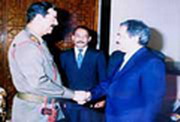 patronage of Saddam Hussein. He gave the group money, weapons, jeeps and military bases along the Iran-Iraq border — a convenient launching ground for its attacks against Iranian government figures. When U.S. forces toppled Saddam’s regime, they were not sure how to handle the army of some 5,000 Mujahedeen fighters, many of them female and all of them fanatically loyal to the Rajavis. The U.S soldiers’ confusion reflected confusion back home. The Mujahedeen has a sophisticated lobbying apparatus, and it has exploited the notion of female soldiers fighting the Islamic clerical rulers in Tehran to garner the support of dozens in Congress. But the group is also on the State Department’s list of foreign terrorist organizations, placed there in 1997 as a goodwill gesture toward Iran’s newly elected reform-minded president, Mohammad Khatami.
With the fall of Saddam and with a wave of antigovernment demonstrations across Iran last month, the Mujahedeen suddenly found itself thrown into the middle of Washington’s foreign-policy battles over what to do about Iran. And now its fate hangs precariously between extinction and resurrection. A number of Pentagon hawks and policy makers are advocating that the Mujahedeen be removed from the terrorist list and recycled for future use against Iran. But the French have also stepped into the Persian fray on the side of the Iranian government — who consider the Rajavis and their army a mortal enemy. In the early-morning hours of June 17, some 1,300 French police officers descended upon the town of Auvers-sur-Oise, where the Mujahedeen established its political headquarters. After offering the Iranian exiles sanctuary on and off for two decades and providing police protection to Maryam Rajavi, the French mysteriously arrested Rajavi along with 160 of her followers, claiming that the group was planning to move its military base to France and launch terrorist attacks on Iranian targets in Europe. Immediately, zealous Mujahedeen members in Paris, London and Rome staged hunger strikes, demanding the release of Maryam, and several set themselves ablaze.
In Washington, Senator Sam Brownback, Republican of Kansas and chairman of the Foreign Relations subcommittee on South Asia, accused the French of doing the Iranian government’s dirty work. Along with other members of Congress, Brownback wrote a letter of protest to President Jacques Chirac, while longtime Mujahedeen champions like Sheila Jackson-Lee, Democrat of Texas, expressed their distress over Maryam’s arrest. But few, if any, of these supporters have visited the Mujahedeen’s desert encampments in Iraq and know how truly bizarre this revolutionary group is.
Recently, I went to visit Camp Ashraf, the main Mujahedeen base, which lies some 65 miles north of Baghdad in Diala province, near the Iranian border. Ashraf is 14 square miles of ungenerous desert surrounded by aprons of barbed wire, gun towers and guards in trough-like bunkers, shaded by camouflage netting and dehydrated palm trees, their trunks thickened by dust. As you pass the checkpoints and dragons’-teeth tire crunchers into the tidy military town, you feel you’ve entered a fictional world of female worker bees. Of course, there are men around; about 50 percent of the soldiers are male. But everywhere I turned, I saw women dressed in khaki uniforms and mud-colored head scarves, driving back and forth along the avenues in white pickups or army-green trucks, staring ahead, slightly dazed, or walking purposefully, a slight march to their gaits as at a factory in Maoist China.
Pari Bahshai, a stocky Iranian woman in her mid-40’s and the military commander of Ashraf, was my tour guide for the day. We drove through the grounds in her white Land Cruiser out to a dry, burning plain where dozens of young women were buried in the mouths of their tanks — adjusting, winching, tinkering with the circuits and engines that keep their fighting machines alive. There were neat rows of Brazilian Cascavel tanks, Russian BMP armored vehicles and British Chieftains, most of them captured from Iran at the end of the Iran-Iraq war.
Some of the women smiled shyly; others were expressionless as Bahshai — who was tough but indulgent and whom they clearly loved — made her introductions. ”When they first come here, it’s hard for them to deal with these armored vehicles,” she said. ”They don’t believe in themselves. They think only men can do it. But as they see the others, they overcome their insecurity. I went through this process myself.” Hossein Madani, a Mujahedeen political spokesman who was my minder for the day, said, ”These young women are all new from Iran or countries abroad.”
One by one, the youngest Mujahedeen sprang to life to recite their stories. A dark-haired beauty blurted out fast and robotically in Farsi, with a comrade translating into English: ”I came from Tehran six months ago. I’m 20 years old. I was in a very unstable psychological situation in the last days of my stay in Iran. I wanted to commit suicide. Why? Because we had no right to express dissent. There was no freedom. Even personal things young people wanted to do like go out to parties or wear makeup or just go out freely. Many of my friends were burning themselves to die or becoming addicted to drugs. On the Internet, I came across a saying of Maryam Rajavi, ‘You’re capable and you must,’ and I felt after that, that I was also capable. I got my self-confidence. I always believed women were weak, but when I read Maryam Rajavi’s words, I got the self-confidence to come here.”
I asked her a question to slow her down, but she simply pushed the pause button in her mind, released it when my question ended, and the tape rolled on. ”My two brothers were supporters of the Mujahedeen,” she said, ”and were executed by the Khomeini regime.”
Several months ago, she e-mailed the Mujahedeen, who then facilitated her passage to Turkey, where she was met at the border, put on a train to Ankara and then Iraq. ”I was educated in courses of Mujahedeen history, Iranian history and the current political situation,” she carried on. ”Now I’m in artillery class.” She explained what it was like to be in Iraq during the U.S. bombing. ”I was scared, but I reminded myself that I came to struggle against fundamentalism, and the fact that I was a member of the Mujahedeen family gave me strength.” And then she stopped, said thank you and went away.
There were three more just like her. ”When I was in Iran, I didn’t think I could drive a tank and shoot a gun, but when I saw sister Maryam Rajavi, I got hope that I can do everything,” said Shiva, a 21-year-old tank driver. ”Now that I know Maryam Rajavi, I want other people to know about her too, because the freedom of Iran depends on her.”
After the parade of testimonials, I was whisked onto a tank for a spin around the training ring. The women were giddy, affectionate and proud of their vehicles. They all told me how much self-confidence they had gained through Maryam. I had heard that the Mujahedeen must take a vow of ”eternal divorce,” that the young ones can never marry or have children and that the older ones had to divorce their spouses sometime in the late 1980’s. I asked Sima, a woman in her late 20’s, whether she ever regretted making that celibacy commitment. ”When I feel that I’m getting closer to my goal,” she shouted in English against the wind, ”it’s a more beautiful feeling than anything else. It’s love.” And what was her goal? ”I have to teach the women in Iran to feel like I feel inside and rebuild what Khomeini destroyed. He is killing the soul of every person.” I noticed that everyone, young and old, at Camp Ashraf referred in the same programmed way to the regime of Ayatollah Khomeini as if the charismatic icon of the Iranian revolution hadn’t died 14 years ago. Sima said that whenever she lapsed into the ”normal girl dreams” of marriage and children, she looked around her and said she felt proud. ”In the difficult situations, I see happiness in the faces of my sisters.”
Nadereh, an Iranian woman who had grown up in Toronto, told me she had broken off her engagement to come to Iraq. ”I was living the best life in Toronto,” she said. ”I was studying physiotherapy and body mechanics. I had friends and family. But I was lacking something.” Then one day in 1998 she lay on her bed staring at the ceiling, and heard on Iranian TV that Assadollah Lajevardi, known as the butcher of Evin, the political prison in Tehran where thousands of Mujahedeen were tortured and executed, had been assassinated. The Mujahedeen claimed to have carried out the celebrated operation. ”I couldn’t stand it anymore. I thought, What are you doing for your people?” Now she drives a Katyusha rocket truck.
After we stopped and dismounted, I noticed my minder, Madani, asking the girls what words we had exchanged out there in the wind. And when he came back, Bahshai picked up her feminist cant about the ”crimes of the misogynist regime” in Tehran and how Maryam paved the way for women to ”qualify for a hegemonic role” in the army’s general staff. As she would say later, ”Women under Khomeini commit suicide; women here become responsible.”
Though Maryam Rajavi spends most of her time in France or lobbying in the West, her smiling green eyes stalk Camp Ashraf almost as ubiquitously as the image of Saddam in Iraq or Khomeini in Iran. Her photographs in flowery blouses grace bedsides, dining tables, lecture halls and even tanks. Back in the 1960’s, the founders of the Mujahedeen were students who melded revolutionary Islam with Marxism, and they were among the few to battle the shah with weapons. Like other radical students in the 60’s, they rejected bourgeois values, spurned individualism and found respite in the militarized life of a cause. They were also vehemently against U.S. involvement in Iran and killed several Americans working in Tehran. Most of the student leaders — except Massoud Rajavi and a few others who were in prison — were executed in the 1970’s.
After the shah was overthrown in 1979, Rajavi, with his charismatic style, gathered thousands of followers. He initially supported Khomeini, but quickly fell out with him and his ring of clerics. And in 1981, he plotted to bring down the Islamic regime. Rajavi dispatched his people into the streets of Tehran, and many were summarily executed. The Mujahedeen detonated a powerful bomb that killed more than 70 officials in the Iranian theocracy. (Today’s supreme leader, Ali Khamenei, lost the use of his right arm in one such explosion that year.) In retaliation, thousands of Mujahedeen members were arrested and then executed or tortured inside Evin Prison — including many of today’s Mujahedeen commanders in Iraq.
Rajavi fled to Paris in disguise. There, he established the National Council of Resistance in Iran, the political umbrella of the Mujahedeen. In 1986, the French began forging ties with Khomeini and kicked out Rajavi and his squads of assassins, who ran into the arms of Saddam Hussein. Hussein had been welcoming the Mujahedeen for several years. (Many Mujahedeen political supporters did stay on in France as political refugees.) Rajavi, in return, betrayed his own countrymen, identifying Iranian military targets for Iraq to bomb, 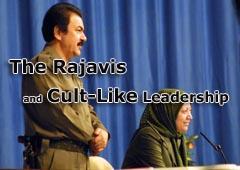 a move most Iranians will never forgive. Then, right after the Iran-Iraq cease-fire in 1988, as if orchestrating the tragic turning point in his own Rajavi Opera, he launched thousands of his warriors on ”Operation Eternal Light” across the border to capture Iranian territory. Two thousand Mujahedeen fighters — many of them the parents, husbands and wives of those who are now in Iraq — were killed by the Revolutionary Guard.
The coup de grâce that metamorphosed the party into something more like a husband-and-wife-led cult was Massoud’s spectacular theft of his colleague’s wife, Maryam. Massoud fell in love with her and invented an entire political program to elevate her into a revolutionary queen and to justify her divorce from her husband. Women should be equal to men, Massoud claimed, and Maryam should be an equal leader by his side. But working together without being married would be a violation of Islamic law. So he maneuvered her divorce and called it a ”cultural revolution.”
As Ervand Abrahamian, a historian and author of ”The Iranian Mujahedeen,” told me: ”Rajavi said he was emulating the prophet” — Muhammad — ”who had married his adopted son’s wife to show he could overcome conventional morality. It smacked of blasphemy.”
Rajavi liked having women around him and overhauled the command structure to replace the men with women — this time calling it a ”constitutional revolution.” It was also politically astute and added alluring spice for their public-relations campaign in the West.
”Rajavi, Rajavi, Iran, Iran, Maryam, Maryam, Iran, Iran,” shouted a dozen young women commandos, trotting with their Kalashnikovs on a scrubby field, camouflage leaves and twigs bouncing on their helmets, their faces blurred by green paint. ”Run, run, fire, fire.” They rolled, crouched, crept, fired and regrouped around their commander. One stepped forward: ”We weren’t coordinated.” Another shouted, ”The distance between us was too much.” Another shouted, ”Our speed wasn’t adequate.” They were given a rest and then, spotting me, skipped up on cue, sweating and out of breath. Nineteen-year-old Sahar began: ”My mother was pregnant with me when she was arrested, and I was born in Evin Prison in 1983. When I was 1 year old, my father was executed for supporting the Mujahedeen. Now I drive a Cascavel. My mother is at another base. It’s one of the reasons I decided to join the army.”
As the leaders like to boast, the Mujahedeen is a family affair. (”We have three generations of martyrs: grandmothers, mothers, daughters.”) Most of the girls I was meeting had grown up in Mujahedeen schools in Ashraf, where they lived separated from their parents. Family visits were allowed on Thursday nights and Fridays. When Iraq invaded Kuwait, many of these girls were transported to Jordan and then smuggled to various countries — Germany, France, Canada, Denmark, England, the United States — where they were raised by guardians who were usually Mujahedeen supporters. When they were 18 or 19, many of them decided to come back to Iraq and fill the ranks of the youngest Mujahedeen generation.
Though ”decided” is probably not the right word, since from the day they were born, these girls and boys were not taught to think for themselves but to blindly follow their leaders. ”Every morning and night, the kids, beginning as young as 1 and 2, had to stand before a poster of Massoud and Maryam, salute them and shout praises to them,” Nadereh Afshari, a former Mujahedeen deep-believer, told me. Afshari, who was posted in Germany and was responsible for receiving Mujahedeen children during the gulf war, said that when the German government tried to absorb Mujahedeen children into their education system, the Mujahedeen refused. Many of the children were sent to Mujahedeen schools, particularly in France. The Rajavis, Afshari went on to say, ”saw these kids as the next generation’s soldiers. They wanted to brainwash them and control them.” Which may explain the pattern to their stories: a journey to self-empowerment and the enlightenment of self-sacrifice inspired by the light and wisdom of Maryam and Massoud.
As we cruised around the grounds, Hossein Madani said: ”Did you know that they built all this from scratch? That’s why the combatants love their base so much.” And it was true; the Mujahedeen had managed to cultivate out of the desert their own little paradise with vegetable gardens, rows of Eucalyptus and poplar trees, sports fields and Thursday night movies. When I asked about the fact that the land — along with all clothing, ammunition, gas and the like — had been donated by Saddam Hussein and that the Mujahedeen was, in effect, fighting one dictatorship under the wings of another, both Madani and Bahshai insisted that the Mujahedeen’s precondition for setting up bases in Iraq was independence from Iraq’s affairs. ”All we’ve used is the soil,” Bahshai insisted. Either she was an adept liar or in deep denial, since everyone I spoke to — Iraqi intelligence officers, Kurdish commanders and human rights groups — said that in 1991 Hussein used the Mujahedeen and its tanks as advance forces to crush the Kurdish uprisings in the north and the Shia uprisings in the south. And former Mujahedeen members remember Maryam Rajavi’s infamous command at the time: ”Take the Kurds under your tanks, and save your bullets for the Iranian Revolutionary Guards.”
Though for years the Mujahedeen preached a Marxist-Islamic ideology, it has modernized with the times. Today, one of the standard lines of the Mujahedeen’s National Council of Resistance to politicians in Europe and America is that it is advocating a secular, democratic government in Iran, and that when it overthrows the regime, it will set up a six-month interim government with Maryam as president and then hold free elections. But despite its rhetoric, the Mujahedeen operates like any other dictatorship. Mujahedeen members have no access to newspapers or radio or television, other than what is fed them. As the historian Abrahamian told me, ”No one can criticize Rajavi.” And everyone must go through routine self-criticism sessions. ”It’s all done on tape, so they have records of what you say. If there’s sign of resistance, you’re considered not revolutionary enough, and you need more ideological training. Either people break away or succumb.”
Salahaddin Mukhtadi, an Iranian historian in exile who still maintains communications with the Mujahedeen because it is the strongest armed opposition to the Iranian regime, told me that Mujahedeen members ”are locked up if they disagree with anything. And sometimes killed.”
Afshari, who fled the group 10 years ago, told me how friendship was forbidden. No two people could sit alone and talk together, especially about their former lives. Informants were planted everywhere. It was Maryam’s idea to kill emotional relationships. ”She called it ‘drying the base,”’ Afshari said. ”They kept telling us every one of your emotions should be channeled toward Massoud, and Massoud equals leadership, and leadership equals Iran.” The segregation of the sexes began almost from toddlerhood. ”Girls were not allowed to speak to boys. If they were caught mingling, they were severely punished.”
Though Maryam and Massoud finagled it so they could be together, they forced everyone else into celibacy. ”They told us, ‘We are at war, and soldiers cannot have wives and husbands,”’ Afshari said. ”You had to report every single day and confess your thoughts and dreams. They made men say they got erections when they smelled the perfume of a woman.” Men and women had to participate in ”weekly ideological cleansings,” in which they would publicly confess their sexual desires. It was not only a form of control but also a means to delete all remnants of individual thought.
One of the most disturbing encounters I had in Ashraf was with Mahnaz Bazazi, a commander who had been with the Mujahedeen for 25 years. I met her in the Ashraf hospital. Bazazi was probably on drugs, but that didn’t explain the natural intoxication she was radiating, despite — or perhaps because — she had just had her legs amputated after an American missile slammed into the warehouse she was guarding. The doctor told me he never heard her complain. ”Even in this way, she’s confronting the Mullahs,” he said. Bazazi interrupted him. ”This is not me personally,” she said in a soft high voice. ”These are the ideas of the Mujahedeen. It’s true I lost my legs, but my struggle will continue because I have a wish — the freedom of my country.” At the foot of her bed, surrounded by candles, stood a large framed photograph of Maryam in a white dress and blue flowered head scarf.
In the chaotic days after the fall of Baghdad, several Mujahedeen members managed to flee the military camps and were in Kurdish custody in northern Iraq. Kurdish officials told me they weren’t sure what to do with them. One was Mohammad, a gaunt 19-year-old Iranian from Tehran with sad chestnut eyes. He hadn’t heard of the Mujahedeen until one day last year when he was in Istanbul desperately looking for work. A Mujahedeen recruiter spotted him and a friend sleeping on the streets, so hungry they couldn’t think anymore. The recruiter gave them a bed and food for the night, and the next day showed them videos of the Mujahedeen struggle. He enticed them to join with an offer to earn money in Iraq while simultaneously fighting the cruel Iranian regime. What’s more, he said, you can marry Mujahedeen girls and start your own family. The Mujahedeen seemed like salvation. Mohammad was told to inform his family that he was going to work in Germany and given an Iraqi passport.
The first month at Ashraf, he said, wasn’t so bad. Then came the indoctrination in the reception department and the weird self-criticism sessions. He quickly realized there would be no wives, no pay, no communication with his parents, no friendships, no freedom. The place was a nightmare, and he wanted out. But there was no leaving. When he refused to pledge the oath to struggle forever, he was subjected to relentless psychological pressure. One night, he couldn’t take it anymore. He swallowed 80 diazepam pills. His friend, he said, slit his wrists. The friend died, but to Mohammad’s chagrin, he woke up in a solitary room. After days of intense prodding to embrace the Mujahedeen way, he finally relented to the oath. He trundled along numbly until the Americans invaded Iraq, when he and another friend managed to slip out into the desert. They were helped out by Arabs, and then turned themselves over to the Kurds, hoping for mercy. Mohammad fell ill, and the next thing he knew he was in prison. ”The Mujahedeen has a good appearance to the outside world, but anyone who has lived among them knows how rotten and dirty they are,” he said.
Another Iranian whom I met at the Kurdish prison told me that he had been a zealous Mujahedeen supporter for years in Iran, and when he finally made it to the Iraqi camps, he was horrified to discover that his dream was a totalitarian mini-state.
Before I left Camp Ashraf, Massoud Farschi, one of the Mujahedeen spokesmen who was educated in the United States, told me that he thought the Mujahedeen was in the best position it had ever been in. ”We’ve said all along that the real threat in the world is fundamentalism, and now the world has finally seen that.” The Mujahedeen, he said, is the barrier to that fundamentalism.
Nevertheless, two days later, in early May, Gen. Ray Odierno of the Fourth Infantry Division was dispatched to the camp to negotiate the Mujahedeen’s surrender. American tanks were posted outside Ashraf’s gates, and two B-52’s were circling the skies above. After a day of discussion, the Mujahedeen commanders reached a capitulation agreement in which they would consolidate their weapons and personnel into two separate camps. Lt. Col. John Miller, also with the Fourth, attended a ceremony in which the men and women bid farewell to their tanks. ”We saw folks kissing their vehicles, hugging them,” he said. One 50-year-old man broke down in front of them, wailing. The women, he said, were much more controlled. Not so the women in Europe, who until recently were crying on the streets for the release of their beloved Maryam. They got their wish; a court ordered her released on bail. As for Massoud Rajavi, he has not uttered a peep. In fact, he seems to have disappeared. Some Iraqis claim to have seen him a few days before Baghdad fell boarding a helicopter south of the capital.
After the negotiations with the Mujahedeen, it was reported that Odierno said he thought that the group’s commitment to democracy in Iran meant its status as a terrorist organization should be reviewed. There are also Senate staff members, Pentagon officials and even some people in the State Department who have said that if all the Mujahedeen is doing is fighting the ”evil regime” in Iran, it quite likely that it will be removed from the State Department’s terrorist list. ”There is a move afoot among Pentagon hard-liners,” one administration official said, ”to use them as an opposition in the future.” Recently Brownback submitted an Iran Democracy Act modeled on the Iraqi Liberation Act, which would set aside $50 million to help opposition groups overthrow the regime. The Mujahedeen, their U.S. supporters say, has provided the United States with key intelligence on Iran’s nuclear program. One Congressional staff member working close to the issue said that there was a national security directive circulating ”that includes a proposal for limited surgical strikes against the Iranian regime’s nuclear facilities. We would be remiss if we did not use the Mujahedeen to identify exactly what the Iranians have and in the longer term, to facilitate regime change.”
Meanwhile, inside Iran, the street protesters risking their lives and disappearing inside the regime’s prisons consider the Mujahedeen a plague — as toxic, if not more so, than the ruling clerics. After all, the Rajavis sold out their fellow Iranians to Saddam Hussein, trading intelligence about their home country for a place to house their Marxist-Islamist Rajavi sect. While Mujahedeen press releases were pouring out last month, taking undue credit for the nightly demonstrations, many antigovernment Iranians were rejoicing over the arrest of Maryam Rajavi and wondering where Massoud was hiding and why he, too, hadn’t been apprehended. This past winter in Iran, when such a popular outburst among students and others was still just a dream, if you mentioned the Mujahedeen, those who knew and remembered the group laughed at the notion of it spearheading a democracy movement. Instead, they said, the Rajavis, given the chance, would have been the Pol Pot of Iran. The Pentagon has seen the fatal flaw of hitching itself to volatile groups like the Islamists who fought the Soviets in Afghanistan and, more recently, the Iraqi exile groups who had no popular base at home. It seems dangerously myopic that the U.S. is even considering resurrecting the Rajavis and their army of Stepford wives.
Elizabeth Rubin is a frequent contributor to the magazine. Her last article was about political reformers in Iran.
By Elizabeth Rubin – Published: Sunday, July 13, 2003