In November 2011 a large group of interested people met in Baghdad to discuss the seemingly intractable problem of how to dismantle the Mohjahedin-e Khalq foreign terrorist group and remove the members from the country. At the behest of families of the individuals trapped inside Camp Ashraf, the GOI agreed to proceed in a way that would avoid violent confrontation. Iraq’s Foreign Minister Hoshyar Zebari announced later, “We will refuse them the satisfaction of becoming martyrs on our soil”. The Governor of Diyala, the military head of Diyala province and other authorities all went the extra mile to prevent the MEK from killing more hostages and blaming the Iraqis for it.
Prime Minister Nouri al Maliki signed a Memorandum of Understanding with the UN which would allow more time and give oversight of the eviction process to the UN and to representatives of the EU and US.
The Iraqis have kept their side of bargain – the deadline for the MEK’s departure was extended and negotiations were facilitated to persuade the MEK to cooperate in a move from Camp Ashraf to Camp Liberty where the UNHCR would be able to assess each individual for refugee status. (Remember that no external body, including the GOI, has been able to freely access the inside of Camp Ashraf since the fall of Saddam Hussein.) The first 800 individuals have now moved and another 800 are lined up to move over the next few days in two groups of 400. The MEK leader has not been able to exploit the situation and kill any hostages. The GOI has control of the situation.
UNAMI has been rigorous in its supervision of the move and, by enforcing its own rules and regulations has not allowed propaganda to overshadow activities at either camp. Facilities at the new camp were approved by UN inspectors, the ICRC has been involved and behind the scene EU and US special advisors have been keeping a watchful eye on events. The MEK has ‘character assassinated’ UNAMI and its officials, and others, in the media but UNAMI has not been diverted by the efforts of the MEK and their backers.
But one pernicious factor which has actively impeded proper progress in this task has been the support given to the MEK by Israelis and US Neoconservatives whose clear intent is to politicise what is essentially a humanitarian situation. The MEK is a well-honed tool in the hands of these ideologues and is used to incite hatred against Iran and Iraq among ignorant and lazy political communities. The MEK is far too valuable for them to allow it to disappear. Most recently, the MEK has been used by Mossad to assassinate Iranian nuclear scientists.
This being so will make it even more difficult for UNAMI to transfer them to third countries. This ruthless use of the MEK as a mercenary terrorist force has a direct impact on the situation of the hostages trapped in the camp; their future becomes all the more uncertain.
But then, it has been all along, the clear intention of the MEK’s paymasters to keep the MEK intact as a terrorist entity in Iraq, in total disregard for the human beings involved.
If it wasn’t because of the backing of Israel and the Neoconservatives, Rajavi would have had no choice but to open the doors of his closed totalitarian group and allow the individuals trapped inside to walk free. That is the aim of everyone on the ground working to resolve the situation in Iraq. In this respect it is no less the responsibility of the US Government to work with the international community to dismantle this terrorist group and rescue the hostages.
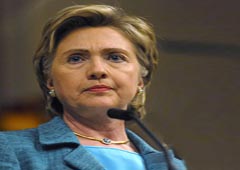
But while the rest of the world is genuinely working toward a peaceful end to the camp and the release and resettlement of the hostages, it appears Secretary of State Clinton is somewhat ambiguous in her dealing with the situation.
Based on a legal ruling, Clinton must make a decision by the end of March whether the State Department remove the MEK from its terrorism list or not. Presenting this as leverage she has introduced a unilateral condition to the MEK’s removal from Iraq; if the MEK cooperate with UNAMI and the Government of Iraq, she has indicated, we will remove them from the US terrorism list. But cooperation with UNAMI is a legal obligation rather than an optional choice for the MEK. So what is really behind this position?
On the surface this would appear as though the USG is prepared to do a political deal to get the MEK to leave Iraq (and in doing so gain credit with the Iraqi government). It is as though the MEK were a far distant uncontrollable threat to US security which needs careful handling to bring it under control before dismantling it. Nothing could be further from the truth. Everything that the MEK’s western owners can do is being done to help the MEK’s leader keep the doors to the camp closed, to keep the hostages inside and to deny them contact with their families – even though this is against all humanitarian, moral or indeed criminal law.
By talking about the terrorism list rather than talking about what is happening in Iraq Clinton is bowing to this pressure. Certainly if UNAMI is allowed to do its job properly – with the support of all the international community – there will not be an organisation left to be listed or not listed. By invoking the US terrorism list, the actual script appears to be whether the MEK can be more useful listed as terrorists or if they are not regarded as terrorists. This false choice disguises the real intent of its proponents which is to keep the group intact as a terrorist group so it can be rearmed and used.
Secretary Clinton, indeed the whole government of America, needs to unhitch the politically charged consideration of the MEK’s inclusion in the US terrorism list from the very real humanitarian situation in Iraq. If the USG’s intention is really to deal properly with this terrorist group, it should reassert the humanitarian focus of American policy toward the MEK and unequivocally support the dismantlement process in Iraq.
Mujahedin Khalq in the List of terrorist Organizations
Clinton says if anti-Tehran terrorist group can’t find someplace to go after being evicted from Iraq, they may get de-listed.
If the terrorist Iranian dissident group Mujahadin-e Khalq (MeK) can’t find someplace to go after being evicted from its base in Iraq, the United States may remove the group from the State Department’s terrorist list.
The MEK has a long history of terrorist activity going back to the 1970′s and it remains on America’s official list of foreign terrorist organizations (FTOs) and has the goal of overthrowing the Iranian government. Because of this goal, there has been a big money push by many influential people in Washington to get the group removed from the State Department’s terrorist list, presumably to make it eligible for U.S. funding and harm Iran.
MeK’s former ally, the late Iraqi dictator Saddam Hussein, had allowed the group to settle at Camp Ashraf, 40 miles from Baghdad. But now Iraq’s Shi’ite majority has forged closer ties with its Shi’ite neighbor Iran, and the MeK is no longer welcome at Ashraf.
Despite still being officially considered a terrorist group, the U.S. has sort of taken MeK under its wing, opening up a former U.S. base in Iraq for the 3,000 MeK members in Ashraf to resettle to, and trying to find a third country that might welcome them, since both Iraq and Iran will not.
But they can’t stay at the U.S. base in Iraq permanently. And if a new home can’t be found for them, the U.S. may de-list them, and possibly even welcome them on U.S. soil.
“Given the ongoing efforts to relocate the residents, MeK cooperation in the successful and peaceful closure of Camp Ashraf, the MeK’s main paramilitary base, will be a key factor in any decision regarding the MEK’s FTO status,” Secretary of State Hillary Clinton recently told U.S. lawmakers.
This is a despicable and hypocritical approach on the part of Washington. U.S. officials recently told NBC News that Israel has financed, trained, and armed MeK terrorists to carry out unprovoked attacks on Iranian nuclear scientists inside Iran. To help MeK find refuge or even de-list them would clearly be U.S. support for terrorists. Of course, when terrorists target the United States or its allies, they are detained without charge or trial, tortured, or even executed. But if terrorists target an adversary of the U.S., like Iran, suddenly they’re worthy of Washington’s help.
by John Glaser,
State Department: It is unlawful to provide support to Listed Terrorists!!
Foreign Terrorist Organizations
Bureau of Counterterrorism
January 27, 2012
Foreign Terrorist Organizations (FTOs) are foreign organizations that are designated by the Secretary of State in accordance with section 219 of the Immigration and Nationality Act (INA), as amended. FTO designations play a critical role in our fight against terrorism and are an effective means of curtailing support for terrorist activities and pressuring groups to get out of the terrorism business.
Current List of Designated Foreign Terrorist Organizations

Identification
The Bureau of Counterterrorism in the State Department (S/CT) continually monitors the activities of terrorist groups active around the world to identify potential targets for designation. When reviewing potential targets, S/CT looks not only at the actual terrorist attacks that a group has carried out, but also at whether the group has engaged in planning and preparations for possible future acts of terrorism or retains the capability and intent to carry out such acts.
Designation
Once a target is identified, S/CT prepares a detailed”administrative record,”which is a compilation of information, typically including both classified and open sources information, demonstrating that the statutory criteria for designation have been satisfied. If the Secretary of State, in consultation with the Attorney General and the Secretary of the Treasury, decides to make the designation, Congress is notified of the Secretary’s intent to designate the organization and given seven days to review the designation, as the INA requires. Upon the expiration of the seven-day waiting period and in the absence of Congressional action to block the designation, notice of the designation is published in the Federal Register, at which point the designation takes effect. By law an organization designated as an FTO may seek judicial review of the designation in the United States Court of Appeals for the District of Columbia Circuit not later than 30 days after the designation is published in the Federal Register.
Until recently the INA provided that FTOs must be redesignated every 2 years or the designation would lapse. Under the Intelligence Reform and Terrorism Prevention Act of 2004 (IRTPA), however, the redesignation requirement was replaced by certain review and revocation procedures. IRTPA provides that an FTO may file a petition for revocation 2 years after its designation date (or in the case of redesignated FTOs, its most recent redesignation date) or 2 years after the determination date on its most recent petition for revocation. In order to provide a basis for revocation, the petitioning FTO must provide evidence that the circumstances forming the basis for the designation are sufficiently different as to warrant revocation. If no such review has been conducted during a 5 year period with respect to a designation, then the Secretary of State is required to review the designation to determine whether revocation would be appropriate. In addition, the Secretary of State may at any time revoke a designation upon a finding that the circumstances forming the basis for the designation have changed in such a manner as to warrant revocation, or that the national security of the United States warrants a revocation. The same procedural requirements apply to revocations made by the Secretary of State as apply to designations. A designation may be revoked by an Act of Congress, or set aside by a Court order.
Legal Criteria for Designation under Section 219 of the INA as amended
1. It must be a foreign organization.
2. The organization must engage in terrorist activity, as defined in section 212 (a)(3)(B) of the INA (8 U.S.C. § 1182(a)(3)(B)),* or terrorism, as defined in section 140(d)(2) of the Foreign Relations Authorization Act, Fiscal Years 1988 and 1989 (22 U.S.C. § 2656f(d)(2)),** or retain the capability and intent to engage in terrorist activity or terrorism.
3. The organization’s terrorist activity or terrorism must threaten the security of U.S. nationals or the national security (national defense, foreign relations, or the economic interests) of the United States.
Legal Ramifications of Designation
1. It is unlawful for a person in the United States or subject to the jurisdiction of the United States to knowingly provide”material support or resources”to a designated FTO. (The term”material support or resources”is defined in 18 U.S.C. § 2339A(b)(1) as”any property, tangible or intangible, or service, including currency or monetary instruments or financial securities, financial services, lodging, training, expert advice or assistance, safehouses, false documentation or identification, communications equipment, facilities, weapons, lethal substances, explosives, personnel (1 or more individuals who maybe or include oneself), and transportation, except medicine or religious materials.” 18 U.S.C. § 2339A(b)(2) provides that for these purposes “the term ‘training’ means instruction or teaching designed to impart a specific skill, as opposed to general knowledge.” 18 U.S.C. § 2339A(b)(3) further provides that for these purposes the term ‘expert advice or assistance’ means advice or assistance derived from scientific, technical or other specialized knowledge.’’
2. Representatives and members of a designated FTO, if they are aliens, are inadmissible to and, in certain circumstances, removable from the United States (see 8 U.S.C. §§ 1182 (a)(3)(B)(i)(IV)-(V), 1227 (a)(1)(A)).
3. Any U.S. financial institution that becomes aware that it has possession of or control over funds in which a designated FTO or its agent has an interest must retain possession of or control over the funds and report the funds to the Office of Foreign Assets Control of the U.S. Department of the Treasury.
Other Effects of Designation
1. Supports our efforts to curb terrorism financing and to encourage other nations to do the same.
2. Stigmatizes and isolates designated terrorist organizations internationally.
3. Deters donations or contributions to and economic transactions with named organizations.
4. Heightens public awareness and knowledge of terrorist organizations.
5. Signals to other governments our concern about named organizations.
An Iranian group that has attracted high-level support from former White House and senior national security officials, was dealt a body blow last week in its effort get off the terrorism list, when the State Department released a series of documents the group had sought under the
Freedom of Information Act (FOIA).
According to the documents the group, known as the Mujahedin-e Khalq (MEK, or MKO), supported the takeover of the U.S. embassy in Tehran in November 1979 – not a position to endear itself to U.S. diplomats – before its “gradual elimination from the ruling coalition” by Ayatollah Khomeini less than two years later.
The new documents describe the MEK terror campaign against the Islamic regime during the 1980s and 1990s, and the group’s alliance with Iraqi dictator Saddam Hussein.
According to hundreds of Iranians interviewed by State Department “Iran watchers” in Dubai, Turkey, Azerbaijan, and Germany, the ties to Saddam were the most damning.
“Ordinary Iranians were almost uniformly dismissive of the MEK, reacting with either disdain or apathy,” a recent cable from the U.S. Consulate in Dubai states.
“The MEK are detested among the young and old in Iran, although many young Iranians don’t know much about them,” the cable quotes one Iranian as having told U.S. diplomats.
“They are hated among Iranians, since their hands are stained with the blood of their fellow countrymen,” another Iranian is quoted as saying in the just-released cable.
A host of former senior U.S. officials have come out in public in support of the group, including, most recently, President Obama’s former National Security Advisor, Gen. Jim Jones.
At pro-MEK event in Brussels on May 25, former White House Chief of Staff Andy Card, former NATO commander Gen. Wesley Clark, former State Department counter-terrorism coordinator Ambassador Dell Dailey, and others, argued that the MEK should be treated as a legitimate Iranian opposition group.
As the U.S. and the European Union continued to ratchet up sanctions on the Islamic Republic of Iran this week, many members of Congress are pressing the State Department to remove the MEK from the terrorism list, as the European Parliament has recently done.
Rep. Michele Bachmann (R-MN), former New York Mayor Rudy Guiliani, and former U.S. ambassador to the United Nations John Bolton have also staked out positions in favor of the group. All three are potential Republican presidential candidates in 2012.
But the newly declassified State Department cables paint a much darker picture of the group, starting with the victimization of its own members if they strayed from the party line or tried to leave the organization.
Several recent cables from the U.S. embassy in Baghdad detail interviews with MEK members who managed to escape from Camp Ashraf, a military base northeast of Baghdad that was assigned to the group by Saddam Hussein in the late 1980s.
Since the liberation of Iraq by the U.S.-led coalition in 2003, the group has been confined to quarters. Tensions with the Iraqi government have been building, and 34 MEK members were killed in April during clashes with Iraqi Army units.
The escapees – refereed to as “defectors” in the State Department cables – painted a harsh picture of repression in the MEK camp, and claimed that the group’s leader had issued standing orders that anyone caught trying to escape should be immediately executed.
“Many of the defectors alleged psychological and physical harm at the hands of the MEK, including solitary confinement in MEK jails in Ashraf,” one cable states.
Some of the MEK escapees said they had been “lured from Iran with promises of study abroad opportunities” or “by offers of travel abroad.” Others were Iranian POWs captured by the Iraqis during the 1980-1988 Iran-Iraq war who were sent to Camp Ashraf with a promise they would soon be repatriated to Iran or resettled in a third country.
The defectors “reaffirmed existing perceptions of the MEK as a cult-like organization that thrives on maintaining control of its members and those lured to Ashraf under false pretenses,” the cable states.
Allan Gerson, a Washington, DC attorney representing the group in its efforts to get removed from the State Department’s list of international terrorist organizations, dismissed the new documents as “much ado about nothing” when he released them at a lavish Capitol Hill reception last Wednesday.
“The question is why, when every single Camp Ashraf residents were taken outside [sic], and interviewed by the U.S. military in American controlled facilities in 2003 and 2004, and each were given the choice to leave, none of those individuals had done so?” Gerson asked.
But the State Department cable that recounts the stories of the MEK escapees, flatly contradicts Gerson’s assertion.
“The defectors confirmed that this was their first encounter with any foreign mission and welcomed future visits,” the cable states. “The defectors were all unified in their desire to leave Iraq… Many accurately pointed out that their failed resettlement has offered little incentive for other residents to leave Ashraf, fearing similar hopelessness and ‘purgatory’ in Iraqi hotels.”
The undated cable, signed “Hill,” appears to have been written in 2009 or 2010, when Christopher Hill was the U.S. ambassador to Baghdad.
Already in 1994, the State Department sent a damning 41-page report to Congress, detailing why it considered the MEK a terrorist organization.
The “original sin” of the group was the murder of three U.S. officers and three civilian contractors working for the Shah’s government between 1973-1976.
MEK representatives claim that the murders were carried out by a “Marxist splinter group” before Massoud Rajavi became MEK leader in 1979. But Mujahedin newsletters published in Iran in 1980 celebrated the murders, calling the U.S. victims “criminal agents of U.S. Imperialism in Iran.”
During an FBI investigation code-named Operation Suture, an FBI agent who infiltrated Camp Ashraf and posed as an MEK member reported that the group continued to celebrate the anniversary of those murders in late 1980s.
The MEK says that it abandoned violence against the Islamic regime in Iran in 2001, after a campaign of mortar attacks and hit-and-run raids against Iranian military and law enforcement personnel failed to win it popular support inside Iran.
Kenneth R. Timmerman is Executive Director of the Foundation for Democracy in Iran and a Contributing Editor at Newsmax Media
In August I was one among several people who wrote about a well-funded lobbying campaign by the Mujahedin-e Khalq (MEK) to get delisted from the US’s foreign terrorist organizations (FTO)
list. The MEK is an exiled Iranian group that has killed US and Iranian citizens. It’s also described as a “cult” that has committed human rights abuses against its own members as documented by the Rand Corporation and Human Rights Watch.
Armed and supported by Saddam Hussein, the MEK helped him repress Iraqi Shias and Kurds and fought against Iran during the Iran-Iraq war. Many analysts including neoconservative Michael Rubin have urged against delisting, noting potential blowback and acknowledging that the group would not be able to implement regime change in Iran due to its unpopularity with most Iranians.
President Obama was put in a tough spot by the MEK’s lobbying blitz not only because of the political heavyweights that expressed differing degrees of endorsement after thousands were paid to them in “speaking fees“, but also because of the MEK’s dishonest merging of the humanitarian concerns at their Camp Ashraf base with their FTO listing. Many expected that the Obama administration would announce a decision in September after dragging its feet for over a year following a 2010 Court of Appeals rare order that the designation be reevaluated, but no final announcement has been made and to date the MEK remains FTO-listed.
Under increasing Iraqi pressure to relocate and from human rights organizations urging leader Maryam Rajavi to allow independent access to over 3,000 Iranians at the camp, many feared a humanitarian tragedy such as mass suicide. But progress has been made after the UN convinced Iraq to sign a memorandum of understanding to temporarily resettle the residents to a former US military base north of Baghdad. The Head of the UN Assistance Mission for Iraq Martin Kobler said relocation was voluntary.
Secretary of State Hillary Clinton said on Sunday that the temporary solution had the U.S’s “full support” and that the UN High Commission for Refugees (UNHCR) would be conducting refugee status determinations for the members “toward resettlement to third countries.”
She also stressed that for the initiative to be “successful”, the camp’s residents would have to give their “full support” and urged them to “work with the UN”–an indication that resistance is expected from the MEK’s avid supporters (many are believed to be held against their will).
While the majority of MEK members have never left the camp, Rajavi has been living in Paris where she has successfully lobbied the group off the UK and EU FTO lists. The whereabouts of her husband Masoud are unknown, but some suspect he’s inside the camp. It will be interesting to see whether any new information about him is disclosed and if Maryam Rajavi will ultimately relinquish her hold on the group’s members.
So far there have been no independent confirmations of a MEK claim that Iranian rockets struck their camp on Sunday. We’ll also have to wait and see whether the residents allow themselves to be relocated out of Iraq. The only thing that’s certain is that these people–especially those who have been lured and born into Camp Ashraf–deserve a better life.
The following is an excerpt from the RAND report (pg. 38-9) for those who want to understand the MEK better.
The MeK as a Cult
From its earliest days, the MeK had had tight social bonds, but these began to be transformed into something more sinister during the mid- 1980s after the group’s leaders and many of its members had relocated to Paris. There, Masoud Rajavi began to undertake what he called an “ideological revolution,” requiring a new regimen of activities—at first demanding increased study and devotion to the cause but soon expanding into near-religious devotion to the Rajavis (Masoud and his wife, Maryam), public self-deprecation sessions, mandatory divorce, celibacy,enforced separation from family and friends, and gender segregation.
Prior to establishing an alliance with Saddam, the MeK had been a popular organization. However, once it settled in Iraq and fought against Iranian forces in alliance with Saddam, the group incurred the ire of the Iranian people and, as a result, faced a shortfall in volunteers. Thus began a campaign of disingenuous recruiting. The MeK naturally sought out Iranian dissidents, but it also approached Iranian economic migrants in such countries as Turkey and the United Arab Emirates with false promises of employment, land, aid in applying for asylum in Western countries, and even marriage, to attract them to Iraq. Relatives of members were given free trips to visit the MeK’s camps. Most of these “recruits” were brought into Iraq illegally and then required to hand over their identity documents for “safekeeping.” Thus, they were effectively trapped.
Another recruiting tactic was arranged with the assistance of Saddam’s government. Iranian prisoners from the Iran-Iraq War were offered the choice of going to MeK camps and being repatriated or remaining in Iraqi prison camps. Hundreds of prisoners went to MeK camps, where they languished. No repatriation efforts were made.
For coalition forces, the MeK’s cult behavior and questionable recruiting practices are significant insofar as they affect both the daily operations at the camp and the strategic disposition options available to the group. The leadership is unlikely to cooperate with policies that would undermine its ability to exert direct control over its members. Indeed, Human Rights Watch reports that the MeK long ago instituted a complicated process to retain members who expressed a desire to leave, which included a “trial,” forced confessions of disloyalty, and even torture. Although this process has been modified since the group was consolidated at Camp Ashraf, would-be walkaways are still “debriefed” for days or even weeks while held in some form of solitary confinement, during which they are encouraged to change their minds.
Conversely, the long-term indoctrination and isolation experienced by MeK members are likely to have instilled an exaggerated sense of loyalty, causing them to reject offers to separate themselves from their leaders. This would apply in particular to repatriation to Iran, where the expectation of persecution has been dramatically instilled in their minds.
Jasmin Ramsey
Thanks to a loophole intended for human rights activists, political leaders are making big bucks advocating for Iran’s Mujahedeen Khalq.
What do the tax dodges of billionaires and the advocacy efforts of former high-ranking officials on behalf of a designated terrorist group have in common (aside from their exposure on the front
page of the Sunday New York Times)? They exemplify the extraordinary legal privileges enjoyed by economic and political elites.
Ronald Lauder, a legacy member of the upper reaches of the top 1 percent, legally avoids paying millions of dollars in taxes through extravagant use of loopholes available only to the super-rich, according to the Times. Prominent politicos, from former Bush Administration officials to Howard Dean, engage in the lucrative business of lobbying for the Mujahedeen Khalqa (M.E.K.), a "fringe Iranian opposition group, long an ally of Saddam Hussein, that is designated as a terrorist organization under United States law," the Times reports.
In doing so they run no apparent risk of being prosecuted under material support provisions of federal anti-terrorism law, enjoying an extra-legal privilege the Times does not report: Last year the Supreme Court rejected a First Amendment challenge to material support bans, ruling that they may be used against human rights advocates who counsel designated terrorist groups in peaceful conflict resolution.
The gross inequities of federal taxation are frequently critiqued by mainstream pundits and politicians; the discriminatory use of vague and far-reaching federal anti-terror laws is targeted mostly by civil libertarians who exert tragically little influence on policy. David Cole exposed the arbitrary, inconsistent enforcement of material support laws in a January 2011 New York Times op-ed that highlighted the illegal but effectively immunized M.E.K. lobbying efforts of Michael Mukasey, Rudy Giuiliani, and other prominent, right wing anti-terror warriors.
Mukasey and Giuliani, et al, responded in the National Review, claiming un-persuasively that laws prohibiting peaceful human rights work by David’s Cole’s client (the Humanitarian Law Project) on behalf of one designated terrorist group simply did not apply to their work on behalf of another. They claimed additionally that the designation of M.E.K. as a terrorist group is inaccurate, but as they must know, the arguable inaccuracy of a designation is legally irrelevant: The law does not allow for lobbyists and other citizens to substitute their judgments for the judgments of State Department officials. That the State Department is sometimes wrong, that terrorist watch lists are arbitrary and inaccurate, is not a defense for violating the law; it’s a strong argument for amending it, which Mukasey and company oppose. Why should they support amending a law criminalizing political speech that their status allows them to evade, and perhaps apply to their political enemies?
It’s not fair to attribute this self-entered vision of justice to political and economic elites exclusively. Millions of middle class taxpayers as well as the very rich naturally tend to support tax laws that work to their advantage. Millions of politically unconnected voters offer general support for expansive anti-terror laws, partly out of ignorance about their contents and partly in the risky belief that the most repressive or intrusive provisions will not be applied to them. "How does the law serve me" is an understandable and useful question, but it’s a treacherous one for people concerned with redressing inequality. While we understand laws most viscerally by experiencing their effects on us, justice requires attending, as well, to their effects on others.
By Wendy Kaminer – the Atlantic
Baseless US accusations countered with more likely Iranian allegations.

Gholam Shakuri, who the US has claimed is a member of Iran’s elite Quds Force, and behind a bungling plot involving a used-car salesman and undercover US DEA agents to assassinate a Saudi Ambassador in Washington DC, thus serving as an impetus for a war with Iran the US has been desperately pursing for the greater part of a decade, is now being accused by Iran of instead being a member of the French/Iraqi-based Mujahedin-e Khalq Organization (MEK), the Guardian reports.
MEK. Admittedly a terrorist organization, listed by the US State Department as being such, it is fully funded, armed, and backed by the United States, based in France and US-occupied Iraq, and allowed to conduct terrorist operations against the Iranian people. The”War on Terror”is a fraud.
….
Number 28 on the US State Department’s list of”foreign terrorist organizations,”MEK has conducted terrorist operations against both the United States and Iran for decades. Readers may be shocked then to realize that MEK has been considered by the Fortune 500-funded Brookings Institution as a prime candidate for US-backing in an effort to undermine and remove the Iranian government. In Brookings’ 2009 report,”Which Path to Perisa?”it is stated:
“Perhaps the most prominent (and certainly the most controversial) opposition group that has attracted attention as a potential U.S. proxy is the NCRI (National Council of Resistance of Iran), the political movement established by the MEK (Mujahedin-e Khalq). Critics believe the group to be undemocratic and unpopular, and indeed anti-American.
In contrast, the group’s champions contend that the movement’s long-standing opposition to the Iranian regime and record of successful attacks on and intelligence-gathering operations against the regime make it worthy of U.S. support. They also argue that the group is no longer anti-American and question the merit of earlier accusations. Raymond Tanter, one of the group’s supporters in the United States, contends that the MEK and the NCRI are allies for regime change in Tehran and also act as a useful proxy for gathering intelligence. The MEK’s greatest intelligence coup was the provision of intelligence in 2002 that led to the discovery of a secret site in Iran for enriching uranium.
Despite its defenders’ claims, the MEK remains on the U.S. government list of foreign terrorist organizations. In the 1970s, the group killed three U.S. officers and three civilian contractors in Iran. During the 1979-1980 hostage crisis, the group praised the decision to take America hostages and Elaine Sciolino reported that while group leaders publicly condemned the 9/11 attacks, within the group celebrations were widespread.
Undeniably, the group has conducted terrorist attacks—often excused by the MEK’s advocates because they are directed against the Iranian government. For example, in 1981, the group bombed the headquarters of the Islamic Republic Party, which was then the clerical leadership’s main political organization, killing an estimated 70 senior officials. More recently, the group has claimed credit for over a dozen mortar attacks, assassinations, and other assaults on Iranian civilian and military targets between 1998 and 2001. At the very least, to work more closely with the group (at least in an overt manner), Washington would need to remove it from the list of foreign terrorist organizations.”page 117-118 of”Which Path to Persia?”Brookings Institution, 2009
Readers may also be shocked to find out that not only has this been proposed, but long ago approved. This was revealed in Seymour Hersh’s 2008 New Yorker article”Preparing the Battlefield,”which stated:
“The M.E.K. has been on the State Department’s terrorist list for more than a decade, yet in recent years the group has received arms and intelligence, directly or indirectly, from the United States. Some of the newly authorized covert funds, the Pentagon consultant told me, may well end up in M.E.K. coffers. “The new task force will work with the M.E.K. The Administration is desperate for results.” He added, “The M.E.K. has no C.P.A. auditing the books, and its leaders are thought to have been lining their pockets for years. If people only knew what the M.E.K. is getting, and how much is going to its bank accounts—and yet it is almost useless for the purposes the Administration intends.”
Moves have also been made to get MEK de-listed as a terrorist organization by the US State Department so that even more aid can be rendered to this admitted terrorist organization. Seymore Hersh in an NPR interview, also claims that select MEK members have received training in the US.
Readers, in the absence of evidence provided by America’s gun-running Attorney General Eric Holder, must consider which is more plausible; that the DEA entrapped a patsy arranged by MEK who has been training literally inside the United States for years, or that Iran’s elite Quds Forces lapsed into insanity, contradicting years of Iranian foreign policy, noted even by America’s conspiring warmongers as wanting to avoid any justification for Western aggression against their nation.
By landdestroyer.blogspot.com
Glancing over the invitations to briefings and rallies from organizations with names like the Iranian-American Community of Kansas, and the Iranian-American Community of North Texas—which include broad references to the "Iranian opposition" and looming "humanitarian catastrophes"—it’s fair to assume that these organizations represent a broad set of issues that face Iranians living here in the United States and back in their native country.
However, attending these events reveals that all of these groups have one primary, and rather narrow, aim: removing an organization known as the as the Mujahedin el-Khalq (MEK) or People’s Mujahedin of Iran (PMOI) from the State Department’s foreign terrorist organization list, where it was placed in 1997. While advocacy groups that support the MEK assiduously cultivate an image as both the face of the Iranian émigré community in the United States and of the opposition to Supreme Leader Ali Khameini back in Iran, a range of Iran experts and members of the Iranian American community in the United States say they are neither. In fact, other Iranian Americans have felt compelled to launch a counter-campaign to oppose the MEK’s removal from the State Department’s list.
Thanks to an appeals court ruling, the State Department has been required to review the MEK’s inclusion on that list, and both sides anticipate a ruling by year’s end. But while the review has attracted a flurry of recent news coverage of the MEK and its alleged terrorist ties, what has been less examined is the impact this whole debate has had on American policy towards Iran and its people. MEK allies’ remarkably sophisticated and well-connected lobbying effort has sown confusion in Washington about the interests of the Iranian-American community as well as of the current generation of dissidents back in Iran. One expert on Iran—who declined to be quoted on the record given the heated nature of the current debate—told me that MEK lobbying efforts had managed only to produce “a distraction.”
Indeed, MEK supporters—including current and former U.S. government officials—often refer to the group as “the Iranian opposition,” or a symbol of “an uprising for the freedom of the Iranian people,” to quote recent statements by lawmakers, but that’s a very questionable assumption. And it prompts a set of policies that, however much they benefit the MEK, are at odds with what many experts say can best help the people of Iran.
THE MEK FORMED in the 1960s as one of a number of opposition groups that supported the overthrow of the Shah. Its early ideology was heavily influenced by Marxism, as well as the anti-colonial fervor then sweeping the globe. The MEK initially supported the Iranian Revolution in 1979 but soon had a falling out with the new regime under Ayatollah Khomeini, after which most of its supporters were either massacred or fled Iran in the 1980s. Many members of the group went to Iraq, and their cooperation with Saddam Hussein during the Iran-Iraq war has since alienated much of the population in their native country.
Like the dissidents in Iran and its many expatriates, MEK members oppose the current regime in Tehran led by Supreme Leader Ayatollah Ali Khameini. And the plight of MEK members since fleeing Iran in the 1980s certainly raises ongoing human rights concerns, particularly for the more than 3,000 members living as refugees in Iraq’s Camp Ashraf. Just this year, Amnesty International called on the Iraqi government to launch an investigation after violent clashes between Iraqi security forces and MEK members in Ashraf left more than 30 MEK exiles dead.
But according to a range of U.S. experts on Iran and Iranian Americans without personal ties to MEK members overseas, neither activists in Tehran nor the average Iranian American share MEK supporters’ top priorities. As Council on Foreign Relations Senior Fellow Ray Takeyh put it flatly to a House Foreign Affairs Subcommittee in July, “Despite its activism in Western capitals, the MEK commands very little support within Iran,” due, in particular, he said, to the past alliance with Saddam.
In justifying its foreign terrorist organization listing, the State Department cited terrorist attacks MEK members committed in the 1970s, which included the murder of Americans, as well as attacks within Iran in the 1990s. MEK supporters argue the listing was politically motivated and that the group’s members have since renounced violence. They also say the Islamic Republic and its allies are behind much of the negative portrayals of their movement.
Despite their designation, the backers of the MEK have long enjoyed an elevated status largely by virtue of being the best organized and, for a while, the sole Iranian-American group involved in national politics. While Iranian Americans have some of the highest rates of education and voting participation of any immigrant community, their fragmentation, as well as a general skepticism about government among first-generation Iranian Americans, allowed allies of the MEK to long have the run of Washington.
In the last decade, however, a second generation of Iranian Americans has begun to take a keen interest in the policy-making process, particularly on issues that affect their community and their relatives back in Iran. That was what generated the impetus for the National Iranian American Council (NIAC), an Iranian-American advocacy group that was founded nine years ago. The NIAC now boasts 4,000 dues-paying members and a mailing list of over 40,000. But Abdi and his colleagues have found that one of their challenges has been breaking through the monopoly MEK activists have enjoyed for so long, particularly on Capitol Hill. “The only interactions with the Iranian-American community” many in Congress had ever had before NIAC, Abdi recalled, “was with these MEK activists.” When it first began reaching out to congressional staffers, its members were surprised by how much confusion they encountered over their agenda and identity. Some staffers would cut them off mid-pitch, saying they had just spoken to their members in weeks prior, or they made assumptions about the sort of issues the group wanted to discuss.
Longevity alone does not fully explain the reach of the MEK’s allies—then and now. The group’s activists have also conducted what even their critics readily acknowledge has been a tremendously savvy and effective lobbying and grassroots campaign, driven in part by the sheer dedication of their members and in part by significant amounts of money from undisclosed sources. One Senate staffer recounted to me how, for a period of about five months, his office “heard from people in the state all the time, and I do mean all the time,” about the human rights abuses suffered by MEK members. “It was clear they were traveling the entire state trying to meet with every state leader trying to plead their case in order to get a meeting with the senator,” the aide recounted. Other congressional staffers have told me about similarly persistent outreach to their Washington and district offices.
Despite these anecdotes, it is very hard to measure the exact scope of grassroots and financial support the MEK and its de-listing campaign enjoy in the United States. The group’s supporters have had a presence on Capitol Hill for years, but it was only in 2010 that lobbying registration reports began to appear for groups advocating the removal of the MEK from the State Department’s terror list. The Iranian-American Community of Northern California, for example, paid the lobbying firm Akin Gump Strauss Hauer & Feld LLP $100,000 for that purpose through the first half of 2011. Various other groups, meanwhile—with monikers like the Iranian-American Community of Kansas, the California Society for Democracy and Human Rights, and Democracy International—have organized Capitol Hill briefings and other roundtables featuring high-profile paid speakers; rallied at the State Department and across the country; and taken out full page print ads in The Washington Post and banner ads on The New York Times website.
The press contact for a number of those organizations, however, could not provide any details on how the various groups are related, who their leadership is, or how many members they have, explaining he was just a summer intern. No one else at these organizations responded to my inquiries. Past conversations I’ve had with MEK activists have yielded similarly vague explanations of their membership and financing. But they consistently maintain, as the intern said in an e-mail, that “of the active Iranian Americans in this country, the largest number support the cause of Camp Ashraf.”
What is quantifiable is the impact their outreach has had. 51 Democrats and 45 Republicans have signed onto a House resolution introduced this year calling on the State Department to remove the MEK from its list of foreign terrorist organizations. As has been widely reported, the group has also attracted a long list of high-ranking former officials and politicians—including former FBI Director Louis Freeh, former Attorney General Michael Mukasey, former Homeland Security Secretary Tom Ridge, and former Democratic National Committee Chairman and Vermont Governor Howard Dean—to their cause. Many, like Dean, retired Gen. Wesley Clark, and former Pennsylvania Gov. Ed Rendell, have acknowledged being paid substantial speaker fees to appear at MEK events, but they maintain that their support for the de-listing campaign is independent of financial considerations.
Thus a large cadre of American public figures regularly takes to the floor of Congress, the airwaves, and the op-ed pages to draw attention to the human rights concerns at Camp Ashraf and the reasons for removing the MEK from the foreign terrorist organization’s list, as Freeh did just this week in The New York Times.
UPSTART GROUPS LIKE NIAC have sought to expand the number of Iranian Americans participating in national political advocacy, as well as the range of issues they bring before policymakers. But increasingly, they have spent their time pushing back against the MEK, rather than advocating for a more robust dialogue with Iran, for example, or opposing broad-based sanctions that hurt average Iranian citizens, which top their list of priorities.
In the past nine months, the group has launched its own full-on campaign to oppose lifting the MEK’s terrorist designation, including a series of briefings, grassroots outreach, and a media blitz. “We would love to sidestep it,” Abdi said of the issues raised by the MEK, “and for a long time we did.” But, he said, the group’s leaders became worried this year that the State Department would give into the pressure to remove the MEK from its terror list, which they believe would send the wrong signal to Iranian citizens.
Regardless of where they stand on the MEK’s terror listing, U.S. public officials across the political spectrum profess a desire to support the Iranian people and their democratic aspirations, even as relations with the Iranian government sink to a new low. They would be better able to pursue that agenda if they distinguish between different segments of Iranian Americans, recognize the limits of the MEK’s reach, and determine how best to promote dialogue with the Iranian people, accordingly.
Emily Cadei, The New Republican
Emily Cadei covers foreign policy for Congressional Quarterly.
The assassination plot allegation against Iran attempts to divert attention from US and Israeli support of the Mujahedin-e Khalq and the activities of the organization inside Iran.

Press TV talks with Mark Dankof, former US Senate candidate in San Antonio, who names prominent Americans who have received money from the Mujahedin-e Khalq (MEK) and who push for the MEK to be removed from the list of international terrorist organizations. He also postulates Israeli intelligence and American neo-conservative involvement in an allegation of an attempt to assassinate a Saudi envoy.
Following is a transcript of the interview.
Press TV: In terms of the UN, the US has sent this alleged Iranian plot to the UN Security Council. But the UNSC is not a court. No court has substantiated the allegations. So what do you think is behind the move by the US?
Mark Dankof: I think what you have here is a clear cut case of Israeli intelligence and American intelligence being involved in trying to pin something phony on the Iranian government. No one who is a responsible international observer or commentator or intelligence expert believes that the President Ahmadinejad would be foolish enough to concoct a plot like this, much less to use as unstable a source as this Arbabsiar in terms of what his public profile is; and to do so with an unproven source allegedly tied to a Mexican drug cartel in Mexico.
And to be having open conversations with these people over open phone waves easily intercepted by the American National Security Agency and conducting bank transactions that would be totally traceable to the players – as I understand it the money that came from these banks that supposedly was used to pay these alleged criminal suspects is from non-Iranian banks.
Philip Geraldi of the Council of National Interests – a long time American CIA station chief – has branded this whole thing for what it is. Gareth Porter and Pepe Escobar of the Asian Times and others have clearly pointed to the phony character of this and the desperate character of the whole thing in terms of Barak Obama and Eric Holder [US Attorney General] working in conjunction with Israeli intelligence and with these American neo-conservatives in the United States government, they’ve been angling for an American Israeli war with Iran for a long time. They’re trying to create a casus belli here.
Press TV: The protests going on inside the US – Don’t they have to be worried about that? At the same time we look at what they’re doing overseas – these drone attacks that have killed many people in several countries from Pakistan to Somalia – there was a report that 27 civilians died in Southern Somalia from these drone attacks.
Again the UN has been silent. Why doesn’t the UN take Washington to account? Of course there is speculation – has the UN become part of the US war machine in this case?
Mark Dankof: Well I think that’s exactly right. In this particular case it’s pathetic that the UN has not taken a more definitive position on these drone attacks and so forth, which are not simply reprehensible, they’re counter productive.
One may presume for every civilian killed in these drone attacks that the United States is probably facilitating the recruitment of an additional 100 to 500 insurgents to oppose it around the world in the future.
The other thing that comes up in all of this of course is that we are seeing attention diverted from what the United States and Israel are clearly doing in conjunction with groups like the Iran Policy Committee; to work with the Mujahedin-e Khalq in Iran to facilitate the assassination of Iranian nuclear scientists and to be involved in other black intelligence operations within Iran that are clearly both illegal and counterproductive.
Raymond Tanter who is the head of the Iran Policy Committee – Raymond Tanter of Georgetown University has all kinds of provable links with Israeli intelligence and Israeli think tanks. His colleague Clare Lopez is an agent for the CIA and they have been at the forefront of this attempt to have the Mujahedin-e Khalq removed from the State Department’s list of terrorist organizations in the United States.
And when you see the number of people who have been receiving money from the Mujahedin-e Khalq to engage in public relations work on behalf of the MEK in the US – this includes Tom Ridge, Rudolph Giuliani, several past members of the Joint Chiefs of Staff, a former FBI counter intelligence expert. And Rudolph Giuliani of course seems to be kind of spearheading these efforts – Patrick Kennedy the son of Ted Kennedy received 25,000 or 50,000 dollars from these folks.
It’s clear that the biggest player in this whole thing is the Israeli MOSSAD and again these American neo-conservatives who want a war with Iran. And whether it’s legitimizing the MEK in this country and having blind eyes and deaf ears turned to things that they’re doing that are terroristic in Iran with the full sponsorship of the US and Israel.
Or it’s a simple question of trying to concoct something phony against the Iranian government.
This is clearly what’s going on here.
And Americans left, right and center should stand opposed to something that is evil – that is immoral and that is not in the own country’s interests and that certainly is facilitating crimes against other people abroad.
Press TV: Maybe the US is not the one that is being proactive here – maybe as you mentioned Israel is pushing the US based on the visit Leon Panetta made to Israel? Or, is it Saudi Arabia doing this because Saudi Arabia has asked for this case to also go to the UN?
Mark Dankof: I think this is where the interests of Israel and the interests of the United States, or at least the elite that controls the United States let me put it that way, and the Saudi Arabians absolutely coincide.
This is why these are the three powers principally involved with the Mujahedin-e Khalq and funding them and their terrorist operations against the Iranian people and the present government in Iran.
And clearly when we look at this whole situation with the public statements that Netanyahu has made; the public statements that Avigdor Lieberman has made – the foreign minister of Israel – And again just look at this laundry list of American neo-conservative in the United States ranging from Kenneth R. Timmerman and Raymond Tanter and Clare Lopez over to Rudolph Giuliani and others, one begins to have a very clear picture as to what is going on here.
And that is that the project for the New American Century crowd – now know as the foreign policy initiative; the American Israeli Public Affairs Committee; and the Jewish Institute of National Security Affairs – JENSA – are in the forefront of manipulating these individuals and groups and events to try and produce what it is that Netanyahu wants; what it is the Israelis want; and what it is that many in the banking community and the military industrial complex want – and that is an American-Israeli war with Iran.
Innocent people will be killed. Untold numbers of innocent people will be killed on all sides if something like this were to take place. And I find it interesting that looking at where Sara Flounders sits on the political spectrum and there you have Jim Fetzer and I – presumably kind of at the other end of the political spectrum – agreeing on this. This poses a lot of questions for an American political and military and economic and media establishment that’s having increasing trouble selling this pack of lies not simply to the international community, but also to the America public.
Despite the release from a Tehran prison of two jailed American hikers, there remain very few issues on which the US and Iran agree.
One is the decision to label the controversial Iranian exile group, Mujahideen-e Khalq (MEK), as a terrorist organisation.
|
Following a court order, US Secretary of State Hillary Clinton is now considering whether the group should be removed from the banned list.
Those backing the MEK are staging a very expensive campaign to call for the group to be removed – a move that would enable the MEK itself officially to lobby Congress.
The group’s long list of detractors – and many Iran experts – warn against removing them from the terrorist list.
In a 2009 report, Rand, a non-profit Washington think-tank, called the group a "cult" and "skilled manipulators of public opinion".
Based inside Iraq, at a camp called Ashraf, north of Baghdad, the MEK has been on the US list of banned foreign terrorist organisations (FTO) since 1997.
The group carried out many attacks inside Iran after the 1979 revolution, and allied itself with Saddam Hussein’s Iraq against Tehran’s clerical rulers during the 1980s.
In recent months, though, a series of heavyweight political and military figures in the US have spoken out in favour of the MEK, calling explicitly for the group to be taken off the list of banned organisations.
They include high-profile former US government officials, politicians and retired military officers, often hired to speak for fees beginning at $20,000 a time.
The sources of funding for the pro-MEK campaign remain unclear, although paying former officials for public advocacy is commonplace in the US.
However, one US government official told the BBC that the MEK "trawls the halls of Congress" for support, something he described as "highly unusual" for a banned organisation.
‘No terror evidence’
MEK supporters operate through dozens of groups, some of which have placed costly full-page advertisements in The New York Times and Washington Post, and hired powerful Washington DC lobbying firms.
A spokesman for one firm, Akin Gump Strauss Hauer & Feld, denied that the company represented the MEK, but said it does lobby on behalf of a group called the Iranian-American Community of Northern California.
The spokesman described the group as "an independent US citizen’s group that advocates for a democratic Iran."
But the group is the organiser of at least two events in support of the MEK and its website is focused on the de-listing campaign.
Ahmad Moein, a member of the group, recently told the Financial Times there was no justification for keeping the group on the banned list. He said the MEK was seeking a "democratic, secular, non-nuclear" Iran and "has halted all military activity since 2001".
| "Everyone is free to debate whether MEK should or should not come off the list, but as we speak they are still on the terrorist list. So frankly, taking money from them to speak in support is worrying," Elliot Abrams, an adviser to the White House |
Among those who have spoken out in favour of the MEK include former Attorney General Michael Mukasey, former UN ambassador John Bolton and former Homeland Security Secretary Tom Ridge.
Gen James Jones, President Obama’s first National Security Adviser and former New York Mayor Rudy Guliani have also called for the MEK to be de-listed.
Howard Dean, a former Democratic presidential hopeful, has gone further, calling on the US government to recognise Maryam Rajavi, the leader of the group, as the legitimate president of Iran.
Speaking to the BBC, Mr Mukasey defended his position, saying there was "no evidence of [the MEK] being involved in any terrorist activity in the last 10 years".
Mr Bolton took a similar line, describing the decision to keep the MEK on the banned list as "a political act" and saying that taking payment for speaking was absolutely normal in the US.
"They should come off the list because when I was in the government, I saw no information that showed they are a terrorist organisation."
‘Held against their will’
However, not everyone in Washington is as relaxed about the MEK’s lobbying.
Elliot Abrams, an adviser to the White House under former President George W Bush, was also invited to speak at an MEK event, but chose not to attend.
"Everyone is free to debate whether MEK should or should not come off the list, but as we speak they are still on the terrorist list. So frankly, taking money from them to speak in support is worrying," he told the BBC.
Reza Marashi, a former state department official, told the BBC he doubted that the group had any support within the US government.
"There is ample classified information that shows the group remains a terrorist organisation. De-listing them would signal that the US does not have a consistent policy towards terrorism," he said.
The Iraqi government wants the group out of Iraq and has recently clashed with the inhabitants of the camp. MEK supporters say the US troop withdrawal from Iraq is leaving the group defenceless in a hostile country.
But many blame the leadership of the MEK for the predicament facing the residents of Camp Ashraf.
In 2005 a Human Rights Watch Report found reported that 70% of Ashraf residents were held there against their will, and accused the MEK of torturing its own members.
Ali Safavi, a member of the political wing of the MEK, has told the BBC that the group’s leadership has ordered the members in the camp to end their marriages and stay celibate.
Opponents of the MEK warn of the possible fallout if the group is de-listed.[..]
But supporters of the MEK disagree entirely.
Ali Jafarzadeh, a key figure in the de-listing campaign, added: "Continuing the terrorist designation sends the signal that the outside world is prepared to preserve the regime."
Inside the US government, officials contend that the MEK does not have popular support and cannot bring democratic change to the country.
The European Union removed the MEK from its list of banned terrorist organisations in 2009.
Faced with a powerful lobbying force, state department officials will spend the coming weeks thinking about the ramifications of following in their footsteps.
By Bahman Kalbasi