
Mind Control systems within cults

Mind Control systems within cults
Of the major challenges the so-called Marxist revolutionary organizations or those under the influence of the Marxism in the contemporary history encounter is how they conceptualize the individual or individuality in contrast to their liberal definition. As defined by the theoreticians of these groups, individual rights are subordinate to social rights and the real value and legal status of individuals are considered to be the same as counter-revolutionary values that are somehow the legacy of the bourgeoisie. In such movements, the first step into the milieu of theory and revolutionary action should be a combat against the individual’s social status and its denial.
The organizational experiences of the leftist parties in general and countless victims of Stalin’s reign in particular are typical instances of the individuals being victimized for the cause of the contemporary revolutionary moves. As such, the groups and organizations that adhere to Marxism in violent warfare and social struggle have the same understanding of individuality. In some instances, they blend Marxist views with that of religious instructions while considering a priority for the former over the latter. For these organizations, individuality means smearing revolutionary values and culture with the stain of the bourgeoisie and sacrificing interests of the group for that of the individual. The outcome of these creeds is physical annihilation of members and depersonalization in the case of any conflict between members and organization whether the grounds of discordance are justified or not.
The course of events in MKO in the past four decades witnesses such instances of conflict which led to the murder of at least four dissent members. However, we are not to review such cases in this article. We are to remind that individuality is of no significance in such organizations. In other words, these kinds of organizations consider individuality as a means to gain organizational objectives so that any criticism on the part of members leads to their physical annihilation. It has to be pointed out that such a process in MKO led to consequences much different from that of other political movements due to the unique features of the group. The climax in MKO was the ideological revolution that mainly targeted the depersonalization in all its social, psychological and mental modes. According to one of the MKO’s ex-members, the gist of ideological revolution is as follows:
Close your eyes, let me hold your hands and ask not whereto you are being taken. [1]
That is the substratum of ideological revolution within Mojahedin that proves the group’s shift into a cult as a result of the negation of democratic elements in the inter-organizational relations as well as encountering numerous strategic stalemates. Establishing an ideological revolution on depersonalization enables the leadership to enforce the leader’s egocentric wills on members and to require the members’ blind obedience that the organization preferably calls it absolute devotion.
Compulsory divorce and marriage, suicidal operations, self-immolations, hypocrisy and a lot more are the immediate consequences of depersonalization and annihilation of mental capacity of members that constitute one of the theoretical challenges of MKO on the one hand and develop personal hegemony of Rajavi on the other hand. Mojahedin justify such a paradox resorting to metaphysics making leadership a sacred and divine entity. As Bijan Niyabati explains, the process of the ideological revolution requires blind obedience with no logical justification:
It goes without saying that such a process is of no logical significance. The main factors contributing to this process are not knowledge and logic but love and emotion and the instruments are not justification and discussion but devotion and obedience. [2]
Then he takes advantage of the expressions of Islamic mysticism for more justification:
In spiritual journey, no question is allowed. The wayfarer has to put his faith in Sheikh wholeheartedly and must regard him as the most perfect person to conduct him in spiritual training, guidance and education, be his interlocutor and obey Sheikh far from any inward or outward objection. [3]
Such justifications forge another paradox as they are in total contradiction with MKO’s standards of developing a worldview based on practical and scientific facts. However, Mojahedin deny such a paradox in order to pass over the challenges they encounter. Mojahedin insist to pose as respecting the rights of the individuals and even tolerating dissidents and critics. In contrast to these claims, makeup of Mojahedin’s internal ideological revolution infuses a much complicated system of values for the individuals:
As I pointed out before, ideological revolution in general means a substitution for conventionally adopted ideology and system of values. In other words, it involves a fundamental alteration in a specific value system. That is, to revolutionize values and standards. It is self-evident that because of the fundamental role of the substituted value system in the ideology in general, any change therein includes all those action and reactions as well as member-organization relations to a full extension of political and social level. [4]
This kind of relation based on the absolute devotion and blind obedience rather than reason and knowledge or political or social weight inevitably results in depersonalization. It makes individuals devoid of any value and devalues any value system out of MKO context.
Even the members’ suffering sustained in the course of struggle to ascertain the ideals are well denied in Mojahedin’s delineated value-system:
Within this scope, neither past campaign records nor organizational qualifications and political conscience count. [5]
Thus, Mojahedin radically deny the role of individuals in their organizational relations and despise it as an element of counter-value. As recently included in the State Department report to maintain MKO on its terror list, the cult-like behaviors within MKO corroborate the routinely practiced acts of depersonalization:
In addition to terrorist actions, Mojahedin express cult-like behavior. At the beginning, the newcomers are indoctrinated with MKO ideology and the revolutionary history of Iran. They have to take the oath of ‘permanent divorce’ and take part in weekly security cleansings. Moreover, the children are separated from their parents. Maryam Rajavi, MKO’s leader, has fostered a cult of personality and claims to be incarnated with Prophet Mohammad.[6]
Now the question arising here is that what is the real status of such an ideology based on blind obedience and absolute devotion of members in our world of knowledge, reasoning and intellectuality?
References:
1. Shahsavandi, S; An interview by ‘Voice of Iran’ radio, Part 112.
2. Niyabati, Bijan; A Different Look at Mojahedin’s Ideological Revolution, Khavaran Publication, 113.
3. ibid, 40.
4. ibid, 115.
5. ibid, 114.
6. The U.S. State Department report. April 30, 2007.
Bahar Irani – July 11, 2007
Brainwashing
Update issues on Iran
Mujahedin Khalq (MKO) in the name of an Iranian Opposition group. They were based in Iraq under the rule of Saddam Hussein and cooperated with the dictator closely. Now that they have to leave that country, they are trying to settle down in Oslo.
Ibrahim Khodabandeh talks about the group disappointedly. . Maryam Rajavi, the Cult leader was recently received in Norwegian parliament. (we should inform the readers that Ibrahim Khodabande was arrested while he was taking two million dollars out of Iraq, he is accused of working with an Iranian dissident group)
Ibrahim was arrested with two million dollars in Iraq- Syria border; Iraq without Saddam Hussein was not safe for MKO and the money had to be transferred to a safe place; at first he was detained in Syrian prison, ‘’the situation there was really bad” he says, before he was transferred to Evin Prison where “is not so bad” and he was allowed to read books on religious cults and cultures. During his research he found out that MKO is also a religious cult.
“MKO as a Religious Cult”
“In high ranks of MKO only the women can be leaders” Khodabande says. It is also said that because the women have always been under pressure now MKO wants to compensate. But in fact the reason is that Masud Rajavi, the real leader and Maryam’s husband, is afraid of making rivals; he thinks that women do not try to compete there fore their growth is allowed. He has forbidden the authority for male rivals and created the women hegemony. Masud Rajavi considers it as a part of ideological revolution.
Maryam was before the wife of one of the MKO leaders [ Mehdi Abrishamchi] he was imposed to declare his great happiness since he could help the “ ideological alliance” between his wife and Masud Rajavi.
In Ibrahim’s opinion it is one of the characteristics of a religious cult that the leader is able to marry the wife of another leader of the organization.
Another aspect of MKO, as a religious cult is that the members have always to obey and follow the leaders.( he says) the leader is everything and everyone has to follow his needs. Maryam Rajavi says:”you can doubt about God but not about Masud, because you can doubt what you don’t see but not what you see.” Nobody in the organization is allowed to doubt about Masud.
“Leader and Objective” are above every thing, Ibrahim says. “Your family and children prevent you from them”. So Masud decided to send the MKO members’ children to other countries where they could be adopted or trained. the members are not allowed to contact their children . The slogan was:” everything for the leader”.
We ask:” what happened to the children?”
Nobody wants to talk about it. Some members were affected by mental problems. Some returned to Iraq to join MKO. The total number is about 1000.
“In Iran you can easily be an opponent to regime.” He says. He himself doesn’t support the Islamic Republic regime but he thinks that he was deceived by MKO cult.
“MKO enjoys the whole criteria of a religious cult. It has a self-proclaimed leader. It enjoys an absolute monarchy structure. The leader has complete control over members’ lives.
Salt Journal – May2007
On Sunday 17 June I was scheduled to speak on this subject at a public meeting in Paris. The meeting was unfortunately disrupted by an unusually large number of Mojahedin cult members who had lain in wait at the venue in order to prevent people speaking. Regardless of the implications for freedom of speech in a European country, this kind of disruption has become emblematic of the Mojahedin’s inability to even vaguely disguise its cult nature. Similar disruption has taken place in meeting after meeting held by former members of the cult; Paris, April 2005, Amsterdam, October 2005, Washington, D.C., October 2005, London, November 2005. (click here to see a montage of these meetings)
During the disruptions, charged-up cult members rant at former members accusing them of being ‘agents of the Iranian Intelligence Ministry’, ‘agents of the regime’, ‘mercenaries of the Iranian regime’. In my speech I explain the reason this is done and why, even though I was unable to speak at the time, I and other former cult members, rather than feeling angry or intimidated, have nothing but the greatest sympathy for those victims who are still trapped inside this dangerous, destructive cult.
Speech of Anne Singleton – Paris June 17, 2007
First may I congratulate all the former members of the Rajavi cult… what a long way we have come, what a difficult path we have trodden and how thankful we are to be free.
Those of us who are former members have come to understand our own experience by studying how cults operate, how they recruit and indoctrinate their members. We know first hand how it was to be subjected to mind control and psychological manipulation and in many cases painful psychological and physical coercion.
We understand that once a person has submitted to the control of the cult that it is not the ideas but rather the environment and methods used which change you from a normal, healthy, thinking person into someone whose identity, beliefs, whose very ways of thinking and feeling are shaped by the cult.
In the Mojahedin the two basic values we were required to live by were honesty and sacrifice (sedaqat and fada). We had no idea that this is the foundation for creating cult identity.
You all remember in the early days in the 1980s when it was extremely difficult to become a member of the Mojahedin and how easy it was to be thrown out. And how that changed after the marriage of Massoud and Maryam and the beginning of cult culture. After that it was too easy to get drawn in and almost impossible to get out.
When Human Rights Watch published its report on human rights violations inside the Mojahedin in May 2005, there could not have been a more appropriate title for describing the conditions we endured in Rajavi’s cult: ‘NO EXIT’.
Our knowledge of how cults operate informs us that the Mojahedin’s Camp Ashraf in Iraq is vital to the ongoing indoctrination of the majority of members – if France hadn’t thrown Rajavi out he would have had to go to Iraq anyway to pursue his vision of how the Mojahedin members must become totally obedient and dependent.
It is in the isolation of this camp, the total exclusion of anything that is not introduced by the cult, from clothes, food, timetables, information and relationships. It is this isolation which has allowed Rajavi to introduce the most outrageous demands and beliefs to his followers, and expect them to be accepted and obeyed without question.
But, there remains a question in many observers’ minds. They look at cult members like Alireza Jafarzadeh and Ali Safavi and others, and ask how is it that these people who are living in the west and are surrounded by western media and political ideas, can be described as brainwashed cult members? If it is the control of the person’s environment which enables the cult to create and maintain and shape an individual’s personality, then how do we account for those who are free to come and go and are not under this tight physical control, who may even look as though they have freedom?
One simple explanation could be that these people are ‘senior’ cult members. They are people who have submitted most to mind control and have the least possibility of thinking for themselves. But this is not the full explanation. Rajavi can never totally trust any of the members.
The answer is to be found in the way that members are indoctrinated.
When we look at the Mojahedin’s ideology we see that the cult creates what can be described within the cult context as ‘positive’ ideological beliefs: You must unthinkingly love the Rajavis, you must believe unquestioningly in the leaders’ authority, you must believe in the black and white version of reality – that the regime is totally evil and we are totally righteous. You must believe that you have to give everything – your heart, mind, body and soul – in order to fight the regime. You must believe that the cult is the source of all right and purity and that you as a cult member belong to a higher order of human kind.
But when former members think back to their time with the Mojahedin they remember that it was not a time spent purposefully and happily pursuing this vision. We remember that much of our everyday life was not about purpose and happiness, but about confusion, pain, anxiety and despair.
The reason for this is that simultaneous with the Mojahedin’s ‘positive’ cult beliefs, the cult is also busy implanting all kinds of negative ideas in the minds of the person.
These negative ideas come under the generic description of phobias. This is something that all cults do and as I describe how it works you will recognise the absolutely vital part they play in controlling the cult member. Phobias are much the most effective way of ensuring total obedience – even in your sleep.
So, what do I mean by a phobia?
A phobia is more than simple fear. Fear is vital to our existence. Fear tells us whether to stay and fight or to run away when danger presents itself. But a phobia is more than fear it is a persistent, irrational fear of an object or situation. There are many kinds of phobias, from fear of drowning, of dogs or heights, spiders and many others.
All phobias are triggered by a cue that starts up a negative cycle of fearful images, thoughts and feelings. That cue can be an internal or external stimulus such as a thought or image a word or smell, taste or behaviour.
When a person’s phobia is activated it stimulates the fight or flight response. The most common coping mechanism is to avoid the provoking stimulus.
Phobias undermine a person’s view of reality, their emotional and intellectual control, self-confidence and judgement. To the extent that the introduction of phobias is the single most powerful technique used by cults to make their members obedient and dependent.
Now this explanation gives us a better understanding of all those people that we know inside the Mojahedin who have long ago stopped believing in the Rajavis or the organisation or the cause, but who are still afraid to walk away – even when they have the opportunity. These people are quite literally frozen with indoctrinated fears. When I tell you that these fears operate unconsciously then you can see why they work so well.
I hope also that as I describe how this works, former members will begin to fully recognise their own achievement in having found the courage to escape the cult however they did it – and some have travelled the most extraordinarily painful and life-threatening paths to escape.
I am sure that as I go on, former members will also begin to remember the specific incidents when the Mojahedin either installed or activated their phobias, their irrational fears.
For example, one irrational fear is that you cannot trust your own capacity to think because you are subjected to negative forces beyond your understanding that arise from your upbringing or culture or society etc. Only Rajavi is pure enough to be able to think beyond these forces.
Another fear is that everything that goes wrong is your fault, that the leader is beyond sin and does not make mistakes. If things go wrong it is because you haven’t obeyed or followed instructions well enough.
Do you remember the one where they hinted they were just about to invade Iran and take over but that you probably weren’t ready yet. That awful fear that they’d go without you and leave you alone, that you didn’t make the grade as a Mojahed to take part in the final battle.
The main point behind such phobias is to bring you to a point at which you cannot think rationally or logically. Fear prevails over logic.
Certainly on an individual level the cult will encourage non-specific fears, fear of loneliness, rejection, failure, being shut up, being tortured, being raped or …
But one of the most powerful and indeed the most universal of cult phobias used in ALL cults not just the Mojahedin is fear of the anti-cult network. Those inside the cult are told that terrible things will happen to them if they fall into the hands of the enemy.
In this way they make you fearful of your own family and friends. They make you fear that there is a huge, well-funded network of enemy forces constantly looking for ways to tear you away from the safety of the cult. Looking at this from outside a cult someone might find such beliefs laughable. But these fears bind the members in perpetual fear and anxiety.
Now, let me tell you the name of the Mojahedin’s specific phobia which deals with this phenomenon. It is called:
‘working for the intelligence ministry of Iran’
No, I’m not talking about a job description. But former members will all recognise this as one of the Mojahedin’s most obvious and powerful phobias. There is not a single person inside the Mojahedin cult who does not believe that anyone who speaks out against the Rajavis and the Mojahedin is working for the Iranian intelligence ministry. Certainly when I was with them I believe this without question.
This is such a specific and widely used phobia that it deserves our further explanation.
This is Rajavi’s way of bringing the enemy right to the doorstep of his members. For years they have lived in isolation and the enemy has been far away. Not only that, but the enemy has changed beyond all recognition for the members – as anyone who has travelled to Iran can testify. So, Rajavi has brought the enemy right up to the members and supporters in order to terrify them, to make them feel that there is nowhere they are safe, that the enemy is right there at the door. And beyond that he has made the members believe that this enemy must be killed.
Those of us who have been inside the cult at any level know that this accusation is shorthand for ‘death sentence’. We all know that when Rajavi says someone is working for the Iranian regime, this is not describing a factual situation – no one ever asks for proof or evidence that this accusation is true or not – just by saying it Rajavi is issuing a death sentence. He is giving permission for anyone to kill the offender any time he orders.
But it goes far beyond this simple threat that the enemy is right upon you and must be confronted. Because for the cult member it is the worst fate ever to be imagined. Even worse than the fear of being tortured or executed is the fear of being accused of being on the side of the enemy. This would mean they had totally betrayed the leadership of Rajavi.
Massoud Rajavi has set himself up as the equivalent of God’s representative on earth. Rajavi’s enemy is the Iranian regime in its entirety. The whole purpose of the cult is to fight the regime and replace it with Rajavi’s rule. There is nothing other than this. Therefore in simple terms you are either with Rajavi or with the enemy.
Anything you do which may be interpreted as not giving 100% of your self, mind body and soul to Rajavi can be labelled as ‘regimi’ that is, undermining Rajavi by supporting the enemy.
Of course, inside the Mojahedin, even a sneeze can be interpreted as being against Rajavi if that sneeze is not performed in the name of Rajavi. So, you can imagine, the level of fear is intense.
The daily confessions and cleansing sessions are aimed at creating and maintaining this phobic mentality.
Now, imagine you are Alireza Jafarzadeh sitting in Washington, surrounded by happy normal people. If one of the distant supporters even hints that you have looked for two seconds longer than necessary at a female journalist or passer-by or something similar, then Jafarzadeh and others like him will be asked to report on their betrayal of Rajavi. Because thinking about anything except Rajavi is considered a sin.
Now, imagine you are not thinking about something as innocent as a woman’s hairstyle or imagine Dowlat Nowroozi is not thinking how nice some man’s aftershave smelled. Imagine instead you are thinking about why Rajavi has sent you to work with Fox News when only a few years ago Maryam Rajavi was running after a meeting with the late Yasser Arafat.
Are you not going to feel frozen in fear that just this question which innocently popped into your mind will lead you to be accused of undermining all of Rajavi’s great empire and ‘working for the enemy’.
Better not to think about it. Empty your mind and focus on something else.
How convenient then that there are people out there who are quite legitimately asking such logical questions, and uncovering some rather unpleasant facts about life in the Rajavi cult. How much easier it is to repeat the mantra to yourself that ‘they’ and not you are working for the Iranian regime, that ‘they’ and not you deserve to die. How comforting to draw that line and be on the right side of it.
How easy.
The effect of phobias is that the cult member cannot imagine being safe, happy or fulfilled outside the cult. At best they fear that their life will lose meaning and purpose, that they will never have such an exalted position again.
Inside a cult you are made to feel that you are the saviour of the world. Only you and this cult can solve the world’s problems.
How difficult then to first reject that position by leaving, and then how difficult to accept that what we were made to believe just wasn’t true anyway and that we had been lied to and cheated and half our lives stolen from us for nothing.
When we are able to penetrate the slick propaganda image and peer into the inner world of a cult we can easily discern the methods of control. It is this ability which arouses our compassion and sympathy for those still trapped inside the Mojahedin cult even when they shout at us.
We can now understand that the hecklers who come to meetings where former Mojahedin members gather, have had this specific phobia deliberately triggered. Although they believe they are attacking their enemy and feel courageous in their face-to-face confrontation with the ‘agents of the Iranian regime’, we understand that the cult leaders’ real purpose behind triggering their ranting is to create an impenetrable barrier between their indoctrinated cult identity and the normal outside world where logic, reason and freedom live. The place that we all now live.
Addendum
How phobias are indoctrinated
Direct suggestion
Eg. You will become a drug addict or a prostitute if you ever leave
Indirect suggestion
Eg. Whenever anyone leaves something terrible always happens to them or their family
The use of stories and testimonials
Eg. Do you remember so-and-so, after they left they got taken to prison and tortured
Use of existing phobias and fears
Members reveal in daily reports information about their past – in particular traumatic events or psychologically disturbing events or disorders. Fears surrounding these can be recreated or triggered.
The cult members’ fear is generalized to include anything which is designated as a threat to the cult identity.
Any thoughts or feelings or information critical of the cult leader, ideology or organisation
Fear of former members or critics of the group
Doubts or thoughts about leaving the group
Once the phobia is in place the cult member becomes a dependent personality, filled with helplessness and hopelessness about leaving the group. Cult leaders want the members to be filled with fear and self-doubt, they cultivate low self-esteem and manipulate members to work harder for praise and promotion.
Common Cult Phobias
Physical health – if they leave the cult member will:
Die painfully, commit suicide
Become ill and die of AIDS or cancer
Become drug addicts
Become prostitutes
Develop sexual perversions or diseases
Become overweight or not eat
Psychological health – if they leave the cult member will:
Go insane
Be committed to a mental institute
Be a failure
Become less intelligent
Lose their memory or talents or abilities
Lose control completely
Never be happy
Lose their dreams and hopes and aspirations
Spiritual life – if they leave the cult member will:
Lose their relationship with God
Be haunted by past problems and without the group’s help they will not be saved
Be judged sinful on Judgement Day
Find their soul rotting in hell forever
Be possessed by evil
Social life – if they leave the cult member will:
Lose the safety and security of the group
Be unloved
Never be able to trust anyone again
Never find a good wife or husband
Be controlled by others
Be rejected by family and friends
Be harassed
Commit crimes
Be imprisoned
Be persecuted by psychiatrists
Paranoia instilled in cult members
Fear they are being spied on and followed
Fear of kidnap by ex-members
Fear their families are working for the enemy Anne Singleton, June 26, 2007
The Mujahedin Cult
A publication by Aawa Association, June 2007
http://www.iran-aawa.com/selbsmorde.pdf
The report has been produced in 4 languages. parts of it reads:
…
Recently the public learnt about members of sects committing suicide or putting themselves on fire. Scientists, psychiatrists and sociologists have pursued studies into this. One of the elementary features of sects is that you cannot distinguish it from the outside. You will have to look behind the facade and recognize similarities between sects and terrorist groups.
In public, sects and their members do behave quite normal and maintain a low profile. Throughout the democratic Europe they would camouflage as peaceful groups, publicize democracy and peace and pretend to fight for human rights, but in the back part of their heads they would be pursuing quite a different philosophy. At the command of their leader they are prepared to kill innocent individuals…
The Mujahedin Cult
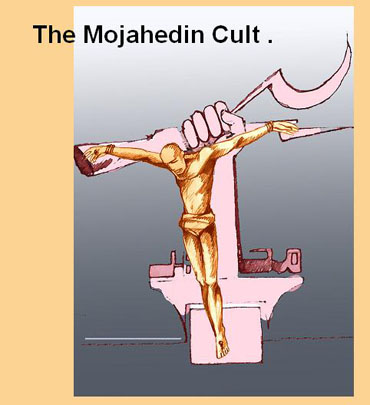
The translated text of Dr. Abbasi’s speech made at the Symposium of the Link between Cults and Terrorism held in Isfahan.
Introduction
One of the common procedures of assessing social, political, ideological, and cultural movements is to compare and contrast them in order to predict their course of events in different circumstances and also to reveal some facts about them, facts that are even kept hidden from the insiders of such organizations. Such a comparative study prevents to be entrapped by prejudice and unfairness and lets everybody to make a sound judgment.
It has to be pointed out that in such an assessment, it is necessary to first categorize fundamental and effective characteristics of the system and then study such movements in terms of their shared characteristics. In other words, the features that should be taken into considerations are those shared by all cults not the accidental and unique features which emerge in the face a certain condition.
Such points will be considered in the present study. Mujahedin-e-Khalgh Organization (MKO), a.k.a the National Council of Resistance (NCR), shares the same features with its other alias (1) and other similar political movements that developed in recent years in Iran. Although, before and after the victory of Islamic revolution in Iran, they were not too influential, but their futile activities heavily impacted Iran’s social and political atmosphere. Moreover, the following factors may justify the significance of the study of such groups: hidden and apparent support of enemies of Islamic Republic of Iran such as liberal-democrat parties (similar to those in the U.S), fascist and reactionary parties (similar to those in Iraq) of MKO, fluctuation in the world’s order on the eve of the third millennium, and growth of terrorism along with the extension of ideological and practical theories of humanism, human rights and democracy. As such, one of the most assuring procedures is to conduct a comparative study between the current and past political and social movements and MKO to reveal the hidden aspects of this group to evolve a sound judgment of it.
However, it has to be pointed out that because of a lack of due time and authentic resources concerning certain historical periods, the present study aims to consider those movements whose history has been documented in history books leaving aside the ancient and legendary groups whose resources are not authentic. These concerned groups belong to post-Islamic period and which can characteristically and ideologically be compared to MKO.
Moreover, it is worth noting that since MKO pretends to be an ideological and cultural movement aimed at making social reforms, it has been tried to compare it to those movements who based their activities on social support and ideological infrastructures. However, the results indicate that MKO is the less socially supported movement amongst others. Despite some movements have attracted the attention of a large number of people, MKO is the least supported organization.
It is necessary to demarcate between those cults such as Babakie or Isma’ili Nezari and that of divine religious sects such as Shiite and Sunni rather than considering any religious sect as a cult. Beside the factor of divine revelation which constitutes the basis of Islam and Shiite sects, there are other factors which distinguish between a cult and a religious sect: eclecticism, violence, monopolism, mental and ideological metamorphosis, secret instructions, superiority of materialism under the pretext of spiritual pretensions, etc. For example, Shiite believe that “those things considered lawful by the prophet of Islam are permanently lawful and things considered forbidden by him are forbidden forever” (2). This belief has remained untouched after more than 1400 years, but all cults undergo various changes under the claims of ideological revolution after a short period of time.
Intrinsic Characteristics of MKO
A review of MKO’s statements, pamphlets, and instructional as well as propaganda booklets since 1960 implies that Mujahedin-e-Khalgh Organization is an ideological group advocating revolutionary moves aimed at provoking the masses to escalate a revolutionary uprising by exploiting possible means of violence and armed warfare in demand of forming a classless society devoid of any social inequality. Moreover, the sympathizers had to observe two main elements, confidence and absolute obedience never thinking of any criticism. No recruitment was admitted unless the applicants were qualified for the membership, a procedure that well distinguishes it from other active parties.
MKO’s ideological infrastructure is an eclectic one synthesizing Islam with Marxism. However, many experts and experienced members of the organization state that the organization is much tainted with Marxism than Islam. Its inclination to Marxism is proven since the organization plays a key role to define concepts such as discrimination, class and economic equality, struggle, and the like that are the central issues in Marxism. In contrast, its adherence to Islam is partial and selective mainly extracting social and political rules while disregarding laws concerning individual status, legal laws, and religious rituals. In addition, the organization’s ambitious utilization of Islamic concepts such as martyrdom, leadership, jihad, enjoining good deeds and forbidding evil are best exploited by the leaders to justify the group’s deeds. As such, many religious customs and rituals of Islam were denied since they were known to be reactionary and thus, Marxism was decorated with an Islamic texture.
However, here the aim is to discuss the remarkable characteristics of MKO rather than its ideological inclinations. It is evident that there are eclectic elements in MKO’s ideology, but here we do not use the term “eclectic” as denoting a negative conception. We use it because it is the best term describing the combination of two or more ideologies in a single one. Some people consider eclecticism as a useful procedure in order to select positive points of different ideologies while some other consider it as an example of distortion in religious issues.
It seems that the first ideologues of the organization were of the first group and believed that they could form a dynamic religious and revolutionary ideology through combining positive points of Marxism and Islam in order to fight against the reign of Iranian monarchical regime. To achieve this end, the Islamic rules did not seem to be productive, as they concluded. On the other hand, because of the global political circumstance at the time that regarded the left ideologies as dynamic in confronting against global colonialism and capitalism, Marxism and communism, disregarding their inherent tenets of secularism and irreligiousness, worked as the best. The outcome was an eclectic ideology that combined Islam and Marxism to the point that the leaders distorted the Quranic concepts to harmonize their eclectic ideology. Later on, some other offshoots of the group like “Peykar” totally denied Islam and antagonized it while some others maintained what they did not judge to be reactionary. Moreover, being unaware of the history and philosophy of Marxism and because of a lack of comprehensive understanding of Marxism’s scientific role in the future, they submitted to a blind acceptance of some key materialistic concepts such as dialecticism, contradiction, and proletariat and never made an attempt to differentiate between them in Islamic and Marxist context.
In general, the organization’s four inherent characteristics can be enumerated as the adopted ideology, eclecticism, attaching to Islam and maintaining Marxism.
The fifth characteristic which was not a product of synthesizing Islam and Marxism but the result of a sever atmosphere of strangulation in Iran in 1960s was a dominant inclination toward revolutionary feats in their most violent form since, because of the overwhelming political situation, no peaceful struggle seemed to be contributive. The best violent struggle mold was known to be assassination and revolutionary execution that MKO proved to be expertise in the practice. The evidences are the group’s perpetrated atrocities before and after the Islamic revolution in Iran, like the violent moves against the survivors of Pahlavi’s regime, armed demonstration in 1980, bombings and assassinations, collaboration with Iraqi regime, and a broad military aggression across the Iranian borders named Forugh-e-Javidan, Operation Eternal Light.
Another unique feature of the organization which has been developed parallel to its ideology, the outcome of both the cause and effect of its ideology, is its inclination to be a cult. This innate tendency made the organization from the very beginning to be a closed and secret group, a tendency that evolved under the impact of a variety of unfolding, both intentionally and unintentionally, which was much the impact of its eclectic ideology, revolutionary objectives, and organizational conducts. (3).
A Comparative Study into a Number of Islamic Cults
Regarding the above-mentioned distinctive characteristics of MKO, it is necessary to further a study of some political and social movements that persisted in a thousand-or so-period and which were similar to MKO. A comparison between the activities and destiny of those movements and that of MKO helps to illuminate facts on the manner, nature and course of events of MKO and grants Iranian elite, officials, masses and even diplomatic and juridical officials of other countries an opportunity to make a sound judgment about this group.
It has to be pointed out again that we are not to value or disvalue such concepts like eclecticism, cult, etc. Rather we use them in order to get a better understanding of the nature of this system, permitting others to make due judgment in this regard.
One of the reign eras in the history of Iran and Islam which gave rise to various movements is that of Abbasids in the second century A.H. because of development of conflicting ideas in Muslim world and certain political and social conflicts.
The remarkable feature of these movements was that they were invested with eclecticism, thought and faith deviation as well as exploiting religion for material and worldly gains. These early Islamic movements turned into a new cult with a leader who occupied a high status parallel to that of an imam, prophet or even God. The followers mainly involved farmers, slaves and common masses. It is interesting to know that the cult leaders were mostly dismissed rulers who now turned to abuse national and religious beliefs to regain a higher status.
An interesting case to begin with may be rebellion of Al-Muqanna’ or masked prophet in the years147-148 A.H. At first, he was a launderer and then was appointed as the secretary of Abu Muslim of Khurasan. Once in a war he lost one eye and since then wore a mask on his face. However, his followers believed that since he claimed to be incarnated God and God could not possibly be seen, he did so to maintain his sacredness.
After the death of Abu Muslim, Muqanna claimed that Abu Muslim’s soul had become incarnated in him and soon claimed to be a prophet and later a divinity. He would hide his face under a golden mask and formed his eclectic cult.
The followers of Muqanna’ consisted of some infidel Asian Turks, Zoroastrians, and a number of other cults. They would wear white garments and started a 14-year long period of murder, plundering, destruction of mosques in the vicinity of Khurasan. Finally, Muqnna’ was surrendered in a fort by Harat ruler. When he became certain that he would be killed, first he poisoned all his wives (about 200 women) and then threw himself into the fire along with some of his followers and burned to death. The major typical of his cult was adherence an eclectic ideology in the frame of a cult and practice of violence. (4)
Coincident with Muqanna’, somewhere in his neighborhood, a man called Staps rebelled in Sistan in 150 A.H. He was a Zoroastrian who pretended to be Muslim. Despite gathering a large number of supporters, he was surrendered, imprisoned, and killed by Mansur Abbasi. Since then, a number of other eclectic rebellions were formed none of which were successful. Such eclectic groups, under the pretext of Islam, indulged in most violent practices; they destroyed the mosques and beheaded children in schools (5).
Babak Khorram-Dīn or Babak Xoramdin formed a Zoroastrian cult which was also tainted with pre-Islamic faiths. They were alleged to run a communal life of sharing wives and properties, somehow an ancient form of a Bolshevik and Marxist community that adhered to a violent strategy that resulted in many murders and plundering. Being a great threat for both Muslims and non-Mulisms, he was suppressed by Muslim Caliphs. After his death, Mazyar, an Iranian prince, became the Khorramis’ leader and continued the path of the former in a much violent manner in looting and killing in the northern Iranian cities of Amol and Saari in 224 A.H. He also maintained the same eclectic ideology and cult manner of Babak. Finally he was imprisoned and executed by Mo’tasem Abbasi (6).
Khawarij was another case of a violent cult in the early Islamic period. Their cult was formed after the Battle of Siffin. They were known to be most violent and extremist. They called their opponents infidels and considered their killings a duty to accomplish. Khawarij were an amalgamation of some other cults, like Abazie, Azaraghe and the like, which were all infamous for their violent feats. The group ended to be notoriously referred to by historians as the Puritans of Islam. It is worth noting that after some decades, regardless of holding onto extremely catchy mottos, they underwent a change to become a conservative sect and became spoiled to the point that actually rejected what they once held precious and strongly fought to promulgate (7).
It is worth noting that all above-mentioned movements were eclectics as well as cultist. In fact, cultist groups such as Khawarij, Babakie, Muqanna’i and the like were popular and famous cults (8).
Isma’ilim is another political and social movement in Muslim world; Iran, Iraq, and Saudi Arabia in particular. Despite many similarities existing between this sect and Mujahedin-e-Khalgh Organization, little attention has been paid to further studies.
Of other important ideological, political and social movements in Islamic territories is Isma’ilism. A split of Isma’ilism is what is notoriously referred to as assassins of Alamut that many think it analogous to MKO. Batinis is also an offshoot of Isma’ilism that can be compared to MKO. Isma’ilism evolved many other splintered sects and was favored by other religions and non-Islamic ideologies because of its innovative and self-interpretation of Islam both in doctrine and practical laws. Such characteristics turned it into an eclectic cult recruiting members of other cults (9).
The first leaders of Isma’ilism, being afraid of the rulers of the time, lived in the hideout and thus, were mostly known as the “occult imams”. The occultation of leaders continued in the next generations to achieve a holy status among the masses. A good example may be Hasan Sabbah(10).
The Iranian Isma’ilis, known as Nizaris, gradually transformed into an extremist cult to the point that they rejected to obey the Fatimid Caliph in the Egypt and tried to recruit remainders from among Mazdakites, Zoroastrians and some others and turned into an eclectic cult. They resorted to violence and assassination and perpetrated big crimes and assassinated king Mlik of Saljuk, Khajeh Nezamolmulk, and a number of Abbasid Caliphs. The Isma’ilis also underwent some ideological revolution, the same as MKO. After a while, this sect that had suffered a complete internal metamorphosis, lost its supporters and was dismantled by Mongols (11).
Qaramite was another aggressive cult formed in 264 A.H. by Hussein Dehdari in Iraq. Qaramite initiated first in Isfahan, Ahvaz and near the Kufa in Iraq. His followers were mostly Qebtis and Arabs while its leaders were Iranian. They distorted Islam and even deviated from the fixed, practical Islamic rituals and made the Arab followers rebel against Sunnis and other Arab tribes; they spilled the blood of people and looted their wealth in Syria, North Iraq, Bahrain, and Yamame (12).
Abu Tahir al- Qaramati was one of the leaders who in 311 A.H. conquered Basra and shed much blood. He invaded Mecca in 317 A.H., and when his troops entered the city, they massacred the people and even the pilgrims who were around and within the Ka’bah. He tore away the door of the Ka’bah and took the Black Stone from its place to Yemen. It was in the hand of Qaramite for 22 years and was later returned by his successors (13).
Qaramatie’s practice of violence was to the extent that even Isma’ilis avoided having any link to it. Eclecticism of this cult was known to every body as a combination of Islamic and non-Islamic ideas. Being an aggressive and threatening cult, any allegation of being a link to it was enough to seize upon a suspect to take away his properties and be executed. (14).
Formation of eclectic cults has been accelerated in recent century. Babism, Baha’ism and Wahhabism, out of which originated al-Qaeda, sects that like Qaramate differ in both the principles and Branches of Islam developed in the modern age.
For example, Babism, initiated during the Qajar reign, was a combination of Isma’ilism and Sufism. Not only it turned into a cult but also took a different path from Islam and came to believe in a devised prophet and Book other than Mohammad (A.S.) and the Holy Qur’an. Baha’ism, formed by Hussein Ali Noori, was a sect branched from Babism.
Besides being eclectic cults, theses cults were strongly supported by England and Russia. Babism was more like an ideological revolution which abrogated Islamic rules that consequently attracted the attention of many permissive people.
As a result of economical and social problems at the time, most supporters of Babism were from among the lower classes that rose in rebellion in various parts of Iran and plotted bloody killings. For instance, they killed Mohammad Taqi Barghani known as “Shahid Thani” in Qazvin when he was saying prayer with broadsword. They also made attempt to assassinate Naser al-din Shah, the Qajar king, and Amir Kabir and killed an old woman in Yazd in Pahlavi’s reign accusing her of cursing Baha’ism (15).
Wahhabism was much violent. Not generally considered a cult, it was also abhorred by the Sunni Muslims, and once its leader Ibn-Taymyyia was excommunicated by great Sunni Faqihs. In the past three centuries, this cult has been heavily supported by Western and colonialist governments. Interestingly, propagating the mottos of Salafism, the cult insisted on reintroducing Shariah (Islamic law) and renaissance of the tradition of the Prophet Muhammad (S). it shed people’s bloods on allegations of having faith in modernized Islam.
In contrast to what is said, Wahhabism is opposed to both Shiite and Sunni Muslims. It was only some years ago that they assaulted Egyptian pilgrims of Mecca in the vicinity of Mecca and killed a lot of Sunni pilgrims. The killing darkened the political relation between Wahhabists and Egypt for years. Their much recent bloodshed was killing of many Iranian pilgrims in 1986.
Nowadays, the dormant Wahhabism is split in two groups. The group seeking violence and crime is known to be al-Qaeda notoriously referred to as an aggressive and terrorist group. It was first supported by Arab Sheikhs, the U.S., and England. The second group underwent a metamorphosis after facing the resistance of Shiite and some other conservative Sunni groups as well as establishing ties with the modern, liberal and the capitalist world. They have resorted to cold war by means of propaganda and political activities and prefer to follow a strategy of wealth gathering. They form that greater part of Wahhabism.
Of other atrocities of Wahhabism is their invation to Karbala and Imam Hussein’s Holy Shrine seeing the weakness of the Othman empire. They massacred a great population there and offended the Holy Shrine by riding their horses into the shrine and looting its treasures (16).
Now, with respect to the above mentioned characteristics of some cultist movements during the past 1400 years in Islamic history, disregarding many existing cults in Christianity, Buddhism, and other faiths, shared characteristics of cults can be identified as follows:
1. Cults have a special outlook on the religion, faith and ideology in contrast to what the majority of people believe in. In their view, the other majorities are misled.
2. Eclecticism; it is the result of (a) a new developed outlook toward ideology, and (b) it is used as an instrument to recruit passive members of the society.
3. The lack of a theoretical balance as a result of eclecticism, i.e. cultist eclecticism consists of putting cultural and ideological issues side by side. It may lead to imbalance and violence.
4. Cults’ opposition to majorities results in the justification of applying violence against others.
5. Cults in their early days receive a great support but their later function cause abhorrence and they face many detachment.
6. They propagate under extremist and catchy slogans.
7. They gradually deviate from their early ideology and undergo a transformation that is in absolute contrast with their basic principles. It is a result of practice of extremism and eclecticism that leads to metamorphosis.
8. They revolutionize their ideological thought and principles calling it ideological innovation and new tactic.
It seems that such actions aim at solving problems, strengthening leadership and turning members into absolute cultists. For example, Isma’ilism abrogated some Islamic rules and declared drinking wine as lawful. According to Mas’ud Banisadr, an ex-member of the National Council of Resistance (NCR), Mujahedin-e-Khalq resorted to ideological revolution after any defeat.
9. The leaders are granted a status as high as the saints or incarnated God to increase the blind obedience of the insiders.
Endnotes
1. The U.S. State Department report on MKO.
2. A well-known saying found in many hadith collections and approved by all Shiite scholars.
3. The history of Mujahedin-e-Khalgh organization and National Council of Resistance.
4. Abbasid Reign in Iran, vol. 4, Cambridge University Press, pp.59-60.
5. The History of Iran after the Advent of Islam, p.456.
6. Abbasid Reign in Iran, pp.68-9.
7. The History of Iran after the Advent of Islam, pp.364-5.
8. Iranian People History, vol.2, p.153.
9. ibid.
10. ibid, pp. 153-4.
11. ibid, pp. 154-5.
12. ibid, pp. 155-6.
13. ibid.
14. ibid.
15. Shamim, Ali-Asghar; Iran under the Qajar Reign, pp.151-2.
16. Khanswari, Mohammad-Baqir; Rozat-al-Jannat, vol.4, pp.402-6. Also the great Islamic encyclopedia; Al-Saud
Nejat Society – June 2007
Translated by mojahedin.ws
The Mujahedin Cult