To the Representative of the International Committee of the Red Cross in Albania
To the Honorable Representative of the International Committee of the Red Cross in Albania,
Greetings and respect,
Dear sir,
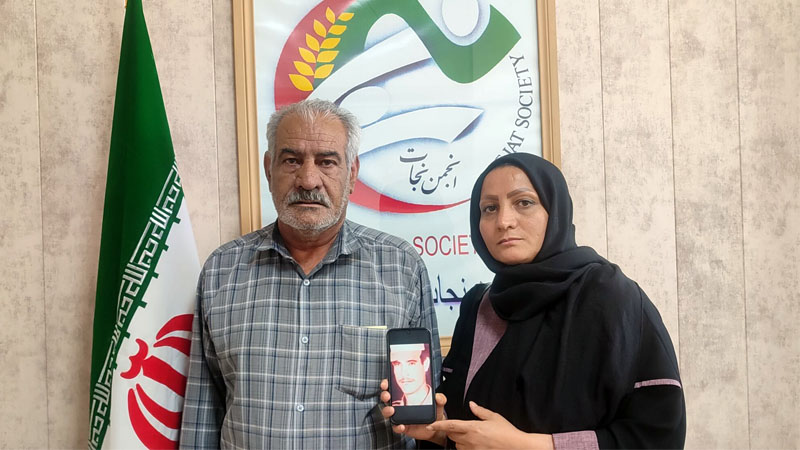
I, Ghorbanali Balaei, the eldest son of my family, respectfully write to you on behalf of all my family members. We sincerely request your assistance in arranging a meeting with my brothers, Mehraban Balaei and Kiumars Balaei, who are currently held in Manza Camp (known as Ashraf 3) in Albania.
If arranging a physical meeting is not immediately possible, we urgently ask that you at least facilitate a telephone connection between us.
My family and I have been waiting for over forty years without any information about the well-being and conditions of my brothers. My brother Mehraban, who was married and father to a son, was captured during his military service. Sadly, until today, he has not been allowed to make even a single phone call to his child.
We respectfully request that—based on your humanitarian mission and legal responsibility to support victims of enforced separation and violence—you assist in restoring communication with our loved ones. We ask that they be permitted, at the very least, to make a telephone call to us.
Thank you for your attention and consideration.
With respect,
Ghorbanali Balaei
+989111848827
Mujahedin Khalq Organization members’ families
To: United Nations Working Group on Enforced or Involuntary Disappearances
Subject: Request for Investigation into the Whereabouts of My Brother, Houshang Pour Ebrahim
Dear Members of the Committee,
My name is Soghra Pour Ebrahim, and I am the sister of Houshang Pour Ebrahim. My brother, Houshang Pour Ebrahim, was captured by the forces of the People’s Mojahedin Organization of Iran (MEK) on October 16, 1987, while serving his mandatory military service in the Baneh region of Kurdistan Province, Iran. Since that time, we have had no information about his fate, whereabouts, or condition.
Over the years, our family has made repeated efforts through various organizations and unofficial channels to obtain any news about him, but no clear answer has ever been received. My mother and I remain waiting and hopeful for his return. Sadly, our father passed away after years of grief and uncertainty over his disappearance.
I respectfully request that the esteemed Committee to use its mandate to investigate the fate and current status of Houshang Pour Ebrahim and to inform our family of any findings.
With sincere gratitude and respect,
Soghra Pour Ebrahim
Dear Director General of the International Committee of the Red Cross,
With respect and best wishes for your success,
we, the families whose names are listed below, in Iran and Kermanshah province, would like to inform you that one of our family members was captured by the Iraqi army during the Iran-Iraq war four decades ago.
Each of them spent the war and the end of the ceasefire in camps and detention centers in Iraq. During those years, we, the families, were informed of the status of our captive members through letters from the International Committee of the Red Cross based in Iraq.
We would like to inform you that 37 years have passed since the ceasefire between Iran and Iraq and the government has changed in Iraq, but our family members have not yet been exchanged and returned to their families.
According to Article 118 of the Third Geneva Convention, prisoners of war must be released and returned to their country immediately after the end of active hostilities. Despite this article, our children have not been exchanged 37 years after the end of the war.
According to the information we have received from the released prisoners, we learned that our children were injected by the dictatorial regime of Saddam in a deal with the terrorist group Mujahedin-e-Khalq, which was based in Iraq at that time, and the International Red Cross was deceived into believing that they freely chose to join this group. And now, for several decades, this injustice has been done to our prisoners.
Therefore, we, their families, ask you, as the International Red Cross, whose duty is to free our captive children, to take action regarding the release of our children. It is necessary to clarify that the Mujahedin-e-Khalq organization, which has taken our children into second captivity, has left Iraq and has a camp called Ashraf 3 in Albania, so we ask you for help in freeing our loved ones.
Thank you in advance,
Names of prisoners:
Ali Sepah Amiri/Yahya Moradpour/Nowrooz Darvishi/Alireza Jafari/Ali Ashraf Maleki/Houshang Moradi/Abdolkarim Karimi/Mohammad Ali Parva/Ali Asghar Darvish Tabar/Alimorad Lotfi/Mosayeb Rashidi/Alireza Khalo Kakaei/Ali Yousefi.
When Soraya Abdollahi was working day and night as a single mother in her 30s to provide for her three young children, she thought the biggest challenge she would face in the future was ensuring her kids received an adequate education and married someone they loved. She never imagined that, at 64 years of age, she and the rest of her family would have already spent over two decades looking for her only son, Amir Arsalan.
Soraya has three children. Arsalan is the second, and the one she felt the closest to. “We led a difficult life financially,” she explained. “I worked at factories and sometimes had to take night shifts. Arsalan helped me with money. After school, he worked at car repair shops, made his own allowance, and helped buy some of the things his sisters needed.”

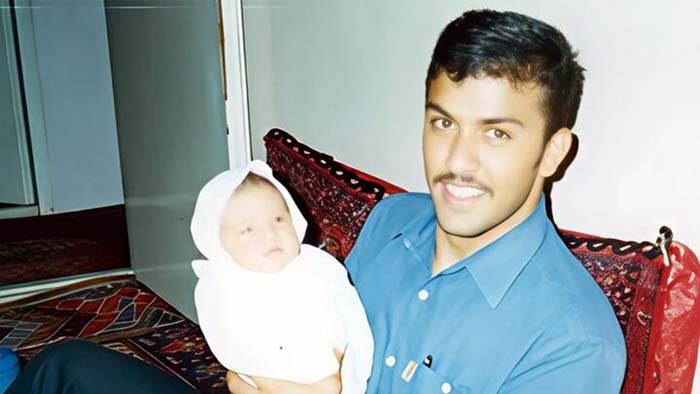
Amir Aslan holding his little sister. He is in his late teens in this picture
Arsalan became obsessed with bodybuilding around the age of 16. He liked the sport because it helped him gain strength and could ultimately help him make money. “He had a coach who told him he needed to complete an international course. That way, he would be able to take part in tournaments and also have trainees of his own.”
In the early 2000s, Soraya’s beloved son travelled to Turkey at 20 years old to get the certification. There, he met an Iranian man who owned a factory in Germany. In reality, however, the man was an undercover Mojahedin-e-Khalq (MEK) agent, looking to recruit new members for the terrorist organization.
“Arsalan called me one day, saying he’d changed his plans,” Soraya remembered. “He said he’d met a wealthy factory owner who offered him a well-paying job in Germany. He said the man promised he could bring me and his sisters to Europe after a few years.”
The Istanbul hotel where Arsalan was staying also housed many other Iranians. The MEK agent had strategically placed other group members around the hotel to vouch for the supposed factory owner, portraying him as a generous and philanthropic individual to those he was targeting.
Soraya sent a significant amount of money to Turkey to cover her son’s travel expenses to Germany. “The man who claimed he was taking him to Europe even spoke to me on the phone while Arsalan was still in Turkey,” she recounted. “He said the money I’d sent wasn’t enough, but that he’d still take Arsalan and deduct the remaining amount from his salary.”
Arsalan called his mother shortly after to say goodbye. Then, he vanished.
“I was worried sick every day. I couldn’t believe I had lost contact with my son so easily and had no way of reaching him. It was a living nightmare.”
It took Arsalan three years to contact his mother again. He told Soraya that he had been staying in a refugee camp in Germany where no means of communication existed, but that he was now out and about, living a good life, and training dozens of athletes at a gym he owned.
“He gave me a German number and said we could now keep in contact regularly,” Soraya stated. The number turned out to be a fake.
Four years outside hell’s gates
It wasn’t until 2008 or 2009 that Soraya discovered the truth about her son. The supposed factory owner Arsalan had met hadn’t taken him to Germany at all; instead, he’d taken him to Iraq. And not just anywhere in Iraq, but to Camp Ashraf: the desolate and secluded headquarters of the MEK, holding over 5,000 individuals. Some had entered the camp willingly, while others, like Arsalan, had been abducted and dragged there.
“I found out about my son’s fate through a distant relative of my sister-in-law, who had left the MEK and returned to Iran. He knew me, so he looked for me and let me know what had happened to Arsalan.”
Back then, Soraya didn’t know much about the MEK. She recalled hearing their name on television in the 1980s when they were carrying out terrorist attacks in Tehran, but at 18, she was too focused on her new married life to pay much attention. Even after learning that Arsalan had been taken by the MEK, she naively imagined they lived relatively normal lives within the general population. The reality of the situation only became clear when an association founded by former MEK members took her and other families whose children had been abducted to Iraq. Their goal was to shout their children’s names outside Camp Ashraf, hoping they would hear them and attempt to escape.

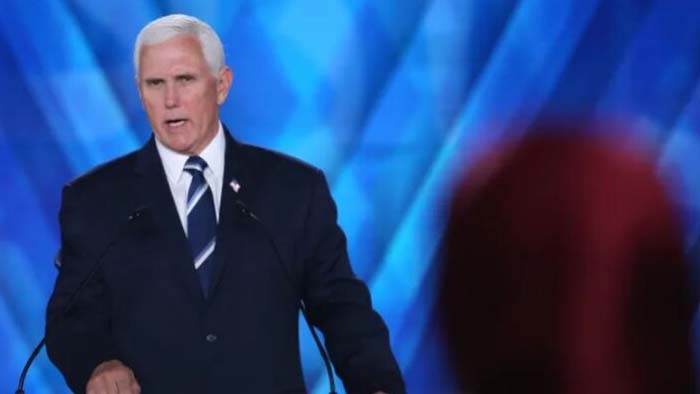
Former US Vice President Mike Pence addresses the MEK at the Ashraf-3 camp in Albania on June 23, 2022
“We crossed into Iraq through the Mehran border in western Iran. I can’t truly describe the emotions I felt when we reached what was essentially a desert. People pointed to these horrifying concrete blocks and said, ‘That is Ashraf.'”
As previously reported by the Tehran Times, those inside the camp were virtually cut off from the outside world. Mobile phones were forbidden, TV watching was restricted, and computer use was limited to assigned tasks. Relationships were tightly controlled as well. The group’s leader, Masoud Rajavi, forced all couples within the camp to divorce, separated children from their parents, and claimed all remaining women as his own wives. He mandated daily sessions where everyone was forced to confess their “sins” and reaffirm their loyalty to Rajavi and his agenda.
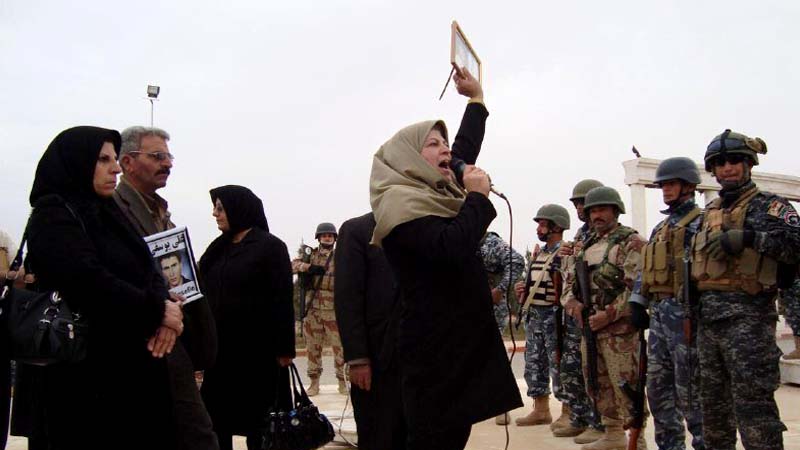
Soraya stayed outside Camp Ashraf for four years. She and other families of abductees lived in harsh conditions alongside the Iraqi Army stationed nearby. Food was scarce, clean water was unavailable, and maintaining hygiene was a constant struggle. But Soraya persevered despite the hardships. She and the others would set up loudspeakers around the camp, shouting their children’s names into microphones, hoping to reach them. Of course, none of their children were ever allowed to approach the gates. Occasionally, some of the higher-ranking MEK members would come out to hurl insults, rocks, and pieces of scrap metal at them.
Soraya was eventually forced to return to Iran for surgery after her back got severely injured in one of these attacks. By the time she returned to Iraq, her son had been moved to a new MEK camp in Albania.
“We tried to do the same thing in Albania. Back then, Albania still had an embassy in Iran. I went there with a few other mothers to apply for visas, but we were all denied without any explanation. Every time we tried after that, the result was the same,” she said, tears starting to stream down her face.
According to information obtained by the Tehran Times, the new camp in Albania—set up for the MEK with U.S. coordination—is run under the same harsh and inhumane conditions as the one in Iraq. People there are stripped of their freedom and identity, forced to work long hours every day, and face severe punishments, even death, if they don’t follow orders.
Tirana snapped its diplomatic ties with Tehran in 2022, under the alleged influence of the United States and Israel, the two biggest supporters of the MEK. Albanian police even raided Iran’s diplomatic premises when the diplomats were not in the building.
Betrayed also by international rights bodies and Western states
After no luck with the Albanian government, Soraya then hoped that involving an international body like the United Nations might help. “All I knew was that the UN was responsible for upholding human rights. So, I went to Geneva in 2016 with several families whose children were also trapped in Albania,” Soraya explained.
In Geneva, she managed to meet with Ahmad Shahid, who was the UN Special Rapporteur on the human rights situation in Iran at the time. “I told him my story, and he assured me he would help me meet my son. He invited me to attend a meeting he was having with the MEK at the UN building. But when he saw me at the meeting, he pretended he’d never met or spoken to me before.”

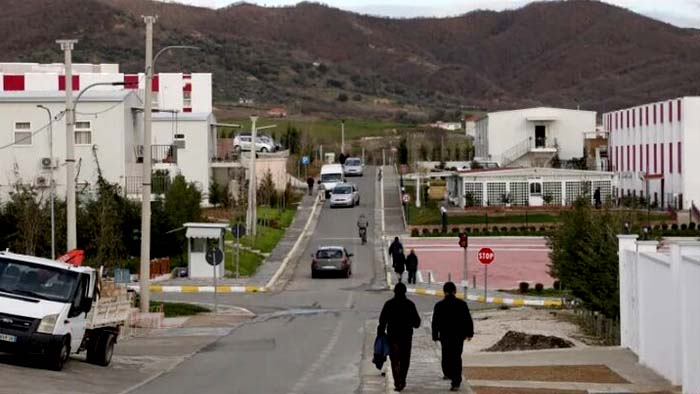
Individuals walking on the streets of Ashraf-3 camp near Tirana. They are banned from exiting the site or communicating with the outside world
Her experiences with organizations like the International Committee of the Red Cross (ICRC) followed a similar pattern. She would initially be promised assistance, only to be ignored indefinitely.
Soraya’s disappointment does not end with international organizations. While she lives every day in pain thinking of her son living in a terrorist jail, Western governments – particularly the US, UK, France, and Germany – promote the terrorist group as freedom fighters striving to bring prosperity to Iran! The MEK is routinely brought to the U.S. Congress as well as European parliaments, honored, and at times awarded.
“I understand that these governments have political goals and are using the MEK to achieve them,” Soraya stated. “But still, how can they call these people democratic? The MEK is torturing its members physically, mentally, and sexually. And now, Albania shelters them while refusing to let mothers like me see our children.”
The future, and what it could look like
An Iranian court is currently conducting public hearings on the crimes committed by the MEK over the past four decades. Since Soraya’s son did not join the group voluntarily, he, along with nearly 2,000 others associated with the organization, is not on the list of defendants. However, Soraya believes that if the doors of the MEK camp in Albania open and people get the chance to leave, even some of those who joined willingly could return to Iran and live there safely. She says she knows many former members who have already come back and are now leading normal lives, just like any other Iranian citizen.
“I doubt any other government would be this forgiving toward people who took up arms and fought against their own country,” she said, referring to the MEK’s alliance with Saddam Hussein during Iraq’s invasion of Iran in the 1980s. “Yet, based on what I’ve learned over the years, Iran’s government has pardoned many of them.”
By the end of our interview, Soraya looked tired and hopeless, a state that also characterized her 24-year search for her son. “I just want to hear my son’s voice one more time. Is that too much for a mother to ask for?”
By Sheida Sabzehvari
The Mohammadi family is among the families of victims of the Mujahedin-e Khalq (MEK), one of those families whose members were murdered by the group.
During the Iran-Iraq War, Nasser Mohammadi was captured by the Mujahedin-e Khalq forces, who were fighting alongside Saddam Hussein’s army against their homeland. He was then forced by pressure and threats to participate in the group’s cross border operation against Iran, named Forough Javidan (Eternal Light). Since Nasser did not want to take up arms against his homeland, he attempted to flee to Iranian soil near the border, but in the presence of eyewitnesses, he was shot in the back by the MEK agents and was killed.

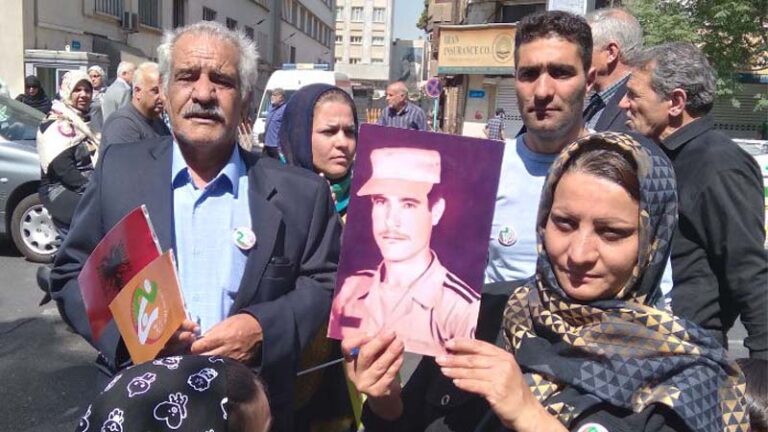
Naser Mohammadi’ family in a protest gathering among other Nejat families
Nasser Mohammadi’s family followed up on this important issue as soon as they learned about his murder by MEK agents. Nasser’s brother Houshang Mohammadi, while in Camp Ashraf in Iraq, directly asked the MEK leaders for an explanation and requested evidence, but as usual, they distorted the truth and identified the Iranian government as the killer of his brother. This claim was not accepted by Houshang, and the issue even escalated into a verbal altercation.
Due to the existence of eyewitnesses to Nasser’s killing by the MEK, his family has been suing the MEK for the murder of their brother since those days. The Mohanmmadis are among the plaintiff families against the leaders of the MEK in the process of their trial. They are members of Nejat Society.
On Saturday, February 1st, this family met with other members of Nejat Society’s office in Zanjan Province. Pursuing the legal process against the MEK leaders and the group itself as a legal entity, through a short video message, they asked the honored head of Branch 11 of the Criminal Court of Tehran Province to consider their family’s complaint.
Dear son,
Why don’t you relieve us from distress with at least one call!? We are fine thanks to God, but we miss you and are waiting for you. Your mother is very sick and so am I, but I have to take care of us and try my best. Of course, your brother takes care of us a lot and loves us. I wish you were here and we could have a happy life together.
Dear Esmail
It has been almost fourteen years since you left us and joined the Mujahedin-e Khalq. Think about it! What have you gained in these years? except that you have wasted your life and youth and you have become far away from your homeland and family.
My dear Esmail
Do you remember our neighbor Sholeh Shadram (Akram)? In 1991, she left the Rajavis and moved to Turkey, and from there, she got refuge in Sweden where she started a family. Having a successful family, she has several children, and the interesting thing is that she returned to Iran and her hometown easily and without any problems. Since then, she travels to Iran and back to Sweden. She has a very good life.
Dear son,
You too can reach the free world by releasing yourself and choose a good and comfortable life. Of course, we are eager to meet and hug you in our warm arms in Iran. Come soon, I miss you so much.
Ismail, I kiss you from afar. Mother also greets you and asks you to call us with this 09919139801.
Your father
Mohammad Hassan Pour Mohammad Ali Bazkiai
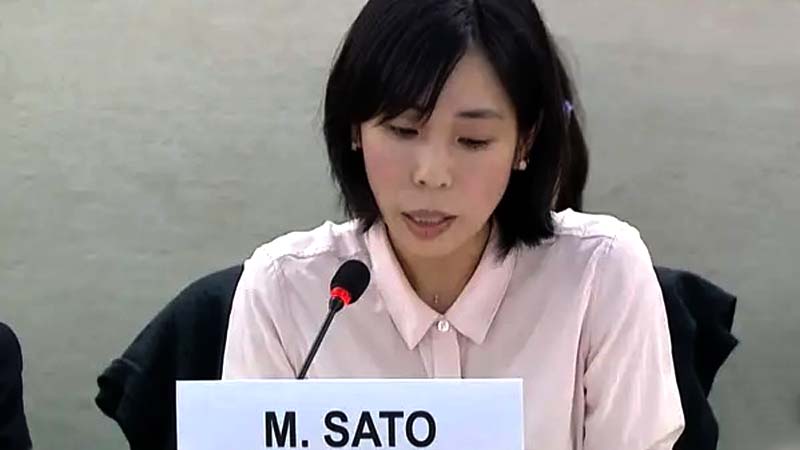
Dr. Mai Sato,
We are a group of Iranian families in Ilam province. We would like to congratulate on your selection as the Special Reporter on Human Rights in Iran wishing you success.
1.I am Mohammad Taheri, Fereydoun Taheri’s brother. My brother is in Ashraf 3 in Albania. My brother has been in the Mujahedin-e Khalq Organization for almost 20 years.
2. I am Farahnaz Moradzadeh from Ilam Province, Satar Kheti’s Mother. My son is taken as a hostage in Ashraf Comp 3, in Albania. My son has been a prisoner of the destructive Mujahedin-e Khalq Organization for 21 years, and we have no information about his situation.
3. I am Sadegh Jalilian from Ilam Province, Holeylan District, Morad Jalilian’s brother. My brother is captive in Camp Ashraf 3 in Albania. My brother was captured in 1988 during his military service in Mehran region in Iran-Iraq war. He has been imprisoned by the Mujahedin Khalq organization for 36 years, and there is no information about him. we do not know about his status.
4. I am Dara Namdari from Ilam Province, Holeylan Districe, Yousef Namdari’s brother. My brother is imprisoned in Ashraf 3, Albania. My brother has been a captive of the destructive cult of Mujahedin Khalq for 25 years, and we have no information about his conditions.
5. I am Rouhollah Mirzaei from Ilam province, Satar Mirzaei’s brother. My brother has been taken as a hostage by the Mujahedin-e Khalq in Camp Ashraf 3, Albania. He has been trapped by the violent Cult of Rajavi for 29 years and we have no information about him.
6. I am Khadad Barani from Ilam Province, Dehloran City, Ali Akbar Barani’s father. Ali Akbar is in Camp Ashraf 3 in Albania in the mujahedin-e Khalq organization. My son left home and joined the Cult of Rajavi 18 years ago and we have no connection with him.
7. I am Mohammad Cheraghi, from Ilam Province, Badre City. I am Akbar Cheraghi’s brother. My brother is in Camp Ashraf 3 in Albania. He was taken as war prisoner by the MKO in Mehran City. He had no contact with us for 36 years.
8. I am Jahanbin Khademi from Ilam Province, Saleh Abad City, Jahangir Khademi’s brother. My brother has been imprisoned in the Mujahedin-e Khalq Organization for 33 years and he had on connect with us during these years. My brother is a hostage in Camp Ashraf 3 in Albania now.
9. I am Ghazban Kheiri from Ilam Province, Hamid Kheiri’s brother. My brother in Camp Ashraf 3 in Albania. He has been involved in the Mujahedin-e Khalq Organization for 18 years and has not had any contact with us during this long time.
10. I am AIi Heiwari from Ilam Province, Mehran City, I am the brother of Mohammad Heiwari. My brother is in Camp Ashraf 3 in Albania, my brother is in the Mujahedin-e Khalq Organization for 43 years and we have no information about his status.
Dear Dr. Mai Sato, our children and the children of other families have no phone contact with us since they entered the Mujahedin-e Khalq organization The organization has restricted them. For what crime should they remain locked up and unmarried for the rest of their lives. This is genocide and war against God, we have already written numerous letters to international organizations and the Red Cross, but unfortunately, we have not gotten any results.
We have tried to meet our children several times, but the leaders of the Mujahedin-e Khalq organization have deprived us from this right. We and all families cannot meet our beloved children who are under the strict control of Masoud and Maryam Rajavi in Camp Ashraf 3 in Manz, Albania. May God makes us the subject of your unquestionable grace and merci.
May God bless you
Best Regards,
Some languishing families of MKO members
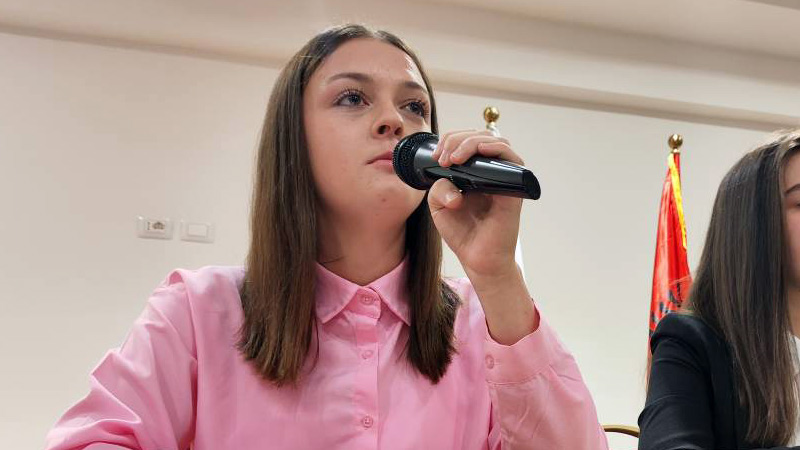
Ms. Basarta Brachai; economist and lecturer in Ashkodar is interested in human rights issues. Getting acquainted with the Nejat Society and its humanitarian goals, she appreciated the Society’s activities.
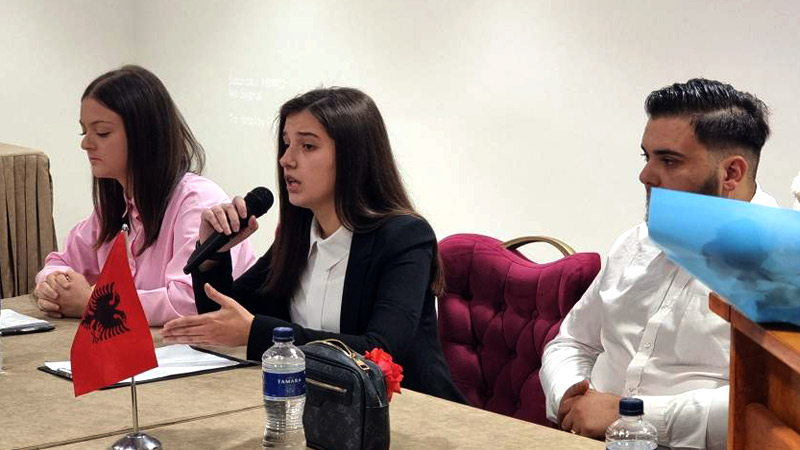
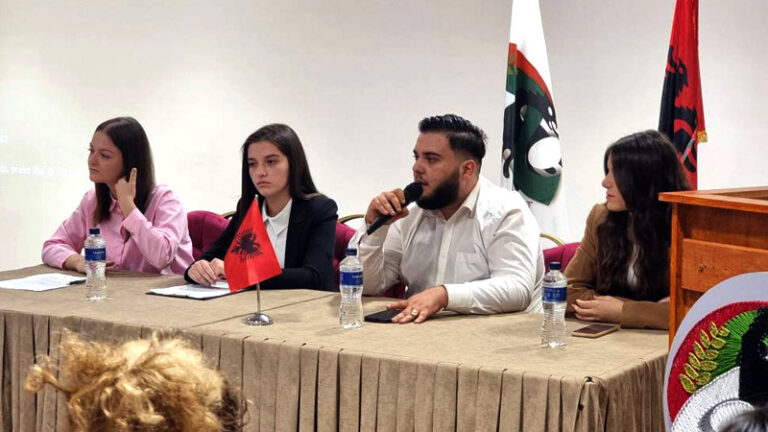
Ms. Brachai participated at the opening ceremony of the public screening of the documentary “Mother, Love, Separation” in the city of Shkodër and made a speech:
Greetings to everyone,
My name is Besarta Bracaj. I belong to the community of economic sciences.
This documentary made me see and understand “suffering” from a different perspective.
Although it is surprising, but it is true and of course very painful.
It is surprising that such an organization exists in Albania and in the world today, their activities are as strange as they are frightening.
How can you not allow a mother to meet her child, her loved one, her only son, her soul?
We all know that a child is the mother’s soul.
It is a violated right and a violated moral principle against those who are unable to take this God-given right.
Why should a mother cry for her child? Why shouldn’t there be a humanitarian law and policy that supports parents and families?
We all need to come together and fight this pain and bring smiles back to the eyes and hearts of these parents.
Let’s do a humanitarian thing and restore the rights taken from these people
Thank you for listening and participating
Basarta Brachaj – Economic expert
The opening of the public screening of the documentary Mother, Love, Separation held yesterday, November 3rd, in the city of Shkodër.
Aldo sullolari director of the 40-minute documentary made a speech after the screening:
Today we are gathered here to share a story, a story that feels the deep pain of mothers who face a pain that many of us cannot imagine. This film, entitled “Mother, Love, Separation”, tells us about the suffering of mothers in Iran, who are separated from their children for years, children who have joined the MEK terrorist organization.
This film is not just a depiction of suffering. It is a call for awareness, a message for all of us, especially for the Albanian public, to support these mothers and their children. Their pain, tears and suffering are evidence of a bitter reality, but our film also shows the power of dedication and conviction to bring back what has been lost.
During the filming in the Persian Gulf, we had the opportunity to experience deep events and emotions, which were skillfully described by our Albanian and Iranian activists. They bring a strong message of unity to the screen, showing that a mother’s love and strength are more powerful than any terrorist ideology.
Our film is a reflection of a sad reality, but also a hope for a brighter future. What we want is to create a feeling of solidarity, for all of us to be on the side of those who are suffering.
Through this project, we want to call for action. It is necessary to listen to the stories of these mothers and understand that each story is a cry for help. We cannot remain silent in the face of this tragedy. This is an opportunity to open a dialogue, to help those who are lost and to bring a light of hope into their lives.
Thank you for being here to support this film and the message it conveys. I hope we can all be inspired by these mothers’ stories and come together for a greater cause.
Thank you!
Dr. Elma Halaj is a general practitioner who has been interested in social activities since she was a student and is currently active in the medical community. The issue of mothers and families who have been separated from their loved ones for decades and are unable to communicate with them attracted her attention as a case of civil rights and human rights.
The text of her speech at the conference of the documentary “Love, Mother, Separation” directed by Aldo Solulari, media director of the Albanian Rescue Association, is as follows:
Dear attendees,
Today we have reached a special moment, not only for the Nejat Society, but for all those who have contributed to this wonderful journey. That’s why I want to share a few words about the Nejat Society, an association that has done an extraordinary job for the integration of Iranians in Albania, especially those who have left the MEK organization.
Nejat Society has been a guiding light for those who have been looking for a better life and an opportunity to renew their hopes. The latest film project, which has brought the stories of our lives and the challenges we have gone through, is a testament to the strength and resilience of our community. This film is an important step to raise awareness and show that we are more than just stories; we are individuals with our own dreams, aspirations and contributions to Albanian society.
As a medical doctor, I understand the importance of support and solidarity at every step of life. I hope that every student, every professional and every individual who is part of this community will continue to support projects like these, which create opportunities and help build a better and more equal society.
Thank you to Nejat Society for your hard work and the inspiration you provide to all of us. Let’s continue to work together, for a brighter and more united future.
Thank you