Nejat Society
  • Home
  • Articles
  • Media
    • Cartoons
    • NewsPics
    • Photo Gallery
    • Videos
  • Publications
    • Books
    • Nejat NewsLetter
    • Pars Brief
  • About Us
  • Contact us
  • Editions
    • عربي
    • فارسی
    • Shqip
Nejat Society
Nejat Society
  • Home
  • Articles
  • Media
    • Cartoons
    • NewsPics
    • Photo Gallery
    • Videos
  • Publications
    • Books
    • Nejat NewsLetter
    • Pars Brief
  • About Us
  • Contact us
  • Editions
    • عربي
    • فارسی
    • Shqip
© 2003 - 2024 NEJAT Society. nejatngo.org
US and terrorists
Mujahedin Khalq; A proxy force

Why the US should not trust the MEK

When it comes to a nation’s fate, sometimes the theory “the enemy of my enemy is my friend” is of little benefit.

We have seen it before in countries such as Iraq, where the US decided to support certain Islamist factions of the Iraqi opposition against the Saddam Hussein regime without considering the long-term consequences or possibility that these same opposition parties might turn against Washington.

And that is exactly what happened in Iraq after 2003, when the majority of Shiite Islamist parties that dominated the political arena turned out to be loyal to the Iranian regime, allowing it to operate on Iraqi soil through well-funded and trained militias directed by the Islamic Revolutionary Guards Corps to launch attacks against US-led coalition troops in addition to kidnapping and assassinating Iraqis who opposed Tehran’s interference.

Regarding Iran, the US is looking at an exiled opposition group, the Mujahideen-e Khalq (MEK), as the best alternative to the republic’s current rogue regime.

MEK Terrorists

Photo MEK have been the US’ and Israel’s terrorists for some time

What is this organization, and is it wise supporting a Marxist-Islamic group in order to replace another Islamic group?

In 1997, the US listed the MEK as a foreign terrorist organization (FTO) over the killing of several American citizens in the 1970s. Then, in September 2012, the US State Department removed the group from its FTO list — a surprise move since the organization was known for targeting US personnel and interests in Iran.

In protest at the 1972 visit of the late US President Richard Nixon to Iran, the MEK set off bombs in Tehran at the US Information Service office, the Iran-American Society and the offices of several US companies. Similar attacks were carried out by the organization throughout the decade.

“Though denied by the MEK, analysis based on eyewitness accounts and MEK documents demonstrates that MEK members participated in and supported the 1979 takeover of the US Embassy in Tehran and that the MEK later argued against the early release the American hostages. The MEK also provided personnel to guard and defend the site of the US Embassy in Tehran, following the takeover of the embassy,” a statement by the US State Department read.

The MEK supported the leader of the 1979 Iranian revolution, Ayatollah Khomeini, and played a part in overthrowing the last shah, Mohammad Reza Pahlavi, but turned against the new government after its leader, Massoud Rajavi, was banned from participating in Iran’s first presidential election.

The organization had strong ties to Saddam Hussein and his brutal regime in Iraq, where they took refuge and moved their base to a camp near the Iranian border in 1986 during the war between the two countries.

During that time, few knew what was going on inside Camp Ashraf. The cult-like group members were isolated from the rest of the country, while several human rights organizations reported that the MEK leadership has committed numerous human rights violations, including the abuse of female members.

After the war in Iraq in 2003, the MEK lost its major supporter, and was under attack by both US troops and Iraqi security forces.

The group is no longer welcome in Iraq since most Iraqi people remember it as another brutal faction that Saddam’s Republican Guards used to crack down on Iraqi Shiites and Kurds who revolted against the dictatorship in 1991, following the invasion of Kuwait.

Later, in 2011, the Iraqi government reached an agreement with the UN to disarm the group and move its members to a transitional location outside Baghdad, Camp Liberty, before resettlement in a third country.

The MEK, or People’s Mujahedin Organization of Iran, uses democratic and human rights slogans to present itself as the secular democratic choice for the people of Iran in a bid to garner the international support it needs.

What kind of democracy does the MEK believe in?

The well-funded group, which has been led by husband and wife Massoud and Maryam Rajavi since 1985, monopolizes the Iranian opposition in an attempt to silence potential rivals.

The US should be careful what it wishes for.

Several secular opposition groups have a strong base and support inside Iran and are leading protests against the clerical regime.

Political Islam was never a friend of the West, regardless of all the promises and vows, and should not be trusted.

That ought to be lesson No.1 from the Iraqi experience.

By Dalia Al-Aqidi – Arab.News

August 24, 2021 0 comments
FacebookTwitterPinterestWhatsappTelegramSkypeEmail
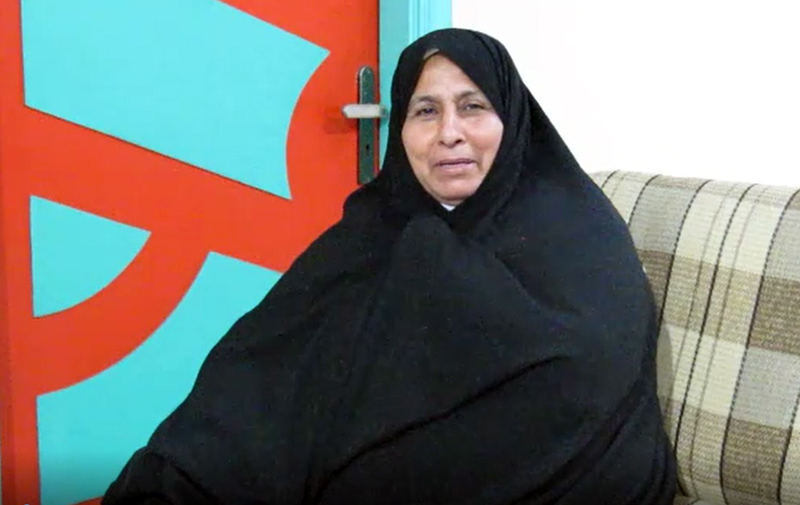
Zahra Moeini and Homeira Mohamamdnejad
Human Rights Abuse in the MEK

Female ex-member of MEK: our memoir of the cult is not fictional

“Cults are terrifying. But they’re even worse for women”, Alexandra Stein states.
Alexandra Stein, Ph.D. is an honorary research fellow at Birkbeck, University of London. Her latest book, “Terror, Love and Brainwashing: Attachment in Cults and Totalitarian Systems” was published in 2017.

What Stein reveals about women in cults has been seen in the testimonies of all female ex-members of the Mujahedin Khalq Organization (MKO/ MEK/ PMOI/ Cult of Rajavi). Over twenty years ago, Zahra Moini and Homeira Mohammadnezhad could manage to leave the MEK after they found it intolerable to stay in the cult-like structure of the group.

Homeira and Zahra have been denouncing the group during the years of living their free life in Germany although they were always labeled as agents of the Iranian Intelligence by the MEK propaganda. In a recent interview with Mardom TV, they talk about the group’s undemocratic practices against its own members particularly women and its current situation in the political and social scene of Iran.

Zahra Moeini and Homeira Mohamamdnejad

Zahra Moeini and Homeira Mohamamdnejad

“History should not be repeated in favor of villains,” Homeira says. “We give testimonies of our experiences in MEK to inform the world about the threat of a group that claims of huge changes in Iran but it does not observe the least human rights inside its own structure.”

“It is not easy for me to review the grieves I endured in MEK but I want more people to know about the disgusting relationships in the cult of Rajavi,” Zahra says.
“After I left the group, I used to see nightmares for so long,” Homeira adds. “When I began to speak out about my sufferings in the group, I felt much better. Our accounts of living in the MEK is not a fictional story. We speak based on facts.”

Homeira and Zahra state that members inside the MEK are deprived from the most basic human rights. “Members in the MEK are prisoners who even do not have the right to contact their families,” Zahra says.
“What has been the achievements of Massoud and Maryam Rajavi for the Iranian people and their own members?” Homeira criticizes the totalitarian leaders of the group. “Massoud Rajavi never takes responsibility for the suffers he created for his own members.”

About Maryam Rajavi’s partnership in the consolidation Massoud’s dictatorship over the cult, Zahra says, “When I was in the group, Maryam told us that the food we ate and the clothes we wore, all had belonged to Massoud! We were considered as a bunch of homeless wrecked people that Massoud had saved us.”
“The MEK’s goal is not the overthrow of the Iranian regime any more,” Zarha believes. “The MEK is stuck in a cul-de-sac but it does not let its members leave.”

“In case of the recent incidents in Afghanistan, the MEK has not taken any position so far,” Homeira says. “Massoud Rajavi’s tactic is based on squeeze. He is always ready to squeeze in the scene through chaos, war and divisions. This is what he exactly did in Iraq and then after the fall of Saddam Hussein he worked as proxy force for Iranian enemies. He might be ready to negotiate with Taliban against Iran.”

“Given that he changes the regime, Rajavi will change Iran into North Korea,” Zahra says.

August 23, 2021 0 comments
FacebookTwitterPinterestWhatsappTelegramSkypeEmail
USA influence in Albania
Albania

Is America Whitewashing Afghan Refugees in Albania

International consternation over the consequences of the American military withdrawal from Afghanistan has triggered recriminations and blame alongside demands for a rapid humanitarian response to help those fleeing. As usual with refugees from conflict, those countries which are most to blame for the crises are those quick to say they are doing their best, while still pandering to a minority racist constituency in their own countries which does not want them. These are the ones talking about numbers, not need.

Thus, the sudden mass exodus of refugees has exposed already existing divisions among the world’s major powers. And thrown the little Balkans country Albania into the spotlight as Albania serves once again as a litmus test for relations among these powers. News emerged that Albanian prime minister Edi Rama has agreed to host Afghan refugees destined for the US as a temporary measure so that their visa applications can be processed. As various western countries scramble to rescue their nationals and vulnerable Afghans who worked with them, this move should not be taken at face value but needs to be looked at in a wider context of America’s presence in the Balkans region. As we are witnessing in Afghanistan, American influence is increasingly recognised as ‘not benign’.

USA influence in Albania

After Albania joined NATO in 2009, American influence was cemented there

After Albania joined NATO in 2009, American influence was cemented there. Indeed, although Albania has ambitions to join the European Union, it is this American influence which is hampering efforts to meet the obligations required to join. As well as the EU’s interest in absorbing Albania, Russia has, of course, not relinquished its own interest in the country. China, also, is a major trading partner for Albania. Both Turkey and Iran have cultural, religious and social ties to Albania. But importantly, since its emergence from Communist rule in 1991, Albania has almost drowned in elements of corruption, crime and foreign influence that have left the country under the rule of mafia families and the Americans. Of course, America has taken advantage of this situation. These complex layers of influence and rivalry embedded in corrupt systems and governance enable the Americans to out muscle the other foreign players.

In 2014, the Albanian government was persuaded (paid) by then US Secretary of State Hillary Clinton to host nearly 3000 Iranian Mojahedin Khalq who were to be expelled from Iraq as members of Saddam Hussein’s repressive regime. Known as Saddam’s Private Army, the MEK had been designated as a terrorist entity by the US, UK and EU. But in 2012, the Americans delisted the MEK to facilitate its transfer to Albania without dismantling the group. The UNHCR claimed that they were transferred on humanitarian grounds. They weren’t. In Albania, the MEK continued unchecked its advocacy and activism for violent regime change against Iran.

The MEK was allowed to build a closed camp to house its members in the same conditions of modern slavery as they had lived in Iraq. Soon after, there was talk of Albania being used to house widows and orphans from Syria. This was a different proposition to the repatriation of Albanian women who had left to marry ISIS fighters; these were many families of many different ISIS fighters. They were to be housed in the MEK camp alongside the MEK members. The idea was to park this problem somewhere ‘neutral’ until the scandal had died down and they could be dispersed elsewhere. The mystery of who these potentially dangerous people were and what would become of them and whether they would be the vanguard for the reception of actual ISIS fighters received enough publicity for the government (Americans) to back down and the plan did not materialise.

Afghans' transfere to Albania

Americans bringing Afghan refugees to Albania as braught MEK terrorists

Now the Americans are bringing Afghan refugees to Albania it is worth examining these previous attempts to contain American problems to see what this could mean.

The MEK camp in Albania is home to radicalised, trained fighters. Many members are old and sick, but still able to work in the click farm set up to disseminate lies and misinformation to skew the political analyses and narratives concerning Iran. The members who came to Albania include those who worked directly with Saddam Hussein’s intelligence and security services – eavesdropping on Iranian military and even torturing captive soldiers. Some members disappeared after 2003 and emerged later in the USA – supposedly useful assets. More concerning is that a number of active suicide operatives are embedded and hidden among the 2000 remaining members in the camp. Their role is to be ready to be deployed in operations in Iran (and perhaps beyond), such as the assassinations of nuclear scientists or be sent to incite violence at the scenes of ethnic unrest and civil demonstrations.

Afghans arriving in Albania will be brought by the Americans for specific reasons. The loosely applied term ‘interpreter’ could be a convenient cover for ‘infiltrator’ or ‘torturer’. Afghans used to spy on the Afghan government or torture their fellow countrymen will have secrets and skills which the Americans may not want to reveal or lose. (Similarly, there may be Afghans who never make it to Albania or America for similar reasons.) Once in Albania, these refugees will be first de-pressured and de-briefed (as were MEK members) and screened for their potential use or benefit. Some will be taken to America, others remain in Albania, and there will be a cohort who, because they are not of any use or benefit, will, as were extraneous, uncooperative MEK members, be ushered into the EU. MEK members who left the group became an unwanted burden. When possible, they were ‘eased’ over the border with Greece so that they become the EU’s problem.

Although the numbers are small – some hundreds – the principle has been set; refugees unwanted by the Americans are dumped on the EU. There is every likelihood that the same selection process will take place for Afghan refugees. America will select those it wants and allow those it doesn’t want to travel on to EU countries, increasing the burden there. The difference this time is that these refugees will feel the full burden of American betrayal. It’s almost as though the anticipated threat of terrorist reprisals could be imported directly into Europe.

By Anne and Massoud Khodabandeh,

August 21, 2021 0 comments
FacebookTwitterPinterestWhatsappTelegramSkypeEmail
USA transfering Afghans to Albania
Mujahedin Khalq; A proxy force

Afghanistan tragedy should end calls for ‘regime change’ in Iran

As the tragedy in Afghanistan continues, there is at least one positive consequence. The warmongers in Israel and their allies in the neoconservative Washington, D.C. war party will find it even harder to convince the American public to support an invasion and “regime change” in Iran.

The idea was already absurd and dangerous. But now the Afghanistan debacle should bury it permanently. Despite 20 years and $1 trillion in military and other aid, the U.S. supported-government collapsed within weeks.

Iran’s population is 83 million, more than twice Afghanistan’s 38 million. It is economically advanced, with a large, educated, technically skilled middle class. What’s more, as John Ghazvinian’s magisterial new history of U.S.-Iran relations points out,

. . . Iran is one of the world’s oldest, proudest, and most enduring civilizations. . . Iran has had three thousand years of (mostly) continuous nationhood. . . It is also one of only seven or eight nations that were never colonized by European powers. . .

USA transfering Afghans to Albania

The regime-changers do not understand a simple human truth; people anywhere will fight to resist foreign invaders, even if they dislike their own government, especially when the outsiders have a different religion and culture.

Even more preposterous is the Iranian exile group the regime changers are allied with to topple the government in Teheran. The People’s Mujahadeen of Iran (MEK) is a cult organization, based in Albania with no real presence inside Iran, other than small groups of commandos who are probably responsible for sabotage and assassinations. The MEK does have funds — the rumors are that Saudi Arabia contributes — which it has used to lure people like Rudy Giuliani and former Trump national security adviser John Bolton into speaking at its conferences. Bolton told a 2017 MEK gathering in Paris, “There is a viable opposition to the rule of the ayatollahs, and that opposition is centered in this room today.”

But the most astonishing fact about the MEK is that it fought alongside Saddam Hussein in the 1980-88 Iran-Iraq War against its own countrymen. The MEK itself estimated that it killed over 50,000 Iranian troops. It defies human nature to believe that such an organization will ever be accepted by the Iranian people.

The Iran regime changers are already howling in fear at the sudden collapse in Afghanistan. Here’s one hysterical neoconservative apparatchik, Eli Lake:

After surrendering to the Taliban, does the Biden administration really have the stomach for its long sought capitulation to Iran?

The Foundation for Defense of Democracies (FDD), Israel’s front organization, is a little more circumspect. But FDD director Mark Dubowitz did warn darkly: “The team managing America’s disastrous Afghanistan policy is in charge of managing America’s disastrous Iran policy.”

Meanwhile, the humanitarian Afghanistan crisis continues. Amid all the noise in the U.S., Rep. Ilhan Omar, a former refugee herself, had one of the most sensible responses:

There will be plenty of time for confronting the failures of Afghanistan policy over the course of 4 presidencies. The urgency of the moment now demands we marshal an international coalition to evacuate every Afghan citizen who is fleeing for their lives.

By James North ,mondoweiss.net

August 21, 2021 0 comments
FacebookTwitterPinterestWhatsappTelegramSkypeEmail
Shirdel Ahmadian Chashmi
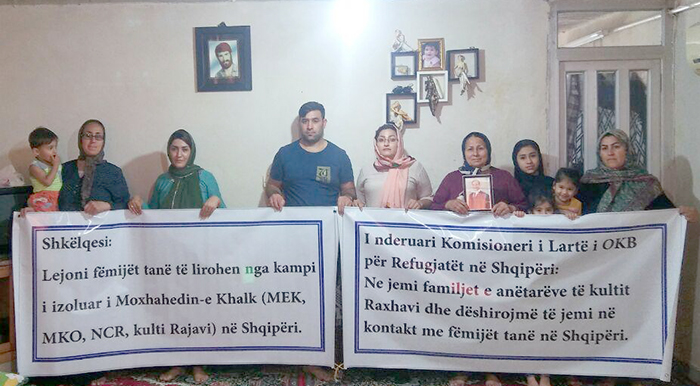
Mujahedin Khalq Organization members' families

I am sure my sons would leave MEK, if they were allowed to meet me

Hadi and Saeed are the sons of Shirdel Ahmadian Chashmi. They were recruited by the Mujahedin Khalq Organization (MKO/ MEK/ PMOI/ Cult of Rajavi) 13 years ago.

Hadi was a technician working in his own firm when he was deceived by MEK propaganda agents in March 2007 and Saeed, a university student, joined the Cult of Rajavi less than a year after his brother joined.

Hadi and Saeed Ahmadian

Hadi and Saeed Ahmadian Chashmi

They were in the group’s Camp Ashraf in Iraq until 2016 when they were relocated in Albania following the expulsion of MEK from Iraqi territory. Shirdel, the father of the two misplaced sons, traveled to Iraq to visit his sons in camp Ashraf but he was not allowed to visit them by the group authorities. “Between 2008 to 2015, we traveled to Iraq over ten times but they did not permit us to meet our sons even for one minute,” he says.

Shirdel Ahmadian Chashmi

Shirdel wrote letters to Iraqi authorities including Iraqi human rights minister. After the group’s relocation in Albania, he continued sending letters to the International human rights bodies and the Albanian authorities.
The MEK’s cult-like structure bans Saeed and Hadi from contacting their families outside the group. “I am sure that my sons would leave the group, if they were allowed to meet us,” their father says. “They are brainwashed there.”

August 17, 2021 0 comments
FacebookTwitterPinterestWhatsappTelegramSkypeEmail
MEK Cult Trolls
Mujahedin Khalq Organization's Propaganda System

Terrorists with Keyboards in Hand

Those pushing back against what many say is an agenda for regime change in Iran are reporting an online backlash the likes of which they have not seen before. However, the Twitter accounts doing the trolling may not be the organic opposition voices they are made out to be.

For all the accusations of disinformation and fake news from both sides, it is rare that we can point to facts, a location, and actual personnel explaining the modus operandi of an organized troll factory.
Former MEK members still stranded in the Albanian capital, Tirana, having left the group, described how the MEK uses thousands of fake Twitter accounts to both promote their organisation and to boost online calls for regime change.

“Our orders would tell us the hashtags to use in our tweets in order to make them more active,” says Hassan Shahbaz, former MEK member. “It was our job to provide coverage of these protests by seeking out, tweeting and re-tweeting videos while adding our own comments.”
MEK keyboard warriors would also target journalists, academics and activists who favour dialogue rather than confrontation with Iran.

https://dlb.nejatngo.org/Media/Report/Terrorists-Keyboards-Habilian.mp4

To download the video file click here

August 16, 2021 0 comments
FacebookTwitterPinterestWhatsappTelegramSkypeEmail
Maryam Rajavi
Mujahedin Khalq; A proxy force

Washington’s Terrorist Friends: Prominent Americans Continue to Support a Murderous Cult

MEK is a curious hybrid creature that pretends to be an alternative government option for Iran even though it is despised by nearly all Iranians.

One might ask if Washington’s obsession with terrorism includes supporting radical armed groups as long as they are politically useful in attacking countries that the US regards as enemies? It is widely known that the American CIA worked with Saudi Arabia to create al-Qaeda to attack the Russians in Afghanistan and the same my-enemy’s-enemy thinking appears to drive the current relationships with radical groups in Syria.

Given the fact that Iran continues to be the Biden Administration’s enemy du jour, it is perhaps not surprising to observe that the US also supports terror groups that are capable of attacking targets in the Islamic Republic. To that end, recently a number of former senior government officials and politicians were involved in cultivating their relationships with the Iranian terrorist group Mojahedin e Khalq (MEK), which held its most recent annual international summit in Paris for three days starting on July 10th. The event was online due to French COVID prevention guidelines and the featured speaker was Michele Flournoy, former US undersecretary of defense for policy under President Barack Obama. Flournoy was once considered a front runner to be President Joe Biden’s defense secretary and she currently heads a consulting firm WestExec Advisors that she co-founded with current Secretary of State Anthony Blinken which has had considerable influence over staffing and other issues in the White House. In her talk, she accused Iran of posing a danger to the security of the Middle East, the United States, and to its own people, elaborating how “Since 1979, every US administration has had to deal with the threat posed by Iran’s revolutionary regime and the Biden administration is no different. Iran is one of the most urgent foreign policy issues on the president’s desk.” She called for an “internal regime change” in the Islamic Republic.

US advicated of MEK Terrorists

A bipartisan group of US lawmakers also spoke before the online gathering. Speakers included House Minority Leader Kevin McCarthy, Senator Bob Menendez, a New Jersey Democrat who chairs the Senate Foreign Relations Committee, as well as Democratic Senators Cory Booker of New Jersey and Jeanne Shaheen of New Hampshire. Also participating were Republican Senator Rick Scott of Florida and both Texas Senators John Cornyn and Ted Cruz. Former Democratic National Committee Chairwoman Donna Brazile also spoke as did former Secretary of State Mike Pompeo, who said that the MEK should be “blessed and protected.”

The summit self-described as “the largest-ever online international event dedicated to liberating Iran” with the objective of “inciting uprisings against the government in the Islamic Republic.” Though it would be charitable to suggest that the congressmen and former officials were largely involved to pick up the generous fees paid to speakers, it must also be noted that knowledge of MEK and its history is readily available on the internet and elsewhere. Flournoy in particular should have known better but even she, after the fact, claimed implausibly that she did not know that she was speaking to a former terrorist group that had killed Americans.

It should also be observed that the participating Congressmen all have extremely close ties to Israel and its domestic lobby, which have been assiduous in their efforts to vilify Iran as America’s designated enemy. To be sure, no one at the summit even mentioned Israel’s use of MEK operatives to carry out assassinations of scientists and sabotage operations inside Iran.

MEK is a curious hybrid creature in any event in that it pretends to be an alternative government option for Iran even though it is despised by nearly all Iranians. It is considered to be both irrelevant and ineffective but Iran hatred is so prevalent that it is greatly loved by the Washington Establishment which would like to see the Mullahs deposed and replaced by something more amenable to US and Israeli worldviews.

MEK is run like a cult by its leader Maryam Rajavi, with a number of rules that restrict and control the behavior of its members. One commentary likens membership in MEK to a modern-day equivalent of slavery. A study prepared by the Rand corporation for the U.S. government conducted interviews of MEK members and concluded that there were present “many of the typical characteristics of a cult, such as authoritarian control, confiscation of assets, sexual control (including mandatory divorce and celibacy), emotional isolation, forced labor, sleep deprivation, physical abuse and limited exit options.”

The group currently operates out of a secretive, heavily guarded 84 acre compound in Albania that is covertly supported by the United States intelligence community, as well as through a “political wing” front office in Paris, where it refers to itself as the National Council of Resistance of Iran (NCRI). MEK is financially supported by Saudi Arabia, which enables it to stage events in the United States and in Europe where it generously pays politicians to make fifteen-minute speeches praising the organization and everything it does. It’s bribing of inside the Beltway power brokers and its support by Israel proved so successful that it was removed from the State Department terrorist list in 2012 by Hillary Clinton even though it had killed Americans in the 1970s.

As indicated above, MEK made the transition from terrorist group to “champions of Iranian democracy” by virtue of intensive lobbying of Iran haters. A Guardian article also describes how “A stupendously long list of American politicians from both parties were paid hefty fees to speak at events in favor of the MEK, including Rudy Giuliani, Joe Lieberman, John McCain, Newt Gingrich, Elaine Chao and former Democratic party chairs Edward Rendell and Howard Dean – along with multiple former heads of the FBI and CIA. John Bolton, who has made multiple appearances at events supporting the MEK, is estimated to have received upwards of $180,000. According to financial disclosure forms, Bolton was paid $40,000 for a single appearance at the Free Iran rally in Paris in 2017.”

It apparently has never occurred to the congressmen and senior officials that the MEK group had a whole lot of history before it appeared on the scene in Washington and began buying American politicians. MEK, which consisted of a group of dissident students having Marxism inspired anti-capitalist and anti-colonialist roots, had a bloody falling out with the Iranian revolution leaders in 1979, forcing it to resettle at Camp Ashraf, near Baghdad. It was protected by Saddam Hussein and used to carry out terrorist attacks inside Iran. It was also fiercely anti-American beginning back in the 1970s when it was still in Iran, to include attacks on US businesses and denunciations of the United States presence in Iran under the Shah. In 1979 it supported executing the US Embassy hostages rather than negotiating their release. One of its songs went “Death to America by blood and bonfire on the lips of every Muslim is the cry of the Iranian people. May America be annihilated.”

Within the US government, MEK was notorious for its assassination of at least six US Air Force officers and civilian defense contractors. One particularly audacious ambush in which two air force officers were murdered by MEK while being driven in from the airport was reenacted for each incoming class at the Central Intelligence Agency training center in the late 1970s to illustrate just how a perfectly executed terrorist attack on a moving vehicle might take place.

Given how currently nearly every news cycle includes stories about fake news on social media, it is surprising that MEK is never mentioned. Its current Albanian operational center uses banks of computers manned by followers, some of whom are fluent in English, who serve as bots unleashing scores of comments supporting regime change in Iran while also directing waves of criticism against any pro-Iranian pieces that appear elsewhere on social media, to include Facebook and Twitter. By one account, more than a thousand MEK supporters manage thousands of accounts on social media simultaneously. The objective of all the chatter is to convince the mostly English-speaking audience that there is a large body of Iranians who are hostile to the regime and supportive of MEK as a replacement.

It is an indisputable fact that over the past ten years, members of both major parties in Congress have either traveled to the group’s compound in Albania or spoken via video messages or live appearances in exchange for hefty speaking fees. The support provided by prominent officeholders and policymakers to include effusive praise of a terrorist group that is viscerally anti-American and has killed US officials is a disgrace. It is also a symptom of deeper problems in terms of how our foreign policy has been developed through the ascendancy of special interests. That America’s Iran policy should lead to praise of a radicalized extremist cult that is funded by authoritarian Saudi Arabia and politically supported by apartheid Israel ignores US actual interests at our peril.

By Philip Giraldi – Islam Times

August 15, 2021 0 comments
FacebookTwitterPinterestWhatsappTelegramSkypeEmail
MEK terrorists in Albania
Albania

Albania and Iran’s dissident MEK: A marriage made in the US

Some 30 kilometres west from Albania’s capital Tirana, nestled between a mountain range and the Adriatic Sea, lies the town of Manëz.

With a population of roughly 7,000 and picturesque views in every direction, it is a typical Albanian town, save for one fact: it hosts Camp Ashraf-3, the base of Iranian dissident group known as the People’s Mujahedin of Iran.

Going by its Farsi acronym of MEK, the group has had a presence in Albania since at least 2013. In its heyday, it was one of the main groups struggling against the imperial regime in Iran, playing a major role in the 1979 revolution before falling out with the newly-established Islamic Republic led by Ayatollah Khomeini.

Over time, the group’s significance diminished.

camp Ashraf 3

The Ashraf-3 base within the main destructive zone (map: USGS.gov)

Currently, roughly 3,000 members of MEK are estimated to live in Camp Ashraf-3, a heavily fortified compound. The camp’s perimeter is lined with Iranian flags and guarded by Albanian private security.

And although the group gets little mainstream attention, it has actively been courted by powers hostile to Iran, primarily the United States. MEK’s leader, Maryam Rajavi (wife of one of the group’s founders, Massoud Rajavi, presumed dead since 2003) has met with prominent US politicians such as Rudy Giuliani, John Bolton and the late John McCain. An annual conference hosted by the MEK in Paris regularly draws visitors from various right-wing European political parties.

Despite this support, the group has next to no credibility in Iran, according to Houchang Chahabi, an Iranian-born professor of international relations at Boston University.

“They have been politically irrelevant in Iran since at least the mid-1980s, and have little to no domestic support,” says Professor Chahabi.

This raises the question of why Albania of all countries would drag itself into one of the world’s most tense geopolitical standoffs, between the United States and Iran, by agreeing to host a tiny, fanatical armed group, which until 2012 was designated as a terrorist group by the United States and most of the European Union.

Now described by various sources as a cult, a cartel, a dangerous extremist group, the group’s presence may even represent a threat to Albanians.

From revolutionaries to cult

MEK was founded in the 1960s by radical students opposed to Shah Reza Pahlavi. With an ideology combining Shia Islamism with Marxism, throughout the 1970s the group staged dozens of often suicidal attacks on security forces, as well as targeting western-owned hotels, airlines and oil companies.

During the 1979 revolution, they were crucial in the final gun battles against the Shah’s police. However, it did not take long for things to sour between the various factions involved in the revolution. The Ayatollah Khomeini-led Islamist faction ended up seizing most of the political power.

Following massive street protests organised by the MEK, the Islamic Republic cracked down hard on the group, executing thousands of supporters and driving many to flee across the border to Iraq, where they were hosted and armed by Saddam Hussein.

MEK women

Women fighters armed with AK-47s in the National Liberation Army of Iran stand at attention during a flag ceremony at Camp Ashraf,Wednesday Jan 29 1997, 110 kilometeres northeast of the Iraqi capital Baghdad. The fighters are dedicated to overthrowing the Islamic regime in Iran and installing a multi-party democracy. (AP PHoto/ Jassim Mohammmed)

Tens of thousands MEK members participated in the Iran-Iraq War, fighting alongside the Iraqi military which was indiscriminately bombing Iranian cities and using banned chemical weapons. This caused what credibility they had left in Iran – and clearly they used to have a lot, as evidenced by their massive support during the revolution and the post-revolutionary period – to dissipate.

An attempted incursion into Iran in 1988 by an 8,000-strong mechanised MEK force, at the closing stages of the Iran-Iraq War, ended in crushing defeat. The group began resembling more of a cult than a political party – the 1988 defeat was partially blamed on members being too distracted by “trivialities” like love, friendship and parenthood to be zealous enough fighters.

Eternal Light Operation - Mersad

Throughout the 1990s, MEK helped Saddam Hussein brutally quell uprisings in the aftermath of the first Gulf War, implicating themselves in some horrendous atrocities, particularly against Kurds.

Following the toppling of Saddam Hussein in 2003, the MEK began piquing the interest of US hawks. It had toppled hostile regimes in Iraq and Afghanistan with ease, and the insurgencies which would end up bogging it down had yet to fully take off. It was widely believed that Iran would be the next country on the list – and the MEK looked like convenient on-the-ground partners.

However, events in Iraq took an unanticipated turn. The country’s post-Saddam government forged closer ties with Iran, particularly under the leadership of Nouri al-Maliki. Between 2009 and 2013, Iraqi security forces raided MEK compounds multiple times, killing over 100 members.

This alarmed the MEK’s western sponsors which began looking for alternative countries to base the group in. They reached out to several of their Eastern European partners, with Romania identified as an ideal location. However, only one country responded to the request positively: Albania.

MEK transfer from Iraq to Albania

MEK officially renounced violence and between 2013 and 2016, between three and five thousand members were relocated to Albania, with the help of the United Nations High Commission for Refugees (UNHCR), overseen by the governments of Sali Berisha and Edi Rama.

Violation of sovereignty?

Few even within Albania know of MEK’s existence. Those that do have asked questions about the implications of hosting such a group: fears were raised that the presence of the MEK forces Albania to inherit a decades-long struggle between a major regional power in the Middle East and a terrorist group with cult-like characteristics, at the behest of the United States.

However, Professor Olsi Jazexhi, an Albanian historian and lecturer at the International Islamic University of Malaysia, believes that there is little immediate security threat to Albania as a result of the group’s presence.

“Iran has attacked MEK terrorists in the past in Iraq, however at present it cannot do anything against MEK in Albania. Albania is a NATO member country and its security is guaranteed by the Americans,” he says.

Dr Zijad Bećirović, director of the International Institute for Middle Eastern and Balkan Studies in Ljubljana agrees with this view.

“Iran does not attach much importance to this group. Albania is a member of NATO and Iran would not want to risk a confrontation,” Dr Bećirović tells Emerging Europe.

MEK troll farm in Albania

Leaked photos showing MEK members at work

This may be particularly true in light of how MEK renounced violence as a precondition of its relocation to Albania. Now, according to interviews conducted by The Guardian with MEK defectors, members spend most of their time posting propaganda comments on online forums demonising the Iranian government.

Furthermore, the group appears to have fallen far from its heyday as one of the trailblazers of the Iranian revolution to becoming something not unlike a cult.

Members are forced to divorce their spouses upon joining. Celibacy is strictly enforced, and daily, members have to confess their sexual urges in front of their peers. Dozens of women have allegedly been sterilised by the group’s doctors under false pretences, presumably to sever them from “distractions” such as raising children.

Dr Bećirović believes that the US clearly played a major role in bringing the group to Albania.

“Albania is a reliable ally of the United States. This was also shown in how Albania hosted prisoners of war from Afghanistan captured by the United States. It is quite certain that the MEK would not have come to Albania without the mediation or role of the United States.”

However, despite this, Bećirović acknowledges that Albania also has its own interests in hosting the MEK. “In this way, Albania strengthens its role in the region and international relations and its position with the United States and western allies.”

—

Others, like Olsi Jazexhi, see the whole situation as evidence of American hegemony over Albania.

“Albania today is ruled by the US embassy in Tirana. The embassy vets our politicians – like the Guardian Council in Iran – and it decides which politicians enter parliament or not. The hosting of MEK in Albania is not an Albanian affair, but an American-Israeli affair.”

However, lately, the MEK has been back on the Iranian government’s radar. In November 2020, Mohsen Fakhrizadeh, a senior official in Iran’s controversial nuclear programme, was assassinated. Some local news reports indicated that over 60 people were involved in the assassination.

Mohsen fakhrizade

Mohsen fakhrizade- iran nuclear scientists assassinated – israel – mek

Iranian government sources blamed the assassination on MEK, acting in conjunction with Israeli intelligence agency Mossad. The unconfirmed reports of there being several dozen people involved in the operation indicate a high level of collusion between locals and the architects of the assassination. MEK has demonstrated its members’ zeal, fanaticism, and willingness to collaborate with enemies of Iran – it would not be preposterous to suggest that they may have played a part in the killing.

The incident also echoed how during a string of assassinations of Iranian nuclear scientists from the late 2000s to the early 2010s, the Iranian government persistently claimed the involvement of MEK sleeper cells.

Regardless of whether or not the MEK were involved in the assassinations, it is clear that they have been identified as the United States’ partner in Iran, should anything happen between the two countries.

This, however you slice it, means that the group is actively collaborating with a country that has been persistently hostile to Iran for over four decades.

And that means that as long as tensions remain between the US and Iran, MEK will continue to be useful to its patrons – meaning Albania will continue hosting them.

“Albania will continue to host the MEK paramilitary base on its soil for as long as the Americans need them to,” says Olsi Jazexhi.

“If one day the United States makes peace with Iran, MEK will be forgotten, dismantled, de-radicalised and its remaining members will finally live a peaceful civilian life. But for the time being they are useful and good terrorists which Albania must host.”

Unlike many news and information platforms, Emerging Europe is free to read, and always will be. There is no paywall here. We are independent, not affiliated with nor representing any political party or business organisation. We want the very best for emerging Europe, nothing more, nothing less. Your support will help us continue to spread the word about this amazing region.

Emerging-europe.com

August 14, 2021 0 comments
FacebookTwitterPinterestWhatsappTelegramSkypeEmail
Hague Court
Missions of Nejat Society

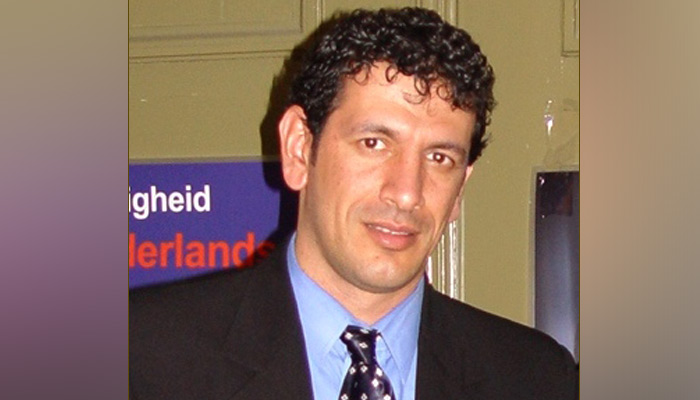
Nejat CEO’s explanations on the petition against the MEK in the ICJ

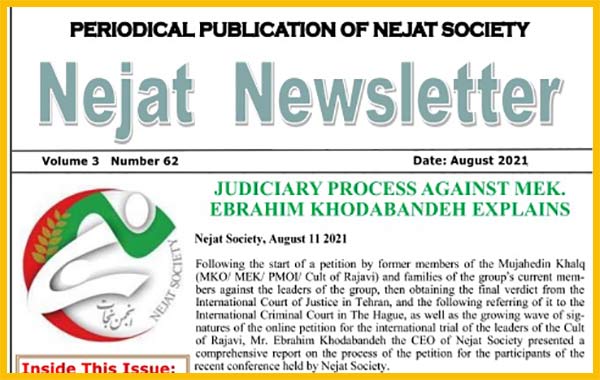
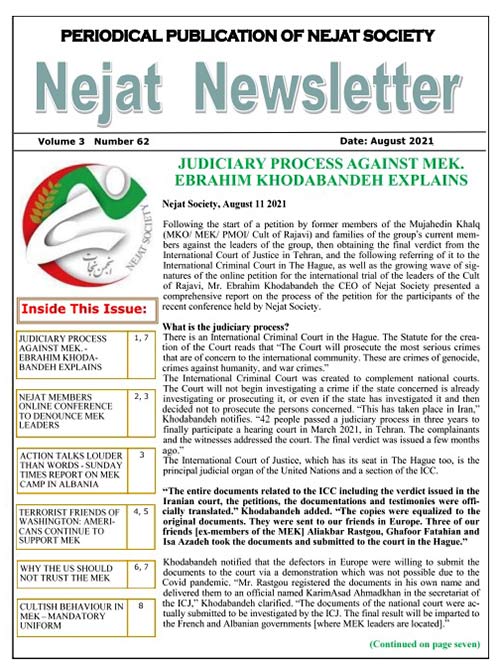
Following the start of a petition by former members of the Mujahedin Khalq (MKO/ MEK/ PMOI/ Cult of Rajavi) and families of the group’s current members against the leaders of the group, then obtaining the final verdict from the International Court of Justice in Tehran, and the following referring of it to the International Criminal Court in The Hague, as well as the growing wave of signatures of the online petition for the international trial of the leaders of the Cult of Rajavi, Mr. Ebrahim Khodabandeh the CEO of Nejat Society presented a comprehensive report on the process of the petition for the participants of the recent conference held by Nejat Society.

Ebrahim Khodabadne

What is the judiciary process?
There is an International Criminal Court in the Hague. The Statute for the creation of the Court reads that “The Court will prosecute the most serious crimes that are of concern to the international community. These are crimes of genocide, crimes against humanity, and war crimes.”

The International Criminal Court was created to complement national courts. The Court will not begin investigating a crime if the state concerned is already investigating or prosecuting it, or even if the state has investigated it and then decided not to prosecute the persons concerned. “This has taken place in Iran,” Khodabandeh notifies. “42 people passed a judiciary process in three years to finally participate a hearing court in March 2021, in Tehran. The complainants and the witnesses addressed the court. The final verdict was issued a few months ago.”
The International Court of Justice, which has its seat in The Hague too, is the principal judicial organ of the United Nations and a section of the ICC.

“The entire documents related to the ICC including the verdict issued in the Iranian court, the petitions, the documentations and testimonies were officially translated.” Khodabandeh added. “The copies were equalized to the original documents. They were sent to our friends in Europe. Three of our friends [ex-members of the MEK] Aliakbar Rastgou, Ghafoor Fatahian and Isa Azadeh took the documents and submitted to the court in the Hague.”
Khodabandeh notified that the defectors in Europe were willing to submit the documents to the court via a demonstration which was not possible due to the Covid pandemic. “Mr. Rastgou registered the documents in his own name and delivered them to an official named KarimAsad Ahmadkhan in the secretariat of the ICJ,” Khodabandeh clarified. “The documents of the national court were actually submitted to be investigated by the ICJ. The final result will be imparted to the French and Albanian governments [where MEK leaders are located].”

MEK defectors at Hague court

Ali Akbar Rastgou

What was the case about?

“The complaints should include the cases that the ICC court can prosecute,” Khodabandeh said. “The ICC prosecutes the crimes that are of concern to the international community. So, a petition was launched on an international reliable website to gather signatures. Until the day we submitted the documents, 4000 had signed the petition. To this date, the signatures have raised a lot more. This means that the crimes of MEK leaders are of concern for the international community. The signatures were filed in 182 pages and delivered to the court together with other papers. The list includes signature from all over the world. It was also accompanied with lots of text, audio and video messages in support of the petition.”

The signatures are a demo of a part of the international community who are concerned about the crimes of MEK leaders.

MEK defectors at Hague

Which crimes that MEK leaders committed will the Court prosecute?
These crimes are crimes of genocide, crimes against humanity, and war crimes. It has been proposed that the Court should prosecute the crime of aggression but the state parties have yet to agree on a definition. Below are brief definitions of the crimes as agreed to in the Rome Statute. According to the ICC, crimes against humanity are crimes that are “committed as part of a widespread or systematic attack directed against any civilian population.” They can include acts such as: murder, extermination, enslavement, deportation, forcible transfer of population, imprisonment, torture, rape, sexual slavery, enforced prostitution, forced pregnancy, enforced sterilization, other forms of sexual violence, persecution against any identifiable group or collectivity, enforced disappearance of persons, the crime of apartheid and other inhumane acts of a similar character intentionally causing great suffering, or serious injury to body or to mental or physical health.

According to the ICC statute, the crimes that are “widespread” and “systematically” committed against a group of people, are included in the crimes against humanity. “First of all, modern slavery is a crime that worries the International community,” Khodabandeh explained. “Therefore, Brainwashing is a crime. Mental and physical pressures under the name of sessions called current operation, solitary confinement, physical torture and death penalty typically took place in the 1990s in Camp Ashraf in the era of Saddam Hussein regime. The MEK leaders suspected 700 members of their group as being the agents of the Iranian government. These people were tortured. Some were killed under torture. Some people were disappeared in the MEK. These are all cases of crimes against humanity.”

The CEO of Nejat Society stated that whatever the outcome of the trial will be, the world will know that Maryam Rajavi’s democratic gesture is entirely deceitful because she has committed the most serious crimes against her own members. “The victims of the MEK were not from their enemies but they were completely under the authority of the group. They were devoted to the cause of the group.” Khodabandeh presented some examples of cases who were killed or disappeared in the Cult of Rajavi. Yaser Akbarinasab who committed suicide due to the severe mental pressure he underwent in the cult and Soheil Khattar who was killed in the group.

About the reaction of the MEK leaders particularly Massoud Rajavi, Khodabandeh says, “Rajavi can bother himself to file his complaint against every person he would like to, in courts of Albania or France. This is what former members of his group just did and then pursued in the ICJ.”

Currently, the petition created by 42 former members of MEK is under investigation in the international court of the Hague.

August 11, 2021 0 comments
FacebookTwitterPinterestWhatsappTelegramSkypeEmail
Ebrahim Khodabande
Missions of Nejat Society

Participants of Nejat Conference Speak of the grieves imposed by the MEK

The two first days of the five-day online conference of Nejat Society were broadcast on Saturday and Sunday, August 7th and 8th. The conference is attended by former members of the Mujahedin Khalq Organization (MKO/ MEK/ PMOI/ Cult of Rajavi) and families of those who are still taken as hostages by the group leaders.

The followings have been taken from the speeches of some of the participants of the first and second day of the conference:

Conference of the Nejat Society

Conference of the Nejat Society perusing to support the International trial of MEK leaders

The brother of Morteza Ghadimi, member of the MEK: “I hope that our letters, complaints and petitions be effective. My parents are both very old. They are still awaiting my brother release from the Cult of Rajavi.”

The sister of Alimadad Sadeghi: “Alimadad has been enduring the brainwashing system of the Cult of Rajavi for over four decades.”

The sister of Habibollah Qasemi: “We ask for visiting our loved brother in Albania.”

The brother of Hossein Nematollahi: “My brother was in the prisons of Saddam Hussein for ten years and since then he has been captive in the MEK. We signed petitions. We wrote letters but there was no answer.”

The sister of Alkhas Kouhpeyma: “We had no news of my brother. We just realized that he is in the MEK after his friends returned to Iran and told us about the fate of Alkhas in the MEK’s Camp Ashraf. We went to Ashraf several times but we were not allowed to see my brother.”

The niece of Mahmoud Talebi: “My uncle was a prisoner of war but he was deceived by the MEK recruiters and was delivered to Camp Ashraf. The MEK leaders never let him contact us and never let us visit him.”

Mahmoud Dashtestani

Mahmoud Dashtestani

Mahmoud Dashtestani, former member of the MEK: “We challenged the leaders of the Cult of Rajavi by running this petition. I am one of the complainants and witnesses of the MEK’s atrocities, in the court. We will pursue our complaint in the International court of the Hague.”

Abbas Pourmohammad, former member of the MEK: “The MEK leaders took our whole life. There is no financial motivation here. We stand by those who have been looking forward to visiting their loved ones for over thirty years. Thirty years is so long!”

The brother of Masoumeh Oladi: “The MEK kidnapped my sister when she was only sixteen years old. I will sue the MEK leaders until the last day of my life.”
Ruhollah Kabiri, former member of MEK: “I was in the MEK for 12 years, the pressures and grieves I endured in this cult are unbelievable.”

The brother of Issa Akbarzadeh: “My brother was recruited by the MEK fraudulent recruiters in Turkey. We picketed behind the gates of Camp Ashraf to visit my brother but the MEK leaders did not permit us to visit him.”

Gholamali Mirzaei

Gholamali Mirzaei

GholamAli Mirzaiee, former member of the MEK: “I returned to Iran eight months ago. The entire propaganda of the MEK about defectors is false. They just lied to us when they said that our family would not welcome us in Iran.”
Mohammad Karami, former member of MEK: “I came back to Iran a few years ago and I have witnessed the efforts of my friends to save their loved ones from the MEK. I ask the international court to aid families contact their loved ones.”

The father of Aliasgar Jaafarpour: “We have been asking to meet our children for several years. The MEK has deprived us from any visit and contact.”

The brother of Abbas and Asghar Faraji: “The requests of families of MEK hostages should be investigated. I am hopeful to visit my brothers again.”

The brother of Mohammad Khatibi: “I am looking for a way to visit my brother in Albania for even a few minutes. We want to be informed about their mental and physical health.”

Fereydoun Nedaei mum

The mother of Fereydoun Nedaei

The mother of Fereidoon Nedayee: “I am waiting. I will be waiting for you as long as I am alive. Why did you take refuge in the MEK?”

The above-mentioned sentences are just a few words quoted out of the heart-breaking stories of these suffering people. Many mothers, sisters and brothers have tears in eyes while speaking in front of the camera.

Nejat Society

August 9, 2021 0 comments
FacebookTwitterPinterestWhatsappTelegramSkypeEmail
Newer Posts
Older Posts

Recent Posts

  • MKO Rally Dispersed by French Police in Humiliating Blow to Terrorist Group

    June 27, 2026
  • Nejat Society Albania’s Conference on June 20th

    June 22, 2026
  • Maryam Rajavi’s Stance, Peace or Survival Tactic?

    June 22, 2026
  • France’s foreign ministry denies asking for ban of MEK’s rally

    June 20, 2026
  • The MEK did not allow them to visit their father

    June 20, 2026
  • Facebook
  • Twitter
  • Instagram
  • Youtube

© 2003 - 2025 NEJAT Society . All Rights Reserved. NejatNGO.org


Back To Top
Nejat Society
  • Home
  • Articles
  • Media
    • Cartoons
    • NewsPics
    • Photo Gallery
    • Videos
  • Publications
    • Books
    • Nejat NewsLetter
    • Pars Brief
  • About Us
  • Contact us
  • Editions
    • عربي
    • فارسی
    • Shqip