Nejat Society
  • Home
  • Articles
  • Media
    • Cartoons
    • NewsPics
    • Photo Gallery
    • Videos
  • Publications
    • Books
    • Nejat NewsLetter
    • Pars Brief
  • About Us
  • Contact us
  • Editions
    • عربي
    • فارسی
    • Shqip
Nejat Society
Nejat Society
  • Home
  • Articles
  • Media
    • Cartoons
    • NewsPics
    • Photo Gallery
    • Videos
  • Publications
    • Books
    • Nejat NewsLetter
    • Pars Brief
  • About Us
  • Contact us
  • Editions
    • عربي
    • فارسی
    • Shqip
© 2003 - 2024 NEJAT Society. nejatngo.org
weekly digest
Iran Interlink Weekly Digest

Iran Interlink Weekly Digest – 230

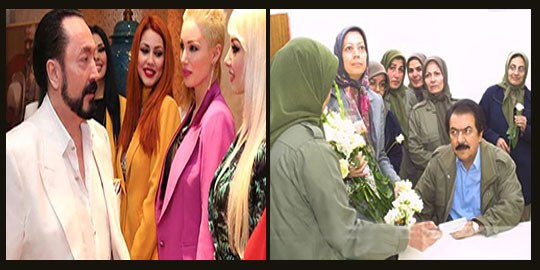
++ Ebrahim Khodabandeh, head of Nejat Association, wrote about the MEK in Albania. He identifies the three most important recent issues as: bringing Massoud Rajavi back from the dead with a written directive from him; whose message is ‘No Exit’ – nobody is allowed to leave. The next significant issue is the appointment of Mehdi Abrishamchi as overall commander of Camp Ashraf Three; again, to enforce the No Exit policy. Both these signify MEK panic over people running away. The exodus recently exploded after former members succeeded in getting their living allowance money from the UNHCR instead of from the MEK. Now the MEK is trying to fight back. As well as the above measures, MEK pays some ex-members to write against the others. MEK also deploys some members to follow the ex-members and intimidate them. But every week it is more and more apparent that these tactics have no effect and the MEK organisation is collapsing from within. Khodabandeh writes, ‘It seems the third camp will be their last and they have reached the end of the road’. According to Khodabandeh, in addition to these issues, there is the problem of members asking questions to which MEK have no answer. MEK have therefore placed a ban on asking about three specific issues. One is: ‘if we have support in Iran as you say we have, how come we see no evidence of this from inside Iran?’ Another issue is: ‘You said President Trump will first liberate Syria and then liberate Iran. But nothing has happened. If the Americans were serious about Syria, wouldn’t they have tried to topple Assad by now?’ The third issue is: ‘You got very excited about Trump tearing up the JCPOA. If the Americans do that to their agreements with other countries, how can we believe they will support us, how can we trust them?’

++ This week as Ramadan began, Maryam Rajavi jumped on the publicity bandwagon. With her glamorous clothes and candles and lavish food, she offered Iftar to guests. People who have seen this before criticise the MEK primarily because they don’t believe in any of these things [religious practice]. For MEK it is all about feeding lobbyists while the members suffer because their food is not up to standard these days.

++ MEK has already announced the annual Villepinte event in July. Members and ex-members say the leaders have announced it forty days in advance since they are desperate for propaganda because they can’t answer the members after lying to them about Trump’s support and the inevitability of war with Iran, etc.

In English:

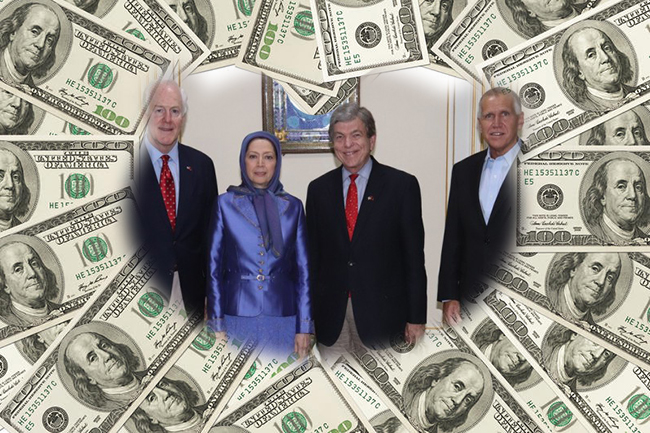
++ Mazda Parsi in Nejat Bloggers writes about ‘Money Adventures of the MKO and the Bloodthirsty Security Adviser. Parsi examines the backtracking of John Bolton after Trump appointed him National Security Advisor. When challenged over his advocacy for the MEK and his desire for violent regime change against Iran, Bolton told CNN “I’ve written and said a lot of things over the years when I was a complete free agent”. He admitted that he is not a decision maker in the US administration. “The circumstances in I’m in now is that I’m the national security adviser to the president. I’m not the national security decision maker. He (Trump) makes the decisions and the advice I give him is between us.” Parsi quotes one of many critics of Bolton in the American media, Caitlin Johnstone of the Ron Paul Institute for Peace and Prosperity: “The MEK is widely considered a cult, using very cult-like methods of indoctrination including exerting control over the personal and sex lives of its members and forcing them to go through weekly ‘ideological cleansings’… The MEK reportedly has weirdly deep pockets which have enabled it to spend millions of dollars rehabilitating its image in recent years, and to pay out sizable fees for panelists and speeches by experts willing to advocate in favor of its regime change agenda.”

Parsi concludes: “The fact that almost no one in the paid campaign of the MKO supporters brings up the cult-like nature of the MKO, its violent past and its unpopularity among Iranians indicates that they are totally motivated by the filthy dollars of the group laundered into their pockets via European Banks.”

++ Various media outlets denounced ‘corrupt American leaders whose salaries are paid by MEK’. Al-Monitor, Newsweek, CNN, Reuters, The Transnational (Oxford), all reported that the position of Secretary of State Mike Pompeo and National Security advisor John Bolton as well as others in Trump’s administration, have strengthened the Iranian establishment and united the people behind their leaders.

May 25 2018

May 26, 2018 0 comments
FacebookTwitterPinterestWhatsappTelegramSkypeEmail
Missions of Nejat Society

Why Pompeo’s Iran speech was So Outrageous

Oxford (The Transnational) – Speaking at the Heritage Foundation…, US Secretary of State Mike Pompeo practically declared war on Iran. His unprecedented threats against Iran went even beyond what President Trump had said in the past.

Commenting on the speech (full transcript here), JStreet wrote: “With their decision to violate the historic JCPOA arms control agreement, the president and his ‘war cabinet’ have created a strategic disaster of their own making and undone the major accomplishments of the previous administration. They have made the US, Israel and the world less safe.”

Short history of Iran’s nuclear activities: 1957 to the JCPOA

After 12 years of intensive talks, initially between Britain, France and Germany (the EU-3), and finally between Iran and the five permanent members of the Security Council plus Germany (P5+1), Iran and the leading world powers reached a landmark agreement. The nuclear deal (officially known as the Joint Comprehensive Plan of Action or JCPOA) was the result of the efforts of the greatest experts in nuclear non-proliferation, including experts from the IAEA and departments of energy and intelligence service of all those countries.

Iran’s nuclear programme had started in 1957 with the help of the United States as a part of the Atoms for Peace program, when a “proposed agreement for cooperation in research in the peaceful uses of atomic energy” was announced.

During the late 1960s and early 1970s, Mohammad Reza Shah’s government started an ambitious nuclear program. It established the Tehran Nuclear Research Centre in 1967, with a US-supplied 5-megawatt nuclear research reactor, which was fueled by highly enriched uranium.

Iran was one of the first countries to sign the Nuclear Non-Proliferation Treaty (NPT) in 1968. The NPT allows all member states to engage in peaceful nuclear activity, including full range of processing, so long as they refrain from manufacturing nuclear weapons.

In return, the five recognized nuclear states (the United States, Russia, China, Britain and France) promised to move towards the elimination of their nuclear weapons in “good faith”. Not only have they not fulfilled this requirement, on the contrary, they have continued to develop more and more deadly and sophisticated nuclear weapons, and they have also been joined by India, Pakistan, Israel and recently by North Korea.

In 1974, with US backing, the Shah approved plans to construct up to 23 nuclear power stations, producing 23,000 megawatts of electricity. US and European companies competed against each other to help build those reactors.

In 1975, the Erlangen/Frankfurt firm signed a contract worth up to $6 billion to build the first nuclear power station in Bushehr. President Ford signed a directive in 1976 offering Iran the chance to buy and operate US built power stations, including a U.S.-built reprocessing facility for extracting plutonium from nuclear reactor fuel.

After the Islamic Revolution, all those programmes were suspended, including the Bushehr power station that was nearly complete.

The start of the eight-year long Iran-Iraq war further delayed the resumption of the nuclear program. Eventually, in 1981 during the presidency of the late Akbar Hashemi-Rafsanjani, Iranian officials decided that the country’s nuclear development should continue.

They turned to the Western countries that had promised to build reactors in Iran to resume their work, but all of them refused to cooperate.

In 1983, IAEA officials were keen to assist Iran in various aspects of reactor fuel fabrication, chemical engineering and design aspects of pilot plants for uranium conversion, corrosion of nuclear materials, LWR fuel fabrication, and pilot plant development for production of nuclear grade UO2. However, contrary to NPT regulations, the United States directly intervened to discourage IAEA assistance to Iran.

Finally, Iran turned to China, but under US pressure China too dropped her nuclear commerce with Iran.

However, Iran was successful to persuade Russia to complete the Bushehr reactor, which was completed after long delay and at great cost to Iran. Faced with this situation, Iran decided to conduct her own work on nuclear enrichment, in which she succeeded.

The United States imposed unilateral sanctions on Iran and forced other countries to follow suit. Iran was taken to the Security Council, which also imposed crippling sanctions that cut Iran’s oil exports by half and cost Iran billions of dollars in lost revenue.

Iran continued with her nuclear programme and increased the number of her centrifuges, despite threats of war, crippling sanctions, cyber sabotage, the assassination of her nuclear scientists by Israeli agents, etc.

It was only after President Barack Obama agreed that as a member of the NPT Iran was entitled to a peaceful nuclear programme that intense negotiations started, resulting in the JCPOA.

While establishing her right to engage in nuclear activity, Iran accepted the harshest conditions as confidence-building measures. The agreement reduced Iran’s enriched uranium stockpile by 98 percent and restricted the level of enrichment to 3.67 percent.

Given that an enrichment level of more than 90 percent is needed to build a nuclear bomb, the deal makes it impossible for Iran’s uranium to be weaponized.

Under the deal, Iran also reduced the number of its centrifuges from 20,000 to a little over 5,000, far below the number that would be needed for manufacturing a single bomb, even if she wanted to do so. Iran closed the Arak reactor, which was capable of producing plutonium, and agreed to severe restrictions on research and development activities in other facilities.

In short, the agreement made it virtually impossible for Iran to build a single bomb.

Some of Pompeo’s intolerable conditions

1) Pompeo demands that: “First, Iran must declare to the IAEA full account of prior military dimension of its nuclear programme, and permanently and verifiably abandon such work in perpetuity”.

This is something that was pursued under PMU or Possible Military Use during the talks. The IAEA studied all those allegations, including taking soil samples from Parchin military base where the Israelis had claimed that nuclear activity had been conducted. The IAEA decided that there had been “no diversion” of nuclear material for military use.

Iran has agreed to abandon work on nuclear weapons in perpetuity, and all the talk about so-called “sunset clauses” is baseless. In addition to being a member of the NPT, Iran has also joined the “Additional Protocol”, which requires continuous, unannounced inspections of all her nuclear sites, and she has also given an undertaking never to produce nuclear weapons.

The prohibitions do not stop at the end of the “sunset clauses”, but will continue in perpetuity.

The IAEA that is the only legal body in charge of monitoring the deal has, on eleven separate occasions, certified that Iran has fully complied with the terms of the deal.

2) “Second, Iran must stop enrichment and never pursue plutonium reprocessing. This includes closing its heavy water reactor.”

Demanding that Iran should stop enrichment goes against NPT rules. As for “never pursuing plutonium reprocessing”, this is precisely what Iran has agreed to do under the JCPOA, and has destroyed her heavy water reactor.

3) “Third, Iran must also provide to the IAEA full unqualified access to all sites throughout the entire country.”

This is again another provision of the JCPOA, which the IAEA has used on many occasions.

4) “Iran must end its proliferation of ballistic missiles and halt the launching or development of nuclear-capable missiles.”

This is yet another misleading and illegal demand. Like any other country, Iran has the right to defend herself (UN Chater Art 51) and as she is unable to acquire advanced military equipment that the United States has readily sold to all Iranian neighbours, Iran’s missiles are her only means of deterring a military aggression.

Iran does not have intercontinental ballistic missiles as she has limited the range of her missiles to 2,000 kilometres. They are not designed to carry nuclear weapons, and in any case Iran does not have nuclear warheads.

5) Pompeo accused Iran of spreading terrorism in Syria, Iraq, Yemen, etc.

Iran has been fighting against ISIS and other terrorists in Iraq and Syria at the invitation of the governments of those countries. It is up to the Syrian government to ask Iran to withdraw her forces from that country, not for a US Secretary of State to dictate to other countries what they should and should not do.

All experts agree that the mantra of “Iran-backed Houthis” is exaggerated propaganda, as Iran’s contacts with the Houthis and influence over them is minimal.

It is Saudi Arabia and members of her coalition who, with American support, have been bombing Yemen, killing and wounding tens of thousands of innocent people and creating the world’s greatest humanitarian catastrophe there.

What this is really about: Obsession with revenge and regime change

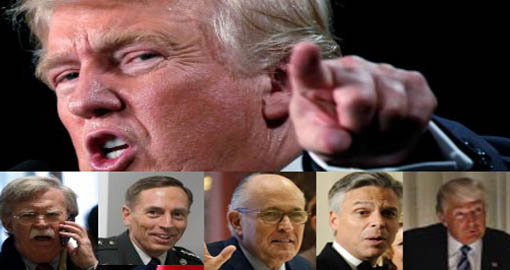
President Trump and his three senior officials, Mike Pompeo, John Bolton and Rudy Giuliani, seem to be preparing the ground for a disastrous war with Iran.

Their hostility towards Iran does not seem to have anything to do with Iran’s nuclear programme, but has everything to do with an obsession for regime change.

Speaking at the Aspen Security Forum, Mike Pompeo boasted that “one of the first things the President did is to go build a coalition of [Persian] Gulf states and Israel to help find a platform which could uniformly push back against Iranian expansionism.”(1)

When he was still a member of Congress in 2016, Pompeo called for action to “change Iranian behaviour, and, ultimately, Iranian regime.” (2)

In the past, he has called for strikes on Iranian nuclear facilities.(3)

Some of his hostility towards Iran seems to have been based on his hatred of Islam. In 2015, Pompeo, then a Congressman, attacked Barack Obama, who, according to him, took the side of the “Islamic East” in its conflict with the “Christian West”. “Every time there has been a conflict between the Christian West and the Islamic East, the data points all point to a single direction,” he said.

Some of his hostility towards Iran seems to have been based on his hatred of Islam. In 2015, Pompeo, then a Congressman, attacked Barack Obama, who, according to him, took the side of the “Islamic East” in its conflict with the “Christian West”. “Every time there has been a conflict between the Christian West and the Islamic East, the data points all point to a single direction,” he said. (4)

John Bolton is another strong advocate of regime change in Iran.

In an op-ed for the Wall Street Journal on 15 January 2018, entitled “Beyond the Iran Nuclear Deal: US policy should be to end the Islamic Republic before its 40th anniversary”, Bolton condemned the 2015 nuclear deal with Iran as a “massive strategic blunder.”

However, he went on to say that American policy, “should be ending Iran’s 1979 Islamic Revolution before its fortieth anniversary.”

He continued: “Recognizing a new Iranian regime in 2019 would reverse the shame of once seeing our diplomats held hostage for four hundred and forty-four days. The former hostages can cut the ribbon to open the new U.S. Embassy in Tehran.” (5)

The former Mayor of New York, Rudy Giuliani, who is now a member of Trump’s legal team has also been a fervent advocate of regime change in Iran.

Speaking at a conference of the terrorist, cultish group, the Mojahedin-e Khalq Organisation, in Washington on 5 May 2018, Rudy Giuliani openly said that Washington’s policy was regime change in Iran, and he even promised that next year they would celebrate the event in Tehran. (6)

This obsession with the past and a deliberate decision to bring about a regime change in Iran will have incalculable costs.

Let’s not forget that prior to Iraq war, Paul Wolfowitz, one of the authors of that war, predicted that it would be a “cake walk”, that it “would pay for itself”, and that “US forces would be welcomed with roses”.

Fifteen years after that disastrous war, American forces are still operating in that country, and the war which has cost trillions of dollars to US taxpayers has killed and wounded millions of innocent Iraqi people, shattered that country and has given rise to a number of vicious terrorist movements.

It should be clear to everyone who is familiar with the Middle East that a war against Iran will not be like Iraq, it will be much worse. It will kill hundreds of thousands of innocent people, will set the Middle East on fire and will do a great damage to Israel and other US allies that she seemingly wishes to support.

During his confirmation hearing at the US Senate, Mike Pompeo was asked if Russia was a unique country. He replied: “This [US] is a unique, exceptional country. Russia is unique, but not exceptional.” (7)

This kind of aggressive, bullying, threatening, demanding and illegal language has not been heard from a responsible government official since before the Second World War.

The concept of Americans being unique and exceptional and almost chosen by God, and referring to other nations as inferior, in the way that President Trump referred to the Latinos as animals, is not far removed from the concept of a superior race and Der Untermensch, or subhuman people.

If we wish to avoid the horrors of the Second World, we must put an end to this kind of arrogant mentality.

It is time for the Europeans, for all the peace-loving Americans and for millions of concerned people across the world who will be paying the cost of this misadventure to stop this madness before it is too late.

Notes

  1. Aspen Security Forum, The View from Langley, July 20, 2017.
  2. “Rep. Mike Pompeo: One year later, Obama’s Iran nuclear deal puts us at increased risk”, Fox News Opinion, July 14, 2016.
  3. Raphael Ahren, “With anti-Iran, pro-Israel stances, Pompeo may become Jerusalem’s new darling”, The Times of Israel, 14 March 2018.
  4. Peter Beinart, “Mike Pompeo at State Would Enable Trump’s Worst Instincts”, The Atlantic, Nov 30, 2017.
  5. “Beyond the Iran Nuclear Deal: US policy should be to end the Islamic Republic before its 40th anniversary”, Wall Street Journal, Jan 15, 2018.
  6. “Rudy Giuliani speaks at Iran Freedom Convention”, CBSN, May 5, 2018.
  7. USA: ‘US exceptional, Russia is not’ – Trump’s Sec of State pick Pompeo on YouTube here.

Reprinted with author’s permission from The Transnational

Farhang Jahanpour,Juancole.com


May 23, 2018 0 comments
FacebookTwitterPinterestWhatsappTelegramSkypeEmail
Rajavi and ISIS
Terrorist groups and the MEK

Is MEK/Jundullah The ISIS Of Tomorrow? – OpEd

One would think that the United States would have learned by now, that it is never a good idea to arm terrorist groups in different parts of the world, due to the inevitable “blowback” which eventually ensues after these violent groups determine that the USA is no longer in support of them, or when the USA wants to deny that they have any relationship with them.

We have seen this paradigm unfold countless times before, over the past few decades, with groups like Al Qaeda, Al Nusra, La Fenice, Avanguardia Nazionale, Ordine Nuovo, the Contras, Cuban Exiles, Colombian Paramilitary Organizations, Los Pepes, Kosovo Liberation Army, Jundullah, Mujahedin-e Khalq (“MEK”), and countless others designed to engage in United States sponsored terrorist activities against sovereign governments and nations that the US doesn’t like for whatever reason.

In the wake of the abject failure of the US using ISIS to destabilize, disrupt and disorient various governments throughout the Middle East, such as Syria, Iraq, Libya, Yemen and others, followed quickly by various ISIS-attributed terrorist attacks against the US and Europe by ISIS, President Donald Trump was swept into office in large part because the American and European people discovered this via the veritable “sieve” known as social media and the internet.

But rather than change US foreign policy to ban or cease using violent thugs to carry out US policy overseas, instead it appears that the US Government through the CIA have now adopted a smaller more surgically precise approach by supporting, through its proxy nations Israel and Saudi Arabia, smaller groups such as MEK and Jundullah, who operate primarily in tiny regions of the world, such as in and around Iran, without much of a global presence.

But like cancer, these groups have a tendency to grow uncontrollably, and then later turn on the US and Europe, when and if the latter starts to pull funding or divorce themselves from the court of public opinion through plausible denial.

This is exactly how ISIS grew into a formidable fighting force, and eventually turned on its creators, much like the Frankenstein monster in the Mary Shelley novels.

All of this must be an abject nightmare for the US FBI, DHS, ICE and DEA pull their proverbial hair out, because they must often clean up/explain the horrific domestic messes of terrorist blowback occurring on US soil when these groups inevitably turn on their paymasters, just like they are the chief law enforcement/preventative bodies that deal with the drug war, also in large part caused by the CIA’s open and clandestine support of massive drug producing/trafficking regimes in Afghanistan, Colombia, Venezuela and Mexico.

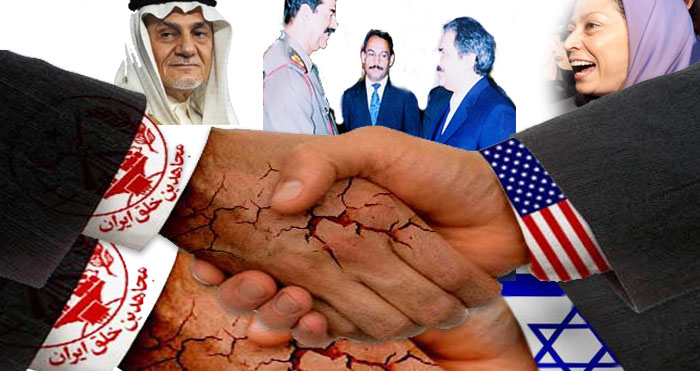
The news lately has revealed that the US, Israel, and Saudi Arabia are openly funding, supporting, arming, training and providing logistical support to Jundullah and MEK in order to take down the current sovereign government of Iran.

Even though the USA, Saudi Arabia and Israel may not like the current government there, what right do they have to engage in this type of state sponsored terrorist behavior?

There is a reason why various governments throughout the world have stood the test of time, and exist in their present states.

Perhaps their people wanted it, or perhaps there was need for that specific type of ideology or mode of governance, but unless and until those governments actively target or harm Americans, the US has absolutely no business getting involved with those groups, and indeed, has invariably and inevitably lived to regret it countless times, in nearly 100% of all cases.

By Rahul Manchanda,Eurasia Reveiw

May 23, 2018 0 comments
FacebookTwitterPinterestWhatsappTelegramSkypeEmail
Missions of Nejat Society

Islamic Terrorism Has an Advocate in the Oval Office

John Bolton’s ascent to one of the most important positions in government and Donald Trump’s decision to withdraw from the Joint Comprehensive Plan of Action (JCPOA), or Iran nuclear deal, have allowed an avowed terrorist group – and its cult-like leader – to take on a position of authority in Washington and in American foreign policy. The Mujahedin e-Khalq (MEK), or People’s Mujahedin Organization of Iran, has a long history of terrorism, of murder, and of attacks on civilians. But its chief Washington lobbyist, John Bolton, is seeing to it that the MEK will be the go-to-organization in the event that “regime change” comes to Tehran. That in and of itself is a crime.

The MEK is as much a cult as it is a terrorist group. It was created in 1965 by a husband and wife team, Massoud and Miryam Rajavi. They combined Islamism with Marxism and helped to overthrow the Shah of Iran, carrying out bombings and terrorist attacks in Tehran for nearly 15 years, including against Americans. In November 1970, the group attempted and failed to kidnap Douglas MacArthur II, the US ambassador to Iran, and in 1972, they assassinated US Air Force Brigadier General Harold Price. The MEK was reportedly the first group ever to use an improvised explosive device.

The MEK supported the Ayatollah Khomeini and the takeover of the US Embassy in Tehran in 1979, but they split with the regime because their personalized brand of violent Marxism didn’t fit in the new Shia Muslim theocracy. The Rajavis, along with their 5,000-member “National Liberation Army,” the MEK’s military wing, finally fled to Saddam Hussein’s Iraq in 1981. They were the perfect propaganda tools for Saddam, and he provided them with money, weapons, safe haven, and a military base along the border with Iran so that they could attack Iranian villages, border guards, and soldiers and then retreat to the safety of Iraqi territory.

Rank-and-file Iranians, including leftists, came to regard the Rajavis as traitors because of their alliance with Saddam and because of news reports that Massoud Rajavi had personally identified Iranian targets for the Iraqi military to attack and because MEK operatives would slip into Tehran and carry out assassinations. Indeed, the Rajavis murdered Iranian brigadier general Ali Sayyad Shirazi on the front steps of his home in 1999.

And that is the basis of the American political right’s love affair with the MEK.

Massoud Rajavi disappeared in Iraq in 2003 and has not been seen or heard from since. Miryam immediately assumed leadership and, upon Saddam’s overthrow, surrendered to US forces. It was her hatred of the Iranian government that made her an attractive propaganda figure to the likes of John Bolton, then serving as George W. Bush’s Undersecretary of State for International Security.

Never mind that Miryam had been charged with crimes against humanity for her role in Saddam’s massacre of Shia Muslims in southern Iraq in 1991. Never mind that she had actively sought – and carried out – the assassinations of American officials in Iran. Never mind that the MEK was on the State Department’s list of terrorist groups, as well as terrorist lists in the European Union and at the United Nations. John Bolton decided that they should be rehabilitated and that the group should be represented in Washington.

This wasn’t just John Bolton’s position, borne of his hatred of all things Iranian. It was also part of Miryam Rajavi’s forward-looking policies. She understood that anyone and anything in Washington could be purchased. And so she hired lobbyists.

The first order of business was getting the MEK off the terrorist list. Lobbyists Joe DiGenova (Ronald Reagan’s former US attorney for the Southern District of New York), the giant international law firm of Akin Gump Strauss Hauer & Feld and, yes, John Bolton worked the issue. They succeeded, and the MEK was taken off the list in 2012. It reportedly cost the group millions of dollars.

Miryam also began paying enormous speaking fees to American politicians and then leveraging those relationships to lobby on the group’s behalf. The New York Times and other outlets reported that Democrats who have taken MEK money include former Vermont governor Howard Dean, former Pennsylvania governor Ed Rendell, former New Mexico governor Bill Richardson, and former House Foreign Affairs Committee chairman Lee Hamilton. The MEK is equally generous with Republicans. Recipients of the MEK’s largesse include former New York mayor Rudy Giuliani, former secretary of Homeland Security Tom Ridge, former attorney general Michael Mukasey, and former White House chief of staff Andrew Card. Even Alan Dershowitz and Elie Wiesel got in on the action.

This is emblematic of everything that stinks in Washington. It’s all about the money. Everybody at the upper levels of government eventually gets rich. That’s always the plan. Do your time making $160,000 a year in some federal position and then cash in, even if you have to get in bed with terrorists. It’s a bipartisan play.

Bolton is making it worse, though. It’s not just about the money for him. Sure, the MEK helped to make him rich. But he wants something more. He wants to overthrow the Iranian government and install Miryam Rajavi as its new leader. We’ve already seen the first step in that direction. Donald Trump withdrew from the JCPOA and ramped up the rhetoric against the Iranian government. He’s doing Benjamin Netanyahu’s bidding here, all with the full support of the royal families of Saudi Arabia, Bahrain, and the United Arab Emirates. That’s always been the plan for all of them.

Meanwhile, Miryam Rajavi is waiting patiently. If John Bolton has his way, she will be the next in a long line of US puppets around the world, even if her path has been decidedly circuitous. It doesn’t matter that she has murdered American citizens. It doesn’t matter that she is wanted in Iraq for crimes against humanity. It doesn’t matter that she’s listed by the United Nations as an “international cult leader.” She’s a part of John Bolton’s plans. Expect to see a lot more of her in the coming few years.

By John Kiriakou, Reader Supported News ,

John Kiriakou is a former CIA counterterrorism officer and a former senior investigator with the Senate Foreign Relations Committee. John became the sixth whistleblower indicted by the Obama administration under the Espionage Act – a law designed to punish spies. He served 23 months in prison as a result of his attempts to oppose the Bush administration’s torture program.

May 22, 2018 0 comments
FacebookTwitterPinterestWhatsappTelegramSkypeEmail
Money Laundry
Mujahedin Khalq; A proxy force

Money adventures of the MKO and the bloodthirsty security advisor

The Middle East has been set in fire during in the last two decades due to the clashes between US-sponsored terrorists and the states of the region. By the withdrawal of Donald Trump from the Joint Comprehensive Plan of Action (JCPOA), his newly-elected National Security advisor longs for another proxy war, this time in Iran using terrorist cultists of Mujahedin Khalq (MEK, MKO, PMOI, the Cult of Rajavi).

On the eve of this year’s gathering of the Mujahedin Khalq in France, while Bolton was supposed to offer the MKO more hope for regime change in Iran, he seems to have retreated from his previous position. As Bolton was widely criticized for his last year’s speech at the so-called grand gathering of the MKO in which he openly called for regime change in Tehran, he said on Sunday that this is not the Trump administration’s current policy.

“That’s not the policy of the administration. The policy of the administration is to make sure that Iran never gets close to deliverable nuclear weapons,” Bolton said on the ABC program. [1]

“I’ve written and said a lot of things over the years when I was a complete free agent,” Bolton said when pressed on the issue of regime change in Iran on CNN’s “State of the Union”. He admitted that he is not a decision maker in the US administration. “The circumstances in I’m in now is that I’m the national security adviser to the president,” He said. “I’m not the national security decision maker. He (Trump) makes the decisions and the advice I give him is between us.” [2]

Bolton’s recent comments on Iran indicates how unbalanced are the supporters of the MKO. In 2015, Bolton wrote an op-ed in the New York Times calling for air strikes on Iran’s nuclear facilities. And in 2016, Bolton called for regime change while he was reportedly under consideration to be Secretary of State. As he confesses, he has said a lot of things. Particularly, in response to large amounts of dollars that the MKO has poured in his pockets, he has said all the things the group loves to hear.  The most significant thing was his speech at the group’s gathering where he said:

“There is a viable opposition to the rule of the ayatollahs, and that opposition is centered in this room today.  I had said for over 10 years since coming to these events, that the declared policy of the United States of America should be the overthrow of the mullahs’ regime in Tehran. The behavior and the objectives of the regime are not going to change, and therefore the only solution is to change the regime itself. And that’s why, before 2019, we will celebrate in Tehran!” [3]

One of many critics of Bolton in the American media, Caitlin Johnstone of Ron Paul Institute for Peace and Prosperity writes: “Bolton, who is so stupid, crazy and evil that he remains one of the only high-profile individuals on this planet who still insists that the Iraq invasion was a great idea, spoke about the need to prevent the Iranian government from achieving”an arc of control”through Iraq, Syria and Lebanon. He decried the Joint Comprehensive Plan of Action (JCPOA), claiming that Iran was still a nuclear threat under the existing agreement, and spoke glowingly of aggressive sanctions against Tehran.” [4]

Johnstone clarifies that how dreadful is Bolton’s choice to alternate the Iranian government. “Also known as the Mojahedin-e Khalq or MEK, a group of a few thousand members who vocally oppose the Iranian government,” he describes the MKO. “The MEK is widely considered a cult, using very cult-like methods of indoctrination including exerting control over the personal and sex lives of its members and forcing them to go through weekly”ideological cleansings”.” [5]

As Johnstone puts, “the president’s bloodthirsty National Security Advisor” and other advocates of the MKO lead the regime change agenda under the stimulus of the multi-million-dollar campaign of the group. “The MEK reportedly has weirdly deep pockets which have enabled it to spend millions of dollars rehabilitating its image in recent years, and to pay out sizable fees for panelists and speeches by experts willing to advocate in favor of its regime change agenda,” he writes. [6]

The fact that almost no one in the paid campaign of the MKO supporters brings up the cult-like nature of the MKO, its violent past and its unpopularity among Iranians indicates that they are totally motivated by the filthy dollars of the group laundered into their pockets via European Banks.

Mazda Parsi

References:

[1] Reuters staff, Bolton says Iran plan isn’t regime change; sanctions against Europe also possible, Reuters, May 13, 2018

[2] ibid

[3] Agorist, Matt, WATCH: John Bolton Promises Room Full of ‘Former Terrorists’ the US Would ‘Overthrow’ Iran by 2019, The free thought project.com, May 11, 2018

[4] Johnstone, Caitlin, That Time John Bolton Promised Regime Change In Iran Before 2019, Ron Paul Institute for Peace and Prosperity, May 11, 2018

[5] ibid

[6] ibid

May 21, 2018 0 comments
FacebookTwitterPinterestWhatsappTelegramSkypeEmail
Ehsan Bidi
Albania

Conflict between roots and soil and rejection of a terrorist’s corpse

Surely you are informed by the media that the cult Mojahedin has announced that Marzie Rezai, a senior official of this organization, has died in Albania. In this way, her illegal burial was opposed by the residents of Manza in the city of Durres.  Of course, those who were like me in Ashraf’s death camp in Iraq well known that there are suspicious deaths inside of Rajavi cult and those who knew Marzie Rezai, know well that in addition to the history of oppression within the organization Mojahedin, she was recently against Masud Raxhavi’s policies, according to a statement by Maryam Rajavi, she has died in Albania.

Ehsan Bidi

The point is, if that what says Maryam Rajavi is correct and Marzie Rezai has died of an illness then why and how about the slightest illness of Maryam Rajavi, when she ill, she will be treated by the best doctors that her treatment cost hundreds of thousands euros, but why the members of the Mojahedin organization cannot have this treatment? Why you did not offer such conditions to Marzie Rezai?

But if we look at the other side of the currency that is closer to reality, the question arises maybe Marzie Rezai drunk a cup of poison served by Maryam Rajavi, it can be true or not?

It should be remembered that during the burial of Marzie Rezai in the cemetery of Manza in the city of Durres, something interesting has happened. The burial of Marzie Rezai’s corpse by the Mojahedin organization has sparked the hatred of the inhabitants of this city and this issue echoed among the Albanian media to the point that the mayor and senior government officials intervened and voted in favor of residents of this city, why the cult Mojahedin buried the corpse of Marzie Rezai without coordination with the cemetery of Manz town in Durres, where the inhabitants of that region were deeply angry or even planned that day to exhume and remove the hideous body of a terrorist who insulted their privacy and identity.

The residents of this city said that the Moxhahedin-Khalk Organization is a terrorist group and in Albania has come under the umbrella of the US and the government with taxes and our money keeps them, instead of spending these money for drinking water and electricity, where residents of this area face daily with these deficiencies. Residents of Manza said that they were tired of the presence of the Mojahedin organization because of the apparent interference with the villagers’ personal issues to the extent that mobile phones were being inspected.

Conclusion:

The Albanian people believe that this land possesses roots and historical passages, and powerful Albanian men and women have been born and buried here. As a result, the body of a terrorist is on these roots and on this earth.

Residents in Durres refuse to bury Iranian jihadists

By Ehsan Bidi

May 19, 2018 0 comments
FacebookTwitterPinterestWhatsappTelegramSkypeEmail
Mujahedin Khalq; A proxy force

Back to the future? Bolton, Trump and Iranian Regime Change

Now that the Trump administration has derailed the Iran nuclear deal, the old issue of regime change in Iran is back again. National Security Adviser John Bolton is obviously the chief regime-change advocate in the administration, and there is every reason to believe he has begun to push that policy with Donald Trump in his first month in the White House.

Bolton was part of the powerful neoconservative faction of national security officials in the George W Bush administration that had a plan for supporting regime change in Iran, not much different from the one Bolton is reportedly pushing now. But it was a crack-brained scheme that involved the Mujahideen-e-Khalq (MEK) exiled terrorist organisation that never had Bush’s support.

Bolton may find history repeating itself, with Trump resisting his plan for regime change, just as Bush did in 2003.

Trump calls for change

Trump has appeared to flirt with the idea of Iranian regime change in the past. During the December protests in Iran, he said on Twitter that it was time for a change, noting: “The great Iranian people have been repressed for many years.”

Trump’s killing of the nuclear deal, however, stopped short of rhetoric signalling the aim of overthrowing the Islamic Republic. Instead, Trump suggested that “Iran’s leaders” are “going to want to make a new and lasting deal, one that benefits all of Iran and the Iranian people”. He added: “When they do, I am ready, willing and able.”

    Bolton has been one of the most enthusiastic clients among former US officials who have associated themselves with MEK, which seeks to overthrow the Tehran regime with US backing

A few days after the Trump announcement, an unnamed National Security Council (NSC) official avoided any hint of regime change, telling the neoconservative Washington Free Beacon: “Our stated policy is to change the Iranian regime’s behaviour.” Now, Bolton has issued an even more explicit denial, telling ABC News: “That is not the policy of the administration. The policy of the administration is to make sure Iran never gets close to deliverable nuclear action.”

And on CNN’s State of the Union, he said:

    I’ve written and said a lot of things when I was a complete free agent. I certainly stand by what I said at the time, but those were my opinions then. The circumstance I’m in now is I’m the national security adviser to the president. I’m not the national security decision-maker.

It’s not difficult to read between the lines: the implied message is that his views on regime change have not prevailed with Trump.

Advocating to bomb Iran

Bolton has long been one of the most vocal supporters of such a policy, although he is better known as the primary advocate of bombing Iran. He has been one of the most enthusiastic clients among former US officials who have associated themselves with MEK, which seeks to overthrow the Tehran regime with US backing.

Bolton has not only appeared at MEK rallies in Paris, along with other former US officials on the take from the well-endowed paramilitary organisation. In July 2017, he declared that the Trump administration should adopt the goal of regime change in Iran, calling MEK a “viable” alternative to the regime. And his final line, delivered with his voice rising dramatically, noted that “before 2019, we here will celebrate in Tehran”.

It appears that Bolton was still pushing the idea within the administration as of last week. The Washington Free Beacon reported on 10 May that a three-page paper outlining a regime-change strategy from a small far-right organisation called the Security Studies Group, with which Bolton is said to have close ties, was circulated among NSC officials. The quotes from the paper in the story make it clear that the strategy is based largely on seeking to exploit ethnic and religious conflicts in Iran.

The paper reportedly makes the point that ethnic minorities – such as Kurds, Azeris, Ahwazi Arabs and Baloch – represent one-third of Iran’s population, and argues that the Iranian regime’s “oppression of its ethnic and religious minorities has created the conditions for an effective campaign to splinter the Iranian state into component parts”. It adds: “US support for their independence movements, both overt and covert, could force the regime to focus attention on them and limit its ability to conduct other malign activities.”

Those minorities have all had organisations that have carried out violent actions, including bombings and assassinations against Iranian officials, over the past decade, and such a strategy would presumably involve supporting a step-up in such activities – in other words, US support for terrorist activities against Iranian government targets.

The role of MEK

But none of this is new. It was the official line of the powerful alliance between the neoconservatives and the Cheney-Rumsfeld axis within the Bush administration. By 2003, Douglas Feith, the uber-neoconservative former undersecretary of defense for policy, had developed a plan for giving MEK, whose army had been captured by US troops in Iraq, a new name and using them for a covert paramilitary operation in Iran.

Meanwhile, Iran was offering to provide names and other data on al-Qaeda officials it had captured in return for US information on MEK. When former defense secretary Donald Rumsfeld sought to protect MEK from such a deal, Bush’s response was: “But we say there is no such thing as a good terrorist.”

Despite the neocon fixation with supporting MEK, both the CIA and the Israelis have long regarded the idea that it could be an instrument for regime change in Iran as ridiculous. After the organisation helped Saddam Hussein’s regime suppress Shia and Kurdish uprisings, it lost any semblance of legitimacy inside Iran. After it relocated to Iraq, moreover, it was transformed into an authoritarian cult.

The former Israeli ambassador to Iran, Uri Lubrani, who was given a free hand to organise a programme for destabilising Iran, recognised long ago, as he told two Israeli journalists, that MEK has no capacity to do anything inside the country.

It was Lubrani who first advanced the argument that about a third of the total Iranian population were ethnic minorities, and that promoting their anti-Tehran activities could help to destabilise the government. Those groups have carried out terrorist bombings and other armed actions in various parts of Iran over the years, and it is well documented that Israel was supporting and advising the Baloch extremist organisation Jundallah on such operations. But the Israelis have used MEK mainly to put out disinformation on Iran’s nuclear programme.

The policy paper Bolton is reportedly pushing states explicitly that the regime change policy should include the use of military force against Iran if necessary. That was the premise of the Cheney-Bolton plan for regime change in Iran, as former Vice President Dick Cheney’s Middle East adviser, David Wurmser, later revealed. And it is the game that Bolton, the enthusiast for bombing Iran, is apparently still playing.

By Gareth Porter, Orbitt.net

  • First published in Middle East Eye
May 19, 2018 0 comments
FacebookTwitterPinterestWhatsappTelegramSkypeEmail
Ann Singleton
Albania

Albanian PM offends the Jews by comparing their suffering to terrorists

Albania, situated in the middle of the Balkans, harbours one of the most eccentric political leaders in Europe. But Edi Rama, Prime Minister of the country, doesn’t claim the spotlight only for his lavish dress sense. On May 13th Prime Minister Rama surprised once more by comparing the suffering of Jewish people during the Second World war to a terrorist organization known as the MEK. A comparison that isn’t only stupid, it’s also deeply offensive against the Jews who suffered under the Nazis.

For those who are not familiar with the Mojahedin Khalq (MEK), allow me to give you a short history. The MEK is a terrorist organization, responsible for thousands of civilian murders in Iran and Iraq over three decades. Until 2012 MEK was listed as a terrorist organization by the United States, the year Hillary Clinton decided to delist them and strike a deal with Albania to take them in.

Nowadays the MEK is demanding that the US and Israel rain bombs down on the homes of their own families in Iran. They were brought to Albania because Iraq refused to tolerate the presence of American backed former Saddamists in their country. They were supposed to be de-radicalized and rehabilitated back into society once they arrived. To be completely clear, this never happened.

Instead, the Americans have insisted on re-grouping the MEK and using them as ‘regime change’ marketeers; placing Albania on the front line in the Neocon’s and Likud’s war against Iran.

Albania, which has already more than enough trouble fighting the well-known organized crime sector, is now wasting costly resources and police officers to keep this vile and dangerous group under control.

This anecdotal view comes with its own headlines. Criminals involved in drug smuggling and arms and human trafficking are still highly organized and very active. The mysterious disappearance of 60 asylum seekers has been treated by the police and SHISH as a matter of state secrecy. Albanian officials I spoke with said, off the record, there was no doubt they had been trafficked to Europe but that the government does not want Europe to be aware of this ongoing business. The fact that some of those who disappeared belonged to the Iranian Mojahedin Khalq (MEK) terrorist group only adds to what the report called a “scary event”.

In this context, Rama has a lot to answer for but has evaded the difficult questions. One of those difficult issues is the disturbing activities of the MEK in the country. Since the first arrivals in 2013 to the last group who arrived at the end of 2016, this group has caused controversy. Only recently, local residents in Manzë had enough of it and protested against their presence. Pointing not only to the MEK’s unwelcome use of their families’ cemetery to bury their dead, but also to the economical inequality between ordinary Albanian citizens and MEK members. Those members do not have pay or pensions and therefore pay no taxes but are afforded the luxury of 24-hour water and electricity supplies that locals cannot access.

When asked by Italian Radio Radicale about the MEK presence in Albania (3.30m – 5.15m), Rama’s oafish, self-satisfied reply is a shocking example of lazy, casual Anti-Semitism. He likens sheltering the MEK now to sheltering Jewish people fleeing the Nazis during WWII.

This comparison is deeply, deeply offensive to Jewish people. The history and current situation of the MEK is about as diametrically opposed to the experience of Jewish people in Nazi Europe as it is possible to imagine.

PM Rama is not only wrong – the MEK’s unchecked presence in Albania is also an affront to the citizens of that country – he reveals how un-statesmanlike he is. How incapable of showing leadership and how easily he has been ‘persuaded’ to stupidly and ignorantly follow American and Israeli foreign policy to the detriment of his own country’s national interests. If unchecked, the MEK in Albania could turn into an even bigger problem for the country, as the recent protest shows.

Anne Khodabandeh (Singleton), Balkan Post

Anne Khodabandeh, is an expert in anti-terrorist activities and a long-standing activist in the field of deradicalization of extremists. She has written several articles and books on this subject, along with her husband, who is of Iranian origin.

May 19, 2018 0 comments
FacebookTwitterPinterestWhatsappTelegramSkypeEmail
Missions of Nejat Society

State Secretary delisted the group, reportedly to use MEK for US purposes.

Will EU be able to sustain the Nuclear Deal?

The United States President Donald Trump’s withdrawal from the Iran nuclear deal was the wrong decision at the wrong time. The decision is likely to compound global political, economic and security risks. Now the European Union must sustain the nuclear deal, along with Russia and China.

For three years, the comprehensive nuclear accord (J.C.P.O.A.) has offered Iran relief from US, United Nations and multilateral sanctions on energy, financial, shipping, automotive and other sectors. However, a shift in the US policy began in late 2016, when the Senate and the House of Representatives unanimously extended the Iran Sanctions Act for a decade.

Not just most Republicans but many Democrats who supported the J.C.P.O.A. in the Obama era reversed their positions surprisingly quickly. This emboldened Trump’s far more muscular – and illicit – policy against Iran.

Effort to destabilize Iran to win the Middle East

Regionally, Trump’s stance leans on Saudi Arabia for economic and geopolitical support, as evidenced by the $110 billion arms deal with Riyadh signed a year ago. This is further reinforced by security ties with Israel, as reflected by U.S. recognition of Jerusalem as the capital of Israel – a fatal policy mistake denounced by the international community in the UN and one that reversed almost seven decades of US foreign policy.

The increasing convergence of the US, Saudi and Israeli interests in the Middle East reflects an escalating quest for regional primacy. Last October, the Trump administration designated sanctions on additional missile and Islamic Revolutionary Guard Corps-related entities, while threatening to cease implementing the J.C.P.O.A. By weakening Iran’s “moderates,” the White House hoped to incite “hawks” into strategic moves that could be used as a pretext for a regime change.

Supported by Republican neoconservatives and Democrats’ liberal interventionists, the plan relies on discontented Iranian exiles and Shah loyalists in the West, while Saudi Arabia and Israel try to soften Iran in military and covert operations in ongoing proxy wars.

Along with economic pressures, Trump seized covert operations after naming the controversial Michael D’Andrea, who was deeply involved with the US interrogation program after 9/11 attacks, the head of CIA’s Iran operations. At the same time, the ultraconservative hawk Mike Pompeo replaced Rex Tillerson as Secretary of State. Both D’Andrea and Pompeo favour a regime change in Iran.

Trump also made the neoconservative John Bolton his national security adviser and Gina Haspel the new head of CIA. While Bolton contributed to the “weapons of mass destruction” pretence that led to the war in Iraq, Haspel served as chief of a CIA black site torture prison and played a role in the destruction of some 100 interrogation videotapes.

In 2003, Bolton relied on false data from U.S.-based Iraqi exiles and now he is reliant on flawed information from Iraqi exiles. In November 2017, Bolton urged the US to have a contingency plan for a “Shah of Iran scenario.” Four months before, he had advocated Trump’s withdrawal from the deal, pledging a regime change before February 2019 – the 50th anniversary of the Iranian revolution.

Withdrawing from the Iran #NuclearDeal should be a top @realDonaldTrump administration priority.

— John Bolton (@AmbJohnBolton) July 17, 2017

#JohnBolton 8 months ago among MEK supporters tells them they will overthrow #Iran’s regime and celebrate in #Tehran with Bolton himself present, “before 2019” pic.twitter.com/H7oaaU3faU

— Bahman Kalbasi (@BahmanKalbasi) March 22, 2018

After Bolton replaced Trump’s national security adviser H.R. McMaster in early April, he is now positioned to execute the regime change plan.

Regime change, terror, puppets, and hot money

Bolton supports Mojahedin-e Khalq (MEK), an Iranian opposition group on which he relies for information(and speaking fees). MEK advocates a violent overthrow of Iran’s democratically-elected government. Until the early 2010s, the UK, EU and the US considered MEK a cultist terrorist organization but State Secretary Hillary Clinton de-listed the group, reportedly to use MEK for US purposes.

former CIA Directors R. James Woolsey and Porter Goss, Homeland Security Secretary Tom Ridge, FBI Director Louis Freeh, Republican Speaker of the House Newt Gingrich, NYC Mayor Rudy Giuliani, Chair of the House Intelligence Committee Mike Rogers, as well as some democrats, such as former Pennsylvania and Vermont Governors Ed Rendell and Howard Dean, and National Security Adviser to President Obama Jim Jones, to mention just a few.

On the MEK side, the demands for regime change in Iran were orchestrated largely by its leader Maryam Rajavi, the “President-elect” of the National Council of Resistance of Iran (NCRI), who has been investigated for terrorism in and expelled from France (her husband is wanted by Iraq for crimes against humanity), and Alireza Jafarzadeh, the NCRI’s public face, who has fed US and international agencies information about Iran’s alleged nuclear ambitions since the early 2000s.

Some of the MEK funds were accrued during the Iraq-Iran War (1980-88) when the MEK was hosted by Saddam Hussein to fight against Iran, reportedly in exchange for millions of dollars. From the ‘90s to early 2000s, MEK coordinated terror raids against Iranian diplomatic missions internationally.

As reported by the NBC the MEK financed, trained and armed by Israel’s secret service – has assassinated Iranian nuclear scientists since 2007. Even before de-listing, the US provided training and funding for the MEK on the US soil and in covert operations in Iran, according to prominent author Seymour Hersh writing in the New Yorker.

When MEK uses substantial funds to attract prominent Americans, these funds originate from money-laundering organizations in Europe, US and the Middle East, according to FBI and State Department. The case of the MEK, argues constitutional lawyer Glen Greenwald, indicates that the “US government is not opposed to terrorism; it favours it.”

Along with the former Shah’s supporters in the U.S. and elsewhere, the regime change planners rely on these shady figures, and their quasi-legal organizations, just as they did with Ahmed Chalabi of the Iraqi National Congress (NC) in 2003. That’s when sanctions led to the War in Iraq – which is their role now in Iran as well.

From old sanctions to new ones

Last week, the US once again acting unilaterally, moved towards cutting Iran off from the global economy as the Treasury Department imposed new sanctions on several Iranian companies, individuals and officials presumably for an illegal currency-exchange network in the UAE. Throughout his 2016 campaign, Trump described the Iran nuclear deal as a “disaster.” Aggressive rhetoric followed by a redefinition of terms are key elements in his deal-making. These unilateral efforts rest first on economic pressure, followed by political intimidation and when necessary, military force.

Following the J.C.P.O.A., primary sanctions on energy, financial, shipping, automotive and other sectors were lifted after International Atomic Energy Agency’s (IAEA) certification in January 2016 that Iran had complied with the agreement. Yet, secondary sanctions on firms remained in place, along with sanctions applying to US companies, including banks.

The White House will seek to strengthen the secondary sanctions while seeking to restore the primary sanctions. Last October, Trump demanded the J.C.P.O.A. to limit Iranian ballistic missile development and regional activities. Accordingly, the administration has imposed sanctions on additional entities related to Iran’s missile program, Navy operations in the Persian Gulf, and other activities in the region.

The spotlight is back on Iran sanctions enacted or under consideration in the Congress, such as the Countering America’s Adversaries through Sanctions Act of 2017 (CAATSA), plus pending legislation relating to Iran’s ballistic missiles, the assets of Iranian leaders, stricter oversight on Iran’s access to finance, the re-imposition of waived U.S. sanctions, and possible multilateral international sanctions.

Since Russia and China will stay solidly behind the Iran nuclear deal, the real question is whether the key European powers – Germany, France, the UK, and the EU itself – will defend it.

Effort to undermine EU-Iran ties

Prior to Trump’s decision, EU leaders stressed the importance of the full implementation of the J.C.P.O.A. French President Emmanuel Macron warned that “the nuclear non-proliferation regime is at stake.” Germany’s Foreign Minister Heiko Maas argued that theJ.C.P.O.A. “makes the world safer.” UK Foreign Minister Boris Johnson tweeted that the “UK remains strongly committed to the J.C.P.O.A..” Top EU diplomat Federica Mogherini pledged the EU will remain committed to the deal.

Deeply regret US decision to withdraw from the Iran nuclear deal. UK remains strongly committed to the JCPoA, and will work with E3 partners and the other parties to the deal to maintain it. Await more detail on US plan.

— Boris Johnson (@BorisJohnson) May 8, 2018

However, about a week ago Macron tweeted saying that “we will work collectively on a broader framework, covering nuclear activity, the post-2025 period, ballistic activity, and stability in the Middle East, notably Syria, Yemen and Iraq.” Such statements suggest that some EU leaders may try to redefine the EU approach by leaving the J.C.P.O.A. intact, but couple the deal with new and broader conditions, which would undermine the deal.

We will work collectively on a broader framework, covering nuclear activity, the post-2025 period, ballistic activity, and stability in the Middle-East, notably Syria, Yemen, and Iraq.

— Emmanuel Macron (@EmmanuelMacron) May 8, 2018

The Trump administration is likely to target European businesses that have done business in and with Iran since the Iran nuclear deal. It may extend sanctions over to companies that represent other J.C.P.O.A. parties – that is, China, France, Russia, UK, Germany and the EU – thus raising risks for their U.S. access. As Treasury Secretary Steven Mnuchin recently put it, European-Iran business agreements will be voided as “the existing licenses will be revoked.”

Along with Renault, PSA Peugeot Citroen and Sanofi have huge stakes in the deal due to the Airbus contract to provide Iran Air 100 aeroplanes for $21 billion and the oil giant Total’s $2 billion deal to develop the South Pars oil field. Over 120 German companies, including Volkswagen and Siemens, operate in Iran and another 10,000 do business with Iran. Economic pressure could harm Iran’s oil industry significantly, the largest single buyers of which include China, South Korea, Turkey, Japan, Italy and India.

The White House’s message seems loud and clear, “Get out of Iran if you want to stay in the U.S.” It is an effort at regime change but without international legitimacy since Iran has fully adhered to conditions of the J.C.P.O.A. The very credibility of the EU powers is on the line now.

Dr. Dan Steinbock is an internationally recognized strategist of the multipolar world and the founder of Difference Group. He has served as research director at the India, China and America Institute (USA) and visiting fellow at the Shanghai Institutes for International Studies (China) and the EU Center (Singapore).

US withdrawal from the Iran deal: a ploy to force a regime change

May 17, 2018 0 comments
FacebookTwitterPinterestWhatsappTelegramSkypeEmail
Mujahedin Khalq; A proxy force

Bolton’s Push for Regime Change in Iran

Trump’s decision to renege on the nuclear deal was a terrible unforced error, and the process that led to that decision is no less worrisome:

Even if Mr. Mattis had wanted to fight for the deal, it is not clear how much he would have been heard. Mr. Bolton, officials said, never convened a high-level meeting of the National Security Council to air the debate [bold mine-DL]. He advised Mr. Trump in smaller sessions, otherwise keeping the door to his West Wing office closed. Mr. Bolton has forged a comfortable relationship with the president, several people said, channeling his “America First” vocabulary.

Bolton’s handling of the run-up to Trump’s decision on the nuclear deal shows that he isn’t interested in presenting a range of opposing views to the president and the president is content to let Bolton limit the information he receives. One of the reasons to be worried about having Bolton as National Security Advisor is that he will not be an honest broker when it comes to presenting the president with all the facts. That worry was obviously well-founded. Because Bolton is an ideologue and has extremely hard-line views on Iran in particular, he isn’t going to allow the president to hear views that contradict his own, and that means that Iran policy in particular and U.S. foreign policy in general is going to become more aggressive and ideologically-driven than they already were.

This is all the more disturbing because of reports that Bolton’s NSC is circulating plans to foment regime change in Iran:

The plan, authored by the Security Studies Group, or SSG, a national security think-tank that has close ties to senior White House national security officials, including National Security Adviser John Bolton, seeks to reshape longstanding American foreign policy toward Iran by emphasizing an explicit policy of regime change, something the Obama administration opposed when popular protests gripped Iran in 2009.

The regime change plan seeks to fundamentally shift U.S. policy towards Iran and has found a receptive audience in the Trump administration, which has been moving in this direction since Bolton—a longtime and vocal supporter of regime change—entered the White House.

It doesn’t come as a surprise that talk of regime change in Iran has increased since Bolton took office. Bolton is a longtime advocate for the Mujahideen-e Khalq, a deranged totalitarian cult that he would like to install as the next government of Iran, and he has made no secret of his desire to topple the Iranian government. It was just a matter of time before he started trying to make this official policy.

Daniel Larison

May 16, 2018 0 comments
FacebookTwitterPinterestWhatsappTelegramSkypeEmail
Newer Posts
Older Posts

Recent Posts

  • The black box of the torture camps of the MEK

    December 24, 2025
  • Pregnancy was taboo in the MEK

    December 22, 2025
  • MEPs who lack awareness about the MEK’s nature

    December 20, 2025
  • Why did Massoud Rajavi enforce divorces in the MEK?

    December 15, 2025
  • Massoud Rajavi and widespread sexual abuse of female members

    December 10, 2025
  • Facebook
  • Twitter
  • Instagram
  • Youtube

© 2003 - 2025 NEJAT Society . All Rights Reserved. NejatNGO.org


Back To Top
Nejat Society
  • Home
  • Articles
  • Media
    • Cartoons
    • NewsPics
    • Photo Gallery
    • Videos
  • Publications
    • Books
    • Nejat NewsLetter
    • Pars Brief
  • About Us
  • Contact us
  • Editions
    • عربي
    • فارسی
    • Shqip