Nejat Society
  • Home
  • Articles
  • Media
    • Cartoons
    • NewsPics
    • Photo Gallery
    • Videos
  • Publications
    • Books
    • Nejat NewsLetter
    • Pars Brief
  • About Us
  • Contact us
  • Editions
    • عربي
    • فارسی
    • Shqip
Nejat Society
Nejat Society
  • Home
  • Articles
  • Media
    • Cartoons
    • NewsPics
    • Photo Gallery
    • Videos
  • Publications
    • Books
    • Nejat NewsLetter
    • Pars Brief
  • About Us
  • Contact us
  • Editions
    • عربي
    • فارسی
    • Shqip
© 2003 - 2024 NEJAT Society. nejatngo.org
Iran

Iran: US has fallen in the direction of fantasies of MEK Terrorist cult

Descendants of ‘gun-toting cowhands’ insulting Iranian nation: Judiciary chief

TEHRAN – Denouncing U.S. President Donald Trump’s aggressive tone and actions against the Iranian nation, Judiciary chief said on Monday that those who are descended from “gun-toting cowhands” are insulting the great Iranian nation whose civilization dates back to thousands of years ago.

Hinting at insults by successive U.S. administrations to the Iranian nation, Ayatollah Sadeq Amoli Larijani said, “We have not forgotten how the new, amateur president of America insulted the Islamic Republic and the dear people of Iran by calling them a ‘terrorist nation’.”

“The biggest civilizations emerged in this territory,” he asserted.

He further said the U.S. is still trying in vain to break the “will” and “power” of the Iranian nation without regard to its past 40 years of failures. “Such wickedness is still ongoing in America’s governing body,” he continued.

Elsewhere in his remarks, Amoli Larijani pointed to the U.S. withdrawal from the 2015 nuclear agreement, saying exiting an international treaty is “indigestible” for every country, “but the U.S. does such thing through bullying.”

He also pointed to the impact of Mojahedin-e Khalq Organization (MKO/MEK), an anti-Iran terrorist group, on U.S. politicians, saying that with the help of the MKO the U.S. has been trying to disrupt the Iranian economy.

Trump’s new national security advisor John Bolton is in close contact with the MKO which has done numerous terrorist activities in Iran and joined Saddam Hussein’s army in the fight against Iran in the 1980s.

Amoli Larijani said the U.S. “has unfortunately fallen in this wrong direction by the illusions and fantasies of [such] terrorist groups.”

“Today, the advisors of the American government are linked with the most notorious and most evil terrorists in the world,” he said, adding that the MKO terrorists are moving the U.S. government in the wrong direction by raising their hopes of the collapse of the Islamic Republic.

The Judiciary chief also highlighted the importance of gaining “insight, unity and empathy” to foil the plots hatched by the country’s enemies.

May 31, 2018 0 comments
FacebookTwitterPinterestWhatsappTelegramSkypeEmail
US Rajavi lobby
Mujahedin Khalq; A proxy force

Iran’s Mohajedeen e Khalq: MEK Money Sure Can’t Buy Love

Iran’s radical pseudo-Marxist cult Mohajedeen e Khalq, better known by its acronym MEK, is somewhat reminiscent of the Israel Lobby’s American Israel Public Affairs Committee (AIPAC) in that it operates somewhat in the shadows and is nevertheless able to punch well beyond its weight by manipulating politicians and understanding how American government functions on its dark side. MEK promotes itself by openly supporting a very popular hardline policy of “democratic opposition” advocating “regime change” for Iran while also successfully selling its reform credentials, i.e. that it is no longer a terrorist group. This latter effort apparently convinced then Secretary of State Hillary Clinton on 2013 as she and President Barack responded to the group’s affability campaign by delisting MEK from the government list of terrorist organizations.

This shift in attitude towards MEK was a result of several factors. First, everyone in Washington and the Establishment hates Iran. And second, the Executive Order 13224, which designates Iran’s Revolutionary Guards as a terrorist organization, ipso facto defines any group fighting against it as one of the good guys, justifying the change.

MEK is best described as a cult rather than as a political movement because of its internal discipline. Its members are, according to the testimony of those who have somehow escaped, subjected to considerable indoctrination best described as brainwashing. Though not exactly imprisoned, adherents are kept isolated and separated insofar as possible and cannot contact their families. Their possessions are collectivized so they have no money or other resources. If they are in contravention of the numerous rules that guide the organization they are punished, including physically, and there are reports of members being executed for trying to escape.

The current head of the group is Maryam Rajavi, the wife of the deceased co-founder of MEK, Massoud. She is reported to be politically savvy and speaks excellent English learned in part to enable her to communicate with adoring American politicians. The group itself was founded in 1965. Its name means “People’s Holy Warriors,” derived from its Marxist/populist roots and its religiosity. It was not unlike the Taliban which developed in adjacent Afghanistan. During the 1970’s it rebelled against the Shah and was involved in bombing and shooting American targets. It executed U.S. Army Lt. Col. Lewis Hawkins in 1973 as he was walking home from the U.S. Embassy and in 1975 it killed two American Air Force officers in their chauffer driven car, an incident that was studied and used in CIA training subsequently as an example of how not to get caught and killed by terrorists. Between 1976 and 1978 the group bombed American commercial targets and killed three Rockwell defense contractors and one Texaco executive.

MEK welcomed the Iranian revolution and also the occupation of the U.S. Embassy but soon fell afoul of the Ayatollah Khomeini regime. It eventually moved to join Iran’s enemy Saddam Hussein in Iraq and participated on the Iraqi side in the bloodletting that followed when the two countries went to war in 1980-8. For that reason alone, MEK is particularly hated by most Iranians and the repeated assertion that it is some kind of “Iranian democracy” alternative is ridiculous as the people in Iran would never accept it. In terms of the duplicity surrounding its marketing, it is reminiscent of Iraqi con artist Ahmed Chalabi, who also had little following inside Iraq but was able to convince Pentagon geniuses like Paul Wolfowitz that he represented some kind of democratic movement. At the time Chalabi was also secretly working for Iran.

MEK was protected by Saddam and later by the U.S. invaders who found a weapon to use against Iran useful. They were housed in Camp Ashraf near Baghdad, and later, after Ashraf was closed, at so-called Camp Liberty. In 2013, when the Iraqis insisted that they go elsewhere the President Barack Obama facilitated their removal to Albania under the auspices of the United Nations refugee program, with the $20 million dollar bill being footed by Washington. The organization’s political arm, the National Council of Resistance or Iran (NCRI), meanwhile established itself in Paris under the control of Maryam Rajavi, in part to place it closer to the American and European sources of its political legitimacy and financing. In 2001, to make itself more palatable, the group had renounced violence.

The MEK folks in Albania have become a bit of a problem. Through various additional migrations they have multiplied and now number around 3,000 and have largely adhered to their cultish ways even though one of the original objectives of the move into Europe was to somehow deprogram and “deradicalize” them in an environment far removed from Iran-Iraq. Part of the problem is that the Albanian government likes the U.N. subsidies used to support the MEK associates, but it will not let them work as they have no legal status and they cannot resettle or lead normal lives. So they resort to criminal activity that includes promotion of fraudulent charities, drug trafficking and even a form of slavery in which their own people are sold and traded as laborers.

The temporary solution has been to move the MEK out of a rundown university property in the capital Tirana to a more remote site in northern Albania dubbed Ashraf-3, but local people believe that that is just kicking the can down the road and that MEK should be forced to go somewhere else, preferably in the United States, which seems to like them so much.

Also, Albania is majority Muslim and has been subjected to the same Saudi Arabian ultra-conservative wahhabi promotion backed by lots of money that has plagued many states in the Middle East. Albanians accustomed to the mild form of Turkish Islam suddenly found themselves confronting the Sunni-Shia divide and also the MEK as agents of both Saudi Arabia and Israel. Many outraged Albanians see the unreformed MEK in their midst as a terror time bomb waiting to go off, but the government, under pressure from the U.S. Embassy has not sought their removal.

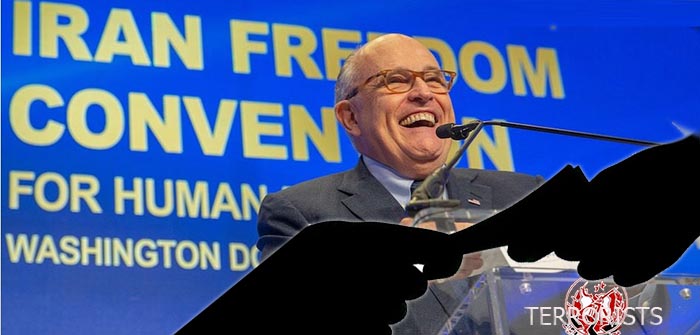
Meanwhile back in the United States everything involving the non-deradicalized MEK is just hunky dory. MEK and the NCRI are enemies of Iran and also seem to have plenty of money to spend, so they buy high ranking American speakers to appear at their events. Rudy Giuliani and John Bolton have appeared regularly, as have Senators John McCain, Lindsey Graham and Jeanne Shaheen. At a 2015 appearance in Paris, Giuliani brought the crowd to its feet by calling for “Regime change!” after shouting out that the “Ayatollah must go!” In August 2017, Senators Roy Blunt, John Cornyn, Thom Tillis and Carl Levin met with Rajavi in Paris. Newt Gingrich also considers himself a friend of the Iranian resistance while Elaine Chao, Secretary of Labor and wife of Senate Majority leader Mitch McConnell spoke in Paris for five minutes in 2015 and was paid $50,000. The payments made to the other politicians have not been revealed.

And then there is the Saudi and Israeli angle. Saudi Arabia is now the major funder of MEK/NCRI. It’s intelligence chief Turki al-Faisal spoke before the group in 2017. Israel funded the group in its early days and its external spy service Mossad continues to use MEK stay-behinds in Iran to assassinate scientists and tamper with computer systems. The CIA, which recently expanded its anti-Iran task force, it also working closely with MEK. And Giuliani, Bolton, Chao are all in the White House inner circle, which, not coincidentally, is baying for Iranian blood.

Lost in all of the above is any conceivable American interest. It is difficult to even make the claim that Iran threatens the United States or any vital interest and the drive to decapitate the Mullahs, both literally and figuratively, really comes from Riyadh and Tel Aviv. And there is potential collateral damage where it really might matter as MEK cultists continues to sit and fester in a holding pattern maintained by Washington in the heart of Europe. What comes next? War of some kind with Iran is appearing to be increasingly likely given recent remarks by Secretary of State Mike Pompeo, threating to crush the Iranians. Is Washington intending to send the MEK warriors on sabotage missions inside Iran, something like the resistance to the Germans in World War 2? Maybe Giuliani and Bolton know the answer to that question.

Philip Giraldi, Global Research

May 31, 2018 0 comments
FacebookTwitterPinterestWhatsappTelegramSkypeEmail
No War
Mujahedin Khalq as an Opposition Group

Iran diary: bracing for all-out economic war

While the dogs of war bark, the Ancient – and New – Silk Road goes on forever and a civilization with a long and proud history gets on with life

The minute you set foot in the streets of Mashhad, the air smelling of saffron, a fine breeze oozing from the mountains, it hits you; you’re in the heart of the Ancient Silk Road and the New Belt and Road Initiative (BRI).

No War

To the east, the Afghan border is only three hours away on an excellent highway. To the north, the Turkmenistan border is less than four hours away. To the northwest is the Caspian Sea. To the south is the Indian Ocean and the port of Chabahar, the entry point for the Indian version of the Silk Roads. The Tehran-Mashhad railway is being built by the Chinese.

A group of us – including American friends, whose visas were approved at the highest levels of the Iranian government – have gathered in Mashhad for the New Horizon Conference of independent thinkers. Right after a storm, I’m in a van on the way to the spectacular Imam Reza shrine with Alexander Dugin, which the usual suspects love to describe as “the world’s most dangerous philosopher,” or Putin’s Rasputin.

Debating and discussion time

We’re deep in debate not over geopolitics but … bossa nova. Exit Sun Tzu and Machiavelli, enter Tom Jobim and Joao Gilberto.

Persia traditionally has been a land of serious intellectual discussion. At the conference, after a lunch break, a few of us decide to start our own geopolitical debate, no cameras rolling, no microphones on. Dugin expands on what multipolarity could be; no universality; pluriversal; a realm of pluralistic anthropology; all poles sovereign. We discuss the pitfalls of Eurasian identity, Islamic identity, sub-poles, India, Europe and Africa.

A few minutes later Iranian scholar Blake Archer Williams – his nom de plume – is delving into “The sacred community of Shi’ite Islam and its covenantal dispensation.”

Karaj is a bustling three million-strong city one hour away from Tehran by freeway. Early one morning I enter a room in a hawza – an Islamic seminary. In my previous travels I have visited hawzas in Qom, but never a female-only school. This one harbors 2,275 active students from all over Alborz province up to PhD level. They study philosophy, psychology, economics and politics. After graduation, some will go abroad, to teach in Islamic and non-Islamic nations.

Our Q&A is exhilarating. Many of my interlocutors are already teachers, and most will become scholars. Their questions are sharp; some are extremely well informed. There’s so much eagerness to know detail after detail about life in the West.

High academic standards

The next day I visit the Islamic Azad University; more than four million alumni, 1.4 million current students, 29,000 faculty members, 472 campuses and research centers and 617 affiliated high schools. The Karaj campus is the second in importance in Iran.

This is an extraordinary experience. The hillside campus may not be a UCLA, but puts to shame many prestigious universities across Europe. Not to mention the annual tuition fees; only US$1,000 on average. Sanctions? What sanctions? Most of the equipment may yield from the 1980s, but they have everything they need. As attested by jovial master architect Ali Kazemi, who spent 16 years in Paris after graduating from Nanterre, the academic standards are very high.

Rector Mohammad Hasan Borhanifar – formerly at the University of Kyrgyzstan in Bishkek – opens all the doors at the campus. I’m shepherded by Mohammad Hashamdar, from the Faculty of Languages. I talk to the deans of all faculties and have a Q&A with students, mostly in international relations.

Even before the proclamation of the “strongest sanctions in history,” everyone wants details on the US Treasury’s new form of financial war, even more deadly than a hot war. In slightly more than two months, the purchase of US dollars, steel, coal and precious metals will be banned; there will be no more Iranian imports to the US and aviation and the car industry will be under sanctions.

Airbus may have to cancel multi-billion dollar orders from Iran. An IT professor tells me Iran can buy excellent Sukhoi passenger jets instead. No Peugeots? “We buy Hyundai.”

My interlocutors update me on investments by Total, Airbus, BASF, Siemens, Eni – its branch Saipem signed a $5 billion deal with the National Iranian Oil Company, NIOC, to develop oil and gas fields and ultimately supply energy to Europe. They confirm that if Total pulls out of the development of the 11th phase of the South Pars gas field, the Chinese CNPC will take over.

Almost 70% of Iran’s oil exports go to China and Asia, 20% go to Europe. Almost 90% of what the EU buys from Iran is oil, going mostly to Spain, France, Italy, Greece, Germany and the Netherlands. Iran remains THE Big Prize, as Dick Cheney well knew; an astonishing $45 trillion in oil and gas reserves.

A wide gene pool

I’m slightly alarmed when, talking to the Friday prayer imam – who is the actual representative of Ayatollah Khamenei in Karaj – he’s clueless about the New Silk Roads. Just as the Ancient Silk Road allowed Buddhism to fertilize Chinese culture, Iran, India and China are bound to cross-fertilize again; imagine a trans-Eurasia lab equipped with a wide gene pool and well-educated young armada searching for creative solutions.

The LA freeway hell pales in comparison with being stuck in a monster three-hour traffic jam from Tehran to Karaj, only 25 kilometers. I duly incorporate a Persian imprecation to my vocabulary; kharab beshe, which in polite translation means “going to nowhere.” I miss my requisite geopolitical dinner with Professor Marandi of the University of Tehran; we do it later on Whatsapp – like MBS and Jared Kushner.

What daily life in 17 million-strong, congested to death Tehran reveals is the standard of living essentially of a mid-level emerging nation. Everyone has a car, and smartphones and wi-fi are ubiquitous. In parallel, everywhere we feel intimations of a Persian civilization boasting at least a millennium of fabulous history even before Islam was born. And when we talk to the secularized intellectual elite, it’s clear that for them, in comparison, Arabs are nothing but trouble.

Everywhere I go I’m back in the ’70s; the whole infrastructure seems decades old, but everything works. Except for timing; Iran might as well be the land of magical realism 2.0, where the unexpected happens when all hope has been forsaken.

A smart, young generation

In Mashhad, I’m the guest in a political talk show on Khorasan TV – in a studio immaculately preserved from the ’70s. Yes, this is the heart of the fabled Khorasan – “where the sun arrives from” – that transfixed Alexander The Great. I spend half an hour dissecting the JCPOA; my translator is an over-qualified import-export expert. Khorasan TV’s blockbuster is an American-style cop show essentially covering road accidents in real time; after all, the crime rate is negligible.

Real inflation is at 16% a year – so far. Foreign exchange inflation is much higher. Real youth unemployment is at a steep 30%, in a country of 80 million where the median age is 29 and 40% of the population is under 24. One of my translators in Karaj, Ali, is 24; he’s unemployed, learned English by watching DVDs and cannot afford to rent his own place.

Under the new rial devaluation, the median regional salary plunged to about US$250 per month. One cannot rent a 40 square meter apartment near Azad University for less than $200 per month.

I stop for a late night pizza in Mashhad. The bill reads a whopping 200,000 rials; that’s a little more than $3. The euro in the black market spikes to nearly 80,000 rials.

Social media

Telegram has been blocked – but still, everyone uses both Telegram and WhatsApp. Some VPNs work, some don’t. The block was not necessarily linked to the spread of anti-government rumors during the January street protests – which actually started in Mashhad.

Elaheh, who did her language master in France; Bojan, who has a PhD in economics from San Diego State; or Ayoub Farkhondeh, who works on terrorism studies at the Habilian research institute, are all amused by the “bizarre” coverage by Western media of all things Iran.

The analysis of well-educated people in both Mashhad and Tehran tends to qualify the protests as essentially IMF riots – which happen when the Washington Consensus forces governments to reduce subsidies. Real revolutions, in Iran, involve clerics, middle-class intellectuals and the bazaaris.

This time the focus was the grassroots; the working class in small provincial cities. Millions in Iran, after all, depend on government salaries and subsidies. In contrast, Team Rouhani is essentially neoliberal.

Of course, there’s government criticism – more towards the clerics than neoliberal Team Rouhani. Businessmen told me of untold ministerial-level corruption – but it’s virtually impossible to verify the numbers. The Pasdaran, as the IRGC is referred to, continue to control a great deal of the economy and to manage a welfare system and client system that distributes favors to millions of people, but also imposes rigid social control.

At the same time, not looking at Iran via a windowless cubicle in Washington but actually on the ground, it’s clear that NSC Adviser John Bolton’s plan to revive the Mujahedin-e Khalq, known as MEK, to attempt a color revolution will fail miserably. MEK is universally despised. The whole of Iranian society won’t blame either Khamenei or Rouhani for the incoming economic war.

Europe on the spot

Persian politeness, hospitality and graciousness always strike a visitor as deeply touching. All that combined with an obsession with the image that the West has of Iran. Iran does not seek “isolation”; it’s Washington politics that wants it isolated.

So no wonder Europe is on the spot. The EU will activate a 1996 law which forbids European companies to comply with US sanctions, protecting them “against the effects of the extra-territorial application of legislation adopted by a third country.” Still, the question is ubiquitous; “The Europeans will side with us or the Americans?”

In parallel, Iranians don’t want to be like the West. And the best way to understand it is by visiting the Imam Reza shrine over and over again – I went early in the morning, after an afternoon storm, and at night.

The Imam Reza shrine, known as Astan Qods-e Razavi, is a marvel enveloped in golden and turquoise domes, lavish minarets and 12 courtyards spread over one million square meters. It hosts the largest Iranian NGO; a centuries-old administrative structure encompassing eight general directorates, more than 50 industrial, agricultural and service companies, over 15 cultural and research institutions and more than 12,000 students.

The 12th-century library at the shrine is one of the world’s oldest, along with Alexandria, the Vatican and Topkaki. Ayatollah Khomeini ordered its preservation. The public library holds four million books in more than 90 languages. There’s even a lab to “cure book diseases.” Mashhad runs a library in India plus a documentation center with more than 18 million items, including a 1,300-year-old document linked to Imam Ali.

Before leaving on a night flight to Doha, I visit the shrine one last time with two fine, steeped in history, Italian observers, ace journalist Giulietto Chiesa and writer Roberto Quaglia. It’s the first day of Ramadan. We’re speechless facing the crossover of aesthetic beauty, spiritual illumination and plain old fun.

Whole families gather, improvise a picnic, chat, take selfies, kids roam around playing. Instead of being glued to some dodgy version of Big Brother, like most across the West, they prefer to live life in a shrine. It is indeed an organic “third day,” like a government insider told me in Tehran.

Meanwhile, a Chinese train is snaking along from Mongolia to Tehran carrying sunflower seeds. While the dogs of war bark, the Ancient – and New – Silk Road goes on forever.

By Pepe Escobar, Atimes.com

May 30, 2018 0 comments
FacebookTwitterPinterestWhatsappTelegramSkypeEmail
Iran

How Trump’s Ditching of the Iranian Nuclear Deal Affirms American Unipolarity—with Obama’s Help

The Trump White House plans to break the Iran deal by sanctioning companies from Europe and Asia doing business in and with Iran. Ironically, President Obama paved the way to unilateral sanctions.

For three years, the comprehensive nuclear accord (JCPOA) has offered Iran relief from US, UN, and multilateral sanctions on energy, financial, shipping, automotive and other sectors. But recently that era came to a halt. “The United States will withdraw from the Iran nuclear deal,” President Trump said on May 8.

Two weeks later, Secretary of State Mike Pompeo, the ultra-conservative former head of the CIA, said Washington will impose “the strongest sanctions in history [on Iran] once they come into full force.”

In contrast, Chinese Foreign Minister Wang Yi has reiterated Beijing’s support for the deal. “China will continue to work to maintain the deal,” Wang said, stressing that the agreement was “hard-earned.” By the same token, the other key signatories of the nuclear deal—UK, France, and Germany, and Russia—say the deal will be sustained.

Breaking Iran by sanctioning EU and Asian companies

American internationalism began a century ago, when President Woodrow Wilson purported to “make the world safe for democracy.” That’s no longer the goal (if it ever was). Rather, the objective is now to ensure US unipolarity in a multipolar era, by any means necessary.

Regionally, Trump’s quest for primacy leans on Saudi Arabia for economic and geopolitical support, as evidenced by the $110 billion arms deal with Riyadh a year ago, and reinforced security ties with Israel, as reflected by US recognition of Jerusalem as capital of Israel—another fatal policy mistake that reversed decades of US foreign policy.

Now America also plans to “apply unprecedented financial pressure on the Iranian regime,” as Pompeo said. The administration’s objective is to restore primary sanctions that were lifted after the International Atomic Energy Agency’s (IAEA) certification in January 2016 that Iran had complied with the agreement. As secondary sanctions on firms have remained in place, along with sanctions applying to US companies, including banks, the White House will fortify them.

In a typical unipolar move, the Trump administration is extending sanctions over to EU firms that have done business in and with Iran since the 2015 nuclear deal, thus raising risks for their U.S. access. As Treasury Secretary Steven Mnuchin says, EU-Iran business agreements will be voided as “the existing licenses will be revoked.”

Along with Renault, PSA Peugeot Citroen and Sanofi, French companies have huge stakes in the deal, thanks to the $21 billion Airbus contract and the oil giant Total’s $2 billion deal to develop the South Pars oil field. Some 120 German companies, including Volkswagen and Siemens, operate in Iran and another 10,000 do business with Iran. Royal Dutch Shell would be adversely affected.

Economic pressure could harm significantly Iran’s oil industry which is the fourth largest reserve holder of crude oil in the world and whose largest buyers include China, South Korea, Turkey, Japan, Italy and India.

During the sanctions era, Iran shifted toward Asia and it has a vital role in the China-led One Road One Belt initiative. Indeed, through the worst days of the 2010-16 sanctions, Asian countries remained engaged in Iran’s economy. In the coming years, these countries hope to support Iran to become a major regional trading hub and to diversify its economy away from oil and gas. But if the White House sanctions EU companies for Iran business, it will sanction firms from Asia as well.

In the 2003 Iraq War, President Trump’s new National Security Advisor, John Bolton, relied on false data from U.S.-based Iraqi exiles. Since last fall, Bolton has been urging the US to implement a similar regime change with Mojahedin-e Khalq (MEK), which was de-listed as a terrorist group by Secretary of State Hillary Clinton in the early 2010s. MEK is an Iranian opposition group which has lucratively financed and then been lobbied by former heads of the CIA, FBI and the Homeland.

Bolton wants a new regime in Tehran before February 2019—the 50th anniversary of the revolution.

How Obama paved the way to Trump’s withdrawals

With his pledges to withdraw from the climate and nuclear accords and America’s key trade agreements (e.g., North American NAFTA, Asia-Pacific TPP, and US-EU TTIP), Trump has electrified the historical debate on the legality of US withdrawal from treaties and other international agreements.

While the US constitution sets forth a process whereby the executive has the power to make treaties with the advice and consent of the Senate, it does not specify how such treaties can be terminated. The nature of the agreement matters as well. When the president enters into executive agreements, these do not receive the Senate’s advice and consent. But such “political commitments” are not seen as binding. As a result, the US will withdraw if the Iran deal is not renegotiated.

Ironically, it was the President Obama who created the opportunity for such strategic maneuvering. When his administration concluded the JCPOA, it considered the plan of action a non-binding political commitment, which allows the Trump administration to argue it has ability to withdraw from the JCPOA. True, on 2015, the Security Council unanimously adopted resolution 2231 endorsing the Iran deal. So Trump’s critics could argue that the resolution converted at least some provisions in the JCPOA into obligations that are binding under international law which would mean a complex and long debate.

Yet, today such critics seem to be largely absent. When Obama concluded the Iran talks, most Democrats hailed the accord. Yet, most Democrats turned their coats in late 2016, the Senate and the House of Representatives unanimously extended the Iran Sanctions Act for a decade.

As a legal scholar, Obama knew well the loopholes his administration left to its successor. His (few remaining) supporters say he concluded the deal out of political expediency (not enough Republican support in the Congress). Others see it as a “Wilsonian” failure (adequate authority to sign the deal but not to implement it). But radicals believe that Obama, who was trained in the CIA front Business International Corp. in the ‘80s, was used to pave the way to withdrawal.

In a recent meeting with President Xi Jinping, German Chancellor Angela Merkel sought a common strategy to ward off a trade war, keep markets open and a unity in the nuclear deal. It is a stance that is aligned with the interests and values in Beijing.

Whatever the legal pretexts for Trump’s withdrawals, they herald the end of Wilsonian internationalism in America. In the past, Washington, Brussels and Tokyo shared similar interests and values, it was said. As the White House is substituting unilateral bullying for multilateral diplomacy, those days are busy fading into history.

By Dan Steinbock, atimes.com

This article was originally published by South China Morning Post (Hong Kong) on May 25, 2018.

May 30, 2018 0 comments
FacebookTwitterPinterestWhatsappTelegramSkypeEmail
Missions of Nejat Society

The MEK’s Man inside the White House

A report by Richard Engel

On assignment with Richard Engel

https://dla.nejatngo.org/Media/Report/NBC/NBC_MEK_20180525_2.mp4


How did a fringe Iranian opposition group with a history of assassinating Americans get so cozy with the likes of John Bolton and Rudy Giuliani? By paying them thousands to speak at its events, where they advocate for MEK-led regime change inside Iran.

(END)

From Richard Angel twitter account:

VIDEO EXCLUSIVE: We obtained never-before-seen footage of the MEK’s secret base in Albania. The MEK is an Iranian opposition group with a history of terrorism. More recently it’s paid thousands to @AmbJohnBolton & @RudyGiuliani. More tonight at 9PM ET @MSNBC @RichardEngel pic.twitter.com/teaGhQeVZy

— On Assignment with Richard Engel (@OARichardEngel) May 25, 2018

NBC report in Albanian media:

Kronika e NBC/ Pamjet me dron mbi kampin e muxhahedinëve, dëshmia për torturat https://t.co/vRnIJFqHdN

— Massoud khodabandeh (@ma_khodabandeh) May 27, 2018

On MSNBC @OARichardEngel I explained that no decent American intelligence officer would say MEK is trustworthy because it is a Destructive Cult.

Examining how @AmbJohnBolton and @RudyGiuliani were paid to speak for Maryam Rajavi. pic.twitter.com/U83F12h5ko

— Massoud khodabandeh (@ma_khodabandeh) May 27, 2018

Rachel Maddow, MSNBC,

May 29, 2018 0 comments
FacebookTwitterPinterestWhatsappTelegramSkypeEmail
NBC on Ashraf three
Albania

Who finances the military base of MKO terrorists in Albania?

NBC News discloses a video of the ‘clandestine military-style base’ of Mujahedin Khalq (MKO) in Albania and addresses the triangle formed by this terrorist group with the Arab monarchies and the Administration of the US president ., Donald Trump.

NBC News discloses a video of the ‘clandestine military-style base’ of Mujahedin Khalq (MKO) in Albania and addresses the triangle formed by this terrorist group with the Arab monarchies and the Administration of the US president ., Donald Trump.

https://dla.nejatngo.org/Media/Report/NBC/NBC_MEK_20180525_2.mp4

The US news network NBC on Friday revealed images”never before seen”of the headquarters of the MKO members in this Balkan country and defines it as a”base military style.”

“Seen from outside, the field seems to be a modest installation, however, seen from the air, it is a massive military complex. Who pays for all that?”, Reads the subtitle of a fragment of the documentary.

Sadolá Seifi, a former member of the MKO, answers that question and says that the money comes from the”wealthy Arab monarchies that oppose the Government of Iran.”

Explains that this terrorist group that apparently advocates”a democratic Iran”after changing the political regime in the country, is actually a”dangerous”and”violent”band that tortures and humiliates its own members.”I have witnessed torture of people, I have witnessed deaths. I myself was the target of torture and humiliation,”he recalls.

In his opinion, the violent behavior of the MKO towards its members is the alarm of a major disaster, if they arrive in Iran.”Even the USA will regret”having supported the MKO, Seifi says.

The MKO – which according to the head of the NBC correspondent, Richard Engel, is an Iranian opposition group that has a long history of terrorist attacks – also pays thousands of dollars to the US Administration, headed by Trump, to offer speeches in their congregations.

The source addresses, in particular, the payments made to John Bolton, US National Security Advisor, and to Rudy Giuliani, Trump’s legal advisor.

Joanne Stocker, of the US portal Defense Post, for her part, told NBC that Bolton had received more than $ 180,000 from the MKO to speak in their favor. Bolton’s office has so far refused to comment on it.

Giuliani, however, spoke with NBC and claimed that he had received money from Iranian dissidents for making propaganda in his favor and supporting his intention to change the political regime of the Islamic Republic of Iran, but”he did not remember the amount,”notes the American chain.

The MKO has carried out numerous terrorist attacks against civilians and government officials of Iran. Of the nearly 17,000 Iranians killed in the terrorist attacks recorded since the victory of the Islamic Revolution in Iran in 1979, nearly 12,000 have died at the hands of this small group.

hispantv.com,Original article in Spanish translated by Nejat Society

May 28, 2018 0 comments
FacebookTwitterPinterestWhatsappTelegramSkypeEmail
Mujahedin Khalq; A proxy force

Why Trump’s small-handed plan to strangle Iran will fail

The plans of President Donald Trump and his Secretary of State Mike Pompeo to strangle Iran will fail, said Professor Mohammad Marandi of Tehran University.

US President Donald Trump announced on May 8 that Washington would pull out of Iran nuclear deal and reinstate nuclear sanctions on Iran.

This is while most world powers including Russia, China, and European Union have repeatedly stressed that keeping the deal is in the interest of world peace and security.

US Secretary of State Mike Pompeo in a speech on May 21 said that following withdrawal from the JCPOA, the US is seeking severe financial pressure and unprecedented sanctions against Iran to contain Iran’s influence in the region and block its nuclear and missile programs.

The Full text of Professor Marandi’d article as appeared in middleeasteye.net follows:

As the 40th anniversary of the Islamic Republic approaches, Washington’s Captain Ahab-like obsession with Iran grows ever deeper. ‘Possessed by all the fallen angels’, Ahab’s chief mate could not shake his captain’s fixation on The Whale.

Like Ahab, the unholy trinity of Donald Trump, John Bolton and Mike Pompeo relentlessly pursue their own Moby Dick.

Captain Mike’s 12 commandments:

Less than a year ago, in a speech to a gathering of the Western-funded Mujahideen-e-Khalq (MEK), a cult-like group formerly under the command and control of Saddam Hussein – a seemingly delusional Bolton claimed they would all celebrate together in Tehran before the end of this year and the 40th anniversary of the revolution.

More recently, a similarly deluded Pompeo delivered his 12 commandments to the Iranian people, warning Iranian men, women and children that the lord will impose not just ‘painful’ sanctions, but also ‘the strongest sanctions in history’. The US secretary of state, formerly Trump’s CIA director, added that he would ‘crush’ Iranian ‘operatives’.

Whether Trump can outdo Barack Obama’s various forms of barbarism – such as his ‘crippling sanctions’, cultivation of extremists in Syria, drone wars, operations in Libya and imposition of hunger on Yemen – is open to question.

After all, there are few ways to objectively gauge the two, as Western media empires are apparently completely unaware that the US funding of takfiri extremists, pushing a dirty civil war, land occupation and strikes against Syrian armed forces are all illegal and constitute crimes against humanity, according to international law.

Rather, the empire’s media seems more focused on Trump’s hand size, Russia Today’s (RT’s) critical role in the US presidential election results, and providing details on the recent weather phenomenon known as Stormy Daniels.

Thus, it cannot be blamed for a collective failure to comprehend that the Israeli air strikes on Syria are also illegal. After all, this is not Lebanon, where Hezbollah ‘terrorists’ successfully expelled the Israeli occupation force from their country after enemy combatants murdered up to 20,000 Lebanese and Palestinians.

The corporate media:

It’s understandable. After all, the region is so complex that Western media outlets think young Palestinians were shoved in the path of innocent Israeli bullets by their families, Hamas and Islamic Jihad. They assume that brown Palestinian people, like black South African people in the Sharpeville Massacre during apartheid, do not understand the value of life. ‘Israelis Reflect on Gaza: ‘I hope at least each bullet was justified”, ran a headline in the New York Times.

Perhaps, if Palestinians took their children to Disneyland, instead of lingering in the gloomy Gaza concentration camp, they would acquire an understanding of the civilised world along with its family values. Perhaps, if Ahed Tamimi wasn’t such so spoilt and irrational and oriental, she would not have overreacted to the murder of friends and relatives by European colonialists.

Just because her 15-year-old cousin Mohammed was shot in the head by Israeli occupation forces, does not give her the right to slap a law-abiding occupation soldier. Indeed, she should consider herself lucky that she is not dark-haired, dark-skinned, or wearing a hijab, otherwise she would not have received any of the undeserved lukewarm sympathy from a few ‘bold reporters’ in the corporate media.

Returning to Captain – he never got any higher up the military ladder, poor fellow – Pompeo’s commandments, the seventh states that ‘Iran must respect the sovereignty of the Iraqi government’. None are more qualified to pass judgment on issues linked to Iraqi sovereignty than the Americans.

After all, they did not interfere when Saddam gassed tens of thousands of his own people with the chemical weapons they gifted him. After ‘liberating’ Iraq, with the blessing of the Iraqi people and international law, they took the best land in Baghdad and built a wonderful new city called the US embassy.

They strengthened the Iraqi judiciary by creating prisons such as Abu Ghraib, where they held First World sex education courses for children in the company of their parents. Sadly, most of the footage and photos have been lost, eerily similar to the experiences of the new CIA ‘glass-ceiling breaker’ chief in Thailand.

Strangling Iranians:

In a strictly non-interventionist manner, the Americans also pursued a progressive policy of Don’t Ask, Don’t Tell when it came to the Saudi-funded al-Qaeda in Iraq, which later evolved into the Islamic State (IS). After all, this was a family affair: IS, al-Qaeda, the Taliban, Boko Haram and Saudi Arabia share the same religious textbooks and lofty ideological values.

Nevertheless, it is clear that the wicked Iranians will ignore the 12 commandments. The apartheid regime in Palestine and their democracy-loving moderate allies in Saudi Arabia will undoubtedly be delighted, even though the world will view them with unkindness, as needy and reckless cheerleaders for regional and global instability.

While there is always a surge of hope in the empire and its Persian-language mouthpieces when they see the faintest flicker of unrest in Iran, it seems pretty clear that ordinary Iranians, whom Trump seeks to lovingly strangle with his undersized hands, will remain decidedly ungrateful to the orange-hued authoritarian.

Instead of questioning the humanity of the threats coming from the White House and worrying about the fate of the innocent men, women and children who are being targeted, ‘enlightened’ Western analysts seem more concerned with who ‘benefits’ from such malevolent US policies in Iran.

When it comes to defending sovereignty and dignity, except for a small group of Western apologists, we are all more or less hardliners. The regime in Washington has already failed.

– Mohammad Marandi is a professor of English Literature and Orientalism at the University of Tehran.

May 27, 2018 0 comments
FacebookTwitterPinterestWhatsappTelegramSkypeEmail
Mujahedin Khalq; A proxy force

EU Splits With Trump On Iran Nuclear Deal – Analysis

The US exit from the Iran nuclear deal hurts Europe;US plans for sanctions won’t work without allies.

In addition to effectively tearing up the Iran nuclear deal on May 8, President Donald Trump announced re-imposition of American sanctions in place before the landmark agreement. These covered the Islamic Republic’s energy, banking and other sectors, with a provision for penalizing foreign businesses worldwide trading with or investing in Iran. This act of economic and diplomatic unilateralism undermining the Western alliance is welcome news for Russian President Vladimir Putin as well as Iran’s Supreme Leader Ayatollah Ali Khamenei.

The premise of the nuclear deal – officially called the Joint Comprehensive Plan of Action, or JCPOA – signed by Iran, the five permanent members of the UN Security Council plus Germany and the European Union – was to let Iran rejoin the global economy in exchange for denuclearization. Trump’s decision undermines the JCPOA’s foundation. Before his rash move on Iran, Trump had angered the 28-member EU by refusing to grant it exemption from the tariffs he imposed on steel and aluminum imports in March. An American president is authorized to take such action to protect national security. EU officials argued that their bloc is a US ally – all members but Sweden are members of Washington-led NATO – but to no avail.

“We are witnessing today a new phenomenon: the capricious assertiveness of the American administration,” said Donald Tusk, president of the European Council, on the eve of the EU summit in Sofia, Bulgaria, on 16 May. “Looking at the latest decisions of President Trump, some could even think, ‘With friends like that, who needs enemies?’” After the summit Tusk announced that EU members agreed unanimously to stay in the agreement as long as Iran remains fully committed: “Additionally, the [European] Commission was given a green light to be ready to act whenever European interests are affected.” Jean-Claude Juncker, president of the EU’s executive arm, the European Commission, said that to protect EU companies doing business with Iran, he would turn to a plan last used to shield European businesses active in Cuba facing sanctions: “the ‘blocking statute’ process, which aims to neutralize the extraterritorial effects of US sanctions in the EU.” He did so on May 18.

The 1996 statute prohibits EU companies and courts from complying with foreign sanctions laws and stipulates that foreign court verdicts based on these laws are null and void in the EU. Juncker added that the European Investment Bank will also provide a funding stream for businesses working in Iran. This has reassured small- and medium-sized EU companies since most have no presence in the United States. Large multinationals doing business in the United States are seeking specific exemption from Washington. Their chances of success, though, are slim.

By happenstance, on 16 May the National Iranian South Oil Company signed an agreement with London-based Pergas International Consortium to develop the Keranj field in the oil-rich Khuzestan province over the next decade.

Though in his election campaign Trump had attacked the JCPOA as a “bad deal,” he granted waivers from re-imposing sanctions thrice because his three senior advisers – secretaries of state and defense, and the national security adviser – urged him to do so. But following his sacking of Rex Tillerson and the resignation of H.R. McMaster, Trump appointed Mike Pompeo and John Bolton secretary of state and national security adviser, respectively. Both are super-hawks against Iran. And Secretary of Defense James Mattis may have decided against pushing too hard his argument that exiting the JCPOA would cause serious rupture with European allies and tarnish Washington’s credibility in the world.

The other important factor was Trump’s imminent meeting with North Korea’s leader Kim Jong-un. Along with Bolton, Trump reckoned that withdrawal from the Iran deal would make Kim realize that he did not issue empty threats, thus easing his path to get what he wants. Overall, when dealing with a foreign regime that refuses to kowtow to Washington, the policymakers advocate either changing its behavior through economic and diplomatic pressure, or overthrowing the offending government through relentless destabilization or military force. Within that frame, Mattis belongs to the behavior camp and Bolton firmly to the regime-change camp.

Trump’s 11-minute address on May 8 explaining his exit from the Iran deal had Bolton’s imprint. After that speech Bolton told the reporters that the United States ceased to accept UN Security Council Resolution 2231 endorsing the JCPOA. As an official in the George W. Bush administration, Bolton advocated invading Iraq and remained unapologetic about his stance. In his 25 March 2015 op-ed in The New York Times, Bolton summarized as argument pithily: “To Stop Iran’s Bomb, Bomb Iran.” In a July 2017 speech to the conference of the Paris-based anti–Islamic Republic organization, Mujahedin-e Khalq, or People’s Mujahedin – listed as a terrorist organization from 1997 to 2012 by the US State Department – Bolton expressed hope that the Iranian regime would be overthrown “by 2019,” that year being the 40th anniversary of the Islamic Republic.

Bolton and his supporters seem to have a particular scenario in mind. Economic pressure applied by US sanctions and military pressure by Israel, starting with its attacks on Iranian military targets in Syria, will generate momentum for overthrow of the regime. Such a scenario is untethered to reality.

The most effective tool in former President Barack Obama’s economic armory was to slash Iranian oil exports by isolating Iran’s Central Bank from the global banking system – and the fact that Iranian oil prices are quoted in US dollars. At present, of the 2.6 million barrels per day of oil that Iran ships to foreign destinations, compared to 1.1 million per day before 2015, almost half goes to China and India, with China in the lead. Both countries were main buyers of Iran’s petroleum before 2012. They managed to circumvent harsh US and EU sanctions. During 2012 to 2015, Chinese oil companies used a domestic bank, Bank of Kunlun, to settle petroleum transactions with Iran, worth tens of billions dollars, in euros and Chinese renminbi.

Unsurprisingly, therefore, in the wake of Trump’s May 8 decision, Beijing was the first foreign capital visited by Iran’s foreign minister Mohammad Javad Zarif along with top oil officials. After meeting with his counterpart, Wang Yi, both sides stated they would remain in the JCPOA.

In the case of India, a rupee-rial mechanism was put in place after 2012, whereby almost half of India’s oil imports from Iran were paid in exchange for such items as rice, wheat and medicines not under sanction. According to Ram Upendra Das, head of the Centre for Regional Trade, US sanctions are unlikely to have any material impact on Indian exports to Iran since there are several mechanisms through which payments can be made for bilateral trade.

About 37 percent of Iran’s oil exports go to European destinations. All told, the EU is Iran’s number one trading partner. The value of trade between the EU and Iran soared from $9.2 billion in 2015 to $25 billion in 2017. Given EU leaders’ resolve to nullify the extraterritorial application of US sanctions on Iran, trade between their bloc and the Islamic Republic is unlikely to dip. The angry parting of the EU from the Trump administration over the Iran nuclear deal is set to become a milestone in the weakening of the Western alliance forged 70 years ago in the form of NATO.

By Dilip Hirom, eurasiareview

*Dilip Hiro is the author of A Comprehensive Dictionary of the Middle East (Interlink Publishing Group, Northampton, MA). His forthcoming, 37th book is Cold War in the Islamic World: Saudi Arabia, Iran and the Struggle for Supremacy (Oxford University Press, New York/ Hurst & Co, London/ HarperCollins India, Noida).

May 27, 2018 0 comments
FacebookTwitterPinterestWhatsappTelegramSkypeEmail
Pompeo
Missions of Nejat Society

Pompeo’s speech unites Iranian media, politicians

Iranian officials and the normally divided Iranian media have uniformly rejected and ridiculed the May 21 speech by US Secretary of State Mike Pompeo outlining 12 demands of Iran that in essence would fundamentally transform the Islamic Republic.

Pompeo

Iran Newspaper, controlled by President Hassan Rouhani’s administration, headlined its article on the speech “The illusions of the newly arrived politician.” The article stated that the speech outlined “Trump’s hostile policies toward Iran.” The Reformist Etemad chose the headline “Pompeo’s delusions” for its front-page story. While the Donald Trump administration is promising unprecedented sanctions against Iran and trying to put pressure on Tehran, Etemad reported, America’s closest allies in Europe are busy negotiating with Iran on how to keep trade and the nuclear deal alive.

The newspaper Javan, affiliated with the Islamic Revolutionary Guard Corps, used its headline to call Pompeo’s speech “bluster.” According to the article, Pompeo had tried to act like Trump in his speech, making 25 false statements. In addition, Pompeo said “Iran must” 15 times. The article charged that when Pompeo was 14, the United States would say what Iran “must” do, and Mohammad Reza Pahlavi would say “yes,” but then Iran kicked out the shah. Javan described Pompeo’s 12 demands as “unintentionally listing America’s failures and Iran’s ascending strength.”

Kayhan, whose editor is appointed by the supreme leader’s office and is often the first to attack the Rouhani administration for every perceived and imagined shortcoming, saved its wrath for Pompeo. The headline for its front-page article roughly translates “To hell with Pompeo’s 12” and makes reference to America’s “big mouth.” The article said that Pompeo’s speech, which channels Trump, was a reminder that whenever a country retreats in the face of the United States, Washington only increases its demands of it.

A number of Iranian officials also commented on Pompeo’s speech. In a speech delivered May 21, Rouhani likened Pompeo’s demands to those from George W. Bush’s presidency, adding, “The world will not accept America making decisions for all countries.” On Pompeo, Rouhani said, “That a person who worked in a spy agency for years becomes the secretary of the state and wants to make decisions for all of the countries is in no way acceptable.” Rouhani asked rhetorically, “Who are you to decide for the world and Iran in the field of nuclear energy what Iran must do?”

The Foreign Ministry released a statement responding to what it called Pompeo’s “insulting comments.” It described Pompeo’s speech as an attempt to “divert world attention from America’s illegal action and violation of the nuclear deal.” It also said Pompeo’s speech once again demonstrated America’s “poor intelligence, weak insight and backward analysis” in its decision-making process. It added that those in America who are seeking war “do not know history nor are they able to learn its lessons.” In response to Pompeo’s accusations that Iran supports terrorist groups, the statement countered, referring to the United States “as the father of al-Qaeda, Daesh [Islamic State], the hypocrites [Mujahedeen-e-Khalq, MEK], Jundollah and other takfiri terrorist groups.”

Even the normally soft-spoken Mohammad-Bagher Nobakht, spokesman for the Rouhani administration, struck an unusually harsh tone in his weekly press conference May 22, in light of Pompeo’s speech. Nobakht referred to post-revolutionary Iran in the 1980s, asking rhetorically whether the United States remembers Iran’s foreign policy of “neither East nor West” or the US helicopters that crashed in Iran attempting to rescue US hostages in 1980 or Iran not being weakened by the MEK bombing campaigns. Nobakht expressed incredulity at comments by US national security adviser John Bolton to an MEK crowd that they would be celebrating in Tehran in 2018.

https://www.al-monitor.com/pulse/originals/2018/05/iran-pompeo-speech-jcpoa-nuclear-deal-unity-iran-reaction.html

Al-Monitor Staff


May 26, 2018 0 comments
FacebookTwitterPinterestWhatsappTelegramSkypeEmail
weekly digest
Iran Interlink Weekly Digest

Iran Interlink Weekly Digest – 230

++ Ebrahim Khodabandeh, head of Nejat Association, wrote about the MEK in Albania. He identifies the three most important recent issues as: bringing Massoud Rajavi back from the dead with a written directive from him; whose message is ‘No Exit’ – nobody is allowed to leave. The next significant issue is the appointment of Mehdi Abrishamchi as overall commander of Camp Ashraf Three; again, to enforce the No Exit policy. Both these signify MEK panic over people running away. The exodus recently exploded after former members succeeded in getting their living allowance money from the UNHCR instead of from the MEK. Now the MEK is trying to fight back. As well as the above measures, MEK pays some ex-members to write against the others. MEK also deploys some members to follow the ex-members and intimidate them. But every week it is more and more apparent that these tactics have no effect and the MEK organisation is collapsing from within. Khodabandeh writes, ‘It seems the third camp will be their last and they have reached the end of the road’. According to Khodabandeh, in addition to these issues, there is the problem of members asking questions to which MEK have no answer. MEK have therefore placed a ban on asking about three specific issues. One is: ‘if we have support in Iran as you say we have, how come we see no evidence of this from inside Iran?’ Another issue is: ‘You said President Trump will first liberate Syria and then liberate Iran. But nothing has happened. If the Americans were serious about Syria, wouldn’t they have tried to topple Assad by now?’ The third issue is: ‘You got very excited about Trump tearing up the JCPOA. If the Americans do that to their agreements with other countries, how can we believe they will support us, how can we trust them?’

++ This week as Ramadan began, Maryam Rajavi jumped on the publicity bandwagon. With her glamorous clothes and candles and lavish food, she offered Iftar to guests. People who have seen this before criticise the MEK primarily because they don’t believe in any of these things [religious practice]. For MEK it is all about feeding lobbyists while the members suffer because their food is not up to standard these days.

++ MEK has already announced the annual Villepinte event in July. Members and ex-members say the leaders have announced it forty days in advance since they are desperate for propaganda because they can’t answer the members after lying to them about Trump’s support and the inevitability of war with Iran, etc.

In English:

++ Mazda Parsi in Nejat Bloggers writes about ‘Money Adventures of the MKO and the Bloodthirsty Security Adviser. Parsi examines the backtracking of John Bolton after Trump appointed him National Security Advisor. When challenged over his advocacy for the MEK and his desire for violent regime change against Iran, Bolton told CNN “I’ve written and said a lot of things over the years when I was a complete free agent”. He admitted that he is not a decision maker in the US administration. “The circumstances in I’m in now is that I’m the national security adviser to the president. I’m not the national security decision maker. He (Trump) makes the decisions and the advice I give him is between us.” Parsi quotes one of many critics of Bolton in the American media, Caitlin Johnstone of the Ron Paul Institute for Peace and Prosperity: “The MEK is widely considered a cult, using very cult-like methods of indoctrination including exerting control over the personal and sex lives of its members and forcing them to go through weekly ‘ideological cleansings’… The MEK reportedly has weirdly deep pockets which have enabled it to spend millions of dollars rehabilitating its image in recent years, and to pay out sizable fees for panelists and speeches by experts willing to advocate in favor of its regime change agenda.”

Parsi concludes: “The fact that almost no one in the paid campaign of the MKO supporters brings up the cult-like nature of the MKO, its violent past and its unpopularity among Iranians indicates that they are totally motivated by the filthy dollars of the group laundered into their pockets via European Banks.”

++ Various media outlets denounced ‘corrupt American leaders whose salaries are paid by MEK’. Al-Monitor, Newsweek, CNN, Reuters, The Transnational (Oxford), all reported that the position of Secretary of State Mike Pompeo and National Security advisor John Bolton as well as others in Trump’s administration, have strengthened the Iranian establishment and united the people behind their leaders.

May 25 2018

May 26, 2018 0 comments
FacebookTwitterPinterestWhatsappTelegramSkypeEmail
Newer Posts
Older Posts

Recent Posts

  • Pregnancy was taboo in the MEK

    December 22, 2025
  • MEPs who lack awareness about the MEK’s nature

    December 20, 2025
  • Why did Massoud Rajavi enforce divorces in the MEK?

    December 15, 2025
  • Massoud Rajavi and widespread sexual abuse of female members

    December 10, 2025
  • Farman Shafabin, MEK member who committed suicide

    December 3, 2025
  • Facebook
  • Twitter
  • Instagram
  • Youtube

© 2003 - 2025 NEJAT Society . All Rights Reserved. NejatNGO.org


Back To Top
Nejat Society
  • Home
  • Articles
  • Media
    • Cartoons
    • NewsPics
    • Photo Gallery
    • Videos
  • Publications
    • Books
    • Nejat NewsLetter
    • Pars Brief
  • About Us
  • Contact us
  • Editions
    • عربي
    • فارسی
    • Shqip