Nejat Society
  • Home
  • Articles
  • Media
    • Cartoons
    • NewsPics
    • Photo Gallery
    • Videos
  • Publications
    • Books
    • Nejat NewsLetter
    • Pars Brief
  • About Us
  • Contact us
  • Editions
    • عربي
    • فارسی
    • Shqip
Nejat Society
Nejat Society
  • Home
  • Articles
  • Media
    • Cartoons
    • NewsPics
    • Photo Gallery
    • Videos
  • Publications
    • Books
    • Nejat NewsLetter
    • Pars Brief
  • About Us
  • Contact us
  • Editions
    • عربي
    • فارسی
    • Shqip
© 2003 - 2024 NEJAT Society. nejatngo.org
Rajavis
Maryam Rajavi

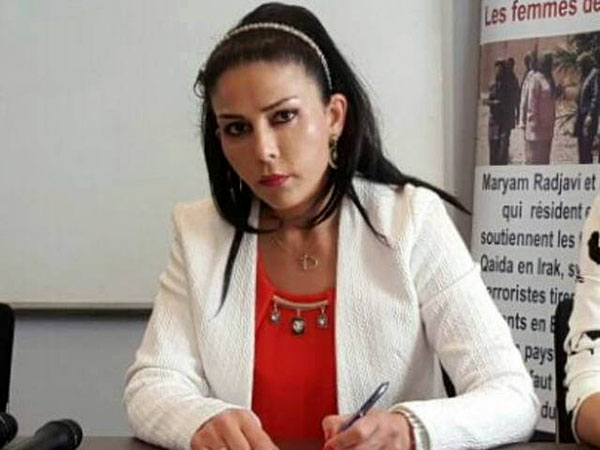
Maryam Rajavi MEK leader or Massoud’s front figure?

There are people out there who are leaders of cults of personality and they do destructive harm against their followers emotionally, psychologically, physically and financially. Actually there is no cult, without a charismatic leader who abuses people to obey him unquestionably.

The Mujahedin Khalq Organization meets all traits of a destructive cult of personality. The disappeared leader of the group Massoud Rajavi had complete control over his followers. He never answered questions on the decisions he made and he was never accountable to no one in his group, the MKO.

What was Maryam Rajavi’s role to establish Massoud’s cult of personality?

According to Dr. Alexandra stein, cult expert and sociologist, “the most inner circles around a cult leader protect him or her from the masses outside.” For Massoud Rajavi the most inner circle is called the “Elite Council” which is exclusively consisted of female members.

“Some cult leaders are surrounded by their immediate lieutenant, their wives “, writes Dr. Stein. “They are in charge of looking after his personal needs as well as leading the organization on a daily basis.”

Certain female defectors of the cult of Rajavi are living eye-witnesses of the existence of such a protective female wall around Massoud Rajavi. Batoul Soltani, who left the group a decade ago, revealed that Massoud Rajavi had married a number of higher layer members of the Elite Council.

She revealed Rajavi’s passion to have sexual relationship with his numerous wives. The surprising part of her testimony was that Massoud Rajavi was aided by his third wife Maryam Rajavi – the so-called president elect of the MKO – to gain his sexual ambitions. Batul clarified how Maryam managed the ceremonies called Salvation Dance to manipulate high ranking members of the Elite Council – of which she was a member too – into getting married and having sex with Massoud.

What made Maryam Rajavi act as a catalyst for her husband’s ambitions?

Based on Alex Stein’s research, Maryam Rajavi’s function was to “implement Massoud Rajavi’s wishes and serving as a proxy for him while his whereabouts remain secret. But, she, too, will likely be dispensable should he so desire.”

Wheather Massoud Rajavi is dead or has desired to dispense Maryam as his successor, Maryam is now the symbol of feminism and women’s rights in the masquerade shows the MKO launches. However, Rajavi’s “all-female leadership” also functions as a shield against any probable dissent by the side of male members of his cult of personality.

Dr. Stein notifies the MKO as a cult in which “Rajavi appoints authority figures in the hierarchy based not on expertise, but because of ideological rank.”

She then describes how the inner feminine circle was formed around Massoud Rajavi: “these rankings change on a dime, depending on Rajavi’s whim. All one point, in a major ideological move, men were removed from any leadership posts and an-all-female leadership replaced them (with the exception, of course, of Rajavi himself) – presumably in an effort to keep the men subservient and prevent the development of internal resistance to Rajavi. More recently seven members of Rajavi’s inner circle have disappeared and the MEK watches suspect they are likely to have been “eliminated” as no longer being of use and potentially dangerous “because of the information they carry.”

To maintain his hegemony over his cult members, Massoud Rajavi victimized hundreds of people and Maryam was his number one assistant to gain the utmost power of saint immortal leader. With the disappearance of Massoud, Maryam is endeavoring to preserve the same authority over the cult of Rajavi. Has she been successful, the process of defection from the group would stop.

By Mazda Parsi


August 12, 2017 0 comments
FacebookTwitterPinterestWhatsappTelegramSkypeEmail
Nejat Newsletter- 46
Nejat Publications

Nejat NewsLetter NO.46

Inside this Issue:

  1. Ostracism of Mojahedin Khalq in Europe may lead to expulsion to Albania

    Nejat Newsletter- 46

    Nejat Newsletter- 46

  2. US-Iran relations (and Mojahedin-e Khalq, Rajavi cult)
  3. Do KSA and MKO share the illusion of regime change?
  4. France’s safety is the main victim of MKO’s traffic
  5. Open letter to the Honorable Gerard Collomb, French Interior Minister
  6. Debate in the European Parliament
  7. Iran Biggest Victim of Terrorism: Police Official
  8. ‘What is to be done about the Iranian MEK?’
  9. Open letter of “Azadi Association”, …
  10. 4 people left the MEK in Albania

to view the newsletter click here


August 10, 2017 0 comments
FacebookTwitterPinterestWhatsappTelegramSkypeEmail
Mujahedin Khalq Organization

Iran’s Social Network Sites : We Hate Mojahedin-e Khalq

We Hate Mojahedin-e Khalq: SNS Respond to a Conference of the Iranian Opposition

In early July, Iran’s National Resistance Council, the political wing of the opposition group Mojahedin-e Khalq (MEK), held its annual conference at the Villepinte Exhibition Center in a suburb of Paris. The conference sparked angry reactions and public criticism on Iran’s social networking sites (SNS). This anger was exacerbated by Saudi and US representation at the conference, which was seen as evidence of Saudi and American efforts to instigate political change in Iran through compromising support of a terrorist organization widely considered traitorous by Iranians.

MEK’s ideology combines Shi‘ite Islam with Marxism. During the early 1970s, the organization emerged in opposition to the Iranian monarchy. The United States and the European Union previously designated MEK as a terrorist organization due to its involvement in terrorist attacks in Iran, with several attacks against Western (including American and Israeli) targets. Shortly after the Islamic Revolution in 1979, MEK and the new regime fell into severe conflict, with the regime implementing strongly suppressive measures against MEK. As a result, the organization transferred most of its activities to Iraq, where it aligned itself with the Saddam Hussein regime. In the 1980s, during the Iran-Iraq War, MEK even participated in several Iraqi army operations against Iran. As a result, MEK was left with very little support in Iran proper, with many Iranians considering MEK activists traitors. In recent years, there has been no evidence of the organization’s involvement in terrorism. Instead, it focuses mainly on political activity in Europe and the United States aimed at enlisting support for regime change in Iran. Nonetheless, critics believe this political activity is merely a façade.

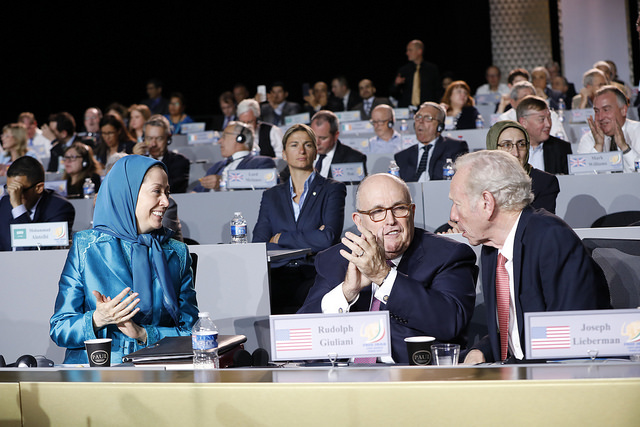
This year’s annual MEK conference was chaired by the organization’s leader, Maryam Rajavi, and attended by hundreds of participants from around the world, including Saudi Prince Turki al-Faisal, who formerly served as head of Saudi intelligence, as well as largely hawkish former US officials, including the former ambassador to the United Nations John Bolton, former US Senator Joseph Lieberman (Ind.-Conn.), and former New York Mayor Rudy Giuliani. In their speeches at the conference, these senior officials harshly criticized the Islamic republic, accused it of supporting terrorism, and called for regime change in Tehran.

The conference aroused strong reactions in Iran. Iranian Foreign Minister Mohammad Javad Zarif, who ended an official visit to Paris on the eve of the conference, criticized France for permitting the opposition group to operate within its borders, saying that regional and European countries are well aware of MEK’s terrorist activities.[1] Ali Akbar Velayati, the Iranian Supreme Leader’s advisor on international affairs, emphasized that hosting terrorists would not contribute to regional or international peace.[2] On SNS, thousands of Iranian users mobilized a virtual campaign against the organization using the English and Persian hashtags “Iran hates MEK” and “No to MEK.”[3] The posts included insults and slurs against members of the organization accused of causing the death of thousands of Iranian citizens. Users contended that MEK is a terrorist organization entirely unrepresentative of the Iranian people, and devoid of popular support. They stressed that opposition to MEK unites Iranians, regardless of ideology or political outlook. As one user tweeted, “There is no difference between conservatives, reformists or independents! We all agree on hatred for Munafakin [a derogatory term for the MEK, meaning hypocrites or false Muslims].”[4]

Predictably, the main criticism of the organization was based on its alignment with the Iraqi regime during the Iran-Iraq war. Iranian users called MEK members “betrayers of the homeland” and “traitors,” accusing them of collaborating with the Ba‘ath regime’s chemical attack on the citizens of Iran during the summer of 1987. “When Iranian women and children trembled in fear of Iraqi missiles, the MEK drank faludeh [a cold Iranian beverage],” wrote one commenter.[5] Many users emphasized that the Iranian people would neither forget nor forgive the organization for its historic misalignment.

Along with expressions of hatred towards the opposition group, users also attacked its supporters in the West and Saudi Arabia. Many users compared MEK to ISIS, arguing that there was no difference between supporting the Iranian opposition group and supporting the Islamic terror organization. Western support for MEK, spearheaded by American politicians close to the current administration, was considered further proof of the West’s hypocrisy. Critics contended that while Western countries claim to defend democracy and human rights against terrorism, they perpetuate a terrorist organization responsible for thousands of innocent civilians’ deaths, and for serious human rights violations in internment camps it operated in Iraq. “Trump administration wants to back an Islamist terrorist cult (MEK) to bring democracy to Iran. What a sick joke,”[6] tweeted one user. Meanwhile, Saudi support for this opposition group reignited Iranian hostility towards Saudi Arabia, which has been the target of Iranian users’ hatred and racism for the past several years of worsening relations between the countries. “Saudi Arabia supports Maryam Rajavi as leader of Iran, but within Saudi Arabia women have no right to drive!” read one tweet.[7]

The angry reactions aroused by MEK’s conference in Paris attest to the intensity of the hostility towards the organization among Iranian citizens, including critics of the regime. Most of the Iranian public view the organization’s conduct since the Islamic revolution as a series of treacheries that climaxed with the organization’s support of the Saddam regime during the Iran-Iraq war, which remains a traumatic memory for Iranians. Therefore, Iranians consider any support for MEK to be an illegitimate offence against national pride. The Iranian public’s aversion to foreign interventions and allies of Iran’s enemies sporadically captivates SNS discourse,[8] as exhibited by the conference’s backlash.

—

[1] “Iranian FM decries France green light to MKO activities,” Press TV, July 1, 2017.

[2] “Velayati Blasts France for Hosting MKO Terrorists,” Fars News Agency, July 3, 2017.

[3] #IranHatesMEK and-#No2MEK

[4] https://twitter.com/sadat0_7/status/881940592195796992.

[5] https://twitter.com/tousheh/status/881193724402962435.

[6] https://twitter.com/Atheist_Iran/status/881221824175984640.

[7] https://twitter.com/sepehrad2/status/881755804449349633.

[8] In this context, see Iranians’ responses to a letter in which Iranian activists in exile urged US President Trump to adopt an aggressive policy towards Iran .Raz Zimmt, “Critics or Traitors? Responses to Iranian Exiles’ Letter to Trump,” Beehive, 5(1), January 2017,

Dr. Raz Zimmt investigates Iranian social media responses to the annual conference of Mojahedin-e Khalq, an Iranian opposition group whose support for Iraq during the Iran-Iraq War remains a searing national trauma.

Dr. Raz Zimmt, The Moshe Dyan Center, Tel Aviv university,

August 9, 2017 0 comments
FacebookTwitterPinterestWhatsappTelegramSkypeEmail
Iran and US flag
Mujahedin Khalq; A proxy force

Why the US is always at logger heads with Iran on bilateral issues

When the deadliest terror outfit Islamic State was on its last legs in Iraq, fighting with its back to the wall to save its bastion of Mosul from where it had declared its Caliphate more than two years ago, the alliance that defeated the militant Islamic State group was found to have aggregated strange bed fellows. This is strange but true that apart from the Iraqi army the Iran-backed militias were also fighting alongside the US forces even though the US may not have the courtesy to praise Tehran for having stood shoulder to shoulder with Washington in such an important military effort.

In March 2003, after invading and sweeping through Iraq, the US forces were apprehensive of an insurgency and desperately needed to know the strength of Al Qaeda presence in the country and to what extent it was behind such resistance. Post 9/11, Al Qaeda was US enemy number one and Washington was sure of some senior Al Qaeda operatives including Osama bin Laden’s relatives hiding in safe haven Iran. Shia Iran provided sanctuary to these Sunni jihadists probably to secure a diplomatic card for use in the future. Iran made an extraordinary offer to swap Al Qaeda’s military council and bin Laden’s family in exchange for the leaders of Iraq-based cult, the People’s Mujahideen of Iran or Mujahideen-i-Khalq (MEK), that opposed the Iranian government. Strangely, the Bush Administration turned down that opportunity.

The history of the MEK’s brush with Iran explains the depth of the US hostility to Iran. MEK was active in university campuses during Iranian revolution and combined Islamic revolutionary fervour with leftist zeal. The group had killed Americans even before the revolution and was fully involved in the 1979 siege of the US embassy even though Washington subsequently accepted it as a potential source of opposition to the Iranian clerical regime.

US Secretary of State Hillary Clinton heeded to a lobbying campaign in 2012 to officially delist MEK as a terrorist organisation. Now it has an office in Washington as it consistently scouts for and receives support from prominent political luminaries though they are wary of backlash from the electorate as the MEK had killed Americans.

The US should better rise above the mutual vitriol and set aside its current hostility to Iran who’s Shia Islamists are more natural allies than the jihadi sponsor Sunni states. Despite being the butt of American hatred. young Iranians adore Western values while Sunni youths in the Middle East harbour far greater distrust of the West than their Shia equivalents. After all, the 9/11 attackers came not from Iran, but from Sunni states like Arab and Yemen.

America’s visceral hatred of Iran, especially of its clerical regime, knows no bounds. Such hostility, nay loathing, could be traced back to siege of the US embassy in Teheran in 1979 which heaped humiliation that has left an indelible mark. Washington got over far greater humiliations at the hands of the North Vietnamese as subsequent US presidents visited Hanoi thereafter, why can’t it forgive Iran.

Post Saddam Iraq is too debilitated to trouble Israel which perceives the most significant threat to emanate from Iran. This explains continued US opposition to Iran just in support of its closest ally Israel. USA is always in need of a villain to appear heroic as Russia and Iran perfectly fit the bill. Since there are no permanent enemies or friends, but permanent interests, the US must make use of the evolving opportunities to befriend Iran.

If Saudi Arabia could patch up with Israel, why not Iran? Winston Churchill once told that Americans can always be counted on to do the right thing – after they’ve tried everything else. Iran is credited with fierce independent thinking; hence its policies do not necessarily tow the superpower line. Iran has the culture, the erudition and the population to dominate West Asia and is less likely to offer the US access to Iranian oil fields and resources.

But Iran could prove to be a better ally of the US than the Gulf Arabs, even Israel, in the long run. Israel’s interests have so far prevented a thaw in US – Iran relations.

By Dr. Ankit Srivastava, Editor – in – Chief , New Delhi Times

August 7, 2017 0 comments
FacebookTwitterPinterestWhatsappTelegramSkypeEmail
Iran Interlink Weekly Digest

Iran Interlink Weekly Digest – 197

++ Reports from Albania reveal that the MEK has issued new mobile phones to those members who are allowed to leave the camp. They must stay in groups of two or three in order to monitor each other. They are instructed not to talk to anyone Iranian, especially ex members or the families. But the members have discovered that these mobiles are connected to a server inside the MEK camp so that the MEK can track the phone’s location and every conversation and text is recorded from inside the camp. The members assume these phones have been given to the MEK by the Pentagon. The members have been quick to stop using them after Iran-Interlink warned of this on its site. Those members who have contact with the outside world now leave their mobile with a trusted co-member while they go to an internet café. The MEK has offered rewards for anyone who pin points who they are and in particular anyone who talks to Sahar, Iran-Interlink etc and passes information.

++ On the anniversary of Forough Javidan (aka Mersad, Eternal Light) the MEK published its usual nonsense to glorify the deaths of the members and supporters in that failed operation. Some families have written commentary to say that rather than apologising for killing them for no reason, the MEK have gambled with the lives of people and are now enjoying the tragic results. Some reminded them of the path they have taken since then. One is titled ‘From Forough to Villepinte’. The central question is ‘why did you have to kill so many of our children if all you wanted to do was to dance for foreigners in Villepinte?’

++ Professor Houshang Amirahmadi, head of the American Iranian Council, was interviewed by BBC Farsi. The interview covered a variety of issues. Amirahmadi touched on the MEK as well because he was asked “where do they stand?” He went into detail to interpret the attendance of people like ‘Mojahed Brother’ Rudi Giuliani and others at Villepinte and other MEK gatherings. He explained that “this is what you get when you pay money. None of these people have responsibility for anything and their speeches make no difference. As someone involved in American politics all my life, I can say this has no effect whatsoever on how US policy is shaped.”

++ Abdulreza Nikbin, one of original founders of the MEK, died of cancer last week in Tehran. Said Shahsavandi, a prominent veteran member who left them many years ago, wrote his memories of that time for BBC Farsi. He says Nikbin was one of original MEK founders but left because he disagreed with them. Afterwards the MEK eliminated him in their publications, removing his name and photographs of him, and in his place promoted the fourth highest ranking member. Shahsavandi praised him as a good man. In answer to this, Fanoos Association in Germany wrote ‘The False Heroes’. This article explained that “if it hadn’t been for the failure of people like Nikbin and you [Shahsavandi] to speak out about the real nature of the MEK, which was in order to preserve your own dignity and keep your face in public, the MEK wouldn’t have had the opportunity to deceive so many victims who followed. Instead of praising yourselves as heroes you should condemn yourself as guilty of cowardice. You didn’t dare speak out because you were afraid the MEK would shout back at you.”

++ Javad Firouzmand from Ariya Association in Paris published a piece exposing the MEK’s photoshopping and fabrication of information. On the occasion of Forough the MEK published the usual picture of a woman hanging upside down from a tree. The MEK claim this is Tahereh Tolouh and say this is what the Iranian army did this to her. The MEK claim many other atrocities were committed such as rape. Firouzmand says I was there during Forough and none of this is true. In evidence, he published pictures of the same tree, without the body, taken from different angles. It is clear the tree is not substantial enough to bear the weight of a body. The rope also is too thick and could not have been used in the way the photograph shows. He demonstrates that the whole scenario is crudely faked but MEK have built a whole false narrative around it.

++ Ebrahim Khodabandeh, CEO of Nejat Association, visited Mashad this week. He had several interviews with various media on the occasion of Mersad (Forough Javidan or Eternal Light). In one video interview Khodabandeh explained in detail how Massoud Rajavi called a meeting to announce the operation and silenced anyone who questioned him. Among these were a married couple who had left Iran only four months previously. When Rajavi claimed that the Iranian people would rise up and help the MEK once they entered Iran, the couple said ’no’. They described what they knew of the atmosphere in Iran during the war and in particular the public perception of the MEK as traitors fighting alongside Saddam Hussein. Rajavi dismissed their speech and silenced them because he could not tolerate being gainsaid even by facts. Khodabandeh also held meetings with the ex-members and families in Khorasan where he discussed the situation of the MEK in Albania and what is happening with the members there.

In English:

++ Mazda Parsi writing for Nejat Society asks whether either the Kingdom of Saudi Arabia or the MEK actually believe regime change in Iran is possible. The article quotes various critics of the MEK who say that nobody who knows the group should have any illusions about how hated they are in Iran. Daniel Larson writes “… In reality, most Iranians don’t want regime change, and they definitely don’t want it forced upon them from the outside by people that clearly hate them.”

++ The Financial Tribune, Iran, examines the United States’ threats to take legal action against Iran for various terrorist acts and to claim compensation for the victims. Iranian lawmakers called it part of a “psychological game” and dismissed such actions as “an act of international lawlessness.” Mentioning the MEK, lawmaker Mohammad Ebrahim Rezaei said “Iran has been a victim of terrorism in a number of cases where the US was directly involved,” promising that it is Iran that would take action against the US for damages caused by its backing for terrorists.

++ Amidst rumours that the Trump administration is considering the MEK as an instrument of regime change in Iran, Nejat Society wrote an article describing how the Iranian people view the MEK as traitors and that they would never accept the group.

 August 04, 2017

August 6, 2017 0 comments
FacebookTwitterPinterestWhatsappTelegramSkypeEmail
Mujahedin Khalq; A proxy force

U.S. Hands Off Iran

I just travelled to Iran where was I was invited to speak at the University of Tehran about human rights and “humanitarian intervention.” I put this term in quotes because I’ve rarely ever seen any intervention that was truly humanitarian or that produced humane results, but more on that later.

Before I traveled to Iran, a number of friends and family members expressed shock that I would go there, feared for my safety and well-being, with some urging me not to go at all. Of course, this is not surprising given the antipathy of the U.S. towards Iran and how that country is portrayed in the mainstream press.

We in the U.S. are constantly told that Iran is our enemy; that it is indeed part of some “axis of evil” that must be sanctioned, fought against and even subject to “regime change.” In terms of the first assertion – that Iran is our enemy – we are usually told that this is so because Iran is allegedly a “state sponsor of terrorism.” This is a quite curious claim given that Iran is a sworn enemy of Isis and Al-Qaida, and indeed was set to help fight Al-Qaida and the Taliban after the 911 attacks until Donald Rumsfeld intervened. Meanwhile, the U.S.’s close ally Saudi Arabia – a country we just sold $110 billion of arms to – has been covertly and overtly supporting Isis and Al-Qaida for years. Recall that fifteen of the nineteen 911 attackers were indeed from Saudi Arabia and that Saudi Arabia aided and abetted some of the 911 attackers.

The claim about Iran sponsoring terrorism is also ironic given the U.S.’s support for the cultish Mojahedin-e Khalq (MEK) organization which itself wants to topple the Iranian government, despite its unpopularity in Iran, and which was actually designated by the U.S. as a terrorist organization from 1997 to 2012. As the London Guardian notes, the MEK has “claimed responsibility for murdering thousands of Iranians” since 1981 (my friends in Iran put the figure of those killed at 17,000); supported the seizure of the U.S. Embassy in Iran in 1979 and the holding of the American hostages; joined Saddam Hussein in fighting Iran during the Iran-Iraq war; and killed at least six Americans during the 1970s. Yet, the MEK, which was holding a conference in Paris while I was in Iran, is now a darling of such U.S. political bigwigs as John Bolton, Newt Gingrich, Joe Lieberman, Howard Dean and Rudy Giuliani.

Another claim that is made about Iran is that it is a despotic, sexist theocracy which is offensive to our Western values and sensibilities (as if those are the gold standard). Again, given that the U.S. is in lock-step with the retrograde, misogynistic monarchy of Saudi Arabia, this claim rings hollow. Moreover, as any visitor to Iran will tell you, Iran is actually a quite modern, Western country where many people speak English. It is also a country where women, though certainly not as liberated as they should be, for the most part wear minimal head coverings, such as colorful silk scarves (which nearly all of the women on my flight from Frankfurt began to put on their heads as we descended toward the Tehran airport); freely drive cars and are found in every sector of public and commercial life.

Most importantly, though, talk about “regime change” begs the question of what the regime will be changed to and how it will be changed. In the case of one of the most notable recent acts of regime change the West has effected – Libya – we see that the West is content to topple a government , doing great damage to the people, civilian infrastructure and ancient antiquities in the process, and leave nothing but chaos in its wake. In my view, the West seems to have the same plans for Syria where it has aimed at toppling the Assad government while claiming to support “moderate rebels” who do not seem to exist. The regime changes in Iraq and Afghanistan have not produced much better results with tens of thousands being killed, the countries being laid to ruin, and at best weak governments resulting from the ashes.

As I walked through the beautiful streets of Tehran and Isfahan, was warmly greeted by the beautiful people of Iran who actually love Americans as I came to find; and witnessed Iran’s wealth of ancient architecture, including functioning Armenian Christian Churches and Jewish synagogues, I couldn’t help but feel pangs of fear and even anger at the thought of but another “humanitarian intervention” which would surely lay waste to many of the people and antiquities I was encountering.

Dan Kovalik, ContributorLabor & Human Rights Lawyer

August 6, 2017 0 comments
FacebookTwitterPinterestWhatsappTelegramSkypeEmail
Mujahedin Khalq; A proxy force

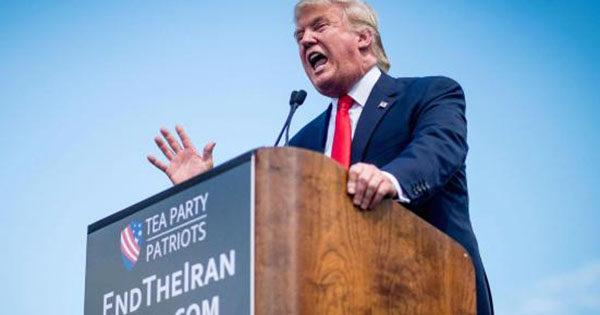
Trump’s Stumbling Toward War With Iran

While Iran and the other signatories of the nuclear deal will uphold it, Trump seems determined to renege, even if that means ignoring evidence and sidelining his administration.

ABU DHABI, United Arab Emirates—Tensions between the U.S. and Iran in the Gulf ratcheted up sharply after the USS Thunderbolt fired warning shots at a fast-approaching Iranian vessel on July 25.

Such incidents—classified as unsafe and unprofessional encounters—attract attention, and are often seen as potential sparks in what is an extremely volatile region.

Because they could degenerate quickly into serious events, the U.S. Navy deals with such incidents with measured professionalism. The rules of engagement are clear, and Iran’s Islamic Revolutionary Guard Corps Navy knows—despite its bravado—the red lines it should not cross.

Unsafe military interactions have decreased: There were 35 in 2016 and, according to U.S. officials, that figure is now “way below” what it was the same time last year. The capture of 10 U.S. sailors in May 2016 may have been a key factor in this decrease; military escalation was only avoided as a result of the personal relationship between Iranian Foreign Minister Mohammad Javad Zarif and former U.S. Secretary of State John Kerry, one that was developed through long hours of negotiations.

The absence of communication between the two administrations since President Donald Trump’s inauguration should, therefore, be a source of concern.

The Iranians feel they can sit out Trump’s presidency, as they consider it ahistorical and transitory. They are benefiting from the 2015 nuclear agreement and reviving their economy with the assistance of European, Chinese, and Russian companies, which are pleasantly surprised by the absence of U.S. competitors.

But Trump’s rhetoric against the nuclear agreement, which he noted as the “worst deal ever,” is slowly getting real. His decisions to reinforce the inspections, and charge a number of trusted White House staffers to make a case for decertifying Iran during the next 90-day review of the deal are the latest examples.

A damaged picture of Syrian president Bashar Al-Assad is seen on a wall in Idlib city, after rebel fighters took control of the area March 28, 2015. The text on the poster reads in Arabic”With Bashar”. Picture taken March 28, 2015.

Soldiers hold weapons while sitting on a vehicle carrying rockets as it drives past the stand with North Korean leader Kim Jong Un during a military parade marking the 105th birth anniversary of the country’s founding father, Kim Il Sung in Pyongyang, April 15, 2017.

While Iran and the other signatories will continue to uphold it, Trump seems determined to renege on the deal, even if that means ignoring the evidence and sidelining his administration. He is even unwilling to listen to Secretary of State Rex Tillerson and members of the intelligence community, who have said repeatedly the nuclear agreement is working imperfectly, but as designed.

The sanctions limit Iran’s nuclear ambitions, not its ballistic missile program, its alleged support for terrorist groups,… As Tillerson reiterated in a recent press conference, “that agreement dealt with a very small slice of Iran’s threats, and that was their nuclear program.” But as Zarif said last month, short of putting a gun to someone’s head and making them “sign a surrender,” the Trump administration “would not like the terms of any negotiated deal.”

The nuclear agreement is supposed to be a step in the right direction. During the same press conference, Tillerson confirmed “the conversation on Iran does not begin and end with the [nuclear deal].” But Trump does not seem to want a dialogue. Evidence suggests the U.S. president is looking to push Iran into refusing further inspections and will use the refusal to decertify Iran. This roll-back strategy could have a destabilizing effect on the region, as it would prevent Iran from accessing the international banking market and offering jobs to its 80 million people.

For ideological reasons, or out of sheer ignorance, Trump is sidelining moderate President Hassan Rouhani, who recently was re-elected with 57 percent of the votes on a program promising further negotiations with the international community to lift the remaining sanctions. Rouhani is supported by the leaders of the Green Revolution, the movement that opposed former President Mahmoud Ahmadinejad’s re-election in 2009 and fought for more reforms.

But even more troubling is the Trump administration’s embrace of the National Council of Resistance of Iran (NCRI) as a legitimate external opposition. The NCRI is one of the many aliases of the Mujahideen-e Khalq, an organization that supported the seizure of the U.S. embassy in Tehran in 1979 before turning its back on the Islamic Revolution and launching a bombing campaign in the country.

Considered a terrorist organization by the U.S. until 2012, it has since gained the support of some Democrats and many hawkish Republicans such as John McCain, Rudy Giuliani, Joe Lieberman, and Newt Gingrich. Most have been paid to participate in conferences, but only Elaine Chao, Trump’s transportation secretary, confirmed having received $50,000 for a five-minute speech in 2015.

With less success, Reza Pahlavi, son of the Shah who was ousted in the 1979 Islamic Revolution, is also trying to gain favour with the Trump administration. Criticizing the Mujahideen-e Khalq as a “cult-type structure,” he presents himself as the champion of the status quo ante. While Iranians were re-electing President Rouhani, he was on Fox News calling for a revolution.

The current absence of communication, intelligence cherry-picking, and reliance on dubious opposition movements bears many similarities to the invasion of Iraq, which was launched by President George W. Bush after exiled politician Ahmad Chalabi’s intense lobbying and false allegations regarding Iraq’s weapons of mass destruction and links to al Qaeda.

After failed attempts at engineering democracy in Iraq, Libya, Syria, and Afghanistan, can the region afford another staged regime change? The current, moderate Iranian president received a clear mandate to improve relations with the international community; it is not the time to destabilize a country that is simply too big to fail.

While some, including Secretary of Defense James Mattis, appear committed to revenge against Iran, the majority of Americans would most likely be opposed to a war. But as tensions increase and external advisers push for an even tougher stance, Trump’s Twitter diplomacy will not be enough to prevent the next incident from escalating.

Many different actors would love to stop the economic and political re-emergence of Iran, including many actors in the region. But as Robert Gates, the former secretary of defense, once said to the French foreign minister about the Saudis, they always want to “fight the Iranians to the last American.”

Marc Martinez, The Daily Beast

August 5, 2017 0 comments
FacebookTwitterPinterestWhatsappTelegramSkypeEmail
MEK Cult
The cult of Rajavi

Brainwashed, threatened, loved, Why people stay in the cult of Rajavi?

Based on testimonies of survivors of the Mujahedin Khalq Organization ( the MKO/ MEK/ the Cult of Rajavi) there have been two ways to get trapped in the cult. First group –mostly joined the cult of Rajavi in the beginning years of its foundation—were inspired by their high ideals which finally lured them into the cult and the second group –most recently recruited—were lured into the group by the fraudulent recruitment methods that promised them a better life, including job, wealth and citizenship of the European countries.

Once the person is surrounded by the oppressive controlling system of the MKO, what restrains him from leaving it? Alex Stein’s “Terror, Love and Brainwashing”, is helpful to realize how cults work. The MKO is one of the cult-like systems that she investigates. Her studies helps her prove that the relationship between a follower and the cult guru is often a “disorganized” attachment. The contradictions is detected between the “apparent kindness” of the cult leader –as it is usually seen in the appearance of Maryam Rajavi— and the confusion and the unhappiness members endure in the oppressive atmosphere of the cult.

According to Alex Stein’s personal experience and her later researches, live-in members of cults like the ones of the MKO cult, who are socially isolated, will lose their family, friends and all attachments of a normal life. She calls these individuals as “total converts”. This causes their unwillingness to leave the cult and its doctrine.

Members of the Cult of Rajavi are not only immersed in the beliefs of the cult but, they are totally immersed in the cult itself. As Alex explains, “Processes of brainwashing rest on the creation of stress or threat with no escape other than the apparent (un)safe haven of the group.” This is exactly the atmosphere ruling the MKO members in the group camps formerly in Iraq and in France and Albania now. Self-criticism meetings, permanent supervising of a hierarchical system, mandatory working schedule, sleep deprivation, forced celibacy are all tools to maintain the stressful, threatening structure.

“This results in a state of terror that causes a dissociative state resulting from a disorganized bond to the leader, or the group as proxy. The hyperobedient and hypercredulous deployable follower existing in this airless world gripped by an iron band of terror can be asked to engage in acts they would not have previously done, nor, once out of the group, would they do in the future,” states Alex Stein.

This way, members are gradually driven to engage in acts they would not have done before their involvement in the totalist system of the cult. For examples, acts of terror, suicide and self-immolation committed by the MKO operatives are numerous in the official history of the group published by different sources including the US State Department, The Human Rights Watch and the RAND Corporation etc.

According to Stein, “A totalist system is formed and controlled by a charismatic authoritarian leader. It is a rigidly bounded, dense, hierarchical and isolating system supported and represented by a total, exclusive ideology. The leader sets in motion processes of brainwashing or coercive persuasion designed to isolate and control followers. As a result followers are able to be exploited, and potentially become deployable agents, demonstrating uncritical obedience to the group, regardless of their own survival needs.”

Alex Stein names Massoud and Maryam Rajavi in the list of totalitarian cult leaders who forbid the formation of any attachments –even imaginary or internal—because they consider it a fundamental threat to the emotionally and disorganizing attachment that they themselves have imposed on members. She writes, “Maryam Rajavi of the Iranian political cult the Mojahedin-e khalq, acted as a kind of front of the leader, Massoud Rajavi, and was known as the group’s “Ideological Mother”.

In Terror, Love and Brainwashing, Stein presents an approach to understanding the profound effect of manipulative processes. Based on her book, it may take even the most courageous and the most intelligent people years to leave or to escape a totalitarian system. That’s why one may find a large number of educated, clever people among the survivors and even currently members of the Cult of Rajavi.

“This goes beyond the idea that simply teaching ‘critical thinking skills’ is enough. While that is, of course, important, we also should be teaching about the specific kinds of mechanisms that interrupt the ability to think critically,” she concludes.

By Mazda Parsi

August 3, 2017 0 comments
FacebookTwitterPinterestWhatsappTelegramSkypeEmail
Mujahedin Khalq Organization's Propaganda System

Iranians loathe the MKO

There are rumors that Trump administration might be considering the Mujahedin Khalq Organization (the MKO/MEK/the Cult of Rajavi) as an option for regime change in Iran. Actually, there are certain figures in the administration who advocate for the group ardently. Western supporters of the Cult of Rajavi are perceived at the lavish so-called “grand gathering” the group launches every year in Paris.

Many retired politicians, former Congressmen, and former military officials and former diplomats have sponsored the MKO. The group pretends to embrace the rhetoric of democracy, but both its violent past and its cult-like behavior contradict the claim. Moreover, the MKO’s supporters claim that they speak at its annual conference in Paris because they want to embrace the cause of the group while five-digit speaking fees seem to be their substantial motivation to appear at the rally of a formerly-designated terrorist group.

F.W. Burleigh of Western Free Press, considers the move by these politicians as the West’s ‘’new mistake’’. “It’s hard to find anything positive on the internet about the PMOI/MEK that wasn’t generated by NCRI’s propaganda machinery,” He writes.” Even Wikipedia slams it as a cult built around the personality of Maryam Rajavi and her husband Massoud, who disappeared in 2003 and was recently declared dead.” [1]

Burleigh describes how the Cult of Rajavi was established around his personality in the group’s ideological container Camp Ashraf, Iraq. “The NCRI/MEK’s claim that it will be the champion of freedom, democracy, and human rights in a future Iran needs to be examined against the history of the mini-societies that it has already created where it enjoyed total control, most notably at former strongholds in Iraq where a social order based on the MEK/Rajavi ideology was established,” He asserts. “These were MEK laboratories for a future Iran, particularly at a huge self-administered base called Camp Ashraf.” [2]

Galen Carpenter of the National Interest also denounces the MKO as a terrorist group that should be avoided by American politic men. “The MEK’s history should cause any sensible U.S. administration to stay very, very far away from that organization,” He writes. “The MEK is a weird political cult built around a husband and wife team of Massoud and Maryam Rajavi. It has been guilty of numerous terrorist acts and was on the U.S. government’s formal list of terrorist organizations until February 2012. The group did not even originate as an enemy of Iran’s clerical regime. It began long before that regime came to power, and its original orientation seemed strongly Marxist. The MEK was founded in 1965 by leftist Iranian students opposed to the Shah of Iran, who was one of Washington’s major strategic allies. And the United States was very much in the MEK’s crosshairs during its early years. During the late 1960s and throughout the 1970s, the MEK directed terrorist attacks that killed several Americans working in Iran.” [3]

But why has such a notorious violent cult been able to foster support among US high profiles? Carpenter clarifies the case: “The MEK has spent hundreds of thousands of dollars cultivating their support, and such gullible (or venal) Americans continue to tout the organization as a genuine democratic movement with strong support inside Iran. The extent of the financial entanglements is deeply troubling. Many prominent American supporters have accepted fees of $15,000 to $30,000 to give speeches to the group. They also have accepted posh, all-expenses-paid trips to attend MEK events in Paris and other locales. Former Pennsylvania Gov. Ed Rendell confirmed in March 2012 that the MEK had paid him a total of $150,000 to $160,000, and it appeared that other “A-list” backers had been rewarded in a similar fashion. Needless to say, accepting such largesse from a highly controversial foreign political organization—and one that was still listed as a terrorist organization at the time—should raise justifiable questions regarding the judgment, if not the ethics, of the recipients.” [4]

Definitely, the recipients of the hefty sums of the MKO, have a very poor judgment about the national interests of their own country as well as the aspirations of the people of their hostile country, Iran.

Burleigh has his own argument. He describes a future Iran under the rule of Maryam Rajavi. “Americans, however, should pause and look into the historical rearview mirror,” He warns. “It gives a lesson of unanticipated consequences for using holy warriors in the cause of Allah to achieve Western goals. If using PMOI/MEK/NCRI is part of an emerging strategy to overturn the Iranian theocracy, as Gingrich implied in his Paris speech, the world may well end up with Maryam Rajavi ruling for life over an Iran that she and her followers have transformed into one vast Camp Ashraf.” [5]

He misses to notice that the Cult of Rajavi can hardly ever find the minimum base among Iranian people.  The Iranians loathe the MKO. As Galen Carpenter assets this is not mere speculation. “The MEK aided Saddam Hussein’s war against Iran in the 1980s, and even Iranians who detest the clerical regime regard the MEK as a collection of odious traitors,” He states. [6]

Mazda Parsi

Sources:

[1] Burleigh, F.W., Iran and the Holy Warrior Trap, Western Free Press, July 23, 2017

[2] ibid

[3] Carpenter, Ted Galen, This Group Hopes to Push America toward Regime Change in Iran, National Interest, July 17, 2017

[4] ibid

[5] Burleigh, F.W., Iran and the Holy Warrior Trap, Western Free Press, July 23, 2017

[6] Carpenter, Ted Galen, This Group Hopes to Push America toward Regime Change in Iran, National Interest, July 17, 2017

August 2, 2017 0 comments
FacebookTwitterPinterestWhatsappTelegramSkypeEmail
Mujahedin Khalq as an Opposition GroupMujahedin Khalq Organization's Propaganda System

Do KSA and MKO share the illusion of regime change?

Bilateral relations between the Islamic Republic and Saudi Arabia has been tenuous during the past years. So, to see a Saudi Prince in the annual gathering of the Mujahedin Khalq Organization (the MKO) would not be surprising, neither it is surprising to see the prince speaking of the overthrow of the Islamic Republic. What is surprising is that the famous Saudi prince counts on the MKO for his hostile plan against the Iranian government.

Since last year, the Saudi prince Turki Al Faisal has turned into the key speaker of the MKO propaganda show held in Villepint, Paris every year. He is one of the most ardent speakers of the show advocating the agenda of regime change in Iran under the democratic gesture and the motto of freedom for Iranian people.

Conversely, Iranians are generally apprehensive of Saudi policies and have a negative attitude toward Saudi Arabia. It is never genuine that Iranians could buy into the narrative of Saudi support for a democratic government in Iran, particularly because the Saudi Arabia has a dark background of human rights violations.

On one hand, the MKO is doing another strategic miscalculation by aligning itself with a loathed rival of Iran. And on the other hand short-sighted support of American politicians for the MKO would poison the relations between the two nations.

“The MEK is hated in Iran for its role in the war and for its terrorism against Iranians over the years,” Daniel Larison of the American Conservative writes. “No one genuinely interested in the freedom of Iranians would have anything to do with such a group, but of course Saudi and American hard-liners couldn’t care less about Iranian freedom. They are simply looking for ways to stoke conflict with Iran, and they see this as a way to do that. Their desire for toppling Iran’s government is so great that they will pretend that a deluded cult is a legitimate opposition group because they think it creates the illusion that many Iranians share their goals. In reality, most Iranians don’t want regime change, and they definitely don’t want it forced upon them from the outside by people that clearly hate them.”

However, there is one true fact that supporters of the Cult of Rajavi seem to be ignorant of: the MEK doesn’t actually seek regime change in Iran. The self-appointed president elect of the group, Maryam Rajavi only longs for her own survival as the leader of the Rajavis’ cult of personality and the survival of the rank and files as her brainwashed followers. This has been the only agenda of the MKO authorities for the past decades –at least after the fall of Saddam Hussein.

Indeed, regime change in Iran is the illusion of those who are unaware of the realities of the Iranian community as well as the true nature and situation of the MKO cult. However, even if the regime change is enforced in Iran it will be through too much bloodshed because both KSA and MKO are detested in Iran.

By Mazda Parsi

July 31, 2017 0 comments
FacebookTwitterPinterestWhatsappTelegramSkypeEmail
Newer Posts
Older Posts

Recent Posts

  • The black box of the torture camps of the MEK

    December 24, 2025
  • Pregnancy was taboo in the MEK

    December 22, 2025
  • MEPs who lack awareness about the MEK’s nature

    December 20, 2025
  • Why did Massoud Rajavi enforce divorces in the MEK?

    December 15, 2025
  • Massoud Rajavi and widespread sexual abuse of female members

    December 10, 2025
  • Facebook
  • Twitter
  • Instagram
  • Youtube

© 2003 - 2025 NEJAT Society . All Rights Reserved. NejatNGO.org


Back To Top
Nejat Society
  • Home
  • Articles
  • Media
    • Cartoons
    • NewsPics
    • Photo Gallery
    • Videos
  • Publications
    • Books
    • Nejat NewsLetter
    • Pars Brief
  • About Us
  • Contact us
  • Editions
    • عربي
    • فارسی
    • Shqip