Nejat Society
  • Home
  • Articles
  • Media
    • Cartoons
    • NewsPics
    • Photo Gallery
    • Videos
  • Publications
    • Books
    • Nejat NewsLetter
    • Pars Brief
  • About Us
  • Contact us
  • Editions
    • عربي
    • فارسی
    • Shqip
Nejat Society
Nejat Society
  • Home
  • Articles
  • Media
    • Cartoons
    • NewsPics
    • Photo Gallery
    • Videos
  • Publications
    • Books
    • Nejat NewsLetter
    • Pars Brief
  • About Us
  • Contact us
  • Editions
    • عربي
    • فارسی
    • Shqip
© 2003 - 2024 NEJAT Society. nejatngo.org
Mujahedin Khalq; A proxy force

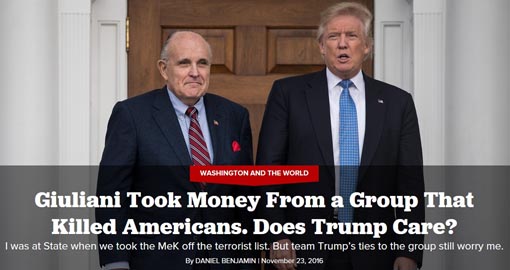
I was at State when we took the MeK off the terrorist list. But team Trump’s ties to the group still worry me.

You can tell a lot about potential Cabinet nominees by the terrorist group they shill for.

As President-elect Donald Trump settles on his nominees for secretary of state and other front-row positions, he has his pick of people who have lobbied for the bizarre and brutal Mujahidi
n e-Khalq (MeK), an Iranian resistance group that helped launch the Islamic revolution and then fell out with the Tehran regime. The MeK has plenty of American blood on its hands, as well as that of thousands of Iranians killed while the group was a strike force serving Saddam Hussein in the 1980s and ’90s.

Perhaps the best known MeK votary is none other than former New York City Mayor Rudy Giuliani, reported to be on the shortlists for Trump’s secretary of state and director of national intelligence, whose ties to the group have resurfaced as the press examines the numerous possible conflicts of interest created by his international business activities. The MeK has paid Giuliani handsomely for years—$20,000 or more, and possibly a lot more—for brief appearances before the group and for lobbying to have it removed from the State Department’s list of Foreign Terrorist Organizations (FTO), which occurred in 2012.

Among other MeK devotees are former U.N. Ambassador John Bolton—another secretary of state in waiting—and champion Trump booster Newt Gingrich. Former Labor Secretary Elaine Chao (also the wife of Senate Majority Leader Mitch McConnell), who suddenly appeared at Trump’s Bedminster, New Jersey, golf club on Monday for a meeting with the president-elect, has also been on the MeK payroll, as has former Bush 43 security aide Fran Townsend, whose name has been in play as a possible Trump secretary of homeland security or director of national intelligence.

Press accounts of MeK support by Giuliani and these others often treat their ties as a curiosity or, at most, some kind of peccadillo, because the group was taken off the State Department list in 2012. I was the coordinator for counterterrorism at that time, and my office was responsible for leading the effort to decide whether the group should be removed from FTO list. While I stand by that action, I also believe that any connection to the MeK is a lot more than a curiosity. Those who embrace the group show an alarming lack of concern about its past and heedlessness about core principles of American counterterrorism policy.

In Giuliani’s case in particular, the hypocrisy is rather stunning. “America’s mayor” has presented himself as a centurion in the fight against “radical Islamic terrorism” and famously doubted Barack Obama’s patriotism, saying, “I do not believe that the president loves America.” Yet he appears to feel that gorging at the table of Islamo-Marxist terrorists who have murdered Americans is in no way unseemly.

The history of the MeK stretches back to the 1960s, when it was founded by a group of Iranian students who opposed the shah and espoused an ideology that mixed Shiism—particularly the cult of martyrdom—and Marxism. Along with the group’s anti-regime sentiment came a hefty dose of anti-imperialism and hatred of the United States and Israel. Some of its members trained in PLO camps in Lebanon and Jordan.

From the outset, the group advocated violence. Among the MeK’s many terrorist operations in the 1970s were bombings and shootings directed against American military personnel stationed in Iran—three U.S. colonels were killed during this period, as were three contractors. There was an attempted kidnapping of the U.S. ambassador to Iran, an assassination attempt against the general heading the U.S. military mission, as well as attacks against Iranian facilities belonging to General Motors, Shell Oil, Pepsi, Pan Am Airlines and others. When the revolution occurred, the MeK joined forces with the religious hard-liners looking to overthrow the regime. The group supported the takeover of the U.S. embassy in November 1979, and, according to some eyewitnesses, MeK members took part.

But as Iran’s revolutionary leader Ayatollah Ruhollah Khomeini consolidated power, he became suspicious of the MeK’s leadership and its Marxist ideology and blocked the group from a role in the government. The MeK then took up arms against [Ayatollah] Khomeini and his followers. Before its top cadres fled to Paris in 1981, the organization carried out a series of bombings in Tehran, and it is believed to be responsible for one that killed more than 70 members of the new regime’s leadership, including Ayatollah Mohammed Beheshti, the second most powerful man in the country.

In 1986, about 7,000 MeK members relocated to Iraq, putting themselves in the service of Saddam Hussein during his war against Iran. Armed with Iraqi heavy weapons, the MeK claimed its fighters killed upward of 50,000 Iranian troops. After the Iran-Iraq War ended, MeK, Saddam’s “Praetorian Guard,” as Iran expert Ray Takeyh has called it, continued launching terrorist attacks against targets inside and outside Iran. After the 1990 Gulf War, the group participated in Saddam’s bloody repression of the Shia and Kurdish uprising in Iraq. In April 1992, it staged attacks on Iranian embassies in 13 countries. Among these was a strike against the Iranian mission to the United Nations, making the MeK, along with al Qaeda and a scattering of others, one of the few international terrorist organizations to actually operate on U.S. soil.

In 1997, the MeK was among the first group of 30 terrorist organizations the State Department put on the list of Foreign Terrorist Organizations, along with the worst of the worst from that period: Hezbollah, Hamas, the Abu Nidal Organization, Aum Shinrikyo and others. The group richly deserved this distinction. Although little known to most Americans, the MeK had considerably more blood on its hands than the large majority of the other groups included. The listing meant, among other things, that individuals who provided “material support” to the group could be prosecuted under U.S. law.

The MeK’s inclusion on the FTO list also underscored a central principle of U.S. counterterrorism policy, namely, that the target of terrorist violence is irrelevant, and the killing of innocents to advance a political agenda is always wrong. So even though the United States may have few more determined and even deceitful foes than the government of the Islamic Republic, we still condemn terrorist violence against the regime. The U.S. has continued to embrace this policy through Republican and Democratic administrations, and opposition to terrorism in all its forms has been essential for U.S. leadership on counterterrorism issues.

In the run-up to the U.S. invasion of Iraq, the administration of President George W. Bush cited Saddam’s provision of safe haven to the MeK as one example of his support for international terrorism. Faced with the juggernaut of the American invasion of 2003, the group surrendered its tanks and other weapons to U.S. forces and gathered its personnel at the largest of its military installations, Camp Ashraf, 40 miles outside Baghdad. Inexplicably, Secretary of Defense Donald Rumsfeld declared the MeK forces, members of a listed Foreign Terrorist Organization, to be “protected persons” under the Geneva Convention. Thus began the incredible anomaly of the U.S. military protecting the MeK at Ashraf until 2009, when a new status of forces agreement turned responsibility over to the Iraqi authorities.

With its world turned upside down in the wake of Operation Iraqi Freedom, the MeK sought to recast itself as the legitimate opposition to the Islamic Republic and endear itself to U.S. advocates of regime change in Iran. Beginning around 2003, the group was led, as it is today, from Paris by Maryam Rajavi, the wife of group founder Massoud Rajavi, who mysteriously disappeared around the time of the invasion. The MeK, whose ability to carry out attacks appeared to be sharply curtailed by the American occupation, claimed—though with scant proof—that it had long since renounced violence—and claimed, as well, to have embraced democracy. Sometime around then, it also began enlisting U.S. politicians to support its effort to have the FTO designation removed.

Money washes away all sins in Washington, and the cash that the MeK offered would-be proponents came in a geyser. In addition to longtime regime-change advocates like Bolton, who recently boasted before a MeK crowd in Paris that he had been engaged with them for a decade, the group signed up Republicans and Democrats en masse. Former Attorney General Michael Mukasey, former Homeland Security Secretary Tom Ridge, former FBI Director Louis Freeh, former DNC chair Howard Dean, former Chairman of the Joint Chiefs Hugh Shelton, former Obama National Security Adviser General Jim Jones, former Pennsylvania Governor Ed Rendell—the list went on and on.

The MeK appears to have built its stable of supporters by offering them lavish fees to speak at events in the U.S. and abroad that denounced Iran and promoted the group itself. They lobbied the secretary of state and the Bureau of Legislative Affairs for the most part, though they occasionally tried to get to me too, as coordinator for counterterrorism. Scores of notables were enlisted in Europe, too—a member of the British House of Lords showed up in my office one day under false pretenses to discuss the FTO listing only to be summarily ejected. No designated terrorist group had ever mounted a campaign like this before. Indeed, as a stampede of hogs to the trough, it was astonishing by any Washington standard.

Exactly where all the money came from remains unknown. Most of those who hitched their wagon to the MeK appeared to be getting $15,000 to $20,000 or more per appearance at these public events, and they were presumably happy to add their names to whatever open letters demanding better treatment for the group that were put in front of them. Many added their name to amicus briefs in support of an unprecedented legal action by the group seeking delisting—the MeK’s lawyer was former New Jersey Democratic Senator Bob Torricelli. (I’m pretty confident about these figures. Shortly after leaving the State Department, I was offered a five-figure sum to appear at a MeK-sponsored event. I know other former senior officials who received similar offers and declined them.) Group supporters claimed the money came from the contributions of ordinary Iranians in exile, but the sums seemed far too great. Rumors circulated about a vast hoard of cash that Saddam had bestowed on the group. Another view was Iran-hating Gulf Arabs were providing the lucre.

Wherever the money came from, plenty of it was being soaked up. And Congress became fixated on the MeK issue, too. Hearings into the case of the MeK were held, and hearings on other issues were hijacked by congressmen such as Republican Ted Poe of Texas and Democrat Brad Sherman of California, who championed the terrorist group. (Hill adoration for the MeK continues to be flabbergasting. Last April, Poe’s House subcommittee invited Maryam Rajavi to testify on the issue of ISIS by videolink. According to at least one House staffer, no one else has enjoyed that privilege since the Democrats were in the majority (2009-11), and Cuban dissidents were interviewed from the U.S. Interests Section in Havana.)

The spectacle of so many current and former legislators, Cabinet members and the like falling over themselves to praise the MeK caused plenty of bemusement and also outrage within the administration. Many officials were repulsed by the campaign for delisting—what, they wondered, was promoting the MeK through public appearances and lobbying if not material support for a designated terrorist organization? In March 2012, the Treasury Department seemed to be leaning toward that conclusion, when it started issuing subpoenas to prominent MeK surrogates

In 2012, the issue of the MeK FTO designation became even more high-profile—in part because of the lawsuit but, more urgently, because of the possibility of a massacre at Camp Ashraf. American troops were no longer defending the camp, and the Iraqi government of Nouri al-Maliki, who had a close relationship with Tehran, wanted the hated MeK gone. Beginning in 2009, Iraqi military and Shia militias attacked the camp on several occasions. In April 2011, 34 inhabitants of Ashraf were killed and hundreds wounded in one such attack. For Secretary of State Hillary Clinton, the priority became averting more killing and getting the MeK members relocated. Such a movement, however, was inconceivable until the group was delisted. No country would give refuge to a bunch of terrorists.

The issue consumed an enormous amount of the time and energy of the Department’s 7th floor, my team in the Counterterrorism Bureau, the Office of the Legal Advisor, the Near East Bureau and the Justice Department. The staff of the Counterterrorism Bureau opposed delisting, a step that is itself a rare occurrence reserved almost exclusively for groups that had become defunct. Although the MeK professed to having forsworn violence, there was insufficient confidence in that pledge. The 3,400 or so remaining MeK members were of course unlikely to do much of anything while bottled up in Camp Ashraf, but who knew what they would do if let out? Moreover, by presenting itself as an opposition force that supported the overthrow of the regime in Tehran, the MeK seemed only a few steps from taking up arms again.

Even more unsettling was the sheer creepiness of the group. While Maryam Rajavi was presiding over enormous conferences with American political celebrities and seas of smiling, waving people in Paris, at Camp Ashraf, the MeK leadership treated its people appallingly. Visitors, including from the U.N., painted a picture of relentless intimidation, shaming and coercion of the inhabitants by camp leaders. The MeK, which is often described as a cult, had a long history of requiring that its members divorce and remain celibate. Now, it leaders were resolved that the group would remain together and none of the members would be relocated individually or in small groups—the Ashraf group was a bargaining chip that the leadership was cynically using for future leverage.

As the discussion within the U.S. government went on in 2012, the Iraqis became increasingly impatient, and the fear of renewed violence grew. The State Department finally designed a solution that would make delisting in essence a self-fulfilling step. That is, the MeK leadership was informed that only by accepting relocation to a place called Camp Liberty near the Baghdad Airport and agreeing that its members would be farmed out to new homes around the world would the group be removed from the FTO list. In essence, the group was being dissolved as it was delisted. Even this the MeK objected to, and it haggled over the plan for weeks.

Faced with the possibility that the U.S. would leave the MeK on the terrorist list and walk away, the group finally capitulated.

The decision to remove the MeK from the FTO list had taken so long that there was relief at State that the ordeal was over, but little satisfaction. When the department announced the delisting in September 2012, it made its ambivalence evident.

With today’s actions, the Department does not overlook or forget the MEK’s past acts of terrorism, including its involvement in the killing of U.S. citizens in Iran in the 1970s and an attack on U.S. soil in 1992. The department also has serious concerns about the MEK as an organization, particularly with regard to allegations of abuse committed against its own members.

The secretary’s decision today took into account the MEK’s public renunciation of violence, the absence of confirmed acts of terrorism by the MEK for more than a decade, and its cooperation in the peaceful closure of Camp Ashraf, its historic paramilitary base.

The United States has consistently maintained a humanitarian interest in seeking the safe, secure and humane resolution of the situation at Camp Ashraf, as well as in supporting the United Nations-led efforts to relocate eligible former Ashraf residents outside of Iraq.

The final Ashraf inhabitants were relocated from Camp Liberty to Albania—where many of the group’s members wound up after being turned down by most other countries—just this past September. What the group does with its rank-and-file next is hard to know, and there has been little reliable reporting on their activities in Albania. For the moment, all eyes are on the group’s effort to ingratiate itself with U.S. policymakers and legislators, which it conducts now from its office on Pennsylvania Avenue.

The Treasury ended its inquiry into the funding of MeK surrogates after the group was delisted—and with it any hope of gathering more information from MeK proponents on their financial relations with the group, or where all that money came from.

It is difficult to capture just how surreal the entire MeK denouement was. In the end, the protestations of Giuliani, Bolton and others made no difference to the process, though the former New York mayor has boasted of his success in the matter: “My ties to them are very open. We worked very hard to get them delisted—by Hillary Clinton, by the way.”

The love affair with the MeK continues to mystify. For some, like Bolton, there is clearly an unshakeable certainty that the MeK will play a role in changing the regime in Tehran. Bolton’s reputation for dogmatism is well-earned in this case: Serious scholars of Iran all agree that the MeK is universally loathed in Iran, where no one forgets its service to Saddam or its slaughter of Iranian conscripts and others.

Iranian reformers, for their part, fear the MeK is girding to play such a role, and they were aghast at the delisting. “The MEK does not have a political future in Iran, but they will turn into a dangerous arm to serve U.S. interests,” one reformist political analyst told the Financial Times at the time. “Intellectuals have long been disappointed with the U.S. but now even ordinary Iranians realise that the U.S. does not support any democratic change in Iran.” That analyst may have been premature in his denunciation of the U.S. But if Bolton and his fellow ideologues do get a chance to pursue their regime-change designs by arming the MeK and others to carry out attacks, the U.S. can forget being a global bulwark against state-sponsored terror.

With Giuliani, as perhaps with Gingrich and others, the attraction to the MeK may be more grounded in plain old greed than foreign policy. According to a financial disclosure reported on by The New York Times, Giuliani has been speechifying at hyperspeed for years, collecting $11.4 million for 124 appearances in just one year—and that was before signing up for the MeK gravy train around 2011. Perhaps he just didn’t have time to consider the character of his paymaster.

Or perhaps, in Giuliani, avarice and ideology melt into one another. His last appearance before the MeK’s front organization, The National Council of Resistance of Iran, involved a scream fest not unlike his performance at the Republican National Convention. “The ayatollah must go,” he yelled. “Gone! Out! No more!”

Whatever the case, the irony seems not to have dawned on America’s mayor that his performance was in front of a group that had helped put the ayatollahs in power and that, at least historically, shared their general view on the utility of violence.

So Rudy Giuliani, hero of 9/11, is a buckraker with few principles. It’s not so surprising to find someone like him near the head of the line for high office. The really depressing thing is—pace Gingrich, Bolton, Townsend, Chao et al.—how many others are behind him in the queue.

Ambassador Daniel Benjamin is Directorof the John Sloan Dickey Center for International Understanding at Dartmouth College and served as Coordinator for Counterterrorism at the State Department 2009-2012.

By Ambassador DANIEL BENJAMIN, Politico Magazine
November 26, 2016 0 comments
FacebookTwitterPinterestWhatsappTelegramSkypeEmail
Mujahedin Khalq; A proxy force

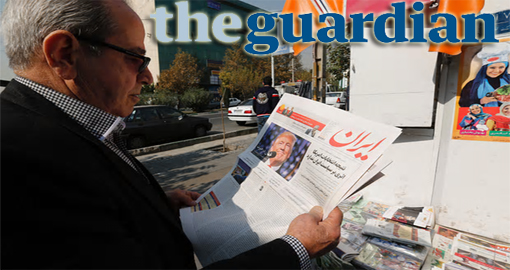
Why Donald Trump needs the Iran nuclear deal

If Trump walks away from the agreement, Iran will revert to its previous policy of enriching uranium that could someday be used to create a nuclear weapon

In March 2016, Donald Trump gave a speech to the American Israel Public Affairs Committee (Aipac). He was forthright about his support for Israel should he become president. He was particularly strong on Iran, and on the nuclear deal with Iran negotiated by Obama, saying straight off: “My No 1 priority is to dismantle the disastrous deal with Iran”.

But dismantling the deal with Iran will not be so easy. In addition to Iran and the US, there are four other signatories – the UK, France, China and Russia, all of whom are convinced that the deal is important and valuable. Even Saudi Arabia seems recently to have come round to the idea that it’s better to have the deal than to lose it. If Trump acts against the deal (or even if he just sits back and allows Republican hawks to enact new sanctions legislation) it is to be expected that the Iranians will walk away from it and revert to their previous policy: enriching uranium that could someday be used to create a nuclear weapon. That would be bad for Israel and everyone else, and would also make Trump look bad.

Some missed it at the time, but there was another strand to Trump’s Aipac speech – a hint of something else. He said the deal was bad – “… and we got absolutely nothing in return”. A little later he said that at the very least, he would enforce the deal “to hold Iran totally accountable”.

It has to be the working assumption, for now, that a Trump presidency is worse for the prospects of the nuclear deal than a Clinton presidency would have been. But it may not necessarily turn out that way. Trump has suggested that he might work with the Russians to destroy Islamic State in Syria, which would in effect mean working with Iran too.

In the Aipac speech and repeatedly elsewhere, he has stressed his self-image as a dealmaker, and also his desire to put America first, and (one of his strongest campaign messages overall) to correct allegedly unbalanced international trade arrangements that disadvantage the US. Might he seek a new deal with Iran, with a major trade element, in return for not tampering with the nuclear agreement? Trump would present such a deal as creating new jobs and benefiting US industries. It would give the US the benefit from the nuclear deal that Trump claims Obama failed to secure, putting Trump ahead of Obama on his own ground by positive action. The idea fits well with a whole range of Trump’s declared priorities, and if successful, would make him look good.

To make this happen, or indeed to come up with any Iran policy with any chance of success, Trump will need good foreign policy advice. It’s not easy to see where that might come from. One candidate spoken of as a possible secretary of state under Trump has been John Bolton, whose favoured policy toward Iran has been to bomb the country. Others mentioned have been Newt Gingrich and Rudy Giuliani. All three of these candidates have something in common: they have spoken in support of the MKO, an exile opposition group (also referred to with an alphabet soup of other acronyms – MEK, PMOI, NCRI, etc). The MKO pays public figures to support them against the Iranian regime.

The MKO is a bizarre organisation. As it is today, it resembles a kind of religious cult, brainwashing its adherents, taking their money and property, and separating them from partners and families. It was removed from the state department’s list of terrorist organisations in 2012, but prior to that perpetrated bombings and assassinations within Iran. It originated in the 1960s as a violent Marxist-Islamic group opposed to the Shah; in the 1970s, it killed US servicemen in Iran, among others. It gave significant armed support to the revolution in 1979, but lost out to [Ayatollah]Khomeini’s supporters in a bloody power struggle thereafter, was forced into exile, and later was based in Saddam Hussein’s Iraq. Because it fought on Saddam’s side against Iran during the Iran-Iraq war, it has since then been completely discredited with ordinary Iranians in Iran. No one with any claim to sound judgment, let alone high office, should have given the MKO their backing.

Another possibility in the air for secretary of state is Bob Corker, Republican senator and chairman of the Senate committee on foreign relations – strongly conservative, but an altogether safer choice.

The coincidence of Trump’s election and Leonard Cohen’s death prompted me (and not only me) to recall lyrics from Cohen’s song The Future: “Things are gonna slide – slide in all directions … ” It’s important for the Middle East as a whole that, with so much else on the slide, the Iran nuclear deal is not.

November 24, 2016 0 comments
FacebookTwitterPinterestWhatsappTelegramSkypeEmail
Iran

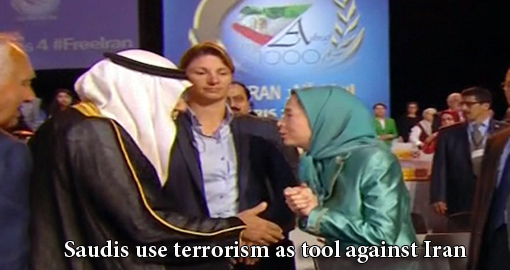
Saudis use terrorism as tool against Iran: Pundit

Iran’s security forces have arrested three terrorists and killed another one in the eastern parts of the country. The forces of the Iranian Intelligence Ministry have seized explosive materials from the terrorist cell. Tehran has called on neighboring states to prevent terrorist groups from crossing the joint borders. Press TV has interviewed a commentator to discuss the threat of terrorism against Iran, which comes from outside of the country.
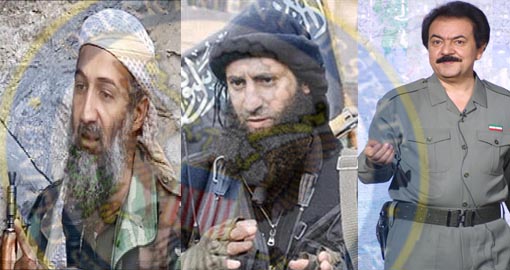
Seyed Mostafa Khoshcheshm, a journalist and political analyst, says after the Saudi authorities have failed to stop Iran’s influence in the region by using terrorist attacks against its allies, the Saudis resorted to proxy war through dispatching terrorists inside the Islamic Republic to undermine its security.

“The Saudis have changed the pattern when they found out they cannot topple the Iranian allies in the region like Iraq and [President] Bashar al-Assad in Syria. They have been trying hard to strike at Iran itself, because Iran is the only country, which is enjoying security in the region,” Khoshcheshm said, noting that the Saudis are seeking “to spread their influence in the region and to contain Iran.”

“This (the use of terrorist groups) has intensified since the nuclear deal [between Iran and the P5+1 group of countries] and they have been trying hard to regroup and to create a chain of these terrorist groups,” he said.

He also noted that “they (the Saudis) have been trying hard to provide financial backup, training, arms and logistics for different terrorist groups that have been operating in Iran throughout the last three decades after the Revolution.”

According to the analyst, the Saudi officials support anti-Iran terrorist groups like the Mujahedin-e Khalq Organization (MKO), which has “martyred over 17,000 Iranians and officials in the last three decades.”

Saudi Arabia has paid “hundreds of thousands of dollars to terrorists” inside Pakistan to arm and regroup them to wreak havoc on Iran, he said, adding that the Saudi consulate in Iraq’s Kurdistan region supported a Kurdish separatist group, which is labeled a terrorist organization by Turkey, Iraq and Iran, to enable it to operate terrorist attacks in the region.

Iranian security forces have arrested dozens of terrorists, belonging to the Daesh Takfiris and other groups over the past months.

In July, the Iranian Intelligence Ministry declared its forces had smashed a terrorist cell, which was planning bombings in Tehran and other cities during the holy month of Ramadan.

November 24, 2016 0 comments
FacebookTwitterPinterestWhatsappTelegramSkypeEmail
Iran

Iran’s letter to Mogherini about MKO terrorists

IRAN  – In the Name of God the Merciful, the Compassionate

Her. Excellency Ms. Federica Mogherini

High Representative of the European Union for Foreign Affairs and Security Policy

Excellency;

     Due to ongoing crimes and terrorist nature of Monafegheen terrorists (MKO) on the one hand, and freedom of movement of its agents in some European countries, I would like to share some points with you in this regard. Since the glorious Islamic Revolution in 1979 so far, Islamic Republic of Iran has been one of the biggest victims of terrorism both domestic and foreign ones. In the meantime, tens of thousands of innocent people have been martyred or injured by them. Terrorist groups have targeted men, women, children, the old, and scientists.

     Meanwhile, the greatest terrors which are crime against humanity, were conducted by Monafegheen terrorists in Iran. The group since the beginning of the Islamic Revolution started to avenge innocent people by carrying out explosions in populated centers, assassinating officials of the country, attacking people with guns and knives, abduction, torturing people and committing betrayal by being involved in espionage on behalf of the Baath regime of Saddam. It should be noted that out of 17000 of martyrs assassinated in Iran, 12000 of them have been martyred by this terrorist group.

     To introduce this terrorist group, it is enough to say that its highest priority and the main basis for performance is to kill and assassinate those who denied and disagreed with them. This can be evidenced in documents and statements issued by them. There is no doubt that killing and murdering innocent people in unscrupulous ways by planting bombs in civilian areas, is the most obvious and egregious violation of human rights. On the same basis, the agents of this terrorist organization martyred officials, including the president, prime minister, head of the judiciary power, ministers, MPs, prominent clergymen and citizens in a wide scale in 1981. After assassinating the officials, they started murdering innocent people and only between 1982 to 1988, they martyred more than 12000 people that all the names and documents are available. Another crime of this group is treason to the country and espionage for the hostile governments. During the imposed war of Iraq against Iran, this group provided the Baath regime with information on gathering places of Iranian civilians to be targeted by the Iraqi missiles.

     Innocent people of other countries in the region including Iraq and Syria have witnessed this group’s crimes as well. After being deployed in Iraq, Monafegheen affiliates in collaboration with Saddam’s regime, committed broad crimes against various tribes in this country including the Shiites and Kurds. Only in one of their crimes named ” Al-Anfal Campaign” and conducted from February to September 1988 in Kirkuk, Dialeh, Neynava and Salahedin, more than 3000 villages were destroyed and more than 182000 defenseless population of those areas were killed horribly including through burring alive, decapitating, burning and mass shooting. Many countries have recognized this crime as genocide and a resolution has been adopted against it. This terrorist group after the beginning of other terrorist groups’ activities in Syria and Iraq since 2011, along with other terrorists in Syria participated in mass killing of Syrians especially in “Daraa” region and also helped training other terrorists.

     Leaders of this criminal group have no mercy on their opponents and killed them brutally and also have had no mercy on their own affiliates and members. By adopting harsh rules, those who violate these rules are being kept in dungeon, executed, emasculated, brutally tortured, and have been separated from their children and spouses for long times. In order to make the female members following the harsh rules, head of this group had the woman undergone hysterectomy, and in an inhuman and immoral action he made some of the women separate from their husbands and forced them to marry him.

      However, unfortunately we are witnessing with such a black history, this terrorist group has had offices in some European countries and despite repeated requests of the Islamic Republic of Iran, its affiliates have traveled freely throughout European countries without any legal proceedings and some of these countries have turned into a safe haven for them.

     Taking into account the immunity granted to this group by the Western countries and rolling out the red carpet for them to participate in the meetings of their parliaments and even providing them with financial assistance, it is unfortunate to see that heads of this criminal and dangerous group have adopted themselves a human rights image and are calling themselves as human right supporters.

     Whit a look at official documents issued by the governmental and security institutions affiliated with Western countries, they have repeatedly acknowledged the terrorist nature of Monafegheenand sanctioned it. For example, in a report from the Federal Bureau of Investigation of the United States in 2004, while pointing out that the group is on the list of terrorist groups, said the National Council of Resistance (MKO), considers terrorism as a tool to deal with the Iranian government. District of Columbia Court of Appeals in America in July 2010 also states that the group is training suicide bombing to some of its female forces. Canada put this group on its list of terrorist groups till 2012. European Union until 2009, each year placed the group’s name on the list of terrorist groups and before that, a lot of documents and statements were issued by various European countries’ officials in recognizing the terrorist nature of the group.

     After suspiciously and politically removing the name of this group from terrorist groups list, unfortunately it is witnessed that some European governmental officials and parliamentarians as well as representatives of the European Parliament while neglecting clear lies of this group in human rights issues and committed crimes, support this group by issuing statements. For instance, we can mention the rally and meeting held by this group in Paris on 9 July 2016 with the presence of some representatives of the parliaments of European countries.

      Lies of this group in defending human rights and opposition to the death penalty can be realized by taking a look at their background as well as the statement issued by the leader of this group in November 2014.  In the statement, he has asked all his followers not only to assassinate Islamic Republic of Iran’s officials and their opponents, but also urged them to arrest and kill all of the organization’s members who have escaped.

     Having looked at the brief facts that some of them mentioned above, every clean natured and free human beings will seriously think how some of countries that claim to support human rights, can call a group which is responsible for the blood of thousands of innocent women and children, imprisoning and torturing women, taking out the uterus of women and castrating them, forcing woman to divorce and forced marriage, a human rights defender? How this paradox can be explained that countries which are now claiming to fight terrorism in Iraq and Syria, support one of the biggest organized terrorist groups which its hands are stained with blood of thousands of Iraqis and Syrian?

     Expansion of the hardships and dangers of terrorism and its spread to other European countries as well as the negative consequences stemming from it, including refugee crisis that European countries have been grappling, clearly prove the needs for a serious determination to fight terrorism. Adopting double standards towards human rights and instrumental view regarding it, supporting a group that for many years have killed thousands of Iranian people and their hatred is ingrained in the hearts of the people of Iran, is not at all acceptable. Therefore, I would ask your Excellency and other European authorities to take into account the extensive crimes committed by this terrorist group, and take serious measures to prevent the members and supporters of this group from freely operating in Europe and bring the leaders and criminal members of the group to justice and hold them accountable.

     In concluding, in order to know the true nature of this organization and some aspects of the crimes committed by it, I invite your Excellency to refer to attached electronic files.

Mohammad-Javad Larijani

 Secretary General of the High Council for Human rights

Judiciary of the Islami Republic of Iran (High Council For Human Rights),

November 24, 2016 0 comments
FacebookTwitterPinterestWhatsappTelegramSkypeEmail
Mujahedin Khalq; A proxy force

Giuliani, the favorite for Trump’s secretary of state, has ties to Venezuela, Qatar and Iranian exiles

Trump, who blasted Clinton’s alleged ties to Middle Eastern countries, has no qualms when it comes to top diplomat

Rudy Giuliani, the favorite for Donald Trump’s secretary of state, has ties to Venezuela, Qatar and Iranian exilesMayor Rudolph Giuliani, center, and the woman he has called his "very good friend," Judith Nathan, are trailed by Giuliani’s divorce lawyer Raoul Felder (Credit: AP/Jason Szenes)
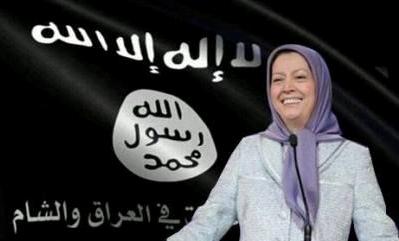
Former New York City Mayor Rudy Giuliani, reportedly the favorite to be appointed as Donald Trump’s secretary of state, has a whole lot of potential conflicts of interest.

On Monday evening, Giuliani repeatedly indicated that he’d be interested in the secretary of state position and offered a glimpse at what his foreign policies might look like during a gathering of The Wall Street Journal CEO Council.

“ISIS, short-term I believe, is the greatest danger and not because ISIS is in Iraq and in Syria, but because ISIS did something al Qaeda never did — ISIS was able to spread itself around the world,” Giuliani told the audience, establishing that fighting ISIS would be his top priority upon assuming the position.

The message is surprising, considering that Qatar, which sent money to ISIS extremists, is a country Giuliani once represented.  He advised Qatar’s state-run oil company at a national gas plant.

The potential leader of the State Department also represented an Iranian group that, at the time, was on a list of terrorist organizations.

    In 2011, an exiled Iranian political party called the Mujahedin e-Khalq, known as the MEK, paid Giuliani to give a speech in Washington calling on the State Department to remove the group from its list of terrorist organizations. The MEK recruited a host of other formal officials to its cause and succeeded in reversing the terrorist designation in 2012.

Since MEK was a designated terrorist organization at the time, Giuliani, as well as other politicians who represented the group, broke the law if he accepted money to advocate on their behalf. Giuliani was investigated by the Treasury Department in 2012 over this issue.

While this is the most controversial of Giuliani’s lobbying ties, it is hardly the only one.

Giuliani Partners, a subsidiary of Giuliani’s consulting firm, provided advice to TransCanada, which is trying to build the Keystone XL pipeline that President Obama opposes but Donald Trump supports.

His company represented a Singaporean gambling project to aid a partnership that included a North Korean organized crime leader.

The Houston-based law firm Bracewell & Giuliani also lobbied on behalf of the Venezuelan-owned state oil company Citgo and Saudi Arabia’s oil ministry.

Giuliani is perhaps best known for his perceived leadership during the September 11th terrorist attacks, but apart from that has had virtually no foreign policy experience to speak of. Then again, he has been a very vocal supporter of Donald Trump.

Matthew Rozsa is a Ph.D. student in history at Lehigh University and a political columnist. His editorials have been published on Salon, The Good Men Project, Mic, MSNBC, and various college newspapers and blogs. For a full review of all his published work, visit matthewrozsa.com.

Matthew Rozsa, salon.com

November 22, 2016 0 comments
FacebookTwitterPinterestWhatsappTelegramSkypeEmail
Mujahedin Khalq; A proxy force

An Iranian Exile Cult Jockeying for War Could Have the Ear of Trump’s White House

Newt Gingrich and Rudy Giuliani are both backers of the Mojahedin-e Khalq regime change lobby.

On June 24, 2012, former House Speaker and prominent Republican Newt Gingrich bent at the waist and bowed to the leader of a little-known cult-like Iranian opposition organization called the Mojahedin-e Khalq, or People’s Mujahedin Organization of Iran, known simply as MEK. Gingrich was in Paris to address the umbrella organization, the National Council of Resistance of Iran, and MEK head Maryam Rajavi accepted his gesture of deference by offering Gingrich a bouquet of flowers as a large crowd cheered enthusiastically.
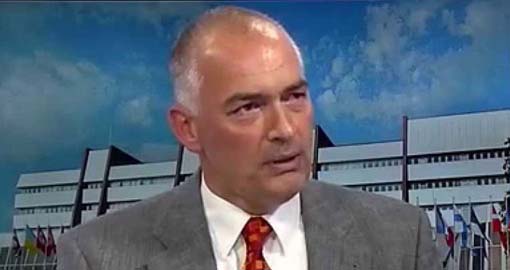
The moment, which was captured on video, was not Gingrich’s only public embrace of MEK, which at the time of that 2012 meeting, was designated a terrorist organization by the U.S. State Department. Speaking at a July 2016 gala affiliated with the organization, in Paris, Gingrich denounced the nuclear deal between world powers and Iran as “absolutely insane,” declaring that “we will eliminate the dictatorship as a threat to civilization.”

Gingrich is just one among a broad array of political influentials with concrete ties to MEK, a well-funded lobbying group aggressively promoting U.S. military confrontation with Iran. The group stands accused of torturing its members and believes that Maryam Rajavi is Iran’s rightful leader — members refer to her as “president elect.” MEK’s relationship to powerbrokers in Washington has taken on new significance as Gingrich assumes a pow

Gingrich is not the only close Trump associate with ties to MEK. Former New York Mayor Rudy Giuliani, also a vice chair of the transition team, has thrown his support behind the organization, declaring at a speaking engagement for the MEK in 2011, "We need regime change in Iran, more than we do in Egypt or Libya, and just as we need it in Syria.”

Giuliani is a contender for the role of Secretary of State, in a cabinet where the extremist right-wing publisher Steve Bannon was recently appointed Trump’s chief strategist. Now, it appears possible that the People’s Mujahedin of Iran could have a direct line to the White House.

Who Is MEK?

The People’s Mujahedin Organization of Iran was launched in the mid-’60s by university students who developed what they deemed Marxist-Islamist opposition to the government of Mohammad Reza Shah Pahlavi and carried out assassinations of at least six Americans during the mid-1970s. Following the 1979 revolution, MEK violently split with the Ayatollah Ruhollah Khomeini and was forced to flee to France, where its leaders continued their opposition activities. In 1986, MEK relocated to Iraq, where it cemented ties to Saddam Hussein, established military camps and fought on the side of Iraq during the bloody Iran-Iraq war.

By the late 1980s, husband and wife Massoud and Maryam Rajavi were at the helm of the group and began imposing cult-like standards of behavior, including forcing members to get divorces and become celibate. A Human Rights Watch report published in 2005 concludes that torture became endemic to the organization’s internal practices. “[F]ormer MKO members reported abuses ranging from detention and persecution of ordinary members wishing to leave the organization, to lengthy solitary confinements, severe beatings, and torture of dissident members,” HRW writes. “The MKO held political dissidents in its internal prisons during the 1990s and later turned over many of them to Iraqi authorities, who held them in Abu Ghraib. In one case, Mohammad Hussein Sobhani was held in solitary confinement for eight-and-a-half years inside the MKO camps, from September 1992 to January 2001.” According to HRW, witnesses reported “at least two deaths during interrogation.”

Meanwhile, according to the reporting of New York Times journalist Elizabeth Rubin, “in 1991 Hussein used the Mujahedeen and its tanks as advance forces to crush the Kurdish uprisings in the north and the Shia uprisings in the south,” as detailed by Iraqi intelligence officers, Kurdish commanders and human rights groups. Rubin writes that Maryam Rajavi proclaimed at the time: ”Take the Kurds under your tanks, and save your bullets for the Iranian Revolutionary Guards.”

The State Department says that, on one day in 1992, MEK “conducted near-simultaneous attacks on Iranian embassies and consular missions in 13 countries, including against the Iranian mission to the United Nations in New York.” Former Secretary of State Madeleine Albright declared MEK a terrorist organization in 1997, and years later, President George W. Bush cited the presence of MEK in Iraq to help justify the disastrous 2003 invasion, stating that Hussein “shelters terrorist groups.”

Yet, there are signs that the U.S. has cooperated with—and even backed—the MEK. During the U.S. occupation of Iraq, Bush kept the MEK in the country, moving them to Camp Ashraf near the city al-Khalis. According to the Rand Corporation, which says it was asked by Major General Douglas M. Stone to provide a “rigorous analysis of the circumstances surrounding coalition protection of the MEK,” in the immediate aftermath of the invasion, “coalition forces accepted a ceasefire from the MEK, disarmed the group and consolidated its members at one of the MEK’s camps.” Investigative journalist Seymour Hersh reported in 2012 that “the Joint Special Operations Command (jsoc) conducted training, beginning in 2005, for members of the Mujahideen-e-Khalq” at the Department of Energy’s Nevada National Security Site. According to one of Hersh’s sources, an unnamed “former senior American intelligence official,” the training ended before Obama took office. However, it is not clear whether the Obama administration pursued covert support for the MEK.

Meanwhile, MEK has itself been targeted by violence, including a rocket attack last year against its members at Camp Ashraf, as documented by Amnesty International.

According to Jamal Abdi, policy director of the National Iranian American Council (NIAC), MEK is “widely reviled” in Iran, and indeed, leaders of the Green Movement have denounced the organization. According to Abdi, “There are families in the U.S. and throughout the world who have lost members of their families to the MEK. They can’t find their family members because they’ve been sucked into the MEK organization.”

The MEK did not immediately respond to a request for an interview.

Powerful Lobbying Force in Washington

Being included on a list of terrorist organizations did not stop MEK from building a lobbying empire in Washington. As Ali Gharib and Eli Clifton reported last year for The Intercept, “even while constrained by their terrorism designation, the group and its affiliates poured millions of dollars into a sophisticated effort to rehab their image, creating an influential lobbying effort on Capitol Hill.”

Numerous former U.S. officials have spoken at MEK events, often in exchange for compensation. According to journalist Glenn Greenwald’s tally, they include prominent Republicans Rudy Giuliani, Tom Ridge, Fran Townsend and Andrew Card, as well as Democrats Howard Dean, Wesley Clark, Bill Richardson and Lee Hamilton. Dean, who is now jockeying to head the Democratic National Committee again, once reportedly proclaimed that Madame Rajavi should be recognized as the president of Iran.

Notably, Gingrich and other powerful supporters of MEK supported George W. Bush’s call to invade Iraq partly on the basis of the group’s presence in the country, arguing that it would serve as an ally in a democratic transition.

While building support in Washington, MEK was reportedly carrying out more attacks in the form of assassinations inside Iran. In February 2012, journalists Richard Engel and Robert Windrem reported, “Deadly attacks on Iranian nuclear scientists are being carried out by an Iranian dissident group that is financed, trained and armed by Israel’s secret service, U.S. officials tell NBC News.”

In September 2012, the state department announced the removal of MEK from its list of terrorist organizations, a move that Glenn Greenwald called a symptom of the “rot and corruption” of Washington. “The history of the U.S. list of designated terrorist organizations, and its close cousin list of state sponsors of terrorism, is simple,” he wrote, “a country or group goes on the list when they use violence to impede U.S. interests, and they are then taken off the list when they start to use exactly the same violence to advance U.S. interests.”

A year later, the Obama administration ordered MEK to relocate from Iraq to Albania. While MEK initially refused, the transfer has reportedly gone into effect in recent months. Meanwhile, MEK has been busy trying to scuttle the nuclear deal between world powers and Iran, buoyed by its list of prominent backers on both sides of the political aisle.

In May 2014, Dean and Giuliani co-authored an op-ed denouncing the deal, claiming that “weak policy vis-a-vis Tehran has only emboldened it to intensify suppression, continue massive support for Syrian dictator Assad and to slaughter its opponents, members of the People’s Mojahedin Organization of Iran in Camp Liberty in Iraq.” Now, Giuliani could become Secretary of State for Trump, who repeatedly pledged on the campaign trail to tear up the Iran deal.

According to Abdi, Iranian-American civil society groups have endured repeated attacks from MEK. “The group has spread a lot of misinformation and accused their critics who oppose war and sanctions as somehow being connected to the regime,” he said. “If the people who are setting U.S. policy don’t know better than to take money from this group, and to blindly advocate for them, there is no telling what they’ll do when they’re in control.”

Sarah Lazare is a staff writer for AlterNet. A former staff writer for Common Dreams, she coedited the book About Face: Military Resisters Turn Against War. Follow her on Twitter at @sarahlazare.

By Sarah Lazare / AlterNet

November 21, 2016 0 comments
FacebookTwitterPinterestWhatsappTelegramSkypeEmail
The cult of Rajavi

Open letters to Axel Fischer, about MKO invitation to attend Rajavi’s carnival on November 26

Vice-President of the Parliament Assembly and the Council of Europe and Chairman of the EPP Group

Dear Mr. Fischer,

As we have heard from the ranks of the MEK-outs in France, you are invited to the international gathering of the Peoples  Mojahedin of Iran “Mojahedin-e Khalq” (MEK / PMOI / MKO) and its political arm, the “National Council of Resistance of Iran (NCRI)” on November 26th in Paris.

We urge you to refrain from participating in this event!

The MEK is a cult organization being in fire for serious human rights violations against their members (according to a HRW-report) and the dubious handling of critics and dropouts.

Especially the refugees from CampLiberty in Iraq, who were relocated to Albania, are especially in the focus of the leadership of the organization to be influenced. The MEK tries everything to keep their members in Albania under control and to prevent their integration in society outside the organization.

In recent years due to its dubious reputation the MEK strives intensively to international political appreciation. They call themselves “the Iranian Resistance”, but within the serious political opposition groups inside Iran, they do not matter. They are also despised by the majority of the Iranian people for their cooperation with the former Iraqi dictator Saddam Hussein. The “Third Way” – the overthrow of the political system inside Iran by the Iranian people and their organized resistance (the MEK) – propagated by Rajavi, is utopian for that reason alone, the MEK has virtually no support among the Iranian people.

The assertion the MEK can be a serious alternative to the current Iranian regime, is merely the wishful thinking of the MEK and its lobbyists.

That’s why they are trying to misuse the media for their own purposes deliberately and to spread their view of reality in the international media.

Also the removal from the US list of Foreign Terrorist Organizations in 2012 was not a political development but the result of a multi-million dollar public relations- and media campaign of the MEK. Both in Iraq, as well as in the US, the MEK tries to place lobbyists in major media in order to influence the reporting.

The Gathering simply is a propaganda event for the MEK themselves and their “President elected” Maryam Rajavi. It is all about to enhance the MEKs international reputation and to interfere with the rapprochement course towards the Western world and Iran.

Even as a well-intentioned humanitarian gesture for the members of the MEK, your participation in this event would be counterproductive, because the simple members are the first who have to suffer from an appreciation of the MEK.

Your participation in this event as Vice-President of the Parliament Assembly and the Council of Europe, nor benefits the people of Iran, neither the MEK members living in Albania. The only one who would benefit from your participation, are Mrs. Maryam Rajavi and her MEK leadership!

With best regards,

AAWA Association e.V.

Dipl. Ing. Ali Akbar Rastgou (Chairman)

November 19th 2016       

–

Open letter of Davood. B. Arshad to Axel. E. Fisher

Link to the source

MdB Mr. Axel E. Fischer

Kaiserstraße 19

76646 Bruchsal

The Honorable MdB Mr. Fischer

I am Davood Arshad a Human Rights Activist. I am active in NTCA registered in Cologne which is dedicated to improving the lives of individuals and families affected by Islamist terrorist cult organizations, and also increase the public awareness on how terrorist organizations are established, recruit members, and hide their barbaric nature in the West and their real Goals thereof.

As ex-members of Mek (Mujahidin-e Khalg Iran) for 3 decades, also ex-member of National Council of Resistance of Iran, I would like to discuss some important issues that affect the fighting terrorism.

Any cooperation with Mek with terrorist background damages the reputation of the politicians within their electoral.

Your honor,

Among our issues are the following:

Brief description of how;

Western educated members like us are recruited by terrorist organizations.

How young members are utilised to take up arms and spread terror.

The goals of Mek in doing so and their long term strategy against the western civilization.

Their tactics in reaching their goals.

Answer any question with regards to this issue.

Attached are some facts about MEK’s previous activities around the Globe.

Thank you for considering this meeting request.  I look forward to hearing from you.

Sincerely,

Davood B. Arshad

No to Terrorist-cults Movement

Cologne

—

MdB Mr. Axel E. Fischer

Kaiserstraße 19

76646 Bruchsal

(END)

Ali Akbar Rastgou and Davood. B. Arshad,   

November 21, 2016 0 comments
FacebookTwitterPinterestWhatsappTelegramSkypeEmail
Mujahedin Khalq; A proxy force

MKO hanging on the Trump administration?

The stunning victory of Donald Trump in the US presidential elections concerned his critics over his domestic and foreign policies. A large number of articles, op-eds and letters have recently been published to warn the audience about the risks of a US run by Donald Trump. Certain journalists and scholars have focused on the hardliners and warmongers who are likely to become a part of his administration. It is worth to know that in the majority of the articles, paid sponsorship for the Mujahedin Khalq Organization (the MKO) is considered as a negative point in the political life of figures like John Bolton, Rudolf Giuliani and Newt Gingrich who are supposed to be Trump’s Secretory of State or advisors.
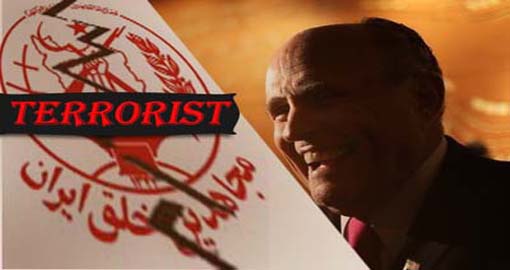
Actually the double standard that divides terrorists to “good” and “bad” is the reason for enemies of the Iranian government to repeat the mantra "Iran is the biggest state sponsor of terrorism", ignoring Saudi Arabia’s financing of ISIS and supplying of suicide bombers and even ignoring the assassination of the American citizens by the MKO in the 1970s and furthermore ignoring the MKO suicide attacks during the 1980s and 90s –in fact the MKO operatives were the first suicide attackers in the history prior to Taliban, Al-Qaida and ISIS. Just because one group opposes your enemy, doesn’t mean they aren’t your enemy as well. The current situation in Syria has made that crystal clear. ISIS opposes Assad who is supported by Iran and opposed by the US, so is ISIS a US ally?

As the elected president Trump criticized the conduct of American foreign policy under the Bush administration and not only the Obama administration, for the wars in the Middle East, it is not improbable that his administration will be careful about fraudulent propaganda of MKO crisis mongers and their sponsors. The open letter of Justin Raimondo a Libertarian American Journalist and the editor of the Antiwar website to Donald Trump tries to exaggerate such antiwar stances taken by him in his speeches in the presidential campaigns. He writes, ”But, hey, I’m not just watch-dogging you – I’m heartened by your apparent decision to stop funding and supporting the Syrian Islamist terrorists Hillary told us are really “moderates.” We have no business trying to bring about “regime change” in Syria, or anywhere else, and the farther we stay away from that hellhole the better.” Raimondo also tries to put an egg in Trump’s hat by implying that another war will be the worst decision in American Foreign policy. ”I’m also very much encouraged by reports that you have no intention of ripping up the Iran deal. That’s exactly what you said during the campaign, but the media – particularly Fox News – wasn’t listening apparently. We don’t need another war in the Middle East: indeed, it’s the last thing we need,” he asserts. [1]

Eli Clifton of the Lobelog expresses his concern over the probable active role of the murderers of Americans in the next American administration. “If Lopez, Giuliani, Bolton, or Gingrich serve in the Trump administrations, the MEK will have the highest level access its ever enjoyed in the U.S. government, a remarkable journey for a fringe Islamic-Marxist group that, until 2012, was on the State Department’s terrorism list for its role in assassinating Americans,” he writes.[2]

American sponsors of the MKO have been paid by the group for the support they voice every now and then. “Throughout the first term of the Obama administration, Iranian American organizations with extensive links to the MEK paid prominent U.S. national security officials to speak on behalf of the group”, Josh Rogin reveals in the Washington Post. “They also contributed heavily to the campaign coffers of lawmakers on both sides of the aisle. The payments ran through the lobbying law firm DLA Piper, which passed the money through a speakers’ bureau that cut checks to the officials.” It should be taken in to consideration that the MMO was officially listed as a foreign terrorist organization at that time. Therefore, paid speakers have violated the law that prohibits American citizens from material support for terrorist entities.   [3]

“In March 2012, Giuliani traveled to Paris to speak at an MEK conference alongside the group’s secretive leader Maryam Rajavi. While there, he called the U.S. military base in Iraq where the United States wanted to relocate the MEK a “concentration camp.” Those comments later appeared in an MEK ad in the New York Times, according to josh Rogin. “That same month, the Treasury Department’s investigation into the payments made to American politicians became public when former Pennsylvania governor Ed Rendell admitted that he had received a subpoena related to his work on behalf of the MEK. It’s illegal for American citizens to do business with a group designated as a foreign terrorist organization.” [4]

Regarding that the MKO have bought a large number of supporters among US politicians particularly the republican figures, it might be natural to be concerned about the next US government’s warmongering policies but how much the extent of such influence would be –if there is any influence.

The Huffington Post reported, a few days ago, that John Bolton –a top candidate to serve as President-elect Donald Trump’s secretary of state, is publicly calling for the U.S. to help overthrow the existing government in Iran. Bolton who was a hyper-hawkish supporter of the US-led military invasion to Iraq and has always recommended a military attack against Iran opposing the nuclear deal with Iran, “has no plans to tone down his adventurist foreign policy views, which run counter to Trump’s repeated promises to focus resources domestically and to avoid unnecessary entanglements abroad.” [5]

Bolton announces his new plan that has cheered the MKO up. He told Breitbart News Daily, “I think the people of Iran would long for a new regime. I don’t think the regime is popular, but I think it has the guns. And I think there are ways of supporting the opposition that does not involve the use of American military force that does involve helping the opposition to get a different kind of government.” His clear recommendation for arming the MKO seems terribly silly because it suggests the extent of his ignorance, mis-calculations, and mis-understanding about the MMO, the Iranian people and their view on the MKO. [6]

Arash Azizi of the Global Voice was one of the first journalists who warned about the disastrous advocacy for the notorious MKO. He suggests, “The links with MEK are a serious cause for worry, and the reason Iranians should be vigilant and make it clear that this cult doesn’t speak for the people of Iran, nor they are genuine advocates of democracy in the country.” [7] His assertion was then confirmed by Michael Rubin, former Pentagon official who is at the same time a harsh critic of Islamic Republic. [8]

“Still, it is important to remember that the MKO is a Marxist, authoritarian cult with minimal support inside Iran,” Rubin writes in commentary magazine. “Many Iranians view the MKO in the same way as Americans view John Walker Lindh, the American Taliban. That the MKO conducted terrorism which victimized ordinary Iranians has only solidified Iranian public opinion against the group even further.” [9]

Rubin also warns about the MKO propaganda, “The MKO’s rhetoric about democracy can be alluring, but if the goal of the Trump administration is to contain, weaken, and roll back the influence of the Islamic Republic, then outreach to the MKO is the worst possible move because it would rally Iranians around the flag and strengthen the current regime.” So, he comes to the conclusion that “the enemy of an enemy is not always a friend.” [10]

By Mazda Parsi

References:

[1]Rimondo, Justin, Dear President Trump, An open letter, Antiwar.com, November 14, 2016

[2] Clifton, Eli, Former Terrorist Group To Enjoy Close Ties to Rumored Trump Cabinet, Lobelog, November 15, 2016

[3] Rogin, Josh, Giuliani was paid advocate for shady Iranian dissident group, Washington Post, November 15, 2016

[4] ibid

[5] Schulberg, Jessica, John Bolton, Top Contender For Secretary Of State, Calls For Regime Change In Iran, Huffington Post, November 18 2016

[6] Conway, Madeline, Bolton calls regime change the ‘only long-term solution’ in Iran, Politico.com, November 17, 2016

[7] Azizi, Arash, Possible Trump Cabinet Members’ Links to the MojahedinKhalq Could Spell Trouble for Iran, Global voice,13 November, 2016

[8] Rubin, Michael, Will Trump Embrace the MKO?,Commetary Magazine, Nov. 11, 2016

[9] ibid

[10] ibid

November 21, 2016 0 comments
FacebookTwitterPinterestWhatsappTelegramSkypeEmail
Mujahedin Khalq; A proxy force

Why Rudy Giuliani Shouldn’t Be Secretary of State

World leaders watching America make a shift under Donald Trump fall into two broad camps: those who hope that the United States will muddle through the next four years, an inexperienced president notwithstanding, and those who are eager to see Washington’s international standing and influence unravel.
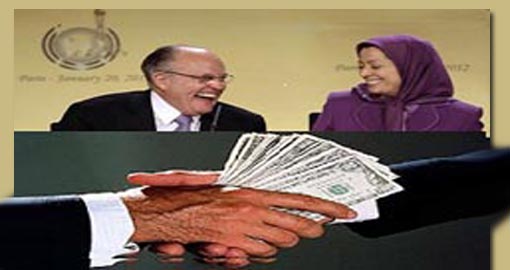
The latter outcome could be averted if Mr. Trump selects an experienced and conscientious leader as his top diplomat. That would require appointing someone other than Rudy Giuliani, the former New York mayor, who is reported to be the front-runner for the job.

Before addressing why he would be a dismal and potentially disastrous choice, it’s worth reflecting on the enormous foreign policy challenges the incoming administration will face.

The Trump administration will have to create a new Syria policy, which will require deft understanding of Russia’s intentions and capabilities in the Middle East, and careful management of a complex coalition of allies fighting the Islamic State. The Trump White House will most likely be tested early by North Korea’s bellicose and nuclear-armed leader. Leaders across Europe will be watching to see whether the Trump administration is willing to let the Western military and diplomatic alliance erode, which would be a boon for Russia. Closer to home, the new White House will have to weigh the risks of turning Mr. Trump’s irresponsible blame-Mexico campaign rhetoric into policy, which would severely undermine national security by halting cooperation between the two governments on migration from Central America, law enforcement matters and counternarcotics programs.

A successful secretary of state must be steeped in history and geopolitics and have shrewd negotiating skills and a clear sense of America’s capabilities, principles and the limits of Washington’s power.

The extent of Mr. Giuliani’s international experience has been largely limited to giving speeches and consulting work. He lacks any substantive diplomatic experience and has demonstrated poor judgment throughout his career. Indeed, as he became Mr. Trump’s most bombastic champion, Mr. Giuliani at times appeared unhinged.

For a taste of Mr. Giuliani’s foreign policy misadventures, consider his 1982 visit to Haiti as an associate attorney general. He preposterously proclaimed that there was “no political repression” on the island, which was then ruled by President Jean-Claude Duvalier, a tyrant. As mayor, he dabbled in petty diplomacy in 1995 by having the Palestinian leader Yasir Arafat ejected from a New York Philharmonic concert celebrating the United Nations.

Mr. Giuliani was embraced as “America’s mayor” after 9/11, a label, which he promoted for years, that allowed him to gloss over his poor performance in City Hall. Under his direction, New York City decided to base its emergency command center in the World Trade Center, a prime target that had been bombed in 1993. In 2000, he enraged black New Yorkers with his shockingly insensitive response to the fatal police shooting of Patrick Dorismond, an unarmed black man, whom Mr. Giuliani derided as less than an “altar boy.”

Since leaving office, Mr. Giuliani has earned millions working for foreign governments and businesses, which would raise a flurry of potential conflicts of interest. For instance, he was paid to deliver speeches in 2011 and 2012 defending a cultlike Iranian exile group that was on the State Department’s list of terrorist organizations.

In the long list of ridiculous things Mr. Giuliani has said, his remarks about President Obama in February 2015, when the presidential campaign was gearing up, were particularly disgraceful. “I do not believe that the president loves America,” Mr. Giuliani said at a dinner in Midtown Manhattan. “He doesn’t love you. And he doesn’t love me. He wasn’t brought up the way you were brought up and I was brought up through love of this country.”

Mr. Trump, who has no background in international affairs, would be wise to seek the counsel of former Republican secretaries of state about the demands of the job. Anyone offering sound advice would urge him to scrap plans to have Mr. Giuliani run the State Department.

By Editorial Board,

November 19, 2016 0 comments
FacebookTwitterPinterestWhatsappTelegramSkypeEmail
Mujahedin Khalq; A proxy force

Rudi Giuliani took money from Qatar, Venezuela, Iranian exiles

His foreign clientele could present conflicts of interest as secretary of state

Rudy Giuliani’s paid consulting for foreign governments would present conflicts of interest as the nation’s top diplomat that would make the Clinton Foundation look trifling.

Since leaving the New York mayor’s office, Giuliani has made millions as a lawyer and consultant, including for some clients at odds with U.S. foreign policy. When some of those ties surfaced amid Giuliani’s own presidential bid in 2007, they were considered to pose an unprecedented number of ethical quandaries for a potential commander in chief.

Now those concerns have no doubt been eclipsed by Donald Trump’s own web of business entanglements, which are still not completely known to the public. Giuliani’s participation in Trump’s transition and contention for the job of secretary of state poses a direct challenge to Trump’s promises to root out Washington self-dealing and ban his administration’s officials from lobbying for foreign governments.

In 2011, an exiled Iranian political party called the Mujahedin e-Khalq, known as the MEK, paid Giuliani to give a speech in Washington calling on the State Department to remove the group from its list of terrorist organizations. The MEK recruited a host of other formal officials to its cause and succeeded in reversing the terrorist designation in 2012.

A subsidiary of Giuliani’s consulting firm, Giuliani Partners, advised Qatar’s state-run oil company on security at a natural gas plant, The Wall Street Journal reported. Qatar is a U.S. ally that hosts a major American military base but once stifled an attempt to arrest Khalid Sheikh Mohammad, who went on to mastermind the Sept. 11 attacks, according to the 9/11 commission report.

The same subsidiary, Giuliani Security & Safety, provided security advice to a Singapore gambling project on behalf of a partnership that included a tycoon close to the North Korean regime who is considered an organized crime figure by the U.S., according to a report in the Chicago Tribune. “I think the person involved, if it’s correct, was a 1 percent owner that had no involvement with us, we never worked for, had nothing to do with,” Giuliani told NBC’s Tim Russert at the time.

Giuliani Partners also advised TransCanada, which sought to build the Keystone XL pipeline that President Barack Obama rejected but Trump has said he wants to approve. And Giuliani helped the maker of the OxyContin painkiller, Purdue Pharma, settle a Drug Enforcement Administration investigation with a fine.

The Houston-based law firm Giuliani joined as a named partner in 2005 lobbied in Texas for Citgo, the U.S. subsidiary of the Venezuelan state oil company then controlled by President Hugo Chavez, The New York Times reported in 2007. The firm also did work for Saudi Arabia’s oil ministry, according to The Associated Press.

The law firm, Bracewell & Giuliani, lobbied at the federal level during Giuliani’s time there for energy companies including Southern Company, Duke Energy, Energy Future Holdings, Arch Coal, Chesapeake Energy and NuStar Energy, records show. It also represented Cornell Companies, a private prison operator that later merged with GEO Group. Giuliani never personally registered as a lobbyist. He left the firm for rival Greenberg Traurig this year, and currently is on leave.

Giuliani’s assistant at Greenberg Traurig and the Trump transition didn’t answer requests for comment.

The Clinton Foundation has been hounded by Republican suspicions of selling access to Hillary Clinton as secretary of state, and the nonprofit did accept big bucks from foreign governments. But Clinton’s defenders point out there’s no proof she ever made an official act to benefit a foundation donor, and, unlike Giuliani, she never personally profited from the foreign contributions to her charity.

When Giuliani ran for president, he reported assets of $18.1 million to $70.4 million.

Isaac Arnsdorf, Politico,

November 19, 2016 0 comments
FacebookTwitterPinterestWhatsappTelegramSkypeEmail
Newer Posts
Older Posts

Recent Posts

  • Fourteen years after US delisting, MKO terror cult’s political rebranding collides with its violent legacy

    September 30, 2026
  • How Did Maryam Rajavi Become All-Powerful in the MEK?

    September 29, 2026
  • Soraya Abdollahi’s Letter to International Human Rights Bodies

    September 28, 2026
  • How Did Maryam Rajavi Become All-Powerful in the MEK?

    September 27, 2026
  • Yazdan Teimorian’s Family:  We Are so Heart-Broken!

    September 23, 2026
  • Facebook
  • Twitter
  • Instagram
  • Youtube

© 2003 - 2025 NEJAT Society . All Rights Reserved. NejatNGO.org


Back To Top
Nejat Society
  • Home
  • Articles
  • Media
    • Cartoons
    • NewsPics
    • Photo Gallery
    • Videos
  • Publications
    • Books
    • Nejat NewsLetter
    • Pars Brief
  • About Us
  • Contact us
  • Editions
    • عربي
    • فارسی
    • Shqip