Nejat Society
  • Home
  • Articles
  • Media
    • Cartoons
    • NewsPics
    • Photo Gallery
    • Videos
  • Publications
    • Books
    • Nejat NewsLetter
    • Pars Brief
  • About Us
  • Contact us
  • Editions
    • عربي
    • فارسی
    • Shqip
Nejat Society
Nejat Society
  • Home
  • Articles
  • Media
    • Cartoons
    • NewsPics
    • Photo Gallery
    • Videos
  • Publications
    • Books
    • Nejat NewsLetter
    • Pars Brief
  • About Us
  • Contact us
  • Editions
    • عربي
    • فارسی
    • Shqip
© 2003 - 2024 NEJAT Society. nejatngo.org
Iran

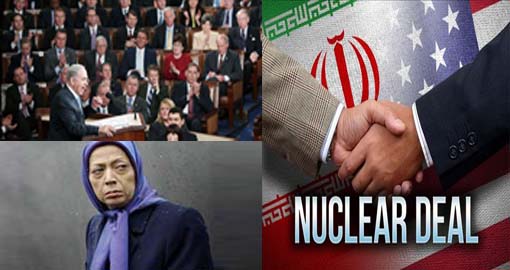
Senior MP: Mojahedin Khalq Trying to Ruin N. Talks

A senior Iranian lawmaker cautioned against the attempts made the terrorist Mojahedin-e Khalq Organization (MKO, also known as MEK, PMOI and NCRI) to prevent Iran and the six world powers from striking a final nuclear deal.
 
“The MKO is trying to cause tension in Iran’s nuclear talks by different means,” member of the parliament’s National Security and Foreign Policy Commission Javad Jahangirzadeh told FNA on Monday.
 
The lawmaker said the MKO agents in their latest move have paid cash to Cal Thomas, the columnist of the Washington Times newspaper to write an article to allege that Iran cannot be trusted for striking a final agreement with the world powers.
 
Thomas wrote in his recent article in Washington Times that Iran has always maintained that it is seeking nuclear power for peaceful purposes; “if that were true, there would be no need for negotiations, how do you negotiate with someone who has lied from the start and is told in the Quran that lying to infidels is permissible in pursuit of the Islamic goals?”
 
The MKO, founded in the 1960s, blended elements of Islamism and Stalinism and participated in the overthrow of the US-backed Shah of Iran in 1979. Ahead of the revolution, the MKO conducted attacks and assassinations against both Iranian and western targets.
 
The group started assassination of the citizens and officials after the revolution in a bid to take control of the newly-established Islamic Republic. It killed several of Iran’s new leaders in the early years after the revolution, including the then President, Mohammad Ali Rajayee, Prime Minister, Mohammad Javad Bahonar and the Judiciary Chief, Mohammad Hossein Beheshti who were killed in bomb attacks by the MKO members in 1981.
 
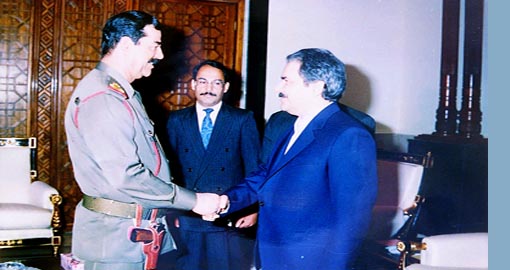
The group fled to Iraq in 1986, where it was protected by Saddam Hussein and where it helped the Iraqi dictator suppress Shiite and Kurd uprisings in the country.
 
The terrorist group joined Saddam’s army during the Iraqi imposed war on Iran (1980-1988) and helped Saddam and killed thousands of Iranian civilians and soldiers during the US-backed Iraqi imposed war on Iran.
 
Since the 2003 US invasion of Iraq, the group, which now adheres to a pro-free-market philosophy, has been strongly backed by neo-conservatives in the United States, who argued for the MKO to be taken off the US terror list.
 
The US formally removed the MKO from its list of terror organizations in early September, one week after Secretary of State Hillary Clinton sent the US Congress a classified communication about the move. The decision made by Clinton enabled the group to have its assets under the US jurisdiction unfrozen and do business with the American entities, the State Department said in a statement at the time.
 
In September 2012, the last groups of the MKO terrorists left Camp Ashraf, their main training center in Iraq’s Diyala province. They have been transferred to Camp Liberty. Hundreds of the MKO terrorists have now been sent to Europe.
 

July 9, 2015 0 comments
FacebookTwitterPinterestWhatsappTelegramSkypeEmail
Mujahedin Khalq; A proxy force

Demonizing Iran To Prevent the Nuclear Agreement

Since April 2 when the Lausanne Accord was signed by Iran and P5+1 – the five permanent members of the United Nations Security Council plus Germany – the opposition, namely, the neoconservatives, the Republican Party, Israel, Saudi Arabia, and their lobbies in the United States has been in high gear to prevent the signing of the comprehensive agreement whose deadline is now July 7, after the two sides could not complete their negotiations by the original deadline of June 30.
 
Right after the announcement of the Accord, the opposition went to work. Two days after the announcement Bill Kristol, the Godfather and “little Lenin” of the necons, declared that the best way of defeating the efforts of the Obama administration is creating the conditions that would kill the nuclear accord, forcing the President not to sign any agreement. Speaker of the House John Boehner was reported telling a Jewish group that the Republicans do not have the votes to override the President’s vote of Congress’ rejection of the nuclear agreement. Thus, the best way to defeat the administration is to prevent any final agreement in the first place.
 
The breadth and depth of the campaign against an agreement with Iran are completely unprecedented. When Richard Nixon re-established diplomatic relations with China in 1972 and Bill Clinton did the same with Vietnam in 1995, we did not see the type of backlash against them that we are seeing today against a nuclear agreement with Iran. At the height of the Cold War the enmity toward the Soviet Union was less intense than against Iran now, even though the Soviets were far more powerful than Iran is or will ever be. Compared with Iran, even the reaction to re-establishment of diplomatic relations with Cuba has been relatively mute. And why this is so? It is all because of Israel and its lobby and allies in the United States.
 
So, what is the best way of killing the final agreement? The usual way: demonizing Iran by lies, exaggerations, half-truths, innuendoes and insinuations.
 
One way of demonizing Iran is by rebuking the President for wanting to reach an agreement with such a “despicable” state as Iran. Over at the Washington Post, neoconservative and Israel’s agent Jennifer Rubin has been working hard to advance this narrative. After claiming that the President is delusional, and starting with her column of April 6 – Iran framework: not good, not a deal – Rubin has been propagating all types of sheer nonsense about Iran, the administration, and the nuclear negotiations.  A few days later Rubin claimed that the Obama administration is prepared to give Iran anything and everything for a deal. This is baseless as one important obstacle to the negotiations has been the U.S. excessive demands, well beyond the international agreements and Iran’s obligations toward them.
 
In another column on June 21 Rubin claimed that “Democrats, Republicans and neutral experts reject Iran sellout.” Who are these neutral experts? One is Olli Heinonen, former IAEA Deputy Director for Safeguards, who has a strong and deserving reputation for being anti-Iran, and a member of pro-Israel lobby United against a Nuclear Iran (UANI). He is also the man who claimed that Iran is only 2-3 weeks away from a nuclear bomb. Two other such “neutral experts” are Eric Edelman and Dennis Ross. Edelman, a member of the conservative Foreign Policy Initiative, claimed that any nuclear agreement with Iran can be torched by Obama’s successor. As an ardent supporter of Israel, Ross does not need any introduction. The UANI published a page-long warning in the New York Times, talking about the “dangers” of an agreement with Iran that is not tough enough. The funds for these activities are provided by Sheldon Adelson, the pro-Israel billionaire and the man who called for dropping a nuclear bomb on Iran.
 
Another way of demonizing Iran is to insist that Iran continues to have a nuclear weapons research program, and has something very horrendous to hide. Over at New York Times, David Sanger, Michael Gordon – remember his collaboration with the Times’ chief propagandist Judith Miller and her sensational stories about Iraq’s nonexistent weapons of mass destruction? –  and company continue to publish their agenda and opinion as “facts.” Sanger continues to insist that Iran’s nuclear weapon research program, if it ever existed, has continued sporadically since 2003, despite the fact that the National Intelligence Estimates of 2007, reaffirmed in 2009, 2011 and 2012, concluded that the program was halted in 2003. Sanger also insinuates the same by continuing to claim that “some of Iran’s most sensitive nuclear work has been done in its military sites,” despite the fact that even the totally politicized International Atomic Energy Agency under Yukiya Amano, a minion of the West, does not make such a claim. And why Sanger insists on this? By relying on the discredited “laptop of death,” supposedly stolen in Iran and delivered to Western intelligence agencies and the fact that Iran is not willing to go beyond its legal obligations and allow the IAEA to inspect its military sites.
 
Sanger and the Times still insist on the relevance of the totally discredited “possible military dimensions (PMD)” of Iran’s nuclear program, allegations based on the same laptop. They never interview true experts and at least allow them to voice their opinion. [Julian Pecquet of al-Monitor makes the same type of claims.] Robert Kelly, a former IAEA expert; nuclear physicist Yousaf Butt, and a failed CIA sting operation against Iran’s nuclear program that prompted the IAEA to reassess some of its so-called evidence for the PMD, have completely discredited the allegations about the PMD.
 
Yet a third way of demonizing Iran is by claiming that if the illegal crippling economic sanctions imposed on Iran are lifted, Iran will have access to billions of dollars of  its foreign currency reserves frozen in Western financial institutions, and will spend it all on its allies in the Middle East, hence making that turbulent region more unstable. An article by David Rothkopf, the CEO and Editor of Foreign Policy group is typical of this line of demonizing Iran. In his article Rothkopf claims that after the sanctions are lifted, Iran will have access to $120 billion of its foreign currency reserves. Over a period of 15 years, the apparent duration of the nuclear agreement, Iran will make at least another $300 billion by exporting its oil. Thus, Rothkopf argues that Iran will have made $420 billion by the end of the nuclear agreement, and claims that while Iran will shore up its economy, it will also continue its meddling in the Middle East.
 
The claim is made while Saudi Arabia, the US staunch ally in the Middle east, has used its approximately $770 billion foreign currency to support terrorist groups in Syria, the military coup in Egypt that toppled the democratically elected government of Mohamed Morsi, has been attacking the defenseless people of Yemen, intervened in Bahrain to suppress the democratic movement there, and provided political cover for the NATO alliance to attack Libya that turned that prosperous nation into a no man’s land populated by some of the worst Sunni terrorist groups, from al-Qaeda to the Islamic State.
 
Iran is besieged by economic problems, caused partly by the crippling economic sanctions. President Hassan Rouhani has promised his nation that after the nuclear agreement is signed and the sanctions are lifted, his administration will be focused on improving the economy. Indeed, if Rouhani cannot deliver on his promises, his government will be toppled by Iran’s hardliners who oppose the many concessions that Iran has made to P5+1 in order to reach the nuclear agreement.
 
A forth way of demonizing Iran is by claiming that Iran is similar to the Islamic State and “1000 times worse” and “bigger.” Making this absurd claim has been Israeli Prime Minister Benjamin Netanyahu’s way of preventing the nuclear agreement. This is while Iran has been fighting the IS in Iraq, and in fact many experts believe that only Iran can defeat the IS. At the same time, Israel has been working with Jabhat al-Nusra, the al-Qaeda branch in Syria, in an attempt to defeat the Iran-backed regime of President Bashar al-Assad.
 
In advancing this narrative, Netanyahu has been helped by the Mujahedin-e Khalgh Organization (MEK, also known as MKO) and its lobby in the United States. The MEK is an Iranian armed opposition cult that sided with Saddam Hussein during the Iran-Iraq war of the 1980s, and acted as his internal security forces against his regime’s opponents. Up until September 2011 it was on the State Department’s list of foreign terrorist organization. The MEK leader Maryam Rajavi has made the same claims as Netanyahu’s, calling the Islamic Republic the IS’ “Godfather.”  She even testified via satellite before a congressional subcommittee, repeating the same nonsense.
 
Parallel to Israel, and perhaps even coordinated with it, the MEK lobbyists in the United States have been making the same type of claims, advocating that the US should help the MEK to topple the regime in Tehran, even though the cult is universally despised in Iran. Ken Blackwell, former Ohio secretary of state and a fellow at the conservative Family Research Council, Clare Lopez, a former CA operative and senior Vice President at CSP, and Raymond Tanter, a cofounder of the defunct Iran Policy Committee that advocated military confrontation with Iran, have been advocating this narrative.
 
At the same time the same discredited people who sold the American people the idea that Saddam Hussein’s regime had weapons of mass destruction, and that it was a terrible regime against its own people, are also trying to do the same with Iran. Former CIA Director James Woolsey, one of the leading liars about Iraq and proponents of its illegal invasion, is now telling us that “a nuclear Iran is a nightmare.” Frank Gaffney, director of hardline neoconservative Center for Security Policy and a leading Islamophobe, has claimed that the nuclear agreement with Iran is a “fraud” perpetuated by the President on the American people, because “It will not prevent Iran from getting the bomb, period.” He is the man who was “delighted” that the US invaded Iraq.
 
And, of course, those who have advocated the military option against Iran have not been idle, and have been aided by the media. CNN had a report on how bunker-busting bombs that can supposedly destroy even Iran’s Fordo site deep under a mountain are on standby to attack Iran, if the negotiations fail. At Business Insider Jeremy Bender has been publishing one scary story after another about how the bunker-busting bombs can be used against Iran. Bloomberg has also reported on the possible use of such bombs against Iran. Senator Tom Cotton (R-AK), an MEK supporter, has claimed that bombing of Iran’s nuclear facilities can be done easily in only “a few days.” Cotton has also called on the President not to cooperate with Iran because “it has blood of hundreds of Americans on its hands,” whereas it was in fact the MEK that assassinated American advisers in Iran in the 1970s.
 
When Mohammad Khatami, a reformist, was Iran’s president, and Rouhani and Iran’s current Foreign Minister Mohammad Javad Zarif, were his chief diplomat and nuclear negotiator, the George W. Bush administration prevented the three European countries, Britain, France and Germany, from reaching a nuclear agreement with Iran that would have severely limited Iran’s nuclear program. Now that Rouhani and Zarif, two moderate politicians, are leading Iran and its efforts for a nuclear compromise, Israel, Saudi Arabia, and their allies in the United States are doing their utmost to prevent the agreement from materializing. Iran has made all the necessary concessions to reach the agreement. If nuclear negotiations fail, it will be either because the Obama administration has excessive demands, or it may buckle and break under the pressure by the War Party in the United States. This time, the world will blame the US and its allies.
 
Muhammad Sahimi, Professor of Chemical Engineering and Materials Science and the NIOC Chair in Petroleum Engineering at the University of Southern California, is co-founder and editor of the website, Iran News & Middle East Reports.

Muhammad Sahimi

July 5, 2015 0 comments
FacebookTwitterPinterestWhatsappTelegramSkypeEmail
Iran Interlink Weekly Digest

Iran Interlink Weekly Digest – 103

++ Tehran hosted an International Conference on Terrorism this week with the theme ’Terrorism – from the Mojahedin Khalq to Daesh’. One of the panel was Abu Aref, representative of the Islamic Supreme Council of Iraq Party whose head is Al Hakim. Aref gave a documented talk on the activities of Daesh and the MEK in Iraq. He said the basis of both phenomenon lies in the use of ideological belief to justify their actions. Another member of panel, Ebrahim Khodabandeh, argued that both entities come from the same root. Both believe they are superior and that they are the reference point for everyone and everything else. They accept no guide but themselves. This is why they are able to do whatever they like and according to this belief, there is no law to stop them. Khodabandeh gave the example of the MEK which, over forty years, changed from anti-Imperialist to pro-America, from anti-Israel to pro-Israel.

++ In the same conference an interview with Ebrahim Khodabandeh was published by IRNA. In it he explains how the MEK have become the tool to wreck the nuclear issue. He says that when MOSSAD approached Iranian monarchists to reveal its intelligence on Iran’s nuclear programme in 2003, they refused to play a part saying they could not do that against their own country. But when they then went to Rajavi, he accepted to be the Iranian voice of MOSSAD. The problem was that MOSSAD only wanted to use the MEK once and had no intention of the group coming out every year with false information which both America and Israel were then forced to reject. The MEK have ruined the game.

++ This week Mohammad Sahimi a known historian and analyst published a Farsi article in Western media titled ‘A Comparison of Two Points of View – Non-Violent Opposition and Violent Opposition’. In it he challenges Iranians who call for regime change but disingenuously do not explain how this is to come about. He says that ironically their main activity is to attack and criticise the non-violent opposition in the West which at least have some roots and some audience in Iran. Sahimi refers to the MEK as typical of this type of regime change pundit, but his criticism spreads to other groups, Farsi media and personalities. All of them, he points out, live in the West. He challenges them to come clean and say that they want America to bomb Iran. But he explains “When I talk with them about armed struggle only some say they want America to bomb Iran. Others say Iranians themselves have to take up arms and destroy the Islamic Republic. But when I ask any of these people ‘why are you in London then? They say, ‘oh you want us to get killed in Iran by the ayatollahs!’ as though it’s my fault that they are pro-armed struggle. When they say no to America bombing Iran they are either lying or the other conclusion we have to draw is that they believe the non-violent opposition should take up arms to fight on their behalf.”

++ A documentary made by Morteza Ghaderi, called ‘The Seven Unforgivable Sins’ has been broadcast in Iran. Based on the concept that all religions have a number of unforgivable sins, the programme shows how the MEK have committed all seven sins to the maximum. Documents reveal the MEK’s relation with Saddam Hussein, the murder of its own members and allying itself with Israel as examples.

++ Irandidban and other Farsi sources have published a document from Wikkileaks. A 2011 letter from the Intelligence service of Saudi Arabia to the then foreign minister, Saud Al Faisal refers to a pro-Baath politician in Iraq trying to mediate on behalf of the MEK in an effort to make a meeting between the Saudi foreign minister and Maryam Rajavi. The Intelligence service letter is the reply to that mediation. It rejects the proposal for two reasons. One is that “the MEK are hated in Iran and have no popular support”. Second, “the MEK has been infiltrated to the highest levels by Iran’s Intelligence services, hence such a meeting cannot be beneficial to us”.

In English:

++ Nejat Bloggers published Ebrahim Khodabandeh’s brief on the MEK, Inside Out. In it he briefly reviews the MEK’s history and concludes that “The organization has absolutely no popular support in Iran since it committed the most public act of betrayal; cooperating with the enemy at war against the homeland. The MEK leaders are aware of this fact more than anyone else. At the present time the organization is striving to find an alternative for the deposed Saddam Hussein, this time in the west, since it has lost its hope to gain any backing inside Iran. They are making contact with all and any enemies of Iran, including terrorist entities such as ISIL. The MEK is currently re-creating its Iraqi terrorist bases in Albania with property and facilities it has purchased close to Tirana. The Iraqis have always considered them as the worst heritage left by Saddam Hussein for their country and have tried to expel them from their country since the fall of the dictator. The MEK participated in suppressing Iraqis in the past and have caused many national security difficulties for the nation at the present time.”

++ Press TV reported on a speech by Ayatollah Khamenei used the anniversary of the MEK’s terrorist attack on the headquarters of the Islamic Republic Party (IRP), in which tens of Iranian officials, including then Head of Supreme Judicial Council Ayatollah Mohammad Beheshti, were killed, to warn Iranians of the dangers of American support for regime change. ““Those who want to cover up the evil enmity of the US and some of its followers through media and propaganda ploys are in fact betraying the nation and state,” the Leader said. “The Iranian nation should, through awareness of the extent of the enemy’s hostility, be prepared to confront and counter [its plots] in the soft war arena, such as in cultural, political and social spheres,” the Leader said.

++ Nejat Bloggers reports that defections from the MEK are increasing. In Iraq, in three months four residents of Camp Liberty managed to escape the camp and were taken to Hotel Mohajer in Baghdad. The MEK prevents members from meeting their families in a bid to prevent defection. Despite this around 17 have escaped the camp in the last year. In Albania over 120 members have left the group. This has caused the MEK leaders to hold the latest arrivals in Tirana “in quarantine”, according to ex-member website reports.

++ Former MEK member Masoud Bani Sadr spoke at a meeting in London on the subject ‘Cults, Racism, Doublespeak and the Search for Justice’ in support of the Jeremiah Duggan campaign.

++ Daniel Larison, writing for The American Conservative, slams Senator John McCain for his “long record of backing unsavory and vicious people that happen to support regime change or that share his hostility to certain other governments… McCain doesn’t discriminate when it comes to choosing allies of convenience in pursuing unwise and reckless goals, so it was probably just a matter of time before he started associating with the MEK.”

++ Mazda Parsi in Nejat Bloggers reviews the revealing article by Dutch journalist Judit Neurink. Iraqi newspaper Assabah Aljadeed cites sources in Paris who claim that the MEK’s plans to create a terrorist camp in Albania are leading to a political storm in Tirana. “The Albanian government fears that the camp will turn into something like Camp Ashraf in Iraq, which was previously the base for military training, planning and preparation for military operations in Iran and abroad,” the Assabah Al Jadeed reported. Croatian writer, N. Babic of Alter Mainstream Info.com has looked at the numbers of MEK leaving Iraq and asks where they are. He “cites from the British Daily Telegraph that on December 30, 2013 published the news of an agreement between the US administration and Romanian authorities to relocate the 3000 Liberty residents to the Romanian city Craiova on the border with Bulgaria. The news was leaked from the conversation of two employees of the Romanian Foreign Ministry, who said that “the United States and the Romanian government are negotiating on the deployment of 3,000 members of the” former “terrorist organization Mojahedin-e Khalq (MEK) on the territory of Romania… Is it possible that between 1 000- 2000 militants MEK finally arrived in Romania, as the government in Bucharest totally dependent on Washington and seldom dared to oppose the then request?’’ Babic asks.”

July 3, 2015

July 4, 2015 0 comments
FacebookTwitterPinterestWhatsappTelegramSkypeEmail
Mujahedin Khalq; A proxy force

The WINEP Letter and the Bipartisan Fallacy

For the past week, a letter from a varied group of policy experts has been making the rounds, mostly as a case against doing a deal with Iran. More particularly, many of these experts have been opposed to doing this deal currently being hashed out in Vienna. The exact contours of the deal are unknown, but the broad strokes have been apparent since an April “framework” laid out the parameters for many of the larger issues. The letter, which was organized and released by the pro-Israel think tank Washington Institute for Near East Policy (WINEP), got a big write-up in The New York Times:
 

Five former members of President Obama’s inner circle of Iran advisers have written an open letter expressing concern that a pending accord to stem Iran’s nuclear program “may fall short of meeting the administration’s own standard of a ‘good’ agreement”…
 
For the White House, the letter may raise the level of political risk in seeking approval of any final agreement. A judgment from Mr. Obama’s own former advisers that the final accord falls short would provide ammunition for Republican critics who have already said they will try to kill it when it is submitted to Congress for review.
 
The Times coverage and the letter, in turn, attracted some gleeful pick up among neoconservative hawks, not least Commentary, The Weekly Standard, and The Wall Street Journal‘s editorial page, which remarked: “Doubts about President Obama’s Iran diplomacy are deepening, and some of the gravest misgivings are coming from his former top officials.”
 
Enter Robert Einhorn, formerly a non-proliferation adviser in Obama’s State Department and a signatory to the WINEP letter. When the coverage started pouring in with the obvious framing, he complained that the letter’s intent was being distorted. Einhorn, along with another signatory who curiously spoke only anonymously, told Foreign Policy‘s John Hudson that the missive wasn’t intended to state a loss of faith in the Obama administration’s ability to negotiate a deal: “That’s not at all what the statement was about.” Then, in a post on the website of the Brookings Institution where he is a Senior Fellow, Einhorn lamented the interpretation of the letter as “an indication that those former officials had broken ranks with the administration and lost confidence in its ability and determination to achieve a sound agreement.” He went on: “As a signer of the group’s statement and a former member of the Obama administration’s Iran negotiating team, I believe such an interpretation of the statement is unfounded and distorts the statement’s significance.”
 
I admire Einhorn’s work. His level-headed analyses of Iran negotiations have been valuable resources for anyone dealing with the issue. But I can’t help but note that his apparent discomfort with the interpretation of the WINEP letter stems from his own naiveté. Surely he knows the players involved in the letter and he should have anticipated how hawkish commentators would interpret it. The records of many of the letter’s signatories all but ensured that critics would seize upon it as an admonishment of Barack Obama’s Iran diplomacy.
 
Opponents of Diplomacy
 
Einhorn wrote at Brookings that the WINEP group “included [those] who have serious reservations about some of the decisions taken by the administration in the negotiations and who fear that U.S. negotiators may make unwarranted concessions in their eagerness to finalize a deal.” He added, “Participants in the Washington Institute’s study group want the negotiations to succeed.” The first assertion is a gross understatement; the second is patently untrue.
 
One need only point to Joseph Lieberman, the former senator from Connecticut, on this second score. I recently wrote about how hard it was to take seriously any advice on Iran policy from a group that included Lieberman. Lieberman has nominally supported negotiations with Iran but in tandem with policies that would make the talks virtually meaningless. In fact, if Lieberman had had his way, talks would’ve been over long ago, and we probably would have already attacked Iran. As far back as 2008, Lieberman was joking—yes, joking, as if this were a laughing matter—about the “appeal” of bombing Iran. In a 2010 speech to the Council on Foreign Relations that re-purposed many of the talking points Lieberman had used to push for the invasion of Iraq, he spoke of a six-month deadline—six months! in 2010!—for Iran to roll back its nuclear program before the U.S. had to seriously consider a military strike.
 
Lieberman’s been at it since then, too. In 2012, he said that a military strike could cause Iran’s nuclear program to “be delayed for enough years that we may hope and pray that there will be a regime change.” And that is the central point of Lieberman’s advocacy: he wants a U.S. policy of regime change. Just this month, he participated by video in a confab of the Mojahedin-e Khalq (MEK), the ex-terrorist Iranian opposition group that relentlessly pushes for regime change.
 
“Inevitably,” Lieberman addressed the MEK members directly, “as individuals you may ask yourself: Is it possible that we can bring about a change of regime in Iran? And I want to say to you that it is. I’m confident that it is and it will happen.” The US, he said, “should be working closely with your resistance group.” The event was even the subject of a “sponsored report“—whatever that means—from The Washington Times that helpfully categorized Lieberman’s statements as “American support for regime change and the Iranian opposition.” Any group that includes Joe Lieberman, in other words, should be seen for what it is: decidedly unserious about negotiations with the Iranian regime.
 
Other members of the WINEP group should raise eyebrows—many of them scholars at WINEP itself. Take for example Dennis Ross and David Makovsky, who have respectively worked for and advised the Obama administration on Middle East policy. In 2012, they too wanted to put an ultimatum to Iran: to deal or face a military attack. Again, if President Obama had taken their advice, we would have already gone to war. Another WINEP signatory to the letter was Patrick Clawson, also a hawkish scholar who has long favored a policy of regime change.
 
Then there’s the head of WINEP, its executive director Robert Satloff, who in 2013 leveled a criticism at the then-recent Geneva interim deal with Iran that patently distorted its terms (upon learning of the errors, The New Republic, which published the piece, went on to update it without acknowledging the corrections). Satloff’s attack hinged on media coverage of the deal that characterized it as a “freeze” of Iran’s nuclear progress; he and I went back and forth about the characterization on Twitter. I was quite surprised, then, to see that he signed on to the new WINEP letter, which urged the administration to “extend the existing Joint Plan of Action”—the official name of the Geneva interim accord—”while negotiations continue. This will freeze Iran’s nuclear activity and international sanctions at current levels” [emphasis added].
 
One might be forgiven for doubting that such characters are serious about diplomacy with Iran. They have pushed for awful policies and sometimes by means of disingenuous criticisms, and their letter is organized under the aegis of a think-tank like WINEP, which was founded as a spin-off of the American Israel Public Affairs Committee (AIPAC). Even if they nominally support the notion of getting a deal rather than going to war, their past utterances, if adopted, would’ve dragged us into war long ago. That doesn’t mean all the experts on the letter come from this school, but surely enough of them do that participating in it should have raised alarms for those who support a genuine compromise and nuclear deal.
 
Bipartisan Support for a Deal?
 
Einhorn, in his blog post, lauded the bipartisan nature of the WINEP group. “The significance of the statement is that this diverse, bipartisan group was able to come together on a number of reasonable and achievable recommendations for concluding an agreement that would serve U.S. interests,” he wrote. That’s all fine and well, but one can hardly be surprised that signing on to a letter with a bunch of harsh critics of the Obama administration’s Iran policy that includes several neoconservative hawks would not be seen as, well, a hawkish criticism of the Obama administration’s Iran policy.
 
The WINEP letter even includes a fine-print disclaimer: “This statement reflects the broad consensus of the group; not every member of the group endorses every judgment or recommendation.” That should give the signatories significant wiggle room; I expect the perpetual critics of Obama’s Iran policy, like Satloff and Lieberman, will object to whatever deal comes down even if it meets the WINEP letter’s conditions, whereas its supporters, like Einhorn, will find themselves supporting a deal even if the circumstances described in the letter are not all perfectly adhered to. Maybe I’m wrong, but one can’t deny the malleability of the positions held over time by the Obama administration critics on the letter.
 
I don’t doubt Einhorn’s noble goals and his own takeaway from the letter, but bipartisanship in this case seems overrated. I stand by my earlier assessment that partisanship could be helpful to the Obama administration in getting a deal. That’s because the main threat to a nuclear accord, from the American side, isn’t from the pundit class (whom, again, Obama has thankfully ignored). Rather, it comes from Congress. And the hawks in Congress—which is to say, mostly Republicans, and nearly all of them—aren’t going to come around, no matter what the WINEP letter says and who signs it.
 
On the Hill itself, the bipartisanship is likely not to come from supporters of a deal, but rather its detractors. Pro-Israel hawks among the Democrats will either break with the administration or with its implacable Republican critics. Take, for example, the embattled Sen. Robert Menendez (D-NJ: he’s introduced legislation, which could’ve derailed talks if passed, alongside Sen. Mark Kirk (R-IL), who opposes any talks and has compared negotiations repeatedly to Nazi appeasement. Menendez’s posturing is indicative of the prevailing bipartisanship in Washington, which hews closely to the line set forth by the hawkish AIPAC. And AIPAC’s demands for the deal, as Einhorn himself seemed to suggest to Foreign Policy, are designed in such a way so as to render any reasonable deal unacceptable.
 
That was the one small stroke of genius in the compromise struck that allowed the Obama administration to reluctantly endorse a bill giving Congress a review of the Iran deal. Importantly, the “poison pills” were stripped out of the bill, but more importantly it ultimately set the threshold for Congress to reject a deal at a veto-proof majority. That means if the administration can keep one-third-plus-one of either chamber in line, the deal will stand. Republicans won’t have to come around—and they almost definitely won’t—and there’s even enough wiggle room that they can peel off a few of the Democrats who stick to the AIPAC line. Pundit bipartisanship is lovely, but let’s be realistic about its limits in the actual corridors of power.
 
Photo: Robert Satloff of WINEP
 
About the Author: Ali Gharib is a New York-based journalist on U.S. foreign policy with a focus on the Middle East and Central Asia. His work has appeared at Inter Press Service, where he was the Deputy Washington Bureau Chief; the Buffalo Beast; Huffington Post; Mondoweiss; Right Web; and Alternet. He holds a Master’s degree in Philosophy and Public Policy from the London School of Economics and Political Science. A proud Iranian-American and fluent Farsi speaker, Ali was born in California and raised in D.C.

July 4, 2015 0 comments
FacebookTwitterPinterestWhatsappTelegramSkypeEmail
Iran

Leader Urges Plans on Crime Prevention in Iran

Supreme Leader of the Islamic Revolution Ayatollah Seyed Ali Khamenei called on the Iranian organizations, the Judiciary in particular, to devise plans for crime prevention.

Crime prevention is one of the major and sensitive responsibilities of the Judiciary, Ayatollah Khamenei said in a meeting with the Judiciary chief and authorities, held in Tehran on Sunday evening.

The Leader also called for an “organized effort” by all responsible organizations to prevent crime in the country, noting that without such plans, “crimes cofntinue to increase and escalate and the macromanagement of them will not be possible.”

Ayatollah Khamenei further highlighted the significance of an “independent” Judiciary system that would not come under the influence of others.

One of the main factors of the Judiciary’s independence is “might”, the Leader explained. The “rule of law” and “absolute health” were the other elements behind the Judiciary’s independence the Leader highlighted.

“Any corruption in the Judiciary system will pave the way for bigger corruptions in the society,” Imam Khamenei warned.

The meeting was held on the occasion of the Judiciary Day (the 7th day of the Iranian month of Tir), commemorating Ayatollah Mohammad Beheshti and scores of other senior Iranian officials martyred in a terrorist attack back in 1981.

On June 28, 1981, members of the terrorist Mujahedin-e Khalq Organization (MKO) blew up the headquarters of the Islamic Republic Party in Tehran, killing 72 ranking officials, including Ayatollah Beheshti, the first head of the Supreme Judicial Council of Iran after victory of the Islamic Revolution.

July 2, 2015 0 comments
FacebookTwitterPinterestWhatsappTelegramSkypeEmail
Mujahedin Khalq Organization as a terrorist group

European Countries and fear of the threat of the MKO

The relocation of members of the Mujahedin Khalq Organization (the MKO) from Iraq to Albania has raised concerns among European countries, particularly the Balkans that are already faced with various crisis in their region.

As the residents of the temporary Transit Location, Camp Liberty are transferred to Tirana, the risk of using the new base as a camp of preparation for fighting against the Islamic republic is increasing day after day.

Joudith Nourink Dutch journalist and the correspondent of Kurdish Website RUDAW reports that the MKO has bought land and properties in Albanian capital. She refers to Iraqi newspaper Assabah Aljadeed citing sources in Paris who claim that the alleged plans are leading to a political storm in Tirana.

"The Albanian government fears that the camp will turn into something like Camp Ashraf in Iraq, which was previously the base for military training, planning and preparation for military operations in Iran and abroad," the Assabah Al Jadeed reported.

The threat of the MKO resettlement in Albania is then investigated by a Croatian writer, N.Babic of Alter Mainstream Info.com. He has a different point of view on the issue. His concerns about the controversial American backed terrorists of the MKO may not seem likely but it is realistic. The Croatian writer’s focus is mostly on the number of the Liberty residents mentioned in Portal of Iraqi Kurds RUDAW.

Nourink states in the report that Camp Liberty is home of about 1000 members of Mujahedin Khalq.  Considering the aforementioned number, Babic points to another report published in December 2013 according to which 3000 MKO militants were supposed to be transferred to Romania. The writer wonders where the 2000 missing members of the group are.

The Croatian website cites from the British Daily Telegraph that on December 30, 2013 published the news of an agreement between the US administration and Romanian authorities to relocate the 3000 Liberty residents to the Romanian city Craiova on the border with Bulgaria. 

The news was leaked from the conversation of two employees of the Romanian Foreign Ministry, who said that "the United States and the Romanian government are negotiating on the deployment of 3,000 members of the" former "terrorist organization Mojahedin-e Khalq (MEK) on the territory of Romania."

”Is it possible that between 1 000- 2000 militants MEK finally arrived in Romania, as the government in Bucharest totally dependent on Washington and seldom dared to oppose the then request?’’ Babic asks.

Since December 2013, when the contents of the conversation of the two Romanian diplomats were revealed, various scenarios that would make this group a "guest" for the Romanian government began to appear. Thus, regarding the consequences of the US support for Syrian, Iraqi and Afghan terrorist groups, the Croatian author warns about the presence of another US backed terrorist group in Balkan territory. He suggests, “This group is the ideal force to get closer to Moldova and Ukraine, two countries where Washington has implemented and carried out a policy of "controlled chaos".”

His warning gets sharper when he asserts,” It is clear that the MEK is not a pacifist organization, or opposition groups, and the evidence of this are numerous… Mujahidin-e-Khalq are all militant armed groups, like Al Nusra Front, or some other branch of Al Qaeda.” 

He is concerned about their “future neighbors” because the arrival of these former fighters in Albania as a key factor of stability in the Balkans poses a serious threat to security. “The crisis in Greece, the situation in Macedonia, tensions in Kosovo and Bosnia and Herzegovina, Montenegro, the polarization of the population that mimics the entry into NATO, while the other half is against it, are the reasons why this group would have to be away from the Western Balkans,” he explains.

He thinks that the MKO’s presence in their neighborhood should be closely monitored because of “many reasons” referring to the MKO’s history of terror and violence and its share in the crisis in Iraq and even Yemen. He investigates, “If until now the militants group Mujahedin-e Khalq were undesirable in Iran, Iraq, and many other Western countries, the question is why it now needs to be placed in Albania and where the "missing" two-thirds of the militants who were found at Camp Liberty near Baghdad in late 2013?”

By Mazda Parsi

Reference:

Babic, N., The remains of the "former" terrorist group Mujahedin-e Khalq-coming into Albania – where the 2013 2,000 of their militants "disappeared"? , Alter Mainstream Info.com, June 24, 2015

July 2, 2015 0 comments
FacebookTwitterPinterestWhatsappTelegramSkypeEmail
Mujahedin Khalq; A proxy force

McCain Is the MEK’s Newest Fan

John McCain continues his long tradition of embracing horrible foreign groups:

The gathering, led by the a controversial, albeit influential Iranian exile organization — the National Council of Resistance of Iran — featured speeches and appearances by dozens of current and former officials from the U.S., Europe and the Middle East, all of whom joined in the call for Iran’s Shiite Islamist government to be overthrown.

Among the more high-profile was Sen. John McCain, Arizona Republican and chairman of the Senate Armed Services Committee, who told the massive crowd in a pre-recorded video message that “the Iranian regime [is] the true epicenter of Islamic extremism in the world.”

The organization mentioned here is the political umbrella group dominated by the Mujahedin-e Khalq (MEK), the “former” terrorist group that is still a totalitarian cult. It’s not surprising that McCain has joined the embarrassingly large number of American politicians, former officials, and retired officers that associate with and advocate for this group. He frequently endorses dubious and disreputable groups when they happen to share his dangerous foreign policy goals. Nonetheless, it is worth noting that there are now many more current members of Congress openly embracing the MEK. That’s a dangerous development, and it could have a pernicious effect on U.S. policy-making in the future.

McCain has a long record of backing unsavory and vicious people that happen to support regime change or that share his hostility to certain other governments. He was a cheerleader for the KLA during the Kosovo intervention, he was a fan of the rebellion in Libya from the start despite the presence of jihadists in their ranks, and he has been one of the most outspoken advocates of sending weapons to rebels in Syria on the pretense that they were “moderates.” In addition to misjudging the “moderate” rebels, McCain has been a leading advocate for a policy that has sent weapons into Syria when they have been seized by Jabhat al-Nusra or ISIS. Those are just the most obvious examples of McCain’s terrible judgment. McCain doesn’t discriminate when it comes to choosing allies of convenience in pursuing unwise and reckless goals, so it was probably just a matter of time before he started associating with the MEK.

By Daniel Larison 

July 1, 2015 0 comments
FacebookTwitterPinterestWhatsappTelegramSkypeEmail
Former members of the MEK

Mr. Gholami; MKO former member reunited his family after 25 years!

Mr. Karim Gholami joined the Mujahedin-e Khalq group in 1987 when he was just 16 years old. Within the organization he was not satisfied with the ideology and doctrines of the group.

During the Chelcheraq Operation he injured severely and forced to use wheelchair for about 24 years.

Within the MKO Cult he lost the track of his family since any relationship and any form of contact with the family members is forbidden in the Cult.

Finally in 2009 Karim managed to leave the Cult. He declared his defection from the group on January 2011.

In January 2015, the family of former MKO member Karim Gholami found him again after 25 years. The family recognized Karim from his writing on the internet along with his picture. He had published this to find his family. It worked and they are all now reunited, Iraninterlink reported.

June 30, 2015 0 comments
FacebookTwitterPinterestWhatsappTelegramSkypeEmail
Terrorist groups and the MEK

Ebrahim Khodabande: Daesh, MKO fed by same sources

A former member of terrorist group Mojahedin-e Khalq Organization (MKO) said on Monday financial sponsors of both terrorist groups, the MKO and Daesh are the same.

Ebrahim Khodabandeh said that if the Iranian people had not resisted to the MKO, which receives its financial support from the same source as Daesh, and the Iranian intelligence officers and security forces were not mighty enough, Iran’s western provinces were the scene of similar events what happened in Syria and Iraq.

Speaking in a panel discussion titled ‘From the MKO to Daesh’ at Iran Press and Cultural Institute, the former MKO member said that such clans as the two brainwash their supporters and destroy their sound reasoning capability.

He said that the other similarity between the MKO and Daesh is that they both take advantage of religious beliefs of the people aimed at securing their horrendous hegemony.

Meanwhile, Khodamabdeh ridiculed the terrorist MKO group’s anti-imperialist slogans and that they were the one and only one such group in Iran, accusing the Islamic Republic that it will eventually roll to the Imperialists camp.

‘The heads of the terrorist MKO groupe in Paris hold meetings with the most brutal branches of imperialists, ignoring all their initial anti-imperialist slogans,’ he said.

He said that the similarity of MKO and Daesh in this regard is that the latter publicized Shiaphobia to attract the fanatic Sunni people and then they control their minds and isolate them.

June 30, 2015 0 comments
FacebookTwitterPinterestWhatsappTelegramSkypeEmail
Former members of the MEK

Defection from Mujahedin-e Khalq is increasing

A growing number of MKO members are leaving the Cult despite the group efforts to hold them in.

Neday-e Haqiqat Website reported the defection of 4 Camp Liberty residents during the last three months.

According to the report the individuals managed to escape the cult and resided at Mohajer Hotel, Iraq.

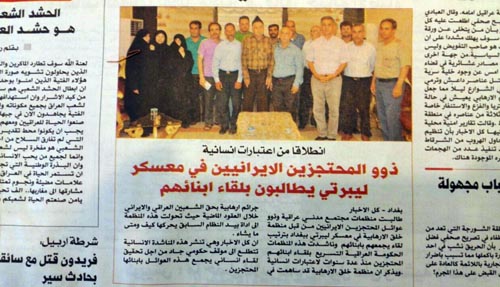
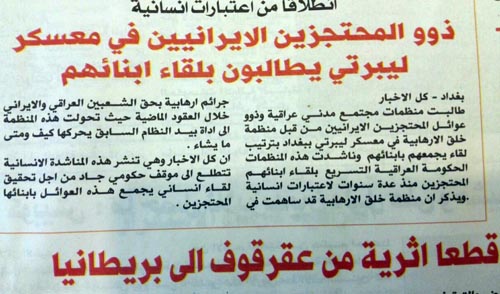
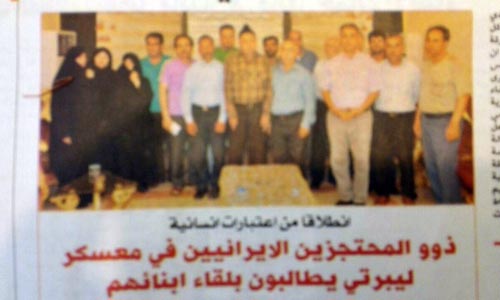
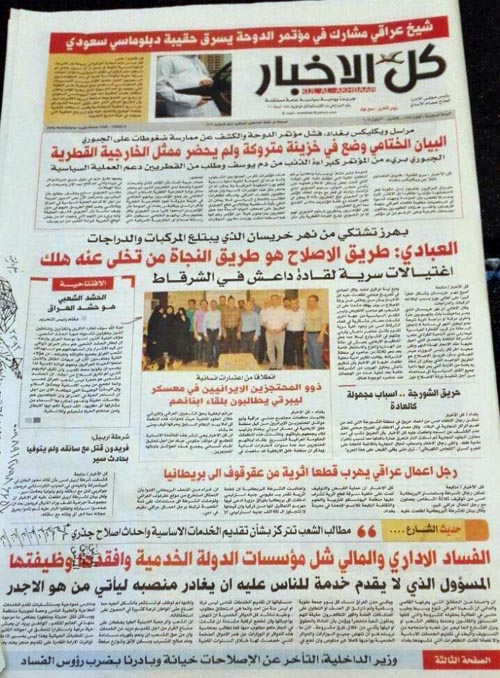
The MKO ringleaders have prevented members of the group from meeting their relatives in a bid to prevent their defection.

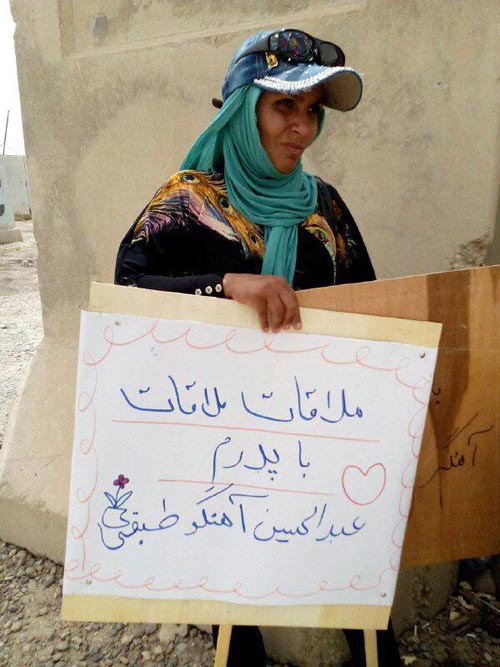
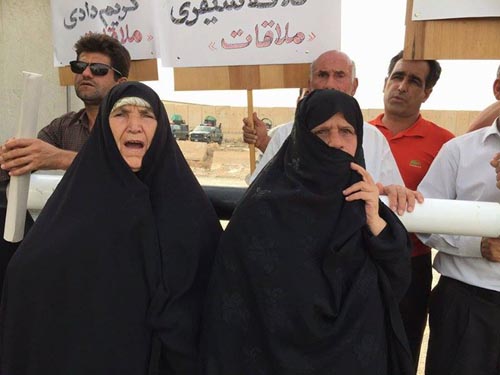
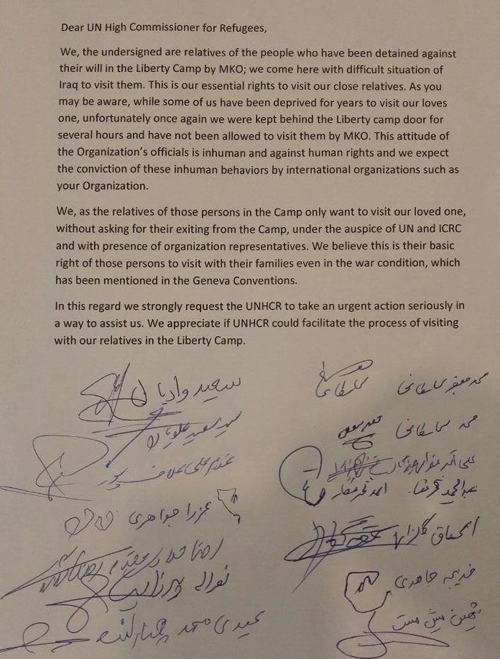
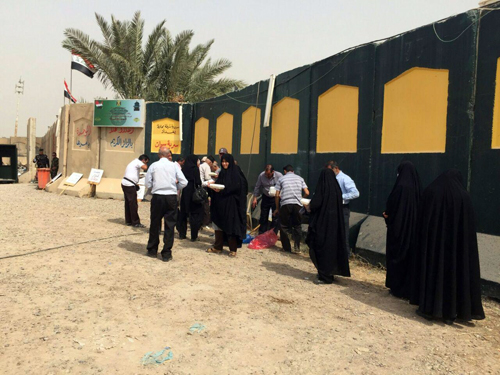
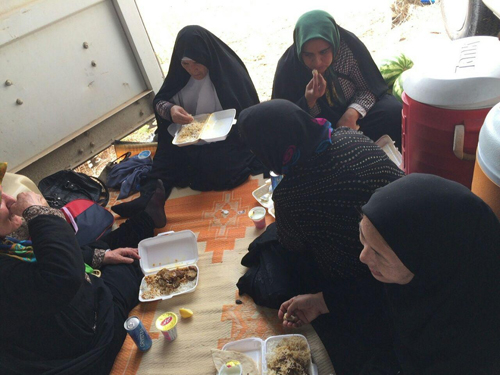
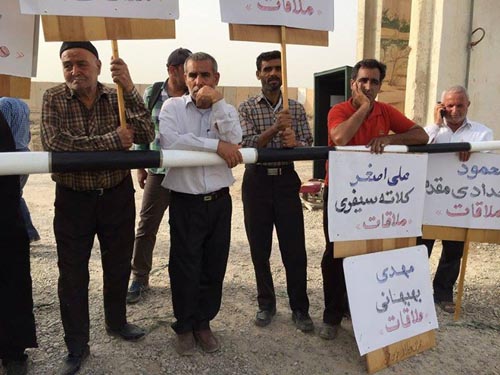
Several family members of Camp Liberty residents have established a permanent picket in front of the Camp entrance since June. The families told Iraq’s Minister of Human Rights they would be satisfied even to see their loved ones at a distance of 10 metres and then they will leave. The Minister did intervene on their behalf and the MKO have again rejected it, Sahar Family Foundation reported.

Despite the group leader’s efforts to keep members behind the bars of the Cult, about 17 Camp Liberty residents could liberate themselves during last year.

Besides, in Albania about 120 members parted away with the group. The increased number of defections in Albania has caused the MKO leaders to hold the last group of transferees “in quarantine “, according to ex-members website reports.

June 29, 2015 0 comments
FacebookTwitterPinterestWhatsappTelegramSkypeEmail
Newer Posts
Older Posts

Recent Posts

  • A Criterion for Proving the Violent Nature of the MEK

    December 31, 2025
  • Rebranding, too Difficult for the MEK

    December 27, 2025
  • The black box of the torture camps of the MEK

    December 24, 2025
  • Pregnancy was taboo in the MEK

    December 22, 2025
  • MEPs who lack awareness about the MEK’s nature

    December 20, 2025
  • Facebook
  • Twitter
  • Instagram
  • Youtube

© 2003 - 2025 NEJAT Society . All Rights Reserved. NejatNGO.org


Back To Top
Nejat Society
  • Home
  • Articles
  • Media
    • Cartoons
    • NewsPics
    • Photo Gallery
    • Videos
  • Publications
    • Books
    • Nejat NewsLetter
    • Pars Brief
  • About Us
  • Contact us
  • Editions
    • عربي
    • فارسی
    • Shqip