Nejat Society
  • Home
  • Articles
  • Media
    • Cartoons
    • NewsPics
    • Photo Gallery
    • Videos
  • Publications
    • Books
    • Nejat NewsLetter
    • Pars Brief
  • About Us
  • Contact us
  • Editions
    • عربي
    • فارسی
    • Shqip
Nejat Society
Nejat Society
  • Home
  • Articles
  • Media
    • Cartoons
    • NewsPics
    • Photo Gallery
    • Videos
  • Publications
    • Books
    • Nejat NewsLetter
    • Pars Brief
  • About Us
  • Contact us
  • Editions
    • عربي
    • فارسی
    • Shqip
© 2003 - 2024 NEJAT Society. nejatngo.org
Mujahedin Khalq Organization's Propaganda System

MKO’s Irresponsible Fear-mongering Goes on

Once again, the Mujahedin Khalq Organization (the MKO) builds up nonexistent threats. It multiplies the fake evidence fabricated by Israeli Intelligence about Iranian nuclear program. Surprisingly the American prominent newspaper supports it with its propaganda against the Iranian government.

On May 27, the US newspaper Wall Street Journal cited a report by the MKO as saying that Iran “has kept active and intact its core team of weaponization researchers.” The news –it was definitely a news piece—was published on the editorial page of the newspaper. It somehow sounded bizarre to other journalists and politicians.

"Noticeably, the WSJ did not claim to have verified the MEK’s allegations that Tehran has continued to pursue nuclear weaponization research," Eli Clifton of the Nation wrote criticizing the WSJ’s editorial board that "apparently felt no compunction to inform readers about the source of this “plausible new report".

“The MEK has a mixed record,” Daryl Kimball, executive director of the Arms Control Association, a Washington-based arms control advocacy group, told The Nation. “It’s curious that it occurred in the editorial page section and not the news section,” said Kimball. “The editors don’t appear to have tried to vet the information and they don’t stand behind it.”

The MKO’s misleading champagne on the Iranian Nuclear Program is aimed to monger more fear and hostility against Iran. This major tactic of the group was formally warned about in the 2004 FBI report on the MKO published in June 2011.  "Additionally, the MEK continues to practice misinformation operations in the U.S. and Europe.  MEK lobbyists routinely hold press conferences and pass information regarding the current Iranian government that is inaccurate and is designed to influence Western Media and governments."[pg 18]

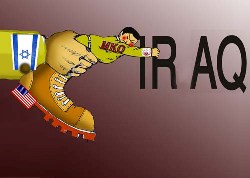
The Israeli backed MKO cult is determined to manipulate US policy. Claims about an Iranian "breakout" on the nuclear agreements are falsified. The MKO propaganda –led by Israel– repeats its fabrications with disturbing regularity. Neocon warmonger sponsors of the group also repeat after the MKO.

Gareth Porter the prominent American investigative journalist and political analyst says in his new book Manufactured Crisis that the allegations about the Iranian nuke is a plot to justify an unjustifiable conflict with Iran. "Fear-mongering propagandists may well succeed in pushing the United States into a situation of increased tension with Iran",said Gareth Porter.

The MKO substituted nonsense for truths. It is just an irresponsible act by a newspaper editorial board to become the tribune of a terrorist cult like group that never admits its crimes against humanity.

By Mazda Parsi

June 3, 2014 0 comments
FacebookTwitterPinterestWhatsappTelegramSkypeEmail
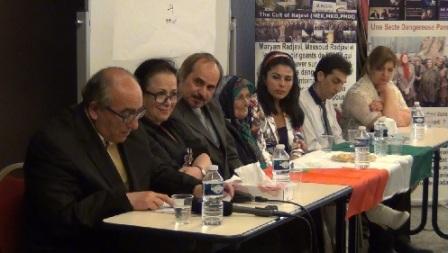
The cult of Rajavi

MEK; from slaughtering 12k Iranians to physical abuses of members

Terrorist MEK organization has been involved in many sabotaging acts and slaughters against the Iranians, Iraqis and even their own members. Following is a brief report of the terrorist records of wrongly-believed Muslim group of Mojahedin-e Khalgh inside and outside Iran.

The Mojahedin Khalq Organization (MKO or Mojahedin-e Khalgh) is an armed Iranian opposition group that was formed in 1965 during Shah Regime. After the Islamic Revolution of Iran in 1979 and the Shah regime was overthrown by the Iranians who were followers of Imam Khomeini the organization turned to be an opposition of the newly established regime.

MEK is mistakenly claimed to be an Islamic organization while the principles followed by the members did not read with the basics of the Islamic lessons.

After the Islamic Revolution of Iran and during the imposed Iraqi war upon Iranians MEK members were camped inside Iraq and they did slaughter many Iranians and had tried for a lot of sabotaging inside Iran.

The organization claimed the responsibility of 12,000 Iranians slaughter for no crime. They also killed many Iraqi and Shiites and Kurd in accordance to Saddam’s wills.

Due to a many crimes, the MKO was listed as a terrorist organization by the U.S. State Department and several European governments. The MKO’s leadership was engaged in an extensive campaign aimed at winning support from Western politicians in order to have the designation of a terrorist organization removed.

Later the U.S. State Department delisted the terror organization Mujahedeen-e Khalq (MEK) in order to clear legal obstacles in the way of overtly arming and funding the terrorists in pursuit of a proxy war with Iran, the LA Times reported.

Human Rights Watch, published articles on 18 May 2005 proving that inside the Mojahedin Khalq Camps, there were a lot of physical and psychological abuses. The articles are available.

Human Rights Watch published that during Saddam’s last year in power, some Iranians held in Abu Ghraib prison were repatriated to Iran in exchange for Iraqi prisoners of war (POWs). These were dissident members of the MKO who had been sent by the organization for "safekeeping" in Abu Ghraib. The release of these prisoners in 2002-2003 provided a direct window into conditions inside the MKO camps that was previously inaccessible to the outside world.

Human Rights Watch interviewed five of these former MKO members who were held in Abu Ghraib prison. Their testimonies, together with testimonies collected from seven other former MKO members, paint a grim picture of how the organization treated its members, particularly those who held dissenting opinions or expressed intent to leave the organization.

The former MKO members reported abuses ranging from detention and persecution of ordinary members wishing to leave the organization, to lengthy solitary confinements, severe beatings, and torture of dissident members. The MKO held political dissidents in its internal prisons during the 1990s and later turned over many of them to Iraqi authorities, who held them in Abu Ghraib. In one case, Mohammad Hussein Sobhani was held in solitary confinement for eight-and-a-half years inside the MKO camps, from September 1992 to January 2001.

The witnesses reported two cases of deaths under interrogation. Three dissident members – Abbas Sadeghinejad, Ali Ghashghavi, and Alireza Mir Asgari – witnessed the death of a fellow dissident, Parviz Ahmadi, inside their prison cell in Camp Ashraf. Abbas Sadeghinejad told Human Rights Watch that he also witnessed the death of another prisoner, Ghorbanali Torabi, after Torabi was returned from an interrogation session to a prison cell that he shared with Sadeghinejad.

The MKO’s leadership consists of the husband and wife team of Masoud and Maryam Rajavi. Their marriage in 1985 was hailed by the organization as the beginning of a permanent "ideological revolution."7 Various phases of this "revolution" include: divorce by decree of married couples, regular writings of self-criticism reports, renunciation of sexuality, and absolute mental and physical dedication to the leadership.8 The level of devotion expected of members was in stark display in 2003 when the French police arrested Maryam Rajavi in Paris. In protest, ten MKO members and sympathizers set themselves on fire in various European cities; two of them subsequently died.9 Former members cite the implementation of the "ideological revolution" as a major source of the psychological and physical abuses committed against the group’s members.

Human Rights Watch interviewed by telephone twelve former members of the MKO living in Europe. These witnesses provided credible claims that they were subjected to imprisonment as well as physical and psychological abuses because they had either expressed criticism of the MKO’s policies or had requested to leave the organization’s military camps.

Each witness was interviewed separately several times between February and May 2005. All witnesses were living in Europe then. Each witness provided independent accounts of their experience inside the MKO camps, and their testimonies corroborated other evidence collected by Human Rights Watch.

The MEK threatens an antiwar radio guest of Huffington Post writer, Shawn Amoei, for Calling Them Terrorists.

The MEK had spared no efforts to act in accordance to terrorist standards ranging from slaughtering the civil, apolitical, innocent Iranians to killing of innocent Iraqis and sexual harassment of their own members.

June 2, 2014 0 comments
FacebookTwitterPinterestWhatsappTelegramSkypeEmail
Mujahedin Khalq; A proxy force

Was the Iranian threat fabricated by Israel and the U.S.?

In a new book and in a conversation with Haaretz, U.S. historian Gareth Porter charges that U.S. and Israeli policies on Iran have been based on fabricated evidence.

A narrative is a story that we tell ourselves, and not necessarily what happened in reality. For example, the “Iranian threat” narrative, which has become the common wisdom in Israeli public discourse. A new book by Gareth Porter, an American historian and researcher specializing in U.S. national security, shows how the actual state of the Iranian nuclear program does not match the Iranian threat narrative.

The book’s title, “Manufactured Crisis: The Untold Story of the Nuclear Scare” (Just World Books), already tells us that it is going against the current. Porter appears to be the only researcher who has read with an unprejudiced eye all the reports of the International Atomic Energy Agency from the past decade. He also had access to American intelligence reports on the Iranian issue from recent decades. In addition, Porter interviewed generations of American officials and analyzed the testimony of senior officials before Congress.

The result is a highly detailed and well-documented book for all interested in understanding how we arrived at the Iranian nuclear crisis, and the “attack scenarios,” and invented facts and intelligence reports whose purpose was to support the preconceptions. At the same time, the book is invaluable for those wishing to understand what is being discussed in the intensive nuclear talks that have been taking place Iran and the superpowers (or, more accurately, Iran and the U.S.) since the signing of last November’s interim agreement, which surprised many Israelis.

According to Porter, it was a hidden political agenda of U.S. decision makers (from long before Israel entered the picture) that gave rise to the Iranian nuclear crisis. This is one of the book’s main subjects, and the starting point for a discussion with which we in Israel are unfamiliar.

The story begins with U.S. support for the Iraqis during the 1980s Iraq-Iran war. The critical point comes with the collapse of the Soviet empire. According to Porter, that event and the end of the Cold War pulled out the rug from under the CIA’s raison d’être. The solution the Americans found to continue providing the organization with a tremendous budget was the invention of a new threat – the merging of weapons of mass destruction (an ambiguous term in itself) and terror. Iran, which rose to the top of the list, provided the threat that “saved” the CIA.

The empowering of the CIA’s organizational interests was reinforced by the gallant neoconservatives, led by ideologues Dick Cheney, Paul Wolfowitz and John Bolton, who had in the meantime reached senior positions in the government. They launched a campaign to delegitimize the Islamic Republic with the aim of toppling the regime (using the sanitized term “regime change”).

Running through Porter’s book is the well-substantiated claim that U.S. and Israeli policies on Iran derived from their political and organizational interests, and not necessarily from careful factual analysis of the Iranian nuclear program, which was subject to IAEA monitoring, or of the intentions of the Iranian leadership.

According to Porter, no systematic analysis was made of the goals of the Iranian nuclear program, and neither U.S. nor Israzeli policy makers devoted any thought to why all of Iran’s official declarations on the subject were in line with the Treaty on the Non-Proliferation of Nuclear Weapons. Furthermore, in U.S. discussions until 2007, and in Israel until today, hovering overhead is the nuclear “axiom” that Iran is dashing toward a bomb via the route of uranium-enrichment centrifuges. Porter and the IAEA found no proof of the dash to the bomb.

Following is Haaretz’s interview with Porter, conducted via email.

You have spent years of research analyzing IAEA reports, intelligence reports and interviewing officials about the Iran nuclear issue. What motivated you to write your latest book?

“It was the realization that a narrative about the Iranian nuclear issue had gained unchallenged credence, but that I had discovered over the years a number of major ‘anomalies’ – important facts that could not be reconciled with the narrative. I also came to realize that I was the only journalist who was closely tracking the evidence surrounding the issue. And finally – and perhaps most importantly – I realized that it  was impossible to convey the truth … in an article or series of articles; I had to write a book.”

Is it fair to say that your book shows us that the whole nuclear crisis as it has unfolded over the past 10 years is about U.S. and Israeli attempts to prevent Iran from developing a non-militarized nuclear program, even though such a program is permitted under the NPT, and that this obscured the fact that Iran never intended to develop nuclear weapons?

“Yes, I put considerable emphasis on the early history of the interaction between Iran’s nuclear program and policy, and the policies of the United States and Israel toward the program. I show how the Reagan administration’s intervention, beginning as early as 1983, to pressure Germany and France to refuse to cooperate with Iran in completing the Bushehr reactor, and to refuse to provide the enriched uranium reactor fuel for Bushehr, meant that Iran had to either give up its nuclear rights under the NPT altogether or go to the black market, in defiance of U.S. policy, to get its own independent enrichment capability. And despite subsequent U.S. and Israeli charges that Iran was interested in enrichment for nuclear weapons, there was and is no evidence whatever to support that charge.”

In my Haaretz blog, I emphasize the paradigm change of the 2007 U.S. National Intelligence Estimate, and still valid today, which concluded that Iran halted its nuclear weapons program in 2003. The Israeli public is unaware of this halt. Furthermore, many commentators believe that U.S. intelligence “corrected” itself and that the 2007 estimate has been annulled. Could you enlighten our readers about the important 2007 NIE?

“The 2007 NIE broke with previous NIEs [in 2001 and 2005], which had concluded that Iran was then running a nuclear weapons program. It concluded instead, with ‘high confidence,’ that Iran had halted its work on nuclear weapons. That conclusion was of course opposed by the Bush administration and Israel, because it had been the charge that Iran was pursuing nuclear weapons that justified the threat of military force against Iran. And it did indeed make the ‘military option’ irrelevant to U.S. policy for the rest of the Bush administration and for much of the Obama administration.” 

According to the 2007 NIE, however, some nuclear weapons research was carried out in Iran until 2003. Could you elaborate on what kind of research was undertaken; when, where and by whom, and what its scope was?

“Precisely who was carrying out research and what kind of research is still completely unclear, despite my effort to get any additional information on the subject from Thomas Fingar, who was in charge of the estimate. What was said by U.S. intelligence officials to be ‘snippets of conversation’ intercepted by U.S. intelligence in 2007 appears to indicate that some research related to nuclear weapons was being undertaken. But how many people were involved remains entirely unclear. And the testimony of the French ambassador to Tehran, as well as other evidence presented in my book, strongly suggests that the Supreme National Security Council had not authorized it and was not happy that it was going on.

“Not only did [Iran’s then-president] Hassan Rouhani order it halted in October 2003, when he was named the first coordinator of Iran’s nuclear policy, but Rouhani prevailed on the Supreme Leader to declare any work on nuclear weapons illicit under Islam in order to compel the researchers to give up their work on weapons. Understanding that episode correctly is clearly necessary to comprehending Iran’s nuclear policy accurately. 

“Unfortunately, as I argue in my book, the evidence indicates that the team of intelligence analysts, who had been wrong about the existence of a nuclear weapons program in 2005 and again in an early draft of the 2007 estimate, got it wrong in their conclusion that the Iranian government had an actual nuclear weapons program [before] late 2003.”

In your book, you explain in great detail the sought-after “smoking gun,” i.e. the mysterious “laptop studies” and the Parchin “bomb test chamber.” The Israeli public is unfamiliar with the details of these “cases.” Could you explain the “possible military dimensions” and comment on the credibility of the “evidence”?

“I devote an entire chapter to the ‘mysterious laptop documents’ and show that they were actually fabricated by Israeli intelligence and given to the Mujahedin-e-Khalq [a militant Iranian opposition group] to pass on to German intelligence in mid-2004. The ‘giveaway’ that they were fabrications is the fundamental error in a series of studies depicting efforts to integrate a nuclear weapon into the Iranian intermediate-range missile, which shows the Shahab-3 that Iran had abandoned in 2000 in favor of a much-improved model that was first tested in August 2004 – too late to correct the mistake before the papers were passed to the MEK. 

“Among the indicators that the documents originated in Israel is the fact that the MEK is not sophisticated enough to have fabricated such a large number of documents, and the well-known history of the terrorist organization’s close working relations with Israeli intelligence. Equally important is the fact that former IAEA director general ElBaradei revealed in his memoirs that Israel had passed on documents and intelligence reports to the IAEA directly in 2008 and 2009, which depicted Iran work on nuclear weapons even after 2003 – obviously prompted by the 2007 NIE.

“Those documents included information alleging that Iran had built a large metal cylinder to carry out tests of nuclear weapons designs at its Parchin military base. The IAEA made that allegation a major news theme by publishing it in its November 2011 report.  But no other evidence except the Israeli intelligence report has ever been produced to support that highly dubious charge. “

The emphasis in your book is on the centrifuges and the “enrichment track to the bomb.” Can you comment on the Arak heavy water reactor that is linked in Israel to the “plutonium track” and is behind the preemptive scenarios that have been developed in the Israeli press.

“The main weakness of the argument that Arak is an Iranian scheme for a ‘plutonium track’ to a nuclear weapon is simple: Iran has already agreed to arrangements under which it would be prevented from maintaining control of the plutonium produced by the reactor. In other words, all of the plutonium would be exported to another country. But there is a second major reason that it is not the threat that is being claimed: To build a plutonium reprocessing plant requires extensive construction as well as time, and it cannot be concealed.”

What is your assessment of the current negotiations between Iran and the P5+1? Is a final agreement to close the Iranian file on the table?

“I am pessimistic about the outcome of these talks, in the coming months at least, because the Obama administration – influenced by the false narrative surrounding the issue and overconfident about its ability to pressure an Iran it assumes has been significantly weakened by the sanctions – is planning to demand that Iran give up all but a very few thousand of its 19,000 centrifuges for many, many years. That demand, based on a notion of Iranian ‘breakout’ that is quite divorced from reality, is an obvious deal-breaker. Iran cannot and will not agree to give up its ability to provide nuclear fuel for more nuclear plants, for which it is planning. In my view, this demand will lead to a much higher level of tensions unless and until it is substantially altered.”

In your view, what is behind the Israeli-Iranian rivalry? Is there a chance for Israeli-Iranian détente following the achievement of a final agreement in the Vienna talks and the possibility of new openings in U.S.-Iran relations?

“In my view there have been political considerations on both sides of the Iran-Israel relationship that have stood in the way of a detente over the past 15 years: On the Israeli side, the first Netanyahu government in 1996 was actually willing to give detente a try, so there is no inherent reason why it could not happen again. It was the opportunity to use the U.S. to put intense pressure on Iran, if not to use force for regime change, that swayed successive Israeli governments to take the ‘existential threat’ approach to Iran. If and when the U.S. pursues a truly independent policy toward Iran, that Israeli motive will disappear.  

“On the Iranian side, the main obstacle to softening of its attitude toward Israel, in my view, has been the degree to which taking a hard line toward Israel makes Iran popular in the Sunni Arab street and counterbalances, at least to some extent, the anti-Iran policy of the Sunni regimes. So Iran-Israel detente has become hostage, to a great extent, to both the pro-Israel stance of the U.S. and the Sunni-Shi’a cold war.”

A final question: Is there a possibility that you are wrong, that you have been misled by some optimistic and naïve theories?

“My operational principle as an investigative journalist is that if there is a single verifiable fact that conflicts with my general understanding of an issue, I need to look more closely to understand why that anomaly exists. In the case of Iran’s nuclear program, I have found an unbroken string of anomalies that undermine the credibility of official U.S.-Israeli narrative, but I have yet to find a single fact that would invalidate my reconstruction of the history of the issue.”

By Shemuel Meir

The writer, a former IDF analyst and associate researcher at the Jaffee Center for Strategic Studies at Tel Aviv University, is an independent researcher on nuclear and strategic issues, and author of Haaretz’s “Strategic Discourse” blog (in Hebrew).

June 1, 2014 0 comments
FacebookTwitterPinterestWhatsappTelegramSkypeEmail
Iran Interlink Weekly Digest

Iran Interlink Weekly Digest -54

++ Behzad Alishahi’s wife has responded to the saga involving a threatening article in Iran Global. She says although she doesn’t usually look at anything from either the MEK or IRI, because this involves her husband she is obliged to set a few facts right. She explains that Behzad Alishahi has not been charged or criminalised. Instead, in June 2013 he was refused permission to stay in the Netherlands and in February 2014 was detained by the Immigration service for overstaying. He is not in prison but is being held in an immigration service camp for his own safety. He doesn’t have a case against him and there is no question about his going or not going to Iran; he has not left the Netherlands at any time since he arrived. He has never been questioned by either the police or the intelligence services. The problem is that he admitted to once being a member of the MEK and taking part in armed struggle and he has been refused permission to remain on these grounds. It is ironic, says Mrs Alishahi, that the MEK should be so excited and pleased about his situation instead of decently trying to help someone who had been involved with their armed struggle. She continues, “Having said this, I wish the MEK would go to Iran and understand more about the real situation there – how a series of pictures of women who took their scarf off, or young people who danced, has a much greater effect on the situation there than the MEK’s thirty years of so-called fighting Iran”. In conclusion she says that Alishahi has no complaint against him in his file let alone a 150 strong petition. These are fictions created by the MEK to divert from their own failures – the things they say they can do, but never have. The second reason is to terrify the stranded people inside the organisation with the fear that the same thing might happen to them. Thirdly, it is an attempt to intimidate MEK critics by claiming to be so powerful that they can make these things happen to them. But the allegation of ‘spying for Iran’ that the MEK banks on so much is entirely invalid because as long as Iran has an enemy like the MEK it doesn’t need to do any spying; the MEK can destroy any opposition much better than any spy could do. She concludes, “our problem has a solution, but the MEK’s problems will have no solution until, as my husband has always said, they sit down and see what it is they are doing and change.”

++ Sahar Family Association translated some Iraqi papers this week. In one example, Dr Adnan Al Seraj’s article in Al Mizan goes into detail about events of the last few yeas and how Rajavi has tried everything possible to hinder and prevent the UN from giving help to the people in Camp Liberty, whether to get them out or simply to give them help inside the camp itself. Quite a few items in the Iraqi media after the election cover many MPs speaking out and demanding that the situation with the MEK has to end. One is Vaheb MP, who clearly states that the UN has failed to live up to its agreement with the government of Iraq and that this needs to be looked at again and reworked. This failure means, he says, that although the MEK are under the protection of the Americans and the UN, they should be treated like the rest of the Saddamists and put on trial.

++ There has been a vast amount of writing from every side – from inside Iran, from ex members and from other opposition groups and personalities – about the new initiative to try to pass Maryam Rajavi off as a human rights advocate. Several point out that this is an insult to the intelligence of people across the globe. One witty writer observes, “This is like trying to paint a pigeon and sell it as a Volkswagen!”

In English

++ According to the Tehran Times, Iranian Deputy Foreign Minister Abbas Araqchi, told a gathering of Revolutionary Guards, that Foreign Minister Mohammad Javad Zarif was standing strong against the Europeans in the nuclear talks in Vienna. He said that Iran has adopted a win-win approach in nuclear talks and will not grant any concessions to the West. He said that the Zionist, Arab and Mojahedeen Khalq lobbyists are campaigning hard against the Geneva deal in the U.S. Congress. Adding that if nuclear talks fail, no one can blame Iran.

++ The Canadian Iranian Coalition for Peace have asked Justin Trudeau, leader of the Liberal Party of Canada, to rein in one of his MPs Reza Moridi who “knowingly or unknowingly, has supported an infamous ex terrorist group in Iran (Mojahedin Khalq) MEK and their lobbyist in Canada which have kept a few young Canadians in Camp Ashraf against their will. MEK is promoting hate and violence in Iraq and Iran which is totally against Canadian values and principles… MPP Moridi also supported the closure of Iranian consulate in Ottawa, which has caused a tremendous amount of inconvenience for all Canadian-Iranians in our country Canada. He is simply following the Conservative Party mandates. Supporting sanction and war, this is against the Liberal party’s policy and philosophy. Therefore our community cannot distinguish between the Liberals and the conservatives… We request that you as the leader of the Liberal party of Canada to guide some of the party members to follow the Liberal path, rather than their own personal agenda!”

++ Iran’s Fars News agency reported a meeting between Head of the Syrian Opposition Coalition (SCO) Ahmad Jarba and Maryam Rajavi in Paris. One former MEK member Mohammad Razzaqi said the MEK has been training some militant groups fighting the Syrian government, including the FSA, on bomb manufacturing, planting and detonation methods, assassination and street war. He noted that some MEK leaders have had a series of meetings with the Syrian opposition leaders in France and Jordan and discussed help and assistance to the FSA and a number of other extremist Salafi groups in Syria. In late 2012, deputy commander of the FSA Malek al-Kurdi said the MEK acted as a role model for Syrian insurgents. “Mojahedin-e Khalq is our role model, and we inform them that all doors of our houses are open to them.”

++ In a televised speech, Lebanon’s Hezbollah leader Seyed Hassan Nasrallah congratulated his forces saying they had pushed back the Syrian opposition forces so far that they have been reduced to sitting and talking with the MEK in Paris which is nothing more than a defeated enemy, a dead horse.

++ An article by Mazda Parsi of Nejat bloggers begins with details of the MEK’s record of human rights abuses inside its own organisation. From this context, which explains more fully why UN Special Rapporteur Ahmed Shaheed cancelled his speech at the Spotlight on Iran in the Canadian Parliament, Parsi says the decision looks less bizarre. Dr. Shaheed’s assistant explained that Shaheed felt the event’s framing “made it feel less like a briefing and more of something that encroached upon what he believes is his independence on the issue” of human rights in Iran.”

++ Iran Pen Association congratulates the people and prime minister of Iraq and wishes Iraq peace, stability and tranquillity. “We condemn the interventionist and divisive policies of MEK/PMOI and demand the leadership of MEK Cult, Mr. Massoud Rajavi and Mrs. Maryam Rajavi , that instead of plotting such desperate attempts and insisting on remaining in Iraq at any cost and victimizing the captive members in your Cult; try for once to be rational and stop persisting on your gross blunders and transfer these victims from Iraq.”

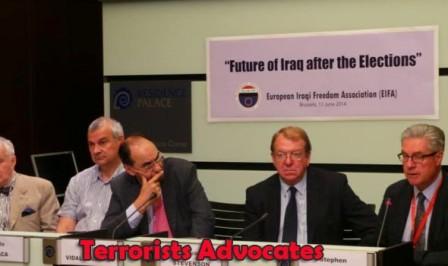
++ Iran Interlink interprets the result of the European Parliament election for the MEK in a short piece titled, ‘Rajavi/Saddamists stranded by European Parliament losses’. “The MEK and Saddamists have lost two key lobbyists in the new session of the European Parliament. Struan Stevenson (UK) threw in the towel and didn’t stand again. Alejo Vidal-Quadras (Spain) tried to garner the far right vote by creating the new Vox Party – which took less than 2% of the vote. Vidal-Quadras was exposed in the Spanish media before the election for supporting terrorism and being greedy for money. Both MEPs had previously worked in the Iraq Delegation for a bloc of anti-Maliki groups and MPs in Iraq which included the MEK.Rajavi will, of course, not be able to further influence the situation in Iraq where Maliki’s coalition was a clear winner. But the MEK will no doubt declare a ‘basij’ (gathering of forces) in the European Parliament to actively hunt, recruit and corrupt new MEPs to keep its terrorist-logo flag flying there!”

++ According to Press TV Iran’s diplomatic mission at the United Nations condemned a report in The Wall Street Journal as a fabrication. The US newspaper cited a report by the terrorist Mujahedin-e Khalq Organization (MKO) as saying that Iran “has kept active and intact its core team of weaponization researchers.” The statement added “that Tehran expects the five permanent members of the UN Security Council — the United States, China, Russia, France and Britain — plus Germany to abide by their commitments concerning Iran’s nuclear rights, regardless of the “uproar” by anti-Iran lobby groups.”

++ On the same subject, Eli Clifton writes in The Nation, ‘What the ‘Wall Street Journal’ and the MEK Get Very Wrong About Iran’s Nuclear Program’. “Even while uncritically reporting on the allegations, the article contained one major factual error… But perhaps more surprisingly, the WSJ editorial board apparently felt no compunction to inform readers about the source of this “plausible new report.” This, despite the fact that the Journal’s editorial team even includes one outspoken critic of the MEK, Sohrab Ahmari, an editorial page writer based in Europe.” “Noticeably, the WSJ did not claim to have verified the MEK’s allegations that Tehran has continued to pursue nuclear weaponization research.” Clifton concludes, “The MEK may be onto something with its contention that Iran continued with its nuclear weapons work (the IAEA’s reporting about the “possible military dimensions” of Iran’s nuclear program only covers the period before 2003). But relying almost exclusively on the organization is, to borrow a word, problematic, and raises a question: Why did the MEK approach the ideologues of the Journal’s opinion pages instead of its newsroom staff with its exclusive report? Perhaps the paper’s veteran foreign affairs reporters, who have no doubt had many interactions with the MEK, are more skeptical of the group’s claim.”

30 May 2014

May 31, 2014 0 comments
FacebookTwitterPinterestWhatsappTelegramSkypeEmail
Mujahedin Khalq; A proxy force

What the ‘Wall Street Journal’ and the MEK Get Very Wrong About Iran’s Nuclear Program

The Wall Street Journal’s opinion pages have long served as a welcoming home to pundits toeing a hawkish line on Iran, Iraq and a laundry list of foreign policy challenges facing the United States. Tuesday, the Journal’s editorial board exclusively published details of a report provided by the Mujahedin-e Khalq (MEK), an exiled Iranian opposition group that until less than two years ago was designated a terrorist group in the United States and Canada.

Noticeably, the WSJ did not claim to have verified the MEK’s allegations that Tehran has continued to pursue nuclear weaponization research.

Even while uncritically reporting on the allegations, the article contained one major factual error. It read:

…having ceded a right to enrich and permitted the Islamic Republic to develop an advanced enrichment capability, the West is now left with preventing weaponization as the final barrier against a nuclear-capable Iran…

In fact, no administration or international negotiating body has “ceded” Iran the “right to enrich.” Iran has enriched uranium for the better part of the last decade despite sanctions from the past two administrations and demands that they cease enrichment. Even in the recent flurry of diplomacy between the P5+1 and Iran, no agreement has been made public and nothing has been formally conceded. (A November accord accepted de-facto enrichment while limiting Iran’s enrichment from 20 percent down to 5 percent.)

But perhaps more surprisingly, the WSJ editorial board apparently felt no compunction to inform readers about the source of this “plausible new report.” This, despite the fact that the Journal’s editorial team even includes one outspoken critic of the MEK, Sohrab Ahmari, an editorial page writer based in Europe.

In a 2011 Radio Free Europe column, Ahmari characterized the MEK as “a mostly irrelevant group as ideologically coherent as Lyndon Larouche’s cult and just as ineffective." Later that same year, Ahmari, writing in Tablet, warned that the MEK was an “Islamo-Marxist cult.” Many critics have pointed to the group’s cult-like features, though over the last the few decades the MEK shed its Islamo-Marxist roots—a past many adherents today deny entirely.

On Tuesday and Wednesday, Ahmari, along with a small group of neoconservative pundits, promoted the article on Twitter but Ahmari, even while defending the MEK report, admitted the source was “problematic” in a tweet directed at me.

.@Ali_Gharib @EliClifton Because problematic sources can never disclose important, useful and newsworthy info, right? #Natanz #Arak

— Sohrab Ahmari (@SohrabAhmari) May 27, 2014

Indeed, the MEK has proven an unreliable source in the past.

In 2010, following an MEK claim to have discovered a secret nuclear site near the Iranian city of Qazvin, State Department spokesperson PJ Crowley told Fox News, “The MEK has made pronouncements about Iranian facilities in the past—some accurate, some not.”

While the Journal’s standards may be different for editorial content, a simple warning that the source was “problematic” and that much of the report was unverified, would be a reasonable expectation from one of the world’s most widely read newspapers.

“The MEK has a mixed record,” Daryl Kimball, executive director of the Arms Control Association, a Washington-based arms control advocacy group, told The Nation. “It’s curious that it occurred in the editorial page section and not the news section,” said Kimball. “The editors don’t appear to have tried to vet the information and they don’t stand behind it.”

The MEK may be onto something with its contention that Iran continued with its nuclear weapons work (the IAEA’s reporting about the "possible military dimensions" of Iran’s nuclear program only covers the period before 2003). But relying almost exclusively on the organization is, to borrow a word, problematic, and raises a question: Why did the MEK approach the ideologues of the Journal’s opinion pages instead of its newsroom staff with its exclusive report? Perhaps the paper’s veteran foreign affairs reporters, who have no doubt had many interactions with the MEK, are more skeptical of the group’s claim.

The Nation – Eli Clifton 

May 31, 2014 0 comments
FacebookTwitterPinterestWhatsappTelegramSkypeEmail
Iran

Iran dismisses WSJ nuclear report as unfounded

Iran has rejected as unfounded a report by The Wall Street Journal (WSJ) on its nuclear energy program.

On Tuesday, the US newspaper cited a report by the terrorist Mujahedin-e Khalq Organization (MKO) as saying that Iran “has kept active and intact its core team of weaponization researchers.”

In a statement on Wednesday, Iran’s diplomatic mission at the United Nations condemned the report as a fabrication.

It said The Wall Street Journal is repeating the claims of a terrorist group whose previous allegations proved untrue.

The MKO is listed as a terrorist organization by much of the international community and is notorious for committing numerous terrorist acts against Iranians and Iraqis.

The statement also said that Tehran has lived up to its obligations under the nuclear Non-Proliferation Treaty.

It added that Tehran expects the five permanent members of the UN Security Council — the United States, China, Russia, France and Britain — plus Germany to abide by their commitments concerning Iran’s nuclear rights, regardless of the “uproar" by anti-Iran lobby groups.

Iran and the six world powers have been discussing ways to iron out differences and start drafting a final nuclear deal that would end the West’s dispute with Iran over the country’s nuclear energy program.

Iran and the world powers reached an interim accord in the Swiss city of Geneva on November 24 last year that took effect on January 20 this year.

Under the deal, the six countries undertook to provide Iran with some sanctions relief in exchange for Iran agreeing to limit certain aspects of its nuclear activities during a six-month period. It was also agreed that no nuclear-related sanctions will be imposed on Iran within the same timeframe.

May 31, 2014 0 comments
FacebookTwitterPinterestWhatsappTelegramSkypeEmail
Mujahedin Khalq; A proxy force

Rajavi/ Saddamists stranded by European Parliament losses

The MEK and Saddamists have lost two key lobbyists in the new session of the European Parliament. Struan Stevenson (UK) threw in the towel and didn’t stand again. Alejo Vidal-Quadras (Spain) tried to garner the far right vote by creating the new Vox Party – which took less than 2% of the vote. Vidal-Quadras was exposed in the Spanish media before the election for supporting terrorism and being greedy for money. Both MEPs had previously worked in the Iraq Delegation for a bloc of anti-Maliki groups and MPs in Iraq which included the MEK.

Rajavi will, of course, not be able to further influence the situation in Iraq where Maliki’s coalition was a clear winner. But the MEK will no doubt declare a ‘basij’ (gathering of forces) in the European Parliament to actively hunt, recruit and corrupt new MEPs to keep its terrorist-logo flag flying there!

May 29, 2014 0 comments
FacebookTwitterPinterestWhatsappTelegramSkypeEmail
Iraq

Iran Pen Association congratulates the people and prime minister of Iraq

Iran Pen Association congratulates the people and prime minister of Iraq

MEK Cult interference in internal Iraqi affairs is condemned

According to the Iraq’s Independent Election Commission of 22 million Iraqis eligible to vote 62% participated in the elections and the State of the Law coalition led by Mr. Nuri al-Maleki emerged victorious in this crucial election, the first to take place after US troops withdrawal from the country.

Meanwhile, the propaganda apparatus of Rajavi’s Cult did everything possible to derail the process of the elections and carried out a campaign of character assassination against Mr. al-Maleki and other Iraqi officials. The MEK/PMOI had planned to affect the outcome of the election by sponsoring and supporting terrorist groups in Iraq and at the same time publishing letters and articles by its hired pen-agents such as Safi al-Yaseri and Sarmad Abdulkarim.

Despite MEK/PMOI’s intervention on one hand and terrorist crimes of radical groups on the other, the Iraqi people overwhelmingly took part in the election, which we believe is a great victory for the suffering people of Iraq and we congratulate them sincerely.

At a time when the Iraqi Nation makes its first steps towards democracy, the Rajavi Cult spends enormous amount of funds by organizing an aggressive campaign to distort the vital outcome of this election. MEK has also utilized its employees such as Stevenson and Rudi Juliani to carry out directed propaganda against the elected representative of Iraqis. These activities show clearly MEK/PMOI’s interference in the internal affairs of Iraq, which do not comply with any legal or ethical standards.

It is in fact due to this kind of meddling in Iraq that MEK has been coming under gross and growing opposition and pressure from Iraqi groups, some of which have resulted in terrorist attacks against the defenseless members of MEK carried out by radical groups in Iraq. Indeed, the MEK leadership is the one totally responsible for what has happened because of his catastrophic miscalculations and decision making, and more specifically his continuous interference in Iraq.

The Iran Pen Association congratulates the people, prime minister and government of Iraq and wishes Iraq peace, stability and tranquility. We condemn the interventionist and divisive policies of MEK/PMOI and demand the leadership of MEK Cult, Mr. Massoud Rajavi and Mrs. Maryam Rajavi , that instead of plotting such desperate attempts and insisting on remaining in Iraq at any cost and victimizing the captive members in your Cult; try for once to be rational and stop persisting on your gross blunders and transfer these victims from Iraq.

Iran Pen Association

26.05.2014

Cc:

– Office of Iraqi Prime Minister Nouri al-Maleki

– Embassies of Iraq in Germany and France

– Relevant MPs

May 29, 2014 0 comments
FacebookTwitterPinterestWhatsappTelegramSkypeEmail
Terrorist groups and the MEK

The MKO’s collaboration with terrorists; whoever wherever

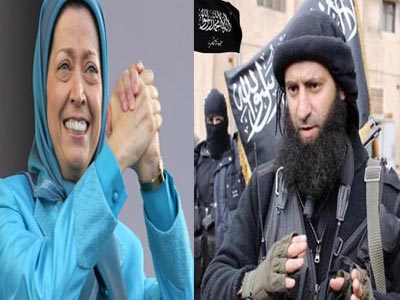
Evidence of collaborating with terrorists in Syria and elsewhere is the issue for more impeachment of the Mujahedin Khalq Organization. The MKO connection with radical extremists has entered into an alliance with the world’s leading terrorist organization al-Qaeda and eventually its factions in Syria —in their zeal to overthrow the present governments in Syria and Iran. The MKO-SFA marriage of convenience is particularly deep and it centers on the drive to survive the lethal crisis in the Middle East.

Head of the Syrian Opposition Coalition (SCO) Ahmad Jarba called the members of the terrorist MKO as brothers of the Syrian opposition, reported FNA. “The MKO and the Syrian Opposition Coalition are brothers,” Jarba said in a meeting with MKO ringleader Maryam Rajavi in Paris a couple of days ago.  During the meeting, Jarba also hailed MKO’s terrorist operations against Iran.

The visit between the two self- claimed presidents took place a few days after their delegations met in Paris. The meeting was held in a hotel in Paris at the request of MKO members, Badr Jamous, the secretary-general of the Syrian coalition told Turkey’s Anadolu Agency. Jamous added that the meeting was aimed at promoting friendship, coordination and exchanging experiences between the two sides.

The mutual services between the two terrorist groups associates them with the support of a major  force in the region: Israel. In March 16th, Haaretz reported, "The Syrian opposition is willing to give up claims to the Golan Heights in return for cash and Israeli military aid against President Bashar Assad, a top opposition official told Al Arab newspaper, according to a report in Al Alam."

Just the same as the MKO in Iran, the so-called Free Syrian Army has no actual popular base and military capabilities inside Syria. FSA consists largely of a group of defectors from the Syrian Army who are safe-housed on military bases inside Turkey. All of the significant military actions targeted at the Syrian government have been carried out by al-Qaeda terrorists, who have infiltrated the country from Iraq. The suicide bombings in Damascus and Aleppo, the assassinations of Syrian government and military officials, and the sabotage of pipelines and other infrastructure have all been carried out by al-Qaeda.

In Iran, the MKO has turned into the proxy force of Israel in the assassination of its nuclear scientists and spying operations on the Iranian nuclear program although the group claims that it has renounced violence since 2001. However, before the alleged date the MKO’s numerous acts of violence against civilians and officials verifies the terrorist substance of the group.

Definitely, common benefits make common enemies for terrorist groups and their sponsors including Israel but the outcome of their alliance has not been anything except the devastation of their homeland and their country fellowmen. Photos of Syrian cities in ruins demonstrate the ultimate failure of rebels that claim to want to bring prosperity and freedom for its people. This is absolutely what Maryam Rajavi promises her misled followers, a democratic secular government!

Regarding the minimal public support the MKO hardly ever enjoys in Iran, its alliance with the most dangerous terrorists of the world will not help it the declining situation it is stuck in right now.

By Mazda Parsi

May 28, 2014 0 comments
FacebookTwitterPinterestWhatsappTelegramSkypeEmail
Iran

Zionist, Arab and MKO lobbyists are campaigning hard in the U.S. Congress

Zionist, Arab and Mojahedeen Khalq lobbyists are campaigning hard in the U.S. Congress. No one would blame Iran if talks fail

Iranian FM stood strong in nuclear talks: negotiator

Iranian Deputy Foreign Minister Abbas Araqchi said on Saturday that Foreign Minister Mohammad Javad Zarif stood strong against the Europeans in the nuclear talks in Vienna.

Talking in a gathering of Revolutionary Guards, Araqchi also said if nuclear talks fail, no one can blame Iran.

Araqchi who is the second-ranking person in the nuclear talks with the major powers (the five permanent members of the UN Security Council and Germany) said Tehran will not bow to pressure by the West in the negotiations.

Iran advances its nuclear program based on international law, he said.

He also said Iran, as a signatory to the nuclear Non-Proliferation Treaty, will not suspend its uranium enrichment program.

He went on to say that Iran has adopted a win-win approach in nuclear talks and will not grant any concessions to the West.

The favorable condition for Iran is to enjoy its right to nuclear technology including uranium enrichment without being under economic sanctions, he explained.

Araqchi also said Iran has eased a concern by the West that it was pursuing to build nuclear weapons.

He went on to say that according to the Geneva agreement the major powers have recognized Iran’s right to uranium enrichment.

He added the Zionist, Arab and Mojahedeen Khalq lobbyists are campaigning hard against the Geneva deal in the U.S. Congress.

Under the Geneva deal, Iran agreed not to expand its nuclear program for six months in exchange for limited sanctions relief. The agreement came into force on January 20.

May 26, 2014 0 comments
FacebookTwitterPinterestWhatsappTelegramSkypeEmail
Newer Posts
Older Posts

Recent Posts

  • National Pride of Iranians: Reject the Rajavis and their Patrons

    July 22, 2026
  • Italian legislators fooled by MEK’s polished presentations

    July 18, 2026
  • The Rhetorical Style and Polemical Language of the MEK

    July 15, 2026
  • Death of Lindsey Graham, notorious hardliner against Iran

    July 13, 2026
  • Nejat Society Albania’s 2026 Peace Delegation

    July 11, 2026
  • Facebook
  • Twitter
  • Instagram
  • Youtube

© 2003 - 2025 NEJAT Society . All Rights Reserved. NejatNGO.org


Back To Top
Nejat Society
  • Home
  • Articles
  • Media
    • Cartoons
    • NewsPics
    • Photo Gallery
    • Videos
  • Publications
    • Books
    • Nejat NewsLetter
    • Pars Brief
  • About Us
  • Contact us
  • Editions
    • عربي
    • فارسی
    • Shqip