Nejat Society
  • Home
  • Articles
  • Media
    • Cartoons
    • NewsPics
    • Photo Gallery
    • Videos
  • Publications
    • Books
    • Nejat NewsLetter
    • Pars Brief
  • About Us
  • Contact us
  • Editions
    • عربي
    • فارسی
    • Shqip
Nejat Society
Nejat Society
  • Home
  • Articles
  • Media
    • Cartoons
    • NewsPics
    • Photo Gallery
    • Videos
  • Publications
    • Books
    • Nejat NewsLetter
    • Pars Brief
  • About Us
  • Contact us
  • Editions
    • عربي
    • فارسی
    • Shqip
© 2003 - 2024 NEJAT Society. nejatngo.org
Mujahedin Khalq Organization

What is the MKO dreaming of?

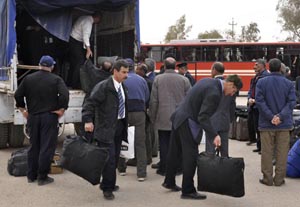
After the relocation of about 2000 people of camp Ashraf to the new Temporary Transit Location (Camp Liberty /Hurriya) the relocation process has been seemingly ceased by the MKO. The What the MKO is dreaming of?leaders of the group do not cooperate with Iraqi government , the UN and the US State Department any more.

The group leaders –apparently mad with the attorney for the US State Department who said that the US army has never been able to inspect Camp Ashraf to make sure it was disarmed — issued a statement and “invited” the State Department to inspect the camp.[1]

Besides, the MKO took a strong stance against the UN Secretary General’s Special Representative in Iraq, Martin Kobler. As usual, the group accused him of serving Islamic Republic of Iran and the government of Nouri al-Maliki.[2]

In its turn the US State Department issued a statement on June18, urging “immediate cooperation of Mujahidin Khalq with the Iraqi Government and UN”. The statement reads that the DOS remains concerned about the situation at camp Ashraf. Victoria Nuland, the spokesperson of the DOS, about the MKO’s recent “invitation for inspection”, said:”Constructive offers must be met with constructive spirit, and not with refusals or preconditions to engage in Dialogue.”She calls the group’s new pretext to stay in Ashraf as “an unnecessary distraction”.[3]

Why such reluctance again by the side of the MKO?

While the State Department believes that the Camp residents and their leadership – both in Iraq and in Paris – should recognize this path as a safe and humane resolution to this situation, the MKO leaders seem to oppose the complete closure of Ashraf and eventually their expulsion from Iraq. And, while the US Secretary of State has said that the camp closure is “a key factor in determining whether the organization remains invested in its violent past” [3] the MKO shows no sign of cooperation in order to comply with Iraqi government’s legal right — that is to sweep foreign forces off its territory.

Since the last convoy of Ashraf residents on May 5th there has been no convoy, according to senior US administration officials who attended a Special Briefing on June18, 2012. “Since that time, the MEK has curtailed its contacts both with the Iraqi Government but even with the UN, refusing to meet with Ambassador Martin Kobler, the head of the UN mission in Iraq.”[4]

The official believes that two probable reasons may have led the MKO to slow down its cooperation with the UN and the Iraq Government. “…there are two issues that have occurred to us. One, the MEK may have over-interpreted Iraqi politics and the possibility of a no-confidence vote against Prime Minister Maliki. That vote appears to be receding,.” he said.” A second reason is it may be an MEK over-interpretation and misunderstanding of the recent D.C. Circuit Court of Appeals ruling with respect to delisting.”[5]

However, the other official clarifies that the court has not told Secretary Clinton to delist the group and its leaders are “quite plainly, wrong”. the official concludes,” So it is time for the MEK to recognize that Ashraf is not going to remain an MEK base in Iraq.”[6]

What does the MKO propaganda do to fulfill the dream?

A delegation of Iraqi senior officials traveled to Europe to mobilize support for Camp Ashraf evacuation and secure transfer of the residents to Camp Liberty [TTL]. The delegation attended the meeting of the Relationship with Iraq Committee at the European Parliament. [7]
Iraqi Foreign Minister Undersecretary, Labid Abbawi proposed a statement about the meeting.”The meeting focused on the efforts made by the Iraqi Government in order to secure the transfer of Camp Ashraf residents to Camp Liberty in a peaceful manner and in accordance with international standards and in respect to human rights and international humanitarian law,” the statement said.[8]

Meanwhile the MKO’s propaganda arm, National Council of Resistance broadcasts the same event in a completely opposite way, claiming that the delegation is charged “to justify inhumane and suppressive behavior towards residents of Ashraf and Liberty.”[9]

The US administration official denounces the group’s propaganda by saying “We support the government considering people for refugee or otherwise bringing them in. Now, the United States is prepared to do its part. We take this obligation seriously. [10]

The MKO propaganda is all the time complaining of the “terrible “conditions of life at TTL. American officials, on the other hand, say that they follow condition at camp liberty in detail: ” We follow conditions at Camp Liberty in detail. We receive daily reports from the United Nations. We have an exact notion of the daily water supply. We know that it is – that each resident now receives about 200 liters per person per day of water. We follow the issues – we follow issues of electricity generation, problems with air conditioners, problems with sewage, that sort of thing. Medical treatment is available. The residents who need it are escorted to Baghdad hospitals. They’re allowed back. They’re given treatment. We follow this in great detail. “[11]

About complexities of MKO leaders’ approach towards the relocation issue, a US senior Official said,” We do not understand why, for example, they consider it in their interest to refuse contact with Martin Kobler, the head of the UN mission in Iraq, who, more than any other person, has – is responsible for the relative success of these relocations so far.” Of-course the official seems to find the answer- which is originated in the cult-like substance of the MKO. “They seem to be concerned with their organizational integrity”, he says.[12]

In order to maintain their integrity, the MKO resort to any probable pretext. The current political situation of Iraq appears to be a very little hope for the group to stay in its Iraqi headquarters Camp Ashraf where the forces are totally isolated from the world, obedient to their leaders. In response to a question posed by National Journal correspondent about the MKO’s possible strategy for the time being, the official said,” there is some evidence, and we – I would say that as an informed speculation, we believe the MEK may indeed calculate that a change of government in Iraq could rebound to their advantage, and they may be able – and they might be able to stay.

They do have some support among the Sunni politicians, but we believe that they are gravely mistaken to think that any Iraq – conceivable Iraqi government would, in fact, allow them to remain as a paramilitary organization in Iraq. We think that their time in Iraq is over.” [13]

By Mazda Parsi

References:
[1]The MKO Website. Nejat bloggers are either former MKO members or have a family member who is currently held in Camp Ashraf. They have suffered deeply because of Massoud Rajavi’s crimes. While the Nejat Bloggers recognize that citing sources of information is essential ,we, as a society feel so strongly against the MKO that we have agreed to not include the group’s websites or links in our articles because we consider it as kind of publicity for the cult.
[2]ibid
[3] US State Department, State Department urges immediate full cooperation of MEK, June18,2012
[4] US State Department, Press Release, Senior Administration officials on Camp Ashraf,June19,2012
[5]ibid
[6]ibid
[7] allIraqnews.com, FM Undersecretary participates in European Parliament session, June 2o, 2012
[8]ibid
[9] The MKO Website. Nejat bloggers are either former MKO members or have a family member who is currently held in Camp Ashraf. They have suffered deeply because of Massoud Rajavi’s crimes. While the Nejat Bloggers recognize that citing sources of information is essential ,we, as a society feel so strongly against the MKO that we have agreed to not include the group’s websites or links in our articles because we consider it as kind of publicity for the cult.
[10] US State Department, Press Release, Senior Administration officials on Camp Ashraf, June19, 2012
[11]ibid
[12]ibid
[13]ibid

June 21, 2012 0 comments
FacebookTwitterPinterestWhatsappTelegramSkypeEmail
Iraq

FM Undersecretary participates in European Parliament session

The Foreign Ministry Undersecretary, Labid Abbawi, head of the Iraqi delegation in charge of mobilizing support for Iraq’s position to evacuate Camp Ashraf and secure transfer of its residents to the interim site of Camp Liberty in order to resettle them in third countries, participated in a meeting of the Relationship with Iraq Committee at the European Parliament held on Tuesday.

A statement by The Ministry of Foreign Affairs received by All Iraq News Agency (AIN) cited "The meeting focused on the efforts made by the Iraqi Government in order to secure the transfer of Camp Ashraf residents to Camp Liberty in a peaceful manner and in accordance with international standards and in respect to human rights and international humanitarian law."

"The Undersecretary started his speech by talking about the development of the political process in Iraq and Iraq’s regional and international role, particularly after Iraq’s hosting the Arab Summit, leading the joint Arab action, as well as hosting the meeting of the 5 +1 group on Iran’s nuclear file," the statement concluded.

All Iraq News

June 20, 2012 0 comments
FacebookTwitterPinterestWhatsappTelegramSkypeEmail
The MEK Expulsion from Iraq

Iraq Camp Relocation Problematic For Iran’s MEK

The U.S. State Department on Tuesday warned Iranian exile group Mujahideen-e Khalq, or MEK, to comply with its relocation from Iraq’s Camp Ashraf to Camp Hurriya if it hopes to be removed from the United States’ list of Foreign Terrorist Organizations.

"The United States remains concerned about the situation at Camp Ashraf and urges the residents of Camp Ashraf to resume full cooperation immediately with the Iraqi government and United Nations Assistance Mission for Iraq," State Department spokeswoman Victoria Nuland said.

"The peaceful closure of Camp Ashraf is achievable but requires continued patience and practical engagement to be realized. Constructive offers must be met with a constructive spirit and not with refusals or pre-conditions to engage in dialogue."

The State Department has held the transition over MEK’s head for half a year, saying a peaceful move and cooperation with American and Iraqi authorities could get it off the terrorist list.

Washington believes that the eviction is necessary for humanitarian reasons since Ashraf has long been considered a refugee camp. So far, around 2,000 MEK members have successfully moved to the Iraqi-run Camp Hurriya, formerly Camp Liberty, in Baghdad. But another 1,200 to 1,400 are still in Ashraf, and the relocation is stalled, with MEK threatening to leave them behind if the conditions in Hurriya are not approved.

MEK — sometimes known as the People’s Mujahedin of Iran, or PMOI — has been on the foreign terrorist list for the last 15 years and is desperately trying to be removed. The group was exiled from Iran after the Islamic Revolution and fled to Iraq, as well as across Europe, under the guidance of leaders Massoud and Maryam Rajavi. The group allegedly helped Saddam Hussein during the Iraq-Iran war and has in the past been linked to various bombings and assassinations inside Iran.

However, MEK and the National Council of Resistance of Iran, an umbrella organization for Iranian exiles run by Miryam Rajavi, insist that the group is now only a political organization and refugee group. All of MEK’s weapons were confiscated by the American government years ago, and it has renounced its former violence.

Over the past few years, MEK, with help from a slate of American supporters that includes an all-star list of former top officials, have campaigned to be removed from the terrorist list, going as far as filing a suit with a U.S. appeals court to force Secretary of State Hillary Clinton to make a decision about MEK’s status within four months.

Nonetheless, a number of MEK members have seized the move from Ashraf to Hurriya as an opportunity to defect, revealing troubling details about the organization in the process. One of the first, according to the Sahar Family Foundation, a nongovernmental organization that says it provides humanitarian assistance to those who leave Ashraf, was Ali Reza Rahmati, who was in MEK for 10 years.

"I am extremely happy, and I thank God that I could obtain my freedom. I did not even have the right of free-thinking, and I was under the constant pressure and mental torture," Rahmati stated. "Now I feel the love of life’s revival inside of me, which was dead for 10 years, and I feel great satisfaction of this."

Ehsan Bidi, who also defected from the MEK and "declared separation" from "the corrupt Cult of Rajavi," compared his time in the refugee camp to being imprisoned and admitted that he had tried to escape before. Eight-year MEK member Sirous Morsalpour said that he was twice shot in the stomach — once in 2009 and once in 2012 — but was not permitted to have surgery outside of Camp Ashraf despite requests and the severity of the injuries. Morsalpour said that after he continued to insist on going to a hospital, "I was told that I was fired."

"They handed me to Iraqi police to get rid of me," he declared as he left the group.

The highest-ranking Mujahedeen to escape was Qorban Ali Husseini Nezhad, a 30-year member who was part of the MEK’s foreign affairs team, as well as a translator. Nezhad escaped after arriving in Camp Liberty in April and, like the rest of the defectors, described MEK more as a cult than a terrorist organization.

However, confirming long-held suspicions, Nezhad also said that thanks to deals between Saddam and Massoud Rajavi, MEK spied for Iraq’s intelligence service and received payment from the ill-conceived oil-for-food program.

By Daniel Tovrov

June 20, 2012 0 comments
FacebookTwitterPinterestWhatsappTelegramSkypeEmail
MEK Camp Ashraf

US Senior Administration Officials On Camp Ashraf

Press Release: US State Department
Background Briefing: Senior Administration Officials On Camp Ashraf
Special Briefing US Senior Administration Officials On Camp Ashraf
Senior Administration Officials
Via Teleconference
Washington, DC
June 18, 2012

MODERATOR: Thank you for joining us this morning. This morning we have a call on background. Joining us today are [Senior Administration Official One] and [Senior Administration Official Two]. Because this call is on background, from here on out we’ll refer to our speakers as Senior Administration Official One and Senior Administration Official Two.
So having said that, I will go ahead and turn it over to Senior Administration Official Number One. Go ahead, sir.

SENIOR ADMINISTRATION OFFICIAL ONE: Good morning. Thanks for joining us. The State Department just issued a statement about Camp Ashraf expressing concern about the situation there. The statement urges the residents of Ashraf to resume full cooperation with the UN and the Iraqi Government. The statement also urges the Iraqi Government to intensify its efforts to fulfill its commitments to provide for the safety, security, and humanitarian treatment of the residents.
The reason for issuing the statement is that after a period of successful convoys moving from Camp Ashraf to Camp Liberty, where almost two-thirds of the residents of Camp Ashraf have been moved on conditions of safety, this process has slowed down. The last convoy was May 5th. There has been no convoy since.
Since that time, the MEK has curtailed its contacts both with the Iraqi Government but even with the UN, refusing to meet with Ambassador Martin Kobler, the head of the UN mission in Iraq. The Iraqi Government has made clear that it wants Ashraf to be closed by Ramadan, which is July 20th. And we wanted – we, the United States wanted to make clear that we continue to support a peaceful and humane resolution of this – of the problem of Camp Ashraf, and we wanted to put both sides on notice that we are concerned by the prolonged stalemate.
Ambassador Kobler of the UN issued a statement about a week ago expressing his concern and pointing out that we have avoided violence until now (inaudible) since there has been no major violence since April of 2011, and it’s important to continue the relocation process to avoid violence altogether.
We cannot speak with certainty about the reasons for the MEK’s slowdown in its cooperation, but there are two issues that have occurred to us. One, the MEK may have over-interpreted Iraqi politics and the possibility of a no-confidence vote against Prime Minister Maliki. That vote appears to be receding. A second reason is it may be an MEK over-interpretation and misunderstanding of the recent D.C. Circuit Court of Appeals ruling with respect to delisting. And my colleague, Senior Administration Number Two, will address that issue.
But we want – in the beginning of this process when the United States backed the UN-Iraqi Memorandum of Understanding to relocate the residents of Camp Ashraf, I promised and [Senior Administration Official Two] promised to keep you all informed, and we are doing so.
A final bit of information: The Iraqi – an Iraqi senior delegation of people directly involved in the movement of residents from Ashraf to Liberty is traveling to Europe this week to explain what they are doing and to urge European countries to accept residents of Camp Liberty as refugees. The United States supports this delegation. We support the governments considering people for refugee or otherwise bringing them in. Now, the United States is prepared to do its part. We take this obligation seriously.
Now, let me stop there and turn it over to my colleague for additional comments.

SENIOR ADMINISTRATION OFFICIAL TWO: All right. Well, thanks for joining us this morning. I really just have one issue to address in this context, which Senior Official One alluded to, and that is the possibility that the MEK has over-interpreted the action of the U.S. Court of Appeals for the D.C. Circuit. Specifically, the court did not order the Secretary of State to revoke the MEK designation as a Foreign Terrorist Organization. It appears that MEK leaders believe that the Secretary has no choice now but to delist them and that is, quite plainly, wrong.
As the Secretary has made clear, the MEK’s cooperation in the successful and peaceful closure of Camp Ashraf will be a key factor in her decision regarding the MEK’s FTO status. She retains complete discretion on this matter. The court has told her to deliver a decision one way or the other. They have not told her to delist.
So it is time for the MEK to recognize that Ashraf is not going to remain an MEK base in Iraq. The Iraqi Government is committed to closing it, and any plan to wait out the government in the hope that something will change it – change its mind – is really quite dangerous. So it is time that the MEK got with the plan here and continued the move from Ashraf to Camp Hurriya. We support that orientation. We think it’s essential, and the MEK should recognize where its interests lie in this regard.
And now I guess we’ll take your questions.

MODERATOR: Operator, if we can go ahead and get our first question.

OPERATOR: Thank you. And for those listening on the phone at this time, if you would like to ask an audio question, please press *1 on your touchtone phone and please record your name and media affiliation clearly when prompted. Once again, *1 on your touchtone phone and please record your name and media affiliation clearly when prompted. One moment as we wait for our first questions.
And our first question comes from the line of Jo Bidell with AFP. Your line is open.

QUESTION: Good morning. Thank you for taking my question. I understand the court of district appeals gave Secretary Clinton four months in which to make her decision. Could you just tell us on the timing of that visit, does that take us to the back end of July? And do you think that the Secretary will comply with this?

SENIOR ADMINISTRATION OFFICIAL TWO: No. It takes us to October 1st.

QUESTION: Oh, to the (inaudible).

SENIOR ADMINISTRATION OFFICIAL TWO: And the Secretary has made clear that she will obey the court’s order in this regard.

QUESTION: Thank you.

OPERATOR: And our next question comes from the line of Guy Taylor with The Washington Times. Your line is open, sir.

QUESTION: Hi. Thank you. Regarding the senior Iraqi delegation that is going to Europe to urge European countries to accept residents of Camp Liberty as refugees and the U.S. obligation to facilitate that or play a role in it, I’m wondering if these individuals are part of a group that remains on the terrorist designation list, how they could be accepted as refugees in European countries. Could you please explain that?

SENIOR ADMINISTRATION OFFICIAL ONE: The U.S. maintains the MEK on its list of Foreign Terrorist Organizations. European countries do not, and the European countries have made clear that our designation is not a legal barrier for them. Whether or not it is a political barrier or an optical barrier is something you’ll have to ask them, but it is not a legal barrier. Moreover, the United States has already made it clear that, for our own part, we are prepared within our law to look at referrals from the UNHCR, the High Commissioner for Refugees, of individuals who may be eligible to bring into the United States one way or another; that is, despite the fact of the listing. This is a legal option, and we are also pursuing it. In other words, we’re not asking Europeans to do something we are in principle unwilling to do ourselves.

OPERATOR: And once again for those on the phone, if you would like to ask an audio question at this time, please press *1 on your touchtone phone and please record your name and affiliation clearly when prompted.
Our next question comes from the line of Joby Warrick with The Washington Post. Your line is open.

QUESTION: Hi. Thanks for doing this. Do you have a sense at this point about how many people are still in Ashraf that remain to be brought over? And then how many are – have already made the move? And also if there’s any – if you’re monitoring complaints they have on the ground about conditions – any specific problems that are causing concern for the MEK?

SENIOR ADMINISTRATION OFFICIAL ONE: There are just under 2,000 former Camp Ashraf residents in Camp Hurriya. That is somewhat under two-thirds – we’re not sure of the exact number of people that Camp Ashraf, but it is within the 1,200 to 1,400 range. So somewhere well over half – somewhat shy of two-thirds of the people have already moved.
We follow conditions at Camp Liberty in detail. We receive daily reports from the United Nations. We have an exact notion of the daily water supply. We know that it is – that each resident now receives about 200 liters per person per day of water. We follow the issues – we follow issues of electricity generation, problems with air conditioners, problems with sewage, that sort of thing. Medical treatment is available. The residents who need it are escorted to Baghdad hospitals. They’re allowed back. They’re given treatment. We follow this in great detail.
That said, it is our view that the Iraqi Government could do even more to address some of these issues. In recent weeks, there has been some progress in getting the Government of Iraq and the residents to agree on a way forward to improve humanitarian conditions. We think that if the MEK – if the residents engaged – reengaged fully with Ambassador Kobler, this process would continue – would be – would go faster and easier.
But do follow this – we do follow conditions at Camp Liberty in great detail.

OPERATOR: And once again, if you would like to ask an audio question, please press *1 on your touchtone phone and please record your name and affiliation clearly when prompted. One moment as we wait for our next questions. And we do have another joining. One moment. We do have two – three joining now. One moment.
And our next question comes from the line of James Kitfield with the National Journal. Your line is open, sir.

QUESTION: Thank you, guys, for doing this. Could you give me an idea of what you sense the MEK’s strategy is here? You talked about them maybe over-interpreting the no-confidence vote in Maliki. Say Maliki was – did face a no-confidence vote. Are they allied with the Kurds or with the Sunnis in some way that they think that they would be allowed under some conditions to remain at Ashraf and sort of keep the status quo?

SENIOR ADMINISTRATION OFFICIAL ONE: Well, I don’t want to speak authoritatively about MEK thinking, because we simply don’t – we’re not sure we understand it. But there is some evidence, and we – I would say that as an informed speculation, we believe the MEK may indeed calculate that a change of government in Iraq could rebound to their advantage, and they may be able – and they might be able to stay.
They do have some support among the Sunni politicians, but we believe that they are gravely mistaken to think that any Iraq – conceivable Iraqi government would, in fact, allow them to remain as a paramilitary organization in Iraq. We think that their time in Iraq is over. And we – instead of arguing over conditions of convoys, we ought to be putting our full efforts behind getting them out of Iraq and safely resettled, which is why we welcome the Iraqi delegation going to Europe. That’s where our focus should be.
But this is – we can speculate as to their thinking, but we’re not sure we understand it. We think it is – we think, though, if they are overconfident, they are making a serious, serious mistake.

OPERATOR: And our next question comes from the line of Rosalind Jordan with Al Jazeera English Television.
Your line is open, ma’am.

QUESTION: Hi. Thanks for the call. I had a similar question to that of James Kitfield. What’s their endgame? Why are they doing this? Does it hurt their credibility to be doing something such as this?

SENIOR ADMINISTRATION OFFICIAL ONE: Well, it certainly does nothing to help their credibility. European governments are considering taking residents of Camp Liberty as refugees, and some non-European governments as well. And we have argued till we’re blue in the face to the MEK leadership that their interests and their safety would be – would increase if they were seen as fully cooperating. We do not understand why, for example, they consider it in their interest to refuse contact with Martin Kobler, the head of the UN mission in Iraq, who, more than any other person, has – is responsible for the relative success of these relocations so far.
They seem to be concerned with their organizational integrity, and we think they need to concentrate on getting out of Iraq safely. But again, we’re not – I’m not speaking with authority about their motives. All we can do is try to figure out what they’re thinking, judging by their actions and their rhetoric.

SENIOR ADMINISTRATION OFFICIAL TWO: I would just add to that that with regard to the court case, they seem to believe that they have won a decisive victory and have failed to read the actual decision, and it appears that they think that delisting is now imminent. And we continue to try to impress upon them that there is no such automaticity, and that we would like to see them continue to move to Hurriya and to dissolve this remaining singular paramilitary camp in Iraq.

SENIOR ADMINISTRATION OFFICIAL ONE: On February 29th, Secretary Clinton said before Congress that leaving – cooperating in the closure of Camp Ashraf would be a key factor in her eventual decision about the FTO status. So as Senior Administration Official Number Two said, that is what we look for.

QUESTION: Thank you.

OPERATOR: And once again, if you’d like to ask an audio question, please press *1 and please record your media affiliation clearly when prompted. Our next question comes from the line of Jo Biddle with the AFP.
Your line is open again, ma’am.

QUESTION: Thank you very much for taking a follow-up question. I note that the UN Envoy Martin Kobler said earlier this month – last week, in fact – that he’s concerned about violence breaking out if the relocation doesn’t go ahead as planned. Could you talk to that, please? Is this a fear that the United States has? And also, could you give us a sense of what the breakdown is among those refugees? Are there men and women among them as well? Thank you.

SENIOR ADMINISTRATION OFFICIAL ONE: There is a history of violence in relations between the Government of Iraq and the MEK. There was a terrible incident in April of 2011 in which a number of residents of Ashraf were killed. Violence in Iraq is something that happens. So Ambassador Kobler was absolutely right to express his concern about what happens if this process does not move forward. The process is like a bicycle. It moves – if it moves, it is more stable; if it does not move, it is less so.
With respect to refugees, well, about one-third of the residents of Camp Ashraf and Camp Liberty are women. The UNHCR has teams on the ground and is devoting great energy to processing people for refugee status. They have processed many hundreds of people, and it – their progress gives us the basis to work with our international partners to see which governments can accept these people who are coming out of the UNHCR process with refugee status.
So there is – has been significant progress made. If you go back to December and think about the fears expressed at that time about mass violence, horrific incidents of people disappearing, none of that is taking place. The convoys have all been secure and safe. We need to continue this process, get Camp Ashraf closed, and focus on relocating people.

QUESTION: Thank you.

OPERATOR: And our next question comes from the line of Guy Taylor with The Washington Times. Sir, your line is open again.

QUESTION: No. Hi. Thank you. With regard to the Treasury Department’s subpoenaing of records pertaining to speaking fees paid to former senior U.S. officials who have spoken out on behalf of the MEK, among them James Woolsey, the former CIA director, along with a long list of others, do you have any information about whether those individuals are considered to be providing material support to a group designated as a terrorist organization?

SENIOR ADMINISTRATION OFFICIAL ONE: Absolutely no comment on this business.

QUESTION: Well, in other words, I mean, in your opinion, is it illegal to, say, accept money for speaking out on behalf of a group designated as a terrorist organization by the United States?

SENIOR ADMINISTRATION OFFICIAL ONE: Yeah. We’re not making any – expressing any legal opinion, any legal judgments, or in any way commenting on this matter, not at all. Sorry.

OPERATOR: And our next question comes from the line of Christina Wilkie with The Huffington Post. Your line is open, ma’am.

QUESTION: Thank you. If – I know part of the legal decision was that the Secretary would make a decision within four months, and if not, that the – then the U.S. Court – that the Washington court would be – would have some kind of a legal authority, it appeared, to delist the MEK themselves. Would you mind talking about – I understand that the Secretary doesn’t plan this – for this to be an outcome, but if it were to for any reason, what – I don’t understand the legal authority that the court would have to delist a Foreign Terrorist Organization.

SENIOR ADMINISTRATION OFFICIAL TWO: Well, I think we’re going to have to refer you to the Justice Department or our own lawyers on that, because this is terra incognita for us. There has never been a case of a court ordering a delisting. We don’t expect it to happen in this case either. But as a legal matter, the – I assume courts have the right to do that. But again, I’m not a – I’m not the legal advisor, and I think Harold Koh might have something to say about that.
SENIOR ADMINISTRATION OFFICIAL ONE: The Department has said that the United States will respect the decision of the court; that is, that the Secretary will make a decision within four months of the court ruling. That’s what we anticipate will happen. As to the authority under which the court did this and the legal way to describe the mandamus petition, I – both Administration – both Senior Administration Officials are not qualified to give legal opinions, and the last thing we want to do is mislead or misinterpret something.

OPERATOR: And at this time, we have no other questions in the queue.

SENIOR ADMINISTRATION OFFICIAL ONE: Well, all right, then. That’s good. Look, thanks, everybody, much appreciate the time and interest, and this is in the nature of an interim update. We are concerned about the situation, but it can – we can still have a decent outcome if the parties involved do what they need to do.

MODERATOR: Thank you all, and have a good day.

SENIOR ADMINISTRATION OFFICIAL ONE: Thank you all. Bye.

June 20, 2012 0 comments
FacebookTwitterPinterestWhatsappTelegramSkypeEmail
MEK Camp Ashraf

U.S. Official: MEK are plainly wrong

Iranian dissident group warned delisting from US terror not guaranteed

The United States warned an Iranian dissident group that it may have "over-interpreted" recent events, and should not presume its removal from the U.S. terror list is guaranteed.

The Obama administration has told Mujahedeen-e-Khalq (MEK) an orderly departure from its base Camp Ashraf inside Iraq will be a central condition to any decision regarding the group’s removal from the list.

From Camp Ashraf, the residents travel by convoy under United Nations and Iraqi government auspices to a former U.S. base in Iraq where they can be processed and eventually re-settled to countries in Europe and elsewhere.

Some 2,000 MEK members have left Camp Ashraf since the process began, but none have moved since May 5. Some 1,200 to 1,400 still remain at Camp Ashraf.

"Constructive offers must be met with a constructive spirit, and not with refusals or preconditions to engage in dialogue," State Department spokesperson Victoria Nuland said in a written statement. "Recent publicly declared conditions for cooperation, including calls for the Department to inspect Camp Ashraf as a precondition for further relocations to Camp Hurriya, are an unnecessary distraction."

Nuland also called on the Iraqi government to "intensify its efforts to fulfill its commitment to provide for the safety, security, and humanitarian treatment" of Camp Ashraf residents.

MEK has waged a widespread, well-publicized campaign for enforcement of a 2010 ruling by a federal court ordering the State Department to review the group’s status on the terror list.

Earlier this month, a federal appeals court ordered Secretary of State Hillary Clinton to make a decision by October 1, or the court would issue a so-called writ of mandamus to set aside the designation. The State Department has said it will comply with the ruling.

On a conference call with reporters Monday, a senior administration official said MEK may have "over-interpreted" the court ruling, and may believe that Clinton has no choice now but to de-list the group. The official said that belief would be "quite plainly, wrong."

Clinton "retains complete discretion on this matter," the official said. "The court has told her to deliver a decision one way or the other. They have not told her to de-list."

The administration says it is incumbent for MEK to realize that Camp Ashraf’s existence is coming to a rapid close.

"The Iraqi government is committed to closing it," the official said on the call with reporters, "and any plan to wait out the government in the hope that something will change it – change its mind – is really quite dangerous."

The Iraqi government has said it would like to see Camp Ashraf closed by July 20, the beginning of the Islamic holy month of Ramadan.

A second senior administration official on the same call said that MEK may also have "over-interpreted" Iraqi politics and the possibility of a no-confidence vote against Iraqi Prime Minister Nouri al-Maliki as a reason to cease cooperating in the eventual closure of Camp Ashraf.

"We believe the MEK may indeed calculate that a change of government in Iraq could rebound to their advantage, and they may be able – and they might be able to stay," the second official told reporters. MEK are "gravely mistaken" to think any Iraqi government "would, in fact, allow them to remain as a paramilitary organization in Iraq," the official said. "We think that their time in Iraq is over."

The official said the push for a no-confidence vote on Maliki appears to be receding.

MEK was placed on the terror list in 1997 because of the deaths of Americans during attacks in the 1970s against the U.S.-backed shah of Iran.

The U.S. says MEK engaged for years in terrorist activities in Iran, launched from bases in Iraq, including assassinations of high-level Iranian officials and attacks in Iran with heavy weaponry. The group was granted refuge in Iraq by Saddam Hussein during and after the Iran-Iraq war of the 1980s.

MEK supports the overthrow of the Iranian regime.

The terrorist designation prohibits Americans from providing material support to the organization, but a number of high-profile former U.S. officials have taken up the cause of the MEK and called for it to be de-listed. Some of them have received speaking fees for that support.

The Treasury Department currently is issuing subpoenas to some speakers bureaus for information on the source of those funds.

By Jamie Crawford

June 20, 2012 0 comments
FacebookTwitterPinterestWhatsappTelegramSkypeEmail
Mujahedin Khalq Organization as a terrorist group

MKO Working Through Senate to Sabotage Iran Diplomacy

Washington, DC – Affiliates of the Mujahedin-e Khalq (MEK), a U.S.-designated Foreign Terrorist Organization, are claiming to be behind a major letter from the Senate aimed at curtailing U.S. MKO Working Through Senate to Sabotage Iran Diplomacydiplomatic efforts to resolve the Iranian nuclear dispute.

The letter, sent last week by forty-four Senators, calls for President Obama to abandon any further diplomatic efforts with Iran unless stringent preconditions are immediately met. While many assumed that the prominent American Israel Public Affairs Committee (AIPAC) lobby was behind the letter, MEK-affiliates are now taking some of the public credit.

The lead author of the letter, Senator Roy Blunt (R-MO), enjoys ties to the Iranian-American Cultural Association of Missouri, an MEK-affiliate that released a statement supporting the letter.

The group claimed, “More than 30 Iranian-American communities, associations, organizations and professional entities representing and encompassing tens of thousands of naturalized Iranian-American citizens from across the United States lent their support to the bipartisan letter.”

As a U.S.-designated terrorist group, the MEK cannot technically operate inside of the country. However, a network of affiliate groups that “support” the MEK have operated with relative impunity to lobby Congress and to organize a public pressure campaign to remove the group from the terror list. A number of former U.S. officials who have received payment to advocate for the MEK have been subpoenaed as part of a federal investigation into the MEK’s U.S. operations.

Senator Blunt recently sponsored and participated in a pro-MEK event on Capitol Hill in May, organized by the Missouri group. The briefing featured many of the same former government officials now under federal investigation.

While the MEK’s public efforts have focused largely on pressuring the Obama Administration to remove the group from the terror list, the MEK is also apparently taking a more public role in working to influence U.S. policy regarding the Iranian nuclear dispute.

U.S. officials have also stated that the MEK, working with the Israeli Mossad, is responsible for the recent bombings inside Iran aimed at nuclear scientists.

While the MEK’s terror designation and federal investigations has not curtailed the group’s influence on Capitol Hill, there are indications that the organization has become emboldened by a recent U.S. court decision initiated by its supporters. The court ruled that Secretary of State has until October 1 to decide whether to keep the MEK on the terror list. If Secretary Clinton does not render a decision, the court says it will remove the group itself.

That has prompted the MEK to renege on a deal with U.S. and international negotiators to peacefully relocate out of its disputed Camp Ashraf compound in Iraq, where the group is based. The State Department had suggested the MEK’s cooperation in relocating would weigh heavily on any decision regarding the group’s terror listing. The MEK had finally appeared to accept the terms for relocation, but following the recent court ruling has reportedly stonewalled the process.

U.S. officials say they are concerned that, if MEK does not leave the compound, the Iraqi military will attempt to remove the group by force. U.S. officials have said they are concerned the MEK believes it can now play out the clock and get removed from the terror list without cooperating at Camp Ashraf. The MEK is believed to want to retain the compound to stage attacks inside of Iran and to protect its leadership from prosecution, and has threatened mass suicides by its rank and file members if forced to leave the compound.

June 20, 2012 0 comments
FacebookTwitterPinterestWhatsappTelegramSkypeEmail
The MEK to launch Armed Struggle

Spectacle glorifying the 31st anniversary of armed struggle

Mojahedin-e Khalq has become an anti-Iraq force

After ten years Western anti-Iran pundits are finally waking up to the fact that the Iranian

Where does the Mojahedin-e Khalq stand now?

Mojahedin-e Khalq (MEK) terrorist group cannot be used against Iran as long as it remains in Iraq. The MEK leader Massoud Rajavi, in a fight for his own survival, has now dug himself into such a deep hole there that the MEK no longer has any role in anti-Iran activities. Instead a ridiculous situation has arisen in which his wife Maryam Rajavi is using her Paris base to attack Nouri Al Maliki and the Government of Iraq. While the West is trying to put more and more pressure on Iran and isolate the country, the self-styled Iranian opposition has now become an Iraqi opposition with no links to Iran at all except the group of Farsi speaking former members scattered through western countries who are now suing the leaders for compensation for mistreatment in Iraq, Europe and North America.

While the MEK’s paid lobbyists remain highly vocal in their attacks on the Government of Iraq (GOI) and United Nations Assistance Mission for Iraq (UNAMI), the people who still don’t have a voice are the residents inside both Camp Ashraf (aka Camp New Iraq) and Temporary Transit Camp Liberty (aka Camp Hurriya). Since the relocation process began in February numerous residents have run away and taken refuge with the Iraqi authorities. They report an increasingly tense and turbulent internal situation with violent attacks and sexual assaults becoming more frequent. Families of the residents have maintained a permanent vigil outside Camp Ashraf and now Camp Liberty[TTL] for two years in an attempt to gain access to their loved ones. The GOI has still not been given the go ahead to allow families access to the people transferred to Camp Liberty[TTL].

The UNHCR has begun refugee status determination interviews with individuals who have relocated to Camp Liberty. Of these, 238 residents have been formally declared refugees. To qualify they needed to renounce membership of the MEK. 1,400 more interviews are scheduled. The GOI remains adamant none of them will be able to remain in Iraq and the process is therefore ongoing. There is no reason for Europe or the US to refuse to accept those who have UN refugee status.
Two-thirds of the residents, just fewer than 2,000 people, have relocated. Interestingly, among them are hundreds of people with special needs, suffering from disabilities and serious medical conditions as well as many elderly people; people whom Rajavi regards as dispensable. At least five people who were rushed to hospital with life threatening conditions after they arrived at Camp Liberty[TTL] said they did not want to leave the MEK but were thrown out and told not to come back because of their illnesses. The Iraqi authorities have ensured that they have received the best treatment available.

UNAMI officials reported that the relocation of MEK from Camp Ashraf to Camp Liberty had stalled since the arrival of the fifth group of residents on 5 May as the MEK refused further movement. The reasoning behind the stop is Massoud Rajavi’s hope to drag the removal process out for another four months until the MEK is removed from the US FTO list and things will then change for him. He is certainly not prepared to cooperate with Secretary of State Clinton’s suggestion – repeated on 18 June – that they should show full cooperation before she reviews their FTO status –the implication being that if they voluntarily remove to the new camp this would be enough proof they have renounced violence.
Instead the MEK is setting its own agenda based on the legal ruling which gave rise to Clinton’s review. Rajavi does not regard the Secretary of State as being powerful enough to need to listen to and is looking instead to his Israeli friends to protect him.

However, the Government of Iraq and the UN have said every resident of Camp Ashraf must leave Iraq and it is clear they cannot be taken off the terrorism list in this situation.

To further his agenda Rajavi is using his wife’s Paris base for an advertising campaign focusing on a rally in VillePinte, Paris on 23 June. The demand is to have the MEK taken off the US list without moving the combatants from Iraq. In addition to this ‘wait it out’ tactic, Rajavi is also hopeful that Al Maliki’s government will fall – or even that he is assassinated – and that a new government in Iraq take a more favourable position toward his group. After the MEK’s office inside the European Parliament was closed, the MEK covertly financed two new lobbying offices outside the parliament for the use of Struan Stevenson, MEP and Alejo Vidal Quadras, MEP. Both MEPs switched from the European Parliament’s Iran Delegation where they lobbied for the MEK, to the Iraq Delegation to lobby for Saddamists during the Iraqi election.

But these activities are balanced by a severe crackdown on the MEK’s activities. The GOI, UNAMI, European and US representatives, the ICRC and a large body of former members are showing a united front to challenge the MEK’s stalling and diversionary tactics.

The GOI has tasked its diplomatic delegations in Europe to apprise the European political community of the lies and deception used by the MEK to cover its many contraventions of the law. Only days ago Maryam Rajavi was summoned to the Palais de Justice in Paris to answer charges to charges of terrorism related activities, fraud and slavery.

Documents have recently been made available to the US Treasury linking an array of front organisation finances to companies and investments controlled by the Mojahedin-e Khalq’s leader.

Speakers’ agencies have been warned to exercise extreme caution regarding the MEK’s methods for recruiting support for the rally in France. Those attending the rally must know they are engaged by organisations with direct links to the MEK.

In addition, with the MEK’s financial sources exposed it has become possible for victims to pursue a class action to claim compensation directly from the Rajavis. Victims of the MEK, including former members who say their basic human rights were denied them for years, have launched a legal case for compensation from the companies which Massoud and Maryam Rajavi use to fund their elaborate and expensive propaganda campaigns. Their message is clear: Individuals who accept financial recompense from the MEK through its front organisations for speeches or lobbying should know that they can no longer claim ignorance and they will be pursued through the courts to recover money which should rightfully go to compensate the victims.
Whether the MEK is on the US terrorism list or not there is very little tolerance for the group. It is widely regarded as finished.

For those who are not involved too deeply with the MEK, it would be advisable to get out now.

By Massoud Khodabandeh, MESConsultants

June 20, 2012 0 comments
FacebookTwitterPinterestWhatsappTelegramSkypeEmail
Mujahedin Khalq Organization as a terrorist group

Source: S. Arabia, Yemen Attempting to Use MKO against Iran

Informed sources disclosed that Saudi Arabia and Yemen are making joint attempts to use the terrorist Mojahedin-e Khalq Organization (MKO also known as the MEK, PMOI and NCR) to impair Iran’s regional clout and face and undermine its national security. S. Arabia, Yemen Attempting to Use MKO against Iran

A report released by the Persian-language Neday-e Haqiqat (the Voice of Truth) website revealed that as the UN and Iraqi government have intensified their efforts to evacuate the MKO members from their main training base, Camp Ashraf, and transfer them to a transient settlement facility in Camp Liberty[TTL] to make them prepared for a final expulsion from Iraq, a meeting was held in Sana’a dubbed as ‘Solidarity with Ashraf Residents’ by Yemen’s National Strategic Studies and in cooperation with the Saudi security services.

The report said that the meeting was arranged and held by Abdulkarim Al-Eryani, a former Yemeni prime minister who is now a close adviser to Yemen’s deposed dictator Ali Abdullah Saleh, and in cooperation with certain figures close to Iraq’s al-Iraqiya’s party and the notorious hirelings of the MKO like Saleh al-Mutlaq.

Al-Eryani is also known to have long held close ties with Iraq’s former ruling party, Ba’ath, and was a confidant of the executed Iraqi dictator, Saddam Hussein.

The report said that the Yemeni-Saudi support for the terrorist group is aimed at damaging Iran’s face and influence in the region and exerting pressure on the Islamic Republic through undermining Iran’s national security and power.

Iran’s enemies have recently sought to make a better instrumental use of the MKO after the group served the former Iraqi dictator and played the role of an informant for the US ever since Saddam Hussein was toppled in a US invasion in 2003.

Recent reports said Zionist lobbies are seeking to shelter the MKO members in Azerbaijan, while the US administration is trying to station the terrorists in five neighboring countries of the Islamic Republic.

Authentic reports from sources privy to the MKO disclosed that the US administration is consulting with five of Iran’s neighboring states to persuade them into sheltering the MKO terrorists.

After nearly three decades, Iraq is now expelling the MKO from its soil, while no world country has accepted to shelter the terrorist group.

The US allies in the Middle-East, including Saudi Arabia, Jordan, Azerbaijan, Qatar and Pakistan, are likely to be the destination of the MKO terrorists, the sources added.

The sources also pointed out that Zionist lobbies are pressuring the US and Baku officials to station MKO terrorists in bases and desolated air fields, and added that the issue was a topic of recent discussions between Israeli Foreign Minister Avigdor Liberman and Azeri officials.

Zionist lobbies are seeking to create Camp Ashraf-like conditions in Azerbaijan to save the MKO from complete dissolution.

The MKO, whose main stronghold is still in Iraq, is blacklisted by much of the international community, including the United States.

The group started assassination of the citizens and officials after the revolution in a bid to take control of the newly established Islamic Republic. It killed several of Iran’s new leaders in the early years after the revolution, including the then President, Mohammad Ali Rajayee, Prime Minister, Mohammad Javad Bahonar and the Judiciary Chief, Mohammad Hossein Beheshti who were killed in bomb attacks by MKO members in 1981.

The group fled to Iraq in 1986, where it was protected by Saddam Hussein and where it helped the Iraqi dictator suppress Shiite and Kurd uprisings in the country.

The terrorist group joined Saddam’s army during the Iraqi imposed war on Iran (1980-1988) and helped Saddam and killed thousands of Iranian civilians and soldiers during the US-backed Iraqi imposed war on Iran.

June 20, 2012 0 comments
FacebookTwitterPinterestWhatsappTelegramSkypeEmail
Terrorist groups and the MEK

MKO supporters stage terror attacks in Iraq

Nouri al-Maliki’s advisor says that three MPs from al-Iraqiya bloc are charged with planning last Wednesday’s terrorist attack in Iraq.

“Primary investigations reveal that more than three representatives of al-Iraqiya have direct responsibility for financing terrorist groups,” Salam Quraishi, an economic advisor to the Iraqi government added, refusing to name them till the investigation is over.

“Investigations continue to identify the parliamentarians who are financing the terrorist groups,” said Quraishi.

MKO enjoys widespread support among al-Iraqiya bloc. In a report published last Tuesday, informed sources close to Nouri al-Maliki said that the Prime Minister of Iraq holds documents which reveal the al-Iraqiya bloc officials’ ties to terrorist groups, especially MKO.

Earlier in April a member of Iraqi parliament told Habilian on condition of anonymity that MKO pays 5000 dollars per month to Haidar al-Mulla, al-Iraqiya bloc’s spokesman, for taking measures against the government.

June 19, 2012 0 comments
FacebookTwitterPinterestWhatsappTelegramSkypeEmail
Mujahedin Khalq Organization's Propaganda System

Pay attention to the deceptive policies of MEK in France

Open letter of Iran Pen Club to the authorities and responsible officials in France

According to the news which has been received from Iranian refugee camps in Europe, we got Pay attention to the deceptive policies of MEK in Franceinformed that people’s mujahedin organization intends on 23 of June ,2012 to organize a ceremony in the Villepinte Village in France. For informing the public opinion we draw your attention to the following subjects:

1. According to the organizing of this ceremony in 30 Khordad ( 23 June) which is the anniversary of the beginning of the huge explosions and blind terrors in Iran , proves that the leaders of pmoi ,Massoud Rajavi as the leader of National Council of Resistance (NCR) and Maryam Ghajar Azdanlo as the third wife of Massoud Rajavi and forcible and imposed president of this council (NCR) in Paris , support the blind terrors as well as the suicide operation in 1981 in Iran which caused panic and public fear and this flow falsely claims through its lawyers in the law courts that they have rejected the arm struggle.

2. The people’s mujahedin organization for deceiving the public opinion and for organizing this ceremony utilize the non Iranian people by paying their transportation fee as well as 3 days trip in Paris with hotel and …………etc , tries its best to show their sham popularity among Iranian people by the presence of those non Iranian people in this ceremony in Villepinte in France. This method has been used many times by this organization in the past and fortunately this fake method has been revealed by news agencies .

3. In circumstances that pmoi with its presence on Iraqi soil as the enemy of Iranian people and as Saddam Hussein’s Persian language mercenaries has been known and recognized since 30 years ago and as the fifth column of Saddam Hussein Army , they have killed many Iranian soldiers and people ,and as a result of that they are very unpopular among Iranian people.

4. This organization tries its best in this ceremony to pay 100000 dollars just for 10 minute speech to draw the attention of the retired politicians to support pmoi and they utilize this method to deceive the public opinion .

5. According to the recent statement of an American responsible official ,Mr. Henry Wooster Deputy Director of the Office of Iranian Affairs in the US state department ,about pmoi terrorist group ¨ ……… one of the problems which we have with mujahedin khalgh (PMOI) is that in our opinion they can not be as a representative of a democratic reformist movement in Iran……….¨ it seems that making supporting policies with the price of dollar has been defeated heavily and this issue has begotten a severe passivity in pmoi leadership and their hopes for going forward in gaining the supporting policies of US has failed .

6. According to the facts mentioned above , we would like to inform you respectfully that in confronting with the representatives of this espionage organization (pmoi) you should be very careful not to involve yourself in their policies which work like trap and ambush. They are not a democratic alternative for the future of Iran and any support of this organization is condemned and rejected by Iranian people .

The Iran pen club comprises of the victims and deceived people from this violent and dangerous religious cult , according to its humanitarian policies submit this letter to you and surely we declare that we are ready to inform you about this organization and also we declare that we are ready to participate in face to face meeting with you with credible documents to inform you more about the real essence and the content of mujahedin’s cult .

Respectfully
ran Pen Club

June 19, 2012 0 comments
FacebookTwitterPinterestWhatsappTelegramSkypeEmail
Newer Posts
Older Posts

Recent Posts

  • A Criterion for Proving the Violent Nature of the MEK

    December 31, 2025
  • Rebranding, too Difficult for the MEK

    December 27, 2025
  • The black box of the torture camps of the MEK

    December 24, 2025
  • Pregnancy was taboo in the MEK

    December 22, 2025
  • MEPs who lack awareness about the MEK’s nature

    December 20, 2025
  • Facebook
  • Twitter
  • Instagram
  • Youtube

© 2003 - 2025 NEJAT Society . All Rights Reserved. NejatNGO.org


Back To Top
Nejat Society
  • Home
  • Articles
  • Media
    • Cartoons
    • NewsPics
    • Photo Gallery
    • Videos
  • Publications
    • Books
    • Nejat NewsLetter
    • Pars Brief
  • About Us
  • Contact us
  • Editions
    • عربي
    • فارسی
    • Shqip