Nejat Society
  • Home
  • Articles
  • Media
    • Cartoons
    • NewsPics
    • Photo Gallery
    • Videos
  • Publications
    • Books
    • Nejat NewsLetter
    • Pars Brief
  • About Us
  • Contact us
  • Editions
    • عربي
    • فارسی
    • Shqip
Nejat Society
Nejat Society
  • Home
  • Articles
  • Media
    • Cartoons
    • NewsPics
    • Photo Gallery
    • Videos
  • Publications
    • Books
    • Nejat NewsLetter
    • Pars Brief
  • About Us
  • Contact us
  • Editions
    • عربي
    • فارسی
    • Shqip
© 2003 - 2024 NEJAT Society. nejatngo.org
MEK Camp Ashraf

Detach the Destiny of the Enslaved from Terrorists

To tie the destiny of residents and terrorist case of MKO deteriorates the predicament of the former

To tie the destiny of Ashraf residents to the controversial removal of Mojahedin Khalq Organization MKO from the State Department’s terror list has turned into another incongruous problem that has resultantly emboldened the group’s leaders to further disregard the previously arrived agreements and to start a new round of defiance by making new excuses. It all began with Secretary of State Hillary Clinton’s statement saying; “Given the ongoing efforts to relocate the residents, MEK cooperation in the successful and peaceful closure of Camp Ashraf, the MEK’s main paramilitary base, will be a key factor in any decision regarding the MEK’s FTO status”.

Was it a thoughtful statement or for any untold reason, for outsiders Clinton’s remarks were somehow viewed as an indication that the US is close to removing the terrorist group from its blacklist. But inside the group, Mrs. Clinton’s words were grabbed at as an offer that led MKO under the delusion that now it had an upper hand for any bargain over the lives of the residing members at Ashraf. Maybe she was looking for a fast and peaceful solution to the plights of the residents and regarded it as a humanitarian issue but it is hard to believe that she was unaware of the group’s innately opportunistic makeup.

Maryam Rajavi’s immediate reaction and response to Mrs. Clinton was that of someone playing the leading role in a bargain. She offered the removal of MKO from the terror list and relocation of residents to Temporary Transit Location TTL simultaneously and also to move residents to the Jordanian border instead of TTL near Baghdad. Besides, MKO was encouraged enough to fill the pockets of the scores of American pro-MKO personalities with bundles of dollars to send them onto the stage to voice their support on its behalf and to urge removal of the terrorist tag. In fact, knowingly or unknowingly, Mrs. Clinton’s sentence became a promoter and feeder of the group’s propaganda blitz as it is a master of the art.

The disadvantages of Mrs. Clinton’s offer seem to have outweighed the intended advantages and have been less than expected to help the enslaved residents out of their predicament. However, there are signs and hopes that the US feels a strong sense of responsibility for what MKO has wrongly taken as buttress for supporting its collapsing structure. An investigation is being conducted at the present by the US Treasury Department focusing on whether the former American officials have received funding, directly or indirectly, from MKO. Proved or unproved, it is a manifestation of the Administration’s concern about the release of a designated terrorist group and the consequences. It is also an indication that some people have been engaged in violating longstanding federal law barring financial dealings with terrorist groups, meaning nothing has changed concerning MKO as a designated FTO.

The latest reaction hit on Monday when the Obama administration urged a US appeals court not to interfere with its review and decision-making process over whether to remove MKO from the FTO blacklist. The group had in February accused the State Department in a court filing of ignoring a 2010 court order to reconsider its status as a terrorist group. According to reports, the State Department urged the court to stay out of the matter, saying it was continuing to evaluate the matter, consulting with the intelligence community and other government agencies and that it had met with representatives of the terrorist MKO.

However, MKO’s removal and its re-designation is a case between the US and a terrorist group while relocation of Ashraf residents is a humanitarian issue. To tie the two only deteriorates the predicament of the enslaved in a terrorist cult and the responsibility of any defiant backwash by MKO is on those who compromise with the group.

March 29, 2012 0 comments
FacebookTwitterPinterestWhatsappTelegramSkypeEmail
Mujahedin Khalq; A proxy force

Guest Op-Ed: MEK and its material supporters in Washington

Jeremiah Goukla worked as a lawyer in the Bush Justice Department, and then went to work as an analyst with the RAND Corporation, where he was sent to Iraq to analyze, among other things, MEK and its material supporters in Washingtonthe Iranian dissident group Mujahedin-e Khalq (MEK), publishing an oft-cited study on the group. MEK has been in the news of late because a high-powered bipartisan cast of former Washington officials have established close ties with the group and have been vocally advocating on its behalf, often in exchange for large payments, despite MEK’s having been formally designated by the U.S. Government as a Terrorist organization. That close association on the part of numerous Washington officials with a Terrorist organization has led to a formal federal investigation of those officials. Goukla has written and supplied to me two superb Op-Eds on the MEK controversy — one about the group itself and the other explaining why so many prominent Washington officials are openly providing material support to this designated Terror group — and I’m publishing the two Op-Eds below with his consent (as you read them, remember that paid MEK shill Howard Dean actually called on its leader to be recognized as President of Iran while paid MEK shill Rudy Giuliani has continuously hailed the group’s benevolence).

Before posting those Op-Eds, I want to note one update on this matter: supporters of MEK have filed a lawsuit asking a federal court to force the State Department to decide within 30 days whether to remove MEK from the list of designated Terrorist organizations (State Department officials have previously indicated they are considering doing so). In response, Secretary of State Hillary Clinton has told the court that (1) it has no role to play in directing the timing of this decision (“Any interference by a court with the Secretary’s ability to carry out these absolutely critical duties would set a seriously troubling precedent”); and (2) the U.S. Government is currently attempting to force MEK to move from its current base in Camp Ashraf to another location in Iraq (something MEK does not want to do), and whether MEK cooperates with the U.S. Government’s directives will play a large role in determining whether the group is removed from the Terrorist list.

With regard to that second argument: in determining whether MEK belongs on the Terrorist list, what conceivable difference should it make whether MEK is cooperative in moving from Camp Ashraf as the U.S. Government wants? What does their cooperation or lack thereof have to do with whether they are a Terrorist organization? The answer, of course, is that the U.S. list of Terrorist organizations (like its list of state sponsors of Terrorism) has little or nothing to do with who are and are not actually Terrorists; it is, instead, simply an instrument used to reward those who comply with U.S. dictates (you’re no longer a Terrorist) and to punish those who refuse (you are hereby deemed Terrorists). The scholarship of Remi Brulin documents how Terrorism, from its prominent introduction into world affairs, has been manipulated that way. Andrew Exum of the Center for a New American Security yesterday objected to my argument that the field of “Terrorism expertise” is basically fraudulent because the concept of “Terrorism” itself is largely propagandistic and ideological, rather than being some meaningful term with a fixed, coherent definition. His commenters have very effectively addressed his claims, but this game-playing with MEK is yet another example underscoring what I mean.

__________________________________

By Jeremiah Goukla

THE IRAN WAR HAWKS’ FAVORITE CULT GROUP

Despite the flurry of support by some prominent politicians as Secretary of State Hillary Clinton scrutinizes its case, the Mujahedin-e Khalq (MEK), a dissident Iranian group based in Iraq with a propaganda arm in Paris, is no enigma.

The U.S. declared the MEK a terrorist organization 13 years ago partly because the group is thought to have assassinated three U.S. Army officers and three U.S. civilian contractors in Tehran in the 1970s. The group’s pep rallies feature U.S. politicians lured with high fees to come speak on its behalf. The MEK wants the U.S. government to take the group off its terrorist list – as the E.U. and U.K. have already done. But before that happens the group requires close scrutiny.

I studied the MEK for the U.S. military and visited Camp Ashraf, the MEK facility 40 miles north of Baghdad. I also interviewed former MEK members. As Human Rights Watch also concluded, I saw that the MEK is a cult. It uses brainwashing, sleep deprivation, and forced labor to indoctrinate members. It segregates men from women, mandates celibacy, forces married members to divorce (except for its leaders), and separates families and friends who must seek permission just to converse.

MEK members must report their private sexual thoughts at group meetings and endure public shaming. In a Catch-22, those who deny having sexual thoughts are accused of hiding them and shamed, too. The cult has but one purpose: to put itself in charge in Iran.

A brief history lesson illuminates how the MEK transformed from a radical student group in 1965 to what it is today. When the MEK was founded it embraced both Marxism and Islam and dedicated itself to the violent overthrow of the Shah of Iran. All this is reflected in its name, the “People’s Holy Warriors.” By 1979 the MEK evolved into a major movement that threatened Ayatollah Khomeini’s dominance after the Iranian Revolution. He suppressed the group, executing some leaders and imprisoning others. In 1981 some MEK leaders escaped in a stolen plane. Among these was Masoud Rajavi. Exiled to Paris, he established the National Council of Resistance of Iran (NCRI), an umbrella organization of Iranian dissident groups opposed to Khomeini. The NCRI soon became the propaganda arm of the MEK. Rajavi’s wife, Maryam, runs the NCRI, which is also on the U.S. terror list. She calls herself “president-elect” of the NCRI’s “parliament-in-exile.”

When Saddam Hussein waged war against Iran, Rajavi moved the MEK from Paris to Iraq. His alliance with Saddam in a brutally violent war cost the MEK credibility and its font of recruits. Isolated in Iraq’s desert, Rajavi instituted authoritarian control over his decimated army and confiscated his troops’ assets. He encouraged Saddam to send Iranian POWs to MEK’s Camp Ashraf rather than repatriate them. With promises of asylum for POWs and family reunions with the new MEK members, Rajavi duped Iranian visitors to come to the camp and stole their passports so they couldn’t leave.

Human Rights Watch reports that those who tried to escape endured confinement or torture. After the U.S. invaded Iraq, the MEK ejected its most “difficult” members and used guards and concertina wire to entrap the rest. Members must swear allegiance to Masoud and Maryam, whose pictures are in every building at Camp Ashraf. But these days Maryam’s is the public face of the NCRI. Masoud Rajavi mysteriously disappeared in 2003.

Maryam trumpets the dangers of Iran’s nuclear program and gives the NCRI credit for discovering Iran’s Natanz nuclear facility. That self-serving claim is doubtful, as is the NCRI’s posture as a democratic government-in-waiting. While its propaganda arm espouses Western values to Western audiences, the MEK continues to force-feed its doctrine to members who may not criticize the Rajavis and are not free to leave the Ashraf compound.

While many people would like to see a change of regime in Tehran, no one should believe that the MEK would provide Iran with a government based on liberty and justice for all. Indeed, based upon its treatment of its own adherents in Iraq, a MEK regime might not be much improvement over the current one.

________________

By Jeremiah Goukla

INVESTIGATIONS BEGIN INTO MEK SUPPORTERS

The U.S. Treasury Department has begun an investigation into nearly two dozen prominent former government officials who have been paid tens of thousands of dollars to promote the Mujahedin-e Khalq (MEK), an Iranian dissident cult group that has been designated by the State Department as a Foreign Terrorist Organization (FTO) since 1997.

These officials include several prominent George W. Bush Administration anti-terror officials like Homeland Security secretary Tom Ridge, Homeland Security advisor Frances Fragos Townsend, Attorney General Michael Mukasey, UN ambassador John Bolton; as well as former Republican Mayor of New York, Rudolph Giuliani; former Democratic governors Ed Rendell of Pennsylvania and Howard Dean of Vermont; ex-FBI Director Louis Freeh; and retired chairman of the Joint Chiefs of Staff Gen. Hugh Shelton. These former officials have given speeches at home and abroad urging the State Department to remove the MEK from the FTO list.

Given the cacophony of saber-rattling over Iran’s alleged nuclear weapons program – which the U.S. intelligence community generally believes was shut down in 2003 – and the risk, however low, of actually getting prosecuted for “material support of terrorism,” it is important to examine why anyone would promote a designated terrorist organization.

What is the MEK?

The MEK – which is also known as the People’s Mujahedin of Iran (PMOI) and often operates through its Paris-based propaganda arm, the National Council of Resistance of Iran (NCRI) – is an Iranian dissident group that once-upon-a-time was a significant force in Iranian politics. Created to oppose the Shah in 1965, the MEK lost out to Ayatollah Khomeini after the Iranian Revolution, and the mullahs have been the MEK’s target ever since. The regime brutally suppressed the group, forcing it to go underground and its leaders into exile. Most MEK members are now based in Iraq, where they have lived since joining forces with Saddam Hussein in 1986 during the Iran-Iraq War. (For more history of the MEK, see the appendices here.)

Collaborating with Saddam was the MEK’s greatest mistake. Saddam started that war, which was a catastrophe for Iran, but he didn’t win and didn’t install the MEK as the new government. In the process, the MEK killed Iranian soldiers and thereby killed off whatever credibility it once had.

The MEK claims to be the best organized and the most prominent opposition group in Iran. No credible sources that I have seen suggest that it has any relevance in Iran at all, other than to get the mullahs riled up. It is, however, very well organized, because, cut off from new volunteers, the MEK’s co-leaders Masoud Rajavi (whereabouts unknown) and his wife Maryam Rajavi turned the MEK into a cult of personality.

The MEK vigorously denies that it is a cult, accusing critics of working for the Iranian regime or performing inadequate research (using the tactics of climate change, evolution, and tobacco denialists). However, I studied the MEK in depth and over a period of many months for the U.S. military. I visited Camp Ashraf, the MEK facility 40 miles north of Baghdad, and interviewed MEK members, former MEK members, and dozens of military and civilian officials. Along with almost all of my interviewees and Human Rights Watch, I concluded that the MEK is a cult. It employs many common cult practices: mandated celibacy and divorce, thought control, sleep deprivation, and forced labor. It segregates men from women, separates families and friends – who must seek permission just to converse – and even tells family members back home that the members are dead.

Why Would Any American Politicians Support the MEK?

Getting off the FTO list is a stepping-stone to the MEK’s main goal: getting America to install it as the new government of Iran. Why would American politicians want that? There are two main reasons, neither of them good.

The first is ignorance. The MEK presents itself well and is good at running “Astroturf” campaigns. Its NCRI is a self-proclaimed “parliament in exile,” dedicated to the principles of western liberal democracy. Over the years, lots of American civilian and military officials have failed to do their homework and fallen for the MEK’s sales spiel, excited as they were to hear what they wanted to hear. (If something sounds too good to be true…)

Does this remind you of Ahmed Chalabi and the Iraqi National Congress? It should. As Ali Gharib has shown, the same people who helped Chalabi push us into Iraq are now orchestrating public events where former officials promote the MEK.

The second reason is money. The officials were paid to speak on the MEK’s behalf, up to $30,000 per speech. Not bad for a few minutes work.

But this is just the beginning. What the media has generally failed to mention is that these former officials are now in the national/homeland security business. Just take a quick look around Wikipedia, Forbes, and OpenSecrets.org, and here is what you will find:

Tom Ridge has his own security consultancy (Ridge Global, LLC) and lobbying firm (Ridge Policy Group). He chairs the U.S. Chamber of Commerce’s national security task force and sits on the boards of at least one military contractor (TechRadium, Inc.) and one company (Geospatial Corporation) that serves the oil and gas industry.
Francis Fragos Townsend chairs an industry association for intelligence contractors (the Intelligence and National Security Alliance) and is the head of lobbying for a holding company (MacAndrews & Forbes Holdings Inc.) that owns the military contractor AM General.
Rudolph Giuliani has a security consulting firm (Giuliani Partners) and is a partner in a law firm with prominent oil and gas and lobbying practices (Bracewell & Giuliani). He used to own a private equity fund that teamed up with Bear Stearns to invest in security companies.
Louis Freeh has a security and investigations consulting firm (Freeh Group International Solutions, LLC) and a law firm (Freeh Sporkin & Sullivan, LLP), where he represents, among other clients, a Saudi prince in a bribery investigation involving an arms deal.
Hugh Shelton has served on the boards of directors of several military contractors, such as L-3 Communications, CACI International, Inc., and Protective Products of America, Inc.
Bolton, Mukasey, Rendell, and Dean are affiliated with major law firms whose clients include not just standard military contractors but many other more mundane corporations, as expert Nick Turse has shown, also benefit from military largesse. (Bolton is also affiliated with several pro-war think tanks.)
For people in the national/homeland security business, war with Iran would be a cash cow. They and their clients stand to benefit handsomely. Just stoking fears of war can get money flowing, from studies to retrofitting naval vessels. Bombing would be better, as even something as small as the Libyan war involved spending more than a billion dollars. But full-on war, that’s the mother lode. An invasion followed by an Iraq-style lingering occupation and reconstruction would open up hundreds of billions and possibly even trillions of taxpayer dollars for the grabbing.

Hopefully these Treasury Department investigations are a sign that the Obama Administration has finally decided to rein in the warmongers. Ignorance, profit, and the dreams of a terrorist-cult group are lousy reasons to start a war.

By Glenn Greenwald,

March 29, 2012 0 comments
FacebookTwitterPinterestWhatsappTelegramSkypeEmail
MEK Camp Ashraf

The Vain Struggle to Keep Ashraf Open

The ground reasons for the closure of Camp Ashraf are more than enough

All the current evidences indicate that the story of MKO is nearing its end in Iraq and closure of its The ground reasons for the closure of Camp Ashraf are more than enoughbastion and the consequent expulsion of its insiders from Iraq are unquestionable. And the Rajavis themselves have come to learn the bare fact despite their advocates’ struggle on their behalf. Whatever we see coming out of the organization’s propaganda apparatus drumming up support for the insiders and recognition of their rights is nothing more than a shrewd play by the leaders, with Rajavi at the top, to distract the outsiders from a different episode that is to occur in the future.

The ground reasons for the closure of Camp Ashraf are more than enough to present. The Iraqi Prime Minister, Nuri al-Maliki, made it clear that the camp had to be closed simultaneous with the exit of the American forces from Iraq. America also left the decision for the group’s future to the Iraqi government. However, under outside pressures and to show its good-will for humanitarian reasons, the Iraqi Government agreed to extend the deadline for another six months, beginning October 2011 to the end of April 2012.

However, a big bulk of MKO’s propaganda machine is still concentrating on the issue of recognizing the rights of Camp Ashraf residents and strives on progress to keep the camp open and active in Iraq. Why is Rajavi on a struggle of securing his organization’s stay in Iraq while he knows the efforts are foiled for certain reasons? Neither the Iraqi political potentiality allows the group to live nor does the organization itself feel safe to survive on the Iraqi soil, especially after the leaving of American forces. An idle organization with many imposed limitations would mean a rapid political and strategic deterioration and structural disintegration. The Iraqi government substituting the fallen dictator totally disappointed MKO’s hope of having a replaced reliable patron.

For clear as well as untold reasons Rajavi can neither continue his organization’s stay on the Iraqi soil nor is Iraq willing to let it on its soil. In fact, further stay in Iraq is tantamount to an idle lingering that guarantees no political and strategic development for the organization. Besides, the heavy investment on some former American personalities and paying them thousands of dollars to speak in MKO’s behalf in the group’s occasionally held luxurious events resulted in much less than the least expectations. Above all, Rajavi came to the reality, particularly after the exit of American forces and handling the control of Ashraf to Iraq itself, that none of the orchestrated squawks and protests against the Iraqi Government and demonization of Nuri al-Maliki to prolong his organization’s stay in Iraq could deter Iraq’s decisiveness to expel the group.

However, MKO has proved to be the untrusted party in any contract, the side that refuses to comply with the other side when there is a dispute to be settled peacefully. It spends big sums to challenge and its tone is hostile and threatening when called to parley. Typically, it is a shock and prepared to strike when you never expect it and double speaks when everything seems resolved and concluded. At least it is what has been going on during the past two months of the arrived agreement to move residents from Ashraf to Temporary Transit Location TTL. The deadline is nearing, less than two months, and still Rajavi is dillydallying. Probably, he is gambling on another trick to disappoint the Iraqi Government; but he has to be also alert to the possibility of a shock he never expects.

March 28, 2012 0 comments
FacebookTwitterPinterestWhatsappTelegramSkypeEmail
The MEK Expulsion from Iraq

MKO from TTL to third countries

Tough road ahead of Mojahedin Khalq, MKO, MEK, Rajavi cult in Iraq

Temporary Transit Location (TTL), which is going to be the only camp of MeK in Iraq, may be an Tough road ahead of Mojahedin Khalq, MKO, MEK, Rajavi cult in Iraqend for the painful life of each member of this terrorist cult that Rajavi has imposed to them.

Over the next few months, Camp Ashraf will be completely blocked and its residents, whether they want or not, will be resettled in the TTL as Refugees- not Mujahedeen-e Khalq, or any other name.

However, the MerK’s obstruction and turbulence is still ongoing, so every moment it is expected from the terrorist group’s leadership to adopt new positions.

25. Dec. 2011, that is considered a turning point and qualitative topic in the project of closing the MeK case in Iraq, now, with transfer of the other Camp Ashraf residents to the TTL, is entering a new phase of its developments.

The existing evidences indicate that, although, European countries, U.S and the Zionist Regime already have made the most of the MeK, but, considering the terrorist cult a serious threat to the security of their citizens, almost none of them are willing to accept its members in their territory.

Philip Giraldy, former CIA agent, in his recent article about the MeK’s departure from camp Ashraf and final destination of its members, (the Mujahidin Khalq’s Useful Idiots) which was inserted on the Antiwar website, says: "…There might be some problem in arranging the move, as few countries want to take the MEK supporters, fearing that they would have to be deprogrammed from their brainwashing."

Also, according to the Habilian Foundation website (families of Iranian victims of terror), Antonio Guterres, the UN High Commissioner for Refugees, on March 3 2012 in a meeting with Shia Soudani, the Iraq’s Minister of Human Rights, announced the UNHCR’s opposition with the granting asylum to terrorist group’s members.

At the meeting that was held in Geneva, Guterres said: "The UNHCR does not give asylum to groups, but it will be given only to individuals, if they quit violence."

So, MeK Have a tough road ahead from TTL to European countries. Renounce of violence and rejection of the sectarian organization is the first and the most important step to pass this arduous path.

Considering what was said above, UN, UNHCR, and ICRC can play the influential and unprecedented role to avoid turning the Temporary Transit Location to a new camp for more brainwashing of its residents by the MeK’s leadership and its gang leaders.

By Seyed Hojjat Seyed Ismaili, former member of the MeK’s central council

March 28, 2012 0 comments
FacebookTwitterPinterestWhatsappTelegramSkypeEmail
Mujahedin Khalq; A proxy force

State Dept to court: Don’t meddle with terror list decisions

The State Department is asking a U.S. appeals court to deny a suit that would force Secretary of State Hillary Clinton to decide, within 30 days, whether to remove an Iranian opposition group from the U.S. list of foreign terror organizations.State Dept to court: Don't meddle with terror list decisions

The group, the Mujahadin-e Khalq, was placed on the terror list in 1997 because of the deaths of Americans during attacks in the 1970s against the U.S.-backed shah of Iran. The U.S. says the M.E.K. engaged for years in terrorist activities in Iran launched from bases in Iraq, including assassinations of high-level Iranian officials and attacks in Iran with heavy weaponry. In the 1980s, the M.E.K. supported Saddam Hussein during the Iran-Iraq war. Later, it vowed to disarm. Since 2003 the group has been living under U.S. protection on a former U.S. military base in northern Iraq, Camp Ashraf.

The Iraqi government is in the process of moving the residents from Camp Ashraf to another location in Iraq. Clinton has said the way that transfer is carried out could influence whether the group is removed from the terror list. A number of residents have objected to the move.

In its statement to the court, the State Department said the review of the M.E.K. requires "close analysis of highly classified information … expert judgments about the continuing capabilities and intentions of a currently designated foreign terrorist organization … extremely sensitive national security judgments and difficult decisions concerning the best way to avoid possible serious human rights violations."

The secretary of state, it said, has to "direct her full attention to emergencies of the highest magnitude, involving the United States and its allies throughout the globe."

"Any interference by a court with the Secretary’s ability to carry out these absolutely critical duties would set a seriously troubling precedent."

The terrorist designation prohibits Americans from providing material support to the organization, but a number of high-profile former U.S. officials have taken up the cause of the M.E.K. and called for it to be delisted. Some of them have received speaking fees for that support. The Treasury Department currently is issuing subpoenas to some speakers’ bureaus for information on the source of those funds.

By Jill Dougherty

March 28, 2012 0 comments
FacebookTwitterPinterestWhatsappTelegramSkypeEmail
USA

U.S. urges court to stay out of decision on MEK

The Obama administration on Monday urged a U.S. appeals court not to interfere with its review and decision-making process over whether to remove the Iranian dissident group Mujahadin-e U.S. urges court to stay out of decision on MEKKhalq from a U.S. terrorism blacklist.

The group asked the U.S. Court of Appeals for the District of Columbia Circuit to order the State Department to either remove it from the list or require action within a specified period on its request to delist the group.

The State Department urged the court to stay out of the matter, saying it was continuing to evaluate the matter, consulting with the intelligence community and other government agencies and that it had met with representatives of the Mujahadin-e Khalq.

Further, in its reply to the appeals court, the department repeated what Secretary of State Hillary Clinton said last month to U.S. lawmakers: that they were closely watching the group’s cooperation in closing its Camp Ashraf base in Iraq.

The group, which calls for the overthrow of Iran’s Islamist government, has been based in Iraq. It was supported by former Iraqi dictator Saddam Hussein, but is no longer welcome in Iraq under the Shi’ite-led government that came to power following the 2003 U.S.-led invasion and Saddam’s downfall.

The Iraqi government plans to expel the residents of Camp Ashraf and is in the process of moving them to a processing center at a former U.S. military base in Baghdad.

Camp residents, who numbered about 3,000 and had been under the protection of the U.S. forces since 2003, agreed to be moved last month. U.S. troops withdrew from Iraq in December.

Also known as the People’s Mujahideen Organization of Iran, the group led a guerilla campaign against the U.S.-backed Shah of Iran during the 1970s that included attacks on U.S. targets.

As a result, the United States placed it on its list of foreign terrorist organizations. The group has said that it has renounced violence.

BAN ON FINANCIAL SUPPORT

Americans are banned from providing financial and other support to any group included on the so-called "Foreign Terrorist Organization" list, and its members or representatives are banned from entering the United States.

Representatives for the group, which has also received support from several former senior U.S. government officials, had urged the court to intervene and force the administration to act or take the step itself of removing the group from the list.

"Such relief would – despite the PMOI’s long history of terrorism – remove an important barrier to the PMOI’s ability to operate freely in the United States, and is clearly unwarranted here," the State Department told the court.

"Moreover, an order directing the Secretary to act by a particular date is also inappropriate given the highly complex and delicate overall nature of the matter pending before her," it said.

The State Department also warned that court action "would seriously interfere" with its efforts to resolve the Camp Ashraf situation.

A lawyer for Iranian opposition group, Viet Dinh, said that they would respond by the April 2 deadline set by the court.

"The important thing to recognize from the brief is that the Secretary recognizes her responsibility to delist the PMOI if it does not meet the statutory criteria, and she does not have any discretion to keep the group on the list simply out of national security concerns," he told Reuters.

The appeals court has deferred a decision on whether it will hear oral arguments in the matter.

The case is In re: People’s Mojahedin Organization of Iran in the U.S. Court of Appeals for the District of Columbia Circuit, No. 12-1118.

Jeremy Pelofsky
(Editing by Mohammad Zargham)

March 27, 2012 0 comments
FacebookTwitterPinterestWhatsappTelegramSkypeEmail
Mujahedin Khalq; A proxy force

MKO’s supporters throw party in U.S. Congress

It’s not every day that groups supporting a State Department-listed foreign terrorist organization hold a party in the U.S. Congress, but that’s exactly what happened today when the friends of the Mujahedeen e-Khalq (MEK) threw their Nowruz party in the hearing room of the House Foreign Affairs Committee.
"Members of Congress will join Iranian Americans in wishing the Iranian people a Happy Nowrouz and address the humanitarian rights of Iran’s main opposition in Camp Ashraf and Camp Liberty, in Iraq," reads the flyer for the party, which was held Thursday at the Rayburn building in room 2172, where the foreign affairs committee holds all of its public events.
The flyer says that the event is sponsored by "Iranian American communities" from around the United States, but the mention of Camp Ashraf and Camp Liberty is a clear reference to the MEK, a group designated by the State Department as a foreign terrorist organization that has about 3,000 members living in the secretive Ashraf compound in Iraq.
The U.N. and the State Department are working to move them to Camp Liberty, a former U.S. military base near the Baghdad airport, but the MEK is resisting that move, and has enlisted its many supporters in the United States to decry the conditions at the former military base. Former New York City mayor Rudy Giuliani even went so far as to call Camp Liberty a "concentration camp."
House Foreign Affairs Chairwoman Ileana Ros-Lehtinen (R-FL) spoke at the event and discussed human rights in Iran, but did not mention the MEK by name. Former Homeland Security secretary and Pennsylvania Governor Tom Ridge, a paid advocate of the MEK, also spoke.
"The event was not sponsored by the MEK," Ros-Lehtinen’s spokesperson Brad Goehner told The Cable. "The room was requested by the Iranian-American Society of South Florida and sponsored by the Iranian-American communities of 39 cities for an event commemorating the Iranian New Year. Space in Congressional office buildings is routinely made available to organizations wishing to hold events on issues important to members of Congress."
The flyer doesn’t say the party is being thrown by or for the MEK, and aides who attended told The Cable that there were no MEK signs or banners at the event, as one usually sees wherever the MEK is camped out.
That could be a result of the revelation that the Treasury Department’s counterterrorism unit has issued a subpoena to former Pennsylvania Governor Ed Rendell for records related to his paid advocacy of the MEK, as part of an investigation into the web of organizations that support the terrorist group.
There is a long list of Iranian-American organizations that fund pro-MEK events and pay speakers fees to MEK supporters. Many of these organizations – such as the "Global Initiative for Democracy, whose homepage is entirely devoted to the MEK’s concerns and who hosted an MEK conference in January — seem to have no other function other than to advocate for the MEK, and the actual sources of their money is unclear.
Receiving funding from a terrorist organization or even providing it with "material support," which could include advocacy, is a crime.
The campaign by the MEK’s supporters to disparage Camp Liberty and lobby for the MEK’s removal from the State Department’s list of foreign terrorist organizations has included huge rallies outside the State Department, massive sit-ins at Congressional hearings, and an ongoing vigil outside the State Department’s C Street entrance.
Those supporters, many of them paid, include Giuliani, Rendell, Vermont Governor Howard Dean, Harvard Law Professor Alan Dershowitz, John Lewis (D-GA), former FBI Director Louis Freeh, former Sen. Robert Torricelli, former Rep. Patrick Kennedy, former National Security Advisor Gen. James Jones, former Joint Chiefs Chairman Gen. Richard Myers, former White House Chief of Staff Andy Card, retired Gen. Wesley Clark, former Rep. Lee Hamilton, former CIA Director Porter Goss, senior advisor to the Romney campaign Mitchell Reiss, retired Gen. Anthony Zinni, and former Sen. Evan Bayh.
Congressional aides attended the event on Thursday in the hearing room both out of curiosity and hunger for free food. But multiple aides told The Cable the event was bizarre, even by Congressional standards.
"Looks like you just have to be the ‘right’ terrorist organization to hold a fancy party in the halls and hearing rooms of Congress," one House aide told The Cable. "Hope everyone who ate their kabobs doesn’t get hit with material support subpoenas."

Josh Rogin, Foreign Policy

March 26, 2012 0 comments
FacebookTwitterPinterestWhatsappTelegramSkypeEmail
Mujahedin Khalq; A proxy force

Secretary Clinton trapped by a false dichotomy

In November 2011 a large group of interested people met in Baghdad to discuss the seemingly intractable problem of how to dismantle the Mohjahedin-e Khalq foreign terrorist group and remove the members from the country. At the behest of families of the individuals trapped inside Camp Ashraf, the GOI agreed to proceed in a way that would avoid violent confrontation. Iraq’s Foreign Minister Hoshyar Zebari announced later, “We will refuse them the satisfaction of becoming martyrs on our soil”. The Governor of Diyala, the military head of Diyala province and other authorities all went the extra mile to prevent the MEK from killing more hostages and blaming the Iraqis for it.
Prime Minister Nouri al Maliki signed a Memorandum of Understanding with the UN which would allow more time and give oversight of the eviction process to the UN and to representatives of the EU and US.
The Iraqis have kept their side of bargain – the deadline for the MEK’s departure was extended and negotiations were facilitated to persuade the MEK to cooperate in a move from Camp Ashraf to Camp Liberty where the UNHCR would be able to assess each individual for refugee status. (Remember that no external body, including the GOI, has been able to freely access the inside of Camp Ashraf since the fall of Saddam Hussein.) The first 800 individuals have now moved and another 800 are lined up to move over the next few days in two groups of 400. The MEK leader has not been able to exploit the situation and kill any hostages. The GOI has control of the situation.
UNAMI has been rigorous in its supervision of the move and, by enforcing its own rules and regulations has not allowed propaganda to overshadow activities at either camp. Facilities at the new camp were approved by UN inspectors, the ICRC has been involved and behind the scene EU and US special advisors have been keeping a watchful eye on events. The MEK has ‘character assassinated’ UNAMI and its officials, and others, in the media but UNAMI has not been diverted by the efforts of the MEK and their backers.
But one pernicious factor which has actively impeded proper progress in this task has been the support given to the MEK by Israelis and US Neoconservatives whose clear intent is to politicise what is essentially a humanitarian situation. The MEK is a well-honed tool in the hands of these ideologues and is used to incite hatred against Iran and Iraq among ignorant and lazy political communities. The MEK is far too valuable for them to allow it to disappear. Most recently, the MEK has been used by Mossad to assassinate Iranian nuclear scientists.
This being so will make it even more difficult for UNAMI to transfer them to third countries. This ruthless use of the MEK as a mercenary terrorist force has a direct impact on the situation of the hostages trapped in the camp; their future becomes all the more uncertain.
But then, it has been all along, the clear intention of the MEK’s paymasters to keep the MEK intact as a terrorist entity in Iraq, in total disregard for the human beings involved.
If it wasn’t because of the backing of Israel and the Neoconservatives, Rajavi would have had no choice but to open the doors of his closed totalitarian group and allow the individuals trapped inside to walk free. That is the aim of everyone on the ground working to resolve the situation in Iraq. In this respect it is no less the responsibility of the US Government to work with the international community to dismantle this terrorist group and rescue the hostages.
But while the rest of the world is genuinely working toward a peaceful end to the camp and the release and resettlement of the hostages, it appears Secretary of State Clinton is somewhat ambiguous in her dealing with the situation.
Based on a legal ruling, Clinton must make a decision by the end of March whether the State Department remove the MEK from its terrorism list or not. Presenting this as leverage she has introduced a unilateral condition to the MEK’s removal from Iraq; if the MEK cooperate with UNAMI and the Government of Iraq, she has indicated, we will remove them from the US terrorism list. But cooperation with UNAMI is a legal obligation rather than an optional choice for the MEK. So what is really behind this position?
On the surface this would appear as though the USG is prepared to do a political deal to get the MEK to leave Iraq (and in doing so gain credit with the Iraqi government). It is as though the MEK were a far distant uncontrollable threat to US security which needs careful handling to bring it under control before dismantling it. Nothing could be further from the truth. Everything that the MEK’s western owners can do is being done to help the MEK’s leader keep the doors to the camp closed, to keep the hostages inside and to deny them contact with their families – even though this is against all humanitarian, moral or indeed criminal law.
By talking about the terrorism list rather than talking about what is happening in Iraq Clinton is bowing to this pressure. Certainly if UNAMI is allowed to do its job properly – with the support of all the international community – there will not be an organisation left to be listed or not listed. By invoking the US terrorism list, the actual script appears to be whether the MEK can be more useful listed as terrorists or if they are not regarded as terrorists. This false choice disguises the real intent of its proponents which is to keep the group intact as a terrorist group so it can be rearmed and used.
Secretary Clinton, indeed the whole government of America, needs to unhitch the politically charged consideration of the MEK’s inclusion in the US terrorism list from the very real humanitarian situation in Iraq. If the USG’s intention is really to deal properly with this terrorist group, it should reassert the humanitarian focus of American policy toward the MEK and unequivocally support the dismantlement process in Iraq.

March 24, 2012 0 comments
FacebookTwitterPinterestWhatsappTelegramSkypeEmail
The MEK Expulsion from Iraq

Martin Kobler in the European Parliament on the MKO

On Wednesday, 21/03/2012 Martin Kobler, the UN Special Representative for Iraq and Head of the United Nation Assistance Mission for Iraq (UNAMI), reported to the meeting of the Foreign Affairs Committee on the work of the UNHCR and UNAMI in Iraq and the current situation of the Iranian Mojahedin-e Khalq (MEK) in Camp Ashraf and Camp Liberty.
As part of his description of the problems of resettlement of the Ashraf residents Kobler said that it demanded a cooperative attitude from the residents.
The infrastructure at Camp Liberty was indeed improved, but the basic services are guaranteed. The capacity of the camp was for use by 4000 – 5000 U.S. soldiers and UN staff. This has been sufficient and would offer ample space.
The medical care at Camp Ashraf, although confined to two doctors and six nurses, but also including use of hospitals outside of Liberty, is guaranteed. The establishment of a clinic inside the camp had, however, until recently been refused by the residents, said Kobler.
In addition, there are ultra-modern kitchen facilities in accordance with U.S. standards, but these were rejected by the occupants.
The U.S. special envoy for Camp Ashraf, Daniel Fried, said that the information that the United States has of the situation in Camp Ashraf and Liberty is consistent with Kobler’s descriptions. The conditions at Camp Liberty are not nearly as bad as described by the MEK.
Kobler appealed to the MEK, to refrain from propaganda and complained that the constant, unnecessary rhetorical attacks by the MEK and its supporters are hindering the UN and the Iraqis in their work.
Fried said the key to success is not discussions about the conditions at Camp Liberty, but the progress of the work of the UNHCR.
In a conversation with Mr Kobler following the meeting, we had the opportunity to inform him of our "Back to the Family" initiative and asked him to work to ensure that in individual discussions with the UNHCR the Ashraf residents are made aware as soon as possible that contact with their family members is available.

March 24, 2012 0 comments
FacebookTwitterPinterestWhatsappTelegramSkypeEmail
The MEK Expulsion from Iraq

Iraq begins the Third Round of Expelling Mojahedin Khalq

Iraq on Monday night took a further step to expel hundreds of Iranian dissidents who received support from Saddam Hussein but who are no longer welcome as relations improve between the Shi’ite-ruled neighbours.

The Iraqi government aims to evict the People’s Mujahideen Organisation of Iran (PMOI), which opposes the clerical rulers of neighbouring Iran and fought with Saddam’s forces in the Iran-Iraq war in the 1980s.

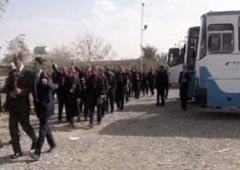
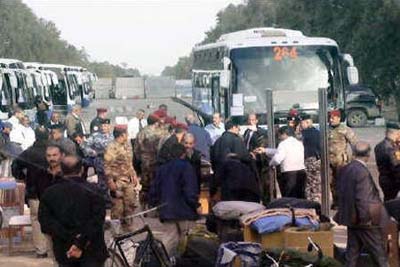
On Monday night buses moved 400 residents from Camp Ashraf – built under Saddam and which remained under the protection of U.S. forces – to a former U.S. military base in Baghdad, said Uday al-Khadran, mayor of the nearby town of Khalis.

The Iraqi government moved similar numbers of Ashraf residents to the temporary processing centre at Camp Liberty on February 18 and March 8 as part of its plans to expel them from the country.

There are now about 1,200 PMOI members at Camp Liberty and 2,000 still at Camp Ashraf. They say they fear for their safety now that U.S. troops have withdrawn from Iraq.

Residents agreed in February to move to the new camp, where the United Nations intends to process them for refugee status in other countries, but they complain that the conditions at the new base are dire. They say they have not been permitted to bring many of their personal belongings.

Behzad Saffari, a resident who moved to Camp Liberty last month and acts as a legal adviser there, said one of the new arrivals died of heart failure overnight shortly after the journey, after enduring 48 hours without sleep.

"At the movement it is a prison, with the saturation of police forces and no freedom of movement," Saffari said via telephone, since Camp Liberty is off limits to journalists.

He said others due for relocation were refusing to move to Camp Liberty until Iraqi police were withdrawn from the camp.

There is no suggestion that PMOI members will be sent back to Iran but finding refuge outside Iraq is made more complicated because the United States lists the group as a terrorist organisation. The PMOI carried out attacks decades ago including against U.S. targets but says it has long since renounced violence and shares the West’s opposition to clerical rule in Iran.

The European Union removed the PMOI from its terrorist blacklist in 2009 after being ordered to do so by a court.

(Reporting by Peter Graff in Baghdad and a Reuters correspondent in Baquba, Iraq; Writing by Peter Graff; Editing by Ben Harding)

March 24, 2012 0 comments
FacebookTwitterPinterestWhatsappTelegramSkypeEmail
Newer Posts
Older Posts

Recent Posts

  • Rebranding, too Difficult for the MEK

    December 27, 2025
  • The black box of the torture camps of the MEK

    December 24, 2025
  • Pregnancy was taboo in the MEK

    December 22, 2025
  • MEPs who lack awareness about the MEK’s nature

    December 20, 2025
  • Why did Massoud Rajavi enforce divorces in the MEK?

    December 15, 2025
  • Facebook
  • Twitter
  • Instagram
  • Youtube

© 2003 - 2025 NEJAT Society . All Rights Reserved. NejatNGO.org


Back To Top
Nejat Society
  • Home
  • Articles
  • Media
    • Cartoons
    • NewsPics
    • Photo Gallery
    • Videos
  • Publications
    • Books
    • Nejat NewsLetter
    • Pars Brief
  • About Us
  • Contact us
  • Editions
    • عربي
    • فارسی
    • Shqip