Nejat Society
  • Home
  • Articles
  • Media
    • Cartoons
    • NewsPics
    • Photo Gallery
    • Videos
  • Publications
    • Books
    • Nejat NewsLetter
    • Pars Brief
  • About Us
  • Contact us
  • Editions
    • عربي
    • فارسی
    • Shqip
Nejat Society
Nejat Society
  • Home
  • Articles
  • Media
    • Cartoons
    • NewsPics
    • Photo Gallery
    • Videos
  • Publications
    • Books
    • Nejat NewsLetter
    • Pars Brief
  • About Us
  • Contact us
  • Editions
    • عربي
    • فارسی
    • Shqip
© 2003 - 2024 NEJAT Society. nejatngo.org
MEK Camp Ashraf

State Department scrambling to move the MEK

State Department scrambling to move the MEK — to a former U.S. military base?

The Iraqi government has promised to shutter Camp Ashraf — the home of the Iranian dissident group Mujahedeen e-Khalq (MEK) — by Dec. 31. Now, the United Nations and the State Department are scrambling to move the MEK to another location inside Iraq, which just may be a former U.S. military base.

The saga puts the United Nations and President Barack Obama’s administration in the middle of a struggle between the Iraqi government, a new and fragile ally, and the MEK, a persecuted group that is also on the State Department’s list of foreign terrorist organizations.

The Marxist-Islamist group, which was formed in 1965, was used by Saddam Hussein to attack the Iranian government during the Iran-Iraq war of the 1980s, and has been implicated in the deaths of U.S. military personnel and civilians. The new Iraqi government has been trying to evict them from Camp Ashraf since the United States toppled Saddam in 2003. The U.S. military guarded the outside of the camp until handing over external security to the Iraqis in 2009. The Iraqi Army has since tried twice to enter Camp Ashraf, resulting in bloody clashes with the MEK both times.

Now the United Nations, led by Martin Kobler, the head of the U.N. Assistance Mission in Iraq (UNAMI), is working with the State Department to convince the Iraqi government and the MEK to open up a new home for MEK members inside Iraq, at a facility near the Baghdad airport. U.S. officials won’t confirm, but also won’t deny, that facility is a U.S. military base that was recently handed over to the Iraqis.

"Ambassador Kobler and we are working flat out to put together the deal for the beginning of the implementation of his plan, which is to move the people in Camp Ashraf to a new facility," a State Department official told reporters in a special Monday briefing. The United Nations and State are hoping that if an agreement is reached, the Iraqi government will push back the deadline and not invade Camp Ashraf on Dec. 31 and forcibly extradite the MEK to Iran. But time is running out.

"Time is extraordinarily short," the State Department official said. "Oh yes, we’re talking days."

The State Department official said the new facility under discussion is near the Baghdad airport, and has extensive infrastructure that "is very well known to the United States." Pressed by The Cable, the official refused to confirm that it was a former U.S. military base, but wouldn’t deny it either. "It’s a highly credible facility," the official said.

The official could not say if there was any precedent for a group that the United States labels a foreign terrorist organization being housed in a facility built by the U.S. military with U.S. taxpayer dollars, but emphasized that all U.S. military installations have now been turned over to the Iraqi government. The Victory Base Complex near the airport has several facilities that could be used for the Camp Ashraf residents.

Nobody knows how many people are in Camp Ashraf, because nobody can go inside. The residents are also suspected to be well armed. There could be as many as 3,200 people there, according to the State Department. If they are evicted from the camp, some will voluntarily go back to Iran and some will go to other countries. Others still may not actually be MEK members but could be living there for their own reason, making their relocation easier, the official said. The unknown number of "card-carrying members" of the MEK who can’t or won’t be relocated are the ones who the United Nations and State are trying to move to the new camp.

The United Nations and the Iraqi government have agreed on the basic way forward, but the MEK is not on board, the State Department official said. The Iraqi government won’t talk directly to the MEK, and the MEK leadership living in Paris may have different priorities than the people actually living in Camp Ashraf.

Of course, the Iraqis have been warning for months that they would close Camp Ashraf by the end of the year. So why is everybody scrambling in the last two weeks? The State Department is placing the blame squarely on the MEK.

"For a long time, the MEK position was ‘here we are and here we stay, period,’" a State Department official said. "In recent days we’ve had the first signs that the MEK is finally, at long last, beginning to engage in a serious way, rather than simply politically through its many, many advocates. This is a good sign."

Reporters at the briefing wondered why the United Nations and State think simply relocating the MEK to another facility will solve the problem of its status as a terrorist group whose members are unable to get refugee status in a country where they are not welcome. The official said the new facility would be better because it would give the Iraqi government some control over what goes on there.

"[Camp Ashraf] is a state within a state. It is run by the MEK and when anybody else tries to enter, well, we’ve seen what occurs," one State Department official said, explaining that the new camp would have some type of Iraqi government administration and yet not be in total control of the MEK. "Iraqi soveriegnty will prevail with a robust set or arrangements and U.N. monitoring."

Another reason the United Nations and State are pushing for the MEK to be moved from Camp Ashraf to another facility is that the U.N. High Commission for Refugees (UNHCR) has refused to give refugee status to Ashraf residents because of the MEK’s tight control over the people there.

"Many international observers have regarding the current facility at Camp Ashraf as a coercive environment. Independent observers have called it a cult," the State Department said. "The UNHCR requires an atmosphere in which people can make their own choice free of group pressure. What’s happened in Camp Ashraf has not been conducive to this."

Advocating for the MEK is a tricky proposition for the State Department, because the organization is on its list of foreign terrorist organizations. The MEK has been lobbying hard for its removal from that list and State’s review of their status has been "ongoing" for years.

As part of its multi-million dollar lobbying effort, the MEK has paid dozens of top U.S. officials and former officials to speak on its behalf, sometimes at rallies on the State Department’s doorstep. MEK supporters have been stationed outside the State Department non-stop for months now, and are even showing up at Congressional hearings.

Their list of advocates, most who have admitted being paid, includes Congressman John Lewis (D-GA), former Pennsylvania Gov. Ed Rendell, former FBI Director Louis Freeh, former Sen. Robert Torricelli, Rep. Patrick Kennedy, former CIA Deputy Director of Clandestine Operations John Sano, former National Security Advisor James Jones, former Vermont Gov. Howard Dean, former New York Mayor Rudolph Giuliani, former Joint Chiefs Chairman Gen. Richard Myers, former White House Chief of Staff Andy Card, Gen. Wesley Clark, former Rep. Lee Hamilton, former CIA Director Porter Goss, senior advisor to the Romney campaign Mitchell Reiss, Gen. Anthony Zinni, former Pennsylvania Gov. Tom Ridge, former Sen. Evan Bayh, and many others.

The State Department officials didn’t say outright that these officials are making the challenge of dealing with the MEK worse by shilling for the organization around Washington. But they did call on the MEK’s paid representatives to use whatever clout they have to urge the MEK to go along with the relocation now.

"It is important for those advocates to support a solution that is feasible. Because maximalist demands and echoing a kind of martyrdom and complex of defiance and blood will produce the results they fear. Now is the time for everybody who says they want a peaceful solution to back that solution right now," the official said.

But what happens after the MEK moves to the new facility, even if the current deal is worked out in time? What’s the plan to deal with these people over the long run?

"Right now our priority is in a successful, peaceful relocation," the State Department official said. "One huge problem at a time."

UPDATE: The AP reported has just reported that Iraqi Prime Minister Nouri al-Maliki has decided to grant a 6-month extenstion on the closing of Camp Ashraf, although he is backdating the start of the extension to November.

December 22, 2011 0 comments
FacebookTwitterPinterestWhatsappTelegramSkypeEmail
France

Rajavi relocates Camp Ashraf to France

Open letter of Iran – Ghalam Association to the honorable Mayors, Former French Representatives and the Deans of Universities in France

It is completely understandable from the current pmoi propaganda( people’s Mujahedin Open letter of Iran - Ghalam AssociationOrganization ) in their Media which this cult is trying its best to transfer and convey its activities from Iraq to the French soil , specially after their strategic failure and impasse in Iraq , now they have targeted the Mayors from different cities in Paris and Val d’Oise province as well as some of the former representatives and members of French parliament by their propaganda.

The members of Iran – Ghalam Association who had been the members of pmoi for a long period of time and fortunately they have succeeded to rescue themselves from the cultic subjective and physical barriers and obstacles and they are currently living in Europe countries such as France, would like to inform the honorable French politicians and warn them about the connection which this cult ( Rajavi cult) wants to have with them.

If the French politicians do not pay enough attention to the vital experiences which these former members of pmoi have about the pmoi threats , allure and propaganda, it does not take long that the same current problem which is about dealing with the presence of this terrorist cult on Iraq soil, will happen on French soil and its politicians as well. For this reason we are urging all French politicians , the former representatives of French parliament and the deans of the French universities to listen to our compassionate warnings and pay enough attention to them.

As you know , after the fall of Saddam Hussein , the former dictator of Iraq , some of the terrorist cults and sects which had regional and universal activities, lost their supporter and their sponsor, one of those cults is pmoi( People’s Mujahedin Organization ).

Pmoi did not have any tolerance to listen to any dissents and criticisms which the dissidents and critics had in their relations in pmoi , and for that reason they were sent to prison to show others a lesson that any objection and criticism against the pmoi leadership will end up in prison. There are many people who tolerated the harsh tortures and long incarcerations in the prisons of Mr and Mrs Rajavi and beyond that the leader of National Council of resistance ( NCR) , the pmoi political wing based in France , has approved and authorized killing and assassination of the dissidents and critics as well.

We would like to pose some questions to the French politicians and the people who have been targeted unilaterally by the pmoi propaganda ;

1. Why is the compulsory divorce , marriage and family ban in pmoi?

2. Why up to now the leaders of pmoi such as Mrs. Maryam Rajavi who is currently living in Auvers Sur Oise , Paris outskirts, have not mentioned anything about the outcome of their strategy of violence and war which terrorized and killed thousands of Iranians ?

3. Why are the members of this cult forced to participate every night in the sessions which is called current mission( Amaliyateh Jari)and they have to reveal their thoughts , imaginations , even their dreams about the opposite sex in those sessions to be ridiculed , insulted , slandered, blamed and punished ?

4. Why in those brainwashing sessions which are the most unethical tactics to put psychological pressure on members to force them to obey and surrender themselves to any illogical demands?

We would like also to mention that all cults need an isolated place with high walls to carry out and implement the brainwashing technique on their members , the Ashraf castle in Iraq and Auvers sur Oise castle in France have provided for such purpose for pmoi terrorist cult .

At the end we would like all the French politicians , the former representatives and members of French parliament and the deans of the French universities, according to the pmoi regional and universal threats to pay enough attention to the vital points and facts which mentioned above.

Respectfully
Iran Ghalam Association

Transcript
-The mayors of France
– The representatives and members of the French parliament
– The deans of Paris universities
-The French presidential office

Ghalam Association,

December 21, 2011 0 comments
FacebookTwitterPinterestWhatsappTelegramSkypeEmail
MEK Camp Ashraf

Iranian exiles ;MEK ready to leave Iraq camp

The head of an Iranian exile group says more than 3,000 of its members holed up in a camp in Iranian exiles ;MEK ready to leave Iraq campeastern Iraq are ready to leave if they get U.S. and U.N. security guarantees.

Paris-based leader Maryam Rajavi said in a statement Tuesday that Camp Ashraf residents are "in principle prepared to relocate to Camp Liberty" _ a recently vacated former United States military base _ if their safety can be guaranteed.

The armed People’s Mujahedeen Organization of Iran moved to the camp during the regime of Saddam Hussein, who saw them as a convenient ally against Tehran. They were disarmed by U.S. soldiers during the Iraq invasion in 2003, and have since become an irritant to Iraq’s Shiite-led government, which is now trying to bolster ties with its neighbor.

The United Nations has said that at least 34 people were killed in an April raid on the camp by Iraqi security forces, and Iraq authorities have vowed to close the facility by Dec. 31.

The Obama">Obama administration _ hoping to avoid a possible violent standoff with Iraqi authorities _ urged the residents Monday to accept a U.N.-brokered deal to move to the temporary site near Baghdad airport where arrangements would be made for them to resettle elsewhere.

The Iranian dissidents have previously resisted leaving, saying they fear persecution at the hands of Iraqi authorities, and sought an extension to the Iraqi deadline.

But on Tuesday, Rajavi said for the move to Camp Liberty to be completed, the "minimum guarantees for the residents’ safety and well-being in order to prevent a recurrence of violence and bloodshed until the residents are resettled in third countries" must be given.

The group said Rajavi had sent a letter Dec. 10 to President Barack Obama">Obama and U.N. Secretary-General Ban Ki-moon outlining the guarantees the dissidents are seeking, including security protection during and after the move by the U.S., European or U.N. forces _ not by the Iraqi government.

U.N. spokesman Martin Nesirky said Tuesday that the top U.N. envoy in Iraq, Martin Kobler, has made helping the Iraqi authorities and camp residents find a workable solution "a top priority."

"The U.N.’s role here is to facilitate, to help the Iraqi government and the camp residents," Nesirky said. "It is very important to note that ultimately it is the responsibility of the Iraqi authorities to work to find a peaceful way out of this, and for the residents of the camp likewise to shoulder their responsibility."

U.S. officials said Monday that the new facility would remain under Iraqi government control, but come under U.N. supervision. Residents not wanting to return to Iran, or live in third countries to which they have family ties, would be able to apply for U.N. refugee status, they said.

The People’s Mujahedeen has been branded a foreign terrorist organization by the U.S., a designation now under review by the State Department. It has been removed from similar blacklists in Europe.

By ANGELA CHARLTON

December 21, 2011 0 comments
FacebookTwitterPinterestWhatsappTelegramSkypeEmail
MEK Camp Ashraf

MEK exiles in Iraq may accept U.N. plan

The leader of an exiled Iranian opposition group said on Tuesday it would agree to a United Nations plan to move residents of a dissident camp in Iraq to a new location, depending on MEK exiles in Iraq may accept U.N. plancertain conditions and guarantees.

The settlement known as Camp Ashraf, some 65 km (40 miles) from Baghdad, is the base of the People’s Mujahideen Organization of Iran, or PMOI, an Iranian opposition group that Washington officially considers a terrorist group.

The Iraqi government, which is friendly with Tehran, has said it intends to close down the camp, home to an estimated 3,000 Iranian dissidents, by the end of this year, leaving less than two weeks to work out a solution.
Maryam Rajavi ,the so called leader of MKO
As described by U.S. officials on Monday, the U.N. plan would move the residents to a location near the Baghdad airport, where the United Nations would monitor them and process them for possible resettlement as refugees.

In a statement, PMOI leader Maryam Rajavi said the camp’s residents were "in principle" prepared to relocate on condition that the United Nations, United States and European Union support and endorse the proposal and that the Iraqi government guarantee the residents’ security and well-being.

The fate of Camp Ashraf is one of the main unresolved issues left over after U.S. forces withdrew from Iraq this month. Residents of the camp have long said they fear for their safety at the hands of Iraqi authorities without U.S. protection.

In April, the camp was the scene of clashes between residents and Iraqi security forces, during which 34 people were killed, according to a U.N. investigation.

U.S. officials have urged residents to accept the U.N. plan.

Rajavi said Baghdad had refused U.S., U.N. or European Union forces protecting the camp, so the group wanted "minimum" guarantees before it would accept the plan.

Its demands include no Iraqi forces being allowed within the camp, independent U.N. and U.S. observers based at the new settlement, the end of harassment of camp residents, provision of medical supplies and international supervision of the transfer of residents and all belongings to the new camp.

Resettling the dissidents in other countries will not be easy given that some may be afraid to return to Iran, where they could be viewed as enemies of the state, while others may be regarded as terrorists by the United States or other nations.

In the 1970s the group, which is also known as the Mujahadin-e Khalq (MEK), led a guerrilla campaign against the U.S.-backed Shah of Iran, including attacks on U.S. targets. It says it has since renounced violence.

Reporting By John Irish

December 21, 2011 0 comments
FacebookTwitterPinterestWhatsappTelegramSkypeEmail
MEK Camp Ashraf

With deadline looming to close MEK’s Camp Ashraf in Iraq, what next?

The fate of some 3,200 anti-Iran militants on the US terrorism list hang in the balance, as an end-of-year deadline looms to close Camp Ashraf in Iraq.

American officials have expressed fears that the leadership of the Mojahedin-e Khalq (MEK/MKO) – which US government reports frequently describe as a cult – may order the massacre of their followers, rather than permit the peaceful disbandment of Camp Ashraf, which would deprive the MEK of one of its most powerful assets.

With deadline looming to close MEK's Camp Ashraf in Iraq, what next?

But Maryam Rajavi, the MEK’s self-styled "president elect" of Iran, said today the group accepted "in principle" a UN plan – if there were "minimum" US and Western guarantees of safety – to relocate members to a former US base near Baghdad airport for individual processing and possible resettlement as refugees.

The Shiite-led government of Nouri al-Maliki, which has close ties to Iran, has made clear its determination to close the base set up by Saddam Hussein in the 1980s.

In Iran, the MEK are widely despised as traitors for fighting alongside Iraqi forces in the Iran-Iraq War. In Iraq, few also have sympathy for the group, which Mr. Hussein deployed to help crush a popular Kurdish uprising in 1991.

"How shall we accept the killers of our sons?" asked Adnan al-Shamani, a Shiite lawmaker speaking at a recent government-sponsored conference in Baghdad to protest the MEK presence.

The decision to close the camp was "supported by the majority of parliament and the majority of the Iraqi people," said Mr. Shamani. "No one has the right to impose their will on Iraqi land, except Iraqis."

A negotiated solution?
United Nations and US officials appear to have made some progress in talks with Mrs. Rajavi, who is based in Paris.

Her husband and MEK leader Massoud Rajavi went into hiding in 2003, though several former Ashraf residents claim to have seen him at the camp as recently as 2007, and that he continued to address them by video link until seven months ago.

"After much regrettable stalling, the MEK finally seems ready to engage seriously," a US official told the Inter-Press Service, a news agency, in Washington. The MEK has backed off from "maximalist positions" in recent days, the official said, but "we’re still hearing talk about martyrdom and dying."

The risks of violence are high, and come from both sides. Clashes erupted at Camp Ashraf in April, leaving 34 MEK members dead, when Iraqi forces took control of a portion of the sprawling site. The MEK has a long anti-American history, and as a revolutionary group killed at least six US military advisers in Iran before the 1979 Islamic revolution.

In the aftermath of the US invasion of Iraq in 2003, some Pentagon officials saw the MEK as a potential weapon against the Islamic Republic of Iran. Repeated calls by Iraqi officials since 2004 to disband the camp have until now been ignored.

But with the complete withdrawal of US forces from Iraq this week, options for the MEK have narrowed.

"From their first day in Iraq, [the MEK] accepted to be a tool of the intelligence and security of the former regime, especially against Iran," Saeed Al-Jayashi, a representive of Iraq’s former National Security Adviser Mowaffak al-Rubaie, told the recent Baghdad meeting of Iraqi officials, tribal sheikhs, and Iranian families of those in Camp Ashraf.

"Any terrorist group that wants to stay in the country is not looking for safe haven, but a base for terrorist attacks," said Mr. Jayashi. "Western societies talk about human rights; I ask them to save these people from unfair separation from their families, and the strange life in this camp."

"How shall we talk to the Iraqi victims of this organization? We should stand in one line to deport them," he added. "Their choice is to go to Iran or choose another country; you can’t stay in Iraq."

Protests
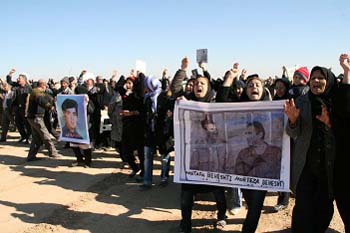
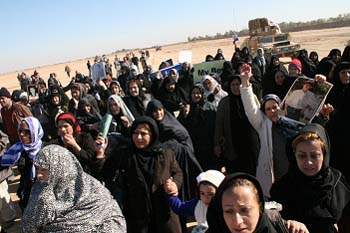
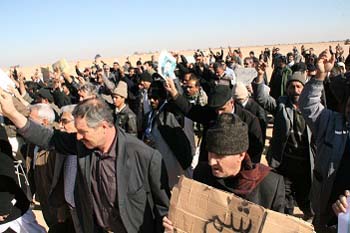
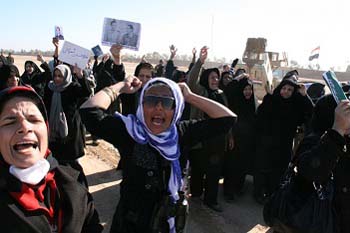
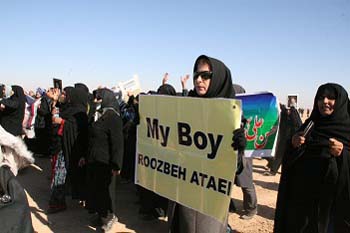
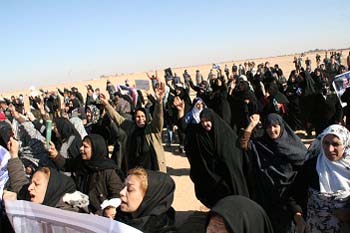
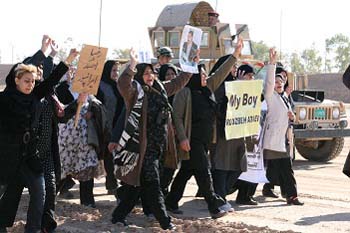
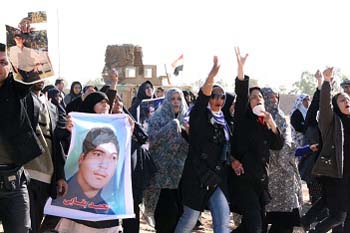
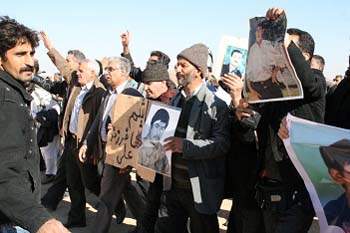
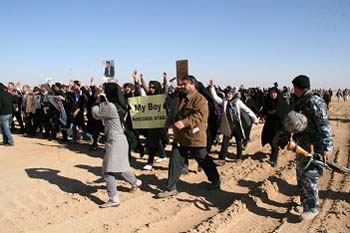
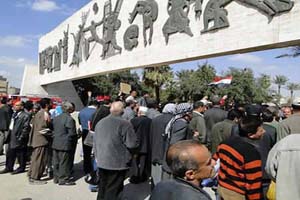
Several such meetings, and a string of anti-MEK protests in Baghdad and at the Ashraf gate, project the same message.

"No to an extension. Yes to deporting the terrorist group," reads one banner. Family members holding framed portraits wore bibs emblazoned on the back: "Free our children."

Between speeches, one man wearing Iraqi tribal dress stood up and shouted: "These criminals are not from us! We have no connection with them."

A male quartet took to the stage, with a song about MEK "hypocrites" causing thousands of deaths, who were "embracing each other over our bodies."

Despite the MEK’s status on the US terrorism list, which it shares with Al Qaeda and Hezbollah, the group says it renounced violence in 2001.

But the US State Department in autumn 2009 submitted information in court that the MEK had trained women at Ashraf "to perform suicide attacks" in the Iraqi shrine city of Karbala.

A declassified FBI report from 2004 similarly found – with data corroborated by French and German wiretaps – that MEK cells in the US, Europe, and Camp Ashraf were "actively … planning and executing acts of terrorism."

Violence renounced?
The MEK denies those charges, and has enlisted dozens of top-ranking former US officials and four-star generals – many of them paid tens of thousands of dollars in speakers fees – to make its case to get off the US terror list, and for protection of those at Camp Ashraf. They say Ashraf’s residents are anti-regime "freedom fighters."

Among the American advocates are former New York mayor Rudy Giuliani; former US homeland security chief Tom Ridge; former CIA directors James Woolsey, Porter Goss, and Michael Hayden; and top retired generals such as Wesley Clark, Hugh Shelton, and Peter Pace.

"This is genocide, and we will not have it!" Howard Dean, the former chairman of the Democratic National Committee, told a pro-MEK audience in July, about Iraqi plans to close the camp.[..]

At the camp itself, MEK members long ago had their identity documents confiscated, and have little access to the outside world through phones, Internet, or TV. They must take part in self-criticism sessions to expel "deviant thoughts" and pledge "eternal divorce."

Free will?
A detailed 2009 report, funded by the US military and published by the RAND corporation, says that the majority at Camp Ashraf "may have been recruited through deception" and remain there "against their will.

"Love for the Rajavis was to replace love for spouses and family," the report reads. MEK members once carried cyanide tablets in case of capture, and since 2003 "the MEK frequently used the threat of suicide as a negotiating tactic or to frustrate investigations."

Mrs. Rajavi’s temporary arrest by French authorities on terrorism charges in 2003 prompted a wave of self-immolations.

Recent MEK defectors from the camp interviewed by the Monitor say further dramatic acts may take place, as the deadline nears.

"It’s clear to me, [Mr. Rajavi] wants people to get killed, and send it to the media," argues Shahram Heydari, who left the camp two months ago. When the April clashes took place with Iraqi troops, he claims, "I clearly saw they [MEK] were pushing people forward" into the line of fire.

Rajavi’s "strategy is based on Ashraf," says Mr. Heydari. "He must have the camp to keep power."

Several defectors say they believe Rajavi is in the camp. A former member of the MEK leadership council, Maryam Sanjabi, defected 10 months ago after spending 24 years at Ashraf. She says she saw Mr. Rajavi "many times," up until four years go.

"He’s there, he’s alive…. His orders are being carried out there – he is the brain," says Sanjabi. Years of brainwashing to make MEK members believe Rajavi "is a god," means the leadership may calculate it "doesn’t matter if one thousand people die," she says.

"If you are ordered to burn yourself, you can’t resist: you burn yourself," says Sanjabi.

By Scott Peterson

December 21, 2011 0 comments
FacebookTwitterPinterestWhatsappTelegramSkypeEmail
Iran

MKO frustrated, after US departure from Iraq

"Throughout its military presence in Iraq, US supported the MKO, but now that they are leaving Iraq, MKO feels frustrated," said Iran’s Ambassador to Iraq Hassan Danaifar.

According to Habilian Association database (families of terror victims of Iran), Iran’s Ambassador to Iraq Hassan Danaifar made the remarks on MKO in an interview with Mehr News Agency.

Following are excerpts of the interview as translated and condensed by Habilian Association database:

MNA: Iraq has announced that Mujahedin-e Khalq has to leave Iraq by year-end. Undoubtedly, winding down U.S. forces in Iraq, caused MKO members to lose one of their main supporters in Iraq. How do you assess MKO’s condition after the withdrawal of US troops from Iraq?

Hassan Danaifar: It is obvious to all that this group has been operating as the proxies and mercenary forces for the enemies of Iran, for more than two decades. Most of the escapees of the Camp Ashraf who have returned to Iran, expressed that what MKO do are acts of treason, and even if we are opposed to our government, we will never cooperate with them, since committing espionage on one’s own country is considered wrong and unacceptable anywhere.

This cell has done many operations against Iran both under Saddam’s regime and at the time of US presence in Iraq. It sounded strange to us: although Americans put the MKO on the list of terrorist groups, they are cooperating with them. As you know they have made strong and concerted efforts to get off US terrorist list, but all in vain.

Throughout their presence in Iraq, US supported the MKO, but, now that they are leaving Iraq, MKO feels frustrated. They failed to persuade US to remain in Iraq. Iraqi government has officially announced and all its officials insist that this military base must be dismantled by the end of 2011, then whoever in European countries, who believe in this group, accept them in their own countries. Though, no country is willing to offer asylum to them.

It’s also interesting that American officials have negotiated with European countries regarding hosting MKO members, and the official in charge of MKO issue in the US Department of State have traveled three times to several European countries, in order to persuade them to host MKO members inside their countries, but they failed. The United Nations in recent days has been trying to take out the MKO members out of Iraq in a peaceful and orderly way. Those who want to return to their country will be repatriated, and those who have EU passports can go to European countries.

December 20, 2011 0 comments
FacebookTwitterPinterestWhatsappTelegramSkypeEmail
The MEK Expulsion from Iraq

Egypt Cancels MKO Meeting in Cairo

The Egyptian government voiced its strong opposition to a planned meeting of the anti-Iran terrorist Mojahedin-e Khalq Organization (MKO) in Cairo and cancelled the convention. Egypt Cancels MKO Meeting in Cairo
The meeting was scheduled to be held this afternoon in Pyramisa Hotel in Cairo, but the terrorist group canceled the meeting after the government of Egypt expressed its strong opposition and did not issue the necessary permission for the meeting.

The meeting organized by a number of MKO members in Iraq was aimed at demanding the UN and the international community to urge Baghdad to postpone the deadline for the expulsion of MKO members from Iraqi soil.

MKO’s members have two weeks to leave Iraq.

The MKO has been in Iraq’s Diyala province since the 1980s.

Iraqi security forces took control of the training base of the MKO at Camp Ashraf – about 60km (37 miles) North of Baghdad – in 2009 and detained dozens of the members of the terrorist group.

The Iraqi authority also changed the name of the military center from Camp Ashraf to the Camp of New Iraq.

Meantime, a report earlier this week disclosed that the main leader of the MKO, Massoud Rajavi, in remarks interpreted as informally declaring war on Iraq cautioned that he would not allow Baghdad to expel the group from Iraq, and stressed that he will keep the MKO in the country even if it costs the lives of all the group members.

According to a report published by the Habilian website, the official website of Iran’s Habilian Association – a human rights group formed by the families of 17,000 terror victims in Iran – on Tuesday, Rajavi has ordered the commanders of Camp Ashraf (the MKO’s main training center located in Iraq’s Northern Diyala province) to be ready to resist against the Iraqi forces, saying that it would not matter if all Camp residents are killed for obtaining his desired goals.

He also ordered his commanders to strengthen the military positions at the camp and in the surrounding areas by erecting numerous bulwarks and hurdles around the Camp and be ready for a war with the Iraqi government.

The MKO, whose main stronghold is in Iraq, is blacklisted by much of the international community, including the United States.

The MKO is behind a slew of assassinations and bombings inside Iran, a number of EU parliamentarians said in a recent letter in which they slammed a British court decision to remove the MKO from the British terror list. The EU officials also added that the group has no public support within Iran because of their role in helping Saddam Hussein in the Iraqi imposed war on Iran (1980-1988).

The group started assassination of the citizens and officials after the revolution in a bid to take control of the newly established Islamic Republic. It killed several of Iran’s new leaders in the early years after the revolution, including the then President, Mohammad Ali Rajayee, Prime Minister, Mohammad Javad Bahonar and the Judiciary Chief, Mohammad Hossein Beheshti who were killed in bomb attacks by MKO members in 1981.
The group fled to Iraq in 1986, where it was protected by Saddam Hussein and where it helped the Iraqi dictator suppress Shiite and Kurd uprisings in the country.

The terrorist group joined Saddam’s army during the Iraqi imposed war on Iran (1980-1988) and helped Saddam and killed thousands of Iranian civilians and soldiers during the US-backed Iraqi imposed war on Iran.

Since the 2003 US invasion of Iraq, the group, which now adheres to a pro-free-market philosophy, has been strongly backed by neo-conservatives in the United States, who also argue for the MKO to be taken off the US terror list.

Since the beginning of this year, the Baghdad government has repeatedly assured Iranian officials and people that it is determined to expel the MKO from Iraq by the end of 2011.

Last Sunday, Iraqi Ambassador to Tehran Mohammad Majid al-Sheikh underscored Baghdad’s serious decision for expelling the MKO from Iraq, and said the decision is irreversible.

"Based on the Iraqi government’s decision, the MKO members should leave our country by the end of 2011," al-Sheikh told FNA, and reiterated, "The decision is irreversible and definite."

December 20, 2011 0 comments
FacebookTwitterPinterestWhatsappTelegramSkypeEmail
USA

U.S. supports plan to relocate MEK terror group

The Obama administration "welcomes" a United Nations-led effort in Iraq to relocate a group on the State Department terrorism list, before an end-of-the-year deadline that could see heavy violence and a large humanitarian disaster unfold, senior administration officials said Monday.

The Iraqi government has said it will close Camp Ashraf – the home of the Iranian opposition group Mujahedin-e Khalq, or MEK – by December 31, without offering clear assurances the refugees will be protected against attacks by Iraqi forces, or reprisals from neighboring Iran. MEK has been on the U.S. terrorism list since 1997 because of the killing of six Americans in Iran in the 1970s, and an attempted attack against the Iranian mission to the United Nations in 1992.
The administration is supporting a plan led by Ambassador Martin Kobler, the U.N. special representative to Iraq, that would allow for a peaceful transfer of the approximately 3,400 residents of Camp Ashraf to a new facility in Iraq, one official said. The plan would also work to repatriate MEK members to Iran who go "voluntarily," or resettle to third countries under the auspices of the U.N., the official said.

"The good news here is that in the past two weeks, Ambassador Kobler and the Iraqi government have made significant progress on this plan," the official told reporter at a briefing. That official and another senior administration official declined to be named due to the sensitivity of ongoing negotiations between the U.N., the Iraqi government, and the MEK.

Under the plan being negotiated, a single "temporary relocation" facility for people now at Camp Ashraf would be established near the Baghdad International Airport, the official said, with that location in "an accessible, not inaccessible part of the country."

The plan would be administered by the Iraqi government. The U.N. high commissioner for refugees would process the MEK residents for refugee status, with the U.N. monitoring the entire process from beginning to end. The relocation facility would remain open until all residents are eventually relocated the official said.

"It will not in effect be an MEK-run facility, this is an Iraqi facility," the official said, while stressing there would be U.N. monitors present to assure the facility does "not exist in the dark."
A second administration official described the facility as one with a good deal of "infrastructure," and at a site that is "well known" to the United States. Neither official would confirm or deny whether the proposed facility is a former U.S. military base that was handed over to the Iraqi government when U.S. forces withdrew from the country.

Camp Ashraf was established in 1986 after Saddam Hussein invited members of the MEK to relocate to Iraq in an effort to undermine the Iranian government, which was at war with Iraq.
Up until "recent days," the administration official said the MEK had not engaged in a meaningful way with the government of Iraq and the U.N. in order to devise a way forward for the closure of Camp Ashraf.

"The Iraqi government has been constructive, and if they keep working with Ambassador Kolber as they have, that’s quite good," the first official said. "The MEK having just recently engaged, needs to get in all the way in a constructive fashion," the official said adding the United States continues to support Kolber’s efforts.

If the plan is implemented, the United States and Europe "will have to do whatever we can do within our laws to look at individuals whom the (U.N. high commissioner for refugees) has made eligible for refugee status, and we will have to consider what we can do to take them," working within U.S. immigration laws, the official said. That aspect of the plan will be tough to reconcile as the United States has been unable to definitively determine the entire makeup of Camp Ashraf, saying some residents are not MEK members, but probably came to the camp under different circumstances.

The official noted that although MEK is on the U.S. terrorist list, "we can look at individual refugee cases on an individual basis," as a matter of U.S. law.

The State Department is in the process of determining whether to remove MEK from the terror list. When asked for an update to that decision, both administration officials would only describe the process as "ongoing."

Iraqi Prime Minister Nouri al-Maliki, who has close ties to Iran, has opposed MEK’s presence in Iraq.

MEK has said Iraqi forces staged multiple attacks on Camp Ashraf earlier this year, killing nearly 50 people. Sen. John Kerry, D-Massachusetts, chairman of the Senate Foreign Relations Committee, described the attack as a "massacre."

Since 2004, the United States has considered the residents of Camp Ashraf "noncombatants" and "protected persons" under the Geneva Conventions. A United Nations commission on refugees has described those at Camp Ashraf as "formal asylum seekers" against persecution by the regime in Iran.

U.S. forces had handed security of Camp Ashraf to the Iraqi government before the departure of U.S. forces from Iraq last week.

By Jamie Crawford

December 20, 2011 0 comments
FacebookTwitterPinterestWhatsappTelegramSkypeEmail
MEK Camp Ashraf

Mass Tragedy Feared as Closure of MEK Camp Looms

The Barack Obama administration and the United Nations are struggling to convince the leadership of the Mujaheddin-e Khalq (MEK), an Iranian opposition group with cult-like characteristics, to vacate a camp in Iraq and allow residents to move to another location in the country or risk the lives of as many as 3,200 people.

U.S. officials fear that unless MEK leader Maryam Rajavi gives her approval, there will be a bloodbath at Camp Ashraf, an MEK base 56 kilometers north of BaghdadMass Tragedy Feared as Closure of MEK Camp Looms that Iraqi leaders insist must close by Dec. 31. There are particular concerns that MEK members will clash with Iraqi security forces or commit mass suicide.

An Obama administration official who spoke to IPS on condition that he not be named said, "The Iraqi government and U.N. ambassador (to Iraq) Martin Kobler have made significant progress recently" but that MEK leaders have still not signed off on the plan, which would transfer residents in stages to Camp Liberty, a former U.S. military base near Baghdad airport.

There, officials from the U.N. High Commissioner for Refugees (UNHCR) would be able to interview MEK members individually to determine their preferences for resettlement.

"After much regrettable stalling, the MEK finally seems ready to engage seriously," the official said Monday. "This is good, but the MEK must be realistic, and time is short."

The official added that while MEK leaders have backed off from "maximalist positions" in the last 48 hours, "We’re still hearing talk about martyrdom and dying."

The Obama administration has been working with the United Nations and Iraq to facilitate the transfer of the estimated 3,200 Ashraf residents. Vincent Cochetel, Washington representative for UNHCR, told IPS in September that the MEK had agreed to the plan through the organisation’s legal counsel in London.

But Rajavi, who lives outside Paris and met with Kobler last weekend, is insisting that U.S. or U.N. troops accompany the Ashraf residents, according to a source with knowledge of the meeting who spoke on condition of anonymity. Iraq has agreed to U.N. monitoring of the transfer but not the presence of foreign troops.

The United States last weekend withdrew the last of its forces from Iraq under the terms of a status of forces agreement and is not about to send them back for this purpose.

Human rights organisations have urged the Obama administration to call on the Iraqi government to extend the deadline.

Sanjeev Bery, advocacy director for the Middle East and North Africa at Amnesty International, told IPS in an email that the organisation "is concerned that Camp Ashraf residents are at serious risk of severe human rights violations if the Iraqi government goes ahead with its plans to force the closure of the camp by the end of this month."

The email noted that there had been several attacks on the camp by Iraqi security forces, most recently in April, which "resulted in the deaths of dozens of residents and injuries to others".

The senior administration official said Amnesty, instead, should urge the MEK to sign onto the plan "at hand and not encourage people to die".

Experts on the MEK accuse its leaders of holding its own members hostage to efforts to get the organisation removed from the U.S. State Department’s list of Foreign Terrorist Organisations. The State Department has been reviewing the MEK’s status for months but has tried to decouple the process from efforts to resolve the impasse over Ashraf.

MEK supporters say the group has renounced terrorism. They have mounted an elaborate campaign to be removed from the terrorist list that has included expensive full-page ads in major U.S. newspapers and paid speeches by prominent former U.S. officials.

However, Trita Parsi, president of the National Iranian American Council, told IPS, "If an organisation is ordering innocent residents of a camp to commit suicide or have themselves killed if their leaders don’t get the outcome they are seeking, isn’t that the definition of a terrorist group?"

U.S. officials do not know for sure how many people are at Ashraf but believe they include minors and others who were tricked into going to the camp. There they were subjected to military training and mind control exercises that include cult-like devotion to Mrs. Rajavi and her husband Massoud, whose whereabouts are unknown.

The prolonged presence of the MEK at Camp Ashraf has been a major irritant for Iraqi officials since the end of Saddam Hussein’s regime in 2003.

A Marxist-Islamist group that helped remove the Shah of Iran but lost out in a post-revolution power struggle, the MEK found refuge in Iraq and fought on the side of Saddam’s forces against Iran in the 1980-88 Iran-Iraq war. It also helped Saddam suppress uprisings by Iraqi Shiites and Kurds following the 1991 Gulf War and carried out a series of high-profile attacks on Iranian officials during the 1990s.

The U.S. State Department put the MEK on its list of foreign terrorist organisations in 1997.

Iraqi officials have promised to give the U.N. sufficient time to process the camp members – provided they leave Ashraf.

Even if they do accept transfer, it will be difficult to resettle the residents. Several hundred camp residents have returned to Iran since 2003 through the auspices of the International Red Cross.
[..]European countries are also not eager to accept MEK members, many of whom have been subjected to brainwashing.

Taking the group off the U.S. terrorist list would not mean that members could automatically come to the United States. U.S. law forbids immigration to "those who provided material support to, or received military-type training" from any organisation that has been on the terrorist list, according to another State Department official who spoke to IPS recently on condition of anonymity.

The Obama administration has tasked Daniel Fried, a former assistant secretary of State for European affairs, with resolving the crisis. Fried’s office is also responsible for resettling Guantanamo detainees.

By Barbara Slavin

December 20, 2011 0 comments
FacebookTwitterPinterestWhatsappTelegramSkypeEmail
Former members of the MEK

Three Former members announce separation from the MKO

As it was previously reported, three residents of Camp Ashraf fled the camp on Friday December 2nd,2011 and joined families picketing in front of the Camp.


The following is the statement issued by the three to declare their separation from the MKO:

We, declare our separation from the terrorist cult of Mujahedin Khalq, noting that we were deceived and recruited by Massoud Rajavi and his agents who took us to camp Ashraf Iraq, under the pretext of giving us membership in an employment agency and sending us to Europe.
 

Once we found out what their real intention was, we tried to return but they threatened us to be handed to Iraqi Baath government that then would imprison us in Abu Quraib and from there we would be sent to Iran where we would allegedly be executed as the MKO members.

Thus, we were forced to spend the best part of our life in Camp Ashraf, imprisoned under daily psychological pressure. Self-criticism sessions and psychological torture were going on every day.

During recent clashes with Iraqi forces, they made us get involved in clashes with Iraqis. They told that the Iraqi soldiers had come there to arrest us and hand us to Iran where we would be certainly tortured and executed. Therefore we thought that we had to fight with Iraqi forces at any cost even our death.

Families’ presence in front of the Camp, created hope of a new life in our hearts and the fear of leaving the group and fear of Iraqi forces lowered in our heart. We were relatively assured that outside Ashraf there would be another life.

The loudspeakers through which families called their children were our only hope in that prison.

We hope that until the day the last resident is released, the presence of families and the sound of their loudspeakers not be ended.

Ultimately, we risked our lives and tried to release ourselves. We had worked on our plan for escape for several months.

We are thankful to the God that helped us escape the horrifying castle and join Iraqi forces.

During our presence in the MKO, we witnessed the atrocities the leaders committed against us and other members. This is our right to campaign against them in Iraqi judicial community as well as the international community for the years MKO leaders deprived us from our basic human rights that are respected by any dictator in any detainment.


Ali Qezel Qarshi entered the MKO in 1992

Sadeq Khavari entered the MKO in 2000

Mohammmad Khavari Golshirmiri entered the MKO in 2000

By SFF – Translated by Nejat Society

December 19, 2011 0 comments
FacebookTwitterPinterestWhatsappTelegramSkypeEmail
Newer Posts
Older Posts

Recent Posts

  • A Comparative Analysis of Psychological Control Mechanisms in Jeffrey Epstein’s Cult and the MEK

    August 3, 2026
  • Operation Mersad: How Iran foiled Saddam’s final gambit 37 years ago

    August 1, 2026
  • Ideology Cannot Prevail over Human Dignity

    July 29, 2026
  • Is Rudy Giuliani so naïve to support MEK terrorists?

    July 27, 2026
  • National Pride of Iranians: Reject the Rajavis and their Patrons

    July 22, 2026
  • Facebook
  • Twitter
  • Instagram
  • Youtube

© 2003 - 2025 NEJAT Society . All Rights Reserved. NejatNGO.org


Back To Top
Nejat Society
  • Home
  • Articles
  • Media
    • Cartoons
    • NewsPics
    • Photo Gallery
    • Videos
  • Publications
    • Books
    • Nejat NewsLetter
    • Pars Brief
  • About Us
  • Contact us
  • Editions
    • عربي
    • فارسی
    • Shqip