SPECIAL INVESTIGATION: A roster of influential former US officials is speaking at rallies in support of removing the MEK, an Iranian opposition group with a violent anti-American history, from the US terrorist list. A decision is expected within weeks.
A high-powered array of former top American officials is advocating removal from the US terrorist list of a controversial Iranian opposition group with a long anti-American history.
With a decision due within weeks by Secretary of State Hillary Clinton, former US four-star generals, intelligence chiefs, governors, and political heavyweights are calling for the US government to take the Mojahedin-e Khalq (MEK/MKO) off the terror list it shares with Al Qaeda and Hezbollah.
Many of these former high-ranking US officials – who represent the full political spectrum – have been paid tens of thousands of dollars to speak in support of the MEK.
They rarely mention the MEK’s violent and anti-American past, and portray the group not as terrorists but as freedom fighters with “values just like us,” as democrats-in-waiting ready to serve as a vanguard of regime change in Iran. Some acknowledge that they knew little about the group before they were invited to speak and were coached by MEK supporters.
Their efforts may be working: Knowledgeable officials say the millions of dollars spent on the campaign have raised political pressure to remove the MEK from the Foreign Terrorist Organization (FTO) list to the highest levels since the group – whose record includes assassinations of US military advisers and attacks on US diplomats – was one of the first to be put there in 1997.[…]
"The people who are saying [the MEK] are no longer terrorists are also saying they are democratic," says John Limbert, a former US hostage in Iran from 1979-1981, who was US Deputy Assistant Secretary of State for Iran until last year.
"The issue is, have [the MEK] changed their terrorist nature?" asks Ambassador Limbert. "If they say, ‘We renounce terrorism,’ I have no confidence in that. What is it in their past – or in their present – that leads you to have confidence in such a statement?"
The State Dept. will be weighing many ramifications, from how this will play out in the streets of Tehran to how it will affect US strategic credibility.[…]
Legal cases have seen the MEK removed from terror watch lists on procedural grounds in the UK and European Union in recent years. A decision on the US designation is now imminent; a federal appeals court in Washington last year ruled that the State Dept. had violated the group’s right to due process, because it had not been allowed to contest unclassified information used to justify its designation.
That information, submitted in autumn 2009, disclosed that “the MEK trained females at Camp Ashraf in Iraq to perform suicide attacks in Karbala” – a charge the group called “manifestly implausible” in court. It also included a US intelligence community assessment that the MEK “retains a limited capability and the intent to use violence to achieve its political goals.”
A detailed 2009 report, prepared for the US Department of Defense by the RAND Corp., notes further that the MEK has made "repeated requests … to have its weapons returned" at Camp Ashraf, the military camp given to the MEK by Saddam Hussein, where 3,400 members remain, disarmed.
Roots of the American label
American antipathy to the MEK stretches back four decades, when it was first formed in the 1960s with an anti-US, Marxist-Islamist ideology. Violent “armed struggle” was glorified from the start.
The group assassinated at least six US military advisers and citizens in Iran in the 1970s, supported the Islamic revolution and then the seizure of the American Embassy in 1979, and tried to block any deal with what it then called "the US, this satanic force threatening the world … the main adversary."
US government documents frequently use the term "cult-like" when describing the MEK, and describe "years of ideological training" for members akin to "brainwashing." The MEK has long denied that it is a cult and routinely charges critics with being agents of the Islamic Republic.
The MEK says it renounced violence in 2001, after claiming responsibility for 350 attacks in 2000 and 2001, according to a RAND tabulation. It is not known to have carried out any attacks for several years, though a 2004 FBI report found that the group was "currently actively involved in planning and executing acts of terrorism."
That conclusion was based on wiretaps of calls between MEK bases and headquarters in Iraq, France, and Los Angeles that discussed "specific acts of terrorism to include bombings" – and were corroborated by French intelligence and German police wiretaps, according to the FBI report
Yet current US officials and many Iran experts – hawks and doves alike – question the MEK’s ability to change in light of the group’s unique history and its cult-like characteristics. They say the fact that it is widely despised inside Iran also makes it a dangerous tool to change Iran’s Islamic regime.
All have been stunned by the speed, heft, and sheer wealth of the current delisting campaign, after years of determined but fruitless efforts.
Dismissing the terrorist label
Removing the terrorist designation is critical to the MEK to bolster its legitimacy. It would also enable the MEK to openly fund-raise in the US – despite having used fraudulent techniques in the past that prompted FBI investigations into smuggling rings, forgery, and fraud schemes that resulted in prison time for dozens of members.
A host of former American officials, in speech after speech since December, dismiss the MEK’s terrorist designation. At more than a dozen events in Washington and Europe since December, they assert instead that the group offers a popular "third way” between failed dialogue with the Islamic Republic and military action.
"With Al Qaeda and Hamas, you would never think they would be able to drum up this kind of support," one State Dept. official told the Monitor. "But with the MEK, they trawl the halls of Congress. Picture this with any other terrorist group; find one."
Talking points for the former US officials often include demanding that the Obama administration "free" the MEK from the terrorist list and ensure "protection" of Camp Ashraf before the controversial enclave is closed at the end of the year by the Iraqi government of Prime Minister Nouri al-Maliki.
Some argue that the MEK “provided invaluable information” to the US during the Iraq war, as Gen. Hugh Shelton, the former Chairman of the Joint Chiefs of Staff, did last month. Yet current US officials have publicly disputed that view, and the 2009 RAND report states that "the CIA unsuccessfully attempted to persuade some MEK leaders to leave the group and provide intelligence information about Iran."
The group is often credited with announcing in 2002 the existence of Iran’s undeclared uranium enrichment facilities at Natanz, but experts widely believe the intelligence came from Israel and was funneled through the MEK. The State Dept., in its October 2009 court filing, noted that UN inspectors say “much” of the information they receive from the MEK about Iran’s nuclear program “has a political purpose and has been wrong.”
Substantial fees
Former US officials taking part in MEK-linked events told the Monitor or confirmed publicly that they received substantial fees, paid by local Iranian-American groups to speaker bureaus that handle their public appearances.
Rajavi has indeed inspired fanatical loyalty among some MEK members. Her brief arrest in France in 2003 on terrorism charges sparked a wave of self-immolations.
Her portrait – along with that of husband and co-leader Massoud Rajavi, who has been in hiding since 2003 – is as ubiquitous at Camp Ashraf as Saddam Hussein’s once was across Iraq, and Ayatollah Khomeini’s still is in Iran. Every day at the camp, the MEK motto is heard: "Iran is Rajavi, Rajavi is Iran. Iran is Maryam, Maryam is Iran.”
Such praise therefore often features at MEK-linked events addressed by prominent Americans, mixed with other MEK talking points.
Howard Dean, the former chairman of the Democratic National Committee, hailed Rajavi in Berlin last March.
"Madame Rajavi does not sound like a terrorist to me; she sounds like a president," Mr. Dean said, gesturing toward the MEK leader from the dais. "And her organization should not be listed as a terrorist organization. We should be recognizing her as the president of Iran."
Mr. Dean confirmed to the Monitor that he received payment for his appearances, but said the focus on high pay was “a diversion inspired by those with a different view.”
Influence and money
Lee Hamilton, former co-chair of the 9/11 Commission, told the Monitor he received a "good fee" to speak in Washington. He "approved" of the MEK’s 10-point platform, which enshrines democracy, gender equality, and freedom, but added: "We all know it’s a piece of paper…. Now is that in fact their practice? I don’t think I am the one to judge that."
Hamilton told the audience he remains "really puzzled" about why the MEK remains on the terrorist list.
Former Pennsylvania Gov. Ed Rendell also spoke at an MEK-linked event and was paid $20,000 for a 10-minute speech. Mr. Rendell confirmed that figure to the Monitor, and said: “No amount of money could make me say something I didn’t believe.”
During his mid-July speech in Washington, however, Rendell stated that he had received a call on Monday, inviting him to appear the following Saturday. He told the audience that at first he declined, telling his would-be hosts: "I don’t know hardly anything about this subject, so … I don’t think I’m qualified to come."
Rendell thanked them for convincing him to come anyway, for briefing him during the week, for the material they sent, and for further discussions that morning.
"It’s been a great learning experience for me, and as a result of what I’ve learned, on Monday I will send a letter to President Obama and Secretary Clinton, telling them … that the United States is morally bound to do everything we can to ensure the safety of the residents of Camp Ashraf," said Rendell.
That comment prompted a standing ovation, followed by Rendell’s call for removal from the terrorist list if, as his fellow speakers had indicated, the "MEK is a force for good, and the best hope we have."
Judge Mukasey told the Monitor he received money for some of his appearances, but added that “the issue of fees is a red herring. Al Gore gets paid to speak about global warming; does anyone question the sincerity of his beliefs?”
One former US diplomatic official told the Monitor he was offered $25,000 to speak in Paris last December, but declined. He was told he could deliver general remarks about human rights in Iran and did not have to mention the MEK, though "the MEK link was clear; there was no hiding of it at all." In his case, he was told "rich Iranians in Europe" would foot the bill.
"Those who speak … have every right in the world to issue statements and make speeches that say [the MEK] ought to be off the terrorism list," says this former official, who asked not to be named. "I just don’t think they should do it for money."
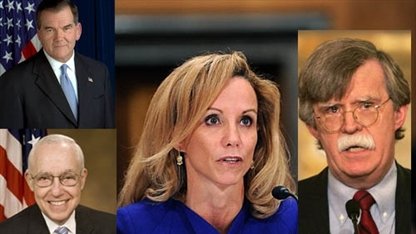
Top-flight speakers include Bill Richardson, the former secretary of Energy; Gen. Peter Pace, former Chairman of the Joint Chiefs of Staff; Wesley Clark, the former Supreme Allied Commander Europe of NATO; and James Jones, President Obama’s former national security adviser.
“You are credible, you are connected, you are respected. And I am amazed that we’ve not reached out,” Gen. Anthony Zinni, the former commander of CENTCOM, said at a January event in Washington. “No one is asking for money, for military support, and guns. They are asking for a hand to be reached out, a light to be shined on what they are doing.”
Speakers also include former CIA chiefs James Woolsey, Porter Goss, and Michael Hayden. Several others confirmed to The Financial Times that they received cash to speak, including John Bolton, former US ambassador to the UN; Louis Freeh, former FBI director; Gen. James Conway, former Commandant of the Marine Corps; and Shelton.
"It’s a very formidable list, full of national security experts, and each of us recognizes the importance of Iran to US security," P.J. Crowley, the former US State Dept. spokesman until March, who spoke at a June event in Washington, told the Monitor.
Among Mr. Crowley’s talking points at State was that the MEK belonged on the terrorism list. He says he was therefore "deliberately circumspect" in his speech and did not take a
position on MEK delisting.
"I was offered a fee to appear, but what I said were my own comments, uninfluenced by what I was paid," said Crowley.
A large-scale operation
In scale and effectiveness at drawing in big names, this campaign stands alone, says Trita Parsi, president of the National Iranian American Council (NIAC), a group that for years has sought to increase the voice of Iranian-Americans in Washington and advocated US-Iran engagement.
The NIAC has launched a counter-campaign, concerned that delisting the MEK would "radicalize" Iran’s homegrown democracy movement, and "unleash a major force for war" between the US and Iran.
"We’ve never seen this kind of money," says Mr. Parsi. "At one conference with 10 speakers, if they average $50k a pop, that is half a million dollars just in speaker fees."
The momentum to remove the terrorist status "is all about [the MEK’s] ability to muster a political lobbying campaign," says Parsi. If the decision were based on "the merits of the case, this would be as uncontroversial as the four times that the Bush administration re-listed them. Four times. No controversy."
One reason may be the caliber of the MEK’s advocates today, and their insistence that they would not back a group with links to terrorism.
For example, Mr. Freeh, who was in charge during some of the FBI’s investigations of the MEK in the 1990s, told an MEK-linked conference in Washington in March that there is "absolutely no credible evidence, we think even on a classified basis," that justifies the MEK’s terrorist listing.
He made no mention of the FBI’s 2004 report that found the MEK “actively involved in planning and executing acts of terrorism.”
At a similar event in mid-July, Mr. Freeh praised the "bravery" of the MEK for "leading the fight for freedom in Iran. Just as our military forces fight for freedom on the battlefields, you fight in a more difficult and much more dangerous place."
Freeh asked the audience if such prominent panelists – which on that day included Shelton, Dean, Rendell, and Anita McBride, the former chief of staff for Laura Bush – would be there if there was "even a remote possibility" the MEK were in fact terrorists.
Raising doubts about change
But the MEK’s history has raised doubts among Iran specialists and in US government reporting about its ability to turn away from violence after embracing it for decades.
The MEK was just one popular faction that toppled the pro-West Shah in Iran’s 1979 revolution – but the only one that assassinated Americans. One MEK song from the time revels in anti-US sentiment: “Leave American, your blood is [already spilling] on the ground.”
The MEK lost out in the post-revolution power struggle; thousands of its members were killed. MEK actions peaked at a rate of three assassinations and attacks per day – its propaganda included how-to assassination guides. The MEK has claimed responsibility for killing thousands of Iranians it called “agents of the regime.”
Among numerous actions abroad, in 1982 the MEK seized the Iranian Interest Section in Washington, taking nine people hostage and doing $500,000 in damage.
On a single day in 1992, the MEK orchestrated attacks on 12 diplomatic facilities in 10 countries. In New York, the Iranian Mission to the UN was “invaded” by five men with knives, who took three hostages and went on a two-hour rampage “behind chained doors,” according to news reports. In Ottawa, the Iranian Embassy was “attacked and pillaged” by some 55 people armed with sticks and hammers.
Expelled from Iran in 1981, and then evicted from France, the MEK in 1986 set up in Iraq where they "became a wholly owned subsidiary of Saddam Hussein’s regime," according to Ken Pollack, a former CIA analyst and National Security Council director for Gulf affairs, in his book "The Persian Puzzle."
Saddam "armed them, paid them, and sent them on missions into Iran during the later stages of the Iran-Iraq War," notes Mr. Pollack, adding that they became "such creatures of the Iraqi regime" that they helped crush Shiite and Kurdish revolts in 1991 that the White House had encouraged – actions that today are one reason for enduring anti-MEK hostility from Iraq’s Shiite-led government.
The MEK denies fighting in Saddam’s wars and often claims it was "independent" of the Iraqi dictator’s regime, but Pollack’s description is confirmed by numerous independent sources.
A US State Dept. report in 1994 dismissed MEK efforts to reinvent itself. Noting the MEK’s “dedication to armed struggle"; the “fact that they deny or distort sections of their history, such as the use of violence”; the “dictatorial methods” of their leadership; and the “cult-like behavior of its members,” the State Dept. concluded that the MEK’s “29-year record of behavior does not substantiate its capability or intention to be democratic.”
That report describes tactics that foreshadow the MEK’s lobbying campaign today, 16 years later. It notes a “formidable Mojahidin outreach program,” which “solicits the support of prominent public figures,” and the “common practice … to collect statements issued by prominent individuals.”
The more recent 2009 RAND study came to similar conclusions. It speaks of the MEK’s "long history of deception," and how it has become "increasingly adept at crafting … its image as a democratic organization that seeks to bring down Iranian tyrants."
When the US invaded Iraq in 2003, it also took ownership of the sprawling MEK base at Camp Ashraf, north of Baghdad near the Iranian border. US forces did not disband the camp; hawkish talk in Washington was that the thousands of MEK militants might be recycled for future use against Iran.
Who pays?
The sources of funding for the campaign to rehabilitate the MEK are not clear, even to US officials. The Monitor sought contact with more than a dozen speakers which, combined with news reports and official disclosures, paint a picture of several Iranian-American groups – some with past links to the MEK, and all engaged in pro-MEK activities – bankrolling the effort.
Besides the string of well-attended events at prestigious American hotels and locations, and in Paris, Brussels, and Berlin, the campaign has included full-page advertisements in The New York Times and Washington Post – which can cost $175,000 apiece – that demand delisting the MEK and protection of Camp Ashraf.
Several conferences have been sponsored by ExecutiveAction, LLC, whose CEO Neil Livingstone has long been active with MEK issues. His company has produced lengthy reports rebutting official US positions on the MEK.
According to his company website, Mr. Livingstone is also a member of the Iran Policy Committee (IPC), which in 2005 laid out a regime-change plan for Iran; its top priority was delisting the MEK.
An IPC panel in 2007 lists one speaker as Alireza Jafarzadeh, the MEK spokesman in Washington who the RAND report notes had "directed the MEK’s US lobbying apparatus" until it was designated an FTO. Mr. Crowley told the Monitor that Mr. Jafarzadeh – who today runs a Washington consultancy and conducts pro-MEK work – is "the driving force” behind the current campaign.
Mukasey, the former attorney general, was photographed speaking with Jafarzadeh at a July 7 hearing on Capitol Hill titled "Massacre at Camp Ashraf: Implications for US Policy." He told the Monitor that Jafarzadeh was "as far as I know, liaison to the Iranian-Americans who attended the hearing."
Jafarzadeh did not respond to communications from the Monitor asking for comment.
Several speakers at MEK-linked events told the Monitor they were paid by the Iranian American Community of Northern California. Director Ahmad Moein did not respond to multiple telephone and e-mail attempts to reach him; the group’s website is dedicated to pro-MEK issues and events.
The California group hired the powerful Washington law firm Akin Gump Strauss Hauer & Feld to lobby on its behalf to remove the MEK from the terrorism list.
Also supplying some funds has been Colorado’s Iranian American Community, according to a disclosure report filed in early July by Rep. Bob Filner (D-CA) and posted at legistorm.com. That group paid $6,589.62 for six days of first class travel and lodging expenses for Rep. Filner to attend the June MEK rally in Paris.
The House disclosure form describes him attending a "Grand meeting of Iranians in support of human rights and democracy for Iran." It makes no mention of the MEK, nor meeting Rajavi. In his speech, Filner said: "I bring you greetings and support from the Congress of the United States … I want to congratulate Madame Rajavi … we will succeed."
In 2007, Filner also accepted $7,949.40 worth of travel to attend a "rally for Iranian human rights" in Paris. Both trips were paid for by Tim Mehdi Ghaemi of the Colorado group, according to the required "Private Sponsor Travel Certification Form."
In 2004, this Colorado group was among 23 co-sponsors of a fundraiser for Iran’s Bam earthquake victims that turned into a “night of resistance.” Seventeen were found to have MEK connections, including the Colorado group, according to news reports at the time. Then-Pentagon adviser Richard Perle delivered a paid speech, unaware of the MEK link. The US government froze the assets of the primary sponsor, the Iranian-American Community of Northern Virginia.
Such groups are familiar to US agencies as a means for MEK supporters to raise and spend funds, despite the terrorist designation. The State Dept. has described how the MEK “has formed associated groups with benign names” to raise cash and sympathy.
"I am not aware of any activities they undertake that are not MEK-related," says one US official about these regional organizations. "I couldn’t begin to count them all…. They’ve got so many shells and fronts among their organizations that we can’t keep up with them all."
Camp Ashraf
But a top priority for speakers at pro-MEK events is Camp Ashraf and its 3,400 occupants, who after years of military training during the Saddam era were disarmed with a promise of protection from US commanders.
The camp – due to be closed by the end of the year – has largely cut itself off from the outside world, with restricted access to telephones, Internet, and satellite television. MEK members, their identity documents long ago confiscated by the MEK, take part in frequent self-criticism sessions and must pledge to “eternal divorce.”
"Love for the Rajavis was to replace love for spouses and family," notes the 2009 RAND report, which found that perhaps 70 percent of the people there "may have been recruited through deception" and are kept at Ashraf "against their will."
Severe gender segregation means that "lines are painted down the middle of hallways separating them into men’s and women’s sides," the RAND report reads. "Even the gas station at Camp Ashraf has separate hours for men and women."
Prior to 2003, all MEK members carried cyanide tablets in leather pouches around their necks, according to RAND. Since then, "the MEK frequently used the threat of suicide as a negotiating tactic or to frustrate investigations."
US officials are trying to convince the MEK to temporarily shift elsewhere in Iraq before disbanding, pinning their hopes on United Nations refugee status and resettlement elsewhere.
Mukasey told the Monitor that “What is developing [at Camp Ashraf] is another Srebrenica, with US complicity,” because Iraqi security forces – hostile to the MEK as past agents of Saddam – have several times in two years engaged in clashes at the camp, most recently in April when 34 were killed.
Former Governor Dean told an MEK-linked audience in July: "Let’s stop the name-calling and foolishness and look at this for what it is. This is genocide, and we will not have it!" Then he spoke of broader ambitions: “We will free the people of Ashraf, and we will free the people of Iran from the tyranny of the mullahs.”
Still uncertain, however, is the path that will lead there. Despite the warning by many Iran experts that the MEK belongs on the terrorism list, the high-powered campaign to resurrect the group carries on.
Also speaking in July, Shelton called the Camp Ashraf resettlement proposal a "recipe for ethnic cleansing," adding: "Wake up, State Department! Take the MEK off the FTO list today."
He said the "10-point program and human rights platform" published by Mrs. Rajavi "makes it a no-brainer."
Then Shelton posed the question: "Why would we not want to put the weight and power of this country behind an organization that we know stands for the same principles we stand for, and that is the best-organized, the best-led organization to take on the current Iranian regime?"
By Scott Peterson
 issues concerning the camp: