
Western and UN experts are expressing increasing doubt about the claims raised by the anti-Iran terrorist Mojahedin-e Khalq Organization (MKO) about Iran’s peaceful nuclear program, saying  that the MKO merely wants to serve the neoconservative hawks in Washington.
David Albright, a former UN weapons inspector and director of the Institute for Science and International Security in Washington is one of them.
"I can no more trust their information," David Albright said.
"It is like a barrage they are throwing up, making all of these accusations. That highly enriched uranium came from Pakistan. That there are two enrichment projects that are active. That bomb designs came from AQ Khan. There is not a single bit of evidence that has been offered to back any of this," the website of the Habilian association quoted Albright as saying.
While the MKO provides a major share of the US and Western intelligence on Iran’s nuclear activities, Albright said that their claims now reflect "a political agenda."
Meantime, in his piece, Iran’s Nuclear Power Play, Dilip Hiro reveals how Tehran was able to secure nuclear, political and trade concessions from the Europeans in return for agreeing to temporarily suspend uranium enrichment.
Washington and its Western allies accuse Iran of trying to develop nuclear weapons under the cover of a civilian nuclear program, while they have never presented any corroborative evidence to substantiate their allegations. Iran denies the charges and insists that its nuclear program is for peaceful purposes only.
Tehran stresses that the country has always pursued a civilian path to provide power to the growing number of Iranian population, whose fossil fuel would eventually run dry.
Despite the rules enshrined in the Non-Proliferation Treaty (NPT) entitling every member state, including Iran, to the right of uranium enrichment, Tehran is now under four rounds of UN Security Council sanctions for turning down West’s calls to give up its right of uranium enrichment.
Tehran has dismissed West’s demands as politically tainted and illogical, stressing that sanctions and pressures merely consolidate Iranians’ national resolve to continue the path.

 (admittedly flawed and politicized) terrorism list; why a lack of determined opposition (unlike to, say, Jonathan Pollard’s pardon) will probably get the MEK what it wants; why Americans never seem to catch on even after being lied into war again and again; Rupert Murdoch’s newspaper empire that specializes in printing propaganda about Iran from Israeli and British intelligence agencies; and the best way to get a “Persian summer” after the Arab spring: leave Iran alone and stop giving the regime an external enemy to blame for its problems.
 Mujahideen-e Khalq’s tendency to accuse their critics of working for the Iranian government; how constant US belligerence and the MEK’s violent radicalism serve as useful foils for the Iranian regime – discrediting dissidents and keeping the people in fear; how violent coups beget radical authoritarian governments, while nonviolent methods often deliver democratic results; the many former US officials now employed as well-paid lobbyists, working toward the MEK’s de-listing from the State Department’s terrorist group list; and the implausibility of a Hamas, al-Qaeda or Hezbollah fundraising and lobbying event on Capitol Hill (though they share the same terrorist designation as the Congress-friendly MEK and MEK’s loyal service to Saddam Hussein, helping put down the 1991 uprisings and acting as his shock troops throughout the 1990s.
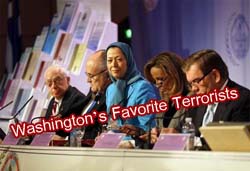 individuals within the U.S. political establishment openly lobbying for, and taking money from, an Iranian organization which is designated by the State Department as a terrorist group.
 are the enemies of Iranian reformers and friends of the Israelis and Americans who want war with Iran. And that they are terrorists.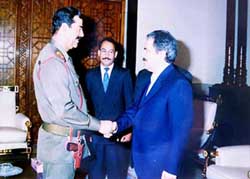
 Maryam Rajavi (her husband Masoud Rajavi mysteriously disappeared in 2003) is standing outside the U.S.’s door. (I examine the group and some of its U.S. supporters in Al Jazeera English.)