Nejat Society
  • Home
  • Articles
  • Media
    • Cartoons
    • NewsPics
    • Photo Gallery
    • Videos
  • Publications
    • Books
    • Nejat NewsLetter
    • Pars Brief
  • About Us
  • Contact us
  • Editions
    • عربي
    • فارسی
    • Shqip
Nejat Society
Nejat Society
  • Home
  • Articles
  • Media
    • Cartoons
    • NewsPics
    • Photo Gallery
    • Videos
  • Publications
    • Books
    • Nejat NewsLetter
    • Pars Brief
  • About Us
  • Contact us
  • Editions
    • عربي
    • فارسی
    • Shqip
© 2003 - 2024 NEJAT Society. nejatngo.org
Mujahedin Khalq Organization as a terrorist group

Double standard on terror

Mojahedin Khalq attacked its own country as well as ours

I write regarding a commentary article that appeared under the headline Egyptian protests provoke images of Iran, on Feb. 11 in The Spectator.

Almost anything critical of Iran seems to find a place in your newspaper, and the origin of the information does not seem to matter. The article tried to legitimize an anti-Iranian terrorist group. MEK, the Iranian People’s Mojahedin Organization, which the author argues should be taken off the U.S. list of terrorist organizations, was founded after the 1979 Islamic Revolution by out-of-power groups. Here’s a partial list of its terrorist activities, which have resulted in 1,200 civilian deaths in Iran:

• June 1981: the bombing of the Islamic Republican Party headquarters, killing Iran’s chief justice, 19 members of the Iranian Parliament, five cabinet ministers, and 47 other people;

• June 1981: the attempted assassination of Iran’s spiritual leader, Ayatollah Khameini;

• August 1981: the bombing of Iranian President Ali Rajai’s office, killing him, the prime minister and another person;

• The exploding of bombs in marketplaces and taxis around the capital city, Tehran.

MEK’s international reach extends to Canada. On April 5, 1992, Iran’s Ottawa embassy was stormed by a group of Iranian exiles linked to MEK. The mob ransacked much of the interior and broke the ambassador’s arm. It was part of a co-ordinated series of actions that saw Iranian embassies attacked in Europe that same day.

MEK has no popular base in any country. It relies totally on foreign sponsorship. During the 1980-88 war against Iran launched by Iraq’s late dictator, Saddam Hussein, which was funded partly by the U.S., Saudi Arabia, Kuwait and other Gulf states, MEK was allowed to set up a military base, Camp Ashraf, inside Iraq. Its own country under attack, MEK was given refuge inside the aggressor’s territory.

The Spectator clearly has a double standard when it comes to terrorism. During the 1970 October Crisis, when ordinary civilians were wounded by FLQ bombs in Quebec and officials kidnapped and killed, The Spectator took a strong stand against terrorism in Canada. Why publish the call for MEK’s rehabilitation now?

MEK is a small sect, united only by its capacity for violence, loyal to no country. However, in the Mideast, there are broadly based popular movements in various countries that the article lists as “extremists.” One of these is Hezbollah in Lebanon, which boasts the largest bloc of members of the Lebanese parliament. Another is Hamas in Gaza, which came to power through election.

How is it that The Spectator can print an article endorsing a terror cell’s call for democracy in Iran, while criticizing movements and governments that represent some of the only democratic processes in the Mideast?

Brendan Stone is cochair, Hamilton Coalition To Stop The War, The Spce

March 3, 2011 0 comments
FacebookTwitterPinterestWhatsappTelegramSkypeEmail
The MEK; Baath Party Accomplice

The Saddam Oil Vouchers Affair and MKO

Introduction

On January 25, 2004, the Iraqi independent daily Al-Mada published a list of approximately 270 individuals and entities who were beneficiaries of Saddam Hussein’s oil vouchers. [1] The report The Saddam Oil Vouchers Affair and MKOevoked reactions from many of those included in the list as well as from the Arab media, among them apologists for Saddam’s regime. The fact that so many have opted for silence may give credence to the list’s authenticity.

A former undersecretary in the Iraqi Ministry of Petroleum, Abd Al-Saheb Salman Qutb, said that the ministry possesses documents proving the authenticity of the list published by Al-Mada. The list was originally the property of the State Oil Marketing Organization (SOMO), which was responsible for marketing Iraqi petroleum. [2] Mr. Qutb also said that the ministry was collecting the information for submission to Interpol, which could then pursue the voucher beneficiaries. [3]

The Iraqi Governing Council has focused on 46 foreign individuals and organizations included on the lists, primarily from neighboring countries, to determine appropriate action. [4] Council member Muwwafaq Al-Rabi’i said during a visit to Beirut that the council has "tons of documents" but emphasized that the publication of these documents will be handled in a constructive way and not "for the sake of vengeance and revenge." [5]

In describing what it called "the curse of the Iraqi vouchers," the London Arabic-language daily Al-Hayat said that it expects more names and details to be made public in the near future and anticipates the revelation of a scandal of vast dimensions transcending countries and continents, implicating many prominent individuals and organizations. [6]
How It Worked: The Voucher Transactions Method

In a subsequent article, Al-Mada provides details on the allocation and sale of oil vouchers. In general, the vouchers were given either as gifts or as payment for goods imported into Iraq in violation of the U.N. sanctions. The voucher holder would normally tender the voucher to any one of the specialized companies operating in the United Arab Emirates for a commission which initially ranged from $0.25 to $0.30 per barrel, though it may have declined in later years to as little as $0.10 or even $0.05 per barrel because of oil surplus on the market. [7] In other words, a voucher for 1 million barrels would have translated into a quick profit of $250,000-300,000 on the high side and $50,000-100,000 on the low side – all paid in cash. According to Al-Mada, Jordan will seek to tax the illicit profits of citizens who benefited from the sale of the vouchers.

One of the common arguments by recipients of vouchers was that the vouchers paid for goods provided in the framework of the U.N.-administered Oil for Food program. However, under the Memorandum of Understanding governing the program, oil allocations were intended for "end users," meaning those with refineries. Most of the voucher recipients would be considered "non-end users." Moreover, if vouchers were used to pay for goods, it would suggest that these were not authorized by the program and should be considered illicit since all contracts approved by the U.N. were reimbursed from the trust account where the oil revenues were kept, at a French bank, at Iraq’s insistence. According to the United Nations: "The oil buyer had to pay the price approved by the Security Council Sanctions Committee into a U.N. escrow account, and the U.N. had to verify that the goods purchased by Iraq were indeed those allowed under the program. But the U.N. had no way of knowing what other transactions might be going on directly between the Iraqi government and the buyers and sellers." [8]

This report reviews the Saddam oil vouchers affair, in two parts:
Part I: (A) the list of oil vouchers recipients; and (B) reactions by implicated individuals and organizations.

Part II: Arab media reactions.

In part of the report one can see the name of Mujahedin Khalq Organization aka MKO, MEK, PMOI:

The Mujahideen Khalq (36.5) is an organization which opposes the Iranian regime which had operated from within Iraq under the Saddam regime. The United States has classified it as a terrorist organization and it has recently been ordered to leave Iraq.

To view the full Document click here

March 3, 2011 0 comments
FacebookTwitterPinterestWhatsappTelegramSkypeEmail
Former members of the MEK

Mr. Saeed Naseris’ official statement of separation

I’m Saeed Naseri. In 1996, I left Iran in order to travel to Europe where I was supposed to continue my studies.

I entered Iraqi territory to reach Camp Ramadi from where I was supposed to set off for Europe I whole-heartedly hope that my ex-comrades in Ashraf will be able to live a free life too.but Iraqi security forces arrested and imprisoned me. After a month, two MKO members came over to visit me in Abu Quraib. They asked some questions about my motivations of coming to Iraq.

In their later visit, they suggested three options including staying in Abu Quraib because of my illegal arrival to Iraqi soil, being handed over to Iranian security forces and joining MKO.
The third option was the one they insisted on a lot. They told me "If you join Mujahedin, you will easily go to Europe to continue your education. So I chose the last option in dream of moving to Europe in six months.

In April 1996, I was taken to Camp Ashraf where I received military training. Day after day, the conditions were deteriorating for me. You had to attend brainwashing meetings where you were verbally abused and you couldn’t say a word to defend yourself. You were forced to work hard in the very hot weather of Iraq…

Briefly, I’d say that You have no power to think in Camp Ashraf. You have to do anything Maryam and Massoud say. You are like a slave. You are just given food and you have no other advantages, no access to free world and no contact with your family.

Finally after two years I decided to leave the camp so I wrote it to my senior official. The result was catastrophic. The same night the officials called me, holding meeting where they terribly insulted me for a long time until after midnight. The next morning they gave me a paper to sign. I noticed that was a document that indicated I would be imprisoned for two years in departure section of the camp (solitary confinement) and then I would be delivered to Iraqi forces to be jailed in Abu Quraib for eight more years … So I decided to choose between bad and worse. I chose bad and stayed in Ashraf where I burned fifteen years of my life.

After the collapse of Baath regime, I found a chance to escape Camp Ashraf and join Iraqi forces. I could begin a new life. Now I’m very content of living in a free world. I’m able to think and decide freely and to contact my family. I whole-heartedly hope that my ex-comrades in Ashraf will be able to live a free life too.
Translated by Nejat Society

March 2, 2011 0 comments
FacebookTwitterPinterestWhatsappTelegramSkypeEmail
Former members of the MEK

Mr. Kohzadi officially declares separation from MKO

Mr. Homayoon Kohzadi could manage to leave Rajavi’s cult. Arriving in free world he declared his separation from Mujahedin Khalq Organization. The following is his statement:

I’m Homayoon Kohzadi. I entered Iraqi territory in 1996 and wasted 15 years of my life in MKO because I thought I was in the right path but after a few months, I found out that I had made a big Mr. Homayoon Kohzadi could manage to leave Rajavi's cultmistake.

I realized that there was no mark of that democracy and freedom MKO propaganda claimed. I decided to leave the organization. I declared my defection but they didn’t accept. They told me that I had to be imprisoned in MKO prison for two years and then in an Iraqi prison for 8 years. Then Iraqi government would decide for my fate. So I got forced stay in the organization because I knew about the terrible conditions of Iraqi prison, AbuQuraib.

I also tried to leave the group several more times and every time they reacted by holding meetings [of self-criticism] for me.

My departure after 15 years!

You definitely wonder how I could be able to leave. After the fall of Saddam Hussein, Iraqi new government started interviewing MKO members. I used the opportunity to express my willingness for leaving the Camp to the Iraqi official. Fortunately I succeeded to leave the group.

I want to warn others about the trap I was captured in. I want to warn them about false propaganda of MKO. When I arrived in MKO; I thought I could leave it whenever I wanted but in fact nobody dares to say a single word about leaving. If you express your defection, they will mobilize the whole members to insult or even beat you in their so-called meetings. They threaten you with two years of jail in Camp Ashraf and eight years in Abu Quraib … I myself witnessed a lot of examples of such maltreatments.

Today I’m really happy for my life in a free world and I can offer my experiences to those who are at risk of being caught in Rajavi’s trap.

Translated by Nejat Society

March 1, 2011 0 comments
FacebookTwitterPinterestWhatsappTelegramSkypeEmail
The MEK; Baath Party Accomplice

MKO leader famously said”take Kurds under your tanks, save bulletes”

Dictators and Violence  – Grim decision-making
In a guest post, a Middle East editor at the Economist Intelligence Unit, our sister organisation, examines the way in which dictators choose whether or not to use violence to stay in power.
Violence only works if it is overwhelming. Up to a critical point, civilian losses embolden protestors who will rally against the injustices they see in the loss of their comrades. If the losses are massive, and pass that point, protestors are likely to realise that the state means business and is here to stay. This was the case in 1991; as soon as Saddam Hussein was allowed to use helicopter gunships, he did. The magnitude of destruction was stratospheric and anybody seen as being remotely sympathetic to the uprising was punished. Even palm trees were destroyed (10m in Basra alone), and the Marshes were drained, ostensibly to stop rebel fighters from seeking refuge there, but undoubtedly also to punish the people seen by the state as being complicit in the uprising by destroying their livelihoods.

The need for a patronised inner coterie: Iraq taught us that magnitude of destruction has to be immense. Muammar Qaddafi’s rhetoric suggests he understands this and is willing to follow through. This will depend on the willingness of the army to follow his directives. Saddam did not have the army, but he did have a series of concentric circles of supporters loyal to him because of the patronage he extended them (special-forces units and tribes). He had tied their interests to his survival so successfully that they could not risk defecting. In the same way that Mr. Qaddafi has turned to foreign mercenaries, he could also rely on his own foreign legion, the Mojahid[in]-e-Khalq organisation whose divisions were used to fight both against the Kurds and the Shia down south (Mariam Rajavi, one of the group’s leaders, famously said "take the Kurds under your tanks and save your bullets for the Islamic Guard").

The need for a scapegoat. Iraqis in 1991, even the Shia, did not trust Iran. According to Kanan Makiya, an Iraqi academic in his book, "Cruelty and Silence", agents from the Iraqi state began to post pictures of Iran’s leader, Ayatollah Ruhollah Khomeini, across the south. This allowed Saddam to frame the uprising as one orchestrated by Iran, not disgruntled Iraqis with real grievance against the regime. This idea gained traction and was key to maintaining support among the "White Provinces", the mainly Sunni areas to the north and west of the country that feared that an Iranian-style regime would replace Saddam, and that the new system would be inherently hostile to their community. These provinces remained loyal and formed the mainstay of Saddam’s support base throughout the uprising.

Supporters of the monarchy in Bahrain are painting the unrest as a Shia uprising to try to retain support of the country’s Sunni community (despite leading Sunni opposition MPs, including Munira Fakhro of Wa’ad, coming out in support of the protest movements). Similar tactics, but with an ethnic dimension, have been used in Jordan; King Abdullah sacked the Palestinian-born prime minister and replaced him with a Jordanian replacement. Part of the reason for the move is likely to play on the Palestinian/Jordanian rift within society and to shore up his Jordanian support base who are uneasy about Palestinian representation in the government.

The will to maintain power vs. the desire to pander to international public opinion: Libya went through years of sanctions and was an international pariah for decades. Mr Qaddafi would probably like to nurture friendly ties with Europe and the wider international community, but he will not do this at the expense of his own survival. Hosni Mubarak, Egypt’s former president, crumbled under international pressure. This was part of the reason he could not use overwhelming force to maintain his grip (the apparent defection of the army played a part too). Mr. Qaddafi, like Saddam Hussein, probably cares less about external pressure because the damage has been done. He may feel he can go it alone, as he has in the past.

February 28, 2011 0 comments
FacebookTwitterPinterestWhatsappTelegramSkypeEmail
Mujahedin Khalq; A proxy force

What’s Behind the Campaign to Delist the Mujahedin al-Khalq Organization?

A growing number of former U.S. officials — both Republicans and Democrats — have hopped on the bandwagon to demand that the State Department delist the Mujahedin al-Khalq Organization (MKO) from its list of terrorist groups.

I consider the MKO a terrorist group for good reason. There is no doubt that the MKO has targeted Americans, and no amount of slick public relations should erase that. During my time in Iran, it was clear that while Iranians respect the United States and have little good to say about their own government, they all detest the MKO.

The enemy of my enemy is not always a friend: Iranian attitudes toward the MKO are analogous to Americans’ views toward American Taliban John Walker Lindh. Iranians despise the MKO for siding with Saddam Hussein as he murdered Iranians. After liberation, the MKO embraced America not because it loves liberty and apple pie but rather because it is an ideological chameleon. Only fools would believe that the MKO is sincere in its pro-American rhetoric. While the MKO claims credit for intelligence coups, more often than not it is either a conduit for other countries to launder their own collections or the MKO simply makes it up.

One thing is certain: embracing the MKO is the surest way to make anti-American the 65 million Iranians.

Still, MKO lobbying is slick and, as a cult, it can rely on the entirety of its members’ incomes to purchase support it might not otherwise receive. If American officials call for the delisting of the MKO, that is their right. For an honest debate on the issues, however, they should acknowledge the honorarium or consulting fees they receive from the group.

Michael Rubin – Commentarymagazine

February 27, 2011 0 comments
FacebookTwitterPinterestWhatsappTelegramSkypeEmail
Mujahedin Khalq Organization members' families

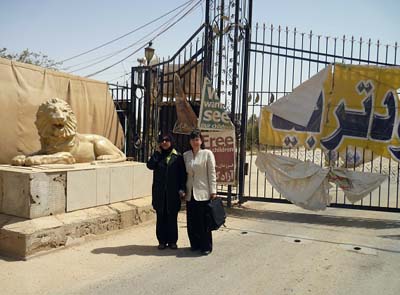
A New group of MKO hostages’ families join others picketing at Ashraf Gate

A number of Isfahani and Mazandarani families join others picketing at Ashraf Gate.

The families set off for Iraq Camp Ashraf along with the one-year strike of picketing families at Ashraf gates.

They endeavor to visit their loved ones taken as hostages by MKO cult leaders.
They called on humanitarian communities and the Red Cross to aid them to visit their brainwashed children.

February 26, 2011 0 comments
FacebookTwitterPinterestWhatsappTelegramSkypeEmail
Terror Teams of the MEK

Mojahedin Khalq failed to rescue its agents

CIA agent arrested over murder charges

IRI Intelligence Ministry has nabbed an individual related to the CIA during the February 14 riots.
Minister of Intelligence Heidar Moslehi told IRIB Thursday night that the nabbed individual was recruiting agents besides his routine plans.

Moslehi noted that the individual was an Iranian national and the ministry has kept an eye on him since months ago.

The minister said another individual has been arrested by the ministry in connection to the killings of two Iranian citizens during the riots.

The individual is an agent of the terrorist MKO group and the group has exhausted its possibilities to help him to exit Iran, according to the minister, who added that the MKO agent has provided god information to the ministry concerning his cooperation with the group.

February 26, 2011 0 comments
FacebookTwitterPinterestWhatsappTelegramSkypeEmail
Mujahedin Khalq Organization's Propaganda System

Mojahedin Khalq propaganda machine cannot hide the facts at Camp Ashraf

There are a number of basic facts which even the sophisticated and well-financed MEK propaganda machine cannot make untrue. It is worth repeating them.

The number of MEK members has never risen beyond 6,000 to 7,000. Even in 1988 at the height of their powers the group could only muster 5500 to launch its abortive operation to topple the regime, the infamous Eternal Light operation. American soldiers corralled 3800 members inside Camp Ashraf in 2003. In the rest of the world figures probably do not exceed an additional one to two thousand including the MEK’s non Iranian supporters and backers.

Fourth Geneva Convention Protected Persons’ status was wrongfully applied in 2004 by Defense Secretary Donald Rumsfeld. He gave ‘Pentagon protection’ to his terrorists in Iraq while the UN and ICRC expressed their concern over the issue and argued (fruitlessly) that the MEK is a paramilitary group, not a civilian population and this designation had no legal basis. But in any case the status would not apply after 2006, a year after the first elections in Iraq – a fact repeatedly corroborated by British, European and American officials. A document produced by the Library of the UK’s House of Commons states: “In the case of occupied territory, the Convention continues to apply for a year after the general close of military operations, and partially thereafter if the occupying power continues to exercise the functions of government. The occupation of Iraq formally ended on 30 June 2004.”

The MEK members in Camp Ashraf do not have any legal right to be in Iraq. No MEK member has refugee status in Iraq. Leader Massoud Rajavi ensured they all entered the country illegally in order to be able to use this against them if they defected (he sent scores to Abu Ghraib in this way). After 2003, the UNHCR in Iraq would not grant refugee status to MEK members because it is a paramilitary group and the GOI has refused to grant refugee status to members of what is known throughout Iraq as a terrorist organisation which has killed some 25,000 Iraqi civilians. In Written Answers in the House of Lords on 20 April 2009, Lord Malloch-Brown (then Minister of State, Foreign & Commonwealth Office) told parliament, “The UN High Commission for Refugees has previously determined that Camp Ashraf residents do not qualify as refugees.”

The Government of Iraq has every reason, regardless of Iranian or American influence either way, to wish to expel the MEK from the country. The MEK was responsible for killing 25,000 Iraqi civilians. It is currently the only part of Saddam Hussein’s repressive apparatus which remains intact and active. This is due to the failure of the American military to dismantle the camp and remove the inhabitants. (RAND Report, August 2009) Iraq’s Foreign Minister Zebari a few weeks ago again accused the MEK of trying to maintain a state within a state and said that "the Mojahedin-e Khalq terrorist organization is like many other armed terrorist organizations," adding that "the government is determined to impose its sovereignty and not allow any party to impose its policy orientations."

The Iraqi Judiciary would like to prosecute leading members of the MEK for war crimes and crimes against humanity committed against Iraqis in Iraq. They have been frustrated by the interference of the MEK’s backers in Washington, London and Brussels.

Iraqi soldiers are stationed at Camp Ashraf to provide protection, a role imposed on them by the Americans who failed to deal with the MEK for six years. In the six years that American soldiers protected the terrorist group and its base, fourteen American soldiers were killed during escort missions for MEK shopping in Baghdad. (RAND Report August 2009.)

There is plenty of evidence that the MEK commit serious human rights abuses against their own members inside Camp Ashraf, but to date no independent investigation has taken place into these allegations.

The Iranians outside Camp Ashraf are the families of members trapped inside. The MEK do not allow the members to have contact with them. The families have been recently attacked by MEK special forces from inside the camp which resulted in the hospitalisation of a couple of old people. The American soldiers have repeatedly come to support the MEK in the harassment of the families who have now entered their 13th month of their picket, demanding a simple visit to make sure their loved ones are there of their own free will. So far, no one has established that the people inside Camp Ashraf are there of their own free will.

February 26, 2011 0 comments
FacebookTwitterPinterestWhatsappTelegramSkypeEmail
Mujahedin Khalq; A proxy force

An Unholy Alliance

Strange days! A few days ago, Congressman Poe (T-Texas) introduced House Resolution 60 calling for the Mojahedin-e-Khalq Organization (MKO) to be removed from the terrorist list by the State Department. At the same time, an unknown group calling itself the "Association of Iranian University Professors in Britain" took a full page ad in the major U.S. papers making the same demand. These efforts to get the MKO legitimized is just the last round of efforts by the MKO and its neocon supporters — presumably as a reward to have "outed" the Iranian nuclear program.

The effort is signed by such neocon luminaries such as John Bolton and former CIA director Woolsey, as well as Bush administration alumni such as former Attorney General Mukasey. What strange bedfellows! On one hand, you have the neocons, close allies of the Israeli right-wing and committed to a muscular war against global terrorism, and on the other, the MKO, a radical left-wing Islamist group involved in the 1970s in anti-Shah and anti-U.S. activities — including a failed attempt on the U.S. ambassador to Iran and the killing of several U.S. citizens based in Iran at the time

There is much more to the MKO story. During the early days of the revolution, the MKO promoted a Khmer Rouge-type policy of wholesale elimination of the previous elite and massive reeducation of the population. After losing the power struggle against Khomeini and reappearing in Iraq, the group’s cult-like reputation and its personality cult around its leader Massoud Rajavi intensified. According to the CIA, the MKO was also used by a beleaguered Saddam to crush the Kurdish rebellion that came immediately after Iraq’s defeat in the Persian Gulf War. The MKO organized regular media visits at its base in Iraq, Camp Ashraf, where it exhibited its military arsenal, which included tanks and artillery. Of course, most of this arsenal remained unused, since the MKO was unable to mount anything more than pinprick attacks against the Iranian regime. At the same time, the MKO’s propaganda machine was working overtime in the U.S. and Europe. In fact, it has been quite effective, and the MKO has managed over the years to pull the wool over the eyes of some European politicians as well as Congress (on particular its most conservative GOP members) and present itself as a bona fide moderate and democratic opposition movement and an alternative to the theocratic government of Tehran. Following the Iraq war, they were unexplainably protected by the U.S. forces — presumably because the Bush administration, with its less than profound understanding of Iranian political dynamics, wanted to keep the MKO as a potential weapon against the Islamic Republic. It is only recently that the Shi’ite-led government of Iraq felt strong enough to challenge the U.S. by taking control of Camp Ashraf.

It is no secret that the neocons have been pushing hard for years to get the State Department to remove the terrorist label from the MKO. As a result, there have been numerous efforts by Congress to remove them from the aforementioned list. However, these efforts have taken a new dimension in the past few years with the unholy MKO-neocon alliance. This campaign, which did not succeed even under the Bush administration, is surprisingly reaching a new crescendo under the Obama administration. Nobody can be fooled by the motivation of the MKO supporters in the United States, who have openly promoted either military action against Iran or the dismemberment of the country as the ultimate remedy. That the MKO is complicit in these policies is not surprising for a movement which has already betrayed the Iranian people by siding with Iraq during the Iran-Iraq war. For this, they have been universally reviled both by Iranians in Iran and the world.[…]

While the human rights issue of the refugees trapped in Camp Ashraf has to be dealt with in a compassionate way, the State Department must continue to resist pressures to legitimize the MKO. Pressure to remove the MKO from the U.S. terrorism list is a cynical ploy that can only have negative consequences for both the U.S. and the Iranian people.

Legitimizing the MKO will not change the fact that it remains a terrorist organization, which has betrayed the Iranian people twice and is willing to go to any length to promote its undemocratic goals, including an unholy alliance with the neocons. The State Department must resist the pressure, for the interest of peace as well as the democratic movement in Iran.

Karim Pakravan is a member of the Faculty at DePaul University in Chicago.

February 26, 2011 0 comments
FacebookTwitterPinterestWhatsappTelegramSkypeEmail
Newer Posts
Older Posts

Recent Posts

  • A Criterion for Proving the Violent Nature of the MEK

    December 31, 2025
  • Rebranding, too Difficult for the MEK

    December 27, 2025
  • The black box of the torture camps of the MEK

    December 24, 2025
  • Pregnancy was taboo in the MEK

    December 22, 2025
  • MEPs who lack awareness about the MEK’s nature

    December 20, 2025
  • Facebook
  • Twitter
  • Instagram
  • Youtube

© 2003 - 2025 NEJAT Society . All Rights Reserved. NejatNGO.org


Back To Top
Nejat Society
  • Home
  • Articles
  • Media
    • Cartoons
    • NewsPics
    • Photo Gallery
    • Videos
  • Publications
    • Books
    • Nejat NewsLetter
    • Pars Brief
  • About Us
  • Contact us
  • Editions
    • عربي
    • فارسی
    • Shqip