Nejat Society
  • Home
  • Articles
  • Media
    • Cartoons
    • NewsPics
    • Photo Gallery
    • Videos
  • Publications
    • Books
    • Nejat NewsLetter
    • Pars Brief
  • About Us
  • Contact us
  • Editions
    • عربي
    • فارسی
    • Shqip
Nejat Society
Nejat Society
  • Home
  • Articles
  • Media
    • Cartoons
    • NewsPics
    • Photo Gallery
    • Videos
  • Publications
    • Books
    • Nejat NewsLetter
    • Pars Brief
  • About Us
  • Contact us
  • Editions
    • عربي
    • فارسی
    • Shqip
© 2003 - 2024 NEJAT Society. nejatngo.org
Mujahedin Khalq Organization members' families

American Army charge on families in a joint operation with MKO terrorists

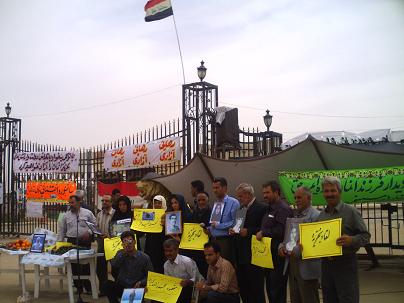
In what can only be interpreted as an attempt to assert their hegemony over their terrorists in Iraq, fifteen American soldiers arrived yesterday (March 01, 2010) in armoured vehicles at the gates of Camp New Iraq (formerly Ashraf) to confront the families who have established a long-term picket there.

Families to US army: bring Obama himself and we will not be intimidated

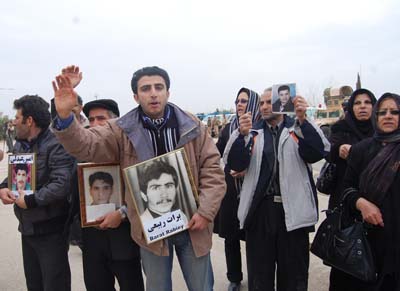
The families have travelled from Iran and other countries to demand that the MKO leaders allow their children to meet with them. The MKO have refused and have bunkered down out of fear. Now the Americans have had to intervene on their behalf to try to send the families away.

The Americans were accompanied by three MKO personnel who acted as translators and who hid their faces so they would not be recognized. The Americans and the translators tried to approach the families to get information from them and film them, but Iraqi soldiers advised the families to keep their distance.

Hourieh Mohammadi from Canada, who is in Iraq to find her sister, used a loudspeaker to inform the Americans of the families’ demands. She told them ‘even if you bring Mr. Obama himself here I will not leave until I have found my sister’.

Iraqi officers at the camp said they will not take action now but the role of the Americans in this situation has been noted. The Iraqi’s have assured the families that if the intimidation becomes more invasive, they will certainly step in to protect them.

March 3, 2010 0 comments
FacebookTwitterPinterestWhatsappTelegramSkypeEmail
Mujahedin Khalq Organization members' families

In solidarity with the MKO Cult’s victims families

Declaration of Ancient Iran Association in solidarity with the Cult’s victims families

Ancient Iran ,Glorious future Association declares its solidarity with the honorable families who have been waiting behind the closed gates of notorious Ashraf Garrison to meet with their loved ones for almost a month .

The cult’s dictator leaders who are terrified of giving permission to any meetings and visitations to their members, have hampered of families’ meeting with their loved ones up to now . Face to face Meeting and visitation is everyone’s legal right and according to that the leaders of this cult must allow their victims to meet with their families.

The Ancient Iran , Glorious Future Association based on its humane task urge and entreat of all humanitarian organizations and Iranian freedom lovers as well as the critics and separated members of this cult for their solidarity with those sad families who have been in sit- in for days behind the closed gates of Ashraf Garrison. In this regard notifying all humanitarian organization such as UNHCR, Amnesty International, ICRC, Human Rights Watch and get in touch with Press and Media throughout the world are the first priority to help these families.

Respectfully

Ancient Iran, Paris

March 2, 2010 0 comments
FacebookTwitterPinterestWhatsappTelegramSkypeEmail
Mujahedin Khalq Organization members' families

PMOI denied families meetings with their captured children in Ashraf

The Mojahedin Khalq Organisation (MEK, MKO) has refused to grant meetings to the families who have came from Iran to Iraq to meet their children who are members of the Mojahedin Khalq and who for years have been held captive by the organization’s leaders in Camp Ashraf.
The Mojahedin Khalq Organisation (MEK, MKO) has refused to grant meetings to the families who have came from Iran to Iraq to meet their children who are members of the Mojahedin Khalq
Mojahedin leaders did not allow the families who came from Iran to Iraq with the consent and support of the Iraqi government to Camp Ashraf in Diyala province since last month, to meet with their children who are in Camp Ashraf in Diyala province northeast of Baghdad and who have been detained by the Organization since the eighties of the last century with the cooperation and support of the former regime.

The protest surprised officials of the Organization who refuse to allow members of the Organization meet relatives for fear they will leave the organization and Camp Ashraf and return to their homeland and their families. The Organisation launched excuses such as lack of names required for the interview between the elements of the organization, or failure of the children themselves to desire to meet with their families and their refusal to communicate with their families and their relatives.

Sources said that the Iraqi government has sought the presence of the delegation of the United Nations and International Red Cross and international human rights organization to hold direct negotiations with the leaders of the organization. The Iraqi government continued throughout the last month to convince them of the need to deal with this situation in a humane and approved way to allow meeting between Iranian families and their children, and not to accept false statements and counterfeit, which accuses the Iraqi government of violating human rights laws. The failed negotiations have resulted in the rejection of the absolute leaders of the organization to this humanitarian initiative.

Ultimately, to reach an end to the sit-in by dozens of Iranian families outside the gates of Camp Ashraf, the Iraqi government and international community must intervene to pressure the leaders of the organization in Camp Ashraf in order to allow meetings with their children and allow them to make personal decisions in response to their emotions and their sensations.

translated by Iran Interlink

March 2, 2010 0 comments
FacebookTwitterPinterestWhatsappTelegramSkypeEmail
France

Ancient Iran Association writes to Bernard Kouchner

How do you tolerate such terrorist organization on your soil?

MR. Bernard Kouchner The Honorable French Minister of Foreign and European Affairs
How do you tolerate such terrorist organization on your soil?
With Our best greetings and wishes to you and the honorable people of France,

As you are well informed that the people mojahedin organization (PMOI) which is a terrorist – cultic organization, unfortunately has pitched its main headquarter in your country for many years and they have masterminded and commanded numerous terrorist measures in iran and Iraq during past decades.

France is among the countries which in war against terrorism is in the front line, so according to this fact how can it tolerate and bear such a terrorist and bloodthirsty organization on its soil? The organization which perpetrated the assassination of American Colonels and Generals in Iran in mid 70,s and even they have composed and written anthem and articles in tribute of those assassinations. The organization which its ideology is based on violence and terrorism and believes in violence and bloodshed and even along furthering its cultic objectives is coercing and compelling its own followers and trapped members to burn themselves vis a vis the astonished and astounded eyes of French people.

The organization which its terrorist record in Iran and Iraq is not covert to anyone and its crimes and abuses are revealed and divulged by brave disclosures of separated and critics and `as a result of that its evil and detestable image is disclosed and divulged.

MR. Kouchner we ,according to our experiences which are the outcome of decades of captivity in this cult, know it as our humane task to draw the French law makers and politicians’ attention and yours to the following facts:

1. The Rajavi’s cult is a very dangerous and organized which by using the brainwashing and religious indoctrinations’ techniques , they are capable of utilizing their deceived members `whenever and wherever requires like the self burnings in 2003 in Paris.

2. This cult by taking advantage of freedom and democracy ruling upon European and western countries and by spending huge amount of money is reinforcing its cultic bastion in France and across Europe, presence of the cult’s leader , Maryam Ghajar Azdanlo (Rajavi) in European parliament and meeting with French politicians and mayors are among those efforts.

3. The leaders of this notorious cult by taking advantage of western – favorite words and playing with words as well as showing off as freedom lovers and democratic organization have deceived a number of European politicians and parliamentarians and unfortunately they are utilizing them along furthering their cultic interests.

4. This cult which does not allow its members’ families to get in touch with their loved ones and some of the families who have gathered behind the closed gates of the notorious Ashraf Garrison since one month ago just to meet with their loved ones ,have been insulted, accused and mistreated by the operatives and ringleaders of this cult and so far they have not succeeded to meet their children and loved ones after almost one month of entreating endeavors . While this notorious cult and its leaders are dealing and behaving with their own members’ families who are their fellow countrymen and compatriots in like manner ,so what do you expect them to do while their cultic interests are in danger in your country? Are they trustworthy?

The only answer and solution to prevent the violence and inhumane activities and measures of this Mafia -terrorist cult is to confine or stop their activities fully in France once and for all.

With our best wishes to you and the honorable French people.

Ancient Iran Association, Paris

March 2, 2010 0 comments
FacebookTwitterPinterestWhatsappTelegramSkypeEmail
Massoud Rajavi

Solution or an escape from challenges

The concerns that had been challenges to MKO’s leadership in the past three decades can be well met in Rajavi’s message of January 20. Of the main issues is that of overthrowing and changing the Iranian regime. The strategic cul-de-sac and failures of Mojahedin in recent yearsThe strategic cul-de-sac and failures of Mojahedin in recent years have resulted in taking some cursory policies have resulted in taking some cursory policies including declaring short-term overthrow, entering the phases of armed warfare with an emphasis on urban warfare, formation of the so-called liberation army and finally resorting to western trends and politicians. However, his message indicates that he has not abandoned the failed strategy of the imminent overthrow of the regime that he has focused on in all these years. His new transition to instigation of insurgency and uprising in Iran in his recent messages is based on his superficial analysis of the internal conditions of Iran in an attempt to tie himself to the regime’s critics. Referring to this transition as the strategy of uprising and overthrow he states:

In answering to strategic questions on uprising and overthrow, it has to be clarified primarily that they are not to be answered immediately nor chimerical and delusive solution are to be found since their solving depends greatly on the occurrence of some events that have not yet happened. I mean logical analysis and thinking is mainly founded on certain conditions rather than on astrology and prevision. In other words, if the conditions are not clear enough to be understood, the first thing to do is trying to get a true understanding of them.

Before expounding on these claims, the common policy of overhanging and gamesmanship of Rajavi is to be taken into consideration. He pretends to be the sole solution for the existing challenges in Iran. Promising strategic solutions to the future conditions due to political considerations are instances of this gamesmanship and it may instill some readers with the idea that he may solve many problems inside Iran. Rajavi makes an attempt to infuse the idea that internal protestors and critics in Iran are agog to follow strategic guidelines and solutions offered by Rajavi to respond to encountered challenges. Although the internal issues of Iran have nothing to do with the outdated solutions of Rajavi and his armed and aggressive strategy, Rajavi resorts to connivance.

Evidently, Rajavi is to misuse recent disturbances in Iran. His unstable situation in Iraq, intra organizational crises and many other unsolvable challenges resulting from his lack of support and political legitimacy in Iran have made him to get rid of his present challenges by various levers including propaganda blitz and fabrication. The publication of his serial message in recent months can be evaluated in this regard. However, his January 20th message demonstrates that he is taking a new approach different from the past ones. Some differences and his objectives will be mentioned hereinafter.

1. The main objective pursued by Rajavi, particularly after delivering the message of January 20th, is infusing this idea that the depicted visage of Mojahedin in books or articles by the Iranian regime for global community is a distorted and unreal. The main part of his message is refusing the terrorist nature of Mojahedin; an issue that seems to be of a high significance for him.

2. He also tries to conform to Iranian internal critics and pretends that Mojahedin have originally been a democratic and non-aggressive trend yet the policies of the regime have victimized it by advertizing it as an aggressive organization. He mainly aims at distracting the attention of the world of the terrorism nature of MKO to the sympathy of the world.

3. His next objective is pretending that the present critics in Iran are reminders of Mojahedin who are following its footsteps after three decades absence of the organization from Iran’s political arena.

4. Furthermore, he makes the demands of Mojahedin parallel to that of Iranian internal critics and invites them to enjoy his facilities as well as strategic and tactical solutions and guidelines for meeting these demands.

5. Being aware of the fact that the internal political conflicts in Iran are solvable, knowing that the organization is of no place therein, Rajavi tries to usurp the power of their body after a short and superficial support of the leaders of Iranian critics. A look at the position taking of Rajavi during the recent Iranian election reveals that he has already noticed his lack of social support in Iran and the fact that his intervention may even endanger the social as well as political status of the critics.

In spite of all his attempts to cover his totalitarian and authoritarian visage under a pro-democratic mask, he fails to bear hearing any voice other than his own due to his egocentric and authoritative nature. His focus on giving the Iranian critics some strategic and tactical solutions has its roots in his megalomania that is evident in various parts of his message.

March 1, 2010 0 comments
FacebookTwitterPinterestWhatsappTelegramSkypeEmail
The MEK and Jundullah

MP: MKO Gravely Affected by Rigi’s Arrest

The plots hatched by the anti-Iran terrorist Mojahedin-e Khalq Organization (MKO) for stationing troops alongside Iran’s eastern borders were defused after Tehran arrested Abdolmalek Rigi, the most notorious terrorist ringleader at its eastern borders, an Iranian lawmaker said Saturday.
The MKO's members were hopeful that after expulsion of the group from Iraq, they could establish a joint den of corruption in the eastern Iran in coordination with (Abdolmalek) Rigi, but this plot fell flat with the capture of Rigi,"
"The MKO’s members were hopeful that after expulsion of the group from Iraq, they could establish a joint den of corruption in the eastern Iran in coordination with (Abdolmalek) Rigi, but this plot fell flat with the capture of Rigi," Mohammad Reza Khabbaz told FNA.

Last Tuesday, Iran announced that it has arrested Abdolmalek Rigi after intensive intelligence and security operations.

Rigi on June 2 admitted receiving assistance from the MKO, but relations between the two anti-Iran terrorist groups had surfaced a long time ago when US started plans to coordinate anti-Islamic Republic moves.

In August, the Jundollah terrorist group warned the Baghdad government that it would retaliate against the closure of a main camp of MKO by the Iraqi forces.

"…the Iraqi government should know that its hostile measures against the residents of Camp Ashraf who are Iranian immigrants in this city are not and will not be in the interest of the Iraqi government," Jundollah said in statement.

The MKO, whose main stronghold is in Iraq, has been in the country’s Diyala province since the 1980s.

Six years after toppling Saddam Hussein’s government in 2003, the country’s security forces took control of the training base of the MKO at Camp Ashraf – about 60km (37 miles) north of Baghdad and changed the name of the military center from Camp Ashraf to the Camp of New Iraq.

The Iraqi government and parliament have both voiced strong determination for expelling the group from the country.

The MKO started assassination of the citizens and officials after the revolution in a bid to take control of the newly established Islamic Republic. It killed several of Iran’s new leaders in the early years after the revolution, including the then President, Mohammad Ali Rajayee, Prime Minister, Mohammad Javad Bahonar and the Judiciary Chief, Mohammad Hossein Beheshti who were killed in bomb attacks by MKO members in 1981.

The MKO is behind a slew of assassinations and bombings inside Iran, a number of EU parliamentarians said in a recent letter in which they slammed a British court decision to remove the MKO from the British terror list. The EU officials also added that the group has no public support within Iran because of their role in helping Saddam Hussein in the Iraqi imposed war on Iran (1980-1988).

Many of the MKO members abandoned the terrorist organization while most of those still remaining in the camp are said to be willing to quit but are under pressure and torture not to do so.

A May 2005 Human Rights Watch report accused the MKO of running prison camps in Iraq and committing human rights violations.

According to the Human Rights Watch report, the outlawed group puts defectors under torture and jail terms.

The group fled to Iraq in 1986, where it was protected by Saddam Hussein and where it helped the Iraqi dictator suppress Shiite and Kurd uprisings in the country.

The terrorist group joined Saddam’s army during the Iraqi imposed war on Iran (1980-1988) and helped Saddam and killed thousands of Iranian civilians and soldiers during the US-backed Iraqi imposed war on Iran.

Since the 2003 US invasion of Iraq, the group, which now adheres to a pro-free-market philosophy, has been strongly backed by neo-conservatives in the United States, who also argue for the MKO to be taken off the US terror list.

March 1, 2010 0 comments
FacebookTwitterPinterestWhatsappTelegramSkypeEmail
Iraqi Authorities' stance on the MEK

Ali al-Dabbagh :MKO have no status in Iraq

Ali al-Dabbagh upbeat about Iraqi election
Ali al-Dabbagh, the Iraqi government spokesman and a candidate for the Rule of Law Coalition, gestures at a sample ballot as he speaks to Shia elders during a campaign event in Baghdad, Iraq.

Press TV has conducted an exclusive interview with Iraqi governmenAl-Dabbagh :Mujahedin have no status in Iraqt spokesman Ali al-Dabbagh on the country’s parliamentary elections, which are to be held on March 7.
Following is the text of the interview:

Press TV: What is the importance of this election for the country?
Al-Dabbagh: The importance of the election based on and coming from that this is the first Iraqi people and the voters going to choose persons, by persons, by numbers. Unlike the others, just like the previous elections which just choose means of the list which they do not know who is that. This is very important which gives them the hope that they could be part of the change. They could nominate their representative by name, by person which they believe that he is going to be a real representative for them, a real defender of their right, and he is going to honestly representing them in a good way. This gives the hope. Second that, it is important that it is building up. It is building an accumulative advantage and record of the democracy. This is an importance. As well as, there is a challenges facing Iraq. Challenges for the reconstruction for the three services, for which the people are waiting after seven years. Some of the people are desperate because there is nothing delivered. Most of the difficulties are not yet fixed. So the people are looking forward to choose a real representative to keep the ministers, the cabinet accountable and the questionable for all the failure which might happen and it could improve the political situation in Iraq.

Press TV: Talking about the services, do you think that this election would lead the country to prosperity and unity?

al-Dabbagh: Well, it is not easy from the first time that they could achieve a hundred percent. But we could say that a certain percentage could be achieved. Once the heart of the political system in Iraq, parliamentary system, which is the council of representatives, which is the parliament, when it is healthy, that it could produce a healthy government, a healthy institution, a positive institution. This is the importance that they could be a good representative, a brave people which they could stand there and could bring a good people to the cabinet to improve the services. The political situation, this is the problem. It is a brittle situation still in Iraq. After seven years of the change in Iraq, still a consensus is ruling and governing the situation, which we do need to make a real democracy. A direct democracy is not a consensus democracy, which depends to on the acceptance of the other. The balanced way, which is being held during the past period, it produced a brittle situation. We hope that it will be a better… in the future.

Press TV: After the election campaigns and all the promises that were given by the candidates, do you think the turnout would be huge for the elections?

Al-Dabbagh: I do not think that. I do not think the promises could be fulfilled. It is not an easy, it is not a magic way that any candidates say I could do what, I could so. It is not the way. The most important thing that we have, I said, a healthy heart, a health of the political process, which is the parliament. When this built, of course, it will produce a better… A qualified and efficient… But a deficient… Some of the deficient minister and deficient senior official, which they could not play a major role in improving the services. I guess that the best thing to achieve that we will have a good governance which could produce a better performance. There is no problem of solving some of the difficulties. While the core is good, they could employ, they could nominate a qualified people which they could fix the difficulties and the problems in Iraq.

Press TV: You think the Iraqi people are looking for security. So what are the measures that you have taken or the government has taken to secure the electoral process?

Al-Dabbagh: Let me say that we do not need to say we do. I think we did. If there is a thing to be named to Mr. Maliki that the security situation… Everybody knows that they cannot move in the daytime. At the 3 o’clock, Baghdad is a ghost city. Nobody could move at 3 o’clock. But now nighttime they could travel. I do not say that there is no challenge. There is still challenge. We still are facing those devils which they make horrific attack on Iraqi people. We do need to work to maintain the security, to fix the security. But we had achieved a good performance in the security. What is after security? After security, I think the people would like to see a better life, to be a better living standard, a better education, healthcare, better rational, food, car, better jobs. Unemployment is high still in Iraq. The salaries, the incomes are still low. We want to improve it. All this people are… and it is legitimate. Iraq is a rich country. So this is the thing we are talking about. What is after security? We do not want to say we will do. We already did. But at the same time there are also some failure. Some of the services are not yet fixed. There is deficiency in some places which we do need to bridge this deficiency.

Press TV: I agree with you a hundred percent, but the question actually popped up after the recent threats which were made by the… groups or the terrorists that they are going to target the polling stations and target even the people who are going to vote. What kind of coordination have you done to secure the elections?

al-Dabbagh: I could say that this is not the first time. We had three elections and this is the election we have. We are just looking and hearing the threat. And at the end… Iraqi people are a brave people. As I said, at the time, some of the countries at the day of election, the percentage of the voters comes down, goes down. But here in Iraq, we have a threat. Bombs are coming and attacks are coming and terrorists may attack. But the people are coming. And this is the thing here in Iraq which might be different. This why they are coming, because we have good people, we have a wise people. Like Grand Ayatollah Sistani, like the other politicians, are calling the people to go for voting and this is good. For the Iraqi government is trying to take all the measures in order to secure the centers and the security of the voters, security of the papers, security of all related issues. This is the job of the government and I think there is a plan which is being done. Even we have a surveillance, area of surveillance, which is giving extra protection. This is in the capacity which we could do. And I think there is no way for us. Only to succeed. Failure and accepting¦ from those devil enemies is not in our agenda.

Press TV: Since the bilateral agreement or the withdrawal agreement between Iraq and the US, most of the US officials and actually the commanders are all the time saying that the security is fragile and the security forces are not well-prepared to take over the security file from the US Army. Why do you think they are all the time accusing the Iraqi security forces, or even the (Iraqi) Army, of being incapable of taking over the security file?

al-Dabbagh: I do not deny that there is a challenge, challenges which are facing us in Iraq. But the situation as… as in the media. We have a threat. Devil enemies are attacking us. I do not know monthly, weekly you could say, and it is horrific attack. We have lost a great number of our civilians. But at the end there is agenda, it has been signed and agreed before. The American administration are committed to that table. At the end of 2011, foreign troops staying in Iraq. That challenge. We have to work hard. There is no choice for us. We have to get the security all transferred to Iraq, the security file transferred to Iraq. And there is no other option for us. We have to succeed. Failure is not our agenda.

Press TV: Will you explain for me what is the meaning of the statement which was released by General Odierno when he said that the withdrawal of the US troops will be based on the results of the elections? What does that mean?

al-Dabbagh: I do not think that the decision is to be taken by the military people. This is a political decision and not a unilateral decision. It is a bilateral (one). It has been agreed. It is over. It is over. So talking on other issues, I do not think that it is right, and in the end Iraq is the main decision-making in this issue. We had this. We did the decision and it is final. 2011 whatever challenges. We feel that there is no major challenges. That cell which hates Iraq, that we are facing this one. And this cannot be overcome by the number of the military, whether it is American or Iraqi. There is another way to protect the Iraqis and to fight those devil enemies, by intelligence, by the other means, by the people. But not part of it that increases the number or maintaining that number, huge number of the military or foreign militaries.
Press TV: Do you call it an intervention by the US ambassador when he accuses the Accountability and Justice Commission members of being related to some countries like for example for Iran he said like Ahmad Chalabi and Faisal al-Lami is being related to Iran and ruled by Iran. How do you look at these accusations?
al-Dabbagh: I do not think that this is the role of any ambassador in Iraq should talk about this issue. This is an internal issue. Iraqis are… they have to fix it. And it is not right to talk in this way because it will create problems and difficulties. And we have noticed that the ambassador had said something positive and he said this is an Iraqi issue, Iraqis, they have to fix this problem. And the American administration is treating this issue as a pure Iraqi decision and they refer to it as an Iraqi decision.
Press TV: We have heard that some pressures have been put on the Accountability and Justice Commission and some other judges who are responsible. Can you tell us about this, if you know any?

al-Dabbagh: I think it has been over. The Iraqis are coming and meet those judges and they had chosen what is their function, how do they function. We do not interfere with their daily job, with their decision, with their technical decision, for legal decision. It is their job. Nobody is allowed to interfere in that. But they have to maintain what for they have been established and what is the function of that committee or that commission. The commission is in charge for checking the candidates names, whether they are complying with the Accountability and Justice law or not. Not the winners, the candidates. (This) means that they have to check it before the election, not after the election. I think that… was a mistake. Their declaration… it is not their job. They put them, the major leaders here in Iraq, they put them and they had explained to them this issue, and they accepted, so we overcame, and it is over.

Press TV: Some candidates made surprise visits, or let’s say visits, to the other countries or even neighboring countries like, for example, recently Mr. Iyad Allawi was in Saudi Arabia and met some Saudi officials and held some meetings with security figures. Why do you think he made such trip in this specific time?

al-Dabbagh: Most of the politicians, they pay a visit to foreign countries for different reasons. The visit is not, is not really a big question or anything which makes doubt or suspect. But at the time of election, it might be different, and especially when meeting some intelligence people. This might create question for Iraqis that we do need people to live among us We need the people to be, when I vote for you and you be a parliament member, you should attend the sessions of the parliament. You should not go just in tourism trips to other countries. I do need you here to defend my right. This is the question being raised by Iraqis. At the end, let me say Iraq is not ruling by one person. There is a chance for everyone to make a healthier relation with some of the regional countries. But based on what? Based on the right of the Iraqis.

Press TV: You know, we noticed that since the Iraqi government signed the bilateral or the withdrawal agreement, the US troops started to withdraw from certain cities. But, in the mean time they handed over the responsibility of the Mujahedin-e Khalq Organization (MKO) or Camp Ashraf or the New Iraq, as it is named now, to the Iraqi government, and we have heard many statements about their expulsion and many other things. So far, do you think that nothing has been done except for entering the camp and opening some police stations over there without making any progress in their expulsion from the country?

al-Dabbagh: We do not want to expel them against their right. We are dealing with them in the most humanitarian way. But at the same time they have to respect the law of the country. They treat themselves as guests. They have no status in Iraq. This is known for us, known for them, known for the United Nations, known for all the organizations, even the Red Cross. They have no status. But they are we treat them as a guest, as de facto we had inherited from the last regime. Once they do not follow the laws of the country here, they are going to face the law itself. So what is we do not want to create a problem for them. We have prepared that their families come to see them. We have arranged to go all the humanitarian aid to them, whatever is food or healthcare or medicines. It is the normal life they have But at the end, we tell them Iraq is not your choice. Look for a third country. We do not want to force you to go back to Iran. We do not want to do so. We do not want to take you and throw you on the border of Iraq like other countries may. But at the same time, it is that this MKO, they live in different places. Do they have that privilege the same as they have in Iraq or that Western countries? Do they give what we are giving to MKO? They have to respect the law. We are telling them we are not going to harm you. We are not going to create problem and difficulties for you. But you have to respect the prevailing law.

Press TV: But, a few months ago, they have rejected the sovereignty of Iraq when the Iraqi security forces tried to enter the camp and they faced the Iraqi government with knives and tear gas and many other stuff. And even, I have met with some Iraqi soldiers and officers, and they were extremely wounded. So, after the elections, what do you think their status is going to be?

al-Dabbagh: That is the status. That is; we are telling them we are working with the organizations, international organizations, to find a third country for them. We cannot keep them and Iraq be their third country. They have no hope to stay in this country. That is what we are telling them. So, friendly we are telling them we do not want to be harsh. We do not want to be dealing or taking any measure. We will not take that measure but at the same time, they have to help us, they have to help themselves. And we ask the international community to help them and find another country to host them and to accept them.

Press TV: One last question Dr. Ali Al-Dabbagh. Do you think there will be any fraud in this election?

al-Dabbagh: It will be. Iraq has not yet built its institution. And there is a weakness in that in the monitoring, in all performance. But it will not be that large-scale and big-scale which, you know, it is a crash or make the election not legitimate. I think we are trying to minimize. One of the good things that the competition between the blocs and alliances will create a self-monitoring. I have to monitor you. You have to monitor me. Plus that we have the media, we have the commission, we have also monitors, international monitors, which they are coming. This is a good… We are trying to build up. But I guess that in this election it will be less violation and fraud compared to the last election.

March 1, 2010 0 comments
FacebookTwitterPinterestWhatsappTelegramSkypeEmail
Mujahedin Khalq Organization members' families

Camp Ashraf,Families Picket and Media

Reporters from Iraqi and International media are at the gates of Camp Ashraf to report on a protracted stand-off between the leaders of the terrorist cult Mojahedin-e Khalq and the families of residents held hostage in the camp. The families are demanding to meet with their relatives.

The MKO have refused. The MKO leadership enforces strict isolation on its members and does not allow them to leave the camp or have access to media or communications. Because of this, their families have not had news or met up for over twenty-five years.Camp Ashraf- Families Picket and Media
Camp Ashraf- Families Picket and Media

February 28, 2010 0 comments
FacebookTwitterPinterestWhatsappTelegramSkypeEmail
Mujahedin Khalq Organization members' families

MKO members escaped Ashraf and joined families’ picket

Seyed Yousef Jarfi and Abdolghader Ostadi escape the Washington backed terror group in Iraq – Rajavi cult – to join families picketing outside Camp Ashraf

(Mr. Seyed Yousef Jafari and Mr. Abdolghader Ostadi joined the Picket)


Reporters from Iraqi and International media are at the gates of Camp Ashraf to report on a protracted stand-off between the leaders of the terrorist cult Mojahedin-e Khalq and the families of residents held hostage in the camp. The families are demanding to meet with their relatives.

The MKO have refused. The MKO leadership enforces strict isolation on its members and does not allow them to leave the camp or have access to media or communications. Because of this, their families have not had news or met up for over twenty-five years.

Since the MKO was forced to disarm by US forces in 2003, many people have travelled from all over the world hoping to find their lost relatives held hostage by the Rajavi cult. Now a group of families have vowed to stay at the gates until Iraqi officials and the international community take notice of the grave human rights abuses committed by the Washington backed terrorist group against their family members.

For some of the families, this is not the first attempt to find their relatives. Mohammad Mohammadi has travelled many times from Canada to Iraq to rescue his daughter. Somayeh Mohammadi was taken to Iraq by the MKO when she was 17 at the time of Saddam Hussein and has not been allowed to leave since. This time her sister, Hourieh has joined her father in the rescue bid. Hourieh told reporters, “This time I will not leave until I take my sister with me. We are determined to free her from this cult”.

Employing its usual propaganda blitz, the Mojahedin leaders are convincing Western media and political circles that these families are dangerous, evil agents of the Iranian Intelligence Ministry who have come to suppress the Mojahedin. But media reports direct from the camp entrance tell a different story.

Al Iraqia TV channel broadcast a full report on its 8 pm news programme yesterday.

According to media reports from Baghdad two members of the Mojahedin were able to break away from the Rajavi cult and join the families in their picket outside the camp. Mr. Seyed Yousef Jafari from Ahwaz and Mr. Abdolghader Ostadi from Iranshahr spoke to reporters about their own ordeal as long-term captives inside the camp.

They expressed their joy at gaining their freedom and claimed the Mojahedin Khalq leaders have been deeply involved the murder and torture of Iraqi civilians and have carried out scores of terrorist activities during their stay in Iraq. They say they have unequivocal evidence to prove their claims. Iraq’s Judiciary is already investigating the many crimes committed by the leaders of this terrorist group.

The Mojahedin Khalq Organisation (Saddam Private Army) was disarmed by US military in 2003 as an enemy force, but the Pentagon ordered the US military to protect the group until the hand over of security to Iraqis in January 2009 despite the fact that the group has been listed as a terrorist entity in the US since 1997.

A report by RAND in August 2009 about the failings of the US army in dealing properly with the Mojahedin Khalq, said that 14 US army personnel were killed and up to 60 injured while providing protective escort services to the terrorist group’s leaders on their shopping trips to Baghdad.

MKO supreme leader Massoud Rajavi has been in hiding (believed to be under the protection of the CIA in Iraq) ever since the occupation. His second-in-command and 3rd wife Maryam Rajavi was discovered and arrested in Paris in 2003 where she was hiding with millions of dollars allegedly stolen from the central bank of Iraq.

to view the pictorial report click here

February 28, 2010 0 comments
FacebookTwitterPinterestWhatsappTelegramSkypeEmail
Mujahedin Khalq; A proxy force

Americans support Mojahedin Khalq Terrorists as well as Jondollah

Scandal over US-supported Terrorists in Iran

Iran insists the US was backing the leader of an armed Sunni group heading an insurgency in the country who was captured earlier this week. Washington denies the claims.
Abdolmalek Rigi says he was on his way to the Manas air base in Kyrgyzstan to meet with a US official when he was seized – sparking further mystery over American use of the facility in the Central Asian country.

It’s not the first time the Manas airbase has hit the headlines, and all for the wrong reasons.

The latest allegation is from Iran claiming the facility is an American front to transport terrorists to undermine the Iranian government.

Read more
“The Americans promised to give us aid, they said they would cooperate with us and give me arms and machine guns. They told me in Kyrgyzstan they had a base called Manas near Bishkek and that in a place like this some high ranking American person could come and we could make an agreement about making personal contacts,” Abdolmalek Rigi said.

This statement comes in a televised confession on Iranian state TV. Officials claim when they captured the terrorist leader he was carrying a fake Afghan passport.
“The Americans said that Iran was going its own way and they said their problem at the present is Iran, not Al-Qaeda, not the Taliban, but Iran,” Abdolmalek Rigi said. “One of the CIA officers said that it was too difficult for them to attack Iran militarily but they plan to give aid and support to all anti-Iranian groups that have the capability to wage war and create difficulty for this Islamic state.”

The confession has sparked criticism from those who let the United States set up shop in their backyard.

“The US is setting a precedent of double standards which manifests itself in the backing of Sunni terrorists who fight against the legitimate government of Iran to create a separatist state in the south of the country. It’s sad that the US air base has now become a transit corridor for pro-American militants from Sunni insurgent groups which organize attacks in Iran,” says political analyst Toktogul Kakchekeev.
The Jundallah group confirmed the arrest of Abdolmalek Rigi and now is accusing the US and other foreign intelligence services of helping the Iranian government capture its leader.

“The Jundallah group or The Rigi Brothers organization – it is a family firm, you might say – which operates as a terrorist organization and is widely thought to be based in Pakistan, but it operates in Iran on the other side of that border,” explained investigative journalist Webster Tarpley, who is sure there is an extra twist to the story involving Pakistan, which possibly gave the militant leader away.
The Jundallah group is believed to be engaged in drug smuggling and organizing terror acts.
They are accused of blowing up top Iranian Revolutionary Guard officers last year.
“This Abdolmalek Rigi was the number one most wanted terrorist on the Iranian most wanted list,” he said.
Despite the fact that the details of Abdolmalek Rigi’s arrest remain unclear, “either way it is a tremendous victory for the Iranians because they essentially decapitated this very threatening terror group,” believes Tarpley.
CIA’s dark ties
Webster Tarpley said that western political observers, like Seymour Hersh of The New Yorker and Brian Ross of the BBC, believe that the Jundallah group was on the CIA payroll.
“This is the US$400 million in Iran’s Regime Change Act approved under [George W.] Bush. This guy has been meeting with, as some say, NATO Secretary General Jaap de Hoop Scheffer who met this terrorist and certainly NATO generals in Afghanistan,” accused Tarpley and added that “they [Jundallah group] operate as an arm of NATO strategy in the entire region.”

In Webster Tarpley’s opinion, this episode is part of the battle for Belujistan, a critical area for Iran for hydrocarbon transit to China.

It appears, said Tarpley, that the goal of the offensive of the US in the Helmand province of Afghanistan is Iran’s economic interests. By announcing the offensive in Helmand province, they “wanted to drive the Taliban to Pakistan,” cutting Iranian exports to China through Pakistani seaports.

Dr. Seyed Mohammad Marandi of the University of Tehran claims that the US is being hypocritical and that Iranians are happy after Abdolmalek Rigi was captured.

“They were not only supporting this particular terrorist organization…[…] For many years, they’ve carried out many thousands of terrorist attacks on Iran, as well as other terrorist groups such as Pi-juk and so on,” Marandi told RT. “What is extraordinary about this particular terrorist organization, that has the backing of the United States, is that they carry out some of the most brutal murders, they cut people’s heads off on television and it does not get any coverage on BBC or CNN or in The New York Times, which is itself pretty extraordinary, but the murders that they carried out have angered the Iranians for the last few years. And it was a major victory for the Iranian intelligence organizations that they were able to capture the leader and his deputy the other day.”

Investigative journalist, Wayne Madsen, also posits there is a connection between the US and the group.

“What [Rigi] has stated on Iranian television is that he was there to meet a top US official,” says Madsen. “And the word I get from Asian intelligence services is that person was President Obama’s special envoy to Afghanistan and Pakistan Richard Holbrooke who happened to have been in Bishkek at the same time.”

Meanwhile, the US State Department strongly denies any involvement with Rigi and released this statement to RT:

“We view the arrest of Mr Rigi as a positive step to prevent potential attacks against innocent civilians. The US strongly condemns all forms of terrorism, including those that target Iran. Any allegations of US involvement are absurd. The US does not sponsor or support terrorism,” US State Department spokesperson Darby Holladay said.

Also, the Obama Administration has repeatedly said relations with Iran have to begin with renewed diplomacy, a sentiment that has critics growing increasingly more skeptical.

“I think it’s quite obvious that the United States is being very hypocritical,” Dr. Seyed Mohammad Marandi says. “They are not only supporting this terrorist organization but they were also supporting the MEK for a number of years, they have carried out many terrorists attacks in Iran over the last three decades.”

Russia today

February 28, 2010 0 comments
FacebookTwitterPinterestWhatsappTelegramSkypeEmail
Newer Posts
Older Posts

Recent Posts

  • Rebranding, too Difficult for the MEK

    December 27, 2025
  • The black box of the torture camps of the MEK

    December 24, 2025
  • Pregnancy was taboo in the MEK

    December 22, 2025
  • MEPs who lack awareness about the MEK’s nature

    December 20, 2025
  • Why did Massoud Rajavi enforce divorces in the MEK?

    December 15, 2025
  • Facebook
  • Twitter
  • Instagram
  • Youtube

© 2003 - 2025 NEJAT Society . All Rights Reserved. NejatNGO.org


Back To Top
Nejat Society
  • Home
  • Articles
  • Media
    • Cartoons
    • NewsPics
    • Photo Gallery
    • Videos
  • Publications
    • Books
    • Nejat NewsLetter
    • Pars Brief
  • About Us
  • Contact us
  • Editions
    • عربي
    • فارسی
    • Shqip