Nejat Society
  • Home
  • Articles
  • Media
    • Cartoons
    • NewsPics
    • Photo Gallery
    • Videos
  • Publications
    • Books
    • Nejat NewsLetter
    • Pars Brief
  • About Us
  • Contact us
  • Editions
    • عربي
    • فارسی
    • Shqip
Nejat Society
Nejat Society
  • Home
  • Articles
  • Media
    • Cartoons
    • NewsPics
    • Photo Gallery
    • Videos
  • Publications
    • Books
    • Nejat NewsLetter
    • Pars Brief
  • About Us
  • Contact us
  • Editions
    • عربي
    • فارسی
    • Shqip
© 2003 - 2024 NEJAT Society. nejatngo.org
Massoud Rajavi

Rajavi’s Revolutionary Cul-du-sac

The fugitive leader of Mujahedin Khalq Organization (MKO, MEK, PMOI) has started writing his memoirs to allegedly inform the Iranian youth. In the ninth part of his serial messages, he has used his last card to achieve the support of Western countries as well as other so-called opposition leaders. Massoud Rajavi addresses Reza Pahlavi (the son of the Shah of Iran) to join his alleged resistance movement

Particularly Massoud Rajavi addresses Reza Pahlavi (the son of the Shah of Iran) to join his alleged resistance movement and invites him to attend his imaginary presidential election in an Iran where there would be a democratic republic state separated from religion!

Why? After decades of accusing Pahlavi of treasons and crimes and struggling against them, Rajavi makes a U-turn and begs the remnant of Pahlavi Dynasty for support. Although Reza Pahlavi does not enjoy a significant role among Iranian opposition leaders, Massoud Rajavi seeks his impact in the US government. That’s why he directly asks Reza Pahlavi to defend PMOI and to try for its removal from terror list of Department of State.

Former members of MKO remember the Mujahed Journal (official journal of MKO) in which Rajavi had attacked US then-president Clinton who had visited Reza Pahlavi in a restaurant. Now what a change that Rajavi asks Reza “to serve his compatriots”

The illusions of Masud Rajavi have led him to a phase where he views himself as an important figure among Iranian politic men. But it is clear that Iranian’s political memory never recalls Massoud Rajavi as a notable political person but as a traitor and criminal.

Thus, the only use of such a message to the son of former Shah of Iran is paving the way for further approaches towards US government and getting removed from the list of FTOs.

Resorting to such a policy, Massoud Rajavi ruined the revolutionary background he had always pretended to have among his supporters.

However, he had already changed his slogans and claims numerous times. This time he clearly and openly contradicts all his previous slogans just as a futile effort to gain the support of the West. His message proved that all his decision and policies are made in accordance with “temporary benefits” not with his beliefs.

By Mazda Parsi

February 20, 2010 0 comments
FacebookTwitterPinterestWhatsappTelegramSkypeEmail
Mujahedin Khalq Organization members' families

MKO elements attacked the Iranian families

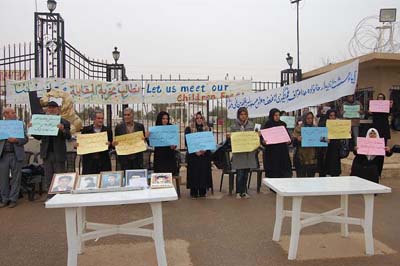
Mujahedin Khalq Organization elements attacked the Iranian families and the Iraqi security forces.

Mujahedin Khalq Organization elements attacked the Iranian families and the Iraqi security forces

While preventing the Iranian families visit their relatives incarcerated in Ashraf Camp in Iraq’s Diyala Province, MKO elements attacked the Iranian families and the Iraqi security forces accompanied them.

Iranian families asked the Iraqi government to take urgent measures for the release of their children imprisoned in Ashraf Camp.

One of the relatives of the detainees told Alalam : “elements of Mujahedin have captured my brother here in Ashraf Base and despite all the problems, we’ve come from Iran but the Organization prevents us to visit him . I ask the Iraqi government to solve this problem.
Iranian families asked the Iraqi government to take urgent measures for the release of their children imprisoned in Ashraf Camp
The child of another detainee said:” My father has long been confined in Ashraf Base, Iraq. I am here to meet my father but the MKO’s elements refused to let me visit my father and beat me.

Adel Almane Iraqi political activists told Alalam : “The Iraqi government opposes the presence of any armed organization in its territory as it threatens the security of neighboring countries as well as that of Iraq itself. “

He also said: "to give the opportunity to MKO to reside at Iraq would darken the Iran-Iraq diplomatic relations.”

Translated by Nejat Society

February 18, 2010 0 comments
FacebookTwitterPinterestWhatsappTelegramSkypeEmail
The MEK Expulsion from Iraq

Iraqi Deputy FM Stresses Expulsion of MKO Members

TEHRAN (FNA)- A senior Iraqi foreign ministry official on Tuesday underlined his government’s determination to expel members of the anti-Iran terrorist group, the Mojahedin-e-Khalq Organization (MKO), from the country. "Transfer of MKO's members to the South of Iraq is a preliminary to their final expulsion from Iraq," Iraqi Deputy Foreign Minister Mohammad Haj Hamoud

"Transfer of MKO’s members to the South of Iraq is a preliminary to their final expulsion from Iraq," Iraqi Deputy Foreign Minister Mohammad Haj Hamoud said at a meeting with Secretary-General of Iran’s Habilian Association Seyed Mohammad Javad Hasheminejad in Iran’s holy city of Mashhad.

"The MKO member will be expelled from our country and I hope that the efforts made by the (Iraqi) government to materialize the Iraqi people’s old demand (for the expulsion of the MKO) will soon yield positive results," Haj Hamoud underscored.

He further reminded the crimes committed by the MKO against the Iraqi people, and added, "The group was not welcomed by the Iraqi people even during the era of Saddam (toppled president of Iraq) and we consider them as a terrorist group."

During the meeting, Hasheminejad stressed that presence of terrorist groups in Iraq was a heavy blow to the establishment of peace and tranquility in the country.

The MKO has been blacklisted as a terrorist organization by many international entities and countries.

The MKO is behind a slew of assassinations and bombings inside Iran, a number of EU parliamentarians said in a recent letter in which they slammed a British court decision to remove the MKO from the British terror list.

The EU officials also added that the group has no public support within Iran because of their role in helping Saddam Hussein in the Iraqi imposed war on Iran (1980-1988).

The group started assassination of the citizens and officials after the revolution in a bid to take control of the newly established Islamic Republic. It killed several of Iran’s new leaders in the early years after the revolution, including the then President, Mohammad Ali Rajayee, Prime Minister, Mohammad Javad Bahonar and the Judiciary Chief, Mohammad Hossein Beheshti who were killed in bomb attacks by MKO members in 1981.

The group fled to Iraq in 1986, where it was protected by Saddam Hussein and where it helped the Iraqi dictator suppress Shiite and Kurd uprisings in the country.

The terrorist group joined Saddam’s army during the Iraqi imposed war on Iran (1980-1988) and helped Saddam and killed thousands of Iranian civilians and soldiers during the US-backed Iraqi imposed war on Iran.

February 17, 2010 0 comments
FacebookTwitterPinterestWhatsappTelegramSkypeEmail
The MEK and Jundullah

Rajavi, Rigi to make Joint Terror front

Mojahedin Khalq terrorist group to be relocated to Pakistani boarder

Text of report by Iranian Tabnak news website on 16 February
Mojahedin Khalq terrorist group to be relocated to Pakistani boarder
Tehran, 16 February: [Opposition group] Mojahedin-e Khalgh Organization [MKO] and [Sunni rebel group] Rigi grouplet have held initial talks to make a joint front and cooperate.

According to Javan Online, the heads of the Rigi and Hypocrites [MKO] grouplets have recently met in an area in Pakistan and have held talks.

In this meeting, [head of the Rigi group] Abdolmalek Rigi has met with a number of the operatives and commanders of the Hypocrites grouplet and has held talks with them. He announced that he would be ready to have any sort of cooperation [with MKO] in line with making a terrorist group under the name of the Armed Forces Organization of Mojahedin.

It is said that provision of weaponry and exchange of information have been among agreed issues in this meeting prior to finalizing the decision to make a joint front.

February 17, 2010 0 comments
FacebookTwitterPinterestWhatsappTelegramSkypeEmail
Iraqi Authorities' stance on the MEK

Iraqi figures criticize MKO presence

A number of Iraqi political and media figures criticized the presence of the terrorist Mujahedin-e Khalq Organization (MKO) on Iraqi soil.

They insisted that the MKO members can not be regarded as political refugees, Habilian Association (families of Iranian terror victims) news website quoted Al-Fayhaa TV.

The Iraqi figures also complained that the MKO presence in Iraq had become a real dilemma left by the dictatorship of Saddam Hussein.

“They have broken rules and norms of international refugee law through acquiring advanced weapons,” they stressed.

February 17, 2010 0 comments
FacebookTwitterPinterestWhatsappTelegramSkypeEmail
Iraqi Authorities' stance on the MEK

Officials: Exclusion of Al-Mutlaq a blow to MKO and terrorism

According to officials in Diyala province, the Justice and Accountability Committee’s exclusion of Saleh al-Mutlaq from the elections has dealt a severe blow to terrorism and the Mojahedin Khalq Saleh Al_Mutlaq, disqualified for his Baathist tiesOrganization of Iran. Saleh al-Mutlaq is considered as the supporter and funder of the terrorist Mojahedin-e Khalq in Diyala, who have been involved with the Saddam regime in the genocide of the opponents of the repressive Baath Party. The Director of the Association for Former Political Prisoners in Diyala under Saddam’s regime, Yousef Jassem al-Sadiq, said Iraq is our home and “the exclusion of al-Mutlaq is a cause for great joy for political prisoners in Diyala and represents the victory of the people and is a severe blow to al Qaeda and the Mojahedin-e Khalq Organization”.

The District Commissioner of Khalis, Uday Adnan Alkhaddran, said, the decision to ban MP Saleh al-Mutlaq from participating in the elections is the latest big blow to the Mojahedin-e Khalq, adding that this will deprive it of one of its most prominent political allies in Iraq and the decision is considered a victory of the Iraqi people’s will.

Alkhaddran added that “al-Mutlaq is a strategic ally of the Mojahedin-e Khalq, who are terrorists, and is supportive of all armed organizations that are working to kill Iraqis. He demanded that the central government speed up the removal of the Organization beyond the borders of the country as a popular demand of the people of the province.

Adustour, Baghdad,Translated by Iran Interlink

February 17, 2010 0 comments
FacebookTwitterPinterestWhatsappTelegramSkypeEmail
France

French court rules against Mojahedin Khalq advocate

Mr. Yves Bonnet, former Member of French National Assembly and Director of the French Counterterrorism Agency (DST), has been fined and was ordered to pay compensation in a libel case on February 11, 2010. He was warned that further infringements would attract even more severe punishments.
French court rules against Mojahedin Khalq advocate Rajavi
The defamation case was brought by Mr. Ehsan Naraghi, Mr. Jahangir Shadanlou and Mr. Manouchehr Shalali against Mr. Yves Bonnet who had falsely accused them of being ‘agents of Iran’s Intelligence Ministry in a book titled ‘VEVAK: At the service of the Ayatollahs’. Mr. Christohpher Barge of Timaeus publishing company was also ordered to publicise the court’s decision in relation to the book.

In February 2005, a similar defamation case was won by British academic Dr. Ali Ansari. A book written by a leading member of the Mojahedin-e Khalq had described Dr. Ansari as an "ardent apologist" and a "fervent proponent" of the Iranian Government. On receiving Dr. Ansari’s complaint in court, the publisher accepted fully that there was no basis for what had been written about him and immediately offered him an apology.

The court ordered a suitable sum to be paid to an appropriate charity and for Dr. Ansari’s legal costs to be met in full.

This latest decision of the Tribunal de Grande Instance of Paris in the case against Yves Bonnet was in a similar vein. The complainants were under severe pressure by the Mojahedin-e Khalq during the hearing on 17 and 18 December 2009 as several hundred members of the group packed the building in an attempt to intimidate the complainants and witnesses.

The judgement against Yves Bonnet and his publisher is another example of the failure of Rajavi in the attempted demonization of Iranian dissidents and critics of the Mojahedin-e Khalq.

February 16, 2010 0 comments
FacebookTwitterPinterestWhatsappTelegramSkypeEmail
Iraqi Authorities' stance on the MEK

Al-Ja’fari:Mojahedin should not be given refuge

Iraqi party leader Al-Ja’fari discusses government “flaws”, election issue

… He expressed understanding for “the Saudi fears regarding the situation in Iraq,” and said: “deep dialogue should be conducted with it to give it the necessary reassurances. Likewise, Iraq should not be turned into a springboard for hurting any neighbouring country and that terrorist organizations such as the Iranian Mojahedin-e Khalq or the Turkish Kurdistan Workers’ Party should not be given refuge.” …

Text of report by London-based newspaper Al-Hayat website on 4 February

[Report on an interview with Ibrahim al-Ja’fari, former Iraqi prime minister and leader of the National Reform Trend; by Uday Hatim in Baghdad. Al-Ja’fari to Al-Hayat: “I Have Reservations on the Government Performance, and Al-Hakim Sought Broad Alliances that the Coalition has not Approved”]

Former Iraqi Prime Minister Ibrahim al-Ja’fari has criticized the government performance and blamed the leader of the Iraqi Islamic Supreme Council [IISC] for his call to form broad alliances, and said that his endeavour “is a personal viewpoint that does not represent the National Coalition,” warning that “such alliances would be dependent on others as the case with the previous coalition.” Al-Ja’fari added that he does not reject the post of prime minister but he does not aspire to be in that position, emphasizing that his rejection of the Kurds’ ideas about Kirkuk had prevented the renewal of his term.

In an interview with Al-Hayat, Al-Ja’fari, who leads the National Reform Trend, which is part of the Shi’i Coalition list, said that “the Reform Trend is something in the middle between the religious extremism and the secular extremism,” pointing out that “it is not an Islamic trend but it respects religions and does not contradict them, and it absorbs all Iraqi sectors and does not favour any one against the other.”

He warned that the political process and the competition in the elections would change into a “conflict,” considering “the victims of the attacks on characters will be efficient and honest people,” and said that the elections “are important and sensitive because the people have started to be aware, even if little, of their rights and duties.”

He admitted that there is a regional and international interference in the elections, and said “the countries have fears and ambitions; therefore, they support the forces they believe are closer to achieving their interests, and this is something that takes place in all world countries,” stressing that “this is the most dangerous thing to the political process in spite of my respect for the friendly relations between the political forces and any country on condition that these relations do not change into a process of dependence and that the symbols [of Iraq] do not change into representatives of that country in Iraq.” He called on the government to “put restrictions and rules for these relations.”

He expressed hope that the Coalition list would win and receive the largest number of parliamentary seats. On the announcement by the Supreme Council, which is the largest component of the Coalition, of the names of its candidates for the post of prime minister, who are Vice President Adil Abd-al-Mahdi and Finance Minister Baqir Jabr al-Zubaydi, he said “this is something that surprised us all.”

He said that “this nomination does not represent the Coalition’s viewpoint because it has not taken place in consultation with the parties that form the alliance and it is something premature and no party should present candidates outside the Coalition framework and without agreeing on these candidates.” He ruled out the possibility of naming the chairman of the National Coalition or its candidate for the post of prime minister before the next elections, pointing out that “discussion on these two posts and the candidates for the ministries will take place after the election results are announced.” He said that “the chairmanship of the Coalition will be for a renewable of either one or two years. Even the prime minister will have his work reviewed every year with the possibility of replacing him if the Coalition decides that he has not succeeded in his task.” He added: “I do not think of the post of prime minister and I do not aspire to have it and will not take the initiative to have it, but I may accept it if I find that the people want that, and then I will carry out this task very seriously.”

He called for “patience regarding the issue of Kirkuk and not to rush in imposing a solution that may aggravate the problem. He pointed out that “the uniqueness of Kirkuk is in the diversity of its inhabitants and society; therefore, the solutions that are applied to the societies that have one ethnicity should not be applied in this city.”

On the most prominent constants he would adopt in case he is chosen as a prime minister, he said that “he is aware that Iraq in 2010 is different from that of 2005, therefore, I will work to correct the mistakes,” pointing out that “the first of his concerns will be to deal with the security situation from its roots, raise the standards of living for the citizen, upgrade the levels of services, and adopt programmes to develop the fields of industry, agriculture, oil, and trade, and tackle the crises between Iraq and the regional countries to protect the joint interests.”

Al-Ja’fari said the endeavour of Ammar al-Hakim, the Supreme Council leader, to restore the previous alliances with the Kurds and Sunnis “is the Council’s viewpoint alone and not that of the Coalition because we were surprised by what Al-Hakim said about a political front during his visit to Kurdistan.” He said, however, that “the Coalition is not against this alliance, but it does not want it to be with one bloc or quarter but with all trends and blocs, which is one of our new constants, and the Coalition wants the alliance to be made after the elections and that it should be based on equal interests and not dependency.”

He expressed reservations on “dual alliances such as the old ones that made the previous coalition dependent on others. This is one of our reservations on it because such alliances had changed into dependence,” in a hint by him to previous alliances by the Supreme Council with the two Kurdish parties and forming a four-party alliance which included the Supreme Council, Al-Da’wah Party, led by Al-Maliki, the Patriotic Union of Kurdistan, and the Kurdistan Democratic Party, which led to the withdrawal of parties from the previous Shi’i coalition such as Al-Sadr Trend and Al-Fadilah Party.

On how he evaluates the performance of Prime Minister Nuri al-Maliki, Al-Ja’fari said “the difficulties and circumstances that faced Al-Maliki are not few, and he paid the price of the governments that resorted to quotas because he has not chosen his ministers.” He, however, criticized the government performance and said that “the standard of services is low, and there are clear signs of flaws, remarks, and reservations on the performance. But every experience should be viewed in light of the circumstances surrounding it.” He also expressed reservations on some leaders of Al-Da’wah Party, pointing out that “the practices that took place at the party’s congress, the one before the last congress, led me to have huge reservations.” Al-Da’wah Party had chosen Al-Maliki secretary general of the party in place of Al-Ja’fari after the latter left the post of prime minister.

He added that “the security apparatuses continue to be penetrated, and this is no secret to anyone. Had it not been so, the terrorist attacks on sensitive areas in the heart of Baghdad would not have been repeated. The government has to conduct investigation with various security commanders of various ranks to diagnose the flaw.” He strongly criticized the continued use of explosives detecting devices, which he termed as “failure and defective, to the point that even the manager of the British company that manufactured them has been put under investigation as a result of these devices.”

Al-Ja’fari said “the national reconciliation has not achieved anything because the weapon is still brandished in the face of people,” and called for “starting dialogue with all those who carry weapons because the reconciliation is with the quarters that carry out armed actions for several reasons, including the presence of foreign forces or the presence of detainees with these forces. These things can be discussed and solutions can be found for them.” He said that “no one should be excluded except the one who insists on maintaining his affiliation to the Ba’th Party and who is trying to bring it back to power.” He expressed his support for the work of the Commission for Accountability and Justice, but he called for refraining from politicizing it and keeping it as a legal body that takes measures which include all.”

On relations with the neighbouring countries, he said that “there is a complex crisis in Iraq’s relations with the various neighbouring countries for which the responsibility is not only that of the government but it is shouldered by the political forces that make painful criticism of this or that country.”

He expressed understanding for “the Saudi fears regarding the situation in Iraq,” and said: “deep dialogue should be conducted with it to give it the necessary reassurances. Likewise, Iraq should not be turned into a springboard for hurting any neighbouring country and that terrorist organizations such as the Iranian Mojahedin-e Khalq or the Turkish Kurdistan Workers’ Party should not be given refuge.” He added: “I rejected the Algiers Agreement when I was on an official visit to Iran in my capacity as the prime minister. I refused to sign a memorandum of understanding that included a paragraph that refers to this agreement. My refusal led to the failure to sign any memorandum.”

Al-Hayat website, London – Translated and reported by BBC Monitoring

February 14, 2010 0 comments
FacebookTwitterPinterestWhatsappTelegramSkypeEmail
Iraq

AL Motlaq, the main backer of MKO Terror group banned permanently

Iraq’s appeal panel allowed 28 banned candidates to stand in parliamentary elections.
Saleh Al_Mutlaq, disqualified for his Baathist tiesOut of 177 candidates who had submitted contests, the panel allowed the participation of 28 candidates only, spokesman for Justice and Accountability Commission Ali Mahmoud told AFP.

MPs Saleh Al Motlaq and Zafer Al Ani are not allowed in elections, Mahmoud added.

February 14, 2010 0 comments
FacebookTwitterPinterestWhatsappTelegramSkypeEmail
Massoud Rajavi

Rajavi’s message, an art of collage

Rajavi’s 20 January message seems to be a turning point for Mojahedin Khalq Organization, a foreseeable message although a little late. Unlike Rajavi’s previous messages that were stereotypically repetitious claims, his new rhetoric is blusters for the third post-revolution generation who hardly know anything about him and his organization. This new step may have been taken because he had already been notified by the theoreticians of his red-movement that the Iranian third generation neither knew him nor considered any political and social weight for him. Usually turning a deaf ear to the warnings of advisers, this time it seems that he has bended his ears to advices to deliver a different message that is a turning point in accepting bitter truths. But, alas, he can never abandon the bad habit of going straight to the point and, as usual, he first brags the highness of his status and then holds onto rhetoric to justify his thirty-year long absence from Iran’s political arena. But, as he always feels others are indebted to him and he has no spare time to waste on inconsequential questions, he prefers to engage in polemics concerning Iranian future.

But he still fails to be relieved of the phantom that the generation he is addressing has never troubled its mind about him and his organization as the former believes the latter are a piece of Iran’s past history. Only some acquainted with the stalemates and crises the organization has recently encountered can realize what is bothering Rajavi at the present. He has been under the direct attack and criticism of the insiders and the outsiders as well as other opposition from among the ultra-left to the ultra-right. Undesirable consequences being inevitable, he is preempting to deter challenges that can further mire him and his organization. As a result, once you hear him claiming to be the instigating engine of Iran’s post-election riots, while he complains of being politically stagnated and does not hesitate to swear that terrorist tag is an attached stigma to smear the organization. But he can never deny that he is still ideologically loyal to Marx when he says:

The important point is that Marx remarks that ‘the philosophers have only interpreted the world, in various ways. The point, however, is to change it’. Of course, Marx has deduced this necessity from social evolution and the historical dialectic. However, it draws us near to the conception of ‘man’s responsibility’. I have no access to texts now but if my mind helps me remind forty years ago, this is the core of Che’ Guevara’s analysis of Marx when he said ‘this is the very same point where the pens have to put down to pick up rifles to change the world’.

That is what Rajavi and all those defected members, whom he calls deserters and the agents of the Islamic Republic, have done in a thirty year-long armed struggle- grabbing guns rather than pens and peaceful campaign. On the one hand he claims to have received letters and questions from inside Iran through a variety of means and routes, on the other hand he forgets all he has said so far by stating “I tell you to know that what the regime has all these years published and distributed in its prisons and its-controlled organs under the name of Mojahedin are untrustworthy. They are either fabricated or distorted to achieve the intended goals and to instill what they want”.

In spite of Rajavi’s exploitation of all social and political schools of thought to convince the third generation they have been deprived of such a great personality and the source of secret knowledge, that is himself, his message is a mixture of ambiguities delivered from a nowhere. A message from a so-called leader whose whereabouts are unknown for those who he calls to recognize, appreciate and follow. It is neither similar to a political statement nor an organizational pronouncement and nor is it in any way a political-ideological pamphlet of instruction. It is much similar to a collage and he is like a collagist who has stuck different pieces of subjects each with a different definition and color together. It is clear that the message has emerged out of a confused mind that is itself escaping from the reality that it had to accept long ago. Anyone looking at Rajavi’s work of collage can easily discern a depicted picture of Rajavi’s betrayal, violence and egocentric ambitions recorded in the history.

February 14, 2010 0 comments
FacebookTwitterPinterestWhatsappTelegramSkypeEmail
Newer Posts
Older Posts

Recent Posts

  • Rebranding, too Difficult for the MEK

    December 27, 2025
  • The black box of the torture camps of the MEK

    December 24, 2025
  • Pregnancy was taboo in the MEK

    December 22, 2025
  • MEPs who lack awareness about the MEK’s nature

    December 20, 2025
  • Why did Massoud Rajavi enforce divorces in the MEK?

    December 15, 2025
  • Facebook
  • Twitter
  • Instagram
  • Youtube

© 2003 - 2025 NEJAT Society . All Rights Reserved. NejatNGO.org


Back To Top
Nejat Society
  • Home
  • Articles
  • Media
    • Cartoons
    • NewsPics
    • Photo Gallery
    • Videos
  • Publications
    • Books
    • Nejat NewsLetter
    • Pars Brief
  • About Us
  • Contact us
  • Editions
    • عربي
    • فارسی
    • Shqip