Nejat Society
  • Home
  • Articles
  • Media
    • Cartoons
    • NewsPics
    • Photo Gallery
    • Videos
  • Publications
    • Books
    • Nejat NewsLetter
    • Pars Brief
  • About Us
  • Contact us
  • Editions
    • عربي
    • فارسی
    • Shqip
Nejat Society
Nejat Society
  • Home
  • Articles
  • Media
    • Cartoons
    • NewsPics
    • Photo Gallery
    • Videos
  • Publications
    • Books
    • Nejat NewsLetter
    • Pars Brief
  • About Us
  • Contact us
  • Editions
    • عربي
    • فارسی
    • Shqip
© 2003 - 2024 NEJAT Society. nejatngo.org
Mujahedin Khalq Organization

A report of purges within MKO- part two

Once in a letter addressed to Christopher George of Human Rights Watch/Middle East entitled Human Rights Abuse in Rajavi’s cult, Nowrooz Ali Rezvani, a disaffected and former member of MKO, presented documented reports of many physical and psychological mistreatments of the documented reports of many physical and psychological mistreatments of the members by the leaders within the organizationmembers by the leaders within the organization.
 
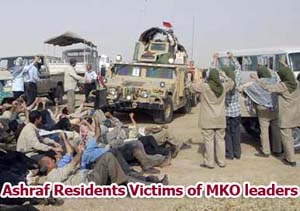
The following is a detailed and proven list of engineering operations plotted in years 1981 to 1994 in an attempt to purge some members for certain organizational reasons. The confessions by Mr. Rezvani well indicates the potentiality of the organization in subjecting the life of those in Camp Ashraf to severe jeopardy through a preplanned scenario and under the cover of defending the camp against the lawful interference of the Iraqi police to take the control in its hands.

It was a detailed account of human rights violation and now let’s point to some indications of Mojahedin’s inter-organizational relations to develop a better understanding of its anti-human nature and to what degree it respects the principles of democracy and human rights.

In winter 1982, Mojahedin Khalq forces stationed in the northern Kurdistan executed three POWs, one of them underage. The commander on the scene were Mr. Mesbah, a member of the central cadre, Mr. Assad, a deputy of the organization’s leadership from Tabriz. The commander of the firing squad was Qudrat-allah Heidari and the firing party was constituted of Mr. Karim Turk and a woman whose son had been executed by the Iranian regime.

In Spring 1984, four more POWs were executed in Kurdistan border zone, the jungles of Shah Nosqeh region just in the vicinity of Pazhveh Village. The executioners were Morteza, working in armory, from Hamada, Naser Turk known as Naser Gestapo, Karim Turk from Tabriz known as Karim fascist, Mr. Assad from Tabriz, Mahdi from Hamadan, and Reza Karam-Ali also known as Yaqub from Tehran.

In 1984, six dissidents were executed in the jungles of Shah Nosqeh region in Kurdistan as they were opposed to Rajavi’s announced imamate. The executed were pseudonymously called Saeed from Tabriz, Qasim from Zanjan, Naser from Shiraz, Rasoul from Kermanshah, Qulam from the northern Iran, and Suhrab from Tehran. The executioners were Karam from Hamadan, Reza Karam-Ali from Tehran, Naser Turk, Karim Turk and Ibrahim Zakeri, the commander of the execution.

In 1985, more than 700 members of the organization were imprisoned in the Iraqi Kurdistan region in jails located in suburb Saveh, Kahrizeh, and Camp Ghayur. Other imprisoned were some members of political bureau and central council including Ali Zarkesh along with other 117. They were all condemned to death and following their preliminary investigations they were sent to prisons in Suleymanieh.

In 1985, more than 50 recalcitrant members of the organization were imprisoned in the Iraqi Kurdistan city of Suleymanieh and built jails in camps Mesbah ans Ghayur. Some were also imprisoned within the safe houses in Kirkuk.

In 1990, more than 500 recalcitrant members of the organization were imprisoned in the castle-like Debs Prison in the vicinity of Kirkuk. The prisoners’ seven day-long hunger strike is an indication of their protest to drastic shortages and harsh prison condition.

In 1991, there were numerous jails and cells inside Camp Ashraf, some of them were the prison of the municipal building, the prison of college, the prison behind the rifle range, the residential prison, and prison H which was one of the most horrible solitary confinements with cell cages in size of graves, there were other prisons in headquarters and army regiments as well.
In 1992, there were prisons and safe-houses set up around Baghdad including prison Muhammad zabeti, prison Saadati, prison Seifi, prison Akbarzadegan, prison Malik Marzban, a prison known as the camp of the members of the National Council of Resistance close to American Embassy, prison Mirzai, prison Dr. Muhammad Tabatabai, prison Rezai, and more.
Pakistan, 1987. Asghar Mirzai working in the Voice of Mojahed from the northern Iran was sent to Pakistan after engaging in some inter-organizational friction. After a while the organization announced that he had broken with the organization and had reported information about the camps of the National Liberation Army and headquarters of leadership to Iranian regime. Still the members were digesting the story that there came the news of his assassination by the regime. His wife was in a state of mental imbalance since it remained an unsolved question why her husband was killed soon after his separation.

Explanation: Asghar had been long working in Rajavi’s private bastion known as Camp Badi-zadegan located 45 km. west of Baghdad in Abu-Ghurib region where he made programs for the Voice of Mojahed. Thus, he had proven information concerning Mojahedin’s implication in Haj massacre and he was also the link between the Voice of Mojahed’s broadcasts and the Iraqi regime.

Of other obliterated members to name was Bahram Turk from Tabriz who worked in Rajavi’s private bastion known as Camp Badi-zadegan located 45 km. west of Baghdad. He knew anything about Rajavi’s residential and its secrets. Later, he was identified as a troublemaker and was degraded to work as a simple gardener in Rajavi’s private courtyard. It did not take long to be announced that he had been found drowned in the camp’s pool. He was reported to have fallen into the pool and drowned as he could not swim and there was nobody around to help him. Bahram was a real source of information and knew things about the organization’s association in Haj massacre. His wife was six month pregnant when he died and the baby was named Bahram after him.

Explanation: Reza Asadi was once a pilot in IR Air Force who had his hand in the escape of Dr. Banisadr and Masoud Rajavi from Iran. He was a comrade working close with Bahram and knew him well. A detached member, now he is living in Netherlands. In a letter to a friend, he gave some details about Bahram’s skill in swimming.

On the day we met, we talked about the article you penned for the Nimrooz. Now I try to give some details. For two years I was working with Bahram in a garage in Baghdad. He was one of those who lacked the proficiency to be invested with responsibility but was enthusiastically devoted to Maryam (Rajavi) and was ready to dive through a window hearing her name. The devotion branded him an ideological element with consequent conferred responsibilities. They say he was drowned in an ordinary pool. Your article in the Nimrooz made me recollect a joint travel I had with Bahram. We were en route to Kirkuk from Baghdad on a hot summer day in month Ramazan. We stopped the car on the bank of river Takrit, a big, rapid and raging torrent, to swim. I am a good swimmer and can swim in any condition.

But Bahram was many times better and swam easily in the deepest part of the river where hardly anybody, and even me, could swim. He swam so comfortably as if he was lying on a soft, flat mattress enjoying himself.

August 18, 2009 0 comments
FacebookTwitterPinterestWhatsappTelegramSkypeEmail
Iraq

Demonstrations in Diala to deport Rajavi cult

DIALA / Aswat al-Iraq: A big demonstration has taken place in the al-Khalis suburb demanding to deport the People’s Mojahedin Organization of Iran (PMOI) from Iraq, the suburb’s Mayor, Uday al-Khadran, said on Monday.

PMOI media spokesperson, Mahdi Aqbaee, accused the Diala province’s police commander of arranging the demonstration, but the commander denied these accusations.

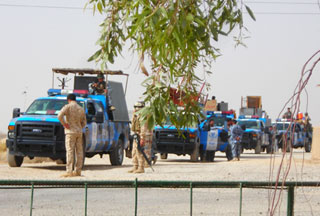
Last week, Iraqi forces engaged with PMOI fighters at the organization’s headquarters in Camp Ashraf in al-Khalis suburb (15 km north of Baaquba city). Two policemen were killed and 66 others were injured, while 12 of the organization’s elements were killed and 400 others were wounded.

“Thousands of the suburb’s residents participated in the demonstration,” Mayor al-Khadran told Aswat al-Iraq news agency.

“The demonstrators want to deport the PMOI from Iraq due to the organization’s interference in the Iraqi issue,” he said.

The PMOI, also known by the abbreviations MKO and MEK, is a militant socialist organization that advocates the overthrow of Iran’s current government. Founded in 1965, the PMOI was originally devoted to armed struggle against the Shah of Iran, capitalism and Western imperialism.

“The organization’s members committed acts of aggression against Iraqi forces inside Camp Ashraf,” al-Khadran said.

“Diala residents do not want the PMOI to stay in Camp Ashraf,” he said.

The organization officially renounced violence in 2001 and today it is the main organization in the National Council of Resistance of Iran (NCRI), an “umbrella coalition” parliament-in-exile that claims to be dedicated to a democratic, secular and coalition government in Iran.

For his part, Aqbaee said, “The Diala police commander, General Abdulhussein al-Shemmary ordered a number of his forces to arrange the demonstration.”

“This measure is illegal,” Aqbaee said.

After more than 20 years of living in Camp Ashraf in the Iraqi province of Diala, near the borders with Iran, the PMOI announced that it is ready to leave Iraq, setting five conditions they said the Iranian government has to fulfill.

He said that the organization members, when they arrive in Iran, are to have immunity against arrests and torture and enjoy the right to express their views and that the Iranian government should issue an official commitment in this regard addressed to the United Nations (UN), the International Committee of the Red Cross (ICRC), and the two governments of the United States and Iraq.

He also said those four sides should certify the commitment, and the UN and ICRC should be responsible for activating this agreement inside Iran.

According to Aqbaee, the conditions should allow PMOI members to sell their property in Iraq, while those who do not want to return to Iran should have the right to seek asylum in a third country.

The PMOI has had thousands of its members for many years in bases in Iraq, but they were disarmed in the wake of the 2003 U.S.-led invasion and are said to have adhered to a ceasefire. Its armed wing is, or was, called the National Liberation Army of Iran (NLA).

The former Iraqi President Saddam Hussein dedicated Camp Ashraf in Diala province, northeast of Baghdad, to host the PMOI members since the 1980s.

Although being designated as a “terrorist” group, the organization has been under U.S. protection.

After the security agreement between Iraq and the United States government was signed, the Iraqi government took the responsibility of providing security to Camp Ashraf residents.

For his part, General al-Shemmary denied the accusations that the demonstration was staged by his forces, stressing that there was no military presence in the demonstration.

“The PMOI operatives were behind the death of two policemen and the injury of 66 others,” al-Shemmary said.

“The damage reached Camp Ashraf itself, which is considered an Iraqi government property,” he said.

Baaquba, the capital city of Diala province, lies 57 km northeast of Baghdad.

August 18, 2009 0 comments
FacebookTwitterPinterestWhatsappTelegramSkypeEmail
Iraq

MP Urges Expulsion of MKO Members from Iraq

Members of the anti-Iran terrorist Mojahedin-e Khalq Organization (MKO) should be expelled from Iraq’s soil, an Iraqi lawmaker said.

"The MKO members should leave Iraq’s soil. That is the least aspiration of the Iraqi nation," member of the Iraqi parliament Neda al-Sudani told Fars News Agency.

"Their presence is against our will. The nation of Iraq does not want them (MKO) and asks for their expulsion," she noted.

Stating that the MKO’s presence in Iraq is a sensitive issue for Iran, she added, "We do not want their presence to be extended any further."

Earlier in August, Iraqi Prime Minister Nouri al-Maliki stressed his government’s resolve to expel MKO members from his country.

"We have always had a clear stance on all terrorist groups. They have to leave the Iraqi soil. The government has underlined this stance since the beginning," Maliki told FNA at the time.

Iraqi security forces took control of the training base of the MKO at Camp Ashraf – about 60km (37 miles) north of Baghdad – last month and detained dozens of the members of the terrorist group.
Asked about the possibility of the return to power by Iraq’s former Baath party, al-Sudani told FNA that based on Iraq’s laws the Baath party can neither have a share in the government nor nominate anyone for elections.

A leading US daily, the Washington Post, cited Turkish and American officials as well as an insurgent leader as saying that the US officials engaged in negotiations with Iraqi insurgent groups in two meetings this spring that culminated in an agreement to organize talks intended to bring the groups into Iraq’s political life.

August 17, 2009 0 comments
FacebookTwitterPinterestWhatsappTelegramSkypeEmail
Members of the MEK

36 PMOI members to face trial

Thirty-six members of the People’s Mojahedin Organization of Iran (PMOI) are due to stand trial in al-Khalis, according to an informed source.

Thirty-six members of the People’s Mojahedin Organization of Iran (PMOI) are due to stand trial in al-Khalis, according to an informed source.“Those members are currently held in accordance with Article 431 for triggering acts of violence that took place between police forces and Camp Ashraf residents in late July,” a judicial source from Diala province told Aswat al-Iraq news agency.

Last month, clashes erupted between Iraqi security forces and PMOI members at Camp Ashraf, the headquarters of the organization, leaving 10 members killed and 400 others wounded, according to the organization’s media spokesperson.
Two policemen were killed and 66 others were injured in the clashes, according to Iraqi officials.

The PMOI, also known by the abbreviations MKO and MEK, is a militant socialist organization that advocates the overthrow of Iran’s current government. Founded in 1965, the PMOI was originally devoted to armed struggle against the Shah of Iran, capitalism and Western imperialism.

The group officially renounced violence in 2001 and today it is the main organization in the National Council of Resistance of Iran (NCRI), an “umbrella coalition” parliament-in-exile that claims to be dedicated to a democratic, secular and coalition government in Iran.

The PMOI has had thousands of its members for many years in bases in Iraq, but they were disarmed in the wake of the 2003 U.S.-led invasion and are said to have adhered to a ceasefire. Its armed wing is, or was, called the National Liberation Army of Iran (NLA).
Former Iraqi President Saddam Hussein dedicated Camp Ashraf in Diala province, northeast of Baghdad, to host the PMOI members since the 1980s.

August 17, 2009 0 comments
FacebookTwitterPinterestWhatsappTelegramSkypeEmail
Iraq

10 major Iraqi parties support MKO expulsion

10 major Iraqi parties announced by issuing a statement their full support for the expulsion of MKO terrorist group from this country.

10 major Iraqi parties announced by issuing a statement their full support for the expulsion of MKO terrorist group from this country.According to Fars News Agency, the statement which was issued by the Coordinating Committee of national and political parties and forces of Iraq in England, says: in late last July Iraqi army and armed forces tried to enter camp Ashraf in Diyali province in order to find control over the camp in account that the camp is a part of the Iraqi soil and a foreign rebellious force belonging to MKO which is an opponent of the Iranian government is based there.

This terrorist organization has been present in Iraq during the era of Saddam in power and has played a key role in assisting the Iraqi dictator in suppressing 1991 Shiites Intifada and massacre of Iraqi Kurds and continued this role until after the fall of the criminal regime in Iraq in 2003.

The statement also states: Military conflicts at the time of doing this operation were the result of the failure of talks with elements of the organization for peacefully entering the camp and of course this operation was within the framework of the security pact signed between Baghdad and Washington over power transmission to Iraqi forces which led to some casualties for both sides.

Participant parties who wrote and signed the letter include the Supreme Iraqi Islamic Assembly, Al-da’avah Party (Party of Islamic invitation), Democratic Party, Union of Iraqi Kurdistan, the Iraqi Islamic Party, Iraqi Communist Party, and National Democratic Alliance, the Communist Party of Iraqi Kurdistan, Organization of feyli Kurds and democratic movement Iraqi Ashouries.

August 17, 2009 0 comments
FacebookTwitterPinterestWhatsappTelegramSkypeEmail
Former members of the MEK

Execution, the approach to repel dissenters

An interview with Batool Soltani on MKO self-immolations – Part ten

Sahar Family Foundation: since the deployment of the American forces in the region and even before that the serious agenda before the organization has been the resistance of Camp Ashraf. That why it is of such significance for the organization is another issue to deal with. But the question here is implementation of the means, explicitly suicide operations, to defend Ashraf as the strategic bastion. That is the fact we have already talked about when referring to human tragedy and human shield, the members’ risking their life in defense of Ashraf. Rajavi has reiterated that ‘if Ashraf resist, the whole world resist’, in fact, such mottos show clear dispositions of the leadership and other rankings towards Ashraf for its strategic importance. Will you give further details on anything untold concerning this issue and even what approaches did Rajavi take to deal with those members who would resist against plotted suicides in defense of Ashraf?

Execution, the approach to repel dissentersBatool Soltani: well, here are a nexus of issues that can be discussed separately. One is the vow to defend Ashraf through any possible means. First it was resolved to fight in defense of Ashraf tooth and nail but circumstances proved to be more serious and they had to think of a different approach to resist, that is to say, human shield. Once they resolved on urgent transfer of the cadres of the Leadership Council from Iraq to France and they even provided passports for high rankings to get them out of Iraq. In 2003, Massoud Rajavi, the beating heart of the organization, made a call insisting that Auvers-sur-Oise, Maryam’s residence, was the brain of the organization while Ashraf was naturally the heart; the brain would naturally collapse if the heart’s beating declined, and it is a question of how the brain and heart interrelate.

You know, after the fall of Saddam, the organization concentrated all its propaganda capacity on Auvers-sur-Oise to present it, along with Maryam, as the organization’s headquarters of the political leadership in the West. They began to maneuver on Maryam as a political engine there just after experiencing the failed tactic of electing her as the president-elect. Just after her sham election, she was sent to France to play her role there but it proved to be a big failure and she was returned to Camp Ashraf to be conveyed back right before the fall of Saddam. A new round of propagation began since they were of the opinion that now,
 
After the political fluctuations in the region, the West would have a differently positive opinion of Mojahedin. They targeted two aims simultaneously; to stabilize their political bastion in the West by attracting attentions to Auvers-sur-Oise, and second, to continue an increasing protection in favor of Camp Ashraf for two reasons. First, it has been regarded the organization’s ideological receptacle that has the potentiality of rendering members’ ideological readiness.
 
Second, it is observed to be a potential armed force just within the reach of the coalition forces to be used against Iran if they had any plan. The organization’s analysis of the regional crises had convinced it that American’s military interference against Iran was decisively inevitable and was planning to fan the fire to accelerate what it imagined had to happen sooner or later. Thus it was all conditioned on the preservation of Ashraf as a future lever for America against Iran that could possibly lead to Mojahedin’s seizing of power, the key issue on the back burner that required the organization to be disarmed but remain under the protection of a second patron and to unwillingly consent to the wills of the Iraqi government until the due time came. So Ashraf had to be preserved to invest the organization with a promising future. After the 17 June tragic incidents, Massoud Rajavi insisted on a new role play for the Leadership Council, the human shield to defend Ashraf. It was just coincident with Rajavi’s two-year pledge that ended with Bush’s presidency.

Rajavi knew well that out of Iraq would be the end of road for the organization and insisted on staying in Iraq at any cost in hope of a miracle that could open the gate to drive through into Iran. In an earlier analysis he had stated that the organization’s permanent stay in Iraq meant destruction of the organization in whole; it was only a short stay to move to Iran. But now there was another analysis that contradicted the previous; to leave Iraq was equal to complete annihilation. The sole solution was to preserve Ashraf; they could either wait to fish in the troubled waters of intensified crises in the region or all would be buried in Camp Ashraf. The approach for the latter choice was a mass suicide. But then they conjectured that there could be other solutions as well. On was based on the promise that because of the Geneva’s fourth article they could not be forcefully repatriated. Then they draw a picture that they would fight tooth and nail if there was any plan to relocate them forcefully.

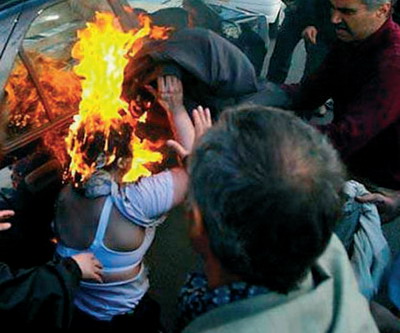
The last proposed resolution was a mass suicide; two deaths were the outcome of this decision. A number of members dispersed after the invasion of the coalition forces were returning to the camp when en route they were informed of the camp’s siege by American forces. Two members the Leadership Council, Marzieh Ali-ahmadi and Nazhat Arzbeigi, immediately set themselves on fire to execute their organizational duty. In fact, they carried out the mission Rajavi had assigned members to do in case American forces occupied the camp. On two conditions members were told to commit mass suicide; the incursion of either Americans or Iraqi Shi’its into the camp. Just when Americans were behind the wall of Ashraf, many members the Leadership Council were preparing to commit suicide. Rajavi had even issued an ultimate for the disobedient who refrained to commit suicide, it was revolutionary execution. No doubt, no outsider could draw any distinction between a voluntary suicide and revolutionary execution following a mass suicide. Rajavi has thought of slightest details concerning his mass suicide program at Ashraf; nobody has to be survived, the willing and the unwilling have to be burn together.

Notably, there were other deterrent decrees issued by Rajavi in private and in a meeting of higher echelons; the lower echelons were unaware of the decrees. The escapees had to be targeted and executed by others; it was the same fate that befell the disloyal and betrayers. The deserters for the opposite front would also face the same destiny. Interestingly, if anybody failed to commit suicide, others had the responsibility to help him/her accomplish the job. Thus, the human tragedy in defense of Ashraf is a program that has to be possibly brought into actuality and there are a variety of approaches that will act to remove deterrents.

August 16, 2009 0 comments
FacebookTwitterPinterestWhatsappTelegramSkypeEmail
Iraq

Iraqi government bound to expel MKO

The Iraqi government is legally bound to expel Mojahedin Khalq Organization members from the country, the political advisor to the Islamic Supreme Council of Iraq Chairman Seyyed Abdul Aziz al-Hakim, said.

There are two reasons why MKO group cannot stay in Iraq: from the legal point of view these persons are terrorists and the Iraqi government does not have the right to let them stay in Iraq, and the political reason is that the MKO members have perpetrated criminal acts against the Iraqi nation, Mohsen Hakim told the Mehr News Agency on Tuesday.

The MKO began a campaign of assassinations and bombings in Iran shortly after the victory of the Islamic Revolution in 1979.

The group moved to Iraq in the early 1980s and it fought Iran from there until the United States invaded in 2003 and until recently the MKO members were guarded by U.S. troops in their base of Camp Ashraf, northeast of Baghdad.

Hakim also said that the Iraqi government has changed Camp Ashraf’s name to Camp of New Iraq.

On July 29 Iraqi security forces stormed Camp of New Iraq that housed MKO and took control of it.

Not only is it the legal right of the Iraqi government but it is the government’s duty to exercise sovereignty over its territory, he explained.

Mohsen Hakim said Iraqi forces were in charge of the camp according to a security deal between the U.S. and Iraq but when the Iraqi forces entered the camp to set up checkpoints they were violently attacked by the group.

“The Iraqi government and nation condemn such actions and will never tolerate the presence of these terrorists in their territory,” he added.

Except for 98 MKO members who have been blacklisted by Iran, the Islamic Republic has declared an amnesty for other members and said they can return to Iran just like 500 members of the group did in the recent years, he added.

Commenting on reports that the senior MKO members have said they will not leave the Iraqi soil, he said the MKO members are neither Iraqi citizens nor defectors, and the Iraqi government will never grant them asylum because they are terrorists, Hakim stated.

The executed Iraqi dictator Saddam Hussein used the heavily armed group during his decade-long war with Iran in the 80s, and it also played a role in Saddam”s bloody suppression of Shia and Kurdish uprisings after the Persian Gulf War in 1991.

The MKO was founded in Iran in the 1960s, but its top leadership and members fled the country in the 1980s after carrying out a series of assassinations and bombings inside the country.
The group is especially notorious in Iran because they allied with former Iraqi dictator Saddam Hussein during the 1980-1988 Iran-Iraq war.

The United States, Canada, Iraq, and Iran have all designated the MKO as a terrorist organization.

The European Union had also designated the MKO as a terrorist organization but inexplicably removed it from the EU terror list in January 2009.

August 15, 2009 0 comments
FacebookTwitterPinterestWhatsappTelegramSkypeEmail
USA

The So-called Imperialism: Maryam Rajavi’s last Resort

Maryam Rajavi once again resorts to her ex-enemy to survive. Following the raid by Iraqi police to Camp Ashraf, Maryam Rajavi asked her new God-father and her former Imperialist enemy, the United States for help. According to THE HOFFINGTON POST:

The People's Mujahedeen of Iran wants the United States to re-establish temporary control over Camp Ashraf, where some 3,500 of its members have been confined since being disarmed by U.S. forces after the 2003 invasion of Iraq, said Maryam Rajavi, leader of the National Council of Resistance of Iran – an umbrella group that includes the People's Mujahedeen.The People’s Mujahedeen of Iran wants the United States to re-establish temporary control over Camp Ashraf, where some 3,500 of its members have been confined since being disarmed by U.S. forces after the 2003 invasion of Iraq, said Maryam Rajavi, leader of the National Council of Resistance of Iran – an umbrella group that includes the People’s Mujahedeen.
Iraqi authorities raided the camp on July 29 with the aim of setting up a police station inside, according to officials in Baghdad. They said six people were killed and 35 people were detained after the exiles resisted the effort and provoked a riot.
The National Council, however, accused the Iraqis of staging the raid at Tehran’s request, and said nine people were killed and some 500 injured, while 36 people were detained. It also alleged the Iraqis were denying medical help to seven people seriously injured, and blocking food and medical supplies to the camp.
Iraqi forces took over the camp’s security from the U.S. military on Feb. 20 as part of a security pact. The U.S. military had pledged that the camp’s residents would be treated as "protected persons" under the Geneva Conventions.
The People’s Mujahedeen of Iran, which is committed to toppling Iran’s regime, is considered a terrorist organization by the United States.


Mrs. Rajavi perhaps remembers their anti America slogans:”American! Get lost! “.Today she does not hesitate to declare her ideological shift:

Rajavi urged the United States to take control of the camp, and asked that the United Nations set up a long-term mission there.
Rajavi also called on Washington to prevent any camp members from being extradited to Iran – as the U.S. military had assured.
"The international community and Western countries must react immediately," Rajavi told The Associated Press after holding a news conference in Paris.
August 12, 2009 0 comments
FacebookTwitterPinterestWhatsappTelegramSkypeEmail
Missions of Nejat Society

Nejat NGO urges Iraq to let MKO members reunite with their families

Nelat Society has urged Iraqi Prime Minister, Nouri al-Maleki, to provide chance for those members of the terrorist Mojahedeen Khalq Organization (MKO), who are residing in Ashraf Camp, to reunite with their families in Iran.

In a letter to al-Maleki, the Nejat Society hailed the brave decision of Iraqi government in opening the gates of Ashraf Camp to the public.

It said the premier’s move gave the opportunity to the families of those, who had been imprisoned in the camp by the terrorist MKO ringleaders, to see the place their loved ones were kept after six years of waiting.

Nejat NGO further asked the prime minister to separate the ringleaders from members to give the residents of the camp the chance to make decisions for their own future.

It also urged the Iraqi government to keep up with efforts to clarify the situation of their loved ones.
Describing the members of the terrorist organization, who are living in the camp, as people, who have been deceived and misled by the MKO ringleaders, Nejat Society urged the Iraqi government to arrest and try the terrorist MKO top leadersDescribing the members of the terrorist organization, who are living in the camp, as people, who have been deceived and misled by the MKO ringleaders, Nejat Society urged the Iraqi government to arrest and try the terrorist MKO top leaders.

The letter further stressed that the families of the deceived MKO members were ready to travel to Iraq to assist the Iraqi government in persuading the Ashraf Camp members to detach themselves from the MKO’s terrorist ringleaders.

Copies of the letter have been sent to Iraq Embassy in Tehran, the International Committee of Red Cross’s (ICRC) representative office in Tehran, the UN representative office in Tehran, and Swiss Embassy in Tehran, which serves as the US interest section in Iran.

August 12, 2009 0 comments
FacebookTwitterPinterestWhatsappTelegramSkypeEmail
USA

Washington wants to write off the Mujahedin-e Khalq

On 28 and 29 July 2009, more than 3000 members of the Mujahedin-e Khalq (MEK) were forcibly evicted by the Iraqi police from their Ashraf base in Iraq. The armed confrontation left 13 people dead, 36 missing and countless wounded.

Adressing the western media, the Mujahedin office in Paris alleged that the operation was carried out by the government of Shia Prime Minister Nouri al-Maliki at Iran’s behest.

Furthermore, the organization accused the International Red Cross of passive complicity with both the Iraqi and Iranian authorities.

The truth of the matter is that the decision to sever ties with the MEK was taken by Washington following a study undertaken by the Rand Corporation, which established, on the one hand, the criminal character of the organization (cracking down on Kurdish and Shia dissidents on behalf of Saddam Hussein) and, on the other hand, its sectarian set-up (the religious cult of the Rajavi couple and the sequestration of their members). In particular, the study shows that the Mujahedin – highly adept at spinning – managed to hoodwink the Department of Defence and to obtain Donald Rumsfeld’s direct protection on the basis of false allegations.

A public version of this report titled "The Mujahedin-e Khalq in Iraq. A Policy Conundrum" has been put out by the Rand Corporation. It is undoubtedly the best reference work on the subject.
Voltaire Network was unable to obtain the classified version of the document. It contains, in addition, an account of the false intelligence transmitted by the MEK since 2003 to the Department of Defence regarding the so-called Iranian nuclear military program. Such intelligence, on which the neo-conservatives used to feast, was subsequently verified and totally discredited by the Director of National Intelligence, Admiral Mike McConnell.

It would appear that Washington’s decision was prompted by the failure of the « green revolution ». This operation was in fact orchestrated with the participation of the Mujahedin-e Khalq who staged various attacks during the presidential campaign and organized bloody provocations during the demonstrations. Considering the fiasco, it was preferable to part company with such incompetent collaborators and to erase any trace of that collaboration.

Voltairnet

August 12, 2009 0 comments
FacebookTwitterPinterestWhatsappTelegramSkypeEmail
Newer Posts
Older Posts

Recent Posts

  • Rebranding, too Difficult for the MEK

    December 27, 2025
  • The black box of the torture camps of the MEK

    December 24, 2025
  • Pregnancy was taboo in the MEK

    December 22, 2025
  • MEPs who lack awareness about the MEK’s nature

    December 20, 2025
  • Why did Massoud Rajavi enforce divorces in the MEK?

    December 15, 2025
  • Facebook
  • Twitter
  • Instagram
  • Youtube

© 2003 - 2025 NEJAT Society . All Rights Reserved. NejatNGO.org


Back To Top
Nejat Society
  • Home
  • Articles
  • Media
    • Cartoons
    • NewsPics
    • Photo Gallery
    • Videos
  • Publications
    • Books
    • Nejat NewsLetter
    • Pars Brief
  • About Us
  • Contact us
  • Editions
    • عربي
    • فارسی
    • Shqip