Nejat Society
  • Home
  • Articles
  • Media
    • Cartoons
    • NewsPics
    • Photo Gallery
    • Videos
  • Publications
    • Books
    • Nejat NewsLetter
    • Pars Brief
  • About Us
  • Contact us
  • Editions
    • عربي
    • فارسی
    • Shqip
Nejat Society
Nejat Society
  • Home
  • Articles
  • Media
    • Cartoons
    • NewsPics
    • Photo Gallery
    • Videos
  • Publications
    • Books
    • Nejat NewsLetter
    • Pars Brief
  • About Us
  • Contact us
  • Editions
    • عربي
    • فارسی
    • Shqip
© 2003 - 2024 NEJAT Society. nejatngo.org
The Ideology of the MEK

Mojahedin leadership before and after the ideological revolution

From the beginning (1965) up to the time being, the issue of leadership in MKO, in spite of stressing on democratic centralism, has actually faced sever challenges. During the early formation years, from 1965 to 1972 when Mohammad Hanifnejad was executed, Hanifnejad’s hegemonic political leadership was known to be the main cause behind the demise of almost 80 percent of the organization’s cadres. So crushing was the strike over the body of the organization that, as Meisami explains, he was held responsible and was inter-organizationally sentenced to death. Concurrently, a court martial sentenced him to death and it was all settled. In the second phase, 1972-75, following the first ideological revolution that led to the ideological schism of the organization, Taqi Shahram assumed Mojahedin leadership; it was due to a power vacuum and his personal potentialities that he could succeed to an autocratic leadership.

In the third phase, 1975 up to now, Rajavi has occasionally ignored the council leadership and developed his hegemonic leadership. Rajavi was regarded as the political leader of Mojahedin before the ideological revolution in 1985 but since then he has been appointed as both the political and the ideological leader of MKO. From the beginning, such a process in the internal relations of MKO has been criticized by the members. After the ideological revolution that started Rajavi’s autocratic political and ideological leadership, a greater number of MKO members, including Parviz Yaqubi and Saeed Shahsavandi, quitted the organization compared with the earlier two phases.

The aim here is, based on the organization’s own sources and acknowledgments made by defectors, to investigate the process of the appointment of the ideological leadership, the reasons behind members’ separation and the disposition of the ideological leadership. Democratic centralism was regarded as the best approach for leading MKO as asserted in the organization’s original documents and sources:

The complexity of social issues and the fundamental differences between a revolutionary organization and society necessitates a council leadership particularly when the organization aims at bringing about fundamental changes within social institutions. In such a situation, an individual can not resolve all the problems. Moreover, council leadership prevents the interference of an individual’s shortcomings to have any impact on the organization; in council leadership an individual’s weakness is thwarted by others’ talent which reduces any possible risks. [1]

As such, some factors such as the complexity of social and political conditions as well as individual features make council leadership to be the first priority. The internal ideological revolution within Mojahedin replaced council leadership, both theoretically and politically, with that of Rajavi’s autocratic ideological leadership. As admitted by a majority of defectors, it was modeled on the Soviet Union’s Communist Party in the reign of Stalin. As Saeid Shahsavandi elaborates:

The Ideological revolution began in 1985. As I said before, I worked in the political department up to 1986 coincident to the transitions made in the Soviet Union. Since I had lived in France for many years, I could read French books and be informed of the events. Then I found that the course of events in our organization was in fact a miniature model of Soviet Union’s communist party particularly during Stalinism reign following the war. Such a mental awareness got me into more problems since I began holding inter-organizational discourses and expressing limited oppositions and finding some other like-minded. [2]

Interestingly, Abrishamchi has the same opinion when justifying the ideological revolution:

It is a reality that in MKO Massoud’s thoughts is problem solving ideologically and determine the ideological boundary. It is not surprising since every ideology has its own ideologue. For all Marxists, there can be found a person’s name next to their ideology; then for Leninists, Maoists and much more. [3]

According to Niyabati and other MKO ex-members, such a leadership as well as the ideological revolution, in contrast to internal discourses that ideological and political leadership is sequel to an evolutionary course, were the outcome of Rajavi’s subsequent strategic failures and were aiming at thwarting probable organizational split. In such a system, leadership is deified. Niyabati considers ideological revolution and the issue of leadership as the upshot of the political and strategic failures of the organization. He believes that the solution to such failures is either retreating from armed warfare or, as he calls it, resorting to ultra-left and revolutionary radicalism:

We had to either submit to the existing conditions and resort to politics or, by embracing all internal, external, and international consequences of resorting to armed warfare and violent overthrow of the regime, lean to the left and yield to radicalism. [4]

According to him, leaning toward the left and radicalism before anything necessitates a fundamental change of mentality on the issue of the leadership. He believes that the status of the leader should be beyond the reach of any criticism and challenge:

In the ancient grasp, Hanif and Massoud are the first founders of the organization, but here Massoud is the connecting point. In the ancient grasp, leader is so accessible that could be easily challenged. But here the ideological leadership is out of reach and to access him, one needs passing through Maryam who is a warrant. [5]

Niyabati resorts to imamate theory in Shiite in order to justify the state of the leadership of Mojahedin:

The core of the ideological revolution was to resolve Massoud’s ideological leadership. The sole solution to the issue which has long been the Achilles’ heel of all the contemporary movements and revolutions lied in the development and the maintenance of the theory of imamate in the organization. [6]

Furthermore, he makes it clear that the leader is held only accountable to God:

For the first time in the history of contemporary revolutions an organization disclaimed its adopted principle of democratic centralism, a several hundred year-long achievement of the organized revolutionary struggle, and (correctly or incorrectly) hands over the leadership to a leader who is accountable only to God. [7]

Mehdi Abrishamchi expounds on the theory of leadership in much simpler words:

The leadership bears no accountability downward. His accountability is determined by the ideological-political principles of the organization. [8]

Unlike Niyabati, Abrishamchi denies Rajavi’s being even accountable to God:

Everybody in the organization is a subordinate except for the leader. Neither is Maryam who is not inferior to Massoud. Both of them are responsible for themselves and not accountable to anybody. They solve problems relying on ideology and their own power of reflection. [9]

All the statements made by MKO ex-members in addition to that of the theoreticians of the ideological revolution and Abrishamchi denote the same fact: denying the council leadership and democratic centralism and the acceptance of the ideological leadership of Rajavi as the symbol of the organizational, ideological and political legitimacy. In a nutshell, Shahsavandi describes the ideological

revolution and the ideological leadership of Rajavi in the following terms:

The ideological revolution aims at proving the fact that it makes no difference who you are, who you were, what you did, how long you spent in the prison, what torments you suffered, and how long you were active in the organization; if you are not connected to Mr. and Mrs. Rajavi and fail to be their believers and absolutely committed to them, whatever you have done is worth nothing. Thus, Massoud can easily demote or promote ranks overnight. [10]

Resources

1. Investigation of the possibility of deviation in democratic centralism (1979), Mojahedin Publication, p. 43.

2. Interview by Saeid Shahsavandi: Radio Voice of Iran.

3. The lecture delivered by Mehdi Abrishamchi on the internal ideological revolution within MKO. Taleqani Publication, 1985.

4. Niyabati, Bijan; A Different Look at Ideological Revolution within MKO, Khavaran Publication, 17.

5. Ibid, 57.

6. Ibid, 90.

7. Ibid, 35.

8. 3. The lecture delivered by Mehdi Abrishamchi on the internal ideological revolution within MKO. Taleqani Publication, 1985.

9. Ibid.

10. Interview by Saeid Shahsavandi: Radio Voice of Iran, session 123.


Bahar Irani – Mojahedin.ws – Sep. 30, 2007
October 1, 2007 0 comments
FacebookTwitterPinterestWhatsappTelegramSkypeEmail
Nejat Publications

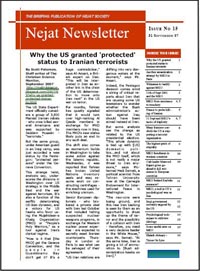
Nejat NewsLetter NO.15

ISSUE No 15, SEPTEMBER 2007

Nejat News Letter

INSIDE THIS ISSUE:

1.    Why the US granted protected status to Iranian terrorists

2.    Another assassination attempt by MKO in Paris

3.    Witnesses to testify against MKO

4.    11th of Sept 200l and the MKO

5.    MKO from resistance to treachery

6.    France to probe killing of Iranian

7.    11 Sept and MKO’s tactic of duplicity

8.    Many Iranians conclude the US is supporting a terrorist organization

9.    The highest pitch of stupidity

10. MKO henchmen in western countries

11. Cult leader Massoud Rajavi gives go ahead to kill witnesses in European countries

12. MKO behind Karbela massacre?

13. MKO, a tool in US’s psychological war on Iran

14. Iraqi government seriously angered by the US

15. Psychological techniques to cultivate ideology

16. Some useful sites on MKO

17. Elaheh obituary Times On Line

Nejat NewsLetter-ISSUE NO.15
Download Nejat NewsLetter-ISSUE NO.15

September 30, 2007 0 comments
FacebookTwitterPinterestWhatsappTelegramSkypeEmail
Bob Filner

Filner Duped Truthout

Congressman Bob Filner (Democrat—California) has succeeded for many years in duping conservative voters in his district. Now, he can add to his list of successes the duping of the left wing in the posted video interview with Marc Ash, Executive Director, Truthout.

http://www.truthout.org/docs_2006/092507J.shtml

Bob Filner’s father ran honestly and unsuccessfully as a communist party candidate for Congress. Bob Filner learned that dishonesty pays. Filner ran successfully for Congress as a Democrat and joined the Progressive Caucus in the House of Representatives. Obviously, there are no entrance examinations for joining the Progressive Caucus. Even the supporter of Iranian communist totalitarian terrorists can join the Progressive Caucus.

Filner revealed his secret in this interview:“I learned how to frame issues.”

Voters should watch this video so that they can learn how to avoid being duped by political candidates in the future. Filner is truly a master of the art of duping voters.

Filner revealed in this interview that he has taken a consistent position on the Iraq War since the war started in 2003. The Iraq War is based upon lies. The Iraq War is illegitimate. America should not have invaded Iraq. America should withdraw most of the American military troops from Iraq immediately. America started the Iraq War for economic and strategic reasons. The presence of an American occupying force provokes most of the violence in Iraq today. The Iraq War has displaced 2 million Iraqis who have left Iraq and 2 million more Iraqis who have become refugees in Iraq. Large numbers of Iraqis and Americans are dying needlessly.

Filner noted that he is the chairman of the House Committee on Veterans’ Affairs. Unlike Hanoi Jane Fonda, who made ten radio broadcasts from North Vietnam attacking American soldiers during the Vietnam War, Filner has learned to take the position of supporting all wounded American soldiers who return from America’s illegitimate wars.

In framing his position on the Iraq War, Filner did not disclose these truths:

1. Filner is a supporter of the Iranian Communist MEK (MKO, PMOI, NCRI, Rajavi Cult, or Pol Pot of Iran) terrorists at Camp Ashraf, Iraq.

2. Supporters of this communist terrorist organization have committed terrorist acts in many countries, including in America.

3. The MEK has been on the State Department’s list of terrorist organizations since the administration of former President Bill Clinton.

4. In September 2002, the White House’s background paper included the MEK as a pretext for the Iraq War.

5. In January 2003, Filner’s name appeared in a full-page advertisement in the New York Times as a supporter of America’s communist terrorist enemies—the murders of American military officers and Rockwell International employees.

6. In 2003, American and coalition military forces attacked the communist terrorists at Camp Ashraf, Iraq.

7. In June 2003, some members of the Rajavi Cult burned themselves to death to protest the arrest in France of a cult leader, Maryam Rajavi.

8. In 2003, the American government ordered American military forces to protect America’s communist terrorist enemies.

9. In 2007, supporters of the MEK communist terrorists paid for Filner’s trip to France so that he could meet cult leader Maryam Rajavi and speak at a rally of America’s communist terrorist enemies while American soldiers are dying in Iraq.

If you are searching for the truth, the full truth, and nothing but the truth, you will not find the truth at Truthout.

Paul Sheldon Foote

http://360.yahoo.com/paulsheldonfoote

September 25, 2007

September 29, 2007 0 comments
FacebookTwitterPinterestWhatsappTelegramSkypeEmail
The Ideology of the MEK

Who Are True Believers in MKO?

Focusing on the subject of members’ suicide fafter the organization’s internal ideological revolution within MKO, Saeed Shahsavandi in his session 129 of interview with the Voice of Iran, originally in Farsi, said that it was all an outcome of the ideological revolution. He asserted that following the revolution, the true believers were those who unquestionably submitted to Rajavi and blindly carried out his orders. Whoever stood on an opposite line was the traitor:

In such a system you are either a critic, who is a traitor in their opinion, or a true believer  as Hoffer explains. True believers are in fact those who set themselves on fire without question.

Quoting Rajavi, Shahsavandi asserted that after the ideological revolution nothing could be included in the organization’s fixed bipolar thought; be either committed to the leader or be called a traitor. However, the ideological revolution is not a process to be ceased ever, since committed suicides and self-immolation might raise doubts which are dangerous and has to be prevented:

At the same time when a number of the insane set themselves on fire, there are others in whose minds doubts are formed. The revolution has to be continued to stop formation of doubts.

Mojahedin.ws – Sep. 27, 2007


September 29, 2007 0 comments
FacebookTwitterPinterestWhatsappTelegramSkypeEmail
Iran

Iran denies secret nuclear site

Deputy Secretary of Iran’s Supreme National Security Council has denied allegations about the existence of a secret nuclear site.

Javad Vaidi said that the new round of Iran- IAEA cooperation and President Ahmadinejad’s active role in the UN Security Council has created a positive political atmosphere for Iran.

"The new allegations ahead of the 5+1 foreign ministerial meeting aim to change this positive atmosphere and exert more pressure on Iran,” he added.

Earlier this week, the terrorist group, the MKO alleged at a news conference in Paris, that Tehran was constructing a secret underground nuclear facility for military purposes in central Iran.

The MKO is accused of assisting Saddam in the massacre of thousands of innocent Iraqis, as well as carrying out countless terrorist attacks inside Iran.

PressTV –  28 Sep 2007

September 29, 2007 0 comments
FacebookTwitterPinterestWhatsappTelegramSkypeEmail
Mujahedin Khalq; A proxy force

US openly supports proscribed terrorist groups while accusing Iran

Asked about Iran’s support for terrorist groups, Ahmadinejad turned the question around and accused the U.S. of backing terrorist groups that he alleged train in Iraq to launch attacks in Iran. The reference is apparently to the Mujahedin-e-Khalq, a group linked to attacks inside Iran. The group is on the State Department’s list of terrorist groups

(Mojahedin Khalq (Rajavi cult) served under Saddam’s Regime against it’s own country during the 8 year Iran-Iraq war)  (Saddam’s support for Mojahedin Khalq was announced by President Bush in 2003 as one of the reasons for invasion of Iraq!!)

Israel Faxx, By Ha’aretz, September 26, 2007

www.Israelfaxx.com

September 29, 2007 0 comments
FacebookTwitterPinterestWhatsappTelegramSkypeEmail
Mujahedin Khalq 's Function

Who is using Terrorist to fuel Iran-West tension?

According to Mehr News Agency, Iran has rejected alligations made by Proscribed Terrorist cult, Mojahedin Khaq Organisation (aka: National Council of Resistance) that Iran is constructing a secret underground nuclear facility. according to Mr. Javad Vaidi, deputy chief for international relations of the Supreme National Security Council, the repetition of the base less lies by Associated Press (AP) broadcasted at the same time as the start of negotiations of permenant security council members in New York is no more than a failed attempt to disturb the positive atmosphere created by the cooporation between Iran and the Atomic Energy watchdog IAEA.

Link to full report by MEHR NEWS (Persian)

http://iran-interlink.org/fa/?mod=view&id=3243

——————-

Press TV also reported the story:

MKO fueling Iran-West tension

Press TV, September 28, 2007

http://www.presstv.ir/Detail.aspx?id=24867&sectionid=351020104

The terrorist group MKO has alleged that Iran is constructing a secret underground nuclear facility for military purposes in central Iran.

The group claimed on Thursday that the new underground military facility is located near the Natanz uranium enrichment plant.

The MKO made the allegations at a news conference in Paris and said it has passed its information, which it claims came from sources inside Iran, to the International Atomic Energy Agency in Vienna, Austria, but has so far not received a response.

The group gave no evidence to back up its claims.

The People’s Mujahadeen Organization of Iran (MKO) has long been placed on Washington’s and the European Union’s lists of terrorist organizations. It is accused of assisting Saddam in the massacre of thousands of innocent Iraqis, as well as carrying out countless terrorist attacks inside Iran

September 29, 2007 0 comments
FacebookTwitterPinterestWhatsappTelegramSkypeEmail
Jordan

Kingdom offers no haven for Iran opposition group – Judeh

AMMAN (JT) – Jordan on Monday rejected as "utterly baseless. news reports that it has granted asylum to members of an Iranian opposition group.

The Kingdom did not receive any leader or member of Mujahedin-e Khalq, and does not allow the organisation to operate on Jordanian soil as claimed by Iranian news reports, Government Spokesperson Nasser Judeh said in remarks to the press.

Judeh expressed shock at such allegations as well as the media campaign targeting Jordan “with the aim of attacking the Kingdom and casting doubts on its stands”.

He added that such reports come despite efforts exerted by His Majesty King Abdullah to build brotherly relations between the two countries based on mutual respect and understanding.

Mujahedin-e Khalq, or the People’s Mujahedin of Iran, is an Islamic socialist organisation that advocates the overthrow of Iran’s government.

The group, which was harboured by the former Iraqi regime, is designated as a terrorist group by the US, Canada and the EU.

Jordan and Iran restored diplomatic ties in the early 1990s after the two states severed their relations in 1980 following the outbreak of the eight-year Iran-Iraq war.

The King paid an historic visit to Tehran in September 2003.

Jordan Times – 25 September 2007

September 29, 2007 0 comments
FacebookTwitterPinterestWhatsappTelegramSkypeEmail
The cult of Rajavi

Psychological Techniques to Cultivate Ideology

The ideological revolution within Mojahedin-e Khalq Organization, or cult of Mojahedin, has led to so many changes in terms of internal relations of MKO. Mojahedin based the survival of the organization on the necessity for institutionalizing the components of the ideological revolution; before that, it was through providing due backgrounds and taking unique approaches. These adopted approaches, according to MKO ex-members, were similar to the techniques utilized by the past and contemporary cults and were applied as leverages to coerce insiders into absolute obedience to Rajavi’s totalitarian and ideological leadership. Since the main objective behind the institution of the ideological revolution was a quantitative instillation of a new system of values, ethics and thought, then, appropriate techniques and approaches had to be implemented. Here are a number of them deduced from comments made by detached members:

1. Shock

2. Accusation

3. Doubt

4. Subversion

5. Discharge

6. Illusion

7. Commitment

8. Repetition

9. Reformation

Shock

Broaching the issue of Maryam and Massoud’s marriage in the early meetings in order to raise ethical misapprehension indicates the function of shock in destabilizing the mental and ethical balance in MKO members. Since Mojahedin considered Rajavi as the symbol of ideological and political legitimacy, the issue of Maryam and Massoud’s marriage came as a sudden strike of shock.

 Accusation

Under the very impact of the sock, in an immediate reaction the members took an inevitable turn to accuse the elements of the shock. However, as the scenarists of the ideological revolution indicate, through the next phases the accusers turned to be the accused for materializing their mentality.

 Doubt

The uppermost outcome intended in the mental and psychological imbalance and shock is raising doubt in ethical, ideological, and political legitimacy in the members. The significance of this phase was due to the fact that no longer in organizational relations Masoud was taken into consideration. Moreover, members showed signs of dissatisfaction and considered him as an illegitimate leader. This phase was most important in the plan for materializing members’ mentality and even detecting their contradictory views formed against leadership.

Subversion

The next phase made members believe that they are in contradiction with themselves. In this stage all members on account of the shown reaction to the early shock are accused of making compromise, incurring adversary and holding reactionary views against the leader. As a result, those who would rebuke the leadership found themselves to be in leader’s debt.

Discharge

The sole solution for the members to be released of any accusations was to come to the point that every body had to develop an internal revolution. The first step to such a revolution was that all the hidden thoughts and mentalities of members against the leadership had to be thought over. Later on, such a mechanism was applied to dig out what was lying deep in members’ mind.

Illusion

Discharge created the impression that members’ mentality concerning the revolution and leadership had not been yet thoroughly cleansed. Members developed the illusion that due to their internal contradictions, they had to challenge themselves if they were to start an internal reformation. The internal challenge led them under the illusion that up to that time not only they had been of no use but also had been impediment to any progress. Consequently, they felt a strong need to be attached to a new value system and outside element who was Massoud in this case.

Commitment

Commitment to the leader meant submission to a process that intended to draw individuals out of a nadir of wretchedness and endow them with a new identity that could only be acquired but trough absolute submission to the new atmosphere and relations that deprived members of thinking and any other quest. The major step was the acceptance of the ideological leadership. Up to this phase, the members were convinced that they could not understand what happen around them; ideological leadership was to bear the sins of members and guaranteed their salvation if they were ideologically committed to him.

Repetition (internal control)

Now members had to follow new teachings. They had to undergo another novel process called ‘current operation’ wherein psychological and ethical mentalities of the members were scrutinized in order to resolve members’ circumstantially encountered contradictions. In this phase, all the actions and thoughts of members came under strict control.

Reformation

Continuous control and scrutiny of members’ mentality led to the development of a mechanism for reconstructing a new value system. In this phase, the members, unaware of the quality of the made changes, try to get rid of their past reactionary ideas and replace them with fresh thoughts suggested by others.

Bahar Irani – Mojahedin.ws – Sep. 27, 2007

September 29, 2007 0 comments
FacebookTwitterPinterestWhatsappTelegramSkypeEmail
Mujahedin Khalq Organization as a terrorist group

Another assassination attempt by Rajavi cult in Paris

Payvand association in a statement today said that two MKO members have attacked Mr. Behzad Alishahi in Rue du Faubourg Poissonniere in Paris on September 24, 2007 around 9:30 am. According to the statement, the attackers were forced to leave the scene when faced by resistance from Mr. Alishahi and people in the street who came to help him. The attackers failed to snatch Mr. Alishahi’s briefcase but vowed to take come back shouting, "we will be back and we will teach you a lesson".

Link to the statement (Persian)  http://www.irane-ayandeh.com/?p=840

Mr. Alishahi had been a high ranking official of the MKO for two decades. He survived the cult after raising concerns about the violations of human rights inside the MKO. He currently resides in Europe and is an active human rights advocate and critic of Mr. and Mrs. Rajavi, the self-appointed life-time leaders of the Mojahedin Khalq Organization.

This news comes after a series of attacks carried out by the MKO in European cities including the planned semi-military operation carried out by MKO members in Paris in June 2007, which ended in the serious injury of speakers and invitees of a peace conference in FIAP building.

Cult leader Massoud Rajavi gives go-ahead to kill witnesses in European countries. An open letter to the British Home Secretary Jacqui Smith (Anne Singleton, July 2007)

While the Mojahedin Khalq Organization is desperately trying to use deception and propaganda to fight back against the inclusion of the group in the list of terrorist entities in the USA, UK, European Union and Canada, it is widely believed that the escalation of violence seen in the last couple of months is the direct result of the order issued by the cult leader in a statement in which he tells his followers to "eliminate" any voice of criticism against the Mojahedin Khalq Organization.

Cult leader Massoud Rajavi gives go-ahead to kill witnesses in European countries. An open letter to the British Home Secretary Jacqui Smith (Anne Singleton, July 2007)

Latest article by Mr. Alishahi. Days before the assassination attempt against him:

The highest pitch of stupidity! (Mojahedin Khalq have not given up violence and terror)

Iran Interlink, September 24, 2007


September 26, 2007 0 comments
FacebookTwitterPinterestWhatsappTelegramSkypeEmail
Newer Posts
Older Posts

Recent Posts

  • The Psychological Impact of MEK Ideology on Members

    August 17, 2026
  • A study on the financial mechanism of the Mujahedin-e Khalq

    August 10, 2026
  • A Child behind the Ideological Bars of Massoud and Maryam Rajavi

    August 8, 2026
  • A Comparative Analysis of Psychological Control Mechanisms in Jeffrey Epstein’s Cult and the MEK

    August 3, 2026
  • Operation Mersad: How Iran foiled Saddam’s final gambit 37 years ago

    August 1, 2026
  • Facebook
  • Twitter
  • Instagram
  • Youtube

© 2003 - 2025 NEJAT Society . All Rights Reserved. NejatNGO.org


Back To Top
Nejat Society
  • Home
  • Articles
  • Media
    • Cartoons
    • NewsPics
    • Photo Gallery
    • Videos
  • Publications
    • Books
    • Nejat NewsLetter
    • Pars Brief
  • About Us
  • Contact us
  • Editions
    • عربي
    • فارسی
    • Shqip