
The Always VICTORIOUS Cult
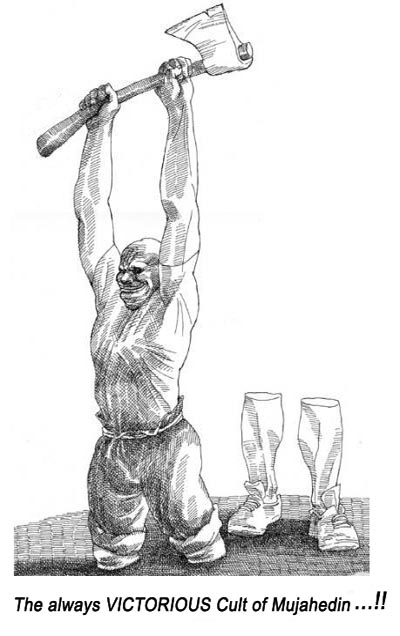
The Always VICTORIOUS Cult
Iran: Iraqi people will put Rajavi on trial as they collaborated with Saddam and suppressed Kurds
…Asked about the recent announcement by Interpol that the leaders of the banned Mojahedin Khalq organisation are being arrested if there are any plans for them to be extradited? Hojjat-Ol-Eslam Mohseni-Ezhe’i said that there are no plans as such but he hoped that the Iraqi people will put these figures on trial as they collaborated with the government of Saddam Hoseyn and they have been involved in acts of suppression against the Kurds… Full report: UK US governments fomenting subversion in Iran – Minister At 1918 gmt IRTV2 started broadcasting a live interview with Hojjat-Ol-Eslam Mohseni-Ezhe’i the Intelligence Minister who said that he has evidence that the UK and US governments are fomenting subversion inside Iran. He said: "Of course, evidence does exist that in the south, say, there were operatives being supported by the British and in the east and the west both the English and the Americans have been involved and we have submitted this evidence to the foreign ministry so that the matter can be pursued through legal channels. If a court is convened then this evidence can be used in that court."
Hojjat-Ol-Eslam Mohseni-Ezhe’i started by paying tribute to the deceased statesmen of the Islamic Republic who lost their lives as a result of an assassination attempt: Doctors Raja’i and Bahonar.
He started by giving a brief rundown of the services of the Ministry to the nation. He said that the mission statement of the ministry is to protect the nation and system from all acts of subversion. He said that given the subversion and instability in the region the ministry has had a few challenging years but it has triumphed over all of these.
The Ministry has identified the programmes of the enemy and their tactics and strategies. He said that some of the services of the intelligence ministry will be made public to the nation soon.
On the Modus Operandi of the ministry he said that arresting of suspects is not necessarily the main objective of the intelligence ministry. The first objective is to identify the spies and not necessarily arresting the suspect. He added that initially the suspect must be warned so that if for any reason they have misguidedly cooperated with the enemy they can repent. Only if the suspect does not refrain from continuing his activities will he be arrested.
Asked if the main enemies are CIA and Mossad? Hojjat-Ol-Eslam Mohseni-Ezhe’i said that the enemy is not just CIA or MOSSAD although they are the main enemies.
He added that some had been duped by the enemy to collaborate and betray the nation in this misguided way. He reassured that these have been warned, sometimes through being pursued by the Judiciary, and they are now collaborating with the ministry.
He added that there were yet others who had gone even further and could not be counselled back to correcting their treacherous ways so they have, either been executed or are serving long term prison sentences.
Hojjat-Ol-Eslam Mohseni-Ezhe’i went on to say that there are spill over effects from terrorism in the region. He reassured the viewers that The intelligence ministry coordinated with many of the government organisations in order to combat the spill over instability and subversion effects.
He added that the remit of the intelligence ministry is not only to neutralise the conspiracies but to also combat the causes of these conspiracies through intelligence and research work.
He went on to pay tribute to his government saying that never before has the intelligence ministry been as coordinated with other government institutions since it became a ministry in 1984.
He used the illustrative case of fighting economic corruption as one of the areas his ministry is charged with dealing. He said that the ministry is also involved in identifying the causes of this corruption.
He said that different government ministries are vetted on a random basis in order to not only report back to the minister in charge but also as a confidence building exercise to combat corruption.
On worries expressed over flight of capital as a result of the seemingly intrusive methods of the ministry he said that contrary to these concerns and expectations the merchants have themselves a stake in this anti-corruption drive. He went on to add that an umbrella organisation ahs been set up to give support to merchants and capital owners and investors.
Hojjat-Ol-Eslam Mohseni-Ezhe’i then went on to talk about the role of the ministry in the democratic process. He reassured that the various ministries who are involved in conducting elections approach his ministry with a view to being served information of the prospective candidates in order to help officials vet the candidates.
Asked about the changing tactics of the counterrevolutionaries, Hojjat-Ol-Eslam Mohseni-Ezhe’i said that the enemies have realised that the tactics of assassination and killing have failed. They are now trying to convey the impression to the people that the leaders of the Islamic Republic are inept in running the country. They are pursuing the objective of creating a rift between the officials and the people.
He went on to say that the enemies are, also, involved in ditching their previous terror tactics and participate in what he called soft overthrow. They are for example using forum of cultural, youth and elite gatherings to recruit prospective talent. Once the recruits are identified by the enemy they are invited to conferences and pseudo-cultural centres abroad and counselled to work for the enemy. He went on to reassure that this ploy has also met with defeat and many of these prospective recruits are, themselves, collaborating with the ministry and denouncing their previous activities and collaborators.
He went on to say that in the eastern parts of the country some are involved in physical assassination. Many of their shy supporters have distanced themselves from this kind of activity showing that the tactics of the enemy has evolved. Hojjat-Ol-Eslam Mohseni-Ezhe’i expressed wonder as to why the human rights organisations do not ever protest the activities of these groups?
Asked about the recent announcement by Interpol that the leaders of the banned Mojahedin Khalq organisation are being arrested if there are any plans for them to be extradited? Hojjat-Ol-Eslam Mohseni-Ezhe’i said that there are no plans as such but he hoped that the Iraqi people will put these figures on trial as they collaborated with the government of Saddam Hoseyn and they have been involved in acts of suppression against the Kurds.
Asked if there is any evidence of the armed groups working against the government in Iran being supported by the West principally Britain and the USA, he said that this evidence exists and if ever there was an opportunity to submit this to a court of law Iran will do so:
"I have to reiterate that given the insecurities that exist all around us in Iraq in Afghanistan or some other countries neighbouring us, and given the attempts that the enemy is conducting against us, the level of insecurity that we are suffering from is [relatively] low. Of course, we and other government organs will make the maximum of efforts not to overlook even one possible instance [Of subversion]. We are surrounded in the east, the west and the south by insecurity. We know that the British and the Americans and others who are being supported by the British and the Americans are active in these border regions. But even with this amount of instability we should not feel insecure. Of course, evidence does exist that in the south, say, there were operatives being supported by the British and in the east and the west both the English and the Americans have been involved and we have submitted this evidence to the foreign ministry so that the matter can be pursued through legal channels. If a court is convened then this evidence can be used in that court."
He went on to talk about the deterrent aspects of the ministry work saying that the ministry is just one organisation within the committee set up to combat fraud and economic corruption and that he can not reveal names as there are legal issues that he has to adhere to.
Asked about the possible connections of the economic criminals with influential political figures inside the system, he said that of course there are connections but the ministry tries to be politically neutral and not to be intimidated by these political influences.
Asked about the conspiracies of ”Zionism” against the Islamic Republic he said that there were cases of people conducting industrial espionage in the communications and nuclear industries but these have all been neutralised and the successes of the ministry are all too palpable.
Asked about the recent release of Haleh Esfandiyari and the possible release of Kian Tajbakhsh, the American academics of Iranian extraction, and whether it is because nothing was proved against either of these tow figures? He said that just because they have been released it does not mean that the evidence against them did not exist:
"I have to say something about the fact that they have been liberated. You see, crime and criminality do not mean that the person being suspected has to necessarily be arrested. It is only in certain cases that the law making bodies have charged us with arresting an individual if he has committed or is suspected of having committed a crime that we arrest on the spot. These instances are of course quite rare. But the suspect is only arrested if that suspect is deemed to be dangerous or if he is abroad or he may flee. It could, of course, be that he is in collaboration with others. It could be that he is involved in destroying indicting evidence against himself. If these matters are at play then that person has to be arrested. Until when would that person remain under arrest? He would remain under arrest until such time that one of or more of these issues are still at play. So if say there was a possibility of collaboration and he was arrested then the following day another person who was also involved in this collaboration was arrested and the nature of their collaboration was clarified then the first person would be released. So just because a certain person has been released it does not mean that the charges against him were light and that his crime has not been proved."
Hojjat-Ol-Eslam Mohseni-Ezhe’i went on to say that the ministry is up against Soft Overthrow.
Asked if the two had revealed any names Hojjat-Ol-Eslam Mohseni-Ezhe’i said that he can not say for legal reasons.
On the Student of Amir Kabir University arrested for agitating against the government Hojjat-Ol-Eslam Mohseni-Ezhe’i said that there were two groups of people who were involved: Those who were students who were duped and those who were agitating and who were not at all functioning within the remit of a student or academic.
On the arrest of Shahram Jazayeri, an ”economic criminal” who was arrested earlier he said that there was cooperation between the ministry and the country where Jazayeri was arrested but that the ministry does not operate in other countries as it is illegal.
On the parallel institutions that are suspected to be operating inside the ministry he said that the ministry is a homogenous and uniform organisation and that all its operations are well coordinated and joined up with other government bodies. He, also, reminded the viewers that the ministry can be contacted through the telephone number 113 not to mention the various provincial offices that are set up in these areas.
Source: Vision of the Islamic Republic of Iran Network 2, Tehran, in Persian 1900 gmt 28 Aug 07
Reported by:BBC Monitoring Middle East
Midland MP (Mr. Binley) lobbies for terrorist group
They were branded murderous terrorists who indiscriminately killed civilians, politicians and soldiers.
But now a group closely linked to Mojahedin-e-Khalq (MeK) – the People’s Mujaheddin of Iran – is being represented by a Midland MP.
Brian Binley went on a six-day trip to Washington as a lobbyist for the National Council for Resistance in Iran (NCRI).
The group is described as the political wing of MeK, and paid for the MP’s visit.
Both organisations are on the US Department of State’s official list of foreign terrorist organisations, alongside Al Qaida, the Real IRA and ETA.
But Mr Binley spent his time in America in July 2006 talking to US politicians about the future of Iran, and spoke on behalf of NCRI.
The MP for Northampton South later declared the trip in the parliamentary Register of Members’ interests.
MeK has been condemned in the west for a campaign of terror lasting three decades.
In the 1970s, its members murdered western soldiers and civilians working on defence projects in Iran.
Throughout the 1980s, the group carried out bombings and assassination attempts on Iranian government workers, killing dozens of civilians.
It helped Saddam Hussein’s brutal campaign.
In 1992 the group attacked 13 Iranian embassies in capital cities around the world.
The organisation has been in limbo since leaders ordered it to surrender to coalition troops during the last Iraq war. The group also had its American office shut down in 2002 and its assets frozen after a court decided it was still classified as a terrorist group.
At the time, a Department of State said NCRI”functions as part of MeK and has supported MeK’s acts of terrorism.”
The NCRI claims it is a legitimate government-in-exile opposing the Iranian regime.
But opponents describe it as a cult based around its leader Massoud Rajavi, who disappeared during the 2003 Iraqi invasion. His wife Maryam is now president of the group.
Mr Binley, who was once photographed meeting Mrs Rajavi, is currently on holiday and could not be contacted last night.
But a source in his office said:”NCRI has been de-listed as a terrorist group by the European Union. Brian, along with a large number of other MPs, has been pushing for a similar change here, and in the States.”
BY TOM SCOTNEY,Sunday Mercury, Birmingham Post & Mail Ltd
Mojahedin-e Khalq Organiztion (MKO) habitually keeps silent over any report and news that poses allegations or international counter-terrorist moves against it. In fact, any reaction from its part somehow turns to be the proven evidence that verifies the accuracy of the released reports and authenticate them.
Released by its official organ Mojahed, originally published in Persian, No. 257 dated August 24, the organization showed an angry backlash against recently released reports by Iraqi and Iranian media that ‘Interpol has issued arrest warrant for Massoud and Maryam Rajavi, and called it a falsified report.
According to Mojahed, MKO’s spokesperson in Oslo referred to Baztab’s report “The Fate of Saddam Awaits Maryam & Massoud Rajavi’ as disinformation by Iran. That is while Jafar al-Mousawi, the prosecutor of Iraqi High Court, had said earlier that the terrorist MKO has been indicted because of involvement in killing thousands of innocent Shiites in accomplice with Saddam during the uprising of Sha’banieh in 1991. The reports on arrest warrant for Massoud and Maryam Rajavi showed that solid evidences of Iraqi prosecutor have convinced the Interpol to arrest the gang leaders.
The Fate of Saddam Awaits Maryam & Massoud Rajavi (Baztab, August 24, 2007)
http://iran-interlink.org/?mod=view&id=3039
A brief by Iran Interlink on July 13, 2007 titled:"Massoud Rajavi name in Mojahedin propaganda signals a cult spiraling toward disaster" reported a number of recent attacks by the henchmen of the Mojahedin Khalq Terrorist cult in European countries against its critics.
http://iran-interlink.org/?mod=view&id=2805
We have now received reports of a new wave of organized attempts this time using the Mojahedin’s pseudonym the National Council of Resistance of Iran, to silence both critics and human right activists across Europe who have striven to expose the group as a destructive and dangerous cult.
On August 26, 2007 in a program broadcast by the Mojahedin’s clandestine TV station, Abolghasem (Mohsen) Rezaee, a member of the NCRI, repeated Massoud Rajavi’s order that his critics and in particular the outspoken critics of the cult in European countries, should be eliminated. Massoud Rajavi, who is believed to be a guest of former Saddam Supporters in Jordan (where the new HQ of the Iraqi Baath Party has relocated and where high ranking officials of the Saddam regime enjoy the hospitality of King Abdollah) gave a written, public order to the cult members to eliminate anyone who dares to speak against the organization. This order came only days after cult members attacked a public meeting in Paris which resulted in serious bloodshed and the arrest of about 50 cult members by French police.
Such violent attacks have become widespread over recent weeks to the point that even individuals like Mr Amir Farshad Ebrahimi – who is by no means a dedicated critic of the Mojahedin Khalq – has been physically assaulted by cult members in Germany.
Iran Interlink has been informed that the Rajavi cult, using the alias "National Council of Resistance of Iran will hold a so-called News Conference .
According to Iran Interlink’s source, the aim of the Conference, which has not been announced publicly and invitations to which have been limited to a discreet handful of journalists and politicians, is "to take revenge against the critics and victims" of the cult who have been exposing the war crimes and crimes against humanity committed by Massoud and Maryam Rajavi under the protection of Saddam Hussein over a period of 25 years.
Since the fall of benefactor Saddam Hussein, the Mojahedin Khalq has spent massive organizational and financial resources but has failed to convince western countries to remove the group from the lists of terrorist entities. The Mojahedin Khalq and its aliases are officially considered as a terrorist entity and subsequently remains banned in the US, UK, European Union and Canada. Additionally, in its annual terrorism review published April 2007, the US State Department upgraded its assessment of the group to describe it as a terrorist cult.
http://iran-interlink.org/?mod=view&id=2309
Previously in May 2005, Human Rights Watch, after thorough investigation described the group as a cult.
http://iran-interlink.org/?mod=view&id=797
http://iran-interlink.org/?mod=view&id=3032
Iran Interlink has been informed that several survivors of the Rajavi cult, resident in Europe, have sent a letter to the National Council of Resistance demanding a presence in the Conference where they would present the overwhelming evidence and documents about the activities of this terrorist organization. They have not received any answer to date.
Iran Interlink believes the on-going escalation of violent activities ordered by cult leaders must be a cause for serious alarm for the authorities of western countries, especially Germany, France and the Netherlands. The cult has in the past carried out many violent attacks in Europe as well as orchestrated self-immolations in the streets of capitals of European countries.
As their base in Iraq is being dismantled by the Iraqi government and as Massoud and Maryam Rajavi find themselves nearer to the corridors of international courts, the possibility of an outbreak of fatal terrorist activities by the cult members in western countries cannot be over estimated by any means.
Iran Interlink Brief, August 2007
As the Interpol issued arrested warrant for the members of MKO by the request of Iraqi government, Iraqi people are also increasingly calling for detention of these people
Iraqi newspaper al-Bayyinah al-Jadidah wrote: "The Organization for Protection of Iraqis’ Rights" asked the Iraqi government to bring the leaders of terrorist MKO to justice. Stressing the fact that terrorist MKO had been involved in killing more than 780 Iraqi citizens, the organization also asked the families of the victims to file a complain in special court."
The Iraqi newspaper also reported that the Interpol has issued an arrest warrant for Massoud and Maryam Rajavi, the leaders of the terrorist MKO. The Interpol has accordingly sent the warrant to all its offices around the world.
"Iraqi government delivered documents and evidences on MKO’s involvement in killing Iraqis during 1991 uprising to the court that’s trying former Iraqi authorities."
Meanwhile, a number of Iraqi newspapers had reported of some MKO leaders’ escape to Jordan due to fears of being arrested and tried.
Last week, the prosecutor of Iraqi High Court Jafar al-Mousawi, said in an interview with Mehr News that arrest warrant had been issued for 150 MKO members including Massoud and Maryam Rajavi and that they would be prosecuted.
On the reasons of issuing ruling against the members of terrorist MKO, he said: "The fact is that Iraqi High Court pursues criminals and takes them to justice even if they are out of the country, there would be measures taken to bring them back; for instance, their hosting countries would be asked to extradite them to Iraq."
Also, on the documents proving MKO’s involvement in crimes, he added: "We investigated about the crimes of the former regime that had been done with the assistance of other groups. During the process, we found documents that proved MKO’s involvement in the inhumane crimes during 1991 uprising in northern and southern Iraq."
Mehr News Agency- 2007/08/22
The translated text of an article presented at the Symposium of the Link between Cults and Terrorism held in Isfahan.
MKO defined as a cult
The original meaning of the term cult, derived from the French word "culte", comes from Latin noun "cultus" which is related to the Latin verb "colere" meaning "to worship or give reverence to a deity". The term has originally a positive, religious connotation but in recent years, it has turned to be a widely used popular term, usually connoting some group that is at least unfamiliar and perhaps even disliked or feared. This latter use of the term has gained such credence and momentum that it has virtually swallowed up the more neutral historical meaning. The term can be defined either sociologically, concerned with behavior, or theologically, concerned with doctrine. “Sociological definition Include consideration of such factors as authoritarian leadership patterns, loyalty and commitment mechanisms, lifestyle characteristics, [and] conformity patterns (including the use of various sanctions in connection with those members who deviate)”. [3]
Authoritarian leadership is the most domineering characteristics of a cult leader and most ex-members of a cult enumerate the hallmarks of a cult leader as follow:
– single authority
– questionable credentials
– requirement for unconditional trust
– they always claim to be in unique direct contact with God
– sexual misconduct
– grandiose promises
– they demand major ongoing financial contributions from members
– they claim that evil sinister forces attempt to subvert them [4]
Besides these characteristics of a cult leader, a cult, regarded destructive, has its own characteristics. Dr. Robert Jay Lifton’s criteria for a destructive cult run as follow:
1. Authoritarian pyramid structure with authority at the top
2. Charismatic or messianic leader(s) (Messianic meaning they either say they are God or that they alone can interpret the scriptures the way God intended.
3. Deception in recruitment and/or fund raising
4. Isolation from society — not necessarily physical isolation, but this can be psychological isolation.
5. Use of mind control (Mileu Control, Mystical Manipulation, Demand for Purity, Confession, Sacred Science, Loading the Language, Doctrine Over Person, Dispensing of Existence) [5]
MKO portraits two completely different images; its relation with the world outside and its internal structure. Duped by its heavy propaganda blitz, most people in Western countries, unaware of its terrorist nature, take it for a revolutionary, freedom-seeker, and pro-democratic organization. The group ‘s internal structure, totally concealed from the eyes of the outsiders, nearly shares all of the characteristics of a destructive cult with added emphasis on the authoritarian pyramid structure and mind control techniques. Massoud Rajavi, the long self-appointed leader, is known to be the mastermind of MKO. Released from Shah’s prison after revolution, Rajavi took up the responsibility of acting as the organization’s spokesman that awarded him an opportunity to develop authority both within the organisation and in the public’s perception.
How did the Mujahideen become a cult? The principal lever for the transformation of the organization from a mass movement to a cult was Rajavi’s “ideological revolution” in January 1985. The first phase of this revolution basically involved Masoud Rajavi marrying Maryam Qajar Azdanlou, the wife of Mehdi Abrishamchi, Rajavi’s most trusted lieutenant. The marriage was an overt violation of Islamic marriage rituals and a majority of ranking members saw the whole affair as an ugly and bizarre form of cuckoldry. The event, more regarded as an internal coup d’ata, promoted the husband to the rank of a guru and the wife to the rank of the joint leader of the organization. Massoud Rajavi indoctrinated the ideological revolution as a purging process saying “Those Mojahedin members who pass through this furnace, are more steadfastness, more steel like person, and have more future in the resisting’ [6]
Masoud Rajavi was exalted as a charisma and some subservient considered the historic achievement as an outcome of an ideological genius in Massoud Rajavi. Bijan Nyabati, a devoted a partisan, in adoring Massoud Rajavi’s personal charisma states:
In the front of revolution and progressiveness, you would not find two people with the same political and organizational potentialities of Massoud Rajavi among all the opposition. [7]
Nyabati abruptly changes the position of Rajavi from a leader to that of a religious, Shi’it imam:
The main core of Mojahedin’s ideological revolution was to solve the issue of leadership. It could put an end to a problem known to be the Achilles’ heel in most contemporary revolutions and movements; only a stabilized theory of imamate inside the organization could lead the new revolution. [8]
Many of his messages imply that he has a close relationship with Imam Zaman (the last and still awaited Imam in Shiite Islam) and therefore he has direct contact with God. Under Rajavi’s instructions as an ideological leader, members began to give up Islamic practices and rituals because, as stated by their chosen ideological leader, they were no longer individually responsible; they were only responsible to Rajavi and he was responsible to God. Later on, especial prayer texts were devised to praise him and his wife, Maryam.
The ideological metamorphosis opened a new gate onto a path where, in the first place, the rationality and even the social-political understanding of individuals were targeted. In other words, individuals would be transmuted into obedient and subjugated creatures serving the wills of the ideological leader. The whole idea can be concluded as:
That is clear that such process could pursue in no rational route. The dominant element in the process is “love” and “emotion” that bypass logic and reason. The means are not those of polemics and persuasions but self-devotion. That is the point where Massoud claims Mojahedin’s heart. [9]
A wave of advertising total devotion to the ideological leader began to be imposed on the minds of the insiders to indoctrinate that the ideological leader had an ideological vision which was broader and more universal than understanding and vision of an ordinary follower. He could see things and think in a way that seemed illogical and irrational at the time but proved to be correct at the end. Hence the followers had to follow the leader not on the basis of understanding, but on the base of total trust.
The second phase of the full transition to the status of a cult started after the Iran-Iraq cease-fire in 1988. Rajavi launched thousands of his warriors on ”Operation Eternal Light” across the border to capture Iranian territory. It was a total military failure. The operation before anything was a resolution of Rajavi’s own volition, a proven suicide operation excluding the leader himself. The failure proved to be a victory for Rajavi; the made amendments to the ideological revolution after the operation guaranteed his position as a hallowed figure with the sole authority to question anybody while the members were not in the least permitted to violate the leader’s sacramental sphere. To create a compelling control atop, all the individual attachments and values had to be detached. The detachment did not include physical spectrum, but above that, psychological scopes.
In a general meeting, Rajavi announced that as the ideological leader, he had issued the divorce of all the members from their spouses and asked all to hand over their marriage rings. The physically divorce of spouses and, consequently, children was the first taken steps; the world outside with all its attractions and emotional attachments had to be cleaned of the mind and devalued. One had to replace them with an alternative that was no one but Massoud and Maryam Rajavi.
Anne Singleton, a separated member of MKO in her book so describes manipulation of the members within the cult:
The psychological manipulation of members springs from Rajavi’s avid interest in using psychology as a means of controlling people. He has read voraciously from the time that he left prison, books on politics, psychology and history etc. His ideology is a mishmash of all these books, and not a single part of it derives from original thinking. Rajavi uses psychological manipulation to control people. The massuls [responsible ranks] are instructed to behave in particular ways towards individuals according to what is required of them or in response to a problem they might have. On a simple level, the warmth and affection shown to newcomers is a basic method of attracting them, fulfilling a basic need, which they lack. The person is told – and this is the ideological element – that if they look for love and affection outside Maryam they will become corrupt and ‘nothing’, they will be condemned to a life of obscurity, drudgery and meaninglessness. A picture of ordinary married life is portrayed as a hellish prison for both sexes. Children are the ultimate burden, removing the person further and further from the glorious joy and happiness that could be theirs if they give all their love to Maryam. She will return their love a hundred fold, and only inside the Mojahedin will they be able to fulfil their true potential as a human being. [10]
During the first Gulf War and the US attack to Iraq, MKO leaders enforced separation of the members’ children residing in Iraq-based camps. The children, about 800 including little babies, were sent to different Western countries for some purposes. First they could be abused as potential fundraising instruments to collect large amounts of charity money on pretext of Iranian homeless children. On the other hand, the children could be trained as the next generation of MKO soldiers. Nadereh Afshari, an ex-member of MKO and who was posted in Germany and was responsible for receiving children during the gulf war, has revealed that when the German government tried to absorb Mojahedin children into their education system, the organization refused. Many of these children were sent to Mojahedin-run schools, particularly in France. She has elaborated that Rajavi ”saw these kids as the next generation’s soldiers. They wanted to brainwash them and control them. Every morning and night, the kids, beginning as young as 1 and 2, had to stand before a poster of Massoud and Maryam, salute them and shout praises to them “. [11]
In June 2003, people in some Western cities were shocked to witness one of the most appalling cult potentialities of MKO. On 17 June 2003 more than 1.200 France police and gendarmerie forces raided 13 MKO-run offices in Paris districts and arrested 164 suspected Mojahedin cadres as well as Maryam Rajavi on charges of terrorist activities. In the next few days, to carry out premeditated missions, a number of the group’s members immolated themselves in public to protest Maryam Rajavi’s arrest. According to reports issued by the group itself, ‘œ16 people attempted to set themselves alight in three days in Paris, Berne, Rome, London, Ottawa, Athens and Nicosia’. The human tragedy ended with two deaths; two women, Sediqeh Mojaveri, 44-year-old, and Neda Hassani, 19-year-old, died because of the self-immolation injuries. [12]
Besides old members joining the organization for political causes, a large number of the members are the young Iranian people who have been deceived to join the group. These young, unaware recruits fall into the trap of the middlemen who by false promises of good job, high salary and residence in Western countries paralyze their rational minds and send them to MKO’s camps in Iraq. Undergoing brainwashing methods in the camps, they rarely dream to return to Iran because they are unnerved and intimidated by the threats of being tried and even executed for having connection and cooperating with a counter-revolutionary group.
The members who try to leave the MKO or criticize it in any form have to pay a very heavy price. In a 28-page report released by Human Rights Watch in May 2005 entitled ‘œNo Exit: Human Rights Abuses Inside the MKO Camps,’ shocking details about inhuman behaviors and control of the insiders of MKO was published for the world. The facts revealed how dissident members were tortured, beaten and held in solitary confinement for years at military camps in Iraq after they criticized the group’s policies and undemocratic practices, or indicated that they planned to leave the organization. The report is based on the direct testimonies of a dozen former MKO members, including five who were turned over to Iraqi security forces and held in notorious Abu Ghoraib prison under Saddam’s rule.
A common, routine procedure in MKO is self criticizing and confession sessions. The members have to write detailed daily reports of activities, their previous night’s dreams, their thoughts, and even love and emotional daydreams. In some cases, they are forced to read their reports before other members and suffer humiliation. Ali Qachqaoui, a separated member, reveals: ‘œThey remote controlled us, like robots. They told us, ‘If you have sexual fantasies, even a dream, you must report it in writing in order to exorcise it’. In a speech repeatedly broadcast in video, Maryam Rajavi told the Mojahedin: ‘80% of your energy should be used in the fight against your sexual instincts’. Many of the organization’s officers, who protested against this sudden authoritarian and sectarian change of course, paid a heavy price for their insubordination. They were humiliated, tortured and imprisoned. [13]
As a closed cult, the members receive any information through a biased channel. No form of news and information, movies and even the group’s own TV productions is presented unless reviewed and censured beforehand. Even the members active in Western countries are severely prohibited to have direct access to the media and have to attend periodical controlling meetings, write reports, and listen to direct or televised addresses of the high ranking members and leaders.
MKO has long been using a lexicon of its own. The terms they use inside the organization have their own connotations different with those used outside. The followings are examples of a more than 1200 terms lexicon volume:
– Alternative: meaning MKO as the sole alternative for Iran’s current ruling power
– To become ‘˜H’: used when demoting a rank
– Organizational marriage: forced inter-organizational marriages ordered by leaders
– Food echelon: a food menu that qualitatively and quantitatively is prepared according to hierarchical posts
– Ideological pride: Massoud and Maryam’s marriage known to be a glorious hallmark of the organization
– Active: a member who well accomplishes the issued orders
– Ring of connection: meaning Maryam Rajavi. Members are not capable to unite with Massoud unless through Maryam
– The host: meaning Iraq
– The guesthouse: the jail where protesting members and quitters were held
– ‘¦. And more
To determine how dangerous MKO cult might be, ‘œthe Advanced Bonewits’ Cult Danger Evaluation Frame’ can be a good help. As Bonewits explains, ‘œThe purpose of this evaluation tool is to help both amateur and professional observers, including current or would-be members, of various organizations (including religious, occult, psychological or political groups) to determine just how dangerous a given group is liable to be, in comparison with other groups, to the physical and mental health of its members and of other people subject to its influence’. [14]
The Advanced Bonewits’ Cult Danger Evaluation Frame
Factors: 1 2 3 4 5 6 7 8 9 10 Low High1. INTERNAL CONTROL: Amount ofinternal political power exercisedby leader(s) over members. 1. _________________________ 2. WISDOM CLAIMED by leader(s);amount of infallibility declaredor implied about decisions or doc-trinal/scriptural interpretations. 2. __________________________ 3. WISDOM CREDITED to leader(s)by members; amount of trust indecisions or doctrinal/scripturalinterpretations made by leader(s). 3. _________________________ 4. DOGMA: Rigidity of reality con-cepts taught; amount of doctrinalinflexibility or "fundamentalism." 4. __________________________ 5. RECRUITING: Emphasis put onattracting new members; amountof proselytizing. 5. __________________________ 6. FRONT GROUPS: Number of subsid-iary groups using different namesfrom that of main group. 6. _________________________ 7. WEALTH: Amount of money and/orproperty desired or obtained by group;emphasis on members’ donations;economic lifestyle of leader(s)compared to ordinary members. 7. ________________________ 8. POLITICAL POWER: Amount ofexternal political influencedesired or obtained; emphasis ondirecting members’ secular votes. 8. ________________________ 9. SEXUAL MANIPULATION: of membersby leader(s); amount of controlexercised over sexuality of members;advancement dependent upon sexualfavors or specific lifestyle. 9. _________________________ 10. CENSORSHIP: Amount of controlover members’ access to outsideopinions on group, its doctrinesor leader(s). 10. ________________________ 11. DROPOUT CONTROL: Intensity ofefforts directed at preventing orreturning dropouts. 11. _________________________ 12. VIOLENCE: amount of approval whenused by or for the group, itsdoctrines or leader(s). 12. _________________________ 13. PARANOIA: amount of fear con-cerning real or imagined enemies;perceived power of opponents;prevalence of conspiracy theories. 13. _________________________ 14. GRIMNESS: Amount of disapprovalconcerning jokes about the group,its doctrines or its leader(s). 14. _________________________ 15. SURRENDER OF WILL: Amount ofemphasis on members not having tobe responsible for personal deci-sions; degree of individual dis-empowerment created by the group,its doctrines or its leader(s). 15. __________________________ 16. HYPOCRISY: amount of approval forother actions (not included above) which the group officially considersimmoral or unethical, when done by or for the group, its doctrines or leader(s); willingness to violate group’s declared principles for political, psychological, economic,or other gain. 16. ___________________________ 1 2 3 4 5 6 7 8 9 10 Low High
A precise evaluation of MKO well crystallizes it as one of the most destructive and visible examples of a group intermingling the characteristics of a terrorist group and a cult to be nominated a terrorist cult. A terrorist cult poses a greater danger because of the growing use of mind control and cult control techniques. Most terrorist organizations actively study and use mind control and cult control techniques to indoctrinate members into committing the horrific acts of terrorism that shock our senses. The real cause of much of today’s terrorism is not what the terrorists themselves advertise and claim in their publicly stated agendas and rationalized causes. The real cause of acts of terrorism is how these agendas and ideas were implanted into the minds of the members with mind control and cult control techniques by their handlers. The responsibility lies on the shoulders of the responsible minds and elites of a society to illuminate the naïve minds and depict a clear-cut image of a destructive cult to stop any further jeopardizing the young generation’s career.
Sources:
[3]. A Guide to Cults and New Religions; ed. Ronald Enroth, Downers Grove, Ill, InterVarsity 1983, p14.
[4].www.phact.org
[5]. www.refocus.org
[6]. www.banisadr.infoideologicalChapter Five.htm
[7]. Bijan Nyabati interview with Zari Isfahani, Taliah-Sepidedaman.com
[8]. Nyabati Bijan; ‘œA distinct look at Mojahedin’s internal revolution, slightly from inside, slightly from outside’, 113.
[9]. Ibid.
[10]. Singleton Anne; Saddam’s Private Army, Iran-Interlink, 2003.
[11]. www.rickross.comThe Cult of Rajavi.htm
[12]. www.mojahedin.ws
[13]. www.mojahedin.wsbooksThe People’s Mojahedin of Iran: A struggle for what?
[14]. www.qed.net/bonewits/ABCDEF.HTML
Nejat Association – Translated by mojahedin.ws -August, 2007
Saeed Shahsavandi’s interview with the Voice of Iran recently has focused on the subject of the ideological revolution within MKO. The details given by Shahsavandi well assert that the theatricalised ideological revolution was a plot for Rajavi’s hegemony that transformed a political group into a destructive cult of personality. The organization follows no logic in its relation with the insiders and the outsiders and the session 125 of the interview examines the group’s undemocratic practices with Rajavi atop who exemplifies the model of a cult entrepreneur:
Mojahedin, from the higher to the lower ranks, when driven to logical discourse indeed have nothing to say and fall back on badmouthing. When man has no evidence to corroborate his claim, then, he resorts to monologue rather than dialogue. That is what their media pursue.
Shahsavandi believes that the ideological revolution was the start of denying council leadership and democratic centralism, the basic principles of organization:
Transformation of the organization’s leadership from a classic-leftist organization preferring democratic centralism to an ideologically religious organization long chanting anti-imperialism slogans violated the basic principles of council leadership and democratic centralism.
In fact, the ideological revolution completely transformed MKO to Massoud Rajavi’s organization:
From this phase on, the Mojahedine Khalq Organization was permuted to the organization of Massoud, radio of Massoud and the media of Massoud.
He also points out to the heavy pile of ostensible letters and lists of signatures published in support of the ideological revolution:
The pile of signatures targeted the minds of the lower ranks to imbue them that the ideological revolution was a serious incident. The published signed-list of the 550-member leadership council aimed at the same purpose. That is while even the China’s Communist Party has not such a big crowd at its leadership council.
However, the growing number of dissatisfied members exposed a great threat against the organization and the dissidents had to be liquidated. The organizational trial of Ali Zarkesh portended the similar destiny that awaited other dissidents. Once a trusted friend of Rajavi, he was promoted to the commander of operation inside Iran sitting next to Rajavi’s room in Auvers sur Oise. Giving evidences from Zarkesh’s videotaped trial shahsavandi explains:
He was no more the same Ali Zarkesh we knew him for long before in Auvers sur Oise decision-making meetings. He resembled a wretched man whose nose, believe me, drivelled.
Of accusations posed against Zarkesh was that his proposal of Massoud and Maryam’s marriage was much a plot to discredit Rajavi in order to repel him and succeed to the position of leadership. Quoting Rajavi accusing zarkesh, Sahsavandi said:
“It was Ali’s mischief when proposed the marriage. He intended to disparage me through my marriage with Maryam to supersede me. Rajavi even overstepped to claim that Ali had proposed the ideological revolution to dismiss him.
Zarkesh was also accused of plotting to assassinate Rajavi. All evidences being against Ali, Rajavi said nothing of his execution. But the majority of those members present at his court demanded his execution; rajavi, however, as the authoritative leadership sentenced him to life imprisonment in Camp Ashraf to intimidate the other dissidents. Zarkesh was transferred to Iraq to be held in room 7 of a building called Baqai and was under intense control to avoid possible attempts to instigate a tense atmosphere. He was finally dispatched as a veteran to Iranian borders to take part in the Operation Eternal Light, where he was destined never to return.
www.mojahedin.ws – 27/08/2007
The friction between Mojahedin’s leadership and its rank and file, critics, as well as dissident members is totally idiosyncratic among all political organizations. The mannerism, due to the dogmatism that is infesting MKO’s methodology, is the outcome of the group’s totalitarianism in terms of political power and aims at elimination of all opposition forces or movements that might be a challenge to the organization. NCR was a turning point in the history of MKO that promised a peaceful coexistence of Mojahedin with other political movements. Unfortunately, after a short while and due to MKO hegemonic ambitions of Rajavi, the NCR failed to preserve its coherence and suffered a crushing dissolution. A brief look at the course of events of MKO up to 20 June 1981 and its continuous friction with other political movements is an evidence of the organization’s incompetence to establish durable contact with the outsiders. Such a reactionary feature has its roots in the fact that Mojahedin consider themselves an exception amongst others; an illusion that resulted in their total social and political isolation. Even they consider all political movements and internal and external opposition forces to be indebted to them for their existence.
Rajavi has his own opinion toward detached members that well represents his reactionary mentalities. Explaining on the emergence of critics and opponent members, Rajavi identifies them as such: “Biological actions and reactions of all living organisms involve absorption as well as excretion. As such, dissident members constitute the excrements of Mojahedin e-Khalq”. It is such a viewpoint that regulates the orientation and relations of Mojahedin with the outside world, critics, dissident members and even former members. The turning point of such a relationship was parallel to the development of the ideological revolution in MKO when, according to many former MKO members and Niyabati, the organization underwent fundamental changes. Prior to the ideological revolution, Mojahedin based their external relations on the necessity for overthrowing Iranian regime by the means of armed warfare; however, after the ideological revolution what determined the internal and external relations of MKO was the degree of blind obedience toward ideological leadership of Maryam and Massoud Rajavi. Such an ideological criterion made the internal relation of the MKO suffer an absolute metamorphosis. Niyabati elaborating on such a metamorphosis writes:
After the initiation of the ideological revolution, Mojahedin’s relations underwent a complete metamorphosis. Mojahedin’s quadrilateral relations changed into a trilateral one. On one side was situated Mojahedin-e Khalq Organizatio, at another stood Massoud and on the third was whatever refuted the two formers. Noting in between the two ends was legitimized. Here, an element of Mojahed was recognized by one criterion through which everything was assessed. From this point on, Mojahedin’s friends and enemies were not bilateral but trilateral. Friends of Massoud were friends of Mojahedin and his enemies were theirs (p.112).
The new criterion made former criteria, through which organizational qualifications of members were assessed, fade away. In fact, the organizational promotion that was based on the members’ past campaign records and their practical as well as theoretical qualifications was replaced by the blind submission to the ideological leadership:
He (a member metamorphosized by revolution) is nobody representing no individual value. Neither imprisonments under Shah or Sheikhs qualifies him nor the blood and smock of the internal combats. He is neither a fine orator nor has multitudes of academic degrees. He is not even a man! In a nutshell, he is devoid of former values for which Mojahedin considered themselves capable of leadership after the development of anti-monarchic revolution in Iran (p.115).
After such a fundamental metamorphosis, members criteria of qualification underwent a qualitative change. No longer was the criterion of qualification to bear with the problems and challenges of revolution but it was the degree of unquestionable demand of obedience to the leader:
Since then, the difference between a volunteer and an ordinary member was far more than that of the latter and a member of executive committee. Since then, organizational ranking was restricted to executive cadres. Since then, promotion was not via political and organizational qualifications but to prostrate before a woman. She was the first woman appointed as imam in the history of the Shiism and who was about to replace Hanif’s ideology with her own. (p.55)
Niyabati further elaborates:
From this point on, Mojahedin’s process of relations underwent a qualitative change. Prior to the ideological revolution, the ideological capabilities within MKO were defined in a hierarchical frame of relations. (p.116)
The approach inevitably resulted in the domination of a personal authority that led to a phase of gradual split the in organization:
The sole outcome and the logical result of such an valuable revolution was replacing the essentiality of recruiting forces with a policy of continuous repelling of forces as a result of Maximalist conduct towards members. The revolution discriminated between the revolutionary and mass forces and did its best to establish a micro ideological society. (p.116)
Of course, the inevitable internal backlashes necessitated especial techniques of control for the advancement of the process:
It goes without saying that without the fulfilment of the internal revolution and its specific controlling mechanisms, Mojahedin would be annihilated under the intolerable pressures during the recent years. (p.116)
However, Mojahedin in an attempt to maintain its hegemonic control over opponents and critics apply a variety of instruments and levers such as launching aggressive attacks against dissidents’ gatherings, spreading disinformation, and even indulges in acts of labeling, harassment and intimidation. Massoud Rajavi’s latest massage delivered nearly two months ago obviously represents MKO’s belligerent attitude adopted for controlling the opponents and former members. The red line Rajavi delineates to distinguish between a sympathizer and an opponent is not the Iranian regime but the extent of rejecting or submitting to his hegemony.
References
All quotations are from Bijan Niyabati’s” Different Look at Mojahedin’s Internal Revolution”.
On the anniversary of one of the first bloody terrorist moves of MKO, one might be astounded to see that the she-guru of a globally blacklisted terrorist cult and who acts as a surrogate for her husband, whose whereabouts are unknown, “appeals to the international conscience to condemn the executions inside Iran”, as recently advertised by the group’s alias website, NCRI. It seems that the shedding of Iranian people’s blood is no crime to torment the conscience of the group’s leaders.
MKO’s resort to armed struggle was the beginning of a bloody chapter in Iranian history that contains numerous pages of violence and terror perpetrated by the terrorist organization. Following many scattered instances of terrorist operations resulting in the killing of many innocent civilians and Iranian ranks, the next second blow came in August 30, 1981.
On the day at 3 p.m, the terrorist agents of MKO exploded a powerful bomb in the Prime Ministry Building in central Tehran. Following the explosion, a fire broke out in the building. The newly elected Iranian President Mohammad-Ali Rajai and his Prime Minister Mohammad-Javad Bahonar were both in the building when the bomb explode and added their names to the list of the victims of MKO’s atrocities.
The terrorist operation justifiably worked for the proscription of MKO as a terrorist group. As described by the State Department’s report “In 1981, the MEK detonated bombs in the head office of the Islamic Republic Party and the Premier’s office, killing some 70 high-ranking Iranian officials, including Chief Justice Ayatollah Mohammad Beheshti, President Mohammad-Ali Rajaei, and Premier Mohammad-Javad Bahonar”.