
subjugating the members
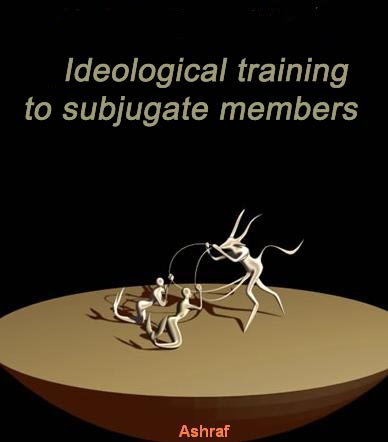
subjugating the members
According to Nejat Society correspondent, four other people defected MKO and repatriated. The four defectors, who were MKO members for a long time, spent a few weeks in TIPF Camp and finally could return Iran with Red Cross cooperation.
The defectors’ names:
Ahmad Rostamian
GholamReza Shirdom
Jamil Abdollahzade
AliReza Naghashzade
The above-named people will consequently state their comments on the disruptive atmosphere in Camp Ashraf.
Nejat Society
Tehran-July 30th 2007
Mr. Booker’s article has been translated in to Farsi and posted in Mojahedin Khalq Organisation web sites (on the list of Terrorist organisation in USA, EU, Canada and United Kingdam!!) shortly before the publication of this article in Telegraph!! (Iran Interlink)
Link to: State Department’s Report on Mojahedin Khalq Orgainsation, Rajavi cult headed by Massoud Rajavi and Maryam Rajavi (2007)
http://www.iran-interlink.org/?mod=view&id=2309
————–
Response to Christopher Booke Ahmad Baaraan, Paris, July 29, 2007 Your Sunday Telegraph article of July 29 titled “EU flouts its own highest court…” has some serious flaws that deserve your attention. I have known MEK (PMOI, NCRI, MKO, …) for more than 25 years up-close and personal. I have also studied the group in my role as a researcher. Therefore, I see myself qualified to comment about it. Quite frankly, your article is just an echo of the PMOI’s own propaganda filled with false and misleading information.
The enlistment of the group in the EU’s terror list is based on the group’s own behavior which is nothing short of a personality cult revolving around its leader, Massoud Rajavi, with a history of violence and a philosophy based on hatred. The group has also been enlisted by the US Government as an FTO (Foreign Terrorist Organization) which was later upheld in court. In concurring with the Court of Appeals for the District of Colombia, Judge Harry T. Edwards notes: “…the public, unclassified administrative record, including petitioner’s own submission to the Secretary, contains more than enough evidence to support the determination that petitioner (PMOI) engages in terrorist activity.” (1)
The December ruling by the EU Court you have referred in your article did not favor de-listing the group. To the contrary, it clearly dismissed the action sought by the PMOI to annul the EU Common Position 2005/936/CFSP- the updated terror list that included the PMOI. It did however order to unfreeze the group’s assets due to lack of proper procedure for such freezing. Therefore, your assertion that the British Government is flouting its own court is not accurate. This ruling is readily available in 16 different languages on the Court’s own official web site. (2) PMOI and its paid politician supporters have misled many about this, relying on that most would not read the actual ruling. I challenged the PMOI to translate the entire ruling (not just the select parts) in Farsi (Persian), and to post the translation on the Internet. They have refused to do so, and will continue such. More than 7 months after the ruling, only the favorable part of the ruling has been published on the group’s Internet site.
Your article also refers to NCRI as a coalition of which PMOI is a member. This is simply not true. Not only people familiar with the group know that NCRI is just a decoy for PMOI; the United States Court of Appeals in Washington DC ruled the following:
After an extensive investigation of MEK and NCRI, the FBI reported to the State Department that “it is the unanimous view of the FBI personnel who are involved in and familiar with the FBI’s investigation of the [MEK]that NCRI is not a separate organization, but is instead, and has been, an integral part of the MEK at all relevant times…. Contrary to NCRI’s portrayal of itself as an umbrella organization, of which the MEK was just one member, the FBI concluded that is NCRI that is “the political branch” of the MEK.”(3)
I caution you not to drift into the PMOI’s propaganda traps by echoing their statistics about the number of people attendant their gatherings, people executed in Iran, and the number of supporters of the group in Iran.
Regards
Ahmad Baaraan
Paris
ABaaraan@yahoo.fr
(1) http://uniset.ca/other/cs5/327F3d1238.html
(2) http://curia.europa.eu (case number T-228/02)
(3) 362 U.S. App. D.C. 143; 373 F.3d 152; 2004
(Farsi translation of Mr. Booker’s article was posted in Terrorist websites before coming out in Telegraph!!)
Link to Mr. Booker article in Telegraph.co.uk.
http://www.telegraph.co.uk/news/main.jhtml?xml=/news/2007/07/29/nbook129.xml
Open Letter to President Nicolas Sarkozy To President Nicolas Sarkozy Dear Mr. President
In our previous letter entitled ‘Exigency of Monitoring Mojahedin’s Moves’ it was asserted that a close monitoring of MKO’s run media deem necessary to develop an exactly calculated judgment of MKO’s positions and its long-term objectives that jeopardize your government and French social health and impede the counter-terrorist measures. MKO’s ideologically hideous and cult-like activities are disguised under its spectacularly made democratic claims and slogans.
It is impossible to develop a deep understanding of the group’s labyrinthine structure unless its philosophy of formation since four decades is well studied. Manifestations of conflicting ideas and Machiavellianism in its ideological infrastructure as well as manipulation of cult-like techniques to have control over the insiders and operatives enable MKO to exploit whatever existing potentiality and leverage in the West in general and France in particular to accomplish its long and short term objectives. Thus, being naturally an outlawed and terrorist outfit, from its very initiation it has strongly championed a strategy of armed struggle; even in its seemingly democratic campaign and propagation you can hardly observe nonthreatening tone and remarks.
For instance, incorporated in Massoud Rajavi’s message delivered from his hideout on July 3, the West and legal bodies as well as the group’s dissidents are unequivocally warned of a violent backlash. In June 2003 event when French police raided the group’s properties including its base in Auvers-sur-Oise and detained 160 suspected MKO members including its leader Maryam Rajavi, Pierre de Bousquet de Florian, head of France’s domestic intelligence service, was reported to have claimed that the group has "transforming its Val d’Oise centre into an international terrorist base". And you, at the time French Interior Minister, declared that the MKO "recently wanted to make France its support base, notably after the intervention in Iraq". All these indicate that you have been aware of and acknowledged the terrorist nature of MKO and will never let sanctuaries be provided for the group in France unlike what did Saddam in Iraq.
Of course, your previously shown antagonistic counter-MKO position and remarks never left the filter of the group unnoticed. They waited to retaliate and their best granted opportunity was to campaign in Ms. Ségolène Royal front against you although at the first look it seemed to be a legally social move. With respect to its terrorist-cult drifts, MKO hardly leave a task unaccomplished and its leaders’ messages to the members and sympathizers contain incitements for provoking social and political chaos. Rajavi’s recent message is not an exception; concerning violent harassment and liquidation of the dissidents and critics, he makes no distinction between the ranks when he says:
Here, at the vital artery of the resistance, there is no place to differentiate a compatriot from a sympathizer or members and ranks from the Council’s head.
He unequivocally approves violent reaction against the detached members as done by the group’s desperados in a Paris conference. He believes whoever leaves the group is a betrayer who engages in an insidious plot with Iranian regime against the organization:
”Absolute boycott of wilayat Faqih regime demarcates the red line of struggle for freedom. Overpassing this red line that draws the vital borderline against theocracy culminates in detachment of dissident individuals and groups from the opposition to become betrayers. ”
Such words uttered by the leader of a terrorist group indicate nothing but an issued order to warrant assault on whoever that for any ideological and political cause disaccords the group. It has to be recalled that for Mojahedin whoever stands with the Iranian regime against the group, being them its critics, French or any other country, judicial systems, international organizations, is the foe battling against enthroning the group that has been struggling as the most Marxist-dedicated and violent Iranian opposition since forty years. The foes have to be challenged and MKO advocates the most violent, cult-like moves to defy the opponents. We have already warned you about the group’s potential threat and Rajavi’s flagrant tone attacking European politicians is actually activating the alarm:
”Now, let me in this respect consider the totally ludicrous labeling and the political traders of the EU, especially ‘the honorable dealer’ Javier Solana who has gain nothing of his serial meetings with Akhond Hassan Ruhani and Pasdar Ali Larijani.”
Mr. president,
Owning no weight in the political mainstream of Iran, MKO is sharpening its knives for a possible encounter with whoever, as Rajavi claims, joins the unified front of so many different opposition parties formed to defy Mojahedin-e Khalq. As the Rajavi draws the boundary, of course you are supposed to be the foe forming an alliance with the Islamic Republic. Consequently, countermeasures to confront the group’s violent reaction deems essential and necessary.
No sooner had the State Department and the EU announced MKO a terrorist cult that Rajavi, as the guru, addresses you from an authoritative position:
The French government and judiciary should suspend the shameful dossier of June 17. This dossier is known to be the blackest smear in the European’s counter-terrorism moves in an attempt to appease the Iranian dictatorial theocracy.
That is MKO’s position taken against one of the most democratic countries wherein its members have been residing as refugees for more than two decade with granted political rights and freedom.
Mr. president,
Rajavi in his message acclaims the burned victims of the 17 June’s self-immolations and , thus, openly encourages the insiders and sympathizers residing in the Europe to take similar steps as the leverages of pressure against the EU and French judiciary system:
Hail Sedigheh and Neda, the blazing torches and everlasting lights of freedom, and other 23 blazing heroes ….
Mr. president,
Rajavi’s message of 3 July is an unexpectedly declared war against a front as wide as the West and Europe. Besides other counter-terrorist measures to confront MKO’s undeclared terrorist moves and threats, we urge you to have a supplementary, strict control over the suspected members and sympathizers of the group, especially those whose names are recorded in the June’s dossier. No doubt, our correspondences are evidences to corroborate the violent nature and cultist activities of MKO and to contribute developing a deep recognition of this terrorist cult.
Yours Sincerely
Mojahedin.ws
July, 2007
Cc
The EU Council of Ministers
French Interior Minister
French Persecutor General
Mr. Javier Solana
The Foreign Secretaries of the EU countries
The US State Department
The Human Rights Watch
Mojahedin.ws, July 2007
In an alarming exposure of the acceleration and urgency of the American war party’s push towards catastrophic war with Iran, Philip Giraldi, former CIA counter terrorism officer, in an interview on 24th July with Anti War Radio debunked the NeoCons’ repeated myth of Iran’s support for AlQaeda as a pretext for war. Whilst acknowledging Iran’s helpfulness in trying to establish security in both Afghanistan and Iraq, Giraldi spoke of the United States’ hypocritical and illegal support for terrorist separatists groups inside Iran, and various plans and scenarios which have been drawn up to destroy Iran’s military and economic infrastructure by massive bombardment, with the use of nuclear bombs a real and stated possibility.
He said how in 2003, the Iranian government, through the Swiss embassy, had offered to hand over the six AlQaeda prisoners kept in Iran, which includes Osama Bin Laden’s son, in exchange for the US ceasing its support for the MEK, and how this offer was rejected by the US.
He said of the MEK that it was sheltered and armed by Saddam against Iran, and now supported and armed by Pentagon against Iran.
Global Research/July 29, 2007
Tehran, July 25, IRNA – Two former members of the terrorist Mojahedin-e Khalq Organisation (MKO), Ebrahim Khodabandeh and Jamil Bassam, said that the organisation has reached the dead-end, and the countdown has started for its decline.
Khodabandeh and Bassam, both 54, became members of the MKO in 1983 and quit the terrorist organisation four years ago.
Talking to IRNA, they uncovered issues about the terrorist group which are "interesting and surprising".
MKO, SILENT ON STATEMENT OF US STATE DEPARTMENT
The interview with the two former MKO members started with the…circumstances "surrounding an accident". The question was: "Why the terrorist MKO has remained silent vis-a-vis the annual statement of the US State Department, after more than two months."
Khodabandeh, who was active at the MKO international relations section for some 20 years, said that the main reason behind this silence was that the statement refers to the MKO as a "Cult of Personality".
He believes that this title, as well as keeping the MKO in the list of "Proscribed Terrorist Groups" by the European Union which recently has been announced, would internationally weaken the position of the organisation.
Although the US State Department has put the MKO in the list of the International Terrorist Groups since 1984, it has underlined the organisation being a "cult" this year.
Khodabandeh, who has made broad studies on cultic organisations and cult leaders, said that according to definitions presented by psychiatrists and sociologists around the world, cultic organisations are those whose members are under mental coercion and mind indoctrination.
According to the law in European countries, unauthorized imposing of systematic manipulation on individuals is an offence which is subject to legal prosecution, he added.
Based on definitions, those who are under thought reform processes in such cults would carry out tasks on the demand of the cult leader they would have never done in normal life and natural situations, he noted.
Meanwhile Jamil Bassam, who was active in the MKO publications section in several European countries for years, outlined another important issue.
According to him, after the MKO was put on the list of terrorist groups by the US State Department as well as the EU, the organisation made great efforts, through American and European Courts, to be dropped from the list.
Regarding the issue, Bassam believes that the US State Department has adopted a "tougher" position on MKO by classifying it a cult as well as putting it in the list of terrorist organisations.
The US State department has come to such conclusion by receiving information from the massive number of former members of the organisation both in Iraq and in other countries, he added.
The statement has reiterated that the MKO, in addition to its terrorist record, has displayed cultic characteristics, too.
The State Department Office of the Coordinator for Counterterrorism on April 30 released the list of designated terrorist organizations. Once again Mojahedin-e Khalq Organization (MKO) continues to occupy the status it has been designated since 1997.
This statement quotes: "In addition to its terrorist credentials, the MEK (MKO) has also displayed cult-like characteristics.
Upon entry into the group, new members are indoctrinated in MEK ideology and revisionist Iranian history. Members are also required to undertake a vow of "eternal divorce" and participate in weekly "ideological cleansings." Additionally, children are reportedly separated from parents at a young age. MEK leader Maryam Rajavi has established a "cult of personality." She claims to emulate the Prophet Muhammad and is viewed by members as the "Iranian President in exile."
Khodabandeh believes that the statement by the US State Department is the work of experts and professionals and is not politically motivated.
MKO EFFORTS TO DRAW ATTENTION OF WAR-MONGERING PENTAGON FACTION
The two former MKO members further unveiled the efforts made by the terrorist organisation to establish relations with the war-mongering faction of the Pentagon.
According to them, after the fall of Saddam Hussein, the terrorist MKO made efforts to attract the attention of certain war-seeking elements of the Pentagon.
They also referred to internal disputes in the US saying the US State Department, contrary to the view of the Pentagon war mongers, is opposed to using the MKO as a tool.
Khodabandeh referred to the statement of the US State Department plus the classification of the MKO as a cult, the two huge "obstacles" in the way of such efforts.
He believes that by inserting the MKO in the list of terrorist organisations again, both by the US and the EU, efforts for the MKO cooperating with the west in general and the USA in particular are "blocked".
Considering the expert views presented on the terrorist MKO, the US State Department would argue that the cult is not trustworthy and would be placed in the rank of such groups as al-Qaeda, the two former MKO members said.
Regarding the question of the cults, they said that "methodology" is the prime issue, not the "ideology". In other words, in a cult, the use of methods for total mental domination on a person in line with the cultic tendencies would be under consideration.
Khodabandeh said that the position of the terrorist MKO for Washington is similar to those terrorist groups supported by the US in certain countries of the world, including Iraq, Afghanistan and Lebanon, who later took action against the US interests.
Bassam also believes that the MKO is trying to take advantages of the existing Iran-US disputes for its survival.
He added that as to restrictions faced by the MKO since it was included in the list of the International Terrorist Groups, the MKO members, in order to escape the restrictions in Europe and in the US, were active under the cover of "Iranian Societies" and "National Resistance".
WHY SILENT
The remaining question is that due to the negative impacts of the statement of the US State Department on the activities of the MKO, why the cult had remained silent over the past two months and had not given any response?
Khodabandeh gives an interesting answer to this question. He said that the MKO used to take a tough stance vis-a-vis previous statements issued by the US State Department but this time the case is different.
According to him, one reason behind the stillness is that the MKO is faced with a political "deadlock" in the international arena and is incapable of showing any reaction.
They both said that all cults are obliged to provide propaganda to feed their members in order to pretend that everything is going well.
The two former MKO members reiterated that the organisation has inducted its members that the west and the US are currently supporting the MKO. Therefore they do not want such negative reports reach their members so they keep silent regarding the statement.
The two believe that members of the cult are living in "delusion".
They give an example saying: "Those living in Ashraf Camp are presented with a false image of Iran. Therefore when we arrived in Tehran, we saw that the situation was totally different from what we had thought."
They added that the MKO has told its members inside the organisation that Maryam Rajavi is the designer of "third option" strategy, which in reality is to be executed by the Pentagon!
Khodabandeh said: "By issuing such statement, the US in fact has disappointed the MKO. Therefore, leaders of this terrorist group, in order to keep their members away from the reality, preferred to remain silent regarding the statement.
He emphasised that the recent report by the US State Department had passed through a point of no-return and has faced the MKO strategy in seeking a substitute for Saddam Hussein in the west with a complete deadlock.
He said that the stillness of MKO regarding the report precisely originates from this strategic deadlock.
Due to the severance of relations between those living in Ashraf Camp with their families and friends and in general with the realities of the outside world, Bassam said that the Iraqi formula is different from those in other parts of the world.
Despite the issuance of such statement by the US State Department, reports point to the cooperation between the MKO and some elements in the US Defence Department, he added.
Khodabandeh is of the view that Washington may use this card in its negotiations with Iran. However, the card is not so important because the Ashraf Camp in not a security concern for Iran any longer, he added.
Bassam believes that Washington has been trapped in Iraq. The MKO is trying to pretend that Iran is involved in the Iraqi problems and thus get closer to Washington, he added.
He said that the Iraqi government is willing to dismantle the Ashraf Camp. Referring to the current situation as sensitive for the MKO, he added that they are trying to come out of this quagmire before George W Bush’s second term is over.
MKO SEEKING AN ALTERNATIVE FOR SADDAM HUSSEIN
The two former MKO members added that the objective of the terrorist organisation is to gain power by any means including cooperation with Saddam Hussein. The cult is seeking a person like the former Iraqi dictator to lean on, they noted.
They were convinced that the statement has placed an obstacle in the way of MKO efforts, to create such a point of backing by the US, and has made the organisation face an impasse.
Asking Khodabandeh about the role of the French government in toughening the tone of the statement, in response he referred to acts of self-immolations by MKO members in Paris in 2003, after the arrest of Maryam Rajavi and added that those MKO members arrested by the French police at that time, unveiled some realities indicating cultic relations inside the organisation.
Meanwhile, Bassam reiterated that in addition to the reports by the French government on the terrorist cult, disclosure made by over 2000 MKO breakaway members was effective in making the tone of the statement stronger.
According to them, the West is currently well aware that such cults are a threat to both their members and their surrounding environment.
ALARM FOR EUROPE, US
The statement of the US State Department has referred to Europe as the two command headquarters of the organisation. Commenting on the issue, Khodabandeh and Bassam said if true, this could be alarming for Europe.
They further reiterated that both the US and Europe should be concerned over terrorist operations by the MKO members.
The move by some MKO members who committed self-immolation after the arrest of Maryam Rajavi on 17 June 2003 in Paris, is an indication of this alarm, they said urging both the US and Europe to be sensitive towards possible terrorist operations by MKO members.
Khodabandeh said that noting is more dangerous than a cult having reached the state of impasse. Under such condition, he said, the behaviour of a terrorist cult would be unpredictable and such a threat would endanger, before anything else, the security of countries they live in as well as its present and breakaway members.
Iraqi President Jalal Talabani has said Baghdad will not let armed forces use its territory against the Islamic Republic of Iran.
In a meeting with Governor General of Iran’s western Kurdestan Province Ismaeil Najjar and his accompanying delegation, Talabani added Iraqi border guards have received necessary orders regarding the case.
Iraqi border guards are duty-bound to firmly counter any armed forces who intend to infiltrate into the Iranian territory, IRNA quoted the president as saying.
He said Iraq believes that under the current regional and international circumstances, armed clashes have the same meaning as terrorism; stressing Baghdad would not allow terrorists to use its soil against neighboring countries.
Iraq will spare no effort to help Iran fight against terrorist groups and has the same expectation from Iran, as an old friend to the Iraqi nation, Talabani added.
He called for expansion of amicable ties with Iran particularly in border regions with respect to bonds between the Iranian and Iraqi nations.
He said the Iranian nation has always supported the Iraqi people, adding opening an official crossing checkpoint at Bashmaq boder was another humanitarian aid by Iran which would cause a big economic development in the region.
Najjar, for his part, said legalization of the checkpoint was a dream of local residents of Iran’s Kurdestan and Iraqi Sulaimaniyah Provinces which came true during Iranian President Mahmoud Ahmadinejad’s visit to Kurdestan.
He added that legalization of the checkpoint on Thursday, which was already used as an unofficial border crossing by locals, would prepare the ground for bolstering bilateral relations in all fields.
Press TV, July 29, 2007
http://www.presstv.ir/detail.aspx?id=17735§ionid=351020101
The horrible nightmare of 9/11’s al-Qaeda attack never seems to be leaving the dreams of American citizens. The consequent decision of declaring a global war on terrorism promised a peaceful world with no vacant place for the terrorist operatives. Now, nearly after six years after the world has unanimously approved the decisive combat against terrorism and it is legally put into practice in many countries, certain terrorist groups, especially those on the world’s terror lists, are jeopardizing people’s security where the chaos is at zenith under the pretext of war against terrorism. Furthermore, not only we see no instances of a terrorist group being uprooted but we hear news of the new ones emerging.
Jeffrey Steinberg in a recently published article in mathaba.net discloses efforts made to create a new terrorist network that some U.S. intelligence officials brand as "al-Qaeda II". The danger of the network appears to be much greater than that of the Bin Laden’s since it is designed to be a source of promoting sectarian conflicts as well as accomplishing warmongering ambitions of people like Cheney. As Mr. Steinberg reveals:
Saudi Arabia, through Prince Bandar bin Sultan, Cheney’s chief ally and the purported national security advisor to King Abdullah, has been pouring money and weapons into Sunni tribes in western Iraq, who have now emerged as what some U.S. intelligence officials brand "al-Qaeda II." These Iraqi Wahabi networks, distinct from the bin Laden/Zawaheri "al-Qaeda in Iraq" apparatus of largely foreign fighters, have emerged in recent months as a significant element within the overall insurgency. According to these sources, "al-Qaeda II" is part of Cheney’s scheme—designed in London by the likes of Dr. Bernard Lewis—to promote a permanent Sunni versus Shi’ite conflict in the region.
Evidences indicate that MKO might be part of this new network since the group is receiving financial aids from the sponsors of the network. Of course, the group’s mission is to carry operations inside Iran:
This Cheney-Bandar effort, the sources warn, is one of the driving factors, provoking Iran, and fuelling the prospects of a near-term explosion. Earlier in July 2007, an emissary of Prince Bandar delivered $750,000 to the Mujahideen-e Khalq (MEK), an Iranian exile group that formerly worked for Saddam Hussein, and which is on the U.S. State Department’s international terrorist organizations (ITO) list, for having assassinated American military officers in Iran. The MEK is actively engaged in sabotage and assassination operations inside Iran—with the enthusiastic support of Washington neo-cons, typified by Daniel Pipes, who recently attended the MEK gathering outside of Paris where the Bandar money was delivered.
Cheney’s warmongering stance and his efforts to sponsor terrorist groups, even if the main purpose is to wage war on Iran, is a plan that backfires, as did the al-Qaeda. There are also good news that the “U.S. Department of Justice is already investigating Prince Bandar for his role in the BAE Systems scandal, involving the $100 billion offshore covert operations fund”. As the assets are kept in Bandar’s bank accounts in the United States, and according to adopted counter-terrorist laws it is banned to provide financial aid to blacklisted terrorist groups, the responsibility of monitoring the implementation of law is a crucial measure, something that does not escape Mr. Steinberg attention: “One question that Justice Department investigators should take up is whether some of those funds are now going to the MEK to fuel Dick Cheney’s Iran war schemes”.
Mailed by Lira Arshia, Mojahedin.ws, July 30, 2007
P: We’re joined now by Anne Singleton she’s a married mum from Leeds. Who was actually brainwashed by extremists at one point but now campaigns to warn others. Good Morning Anne.
AS: Good morning.
P: Is brainwashed the right word to use? What actually happened to you Anne?
AS: It is a word which resonates with people. More familiarly I would call it ‘mind control techniques. These are well-known, well-documented. For years and years destructive cults have been using them. The way that they work in essence is that they will take a perfectly ordinary person and strip that person of their values using specific psychological manipulation.
P: What got you into this position in the first place?
AS: I was involved with Iranian students at the time of the Iranian revolution in 1979. I was at Manchester University. I was young and innocent, looking for something to fulfill my ambition to ‘change the world’. I was very idealistic and I got involved with those people. They seemed to me very sincere, very genuine and committed to making change in their country. I hadn’t grasped that the path which they were leading me along led to extreme violence.
P: So this was happening in this country, it wasn’t happening in a foreign environment where you would maybe be more susceptible to someone else’s culture.
AS: I was recruited at Manchester University. Having said that, ten years down the line – I was just supporting the group from a distance, I had a job and ostensibly a normal life. But ten years down the line I took part in a hunger strike and that’s really what tipped the balance for me and sent me over the edge into total commitment to this group. After about five days of eating nothing I was on a complete high and I felt as though I was moving at a different speed to the rest of humanity.
P: What was it they encouraged you to support?
AS: The Mojahedin even today present themselves as an alternative to the islamic regime in Iran. They say that they want to overthrow the whole regime in its entirety and replace that regime with themselves. They frame this in the context of human rights. They say we will protect human rights by overthrowing the mullahs. What I came to realize was that they were committing just as much abuse of human rights inside their organization as Amnesty International was ‘clocking-up’ in other countries throughout the world.
P: Anne, what do you think of the stories today? The front page of the Yorkshire Post says ‘University Launches Review after Conviction of Student Terror Ring’. How do you feel when you feel when you hear about these students, about what they were doing – substituting their faces with the faces of the 9/11 highjackers – after what you have been through.
AS: What comes to mind first of all is that terrorism is such a complex issue. Yes, it sounds horrific on the surface when you hear of people having extremely radical views like this. And people are frightened because they know that such views can lead to violence. But what I have understood from my experience is that to tip somebody over the line between radical ideas and actually perpetrating violence needs psychological manipulation. Words don’t kill people, they never have. Words are how societies move forward, through discussion, debate and progress. There have been lots of radical ideas throughout history – the world is round was quite a radical thought at one point. So we must pull back a little bit and say that OK there are extremist views but if we remember a few years back – 1993 – the Admiral Duncan pub was bombed, a gay pub in Soho. If you start looking only at the so-called ideology of these people then you are going to miss a whole lot of clues that lead you to understand how a person goes from thinking extremely to acting extremely.
P: You mentioned the hunger strike thing and that really strikes a chord with me. When I was going through my divorce I literally couldn’t eat a thing. And it absolutely does your mind no good. If you are not eating properly you think in a totally irrational way. That’s my experience. So, when you say your hunger strike was the one that led you up to that kind of high, moving and thinking differently from everyone else, that must be part and parcel of it.
AS: This is a fundamental technique for psychological manipulation. These techniques are used by all destructive cults – whether they present themselves as religious, therapeutic, or like the Jonestown cult of the 1980s. They each present themselves differently but they all use the same techniques. These techniques are very effective, you can actually recruit and convert somebody into a cult member within three or four days. That’s how effective they are.
P: This was happening to you at Manchester University. Now we hear about these students at Bradford University. There are some interesting issues about how this radical thought, idealistic thought can tip over the edge into violent action, but in terms of the universities what is the best plan for them in your experience in combating this, I mean tipping over into violent action.
AS: I think that young people generally need to be educated in the danger of destructive cults. You should start at high school even. I am surprised that in schools you may be given sex education, you are educated about how to keep your PIN number safe and not get robbed, But where is the education to tell people how to look out for somebody who is going to come along, take you out of your normal environment and convert you into either a terrorist or at least a cult member.
P: But will that education be enough? I think one of the things Bradford University is looking at as well is the idea of surveillance and looking at what people are looking at on the Internet and monitoring the traffic that’s coming through.
AS: I am not a security expert so I couldn’t say how effective that would be.
P: Would education have stopped you?
AS: Certainly it would have opened my eyes a lot sooner to looking for signs that people were trying to influence me in ways that I wasn’t aware of actually happening. I think university students are quite vulnerable because they are away from home usually, they are in a vibrant atmosphere. They are intelligent, idealistic and are looking for new experience and new ideas.
P: You are a mum, Anne. How many kids have you got?
AS: I’ve just got the one.
P: And how old is your child?
AS: My child is seven.
P: Right, so a long way to go in terms of university. How do you feel about your life now and your fears for your child?
AS: I have to add here is that the reason I have one child is that we started rather late. I was involved with a terrorist cult, the Mojahedin Khalq, which denied its members marriage and children. Those are the levels of intrusion that these organisations have on ordinary members. So, they would not allow anyone to be married, they forced people to divorce and took their children away from them. It was only after I left and met my husband that I was able to have a family. And I realise now that being in one of these organisations deprives you of all your basic, fundamental human rights, even freedom of thought. Because a person who is brought around to thinking as terrorists do in order to give their own life to this other person – because it is someone else who will be persuading them to do that – your basic freedoms are taken away from you without you realising. Now, if you are aware, first of all, of your basic freedoms – what are the basic human rights that everyone is entitled to – that is a starting point from which you can say, I do have the right to have a family, to have children. These are certainly the things I will be teaching my child as he grows up and certainly I will be teaching him to think and to question and not to accept anything at face value, ever.
People can be very persuasive. I think we’ve all been sold something we didn’t really want by somebody who was very persuasive. The same techniques will persuade you to act in ways that you don’t mean to, let alone buy things.
P: Anne, thank you very much for coming in. She’s a wife and mum and she was involved with the Mojahedin in West Yorkshire.
BBC Yorkshire, Radio Leeds, July 26, 2007
http://www.bbc.co.uk/leeds
When will you disclose the amount of money (if any) you receive from or contribute to the Iranian Communist MEK (MKO, PMOI, NCRI, Rajavi Cult, or Pol Pot of Iran)?
Paul Sheldon Foote, July 22, 2007 – http://360.yahoo.com/paulsheldonfoote
In response to my book review of David Horowitz’s The Professors: The 101 Most Dangerous Academics in America, Professor Rabbi Daniel M. Zucker posted the following comment:
“May we ask why Professor Foote always attacks opponents of the current Teheran regime? Even Professor Ervand Abrahamian
(author of the 1987 text The Iranian Mojahedin and no friend of the MEK)wrote that the MEK never was or had any ties to the Communist Party or any of its fellow travellers. Foote uses his”conservative”credentials to hide his support and defense of the tyrannical theocratic regime in Teheran. Shame on him! He opposes those that want to end the tyranny in Teheran.
Professor Rabbi Daniel M. Zucker”
http://www.theconservativevoice.com/forum/read.html?id=2075
My answers to Professor Rabbi Daniel M. Zucker are:
1. I am a lifelong registered Republican. You may verify my current party registration with Orange County, California. You have failed to disclose your party affiliation.
2. In 1992, I was a candidate for the California State Assembly in the Republican primary election. The California Republican Assembly (CRA) endorsed me. United Republicans of California (UROC) co-endorsed me. These were the two conservative Republican groups endorsing during that election.
3. I volunteered and served in Vietnam as an American Army officer fighting against communism. When have you ever opposed communism? Unlike chickenhawk neo-conservatives (neo-Trotskyites), I served in the military in a war zone. I did not attempt to dupe any Christian Zionists to go in my place.
4. The following is a posted usage of the word conservative related to your name:
Congregation Beth Sholom
~~~~~~~~~~~~~~~~~~~~~~~~
(CONSERVATIVE)
516-432-7464
315 Roosevelt Blvd., Long Beach, NY 11561
fax: 516-889-1015
Rabbi Daniel Zucker
S,DM,L,RS,AE email: bethsholom@peoplepc.com
http://cojonc.org/_wsn/page5.html
Can you provide any other evidence that you are conservative in any way?
5. Your summary of Professor Ervand Abrahamian’s book The Iranian Mojahedin is totally false.
On page 2, Professor Abrahamian wrote:
“The Mojahedin has in fact never once used the terms socialist, communist, Marxist or eshteraki to describe itself.”
On page 102, Professor Abrahamian included (in black and white) the red, communist flag of the MEK. Throughout his book, Professor Abrahamian explained in detail the Marxist and Maoist influences on the MEK.
Any serious student of communism knows that communists have attempted to dupe religious people in this way. Massoud Rajavi was familiar with the liberation theology successes in Latin America. If the communists in Latin America can dupe ignorant Christians by not using the usual Marxist jargon, then they will do so.
On page 261, Professor Abrahamian concluded that the MEK vision that there will be a Second Coming in Iran with the people shouting the slogan ‘Iran is Rajavi, Rajavi is Iran’ is a vision shared only by members of the MEK.
Professor Abrahamian and I are signers of the Stop War on Iran statement:
Ervand Abrahamian, Prof. ME History, Author, Between Two Revolutions
Paul Foote, Professor, California State University, Fullerton*, Fullerton, CA
http://www.stopwaroniran.org/statement.shtml
6. Your claim that I support any theocracy is a total lie. My postings are available for all to read at my blog and at my Yahoo political discussion group:
http://360.yahoo.com/paulsheldonfoote
http://groups.yahoo.com/group/traitorsusa/
Also, I appeared last year on the NITV’s “Power of One” Iranian opposition satellite television program with the hosts Zia Atabay and Manook Khodabakhshian. In a program watched in Iran, I explained that my Foote ancestors left England, a theocracy and a monarchy, nearly 400 years ago to enjoy religious and economic freedom in America. Today, I remain opposed to any theocracy and to any monarchy. However, I do not know of any member of the Foote family in America for nearly 400 years who has advocated a military attack on England because it has a theocracy or a monarchy. If Iranian expatriates do not like what is happening in Iran today, they can return to Iran to make improvements. Why have dishonest Iranian communists and monarchists moved to America? The leaders of the Islamic Republic of Iran need to study why the United Kingdom has been successful in maintaining a theocracy and a monarchy.
At the start of the Iranian Revolution in 1979, the Iranian nationalists collapsed quickly. That left only Islamic religious leaders and Massoud Rajavi (the leader of the communist MEK) struggling for power. I have written repeatedly that, while I am a Republican who did not vote for President Jimmy Carter, I am delighted that President Carter’s strategy of a Muslim green zone in the Middle East succeeded. I was delighted in 1981 when the Islamic leaders ousted Massoud Rajavi from Iran. If Rajavi had succeeded in installing a totalitarian regime similar to Pol Pot’s in Cambodia, Rajavi would have murdered a large percentage of the Iranian people and there might still be a Soviet Union.
7. The Web site for your Americans for Democracy in the Middle East (ADME) does not include any disclosures of financial statements:
1040 First Avenue, Suite 350
New York, NY 10022-2902
http://www.adme.ws/
When will you disclose the amount of money (if any) you receive from or contribute to the Iranian Communist MEK (MKO, PMOI, NCRI, Rajavi Cult, or Pol Pot of Iran)?