Nejat Society
  • Home
  • Articles
  • Media
    • Cartoons
    • NewsPics
    • Photo Gallery
    • Videos
  • Publications
    • Books
    • Nejat NewsLetter
    • Pars Brief
  • About Us
  • Contact us
  • Editions
    • عربي
    • فارسی
    • Shqip
Nejat Society
Nejat Society
  • Home
  • Articles
  • Media
    • Cartoons
    • NewsPics
    • Photo Gallery
    • Videos
  • Publications
    • Books
    • Nejat NewsLetter
    • Pars Brief
  • About Us
  • Contact us
  • Editions
    • عربي
    • فارسی
    • Shqip
© 2003 - 2024 NEJAT Society. nejatngo.org
France

MKO’s Days in France Might Be Counted

Taking a clear political stand in support of Ségolène Royal, MKO looked with dismay a resounding win by Right Wing UMP candidate Nicolas Sarkozy. It does not necessarily mean that Ms. Royal intended to sacrifice the people’s interests and political concerns to meet the demands of a proscribed group long leeching onto France.

Of the diplomatic controversies that have clouded French-Iranian relations, which Nicolas Sarkozy has on his political agenda to improve, was the issue of MKO. Darius Kadivar, a freelance journalist, in an article released in persianmirror makes a short reference to the issue and is of the opinion that the days of MKO in France may well be counted with Sarkozy who is anti-communist.

Another issue of controversy between Iran and France has been the Armed Opposition Organization of the Peoples Mujahedin Khalge known as the MKO which is labeled as a terrorist organization by the EU and the US. The Para Military organization founded by Massoud Rajavi and led by its self elected wife Maryam Rajavi combines Marxist and Islamist ideologies and has made headlines for the spectacular fanatical actions of its members such as self immolation to protest against the arrests of its leaders. It claims to have given up military actions against the Islamic Regime and seeks respectability amongst European deputies and personalities such as Bernard Lavillier, and controversial excommunicated Bishop Jacques Gaillot. It has however found amongst its staunchest ally the former First Lady Danielle Mitterand, who has often been at odds with her own husband the late French President François Mitterand who favored political ties with Iran whilst selling Arms to both Iran and Iraq during their 8 year war. The days of this organization in France may well be counted with Sarkozy who is anti-communist, with pro-American sympathies and claims to combat terrorism and support Human Rights.

19/05/2007 –  Mojahedin.ws

May 21, 2007 0 comments
FacebookTwitterPinterestWhatsappTelegramSkypeEmail
Iran

Iran criticizes Western war against terrorism

Vienna – Iran sharply criticized the Western powers’ approach to fighting terrorism Saturday as superficial and biased.

Iran’s Ambassador Ali Asghar Soltanieh told delegates participating in a UN-sponsored counter-terrorism symposium in Vienna that the West’s actions only led to an increase in violence.

‘The unsuccessful experience of major powers in their superficial, improper and biased approach to combating terrorism has been ineffective in decreasing terrorist threats,’ he was quoted as saying by the Iranian IRNA news agency.

At the two-day meeting which concluded on Friday, Soltanieh, who represents his country at the Vienna-based International Atomic Energy Agency, denounced the attempt to establish a connection between terrorism and religion.

‘Worst of all are the attempts made to associate terrorism with a certain religion and culture,’ he said.

The reasons behind terrorism were foreign occupation, discrimination, the West’s double standards in politics and economy, and so-called ‘state terrorism,’ Soltanieh argued.

The ambassador also belaboured Western support for the exiled anti-Iranian People’s Mujaheddin (MEK), whom Iran regards as a terrorist organization, formerly under the protection of Iraqi dictator Saddam Hussein.

The Vienna counter-terrorism symposium was aimed at propelling forward the UN-strategy for fighting terrorism.

The participants from approximately 100 UN member states were asked to present their issues and discuss strategies.

dpa – Deutsche Presse-Agentur – May 19, 2007

May 21, 2007 0 comments
FacebookTwitterPinterestWhatsappTelegramSkypeEmail
Terrorist groups and the MEK

More Evidence on Rajavi cult – Qaeda Ties

The terrorist organization of Mojahedin-e Khalq, with long history of denying its own acts and plots, responded to the comments and revelations of Mr. Hadi Farhan Abdullah al-Aameri, the head of Iraqi Parliament’s Security Commission, by projection and denying the facts; Mr. Aameri had revealed MKO’s ties with Al-Qaeda.

He had stressed that the MKO was involved in violent acts in Dyalah province.

However, the gang of Rajavi, failed to benefit from such acts, claimed that American Generals can testify that MKO has nothing to do with this.

Meanwhile, additional intelligence have been reported, including those broadcast by Kurdistan TV, which quoted Al-Sharq alawsat:

“Mountains of Hamrin have turned to safe haven and training base for armed terrorists of Al-Qaeda. Following the security plan in Baghdad and mobilization of tribes in Anbar province to push out Al-Qaeda militants, members of this terrorist organization left the place to Hamrin Mountains. Armed members of Al-Qaeda have established 7 bases in Hamrin to train new terrorists.”

What can be clearly seen of MKO’s involvement in this issue is that Hamrin was for long time a place for MKO’s terrorist training and practices; now they coordinate with Al-Qaeda by establishing terrorist bases.

Such relations with Al-Qaeda justify in part the philosophy of abducting and killing of two MKO members by the Gestapo of this group; they abducted and killed two of their own members in order to take position against those who may accuse the group of terrorism!

The Gestapo of Ashraf has already accused tens of Iraqi officials and figures of being involved in abducting the two members and Mr. Aameri is the last one to be accused after he revealed MKO’s ties with Al-Qaeda.

May 21, 2007 0 comments
FacebookTwitterPinterestWhatsappTelegramSkypeEmail
Mujahedin Khalq; A proxy force

West’s duplicity in war on terror

Iran’s permanent envoy to the International Atomic Energy Agency has criticized the approach taken by certain nations in countering terrorism.

"The unsuccessful experience of major powers in their superficial, improper and biased approach to combating terrorism has been ineffective in decreasing terrorist threats," said Ali Asghar Soltanieh.

"Worse of all are the attempts made to associate terrorism with a certain religion and culture," he added.

Soltanieh made the remarks Thursday in the Austrian capital Vienna during a conference for the United Nations Global Counter Terrorism Strategy.

He also touched on terrorist groups such as the anti-Iranian Mojahedin Khalq Organization (MKO) operating under the patronage of deposed Iraqi dictator Saddam Hussein.

The MKO were also supported by several western countries while launching their terrorist attacks inside and outside of Iran.

"These double standards are at odds with the UN resolutions. The best way to ensure we are on the right path is to take all the measures to combat terrorism in the UN paradigm," Soltanieh said.

"Countering terrorism must be based on rules and respecting human rights. Acts such as secret arrests of terrorist suspects and sending them to clandestine prisons is against humanitarian rights,” he continued.

Soltanieh said fighting terrorism demands a multidirectional approach based mainly on confronting the roots of terrorism.

"Foreign occupation, isolation along with double standards and the political and economic policies of certain hegemonic powers, merely fuel violence and terrorism," he said, reiterating such issues must be dealt with at a fundamental level.

Elsewhere in his remarks Soltanieh described "state terrorism" as simply another form of the overall phenomenon of terrorist, and called it "a menace to joint measures in countering terrorism."

"The international community should prevent the bombardment of residential areas and the massacre of innocent people including children under the pretext of fighting terrorism," he reiterated.

Press TV –  18/05/2007

May 21, 2007 0 comments
FacebookTwitterPinterestWhatsappTelegramSkypeEmail
Iran

FT interview with Abbas Araghchi, Iran’s deputy FM for legal and international affairs

Gareth Smyth, the FT’s Tehran correspondent, interviewed Mr Araghchi at the foreign ministry in Tehran on Tuesday May 8 2007. The interview was conducted in English.

Financial Times: What is the big obstacle to Iran and the US talking to each other?

Abbas Araghchi: We had no plan to do so, although the Americans were obviously interested … We didn’t think the theatrical behaviour would help with this very complicated situation, and the difficult relationship between the two sides … We need understanding of each other, and understanding of the situation in Iraq. If the US wants to solve their problems in Iraq, they should understand their mistakes so far.

Their invasion was a disaster – let there not be a double disaster with a disastrous withdrawal. If they have the good will to solve problems, they should introduce an exist strategy, and then there can be a face-saving withdrawal.

FT: So Iraq is the first step to wider progress?

AA: We want to bring stability back to Iraq – this is very important. We are interested in the peace and security of Iraq, its unity, its territorial integrity, that it be at peace with its neighbours. We consider peace and security in Iraq [to be] our own peace and security.

It is very important for us to see that the Iraqi government and prime minister [Nouri] Maliki are successful, because …the only alternative is absolute chaos, maybe civil war or the breaking of Iraq into different pieces.

Iran would be the first to benefit from the return of peace and security in Iraq.

FT: And peace and security cannot come without a US withdrawal from Iraq?

AA: This is what we understand. Iraq is suffering a vicious cycle. There are foreign forces who have occupied Iraq, and justify their presence on the pretext of the ‘war on terror’ and terrorists who claim they are fighting occupiers …Each is justified by the other.

The only solution is to end occupation, and this means a well-planned strategy.

In his speech at Sharm el-Shiekh, Mr [Manouchehr] Mottaki [the Iranian foreign minister] tried to give some guiding principles … First of all, the government of Iraq should be supported and strengthened, it needs to be helped, and not only the government, but the whole political establishment, which is the result of a democratic process …

Second, the government should be given more responsibility – political, economic and especially in security matters. The security file should be given to the Iraqi government. It is not acceptable, not useful, for the Americans to continue to manage security by themselves ….The Iraqi government should have authority and responsibility, and then it can be held accountable.

Thirdly, enough facilities, equipment and training should be given to the Iraqi armed forces and police, to enable them to fulfil their responsibilities ….

Fourthly, help for reconstruction in Iraq. Without improving the lives of ordinary Iraqis, we cannot expect the return of peace and security. Why, for example, in Baghdad, is there only two or three hours of electricity a day? Why is there not enough safe water, or enough schools?

An exit strategy should include these principles, these guidelines. Together Iraq’s neighbouring countries and foreign forces, we can help the Iraqi government and have a clear prospect for the future, a bright horizon … Iran is completely ready to help in that direction. There should be good will on the other side, and a road-map and sense of co-operation.

FT: The US would say they agree with these principles. But their disagreement would be over their withdrawal. They do not seem to want to accept a timetable for a withdrawal.

AA: This is why I’m talking about an exit strategy. They think it’s premature to talk about a timetable, they are afraid of ‘premature’ withdrawal. But this should not mean we have nothing, and continue like this … We should clear the prospects and talk about co-operation, and America should encourage the same approach by other countries in the region. To some extent, this happened in Sharm el-Sheikh. We saw more support for Iraq’s government and its political establishment. The final statement … has expressed and emphasised full support for prime minister Maliki, and the government and the political establishment. That was good.

We can continue our efforts, to build more support, to remove the concerns of some other parties in the region, to convince some Sunni groups and their supporters that in a democratic process they can achieve what they want …If they are not happy, there are mechanisms in the constitution they can use.

We need good-will first of all, and the Americans should stop accusing others for mistakes they have made themselves. It is useless to accuse Iran of supporting foreign fighters or sending arms. Why should we do that? We have the same interests in Iraq? Why should we undermine the Iraqi government?

Terrorist groups are against Iran as well. Al-Qaeda, for example, is a sworn enemy of Iran …. We are the first victim of terrorism ourselves.

FT: You said the US was afraid of withdrawal. What do you think they are afraid of?

AA: You should ask them.

I think there should be no place for being afraid of their withdrawal. Yes, immediate withdrawal could lead to chaos, civil war, could turn Iraq into a failed state. This is a fact. No-one is asking for immediate withdrawal of foreign forces from Iraq. But there should be a plan … if we continue like this, there will be more excuses for terrorists …

I don’t think they are afraid of withdrawal, they just don’t know how to do it … The whole world, the region, expect the Americans, just as they had a military plan for the invasion, to have a political plan for withdrawal from Iraq. This is a reasonable, legitimate expectation, and if they fail to introduce an exit strategy, there will be a double failure.

Their invasion was a disaster – let there not be a double disaster with a disastrous withdrawal … If they have the good will to solve problems, then there can be a face-saving withdrawal.

FT: There was a report in al-Hayat [London-based, Saudi-owned Arabic newspaper] the other day that Iran was unhappy that the Syrian foreign minister, Walid al-Moallem, had met Condoleezza Rice …

AA: Syria has its own interests and policies. We are neither encouraging nor discouraging them from meeting Americans or anybody else. When they met Ms Rice at Sharm el-Sheikh, they briefed us what happened between the two ministers. We had no objection.

FT: Would you say the Syrians agree with the process you have outlined for the future of Iraq?

AA: They have their own concerns and interests, each country does. We advise the Americans to acknowledge these …. In the case of Iran, we had eight years of war [with Iraq, 1980-8], and we have suffered from the dictator in Iraq [Saddam Hussein]… We have a long boundary with Iraq, and a shared history … We share religion and culture.

So we have legitimate concerns and interests. The same is true for other neighbours – Syria, Saudi Arabia, Turkey. There is no way other than including all these countries’ concerns.

This is why we insisted the meeting of Iran’s neighbouring countries should stay as it is. We don’t think the addition of more countries to this institution can help … the P5 or G8. We have no problems with these countries, but we should keep this institution of neighboring countries so as not to complicate the decision-making process …

On reconstruction, we can have a large number of countries, as we did at Sharm el-Sheikh on the first day for the International Compact on Iraq. We had something about 70 countries. Yes, they can express their wishes to help Iraq, Iraqi reconstruction, their pledges for help, loans, grants, things like that … but when it comes to the question of security, to the question of political issues, I don’t know that countries who are thousands of kilometers far from Iraq how they can help.

So we shouldn’t complicate the process. We should keep the neighbouring countries’ meeting as it is. In Sharm el-Shiekh, more and more neighbours understood the points we have said before: that we need closer contact among each other … we should have our own [foreign] ministerial meetings for neighbouring countries, and [also meetings of] ministers of interior …

FT: How do you assess the Saudi role in Iraq, particularly their relationship with some Sunni militants?

AA: The Saudis are trying to be constructive. We acknowledge that they also have their own concerns, and I think we should find a way to accommodate the concerns of all countries in the region. With the Saudis, we have always good and close consultation, and they know our concerns, and we try and develop understanding among each other – on the question of Iraq, on the question of Lebanon we have had good consultations. On other issues – security issues in the Persian Gulf region – we are in close contact ….

We hope that a positive climate can be developed among all countries in the region, based on which we can develop a security arrangement for the region in which there would be no need for foreign forces. We think that the security of the region should be provided by the countries of the same region – I’m talking about the Persian Gulf.

FT: Do you think Saudi Arabia – and all significant forces in Saudi Arabia – are reconciled to a Shia-led Iraq?

AA: I think we should all accept a democratic process in Iraq…. We should respect the will of Iraqis … because otherwise we would have fighting and clashes between different tribes, sects, between Shi-ites and Sunnis, between Kurds and others. There is one solution – to have a democratic structure for Iraq, and there have been good achievements so far: a general assembly, a constitution, then a constitutional-based government … so we have to admire these achievements, we shouldn’t try to undermine them….

Of course there is always place for the improvement of everything. Iraq has a federal system now, and it should remain as it is. We shouldn’t consider it as a Shi-ite-led government. It is a federal one, and the political structure is based on proportional representation. The prime minister is Shi-ite, the president is a Kurd, and the head of parliament is a Sunni. It’s a very good combination of different parties in Iraq, we should respect this.

If we think there is something wrong with that, we have to go though democratic processes to correct it …

FT: What do you know about the Americans’ relationship with Pejak, the so-called Iranian wing of the PKK (Kurdistan Workers Party)?

AA: We have some information, and some indication, that contrary to what the Americans claim, there has been some contact with some terrorist groups.

This is why I talked about good will at the beginning. One of the bad policies of the United States is this double standard towards terrorism, to divide terrorists into good and bad terrorists. This is the source of so many problems.

You named one of those groups. We may name others as well – the MKO [the Mujahedin-e Khalq], for example, which is based in Iraq under the protection of the Americans. They are terrorists, recognised by the European Union, by the United States, and they should be sent to trial.

FT: Where do you think [Massoud] Rajavi [the MKO leader] is?

AA: I don’t know. He is either in Iraq or somewhere in western countries, I don’t know, I have no information, no intelligence. But the kind of MKO terrorists we know are either in Iraq or in European countries, and in the US. This is very bad. We see they are doing whatever they want in European countries, in Britain, in France, in Germany. Of course, under the cover of different names, but everyone knows they are the same group.

They killed Americans before the Revolution in Iran, they have killed so many Iranian officials after the Revolution, Iranian people, and they are proud of that. Then they went to Iraq, helping Saddam Hussein in fighting with Iran during the war, then fighting with Shi-ities and Kurds during the 1991 uprising, giving Saddam Hussein intelligence and every assistance. Now they are in Iraq. A good number of them have already been transferred to Europe, but some foot-soldiers – worthless in the current situation – have remained in camp Ashraf.

We have tried hard – from a humanitarian point of view – to help those people in Ashraf camp. We have given them an amnesty if they return to Iran. A group – 500 all together – has already returned to Iran, and they have joined their families. The Red Cross has their records, they know they have started a new life …

If they come back to Iran, they are welcomed by their families … If they have done a crime inside Iran, they should be sent to trial, but we know that most of them have done nothing ….

FT: Do the Americans have relationships with other groups that have carried out violent acts in Iran – Baluchi groups, or Arab groups in Ahvaz?

AA: Well, we have some indications. Our intelligence ministry has said they have some indications of contacts between both American and British soldiers in Iraq with this kind of group …

FT: Have you made any estimation of the amount of arms that have come in Iran from Iraq since the 2003 invasion?

AA: I don’t have any figures, but the number is high, as you can see by reading the page of incidents [crime page] of Iranian newspapers … in almost all of them where a person has killed someone, he says he bought the gun from Iraq …‘it was so cheap, I got one’.

So we have a problem with the number of individuals who buy guns from Iraq.. Terrorist groups as well as criminals see Iraq as an opportunity.

FT: The Americans accuse Iran of supplying weapons to insurgents in Iraq, particular kinds of weapons [armour-piercing explosive devices]. Why don’t you counter that by pointing out the amount of weapons coming the other way?

AA: Their claim that Iran is sending arms to Iraq is baseless. They have never been able to present any acceptable documents, valid proof that Iran has sent arms to Iraq. Even some of their own officials have questioned publicly the validity of these claims. The only things they have presented so far is that some arms, munitions they have found in Iraq are manufactured in Iran. This cannot prove anything, it cannot prove the involvement of any agency from Iran.

If governments were to be held responsible for the use by terrorists of all the weapons manufactured in their country, the Americans should be blamed first.

They haven’t been able to provide any valid proof – and there is also no reason. Why should we help them? Why should we arm them? We are suffering from the same problem [“terrorism”]. Both us and other groups [countries], both us and Turkey and others. This is why in the statement of the Sharm el-Sheikh meeting [paragraph 4], it is said that the transit of arms to and from Iraq should be stopped. This recognises that there is a problem for neighbouring countries, that arms are coming from Iraq into their countries as well.

FT: Again on good will. What is the latest on the ‘Arbil Five’, the five Iranians arrested in Arbil in January?

AA: We have just received a good will sign, that the Americans have [agreed to] let their families meet them. This will be done perhaps by the end of this Iranian week. We arranged that with the help of the Red Cross.

They have been able to send letters to their families, and even telephone calls .. in at least one case I know …

There are also some indications by Iraqi officials they have received promises they might be released soon. Certainly, their release is very important for us, and it would be considered a good step forward. Their abduction is against international conventions, it is against the sovereignty of the Iraqi government, it undermines the government …. And very importantly, it discourages other countries from having diplomatic missions in Iraq, something the Iraqis are encouraging …

FT: How do you explain the confusion over whether the Iranian ‘consulate’ in Arbil was or was not a consulate?

AA: We have passed from that question, it is already solved. Our mission, our office in Arbil has been there since 15-16 years, after 1991. It has worked with the permission of Kurdish officials there. It didn’t have the condition of other diplomatic missions because of the special environment in Kurdistan, but even that problem has been solved. Just a couple of months before the American invasion of our consulate [in January] …unintelligible… were exchanged between the two countries, between the Iraqi and Iranian foreign ministers, and they accepted the diplomatic status of our office in Arbil.

FT: So the Iraqi government did accept this was a consulate?

AA: Yes. In the meeting in Baghdad, in March this year, when I raised the issue in the meeting, and Mr [Zilmay] Khalilzad [then the US ambassador in Iraq CHECK] claimed they were not diplomats, Mr [Hoshyar] Zebari [the Iraqi foreign minister] intervened himself and said no, the Iraqi government recognised their status as diplomats, and the Iranians consulate in Arbil as an official diplomatic mission.

The Iraqis have asked the Americans to show good will, and tell us they insist …on their release.

It was a very unreasonable act by the Americans. Why did they abduct them? What is it good for?

FT: They say the five were involved in organising insurgents.

AA: We already talked about that. The whole idea is unreasonable. Why should we do that? Why should we undermine a government in Iraq that we support more than anybody else?

FT: They would say you want to encourage the Americans to withdraw.

AA: This is not a good excuse. There are other ways, we are always encouraging the Americans to do that. They know themselves that they should withdraw.

FT: Can I ask you about the American who disappeared in Kish, Mr Levinson? Do you have information about him, whether he has left Iran?

AA: We have heard rumours, but we have no information about him, and this is what our intelligence ministry and other relevant organisations have said. We have tried hard to help investigate the case in Kish, and we have let the Americans know we are trying our best to find the gentleman, if he is in Iran, but we haven’t found anything yet.

FT: He was in Iran, wasn’t he?

AA: Apparently, he has been in Iran.

FT: Well, then you would know [from entry-exit information] whether he has left.

AA: We have no information.

FT: Turning to the nuclear programme, are the talks with Javier Solana, the European Union foreign policy chief, going anywhere? They seem to be turning in a big circle.

AA:They [Mr Solana, and Ali Larijani, Iran’s leading security official] met in Ankara and decided to continue. That itself was good news. Some new ideas and initiatives were raised in their meeting, and they preferred to have more talks, more thinking on those ideas, and to meet each other at a later time.

The western side should find a more logical and reasonable way to deal with this issue. They tried [UN security council] resolutions, and it proved unhelpful. There are two paths, two options – confrontation and co-operation. Each one has its own requirements.

If they prefer confrontation, okay. Let’s go together. But they cannot sanction us, adopt resolutions against us, add pressure on us, and expect co-operation from us. The two options cannot go side by side – there is either co-operation or confrontation.

What has been the result of three [UN] security council resolutions, two introducing sanctions? Iran has quickened the pace of its peaceful activities, and reduced its co-operation with the IAEA [International Atomic Energy Agency], of course within the framework of the NPT and Safeguards, so [there is] less transparency, and less confidence and trust. Because the core of this problem is trust, and trust is a two-way road. They don’t trust us, we don’t trust them either. We cannot solve this problem unless we build confidence and trust between the two sides. Resolutions have not helped, they have worsened the case …

They can continue. They could adopt a new resolution, more sanctions, and they know what would be Iran’s reaction. We have no way to react but to reduce our co-operation with the agency, we may decide to go out of our relations ….

FT: Which relations?

AA: … Safeguards, and international rules and regulations, because our people would ask: ‘They are sanctioning you, what is the use of co-operating?’

FT: Are you talking about leaving the NPT?

AA: Well, we are not talking about this. But you know there are serious debates, in the parliament, among some political people … what is the good of remaining in the NPT? …When you cannot enjoy the benefits of NPT, why have you remained there? We hope not to find ourselves in a position where we cannot answer that question.

Another resolution, harsher reactions by Iran, which would lead to another resolution and more sanctions. There is action and reaction. Step by step, we would reach the point where we have few options on the table … This can go on, but the result is escalation of the crisis whose end result will be a ‘lose-lose’ situation.

There are other ways. The line of co-operation is not closed. What we want is only our rights, and the materialisation of our rights… We are confident about the peaceful nature of our programme and we are prepared to share that confidence. They cannot ask us to give up our rights, but they can ask us for clarification, for asking their questions about diversion.

They have concerns that the Iranian programme might be diverted into non-peaceful purposes in the future. Let’s find a solution. Why are they sanctioning us because they think maybe in the future, Iran would go for military purposes ..? They have doubts about our intentions, they have found nothing in the ground. So they are punishing us for crimes we have not committed yet! This is not fair, the resolutions are not fair.

They want to be ensured about the peaceful nature of our programme. Okay, let’s work together … let’s concentrate on the question of non-diversion, which can be a good subject for negotiations …There are different ideas and initiatives [on] how we can ensure the peaceful nature of Iran’s programme in the future. A good one is the idea of consortium, we may go for consortium based on the proposal of our president in the General Assembly of the United Nations in 2005. If they want to be assured about our programme, okay, they can be a part of it, they can be present in a joint venture …

There might be other ideas, how we can have enough guarantees that Iran’s programme would remain peaceful. We are prepared to talk about that, to negotiate that. They should not ask to give up our rights, to stop our programme, but they are entitled to ask anything else.

But we will pay the price for [continuing] our nuclear programme. We know it may be a costly way, but this is an important juncture in our history.

The British went to the UN security council over Iran’s nationalization of oil [in 1951] – saying it was a threat to the peace of the world …

The Iranian people resisted …and paid a price. There was a [US engineered] coup [in 1953] …and 26 years of dictatorship [under Shah Mohammad Reza, overthrown in 1979]. But if we had not paid that price, people would still be buying Iranian oil from BP.

Interview transcript: Abbas Araghchi –  May 10 2007

May 21, 2007 0 comments
FacebookTwitterPinterestWhatsappTelegramSkypeEmail
Mujahedin Khalq 's Function

MKO Admits Iran’s Nuclear Achievements

After Iran announced that it had achieved industrial level of uranium enrichment despite all pressures and sanctions, elements of Rajavi’s gang tried to deny the facts and they suddenly stopped their so-called revelations on Iran’s nuclear program.

At that time, Irandidban said that the MKO has been stripped of its ability to maneuver on Iran’s nuclear program and that they have become silent fearing that Iranian nuclear project may be taken into account seriously.

It seems that MKO leaders have forgotten their previous gestures (denying Iran’s advances) and believe that they should exaggerate Iran’s achievements to get to their goals.

MKO, which earlier denied Iran’s ability to have even the nuclear technology, has been forced now to admit the realities they don’t like.

MKO leaders have always been criticized for mixing their so-called political analyses with their dreams and feeding them to their restricted forces.

This is an undeniable characteristic of MKO leaders, and Rajavi himself in particular, but this is not the whole deviation by the gang of Rajavi. The fact is that he is a liar who deals with realities with censorship and sarcasm.

That is why the MKO has lagged behind in political issues.

Denying the facts of Iran’s advances and its political, social and scientific achievements is part of this illness, which results in censorship and restricting the members in Camp Ashraf.

Irandidban – 2007/05/19


May 21, 2007 0 comments
FacebookTwitterPinterestWhatsappTelegramSkypeEmail
USA

The US and a Decision to Show Good-Will

According to released reports approved by officials from the two nations, the U.S. and Iran will hold rare meetings within the next few weeks in Baghdad to discuss the dominant disorder and insurgency in Iraq, "The purpose is to try to make sure that the Iranians play a productive role in Iraq," said Gordon Johndroe, a National Security Council spokesman. "This is not about the United States and Iran. This is about Iraq."

But there is a big question mark here. Among the many questions imposed by Iranian side concerning Iraq would be the US forces’ supporting of a terrorist group blacklisted by its own State Department. If the both countries are indeed concerned about the troubled situation in Iraq, first they should deal with the terrorist Mojahedin-e Khalq or the Mojahedin cult that has long threatened the security of certain Iraqi regions.

The Iranian side might at least require the US officials to respect the facts they have released on MKO in the State Department’s 30 April report on the designated terrorist organizations. It is a good opportunity for the US to show its good-will and that the actions speak louder than the words.

14/05/2007

May 17, 2007 0 comments
FacebookTwitterPinterestWhatsappTelegramSkypeEmail
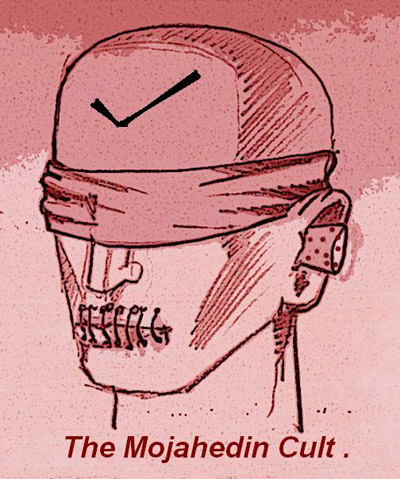
The cult of Rajavi

Cult-like characteristics

The State Department Office of the Coordinator for Counterterrorism on April 30 released the list of designated terrorist organizations. Once again Mujahedin-e Khalq Organization (MEK) continues to occupy the status it has been designated since 1997.in one part we read: "In addition to its terrorist credentials, the MEK has also displayed cult-like characteristics. Upon entry into the group, new members are indoctrinated in MEK ideology and revisionist Iranian history. Members are also required to undertake a vow of "eternal divorce" and participate in weekly "ideological cleansings" . children are reportedly separated from parents at a young age. "

Cult-like characteristics

May 16, 2007 0 comments
FacebookTwitterPinterestWhatsappTelegramSkypeEmail
Former members of the MEK

Mrs. Marzieh Qorsi joined her beloved son

Mrs. Marzieh Qorsi returned home and after a longtime of separation from her beloved son, saw him, embraced him warmly with tearful eyes.

Mrs. Marzieh Qorsi joined her beloved son

May 14, 2007 0 comments
FacebookTwitterPinterestWhatsappTelegramSkypeEmail
Mujahedin Khalq; A proxy force

America’s Covert Terror War Against Iran

The Bush Regime is sponsoring terrorist attacks as a means of ratcheting up its campaign of aggression against Iran  A US-backed militant  Pakistani Islamist group has carried out a string of terrorist attacks against Iranian targets The group known as Jundullah (Army of God), a Sunni militant organization made up of  members of the Baluchi tribe,  “has been secretly encouraged and advised by American officials since 2005” as it has carried out its deadly operations inside Iran  This US-backed terrorist group has close ties to both Al Qaeda and the Taliban, supposedly the principal enemies in Washington’s “global war on terrorism”

A leading government official in Teheran charged Thursday that the Bush Regime is sponsoring terrorist attacks as a means of ratcheting up its campaign of aggression against Iran.

The charge by the speaker of the Iranian parliament, Gholamali Haddadadel, followed a report by ABC News in the US that Washington has been covertly aiding and advising a militant Pakistani Islamist group that has carried out a string of terrorist attacks against Iranian targets.

“There is no doubt in our minds that the United States spares no efforts to put pressure on the Islamic Republic of Iraq,” Haddadadel told reporters following a meeting with Pakistani officials in Islamabad.

“The best indication of United States support to a particular terrorist group is that one of the leaders of his terrorist group was given the opportunity to speak on VoA [Voice of America] after committing the crime.”

In its report aired first on Tuesday night, ABC charged that a group known as Jundullah (Army of God), a Sunni militant organization made up of members of the Baluchi tribe, “has been secretly encouraged and advised by American officials since 2005” as it has carried out its deadly operations inside Iran.

According to numerous published reports, this US-backed terrorist group has close ties to both Al Qaeda and the Taliban, supposedly the principal enemies in Washington’s “global war on terrorism.”

The organization is also believed to be involved in narcotics trafficking across the porous Iranian-Pakistani border.

Jundullah’s attacks have centered on the Iranian province of Sistan-Baluchestan, which borders both Afghanistan and Pakistan. In February, Jundullah terrorists carried out a car bomb attack on a bus in the Iranian city of Zehedan, killing at least 11 Iranians, most of them apparently members of Iran’s Revolutionary Guard. Another 31 people were wounded in the blast.

Other bloody attacks included a May 2006 bombing of a motorcade, which claimed the lives of at least 20. The group has also filmed the beheadings of captured Iranian soldiers and officials.

According to the ABC report, Pakistani intelligence sources said that the covert terror campaign was a central topic of discussion when US Vice President Dick Cheney met Pakistan’s dictator, President Pervez Musharraf, in February.

When asked by the Reuters news agency about this account, a spokeswoman for Cheney replied, “We don’t discuss conversations between the vice president and foreign leaders.”

Haddadadel, who was in Islamabad in part to seek Pakistani cooperation in stemming the cross-border attacks, dismissed this aspect of the ABC report.

“Some of the militants…are active in our border areas and we should work with Pakistan in order to increase security cooperation,” he said.

“There is no news, no evidence, and we don’t have any reason to believe that the military establishment in Pakistan is also supporting such militant groups.”

ABC indicated that the US-sponsored terrorism is an “off-the-books” operation, which some officials told the network was reminiscent of the illegal covert US “contra” war against Nicaragua under the Reagan administration in the 1980s.

Money, according to ABC’s sources, is funneled through Iranian exile groups in Europe and elsewhere to Jundullah’s leader, Abd el Malik Regi. Counterrorism expert Alexis Debat told ABC that Regi “used to fight with the Taliban. He’s part drug smuggler, part Taliban, part Sunni activist.”

The purpose of this arrangement, US officials told the network is to avoid the necessity of “an official presidential order or ‘finding’ as well as congressional oversight.”

It is evident that the covert US links with Jundullah are only part of a broader destabilization campaign being waged by Washington with the aim of fomenting conflict between Iran’s Shia majority and a Sunni minority that accounts for nearly 12 percent of the country’s 70 million people.

The largest component of this Sunni population is made up of Kurds, followed by the Baluch and then the Turkoman, based in the northeast.

The CIA is also reportedly funding the Iran-based Kurdistan Free Life party to destabilize the Iranian government.

And Washington has come into conflict with the Iraqi regime over the presence in Iraq of some 3,800 expatriate Iranian members of the Mujahedin-e Khalq, or MEK, which has claimed responsibility for numerous terrorist attacks against Iran.

Even though the State Department has classified the MEK as a foreign terrorist organization, and the Iraqi regime accuses it of acting as an arm of the Saddam Hussein regime security forces, the Pentagon and CIA have provided it with protection at a base outside Baghdad and have reportedly sponsored its operations inside Iran.

Washington’s covert terror war against Iran is aimed at furthering a goal of “regime change” in Teheran. It is likewise designed to pave the way for a far more direct US military intervention.

As ABC aired its report of US-sponsored terrorism, a third US nuclear aircraft carrier battle group set sail for the Persian Gulf.

The USS Nimitz and its accompanying warships left San Diego on Monday, supposedly to relieve the USS Dwight D. Eisenhower.

The John C. Stennis Strike Group is also in the Gulf. Obviously, the Pentagon has the option of reversing the order to withdraw the Eisenhower, thereby concentrating unprecedented firepower against Iran.

The preparations for a US war against Iran are being carried out—with support from both Democrats and Republicans in Washington—under the same propaganda slogans used to justify the attack on Iraq: the threat from a supposed drive to build “weapons of mass destruction” and terrorist ties.

But, as the ABC report indicates, Washington itself appears to be pursuing its militarist policy by funding and advising a terrorist group connected to Al Qaeda, the organization blamed for the September 11, 2001, attacks. http://www.wsws.org/articles/2007/apr2007/iran-a06.shtml

The Best That’s Left  8 April 2007

May 14, 2007 0 comments
FacebookTwitterPinterestWhatsappTelegramSkypeEmail
Newer Posts
Older Posts

Recent Posts

  • The black box of the torture camps of the MEK

    December 24, 2025
  • Pregnancy was taboo in the MEK

    December 22, 2025
  • MEPs who lack awareness about the MEK’s nature

    December 20, 2025
  • Why did Massoud Rajavi enforce divorces in the MEK?

    December 15, 2025
  • Massoud Rajavi and widespread sexual abuse of female members

    December 10, 2025
  • Facebook
  • Twitter
  • Instagram
  • Youtube

© 2003 - 2025 NEJAT Society . All Rights Reserved. NejatNGO.org


Back To Top
Nejat Society
  • Home
  • Articles
  • Media
    • Cartoons
    • NewsPics
    • Photo Gallery
    • Videos
  • Publications
    • Books
    • Nejat NewsLetter
    • Pars Brief
  • About Us
  • Contact us
  • Editions
    • عربي
    • فارسی
    • Shqip