Nejat Society
  • Home
  • Articles
  • Media
    • Cartoons
    • NewsPics
    • Photo Gallery
    • Videos
  • Publications
    • Books
    • Nejat NewsLetter
    • Pars Brief
  • About Us
  • Contact us
  • Editions
    • عربي
    • فارسی
    • Shqip
Nejat Society
Nejat Society
  • Home
  • Articles
  • Media
    • Cartoons
    • NewsPics
    • Photo Gallery
    • Videos
  • Publications
    • Books
    • Nejat NewsLetter
    • Pars Brief
  • About Us
  • Contact us
  • Editions
    • عربي
    • فارسی
    • Shqip
© 2003 - 2024 NEJAT Society. nejatngo.org
Mujahedin Khalq; A proxy force

CIA Controls the Cult

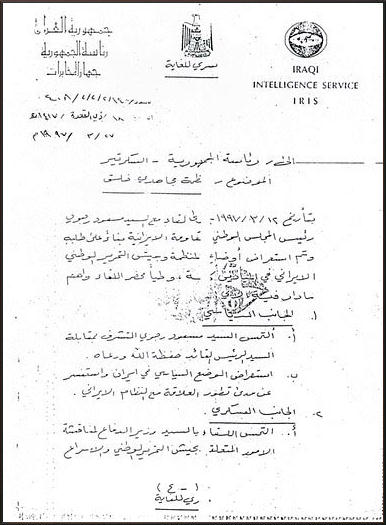
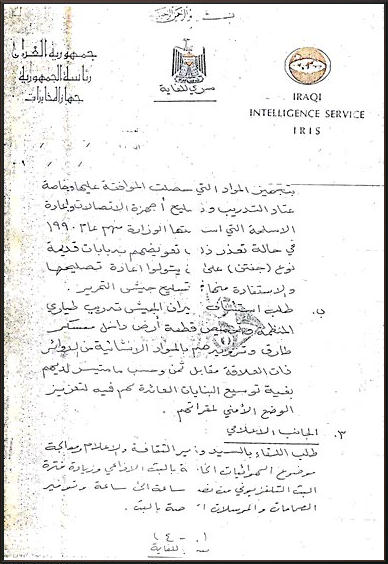
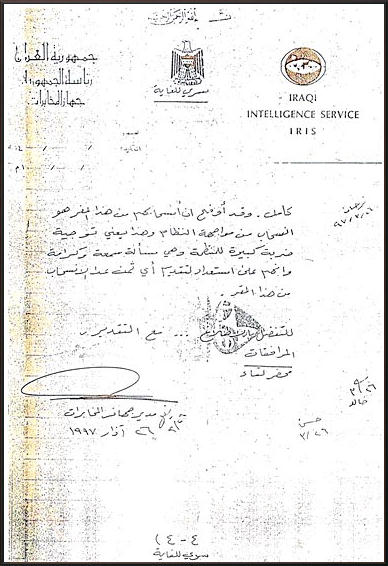
The issue of MKO’s presence in Iraq could be viewed from three different levels: 1. In an official level, disarming the MKO, detaining its members, and signing agreement with each and every one of Camp Ashraf residents (under the name of Geneva Convention) are of measures taken by the US to counter the pressures of Iraqi government to expel the group from Iraq; by such efforts, the US tries to convince the Iraqi government to agree with the temporary stay of the group in the country so that the final fate of the group could be determined. Although the Americans tried to prove their good will by paving the way for defecting members to get back to Iran by the Red Cross and also allowed the UNHCR to interview the members in the camp, Iraqi authorities are still opposing the presence of this group in Iraq. However, Iraqi officials prefer to solve their problems with Americans (including problems related to the MKO) through legal channels; they have repeatedly stressed that the presence of occupiers in Iraq has influenced diplomatic and legal issues of Iraq and that this is not what they want. 2. What is obvious (and is backed by the evidences presented during past 3 years) is that extremist warmongers and Zionist lobby in the US prevent the MKO’s dissolution and want it to be used. This request has failed due to the opposition of large part of US administration, the State Department in particular. So the "protected status", which means nothing except confusion and limbo for the MKO and suspension of warmongers’ plans, is related to the differences inside the US government. 3. But the main hand behind the issue is "CIA". By detaining Massoud Rajavi and declaring conditions for his freedom, CIA is trying to control the MKO and advance its own goals, which are mostly different from those of Pentagon and the State Department. For instance, it instructs the MKO to establish ties to Sunni tribes in Iraq in order to stay in that country. It appears that the MKO is told that by such move is influential in its efforts for staying in Iraq, but the truth lies beneath: by keeping them in Iraq, CIA advances its own intelligence purposes and at the same time increases the price of the group for possible deals with Iran. Also, to control the political atmosphere inside the US, CIA directs the propagandistic activities of the MKO in order to convince those politicians opposing the group that the MKO has been useful in Iraq. This can be proved with a brief look at MKO’s expensive ad in New York Times. On the other hand, this agency doesn’t allow the removal of the group’s name from terror list and prevents the warmongers and Zionist lobby from using this group because it’s fully aware of the failure of such plan due to the unpopularity of MKO inside Iran, group’s military weaknesses, and its bad record in military cooperation with Saddam Hussein. It’s amazing that when discussing the issue of supporting pro-democracy groups in Iran, CIA always introduces the MKO as an undemocratic group with cult-like structure. Creating such a balance allows the agency to advance its own goals and plans by the obedient members of the MKO.

Irandidban  –  2006/06/26

June 28, 2006 0 comments
FacebookTwitterPinterestWhatsappTelegramSkypeEmail
Ali Reza Jafarzade

Dissidents Seeking Help

Laura Rozen, a senior correspondent, in part of her Washington Post article Iran on the Potomac, described several Iranian dissidents who are pressing Washington, seeking help in fostering regime change back home. The only problem, as she says, is that the exiles can’t agree on a strategy. Among all the opposition, there can be found no equivalent to the Iraqi National Congress, and the exiles have yet to coalesce around a platform or leader.

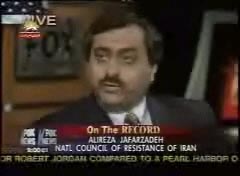
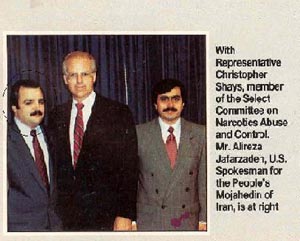
Mojahedin Khalq Organization, MKO, is one of the exile groups that has advocates in Congress in spite of being blacklisted as a Foreign Terrorist Organization. Talking of Alireza Jafarzadeh, Washington spokesman for the MKO, Rozen describes Jafarzadeh as ‘The militant voice’:

"Alireza Jafarzadeh , 49, is the longtime Washington spokesman for the National Council of the Resistance of Iran, the political wing of the Mujaheddin-e Khalq, an anti-regime militant group supported for years by Saddam Hussein. MEK has been on the State Department’s list of terrorist organizations since 1997. In 2002, Jafarzadeh and the group announced details of Iran’s previously unknown nuclear program. With NCRI’s Washington office shut down since 2003, Jafarzadeh has reinvented himself as an expert commentator on Iran’s nuclear program. The MEK is reviled by Iran but it has support from the Iran Policy Committee, a group of conservative retired U.S. military officers and Reagan-era officials, who say Washington should work with the MEK to overthrow the Tehran regime."

Washington Post, June 25, 2006

June 28, 2006 0 comments
FacebookTwitterPinterestWhatsappTelegramSkypeEmail
Human Rights Abuse in the MEK

Inside a group caught between three powers

Mujahideen-e Khalq, an Iraq-based group founded to fight Iran’s regime, may be expelled from its base this week.

TEHRAN, IRAN  The day Masumeh Roshan had been praying for finally came in late September, when the Iranian mother traveled to Iraq to visit her only son – a teenager she says was lured into ties with terrorism.

But the joyful reunion soon dissolved into tears at Ashraf Camp, where US troops are guarding some 3,800 militants of the Mujahideen-e Khalq Organization (MKO) – the only armed opposition to the ruling clerics of Iran.

Ms. Roshan’s militant son, they said, could not leave.

The case of those holed up in Camp Ashraf, near Baghdad, remains a quirky piece of unfinished business left over from the American campaign to oust Saddam Hussein. It continues to leave a trail of broken lives.

Officially, both the US and Iran label the MKO a terrorist group. The US-appointed Iraq Governing Council concurs: Citing the "black history of this terrorist organization" and its years of working closely with Mr. Hussein, it has ordered the expulsion of the MKO from Iraq by the end of this year.

But the MKO’s fate is unclear. While the Iraqis want it disbanded, the politically savvy group still has support among some congressmen and Pentagon officials, who see it as a potential tool against Iran, a country which President Bush calls part of an "axis of evil."

Some MKO tips have led to recent revelations about key aspects of Iran’s clandestine nuclear program, though many others have proven unreliable. Long a diplomatic hot potato – which Tehran has offered to solve, by exchanging MKO militants for Al Qaeda players now in Iran – the MKO continues to complicate US-Iran-Iraq relations.

Lives on the line

But for those rank-and-file members trying to escape MKO control, resolving the status issue is an urgent need. Ms. Roshan says she hardly recognized the gaunt visage of her 17-year-old boy, Majid Amini, at Ashraf Camp.

"He pulled my ear to his lips, and said: ‘Don’t cry; be sure that I will come with you. I can’t stay here; they are not human beings,’ " Roshan recalls, trying to control her trembling voice.

But Mr. Amini – a Karate kid with an orange belt, who his parents say was recruited to join the MKO in Tehran with promises of completing two school grades in one year and gaining a place in college – was forced to remain behind.

"He took his uniform off, stamped on it, and shouted: ‘I can’t go back! My life will be in danger!’ " Roshan recalls during an interview in Tehran. MKO officers and US troops insisted the young man stay, and Roshan climbed alone onto the bus home. "I was like a dead person," she says.

The voices of former MKO militants give a rare glimpse inside a group they say demands a cult-like control over members, practices Mao-style self-denunciations, and requires worship of husband-and-wife leaders Massoud and Maryam Rajavi.

Recruited from the United States and Europe, or even drawn directly from Iranians held in Iraqi prisoner-of-war camps and jails, the former fighters describe a high level of fear, and speak of their own awakening – and freedom from the MKO’s grip – as if it’s an epiphany.

The US State Department lists the MKO as a terrorist group that conducted assassinations against American citizens in the 1970s – and was behind bombings and killings of hundreds of members of the Iranian regime starting in the early 1980s.

By one count, after the recent invasion of Iraq, the MKO surrendered to US troops 300 tanks, 250 armored personnel carriers, 250 artillery pieces, and 10,000 small arms. Still, the group is reported to be able to continue antiregime broadcasts into Iran.


The Pentagon – after bombing MKO camps in Iraq in the first stages of the invasion – quickly worked out a truce with the group some civilian hawks in the Pentagon believe should be supported and turned into a US tool of opposition against the Islamic Republic of Iran.

Militants who were once ready to die for the MKO, however, now have some advice for those who may want to apply the Afghan model to Iran by using the Mujahideen in the same way the Northern Alliance was used against the Taliban.

"I don’t think the US can take advantage of this group," says Arash Sametipour, a former MKO militant recruited in the US. He survived his own attempts to kill himself with cyanide capsules and a hand grenade that blew away his right hand after botching an assassination attempt in Tehran in early 2000.

"When we were on clean-up duty [at Ashraf Camp], at 7 a.m. they played songs with words like ‘At the end of the street, the Mujahideen is waiting – Yankee get out!’ " recalls Mr. Sametipour, who speaks rapid-fire English with an American accent. He remains in prison in Iran, where he was made available at the request of the Monitor. "This organization does not like the US. It is a mixture of Mao and Marxism, and [leader Massoud] Rajavi acts like Stalin."

Ostensibly under US guard, the MKO still keeps its small arms. US officials said in November they were being screened for war crimes and terrorism. The Pentagon denies reports that the militants are able to freely roam or conduct attacks.

MKO representatives could not be contacted for further comment. Both office and cellphone lines in Washington have been disconnected. The MKO office in Paris was unable to provide contact details for two senior officials it said were traveling in Europe.

Western diplomats and analysts agree that the MKO has very little support inside Iran itself. Though many Iranians take issue with their clerical rulers, MKO members are widely seen to be traitors, as they fought alongside Iraqi troops against Iran in the 1980s.

Most Iraqis, too, have little time for the MKO, which helped Hussein’s security forces brutally put down the Kurdish uprising after the Gulf War in 1991, and helped Baghdad quell Shiite unrest in 1999. The group, however, said in a Dec. 11 statement that "throughout its 17 years in Iraq," it had "never" interfered in Iraq’s internal affairs.

Last summer, the US State Department outlawed several MKO-affiliated groups in the US. In June, France arrested 150 activists, including self-declared "president-elect" Maryam Rajavi.

The crackdowns sparked some to publicly commit suicide by setting themselves alight – a type of protest that some suggest could be repeated if the MKO is forced out of Iraq.

Within days of the expulsion order, lawyers for the MKO – arguing that expulsion would violate the laws of war – are reported to have sent letters to Defense Secretary Donald Rumsfeld and others, asking the Pentagon to overrule the move.

A senior Pentagon official told the Monitor Tuesday that the US was exploring the option of sending former MKO members to a country other than Iran.

"They ought to be vetted," he said, "and anyone who is a criminal deserves to be punished somehow. [But] they don’t have to go back [to Iran]. If they are not guilty of crimes there are various places they could go."

"Scott Peterson is the Staff writer of The Christian Science Monitor"

June 26, 2006 0 comments
FacebookTwitterPinterestWhatsappTelegramSkypeEmail
Duplicity of the MEK nature

Fanatic Friends, MKO tricks US progressives, gains legitimacy

On May 26, 2006, a representative of the violent Iranian fugitives based in Iraq, known as MKO, addressed a forum – an anti-war forum – sponsored by the liberal Fellowship of Unitarian Universalists in Berkeley, California, as he had done the year before. Introduced as Ali Mirardal, the speaker lamented human rights abuses in Iran and offered the National Council of Resistance, a Paris-based front group for MKO, as the best hope for a democratic Iran. The US state Department has listed both as terrorist organizations.

In Iran, where the militia has been known since its inception in 1965 as Mojahedin, or jihadists, MKO lost all credibility after it became a proxy of Iran’s archenemy, Saddam Hussein, in 1986. Anne Singleton, a former insider and now an advocate for penitent MKO activists in Europe, has labelled the militia "Saddam’s private army" in her book-length memoirs by the same title.

A day before the Berkeley forum took place, the far-right daily “Washington Times” was busy promoting MKO’s annual convention in the US capital. Perhaps you remember a similar cosy relationship the Moonie newspaper had with Nicaragua’s contra mercenaries and with UNITA, the rebel army that terrorized Namibia on behalf of the Reagan Administration and apartheid South Africa. A Reagan-era Pentagon official and leading architect of the Iraq invasion, Richard Perle, was the keynote speaker at MKO’s 2004 convention.

Everything Unitarian Universalists stand for is contradicted by these and other MKO affiliations. Neil Livingstone, an ally of Pentagon’s Iraqi co-conspirator Ahmad Chalabi and a frequent commentator on Fox News television, is a regular speaker at MKO’s Washington rallies. So is the Colorado Congressman Tom Tancredo, an immigrant basher who has advocated bombing Mecca and other Muslim holy sites (See DailyKos).

Like Perle, Livingstone, and Tancredo, MKO’s other leading defender, Raymond Tanter, introducing himself as a professor at Georgetown University, where he teaches part-time, is affiliated with the Israel lobby (See: sourcewatch.org.

These pro-MKO "national security experts" are core members of the unilateralist Washington elite that sabotages peace in Palestine/Israel, promotes the "liberation" of Iraq, and aggressively pushes confrontation with Iran. The four have personally cheered on the faithful at MKO’s Washington rallies and urged the State Department to remove the militia from its list of terrorist organizations.

Returning the favour, several MKO publicists participate in Washington gatherings of Middle Eastern regime-change conspirators. At the October, 2004 Middle Eastern American Convention for Freedom and Democracy (See: defenddemocracy.org), MKO activists rubbed shoulders with George Bush fundraisers representing such extremist movements as the "Lebanese Forces", the far-right Phalange militia that carried out the 1982 massacres at Beirut’s Sabra and Shatila camps. A key organizer of the conference was MKO defender and former staff publicist at the Israeli embassy, Nir Boms.

A year earlier, the State Department, a known irritant to neoconservatives like Boms, had expanded its 1997 designation of MKO as a terrorist organization to include the National Council of Resistance (See: state.gov). The NCR filed suit and mobilized its friends in Congress, but could not have the infamy reversed. (Canada and the European Union have also officially labelled MKO a "terrorist" organization.) As a last resort, US-based MKO publicists and fundraisers have activated a web of local Iranian American front groups that infiltrate mainstream organizations to build grassroots support against their terrorist "listing".

The function of the "dissident" groups is to exaggerate Iran’s human rights record for consumption by liberal Americans and to fabricate a doomsday scenario of Iran’s nuclear program to impress the rest of public opinion. In this role they follow, of course, a trail well-trodden by defectors from other "enemy" states, most notably during the Cold War. The group that was invited to address Berkeley’s liberal community on May 26, the so-called Iranian American Community of Northern California, is MKO’s front organization in the Bay Area.

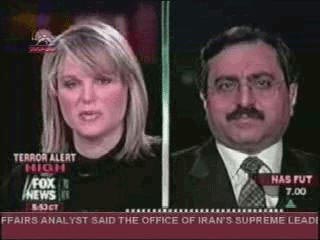
While MKO activists feign humanistic values before mainstream audiences, they work closely with some of the extremist Washington circles that push for pre-emptive US confrontation with Iran. (Other American unilateralist think tanks prefer to support the rival monarchist Iranian groups here.) For example, the Iranian "security expert" who regularly warns us about Iranian fundamentalism on Fox News television, Alireza Jafarzadeh, is none other than the terror group’s former registered Washington representative.

Jafarzadeh’s office at the National Press building, located two blocks from the White House, was shut down in 2003 (See: rightweb.irc-online.org) on orders from the then-secretary of state Colin Powell. When confronted by other Iranian expatriates, MKO activists rarely deny the militia’s collaboration with the Washington hawks and Israel partisans. Rather, they insist that the necessity of a coup in Iran justifies any and all shortcuts to victory.

Although it is hard to fathom, MKO’s front groups have a superficial anti-war line, one that Berkeley’s progressive radio KPFA (a Pacifica station) swallowed whole in 2005. It goes like this: "We are against foreign intervention and ask for no help from Western powers.

The MKO was armed and funded by Saddam Hussein from 1986 to 2003 for its bloody cross-border terror campaign to overthrow Iran’s government.

However, the beleaguered people of Iran – whom MKO represents – just want the US government to stop appeasing the mullahs so MKO can free Iranians from tyranny. How can the American public help liberate Iranians peacefully and save civilization from the Iranian nuclear threat, too? Why, of course, they should push the State Department to remove the "terrorist" label from MKO" . But although it presents itself as an antiwar, pro-human rights organization, not a single MKO or National Council of Resistance statement has condemned US actions in Iraq. Instead, the militia’s criticism is reserved for observers who question its sincerity.

KPFA reporter, Joshua Smith, interviewed MKO demonstrators about their demands last July, but did not ask what legitimate connection there could be between MKO’s status in the US and its ability to liberate Iranians. After all, MKO claims at every available opportunity that it relies entirely on its boundless popularity in Iran and therefore needs no foreign sponsor. Could it be that the key to democracy in Iran is more aggressive MKO fundraising in the US — not practical unless the militia shakes off the "terrorist" label – and expanded campaign contributions to American lawmakers?

Would legitimizing MKO not help make the militia the bargaining chip against Iran that many Western politicians say they need? KPFA did not probe. Nor did the Unitarian Universalists of Berkeley. But what brought together their progressive church and the so-called Iranian American Community of Northern California was not a case of "politics makes strange bedfellows".

Rather, the Fellowship fell for MKO’s "nonviolent change by the people" PR, devised for non-Iranian consumption. (Until MKO lost its Iraqi sponsor in 2003, its Farsi-language satellite television and literature proudly marketed MKO as an aggressive "national liberation army" with ample photos of its Saddam-supplied heavy armour and uniformed fighters in military formation. The militia’s highly secretive, regimented hierarchy is also well-known among Iranians.) This bait-and-switch strategy has succeeded in blunting the Western public’s awareness of MKO, as the militia’s activists approach liberal and humanist opinion-makers in the US, Canada, and Europe through an elaborate network of "dissident" groups.

In 2000 the 100,000-member Feminist Majority Foundation co-sponsored a Washington rally against Afghanistan’s Taleban fundamentalists with the so-called National Committee of Women for a Democratic Iran. A quick web search leaves little doubt that the sole purpose of "National Committee" was then and still is to promote MKO. More recently Ron Jacobs, whose political commentaries appear regularly on left-of-center websites, described MKO as "a humane alternative to both Tehran and Washington" who’s religious "approach is no different than that of liberal Christian and Jewish denominations" (See: counterpunch.org).

MKO’s incessant PR campaign has taken on added urgency with the growing pressure on the US military to withdraw from Iraq, a prospect that would put MKO at the mercy of either international aid organizations or MKO’s former victims who now govern Iraq. So when extensive research led Human Rights Watch to denounce the militia in 2005 as a cult that mistreats its members (See: hrw.org), MKO hit back with a costly campaign of press conferences, interviews, "witness" testimonies, and published rebuttals on both sides of the Atlantic to discredit the report. As they always do against their critics, MKO publicists charged that Human Rights Watch was influenced by agents of Iran’s government . One is left with the feeling that the militia’s campaign to spread "tolerance", like that of neoconservatives, is aimed against its intolerant critics like HRW only.

Fanatic Friends in High Places

Also known as Mojahedin (or Mujahedin), MKO, and PMOI, the militia was armed and funded by Saddam Hussein from 1986 to 2003 for its bloody cross-border terror campaign to overthrow Iran’s government. MKO activists also violently overran a dozen Iranian consulates worldwide in 1992.

Since the US invaded Iraq and placed the fighters (reportedly numbering 3,800) in protective custody (See: abc.net), a number of pre-emptive warriors in Washington have suggested using them to destabilize Iran (See: Newsweek). To slow down this cabal, Congressman Dennis Kucinich has demanded that the White House explain the Pentagon’s rumoured recruitment of MKO mercenaries (See: commondreams.org). American backers of other Iranian defectors have similarly denounced MKO’s influence in Washington (See: rightweb.irc-online.org).

Rejected widely in Iran for treason and in Iraq for participating in Saddam’s atrocities, MKO must rely on Pentagon’s regime-change hawks to survive and continue its 25-year campaign to unseat Iran’s government (See: New York Times). The fighters’ number one priority now, as their numerous websites attest, is to be recognized in the West as the one and only "anti-fundamentalist" safe option for Iran (See: hillnews.com). Their propaganda has, therefore, focused entirely on frightening Western public opinion about Iran, as their neoconservative allies do (See: payvand.com).

Berkeley’s Unitarian Universalists could have availed themselves of this information before they invited the so-called Iranian American Community of Northern California to their forum. IACNC richly promoted MKO as the sole democratic alternative to the Iranian government (See: iacnc.com) at the church last year, too. The Fellowship could also have known what kind of friends MKO has in high places. Investigative journalist Laura Rozen reported in 2005 that former Congressman Dick Armey – a confidante of President Bush – vouched for MKO when the militia needed help to recruit certain high profile American speakers (See: warandpiece.com) for its convention.

At the 2005 convention, held three blocks from the White House, "The crowd gave rapturous applause to words of support from Republican Senators Kay Hutchinson from Texas and James Talent from Missouri," reported an official MKO website, referring to the conservative senators’ solidarity messages read by staffers .

The notorious John Ashcroft did not mind backing the mercenaries, either. According to Newsweek, "When Mahnaz Samadi, one of [MKO’s] spokeswomen, was detained by U.S. immigration authorities in early 2000 on grounds that she did not disclose her past “terrorist” ties, including her role as a ‘military commander’ for the MKO, John Ashcroft, then a senator, wrote a letter of ‘concern’ to Attorney General Janet Reno… . Ashcroft described Samadi as a ‘highly regarded human-rights activist’ and a ‘powerful voice for democracy’” (See: truthout.org).

Added Newsweek, "When the National Council of Resistance staged a September 2000 rally outside the United Nations to protest a speech by Iranian President Mohammed Khatami, Missouri’s two Republican senators–Ashcroft and Chris Bond–issued a joint statement of solidarity that was read aloud to a cheering crowd… .and a picture of a smiling Ashcroft was later included in a colour briefing book used by MKO officials to promote their cause on Capitol Hill."

On the House side, Representative Ileana Ros-Lehtinen of Miami, is MKO’s leading supporter (See: hillnews.com), as a full-page MKO ad in the New York Times made clear on January 15, 2003. She is a member of the Committee on International Relations and considered a leading contender for its chairmanship after this year’s elections. Re-elected continuously since 1988 with the help of south Florida’s powerful Cuban and Zionist extremists, she is known for authoring or co-sponsoring all legislation that promote sanctions or regime change against Syria, Iran, Cuba, and lately Venezuela.

This is how former US diplomat Wayne Smith describes Ros-Lehtinen’s fondness for friendly terrorists (See: ciponline.org):

… on June 15 [2005] Venezuela again formally asked the U.S. government to extradite [self-described serial bomber Luis Posada] to Venezuela…. . And how did Posada get out of prison in Panama and return to Miami? Why, because U.S. Rep. Ileana Ros-Lehtinen and her two congressional colleagues, Lincoln and Mario Díaz Balart, wrote to then-President Mireya Moscoso requesting that she pardon him …. .

Nor was this the first time Ros-Lehtinen had acted to free terrorists. [Orlando] Bosch, also accused of being a mastermind of the 1976 Cubana airliner bombing, was released from Venezuelan prison under mysterious circumstances in 1987 and returned to Miami without a visa in 1988… .Urged on by Ileana Ros-Lehtinen and Jeb Bush – then managing her election campaign – the administration of George H.W. Bush approved a pardon for Bosch, who has lived freely ever since in Miami.

iranian.com –  By Rostam Pourzal  –  June 23, 2006

June 25, 2006 0 comments
FacebookTwitterPinterestWhatsappTelegramSkypeEmail
Iraq

MKO and Dyala province security issues

Regarding the position of Dyala province in Iraq’s developments, one can understand why Saddam Hussein settled the MKO in this province.

One of the advantages of this province is that it houses Baath forces and pro-Saddam tribes who also work as a protective circle around MKO.

This advantage has been maintained and that’s why terrorists’ headquarters, and even the shelter of Zarqawi, is located in this province.

Hebheb region, where Zarqawi lived, is one of Baqubah districts next to Camp Ashraf. MKO was in touch with this region, and kept the contact even after the fall of Saddam Hussein.

After the ouster of Saddam, this region witnesses several events, the reason of which can be understood now.

After an increase in insurgency, Iraqi intelligence services and interior ministry focused on Diyala and Baqubah in particular. This focus was suspicious since most of insurgency took place in Fallujah and Al-Ramadi. However, Iraqi officials were looking for the roots of the problems in this region due to the intelligence.

This emphasis was so strong that even an analyst said he believed that pro-Iran Shiite forces were active in the region because of the presence of MKO in the same region!

On the other hand, influential figures from SCIRI, Interior Ministry and other units were assassinated in this province so that the intelligence war between Iraqi officials and Al-Qaeda members overtook military war.

Anyway, directing the US forces towards the shelter of Zarqawi and killing him, which was the result of months of intelligence operations, clarified many issues.

In this regard, Mojahedin-e khalq repeatedly tried to disrupt the operations of Interior Ministry in the province.

Once (in 2005), Mojahedin prepared a bulletin about the intelligence operations of Interior Ministry in Iraq and exposed all intelligence efforts for tracking Al-Qaeda members in Dyala only with this excuse that they considered these operations as threat for their organization!

They even went further and proposed the formation of a special security unit to control the province!

It’s notable that the brutal gang of Al-Qaeda, who kills everyone- from men and women, kids and … to Iraqi and non-Iraqi reporters and even the workers of Camp Ashraf (only because they were being escorted by coalition forces) – has done nothing against the residents of Camp Ashraf or the guards who protect it!

Zarqawi appreciated MKO officials for their efforts against Shiites and the forces of interior ministry and considered them as a potential army in the war against Iran; he conveyed satisfaction from MKO through Baathists.

Irandidban, June 19, 2006

June 25, 2006 0 comments
FacebookTwitterPinterestWhatsappTelegramSkypeEmail
The cult of Rajavi

The Decreed Self-Immolations

On 18 June 2003, following Maryam Rajavi’s arrest in France, a number of Mojahedin’s sympathizers, reported 20, committed self-immolations in streets of Paris and other Western cities to obtain her liberation. Commonly believed, these acts of self-burning were organizationally preset acts of dissent dictated to the members who practiced them. The organization, however, insists to hail them as heroic, spontaneous acts done by some sympathizers.

Pay attention that Mojahedin had videotaped all scenes of the self-immolations, implying it is impossible to be in the right place at the right time unless you were prepared and informed beforehand. The acts of self-burnings had to be stopped somewhere, and that justifies Maryam Rajavi’s call from prison on members to refrain from self-immolation. But the call came after two innocent women, Sediqeh Mojaveri and Neda Hassani, died of the burn injuries.

In a Mojahedin’s TV program on the anniversary of the self-immolations, Ali Hassani, Neda Hassani’s brother, described his sister’s self-immolation before the French Embassy in London based on completely videotaped scenes. His words prove the fact that none of these fiery protests had been done deliberately; the innocent practitioners were set on fire to fulfill a decreed mission.

June 25, 2006 0 comments
FacebookTwitterPinterestWhatsappTelegramSkypeEmail
USA

Funding regime change

TEHRAN – Washington’s latest policy of putting more pressure on Iran through securing additional funding for "democracy-promoting" activities inside Iran has been greeted with official and popular rejection, even open derision, in Tehran.

"I think the Americans have no idea of what they’re talking about," said Mamak Nourbaksh, a teacher of English literature. "No one is going to touch them [the funds], no one will work with them."

Secretary of State Condoleezza Rice’s request for extra funds marks a nearly eightfold increase in the US government’s current expenditure on Iran and signals the beginning of a new period of concerted diplomatic pressure by the United States against Iran, a country that President George W Bush included in his infamous "axis of evil" speech in 2002.

In seeking an additional US$75 million from the US Congress to fund Iranian non-governmental organizations (NGOs) that promote democracy, human rights and trade unionism, Rice is broadening the range of non-military options at Washington’s disposal to weaken from within Tehran’s clerical regime.

Of the new outlay, $50 million will go toward Farsi radio broadcasts; another $15 million is earmarked for increasing participation in the political process, including measures such as expanded Internet access. The Bush administration hopes to spend $5 million to fund scholarships and fellowships for young Iranians, and the State Department said $5 million "would go to public diplomacy efforts aimed at Iran, including its Persian-language website".

"The United States will actively confront the aggressive policies of the Iranian regime," Rice said. "At the same time, we will work to support the aspirations of the Iranian people for freedom and democracy in their country."

Such pronouncements are greeted with open skepticism by ordinary Iranians who have seen the infrastructure of neighboring Iraq and Afghanistan sustain significant blows by US invasions, after which they have lagged far behind the touted recovery schedules. Iranians also have not forgotten the support offered by Washington to their arch-enemy Saddam Hussein in the Iran-Iraq War of the 1980s.

One of the militantly anti-clerical-regime groups that could stand to benefit from the new windfall is the Mujahideen-e-Khalq (MEK), a Marxist-Islamist organization that is hated within Iran because it sided with the Iraqi dictator against Iran during the eight-year Iran-Iraq War.

The MEK has been registered by the State Department as a terrorist organization for the past 10 years, but now neo-conservative factions of the Bush administration are lobbying hard to remove it from the list. Should the MEK end up benefiting from US pro-democracy largesse, it would send a clear message to people inside Iran that Washington funds groups that engage in terrorist activity. Some reports quote unidentified US officials as saying that the MEK would not receive any of the new funds.

"Most of the groups which will be suckling from this new taxpayer teat include designated terrorist organizations such as the MEK and ancien regime agonists, all with their own agendas which are not limited to outreach to Iranians, as these groups have little if any traction or credibility in Iran today," said Donald Weadon, an international lawyer specializing in Iran.

As much as $50 million of the planned allocation is directed at media planning, with the stated intention of extending the government-run Voice of America’s Farsi service from a few hours a day to around-the-clock coverage. But the idea that Iranians would turn more pro-US if only they had access to free media belies the reality that, unlike Saddam-era Iraq, in Iran the people already have relatively unrestricted access to satellite stations and news on the Internet.

"If the Danish cartoons and most recent Abu Ghraib pictures are timed to promote another war in the Mideast and inculcate the ‘clash of civilizations’ mindset in the public," said Cyrus Safdari, an independent Iranian analyst, "then Madame Rice has a really bad sense of timing in seeking to ‘reach out to the people of Iran’ – who don’t need $75 million to watch … ‘a few bad apples’ from the US torturing people in Abu Ghraib."

Nevertheless, the announcement comes at a time when an increasing amount of evidence points toward the fact that the Iranian government is cracking down on access to information. The British Broadcasting Corp’s popular Persian-language service has been blocked after the Iranian government accused the British Foreign Ministry-funded medium of being anti-Iranian. And many Farsi dailies have switched to a more nationalistic, less critical coverage of the government after the Danish-cartoon protests and the concomitant polarization.

"If the money goes to improve and expand VOA’s Persian service, this would also be money well spent," said Professor William Beeman, an Iran specialist at Brown University. "However, Sam Brownback’s $3 million [1] appears to have been sucked up by private parties with no possibility of public oversight.

"As a taxpayer, I would certainly object to more money being spent in this way – particularly if it goes to private commercial broadcasters where there is no open accountability as to operational activities or content. This would be a deeply irresponsible use of US public funds," Beeman said.

The US has a history of covert operations aimed at destabilizing the Tehran regime that went awry. In 1980, eight US commandos were killed at the beginning of an operation to rescue American diplomatic hostages held by the new revolutionary regime in the US Embassy in Tehran. After a US airplane and helicopter crashed, it was decided to call off the mission, but not before holding hostage for three hours 44 Iranians whose bus had stumbled on the scene.

More recently, in 1996, an $18 million covert action aimed at unseating the government of then-president Hashemi Rafsanjani had its secret cover blown even before it started. Washington insiders, concerned at the potentially disastrous effects it would have, leaked the story to the mainstream press, prompting a furious backlash from the authorities in Tehran, which authorized a $20 million counteroffensive.

Washington’s new initiative might end up backfiring and contribute to the further stifling of civil society in Iran, if experience can be trusted. NGOs are regarded suspiciously by the Iranian government and are often accused of being agents of foreign influence.

Rice failed to make clear how the funds would be disbursed to groups inside Iran, given that Washington has lacked a direct diplomatic presence in Tehran for the past 26 years.

Some American analysts have also reacted with skepticism at the initiative, pointing out that it may be a case of too little too late. "One suspects there are no shortage of potential Iranian Chalabis [2] ready to set themselves up in a nice apartment in London’s West End with some copiers and fax machines and the requisite bank accounts to reap the windfall," said James Russell, a senior lecturer at the Naval Postgraduate School’s department of national security affairs.

Despite other secret efforts the US Central Intelligence Agency has mounted in recent years, including a $2 million campaign in 1995 based largely on radio broadcasts denouncing the clerical regime, the CIA’s analysts see little hope of creating a new generation of pro-Washington leaders for Iran.

Notes

1. Senator Sam Brownback, as chairman of a US Senate Foreign Relations subcommittee, successfully campaigned for a $3 million appropriation for 2005, mandated by Congress, to help pro-democracy activists inside Iran. This was in addition to the approximately $10 million annually allocated for such activities.

2. Ahmad Chalabi, an Iraqi exile, received millions of dollars from the US while being courted as a possible successor to Saddam Hussein.

Iason Athanasiadis is an Iran-based correspondent.

By Iason Athanasiadis –  Asia Times  – Feb 18, 2006

June 22, 2006 0 comments
FacebookTwitterPinterestWhatsappTelegramSkypeEmail
Mujahedin Khalq as an Opposition Group

How Iran’s expatriates are gaming the nuclear threat

EXILES

In the spring of 2003, another Iranian opposition group, the Mujahideen-e Khalq (people’s Mujahideen), or M.E.K, was also trying to exploit the opportunity created by the overthrow of Saddam Hussein. Its situation was more complicated, as its forces were based in Iraq and Saddam had been its financial backer and protector, but this was not the first time that the M.E.K had turned adversity to its advantage. Founded in the mid-nineteensixties by middle-class students at Tehran University opposed to the Shah, it has shifted from an eclectic mixture ofIslamism and Marxism to anti-imperialism, and, finally, to its latest incarnation, which espouses democracy, freedom, and women’s rights. Like the monarchists, the M.E.K’s leaders claim that theywill bring a pluralistic democracy to Iran that will be fuendly to the West.

Just before the Shah was deposed, Massoud Rajavi, who as a politicalscience student at T ehran University had been part of the group’s governing committee, was freed from prison and assumed its leadership. Although at first Rajavi seemed a potential Khomeini ally, by 1980 he and the Ayatollah were enemies. (M.E.K members were prevented, through electoral fraud, from winning seats in the parliament, and Khomeini banned Rajavi from appearing on the ballot as a Presidential candidate.) In an effort to launch another revolution, Rajavi mobilized the M.E.K against the regime. In mass demonstrations in June, 1981, scores of people were killed or arrested and later executed. Rajavi escaped to Paris. The regime continued to target the M.E.K, carrying out hundreds of executions a month, and, with Rajavi calling for "revolutionary justice," the M.E.K, in turn, assassinated hundreds of regime officials, clerics, and judges, ‘often through suicide bomb attacks.

In Paris, Rajavi formed the National Council of Resistance of Iran, which initially was a genuine "council," including other opposition groups in addition to the M.E.K., but the other groups subsequently dropped out. Rajavi’s style of leadership was autocratic from the start, but by the mid-eighties the signs of a personality cult were unmistakable. According to Ervand Abrahamian, in his authoritative book, ”The Iranian Mojahedin," M.E.K members, especially in Westem Europe, lived in communes, and each member had a supervisor, to whom he or she had to recount, hour by hour, the day’s activities, which ended with a prayer and the chant "Greetings to Rajavi." Members had to surrender all their financial assets. Reading non-M.E.K. newspapers was prohibited, and self-criticism was obligatory. Those who wanted to marry had to obtain permission from the organization, which often provided a spouse as well. ”In short, the Mojahedin had metamorphized from a mass movement into an inwardlooking sect in many ways similar to religious cults found the world over," Abrahamian wrote. This transition was epitomized by Rajavi’s involvement, in 1985, with Maryam Azodanlu. Maryam was already married, to Mehdi Abrishamchi, one of Rajavi’s close associates. Rajavi overcame that fact by making the romance a matter of revolutionary necessity. FIrst, he said that he was making Maryam his co-Ieader-and that it would transform thinking about the role of women throughout the Muslim world. Then, about a month later, it was announced that Maryam was divorced from Abrishamchi and that the two co-leaders would marry, in order to further the "ideological revolution." The announcement implicitly compared the marriage to one of the Prophet Muhammad’s.

In 1986, the French government, eager to improve Franco-Iranian relations, yielded to demands from the Islamic Republic and expelled Rajavi and many of his followers. Rajavi went to Iraq, where he created the National Liberation Army of Iran, with about seven thousand M.E.K. troops. The M.E.K. established communes, training camps, clinics, schools, and prisons. In the ongoing Iran-Iraq war, the M.E.K. provided Saddam with intelligence on specific targets in Iran, and received arms, funds, and protection. (For this collaboration, above all, the M.E.K. is despised in Iran; several hundred thousand Iranians died in the war. "It is one of the issues where the Islamic regime and the people agree," Mshin Molavi, the Iranian journalist, said. "Language is really important in Iran. For the U.S., the government says ‘Global Arrogance "-the term has largely supplanted the familiar "Great Satan"- "but the people say ‘Americans.’ The government refers to the M.E.K. as monafeqin, which means hypocrite; it’s a very loaded term, meaning almost a kind of blasphemy. And the people, too, casually say, ‘Those monafeqin.’ ") .

In Iraq, M.E.K. fighters (many of them women) lived in military camps where vows of celibacy were mandatory, dissent suppressed, and any contact with outsiders strictly monitored. According to former M.E.K. members, some of their comrades who decided that they wanted to leave the M.E.K. camps were imprisoned or killed. The system of indoctrination, however, appears quite effective. When, in June, 2003, Maryam was arrested and imprisoned in France, several of her followers in Europe immolated themselves. Today, images of Maryam and Massoud Rajavi gaze out from walls in M.E.K. offices and barracks in Iraq, and adorn placards and T-shirts at M.E.K. demonstrations (as, for example, at the United Nations last September, where M.E.K. members protested against President Ahmadinejad, who was addressing the General Assembly).

As the best-funded and best-organized Iranian opposition group, the M.E.K. has a highly sophisticated and successful propaganda machine. A1i Safavi, a deft, smooth-talking Iranian émigré, acts as a spokesman for the N.C.RI., the M.E.K’s political wing. "For years, the Saudi lobbying machine in Washington was put to use by the M.E.K," Vall Nasr, the Naval Postgraduate School professor, told me. "Reza Pahlavi and other exiles were envious of the contacts A1i Safavi had." Despite the fact that the M.E.K has been on the list of Foreign Terrorist Organizations since 1997, the group has many supporters in Congress, including Representative lleana Ros- Lehtinen, a Florida Republican, who noted in April, 2003, that "this group loves the United States. They re assisting us in the war on terrorism-theyre pro-U.S."

In the weeks before and after the invasion of Iraq, American and Iranian officials held talks; as with the U.S.-led invasion of Mghanistan, there were common interests. The Americans were planning to remove Saddam Hussein, and to establish a democratic Iraq in which the long-oppressed Shiite majority would gain greater political power. The Iranians, as Shiites, heartily approved both measures. A Shiite-dominated government in Iraq would at least be friendly, if not an Iranian proxy. Iran, therefore, not only would not cause trouble for the U.S. invasion but would offer assistance in the early reconstruction period. In the course of the talks, however, the Iranians asked for assurances that U.S. forces would treat the M.E.K. members, most of whom were in a facility called Camp Ashraf, near Iraq’s border with Iran, as a hostile, Saddam backed force. An Iranian official told me that ultimately such assurance was given.

A military officer who was monitoring intelligence and communications £rom American troops as they approached Camp Ashraf, where some four or five thousand M.E.K. fighters were living, told me, "They were clearly a target. We viewed them as a possible ally of Sad dam. But, once our folks rolled up on the camp, it was Wait a minute, were going to hold up and talk’" A ceasefire was negotiated.

In the Bush Administration, the usual factional conflict now erupted over the question of what should be done with the M.E.K. At the State Department, Richard Armitage said, "Some of us were arguing that they should be disarmed

they’re a terrorist organization. And the Pentagon was arguing, Maybe we can use them in Iran. And Dr. Rice"-Condoleezza Rice, then the national-security adviser-"I heard her say one time, ‘Look, a terrorist group is a terrorist group.’ "

In the end, the M.E.K. fighters were largely disarmed, and were restricted to Camp Ashraf, under U.S. control; then, suddenly, they became a bargaining chip. On May 12, 2003, three truck bombs were detonated in Western housing complexes in Saudi Arabia, killing twenty people, seven of them Americans. According to U.S. intelligence, A1 ~eda figures connected to that bombing were in Iran, and U.S. officials demanded that the Iranians turn them over. The Iranians responded that they would do so, but only in exchange for the M.E.K.-terrorists for terrorists. The Administration said no.

If the Administration had gone ahead, it would have laid the basis for discussing other parts of a grand bargain," Martin Indyk, a top Middle East negotiator in the Clinton Administration, said. In the spring of 2003, no longer in the government, he spoke with Iran’s Ambassador to the United Nations, Mohammad Javad Zari£ "After the toppling of Saddam, the swiftness of that victory and the presence of U.S. forces on all oflran’s borders got the attention of the hard-liners. They sent signals to the Bush Administration that they might be ready for a grand bargain."

"That’s nonsense," an Iranian official said. "The discussions were initiated by the United States. The idea did not originate in Tehran." The official said that the regime received a proposal through an intermediary who said that it had originated on the seventh floor of the State Department. He said that the gist of the proposal was that Iran and the United States should agree to start negotiating with mutual respect, and that each side would address the others concerns. The official wouldn’t specify details, because he still hoped that the proposal could serve as the basis for future talks.

According to Indyk, who was one of

a number of conduits between the two countries during this period, "Zarif said that everything would be on the table: their nuclear program; their sponsorship

of terrorism-he was quite open about it. He said they would drop support for the Palestinian terrorist organizations. But they had certain requirements, regarding their role in Iraq and in the Gulf: They wanted us to concede their dominance in the Gulf: We’d essentially be partners. And what kind of security guarantees could we provide?"

The Iranian official said that the regime responded with a counterproposal, which had only minor modifications. "And that was the end of the story. It was April, May, 2003. There was no reaction."

(A former U.S. government official who had read the proposal speculated that the confusion about its provenance may have originated with the intermediaries.)

If the Administration’s engagement faction had had its moment, it was short lived, and the proponents of regime change clearly carried the day. The proposal was dropped. "Once that was off the table, the Iranians went into a different kind of calculation," Indyk said. "As we became bogged down in Iraq, we were much less of a threat, and we needed them not to playa destabilizing role." Indyk ticked off examples of U.S. actions that had benefited Iran: beating back the Taliban, overthrowing Saddam, empowering the Iraqi Shiites, and pushing the Syrian Army out of Lebanon, which left a vacuum that the Iranian-backed Hezbollah was able to fill. ‘The Iranians are markedly strengthened. It’s a perfect storm! And all by our own actions." Indeed, the Iranian official remarked to me recently, "Since the revolution, we’ve never felt stronger in the region."

The M.E.K, demonstrating its longhoned talent, was wresting opportunity from this latest misfortune. Having lost its Iraqi patron, naITowly escaped annihilation by U.S. forces, and come close to being delivered into the hands ofits bitterest enemy, it was promoting its candidacy as an agent of regime change. In Camp Ashraf, M.E.K fighters being interviewed by American intelligence officials struck consistent themes, according to a former U.S. military officer. FlI’St, they should be taken off the F.T.O. list. Their forces could then assist the Coalition Provisional Authority, patrolling the border between Iraq and Iran. And, more broadly, this former officer

continued, "they saw themselves as the equivalent of the Iraqi National Congress, the Chalabi group that was used so heavily in prewar planning. They wanted to be like that, and part of the solution of a new Iran." A person close to the M.E.K said that it offered to provide intelligence, both on Iran and on Iranian activity in Iraq.

In fact, the highlight of the M.E.K resume is its role as an intelligence source. Over the years, it has made periodic claims about Iran’s nuclear programs. The claims have always elicited skepticism from the International Atomic Energy Agency, the organization that monitors nuclear proliferation. In August, 2002, the M.E.K’s political wing, the N.C.RI., announced at a news conference in Washington that its sources had discovered that two secret sites were being built, south of Tehran, to provide fissile material for nuclear weapons. One, it said, was a plant that would be used for nuclear-fuel production, in the desert town of Natanz, and the other was a heavy-water production plant, for the extraction of plutonium, in Arak. This time, the I.A.E.A. was able to confirm the allegations, and in early 2003 the M.E.K attained a level of credibility it had never had before.

An Iranian-American political activist told me, however, that the N.C.RI.’s intelligence had actually come from Israel. This person said that Israel had earlier offered it to a monarchist group, but that that group’s leaders had decided that "outing" the regime’s nuclear program would be viewed negatively by Iranians, so they declined the offer. Shahriar Ahy, Reza Pahlavi’s adviser, confirmed that account-up to a point. "That information came not from the M.E.K but from a friendly government, and it had come to more than one opposition group, not only the mujahideen," he said. When I asked him if the "friendly government" was Israel, he smiled. "The friendly government did not want to be the source of it, publicly. If the friendly government gives it to the U.S. publicly, then it would be received differently. Better to come from an opposition group." Israel is said to have had a relationship with the M.E.K at least since the late nineties, and to have supplied a satellite signal for N.C.RI. broadcasts from Paris into Iran. When I asked an Israeli diplomat about IsraeYs relationship with the M.E.K, he said, "The M.E.K is useful," but declined to elaborate.

While the M.E.K fighters in Camp Ashraf were making their case to American intelligence officers, the N.C.RI. was working its levers in Washington. In 2003, an associate from the powerful Republican lobbying group of Barbour Griffith & Rogers invited Neil Livingstone, the C.E.O. of Global Options, an international risk-management firm, and Gregory Minjack, who was an executive at Public Strategies, a Washington-based crisis-management company, to explore the possibility of getting the M.E.K off the F.T.O. list, and to promote its usefulness. Even though the N.C.RI. was allowed to operate in the United States, the job would have to be handled carefully, because receiving funds from an organization on the F.T.O. list is prohibited. Payment was supposed to come from U.S.-based Iranian expatriates.

For several weeks, the three companies worked on a pitch, sending representatives to meet with different expatriate Iranians who might serve as fund-raisers for the effort. Livingstone told me that he has known some M.E.K fighters for decades. ‘There are a few cult like aspects to them," he said, but added, "I like them, because they bug Iran." Minjack, who did a good deal of the legwork, learned that the M.E.K was eager to serve as a proxy for the Bush Administration. "The M.E.K people were saying, ‘Let us be your surrogates, the lead troops-and then the disaffected will rise up,”’ he said. "It was to be a Bay of Pigs kind of thing."

The M.E.K also wanted to be the government-in-waiting, Minjack recalled, so he asked whether the organization had any documentation to show its democratic bona fides. A constitution? Statutory documents? Members gave him "a big stack of stuff,” which he asked an analyst at the Hoover Institution to examine. "I wanted to see whether Hoover would give them a seal of approval-saying, if something happens, this group has the intellectual basis to fill the vacuum." The analyst declined to become involved. All this maneuvering came to an abrupt halt on August 15, 2003, when the Treasury Department shut down the N .C.R!. office in Washington; the State Department had argued that the office was functioning as part of the M.E.K.

As the Bush Administration became wholly absorbed by Iraq, the M.E.K concentrated on making itself useful to the U.S. there. In the past eighteen months, it has provided a steady stream of intelligence on what it claims are Iran’s activities in Iraq, and its Washington advocates continued to lobby on its behalf Last summer, Raymond Tanter, a former National Security Council staff member and a visiting professor at Georgetown University, told me that he considered the M.E.K. the only opposition group capable of overthrowing the regime. He added that he had spent six hours with Maryam Rajavi in Paris, and found her to be a "very impressive woman." (Massoud Rajavi’s whereabouts have been a mystery since the U.S. invasion of Iraq.) Tanter predicted that the M.E.K. would be removed from the terrorist list and used by the U.S. against the regime. "I foresee a situation where Laura Bush, Condi Rice, Karen Hughes, and Maryam Rajavi are posing for a picture in the White House," Tanter said.

New Yorker  –  BY CONNIE BRUCK

June 21, 2006 0 comments
FacebookTwitterPinterestWhatsappTelegramSkypeEmail
Mujahedin Khalq 's Terrorism

17 June, an Autopsy of Violence and Terrorism

Maryam Rajavi’s arrest and imprisonment in France on 17 June 2003, not talking of its prejudicial impact to her political character, made Mojahedin face a new challenge. The challenge was the outcome of an encounter of Western democracy and civility vis-à-vis the dominant social anarchism and wild adventurism in Mojahedin organization that attempted to forge legitimacy by comparing itself to one of the most prime anti-fascism resistances in the Europe.

Maryam Rajavi’s arrest and its aftermath gave the states and the public opinion the opportunity to see behind the pseudo-democratic face of Mojahedin. Accused of terrorist activities, association with a terrorist organization and financing terrorist operations, the French Police raided the office of MKO at Auvers-sur-Oise and arrested 164 suspected Mojahedin cadres as well as Maryam Rajavi. Immediately after the arrests, a number of the group’s insiders immolated themselves in public in a series of premeditated missions as leverages of pressure to buy Maryam Rajavi’s freedom. The human tragedy ended with two deaths; according to the group’s own reports, two women, Sediqeh Mojaveri and Neda Hassani died because of the self-immolation injuries. One more was paralyzed forever.

These acts of self-destruction reveal the covert violent mien of the group’s ideology which is brought to surface and fully practiced whenever the circumstances deem it just. It is not wrong to say that the acts of self-immolations imposed Mojahedin’s demands on the French judges and courts to take a moderate position to stop further agitation of the public opinion.

Violence is rebuked for its transparent contradiction with social and conventional codes. Utilization of violence for whatever objectives never justifies it as a theorized instrument practiced by opportunists to accomplish the ends. The practitioners of violence, whether from a potential military standpoint or frustrated political stance, resort to what is most regarded a reactionary approach. Legalization of violence terminates the rational ways of furthering dialogue to a democratic solution and its utilization as leverage of pressure, a threatening method, and even as a moving element to stir sympathy never justifies its application.

Appalling, sect-like self-immolations once more endorsed Mojahedin’s restoring to complexities of a cult. The ideology does not necessarily suggest application of violence against others since teachings of some cult decree self-destruction practices as the most influential approach. Overt practices of violence against other individuals spread psychological terror among a society while acts of self-destruction, besides spreading psychological terror, endanger emotional and social health. In other words, when someone consents to commit self-destruction in so appalling a way, no doubt he is capable of wiping out masses in cool-blood.

There are many instances of known cult decreed self or collective destructions. So impressed are the insiders by the violent approaches of a cult that they may volunteer to commit suicide before they receive orders to do so. Following the same cult codes, Mojahedin owns a prearranged, deliberate list of registrants volunteered for self-immolation wherever and whenever the organization deems it appropriate. Alireza Jafarzadeh, a Mojahedin’s media spokesman, in a letter published in one of Mojahedin’s newsletters, prior to his demands to be registered as a volunteer of self-burning, stated:

Truly, the ignorant have not fully made out the sharpness, shrewdness and decisiveness of a Mojahed Khalq element more because they have failed to acknowledge Massoud. They are too narrow minded to know what a storm Rajavi’s order might give rise to, and that this generation’s will might leave them in a dark world of absolute desperation. [1]

His words indicate that he is fully under the influence of the group’s non-peaceful teachings as a strategic approach. He does believe in what he is saying and the history of the organization approves him.

Mojahedin’s past history contains a broad practice of violence against the agents of Shah’s regime and, furthermore, against the working Americans in Iran in 1970s to prove they were on a right path of struggle; it is an aspect of its utilizing violence against others. Later on, during the mass trials of the members arrested by Shah’s security system SAVAK, the arrested members decided to commit self-destruction to stir sympathy among people. To achieve the goal, they decided to take a harsh attitude in their speeches made at court defense sessions to incite the military judges to deal harshly with the defendants. Their tactic of self-destruction worked well and most of the leading figures but Massoud Rajavi were executed by the regime. Talking of the method of self-destruction at the time, Massoud Rajavi said:

We had to do our outmost to be executed by Shah. Then, our movement overpowered the proceedings. He [Shah] had to give an answer and we could not let him evade. [2]

First, by utilizing an armed struggle strategy and then by throwing themselves before the fire squads, Mojahedin furthered an overall method of violence. They were thoroughly devoted to a ferocious style of struggle against Shah and nothing but death could stop the move. Hanifnezhad, one of the first founders of Mojahedin, received a life imprisonment by the Shah’s court but his colleagues in prison coerced him, and even threatened him of being given an organizationally decreed revolutionary execution, to move on a self-destruction path so the organization could condemn the regime of his death. He was put before the fire squad, however.

Mojahedin can never think of peaceful ways when seeking for solution to an issue. In the course of Iran’s nuclear file, for instance, they resort to violent proposals or incite other parts to take a hostile attitude towards Iran. Violence is integrated in Mojahedin’s literature and it can be classified as:

– Transparent violence: armed struggle and terrorist operation.

– Advocating violence: inciting others to resort to violent ways to solve a problem.

– Provoking violence: coercing others to take violent reactions.

– Utilizing violence: self-destruction as a leverage of pressure or a moving element to stir sympathy.

The 17 June and its aftermath crystallize terrorism and violence in their full term. The case has to be studied in full details.

Notes

[1]. Alireza Jafarzadeh’ letter; Newsletter of the Union of the Muslim Student Associations Abroad, No. 127, 11.

[2]. The Founders, 96, Mojahedin Khalq publication.

June 21, 2006 0 comments
FacebookTwitterPinterestWhatsappTelegramSkypeEmail
Mujahedin Khalq Organization as a terrorist group

Terror Ops Underway in Iran

Despite the Bush Administration’s adamant and continual denunciation of terrorism, the Department of Defense—under Dick Cheney and Donald Rumsfeld’s orders—is using a terrorist organization to orchestrate attacks and collect intelligence inside Iran, according to numerous former and current military, intelligence, administration, and United Nations officials.

Government sources—according to reports by Raw Story, UPI, and others—say the militant group is being “run” by the Pentagon in Iran’s oil-rich province of Khuzestan—which has been the subject of numerous attacks and terrorist bombings over the past year—and in the opium-smuggling border province of Sistan-Baluchistan, where suspected US operatives attacked and killed several Iranian officials just this March.

Based in Iraq, the group carrying out the reported operations is an Iranian rebel organization that aims to overthrow and replace Iran’s clerical regime. Known as the Mujahedeen-e Khalq (MEK or MKO), the group has been officially designated by the US government as a terrorist organization.

Widely regarded as an extremist cult, the MEK has a long history of violence: they murdered several Americans during the 1970s; they were involved with the 1979 takeover of the US embassy in Tehran; they killed 70 high ranking officials by bombing the Premier’s office and the head office of the Islamic Republic Party in 1981; they helped the Iraqi government violently suppress Shia and Kurdish uprisings during the 1990s; they executed near-simultaneous bombings against Iranian interests in 13 separate countries in 1992; and they have carried out several attacks and assassinations inside Iran over the past decade.

During the first stages of the 2003 invasion, US forces destroyed two MEK bases and confiscated a considerable stockpile of the group’s weaponry, by one count: 300 tanks, 250 armored personnel carriers, 250 artillery pieces, and 10,000 small arms.

The MEK was officially expelled from Iraq by the Iraqi Governing Council in 2003, but approximately 3,800 members of the group remained in the country under the watch of US forces. [1]

In 2004, they became the first terrorist organization to be granted “protected” status by the US government.

The MEK captives were supposedly being confined to a US military-run compound northeast of Baghdad, but according to several sources, the Bush Administration and the Department of Defense have been using the group against Tehran. [2]

According to Raw Story, “Although the specifics of what the MEK is being used for remain unclear, a UN official close to the Security Council explained that the newly renamed MEK soldiers are being run instead of military advance teams, committing acts of violence in hopes of staging an insurgency of the Iranian Sunni population.”

Suspected US-sponsored MEK operations include the string of terrorist bombings that killed at least 12 people and injured 90 others in Iran just prior to the country’s elections in 2005.

The vehicle pictured above was destroyed during the pre-election attacks

(Photo: AP / Iran TV)

US-sponsored MEK militants also attacked and killed 22 Iranian officials in the south-eastern province of Sistan-Baluchistan this March, according to US government officials who spoke to Raw Story.

As early as January of 2005 the MEK were “launching raids” from Camp Habib in Basra on behalf of the US, and had also been given permission by Pakistani President Pervez Musharaff to operate from Pakistan’s Baluchi area, according to US officials who spoke to UPI.

“[Undersecretary of Defense Intelligence Stephen] Cambone and those guys made MEK members swear an oath to Democracy and resign from the MEK and then our guys incorporated them into their unit and trained them,” one intelligence official told Raw Story. “These guys are nuts,” he said.

In addition to carrying out attacks, US-trained MEK units are also reportedly being sent into Iran to collect information and targeting data on the country’s alleged nuclear weapons program. [3]

According to former and current intelligence officials interviewed by UPI, the MEK units are entering Iran from the south while Israeli-trained Kurds are carrying out parallel operations from the north.

“Both covert groups are tasked by the Bush administration with planting sensors or ‘sniffers’ close to suspected Iran nuclear weapons development sites that will enable the Bush administration to monitor the progress of the program and develop targeting data, these sources said,” according to UPI.

“There is an urgent need to obtain this information, at least in the minds of administration hawks,” one administration official reportedly said.

While ‘gathering’ intelligence in the past, the MEK has been known to use deception to advance their own agenda—in some cases conspiring with their American supporters.

According to The New York Times, for instance, the MEK “rattled the Iranian government and the arms control community in 2002 when it revealed the existence of two secret Iranian nuclear facilities.” The MEK’s information, however, according to a CIA official interviewed by Iran Press Service (IPS), was actually given to the group by sources within the Pentagon that were seeking to legitimize the MEK.

In October of 2004 the MEK once again falsely took credit for exposing a ‘secret’ Iranian uranium processing plant. Far from being secret, the plant had been disclosed to the IAEA two years earlier.

Current and former senior national-security officials told Newsweek that “all the major revelations MEK publicly claims to have made regarding nuclear advances in Iran were reported in classified form—and from other sources—to U.S. policymakers before MEK made them public.”

“Except the information…given to them by the Americans, all other material the Mojahedeen gave to the media are open secrets,” said a former MEK leader, according to IPS.

“All the information the Mojahedeen provides the western media is pure lies and fabricated to discredit the Iranian regime and help the United States and Israel to put more pressures on Iran,” another former MEK leader reportedly said.

‘Covert infrastructure’

A “long-time CIA operator” interviewed by UPI revealed even more regarding the US-sponsored operations inside Iran:

“The United States is also attempting to erect a covert infrastructure in Iran able to support U.S. efforts, this source said. It consists of Israelis and other U.S. assets, using third country passports, who have created a network of front companies that they own and staff.”

“It’s a covert infrastructure for material support,” one administration official said, according to UPI. This official said the “network would be able to move money, weapons and personnel around inside Iran.”

A former CIA officer interviewed by The Guardian commented, “They are bringing a lot of the old war-horses from the Reagan and Iran-contra days into a sort of kitchen cabinet outside the government to write up policy papers on Iran.” This former officer, who reportedly refused a request to oversee “MEK cross-border operations,” called the plans “delusional”.

Saddam’s ‘crimes’

The Pentagon and the Bush Administration’s use of the MEK is ironically similar to the tactics once used by the regime of Saddam Hussein—tactics the administration actually condemned while attempting to build support for war against Iraq.

In fact, the White House pointed to Saddam Hussein’s support for the MEK as evidence that Iraq was violating UN Security Council Resolutions. Specifically, the background paper for President Bush’s September 2002 speech before the UN General Assembly accused Iraq of “supporting terrorism” and “allowing terrorist organizations to operate in Iraq,” citing the following example:

“Iraq shelters terrorist groups including the Mujahedin-e-Khalq Organization (MKO), which has used terrorist violence against Iran and in the 1970s was responsible for killing several U.S. military personnel and U.S. civilians.”

Legality

The Bush Administration’s reported use of the MEK for special operations—in addition to being hypocritical—may also be illegal.

As the Associated Press reported in February of 2005, “as soon as the State Department created a list of terror organizations in 1997, it named the MEK, putting it in a club that includes al-Qaida and barring anyone in the United States from providing material support [to the group].”

Moreover, in August of 2003, the US Treasury Department officially designated the MEK and its affiliates as “Specially Designated Global Terrorist” entities, “effectively freezing all [of their] assets and properties and prohibiting transactions between U.S. persons and these organizations.”

Defense Secretary Rumsfeld’s reported plan to “convert” the MEK fighters and make them swear an oath to democracy was apparently implemented in order to give the Pentagon a legal justification for using the group against Tehran.

Even if such a justification were to hold up in court, military and intelligence officials, according to Raw Story, say the operations bypass congressional oversights.

An article by Pulitzer Prize winning journalist Seymour Hersh from January of last year suggests how the Pentagon may be avoiding such standard legal restrictions:

“The President has signed a series of findings and executive orders authorizing secret commando groups and other Special Forces units to conduct covert operations against suspected terrorist targets in as many as ten nations in the Middle East and South Asia. … The President’s decision enables Rumsfeld to run the operations off the book—free from legal restrictions imposed on the C.I.A. Under current law, all C.I.A. covert activities overseas must be authorized by a Presidential finding and reported to the Senate and House intelligence committees.” [4]

Military and intelligence sources, as Raw Story reported, “say no Presidential finding exists on MEK ops. Without a presidential finding, the operation circumvents the oversight of the House and Senate Intelligence committees.”

“The Pentagon doesn’t feel obligated to report any of this to Congress,” a former high-level intelligence official said, according to Hersh. “They’re not even going to tell the cincs,” he said, referring to the American military commanders-in-chief.

“They are doing whatever they want, no oversight at all,” another intelligence official told Raw Story.

According to Raw Story, “Congressional aides for the relevant oversight committees would not confirm or deny allegations that no Presidential finding had been done. One Democratic aide, however, wishing to remain anonymous for this article, did say that any use of the MEK would be illegal.”

Speaking with The Asia Times about the reported operations, retired Air Force colonel Sam Gardiner said, “The president hasn’t notified the Congress that American troops are operating inside Iran. … So it’s a very serious question about the constitutional framework under which we are now conducting military operations.”

Pentagon’s priorities

In 2003 the US reportedly rejected a deal with Iran to exchange MEK captives for several top al-Qaeda leaders. According to NBC, among those in Iran’s custody at the time was Abu Mussab al Zarqawi, who is now supposedly leading al-Qaeda in Iraq.

In exchange for the MEK captives, Iran was reportedly willing to hand over Zarqawi, along with al-Qaeda spokesman Suleiman abu Gaith and Osama bin Laden’s third oldest son Saad bin Laden, but according to Washington Post columnist David Ignatius, “the Bush administration ultimately rejected this exchange, bowing to neoconservatives at the Pentagon who hoped to use the Mujaheddin-e Khalq against Tehran.” [5]

In an article published by antiwar.com in August of 2004, Juan Cole, president of the US Middle East Studies Association (MESA), wrote that “[Larry] Franklin, [Harold] Rhode and [Michael] Ledeen conspired with [Manucher] Ghorbanifar and [the Italian intelligence agency] SISMI to stop that trade.” [6]

Cole commented, “Since high al-Qaeda operatives like Saif al-Adil and possibly even Saad bin Laden might know about future operations, or the whereabouts of bin Laden, for Franklin and Rhode to stop the trade grossly endangered the United States.”

Lobbying

The MEK, in addition to gaining the support of the Bush Administration and the Department of Defense, has conducted a fairly successful lobbying campaign in Washington DC, garnering support from influential foreign policy groups and several members of Congress.

The Iran Policy Committee (IPC), which has been described as a “spin off” of the highly influential American Israel Public Affairs Committee (AIPAC), serves as the MEK’s primary support group in Washington. [7]

The MEK’s lobbying ability is actually “very weak and would be completely ineffectual were it not for the support of the pro-Israel lobby,” a former MEK leader recently told The Asia Times. He said “if you need 1,000 lobbying units to influence Iran policy in the US Congress, 999 of these are provided by the pro-Israel lobby or the American administration, and the remainder by the weak and fragmented exiled opposition.”

“We knew which members of Congress were influenced by AIPAC, so when we needed signatures we’d go to these congressmen first,” the former MEK leader revealed.

According to Front Page Magazine, “MEK supporters roam the halls of Congress asking unsuspecting twenty-something aides if their Member will sign a ‘Dear Colleague’ letter calling for freedom and democracy in Iran.” [8]

Coincidently, in 2002 150 members of Congress reportedly signed a letter advocating the group’s removal from the State Department’s list of terrorist organizations.

House Representative Tom Tancredo (R-Co), according to The New York Sun, has compared the MEK to “America’s Founding Fathers,” while Representative Ileana Ros-Lehtinen (R-Fla.) told The Hill that the MEK “loves the United States.” “They’re assisting us in the war on terrorism; they’re pro-U.S.,” she said.

“In fairness to those on the Hill, I don’t think they have any idea who these people are,” State Department spokesman Greg Sullivan said, according to The Hill. He said the MEK’s Washington representatives “conceal [the group’s nature] by covering it in an anti-Iranian message.”

“I don’t give a shit if they are undemocratic,” Representative Gary Ackerman (D-NY) told the The Village Voice in December of 2001. He said, “OK, so the [MEK] is a terrorist organization based in Iraq, which is a terrorist state. They are fighting Iran, which is another terrorist state. I say let’s help them fight each other as much as they want. Once they all are destroyed, I can celebrate twice over.”

ADDITIONAL NOTES:

1. This is not the only example of the Pentagon’s support for the MEK undermining the Iraqi government’s attempts at sovereignty. In the summer of 2005, for example, as part of a new cooperative counterterrorism effort between Iraq and Iran, the Iraqi government promised to prevent MEK from attacking Iranian interests. Such attacks, however, reportedly were, and still are, being launched on behalf of the United States.

2. While most reports have placed the Department of Defense in charge of the MEK operations, former United Nations weapons inspector Scott Ritter reported in June 2005 that the MEK units were working for the CIA’s Directorate of Operations.

3. Philip Giraldi, a former CIA counterterrorism official, has corroborated the reports of the MEK being used for intelligence gathering purposes.

4. This April, Hersh reported that “American combat troops have been ordered into Iran, under cover, to collect targeting data and to establish contact with anti-government ethnic-minority groups. … If the order were to be given for an attack, the American combat troops now operating in Iran would be in position to mark the critical targets with laser beams, to insure bombing accuracy and to minimize civilian casualties. As of early winter, I was told by the government consultant with close ties to civilians in the Pentagon, the units were also working with minority groups in Iran, including the Azeris, in the north, the Baluchis, in the southeast, and the Kurds, in the northeast. The troops “are studying the terrain, and giving away walking-around money to ethnic tribes, and recruiting scouts from local tribes and shepherds,” the consultant said. …”

“‘Force protection’ is the new buzzword,” one former senior intelligence official told Hersh. This former official, as Hersh notes, was referring to the fact that these clandestine activities are being broadly classified as “military, not intelligence, operations, and are therefore not subject to congressional oversight.”

5. Ignatius’ account of the botched MEK/al-Qaeda deal has been corroborated by Flynt Leverett, a former senior CIA official who recently discussed the issue with Time magazine and The American Prospect.

6. Ghorbanifar, a central figure in the Iran-contra affair along with Ledeen, has admitted to having secret discussions with Rhode and Franklin regarding regime change in Iran. Furthermore, an article from the upcoming June 2006 issue of The American Prospect places MEK representatives at one of the meetings.

7. The IPC consists of former military and intelligence officials, most of whom now work in the private sector and four of whom also work as military analysts for Fox News. In addition, the MEK’s former U.S. representative is also working for Fox News as a foreign affairs analyst.

Interestingly, in December of 2004, Sasan Fayazmanesh, a professor of economics at Fresno State University, wrote an article for Counterpunch in which he commented on the MEK’s activities: “Every few weeks these Chalabi-like, men-in-black characters-and also Fox News commentators-come up with some ‘top secret satellite photos’ showing non-existent nuclear weapons sites in Iran (how a US designated terrorist organization gets top secret satellite photos is, of course, beyond one’s imagination).”

8. The MEK’s supporters, operating under a number of fronts, have funneled out more than $204,000 in campaign contributions in an attempt to get their terrorist designation lifted, Front Page Magazine reported.

It should be noted that the article’s author, Kenneth R. Timmerman, is the founder of the Foundation for Democracy in Iran (FDI), which shares the goal of “revolution” in Iran with many hawks in Washington. Timmerman, however, disagrees with supporting the MEK. “When making a revolution, it is critical to choose one’s allies well,” he wrote for the conservative magazine.

Devlin Buckley-  The American Monitor-June 01, 2006

June 21, 2006 0 comments
FacebookTwitterPinterestWhatsappTelegramSkypeEmail
Newer Posts
Older Posts

Recent Posts

  • Rebranding, too Difficult for the MEK

    December 27, 2025
  • The black box of the torture camps of the MEK

    December 24, 2025
  • Pregnancy was taboo in the MEK

    December 22, 2025
  • MEPs who lack awareness about the MEK’s nature

    December 20, 2025
  • Why did Massoud Rajavi enforce divorces in the MEK?

    December 15, 2025
  • Facebook
  • Twitter
  • Instagram
  • Youtube

© 2003 - 2025 NEJAT Society . All Rights Reserved. NejatNGO.org


Back To Top
Nejat Society
  • Home
  • Articles
  • Media
    • Cartoons
    • NewsPics
    • Photo Gallery
    • Videos
  • Publications
    • Books
    • Nejat NewsLetter
    • Pars Brief
  • About Us
  • Contact us
  • Editions
    • عربي
    • فارسی
    • Shqip