Nejat Society
  • Home
  • Articles
  • Media
    • Cartoons
    • NewsPics
    • Photo Gallery
    • Videos
  • Publications
    • Books
    • Nejat NewsLetter
    • Pars Brief
  • About Us
  • Contact us
  • Editions
    • عربي
    • فارسی
    • Shqip
Nejat Society
Nejat Society
  • Home
  • Articles
  • Media
    • Cartoons
    • NewsPics
    • Photo Gallery
    • Videos
  • Publications
    • Books
    • Nejat NewsLetter
    • Pars Brief
  • About Us
  • Contact us
  • Editions
    • عربي
    • فارسی
    • Shqip
© 2003 - 2024 NEJAT Society. nejatngo.org
MKO Expired opposition group
Iran

Iranian nation once again slapped the US-backed MEK in the face

IRGC chief warns US, UK, Israel to stop sedition or see their interests set on fire

Chief commander of the Islamic Revolution Guards Corps (IRGC) says the US, UK, Israel, and the regional regimes must expect to see their interests on fire if they continue stirring sedition in the Islamic Republic.

“I tell you – the leaders of America, Israel, Britain, and the regional enemies who instigate sedition – if you don’t stop sedition, we will set fire on your interests, and this is our last word,” Major General Hossein Salami told a gathering in Rey, south of Tehran.

“We tell our enemies: we will chase you, find you, and take revenge on you,” he warned.

General Salami had earlier said that the enemies were attempting to incite “sedition” in Iran with the goal of “making up for their successive defeats against the Iranian people.”

In remarks on December 4, he said the enemies sought to portray the chaos in Iran as an outcome of “psychological pressure” on Iranians caused by Washington’s so-called maximum pressure campaign.

The Iranian people, however, managed to once again turn the enemy threat into an opportunity as they “were well aware that Iran faces a security risk whenever the enemies infiltrate into the country from abroad.”
The IRGC chief commander says the Iranian nation once again slapped the US and other arrogant powers in the face by nipping foreign-backed riots in the bud.

In mid-November, the Iranian government raised gasoline prices in order to moderate the national consumption rate.

The move prompted protests in a number of cities that went largely peaceful, but turned violent when armed riotous elements took advantage of the situation to vandalize public and state property, and attack civilians and security forces alike.

Iran says many of the rioters were found to have links to the notorious US-backed Mujahedin Khalq Organization (MKO) terror group, royalists and separatists besides members of organized groups trained towards staging acts of sabotage.

US leaders openly supported the rioters, with Secretary of State Mike Pompeo calling on them to send him videos of their acts of violence.

‘US troops will soon flee region’

In separate comments on Thursday, a senior military adviser to Leader of the Islamic Revolution Ayatollah Seyyed Ali Khamenei said American troops will soon flee the West Asia region.

“I give you assurance that the US will soon escape the West Asia region,” Major General Yahya Rahim-Safavi said Thursday.

“The Syrian nation will throw American away from their country, and the vigilance of regional nations will bring the United States to defeat,” he added.
December 15, 2019 0 comments
FacebookTwitterPinterestWhatsappTelegramSkypeEmail
Hassan Heyrani- MKO defector interview with Report TV
Albania

MEK defectors raise doubts over alleged Iranian ‘terror cell’ in Albania

Police said cell planned attacks on exiled Iranian opposition group. Others wonder if Albania is being drawn into US and Israeli fight with Iran
MEK defectors raise doubts over alleged Iranian ‘terror cell’ in Albania

Albanian police recently announced that they had discovered a terror ring, run by the Iranian Revolutionary Guards, which had planned attacks on an exiled Iranian opposition group living in Albania.
“A terrorist cell of the foreign operations unit of Iranian Quds was discovered lately by Albanian intelligence institutions,” Police Director General Ardi Veliu said at a press conference in late October.
The goal of the ring, Veliu said, was to strike the Mojahedin-e Khalq (MEK), an exiled Iranian opposition group which has been based in Albania for the past three years.
Names of group members were also released, including Alireza Naghashzadeh, whom Veliu identified as the cell’s operations chief and a member of the Quds Force, the arm of the revolutionary guards which conducts foreign operations.
The ring, he added, had been identified by sources inside it.
But no arrests have been made and Albania has yet to request international arrest warrants for the alleged attackers, leaving local journalists and Iranian dissidents with lingering doubts.

‘If it was true, why hasn’t Interpol arrested them?’
– Hassan Heyrani, former MEK member

Gjergj Erebara, a journalist with the Balkan Investigative Reporting Network, said the press conference – which he attended – was unusual, to say the least.
“Albanian police gave no proof to substantiate its claims. They said they have discovered the “terrorist cell”, but they didn’t make any arrests,” Erebara said.
Hassan Heyrani, a former high-ranking MEK member who defected from the group in 2017, said he believes the story that the police presented is fabricated.

“If it was true, why hasn’t Interpol arrested them? Albania is a very poor country where corruption is rife, police can be bought,” he said.

MEE repeatedly asked the Albanian police for further details about the alleged ring, but a spokesperson declined to comment. The Iranian Embassy in Tirana refused to comment.
Without further detail, some observers say they have been left wondering if the announcement is a sign that the Balkan country is being drawn further into America’s – and Israel’s – fight to overthrow the Iranian government.

From Iran to Albania
Established in 1965 as an Islamist-socialist movement, the MEK rose up against the rule of the Shah of Iran during the 1979 Islamic Revolution, but soon ran afoul of new leader Ayatollah Ruhollah Khomeini.
Facing a deadly crackdown, the MEK launched attacks on government officials and security forces and eventually was forced to flee the country, first to France and then eventually to Iraq.
MEK defectors raise doubts over alleged Iranian ‘terror cell’ in Albania
Massoud Rajavi, who led the MEK until he disappeared in 2003, and his wife Maryam, who now leads the group, seen in Paris in 1985 (AFP)
The group, whose activities have been described as cultish, with a goal of overthrowing the Iranian government using violence and indoctrination, was designated for more than a decade by both the US and the UK as a terrorist organisation.
But in recent years, and as both countries delisted the group, the MEK has become a favourite of anti-Iran hawks in the US and Europe who see it as a weapon against the government in Tehran.
Between 2014 and 2016, at the bequest of the US, at least 2,700 MEK members were resettled in Albania after the group came under attack at Camp Ashraf, the Iraqi refugee camp where they had been living since the mid-1980s.
These days, the group lives in a fortified camp in the country’s northwest, heavily protected by Albanian authorities.

Covert playground
Analysts say the group’s presence in Albania has raised alarm bells in Tehran and there have been reports that prominent members of the group have been under surveillance globally.
Ruslan Trad, an independent researcher focused on Iranian influence in the Balkans and co-founder of De Re Militari, said he believes Albania is now “a subject of espionage games” between Israel, Iran and the US.
Trad said Iran’s presence in Albania must be understood in the context of Tehran’s activities over the past two decades in the Balkans where it has been quietly establishing a foothold, triggering the concerns of western governments that the conflict with Iran had arrived in their backyard.
A 2012 attack killing five Israeli tourists, a bus driver and the bomber outside the airport in the Bulgarian city of Burgas, which Bulgarian intelligence eventually attributed to Hezbollah, was seen by many analysts as part of the covert war between Iran and Israel. Hezbollah denied its involvement.
Since then, however, Trad said he believes the Balkans have become an attractive location for Hezbollah, according to locally based Hezbollah members and sympathisers he has interviewed.
“Hezbollah is using Kosovo and Macedonia as a logistic centre and transit path, and Bulgaria as a hub,” he explained. He believes Hezbollah is heavily linked to Balkan mafia circles.
In turn, the activity has seen the Israelis step up their own operations in the Balkans, he said: “The Albanian authorities are probably cooperating with them.”

US-Albanian ties
Heyrani, the former MEK member who defected, said he believes the main reason Albania has been so supportive of the MEK is a result of the close relations between Albania and the US.
“Albania is under American control and also MEK is supported by the American Israel Public Affairs Committee (AIPAC),” he said, referring to the appearance of MEK members in an AIPAC-funded TV commercial against the Iran nuclear deal in 2015.
Under Donald Trump’s administration, hawkish support for the MEK has continued, including from now-former security advisor John Bolton and Secretary of State Mike Pompeo.
Bolton praised Albanian President Edi Rama at the end of last year for expelling the Iranian ambassador in Tirana in direct relation to an alleged terror plot targeting MEK members.
Trump wrote a letter acknowledging Albania’s “steadfast efforts to stand up to Iran and to counter its destabilising activities and efforts to silence dissidents around the globe”.
The continued support and safety measures that the Albanian government provides the MEK – now with the added questions about the alleged terror cell – has led many dissidents who have left the group to be concerned about their futures.
MEE spoke to several MEK defectors, several on condition of anonymity, who said they were distressed about what would come next for them, given the government’s stance.

“We just want a normal life, to get married and have a family. We have no citizenship, no passports, no land rights. We came here on humanitarian grounds, but we are treated like criminals,” Heyrani said. “I have no choice but to live here. I can’t go back to Iran. They do not accept us.”

Heyrani said that recently his image was splashed on Albanian television where he was described as an enemy of the state.
“They have no evidence, just like the alleged terror plot,” he said. “But here in Albania that is not important.”

Suddaf Chaudry, Middle East Eye

December 14, 2019 0 comments
FacebookTwitterPinterestWhatsappTelegramSkypeEmail
blank
Mujahedin Khalq Organization's Propaganda System

Rudy Giuliani and MEK

Inside Giuliani’s dual roles: Power-broker-for-hire and shadow foreign policy adviser

The president’s personal attorney Rudolph W. Giuliani was on the phone in late 2018, pressing administration officials about his latest agenda item.
a man and a woman standing in front of a building: President-elect Donald Trump talks with Rudolph W. Giuliani after a meeting at Trump National Golf Club Bedminster in New Jersey on Nov. 20, 2016.© Jabin Botsford/The Washington Post President-elect Donald Trump talks with Rudolph W. Giuliani after a meeting at Trump National Golf Club Bedminster in New Jersey on Nov. 20, 2016.
President Trump had nominated a career Foreign Service officer to become the U.S. ambassador to Qatar, a key post in a Middle Eastern country with tricky regional relationships, an important U.S. military installation and vast oil reserves.

Giuliani, who has said he had held a cybersecurity contract with Qatar in 2017 and early 2018, proposed replacing her with someone he said would be a better fit — Scott W. Taylor, a Trump-supporting former congressman from Virginia defeated in his reelection bid in November 2018, according to people familiar with his outreach.
Giuliani’s previously unreported attempts to shape the pick for the U.S. envoy to Qatar is part of an un­or­tho­dox foreign policy portfolio he has carved out for himself while also working as a power-broker-for-hire with direct access to the president and top administration officials.
Subscribe to the Post Most newsletter: Today’s most popular stories on The Washington Post
The dual roles he has embraced is part of what longtime colleagues say has been a transformation of the once-iconic New York mayor into a multimillionaire consultant to powerful figures overseas.
In the three years since Trump took office, Giuliani has expanded his lucrative foreign consulting and legal practice, taking on clients that span the globe, from Turkey to Venezuela to Romania to Ukraine.

Rudy Giuliani

Along the way, he also has used his singular perch to try to influence U.S. policy and criminal investigations — at times pushing the interests of foreign figures who could benefit him financially.
In 2017, Giuliani tried to get Trump and top Cabinet members to make moves sought by Turkey while working as a lawyer for a gold trader from that country with ties to top government officials. This spring, he successfully helped oust U.S. ambassador to Ukraine Marie Yovanovitch, a top target of a Ukrainian prosecutor who he considered representing in a six-figure contract. In September, he urged Justice Department officials not to pursue a case against a wealthy Venezuelan energy executive who had hired him as a private attorney.
Giuliani has said he separates his private business from the work he does for the president for free. He has said the kind of services he provides his foreign clients does not require registering with the U.S. government as a foreign lobbyist.

But since the start of the administration, his actions have caused persistent alarm among Trump’s advisers, who worry that it is often not clear who Giuliani is representing — the president, his private clients or his own foreign policy views — in his meetings at the White House and in foreign cities, according to people familiar with the concerns who spoke on the condition of anonymity to describe internal discussions.
Those worries have become acute since Giuliani emerged as a central figure in the Ukraine pressure campaign that is the subject of the House impeachment inquiry — and the arrests of two of his associates, Lev Parnas and Igor Fruman, who assisted him in that effort.
Federal prosecutors in New York are scrutinizing Giuliani’s business ties to the men and his consulting business as part of a broad probe, according to people familiar with the investigation.
In several conversations in recent months, Attorney General William P. Barr has counseled Trump in general terms that Giuliani has become a liability and a problem for the administration, according to multiple people familiar with the conversations. In one discussion, the attorney general warned the president that he was not being well-served by his lawyer, one person with knowledge of the episode said.
The Justice Department and the White House declined to comment. Giuliani did not respond to multiple calls and messages seeking his comment. His lawyer declined to comment.
Giuliani has assured the president that he is not in legal trouble, according to White House aides. And Trump has so far resisted entreaties to distance himself from the former New York mayor, telling others that he appreciates Giuliani’s combative media appearances on his behalf, according to White House officials and Trump advisers.
“He’s a good man and he’s an honorable guy and he’s a great crime fighter, corruption fighter,” the president said in an interview with Bill O’Reilly last month.
Last week, even as the House began drafting articles of impeachment, Giuliani kept up his work abroad on the president’s behalf, swooping into Kyiv to meet with Ukrainian prosecutors who he claims have damaging information about Democrats.
But the federal probe — being run out of the U.S. attorney’s office in Manhattan that Giuliani once led — appears to be delving into his foreign entanglements.
In recent weeks, prosecutors subpoenaed a consulting firm founded by former FBI director Louis Freeh, which hired Giuliani to write an August 2018 letter to Romanian officials calling for an amnesty for people prosecuted for corruption, a policy change that would have benefited a Freeh client, according to people familiar with the move. The subpoena has not been previously reported.
Freeh’s firm declined to comment, as did a spokesman for the U.S. attorney’s office in Manhattan.
This examination of Giuliani’s activities is based on interviews with more than 25 of his associates, current and former administration officials and other people familiar with his work, many of whom spoke on the condition of anonymity because of the ongoing criminal investigation.
In recent interviews, Giuliani told The Washington Post that questions about his foreign clients are “diversions by Democrats hoping to shoot the messenger” and an effort to distract from information he is uncovering about the president’s political opponents, such as former vice president Joe Biden.

“The Swamp Media is going back 20 years to find anything I could have done which they can paint as ‘wrong,’ ” he wrote in a tweet this fall.
Embracing a new lifestyle
Giuliani first came to prominence as the mob-fighting U.S. attorney in Manhattan in the 1980s, a position that helped propel him into the New York mayor’s office in 1994. His calm, take-charge leadership during the Sept. 11, 2001, terrorist attacks brought him international acclaim.
George Pataki, Rudy Giuliani are posing for a picture: Then-New York Gov. George Pataki, left, Giuliani, center, and then-Sen. Hillary Rodham Clinton tour the site of the World Trade Center disaster in New York on Sept. 12, 2001.© Robert F. Bukaty/AP Then-New York Gov. George Pataki, left, Giuliani, center, and then-Sen. Hillary Rodham Clinton tour the site of the World Trade Center disaster in New York on Sept. 12, 2001.
After leaving office, he parlayed that fame into a new role as a paid speaker around the world. The money that suddenly began flowing his way was a revelation, according to people who knew him.
One longtime friend recalled that during his travels for speeches abroad, Giuliani learned he could get paid $1 million or more as a consultant to foreign interests. He was stunned — and enticed, said the friend, who spoke on the condition of anonymity to describe private conversations.
Soon, Giuliani began living a much more affluent lifestyle, enjoying a house in the Hamptons, premium cigars, fine scotch, first-class travel and a luxury residence in New York. In 2003, he married his third wife, Judith Nathan, in an elaborate ceremony on the lawn of Gracie Mansion attended by 400 guests, including Trump. (The two are now in the midst of a bitter divorce.)
By the time Giuliani ran for president in 2008 — a bid that started strong but fizzled — his financial disclosure showed he had made $9.2 million for speeches alone between 2006 and mid-2007, many from domestic companies but also from foreign sponsors and think tanks. He made additional millions through his consulting company and his law firm, Bracewell & Giuliani, the disclosure showed.
But Giuliani’s failed presidential bid left the onetime hero “cast off into the political wilderness again,” said Andrew Kirtzman, a journalist who covered his political rise and wrote a 2001 biography of the former mayor.
He redoubled his efforts to make money, friends and associates noted.
“His values seemed to change,” Kirtzman said. “He was the least materialistic figure I’d ever covered back in his prosecutorial and mayoral days. His interest was always in power, not money. Then he became a man who was very interested in money.”
In the process, the former prosecutor began to drift away from colleagues he had known for decades, some of whom now express bewilderment at his transformation.
“There was a time when he wouldn’t take dirty money or questionable money or money of dubious origin,” said Ken Frydman, who served as the press secretary for Giuliani’s 1993 mayoral campaign, noting Giuliani was known then for vetting donors especially aggressively. “Today, it seems he’ll take money from anyone.”

Like Trump, Giuliani has always had a stubborn refusal to admit mistakes, Frydman said.
“Don’t back down. Don’t apologize,” Frydman said of Giuliani’s philosophy. But he said there is an “an intensity” to Giuliani now that goes beyond what he remembers: “He’s turned on the afterburners. He’s Rudy on steroids.”
Giuliani was soon moving in the same social circles as Trump, whom he had known for years in New York, emerging as one of the developer’s most vocal surrogates in the 2016 campaign.
Rudy Giuliani et al. sitting in front of a crowd: Giuliani arrives a Trump campaign stop in Aston, Pa., on Sept. 13, 2016.© Matt McClain/The Washington Post Giuliani arrives a Trump campaign stop in Aston, Pa., on Sept. 13, 2016.
After Trump’s surprise victory, Giuliani made clear he wanted to be named secretary of state, according to current and former administration officials. But a team of lawyers vetting potential administration appointees raised red flags about possible conflicts of interest arising from his work overseas, according to the officials.
A few weeks after Trump’s election, Giuliani announced that he had taken himself out of the running for the job. On Fox News, he said he planned to pursue his private legal and consulting business “with even more enthusiasm” than before Trump’s election.

Expanding foreign practice
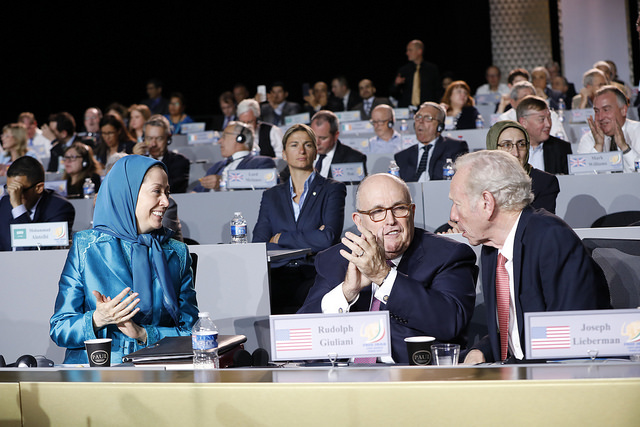
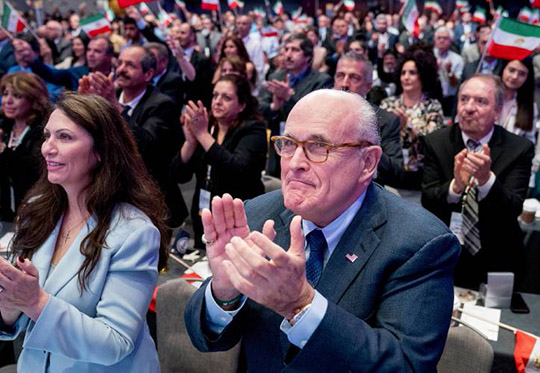
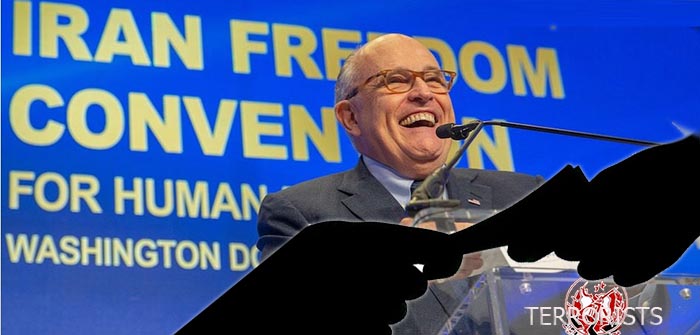
The former New York mayor had robust work overseas before Trump took office. His companies, Giuliani Partners and Giuliani Security & Safety, provided security and emergency management consulting to governments in Peru, Chile, Argentina and Ukraine, among others. He gave paid speeches around the world, including to Mujahideen-e-Khalq, or MEK, an Iranian resistance group operating in exile that was listed as a terrorist group by the State Department as recently as 2012.
Rudy Giuliani et al. standing on a stage in front of a crowd: Giuliani attends a March 2018 ceremony in Albania marking the Iranian new year.© Siavosh Hosseini/Alamy Giuliani attends a March 2018 ceremony in Albania marking the Iranian new year.
But Trump’s election provided Giuliani with a substantially bigger platform — and newfound access to the top levels of U.S. decision-making.
He became a mainstay at the Trump International Hotel down the street from the White House, where he has spent long evenings meeting friends and potential business partners. When he needs to privately discuss deals, he convenes meetings at some of his favorite cigar bars, including Shelly’s Back Room in Washington and New York’s Grand Havana Room, according to people familiar with the sessions.
Giuliani has bragged to other Trump allies that he has made millions of dollars since the president took office, according to people familiar with his comments.
He also has regularly boasted about his access to Trump and the closeness of their friendship, said a senior U.S. official who interacted with Giuliani.

In one meeting with a prominent Ukrainian political figure in early 2018, Giuliani was explicit that hiring him would provide a route to the president, according to a person in attendance.
“It was just so clear what he was peddling. He was pushing for business, and his pitch was, ‘I’m close to the White House, I’m close to Trump. If you want to get in there, I’m your guy,’ ” the person said. In that case, the Ukrainian did not hire Giuliani.
Giuliani used his access to Trump in 2017 to push for two controversial issues sought by Turkish President Recep Tayyip Erdogan, as The Post has previously reported.
Early that year, he was hired by the legal team of a Turkish-Iranian gold trader, Reza Zarrab, who was charged in New York with violating U.S. sanctions against Iran. The matter was of keen interest to Erdogan, who said Zarrab was a political “hostage” of American law enforcement. Giuliani met with the Turkish president on a visit to Istanbul in February 2017 to discuss a possible “state-to-state resolution in this case,” according to court filings in the Zarrab case.
In the fall of 2017, Giuliani attended an Oval Office meeting where Trump urged then-Secretary of State Rex Tillerson to consult with Giuliani and craft a diplomatic deal that would involve dropping charges against Giuliani’s client in exchange for concessions from Turkey, such as the release of an American pastor in Turkish custody.
People familiar with the incident have said Tillerson was shocked at what he viewed as an inappropriate request to intervene in a criminal matter. Tillerson has declined to comment.
Giuliani told The Post he sought a prisoner exchange but declined to comment on any private discussions on the topic. He said he did not need to register as a foreign agent for his Turkish advocacy because his only goal was to assist the legal case of his client, Zarrab. Defense attorneys are not required to register as foreign lobbyists when they assist clients in criminal or civil matters.
In late 2017, Zarrab pleaded guilty to orchestrating a multibillion-dollar conspiracy to evade U.S. sanctions against Iran by disguising money transfers so they would appear to be legitimate gold trades. He testified in federal court that the scheme was approved by Erdogan. Turkish officials denied any wrongdoing.
That year, Giuliani also persistently pushed Trump on another top concern of the Turkish president: extraditing exiled Turkish cleric Fethullah Gulen back to his home country to face prosecution. State Department and National Security Council officials have argued against such a move, but Trump appeared receptive to the idea, pressing his advisers about Gulen’s status, as The Post previously reported.
Giuliani declined to discuss whether he advocated for Gulen’s extradition, writing in a text message earlier this year: “can’t comment on it that would be complete attorney client privilege but sounds wacky.”
“I don’t represent foreign government in front of the U.S. government,” he told The Post earlier this year. “I’ve never registered to lobby.”
But inside the White House, officials were so disturbed by how he was promoting Turkey’s causes with Trump that then-Chief of Staff Reince Priebus pulled Giuliani aside in the West Wing in 2017 and warned him against lobbying for the country, officials said.

New proximity to president
Rudy Giuliani standing in front of a wedding cake: Giuliani and Maria Ryan arrive for a State Dinner with Australian Prime Minister Scott Morrison and President Trump at the White House on Sept. 20.© Patrick Semansky/AP Giuliani and Maria Ryan arrive for a State Dinner with Australian Prime Minister Scott Morrison and President Trump at the White House on Sept. 20.
In April 2018, Giuliani formally joined Trump’s legal team to help him deal with special counsel Robert S. Mueller III’s investigation, a position that required him to talk frequently with the president.
White House aides fear Giuliani has used his role as the president’s lawyer to promote the interests of private clients, fretting that they do not know who he represents, officials said. His conversations with Trump are protected by attorney-client privilege, meaning even Trump’s closest aides are not briefed on what they discuss.
Priebus’s successor, John F. Kelly, tried to limit Giuliani’s reach, scheduling his meetings with Trump at the White House residence, so he would not interact with other White House staff, former administration officials said. Kelly also told others he did not want to be part of calls or meetings with Giuliani, the people said.
Giuliani has insisted that he keeps his role as the president’s lawyer separate from the work he does for foreign interests.
“I’ve never lobbied him on anything,” Giuliani told The Post earlier this year, referring to Trump.
But he has continued to take on foreign clients, and, behind the scenes, his advocacy on foreign policy issues has not ceased, according to people familiar with his activities.
In the months after Giuliani joined Trump’s legal team, he began discussions with a group interested in influencing U.S. policy in Venezuela.
In the summer of 2018, over cigars and whiskey at New York’s Grand Havana Room, Giuliani met with Parnas and two American business executives with investments in the country seeking his advice on how to open a back channel of communication between Trump and Venezuela’s socialist leader, Nicolás Maduro, according to people familiar with the gathering.
As part of the previously unreported talks, Giuliani agreed to help find a way to negotiate with Maduro and a diplomatic solution to the political chaos and economic collapse overtaking the country, they said.
Weeks later, he told the group that he had met with John Bolton, the president’s national security adviser, to discuss the idea.
harles Cooper, an attorney for Bolton, declined to comment.

Bolton’s distaste for Giuliani’s foreign policy freelancing has emerged during the impeachment inquiry. Former national security official Fiona Hill testified that Bolton warned her not to interact with the president’s lawyer, calling him “a hand grenade that is going to blow everybody up.”
After a contested election in January, Bolton urged Trump to formally recognize legislative leader Juan Guaidó as the country’s leader instead. Maduro has refused to abdicate and the United States imposed stiffer sanctions in response.
By this summer, Giuliani had picked up an important Venezuelan client: energy executive Alejandro Betancourt López, who hired Giuliani to help him contend with a Justice Department investigation of alleged money laundering and bribery, according to people familiar with the situation.
Giuliani stayed at Betancourt’s historic estate outside Madrid in August, when he met with a top aide to Ukrainian President Volodymyr Zelensky and urged him to open investigations into the 2016 election and Biden’s son Hunter’s work for a Ukrainian gas company , as The Post previously reported.
On Aug. 13, days after returning from Madrid, Giuliani was back at Grand Havana Room, meeting with another potential client: the National Bank of Ukraine, which had taken over a bank once owned by Ukrainian businessman Ihor Kolomoisky, according to a person familiar with the meeting.
He suggested that lawyers with the law firm Quinn Emanuel, which represents the Ukrainian state-owned bank, hire him to wage a public campaign against Kolomoisky, with whom the bank is engaged in a complicated legal battle. Kolomoisky is also considered a political supporter of Zelensky.
Giuliani told Bloomberg, which first reported the meeting, that he was approached by the lawyers for the bank to see whether he could help them with a civil suit. He said the timing was not right.
“Since representing Trump I have considered and turned down all deals in Ukraine, even those not presenting a conflict,” Giuliani tweeted last week.
A spokesman for Quinn Emanuel declined to comment.
Interest in Qatar
Giuliani’s interest in U.S. foreign policy has often tracked with countries where he has had a financial interest.
That was the case with his efforts to shape the pick for ambassador to Qatar, where he did security consulting work in 2017 and 2018 related to a hacking incident, Giuliani told The Post earlier this year.
He declined to describe the specific work he did but said his contract concluded before he was named Trump’s attorney in April 2018. He said that he did not register as a foreign lobbyist because he never lobbied U.S. officials on behalf of Qatar.
The Qatari Embassy in Washington declined to comment.
In November 2018, Trump nominated Mary Catherine Phee to fill the post of ambassador to Qatar, a key diplomatic job that had been vacant since June 2017. Phee had served as a career diplomat since 1991, including a stint as ambassador to Sudan.

She is known as “an old school, talented diplomat” whose “strong point is the nitty-gritty of bilateral relations,” according to a former senior administration official involved in Middle East policy.
Scott Taylor, who wrote a 2015 book called “Trust Betrayed: Barack Obama, Hillary Clinton, and the Selling Out of America’s National Security,” had experience in the region and with energy policy. He served as a security contractor for Hunt Oil in Yemen from 2008 to 2010, Taylor told the Virginian-Pilot before his 2016 election. While in Congress, Taylor worked to build ties with Qatar, visiting the country in 2017 and speaking at a Qatari event in Washington in 2018.
Giuliani offered to promote Taylor as candidate for the post and help guide him through the process, according to a person familiar with his outreach.
During a night at a cigar bar in Friendship Heights in December and a lunch meeting the following day at the Trump hotel, Giuliani described a plan to promote Taylor for the job, the person said.
During the conversations, Giuliani told Taylor that he had done work in Qatar, but it was unclear why he was interested in shaping the ambassador pick.
In subsequent calls to administration officials, Giuliani argued that Taylor would be a better choice than Phee because he would be more supportive of Trump’s agenda, according to multiple people familiar with the conversations.
As the process progressed, Giuliani also told Taylor he had discussed the idea with the president, who had seemed enthusiastic, one person said.
When asked about his advocacy for Taylor in a November interview, Giuliani laughed and ended the call.

Reached by phone, Taylor — who this summer launched a campaign to unseat Sen. Mark R. Warner (D) — declined to comment on Giuliani’s effort to get him the appointment, saying only, “I had a lot of advocates on that.”
The State Department declined to comment.
Phee’s nomination expired when Congress adjourned last year and Trump has not renominated her. He also did not name Taylor, leaving the key job vacant.

Foreign work under scrutiny
a group of people standing in the rain holding an umbrella: Lev Parnas arrives at federal court in New York on Dec. 2.© Seth Wenig/AP Lev Parnas arrives at federal court in New York on Dec. 2.
The scope of the ongoing investigation by federal prosecutors in Manhattan is unclear, but the recent subpoena to Freeh’s firm indicates that investigators appear to be drilling into Giuliani’s work abroad.
In August 2018, Giuliani sent a letter to the Romanian president, expressing his concern that “excesses” by the nation’s anti-corruption agency were resulting in the prosecution of innocent people. Giuliani called for an amnesty for people convicted under the system.

Giuliani told The Post at the time that he was hired to send the letter by Freeh’s firm. He declined to say on whose behalf Freeh’s firm was working or how much he was paid.
But Freeh has said he was hired in July 2016 to conduct a review of the conviction of Gabriel “Puiu” Popoviciu, a Romanian real estate executive sentenced to seven years in prison for fraud.
Popoviciu originally hired Freeh at the recommendation of Hunter Biden, who had been retained by the Romanian, an attorney for the former vice president’s son, George R. Mesires, confirmed. The New York Times first reported Hunter Biden’s role. A Biden campaign official said Hunter Biden never discussed his Romania work with his father, who actively supported anti-corruption initiatives in the country.
Giuliani’s letter to the Romanian president, written on the letterhead of his firm Giuliani Partners, did not mention his relationship to Trump. But it caused an immediate stir in Bucharest, where news organizations highlighted Giuliani’s role as the president’s attorney and questioned whether the letter indicated a shift in U.S. support for the anti-corruption agency.
The State Department tried to distance itself from him. “Rudy Giuliani does not speak for the U.S. government on foreign policy,” an official told The Post at the time.
Giuliani has repeatedly dismissed questions about the propriety of his foreign work.
“5 different organizations are looking at 8 different cases trying to find something wrong. why if I’m not part of a Left Wung [sic] Witchunt for nailing Biden,” he wrote in a recent text message.
But people familiar with the current investigation have said federal prosecutors are exploring a wide range of potential crimes — including wire fraud and failure to register as a foreign agent — as they examine Giuliani’s relationship with his two associates, Parnas and Fruman.
The two men were charged in October with campaign finance violations. The allegations do not implicate Giuliani and both have pleaded not guilty.
Parnas and Fruman were key intermediaries who helped connect Giuliani early this year with Ukrainian officials such as Ukraine’s then-top prosecutor, Yuri Lutsenko, who was offering damaging information about Trump’s political opponents, Giuliani and Parnas have said.
Giuliani’s efforts in Ukraine soon merged with official U.S. policy. He pushed White House and State Department officials to issue a visa to a former Ukrainian prosecutor who was blocked from traveling to the United States because of corruption allegations, according to testimony from U.S. officials during the impeachment hearings.
And he lobbied Secretary of State Mike Pompeo to dismiss the U.S. ambassador, speaking with Pompeo twice by phone and then sending him a packet of material advocating her removal, documents show.
Denisse Oller wearing glasses and looking at the camera: Marie Yovanovitch, former U.S. ambassador to Ukraine, testifies before the House Intelligence Committee last Friday. Yovanovitch “exuded tremendous strength and integrity,” in the opinion of one Georgetown student.© Jonathan Ernst/Reuters Marie Yovanovitch, former U.S. ambassador to Ukraine, testifies before the House Intelligence Committee last Friday. Yovanovitch “exuded tremendous strength and integrity,” in the opinion of one Georgetown student.

Yovanovitch was removed from her post in May, the same month Trump directed top U.S. officials working on Ukraine policy to coordinate with his private attorney. By July, Trump was personally involved in the effort, pressing Zelensky by phone to work with Giuliani to open the investigations.
Giuliani has insisted he was not paid for the work he did for Trump. But he has acknowledged that in January he considered representing Lutsenko and the Ukrainian Ministry of Justice, writing a draft contract to formalize the deal in which he would have been paid $500,000.
He told the Wall Street Journal that he quickly decided against the arrangement, fearing it could pose a conflict with his representation of the president.
Last week, Giuliani traveled to Budapest, where he met with Lutsenko, then traveled to Kyiv, where he met with two members of Ukraine’s parliament who have called for a joint U.S.-Ukrainian parliamentary investigation into the gas company that hired Hunter Biden.
During the trip, Giuliani indicated he was speaking for the United States, writing on Twitter that until Ukraine investigates the “criminal conduct” of Biden, it “will be a major obstacle to the U.S. assisting Ukraine with its anti-corruption efforts.”
The president appeared pleased with his efforts, telling reporters Saturday that Giuliani was going to “make a report” to the attorney general and Congress.
“He says he has a lot of good information,” Trump said, adding: “I hear he has found plenty.”
josh.dawsey@washpost.com
rosalind.helderman@washpost.com
tom.hamburger@washpost.com
devlin.barrett@washpost.com
Anne Gearan, Alice Crites and John Hudson contributed to this report.

Josh Dawsey, Rosalind Helderman, Tom Hamburger, Devlin Barrett

December 11, 2019 0 comments
FacebookTwitterPinterestWhatsappTelegramSkypeEmail
Herd mentality or mob mentality within cults
The cult of Rajavi

Herd mentality helped the Rajavis run their cult

Cults make the news when there is a large number of deaths of their victims. Terrorism is also in the news when there is violence or catastrophe, such as numerous acts of terror all over the world by alQaeda, ISIS and other terrorist groups. Not all cults are dangerous but there is a risk and likelihood of violence from cult members. As their name implies, terrorists intentionally use violence to achieve their goals, but cult members are always potentially expected to turn into terrorists.

The same person can be identified as a”cult member”or”terrorist”in one society and at the same time welcomed as a”freedom fighter”or”hero”in her or his own group. In case of members of the Mujahedin Khalq Organization (the MKO/ MEK/ PMOI/the Cult of Rajavi),”terrorist”can simply fit the group based on its evident undisputed background of violent acts although it not listed as a terrorist organization by western states.
The group leaders claim that they are”freedom fighters for people”which is the equivalent of the term”Mujahedin_e Khalq”. However, the group is considered as a cult by experts and based on many evidences. Leaders of the Cult of Rajavi have used manipulative techniques to run their cult.
Herd mentality is a behavior pattern in human beings that helps leaders to program the crowd. Once the crowd is programmed, cult leaders indoctrinate them. Members of the MEK have been enduring the state of being programmed for over 40 years –at least since Massoud Rajavi became the leader of the group.

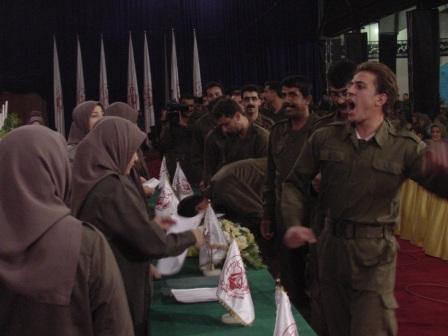
In the late 1979, following the Iranian revolution and the MEK’s breakdown with the newly established Iranian government, the MEK formed its militia. The semi military MEK members included ambitious youth who were recruited by the MEK agents; they were excited and influenced by their leaders and peers to commit certain acts of violence. They were terribly influenced by the leaders of the MEK. The consequence was the loss of thousands of innocent civilians, the arrest and the execution of a large number of the group members by the Iranian government.
This was how herd mentality functioned. When a crowd is led under herd mentality, it adopts some characteristics:
*They lose fear of the consequences so they commit any violent act that they are ordered or indoctrinated to do even if their victims are children and women. The documents on MEK’s homicide or suicide attacks against civilians is the proof.
*They lose moral responsibility; they are no more sensitive to violation of moral, religious or social norms. They are told to boycott their family, to divorce their spouses, to leave their children, to insult them all and they are coerced to accept.
*They enjoy a feeling of invincibility. Thus they are courageous enough to act unethically, immorally and violently. They are ready to set themselves on fire for the release of their leader Maryam Rajavi.
*The act of the crowd is contagious. This is empowered by peer pressure in the cults. In the Cult of Rajavi peer pressure is a tool to keep members under control. Self-criticism sessions are regularly held inside Camp Ashraf 3 in which members have to confess their thoughts in front of their peers and eventually get verbal and physical abused by them.
*The crowd interests are preferred over personal interests. This turns out to be a jargon in the cults that every cult member should follow. In the MEK, the consequences of such a jargon have been a range of human rights abuses including forced labor, sleep deprivation, mandatory celibacy, separation of children from parents and etc.
Even irrational acts become contagious. Self-immolations of a dozen of MEK members in June 2003 to protest the arrest of Maryam Rajavi by the French Police is an example of irrational acts. Agitated by the group’s propaganda and manipulative meetings, certain members were not able to decide over their lives. Herd mentality and eventually cult-like indoctrinations made them choose that catastrophic death.
*Human herding is usually led by a Demagogue. In case of the MEK, Maryam Rajavi tries her best to play the part of a demagogue. Despite the huge violation of human rights that are taking place in her establishment, she always vows for democracy, women rights and freedom in Iran. Although she hardly ever enjoys Iranians’ public support, her claims can be taken as serious by the isolated members inside the cult or at least she wishes to influence them.
Being in a cult, under the rule of a Demagogue, individuals enter a hypnotic-like state mesmerized by the leader. So the leader can influence the crowd. Glorified as”unique gems”who are”freedom fighters”for the Iranian Khalq (people), the MEK member became more and more suggestible. They started to turn Rajavi’s thoughts to acts. This has had a lot of disastrous outcomes in the MEK. To mention one, you can refer to the marriage of Massoud Rajavi with a large number of female members of the group’s Elite Council.
In human societies, herding often involves people using the actions of others as a guide to sensible behavior, instead of independently seeking out high-quality information about the likely outcomes of these actions. It seems that destructive cults such as the MEK go much further misusing this behavior pattern in human beings. The outcome has been numerous acts of violence against the Iranian civilians, Iraqi Kurds and even their own members.
Those who could manage to leave the MEK, before their departure they definitely could take some time and look at what they were following for decades, who they were following and why. They might be surprised by what they found. That was the time they could make a decision by their own. However, most of these people were not lucky enough to find a way to escape the group.
The human rights bodies including the UNHCR must take proper action to help those MEK members who are under the rule of Rajavi’s cult of personality. The threat of a cult herding some thousand rank and file should not be neglected.
Mazda Parsi

December 10, 2019 0 comments
FacebookTwitterPinterestWhatsappTelegramSkypeEmail
Vidal Quadras
Mujahedin Khalq as an Opposition Group

MEK money transfers under the request of Quadras

Russian And American Geopolitical Scheming And The Destabilization Of Europe

The Spanish government has been recently investigating the activities of Denis Sergeev, a Russian spy and intelligence agent, and his alleged involvement in the rebellious Catalonian election of 2017 in which Catalans voted to secede from Madrid. They say that Sergeev is a member of “Unit 29155” which consists mainly of veterans of Russia’s bloodiest wars, including in Afghanistan, Chechnya and Ukraine.

One retired G.R.U. officer with knowledge of Unit 29155 who spoke anonymously said that the unit was efficient in preparing for “diversionary” missions, “in groups or individually — bombings, murders, anything.” “They were serious guys who served there,” explained the retired officer. “They were officers who worked undercover and as international agents.”

Sergeev went by the alias, Sergey Fedotov and according to the Passenger Name Record (PNR) database, which is used by airlines to document all of their travelers, he took two trips to Spain. In the first trip, Sergeev was in Madrid on November 5, 2016 and stayed there for six days before returning to Moscow through Zurich. Sergeev’s second trip was on September 29, 2017, only two days before the Catalan separatist referendum which occurred on October 1st. This time he stayed in Spain until October 9th and then returned to Moscow through Geneva. There is no known documentation about further trips. This information has been discovered in the investigation opened by High Court Judge Manuel García-Castellón and which is currently sealed but has been revealed by El Pais. The inquiry into Sergeev’s activities is being conducted by the National Police force’s General Information Office.

Vzglyad has a dark history. It was founded by Russian troll and politician, Konstantin Rykov who also went by his internet pseudonym, “Jason Foris.” His snide, trolling and attention grabbing ways earned him millions as an internet entrepreneur and even got him elected into the Russian Parliament. Rykov spent years on the internet as a troll, and would eventually land himself in a position to help put Russia in the battlefield of the trolling world online. Rykov created accounts on Russian social media sites like Vkontakte (VK), Live Journal, and Odnoklassniki, where he accrued large followings by sharing pictures of scantily clad women, telling crude jokes and spreading a satiric, nihilistic brand of humor. He eventually got a position with Russia’s state-owned Channel 1 as the head of its internet department. 2005 would be the year that Rykov would create the online publication, Vzglyad, which would eventually become a mouthpiece for the Kremlin. In fact, President Vladimir Putin’s former deputy chief of staff, Vladislav Surkov, had direct ties to Vzglyad’s editorial department and determined what they published.

Alexander Shmelev, who served as Vzglyad’s editor-in-chief in 2007 and 2008, recounted the type of control the Russian government had on the paper’s articles:

“There were weekly meetings at the presidential administration … Sometimes, there were situations when we published something, and Surkov’s assistant who was in charge of the media, Alexey Chesnakov, called and said, ‘No, please, replace this article,’ or, ‘Please, publish something about this issue.’”

Shmelev, exasperated over how much control the state had over the publication, left Vzgylad. In 2008, when Russia invaded Georgia, the general consensus in online media was that Russia was the aggressor and the antagonist. This pushed Russia to shift its gears from just being focused on television and newspapers to the internet. Russia had to adapt to the world of internet propaganda. Shmelev explained:

“It was discussed that we lost the information war — that on the internet, everyone around the world believes that Russia suddenly attacked Georgia, and the topic of Georgia attacking South Ossetia is never mentioned and that we came to protect it … We need to change this somehow, we need to learn to be proactive, we need to learn to work not only in the Russian segment of the internet but in the internet in general.”

Through Vladislav Surkov, Putin’s administration began signaling to Konstantin Rykov that they were interested in his skills as a troll. As we read from Molly Schwartz:

“In 2007, Surkov organized private fundraisers for Rykov’s ventures. Rykov was elected to the Russian Parliament in 2008 as a member of the United Russia party, the same party as Putin. Rykov was only 28-years-old.

In return, Rykov developed tactics to help the Kremlin boost support for its image online. Shmelev says that he attracted a new community of supporters for the government by advertising pro-Kremlin articles on sites like Mail.ru, porn websites and humor websites. Rykov showed the Kremlin how to spread competing narratives on social media to deflect attention away from reporting that was critical of their activities.”

Rykov’s Vzglyad site became, and still is a, a means to spreading propaganda and information that Russia wants inculcated online, nationalist and anti-European Union sentiment.

On September 8th of 2017, Vzglyad published another article stating: “Catalan politicians are already discussing what they’ll do after proclaiming independence. One of them told Vzglyad that Catalonia will seek recognition for Abkhazia and South Ossetia,” two regions that Russia recognized as autonomous and independent from Georgia in 2008. This one politician was J. Enric Folch Vila of the obscure Catalan separatist party, Solidaritat Catalana. In September of 2016, Folch attended a conference in Moscow funded by the Russian government and organized by the Russian Anti-Globalization Movement (MAR). “We were invited by the Anti-Globalization Movement of Russia, because the reason for the meeting was to meet other nations without a State or that seek to achieve independence. Basically, the objective was to contact other nations or countries that are in these processes, and make a change of impressions,” explained Folch. According to the president of the Anti-Globalization Movement, Alexander Ivanov, about 30% of the group’s general budget come from the Russian government. They have also received separatists from Northern Ireland, Scotland, Italy, Catalonia, and the Basque country. One thing that is fascinating about this group is how its name “anti-globalism” echoes the rhetoric of those on the Alt-Right, that is, that they are against “globalism,” which simply means, amongst other things, that they are against immigration and want to create a fixation on national pride and tribalism.

This tribalism can be seen in Folch who has called for open rebellion against Madrid and says that the days of reasoning with Spain are over, exlaiming : “We will follow our own law, our own institutions, our own Catalan Republic”.

In 2017, Pravda, the official newspaper for the Communist Party of the Russian Federation, put out an article that said: “if Catalans hold the referendum and unilaterally declare independence, there will be a precedent for the EU similar to Crimea.” This article was shared by two Twitter accounts owned by Pravda, @pravda.ru and @pravdaonline, both of which have over a quarter of a million followers. Another Twitter account that advances the pro-Russian view, while at the same time disseminating propaganda for European nationalist parties (like the AfD), is Voice of Europe , which has over a quarter of a million followers. This page has retweeted posts sympathetic to the Catalan cause and with sensational titles like: “Spain BOILS: EU REFUSES to act for Catalonia despite Spain ‘violating basic human rights,’” or “Spain in CRISIS: Troops sent in as 40,000 protest over ‘WAR’ on Catalan independence vote.”

The Spanish Twitter account for RT (the most popular media voice for the Russian government), RT en Espanol which has over three million followers, and its Facebook page (currently over seven million followers) has posted stories with titles like “Catalonia: the dictator Francisco Franco has returned victoriously.” This last line on Franco implies that Spain, because she has suppressed the Catalan separatist movement, is like her past “dictator,” Francisco Franco.

The agenda of these media publications is to rile up the separatist side to vote in favor for their cause. Spain’s Defence Minister Maria Dolores de Cospedal, said back in 2017:

“What we know today is that much of this came from Russian territory … These are groups that, public and private, are trying to influence the situation and create instability in Europe”

When Spain’s Foreign Minister, Alfonso Dastis, was asked if he is emphatically sure of Russian meddling, he responded: “Yes, we have proof.” According to Dastis, a Spanish investigation confirmed a plethora of fake accounts on social media expressing support for Catalan separatism. These accounts were traced back to Russia and another 30% of them to Venezuela.

It makes sense as to why Russia would have an interest in Catalan nationalism, just like it makes sense that they would have an interest in nationalist parties like the AfD in Germany. By splitting up Spain, several things happen: firstly, it would destroy the European Union as we know it today, and secondly it would give the pretext to Germany to reinstate herself as the military ruler of Europe.

Germany is currently the economic controller of her continent, but she is still under American eyes when it comes to military defense. If Catalonia splits from Spain, it would trigger a continental emergency that Germany would then use to justify a return to militarism in the name of ‘European unity.’ Lets remember that Nazi Germany’s warpath did not begin in Poland nor Czechoslovakia, but in Spain, when the Spanish Civil War broke out after Franco and soldiers loyal to him overthrew the Left-wing government of Manuel Azana. Hitler used the conflict as an excuse to send in the German military to fight off the Left-wing forces that were combating the nationalists who would be on the side of Franco.

Hitler and Mussolini sent over 90,000 troops into Spain to back the Spanish nationalists (Ganser, NATO’s Secret Armies, ch. 8, p. 104) During the Spanish Civil War, the Soviet Union supplied the Spanish Left-wing fighters with weapons and training. It was a proxy war between Germany and Russia for power and influence over Europe. Hitler helped Franco’s regime, not because he really sympathized with Catholics who were being butchered by the anarchists and Republicans (Hitler butchered millions of Catholic Poles), rather he did so because he wanted to expand Germany’s geopolitical leverage, hence why Franco sent the Spanish military’s Blue Division to the Russian front to fight alongside the Wehrmacht (Ibid). Stalin backed the Popular Front government which was a coalition of Left-wing parties such as the Spanish Communist Party and the PSOE (Partido Socialista Obrero Español or the Spanish Socialist Workers’ Party). What is very interesting is that the PSOE, through Spain’s Prime Minister Pedro Sanchez, is the very party that today authorized the removal of Franco’s remains from the Valley of the Fallen mausoleum, an action which has angered the Right-wing but has pleased the Left. As we read from Time Magazine:

“While few defend the human rights abuses under Franco’s regime, many have argued that moving his remains serves little purpose and that his family should decide where he rests. “Sanchez has spent a year playing with [Franco’s bones] to try to divide us into reds and blues, but at this point this no longer matters to many Spaniards,” Alberto Rivera, leader of the centre-right Citizens, tweeted after the ruling.

Santiago Abascal, the leader of Spain’s far-right party Vox, which in 2018 became the first far-right political force to win seats in national elections since Franco’s death, attacked the exhumation as “profaning tombs and digging up hatreds”.”

While the Left in Spain is becoming more aggressive, with Catalonian Leftists working for separatism and the Socialists removing Franco’s remains, the Right-wing in Spain is also rising, and this is indicated in the fact that Vox — a nationalist and Right-wing party — went from being an obscure party to one that has 52 seats in the parliament (out of 350 seats), the first time a Ring-wing party won more than one seat since Spain returned to democracy in the 1970s. With the intensification of the Right-Left rift in Spain, its as if a strategy of tension is being done to cause all of this.

Vox in fact received a substantial amount of cash from the People’s Mujahideen of Iran (the MEK) which, until recently, was classified as a terrorist organization but nonetheless has been getting American backing thanks to people like Rudy Giuliani, John Bolton and Newt Gingrich.

With such high level Republicans backing the MEK, it is fitting to quote Dina Esfandiary who wrote that the Trump administration “provides a platform to groups like the Mujahideen-e Khalq, an exiled Iranian resistance group once listed as a foreign terrorist organization by the U.S. government”.

In April of 2019, documents leaked to El Pais revealed that between its founding in December 2013 and the European Parliament elections in May 2014, Vox received almost a million euros from the MEK’s front group, the National Council of Resistance of Iran (NCRI). It was not as though the financial relationship between Vox and the NCRI began gradually, but right when Vox was founded. Joaquín Gil, a journalist with El Pais, explained: “From the day it was founded in December 2013—the same day that it registered as a political party with the Spanish Ministry of Interior—Vox started to receive Iranian funds”. These funds came from different countries including the United States, Germany, Switzerland, Canada, and Italy in amounts ranging from 60 to 35,000 euros, totaling almost 972,000 euros, from December 2013 to April 2014, right before the 2014 elections. According to Gill, Alejo Vidal-Quadras Roca, who was a leading member of Vox, “asked his friends at NCRI … to instruct its followers to make a series of money transfers.”

Vidal-Quadras has confirmed that the NCRI organized the international fundraising campaign for Vox and the group was willing to discuss the matter with Spanish journalists. “We knew that it was a new party, but not a far-right one,” a spokesperson for the NCRI told El País. In fact, Vidal-Quadras admitted that the NCRI organized the international fundraising campaign for Vox. “We knew that it was a new party, but not a far-right one,” a spokesperson for the NCRI told El País. Its difficult to believe the NCRI when it was obvious from the beginning that Vox had nationalist beliefs. The main question is: what interest does an Iranian lobbyist group have with Spanish nationalists? The NCRI is backed by influential American political agents like Giuliani and Bolton. Thus it would not be shocking if it is indeed the US government backing Vox through a third party, and that the support for Vox and Catalonian nationalists by international players like Russia and the US is simply a strategy of tension to get the whole of Europe to implode.

Is it possible that the removal of Franco’s remains is really part of a strategy of tension to get the Right and Left to eventually implode in violent war within Spain? It would not be surprising, given the fact that the Soviet Union backed the Left during the Spanish Civil War. It would not be to our shock if the US is also backing the Catalan cause, since even back in 1947, the OSS (the CIA’s precursor) armed Catalonian nationalists to overthrow Franco in what is known as Operation Banana.

It was a failed operation nonetheless, since not everyone in Washington or London agreed to topple Franco and some saw him as an asset. So the militants were arrested and the coup failed. Franco solidified his relationship with the US in 1953 after he made a deal with the Americans to allow missiles, soldiers and airplanes and Signals Intelligence (SIGINT) antennas in Spain. The United States backed the Spanish nationalists since the Franco regime was a true bulwark against Communism.

US intelligence collaborated with Spanish intelligence to combat Soviet influence; this was part of NATO’s Gladio operation. Andre Moyan, a leading Belgian counter-intelligence agent during the Cold War, said in an interview with the Communist newspaper, Drapeau Rouge, that Spain had played “a key role in the recruitment of Gladio agents” and that his first contacts with the Spanish Gladio network occurred in October of 1948 when “a cell of the network operated in Las Palmas” on the Spanish Canary Islands. Spain had become a center for Italian Right-wing radicals bent on overthrowing Italy’s government. For example, the Right-wing extremist, Marco Pozzan, a member of the terrorist organization, Ordine Nuovo, which was behind the massacre in the Piazza Fontana (in which 17 people were murdered) in 1969, revealed to judge Felice Casson in 1984 that there was a plethora of Italian fascists operating in Spain during the final years of Franco’s rule.

After Prince Valerio Borghese organized a failed neo-fascist coup against the Italian government on December 7th of 1970, 100 of the plotters fled to Spain. Borghese, as well as Carlo Ciuttini and Mario Ricce, regrouped in Spain under the command of the known neo-fascist terrorist, Stefano Della Chiaie. While in Spain, Chiaie was hired by the former Nazi, Otto Skorzeny (who was hired by the Spanish government as a security consultant) to target any enemies of Franco, especially anti-fascists. (Ganser, NATO’s Secret Armies, ch. 8, pp. 105-108)

If the United States was backing nationalists during the Cold War, and since the Cold War has never really ended, it would not be shocking that the US is still backing nationalists in Spain. NATO supported stay-behinds or Right-wing paramilitaries in Europe during the Gladio operation, and we know for a fact that the vice-president of Vox, Victor Gonzalez, has been involved in paramilitary training. In fact, we know this from our own personal conversion that we had with Gonzalez back in 2015.

We were in Madrid for a conference and Mr. Gonzalez, impressed by the subjects we delved in, sat by us to have a conversation on politics and religion. In the middle of the conversation, Gonzalez told us that he was a part of a secretive Catholic order that was involved in paramilitary training. He even said that he was jumping off of planes as part of the training. As he explained, this training was being done to prepare for a war with Muslims since, as he told us, “If we don’t fight them outside of Europe, then we will fight them in the streets.” He did not tell me the name of the order and when I requested an interview with him to discuss the paramilitary group he explained that he would first need permission from his superior. Weeks later we contacted Mr. Gonzalez and requested an interview to discuss his political ideology and paramilitary activity, but he declined. The fact that the vice-president of the biggest nationalist party in Spain has been, admittedly, involved in paramilitary training, should at least make us suspicious. Vox has been financed by the US-backed Iranian lobby, and its vice-president has been involved in paramilitary training. We wrote Gonzalez for this article but he declined to write us back. The apparatus has the trappings of a Gladio operation.

Russian outlets have been advancing the propaganda for Catalonian nationalism while backing other nationalisms like that of the German AfD, while at the same time the US government under the Trump administration has been pushing Germany to stop being independent on the US for its defense. Both of these actions are extremely dangerous. Russia wants to split the European Union, and if this occurs it will accelerate Germany to pursue militarist aims, since the a fragmented EU will be a national security disaster and will give Germany the opportunity to claim that allies no longer care about Europe and that European countries should follow Germany as the continent’s defender. In addition, with the US pushing for Germany to not be dependent on the US for defense spending, the Germans are taking this as a green light for German military independence. A Germany bent on military independence, alongside a fragmented Europe, will only spell disaster, and that is a revival of German military power. Russian trolling for anti-EU sentiment, and the US’ pushing for Germany to pay for her own defense, are ingredients for the recipe of Europe’s implosion.

By Walid & Theodore Shoebat
December 6, 2019

December 9, 2019 0 comments
FacebookTwitterPinterestWhatsappTelegramSkypeEmail
blank
Nejat Publications

Nejat Newsletter – No 66

Inside This Issue:

Nejat Newsletter

– MEK, and protests against fuel price in Iran

– MEK Terrorist Cult Members In Albania Who Mustn’t Think About Sex

– MEK may conduct terror attacks in Europe

– Iranian Protests And MEK Absence Inside Iran

– Albanian MEK Ashraf Camp Is a Prison

December 8, 2019 0 comments
FacebookTwitterPinterestWhatsappTelegramSkypeEmail
weekly digest
Iran Interlink Weekly Digest

Iran Interlink Weekly Digest – 265

++ After the fuel demonstrations in Iran were quashed, Iran’s right wing claimed the MEK was behind the violent unrest. The MEK also claimed they were behind it. Genuine opposition groups and demonstrators said they need to have the right atmosphere and conditions so that people can demand their rights without the interference of MEK, Pompeo, bullets, burning buildings and vandalism. Commentators say that interference by MEK and such like in the protests has led to people supporting the current ruling regime or at least refusing to come out on the streets. Western support for MEK and the demonstrations at the same time is stopping the democratic processes and the struggle of the genuine human rights organisations.
++ The soul of Massoud Rajavi issued a statement in Farsi (which was not translated into English). In it he has been lashing the Saudis alongside Iranian media outlets in London (BBC Persian, Iran International, Man-o-To). Rajavi’s ghost specifically referred to Massoud Khodabandeh’s statements about gold and money being paid to MEK by the Saudis, saying these are all lies. He also verbally lashes the Saudis, telling them that they couldn’t even retaliate for the Yemeni drone attack (alleged to have been by Iran) on their oil facilities (he means they didn’t start a war against Iran) and that they are not capable of standing up to Iran.
++ The point that Massoud Rajavi’s rant has only been issued in Farsi (and from Massoud Rajavi who is presumed dead and not the current leader Maryam Rajavi) shows this has been done only to shut up the dissent inside the camp rather than being about biting the hands feeding them. Ebrahim Khodabandeh of Nejat Society wrote a short note of explanation saying that after losing Saddam, Rajavi found the Saudis as the MEK benefactor. Now that the Saudis have started talking with Iran Rajavi is in deep shit. Khodabandeh advised Rajavi to let the MEK hostages go free as it is unlikely that any other benefactor could be found to replace the Saudis.
++ After the earthquake in Albania and casualties were reported, MEK gave no response. Critics of the MEK say the MEK should publish the names of any victims to inform the families of the hostages in the camp. Instead, the MEK issued propaganda (only in Farsi) that they are helping the Albanian people – photos are published of the MEK giving glasses to a child inside a building in the camp. (Albanian news shows that the free glasses – given to the MEK by America as part of a medical care package – were distributed among the local population well before the earthquake.) In any case, MEK critics say, why not help the MEK members? What is this? Why are you helping the Albanians and not your own people?

In English:

++ Several articles identify MEK as an artificial and insidious force interfering in the fuel protests in Iran. It is acknowledged that ordinary Iranians are not seeking regime change but are protesting genuine grievances. When the violence started, ordinary Iranians went home. MEK are seen by analysts as an externally promoted force which wants to introduce extremism.
++ Following the earthquake in Albania, a report was published in Balkans Post claiming that many MEK members were killed and injured. Since the MEK has kept silent on the issue, there is no way of knowing what happened behind the closed doors of the camp.
++ Nora Doyle-Burr, Valley News reports on some MEK supporters. Maria Ryan, Cottage Hospital CEO and consort of Rudi Giuliani, has exposed herself – as many MEK fans do – as a fool for the taking. Apparently, she was moved by the plight of Iranian women only after hearing about them from Maryam Rajavi and the MEK. Since then Ryan has travelled around a bit promoting the MEK, with Giuliani. “The New York Times reported in 2011 that the group paid speakers of diverse political backgrounds between $10,000 and $50,000 per appearance”, writes Doyle-Burr. Enough said.

December 8, 2019 0 comments
FacebookTwitterPinterestWhatsappTelegramSkypeEmail
Albania's earthquake
Mujahedin Khalq as an Opposition Group

MEK absolute silence over the Albanian earthquake

US Favors ‘Regime Change’ Not Diplomacy with Iran: Ex-US Senate Candidate

Mark Dankof, a former US Senate candidate, said the US administration is interested in “regime change” not diplomacy with respect to Iran.
“They are obviously interested in ‘regime change,’ not diplomacy, with the interests of Israel, Saudi Arabia, the Central Banks, Oil-Gas Consortiums, and Armament Manufacturers being paramount,” Dankof told Tasnim.
Mark Dankof is a broadcaster for The Ugly Truth Podcast. Born in Wiesbaden, Germany, the son of a United States Air Force Colonel, he graduated from Valparaiso University in 1977 and from Chicago’s Trinity Evangelical Divinity School in 1983. In recent years, he has pursued post-graduate work in systematic theology and theological German at Westminster Theological Seminary in Philadelphia. Formerly the 36th District Chairman of the Republican Party in King County/Seattle and later an elected delegate to Texas State Republican Conventions in 1994 and 1996, he entered the United States Senate race in Delaware in 2000 as the nominated candidate of the Constitution Party against Democratic candidate Thomas Carper and Republican incumbent William Roth.

Following is the full text of the interview.
Tasnim: In an interview with BBC Persian on Nov. 21, the US special representative for Iran, Brian Hook, said Washington is “very pleased” with protests over a fuel price hike in Iran, adding that the maximum pressure against Iran will continue. US President Donald Trump and Secretary of State Mike Pompeo also took to Twitter to express support for the protesters. Open support for rioters has just reinvigorated the Islamic Republic’s official narrative that the real goal the United States pursues through maximum pressure is not to bring Iran to the negotiating table but to cause “regime change” in the country. What do you think? What is behind this kind of US policy?
Dankof: It is clear that “regime change” in Iran is the goal of the Neo-Conservative, Zionist foreign policy of the Trump Administration. As I stated in an interview on the Republic Broadcasting Network this afternoon, and on UK EuroFolkRadio yesterday morning, the situation in Iran must be understood not only in light of what the CIA and British intelligence did in Tehran with Operation Ajax in 1953, but in contemporary terms in the 4 decades since the overthrow of Shah Mohammed Reza Pahlavi in 1979 with ongoing American and Israeli subversion in various cities and provinces of Iran, along with the current American Empire machinations in Ukraine, Libya, Syria, Iraq, Bolivia, Venezuela, and now Hong Kong among others. Pompeo’s recent announcement giving Israel the green light to steal the West Bank along with solidifying their theft of East Jerusalem (al-Quds) must also be added to this demonic mix and overview. Jewish settlement in Hebron (al-Khalil) alone has now tripled, as but one example of the ramifications. The American backed horrors in Gaza and Yemen amplify a very blood-soaked picture.
Tasnim: Reports by Iranian intelligence services say that the US and its allies in the region meddled to stoke recent unrest in Iran. They say clues have been found proving that they intervened to create the turmoil. Bahman Reyhani, a military commander in Kermanshah, said “the rioters belonged to anti-revolutionary groups and America’s intelligence services”. What are your thoughts on this?
Dankof: All of the published reports over time indicate that the Saudi-backed terror groups are involved in (Sistan and) Balouchestan Province terrorist operations coming across the Pakistani-Iranian border. In Khuzestan Province, where unofficial reports indicate Iran has discovered a new potential deposit of oil in southwestern Iran, both groups and the nefarious Muhajedeen-e-Khalq (MEK-MKO) are apparently involved in the ignition of violent incidents. The MEK is clearly involved in the troubles in Tehran, and in Golestan Province and Iranian Azerbaijan.
The MEK headquarters in Tirana, Albania, has been regularly entertaining leading American Neo-Conservatives and Zionists in public photo-ops. The New York Times has extensively covered the Neo-Conservative, Zionist politicians who have been on the MEK payroll, and who helped remove them from the American State Department list of Officially Designated Terrorist Organizations. The money of the MEK is traceable to Saudi Arabia, and Israeli players in this New Great Game. It is fascinating to note the absolute silence over the recent Albanian earthquake and the report of the Balkans Post and Iran Interlink that the MEK headquarters there was devastated. I’m fishing for more information on this report, and what the damage and casualties there might mean to this key asset in the American-Israeli-Saudi war on Iran.
As far as Kermanshah, (military commander) Bahman Reyhani’s initial report may later lead to more information publicly on these “anti-revolutionary” groups, in terms of specific identification of the organizations involved. Dr. Philip Giraldi has already confirmed to your agency (Tasnim) that American, Israeli, and Saudi fingerprints are all over these operations. I concur.
Tasnim: Last Wednesday, the director-general of the anti-espionage department of the Iranian Intelligence Ministry said a number of elements that were seeking to collect information on the riots and transfer it to foreign countries were identified and arrested before they could carry out their mission. “These elements that had received CIA-funded training in various countries to gather information under the guise of citizen-journalists had been monitored for quite a long time,” the official said. How much do you think the CIA, Mossad and Saudi spy agency were involved in the riots?
Dankof: As I have already indicated, I believe it to be logically indisputable that the CIA, Mossad, and Saudi are involved in funding these subversives and provocateurs, and providing legends and covers for those operationally active in these incidents. The use of “citizen-journalists” and fake NGO “human-rights” activist profiles is a regular feature of these “spontaneous” uprisings and “color revolutions.” One presumes the interrogations of those apprehended yielded all kinds of additional information and evidence for Iranian intelligence and the internal security apparatus.
Tasnim: Iranian officials have repeatedly said that US sanctions against Tehran have dealt a blow to the prospects of talks between Washington and Tehran. It seems that Trump administration has closed the door to diplomacy. Do you share the opinion that the White House is not interested in diplomacy when it comes to Iran?
Dankof: They are obviously interested in “regime change,” not diplomacy, with the interests of Israel, Saudi Arabia, the Central Banks, Oil-Gas Consortiums, and Armament Manufacturers being paramount. Trump unilaterally and illegitimately abrogated the multilateral JCPOA, P5+1 nuclear treaty being adhered to by Iran. The Treasury and State Department have instituted economic sanctions on Iran that are a literal declaration of war on Iran by other means. This has led to predictable political unrest in Iran, exacerbated by the wartime gasoline rationing designed by the Iranian government to bring national consumption of gasoline down from 110 million liters to 70 million annually. Once the economic distress led to more publicly expressed political dissatisfaction and unrest, American, Israeli, and Saudi intelligence began unleashing the MEK/MKO terrorists and subversives within the country, with an assist from the Saudi Wahhabist groups, depending on the region and location involved. It is as simple as that.
But it may get worse. The economic sanctions and deployment of terrorists and provocateurs in cities and provinces must be seen as the last stage in “regime change” endeavors short of an overt military attack on Iran.
The endgame may well be a False Flag event somewhere, falsely and deliberately attributed to Iran, that would provide the cover for such an attack. This is how evil and ruthless these people are.

December 7, 2019 0 comments
FacebookTwitterPinterestWhatsappTelegramSkypeEmail
MKO memebrs in Albania
Mujahedin Khalq Organization

BBC Persian: What MKO has done in Albania?

MKO Camp in Tirana, Albania. It has been for 6 years that MKO’s members living in a camp on a hill, 30 kilometers from Tirana. In a report compiled by two BBC reporters it reads:

“the MKO has strict rules for its members. They are often dressed in the same clothes and are strictly monitored to the extent that thinking about sex is forbidden, too. They have even been deprived of outside communication, using mobile phones, and internet access for years.”

Many analysts consider the MKO as a cult.

A cult that has a lot of money, holds large meetings annually and in recent years, it has also pursued the fight against the Islamic Republic on social media.

The MKO has no good relations with journalists, but invites politicians from different countries to their meetings. Among them are U.S officials some of which has close ties to the MKO. Including this character: Donald Trump’s personal attorney Rudy Giuliani. Mr. Giuliani has repeatedly recommended the MKO as a strong alternative to the Islamic Republic of Iran, which can establish democracy. “We are going to focus on Iran. The policy change that is the goal of our government or the regime change that the MKO has been working on for a while. If massive changes don’t occur in Iran, nothing in the Middle East will be correct.”
John Bolton, Former Donald Trump security adviser is also a major supporter of the MKO.” Ayatollah Khamenei’s Revolution “would not last until its 40th anniversary.”

According to US media these men were paid to speak in MKO’s meeting.

Saudi Prince and Former head of Saudi intelligence, Turk Faisal, referred to Massoud Rajavi the MKO’s founder as deceased in MKO’s conference in 2016 in Paris.

Massoud Rajavi was seen 16 years ago in public for the last time. Since then, only voice messages of him have been played for MKO’s members. Rumors of his being killed in US-led coalition attacks on Saddam Hussein’s government have been circulated in the same year, but there is no evidence.

Maryam Rajavi, who is considered by the members of the organization as the president-elect, has been the head of the National Council of Resistance since then. The MKO was previously on the EU, US and Canada terrorist list. The Council of Europe in 2008 and the United States in 2012 removed MKO from this list.

The MKO’s website explains: The MKO seeks to replace Iran’s religious dictatorship with a democratic and pluralistic State based on separation of religion and government. That respects individual freedoms and equality of men and women.

Many in Iran believe that this group opposed to the Islamic Republic is a marginalized and isolated group that they have no sympathy for the majority of the Iranian people.

Farrin Aassemi BBC – Translated By Terrorspring.com

December 5, 2019 0 comments
FacebookTwitterPinterestWhatsappTelegramSkypeEmail
MEK women in Ashraf 3
The cult of Rajavi

Seven Reasons Why MEK Should Be Considered a Cult

A recent report by BBC once more revealed facts on the world inside the Mujahedin Khalq Organization (the MKO/ MEK/ PMOI/ Cult of Rajavi). The investigated report describes members of the MEK as those”who mustn’t think about sex“. Although the BBC correspondents were not allowed to enter the group’s headquarters in Tirana’s countryside, they could interview former members of the group. Not surprisingly former members are accused by the MEK of being agents of the Iranian regime.
Meanwhile, the report quotes the group’s longtime sponsor Rudy Guilliani as saying:”If you think this is a cult, then there’s something wrong with you”
“These are people who are dedicated to freedom,”he said, referring to the uniformly dressed and gender-segregated MEK members present in the hall. [1]
However, testimonies of the former members including Hassan Heyrani and Gholam Mirzai interviewed by BBC, confirms numerous testimonies made by other ex-members of the group. The entire evidences prove that the Mujahedin Khalq is a cult-like group if not a cult. However, many cult experts argue that the MEK is a cult in which lives of members are under daily threat and the cult itself is a threat for the outside world. Rick Alan Ross an American deprogrammer, founder and executive director of the nonprofit Cult Education Institute asserts:”The MEK fits well into the definition of cult”. [2] Here are reasons why the MEK should be considered a destructive cult listed by Rick Ross and confirmed by the testimonies of former members and journalists’ accounts of the group of which just a few examples are stated:
Mind Control (undue Influence): Manipulation by use of coercive persuasion or behavior modification techniques without informed consent. Hassan Heyrany told BBC of the leadership’s oppressive control of his private life inside the MEK.
The nadir of Heyrany’s life with the MEK an evening meeting he was obliged to attend, according to BBC. [3]
“We had a little notebook, and if we had any sexual moments we should write them down. For example, ‘Today, in the morning, I had an erection.'”[4]
Romantic relationships and marriage are prohibited by the MEK. It was not always like that – parents and their children used to join the Mujahideen. But after the bloody defeat of one MEK offensive by the Iranians, the leadership argued it had happened because the Mujahideen were distracted by personal relationships. Mass divorce followed. Children were sent away – often to foster homes in Europe – and single MEK members pledged to stay that way. [5]

Charismatic Leadership: Claiming divinity or special knowledge and demanding un-questioning obedience with power and privilege. Leadership may consist of one individual or a small core of leaders. In the MEK, the couple Masoud and Maryam Rajavi are the core of MEK’s cult of personality. Their leadership is so undisputed that no one dares to ask about the whereabouts of Massoud Rajavi who has been disappeared since 2003 and even his death was declared by Saudi prince Turkie Faisal in the group’s gathering in Paris.
“Rajavi and his wife are the defining role of authoritarian charismatic leadership that has become the focus, defining element and driving force of MEK,”Rick Ross says.”There are no checks and balances to their power, meaningful accountability or transparency.”[6]
Deception: Recruiting and fundraising with hidden objectives and without full disclosure of the use of mind controlling techniques; and the use of”front groups.”
MEK recruiters had their fraudulent techniques to recruit young Iranians looking for a better life outside Iran. They were promised to be granted European passports but their own ID cards were confiscated by the MEK as soon as they entered the group.
Once they are in the group, members are bombarded with fake news and propaganda about the outside world particularly Iran. They are constantly promised by the group leaders that the overthrow of the Iranian government is close. They are so isolated from the reality that cannot believe their eyes when they see an Albanian child talking on a mobile phone. According to the BBC report, Gholam Mirzai was astonished that even children had mobile phones. [6]

Moreover, several charity associations that in fact were front group of the MEK have been delegitimized by European states.
Exclusivity: Secretiveness or vagueness by followers regarding activities and beliefs. The MEK’s internal relations were secret to the outside world until the early 2000s when a large number of members started defecting the group. The increasing process of defection resulted in huge revelations on the mysterious issues inside the MEK. Elizabeth Rubin of the New York Times Magazine, described the group’s Camp Ashraf in Iraq as “fictional world of female worker bees.” [7]
Alienation: Separation from family, friends and society, including a change in values and substitution of the cult as the new”family;”evidence of the subtle or abrupt personality changes. The latest example of an alienated member who was interviewed by BBC is Gholam Mirzai who has not seen his family for almost 40 years.”When Mirzai left to go to war against Iraq in 1980, he had a one-month-old son,”BBC reports.”After the Iran/Iraq war ended, his wife and other members of his family came to the MEK camp in Iraq to look for Mirzai. But the MEK sent them away, and told him nothing about their visit. This 60-year-old man never knew he was a much-missed father and husband until he made that first call home after 37 years.”[8]
“They didn’t tell me that my family came searching for me in Iraq,”he told BBC.”They didn’t tell me anything about my wife and son. All of these years I thought about my wife and son. Maybe they died in the war… I just didn’t know.”[9]
Exploitation: Can be financial, physical, or psychological; pressure to give money, to spend a great deal on courses or give excessively to special projects and to engage in inappropriate sexual activities, even child abuse. According to RAND report sponsored by the US Defense Department, members of the MEK are subjected to forced labor, sleep deprivation, mandatory celibacy. [10]
BBC’s account on the exploitation in the MEK states:

“Romantic relationships and marriage are prohibited by the MEK. It was not always like that – parents and their children used to join the Mujahideen. But after the bloody defeat of one MEK offensive by the Iranians, the leadership argued it had happened because the Mujahideen were distracted by personal relationships. Mass divorce followed. Children were sent away – often to foster homes in Europe – and single MEK members pledged to stay that way.”[11]

However, the most shocking issue on human rights abuses in the MEK is polygamy. Massoud Rajavi married dozens of female members of what is called the Elite Council in the MEK. He had sex with a large number of these women. The Guardian reported the horrible story of female victims of the MEK. Batul Soltani was sexually abused by Massoud Rajavi before she left the group. [12]

Batoul Soltani - MEK former member of the Leasership Council

Besides, Female defectors Zahra Mirbagheri, Batul Soltani and Nasrin Ebrahimi revealed the list of a hundred women who underwent forced hysterectomy surgeries. They became barren under the order of the Rajavis. [13]
Totalitarian Worldview (we/they syndrome): Effecting dependence, promoting goals of the group over the individual and approving unethical behavior while claiming goodness. That’s why all defectors of the MEK are labeled as traitors and agents of the Islamic Republic. The group leaders indoctrinate the rank and file that”anyone who is not with us is against us”.
Hassan Heyrani, Gholam Mirzai and other defectors of the MEK –who live in Albania or any other side of the world speaking to the media about what they underwent in the cult-like system of the group—are accused of being spies of the Iranian Intelligence. [14]
“Now he scrapes by in the city, full of regrets and accused by his former Mujahideen comrades of spying for their sworn enemy, the government of the Islamic Republic of Iran,”BBC write about Gholam Mirzai, the 60 year old former cult member. [15]
Rajavi’s totalitarian character allows him to have sex with dozens of female members of the group but members mustn’t even think about it.

By Mazda Parsi

References:
[1] Pressly, Linda & Kasapi, Albana, The Iranian opposition fighters who mustn’t think about sex, BBC News, November 11th, 2019.
[2] MEK fits well into definition of cult, Mehr News Agency, February 8th, 2017
[3] Pressly, Linda & Kasapi, Albana, The Iranian opposition fighters who mustn’t think about sex, BBC News, November 11th, 2019.
[4]ibid
[5] MEK fits well into definition of cult, Mehr News Agency, February 8th, 2017
[6] Pressly, Linda & Kasapi, Albana, The Iranian opposition fighters who mustn’t think about sex, BBC News, November 11th, 2019.
[7] Rubin, Elizabeth, The Cult of Rajavi, The New York Times Magazine, July 13th, 2003.
[8] Pressly, Linda & Kasapi, Albana, The Iranian opposition fighters who mustn’t think about sex, BBC News, November 11th, 2019.
[9] ibid
[10] Goulka, Jeremiah & Hansell, Lydia & Wilke, Elizabeth & Larson, Judith, The Mujahedin-e Khalq in Iraq, A Policy Conundrum, National Defense Research Institute, August 4th, 2009.
[11] Pressly, Linda & Kasapi, Albana, The Iranian opposition fighters who mustn’t think about sex, BBC News, November 11th, 2019.
[12] Merat, Aron, Terrorists, cultists – or champions of Iranian democracy? The wild wild story of the MEK, The Guardian, November 9th, 2018.
[13] ibid
[14] Pressly, Linda & Kasapi, Albana, The Iranian opposition fighters who mustn’t think about sex, BBC News, November 11th, 2019.
[15] ibid

December 4, 2019 0 comments
FacebookTwitterPinterestWhatsappTelegramSkypeEmail
Newer Posts
Older Posts

Recent Posts

  • The black box of the torture camps of the MEK

    December 24, 2025
  • Pregnancy was taboo in the MEK

    December 22, 2025
  • MEPs who lack awareness about the MEK’s nature

    December 20, 2025
  • Why did Massoud Rajavi enforce divorces in the MEK?

    December 15, 2025
  • Massoud Rajavi and widespread sexual abuse of female members

    December 10, 2025
  • Facebook
  • Twitter
  • Instagram
  • Youtube

© 2003 - 2025 NEJAT Society . All Rights Reserved. NejatNGO.org


Back To Top
Nejat Society
  • Home
  • Articles
  • Media
    • Cartoons
    • NewsPics
    • Photo Gallery
    • Videos
  • Publications
    • Books
    • Nejat NewsLetter
    • Pars Brief
  • About Us
  • Contact us
  • Editions
    • عربي
    • فارسی
    • Shqip