Nejat Society
  • Home
  • Articles
  • Media
    • Cartoons
    • NewsPics
    • Photo Gallery
    • Videos
  • Publications
    • Books
    • Nejat NewsLetter
    • Pars Brief
  • About Us
  • Contact us
  • Editions
    • عربي
    • فارسی
    • Shqip
Nejat Society
Nejat Society
  • Home
  • Articles
  • Media
    • Cartoons
    • NewsPics
    • Photo Gallery
    • Videos
  • Publications
    • Books
    • Nejat NewsLetter
    • Pars Brief
  • About Us
  • Contact us
  • Editions
    • عربي
    • فارسی
    • Shqip
© 2003 - 2024 NEJAT Society. nejatngo.org
blank
The cult of Rajavi

Recruited By Giuliani,Maria Ryan is lobbying for the MEK terrorists

Cottage CEO has high profile away from work
WOODSVILLE — Cottage Hospital CEO Maria Ryan has made headlines due to her friendship with former New York Mayor Rudy Giuliani, whom she accompanied to a state dinner at the White House in September.

And her appearances with Giuliani, who has become embroiled in the controversy over President Donald Trump’s dealings with Ukraine, also seem to have raised her profile in other venues. In addition to her day job running the 25-bed hospital in Woodsville, Ryan has in the past couple of years been speaking and writing on the subject of the rights of women in Iran, work that has brought her — with Giuliani — to places as far from home as Paris and Albania.
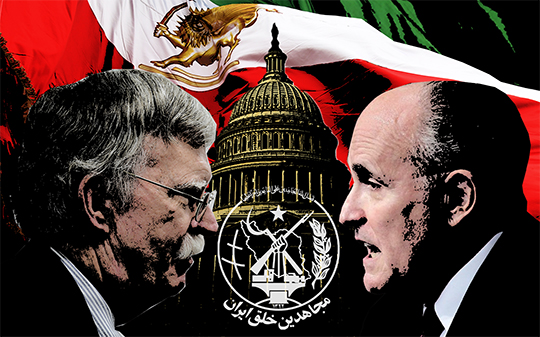
Ryan’s travels with Giuliani have also taken her to the far-flung locales of Israel to visit a hospital and London to see the Yankees play the Red Sox.

Ryan, in remarks during a May 2018 appearance at the Iran Freedom Convention for Human Rights and Democracy in Washington, addressed the question of what brings her to the issue of human rights in Iran.
“You may wonder why I am here,” she said, according to excerpts of her remarks posted on the website of the Organization of Iranian American Communities, which hosted the convention. “I’m not Iranian, I’m not a politician, I’m just a human being who was very compelled by the story I heard about the (Iranian opposition movement, the Mujahedin-e Khalq).”

Ryan said in the excerpts of the May 2018 convention that she has been “really affected” by stories of the plight of the Iranian people.

“I’ve had my ups and downs in life and my struggles,” she said in May 2018. “I had to overcome poverty. But never was I persecuted on a daily basis. Never was I told my opinion doesn’t matter because of my gender. Never was I tortured or had loved ones kidnapped or killed.”

Ryan did not respond to interview requests, and her executive assistant, Missy Lund, said last week that Ryan will not be conducting any interviews “for the next several months” because of a transition in the hospital’s marketing department.

But Lund confirmed that Ryan had visited Albania in July and had written an opinion piece in September for The Hill. Giuliani has ties to The Hill’s Republican owner, Jimmy Finkelstein, a friend who raised funds for Giuliani’s failed 2008 presidential bid.

Ryan’s piece in The Hill, titled “Women are crucial to resisting Iran’s regime,” said that Ryan and other “sponsored” speakers attended the annual conference of the National Council of Resistance of Iran and visited Ashraf 3, home to members of the Mujahedin-e Khalq political movement.

“I met many brave women who survived the mullahs’ brutal crackdown,” Ryan wrote. “Many said they had suffered in torture chambers for long years. They shared their stories with me, their personal suffering and the loss of loved ones.”

In response to a question about whether Ryan had ever traveled to Ukraine or been in meetings with Giuliani where Ukraine was discussed, Lund said via email, “As far as the Ukraine goes, Maria has never been to the Ukraine nor has she been involved in any of the issues pertaining to the Ukraine.”

Lund also said that “any charity work that Maria has done has been during her scheduled time off from Cottage Hospital.”

Ryan’s work on such topics diverges from her career path in New Hampshire.


A Manchester native in her mid-50s, Ryan owns properties in Lisbon, N.H., and Manchester. She married at age 17, had three children, and entered nursing after earning an associate degree at New Hampshire Technical Institute in 1989. She went on to earn a bachelor’s degree at the University of New Hampshire in 1994 and a master’s degree from Rivier College in Nashua, N.H., in 1997. She is a board-certified nurse practitioner and registered nurse.

In 2000, Ryan was named chief nursing officer with the for-profit Hospital Corporation of America, a nationwide chain of hospitals, then joined Cottage Hospital in 2006 as chief nursing officer and chief operating officer. She became CEO of Woodsville’s critical access hospital in 2010.

Ryan earned $318,000 in 2017 for leading the roughly 250-employee hospital in rural Grafton County. It had an operating budget of $33.9 million for the fiscal year that ended in September 2018, according to Cottage’s most recent 990 tax filing.

A 2017 profile of Ryan in the Valley News’Enterprise business magazine described her collecting photographs of herself with Republican politicians such as Sen. Marco Rubio, former House Speaker Paul Ryan and former President George W. Bush.

“My meeting schedule is like a hamster wheel, but if I have five minutes sometimes I’ll just go and ask permission to go in and meet patients,” she said at the time. “And it just fills my heart.”

She also went target shooting, accompanied by a Valley News photographer, at a fish and game club in Bath, N.H., where she used both her .38-caliber snubnosed revolver, which she said was her concealed-carry gun, and a .357-caliber revolver.

William Taxter, a Lyman, N.H., resident who chairs Cottage’s board, said he was unaware of Ryan’s speeches about human rights in Iran.

“When she does travel, it’s on her vacation time,” said Taxter, a semi-retired stonemason. “It’s not an issue at all.”

It’s challenging for the small hospital to maintain its place in the increasingly competitive health care market, but Ryan has managed to do that, he said.

“I think she’s doing a great job,” he said.

A Cottage news release earlier this year noted that she had been awarded the “coveted Louis Gorin Award for outstanding achievement in rural health care” by the National Rural Healthcare Association.

As for her international travels, the Mujahedin-e Khalq — the group Ryan has spoken in support of — has a “checkered history,” said Nicholas Miller, a government professor at Dartmouth College.

The group, first formed as an Islamic socialist group in the 1960s, was designated as a terrorist group by the U.S. State Department in the late 1990s. It was allied with Saddam Hussein and has participated in terrorist attacks in Iran the past.

Since then, the Mujahedin-e Khalq has positioned itself as a democratic movement and successfully lobbied to be removed from the United States’ list of terrorist groups in 2012, during the Obama presidency, said Miller, who does not know Ryan nor of her involvement with the group specifically.

Given the Trump administration’s opposition to the current regime in Iran, the Mujahedin-e Khalq might be viewed as a potential partner and successor government, Miller said.

For Mujahedin-e Khalq supporters, such as Giuliani and Trump’s former National Security Adviser John Bolton, “the enemy of Iran is their friend kind of by default,” Miller said.

While it goes without question that the current regime in Iran has a poor human rights record, Miller said it’s not clear that the Mujahedin-e Khalq offers “a great model for human rights.”

Misagh Parsa, a Dartmouth professor of sociology, said the Mujahedin-e Khalq, sometimes known as the MEK, has not abandoned its initial goal of establishing an Islamic-socialist state in Iran, “whatever they say in the west” about the group’s interest in democracy.

Conditions in Iran will not improve by replacing one group with another, Parsa said.

“Democracy will not come without a revolution,” he said.

Whether or not people who speak at conferences in support of the MEK, such as Giuliani and Bolton, actually believe in the group’s cause, they likely get paid to be there, Miller said.

The New York Timesreported in 2011 that the group paid speakers of diverse political backgrounds between $10,000 and $50,000 per appearance.

Ryan has participated in the Iran-related events with Giuliani, Trump’s personal lawyer whose international work has been under increasing scrutiny as Democrats in Congress press for impeachment. On Tuesday, The Washington Postreported that Giuliani’s consulting business is being investigated by the U.S. Attorney’s office in New York that he once led.

In her May 2018 remarks, Ryan said, “I was very thankful that Mayor Giuliani and people from the American government helped MEK resettle in Tirana, Albania.”

Giuliani also mentioned Ryan in his remarks at the time, saying “Dr. Ryan … runs a hospital in New Hampshire and she’s one of the top executives in New Hampshire. And as you will see, she’s a woman, and a mother, and a grandmother. But she has a full-time, very important job as the head of a hospital. And she is working with us to make sure that the health care facilities at Tirana are as good as they were at Ashraf and better.”

Giuliani referred to Ryan as “Dr.” because she holds a doctorate in health care administration from Warren National University, an online school that closed in 2009 following a failed accreditation bid.

He also referred to Ryan as a “doctor” when he represented her daughter Vanessa, his personal assistant, in an insurance fraud case in Florida last year, according to the Miami Herald.

Ryan also uses the “Dr.” title on a personal webpage, drmariaryan.com, through which she can be booked for speaking engagements. The website says it is “Powered by: Montagne Communications,” a leading public relations firm in New Hampshire.

Ryan was the only hospital administrator on a panel on “policy in Iran,” organized by the Paris-based Foundation for Middle Eastern Studies, or FEMO, and the Alliance for Public Awareness in Paris in June of 2018. The panel otherwise included current and former U.S. and European politicians and diplomats, according to an outline of the event on FEMO’s website.

Some trips have been closer to home. Ryan accompanied Giuliani, who is going through his third divorce, to a state dinner at the White House for Australian Prime Minister Scott Morrison in September of this year. Both have denied any romantic relationship, according to The Washington Post.

Vanessa Ryan, in a September interview with the New York Times, also denied that her mother and Giuliani, her employer, were having an affair. Instead, she said her mother sometimes serves as a consultant for Giuliani. For her part, Ryan referred to Giuliani as a “business partner” in a July tweet.

About a week before the White House dinner, Ryan tweeted a picture of herself standing next to Trump. He is wearing a red “Keep America Great” hat and she is wearing a sundress. Both are giving a thumbs up to the camera. She notes in the tweet that she also met Trump’s daughter Ivanka and her husband Jared Kushner.

Ryan’s tweets also include photos of her wearing a Patriots jersey and dancing with the actor Jon Voight during a Super Bowl party. Trump awarded Voight the National Medal of Arts on Thursday.

Taxter, Cottage’s board chairman, was aware that Ryan knew Giuliani, who visited Cottage in 2018.

“I’ve always liked him,” Taxter said.

As for Ryan, her speaking topics include, “but are not limited to,” health care, leadership, empowerment and humanitarianism, according to her website.

The site says Ryan “is passionate about creating value for the consumer and is a fierce defender of patient rights. Her secrets to success are simple: be transparent and passionate, have enthusiasm and insight, listen well, and be visible.”

Valley News

Valley News Staff Writer Nora Doyle-Burr can be reached at ndoyleburr@vnews.com or 603-727-3213. Valley News Staff Writer John Gregg contributed to this report.
December 3, 2019 0 comments
FacebookTwitterPinterestWhatsappTelegramSkypeEmail
Camp Ashraf 3
Albania

Earthquake Destroyed MEK Camp in Albania

Devastating earthquake destroys the PMOI/NCR base in Albania, possibly dozens dead, survivors blame Iran

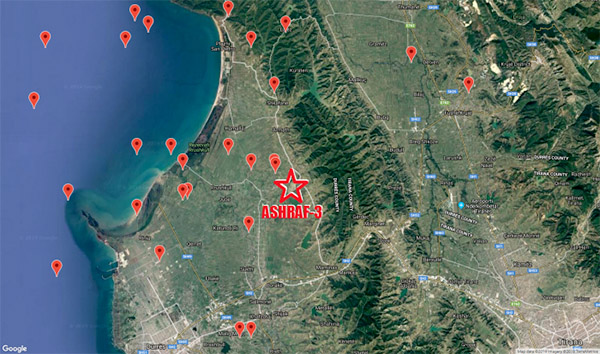
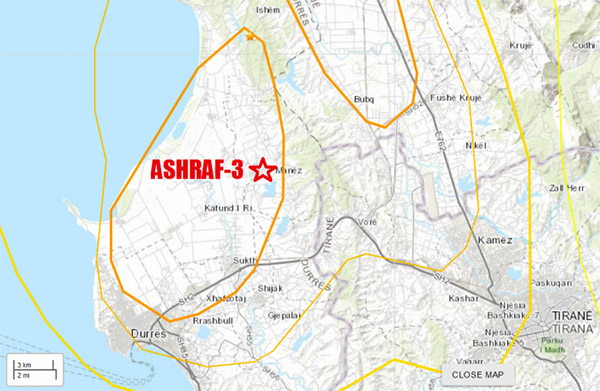
On 26 November, early Wednesday morning at 3:54 local time, northwestern Albania was struck by a strong 6.4-magnitude earthquake with an epicenter northwest of the capital Tirana. The maximum perceived intensity was VIII (severe) on the Modified Mercalli intensity scale. The tremor was felt in all parts of the country, and in places as far away as the Italian city Taranto and the Serbian capital Belgrade, some 370 kilometers northeast of the epicenter. It was the strongest earthquake to hit Albania in forty years. There have been hundreds of aftershocks, of which four have been greater than 5-magnitude.
Following the deadly earthquake, the Albanian government declared Wednesday a day of national mourning and a state of emergency in the Durres and Tirana regions. The earthquake razed several buildings to the ground in the port city of Durres and the surrounding villages, trapping dozens of people. Material damage and casualties have been reported in Tirana also. Neighboring and European Union countries have reacted to the earthquake with sending civil emergency rescue teams and financial aid.
For more than 36 hours, civil emergency crews, police, the army and specialized rescue teams from other countries have been digging in the ruins of collapsed buildings seeking survivors. The authorities say they have so far rescued 45 people. According to the latest official data, at least 48 people were killed in the earthquake, with 790 injured and more than 20 missing. These numbers are far from complete, especially considering the official hiding of foreign victims.

Unreported foreign casualties
While Albanian citizens living in Tirana and Durres, 30 km and 15 km from the epicenter respectively, had some luck to avoid disaster, the members of the People’s Mojahedin Organization of Iran (PMOI or MEK) aka National Council of Resistance of Iran (NCR) had none. Stationed only 5 km from the epicenter of the main earthquake, as well as less than a kilometer away from the epicenter of powerful 5.3-magnitude aftershock, the residents of poorly built barracks of the Ashraf-3 base have experienced true horror.

Camp Ashraf 3 camp Ashraf 3

And everything almost went unreported. Standing with a colleague at the entrance of Tirana’s hospital in search of new information and tragic personal experiences, we were surprised to see a column of emergency vehicles led by a police car, trumpeting and shouting “Clear the way!” Wondering who is so important that ordinary civilians have to get out of the way, including wounded women and crying children, we followed the column until it stopped and politely asked the police officer about the VIP patients. “No camera, get back,” he ignored our questions and tried to drive us away.
Standing aside, but at a decent distance, we saw paramedics fastly carrying wounded on stretchers inside, at least two dozen of them. Some were covered with sheets full of blood, probably half dead, while others were howling in some incomprehensible language. Foreigners, therefore special treatment, I think to myself. But who? Too many for some embassy staff, too much well-treated for tourists, I wondered.
Given the obvious secrecy and strict police measures, we decided to change our approach. Instead of asking sensitive details with the press cards, we dodged the cops and approached one young paramedic: “They sent us here, we are translators, where should we go?” I asked him with self-confidence. “So you speak Iranian,” he responded. “Of course I speak Persian, or Iranian, as you inaccurately say,” I taught him differences and repeated the question about direction. “Second floor,” he explained, showing us where to go, and left quickly.
For me, things immediately started to make sense. Few in Albania do not know that there is a base near Tirana with 4,000 members of the controversial Iranian opposition group, displaced in 2016 from Iraq at the request of the US government. We journalists know a little more. Their compound is highly guarded and residents are strictly controlled, with no contact with the outside world. Several fugitives from the base gave shocking stories, and Albanian journalists who reported about their cases were facing tremendous pressures and harassment. Thus, this disastrous situation turned out to be a gold mine, a unique opportunity to find out what happened there. And what was happening earlier.

Repeating the same approach, I introduced myself as a translator and entered the hospital building. Fortunately, being busy in all that mess, none of the hospital staff asked additional questions or demanded documents, nor know Persian. Neither do I. Therefore, I hoped to find a sufficiently lively and friendly English speaker among the casualties, and I did. Teymur, a skinny mustachioed man in his late 50s, spoke English badly and slowly, but honestly.

“Not fair, we’re razed, but Tehran is not”

“It started shaking while I was sleeping in our dormitory with many others,” Teymur begins his experience. “At first the bed started to shake and I saw many waking up, then the windows and ceiling bursting down. Comrades in our and adjacent dormitories started screaming, some shouting that we were under attack. Finally, the structure began to collapse and the beam fell on my legs. I can’t feel my legs. In the half-dark I saw large chunks falling down, some were crushed, instantly dead. All this happened in less than a minute. Soon there was a lot of dust and I couldn’t see anymore, I just yelled for help. It felt like Mersad.”

Later, on the Internet I found out that Mersad was the name of the 1988 military operation in which Iranian army destroyed their troops in a canyon. Asked to evaluate the number of dead and the damage in their base, Teymur says:

“At dawn I was pulled out of the rubble. They lined us up the road and we waited for emergency vehicles. I heard that some were taken to Durres, others to Tirana. I saw seriously wounded and dead, perhaps dozens. I don’t know exactly. Earlier in the ruins I was calling out the names and out of twenty comrades in dormitory, only three answered me. But I know very well that the dormitory barracks have been destroyed, some razed to the ground, some badly damaged. Most of the base staff were sleeping, the rest were at computers in a hall, working an eight-hour night shift online. There are casualties there too, the ceiling has fallen and ruined our hard work. Simply not fair!”

It was astonishing that Teymur spoke calmly about the dead and wounded, but started to blubber like a baby about the computer hall. He seemed to be more upset by infrastructure losses than by human casualties. I asked him why the computer hall is so important to him.

“We arrived in Albania three years ago and since then we have been preparing for a new life. We have been told that our dear Saudi and Israeli allies have invested a lot of money in our base and infrastructure, that we are safe here. We have been told that we have full support of the US government and all their allies, mister Bolton even promised us to celebrate together in Tehran soon. A year ago, we got new computer equipment and for months we worked hard, promoting human rights and democracy. Just ten days ago, we saw Iranian people on the streets and Tehran buildings ablaze, we thought our dreams had come true. But today, no revolution, no halls, no computers. Everything was lost!”

“It has something to do with Iran”

Teymur’s raised voice elicited the reaction of his colleague in the next bed, chanting something like “mark bar this, mark bar that.” Asked to translate from Persian, Teymur explained that his comrade was cursing Iran and its government. “Why,” I asked.

“It has something to do with Iran, no doubt, we all know that,” Teymur claimed. I was pretty dazzled and asked him if he wants to say that Iran caused the earthquake.

“Yes, yes! How is it possible that an earthquake hits us directly? We were told that the earthquake epicenter was very, very close to our base, that there had been no such strong earthquake for decades! Is it a coincidence that it strikes precisely in the early morning hours when all comrades are at the base, inside the barracks? Someone obviously planned to cause as many casualties as possible! How is it possible that an earthquake strikes us just five days after the suppression of our revolution inside Iran? This is pure revenge! I’m sure that Iranian fingerprints exist. In fact, the Albanian police already announced that they had uncovered Iranian agents who were planning attacks against us, just a month ago. Maybe their agents buried and activated powerful bombs, maybe they use high frequencies via satellites to provoke earthquakes, I read that it’s possible. Iran should not posses such advanced technology, I hope our brother Trump will increase sanctions against their research networks, or respond by force,” Teymur said.

Just when his story was becoming more and more interesting, our conversation was interrupted by a security guard who banged on the door. “Who gave you permission to interview the casualties? If you don’t have an interview permit, get out”, security guard yelled, threatening to take our equipment. “If you publish anything in the media without permission, we will sue you and you will regret it,” a corpulent patron of alleged democracy fighters threatened us at the end.

BY Balkans Post,

December 1, 2019 0 comments
FacebookTwitterPinterestWhatsappTelegramSkypeEmail
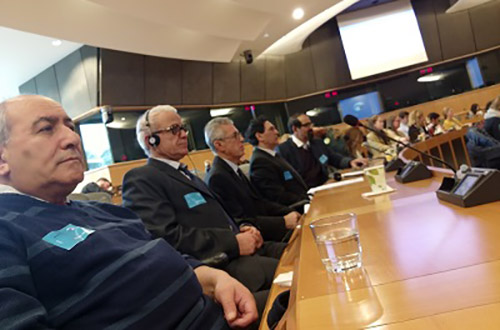
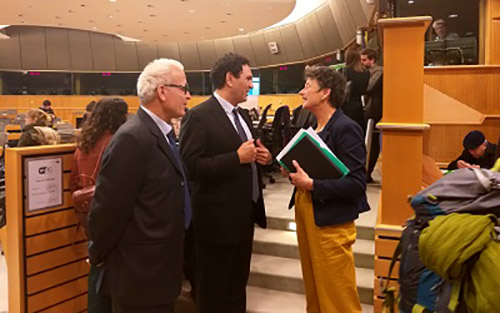
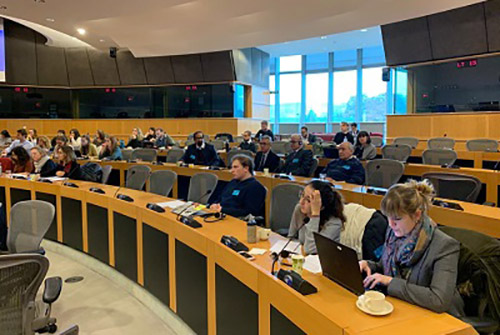
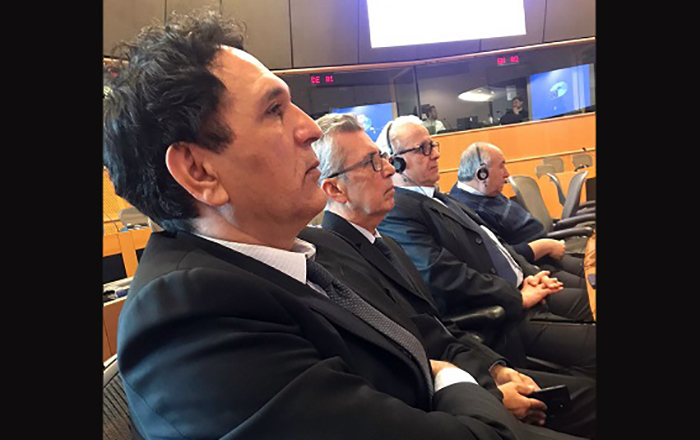
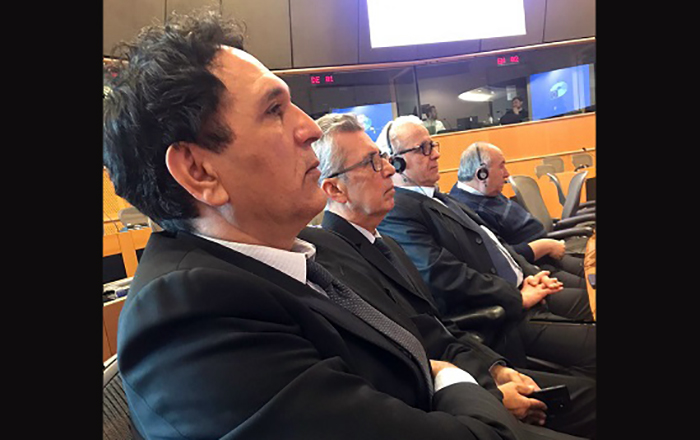
A delegation of former members of the Mujahedin Khalq attended a conference in the European Parliament.
Human Rights Abuse in the MEK

MEK formers at EU Parliament

On Thursday, November 21, a delegation of MEK defectors including Ghorban Ali Hosseinnejad, Isa Azadeh, Mohammad Karami, Reza Sadeghi Jebeli and Ali Akbar Rastgou attended the conference “Shrinking spaces: Policing humanitarianism and human rights defenders” held by the Greens in the European Parliament, Brussels.

A delegation of former members of the Mujahedin Khalq attended a conference in the European Parliament.

The conference addressed how the criminalisation affects the rights of citizens and discuss ways to protect NGOs and human rights defenders.
The defectors clarified that the MEK members do not enjoy the right of education, marriage, having family, contacting the outside world; they have no access to modern communication tools.

November 30, 2019 0 comments
FacebookTwitterPinterestWhatsappTelegramSkypeEmail
Mohammad Turang family
Former members of the MEK

Families, forgotten victims

My name is Mohamamd Turang, I am from Qeshm Island.
Follow my story:

November 28, 2019 0 comments
FacebookTwitterPinterestWhatsappTelegramSkypeEmail
Reza Jebeli - Eu Parliament
Human Rights Abuse in the MEK

Defectors in EU Parliament: Violation of Human Rights in the MEK

A delegation of former members of the Mujahedin Khalq attended a conference in the European Parliament.

On Thursday, November 21, a delegation of MEK defectors including Ghorban Ali Hosseinnejad, Isa Azadeh, Mohammad Karami, Reza Sadeghi Jebeli and Ali Akbar Rastgou attended the conference “Shrinking spaces: Policing humanitarianism and human rights defenders” held by the Greens in the European Parliament, Brussels.

Reza Jebeli - Eu Parliament

The conference addressed how the criminalisation affects the rights of citizens and discuss ways to protect NGOs and human rights defenders. The speakers of the panels included a number of Greens MEPs and guest speakers such as experts and authorities of the Amnesty International’s European Institutions Office.
Socializing with other participants, MEK defectors tried to describe the conditions of refugees who are behind the bars of the cult-like MEK establishment in Albania. They stated that the Cult of Rajavi (MEK/MKO) has deprived its members of their basic rights.

The defectors clarified that the MEK members do not enjoy the right of education, marriage, having family, contacting the outside world; they have no access to modern communication tools.

The audience were impressed by the human right violations that take place in the MEK. Responding to their questions, defectors informed them of the most recent conditions of dissident members who are inside the MEK camps and defectors who have left the group.

November 26, 2019 0 comments
FacebookTwitterPinterestWhatsappTelegramSkypeEmail
Bakhshali Alizade
Former members of the MEKMujahedin Khalq Organization members' families

A complaint to God

I am Bakhshali Alizade.
I was born in 1964.
I was born in Tehran.
…one day, thy took me to a meeting chaired by Massoud Rajavi. From what he said I concluded that in order to overthrow the IRIB we had to divorce our families…
.. in order to force us not to go and see our families they tried to mar the image of our families by calling them “ Ministry’s families” which meant our families were agents of Iran’s Ministry of intelligence..
When my father came, he wished to see me after 17-18 years and I wished to see him as well ….
I was realized that the organization was not to recognize the family at all…
Here you can watch Mr. Alizade’s father at Camp Ashraf Gates before Bakhshali could release himself from the cult barriers:

November 25, 2019 0 comments
FacebookTwitterPinterestWhatsappTelegramSkypeEmail
weekly digest
Iran Interlink Weekly Digest

Iran Interlink Weekly Digest – 264

++ The main issue in Farsi was the BBC report from Albania which was translated into Farsi as well as French and Albanian. The MEK went into overdrive, swearing and threatening. They used their maximum resources in Farsi and English to try to bend reality to their version of events in order to discredit the BBC. Some of those who are close to them in Albania are questioning this and say this is making things worse. ‘Why are MEK calling them “Ayatollah BBC” when Iran’s worst enemy is the BBC’, they ask, ‘it doesn’t add up’. MEK’s Shahin Gobadi told members in a meeting that ‘we do this to make others stop, we make the price of criticism so high that they won’t dare write against us. They know that if we swear at the BBC, we will do the same against them’. The only supporter MEK could find to defend them is Lord Clarke of Hampstead, a veteran MEK advocate in the House of Lords. However, no outlet was interested in publishing his writing, so it had to be re-hashed between MEK sites – Iran Focus, Iran News Update, NCRI, MEK etc. Ironically, someone who has had access to some of the mass of emails complaining to the BBC using pseudonyms, has given a quick analysis. And it happens that they all originate from Tirana and the troll farm and three IPs in London. Which are also the same IPs as Iran Focus and Iran News Update. When this was exposed in Farsi there was a furious backlash. Some ex-members commented and challenged MEK ‘what did the BBC say that is not true? You won’t answer what the BBC said, but which bit of the report haven’t you announced yourself – the divorces, the separation of families, etc?’.
++ The moment the MEK and Pompeo entered into the protests everyone went home. Many opposition personalities are saying we have been forced to shut up and not complain about anything. Whatever happens in Iran, Pompeo or Bolton or MEK want to highjack the protest or demonstration. Therefore, we are stuck. Ironically, these opposition writers have had to address the government they are protesting against to solve this problem. They demand the Iranian government deal with these interlopers and provide more security so they can hold genuine protests and demonstrations. ‘We have to side with the government because our common enemy is Pompeo and MEK’ they say. We ask our government to deal with this external threat so we can have our activities.
In English:
++ The MEK members in Albania (members and formers) continue to hold a disturbed fascination for the media there. Formers accused by MEK’s Ali Safavi of being ‘agents of the Iranian regime’ were interviewed by several media outlets to give their side of the story. Whatever MEK does seems to not work out well for them, though they have still been able to keep a tight hold on those captives in their enclave.
++ Linda Pressly and Albana Kasapi’s radio report for the BBC was written up as a long and detailed article which through interviews and quotes exposes the whole controversy of the MEK’s presence in Albania. Some Albanians commented to Iran-Interlink privately that the country was much better off before MEK arrived.
++ Soraya Sepahpour-Ulrich, an expert on US foreign policy, in an interview with the Balkans Post, says that given the MEK’s past – which she talks about in the interview – it would not be surprising that MEK is used to “carry out acts of terror and sabotage in Europe and place the blame on Tehran”.

++ Several Iranian media outlets published articles in English reviewing various aspects of MEK’s history of enmity against their former country – what is referred to as MEK’s ‘dark history’ of assassinations and bombings which killed over 12,000 Iranian civilians. In one article, MEK’s history of support for the hostage takers at the American embassy in 1980 is exposed through its own publications.
++ MEK’s role in the recent protests against fuel price rises is demonstrated through various articles to have been extremely negative and damaging. Iranian protesters saw very quickly and clearly that their spontaneous activities had been highjacked by the US and its agents like MEK and Reza Pahlavi. They went home. The activities of Iran’s genuine indigenous opposition groups have again been quashed; their genuine grievances exploited by external agents for regime change. It must be clear by now that nobody in Iran wants regime change and especially not with US-backed MEK involvement.

November 22, 2019

November 24, 2019 0 comments
FacebookTwitterPinterestWhatsappTelegramSkypeEmail
blank
Mujahedin Khalq Organization as a terrorist group

Iranian Protests And MEK Absence Inside Iran

AS U.S. SANCTIONS strangle Iran’s economy, anti-government protests are spreading. This week on Intercepted: Iranian-American author and analyst Hooman Majd discusses a century of history marked by intervention and threats from major world powers. Beginning with Britain, Russia, and Germany battling for control of Iran’s oil, Majd and Jeremy Scahill discuss the CIA coup against Mohammed Mossadegh in 1953, the Islamic revolution, and the seizure of the U.S. embassy in Tehran in 1979 and how Washington has repeatedly tried to bring down the government of the Islamic Republic. The Intercept’s investigative series The Iran Cables offers historical insight into Iran’s operations in neighboring Iraq, which are informed by the bloody history of the Iran-Iraq War, the U.S. invasion, subsequent occupation, and the shattering of Iraqi society.
[…]

The Audio File

JS: We’re talking about what is driving the protests on just sort of a human level but who is organizing these protests? What do we know about the kind of opposition to the established government in Tehran right now? Is there a nexus of groups? Are there individuals or is this spontaneous?

HM: In this particular case, it’s mostly spontaneous, although exile groups have taken some credit and have sort of become the focal point of conversation about these protests.

JS: What kinds of exile groups?

HM: The monarchists and the MEK. The monarchists are claiming that people are shouting for Reza Pahlavi, the Shah’s son to come back. MEK are claiming that they have thousands and hundreds of thousands of supporters in Iran who are out on the streets. Not that they don’t have any supporters, I mean, that would be ridiculous. Of course, they have some support in Iran. And they have contacts and probably spies even inside the government. But to say that either one of these groups was able to instigate protests and riots and all kinds of vandalism in Iran in over 100 cities in the space of, you know, a day would mean that they’re much, much more powerful than we would think, and therefore, why haven’t they been able to overthrow the regime by now?

JS: Your analysis that you’re offering here is reminiscent of some of the conversation that we heard around Iraq in the 1990s where you had these totally discredited exile figures like Ahmed Chalabi getting a disproportionate amount of influence in Washington. You know, Iraqis I knew at the time used to say Ahmed Chalabi has much more of a constituency along the Potomac than he has along the Tigris, or Euphrates. And part of the plan early on in the invasion of Iraq and the toppling of Saddam that was a pretty popular concept in the CIA and elsewhere was to put Ahmed Chalabi in charge of the Iraqi government. This guy who was totally unknown to most Iraqis.

You’re talking about the MEK right now, which for a long time was a State Department designated terror organization and has had bipartisan political support in the United States from the likes of Howard Dean, Rudy Giuliani, John Bolton, Mike Pompeo, and others—

HM: Governor Richardson.

JS: Governor Richardson, right. I mean, but again, the United States government determined that this was a terror organization, you know, at one point and there was a huge lobbying campaign to lift it. Does it seem to you like the Trump administration policy seems to be a desire to place MEK people in charge of a new Iran? I mean, that was John Bolton’s position.

HM: I think that was John Bolton’s position, yes, but he’s gone. I also don’t—I find it very hard to believe that with all the—I mean, of course, with the Trump administration it’s hard to say. But with all the intelligence officers, all the analysts, all the think tanks that say that that’s not going to happen, that they will never be in charge of Iran, that we would think that that would still be OK. I mean—

JS: The Iranians of all political strifes would resist that.

HM: Including the monarchists who hate them, as well. And the monarchists do have a, you know, kind of presence in Washington as well. I mean, they may have been a useful tool for the United States and even in the delisting as a terrorist organization has been a useful tool in the toolbox that we have against regimes we don’t like. Let’s also remember the Iraqi people at the time that Chalabi was being groomed in Washington, were not, I mean, they didn’t have access to the internet. They weren’t very aware of what’s going on in the rest of the world. As you say, they hardly even knew who Chalabi was.

Iranians inside Iran, until Sunday night, were very connected. They have 4G on their phones. I mean, yes, a lot of sites are blocked in Iran but they could read the New York Times; they could be on Instagram, which are not blocked. They could get VPNs, and you know, they’re on Twitter and everything else. They’re much more aware of the MEK than for example, Iraqis would have been of Chalabi. And I don’t think we, when I say we, the United States had very much intelligence inside Iraq prior to the invasion of Iraq. Whereas we do have a lot of intelligence inside Iran, mainly because there’s two million Iranians living in America who go back and forth all the time.

JS: I think it would be really helpful to take a walk through some of the multi-decade history of how Iran ended up the way it is now, the way its government functions and the way that Iran has acted in Iraq, as evidenced by these cables. Let’s begin sort of in the 1930s or 40s. What was Iran like during that period? How was it governed? What was its standing in the world?

[…]

Jeremy Scahill, The Intercept

November 23, 2019 0 comments
FacebookTwitterPinterestWhatsappTelegramSkypeEmail
blank
Mujahedin Khalq Organization's Propaganda System

US – MEK meddling poisons grassroots democracy in Iran

Though the latest unrest in Iran about the rising prices of fuel started as a purely internal issue, Washington quickly inserted itself into the dispute, seeking to advance its agenda of toppling the government in Tehran.

Gas prices doubled or even tripled over the weekend, following a decision by the government to cut fuel subsidies and redirect those funds into other social programs. Widespread protests across Iran have escalated into riots in some places, with reports of half a dozen deaths and multiple injuries. The authorities have blamed the US for fueling the unrest and apparently shut down the internet in response.

The official line coming out of Tehran seems to be that protests themselves are legitimate, but that the violence was the work of “a group of anarchists and saboteurs” which are “by no means in line with the conduct and behavior of the majority of the understanding and insightful Iranian people,” in the words of Foreign Ministry Spokesman Abbas Mousavi.

Another indication that the government recognizes the protests as legitimate was a sarcasm-laden segment about gas prices and inflation in general, which had no trouble airing on state TV.

“Our authorities make other really nice comparisons: Comparing our taxi fare w/ that of #NewYork, price of fuel w/ #London, price of rent w/ #Paris, price of gas w/ #Turkey but when it comes to wages they make a comparison w/ #Ethiopia. Otherwise, their comparisons are really gd.

— Ali Fathollah-Nejad (@AFathollahNejad) November 16, 2019

Washington is not even bothering to hide its glee. Over the weekend, as the protests heated up, Secretary of State Mike Pompeo retweeted a 2018 message to the “people of Iran,” telling them that the US “hears you… supports you… is with you.”

On Monday, the State Department tweeted out graphics accusing the government in Tehran of spending billions of dollars on “funding terrorism” instead of on social programs at home.

Iran’s President Rouhani raided $4.8 billion from the National Development Fund to pay for terrorism. pic.twitter.com/UWBPHZXQIr

— Department of State (@StateDept) November 18, 2019

That’s some irony, considering that Iran’s current predicament is almost entirely due to the US unilaterally shredding the 2015 nuclear deal and reimposing sanctions on Tehran – while threatening other countries to follow suit, or else. Pompeo himself said a year ago that Iran had a choice to submit or starve.

Mousavi brought that up on Sunday, arguing the people of Iran are “under pressure of the United States’ economic terrorism,” and rejecting Pompeo’s “hypocritical remarks” as lacking genuine sympathy.

Support for the protests by US-backed exiles such as MEK, who are angling for regime change in Tehran, will do little to dissuade those in Iran inclined to see Washington behind the violence.

Shiraz, south-central #Iran
“Down with dictator!”
Locals are continuing their protests over the latest gas price hikes & targeting senior regime figures.#IranProtestspic.twitter.com/c11ffSI8Rs

— People’s Mojahedin Organization of Iran (PMOI/MEK) (@Mojahedineng) November 16, 2019

It is no secret that Washington has been opposed to the Islamic Republic ever since it overthrew the pro-US monarchy in the 1979 revolution. While it may have seemed that Trump’s hard line towards Tehran may have been driven by MEK fan John Bolton, the fact that nothing changed following Bolton’s dismissal in September suggests otherwise.

When Pompeo says the US “stands with the people of Iran,” it is hard to not notice that he also“stands with Venezuela” – in wanting regime change in Caracas, that is. Or that the Trump administration hailed the entirely undemocratic trampling of electoral results in Bolivia as a “significant moment for democracy” and “one step closer to a completely democratic, prosperous, and free Western Hemisphere.”

Rising gas prices were behind last month’s demonstrations in Ecuador, as well as the Yellow Vests movement in France that’s been going on for a year now. Chileans have been protesting for weeks over subway fare hikes – with two dozen reported deaths so far. Yet the US has not clamored for regime change in any of those places. Amnesty International has not been “horrified” or “alarmed” by any of them, as it is about Iran.

Compare and contrast the amount of coverage given to those protests with places whose governments Washington disapproves of: Hong Kong, Bolivia, Venezuela, Iran… Could it possibly be that the “who” and the “where” have a lot more to do with that than the “why”?

One of the overlooked but especially pernicious effects of US-backed “color revolutions” over the past 20 years has been to poison the well of genuine democracy and grassroots protests around the world. When media, NGOs, street protests and even elections are easily weaponized to either advance the cause of regime change, or delegitimize genuine social movements – depending solely on whether the US likes the country’s government or not – how does anyone know what is legitimate anymore?

So no, this is not just about the cost of gas at the pump.

November 20, 2019 0 comments
FacebookTwitterPinterestWhatsappTelegramSkypeEmail
MEK- Mujahedin khalq Organization
Mujahedin Khalq Organization as a terrorist group

Five reasons why the MEK should be still considered a terrorist entity

The Mujahedin Khalq Organization (the MKO/ MEK/ PMOI/ the Cult of Rajavi) is not in the western lists of terrorist groups rather it is designated as a terrorist organization by Iran and Iraq. The documented history of the MEK indicates that it has committed several acts of violence against civilian and has been involved in massacring innocent people of Iraq and Iran. It has carried out bombings against the Iranian shah’s government in the 1970s and later against Iran’s post-revolution Islamist rulers in the 1980s and 1990s. The United States designated MEK as a terrorist organization in 1997, citing those attacks, including 1970s-era bombings that killed several U.S. contractors.

However, the MEK was removed from the terrorist list in 2012 following a heavy multi-million dollar campaign and lobbying by prominent American figures. Their reason for delisting of the group was based on the group’s alleged renunciation of violence. Yet, there are many reasons to consider the MEK as a terrorist group.

1. The MEK’s army structure
In June 1981, the MEK leaders announced armed struggle against the Iranian government. This date is celebrated every year by the group glorifying the start of armed struggle against Iranians who soon became the target of this terrorist army. The MEK established a military force which was financially and logistically supported by Saddam Hussein. Actually they formed”Saddam’s private army”but they named it”National Liberation Army”.
Units of the so-called NLA received military training and eventually launched several cross border operations against Iran killing a large number of Iranian civilians and governmental figures. They aided Saddam Hussein in suppressing Kurdish and Shiite uprisings. Maryam Rajavi is notoriously known for telling her forces:”Take the Kurds under your tanks; save your bullets for Iranian revolutionary guards”.
The MEK is still directed in a hierarchical army structure. There are various units of an army like battalion, brigade, division and commanders who are appointed to control the rank and file. This army was physically armed until the fall of Saddam Hussein. Then, the US military decided to disarm the group.
The MEK was apparently disarmed but the military structure did not change. The MEK’s cult-like structure did not allow members to think freely out of the army establishment.

2. The MEK’s cult-like structure
Although the MEK is not officially called a cult but it has been repeatedly considered a cult-like organization. It was first called”The cult of Rajavi”by Elizabeth Rubin the correspondent of the New York Times Magazine who wrote a documented report of the life in Camp Ashraf, Iraq after she visited the camp in 2003. Rubin was allowed to interview the rank and file observing their daily routine life in the Camp. Eventually, she published a detailed report of what she called”a fictional world of female worker bees”even though the group’s leaders had tried hard to show off a nice portrait of the life in the camp for Rubin.
Since then, there have been various reports, testimonies and documentaries that confirmed Rubin’s article on group’s cult-like behavior, consequently the group is now widely regarded as a cult. Report commissioned by the US Defense Department (RAND Report), based on interviews within Camp Ashraf, later concluded that the MEK had”many of the typical characteristics of a cult, such as authoritarian control, confiscation of assets, sexual control (including mandatory divorce and celibacy), emotional isolation, forced labour, sleep deprivation, physical abuse and limited exit options”.
Cult-like structure of the MEK has been established around the personality of its couple leaders Massoud and Maryam Rajavi. They are considered as absolute leaders to whom the rank and file should dedicate their life. According to the group’s regulations, members are constantly brainwashed and indoctrinated to sacrifice themselves not only for the cause of the group but also for the leaders.

3. MEK Members always prepared to commit suicide
MEK’s violent past is coincident with their suicide operations. From the early years of armed struggle, MEK operators were always ready to commit suicide. They were trained to swallow the cyanide capsule in case they were at risk of being arrested. In several assassination operations the MEK member had to commit suicide in order to kill his victim. For example, in December 1981 woman named Gohar Adab-Avaz killed the representative of Ayatollah Khomeini in Shiraz, Abdol Hossein Dastgheib in a suicide attack in Shiraz. She was praised by MEK propaganda as a”Great Mujahed”.
The cult jargon that requires members to commit suicide got its top notch when Maryam Rajavi was arrested by French Police alongside some 150 MEK members for preparing to commit or finance acts of terrorism in June 2003. A dozen of MEK members set themselves on fire to protest the arrest of their leader”Sister Maryam”. Two women named Neda Hassani and Sedighe Mojaveri died from the injuries. They were then glorified as”martyrs”by the group’s propaganda.
It is normally expected that those few thousand Mujahed members who are residing in Albania now have been coerced to commit suicide and/or homicide whenever the group orders them to do so.

4. Having no public support the MEK has to resort to violence
As Saddam’s private army, under their disillusioned leader Massoud Rajavi, the MEK staged attacks against civilian and military targets across the border in Iran and helped Saddam to suppress his own domestic enemies. But after siding with Saddam – who was in a bloody war with Iran that cost the lives of thousands Iranians – the MEK lost almost all the support it had inside Iran. Members are now widely regarded as traitors.
The new Iranian generations hardly ever know who the MEK are. However, their parents and grandparents remember the group’s atrocities against their own country fellow men which is a good reason for their hatred against the group. Therefore, the MEK is so notoriously known inside Iran that it can never enjoy the support of Iranian public thoughts.
Nevertheless the MEK claims that its main objective is the overthrow of the Iranian regime. Maryam Rajavi uses a controversial expression: peaceful regime change. How can she succeed to change the regime in Tehran peacefully without the support of the Iranian people? It is absolutely undisputable that the group has to resort to violence in order to achieve its objective as it has been involved in recent violent acts against Iranian nuclear scientists.

5. MEK a proxy force for enemies of Iran
After the collapse of the MEK’s main sponsor, Saddam Hussein, the group tended to offer services to super powers such as the United States and Israel. The group cooperated with the Israeli Intelligence agency Mossad to assassinate the Iranian nuclear scientists. NBC News reported that the MEK agents were Mossad’s operational arms to injure and kill a dozen of the Iranian scientists.
It was also investigated by Seymour Hersh of the New Yorker, that the MEK operators received spying, military and other special trainings in Nevada desert, the United States, under the command of the US military.
This indicates that the MEK has still the capacity to commit acts of violence. Actually, the MEK members have turned into brainwashed bombers, assassins and suicides. They should be considered terrorists.

November 19, 2019 0 comments
FacebookTwitterPinterestWhatsappTelegramSkypeEmail
Newer Posts
Older Posts

Recent Posts

  • The black box of the torture camps of the MEK

    December 24, 2025
  • Pregnancy was taboo in the MEK

    December 22, 2025
  • MEPs who lack awareness about the MEK’s nature

    December 20, 2025
  • Why did Massoud Rajavi enforce divorces in the MEK?

    December 15, 2025
  • Massoud Rajavi and widespread sexual abuse of female members

    December 10, 2025
  • Facebook
  • Twitter
  • Instagram
  • Youtube

© 2003 - 2025 NEJAT Society . All Rights Reserved. NejatNGO.org


Back To Top
Nejat Society
  • Home
  • Articles
  • Media
    • Cartoons
    • NewsPics
    • Photo Gallery
    • Videos
  • Publications
    • Books
    • Nejat NewsLetter
    • Pars Brief
  • About Us
  • Contact us
  • Editions
    • عربي
    • فارسی
    • Shqip