Nejat Society
  • Home
  • Articles
  • Media
    • Cartoons
    • NewsPics
    • Photo Gallery
    • Videos
  • Publications
    • Books
    • Nejat NewsLetter
    • Pars Brief
  • About Us
  • Contact us
  • Editions
    • عربي
    • فارسی
    • Shqip
Nejat Society
Nejat Society
  • Home
  • Articles
  • Media
    • Cartoons
    • NewsPics
    • Photo Gallery
    • Videos
  • Publications
    • Books
    • Nejat NewsLetter
    • Pars Brief
  • About Us
  • Contact us
  • Editions
    • عربي
    • فارسی
    • Shqip
© 2003 - 2024 NEJAT Society. nejatngo.org
MEK- Mujahedin khalq Organization
Mujahedin Khalq Organization as a terrorist group

MEK claimed the responsibility of terror acts against civilians

In June 1998, a year after the election of the Iranian Reformist President, Mohammad Khatami, the Mujahedin Khalq Organization (the MKO/ MEK/ PMOI/ Cult of Rajavi) launched a new series of terrorist attacks in Iran. On June 2nd, 1998 two mortar attacks and a bombing was launched in three locations in Tehran by the MEK.

The group’s operatives attacked the Tehran General Prosecutor’s Office on Shariati Avenue carrying the bomb in a handbag.

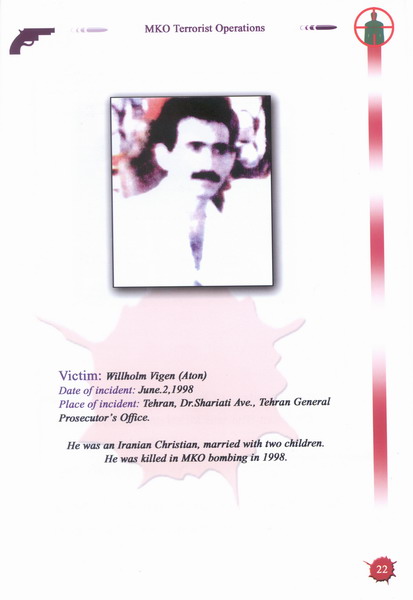
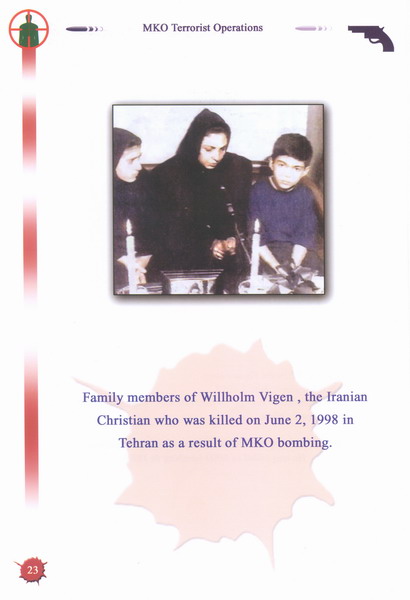
The bomb exploded in the corridor of the building killing three men including a Christian man who was the facilities engineer of the Justice department. Willholm Vigen was 52, married with two children. 21 people were injured in the attack too.
The MEK claimed the responsibility of the attack immediately and issued a statement claiming that the group’s “military units crushed the dozens of torturers and judges of the Iranian courts”!
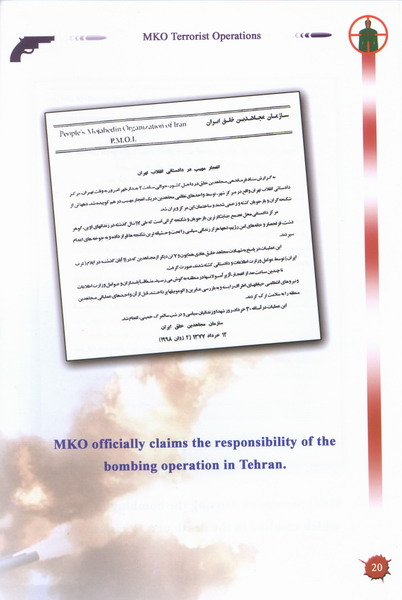
MKO Terrorist Operations - page 20  Another statement was published just two days later to launch disinformation about the death of the Christian citizen, Vigen. The group’s propaganda completely denied that the attack had targeted civilians and particularly the Christian citizen. They claimed that Vigen’s funeral in a church in Tehran was attended by the Islamic revolutionary guards and agents of the Intelligence ministry!
June 3, 2019 0 comments
FacebookTwitterPinterestWhatsappTelegramSkypeEmail
Female operators in ISIS and MEK, victims of destructive cults
The cult of Rajavi

Female operators in ISIS and MEK, victims of destructive cults

The recent report on the “the Most Notorious Wives and Mothers of Daesh” published on Sputnik, should not be taken for granted, neither should it be considered as the problem of Daesh (ISIS). [1] Moreover, the report is supported by several reports previously published by other news outlets, for instance the Guardian’s one on an American woman of ISIS, Hoda Muthana. [2]

The bitter stories of wives and mothers of ISIS fighters have been highlighted following the decline of the terrorist group. Most of these women regret their decision to join ISIS. Muthana describes her experience with Isis as “very mind-blowing”. “I was brainwashed once and my friends are still brainwashed,” she tells the Guardian. [3]
Although the ISIS terror group was mostly collapsed, there are other groups out there who have already trained the most dangerous wives and mothers to commit the most horrific acts. The Mujahedin Khalq Organization (the MKO/ MEK/ PMOI? Cult of Rajavi) is one of the avant-garde movements to mobilize female jihadists. Cult-like structure is the common characteristic of all these groups which causes the most horrible disasters to their victims.

The group has used female fighters from the early years of its establishment in the 1960s. Female members, particularly young girls were the first terrorist operators in the cities of Iran. After the 1979 Iranian revolution and the early break down with the Islamic Republic government, the MEK launched numerous terrorist attacks against the Iranian civilians and authorities. A large number of these violent acts were carried out by female members of the group. Certain terror acts were committed by female suicides. Iran_interlink reports,”On the morning of Friday, 11 December, 1981, an elderly Iranian cleric Abdol Hosein Dastgheib was assassinated by Mojahedin Khalq assassins in the city of Shiraz while he was leaving his house for the Friday prayer. The assassin was a 19 year old female who was later recognized as Gohar Adab Avaz. “The assassination was a unique act of terror practiced by the MEK in which a human being was used as a living weapon. Pretending to be pregnant, she told the victim’s security people that she had a letter for the Grand Ayatollah and was willing to give the letter to him personally, while under her clothing she was wearing a powerful hand-made bomb.” [4]

Zahra Noorbakhsh, is a victim of Mek’s violence. She was interviewed in a documentary titled “The Secrets Behind Auvers-Sur-Oise”. She also recalls MEK’s female terrorists. She recounts the story of her injury and the death of her two-year-old sister in a public transportation bus that was set on fire by the MEK agents: “We were on the bus and there were a lot of people. Four women got on the bus and they had firebombs on them. They threw the firebombs into the middle of the bus. The bus caught fire. When the bus went on fire, we were in the middle of it and everyone run towards the doors to get out. My sister and I were in the middle of the bus and we were engulfed in flames. My sister got completely burnt, she was burnt to death. And I was injured. I immediately took to hospital. I had very bad injuries on my head, my hands and my face.” [5]
“Marjan Malek was recruited as an asylum seeker in the Netherlands, and changed from a non-political person into a soldier for Rajavi”, states Judith Nourink in her book on the MEK, “Misled Martyrs”. “She went to Tehran for an attack on an army barracks. She was caught.” After her arrest and the deradicalization, Marjan Malek turned out to be one of the early founders of Nejat Society. [6]
Female jihadists usually have a tough life inside their organizations too. “I’m really traumatised by my experience,” Muthana told the guardian. [7] Although they may seem to be overconfident fighters for the cause of the group, female members of the MEK are themselves victims of the most horrific abuses.
In November 2018, the Guardian published an investigated report on the MEK. The author of the piece Arron Merat describes the story of the MEK “terrorist cultists” as “wild wild”. About the human rights abuses inside “the Cult of Rajavi” he writes:

“When we spoke recently, Soltani accused Maryam Rajavi of helping Massoud to abuse female MEK members over the years. “[Massoud] Rajavi thought that the only Achilles heel [for female fighters] was the opposite sex,” Soltani told me. “He would say that the only reason you women would leave me is a man. So, I want all of your hearts.”

“Soltani, who was one of three women to speak about sexual abuse inside the MEK in a 2014 documentary aired on Iranian television, alleged that Rajavi had hundreds of “wives” inside the camp.” [8]
Of-course, the testimonies of Soltani was not broadcasted as widely as the stories about”Jihad al-Nikah”that is referred to”sexual Jihad”by the women in the ISIS. There are definitely a lot more untold stories on female members of the cults such as MEK and ISIS. However, with the fall of ISIS the wives and mothers of the group are now in the limelight of the news media while female members of the MEK are still victims of the notorious hierarchy of Rajavi’s cult. They are isolated in Camp Ashraf 3 in Albania, being brainwashed on daily basis and trained for any act of violence in case of necessity. Remember the two young women Neda Hassani and Sedigheh Mojaveri who set themselves on fire in June 2003 to protest the arrest of the cult leader Maryam Rajavi.
Mazda Parsi

References:
[1] Klarenberg, Kit, On the Run, Nowhere to call Home: The Most Notorious Wives and Mothers of Daesh, Sputnik News, May 20th, 2019.
[2] Chulov, Martin& McKernan, Bethan, Hoda Muthana ‘deeply regrets’ joining Isis and wants to return home, The Guardian, February 17th, 2019.
[3] ibid
[4] https://www.nejatngo.org/en/posts/4624
[5] https://www.nejatngo.org/en/posts/6767
[6] Neurink, Judit, Misled Martyrs: How Iranian terrorists became America’s best friends, GigaBoek, January 12, 2009.
[7] Chulov, Martin& McKernan, Bethan, Hoda Muthana ‘deeply regrets’ joining Isis and wants to return home, The Guardian, February 17th, 2019.
[8] Merat, Aron, Terrorists, cultists – or champions of Iranian democracy? The wild wild story of the MEK, The Guardian, November 9th, 2018.

June 2, 2019 0 comments
FacebookTwitterPinterestWhatsappTelegramSkypeEmail
MEK Terrorists
Mujahedin Khalq; A proxy force

MEK the pretext of US invasion of iraq

The U.S. military’s guided bombs brought “shock and awe” to Baghdad in 2003 when American forces invaded Iraq 16 years ago to hunt for weapons of mass destruction. They never found any. Many observers, today, consider that war a failure.
Now, half of all Americans believe the U.S. will go to war with Iran “within the next few years,” according to a Reuters/Ipsos public opinion poll released in late May amid increased tensions between the two countries, longtime geopolitical foes.

The escalating Tehran-Washington crisis comes as the White House claims, without providing detail or public evidence, that Iran poses an increased threat to American forces and facilities in the Middle East – one year after Trump withdrew from an accord between Iran and world powers aimed at limiting Tehran’s nuclear capabilities.
Trump’s hawks: Bolton amps up Iran sabotage claims, desire for nuclear weapons
Is Iran doomed to be an Iraq redux? This is just one of the questions raised by a crisis that has eerie parallels to the missteps that led to the Iraq War in 2003, where the buildup to conflict was precipitated by faulty intelligence and confrontational foreign policymakers such as John Bolton in President George W. Bush’s administration.

To make sense of what’s happening now, here’s what happened then:

Operation Desert Storm – the 1990-91 Persian Gulf War – came to an end 42 days after a U.S.-led offensive was launched in response to Iraqi leader Saddam Hussein’s invasion of neighboring Kuwait. Iraq’s dictator accused Kuwait and Saudi Arabia of conspiring to keep oil prices artificially low for western consumers. President George H.W. Bush declared a ceasefire on February 28, 1991, as Iraqi forces in Kuwait surrendered or fled back to Iraq. About 700,000 American service members were deployed to the Gulf for the short war; 383 were killed.
When President George W. Bush became president in 2001, Hussein was back on the agenda. “There were a number of people in the Department of Defense who wanted to pursue a certain policy course. I don’t think they ever took their eyes off of Iraq,” former CIA Director John Brennan said in a 2007 National Geographic documentary about the 2003 Iraq War. “There was still a great deal of residual feeling that we should not have stopped the first Persian Gulf War when we did, but rather continue into Baghdad and topple Saddam Hussein,” ex-Senator and ex-Florida governor Bob Graham said in the same documentary.
Among the figures Brennan and Graham were referring to: Vice President Dick Cheney, Defense Secretary Donald Rumsfeld and Bolton, who had worked as a lawyer for the Bush campaign to block recount efforts in Florida that led to state officials awarding the 2000 election to Bush over Democratic candidate Al Gore.
Bolton was a lifelong staunch conservative with hawkish views on foreign policy. For a start, he abhorred multilateralism. “There is no United Nations. There is an international community that occasionally can be led by the only real power left in the world, and that’s the United States,” he said of the international organization in 1994, adding: “The secretariat building in New York has 38 stories. If you lost 10 stories today, it wouldn’t make a bit of difference.” Years later, Bolton’s nomination to be U.S. Ambassador to the UN was blocked because of his hardline views. He would also call for the U.S. to make pre-emptive strikes against North Korea.
The Sept. 11, 2001, attacks in New York City and Washington shifted the Bush administration’s focus to hunting Osama Bin Laden in Afghanistan, where the ruling Taliban had given shelter to the al-Qaeda’s leader, who masterminded the attacks. But Iraq was also on the radar of the Pentagon’s military planners, who feared that Hussein might try to support or orchestrate an equally, or worse, catastrophic assault on U.S. soil “We’re also working to prepare our nation for the next war,” Rumsfeld said at a briefing on Afghanistan in late 2001, referring to Iraq.
In January 2002, Bush branded Iraq part of an “axis of evil” for harboring, financing and aiding terrorists, and for its pursuit of nuclear weapons. Also members of the club: Iran and North Korea. These countries, Bush said, “are threatening the peace of the world.” He cast aside more dovish voices in his cabinet who urged him to pursue a diplomatic path in Iraq, saying “we can’t wait for the final proof, the smoking gun, that could come in the form of a mushroom cloud.”
Around the same time, Bolton, then serving as undersecretary of state for arms control and international security affairs in Bush’s administration, was becoming a key player in pushing for a military confrontation with Iraq, saying in a BBC radio debate that he was “confident” that Iraq had “hidden” weapons of mass destruction, including chemical weapons and production facilities. “The U.S. has already decided the outcome of this story – Saddam will be left with no weapons of mass destruction – but how that point is reached is up to Saddam Hussein,” Bolton said in the debate in London. He was also making unverified claims about other countries he wanted included in Bush’s “axis of evil,” testifying to the House Committee on Foreign Affairs that Cuba was secretly developing a biological weapons program that could be used in warfare against American forces and civilian targets by “rogue states.” Bolton provided no details when questioned. A subsequent Senate investigation found no evidence supporting his assertions.
In the months leading up to the Iraq War in 2003, Cheney appeared on NBC’s “Meet the Press” with a further warning: “The situation, I think, that leads a lot of people to be concerned about Iraq has to do not just with their past activity of harboring terrorists, but also with Saddam Hussein’s behavior over the years and with his aggressive pursuit of weapons of mass destruction.”
Despite not being able to produce clear “smoking gun” evidence of Hussein’s “hidden” program to acquire weapons of mass destruction, Bush, buoyed by key advisors such as Bolton, opted for war with Iraq. When he was not able to get an express United Nations Security Council mandate to do so he pursued a “coalition of the willing” that included Australia, Britain, Japan, Spain and others.
After the U.S. invasion of Iraq on March 20, 2003, Hussein spent nine months on the run before he was found hiding in an eight-foot-deep hole near his hometown of Tikrit. An Iraqi court convicted Hussein of crimes against humanity, for using deadly gas against Iraqi Kurds and other transgressions, and he was later executed by hanging. No evidence of Iraq’s weapons of mass destruction was found. The war was viewed as a fiasco, not only of intelligence, but because it further destabilized the region, contributed to the formation of the Islamic State terrorist group and led to the violent deaths of more 200,000 Iraqi civilians and at least 4,500 American troops. It added more than $1 trillion to U.S. government debt. Iraq’s economy, security and government remain in a fragile state.
In an opinion article in The Guardian in 2013, Bolton wrote: “Overthrowing Iraqi dictator Saddam Hussein in 2003 achieved important American strategic objectives. Our broad international coalition accomplished its military mission with low casualties and great speed, sending an unmistakable signal of power and determination throughout the Middle East and around the world. Despite all the criticism of what happened after Saddam’s defeat, these facts are indisputable.”
Meanwhile, with the failed outcome of the 2003 Iraq War still plain to see, Bolton started ramping up his outspoken criticism of Iran’s Islamic Republic. In 2009, as President Barack Obama’s administration entered into what would turn out to be almost five years of negotiations with Iran over its nuclear program, Bolton said: “Ultimately, the only thing that will stop Iran from getting nuclear weapons is regime change in Tehran.” As the deal entered its final stages, Bolton advocated in a New York Times opinion piece that the U.S. join forces with Israel: “Time is terribly short, but a strike can still succeed. Such action should be combined with vigorous American support for Iran’s opposition, aimed at regime change in Tehran,” he wrote. The articled was headlined: “To Stop Iran’s Bomb, Bomb Iran.”

Also troubling: The Iranian opposition group Bolton was referring to in his New York Times opinion article is the National Council of Resistance of Iran, a controversial Paris-based political organization also known as the Mujahedeen-e-Khalq, or MEK. Along with Trump’s lawyer, Rudy Giuliani, Bolton is long-time supporter of the exiled opposition group and has been paid to speak at its annual rallies. The MEK is often described by observers of its activities, including by humanitarian groups and even a U.S. government research document from 2012, as displaying “cultlike behavior.” The MEK’s reported abuses – vigorously denied to USA TODAY by its senior leadership who claim they result from a vicious and protracted “disinformation campaign” by Iran’s clerical rulers – range from torture and forced celibacy to holding members against their will, sometimes in solitary confinement. The MEK says its critics are often spies for the Iranian regime. Bolton’s first encounters with the MEK took place in Iraq, where for a period it had aligned itself with Hussein’s government, which was fighting a war with Iran.

When Bolton joined the Trump administration as national security adviser in 2018, replacing seasoned former Army officer Lt. Gen. H. R. McMaster, he continued his public saber rattling and criticism of Iran by releasing a video on the 40th anniversary of the Iranian revolution via the White House’s official Twitter channel. In the video, Bolton calls Iran “the central banker of international terrorism” and accuses Tehran of pursuing nuclear weapons and missiles to deliver them and of “tyrannizing its own people and terrorizing the world.” The video ends with a direct threat to Ayatollah Ali Khamenei, Iran’s Supreme Leader: “I don’t think you’ll have many more anniversaries to enjoy,” Bolton says.
Iran’s interest in nuclear technology dates to the 1950s, when it received help from a U.S.-backed program promoted by President Dwight D. Eisenhower, who wanted to share U.S. nuclear expertise with other countries for peaceful purposes, such as energy production. But after Iran’s 1979 Islamic Revolution and a U.S. hostage crisis at the U.S. Embassy in Tehran effectively ended relations between the two nations, U.S. intelligence agencies have long suspected, without explicit evidence, that Iran has attempted to use its civilian nuclear program as a cover for clandestine weapons development. Obama’s 2015 nuclear accord was designed to prevent that and the UN’s nuclear watchdog has repeatedly verified through inspections and other safeguards that Iran has been complying with the terms of the agreement, even after the U.S. withdrew from it and Washington re-imposed sanctions that have crippled Iran’s economy. Bolton has regularly decried those inspections as ineffectual, believes the nuclear accord was a sham and has advocated for a far bolder Iran policy that aggressively addresses Iran’s support for anti-American shia militias and Tehran’s ballistic missile program.
Most Iran experts, political scientists and many U.S. lawmakers believe that it is this – Bolton’s desire, like in Iraq, to confront Iran – that underpins a still-unexplained decision by the Pentagon to deploy warships, B-52 bombers and missiles to the Persian Gulf earlier this month in response to unspecified threats from Iran in the region. The U.S. also plans to send 900 additional troops to the Middle East and extend the stay of another 600 who are part of tens of thousands of others on the ground there. “The previous administration appeased the Islamic Republic of Iran. So we are pushing back. And when you push back, tension does increase,” U.S. Secretary of State Mike Pompeo, another Iran hawk in the Trump administration, said in response to efforts to get clarity over the moves.
In recent days, Bolton also has accused Iran of being behind a string of incidents in the Persian Gulf, including what officials allege was sabotage of oil tankers off the coast of the United Arab Emirates and a rocket that landed near the U.S. Embassy in Baghdad, while Yemen’s Iranian-aligned Houthi rebels launched a string of drone attacks targeting Saudi Arabia. Iran has mostly avoided addressing the allegations, although it has said it doesn’t fear a war with the U.S. It has also signaled that its patience with the nuclear deal is wearing thin and threatened to resume uranium enrichment at levels higher than the accord permits. Speaking in Abu Dhabi, Bolton said Wednesday that there had been a previously unknown attempt to attack the Saudi oil port of Yanbu as well. “Who else would you think is doing it? Somebody from Nepal?” Bolton said that there was “no reason” for Iran to back out of the nuclear deal other than to seek atomic weapons.
As for Trump’s position on Iran, nobody seems to know the president’s mind, not even, perhaps, the president. Trump has oscillated between overtly aggressive rhetoric and seemingly conciliatory statements. “We have no indication that anything’s happened or will happen, but if it does, it will be met obviously with great force,” Trump said last week at the White House. While on a four-day visit to Japan, Trump denied he wants regime change in Iran and said it’s not the goal. Some national security experts believe that Bolton’s role in pushing for war with Iran has been exaggerated, and that his influence on the president has been overstated. Still, there have been few Iran-related denials from Bolton, although just hours after the publication of this story, Bolton told a group of reporters while on a trip to London: “The policy we’re pursuing is not a policy of regime change. That’s the fact and everybody should understand it that way.”
Trump says he doesn’t want war: Is Bolton driving the U.S. into a conflict anyway?
Inside Iran: America’s contentious history in Iran leads to anger, weariness, worry

Kim Hjelmgaard,  USA TODAY

June 1, 2019 0 comments
FacebookTwitterPinterestWhatsappTelegramSkypeEmail
Bolton and Rajavis
Mujahedin Khalq; A proxy force

MEK play the role of wedge-driver in the Persian Gulf!

John Bolton has long been an active supporter of Mojahedin-e Khalq (MEK). Will he use them to arrange the provocation he needs to trigger a war on Iran?

The United States has sent an aircraft carrier group to the Arabian Gulf. US”acting foreign president”John Bolton threatens war. The gunpowder is gathered around Iran. The question is whether anyone will now add fuel to the fire, that is, make the pretext that war cries need to trigger a war – and if so, who should.
Not only do we have the memory of the Tonkin Bay episode, the fake flag affair that was used as a pretext for starting the Vietnam War. There are several observers internationally who see the danger that something similar can happen here too. For example, it could take the form of an attack on US naval vessels in the Arabian Gulf or on strategically important installations in the area. Or it could be attacks on commercial vessels in the Persian Gulf. But who would do such a thing?
Iranian writer Massoud Khodabandeh, formerly a leading member of the Mojahedin-e Khalq (MEK) organization, believes that this particular organization could play such a role.

Khodabandeh writes in Iranian.com that such a false-flag attack is in preparation. He points out that MEK has a headquarters in Albania and that the aircraft carrier USS Abraham Lincoln visited Albania on 1 May 2019 on its way to the Persian Gulf. There the ship should have taken on board people who spoke farsi, he claims.

John Bolton has long focused on just MEK as his preferred tool for triggering a regime change in Iran. In July 2017, he told a MEK delegation that the Trump administration would embrace their regime change regime in Tehran and recognize them as a serious alternative.
MEK marketed itself in its time as Marxist-Leninist. According to a report from the US State Department of 2009, their ideology today is a mixture of Marxism, Islamism and feminism. While they were previously strong critics of Israel and Zionism, they are now allies with Israel. In 1993, Bill Clinton, in a private letter to MEK’s leader, expressed his support for the organization. John Bolton is also one of those who has long supported MEK.
See also the New York Times and The Guardian about MEK’s relationship with Bolton.
One can choose whether to add weight or not to Khodabandeh’s assessments, but MEK’s close relationship with the United States and John Bolton does not make it unlikely that precisely MEK can play the role of wedge-driver in the Persian Gulf and spark the fire that causes the region to explode.
steigan.no – Translated by Nejat Society

May 29, 2019 0 comments
FacebookTwitterPinterestWhatsappTelegramSkypeEmail
blank
Mujahedin Khalq; A proxy force

Tick-Tock: Washington’s coming war on Iran

Author’s Note
This article is not ‘journalism’, or pretence at ‘journalism’. The author does not work for the BBC, the Guardian or any other MSM platform that once provided the former, but increasingly delivers the latter. It was not written by an ‘expert’, real or imagined, and the author has no connection with the Council on Foreign Regime-Change or any other ‘stink-tank’. The author is a retired British citizen with neither the resources nor the inclination to lie to you. What follows is ‘opinion’.

Backdrop
“In the coming months, we can expect to witness an increasing number of speeches and articles demonising Iran, along with a growing number of ‘serious incidents’, that will be used to justify reneging on the nuclear deal. The phoney war on Iran has entered a new phase. The Likud party led by Netanyahu, the Trump administration, supported by the Wahhabi backed princeling in Riyadh…have absolutely no interest in collaborative solutions in the Middle East. Their goal is regime change”
The Psychopath, the Puppet and the Princeling
I wrote that six months ago in September 2017. Since then a number of events have played out along the lines expected:
• The nuclear agreement was disowned by President Trump in October, and is now living on ‘borrowed time’. Ostensibly thrown back to Congress to get a better deal, this will not materialise. I see three possibilities: a) Congress will ‘take too long’, b) Congress will not be tough enough to satisfy the WH, or c) Congressional demands will be unacceptable to Iran. Any of these will give Trump the political cover he needs to rip up the agreement and create the conditions for escalation.
• The Iranian protests of December & January were given blanket media coverage in the west, and used by neoconservative ‘intellectuals’ to fuel the regime change agenda. Here’s Frederick Kagan in ‘The National Interest’:
“The protests rocking an unprecedented expanse of Iran do not, and probably will not, immediately threaten the regime’s survival despite the hopes and dreams of many here in Washington”
• The continued destruction of Yemen by Saudi Arabia, with the full support of the US and the UK, has received very little media coverage; in stark contrast to the rare occasions that the Yemenis have been able to strike back, which have been used by Washington as opportunities for the continued demonization of Iran. Here is UN Ambassador to the United Nations, Nikki Haley using an ‘Iranian Missile’ as the backdrop for a press conference:
• On December 28th 2017, the Times of Israel reported that the US and Israel have set-up mechanisms for dealing with ‘the Iranian nuclear threat’:
“Israel and the United States have secretly signed a far-reaching joint memorandum of understanding providing for full cooperation to deal with Iran’s nuclear drive, its missile programs and its other threatening activities…Citing both American and Israeli officials, the report said the document is designed to translate into “steps on the ground” the positions set out by US President Donald Trump in his October 13 speech on Iran, in which he decertified the Iran nuclear deal”.
None of this is surprising. Taken in isolation it may seem to be a slow process, but when set within the context of the geo-political landscape, things are moving quickly, especially given Washington’s defeat in Syria – which was supposed to ready for partition by now. The latest regime change operation has failed, due in no small part to the resilience of the Syrian government and its people, the overwhelming majority of whom do not want to live in a fundamental Islamic society, any more than they want to exist in order to serve the strategic interests of US, Israel & Saudi Arabia. However, even with such strong resistance, Syria would undoubtedly have fallen without the support of its three allies, Iran, Hezbollah and most importantly Russia. The survival of Syria as a sovereign independent state is vital to them all.

Latest Development
I am writing this update now because a major piece of the jigsaw has just been put in place, and as a result of that, I suspect that events will accelerate and become more visible to the general public.
On 22nd March 2018, President Trump announced that his new National Security Advisor will beJohn Bolton, former Ambassador to the UN under George W. Bush, ex-Fox News Analyst, leading advocate of the wars in Iraq and Libya; a man who has consistently called for regime change in North Korea and Iran.
To call Bolton a ‘hawk’ would be underestimating his lofty perch in Washington’s raptor house. The only war that he didn’t like was the one that required his own skin in the game: Bolton joined the National Guard to avoid the Vietnam draft. When asked why, this was his comment, as recorded in his 25th Yale Reunion Book: “I confess I had no desire to die in a Southeast Asian rice paddy”
Since then, in common with other reluctant soldiers such as Bush Junior and Dick Cheney, Bolton has been very keen on sending other young people to kill and die overseas, albeit mainly to deserts rather than rice paddies. The following comment summarises his position on North Korea just over a month ago. On 28th February 2018, in the Wall Street Journal, Bolton wrote:
“The threat is imminent, and the case against pre-emption rests on the misinterpretation of a standard that derives from pre-nuclear, pre-ballistic-missile times…Given the gaps in US intelligence about North Korea, we should not wait until the very last minute. That would risk striking after the North has deliverable nuclear weapons, a much more dangerous situation. It is perfectly legitimate for the United States to respond to the current ‘necessity’ posed by North Korea’s nuclear weapons by striking first”
However, let’s set aside his position on North Korea, and pose the question: what does his appointment tell us about the Trump administration’s plans for Iran?
Firstly, here’s a typical example of Bolton’s utterances on Iran, from the ‘Free Iran Gathering’ in Paris, 1st July 2017:
“So, for the first time in at least 8 years that I have been coming to this event, I can say that we have a President of the United States who is completely and totally opposed to the regime in Tehran…he completely opposes the Iran nuclear deal signed by his predecessor…there is a viable opposition to the rule of the Ayatollahs, and that opposition is centred in this room today…”
But the most disturbing part of his speech was kept for the crescendo:
“I have said for over ten years since coming to these events, that the declared policy of the United States of America should be the overthrow of the Mullah’s regime in Tehran. The behaviour and the objectives of the regime are not going to change and therefore the only solution is to change the regime itself. And that’s why before 2019, we here will celebrate in Tehran, thank you very much”
Of course, the comments that Bolton has made since his appointment have ‘softened’ to include statements like ‘I’m here to serve the wishes of the President…anything I said before was my personal view as an independent analyst…blah blah blah’. Even if you believe this, it still begs the question: why would a President intent on peace in the Middle-East appoint a guy who can’t wait to park his Cadillac on [Ayatollah]Khamenei’s lawn? He wouldn’t. The goal is regime change.

Bolton’s regime change credentials
Bolton has a long history of direct contact with an Iranian terror group known as Mujahideen-e Khalq, usually referred to by its acronym, MEK. Here is Jason Rezaian writing in the Washington Post on 24th March 2018:

“Bolton’s hawkish views on Iran mirror those of Israel, Saudi Arabia and one of his key ideological partners, the Mujahideen-e Khalq (MEK)…The MEK is the type of fringe group that sets up camp across the street from 1600 Pennsylvania Avenue and hands out fliers filled with unsubstantiated claims…I would never suggest that they be prohibited from doing that. But giving the MEK a voice in the White House is a terrible idea. In John Bolton they have someone who will do it for them…

The MEK was on the State Department’s list of terrorist organisations until 2012, when Bolton and a number of others successfully lobbied to have its designation removed. The group is loathed by the majority of Iranians, irrespective of their political affiliation, because of its role in fighting alongside Saddam’s forces in the Iran-Iraq war. According to Rezaian’s source at the State Department, the group hires prominent US officials to spread its regime change message:

“Very few former U.S. government officials shilled pro bono for the MEK,” said a former State Department official who worked on Iran. Among the long bipartisan list of people who have taken money from the group in exchange for speaking at its events are former New York mayor Rudy Giuliani and former Democratic National Committee chairman Howard Dean. Bolton, the former official told me, was also paid”

So…we have Bolton arguing for regime change, taking money from an organisation advocating regime change…a group that was designated a terrorist group until Bolton managed to have it removed from the list.
What could these lovebirds possibly want with each other? Rezaian:

“To those who claim that the nuclear deal isn’t working, regime change remains the only solution. For the MEK, and Bolton, if his words are to be taken at face value, the only path to that could be war. The group has long been prepared to do whatever it takes to see that happen, including presenting fake intelligence about Iran’s nuclear program”

The fake intelligence referred to includes a 2015 ‘incident’ in which the political front for the MEK, the National Council of Resistance of Iran (NCRI), ‘revealed’ the existence of a phoney underground centrifuge facility in the suburbs of Tehran: http://foreignpolicy.com/2015/03/03/that-secret-iranian-nuclear-facility-you-just-found-not-so-much/
So…now we have Bolton arguing for regime change, working with a re-designated terrorist group that is intent on war & happy to use false flags. Sounds like a perfect fit for Washington doesn’t it?
If you want more on the history of the MEK and its involvement with US military and intelligence, I suggest you read Seymour Hersh’s 2012 article in the New Yorker “Our men in Iran”
What next?
If Washington follows the playbook they have used in Libya and Syria, a ‘popular uprising’ will be fomented using the MEK or a re-branded version – as in Syria where al-Qaeda morphed into al-Nusra. Many of the protestors will have genuine grievances of course, but the violence that will be used to escalate the protests into a ‘revolution’ will be the work of US sponsored terrorist groups.
This will be presented by western media as a spontaneous democratic uprising, and will be reinforced by the twin strategies of demonization and virtue signalling. The neoconservative ‘right’ will go along with it because they always do; the liberal interventionist ‘left’ will go along with it because it will be presented as a ‘democratic revolt’. But let’s be clear: Nothing touched by the hands of the CIA & their proxies is remotely ‘democratic’ – it’s always about resources, money, and power. Uncle Sam is not the sweet, freedom-loving old guy he’d like us all to think. And neither is his handmaiden, Britannia.
If this were not so dangerous it would be truly funny. There is no effective opposition left in the US – ‘Russiagate’ has seen to that. The ‘left’ in America, for all its rhetoric about ‘progressive values’…is easier to play than a tambourine.

Final thought
I started this piece by taking a shot at the media. I make no apology for that. We are being taken to war by sociopaths, and the mainstream media are their collaborators.
I leave you with a quote, and a short film of Harold Pinter speaking on ‘the nature of truth’, from his Nobel acceptance speech in 2005. When you read it and/or view the film, bear in mind that none of this would be possible without collaboration from the media:
“Since the majority of politicians, on the evidence available to us, are not interested in truth but in power and in the maintenance of that power. To maintain that power, it is essential that people remain in ignorance. That they live in ignorance of the truth, even the truth of their own lives. What surrounds us therefore is a vast tapestry of lies upon which we feed. The justification for the invasion of Iraq was that Saddam Hussein possessed a highly dangerous body of weapons of mass destruction…We were assured that was true. It was not true. We were told that Iraq had a relationship with Al Qaeda and shared responsibility for the atrocity of September 11th 2001. We were assured that this was true. It was not true. We were told that Iraq threatened the security of the world. We were assured that this was true. It was not true. The truth is something entirely different.
The truth is how the United States understands its role in the world, and how it chooses to embody it. I believe that despite the enormous odds which exist; unflinching, unswerving, fierce intellectual determination as citizens, to define the real truth of our lives and our societies, is a crucial obligation which devolves upon us all. If such a determination is not embodied in our political vision, we have no hope of restoring what is so nearly lost to us – the dignity of man”

By MarkGB, Renegadeinc.com

May 28, 2019 0 comments
FacebookTwitterPinterestWhatsappTelegramSkypeEmail
US Warmonger Hawks
Mujahedin Khalq; A proxy force

Robert Azzi: Beware the Gulf of Tonkin, WMDs, Straits of Hormuz

In August 1964, Congress passed the Gulf of Tonkin Resolution, authorizing President Lyndon Johnson to “take all necessary measures to repel any armed attack against the forces of the United States and to prevent further aggression” by the North Vietnamese.
The resolution, passed at Johnson’s insistence, was inspired by two alleged attacks on American destroyers by North Vietnamese patrol boats, turned out to be only partly true.

No War

Navy Cmdr. James Stockdale, who was flying recognizance over the Gulf at the time, doubted whether the second attack ever happened: “Our destroyers were just shooting at phantom targets. … There were no (North Vietnamese) boats there … nothing there but black water and American firepower.”

History proved Stockdale correct: The resolution was a deadly fraud perpetrated by Johnson; by 1975, at war’s end, 58,318 American troops, 250,000 South Vietnamese troops, over 1 million Viet Cong and North Vietnamese fighters, and more than 2 million Vietnamese civilians had died.

Beware.

In October 2002, Congress, fueled by false claims that Iraq’s Saddam Hussein had weapons of mass destruction (WMDs), passed the Authorization for Use of Military Force Against Iraq Resolution of 2002, authorizing President George W. Bush the use of American force against Iraq.

It, too, was based on manipulated and flawed intelligence assessments.

Donald Trump’s national security adviser, John Bolton, and Israel’s Bibi Netanyahu were two of the leading cheerleaders for that war – a war that broke the Middle East for generations, awarded Iran hegemony over the Persian Gulf, and precipitated the rise of al-Qaida in Iraq and ISIS.

That war killed almost 4,500 and wounded 32,000 American troops, It killed 100,000 Iraqis and displaced millions. It added $3 trillion to America’s national debt.

Beware.

Today, I fear that yet another American president will again manipulate circumstances and the media into believing that an attack is both necessary and imminent, this time on Iran.

Beware.

Once known as Persia, Iran’s a proud nation with a history that spans over two millennia. Any attack on its sovereignty and 81 million people will galvanize most Iranians – regardless of how they might feel about its government – in solidarity and further destabilize the entire region.

In solidarity, Iranians remember well a 1953 challenge to its sovereignty when America, serving colonial interests, overthrew its democratically elected prime minister, Mohammad Mossadegh, and installed the shah.

Beware.

Iran controls access to the Straits of Hormuz, a narrow passageway into the Persian Gulf and any disruption there could cause global economic upheaval and a strategic challenge for thousands of American military personnel deployed in the Gulf.

Trump – fueled by his personal animus of President Barack Obama and opposed to anything Obama accomplished – by choosing to unilaterally violate the Joint Comprehensive Plan of Action (JCPOA) not only undid one of the most significant arms control agreements of our time but chose to align himself against Iran, in possible military conflict, with the current leaders of Israel, Saudi Arabia, Egypt and the Emirates.

With allies like those, who needs enemies?

Secretary of State Mike Pompeo, in support of that agenda, is today trying to convince the world that a strategic alliance exists between Sunni al-Qaida (which took credit for a 2017 attack on Iran’s parliament building and Ayatollah Ruhollah Khomeini’s tomb) and Shia Iran – a laughable intellectual exercise and contradicted by numerous intelligence agencies.

Beware.

For over a decade Bolton has been a well-paid supporter of the Mujahideen-e Khalq (MeK), a cultish Iranian terrorist organization that had first opposed the shah. MeK is responsible for the killing of six Americans in Iran, and it enthusiastically supported the seizure of the American embassy in Tehran before changing alliances and opposing the ayatollahs.

Consistent with MeK policy, John Bolton wrote in the Wall Street Journal in 2018 that American policy should be regime change and “ending Iran’s 1979 Islamic Revolution before its 40th anniversary.”

“Recognizing a new Iranian regime in 2019,” he wrote, “would reverse the shame of once seeing our diplomats held hostage for 444 days.”

Shame?

Shame is to dishonor diplomats. Shame is to put more American troops in harm’s way under false circumstances.

Shame is to deploy Americans to settle personal grievances.

There is much in Iran’s behavior – particularly its support of Hamas and Hezbollah – that needs to be confronted and moderated; moderated by negotiation in conjunction with our allies. JCPOA was designed to limit Iran’s nuclear program – and it worked.

Whatever “malign” behavior Iran engages in – whatever suppression of dissent, women’s rights, minorities, artists and homosexuals it engages in – should certainly be confronted, but not by recklessly placing Americans in harm’s way.

Trump’s confrontation with Iran evokes memories of President George W. Bush’s false assertions that al-Qaida had links to Iraq, suggesting even that bin Laden and Saddam Hussein might have cooperated in planning 9/11.

Bush’s illegal 2003 invasion of Iraq – a war of choice I vociferously feared and opposed – predictably fractured the Middle East, exacerbated sectarian tensions and provoked a rise in chaos, violence and terror that continues to this day.

Beware.

America is still deeply embedded in Afghanistan and Iraq, still supporting Saudi Arabia’s genocide against Yemen, still failing to hold Saudi Crown Prince Muhammad bin Salman accountable for the assassination of journalist Jamal Khashoggi.

Trump’s America is increasingly distant from its professed values. Today we face, as Vali Nasr, dean of the Johns Hopkins School of Advanced International Studies, recently said “a crisis that has entirely been manufactured by the Trump administration.”

This Memorial Day, as America remembers and honors those who have died while serving in the U.S. Armed Forces, let us pray and resolve to impress upon our leaders that no life should be sacrificed in vain, no life lost because of the false vanities of leaders, tyrants and autocrats, no crisis created that jeopardizes justice and peace.

(Robert Azzi, a photographer and writer who lives in Exeter, can be reached at theother.azzi@gmail.com. His columns are archived at theotherazzi.wordpress.com.)

By ROBERT AZZI, For the Monitor, concordmonitor.com

May 26, 2019 0 comments
FacebookTwitterPinterestWhatsappTelegramSkypeEmail
Jhon Bolton - warmonger - terrorist lobbist
Mujahedin Khalq; A proxy force

White House crumbling under the weight of Bolton’s ambitions

John Bolton, Donald Trump’s national security adviser in the White House (who was the US ambassador to the UN during the Iraq War in George Bush’s administration), along with Benjamin Netanyahu and Muhammad Bin Salman have for a long time been in a ‘warmonger club’ which has striven to drag the United States into a war with Iran, paid for by US citizens for the benefit of a small elite.

Bolton believes that Massoud (or Maryam) Rajavi of the Mojahedin-e Khalq Organization (MEK, MKO, Rajavi cult), just like Ahmed Chalabi during the war against Iraq, can be beneficial in creating excuses and repeating the White House’s wishes under the banner of a so-called opposition group. The Rajavi terrorist cult has always been ready to offer its treacherous services to any bidder. And Bolton, after Saddam Hussein, is eager to use them.

The Saudis provide the funds, the Israelis provide the propaganda means and lobbying, and Rajavi plays the role of the loudspeaker while Bolton lays claim to the ammunition – all to launch a new war no matter what the cost.

Bolton has repeatedly announced his desire for regime change in Iran through the imposition of severe sanctions followed by military action. This wish has been constantly publicized by the Mojahedin-e Khalq Organization to prepare the world, and in particular western public opinion, for another disastrous war.

Trump has announced that a war with Iran would be the end of the country. This assessment is absolutely wrong. Apart from the trio of warmongers, no official in the world has agreed with that assessment. On the contrary they all advise that such a war would become the US’s tragedy.

When Trump took office, he rejected the Iran nuclear agreement – a UN Security Council resolution signed by 7 major countries. He promised to get a better deal with Iran and introduced 12 unacceptable demands thereby setting foot on the path of no return.

Bolton’s ambitions and Trump’s lack of knowledge and experience have put the United States in a situation of complete deadlock. As time passes the US administration sinks deeper into the swamp they have created themselves. Getting into a war or pulling back from their demands have both become impossible for them now.

The responsibility for all this rests on the shoulders of John Bolton and Rudi Giuliani and other warmongers who fed the president with false data and assessments and paved the ground for dragging the White House into the present deadlock.

The Bush administration entered into the war with Iraq in 2003 to bring peace and security to the region. How do they explain this to the families of over 4000 US servicemen and women killed in Iraq whose loved ones lost their lives in Iraq because some few individuals wanted to attack Saddam Hussein for supporting terrorist groups like the Mojahedin-e Khalq Organization? The group which they are now supporting themselves.

US forces eventually pulled out of Iraq only to leave the situation much worse than before. In Syria the US intervention did not help anyone and Trump himself was a critic of his country’s military involvement there. In Afghanistan, US officials are negotiating with the Taliban after invading the country and changing their regime. The Israelis in Gaza and the Saudis in Yemen are involved in endless devastating wars which have no winners.

War with Iran is the dearest wish of John Bolton and other warmongers such as Rajavi, but none of them give a thought to the outcome for the US and do not care a jot about the country’s national interests.

But at the end of the day, Donald Trump should pay the price and be responsible toward his people. The American people have paid the price of all the US wars from Vietnam to Iraq.

It is the critical duty of the American nation and its elected representatives to stop John Bolton and remove him from the White House before it is too late, to go back to the nuclear deal and forget about the regime change policy, and lift the unjustified sanctions imposed on the people of Iran.

May 25, 2019 0 comments
FacebookTwitterPinterestWhatsappTelegramSkypeEmail
blank
Mujahedin Khalq; A proxy force

Trump’s Retreat the end of MEK and Regime Change

Trump suddenly reverses course on Iran, says there is ‘no indication’ of threats

Trump has no coordinated strategy on Iran — and it’s obvious.

President Donald Trump spent the last week talking up possible military action against Iran, discussing the number of troops that would be involved, and threatening that war would mean the “official end of Iran.”

On Monday, he suddenly reversed course, claiming that there was “no indication” of threats from the country that would require such a response.

“They’ve been very hostile. They’ve truly been the no. 1 provocateur of terror,” Trump told reporters as he left the White House, before saying that there was, in fact, no threat. “We have no indication that anything’s happened or will happen, but if it does, it will be met, obviously, with great force. We will have no choice.”

That’s a huge about-face from his own tweet on Sunday, in which he wrote, “If Iran wants to fight, that will be the end of Iran. Never threaten the United States again!”

A few days before that, Trump said he would send a “hell of a lot” more than 120,000 troops to the Middle East to counter Iran, referring to a New York Times report on an updated military plan should Iran attack U.S. forces or resume nuclear fuel production that it suspended under the 2015 nuclear agreement.

Experts say the mixed messages have to do with the administration’s lack of a coordinated Iran strategy in general.

“I oscillate between thinking the administration is being quite clever, and almost demonstrating irrationality in order to scare the Iranians into not doing anything stupid — or at least that’s what they think they’re doing — or just genuine total cluelessness, which is what I tend to lean towards,” said Dina Esfandiary, a fellow at the Harvard Kennedy School’s Belfer Center and the Century Foundation’s Middle East Department.

“[Trump] wants to sound threatening and wants to basically demonstrate that the U.S. … will stand up to Iran, that the maximum pressure campaign is working,” Esfandiary said. “But he wants to do it up until the point where there’s a war, and he definitely wants to avoid war, to — I think — [National Security Adviser John] Bolton’s great dismay. I tend to lean towards that being the explanation for why there’s so much back and forth, they want to take them to the cusp of war and then basically reign it in and be like, ‘Wait, no actually, at the moment there’s no threat.’”

Alex Vatanka, a senior fellow at the Middle East Institute, said the back and forth has to do with the fact that the administration “has not made up its mind on what it wants to get from its Iran policy.”

Trump withdrew from the 2015 Iranian nuclear agreement, also known as the Joint Comprehensive Plan of Action (JCPOA), last year. He called it a “horrible, one-sided deal that should have never, ever been made,” ignoring the fact that it was a multilateral agreement also signed by the United Kingdom, Russia, France, China, and Germany. Since then, Trump has reimposed sanctions on Iran that were lifted under the deal and designated the country’s Revolutionary Guard Corps as a foreign terrorist organization.

“What is clear is that by this stage the Trump administration had hoped that the historic sanctions would have brought the Iranians back to the table for a new set of talks,” Vatanka said. “That hasn’t happened, that’s unlikely to happen, and this new reality is creating an urgency for President Trump and his team in terms of Plan B.”

In his statement to reporters on Monday, Trump indicated that he would be open to negotiating with Iran. “If they called, we would certainly negotiate, but that’s going to be up to them,” he said.

But complicating any negotiations, said Vatanka, are two issues: Trump’s withdrawal from the nuclear deal and the administration’s set of 12 demands that must be included in any future deal with Iran. Shortly after Trump’s withdrawal from the nuclear agreement, Secretary of State Mike Pompeo announced this list of requirements, which includes demands that Iran stop all uranium enrichment entirely and give the International Atomic Energy Agency (IAEA) “unqualified access to all sites throughout the entire country.” (The IAEA has already repeatedly verified Iran’s compliance with the 2015 agreement.)

“The problem with finding a Plan B is that it kind of could really amount to an uncomfortable position that the Trump administration has to adopt … You’ve got on the one hand the option of escalating, which I don’t think President Trump wants to do, for obvious reasons with his reelection in mind and the promises he has made in the past about getting out of wars in the Middle East,” Vatanka said. “And number two is to … deescalate, bite the bullet, which could be obviously humiliating. That isn’t a President Trump-style item.”

“Neither side has given the other side much room to maneuver,” he added. “On the U.S. side we have those 12 points, demands. And on the Iranian side the idea that Trump has to come back to the nuclear agreement before they talk to him… The real challenge right now, given that neither side wants to go to war, how do you find something you can talk about? It has to be something small, it has to be something that both sides can say, ‘Well that just makes common sense, we don’t want accidental war, maybe we should create some sort of a back channel.’ It remains to be seen what they can actually talk about.”

Meanwhile, talk of war is also coming from Trump’s allies in Congress. Rep. Tom Cotton (R-AR) said last week that Iran could be defeated with just “two strikes.” Cotton is a supporter of the Mujahedeen-e-Khalq (MEK), an Iranian opposition group that both Iran and Iraq consider a terrorist group and that the United States did as well until 2012, and  has been a vocal advocate of regime change inside Iran.

Sen. Lindsey Graham (R-SC), who has also called for regime change in the past, said Monday that Trump should “stand firm” against Iran and referred to a briefing from Bolton that revealed Iran “created threat streams against American interests in Iraq.”

Bolton has repeatedly called for regime change inside Iran — and was an architect of the 2003 invasion of Iraq — and Trump is reportedly growing frustrated with him.

Several U.S. officials told The Washington Post earlier this month that Trump is not convinced that now is the right time to attack Iran and is frustrated with Bolton and Pompeo’s Iran strategy.

“They are getting way out ahead of themselves, and Trump is annoyed,” one senior administration official told the Post. “There was a scramble for Bolton and Pompeo and others to get on the same page.”

The lack of a strategy could end badly, said Esfandiari.

“The only thing [this strategy] is doing is it’s worsening the situation, in terms of increasing the risk and likelihood of either miscalculation or accident leading to actual military confrontation, and it’s not working internally in Iran,” she said. “Because if the point is to foster some kind of regime change, well, all Trump’s maximum pressure campaign is doing is unifying the public behind its government and even unifying the system within Iran. Because like any other normal country, when you tend to have an external enemy, people tend to unify behind the flag.”

“Increasing the maximum pressure campaign, using sanctions as much as possible, threatening war, to them, it seems to be working,” she continued. “Because you know, when they talk about it … they seem to allude to the fact that we’ve reduced Iran’s oil imports, the Iranian economy is being severely squeezed, all of which is true.”

She added, “But again, as an analyst of international relations, you want to ask them, ‘Okay, but to what effect? What are you trying to achieve?’ And as soon as you ask people supportive of the policy that question, then the answer can begin to get a little bit more confused.”

By Adrienne Mahsa Varkiani, Think Progress

May 23, 2019 0 comments
FacebookTwitterPinterestWhatsappTelegramSkypeEmail
Bolton and Rajavis
Mujahedin Khalq; A proxy force

What is the MEK doing in the heart of Bolton’s war plans?

Amid rapidly growing tensions between the US and Iran, the Mujahedin Khalq Organization (the MKO/ MEK/ PMOI/ Cult of Rajavi) is once again notoriously mentioned in the news lines.

Whenever, the journalists and analysts investigate the US warmonger campaign against Iran, the MEK is considered as part of the war plans. The recent escalating tensions following the dispatch of the US aircraft carrier to Persian Gulf, has brought up the case of the MEK as the tool for false flag operations to foment war. “Forces in the U.S. and Israel have been actively pushing for a U.S.-led war with Iran for years and have a track record that demonstrates little inhibition about using an “accident” or “false flag” to drag the country into a war with the Islamic Republic,” writes Whitney Webb of the Mint Press news comparing the case to the US invasion to Iraq in 2003 which was led by then-Vice President Dick Cheney based on fake intelligence on the so-called Weapons of Mass Destruction. [1]
The explosions of several oil tankers of Saudi Arabia and Emirates in Fujaira on May 12, was the desired accident for the US warmongers. Although the authorities of Saudi Arabia and the UAE tried to keep silent on the issue, the warmongers, or in better words, paid supporters of the MEK started fishing the troubled water.
Mint Press reported: “This past Thursday, the U.S. Maritime Administration — a division of the U.S. Department of Transportation — stated that “Iran or its proxies could respond by targeting commercial vessels, including oil tankers, or U.S. military vessels in the Red Sea, Bab-el-Mandeb Strait or the Persian Gulf.” The U.S. Department of Transportation is currently headed by Elaine Chao, who was paid $50,000 for a five-minute speech to the Iranian exile group, Mujahedeen-e-Khalq (MEK), known to actively seek regime change for Iran. Other top U.S. officials, such as Bolton, have also been paid hefty sums for appearances at MEK events, where they have openly advocated for the overthrow of the Iranian government.” [2]
The American’s anti-Iran propaganda is naturally supported by the Israeli plain resentment against Iran. “Israeli Prime Minister Benjamin Netanyahu, whose desire to goad the U.S. into a war with Iran is an open secret” actually leads the majority of these false flag plots by the help of the MEK operatives. Moreover, to fund the MEK, Israel is not alone. Saudi Arabia’s hefty dollars find its way to the MEK’s pocket when it comes to their common enemy: Iran.

“Danny Yatom, the former head of the Mossad, told the Jerusalem Post that Israel can implement some of its anti-Iran plans through MEK if a war were to break out,” Tele Sur English states. ”Saudi Arabia’s state-run television channels have given friendly coverage to the MEK, and Prince Turki al-Faisal, Saudi Arabia’s former intelligence chief, even appeared in July 2016 at a MEK rally in Paris… Yet for the U.S., Israel, and Saudi Arabia, MEK represents an anti-Iranian voice that they so desperately need, and that on the surface didn’t come from them directly.” [3]

In order to bring more evidences on the MEK-Israeli plot against Iran, Tele Sur English refers to NBC News, citing two unnamed U.S. officials in 2012, who reported that the attacks against the Iranian nuclear scientist were planned by Israel’s Mossad and executed by MEK operatives inside Iran. [4]
The role of the MKO in the war plans of “B-team” gets definitely clear when you read Massoud Khodabandeh’s latest article on Iranian.com. He notices “the significance of a visit to the USS Abraham Lincoln on May 1st by Albanian President Ilir Meta along with top Albanian military leaders and diplomats”. [5]
As he states Albania matters because it is now “home to the Iranian Mojahedin-e Khalq terrorist cult (MEK) and John Bolton has long believed he can use the MEK to facilitate regime change in Iran.” [6]

Khodabandeh writes, “An Albanian source told me off the record that alongside the delegation to the ship he witnessed the presence of Shish operatives taking some Farsi speakers on board the USS Abraham Lincoln who were not disembarked before the ship moved on. Kuwaiti media also reports that MEK operatives have been arrested attempting to buy speed boats in the Persian Gulf. Such a combination is highly concerning. MEK operatives were trained as suicide bombers by Saddam Hussein’s Republican Guard and in the MEK’s camps in Iraq. They have transferred this training to their new closed camp in Albania.” [7]

“Bolton’s unrelenting drive to attack Iran and his unstinting support for the MEK can only lead to one conclusion: MEK operatives, brought from Albania, will be deployed to carry out false flag ops that can be blamed on Iran – such as a suicide attack,” Khodabandeh states.
Yes, time passed, Bolton did not succeed to celebrate the 40th anniversary of the Iranian revolution in Tehran with the MEK so they have to endeavor harder together with other members of B-team to launch their war campaign against the Iranian nation.

Mazda Parsi

References:
[1] Webb, Whitney, With the US-Iran War Ball Now Rolling, Could an “Accident” or “False Flag” Serve as Pretext? , Mint Press News, May 14th, 2019.
[2] ibid
[3] Tele Sur English, Spain’s Far-right Vox Received Almost $1M from ‘Marxist-Islamist’ Iranian Exiles: Report, May 1st, 2019.
[4] ibid
[5] Khodabandeh, Massoud, Bolton’s False Flag Op Involving MEK, Iranian.com, May 12th, 2019.
[6] ibid
[7] ibid
[8] ibid

May 22, 2019 0 comments
FacebookTwitterPinterestWhatsappTelegramSkypeEmail
blank
Mujahedin Khalq Organization's Propaganda System

Source of MEK cash in London?

MEK ON THE DL

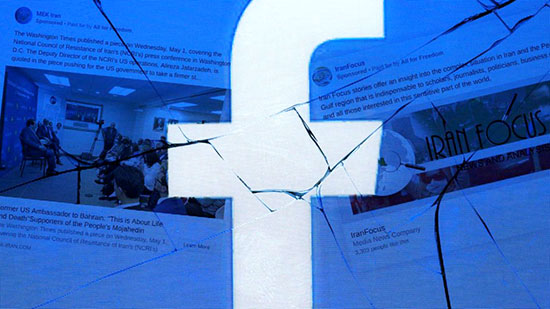
The Facebook pages appear to be a part of a larger effort to sway U.S. opinion on policy toward Iran.

As U.S. policymakers weigh responses to increasing Iranian aggression in the Persian Gulf, a German national based in a small neighborhood of northwest London is quietly financing an ad campaign designed to stoke a more forceful U.S. policy toward Tehran.
The person behind the campaign, pushed in part under the guise of independent news and analysis, is Soheila Aligholi Mayelzadeh, who’s previously identified herself as a lobbyist for the National Council of Resistance of Iran, a leading opposition group in the country. Since March, a company owned by Mayelzadeh has bought dozens of Facebook ads targeted at users in the United States promoting a more aggressive confrontation with Iran.
Those paid ads have run on two Facebook pages. One is the official page of the People’s Mujahedin of Iran, a militant Marxist opposition group in the country with deep ties to the NCRI, and commonly known by its Farsi acronym, MEK. The other is the page of an ostensibly independent news organization called Iran Focus.
The previously unreported advertising campaign shows how some leading opponents of the present Iranian government are attempting to capitalize on U.S. momentum for a more aggressive policy toward Iran. And it reveals efforts to present that lobbying campaign not as the work of an organized political bloc but as supposedly independent foreign policy analysis.
Both Iran and Iraq consider the MEK a terrorist group. It was previously designated as such by the U.S., United Kingdom, Canada, and the European Union, all of which have since removed the group from their respective lists of foreign terrorist organizations. The U.S. did so in September 2012.
Since then, the MEK has won some critical U.S. allies in its push for regime change in Iran, most notably John Bolton, President Donald Trump’s national security adviser. “There is a viable opposition to the rule of the ayatollahs,” Bolton told an annual MEK gathering in Paris in 2017. “And that opposition is centered in this room today.”
Bolton is currently one of the leading advocates in the Trump administration for a more aggressive confrontation with Iran, putting him squarely in line with the immediate U.S. policy objectives of the MEK and the NCRI, widely considered to be the MEK’s de facto political arm. The NCRI has pressed its case with other Trumpworld figures as well, according to foreign agent filings with the Justice Department, including Rudy Giuliani and Newt Gingrich.
The Facebook pages for the MEK and Iran Focus appear to be a part of that larger effort to sway U.S. opinions on policy toward Iran.

Both pages began running ads on the same day in late March, according to Facebook’s archive of political ads. They’ve run dozens of ads since then, and while neither page is hugely popular—fewer than 4,000 “likes” between them—and the sums spent on those ads have been relatively small, about $7,500 total, they’ve managed to reach between 500,000 and 1.4 million U.S. Facebook users over the last two months.
All of the money for those ads, according to Facebook’s archive, has come from a single company called All for Freedom. The London-based company’s website says it “work[s] with charities and non-profit organisations to help them with events management and other services for them to achieve their charitable and humanitarian activities and goals.”
Corporate records in the U.K. list Mayelzadeh, a German national, as All for Freedom’s only officer. And she has ties to the NCRI going back decades. In 1995, Mayelzadeh donated to the campaign of former Rep. Jim Traficant (D-OH). She listed an address in the Virginia suburbs of DC, and her occupation as a “lobbyest” [sic] for the National Council of Resistance.

Attempts to reach Mayelzadeh were not successful. An email sent to the address listed on All for Freedom’s website was not returned.
The majority of the Facebook ads that the company has financed have simply promoted the pages and websites of the MEK and Iran Focus, all of which take a hard line on U.S. policy towards Tehran. Some ads, though, promote specific bits of content that advance the Iranian opposition’s views on the matter.
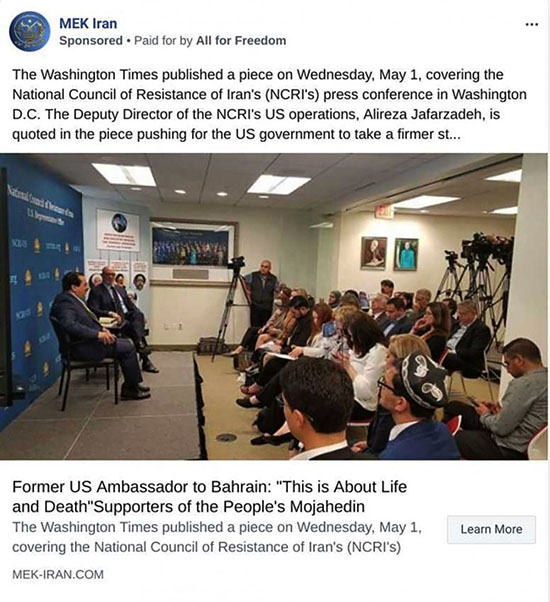
One recent ad on the MEK page recapped a NCRI press conference in early May and subsequent coverage of the event by the Washington Times. At the press conference, a top NCRI official called on the U.S. to designate Iran’s intelligence service as a foreign terrorist organization and generally to “take a firmer stance against the bloody and violent Iranian regime.”
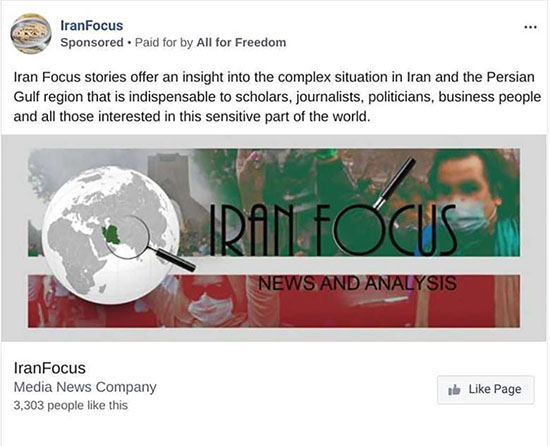
The event also got a positive write-up in Iran Focus, which describes itself as “an independent non-profit news service provider that focuses on events in Iran, Iraq and the Middle East with a network of specialists.”

Its coverage of late has leaned heavily on the U.S. to step up a military confrontation with the Iranian government. “Iran seems to understand only the language, the language of force,” one recent piece declared. “They speak the universal language of bullies. And we all know what happens when you stand up to a bully… they back down.” Another piece last week said the Iranian government has “benefited from impunity for far too long and it must face the consequences. Whatever they may be.”
The website appears to be less independent than it claims. It’s favorably covered the MEK and NCRI for years, but it appears to have some overt ties as well. According to domain registration data, the Iran Focus website was maintained by Mohammad Hanif Jazayeri, whom the NCRI website identifies as a spokesperson, until at least 2015, when the site anonymized that registration information.
Neither Iran Focus nor Jazayeri responded to questions about the news outlet’s relationship with the NCRI and MEK.
The latter is renowned for its foreign media, propaganda, and lobbying capabilities. Stolen U.S. diplomatic cables released by WikiLeaks show State Department staff repeatedly marveling at the MEK’s ability to promote its message abroad. One cable remarked on the group’s “extremely sophisticated international media and lobbying apparatus.”

The Daily Beast, By Lachlan Markay 

May 21, 2019 0 comments
FacebookTwitterPinterestWhatsappTelegramSkypeEmail
Newer Posts
Older Posts

Recent Posts

  • The black box of the torture camps of the MEK

    December 24, 2025
  • Pregnancy was taboo in the MEK

    December 22, 2025
  • MEPs who lack awareness about the MEK’s nature

    December 20, 2025
  • Why did Massoud Rajavi enforce divorces in the MEK?

    December 15, 2025
  • Massoud Rajavi and widespread sexual abuse of female members

    December 10, 2025
  • Facebook
  • Twitter
  • Instagram
  • Youtube

© 2003 - 2025 NEJAT Society . All Rights Reserved. NejatNGO.org


Back To Top
Nejat Society
  • Home
  • Articles
  • Media
    • Cartoons
    • NewsPics
    • Photo Gallery
    • Videos
  • Publications
    • Books
    • Nejat NewsLetter
    • Pars Brief
  • About Us
  • Contact us
  • Editions
    • عربي
    • فارسی
    • Shqip