Nejat Society
  • Home
  • Articles
  • Media
    • Cartoons
    • NewsPics
    • Photo Gallery
    • Videos
  • Publications
    • Books
    • Nejat NewsLetter
    • Pars Brief
  • About Us
  • Contact us
  • Editions
    • عربي
    • فارسی
    • Shqip
Nejat Society
Nejat Society
  • Home
  • Articles
  • Media
    • Cartoons
    • NewsPics
    • Photo Gallery
    • Videos
  • Publications
    • Books
    • Nejat NewsLetter
    • Pars Brief
  • About Us
  • Contact us
  • Editions
    • عربي
    • فارسی
    • Shqip
© 2003 - 2024 NEJAT Society. nejatngo.org
blank
Mujahedin Khalq; A proxy force

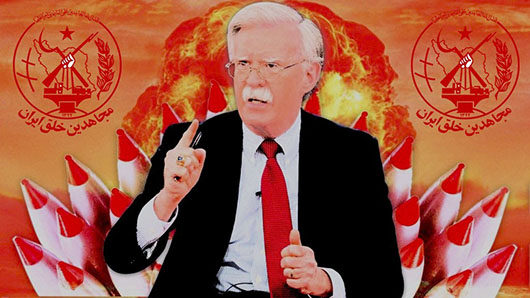
Bolton MEK Iran Policy at odds with Trump

As Trump calls for dialogue with Iran, his national security adviser is beating drums of war
National Security Advisor John Bolton has been calling for regime change in Iran for years (AFP)

Despite the drums of war resonating ever louder this week, President Donald Trump has repeatedly said he isn’t seeking a military conflict with Iran, instead urging the leaders in Tehran to engage in direct negotiations with Washington.
Still, Trump’s seemingly conciliatory posture has not stopped a stream of threats from members of his administration.
Nor has it stemmed the flow of US media reports about the United States’s alleged military plans, or purported Iranian schemes to attack American troops in the Middle East.
According to former US officials and analysts, the culprit behind the current crisis is most likely Trump’s top aide: National Security Advisor John Bolton.
“He’s been an advocate of regime change in Iran for decades, and that’s one of his main goals,”Peter Bergen, director of the national security studies programme at the New America Foundation, told Middle East Eye.
The latest round of escalation can be traced back to 5 May, when Bolton said Washington was sending a naval strike group to the Gulf with the aim of sending a”clear and unmistakable message to the Iranian regime”.
Bolton, who has served in every Republican administration since Ronald Reagan’s presidency, is known for his neo-conservative, hawkish foreign policy views.
He was a staunch supporter of the war in Iraq when he served in the State Department in the lead-up to the 2003 US-led invasion.
And as US ambassador to the United Nations between 2005 and 2006, he often defended then-president George W Bush’s foreign interventions.
Wherever there is a government seen as hostile to Washington, Bolton has adopted a hard line against it.
For example, weeks before Trump’s summit with North Korean leader Kim Jong-Un in June 2018, Bolton drew Pyongyang’s ire by suggesting the”Libya model”for denuclearising North Korea.
Although the administration later clarified that Bolton was calling on Pyongyang to voluntarily give up its nuclear weapons as Tripoli did in the mid-2000s, the remarks were interpreted as a call for military strikes against North Korea.

Bolton”seemingly hasn’t met a war he doesn’t love,”Bergen wrote in a CNN column this week.

‘America only’
Still, Bolton’s fondness for military interventions remains at odds with Trump’s”America first”foreign policy and pledge to stop foreign wars and put an end to US-led”nation-building”.
“The world view of regime-change is that if anyone has a different foreign policy than we do, it must be because they’re wrong, and if they hold to it, they must be removed,”former US diplomat Christopher Hill said.
“So, it is a statement not only of ‘America first’ but ‘America only’.”
The inconvenient truth is that only military action … can accomplish what is required
– John Bolton wrote in 2015 in the NYT
Indeed, in a 1994 speech, Bolton said that the United States is”the only real power left in the world”.
Hill, who served as the head of the US delegation for multilateral negotiations with North Korea in 2005 and as US ambassador to Iraq in 2010, said the recent impasse with Iran is largely coming”from the US side”.
And Bolton in particular is”trying to whip up hysteria,”Hill told MEE.
“I would support the British general who said there was nothing new in the threat level. However, I do not rule out that Iran may be responding to some of this.”

Regime change in Iran
This month’s tensions come a year after Trump pulled the US from the multinational Iran nuclear deal that saw Tehran significantly scale back its nuclear programme in exchange for the lifting of economic sanctions.
“The strategy seems to be to put additional sanctions on Iran to essentially tank the Iranian economy to produce some kind of popular uprising to replace the regime – or prepare some kind of military conflict,”Bergen said of the administration’s policy on Iran.
The Trump administration’s stated policy is to exert”maximum pressure”on Iran to force Tehran to change its regional behaviour and end its nuclear programme.
But Bolton has said in the past that sanctions alone do not work.
“The inconvenient truth is that only military action … can accomplish what is required,”he wrote in a 2015 column published in the New York Times.
The article, titled”To stop Iran’s bomb, bomb Iran,”did not only call for targeting Iran’s nuclear facility. It also advocated US-led efforts to topple the Iranian government.
“Such action should be combined with vigorous American support for Iran’s opposition, aimed at regime change in Tehran,”Bolton wrote.
It wasn’t the first – nor would it be the last – time Bolton called for regime-change in Iran. In early 2017, days before Trump took office, Bolton backed the incoming president’s pledge to scrap the Iran nuclear deal and presented a different approach.

I don’t think you can ignore the fact that Bolton has made six-figure income from the [Iran opposition group] Mojahedin-e Khalq’
– Christopher Hill, former US diplomat

“The alternative policy is regime change in Iran,”he said in an interview with Fox News at the time.
Speaking at a 2017 gathering for Mojahedin-e Khalq (MEK), an Iranian opposition group that was on the US list of terrorist groups as recently as 2012, Bolton went so far as to promise the Iranian government would fall by 2019 with Trump in office.
“I have said for over 10 years since coming to these events that the declared policy of the United States of America should be the overthrow of the mullahs’ regime in Tehran,”Bolton said.
“The behaviour and objectives of the regime are not going to change, and therefore the only solution is to change the regime itself. And that’s why, before 2019, we here will celebrate in Tehran.”
Bolton’s motives
Some of Bolton’s critics say his views on Iran may not be driven by only ideology.

The MEK paid him $40,000 for that 2017 speech, according to financial disclosures, and over the years, Bolton has reportedly received more than $180,000 from the Iranian opposition group.
“I don’t think you can ignore the fact that Bolton has made six-figure income from the Mojahedin-e Khalq and has publicly called for them as the successor regime,“Hill said.

“So I think it’s a little hard to sort out one’s personal interests with a national interest here.”

Regardless of Bolton’s motives, Trump ultimately remains in charge, and he appears to want dialogue – something that may not bode well for his senior adviser.
In fact, the New York Times reported on Thursday that Trump was”frustrated”by the perception that Bolton is leading the administration’s Middle East policy.
What that says about his future in the White House remains unclear, as the president has regularly disposed of close aides who are considered influential in his administration.
Eight months into his tenure, Trump fired his chief strategist Steve Bannon, while cabinet secretaries, chiefs of staff and top White House officials once seen as indispensable have come and gone. Bolton himself is Trump’s third national security adviser in less than three years.
Still, Trump’s invitations for Iranian leaders to call him to avoid a military conflict may not be effective, said Hill, who is currently the chief global adviser at the University of Denver.
“When you aggravate an agreement, calling it ‘the worst deal ever,’ and then say, ‘but I’ll just call them back and they’ll give me more concessions,’ you might be able to pull that off in the New York real estate market,”Hill said.”I’m just not sure the Iranian leadership wants to go along with this.”

By Ali Harb in Washington, Middleeasteye
May 20, 2019 0 comments
FacebookTwitterPinterestWhatsappTelegramSkypeEmail
Rudy Giuliani
Mujahedin Khalq; A proxy force

What are the schemes that made Rudy Giuliani millionaire

Less than a year after Rudy Giuliani , the former mayor of New York, had the first page in the Romanian press after a letter addressed directly to the President of Romania , Bloomberg Businessweek entered in the backdrop of the international consulting business of the person who is Donald Trump’s personal advocate.

This article appeared in NewMoney’s 65th issue (May 13-26, 2019)

In November 2017, when Rudy Giuliani went to the Ukrainian city of Kharkov (one hour away from the Russian border) for a business meeting with Mayor Hennadiy Kernes, an unprecedented scene awaited him. In a big cage in the anteroom, he met with a”Privet!”(“Hello!”In Russian) even the petter of the mayor, parrot Johnny. In the same antechamber there was a diverse group of visitors. They were waiting silently to enter the office of Mayor Kernes, who for nine years led the second largest city in the country.
APPLICANT AND CONSULTANT. Giuliani was in Ukraine for the second time in less than a year as Kernes’ security adviser. At the same time, Giuliani was and still is a cyber security advisor to the President of America, Donald Trump, which is why a Ukrainian television has even marked the moment -“The Visit of a Trump’s Counselor.”In both visits, Giuliani also met with the acting Ukrainian President, Petro Poroshenko.
Mayor Kernes (59) is in a wheelchair in April 2014. While doing jogging somewhere on the outskirts of the city, an unknown shot him. Prior to the assassination attempt, the mayor had been very active on his Instagram account, where he exhibited his opulence – expensive holidays, clocks and even pictures from a meeting with Chechen leader Ramzan Ahmatovici Kadirov, an ally of the Kremlin leader Vladimir Putin . In 2017, Kadirov was sanctioned by the US for murder, torture and other human rights abuses. Kernes is also very close to former Ukrainian President Viktor Yanukovych, forced by Kyiv Maidan in 2014 to flee to Russia.
Kernes quickly explained his collaboration with Giuliani – he wants to use the vast experience of the former mayor of New York. Giuliani advised him, for example, to set up an emergency service similar to 911.”Giuliani also met with President Poroshenko, who offered his support to complete the idea,”confesses Kernes. But how did a politician like Giuliani become the councilor of a mayor in eastern Ukraine? Kernes did not pay Giuliani, instead there is a one-year contract whose value is not public and which was largely funded by Ukrainian-Russian businessman Pavel Fuks.
In 2015, Fuks returned to Ukraine after 20 years in Moscow, where he has made wealth from real estate and banking. In the mid-2000s, the same Fuks had talks with the current US president to build a Trump Tower in Moscow, but they did not agree. At age 47, Fuks lives in Kiev, guarded by bodyguards, as well as Kernes. He says he hired Giuliani to give something back to his hometown.”Giuliani’s firm offers lobbying services and its asset is on security issues. He is a star,”he adds.
Collaboration in Ukraine is just a small piece of the global consulting business that Giuliani continued in parallel with Trump’s supporter in the Republican electoral campaign. He was followed by his adviser, as well as his personal attorney in the investigation by the special prosecutor, Robert Mueller, on the interference of Russia in the 2016 elections.
Following the verdict of General Prosecutor William Barr, according to which there is no evidence that Trump had any understanding with the Kremlin, Giuliani has overcome his name a victory that heavily hangs in his global consultant portfolio.
Known and appreciated for taking action as a prosecutor against New York Mafia, but also for managing New York after the tragedy of September 11, 2001, Giuliani is actively looking for clients like Kernes to advise on security issues. He made millions of dollars – 9.5 in 2017 and 5 in 2018, according to information in the context of the divorce of his third wife, Judith Nathan.
CONFLICT OF INTERESTS OR NOT? At age 74, Giuliani still prefers to remain in the spotlight as”what he does is extremely exciting,”he says. In addition to working in Ukraine, he has lectured and advised over the last two years in countries such as Armenia, Bahrain, Brazil, Colombia, Turkey and Uruguay.
In the context of Donald Trump’s unusual mandate at the White House, Giuliani’s role is even more out of the ordinary. His foreign contracts prompted seven democratic senators to ask the Ministry of Justice in September 2018 to check whether the former mayor should disclose his activities covered by the Law on the Registration of Foreign Agents (FARA). This normative act obliges the registration of individuals or organizations working as agents of foreign interests”in a political or quasi-political space”.
“As President Trump’s personal attorney, Mr. Giuliani communicates privately with the president and his staff on a regular basis,”wrote senators to the Ministry of Justice.”Without further analysis, it is impossible to know whether Mr. Giuliani is lobbying the US government for his foreign clients.”
Giuliani has always denied that he would do so, saying that most of his work is consulting for various countries of the world. Most often, contracts involve the delivery of security plans designed to improve crime rates, counseling on terrorism issues, or critical infrastructure issues. In Ukraine, he advised only on security issues, but he did not promote Kernes’ interests in the US, Giuliani said.
There is no conflict of interest between working so closely with the Trump Administration and working with foreign clients, says Giuliani,”I do not ask the President for any favor for them, nor do I represent these clients before the US government. I do not do trafficking because I have no reason to. I make a lot of money as a lawyer and a security consultant.”

However, the issue of a conflict of interest floats in the air, as the former editorial promotes ideas that resonate with the Trump’s foreign policy.”In order to have peace and stability in the Middle East, a major shift in the theocratic dictatorship in Iran is needed. It must come to an end quickly,”Giuliani told Warsaw, in front of hundreds of people flying Iranian flags, at an action by the National Resistance Council for Iran (NCRI, based in Paris), supported by the Iranian People’s Mujahedin Organization (Mujahedin-e Khalq, MEK).
Giuliani says that since 2008 he has been working with the MEK, a group that at that time the United States foreign ministry has classified her as a terrorist (in 2012, she removed it from this category).
Over the years, MEK has collaborated with several recognized American politicians, including the current presidential advisor for national security, John Bolton. The support that Giuliani offers is at sight. In January 2017, along with several former senior US officials, he signed a letter inviting President Trump to open the dialogue with the NCRI.
“It is quite inadequate that Giuliani continue to publicly associate with MEK,”says Suzanne Maloney, an Iranian expert at the Brookings Institution, arguing that the organization remains controversial. In addition, his anti-Iraqi rhetoric did not prevent him from working for Reza Zarrab, accused of orchestrating $ 1 billion in money laundering to help Iran avoid sanctions imposed by the US.
Dan Pickard, a partner at Wiley Rein LLP, a law firm in Washington, and a FARA specialist, did not want to refer specifically to the Giuliani case. However, Dan Pickard is of the opinion that if someone is paid by a foreign political group to support a speech in the United States that can influence certain policies, it should be labeled a foreign agent.
Giuliani says he is not paid directly by MEK, but by an American organization of Iranian dissidents.”Is the Organization of the Iranian-American Communities, which is allied with MEK?”Asked Bloomberg Businessweek reporter.”I do not remember the exact name. But there is no difference if you work for an Israeli-American group that has strong views on Israel,”he argues, trying to compare.

In February 2017, Rudy Giuliani went to Turkey, where he met with Turkish President Recep Tayyip Erdogan, hoping to help the Turkish-Iranian Reza Zarrab, arrested in the US on the charge that he had washed money in favor of Iran through a own company. Giuliani admits he tried to negotiate a deal for Zarrab, who pleaded guilty and became a witness in a federal file that targeted a banker.
Some shocked Giuliani’s involvement in this case.”I see a rupture between the old Rudy and the current Rudy, am astonished that he has been hired to be a bridge between President Trump and his Turkish counterpart in an attempt to resolve this case in some way,”says Judge Richard Berman, who also worked on this file.
As a rule, lawyers are exempted from applying for a foreign agent, but the exception may not apply, Ben Freeman, a specialist in intervention operations at the Center for International Policies in Washington. Quite irritated, Giuliani claims he is not the Turkish government,”but one man in detention and trying to get an exchange of prisoners with the Turkish government.”
Giuliani was promoted internationally as a New York super-officer who dramatically reduced the rate of crime in the US metropolis using the”broken windows”strategy. He was, however, strongly criticized for the brutality with which the New York police acted, especially against the African Americans. These critics scattered quickly when he made a discourse between the ruins of the Twin Towers still smoking. He was then appreciated by a whole world for the courage and cold blood he showed in those moments.
In fact, immediately after completing his mayoral mandate, he sought to capitalize this fame as quickly as possible. At the beginning of 2001, while Giuliani was in full divorce from his second wife, Donna Hanover, his lawyer said all his fortune was $ 7,000.
He founded several companies – Giuliani Partners LLC, a consulting firm for governments and companies, Giuliani Security & Safety LLC and Giuliani Capital Advisors LLC, an investment bank sold in 2007 to Macquarie Group Ltd In a few years, Giuliani made a fortune of several million dollars. In 2002, Mexico City drew $ 4.3 million from its budget to find out from Giuliani how you can fight crime as effectively as possible.
In 2004, the former president arrived for the first time in Ukraine. Then he went to Russia, where he met Russian Foreign Minister Sergey Lavrov (it is not known whether he paid his own move). He also made a conference circuit, the commission being between 100,000 and 200,000 dollars per lecture. When in 2007 he filed his candidacy for the Republican presidential election, he had $ 11 million in revenue from commissions for talks last year and a half, according to federal data.
Since completing his mayoral mandate, he has supported over 1,000 speeches in 80 countries, he says. He convinced clients all over the world, from mayors to presidents, that what worked in New York works anywhere. In Brazil, in February last year, signed a $ 1.6 million contract with Giuliani Security & Safety to improve border security. The contract is now under investigation by a team of Brazilian prosecutors. The consulting activity helped Giuliani gain access to a global network of politicians who have lectured him especially since Donald Trump became president of the United States.
With the lifestyle that Giuliani now has, foreign customers may be more needed than ever. When he started working as Trump’s personal attorney in April last year, he agreed to do it pro bono. He gave up his position as chairman at law firm Greenberg Traurig LLP, where he had annual income between $ 4 million and $ 6 million.

By Mimi Noel
He has more than ten years of experience in journalism. He started at the Rompres national press agency, and in 2006 joined the team dealing with the Romanian edition of the US BusinessWeek. In 2007, he completed the team of journalists who started the Money Express business magazine. The covered areas ranged from retail to FMCG, pharmaceuticals, investment funds, mergers and acquisitions, IT & C. He interviewed the most prominent Romanian businessmen, local entrepreneurs and well-known foreign businessmen, such as Microchip executive Steve Sanghi, or former Sony executive director Michael Schulhof. Mimi Noel has been working as an Account Manager at AMICOM since 2012. At NewMoney, he is dealing with international issues.
Original article in Romanian newmoney.ro – Translated by Nejat Society

May 18, 2019 0 comments
FacebookTwitterPinterestWhatsappTelegramSkypeEmail
blank
Mujahedin Khalq Organization's Propaganda System

MEK terrorists pay Bolton Regularly

“I actually temper John,” Trump said, “which is pretty amazing.”

Fourteen months into his tenure as national security adviser, John Bolton has become a central figure in the run-up to what could be the most extensive American military offensive since the invasion of Iraq. Tensions between Iran and the United States have been high for weeks, beginning with a menacing video Bolton released in February targeting the Iranian supreme leader and reached a boil last week when, according the New York Times, he ordered the Pentagon to prepare to send as many as 120,000 troops to the Middle East to counter Iran.
His saber-rattling in the Middle East comes on the heels of his recent and unsuccessful public campaign to topple President Nicolas Maduro of Venezuela, which left President Donald Trump complaining privately that Bolton wants to get him “into a war,” the Washington Post reported. Trump, long an opponent of America’s “endless wars” despite initially supporting the Iraq invasion, reportedly “prefers a diplomatic approach” to Iran as well and “wants to speak directly with Iran’s leaders,” a Post story noted Wednesday evening. The ensuing debate has left Trump, who once promised to “bomb the shit” out of Islamic State terrorists, in the unusual position of moderating his notoriously hawkish national security adviser.
“He has strong views on things but that’s okay,” Trump said during a White House press conference last week. “I actually temper John, which is pretty amazing.”
What’s also pretty amazing is how frequently Bolton has argued in favor of regime change in Iran, an enemy he has been fixated on for decades. As early as May 2002, Bolton considered Iran’s “ongoing interest in nuclear weapons” a threat to the United States on par with North Korea and Iraq. Then the top arms control official in the State Department, Bolton continued to emphasize the threat of Iran to American security and the security of Israel, even during the lead-up to the invasion of Iraq. In February 2003, he assured Prime Minister Ariel Sharon during a visit to Israel that “it would be necessary” for the United States to “deal with” threats from Iran, Syria, and North Korea after ousting Saddam Hussein. The prior year, a senior British official told Newsweek that President George W. Bush’s national security team was fixated on Iran even more than Iraq. “Everyone wants to go to Baghdad,” the official said. “Real men want to go to Tehran.”
But why does Bolton care so much about Iran, a country that for decades was a pariah in the international community and kept in check by the stranglehold of American sanctions? The none-too-simple answer resides in his understanding of America’s place in the world and opposition to any limits on American power.

The roots of Bolton’s warmongering against Iran
As a diplomat and national security official across four Republican administrations, from Ronald Reagan to Donald Trump, Bolton has made the case for regime change in North Korea and Syria, among other places. But Iran remained a persistent concern for him, due to its alleged links to terrorism and burgeoning nuclear program. Once he left his position as ambassador to the United Nations in the Bush White House in 2006, he began more openly criticizing Bush’s Iran policy as too soft, calling it “four and a half years of failed diplomacy.” In an appearance on Fox News in 2008, Bolton argued in favor of bombing Iranian camps that the US said were training insurgents to oppose American troops in Iraq. “This is not provocative or preemptive—this is entirely responsive,” he said. “If we don’t respond, the Iranians will take it as a sign of weakness.”
His enmity was further inflamed when President Barack Obama began negotiating with Tehran to eliminate their nuclear program. Bolton dismissed the prospect of diplomatic solution in several opinion pieces. “The inescapable conclusion is that Iran will not negotiate away its nuclear program. Nor will sanctions block its building a broad and deep weapons infrastructure,” he wrote for the New York Times in March 2015, four months before Obama announced a deal with Iran that had broad international support in blocking the rogue state’s pathway to creating a nuclear weapon in exchange for partial sanctions relief.
Bolton rejected this outcome. Only a military strike “like Israel’s 1981 attack on Saddam Hussein’s Osirak reactor in Iraq or its 2007 destruction of a Syrian reactor” can do the job, Bolton wrote. He failed to mention that Israel’s premeditated strike on Osirak was condemned at the time by the United Nations and troubled US officials in the Middle East. Even Ronald Reagan confided to his journal that when this happened he believed “Armageddon is near.”
For Bolton, diplomacy with Iran has never been a realistic option. Last year, he argued that “America’s declared policy should be ending Iran’s 1979 Islamic Revolution before its 40th anniversary.” On the fortieth anniversary of the revolution that toppled Iran’s US-backed shah and led to the creation of modern Iran, Bolton released a video implying Ayatollah Ali Khamenei would not be in power for long. “I don’t think you’ll have many more anniversaries to enjoy,” he said.

He’s offered no less than a full-throated endorsement for regime change in other venues too. In 2016, he gave a speech in Paris to tens of thousands of supporters of the Mujahideen-e-Khalq, a group of Iranian exiles who were responsible for a series of bombings in Iran prior to the revolution, including one that killed six Americans. The MEK supported the Iranian Revolution and were cheerleaders for the takeover of the American embassy in Tehran, which led to the kidnapping of more than 50 American citizens for over a year, but ultimately broke with the ruling clerics and went into exile. The group is considered by some Iran experts to be a cult and, for more than a decade, was listed as a terrorist group by the United States. Bolton has been attending the MEK’s annual event for at least a decade, the New Yorker has reported.

“There is only one answer here: to support legitimate opposition groups that favor overthrowing the military theocratic dictatorship in Tehran,” he said. “Let me be very clear, it should be the declared policy of the United States of America and all its friends to do just that at the earliest opportunity.”

At the group’s rally the following year, in 2017, Bolton vowed to celebrate the fall of the regime “before 2019.”

#JohnBolton 8 months ago among MEK supporters tells them they will overthrow #Iran’s regime and celebrate in #Tehran with Bolton himself present, “before 2019” pic.twitter.com/H7oaaU3faU
— Bahman Kalbasi (@BahmanKalbasi) March 22, 2018

Once Trump took office but before Bolton joined the administration, he pursued his hawkish agenda by lobbying to rip up Obama’s nuclear deal. The agreement was “execrable” and should be abrogated “at the earliest opportunity,” Bolton wrote in August 2017 in the National Review. “We can no longer wait to eliminate the threat posed by Iran.”
The hawk in Trump’s Situation Room
Since joining the Trump administration last year as national security adviser, replacing HR McMaster, who urged Trump to maintain the Iran deal, Bolton has had some success in escalating the pressure on Tehran and reducing its sources of revenue through sanctions. Last year, his efforts to persuade Trump to leave the nuclear deal finally succeeded, although several European allies remained in it. He warned Iran of “hell to pay” if it crosses the US, and proclaimed that an American military presence would remain in Syria indefinitely until “Iranian proxies and militias” left the country. Even though Trump ignored that last promise when he announced the withdrawal of US troops from Syria in December, Bolton kept pursuing military solutions to challenge Iran.
“I am convinced that John Bolton has calculated that he has about 18 months to start a war with Iran or he’ll miss his chance,” says Joe Cirincione, an expert on nuclear weapons policy and the president of the Ploughshares Fund, a global security foundation. “They want Iran to be like Japan at the end of World War II.”
Bolton reportedly asked the Pentagon in September for options to strike Iran after a Tehran-linked group fired mortar shells toward the American embassy in Baghdad, which “landed in an open lot and harmed no one,” the Wall Street Journal reported. Bolton’s request concerned US officials who spoke with the Journal.
“It definitely rattled people,” a former senior US administration official told the newspaper. “People were shocked. It was mind-boggling how cavalier they were about hitting Iran.”
That request was a prelude to what Bolton would ask of the Pentagon this month. In response to intelligence that Iran was planning to strike US military assets in the Middle East, Bolton announced the early deployment of an aircraft carrier and several Air Force bombers to the region. (The US routinely deploys carrier groups to the Gulf region and this particular one had already departed Virginia on April 1, well before Bolton’s statement about the Iranian threat.)
Sources with knowledge of the intelligence quickly threw cold water on the severity of the threat. “The administration blew it out of proportion, characterizing the threat as more significant than it actually was,” multiple anonymous Trump officials told the Daily Beast. In a briefing to reporters at the Pentagon, the second-ranking general in the US-backed coalition to fight ISIS suggested there had been no increase in threats toward American forces. “There are a substantial number of militia groups in Iraq and Syria, and we don’t see any increased threats from many of them at this stage,” the British general, Chris Ghika, said. (US Central Command later dismissed these comments in a rare rebuke of an allied general, insisting there are “credible threats available to intelligence from U.S. and allies regarding Iranian backed forces in the region.”) Nonetheless, US officials used the intelligence to justify removing nonessential diplomats from its embassy in Baghdad on Wednesday.
Now the US is considering another series of military options despite Trump’s apparent opposition. The New York Times reported Tuesday that “Acting Defense Secretary Patrick Shanahan presented an updated military plan that envisions sending as many as 120,000 troops to the Middle East should Iran attack American forces or accelerate work on nuclear weapons.” Trump denied the storyand said, if military action were taken against Iran, “we’d send a hell of a lot more troops than that.”
The newspaper said the plans were ordered by “John R. Bolton.”

By Mother Jones,

May 18, 2019 0 comments
FacebookTwitterPinterestWhatsappTelegramSkypeEmail
blank
Mujahedin Khalq; A proxy force

Elaine Chao, John Bolton paid by MEK, sending Americans to war

With the US-Iran War Ball Now Rolling, Could an “Accident” or “False Flag” Serve as Pretext?

Certain forces in the U.S. and Israel have been actively pushing for war with Iran for years and have a track record that demonstrates little inhibition about using an “accident” to start it.
As tensions between the U.S. and Iran threaten to boil over, the probability of a provocation or “accident” that would provoke hostilities between the two countries is higher than ever. U.K. Foreign Minister Jeremy Hunt, after meeting with U.S. Secretary of State Mike Pompeo, openly stated as much on Monday, telling reporters in Brussels that the U.K. was worried of a conflict breaking out between the U.S. and Iran by “accident with an escalation that is unintended really on either side but ends with some kind of conflict.”
Yet, current and past events make it clear that such an “accidental” provocation is unlikely to be purely accidental in nature, as forces in the U.S. and Israel have been actively pushing for a U.S.-led war with Iran for years and have a track record that demonstrates little inhibition about using an “accident” or “false flag” to drag the country into a war with the Islamic Republic.
Notably, the state of Israel — in an event long since buried by the government and corporate media — has previously staged such a “false flag” by targeting an American naval vessel, killing 34 Americans, in order to blame the attack on Egypt and drag the U.S. into a war with several Middle Eastern nations in 1967. However, Israel is not alone in this, as the CIA as well as neo-conservatives serving in the Bush administration, led by then-Vice President Dick Cheney, have planned “false flags” that involved the murder of American servicemen and civilians in order to justify military action against U.S. adversaries.
In this two-part series, MintPress explores the troubling evidence that preparations for another such “false flag” are well underway. In this first installment, current events in relation to U.S.-Iran relations and the role of Israel in the ratcheting up of tensions will be examined, while the second installment will focus on Israel’s past of conducting “false flags” to goad the U.S. into wars on Israel’s behalf as well as efforts by former Vice President Dick Cheney to conduct a “false flag” pitting American sailors against American sailors disguised as Iranian naval forces to justify a conflict with Iran.
Bolton, taking a page from Iraq 2003 playbook, sets ball rolling
Since National Security Advisor John Bolton sent out a dramatic press release announcing the deployment of a U.S. carrier strike group as a warning to Iran on May 5, tensions between the U.S. and Iran have risen dramatically, a development that Bolton — who has long advocated regime change and a pre-emptive war against Iran — likely welcomes. As MintPress recently reported, that press release was intentionally vague, allowing justification for a military response to any number of incidents, whether committed by Iran or alleged “proxies” of Iran, including groups over which Iran’s government has no control.
Furthermore, it has since been revealed that the “intelligence” Bolton used to frame the deployment and the rationale for future U.S. military action against Iran was from the Israeli government — which has long pushed the U.S. towards war with Iran. In addition, several unnamed U.S. officials stated soon after that Bolton and other Trump administration officials had greatly exaggerated the nature of this intelligence and overreacted. MintPress has noted on several occasions Bolton’s history of distorting intelligence to conform with a specific narrative or in order to promote specific policy actions and this tendency of Bolton’s was also recently noted in a New Yorker profile on the current National Security Advisor.
It was subsequently revealed that a few days prior to Bolton’s press release, Bolton had made a “highly unusual” visit to CIA headquarters to discuss Iran. NBC News reported that the “extremely rare” choice to hold this meeting at the CIA instead of the White House’s Situation Room likely meant that the purpose of the meeting was “to brief top officials on highly sensitive covert actions, either the results of existing operations or options for new ones,” based on statements from five former CIA operations officers and military officials.
That meeting, as noted by the political and financial news site ZeroHedge, “hearkens back to the Bush-Cheney White House’s direct intervention over Iraq intelligence in the lead-up to the 2003 invasion, which involved the VP and his staff making multiple personal visits to CIA headquarters and the Pentagon to pressure the intel analysts into conforming to a preferred ‘narrative.’” Yet, the emphasis on “covert actions” in relation to Iran suggests that something much more sinister may be afoot.
Indeed, in the weeks since that press release and the “highly unusual” CIA meeting, the U.S. has deployed more military assets towards the Persian Gulf and Secretary of State Pompeo has made several abrupt schedule changes in order to discuss Iran with various countries. Notably, the Trump administration has also announced the end of waivers that have allowed some foreign companies to continue buying Iranian oil without facing U.S. sanctions.
The situation has forced Iran to respond, with Iran announcing that it would begin withdrawing from the Iran nuclear deal — which the U.S. unilaterally withdrew from over a year ago — as the U.S.’ economic war against Iran shoots to another level.
Perhaps most telling of all is the fact that Western media, particularly U.S. media, have been heavily promoting the Iranian “threat” since soon after Bolton’s Mary 5 press release, in yet another striking parallel to the lead-up to the 2003 invasion of Iraq. Yet, particularly notable in this case is that much of the “intelligence” that has been used to justify these recent moves by the Trump administration has come from Israel’s government, led by the recently re-elected Israeli Prime Minister Benjamin Netanyahu, whose desire to goad the U.S. into a war with Iran is an open secret.
One potential pretext already in play in the Persian Gulf
On Sunday, reports surfaced that several oil tankers were the victims of “sabotage” while sailing towards the Persian Gulf near Fujairah, one of the seven emirates that comprise the United Arab Emirates (UAE), which is located just outside the Strait of Hormuz. Fujairah’s government initially denied that any “sabotage” took place and maintained that its port facilities were operating normally after media reports from Iranian outlet PressTV and Lebanese outlet Mayadeen reported on a series of “explosions” on unidentified ships in the area.
The UAE’s foreign ministry later confirmed an incident in the area but said no casualties or spills occurred and notably did not provide details as to the number or nationalities of the ships involved nor the groups responsible for the alleged attack.
However, Saudi Arabia subsequently claimed that its tankers had been affected by this act of “sabotage” and that the targeted tankers had been approaching the Strait of Hormuz on route to load oil destined for the United States. Saudi Arabia, like the UAE, did not blame any country for the attack. A Norwegian-registered oil tanker experienced hull damage after striking “an unknown object,” potentially suggesting the attack was caused by an explosion of a sea mine or the result of a torpedo or other projectile launched underwater. Notably, the U.S., U.K. and France held a “mine warfare drill” in the Persian Gulf just last month and past Western media reports have characterized sea mines as “Iran’s favorite military asset.”
Iran rejected any responsibility for the attack and Iran’s Foreign Ministry spokesman Abbas Mousavi warned against a “conspiracy orchestrated by ill-wishers” and “adventurism by foreigners.”
However, the timing of the sabotage came right on the heels of statements made by the U.S. and Israeli governments that have led some to blame Iran or suggest Iranian responsibility for the attacks — despite the lack of evidence made public and the decision by both the Saudis and Emiratis, long-time adversaries of Iran, from blaming any country for the incident or describing any specifics about the attack.
This past Thursday, the U.S. Maritime Administration — a division of the U.S. Department of Transportation — stated that “Iran or its proxies could respond by targeting commercial vessels, including oil tankers, or U.S. military vessels in the Red Sea, Bab-el-Mandeb Strait or the Persian Gulf.”

The U.S. Department of Transportation is currently headed by Elaine Chao, who was paid $50,000 for a five-minute speech to the Iranian exile group, Mujahedeen-e-Khalq (MEK), known to actively seek regime change for Iran. Other top U.S. officials, such as Bolton, have also been paid hefty sums for appearances at MEK events, where they have openly advocated for the overthrow of the Iranian government.

In addition to warning from a U.S. department headed by an official with links to an Iranian opposition group actively seeking regime change, Israeli officials “leaked” information on Israel’s Channel 13 on Saturday that Iran was allegedly planning to target Saudi oil assets in the region. According to the unsourced report, as cited by the Times of Israel, the Iranians were “considering various aggressive acts” against American assets or those of its regional allies, such as Saudi Arabia and Israel. The report also claimed that Iran had considered targeting American bases in the Gulf, but rejected it as too drastic and instead had decided to target “Saudi oil production facilities.”
In light of recent events, as well as the corporate media’s willingness to suggest Iranian culpability despite little to no publicly available evidence, it appears that this recent attack — regardless of who was responsible — could be seized upon by officials in the U.S. or Israel eager to see tensions between the U.S. and Iran escalate.
Netanyahu: “America is easily moved”
It is an open secret that Israel’s government, particularly under Netanyahu, has been eager to see the U.S. engage in hostilities with Iran. The main driver for this is the fact that, while Israel has since forged alliances with several Arab-majority nations such as Saudi Arabia, Egypt and the United Arab Emirates, Iran and its regional allies — namely Lebanon’s Hezbollah and Syria — oppose Israeli objectives for the region and those of its allies. More crucially, Iran is arguably the country that is most supportive of Palestine and the major barrier to Netanyahu’s plans to annex Palestine’s occupied West Bank, a promise on which Netanyahu rode to reelection last month. Now more than ever, Netanyahu wants Iran’s government out of the way.
Netanyahu has openly stated that he views the U.S. government as a vehicle for fulfilling Israeli objectives and believes that Americans are easily manipulated, by Israel in particular. For instance, in a video recorded in the early 2000s — later broadcast on Israeli TV and subsequently reported on by Consortium News — Netanyahu “brags about how he deceived President Bill Clinton into believing he [Netanyahu] was helping implement the Oslo accords when he was actually destroying them. The tape displays a contemptuous attitude toward, and wonderment at, a malleable America so easily influenced by Israel.”
In the video, Netanyahu states:
America is something that can be easily moved. Moved in the right direction. They won’t get in our way; 80 percent of the Americans support us. It’s absurd.”
Israeli journalist Gideon Levy later asserted that the video reveals Netanyahu to be “a con artist who thinks that Washington is in his pocket and that he can pull the wool over its eyes” and that the current Israeli prime minister’s attitude is unlikely to “change over the years.”
Now, with the Trump administration having shown its willingness to favor Israeli interests in the Middle East, Netanyahu has apparently sensed that the hour has come to push the U.S. towards war with Iran. For instance, the Trump administration organized a summit aimed at securing “peace and security in the Middle East,” to which Iran was not invited. The New York Timesdescribed that summit as follows:
…Leaders of Israel and Arab states met publicly again, at an international conference in Warsaw staged by the Trump administration. But the goal of this meeting, drawing officials of some 60 nations, was not peacemaking. It was to rally support for economic and political war with Iran, for which the United States has found little enthusiasm among allies since withdrawing from the 2015 deal that restricts Iran’s nuclear program.”
Notably, during that meeting, Netanyahu wrote in a since deleted tweet that the summit was “an open meeting with representatives of leading Arab countries, that are sitting down together with Israel in order to advance the common interest of war with Iran.”
In the wake of the Warsaw summit, Netanyahu has since claimed that he was responsible for the Trump administration’s decision to label Iran’s Islamic Revolutionary Guard Corps (IRGC) a terror group, a move that dramatically increased the risk of a military confrontation between the U.S. and Iran, especially given that Iran subsequently responded by declaring the U.S. military’s Central Command a terrorist organization.
Now, with Netanyahu feeding Bolton “intelligence” that Bolton has greatly exaggerated in order to justify their common goal — a U.S. war with Iran — and also “predicting” dubious “sabotage” attacks near the Persian Gulf, Israel’s government has revealed itself to be a driving force behind the spiking tensions between the two countries.
Equally troubling is the fact that world leaders are now openly positing that an “accident” or “false flag” provocation will be used to provoke such hostilities.
For Netanyahu, it’s now or never for a U.S.-Iran war
With the Iran nuclear deal in tatters, one consequence of the Trump administration’s “maximum pressure” campaign against Iran has been to push Iran to renege on aspects of the deal, from which the U.S. has already long since withdrawn. The goal, by all appearances, is to use Iran’s plan to breach parts of the deal as justification for further aggressive actions against the country by claiming that such breaches, instead of a response to U.S.-led economic warfare, are a sign of an intention to develop nuclear weapons.
With waivers for the purchases of Iranian oil now ending and Iran’s president announcing that Iran will end compliance with some aspects of the deal if Europeans do not find a meaningful workaround for U.S. sanctions, the Trump administration — and the Iran hawks within — seem to have their ducks in a row.
While there has long been concern about a U.S.-Iran conflict, several situations have arisen that have made this push for a regime-change conflict with Iran of extreme importance to both U.S. and Israeli interests in the region.
For instance, Syria’s government is set to take the Idlib province, after which Syria will turn its attention towards the Israel-controlled Golan Heights and the U.S.-occupied area of northeastern Syria. Israel was revealed to be the “brains” behind the Syria conflict and has been actively preparing for hostilities with Syria and nearby Lebanon since last year, following the failure to overthrow Syria’s government. Syria holds a mutual defense pact with Iran, meaning that it will join a conflict with Iran if Iran is threatened, thus preventing Syria’s government from focusing its efforts on retaking areas occupied by the U.S. and Israel.
If the U.S. and Israel wait until Syria consolidates control over Idlib, they will be facing a much stronger adversary in Iran’s closest regional ally than one distracted by a pocket of Al Qaeda-dominated terrorist groups in its north.
Yet, the clearest indicator that the push for war is very much in earnest is the intention of Netanyahu to effectively destroy Palestine. Several analysts, including ex-CIA analyst Ray McGovern, have long maintained that Israel’s and Netanyahu’s main reason for wanting a war with Iran is to “have Iran bloodied the same way we did to Iraq” so that Iran “would no longer be able to support Hamas and Hezbollah in Gaza, Lebanon, and elsewhere.” In other words, Netanyahu wants Iran out of the picture so it can no longer provide material or financial support to groups that resist Israeli occupation.
Having won reelection in part because of his promise to annex the occupied West Bank, Netanyahu worries that Iran and its regional allies will strongly oppose that annexation and may even go to war over it, particularly if the fate of the Al-Aqsa mosque compound in Jerusalem is threatened. Now, with the Trump administration’s “Deal of the Century” also set to be made public in less than a month, that deal’s push to enable the annexation is also threatened by the regional bloc led by Iran that still supports Palestine. If Netanyahu is able to eliminate Iran as a regional power, he will have eliminated the greatest single threat to both his plans for complete annexation and the enactment of the Trump administration’s “Deal of the Century.”
With top officials in the U.S. government and much of the media failing to push back, Netanyahu finally has a window of opportunity — albeit one that is shrinking — to push the U.S. to war with Iran and it appears that he, along with his allies in the Trump administration, plans on taking it.
As Part II of this series will show, Israel’s government and Bush-era neo-conservatives have a track record of enacting and planning “false flag” attacks to embroil the U.S. in foreign wars and that playbook would include provoking the U.S. into a war with Iran.

By Whitney Webb, Mint Press News
Whitney Webb is a MintPress News journalist based in Chile. She has contributed to several independent media outlets including Global Research, EcoWatch, the Ron Paul Institute and 21st Century Wire, among others. She has made several radio and television appearances and is the 2019 winner of the Serena Shim Award for Uncompromised Integrity in Journalism.

May 16, 2019 0 comments
FacebookTwitterPinterestWhatsappTelegramSkypeEmail
blank
Mujahedin Khalq; A proxy force

The Trump Administration Is Manufacturing an Iran Crisis

What follows is a conversation between professor Larry Wilkerson and Sharmini Peries of the Real News Network. Read a transcript of their conversation below or watch the video at the bottom of the post.

SHARMINI PERIES It’s The Real News Network. I’m Sharmini Peries, coming to you from Baltimore. The United States is sending the aircraft carrier USS Abraham Lincoln into the Persian Gulf, according to a statement that the National Security Adviser John Bolton released on Monday. Bolton’s statement says that the purpose of the deployment is in response to a number of the troubling and escalatory indications and warnings and to send a clear and unmistakable message to the Iranian regime that any attack on the United States’ interests or on those of our allies will be met with unrelenting force. Now, neither the White House nor the Pentagon officials clarified what kind of escalatory warnings had been received by the Trump administration. Now the previous week on Fox News Sunday With Chris Wallace, the Iranian Foreign Minister gave an interview in which he accused Bolton of having vested interests in fomenting a war against Iran. Foreign Minister Mohammad Javad Zarif said the following.
MOHAMMAD JAVAD ZARIF Mr. Bolton has said publicly before he became National Security Adviser in a rally that was organized by an Iranian terrorist organization that was on the list of terror groups by the United States State Department and Mr. Bolton was on the payroll, that he would celebrate the 40th anniversary of the Islamic Revolution in Tehran with that terrorist organization. He is on the record, after receiving $50,000 to say that. He has said it again as National Security Adviser.
SHARMINI PERIES And when Chris Wallace asked Bolton in a later interview about these allegations, here’s what Bolton said.
JOHN BOLTON It’s completely ridiculous. I think what that interview showed was a carefully prepared propaganda script by the Iranians. This is their effort to try and sow disinformation in the American body politic. The fact is, the president’s policy on Iran has been clear well before I arrived in the administration. It is to put maximum pressure on the regime to get it to change its behavior and I think it’s working and I think that’s what they’re worried about.
CHRIS WALLACE Well, Zarif is right about one thing. In 2017, as he said, you did give a speech to MEK, an opposition group which at one point, not now, but at one point was listed as a terrorist group, in which you talked about regime change in Iran and celebrating in Tehran with MEK
JOHN BOLTON Let me just say, on the MEK, you know who took the MEK off the US list of foreign terrorist organizations? Hillary Clinton, that well-known right-wing Republican.
SHARMINI PERIES Joining me now to discuss all of this is Larry Wilkerson. He is the former Chief of staff to Secretary of State Colin Powell and he’s a Distinguished Adjunct Professor of Government and Public Policy at the College of William and Mary. Good to have you back, Larry.
LARRY WILKERSON Good to hear your voice, Sharmini.
SHARMINI PERIES All right, Larry. Let’s start with the most recent development here about the aircraft USS Abraham Lincoln going to the Persian Gulf. And of course, also tell us about this exchange between the Foreign Minister and John Bolton about the MEK starting with, what is the MEK?
LARRY WILKERSON I think John Bolton, Rudy Giuliani, and a host of other Americans, have been using the MEK as a cash cow since we very stupidly took them off the terrorism list.

The MEK is a cult; it is a terrorist cult. There’s no doubt about it, but we seem to have this uncanny knack of calling people terrorists when we don’t like them, and calling them freedom fighters when they are terrorists when we like them. And John Bolton has taken money from these people. I heard it was $30,000 a whack and several whacks, but he’s in a crowd of people who’ve done that. The interview was interesting that he did with Chris Wallace and that Zarif did. Both were performing, as you would expect, diplomats for various states to perform, in this case, John for us and Zarif for Iran. In other words, John’s comment that Zarif was a carefully prepared propaganda script, was absolute nonsense.

If you want to say that, you want to say that as much about John Bolton as you do Zarif. What it was, was two diplomats dueling with one another, one of them with a fairly full deck, and the other one with a deck missing of two cards. And that’s John Bolton because Bolton has said so many things in the past, as you’ve pointed out from time to time, celebrating on the 40th anniversary of the Iran revolution in Tehran with the MEK, for example. That’s what he claimed he would do. Well John, I’m sorry that anniversary has passed, and I haven’t seen you in Tehran. So this is two diplomats dealing with each other and they’re dealing with each other on the script I presuppose that Donald Trump has put out there for him, that Trump wants negotiations. He wants to sit down with Rouhani, Zarif, both of them, whatever, and he wants to resume negotiations so he can leap up from the chair and say, look I got a better deal than President Obama. He wants to do a Kim Jong-un moment with Rouhani and Zarif. He wants to do it really close to the election too because it would be a real kick for him electorally. So Bolton is operating, I think, under that script guidance, if you will, but at the same time, John wants more than that.
John wants regime change. And so, what worries me here, and your talk about the deployment of forces and so forth, and what might be going on with Saudi Arabia and with the UAE and with Israel, really worries me because Trump’s attention to detail is almost nonexistentant. And underneath that inattention, John Bolton—and with regard to Venezuela, for example Marco Rubio, Rick Scott from Florida, Elliott Abrams, and a host of people, are making mischief. While John Bolton and his crew are making mischief with regard to Iran, and that crew might include some of these military forces that are deploying there, if we’re looking for an incident, it’s not going to be hard to manufacture one. If we’re looking for a Tonkin Gulf, if we’re looking for a smoking gun and a mushroom cloud, you know, those kinds of propagandistic things, those kinds of made up things that lead to war, then this is a perfect scenario in which to find something like that. And that worries me. If Bolton’s operating under this inattention of the president and trying to do what he wants to do, that’s of deep concern to me.
SHARMINI PERIES All right. Now, John Bolton in his statement, Larry, indicated that this move of sending the carrier to the Gulf was so that it could protect US interests and US allies. What did he mean by that?
LARRY WILKERSON He’s looking for something. He’s trying to provoke something. He’s looking for an incident. That’s all I can see in it because Iran does not threaten a country to whom we are by Donald Trump’s own proud admission, selling a $100 billion worth of arms to. Iran does not threaten a country that has more of the United States military power arrayed around it, than any other place on the face of the earth— Al Udeid in Qatar, Khalifa in Saudi Arabia, Military City in Saudi Arabia, Fifth Fleet headquarters in Bahrain. How can Iran possibly—Americans need to get off the pot and think for a minute. How can this country threaten anything the United States has in the Strait, in the Gulf, or in the region, when we have so much superiority? And Saudi Arabia and other countries allied with us have so much superiority. Israel has so much superiority. It’s all make believe. It’s John Bolton make believe. It’s Mike Pompeo make believe. And the fact that Donald Trump goes along with it, makes him an idiot.
SHARMINI PERIES All right. And finally, Larry, the ongoing sanctions against Iran has caused a situation where people suffering, Iranian people suffering under floods and horrible natural conditions, aren’t able to receive aid at this point through international organizations like the Red Cross because of the economic sanctions. What do you make of that and what’s the precedent for this kind of behavior? Is there a possibility of lifting sanctions at a time of crises like this?
LARRY WILKERSON The precedent, Sharmini, is that this is the most brutal administration in the history of this country. I remember in 2003 when the earthquake hit—bam. You remember that thousands, thousands of casualties. People buried in the rubble. It was horrible. And I remember going into Secretary Powell and I just started to say, we need to send aid. We need to send out help, immediately. And Powell kind of smiled at me and I said, what are you smiling at? And he said, don’t worry about it, Larry; the president’s already on it. This was George W. Bush. We were already on it. We sent firemen. We sent search dogs. We sent search teams. We sent ambulances. We sent food. We sent water. We sent all manner of humanitarian support and we extended it over months in order to help the Iranians recover from that tragic earthquake.
This administration is looking at a country, Sharmini, that has received 70 percent of its annual rainfall in 13 days. Over 1,300 villages and communities have been devastated, flooded. People are in trouble. The government can’t possibly—we’ve been talking about this all along, Bolton talks about this all along, Pompeo talks about it. The government is not competent. It is not competent. That is true. It is not responding. The RGC is not responding. They’re not doing what they should be doing for their people, partly because, if not largely because, they’re incompetent. We should be helping. I have a friend in Salt Lake City, a billionaire, who’s been trying to send a ship full of humanitarian supplies. He can’t even get it through OFAC to send this ship. This is brutal. This is uncharacteristic of America, uncharacteristic of Americans, and we should be ashamed of ourselves for it.
SHARMINI PERIES All right. Larry, thank you very much for that. Looking forward to having you back. And please join me. I’m not going to let Larry go back to his garden until he answers some questions on the Venezuela crises, so bear with me. And Larry, hang in there. We’ll be right back.
Truthdig.com

May 15, 2019 0 comments
FacebookTwitterPinterestWhatsappTelegramSkypeEmail
Albania USS Gulf
Mujahedin Khalq; A proxy force

Bolton’s Plans For A False Flag Op Involving MEK Are Already Underway

The United Arab Emirate’s foreign ministry did not issue details about an attack on four commercial vessels near its territorial waters on 12th May except to describe it as “sabotage operations”. However, with heightened tensions in the Persian Gulf Iran did not wait for allegations of Iranian involvement to take flight in western media and was quick to suggest that an international investigation should be launched.

Tensions increased when the scheduled return of the USS Abraham Lincoln to the Middle East on April 2nd was hyped by John Bolton as a “clear and unmistakable message” to Iran that the USA is ready for confrontation. The significance of Bolton’s wording has not been lost when he said the US would counter any attack [by Iran] with “unrelenting force”. Reporters and analysts were quick to contextualise Bolton’s rant against Iran in the demands of Israeli PM Netanyahu. In this respect, the fears of a false flag op which would be blamed on Iran are clear and present. But concerned observers do not appear to recognise the significance of a visit to the USS Abraham Lincoln on May 1st by Albanian President Ilir Meta along with top Albanian military leaders and diplomats.

Why Albania matters

Albania is now home to the Iranian Mojahedin-e Khalq terrorist cult (MEK) and John Bolton has long believed he can use the MEK to facilitate regime change in Iran. One of those ways is to create false flag ops which can be blamed on Iran as a means to provoke a military response. One such event took place in Iraq when it was reported last year, falsely it turned out, that Iran had launched missiles against the US embassy in Baghdad.

In Europe, several unresolved incidents have been blamed on Iran. This author has warned that these are false flag ops meant to destabilise relations between Iran and the EU as well as to provoke Iranian reaction. This activity has now shifted to the Middle East.

MEK operatives, brought from Albania, will be deployed to carry out false flag ops that can be blamed on Iran – such as a suicide attack.

An Albanian source told me off the record that alongside the delegation to the ship he witnessed the presence of Shish operatives taking some Farsi speakers on board the USS Abraham Lincoln who were not disembarked before the ship moved on.

Kuwaiti media also reports that MEK operatives have been arrested attempting to buy speed boats in the Persian Gulf. Such a combination is highly concerning. MEK operatives were trained as suicide bombers by Saddam Hussein’s Republican Guard and in the MEK’s camps in Iraq. They have transferred this training to their new closed camp in Albania.

Albanians aboard the USS Abraham Lincoln

Bolton’s unrelenting drive to attack Iran and his unstinting support for the MEK can only lead to one conclusion:

MEK operatives, brought from Albania, will be deployed to carry out false flag ops that can be blamed on Iran – such as a suicide attack.

Their unique value is that as Iranians they can be passed off as Iranian naval personnel. This ties in with the attempted purchase of speed boats which are used by the Iranian naval forces. The attack on commercial vessels in the gulf for which no details are forthcoming hint that this was a trial run to see what Iran’s reaction would be. In this context, a false flag op that could trigger Bolton’s war in the Middle East is almost certainly already planned and underway.

May 14, 2019 0 comments
FacebookTwitterPinterestWhatsappTelegramSkypeEmail
MEK mercenaries
Mujahedin Khalq; A proxy force

MEK the most hated in Iran’s history

When I was young, I remember how much the communist ‘Tudeh’ party was hated by Iranians. Not just because they were communist and did not believe in Islam, but mostly because they did not care for Iran’s national interests. They were so-called Internationalists and believed all socialist revolutions must be led by the former Soviet Union.

Ebrahim Khodabandeh

Since I left the Mojahedin-e Khalq Organization (MEK, MKO, Rajavi terrorist cult) and came back to Iran in 2003, I have realized that this cult is now much more hated by Iranians than the Tudeh Party, and these Iranians include every opposition to the Islamic Republic inside and outside the country. The MEK assassinated thousands of innocent people, they cooperated with the attacking enemy Saddam Hussein against the defenders of the borders, and far more than the Tudeh Party do not believe in Iran’s national security and interests.

Recently, in an interview with the American Fox News, the Iranian reformist foreign minister Mohammad Javad Zarif described a ‘B-Team’ pushing the US towards “disaster” by clashing with Iran, and the MEK typically is trying by every possible means to jump on this bandwagon with the hope of gaining something for its cultic goals.
But a loser is always a loser. No matter what the future of Iran might be, the MEK certainly will have no place in Iran’s political and social scene since the cult is the most hated in Iran’s history.

May 14, 2019 0 comments
FacebookTwitterPinterestWhatsappTelegramSkypeEmail
blank
Mujahedin Khalq; A proxy force

France holds MEK Mujahedin-e Khalq terrorists

“There Is No Room for Wishful Thinking in International Relations” – Prof
Alexander Azadgan,

On Wednesday, Iran announced its decision to partially discontinue its 2015 nuclear commitments a year after the US unilaterally left the accord. Tehran also threatened to enrich its uranium stockpile closer to weapons-grade levels in 60 days if world powers fail to negotiate new terms for the JCPOA.
Sputnik has discussed the latest developments of the JCPOA with Alexander Azadgan, professor of international policitical economy, a senior geopolitical analyst and Editor-at-Large with UWI (United World International).
Sputnik: Iranian state TV announced on Wednesday that the Islamic Republic would be suspending several commitments within the nuclear deal, adding that Iran is not exiting the agreement. What does this mean for the deal?
Alexander Azadgan: The deal for all means and purposes was really finished and over and done with when Mr. Trump reneged and got the United States out of it. What was left was a hodgepodge of European nations, [faithful] states to Washington. And of course, you have China and Russia on the other hand. Let’s go back and just briefly look at the sacrifices that Iran made in this deal, the Joint Comprehensive Plan of Action. In July of 2015, Iran had almost 20,000 centrifuges. Under this JCPOA it was limited to 5,060. And this 5,060 are old and outdated centrifuges. Iran’s uranium stockpile was reduced by 98 percent, 300 kilograms only, from 10 tonnes or 10,000 kilograms. And according to the JCPOA, this figure cannot be exceeded; the 300 kilograms cannot be exceeded until 2031. It must also keep the stockpile’s level of enrichment at only 3.67 percent, low enrichment uranium which has a 3 to 4 percent concentration of Uranium-235. And that cannot be used to fuel the nuclear power plants; the weapons-grade uranium is 90 percent enriched. So basically they are telling the Iranians that you cannot even power your nuclear power plant in Bushehr, which was built by the Russians for Iran.
During this entire time, the International Atomic Energy Agency, IAEA Director General Yukiya Amano has time after time verified and confirmed to the global community, the international community that Iran abided by all its commitments, in 13 consecutive reports, as a matter of fact. And the IAEA is the only legitimate body for nuclear regulations and inspections, not the US, not Germany, not France, and certainly not the UK.
Sputnik: So, let me get back to the European countries for a while. In your opinion, what agreements would satisfy Iran and prevent a further escalation of the situation?
Alexander Azadgan: After Rouhani got into power, he went to Italy and he went to France. He signed tens of billions dollars of lucrative contracts with the French; they have reneged from all of them. The (deal with) Renault, a strong car company, they reneged out of that. Total, the huge French oil company, reneged out of developing the Iranians’ South Pars natural gas field. They have reneged from everything. So JCPOA has been nothing but just a name, there is no substance to it. And the Europeans are just buying time. They couldn’t even implement their so-called Special [Purpose] Vehicle to bypass Washington’s draconian financial sanctions. They haven’t done a thing, and this was one of the easiest forecasts that my colleagues and I did. The Europeans always, their ships always, cast to the same direction as Washington. Nothing is going to disrupt the transatlantic alliance unless Germany shows more interest in [taking steps] closer to Russia. And we are already seeing that development happen.
Sputnik: You have already mentioned that about France. France has said that there is nothing worse than Iran’s exit from the deal and that the EU wants to keep the deal alive. What steps can we expect from Europe?
Alexander Azadgan: Nothing. We can expect nothing from Europe. And if anything, Europe is going to escalate their rhetoric as France has done during the past couple of days with Iran.

Let’s be frank here, France holds one of the worst terrorist groups in modern times. They are called MKO or MEK (Mujahedin-e Khalq Organization). They are based in Paris; they are an anti-Iran terrorist group who have been known to kill American citizens in the 1960s and 1970s in Iran. France has hosted them and to me, it is appalling that Iran is not raising this question during their negotiations.

One of the things that are very suspicious to the Iranian people at least in the wording of the JCPOA — some phrases –they call it the ‘spirit’ of the JCPOA. I think many of us believe that when they refer to the ‘spirit’ of the JCPOA, they are referring to Iran basically ending its revolution as it is: Iran no longer defending the Palestinian people; Iran no longer playing a real leadership role as it has been playing in defeating the terrorist in Iraq and in Syria. For all means and purposes, just sit back and join the trend of globalisation and become another client state for Washington in the region.
Washington is engaging in economic terrorism and it has taken a toll on the Iranians. And you know, that is how they are trying to foment regime change in Iran. There may not be a war, we are not forecasting a war, but they are going to economically crumble Iran and they are going to expect that. When that happens, the Iranian people will rise and have a regime change, very much similar to what is happening in Venezuela right now.
This is why the Venezuelan case is absolutely crucial. They just pick somebody to become the next president; Washington picks somebody to be the next president. They’ve actually declared him the president. If this precedent is set, the entire world, the entire non-aligned movement world is going to be in danger, because they are going to do the same thing in Iran. They are going to pick some lackey over there, some liberal lackey, they are going to announce: “He is the president”. And they are going to try to foment in Iran, as they did in 2009.
Sputnik: Is it possible to influence the USA to restart the negotiations?
Alexander Azadgan: It depends on who gets into power. The Democrats have openly said if they are back in power in 2020, they would want to rejoin the JCPOA. But I don’t think that the Iranian people and the Iranian militia would ever trust Washington again. How could you have international treaties, how could you be part of a multilateral treaty and then another administration comes in and within a few days does away with 20 years of negotiations between Iran and P5+1, right? And Mr. Obama was on record that “if Iran reneges, we know exactly where the crucial sites are so we can bomb them.” Mr. Kerry and Mr. Obama are on record, we can watch these videos on YouTube.
So there was never good faith. And restart what? How can Iran ever trust anybody? Iran is looking around, Iran saw how Trump was wooing the Korean leader. And we saw what happened with that. I mean it is absolutely ridiculous. There is no credibility left in Washington. International law, a big chunk of international law, and international relations per se rely on credibility, on trustability. Washington doesn’t have any of that left. And it is not just the JCPOA they are coming out of. They came out of the Paris Climate Accord and all sorts of other treaties that this man is trying to bring us out of.
Sputnik: What reaction can we expect from the US if the deal between the European countries and Iran is successful?
Alexander Azadgan: The second part of this question, “if the deal between the European countries and Iran is successful”, it is not, it hasn’t been. The UK’s political attitude, populism, is bringing it closer to Washington, which is 3,000 miles away instead of Europe, which is 30 miles away. In France, you have someone – you see what is going on in France with the trend of Mr. Emmanuel Macron. He has that Napoleonic tendency and arrogance. We have known for a long time about Israel’s tremendous influence within French politics. We look at Germany as a neutral power in this case, but they are going to stick with the European Union foreign policy apparatus. Mrs. Mogherini has been constructive in her rhetoric but nothing has come as a result of that rhetoric: nothing but cheap words, no abiding by contracts.
[Many are thinking] that Mr. Trump is surrounded by lunatics. But I think that another mistake, a miscalculation of the liberals in Iran is thinking they can drive a wedge between Mr. Trump and his closest advisors around him. This is another miscalculation that the liberals in Iran are making. Mr Trump cannot do anything right now. It is my personal belief that the neocon (associates) of Mr. Trump are blackmailing him in every which way. If he doesn’t go with war-expanding policies around the world, they are going to reveal even more information about him. And we all know Mr. Trump has quite a lot of skeletons in his closet, many of them of his own making. So he is stuck in this position.
I don’t think he can act independently in this situation. Well, I think the Iranian liberals that are still in power for the next two years I think are miscalculating once again, thinking they can separate Mr. Trump and they can influence the US to restart a negotiation. I don’t think that’s a possibility, I think it’s wishful thinking. And in international relations, there is no room for wishful thinking.

Sputnik International, 
*The views and opinion expressed by the speaker do not necessarily reflect those of Sputnik.

May 13, 2019 0 comments
FacebookTwitterPinterestWhatsappTelegramSkypeEmail
blank
Mujahedin Khalq; A proxy force

Spain’s Far-right Vox Received Almost $1M from ‘Marxist-Islamist’ Iranian Exiles: Report

It is unlikely that Vox’s hyper-nationalist voters know that their party scored a significant presence in Spain’s parliament mostly thanks to Zionists, Islamists and foreigners.
With the April 28 general elections in Spain over, the far-right party Vox gained about 10 percent of parliamentary seats, marking the far-right’s rising comeback into politics four decades after Francisco Franco’s dictatorship. While a less alarmist reading would say that the far-right was always there, hidden in the conservative People’s Party (PP), the fact that they are out in the open strengthens Europe’s wave of far-right xenophobic and anti-European advance.
The party appealed to voters in one of Spain’s most contested elections since its return to democracy, mostly basing its arguments against leftists politics, social liberals, migrants, charged mainly with an Islamophobic narrative. Emphasizing the return of a long lost Spain and pushing to fight what they refer to as an “Islamist invasion,” which is the “enemy of Europe.” One could summarize it as an Iberian version of “Make Spain Great Again.”
Yet while this definitely appealed to almost two million voters, many are unaware of where their party’s initial funding came from. Back in January 2019, an investigation made by the newspaper El Pais revealed, through leaked documents, that almost one million euros – approximately 80 percent of its 2014 campaign funding – donated to Vox between its founding in December 2013 and the European Parliament elections in May 2014 came via the National Council of Resistance of Iran (NCRI), a self-declared “Marxist” organization and an Islamist group made up of Iranian exiles.
However, this is where things get complicated. The NCRI is based in France and was founded in 1981 by Massoud Rajavi and Abolhassan Banisadr, nowadays its president-elect is Maryam Rajavi (Massoud’s wife). The Rajavis are also the leaders of the Mojahedin-e-Khalq (MEK). A reason for many to believe that the NCRI is just a front for the MEK, which over the past few decades has managed to create a complicated web of anti-Iranian, pro-Israel and right-wing government support from all over the world.
To understand MEK, it’s necessary to review the 1953 U.S. and British-backed coup which ousted democratically elected prime minister of Iran Mohammad Mosaddegh and instituted a monarchical dictatorship led by Shah Mohammad Reza Pahlavi.
The oppression carried out by the Pahlavi royal family led to the creation of many radical groups, one which was MEK, whose ideology combined Marxism and Islamism. Its original anti-west, especially anti-U.S. sentiment pushed for the killing of six U.S citizens in Iran in the 1970s. While in 1979, they enthusiastically cheered the seizure of the U.S. embassy in Tehran. After the Iranian Revolution, its young leaders, including Rajavi, pushed for endorsement from the Ayatollah Ruhollah Khomeini, but were denied.
So Rajavi, allied with the winner of the country’s first presidential election, Abolhassan Banisadr, who was not an ally of Khomeini, either. Soon Banisadr and MEK became some of Khomeini’s main opposition figures and had fled to Iraq and later to France.

In the neighboring country, MEK allied with Sadam Hussein to rage war against Iran. In a RAND report, allegations of the group’s complicity with Saddam are corroborated by press reports that quote Maryam Rajavi encouraging MEK members to “take the Kurds under your tanks, and save your bullets for the Iranian Revolutionary Guards.”

The organization was deemed a terrorist organization by the U.S. and European Union for the better part of the 1990s, but things changed after the U.S. invasion to Iraq in 2003. This is when the U.S. neoconservative strategist leading the Department of State and the intelligence agencies saw MEK as an asset rather than a liability. Put simply in words they applied the dictum of “the enemy of my enemy is my friend.”

The U.S.’s dismissal of past crimes reinvigorated MEK’s intense lobbying campaign to have itself removed from terrorist lists in the U.S. and the European Union. MEK, which by the beginning of the 21 century had morphed into a cult-like group according to many testimonies from dissidents, moved from Camp Ashraf to the U.S-created Camp Liberty outside of Baghdad. And that’s when things rapidly changed.

According to the Guardian, between 2007 and 2012, a number of Iranian nuclear scientists were attacked. In 2012, NBC News, citing two unnamed U.S. officials, reported that the attacks were planned by Israel’s Mossad and executed by MEK operatives inside Iran. By 2009 and 2012, the EU and the U.S. respectively took it out of its terrorist organizations list.
Soon after it gained support from U.S. politicians like Rudy Giuliani and current National Security Advisor John Bolton, who now call MEK a legitimate opposition to the current Iranian government. As the U.S. neocon forefathers did before, MEK shed its “Marxism.” After the U.S.’s official withdrawal from Iraq, they built MEK a safe have in Albania, near Tirana, where the trail of money can be followed once again.

Hassan Heyrani, a former member of MEK’s political department who defected in 2018, and handled parts of the organization’s finances in Iraq, when asked by Foreign Policy where he thought the money for MEK came from, he answered: “Saudi Arabia. Without a doubt.” For another former MEK member, Saadalah Saafi, the organization’s money definitely comes from wealthy Arab states that oppose Iran’s government.

“Mojahedin [MEK] are the tool, not the funders. They aren’t that big. They facilitate,” Massoud Khodabandeh, who once served in the MEK’s security department told Foreign Policy. “You look at it and say, ‘Oh, Mojahedin are funding [Vox].’ No, they are not. The ones that are funding that party are funding Mojahedin as well.”
Meanwhile, Danny Yatom, the former head of the Mossad, told the Jersulamen Post that Israel can implement some of its anti-Iran plans through MEK if a war were to break out. Saudi Arabia’s state-run television channels have given friendly coverage to the MEK, and Prince Turki al-Faisal, Saudi Arabia’s former intelligence chief, even appeared in July 2016 at a MEK rally in Paris.
With Israel and Saudi Arabia backing MEK, the question of why a far-right movement would take money from an Islamist organization clears up a bit. Israel’s support of European far-right parties has been public. In 2010, a sizeable delegation arrived in Tel Aviv, consisting of some 30 leaders of the European Alliance for Freedom, gathering leaders such as Geert Wilders of the Netherlands, Philip Dewinter from Belgium and Jorg Haider’s successor, Heinz-Christian Strache, from Austria.
Yet for the U.S., Israel, and Saudi Arabia, MEK represents an anti-Iranian voice that they so desperately need, and that on the surface didn’t come from them directly. It is unlikely that Vox’s hyper-nationalist voters know that their party scored a significant presence in Spain’s parliament mostly thanks to Zionists, Islamists and foreigners.
Telesurenglish.net

May 12, 2019 0 comments
FacebookTwitterPinterestWhatsappTelegramSkypeEmail
Jhon Bolton - warmonger - terrorist lobbist
Mujahedin Khalq; A proxy force

John Bolton has his own proxy force in MEK

Trump Is Getting Dangerously Close to War With Iran

The administration has drawn a dubious red line that could be easily crossed.
The United States is hurtling toward a conflict with Iran, and it’s not clear that President Donald Trump has an exit strategy.
In the year since he dumped the Obama administration’s prized nuclear agreement, Trump has pursued a policy of “maximum pressure” toward Iran with a series of increasingly bellicose moves. Last month, he designated the Islamic Revolutionary Guard Corps, an elite military group with vast economic influence in the region, a foreign terrorist organization. Weeks later, he bannedthe purchase of Iranian oil, in a blow to eight countries—including allies like Japan and South Korea—that had previously relied on US waivers to accept it.
Those actions were just a prelude to this week, during which Trump sanctioned another key Iranian export, industrial metals, and deployed an aircraft carrier to the Middle East two weeks earlier than planned in response to intelligence that Iran was targeting US troops in Syria and Iraq. “The United States is not seeking war with the Iranian regime,” national security adviser John Bolton said in a statement announcing the move, “but we are fully prepared to respond to any attack, whether by proxy, the Islamic Revolutionary Guard Corps, or regular Iranian forces.”
The statement hinted at “a number of troubling and escalatory indications and warnings” from Tehran, but the nature of this intelligence remains unclear. The Daily Beast reported Tuesday that “the administration blew it out of proportion, characterizing the threat as more significant than it actually was.” Israel, purportedly the source of the intelligence, acknowledged as much to Axios. “It is still unclear to us what the Iranians are trying to do and how they are planning to do it,” an Israeli official told the outlet.
More concerning is the role played in all of this by Bolton, who earned a reputation in the George W. Bush administration for exaggerating global threats by cherry-picking intelligence. Interagency meetings, which used to be a regular feature of the National Security Council, have all but disappeared during his tenure. The lack of a permanent secretary of defense—and the presence of an acting one with zero foreign policy experience—have increased the influence of Bolton and Secretary of State Mike Pompeo, both of whom have expressed strong anti-Iran sentiments. (On Thursday, Trump announced his intention to nominate Patrick Shanahan, the acting Defense secretary, for the permanent job.)

Bolton once argued for a preemptive military strike to wipe out Iran’s nuclear program and received $40,000 in 2016 to speak before the Mujahideen-e-Khalq, a radical anti-regime organization formerly designated as a terrorist group by the United States. “The regime in Tehran needs to be overthrown at the earliest opportunity!” he told attendees at one MEK event, according to The New Yorker. Pompeo considers Iran “the world’s largest state sponsor of terrorism” and has made the questionable claim that the regime, which espouses a brutal form of Shiite Islam, has ties to al-Qaeda, the Sunni terrorist group that despises Iran.

Pompeo and Bolton see Iran’s fingerprints everywhere. That’s why the red line laid out in Bolton’s statement is so frightening to national security experts familiar with these men’s views. “The fact that those actions take place, if they do, by some third-party proxy, whether that’s a Shia militia group or the Houthis or Hezbollah, we will hold the Iranians—Iranian leadership—directly accountable for that,” Pompeo told reporters while traveling to Finland this week. The groups he identified often come into conflict with Saudi Arabia and Israel, the United States’ two strongest allies in the region. Whether their encounters qualify as a proxy attack on American interests is for presumably Trump and his advisers to decide.
“We’re closer to war with Iran now than we’ve been at any time since the summer of 2010,” says Joe Cirincione, the president of the Ploughshares Fund, a global security foundation. “Any spark in the region could set off this fire.”
On Wednesday, Iranian President Hassan Rouhani announced the country’s partial withdrawal from the nuclear deal unless its signatories arrived at a new compromise within 60 days. The move left Europe in an awkward position, stuck between letting the 2015 agreement collapse and incurring the wrath of Trump’s sanctions.
“I don’t think that the pressure is designed to bring the US to the negotiating table,” says Emma Ashford, who studies the Middle East and international security at the libertarian Cato Institute. “It’s designed to work around the US in a situation where the Iranian leadership doesn’t perceive any ability of working with the US.”
If Trump’s evolution on North Korea is any clue, he is not averse to abandoning “fire and fury” in pursuit of a breakthrough with a hostile regime. Once dictator Kim Jong Un agreed to meet with him last year in Singapore, Trump went from mocking him as “Little Rocket Man” to praising him as “very talented.” He’s laid the groundwork for a similar about-face with Rouhani. After threatening his Iranian counterpart with consequences “THE LIKES OF WHICH FEW THROUGHOUT HISTORY HAVE EVER SUFFERED BEFORE” on Twitter, Trump invited him to meet eight times—Rouhani says he rejected every invitation—and called him, in another tweet, “an absolutely lovely man.”
The flexibility Trump so prizes in his negotiating style was missing in Hanoi, when the second Kim-Trump confab failed after the United States refused to grant partial sanctions relief in return for incremental action from North Korea. It would presumably be missing in any conversation with Iran, too. The moderate, incremental option went out the window when Trump abandoned the 2015 nuclear deal. The foundation of Trump’s rejection of that deal was the belief it didn’t go far enough.
Brian Hook, the US special representative to Iran, hinted at the Americans’ intransigent position during his remarks on Wednesday at the Center for Strategic and International Studies, a defense think tank in Washington, DC. He wouldn’t say whether there were any preconditions to talks with Tehran, but hanging over any future negotiation would inevitably be the 12 requirements Pompeo outlined last year as a framework for another American deal with Iran. No reasonable observer expects Iran to accede to all these demands, but Hook left no moderate options on the table. “We don’t want to give Iran veto power over our national security,” he said.
That’s a noble goal, but any deal is incumbent on Iranian involvement, and it’s not clear how Iran could expect its American interlocutors to be negotiating in good faith. “They want Iran to be like Japan at the end of World War II,” Cirincione says. “It’s the codification of regime change.” Pompeo privately denies this. In a closed-door meeting last month with Iranian-American leaders, he reportedly said the United States is “not going to do a military exercise inside Iran” to spur regime change, according to Axios. Bolton has struck a far harsher tone. In February, he filmed a menacing video on Twitter to mark the 40th anniversary of the Iranian Revolution. “For all your boasts, for all your threats to the life of the American president, you are responsible for terrorizing your own people,” he told Supreme Leader Ali Khamenei. “I don’t think you’ll have many more anniversaries to enjoy.”

Dan Spinelli, Mother Jones,

May 11, 2019 0 comments
FacebookTwitterPinterestWhatsappTelegramSkypeEmail
Newer Posts
Older Posts

Recent Posts

  • The black box of the torture camps of the MEK

    December 24, 2025
  • Pregnancy was taboo in the MEK

    December 22, 2025
  • MEPs who lack awareness about the MEK’s nature

    December 20, 2025
  • Why did Massoud Rajavi enforce divorces in the MEK?

    December 15, 2025
  • Massoud Rajavi and widespread sexual abuse of female members

    December 10, 2025
  • Facebook
  • Twitter
  • Instagram
  • Youtube

© 2003 - 2025 NEJAT Society . All Rights Reserved. NejatNGO.org


Back To Top
Nejat Society
  • Home
  • Articles
  • Media
    • Cartoons
    • NewsPics
    • Photo Gallery
    • Videos
  • Publications
    • Books
    • Nejat NewsLetter
    • Pars Brief
  • About Us
  • Contact us
  • Editions
    • عربي
    • فارسی
    • Shqip