Nejat Society
  • Home
  • Articles
  • Media
    • Cartoons
    • NewsPics
    • Photo Gallery
    • Videos
  • Publications
    • Books
    • Nejat NewsLetter
    • Pars Brief
  • About Us
  • Contact us
  • Editions
    • عربي
    • فارسی
    • Shqip
Nejat Society
Nejat Society
  • Home
  • Articles
  • Media
    • Cartoons
    • NewsPics
    • Photo Gallery
    • Videos
  • Publications
    • Books
    • Nejat NewsLetter
    • Pars Brief
  • About Us
  • Contact us
  • Editions
    • عربي
    • فارسی
    • Shqip
© 2003 - 2024 NEJAT Society. nejatngo.org
Iran Interlink Weekly Digest

Iran Interlink Weekly Digest – 172

++ Politically, the MEK have been flying the flag for Syria this week, working hard to promote the West’s Aleppo agenda. Farsi commentators have suggested that the MEK did the same propaganda work for Saddam hoping the West would pay them, but see what happened to him. Not only will the MEK get nothing for promoting the Syrian issue, but it appears they have forgotten who they are and what they are for.

++ A further backlash occurred in Tirana. Maryam Rajavi has been pumping up her followers with promises that now Donald Trump has been elected as US President he has ‘personally assured me’ that he will help the MEK. However, now that Rudy Giuliani is out of the picture, it is clear there is no substance to her claims and the members have become deflated and depressed again.

++ In Tirana, the MEK is working flat out to somehow prevent any families from Europe or North America, or anywhere, from visiting Albania. They are very afraid of this happening.

++ Also in Tirana, former members have issued a collective statement warning about Rajavi’s new phase which involves intimidation and threats to kill former MEK members living in Albania. Gangs of MEK follow them in the street, swear at them and make life difficult for them in any way possible. Now the MEK are activated in this way their history shows there is a very real threat to the formers. The MEK have previously harmed, seriously injured and killed dissenters in Europe.

++ The MEK has trafficked several of its operatives out of Albania. Some have been seen in Sweden collecting money in the streets. One member of the public who had been approached for a charity donation showed the documentation used by the MEK to a former member who lives in Stockholm. He reported that the MEK does not use its own logo and instead prints Swedish governmental charity logos on its (false) documentation. They ask for National Insurance numbers and bank account details to process donations. The donations are demanded using ridiculous stories such as ‘there are over a thousand people on death row in Iran and if you don’t pay to help them immediately, they will die’. Three of these MEK members were recognised by the Stockholm resident as fully radicalised operatives, trained by Saddam’s Mokhaberat in dissembling, bomb making and assassination techniques among other skills. They use local MEK supporters as interpreters.

++ Neda-ye Haghighat website is running a project to collect the names, stories and photographs of internal victims of the MEK – those killed internally in one way or another. Each week the site publishes their stories along with evidence. This week, number 25 and 26 were published: the stories of Alireza Taherlou and Morteza Houdashtban who were killed by the MEK in Camp Ashraf whilst being imprisoned for dissent.

In English:

++ Will Bredderman in Observer Media reported that Rudi Giuliani had “had voluntarily ‘removed his name from consideration for a position in the new administration’ all the way back on November 29”. “… Giuliani, Trump and White House chief of staff-to-be Reince Priebus released a joint statement announcing the decision late today, an age-old practice for burying unflattering news. Priebus, the outgoing chairman of the Republican National Committee, stated that America’s mayor ‘was vetted by our team for any possible conflicts and passed with flying colors’— despite the payments he and his company Giuliani Partners have received from the Islamic State-funding government of Qatar or the registered terrorist group Mujahedin e-Khalq, a banished Iranian political party.”

++ An Open Letter to Baroness Afshar by Anne Khodabandeh of Open Minds and published by Iran Interlink commiserated with the respected Iranian women’s rights advocate over a debate she called in the House of Lords last week. Whilst the other participants echoed her call for the UK government to put diplomatic pressure on Iran over its human rights record, Lord Alton, without a qualm of conscience, entered the debate by promoting and praising Maryam Rajavi and her “commitment to the Universal Declaration of Human Rights and to other international instruments”. Khodabandeh described this as ‘throwing a mouse in the stew’ after a Persian proverb. “Rather than enjoying a free and productive discussion about human rights in Iran, the whole debate was contaminated by Lord Alton’s unwarranted support for a terrorist group which is known far and wide for its war crimes and crimes against humanity. We cannot now expect Iran not to take advantage of this speech and denounce the UK for double standards and supporting a terrorist group.”

++ Daniel Benjamin’s second article in Politico Magazine ‘Yes, We Do Know the MEK Has a Terrorist Past’ completely refuted an attempt by Robert Torricelli to do “what the group’s supporters always do: He rewrites history, and then smears the group’s critics”. Benjamin uses several examples of US governmental and academic assessments of the MEK’s sordid and bloody history over decades to trounce Torricelli’s attempts to whitewash the group’s past. He concludes “It’s probably too much to ask that Robert Torricelli or any of the renowned political figures supporting the MEK reconsider their views. But others in Congress and the public ought to consult the abundance of evidence of the MEK’s troubling history, including the abuse of its members relayed in reports by such observers as Human Rights Watch and the account of its efforts to buy influence on Capitol Hill contained in the memoir by former Congressman (and onetime Iran-based CIA operative) Robert Ney. A more informed debate about the MEK might start there.”

December 16 2016
December 18, 2016 0 comments
FacebookTwitterPinterestWhatsappTelegramSkypeEmail
Mujahedin Khalq; A proxy force

Yes, We Do Know the MEK Has a Terrorist Past

In his response to my article on the connections between a number of potential Trump Cabinet nominees and the Iranian organization known as the Mujahidin e-Khalq (MEK), Robert Torricelli does what the group’s supporters always do: He rewrites history, and then smears the group’s critics.

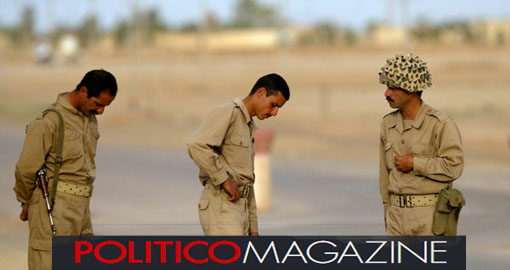
Members of the Mujahedeen Khalq, or MEK, an armed Iranian opposition group in Iraq, guard the road leading to the group’s main training camp near Baqubah, north central Iraq, in May 2003. | AP Photo

With one MEK supporter already tapped to be a Cabinet secretary (Elaine Chao at Transportation); several others, including John Bolton and Fran Townsend, still in discussion for senior jobs in a Trump administration; and a fourth, Newt Gingrich, taking the self-described role of “chief planner,” the character of the MEK and, by extension, its well-paid supporters matters.

Let’s start with the revisionist history. Torricelli, a former congressman and senator and for many years the MEK’s lawyer, denounces my assertions about the group’s violent past as outrageous and contends that he “has seen no evidence to support the assertion Benjamin makes that it took part in terrorist activities against Iranians or Americans.”

But there’s plenty of evidence out there. For decades, and based on U.S. intelligence, the United States government has blamed the MEK for killing three U.S. Army colonels and three U.S. contractors, bombing the facilities of numerous U.S. companies and killing innocent Iranians. Multiple administrations have rejected efforts by the MEK and its surrogates to claim that any bad acts were the result of what Torricelli calls “a Marxist group” that briefly ran the MEK while other leaders, who later rejected this cabal, were in prison.

So much was true when Torricelli himself was in the House of Representatives and served as a member of the Europe and Middle East Affairs Subcommittee of the House Foreign Affairs Committee. In a written response to a subcommittee question in 1992 about the MEK, Assistant Secretary of State Robert Pelletreau wrote:

We do not deal with the People’s Mojahedin Organization of Iran. This policy arises from our concerns about the organization’s past use of terrorism, its continuing advocacy of violence, and a fundamental contradiction between its policy and our own.

First of all, the Mojahedin murdered several Americans [sic] officials in Iran in the 1970s. This is not history to us, nor do we accept the Mojahedin attempts to excuse such actions on grounds that some of the organization’s leaders were incarcerated at the time of the attacks. The organization took responsibility for the attacks, and must bear the subsequent responsibility. They also supported the occupation of our Embassy in Tehran, in which American diplomats became hostages for over a year.

This is not a solitary reference. The issue came up frequently, and the answer was always the same. A 1992 Congressional Research Servicereport detailed the MEK’s extensive record of murder of Americans and Iranians. Although Torricelli denies that the MEK took part in Saddam Hussein’s repression of the Kurds after Operation Desert Storm, the report, drawing on U.S. government sources, notes, “Iraqi Kurds also claimed the Mojahedin had assisted the Iraqi army in its suppression of the Kurds, ‘a claim-substantiated by refugees who fled near the Iranian border.’” The report goes on to cite the Kurdish leader—and first president of Iraq after the fall of Saddam—Jalal Talabani, as telling reporters at the time that “5,000 Iranian Mojahedin [MEK] joined Saddam’s forces in the battle for Kirkuk” and points to Wall Street Journal reporting as well on the MEK’s part in this bloody campaign.

There is also a rich scholarly literature on the MEK’s misdeeds. Indeed, in 2011, distinguished Iranian-American historian Ervand Abrahamian (author of The Iranian Mojahedin) and three dozen other leading Iran scholars including Shaul Bakhash, Gary Sick and Juan Cole all signed a letter, published in the Financial Times, that opposed removing the MEK from the State Department’s Foreign Terrorism Organization List because of its history of terrorism, cult-like behavior and lack of support among Iranians.

Additionally, the MEK’s lawyer claims that in 1997, at the time of the designation, “The State Department gave as its reasons the MEK’s long record of violence, but I can tell you that as a member of the [Senate] Foreign Relations Committee, I reviewed the State Department file on the MEK and found no evidence, no testimony and no reason for the designation except placating Tehran.” But here, too, former Sen. Torricelli’s statement is incorrect. The State Department never shares the administrative record that underlies the listing of foreign terrorist organizations with anyone outside the Justice Department, the FBI, the Treasury Department and the White House. He would not have seen any State Department “file” or any evidence it contained.

Torricelli dismissed my argument by labeling me, and those who pushed to designate the MEK as a terrorist group back in 1997, appeasers of Tehran. The MEK and its surrogates commonly use this attack against those who criticize the group, but it is nonsense. Those who worked on the designation have repeatedly refuted this claim about doing a favor to Iran, and I certainly carry no brief for Tehran.

Indeed, in my years on the National Security Staff and as coordinator for counterterrorism at the State Department, I’ve been devoted to combating Iranian terrorism. I pressed our European partners to designate Hezbollah as a terrorist organization, which they eventually did in 2013. I briefed other countries on the Iranian plot to kill the Saudi ambassador in Washington, D.C., an effort that led to an unprecedented U.N. General Assembly condemnation of Iran in 2011. MEK supporters simply believe that anyone who won’t echo their calls for regime change in Tehran must be on the Islamic Republic’s side. They also claim that the MEK has a future as the “true democratic opposition to the mullahs”—that if and when regime change comes about in Iran, the MEK will be able to fill the void. But this is just pure wishful thinking. With no support in Iran and a gruesome history behind it, the MEK has no serious political prospects.

Lastly, Torricelli implies that because several high-level officials such as Secretary Hillary Clinton and Secretary John Kerry have thanked prominent American MEK supporters for their help in pressing the remaining group members to leave Camp Ashraf and later Camp Liberty, they somehow approve of the MEK.

I can’t speak for any private communications after I left State, but I would be surprised if the sentiment inside the building were any different from what it was when I was there—which is that gratitude was expressed to various American political figures for urging MEK followers, who were being used as pawns by their leadership, to start leaving Iraq. We wanted to avoid them all getting killed—86 were slaughtered in attacks in 2011 and 2013. That’s why I recommended, and Clinton signed off on, delisting the MEK—and doing so specifically as a matter of her discretion and not because of “changed circumstances,” which would have been the reason of record if the State Department felt confident that the MEK had become a genuinely trustworthy, nonviolent and democratic group.

It’s probably too much to ask that Robert Torricelli or any of the renowned political figures supporting the MEK reconsider their views. But others in Congress and the public ought to consult the abundance of evidence of the MEK’s troubling history, including the abuse of its members relayed in reports by such observers as Human Rights Watch and the account of its efforts to buy influence on Capitol Hill contained in the memoir by former Congressman (and onetime Iran-based CIA operative) Robert Ney. A more informed debate about the MEK might start there.

Ambassador Daniel Benjamin is Director of the John Sloan Dickey Center for International Understanding at Dartmouth College and served as Coordinator for Counterterrorism at the State Department 2009-2012.

Daniel Benjamin, Politico Magazine,

December 15, 2016 0 comments
FacebookTwitterPinterestWhatsappTelegramSkypeEmail
Mujahedin Khalq; A proxy force

House debate contaminated by Maryam Rajavi lobbyist Lord Alton

Open letter to Baroness Afshar

Dear Lady Afshar,

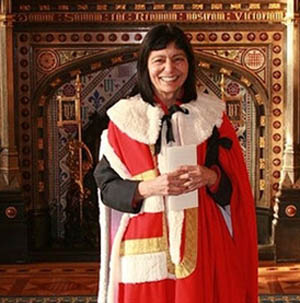
Baroness Afshar 

We are fortunate in the UK to have in the House of Lords an Iranian woman with your distinguished past as Professor of Politics at York University and as a highly-respected advocate for Iranian and Muslim women’s rights.

The House of Lords debate you called on December 8 was most welcome and timely. Your call to exert diplomatic pressure on Iran over its failure to administer true justice to its citizens and its mistreatment of named individuals was an admirable example of ‘speaking truth to power’.

“Having spoken truth to power all my life, I find that in this country I am invited to apply to join your Lordships’ House. I fear that in my own birthplace I would be put in prison and maybe the UK Government would not be able to help.”

Surely then you were as dismayed and frustrated as myself and many others that Lord Alton brushed aside your “deep personal experiences and knowledge of Iran” to opportunistically launch into his stock speech in support of the notorious National Council of Resistance of Iran (aka MEK, MKO, PMOI, Rajavi cult) and its leader Maryam Rajavi. To say this was an unwanted and irrelevant intervention is an understatement. Indeed, when he referred to Maryam Rajavi’s (fictitious) “commitment to the Universal Declaration of Human Rights and to other international instruments”, I was deeply dismayed.
Over decades, report after report by human rights bodies including various offices of the United Nations, Human Rights Watch and Amnesty International have charted the appalling violation of every single article of the Universal Declaration of Human Rights by Maryam Rajavi and her late husband in relation to their own followers. Surely it is common knowledge – at least among Iranians – that members of the MEK are held in a state of modern slavery and subjected to bizarre cultic abuses.

As a Farsi speaker I am sure you will understand when I describe Lord Alton’s contribution as throwing a mouse in the stew (moosh andakhtane Lord Alton dar dige hoghoogh bashar); he ruined it for everyone.

Rather than enjoying a free and productive discussion about human rights in Iran, the whole debate was contaminated by Lord Alton’s unwarranted support for a terrorist group which is known far and wide for its war crimes and crimes against humanity. We cannot now expect Iran not to take advantage of this speech and denounce the UK for double standards and supporting a terrorist group.

Some in the west perhaps forget that the Iranian establishment controls the narrative on the MEK in Iran and not Maryam Rajavi, and that it has lost no opportunity in the past to bring victims of MEK bombings as well as former members to the screen to testify to the MEK’s (irrefutable) acts of terrorism, treachery and human rights abuses.

As a result of its bloody and treacherous past the MEK is reviled both inside and outside Iran. I would challenge anyone to find an Iranian who has not been paid or brainwashed by the MEK who would advocate for the group. What possible motive could Lord Alton have to support this group for three decades in full knowledge of their past and current human rights abuses? What possible benefit could be brought to the debate on human rights in Iran by such support?

As a respected member of the House and an Iranian woman who for decades has advocated for women and human rights you know that this directly damages every effort by activists and protestors inside and outside Iran to democratically challenge and change their government’s suppressive, discriminatory and harmful policies. Support for Maryam Rajavi and the MEK plays directly into the hands of the hardliners who like nothing better than to point to UK support for MEK terrorism to justify their continued crackdown on civil protest.

Open Minds,

December 13, 2016 0 comments
FacebookTwitterPinterestWhatsappTelegramSkypeEmail
Former members of the MEK

Mr. Edvard Tremado met Dennis de Jong; member of EU Parliament

Mr. Tremado reiterated his experiences within the Mujahedin-e Khalq Cult. He was a POW of Iran- Iraq war when he joined the Cult. As a Christian he suffered a lot within the Cult affairs. He managed to liberate himself from the MKO destructive cult after 12 years.

blank

December 12, 2016 0 comments
FacebookTwitterPinterestWhatsappTelegramSkypeEmail
Mujahedin Khalq; A proxy force

Nuclear Deal Opponents Urge Military Confrontation with Iran

The U.S. should sink Iranian ships, consider targeted killings of Iranian fighters in Syria, and ratchet up new non-nuclear sanctions on Iran under the Trump Administration, according to a panel of lawmakers and policymakers organized on Capitol Hill yesterday by the hawkish United Against Nuclear Iran organization.
Outlining Trump’s options going forward, Mark Dubowitz of the Foundation for Defense of Democracies said the U.S. must “restore coercion” and recommended direct military confrontation, saying that sanctions alone are not a silver bullet. “The next time a Revolutionary Guard attack boat harasses the U.S. Navy, we should sink it, put it in the bottom of the Gulf,” Dubowitz said. “That would be a good start.” He also noted the possibility of directly targeting Iran’s Revolutionary Guard and Hezbollah proxies that are operating in the Syrian civil war. “Remember, right now Syria is a target-rich environment if you want to go after the Revolutionary Guard and Hezbollah, and that’s not just a hypothetical possibility, the Israelis are doing it today…The Israelis are enforcing their red lines, they’re using military force against the Iranians. I think the United States of America could do the same.”

Former Connecticut Senator Joe Lieberman, echoed Dubowitz’s calls for military action, advising Trump to “make it explicit with the power he has as Commander-in-Chief that if they challenge some of our naval assets, we will fire on them. We’ve got to be that explicit.” Lieberman is chairman of UANI and formerly an advisory board member of an AIPAC organization explicitly established to kill the nuclear deal. In addition to the UANI panel, he appeared at a Capitol Hill event this week organized by the Mujahedin-e Khalq (MEK), a shadowy group formerly designated as a terrorist organization by the State Department. They have a long history of using violence and terror both against their own members as well as when they were serving as a military force for Saddam Hussein in Iraq. At the UANI event, Lieberman said the goal of increased “pressure” on Iran would be to elicit concessions from Iran by causing them to “begin to wonder about the survival of the regime.”

Military confrontation was only part of the strategy put forward at the UANI briefing. Rep. Ileana Ros-Lehtinen (R-FL) joined others in calling for an escalation of sanctions under the Trump administration. She advocated for expanding non-nuclear related sanctions on Iran – including those targeting entire sectors of the Iranian economy – “and perhaps even rolling back or tightening provisions of the JCPOA.” Dubowitz, meanwhile, called to “use our ability under the deal, particularly in non-nuclear sanctions, which the administration itself has admitted are not inconsistent with the JCPOA, to begin to address Iran’s malign activities outside the deal and inside the deal.” Contrary to his assertions, however, the JCPOA prohibits the U.S. from re-imposing sanctions lifted under the nuclear deal under a separate pretext, and the Obama administration has threatened to veto legislation that does so in order to protect the deal.

Ros-Lehtinen, whose former Chief-of-Staff is leading the Trump Transition Team’s approach to Iran, forecasted “a flurry of Iran-related activities early in the New Year” and looked forward to the “opportunity to undo a lot of the problematic concessions that we have seen over the last few years,” adding an enthusiastic “I can’t wait!”

National Iranian American Council ,

December 11, 2016 0 comments
FacebookTwitterPinterestWhatsappTelegramSkypeEmail
Mujahedin Khalq; A proxy force

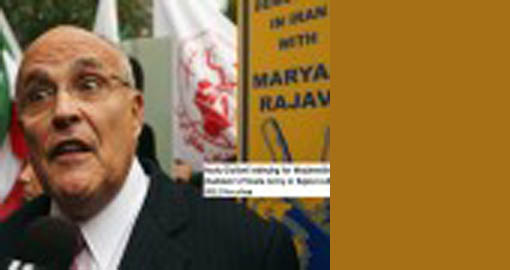
No Job in the Trump Administration for Rudolph Giuliani (Lobbyist for MEK)

Mayor Rudolph Giuliani—known to covet the post of secretary of state—will not have a role in President-elect Donald Trump‘s incoming administration, supposedly not because of complications arising from his consulting work for terror-supporting organizations and interests, but due to undefined “reasons for remaining in the private sector.”

Giuliani, Trump and White House chief of staff-to-be Reince Priebus released a joint statement announcing the decision late today, an age-old practice for burying unflattering news. Priebus, the outgoing chairman of the Republican National Committee, stated that America’s mayor “was vetted by our team for any possible conflicts and passed with flying colors”—despite the payments he and his company Giuliani Partners have received from the Islamic State-funding government of Qatar or the registered terrorist group Mujahedin e-Khalq, a banished Iranian political party.

Instead, the president-elect’s press office insisted Giuliani had voluntarily “removed his name from consideration for a position in the new administration” all the way back on November 29.

“Rudy would have been an outstanding member of the Cabinet in several roles, but I fully respect and understand his reasons for remaining in the private sector,” said Trump in the statement, leaving open the possibility of a nomination for Giuliani at an unspecified time in the future. “He is and continues to be a close personal friend, and as appropriate, I will call upon him for advice and can see an important place for him in the administration at a later date.”

Giuliani, who went from demurring over whether to back Trump to becoming one of his most strident surrogates, neglected to elaborate on what those “reasons” for preferring not to get a gig in the federal government were. He did, however, claim it was nothing personal.

“This is not about me; it is about what is best for the country and the new administration,” said Giuliani, who last won an election in 1997. “Before I joined the campaign I was very involved and fulfilled by my work with my law firm and consulting firm, and I will continue that work with even more enthusiasm. From the vantage point of the private sector, I look forward to helping the President-elect in any way he deems necessary and appropriate.”

Trump has also considered former Massachusetts Gov. Mitt Romney—one of his loudest critics in the primary season—and disgraced former Central Intelligence Agency Director and retired General David Petraeus for the helm of the State Department, which sets the country’s foreign policy.

Giuliani will remain a vice chairman of Trump’s transition team.

Disclosure: Donald Trump is the father-in-law of Jared Kushner, the publisher of Observer Media.

Will Bredderman, Observer,

December 11, 2016 0 comments
FacebookTwitterPinterestWhatsappTelegramSkypeEmail
Nejat Publications

Pars Brief – Issue No. 93

Inside This Issue:

  1. I was at State when we took the MeK off the terrorist list. But team Trump’s ties to the group still worry me.
  2. Gaffney, Lopez, and the MEK
  3. Why Donald Trump needs the Iran nuclear deal
  4. No Job in the Trump Administration for Rudolph Giuliani
  5. Giuliani was paid advocate for shady Iranian dissident group

Download Pars Brief – Issue No. 93

December 10, 2016 0 comments
FacebookTwitterPinterestWhatsappTelegramSkypeEmail
Iran Interlink Weekly Digest

Iran Interlink Weekly Digest – 171

++ Several former MEK members attended meetings held by the S&D Group in the European Parliament about terrorism. Reza Sadeghi Jebelli contributing from the audience in one meeting said: ”you have the MEK here in this building right now (he showed them leaflets from the MEK) holding a meeting supposedly about human rights in Iran. If you have a terrorist group in your building then nothing you say about terrorism has any credibility. Clean your own house first.” Formers, however, say that when they talk individually with parliamentarians about the MEK they know them to be a cult and dismiss them with contempt.

++ This week Rajavi’s sites have been busy claiming that recent criticisms by formers and human rights activists are all ‘because the regime is afraid of us’ – the reasoning being that anyone who criticises us is an agent of the Iranian regime and ‘they’ all belong to the Iranian regime, therefore… Rajavi’s sites refer to the case of Shabnam Madadzadeh (see last week’s Digest) whose case embarrassed genuine human rights advocates who had previously said Iran had wrongly arrested and imprisoned her on national security charges, only to be proved wrong when the moment she was freed she aligned herself with the terrorist MEK. Those human rights groups which had supported her now denounce her. Rajavi just says ‘they are all agents of the Iranian regime’ and just as ridiculously she says ‘Madadzadeh is proof that we have young people in the MEK as well’.

From Tabriz, a trusted source and friend of Iran Interlink who has family inside the MEK wrote ‘Being in Tabriz I can assure Maryam Rajavi that only the government of Iran is keeping you alive, nobody else here cares a pinch about you. If it wasn’t for the government, nobody would hear of you. But I see why they do it. You are the example to point out the double-standards and hypocrisy of France, the UK and America. They are also able to claim ‘all my opposition is like you’.’

++ Mohammad Javad Hashemi Nejad, General Secretary of Habilian Association, had an interview with media in Tehran on the issue of Iran and Saudi Arabia. He said ‘when the Saudis started using the MEK through Al Arabiyeh and sending Prince Turki to talk in Paris and thereby opening up their use of MEK, we discovered what a tight hand the Saudis are holding. We didn’t know before how weak their hand is and we will not overvalue them again. The MEK is being

used as a loudspeaker for every other terror group that is being fed by the Saudis against Iran. But Iran has the situation under control and all their activities have been prevented and the people arrested. For example, during Arbaein there were over twenty teams with plots to conduct terror acts. Not one of them was successful and the perpetrators are now either dead or in prison.’

++ Mohammad Hussein Sobhani wrote article for Iran Pen Association arguing with various reasons and explanations that Maryam Rajavi has failed repeatedly to replace her husband Massoud as leader of the MEK. Sobhani says that ‘each time she tries to do what Massoud used to do, she fails miserably. Now the question remains, is there nobody in this organisation among all these people who is better than her? Why are they insisting she stays when it’s clear she can’t do the job?’

In English:

++ Former MEK members Isa Azadeh, Ghorbanali Hossein-Nejad and Reza Sadeghi Jebelli participated in the EU Press Club Conference during which they had the opportunity to speak with journalists, reporters and media staff from different European states such as Albania. The formers explained the situation of the MEK cult hostages, particularly after their relocation to Albania. They elaborated on different aspects of the cult’s manipulative techniques including isolation and forced celibacy. The former members shared their own experiences with the Conference attendees.

++ Speculation over President-elect Donald Trump’s potential cabinet appointments continued last week with articles covering various aspects of the conundrum but sharing one common denominator – Americans’ support for the Mojahedin Khalq terrorist group and the continued vexed question as to how such supporters might be placed to somehow engineer regime change in Iran during the Trump presidency.

++ The National Iranian American Council (NIAC) warned in article ‘Nuclear Deal Opponents Urge Military Confrontation with Iran’. A panel of lawmakers and policy met as the “hawkish” United Against Nuclear Iran organisation. NIAC reported that among those who attended, Senator Joe Lieberman had “appeared at a Capitol Hill event this week organized by the Mujahedin-e Khalq (MEK), a shadowy group formerly designated as a terrorist organization by the State Department. They have a long history of using violence and terror both against their own members as well as when they were serving as a military force for Saddam Hussein in Iraq.”

December 09, 2016

December 10, 2016 0 comments
FacebookTwitterPinterestWhatsappTelegramSkypeEmail
Mujahedin Khalq; A proxy force

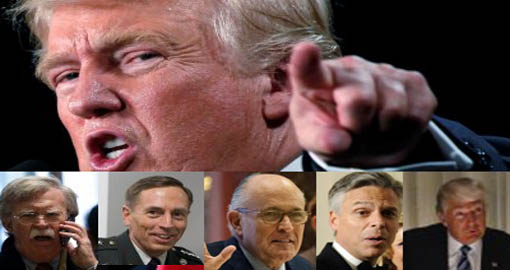
From Mitt Romney to Rudy Giuliani: Who are Donald Trump’s top five picks for secretary of state?

Jon Huntsman, John Bolton and David Petraeus are also in the running.

And the winner is… Donald Trump is yet to reveal who his choice is for secretary of state, the US equivalent to foreign minister (Reuters)

President-elect Donald Trump is taking his time to appoint a secretary of state – arguably one of the most important positions in his cabinet – leaving the world guessing about who will represent the US on the world stage. Whenever it has looked like the decision is made, another candidate has popped up and thrown the race wide-open. Trump, for his part, seems content to let us wonder a bit longer.

The top five – outlined below by IBTimes UK – are a totally mixed bag. On the one hand you have a former general, David Petraeus, with 37 years in the military and – for better and for worse – a well-established public profile. On the other you have Mitt Romney, a former Republican candidate for president who has branded Trump both a “phony” and a “fraud”.

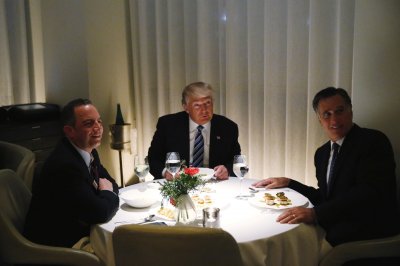
US President-elect Trump sits at a table for dinner with former Massachusetts Governor Romney (Lucas Jackson)

1. Mr Massachusetts: Mitt Romney

Mitt Romney openly opposed Donald Trump’s campaign and was a preferred candidate by many Republicans, but since the election appears to have overcome his differences with the US president-elect. But while many moderates would welcome his appointment, Romney, a Mormon, is hated by the religious right and his appointment to a cabinet position would be extremely controversial.

Despite Romney branding Trump both a “fraud” and a “phony” during 2016, Trump reportedly told aides that the 2012 Republican nominee for president “looks the part”. Last month, the former Massachusetts governor was pictured having dinner with Trump at one of his restaurants in New York, the latter smiling and the former looking decidedly awkward.

Speaking after the meeting, Romney said: “He did something I tried to do and was unsuccessful in accomplishing: he won the general election. He continues with a message of inclusion and bringing people together, and his vision is something which obviously connected with the American people in a very powerful way.”

In terms of what Romney thinks about foreign policy, Trump supporters are concerned that he is far more aligned with George W Bush-era interventionism rather than the president-elect’s more isolationist stance. Romney ran in 2012 on a platform that was wary of Vladimir Putin (the opposite to Trump) and wanted to see a greater US presence in Iraq (again, the opposite to Trump).

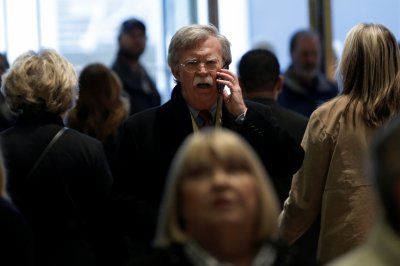
John Bolton has an established diplomatic pedigree but some controversial alliances (REUTERS/Mike Segar)

Mr Moustache: John Bolton

Of all the candidates for secretary of state, John Bolton has by the far the best facial hair. Unfortunately he is also known to have some unusual friends, once speaking on behalf of an Iranian rebel group called the People’s Mujahedin (MEK). Until 2012, the MEK was listed as a terrorist organisation and is hated as much by Iran’s democratic opposition as it is by the regime in Tehran.

Bolton has flirted with foreign-orientated office before. In 2005 his nomination as ambassador to the United Nations was blocked by the Democrats and although he was appointed to the position during recess he lasted less than a year, resigning at the end of 2006. He served in George W Bush’s administration as secretary of state for arms control and international security.

His views on both Iran and North Korea will certainly play to Trump’s campaign playbook. He opposed Barack Obama’s nuclear deal with Iran and Bill Clinton’s with North Korea. He led the fight to repeal UN resolution 3379, which branded Zionism as racism. Bolton would certainly mark a sea change for US foreign policy. Bloomberg columnist Eli Lake has branded him “the anti-John Kerry”.

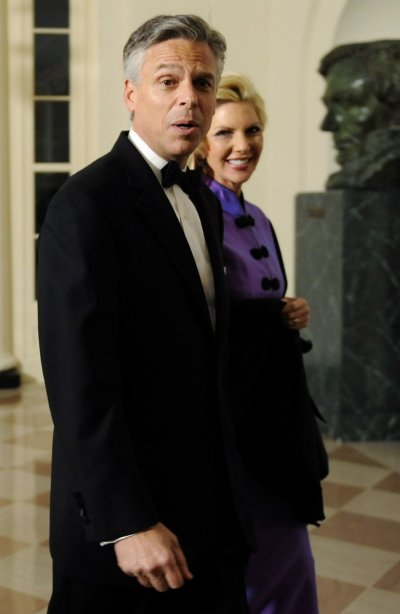
Jon Huntsman was US ambassador to China under Barack Obama (Reuters)

Mr China: Jon Huntsman

Jon Huntsman is another candidate for secretary of state that was once tipped as a future Republican presidential candidate. The billionaire former governor of Utah ran in the primaries for the US election in 2012 before losing out to another of Donald Trump’s suitors, Mitt Romney.

Huntsman is perceived as a bit of a political lightweight, but the events of the past few days may actually improve his chances of landing the job. A former US ambassador to China, Huntsman speaks fluent Mandarin Chinese and may be able to smooth relations with Beijing over the Trump/ Taiwan furore.

Sadly though, Trump doesn’t think much of Huntsman’s linguistic skills. After the 56-year-old spoke it during the 2012 primaries, the president-elect said: “I didn’t think the Mandarin thing worked at all. I thought it was ridiculous.” Before calling Huntsman “an Obama plant”.

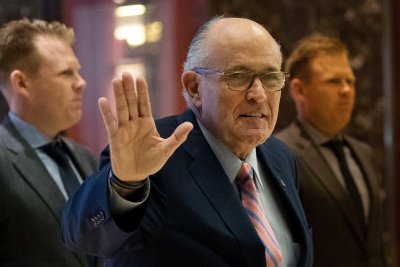
Former New York City mayor Rudy Giuliani arrives at Trump Tower in New York City (Eduardo Munoz Albarez/ AFP)

Mr Mayor: Rudy Giuliani

Rudy Giuliani was among the first Donald Trump allies to be linked with the top job, and he has been banging the drum pretty hard since, keen to show the world that he has the credentials to take up what is arguably the most important job in the cabinet. He told the US media that secretary of state was the only role he was interested in taking.

But administration insiders have suggested that the former New York mayor’s active public campaigning for the role may have put Trump off. Giuliani has faced searching questions about his international business ties, including revelations that he has earned more than $11m (£8.6m) from lucrative speaking contracts. Trump has heavily criticised Hillary Clinton for doing the same thing.

His firm, Giuliani Partners, has carried out work both with Qatar and the company building the Keystone XL oil pipeline. Giuliani has defended his firm’s Qatari work, pointing out that the Gulf country is a US ally, and said that he “has done no work on the pipeline”. Like John Bolton, he has also given speeches to the Iranian MEK, which he campaigned to have delisted as a terrorist group.

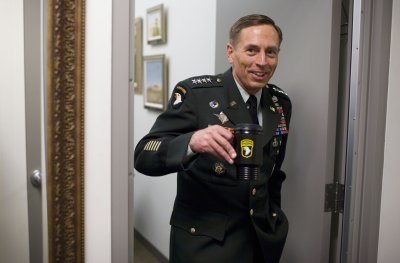
David Petreaus

Mr Military: General David Petraeus

David Petraeus spent 37 years in the military and was once touted as a future president before he was buried in a scandal over his mistress, Paula Broadwell, in 2012. He was later fined $100,000 for sharing classified information with Broadwell, who at the time was his biographer.

Like James “Mad Dog” Mattis, Donald Trump’s new secretary of defence, Petraeus served as General Command of the US military, as well as commander of the US forces in Afghanistan. When he retired he was appointed director of the CIA, until being forced out of the role over his affair.

Critics point out that after hammering Hillary Clinton relentlessly during his campaign over her mishandling of classified information relating to her personal emails, it may be a touch hypocritical to appoint a man who was actually convicted of doing so. But the president-elect may take the view that Petraeus has paid his dues for the breach and that his military record is too good to pass up.

His supporters argue that his military experience coupled with his internationalist approach to foreign affairs – Petraeus chaired a Council on Foreign Relations task force that called for strengthening relations between the US, Mexico and Canada – would make him a good counterweight to Trump’s bull-in-a-china-shop approach to geopolitics and reputation for isolationism.

“He understood that the key terrain of the conflict was in the realms of politics, diplomacy, and communications, not the use of force per se — although he also did not hesitate to use force in a targeted and effective way,” Max Boot wrote in Foreign Policy, while also pointing out that he “has probably been responsible for the deaths of more violent jihadis than any other American”

Petraeus, for his part, seems keen to take the role. Speaking on US TV last week, he spoke out about the scandal that cost him his job. “Five years ago, I made a serious mistake,” he said. “I acknowledged it. I apologised for it. I paid a very heavy price for it, and I’ve learned from it.”

By Orlando Crowcroft, International Business Times,

December 10, 2016 0 comments
FacebookTwitterPinterestWhatsappTelegramSkypeEmail
Mujahedin Khalq; A proxy force

Probable Trump Foreign Policy cheer the MKO up!

These days we are hearing that Trump may choose the most hawkish American figures for crucial posts in his administration. The majority of these figures are naturally paid supporters of the Mujahedin Khalq Organization (the MKO).

Regarding the group’s massive lobbying activities in the US Congress and large amounts of money it has spent to buy supporters, a hawkish warmonger Trump administration is what the MKO has been dreaming of for years. However, the affairs do not look to be as easy as the group supposes.

The MKO propaganda praises certain nominees that Donald Trump has settled for Secretary of State because they are its top paid speakers in its propaganda events. Daniel Benjamin, former coordinator of Counter terrorism Bureau of the State Department was one of the targets of the group before it was removed from the FTO list in September 2012. He writes an op-ed in the Politico Magazine in which he thoroughly discusses the MKO’s huge lobbying campaigns to buy supporters in the US Congress and administration, particularly in the State Department. Based on Benjamin’s experience, he suggests, “No designated terrorist group had ever mounted a campaign like this before. Indeed, as a stampede of hogs to the trough, it was astonishing by any Washington standard.”

As Daniel Benjamin is not sure about the source of the MKO lavishly donated funds, he is sure about five-figure sums that ensure many supporters of the group to ignore its dark background of violence and terror. “Those who embrace the group show an alarming lack of concern about its past and heedlessness about core principles of American counterterrorism policy,” he writes. “Exactly where all the money came from remains unknown. Most of those who hitched their wagon to the MeK appeared to be getting $15,000 to $20,000 or more per appearance at these public events, and they were presumably happy to add their names to whatever open letters demanding better treatment for the group that were put in front of them.”

The former coordinator of counter terrorism office of the State Department warns about the hypocrisy of the MKO leaders and the reality of the undemocratic relations inside the MKO camps. “Even more unsettling was the sheer creepiness of the group,” he asserts. “While Maryam Rajavi was presiding over enormous conferences with American political celebrities and seas of smiling, waving people in Paris, at Camp Ashraf, the MeK leadership treated its people appallingly. Visitors, including from the U.N., painted a picture of relentless intimidation, shaming and coercion of the inhabitants by camp leaders. The MeK, which is often described as a cult, had a long history of requiring that its members divorce and remain celibate.”

 “The love affair with the MeK continues to mystify,” writes Benjamin. “For some, like Bolton, there is clearly an unshakeable certainty that the MeK will play a role in changing the regime in Tehran. Bolton’s reputation for dogmatism is well-earned in this case: Serious scholars of Iran all agree that the MeK is universally loathed in Iran, where no one forgets its service to Saddam or its slaughter of Iranian conscripts and others.”

In case of other MKO advocates such as Giuliani, Benjamin proves that he is mostly motivated by the MKO’s hefty payments rather that its cause. He suggests, “With Giuliani, as perhaps with Gingrich and others, the attraction to the MeK may be more grounded in plain old greed than foreign policy.”

“According to a financial disclosure reported on by The New York Times, Giuliani has been speechifying at hyper speed for years, collecting $11.4 million for 124 appearances in just one year—and that was before signing up for the MeK gravy train around 2011. Perhaps he just didn’t have time to consider the character of his paymaster,” adds Daniel Benjamin.

As a matter of fact,Trump’s White House appointments, with links to the Cult of Rajavi definitely causes concerns over the future foreign policies of the White House but it should be taken into consideration that the MKO lacks any public support among Iranians. So, the US government will be entirely discredited if it follows the illusions of people like John Bolton or Rudy Giuliani. Besides, the US is not independent on its foreign policy towards Iran. As a normal US policy, it might impose secondary sanctions against Iran and on European companies to prevent them from having business with Iran. Obviously, this tactic will not work with Russia, China and India who have taken steps to disconnect their economy from the U.S. economic system. Moreover, the EU states do not seem to be satisfied with the presidency of Trump and evidently they do not seem to agree with his probable aggressive foreign policy. The Cult of Rajavi is betting on the wrong horse again.

By Mazda Parsi

December 8, 2016 0 comments
FacebookTwitterPinterestWhatsappTelegramSkypeEmail
Newer Posts
Older Posts

Recent Posts

  • Pregnancy was taboo in the MEK

    December 22, 2025
  • MEPs who lack awareness about the MEK’s nature

    December 20, 2025
  • Why did Massoud Rajavi enforce divorces in the MEK?

    December 15, 2025
  • Massoud Rajavi and widespread sexual abuse of female members

    December 10, 2025
  • Farman Shafabin, MEK member who committed suicide

    December 3, 2025
  • Facebook
  • Twitter
  • Instagram
  • Youtube

© 2003 - 2025 NEJAT Society . All Rights Reserved. NejatNGO.org


Back To Top
Nejat Society
  • Home
  • Articles
  • Media
    • Cartoons
    • NewsPics
    • Photo Gallery
    • Videos
  • Publications
    • Books
    • Nejat NewsLetter
    • Pars Brief
  • About Us
  • Contact us
  • Editions
    • عربي
    • فارسی
    • Shqip