Nejat Society
  • Home
  • Articles
  • Media
    • Cartoons
    • NewsPics
    • Photo Gallery
    • Videos
  • Publications
    • Books
    • Nejat NewsLetter
    • Pars Brief
  • About Us
  • Contact us
  • Editions
    • عربي
    • فارسی
    • Shqip
Nejat Society
Nejat Society
  • Home
  • Articles
  • Media
    • Cartoons
    • NewsPics
    • Photo Gallery
    • Videos
  • Publications
    • Books
    • Nejat NewsLetter
    • Pars Brief
  • About Us
  • Contact us
  • Editions
    • عربي
    • فارسی
    • Shqip
© 2003 - 2024 NEJAT Society. nejatngo.org
Iran

Tehran calls S. Arabia ‘founding father of Daesh, al Qaeda’

Reacting to a recent barrage of anti-Iranian remarks by Saudi Foreign Minister Adel al-Jubeir, the Iranian Foreign Ministry on Saturday lambasted the Saudi kingdom, calling it “the founding father of Daesh and al Qaedeh.”
During a lecture on terrorism organized by the Belgian Ministry of Foreign Affairs in Brussels and hosted by Egmont Research Center, Saudi Foreign Minister Adel al-Jubeir had accused Tehran of expansionist policies and “harboring” terrorism.

The acid comments were rejected by Iranian Foreign Ministry spokesman Bahram Qasemi as “absurd, unfounded, and repetitious.”

“Adel al-Jubeir, who is these days desperately obsessed with smudging the footprints of the interventions of Saudi officials in numerous terrorist attacks over the past decades, thinks can deflect the public opinion of the world from endless disgraces of his country as the founding father of Daesh and al Qaeda through propaganda,” Qassemi stated in a statement carried by the official website of the Iranian Foreign Ministry.

Iran and Saudi Arabia have been supporting opposing sides in regional developments in the Middle East region, particularly in Syria.

Saudi Arabia claims Tehran launches proxy wars in the Middle East to widen its sphere of influence.

Ironically, al-Jubeir’s comments come days after Washington published 28 pages of a congressional report on the September 11 terrorist attacks, part of which had hinted at the Saudi government’s involvement in the attack

“While in the United States, some of the September 11 hijackers were in contact with, and received support or assistance from, individuals who may be connected to the Saudi Government,” reads part of the report released on July 15, according to Press TV.

Referring to the report, Qasemi pointed out, “Of course this is understandable that the Saudi foreign minister has been through tough days just before the confidential September 11 report and await even tougher days ahead.”

“There is no doubt that the consequences of such important information about the resources of a country which shelters terrorism will not escape the public opinion of the world and of nations which fell victim to terrorism after the September 11,” the spokesman remarked.

Key here is that Saudis’ regional mudslinging runs counter to what they do in practice.

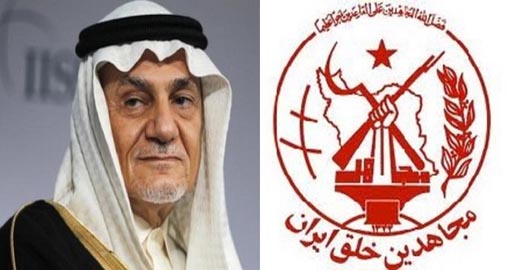
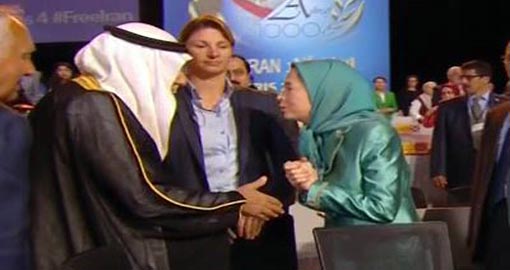
On July 9, Prince Turki al-Faisal, Saudi Arabia’s former spy chief, attended an annual meeting of the MKO terrorist group in Paris where he pledged backing and wished for the collapse of Iran.

For years, the group has committed acts of terrorism against Iran and the Saudi link simply means they have been feeding them financially.

Hossein Mousavian, the former Iranian diplomat and current researcher at Princeton University, wrote an article on July 21 in the Huffington Post saying “Riyadh’s now open alliance with the MEK only solidifies its position as the sponsor of yet another extremist group…”

Also, in his recent article published in the Guardian, Mousavian said, “It has long been evident to the global community that Saudi Arabia is a benefactors of Islamist militant groups, including likely the group that evolved into ISIS.”

To support his stance, the Iranian diplomat quoted U.S. Secretary of State Hillary Clinton as having stated at the Brookings Institution last year that, “Much of the extremism in the world today is the direct result of policies and funding undertaken by the Saudi government and individuals.”

Likewise, last year German Vice Chancellor Sigmar Gabriel called on Saudi Arabia to stop financing Wahhabis.

“We have to make clear to the Saudis that the time of looking away is over,” Gabriel had told Bild am Sonntag newspaper.

The German official added, “Wahhabi mosques all over the world are financed by Saudi Arabia. Many Islamists who are a threat to public safety come from these communities in Germany.”

With this background, it seems Saudis are pulling the wool over outsiders’ eyes, accusing others of backing terrorism cunningly to avoid being accused of terrorism!

July 26, 2016 0 comments
FacebookTwitterPinterestWhatsappTelegramSkypeEmail
Mujahedin Khalq Organization's Propaganda System

Supporting the MKO is big waste of time and money

Saudis, Iran must resume dialogue; MKO a big imposture

Supporting the MKO is big waste of time and money,vice chair of the Foreign Affairs Committee of the French Senate said.

Tehran and Riyadh have to make effort to bear each other and restart a dialogue, Nathalie Goulet, vice chair of the Foreign Affairs Committee of the French Senate told Trend.

Recently, the long-escalated relations between Tehran and Riyadh worsened after participating of Prince Turki al-Faisal, Saudi former intelligence chief, in Mujahedin-e Khalq Organization’s (MKO) annual meeting in the Le Bourget, near Paris on July 9.

MKO is considered a terrorist group by Iran because of its history of assassinations and bombings against Iranian authorities and for siding with former Iraqi dictator Saddam Hussein during the eight-year Iran-Iraq war in the 1980s, which resulted in about a million casualties from the Iranian side.

“The most challenging issue is to restore trust and get rid of irrational fears or feeling of superiority between Iran and Saudi. The world security needs both KSA and Iran,” Goulet said.

Saudi Arabia’s important role in Middle East peace

Goulet said that the Kingdom of Saudi Arabia (KSA) was known as a major oil producing country in the world and stayed out of the limelight before the Gulf War.

“When Saddam Hussein targeted Saudi Arabia in retaliation to the US offensive, the Kingdom was alarmed that it needed better defensive measures. The regional events after the new millennium encouraged the Kingdom to take on a more active role in the region. The economic power of the country grew steadily and helped the Kingdom to establish itself as one of the major players in the region,” the senator said.

She added that with the current administration in Saudi Arabia and their desire to play a more constructive role in regional peace and stability, France welcomes such efforts.

“France and the Kingdom remain good partners in fighting terrorism worldwide and are determined to uproot this global disease. Of course we do have other partners in the region, sharing the same goal and we will work hard to create a stronger and stable consensus to speed up the counter terrorism efforts,” said Goulet.

Riyad is a member of US-led coalition in fight against Islamic State (IS) terrorist group and Iran also helps Iraq and Syria to battle against this group separately.

Goulet said that France welcomes the true efforts of KSA to control financing of terrorism, however, it’s obvious that restoring peace and security in the Middle East will not come overnight.

She added that as the guardian of the two holy mosques in Mecca and Medina, KSA has to play a major role in fighting Islamic extremism.

“I had the chance and the privilege to meet HRH Muhammed Bin Salman and Foreign Minister Al Jaiber in Paris. I fully trust their will to be successful in their vision of KSA 2030. Our standards are really far from KSA’s rules and regulation. More cooperation will help a lot to achieve the goals,” she said.

Supporting MKO – waste of time and energy

Coming to MKO’s meeting in France and participating of a former top Saudi official there, Goulet said that “we always encourage the countries in the region to establish closer relationship for more enduring regional peace. The recent gathering of exiled Iranian terrorist group in France known as MKO and presence of some Saudi figures hopefully shall not be interpreted as position of current administration of KSA”.

Members of the MKO fled to Iraq in 1986, where they enjoyed the support of former Iraqi dictator Saddam Hussein, and set up Camp Ashraf near the Iranian border in Diyala.

The group has carried out numerous terrorist acts against Iranian civilians and government officials. The terror organization is also known to have cooperated with Saddam in suppressing the 1991 uprisings in southern Iraq and the massacre of Iraqi Kurds in the north.

Goulet said that the MKO is a big imposture and tries to appear as a solution for a replacement of Iranian regime.

“Anyone involved in the regional policy knows that MKO has no foot print inside Iran and have in fact acted as mercenaries against Iranians during the Iran-Iraq War. Even if you dislike the Iranian regime, supporting the MKO will not help to get a new regime. No one in Iran will support MKO as it betrayed this country by supporting Iraq during a terrible war," Goulet said.

She added that supporting MKO will just bring more solidarity among Iranian people and will create more misunderstanding between the two nations. “It is big waste of time and money,” she added.

By Dalga Khatinoglu / Trend.az  / Baku, Azerbaijan

July 26, 2016 0 comments
FacebookTwitterPinterestWhatsappTelegramSkypeEmail
Mujahedin Khalq Organization as a terrorist group

Saudi-MKO Alliance, a Political Idiocy

Prince Turki al-Faisal’s hostile remarks against Tehran in the annual gathering of the Mujahedin Khalq Organization and his promises to stand by the MKO seems to be a total failure for both sides of the alliance.

The Saudi policies aimed at destabilizing its rival Islamic Republic –as a powerful neighbor and an influential country in the Muslim world—sounds to have formed new stances that are now overt rather than covert. Prince Turkie who presumably have been authorized by his peers in the Saudi regime cheers up the MKO-gathered audience by saying, “I, too, want the downfall of the regime.”

But, this plain sponsorship for the destructive cult of Rajavi with a dark history of violence and human rights abuse will not work. As the New York-based journalist on U.S. foreign policy, Ali Gharib writes, “If Saudi Arabia is on a quest to paint itself as a responsible actor in the region, the kingdom took a big step backward over the weekend.”[1]

It’s truly “a big step backward” and as Barbara Slavin Acting Director of the Future of Iran Initiative at the Atlantic Council in Washington, asserts in her article on Turkie Feisal’s support for the MKO, “mixing with the MEK is a recipe for disaster and a distraction from the region’s and the world’s real enemy – the group that calls itself the Islamic State.”[2]

Slavin confirms rumors about Saudis’ long-standing support for the MKO, “It’s entirely possible that the Saudis have funded the MEK for years.” [3] So, In case of Turkie and other rich Arab figures MKO’s speaking fees do not create the motivation to take such hostile stances against the Islamic Republic. “The Sunni Gulf states—flush with petrodollars and bearing sectarian grudges against Shiite Iran in a regional battle for hegemonic primacy—have long been suspected as a source of funding for MEK’s lavish spending, but no reliable reports have definitively established where the group gets its cash,” writes Ali Gharib. “Al-Faisal’s public move in support of the group certainly provides one more piece of evidence to link Gulf States to MEK’s financing.”[4]

He explains, “Although MEK is famous for lavishing money on its supporters—paying as much as $50,000 for a short speech and investing in politicians through campaign contributions—al-Faisal, as a member of Saudi Arabia’s super-rich royal family, probably scoffs at the sort of cash MEK offers. Instead, al-Faisal attended for obvious reasons: to put a thumb in Iran’s eye.”[ 5]

Actually, Saudi’s financial and spiritual support for the MKO is already a failed investment because the MKO is notoriously known to Iranians and many others in the international community. “Contrary to the MEK’s claims, there is nothing democratic about this cultist organization, which requires its members to divorce their spouses or remain celibate and engage in Maoist-style struggle sessions of self-humiliation”, Slavin warns. “Those that manage to escape often require long periods of de-programming.” [6]

And this is Ali Gharib’s account about the MKO’s situation among all Iranians in general: “Let’s be blunt: MEK is neither a viable agent for regime change in Iran nor the “government-in-exile” the group pretends to be. They enjoy almost no support among Iranians at home or abroad. Exiled royalists hate them for their terror war against the Shah’s regime and their part in the Islamic Revolution. Inside the country, they are reviled across the political spectrum for siding with Saddam Hussein—and fighting against Iranians—in the Iran-Iraq war.” [7]

The MKO has carried out numerous terrorist attacks against Iranian civilians and government officials over the past three decades. Out of the nearly 17,000 Iranians killed in terrorist attacks since the Islamic Revolution, about 12,000 have fallen victim to MKO’s bombings, mortar attacks and other violent acts.

Robert Macey of the Intercept cites from an Iranian scholar Ariane Tabatabai of Georgetown University _who describes the MKO as “cult-like dissident group”_ what the Iranians feel about the MKO.  “If the current government is not Iranians’ first choice for a government, the MEK is not even their last — and for good reason,” tells Ariane Tabatabai to Robert Macey. “Today, the MEK is viewed negatively by most Iranians, who would prefer to maintain the status quo than rush to the arms of what they consider a corrupt, criminal cult.” [8]

Saudi transformation from a sponsor of Syrian rebels particularly ISIS to a state sponsor of the terrorist cult of Rajavi indicates the failure of previous proxy wars and a new endeavor to confron Iran. However, the new choice is not reliable at all. The common enmity for Iran does makes an absolutely idiot alliance.

As a matter of fact, ISIS is losing ground in Syria and Iraq and eventually Saudi Arabia is largely losing the capacities to use terrorist groups against its rival. Thus, the kingdom is beating the dead horse of “the late Massoud Rajavi”.

Mazda Parsi

References:

[1]Gharib, Ali, Saudi Supports Anti-Iran MEK Fanatics Mujahedin Khalq Organization as a terror group,     Lobelog, July16, 2016

[2] Slavin, Barbara, Saudi Backing of Iranian Exile Group Inflames Mideast Conflicts, Voice of America

July 11th, 2016

[3] ibid

[4] Gharib, Ali, Saudi Supports Anti-Iran MEK Fanatics Mujahedin Khalq Organization as a terror group,     Lobelog, July16, 2016

[5] ibid

[6] Slavin, Barbara, Saudi Backing of Iranian Exile Group Inflames Mideast Conflicts, Voice of America

July 11th, 2016

[7] Gharib, Ali, Saudi Supports Anti-Iran MEK Fanatics Mujahedin Khalq Organization as a terror group,     Lobelog, July16, 2016

[8]Mackey, Robert, Newt Gingrich Pals Around With Terrorists Saddam Hussein Once Armed, the Intercept, July 11, 2016

July 25, 2016 0 comments
FacebookTwitterPinterestWhatsappTelegramSkypeEmail
Iran

From Iran to Nice, We Must Confront All Terrorism to End Terrorism

France has unfortunately been the epicenter for two terrorism-related events in recent weeks. The tragic truck attack in Nice, which received international attention, and a rally recently held in Paris by a notorious Iranian opposition group — the “Mujahedin-e Khalq,” or MEK, which for years has committed acts of terrorism against Iran. While it might not be immediately evident, there is a connection between the events — the groups behind them have been accused of atrocities and have historical ties to Saudi Arabia.

Both the MEK and the self-proclaimed Islamic State, which claimed the attack in Nice, are groups with a history of terrorism, and both, in some way or another, are influenced by the kingdom.

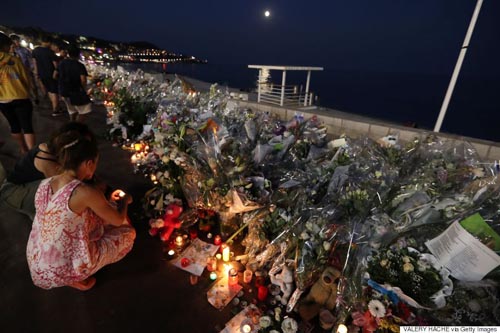
People light candles at a makeshift memorial on the Promenade des Anglais in Nice on July 19, 2016 in tribute to the victims of the Bastille Day attack. (VALERY HACHE/AFP/Getty Images)

MEK’s Terrorism in Iran

While the group no longer has the distinction of a terrorist group in the United States and is not related to or as widely destructive as ISIS, in Iran the MEK is still very much a perpetrator of terror.

Since its founding in the late 1960s, the MEK’s favored tactic has been terrorism, which for years it directed towards Americans. An MEK leader by the name of Massoud Rajavi stated in 1972 that the group’s “main goal” was to “free Iran of U.S. imperialism.” As I documented in my 2014 book, “Iran and the United States,” the MEK’s assassination campaigns in the 1970s claimed the lives of several high-profile Americans. Among the victims were one colonel and one lieutenant colonel of the U.S. Air Force, along with other servicemen.

The MEK’s hands are tainted not only with American blood, but also with the blood of countless Iranians, Iraqis and Kurds. Since Iran’s 1979 revolution, the MEK has been responsible for the deaths of upwards of 17,000 Iranians, including senior officials and ministers. During the Iran-Iraq War, the MEK also sided with Saddam Hussein, earning the enmity of the vast majority of Iranians. An Iranian NGO, the Habilian Association, has gone so far as to document all the Iranian victims of the MEK in a comprehensive database that includes photos and biographies of each of the victims.

In the ‘80s and ‘90s, the MEK was responsible for several terrorist campaigns within Iran, one of which killed some 70 Iranian officials in 1981, including both the president and prime minister at the time.

After the Iran-Iraq War, the MEK resided in Iraq and took on the role of Saddam’s henchmen. An October 1994 Wall Street Journalreport quoted a Clinton administration official as saying, “Saddam looked on the Mujahedeen as more loyal than some of his own army units.” After the 1991 Persian Gulf War, Massoud Rajavi lambasted the U.N. coalition that pushed Saddam out of Kuwait, stating, “Iranian national movements and their masses strongly denounce the Iranian regime’s alliance with U.S. imperialism, world Zionism, and regional reactionaries to launch aggression against Iraq.”

In recent years, Iranian nuclear scientists have been assassinated — in some cases murdered while driving to work. MEK is thought by many to be involved in these attacks, perhaps with the assistance of Israel. According to a 2012 NBC News report, Israel was “training MEK members” to carry out the killings. The group has also been held responsible for an April 2000 assassination attempt on the leader of the Iranian policy making center for the war in Iraq.

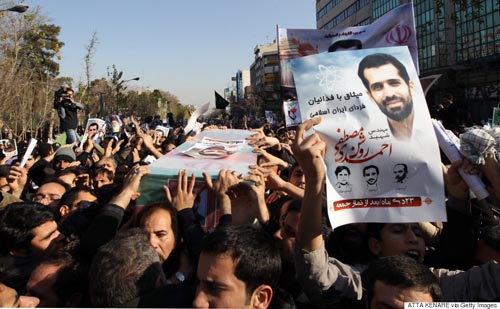
Mourners carry the coffin of an Iranian nuclear scientist on January 13, 2012. Some believe MEK is involved in the deaths of the nuclear scientists. (Atta Kenare/Getty Images)

The Saudi Connection

This year, the annual gathering of the MEK in Paris featured Prince Turki al-Faisal, the former director of Saudi intelligence, as a speaker. The conference typically draws the attendance of politicians of many nations, including the U.S., Egypt, and this year, Saudi Arabia. In his remarks, al-Faisal praised the pseudo-Islamist-Marxist group and emphatically supported its objective of toppling the Iranian government. Al-Faisal’s comments, which come at a time when Saudi-Iranian relations are at an all-time low and have even been compared to a “Cold War” state, will have serious consequences for the Tehran-Riyadh relationship going forward.

During my trip to Iran a few weeks ago, I spoke with a senior official about the necessity of improving Iran-Saudi relations. He told me that Iran was willing to engage the Saudis but that Riyadh had devoted itself to a confrontational approach. This official informed me that Iran had detailed intelligence about Riyadh’s financial support to the MEK, which he said had increased 800 percent in the past two years. He also noted that Saudi Arabia would cover the cost of this year’s MEK conference in Paris and that Prince Turki would be present to publicly declare Saudi Arabia’s support.

With Prince Turki’s speech to the MEK, Saudi Arabia has elected to destroy any chance of de-escalating tensions between the two nations. In pursuing this approach, Saudi leaders should be cognizant that not only are they imperiling regional and global security, but they are also following in the footsteps of Saddam Hussein. Saudi Arabia has already separated itself from its traditional regional allies with its hyper-anti-Iranian posture, so much so that only Bahrain— which is effectively under Saudi occupation — is standing fully with it. Global powers, on the other hand, are pursuing ways to enhance ties with Iran. It is truly a shame that Prince Turki al-Faisal, a man of significant ability and experience, has committed himself to this doomed cause rather than searching for peace and friendship between Iran and Saudi Arabia.

Riyadh’s now open alliance with the MEK only solidifies its position as the sponsor of yet another extremist group that espouses perverted views of Islam. The barbaric Nice terrorist attack— later claimed by the self-proclaimed Islamic State — and Prince Faisal’s endorsement of the MEK have a common denominator: a connection to Saudi Arabia.

Saudi Arabia’s Prince Turki al-Faisal looks on during the National Council of Resistance of Iran annual meeting on July 9, 2016. (Alain Jocard/Getty Images)

Saudi Arabia and ISIS

It has long been evident to the global community that Saudi Arabia is a benefactors of Islamist militant groups, including likely the group that evolved into ISIS. Many U.S. officials have publicly acknowledged this reality. Even former U.S. Secretary of State Hillary Clinton stated at the Brookings Institution last year that, “Much of the extremism in the world today is the direct result of policies and funding undertaken by the Saudi government and individuals.” A recent British parliament report also stated that it is “very likely” that individuals close to the royals of the Arab monarchies of the Persian Gulf have donated money to ISIS, though it is unclear how directly those funds have been given. Historically, too, the ideology of the group has ties to Saudi Arabia’s own identity via Wahhabism.

While ISIS wreaks havoc on the world with its global acts of terror, the MEK ravages Iran. In much the same way ISIS is a twisted offspring of the Sunni world that has ravaged, among others, Sunni-populated areas, the MEK is its counterpart for Iranians in the Shia world. Iranians thus expect the world community to confront the MEK just as it confronts ISIS. At the very least, the group should not be hosted by countries like France and endorsed by Saudi Arabia. In the fight against terrorism, European and Saudi leaders should know better than to distinguish between “good” and “bad” terrorism, or tolerate any form of terrorism in the service of cheap geopolitical gains.

In light of the Nice terrorist attack, the international community should also view the threat from other groups such as the MEK as an interconnected phenomenon. The scourge of terrorism currently threatening the whole world can only be alleviated if it is addressed in a holistic way. The Nice truck slaughter — indeed the slaughtering by ISIS in general — and the MEK’s killing of thousands of Iranians are both worthy of our attention and condemnation. The territory the perpetrators of such violence use to plan and launch attacks, as well as the flow of cash, equipment and ideology they draw their support and influence from should all be considered as pieces of the same terrorism “puzzle.” The global terrorist threat simply cannot be solved until all these pieces are recognized as being a part of the same puzzle and dealt with in an effective and simultaneous manner. This means not only increasing security to prevent attacks, but also seriously confronting those who aid terrorism in any way — from the MEK to ISIS.

Seyed Hossein Mousavian

 Head of Foreign Relations Committee of Iran’s National Security Council (1997-2005)

July 24, 2016 0 comments
FacebookTwitterPinterestWhatsappTelegramSkypeEmail
Iran Interlink Weekly Digest

Iran Interlink Weekly Digest – 153

++ The consensus among Farsi commentators and media, including mainstream media such as the BBC, over the ‘is Massoud Rajavi dead or alive’ question is that the Mojahedin Khalq cannot be taken seriously as an organisation. Any organisation, whether it is mercenary or not, which cannot prove conclusively whether its own publicly lauded leader is alive or dead is only demonstrating further proof that it is a cult, not a group of any substance.

++ Lotfollah Meisami – a former MEK member at the time of the Shah who now writes political commentary in Iran – was asked his view on Massoud Rajavi. He said everything in just one sentence: “I don’t know if Massoud Rajavi is alive, but I certainly know that the MEK is dead”. Several years ago he was asked ‘where do you think Massoud Rajavi is?’ Meisami replied, “He’s hidden where he doesn’t have to answer anyone”. The MEK themselves have remained silent as though nothing has happened. But they are using their second and third hand supporters who pose as critics. These so-called critics are repeating the MEK line that Massoud Rajavi is alive. One famous writer, Behrouz Reyhani, has written a long explanation for the Pejvak Iran website belonging to Iraj Mesdaghi. All it boils down to is the point that Maryam Rajavi can organise a carnival and this, therefore, is proof that Massoud Rajavi is alive. If he wasn’t alive she couldn’t do that. After three pages of swearing at people who say they should answer ‘the question’, this is all he can come up with.

++ The MEK instead of answering ‘the question’ claims there were a hundred and fifty thousand Iranians in their gathering on July 9th. As usual this was ridiculed. Firstly, because hardly any of the audience were Iranians. It was the usual paid audience from Poland and France. The speakers, the security and etc. were all hired. Secondly, some comments gave the link for the salon hire office saying that the maximum seating number is something closer to two thousand.

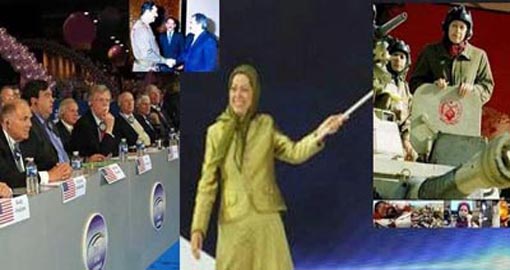
++ Most analysist have not talked about ‘the question’ but about the Saudis and have likened their imminent collapse to the fate of Saddam Hussein whose western masters turned on him. They point to the US’s role in all this. Some Arab outlets have highlighted what Turki said that the MEK didn’t translate. He praised Saddam in his speech, saying ‘we helped Saddam to confront Iran’ and ironically claimed that Iran attacked Iraq in 1980. The man gone mad to talk like this. Claiming he wants to topple the Iranian regime through the MEK means he’s really lost the plot. Several writers pointed out that, for whatever reason, Maryam Rajavi displayed every country’s flag on her stage, but for Iraq she used the old flag of Saddam Hussein and for Syria she used Daesh affiliated group flags. This is what Turki is famous for – supporting Daesh [against Iran]. Some have even said that the collapse of Daesh in Iraq and Syria has forced Turki and the Saudis to ostensibly back the MEK in order to provoke Iran to open dialogue over something.

++ It was of some significance that several of the MEK’s usual supporters didn’t attend, such as Rudi Giuliani. These are people who are retired but still have political ambitions in the USA. The three main Arab lobbyists of the MEK also did not attend. One commented that ‘the money is not worth it, I have a wife and children to think of’.

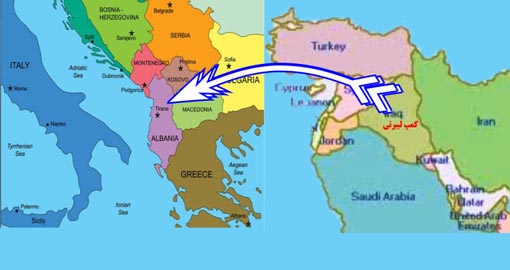
++ News from Albania indicates that hidden among the new groups being transferred from Camp Liberty are the MEK’s notorious torturers and murderers who are taking the opportunity to run away. They are being taken to Albania to escape the criminal charges against them in Iraq.

++ Ghorban Ali Hossein Nejat and Mustafa Mohammadi, two fathers of hostages in Camp Liberty, staged a sit-in in Auvers sur Oise asking for help to contact their own children. They also visited the Albanian and Canadian embassies in Paris to ask for help.

In English:

++ Yaran-e Iran Website reported a daytime protest gathering in Paris Chatelet square on Saturday, July 9th, the same day as Maryam Rajavi’s ‘grand gathering’. The MEK is so reviled by Iranians it has attracted its own opposition. Many are former members who campaign to expose the true nature of the MEK as victims of its cultic abuses. In the evening a seminar was held. Mr Mostafa Mohammadi whose daughter is held hostage by the MKO, Ms Batoul Soltani, Ms Homeria Mohammadnejad, Ms Zahra Moeini, Mr Aliakbar Rastgou, Mr Mohammadhussein Sobhani and Mr Gholam Husseinnejad addressed the audience.

++ Mazda Parsi writing for Nejat Society ridicules Newt Gingrich for a speech in which he claimed that “Sharia is incompatible with Western civilization” while a few days ago he spoke in the rally of the Mujahedin Khalq Organization (the MKO/ the Cult of Rajavi) and declared his sponsorship for this Islamist terrorist cult-like group. The article quoted the Iranian-American independent researcher, writer and journalist, Soraya Sepahpour Ulrich who updated her Facebook status highlighting Gingrich’s double standard towards radical Islamists: “The irony! Gingrich demands Moslems be deported from America a couple of days after he attended a rally in France in support of a Moslem Terrorist Cult, the MEK, funded by Wahhabi Saudis! And not a freaking news stations is making the link! Wake up people…”

++ Press TV reported that “Iran has lashed out at the French ambassador to the UN for making ‘consciously biased’ remarks about Tehran’s role in the Middle East, saying such fabricated claims aim to cover up Paris widespread interference in Syria’s internal affairs… In his address to the Security Council session, Delattre said France was concerned by information about foreign travel by General Qasem Soleimani, who was still subject to a travel ban. The Iranian spokesperson said France itself is one of the sources of instability in the region. ‘Regrettably, France, besides its continuous efforts to destabilize the region through its convergence with the creators and supporters of Daesh, has recently hosted a gathering of terrorist groups such as the terrorist Mujahedin-e Khalq Organization (MKO) and the directors of the Taliban, al-Qaeda and Daesh’, he added. He said such measures by the French authorities are aimed at whitewashing the crimes of the MKO terrorist group against the Iranian nation and officials and stand in stark contrast to the obligations of this country and declared policies of French political leaders. Paris on July 9 hosted an annual meeting organized by the MKO terrorist group which was attended by former Saudi intelligence chief, Prince Turki al-Faisal. The former Saudi spy chief gave a 30-minute address to the gathering.”

++ Hassan Ahmadian, Al-Monitor, ‘Why Iran needs to fight Saudi Arabia to forge peace’ is an interesting analysis of the dynamics of Saudi-Iran relations. The author points out that in spite of provocation by Saudi Arabia – including support for the MEK terrorist group – Iran still does not regard the kingdom as a threat. Perhaps, he concludes, Iran should engage with the KSA as a threat before it escalates so as not to limit its options further down the line.

++ The UNHCR published Update 14 on the relocation of Camp Liberty residents to Albania. “The relocation of residents of the Hurriya Temporary Transit Location (TTL), (aka Camp Liberty) out of Iraq continues to maintain momentum, with more than 1700 residents having now been relocated to a situation of safety in third countries. This represents a significant milestone: more than half of the residents registered by UNHCR have now been successfully relocated. Prospects for relocating all residents out of Iraq in 2016 are at their most buoyant since international efforts to find solutions began in 2011. UNHCR is supporting a steady and growing stream of movements out of Iraq in coming months. It is hoped that the process will be completed well before year end.”

++ Iran Interlink compiled a short video showing Maryam Rajavi’s reaction to the news, delivered by Prince Turki al-Faisal of Saudi Arabia, that her husband Massoud Rajavi is dead. The video is in Farsi and Arabic with the following explanation in English: At the annual gathering of the Mojahedin Khalq to celebrate armed struggle, Maryam Rajavi praises her husband Massoud Rajavi’s leadership of the organisation. The crowd cheers and chants. However, during his speech, Prince Turki al-Faisal, Saudi spy master, refers to Mrs Rajavi and “the late Massoud Rajavi”. The translator does not translate the word ‘Marhoum’, an expression of condolence in Arabic. But Maryam Rajavi’s expression shows clearly enough that she understood exactly what was said. Paris July 2016”

22 July 2016


July 24, 2016 0 comments
FacebookTwitterPinterestWhatsappTelegramSkypeEmail
Camp Liberty

Prospects for relocating all residents out of Iraq in 2016 at their most buoyant

Update N° 14

Update on the implementation of solutions for residents of Hurriya Temporary Transit Location (TTL)

 The relocation of residents of the Hurriya Temporary Transit Location (TTL) out of Iraq continues to maintain momentum, with more than 1700 residents having now been relocated to a situation of safety in third countries. This represents a significant milestone: more than half of the residents registered by UNHCR have now been successfully relocated.

Prospects for relocating all residents out of Iraq in 2016 are at their most buoyant since international efforts to find solutions began in 2011. UNHCR is supporting a steady and growing stream of movements out of Iraq in coming months. It is hoped that the process will be completed well before year end.

This progress has been achieved with the cooperation of the residents who have proceeded with the relocation process despite difficult circumstances, including the attack on 4 July 2016, which fortunately did not result in any casualties. 

Ongoing success in the implementation of solutions has also been assisted by the residents’ commitment to meeting the bulk of the associated costs, particularly for long term support of all residents relocated out of Iraq who have no access to state-sponsored assistance. This commitment is crucial to the ongoing implementation of solutions for the group.

UNHCR deeply appreciates the measures taken by some countries to relocate residents to situations of safety and security. Albania’s exceptional contribution to this humanitarian endeavour merits special note, as Albania has received a significant proportion of the residents who have been relocated. Likewise, the United States has been actively supporting the relocations in a number of ways, and without those sustained and concerted efforts, the progress reported here could not have been achieved.

Despite noteworthy progress made over the last two years, UNHCR maintains its call upon States to find ways to offer long term solutions for the residents in the Hurriya TTL and to do so with urgency. This appeal should be read in light of the potential for more attacks on the Hurriya TTL, as has been recently witnessed. This emphasizes the need for quick and pragmatic action on the part of States to ensure that these people are very swiftly relocated to a situation of safety and security.

UNHCR continues to call upon the Government of Iraq to take all possible measures to ensure the safety and well-being of residents, including ensuring access to life saving medical treatment and assistance with the provision of goods and services to enable the residents to make arrangements for their own protection.

UNHCR also recalls the Memorandum of Understanding between the Government of Iraq and the United Nations explicitly recognizes that residents benefit from the principle of non-refoulement.

UNHCR, Geneva,

July 23, 2016 0 comments
FacebookTwitterPinterestWhatsappTelegramSkypeEmail
Albania

75 more TTL residents Transferred to Albania

Seventy-Five Camp Liberty Residents moved to Albania in three groups on June 28th and 29th,Neday-e Haghighat Website reported.

A total number of 372 Camp Liberty residents relocated in Tirana in the last 19 groups of relocations since January 2016.

The first group:

  1. Nafis Mozafar Moghadam
  2. Kourosh Sharif Zadeh
  3. Abdollah Mombini Kazemi
  4. Ali Sadegh Taleghani
  5. Ali Sepah Amiri
  6. Ghasem Keivani
  7. Mansour Abbaskhani
  8. Vahid Azizpour
  9. Sharif Danesh Peyb
  10. Seyyed-Rahim Mousavi(Mostafa)
  11. Ali Sharifi
  12. Fakhroddin Asyal
  13. Vahid Rezaei
  14. Gholamreza Rezaei Bazarjani
  15. Ebrahim Rezvani
  16. Mohammadali Parva
  17. Hushang Abdi Goudarzi
  18. Hossein Moradi
  19. Reza Alimirzaei aliases Mirzaei
  20. Mohammadreza Farajipour
  21. Mohsen Moakkadi
  22. Naser Haghighi Ashani
  23. Ali Jamali
  24. Mahmoud Fadaei
  25. Amir Hazbehpour
  26. Amir Rahdar aliases Amir Omidi
  27. Fereydoun Parvaresh
  28. Gholamhossein Gouraki
  29. Shahin Khoshkalam
  30. Heydar Homaei
  31. Ghorbanali (Saeed)Purnamazi
  32. Mohammad(Kambiz) Massoudi(Dadkhah)
  33. Javad Jaafarzadeh Sar-Eskandar-rood

The second group:

  1. Fatemeh (Sepideh) Effati
  2. Fariba Shirvanian
  3. Farideh Alizadeh Shirazi
  4. Hossein Sojoudi
  5. Nemat Firouzi
  6. Hossein Nazem Bokaei
  7. Mohammad Feyzi
  8. Reza Eslami
  9. Mohsen Asgari
  10. Majid Hanifnejad
  11. Hamid Khazaei
  12. Seyyed Ebrahim Nabavi Chashemi
  13. Majid Hanif Nejad
  14. Hamid Khazaei
  15. Seyyed Ebrahim Nabavi Chashemi
  16. Farid Shahkarami
  17. Vali Haghighat Talab
  18. Nasar Sheikh Mansouri
  19. Karim Jabari
  20. Hamid Rezaei
  21. Karim Aliyari
  22. Mohammadali Seyf
  23. Javad Olyan Najafabadi

The third group:

  1. Alireza Emam-Jome aliases Reza Emami
  2. Javid Ajabi
  3. Hamidreza Sadr-Dehghani
  4. Jaafar Paki
  5. Manouchehr Kouhaki
  6. Allah-Nazar Azin
  7. Rahim Mazloumi Tabrizi
  8. Mohammadreza Vakili Tabatabaei
  9. Mohammadali Farshidian
  10. Hossein Pur-Shaabani
  11. Hassan Jirani
  12. Adam Balouch
  13. Reza Mansouri
  14. Mozaffar Zakizadeh
  15. Farzin Larinejad
  16. Alireza Malayjerdi
  17. Ebrahim Babaei Divkalaee
  18. Abbas Faraji Joei
  19. Ebrahim Jame Balaei
  20. Reza Hosseini
July 21, 2016 0 comments
FacebookTwitterPinterestWhatsappTelegramSkypeEmail
Iran

Harbouring Mojahedin Khalq Terrorists not acceptable

Iran rejects French envoy’s biased remarks.

Iran has lashed out at the French ambassador to the UN for making “consciously biased” remarks about Tehran’s role in the Middle East, saying such fabricated claims aim to cover up Paris widespread interference in Syria’s internal affairs.

Iranian Foreign Ministry spokesman Bahram Qasemi said on Tuesday that French Ambassador to the United Nations François Delattre made “spiteful” remarks about Iran’s nuclear and missile activities and its regional policies.

“The French ambassador’s remarks are devoid of truth and are aimed at covering up France broad interference in Syria’s affairs which has inflicted heavy human and financial losses on the Syrian people,” Qasemi said.

Addressing a UN Security Council’s meeting in New York on Monday, the French envoy expressed concern over several “destabilizing” actions by Iran, including the testing of ballistic missiles “capable of carrying nuclear weapons.”

“It is important for regional stability for Iran to abstain from any destabilizing and dangerous activity,” Delattre alleged.

The Iranian spokesman rejected the claims and said, “Iran’s military capabilities, including missiles, have not been designed to carry nuclear weapons and are not within the jurisdiction of the Security Council’s resolutions and their annexes.”

He added that countries equipping armed groups are responsible for further complicating and escalating the crisis in Syria.

“The Islamic Republic of Iran has always supported [the introduction of] reforms in Syria and the cessation of violence and regards holding national dialog within the framework of Syria-Syria negotiations as the solution to the country’s crisis,” the spokesperson pointed out.

He expressed Iran’s determination to actively help improve peace and stability in the Middle East in a bid to counter violent terrorism and extremism, saying Tehran is ready to fully cooperate with its neighboring countries and the international community to fight this common global threat.

He also said the French diplomat’s comments about Iran’s missile program run counter to the nuclear agreement, known as the Joint Comprehensive Plan of Action (JCPOA), reached between the Islamic Republic and the P5+1 group of countries on July 14, 2015.

“Iran’s military capabilities, including missiles, are exclusively for legitimate defense purposes. Such equipment have not been designed to carry nuclear weapons,” Qasemi said.

The Iranian Foreign Ministry spokesman further criticized the French diplomat for leveling allegations against Major General Qasem Soleimani, the commander of the Quds Force of Iran’s Islamic Revolution Guards Corps (IRGC).

“The comments by this French official … come as French leaders and authorities are consciously ignoring the Zionist regime as the source of crisis and the main obstacle to regional and global peace.”

In his address to the Security Council session, Delattre said France was concerned by information about foreign travel by General Qasem Soleimani, who was still subject to a travel ban.

The Iranian spokesperson said France itself is one of the sources of instability in the region.

“Regrettably, France, besides its continuous efforts to destabilize the region through its convergence with the creators and supporters of Daesh, has recently hosted a gathering of terrorist groups such as the terrorist Mujahedin-e Khalq Organization (MKO) and the directors of the Taliban, al-Qaeda and Daesh,” he added.

He said such measures by the French authorities are aimed at whitewashing the crimes of the MKO terrorist group against the Iranian nation and officials and stand in stark contrast to the obligations of this country and declared policies of French political leaders.

Paris on July 9 hosted an annual meeting organized by the MKO terrorist group which was attended by former Saudi intelligence chief, Prince Turki al-Faisal. The former Saudi spy chief gave a 30-minute address to the gathering.

The MKO is the most hated terrorist group among the Iranians because of its dark history of assassinations and bombings and for siding with Saddam Hussein in his eight-year war against Iran in the 1980s.

July 21, 2016 0 comments
FacebookTwitterPinterestWhatsappTelegramSkypeEmail
Saudi Arabia

Former Saudi Chief Spy Infuriates Iranians by Attending Terrorist Group Rally

Turki Faisal has raised the anger of Iranian officials by attending Mojahedin-e Khalgh’s annual congress in Paris. 

When it comes to politics, there are only a handful of things that bring Iranians together in unison. Of these enviable handful, opposition to Mojahedin-e Khalgh, MEK/MKO, stands on top of the list. It beats contenders for its ability to unite not only Iranians inside the country and those loyal to the Islamic Republic, but also the majority of the establishment’s critics and opposition groups outside the country.

The Mojahedin-e Khalgh Organization, aka MEK/MKO, described by Bobby Ghosh as "1 part opposition, 3 parts terror group, 6 parts cult", earned the grudge of Iranians early in the 1980s after it resorted to armed opposition and wave of blind terror that targeted not only officials of the nascent Islamic Republic, but also civilians. Yet, it was the organization’s decision to side with Iraqi tyrant Saddam Hussein during his eight year war against Iran that served as the last straw and turned MEK into a national target of hatred.

On July 9, the group held its annual gathering in Paris with its typical pomp and circumstances and hired supporters gathering to voice their support for Maryam Rajavi, head of MEK and self-proclaimed president of Iran. Were it not for some unexpected guests, Iran’s Ministry of Foreign Affairs would perform the ritual summoning of the French ambassador to Tehran after the event and let the story to rest. However, former chief of Saudi intelligence service Turki al Faisal was invited to the event, uttering provocative remarks against the Islamic Republic and wishing for its overthrow. This was apparently more than Tehran could tolerate.

Reactions to Turki Faisal’s speech in MEK’s Paris gathering were predictably fierce. In his Instagram account, Mohsen Rezaei, former Revolutionary Guards’ commander, threatened that if Iran became angry, it would "leave no trace of the House of Saud on earth", a strong reaction even in his own scale. Rezaei accused Riyadh of holding secret meetings with Iranian Kurdish separatist groups in Erbil, capital of Kurdistan Regional Government in Iraq, after which terror attacks were carried out, apparently against Iranian targets, in Iraqi Kurdistan. "Saudi Arabia’s official en the MEK shows that all terrorist attacks carried out in the recent years by this group enjoyed Saudi support."

Tabnak, affiliated with Mohsen Rezaei, followed the same line. "[Faisal’s] official, open support for the MEK, removed all doubts about Saudi Arabia’s support for criminal acts of this terrorist group" the website said. "This becomes important knowing that many of these acts of terror were carried out during the time Faisal held an official position in the highest level of the Saudi establishment" it added. Tabnak also stated that from now on, Saudi Arabia will be viewed as responsible for any action carried out against Iran by the MEK, and Iran reserves the right to show appropriate response.

The hardliner Mashregh News pointed to the unprecedented coverage of the MEK gathering by Saudi-sponsored media, including al Arabiya, al Hadath, and Sky News Arabia. Mashregh News called Riyadh support for MEK, "an out-of-date group", a sign of Saudi Arabia’s "absolute failure in its anti-Iran policies".

"Saudi Arabia has extensive relations with the MEK" said Hossein Amir-Abdollahian in an interview with Al Alam, the international state-run Arabic channel of Iran. Amir-Abdollahian, who recently left his position as Deputy Foreign Minister for Arab and African Affairs, added that remarks by Turki Faisal prove that sponsoring terrorism has been always on Riyadh’s agenda. "Riyadh’s strategic mistake of wielding terrorism in [order to influence] regional developments, will bring irreparable damage to Riyadh and all of us" in the Middle East the Iranian diplomat added.

Another diplomat, Alireza Miryousefi, head of the Iranian foreign ministry’s Middle East research center was less soft-spoken, calling Turki Faisal’s attendance at the MEK annual gathering a sign of Riyadh’s "desperation" and the consequent "stupidity". Miryousefi claimed that de-listing the MEK as a terror threat in 2012 by the US was thanks to "Saudi petrodollars". He also attributed Riyadh’s recent move to its struggle with domestic and regional challenges, and its need to project those challenges to the region. "In its instrumental use of terrorists, Riyadh is playing with fire" Miryousefi warned.

July 18, 2016 0 comments
FacebookTwitterPinterestWhatsappTelegramSkypeEmail
Massoud Rajavi

Saudi chief spy announced the death of Massoud Rajavi

At the annual gathering of the Mojahedin Khalq to celebrate armed struggle, Maryam Rajavi praises her husband Massoud Rajavi’s leadership of the organisation. The crowd cheers and chants. However, during his speech, Prince Turki al-Faisal, Saudi spy master, refers to Mrs Rajavi and “the late Massoud Rajavi”. The translator does not translate the word ‘Marhoum’, an expression of condolence in Arabic. But Maryam Rajavi’s expression shows clearly enough that she understood exactly what was said.

From 1977 to 2001, Prince Turki was the director general of Al Mukhabarat Al A’amah, Saudi Arabia’s intelligence agency, resigning the position on 1 September 2001, some ten days before the September 11 attacks in which 14 Saudi nationals hijacked commercial American airliners. Prince Turki subsequently served as ambassador to the Court of St. James’s and the United States.
Download Saudi chief spy announced the death of fugitive terrorist Rajavi

July 18, 2016 0 comments
FacebookTwitterPinterestWhatsappTelegramSkypeEmail
Newer Posts
Older Posts

Recent Posts

  • Pregnancy was taboo in the MEK

    December 22, 2025
  • MEPs who lack awareness about the MEK’s nature

    December 20, 2025
  • Why did Massoud Rajavi enforce divorces in the MEK?

    December 15, 2025
  • Massoud Rajavi and widespread sexual abuse of female members

    December 10, 2025
  • Farman Shafabin, MEK member who committed suicide

    December 3, 2025
  • Facebook
  • Twitter
  • Instagram
  • Youtube

© 2003 - 2025 NEJAT Society . All Rights Reserved. NejatNGO.org


Back To Top
Nejat Society
  • Home
  • Articles
  • Media
    • Cartoons
    • NewsPics
    • Photo Gallery
    • Videos
  • Publications
    • Books
    • Nejat NewsLetter
    • Pars Brief
  • About Us
  • Contact us
  • Editions
    • عربي
    • فارسی
    • Shqip