
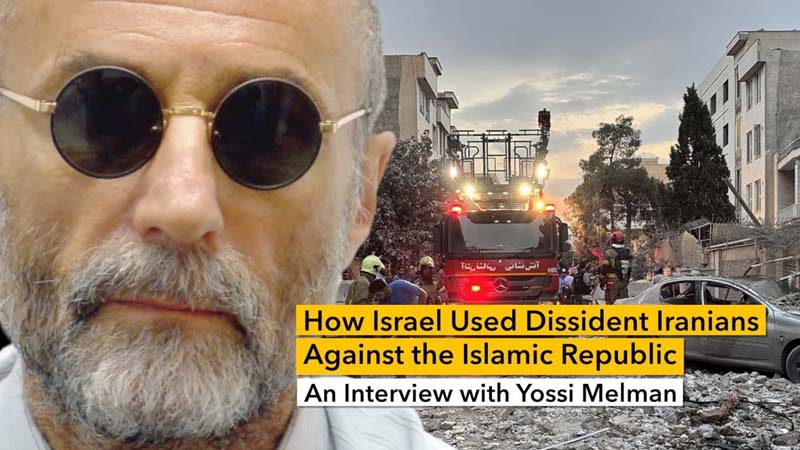
Veteran Israeli investigative journalist Yossi Melman recently co-wrote with Dan Raviv an article about how Israel’s intelligence agency Mossad has been recruiting Iranian dissidents as its agents in Iran.
The article Israel Secretly Recruited Iranian Dissidents to Attack Their Country From Within was published in ProPublica in August 2025.
Melman and Raviv have coauthored several books in the past, including Friends in Deed: Inside the U.S.-Israel Alliance, Every Spy a Prince, and Spies Against Armageddon: Inside Israel’s Secret Wars.
IranWire’s Maziar Bahari interviewed Melman to lift the curtain on Mossad’s evolving playbook inside Iran and the information that may provide context for Melman and Raviv’s investigation.
Drawing on four decades covering intelligence, Melman explains how Israel shifted from using Israeli agents with false identities to a vast ecosystem of non-Israeli agents inside Iran trained for operations ranging from running a safe house to conducting a surgical strike.
He revisits the 2018 heist of Iran’s nuclear archive – all 500 tons of it – and the 2024 “beeper” attack on Lebanon’s Hezbollah to showcase how Mossad has undermined the Islamic Republic of Iran over the past decade. The late Mossad chief Meir Dagan, who unified policy levers and saw opportunity in Iran’s ethnic mosaic, was central to the success.
Bahari: This morning, I was thinking about how many books of yours I’ve read, and I counted seven. And I think you’ve written ten books in English.
Melman: Yes, some of them were translated into English, most of them actually. And to other languages as well.
Bahari: And, you know, you have a level of access to current and former Mossad agents that I don’t think anyone else has. And I don’t think that many other investigative journalists in other countries like David Ignatius or Seymour Hersh, they have that kind of access to CIA agents in the US. What do you think motivates and persuades these agents to talk to you and to trust you with their stories?
Melman: Well, thank you for the compliments. I think David Sanger is also a very excellent journalist with good access. Actually, nine years ago, we did a film together, “Zero Days” about the Stuxnet operation. And both of us work with the director and producer Alex Gibney of Jigsaw.
I mean, I think it’s a combination of trust, long years in the field. I mean, as a journalist, I’ve never been in the intelligence community except my military three-year national conscript service. But when I say that I’ve never been in the Israeli intelligence community, people don’t believe me. They think that I work for one of the agencies. But I didn’t.
But I’ve been observing them and following them and writing about them for nearly, I think, 40 years. When I was already in London as Haaretz correspondent in London between ’80 and ’84, there was an incident there, actually, an assassination attempt on the life of the Israeli ambassador there, by three Palestinians, sponsored by the Iraqi intelligence. And that triggered the war and the invasion of Israel into Lebanon in ’82. So since then, I’ve been covering intelligence, terrorism.
And I think that altogether that, you know, I’m experienced. I’ve been around. It’s enabled me to gain the trust of people, enable me to talk to them. But still, I don’t know everything. I mean, you know, I don’t live in the illusion that I know what’s going on in the intelligence community or in the Mossad.
But sometimes I already have the experience to understand the patterns of operations, the modes of operations. So if I read something, even if I’m not sure whether it is Mossad or not, I can reach the conclusion because of all these various elements.
Bahari: Yeah, it comes with experience. And, actually, I have your book “Every Spy a Prince” here and I think it’s one of the best books to understand the psyche of Mossad agents and Mossad as an agency. And I remember reading it 30 years ago. It really opened, you know, a window for me to understand Mossad. And I’m sure it was the same thing for many people.
So based on your knowledge of Mossad, based on the work that you have done on Iran, when—what year do you think that, or do you know that Mossad started to recruit agents inside Iran on such a large scale?
Melman: That’s a phenomenon of the last decade. But you have to make a distinction, until 15, 18 years ago, all Mossad operations, either in Iran or in hostile countries hostile to Israel, the operations were what Mossad would call “Blue and White,” the colors of the Israeli flag. They were Israelis, Israeli nationals, not necessarily going with Israeli passports, most probably with borrowed identities and undercover and so on.
But at a certain moment, they decided, especially with Iran, that it’s too dangerous to have Israeli nationals, even if they are equipped with Australian passports or Irish passports, and therefore they started recruiting these agents, but, Iranian agents or ex-Iranians or people from the neighboring countries which—who have access to Iran and know the terrain.
But most of them were what the Mossad would call infrastructure agents, which means they are not combatants in the sense that they go and pull the trigger. They can be, you know, store owners. They can be people, real estate agents or who rent apartments. They can be people who work for rental car companies. These are infrastructure agents. And their mission is to be there for as long as possible.
Some of them are Iranians, and they work for foreign companies. Not always they know that these are Mossad companies. They can be front companies. They don’t know that it’s Israel or Mossad behind it. And their mission is to be ready, for the judgment date. When you need someone, you need a driver, you need a car, you need a safe house.
Then you have a second layer of agent. These are people who are combatants, people who have been trained, to carry out military operations. And they can be trained—some of them might be trained in Iran, but most probably outside Iran and in very, in some cases, they even are brought to Israel and trained on such missions.
I can give you an example. In 2018, when Israeli Mossad agents, but they were foreigners, non-Israelis, stole the Iranian nuclear archive from a neighborhood in Tehran. They needed to be trained on a model. So the Mossad built for them—I don’t know if it was inside Israel or in another country, they built a model which simulated the exact warehouse where the archive—it’s exactly the same as the archive. Also the safe boxes that were there. And they trained how to break into this place and into the safes and how to bury them or to open them.
Bahari: Turquzabad operation. The agents went to Turquzabad and they took the evidence from there, and they took it to Azerbaijan as you mentioned.
Melman: Probably, yes. Well, but it’s not just that. First of all, they loaded 500—half a ton of documents, documents, discs, you know, photographs, drawings. So it’s a heavy load and they put it in two trucks. Now, it’s not only that, because they, you know, they worked in the middle of the night. They knew they had, like, 6 or 7 hours working inside the place.
So they, I mean, it was such an excellent and precise operation. They knew in advance during the preparatory sessions which safes are important and which safes are, you know, less important, like, I don’t know, about logistics, about accounts, about, you know, bookkeeping and so on. So that’s—that’s an example of an operation which was already, carried out by the Mossad, led by the Mossad, initiated by the Mossad. The Mossad oversaw the operation, but the agents in the field were non-Israelis.
Bahari: And the most probably the those infrastructure agents, they had a role in terms of determining, where the evidence were and where the safes were, etc, etc.
Melman: Okay. Yes. And, and the some of them might be on the, on the lookout for the neighborhood, you know, on observatory positions So these are mostly the, infrastructure agents. The combatants, those who really, pull the trigger or fire the missiles during the last war. These are especially trained on almost similar, to the training of Israeli Mossad agent.
I mean, sure, the Mossad with all not no, would not fully trust them to share with them all the information and all their secrets or all the modern technology, state-of-the-art technology. But they are treated almost as equal as Israeli Mossad agents.
Bahari: And in your article, you mentioned that Meir Dagan, the former head of Mossad, he had an important role in terms of expanding Mossad’s operation inside Iran. Can you tell us about Meir Dagan and his operations?
Melman: Meir Dagan was a general in the Israeli army. He was a good friend of Ariel Sharon, the prime minister of that time. He appointed him as the head of the Mossad, after he left military service. His mission was to concentrate all the measures and all the decision processes from all the Israeli government offices regarding Iran. So he was like the czar of the struggle against Iran, to stop Iran having nuclear weapons.
And Meir Dagan, who was the architect of building all these elements—diplomacy, economic sanctions, sending assassins to kill scientists in Iran, to sabotage warehouses or missile sites or nuclear sites, or technology, which was on the way, brought from abroad, either by sea or by air. He was in charge of that, and the overall authorities were given to him.
And he was a very, important key in building the case, against Iran, not just for the Israeli intelligence community and the Israeli military, but also for, the countries that cooperated with Israel, whether the United States or EU and so on. In terms of imposing sanctions on Iran.
But before you impose sanctions, you need to have information whom to target with your sanctions. So that was the role of Meir Dagan.
Bahari: He was the director of Mossad between 2002 to 2011, negotiating and he was negotiating with the rest of the world about its nuclear program.
Melman: Yes. And, but also there were sanctions on Iran, international sanctions, UN sanctions on Iran from 2006. Now Meir Dagan, at a certain point, it became very—I don’t want to be—obsessed—but he became very interested in the mosaic of Iranian society and Iranian ethnicity.
And he was maybe the first one on such a level. Of course, scholars knew that Iran is built on, you know, minorities and different religions and so on. But he was very much, the guy at the top who, whose attention was was taken into that and to that study of, in the field.
And he became very keen on looking at the possibilities that derived from this, you know, from this mosaic of ethnic differences. And he started, recruiting dissatisfied Iranians, or Iranians that were not happy about their regime or maybe had a grudge family grudge or personal grudge against Iran. And he started recruiting them.
You know, there are Kurds and Azeris, You know better, Maziar. Balochi. Azeris. And Turkmen and Arabs and others.
Bahari: Yes.
Melman: So he started to build that notion that we will use Israeli “blue and white” agents only as commanders, only as supervisors. But we would not risk them in the most daring operations. And then it expanded. After Dagan left office, it expanded into the next directors of of Mossad.
Bahari: Before we move on to the next director, so these members of different ethnic and religious minorities, they were recruited as infrastructure agents or operational agents?
Melman: Both. Most of them, infrastructure agents, because you needed to build the infrastructure. You needed to acquire all the necessary logistics just in case, if you, if you want to execute something.
I can give you an example. You know, the the famous beeper operation in Lebanon against Hezbollah in September 2024, last year. That started, the idea and the, and the planning of the operation and the acquiring of the equipment, it started in 2014. Of course, technologies over time change. Hezbollah started using first radio walkie talkies and then they moved to the beepers.
But it doesn’t matter. The method was the same. So it started 10 years before it was executed. And I assume the same with Iran. Some of these infrastructure agents started working ten years before.
Now, one more point. Some of these operations, because for the Mossad even to bring, you know, a battery into Iran, they call it an operation. So some of the operations failed and they needed to start building them from scratch. Some of them were exposed, some of them were not working.
So, you know, you had to always update your infrastructure operations and your infrastructure equipment and your infrastructure logistics.
Bahari: So based on what you’re saying, Meir Dagan really started this massive recruitment of Iranians from inside Iran as agents of Mossad.
Melman: Yes.
Bahari: Based on what you know or what you’ve heard, do you know which, ethnic minorities were recruited more than others? Kurds, Baluch, Arabs, Azeris? Which ones?
Melman: I don’t think they are very picky, the Mossad, about it. Anyone who can be useful for them after he has been tested, after he been examined, after he, you know, his background is checked, is suitable for them and he’s suitable for a particular mission, would be selected.
So it can be, you know, Iranians, Farsi, Azeris, Baluchis all of them, Arabs, Kurds, As long as, you know, as long as they can serve Mossad purposes and they’re, they are ready to be part of it, because it’s not by coercion. You cannot—I mean, the Mossad is not is not recruiting people, not just, you know, for Iranian operations, even against the Lebanese or Hezbollah or Palestinians, usually not by coercion, because the recruiters and the case officer, they know that if force someone, okay, you can have some leverage against against him. But eventually he would betray you because he hates you.
Bahari: It has to be volunteered to a certain extent.
Melman: Yeah. He would he would hate you and maybe would turn you over. So, they want to build trust with the agents that they recruit. And. Yeah, I mean Of course it’s trust. You know it’s not between equals.
Bahari: Yeah. In your article, you mentioned something important, that these agents, they get paid but money is not the primary reason for them to work with.
Melman: I mean, money is always necessary to be able to sustain that help, but it’s not the primary reason for them to volunteer their services. The reasons why why people agree to work for the Mossad, varies.
It can be, some of it, some of it is financial rewards. But it’s the hatred of the regime, it’s the grudge against certain elements in the regime. It can be a desire to take revenge because a member of your—of a family, was tortured in a prison or maybe he was tortured in a prison.
Sometimes it’s based on promises that are made, “We will take care of your family” “We will take care of your medical necessities”. Maybe education, you know, I know about cases in which, people, Iranians were sent abroad, for education after a member of their family worked for the Mossad. And you wanted to, you know, and that particular person wanted to, to bring a better future for his kids or a better education for his kids abroad. And Mossad is taking advantage of all these, you know, motives.
Bahari: And in your article, you also mentioned that medical help is a great motive for many Iranians and non-Iranians, and Mossad has access to many medical facilities and doctors around the world, and that’s how they recruit many agents through those doctors and medical facilities.
Melman: Yes, in some cases they recruit agents because the agents or a member of the family need a medical treatment. But you know, it doesn’t apply only to Iranians. Human beings would walk an extra mile for medical treatment for life-saving treatment. I mean, it’s human nature.
And therefore, yes, the Mossad is very good at it. It has contacts around the world with clinics and with doctors, not necessarily, They know they who is brought into the clinic, you know, but the Mossad is bringing someone and, you know, someone, a doctor in a clinic or in a hospital and and asking them to please take care of this patient. They don’t know who is the patient. Maybe they know his nationality. Although I would be—I would doubt it very much.
Bahari: Yeah. I want to ask two more questions about Meir Dagan, because he’s a very fascinating character. In your article, you also mentioned that Holocaust played, or the memory of the Holocaust, and his grandfather especially played an important role in terms of motivating him. And on IranWire we try to educate the Iranian public about the Holocaust and tell them the truth about the Holocaust, could you tell us about what role did that play, the memory of the Holocaust in terms of Meir Dagan’s actions and decisions?
Melman: Meir Dagan was born in the Soviet Union to Polish immigrants, and his parents emigrated to Israel. Later on he found, in the Israeli Holocaust Memorial Museum, Yad Vashem in Jerusalem, he found a photo which he recognized as a picture of his grandfather kneeling in front of German Nazi soldiers, and they killed him.
And once he found that photo, he took it with him wherever he went, to whatever office he served. And on his desk in the Mossad headquarters, there was this photo. And he was highly motivated by the notion that Israelis, Israeli Jews, Israelis should defend themselves, and that it would not happen again.
But at the same time, after he retired from Mossad, he also said, when Israel started to change a little bit, as we see nowadays, he said that he reached the conclusion that almost in every human being there is, there are traits of brutality or, there are, you know, infrastructures or layers in which might grow brutality and sadism and so on. So, yes.
The Holocaust factor was very important, especially when the Iranian leaders have been threatening left and right, day after day, that they don’t recognize Israel and they want to destroy Israel. I think it was Rafsanjani who said—and Rafsanjani was considered a reformist—
Bahari: A moderate, yes.
Melman: Yeah, yeah. A reformist president and politician. He said it would take only one bomb to get rid of Israel, so that notion that Iran may use, may reach the stage in which they have a nuclear bomb. Israel doesn’t want to take that chance. Or to wait and see whether they use it.
We call, I mean, in Israel that perception, that notion is called, the Begin Doctrine after Prime Minister Menachem Begin was the first prime minister to order to destroy a nuclear facility, at that time, in 1981, of Saddam Hussein in Iraq, saying no single country or a coalition of countries in the Middle East, would have nuclear weapons, we would not allow it. And indeed, in 2007, Israel bombed the Syrian nuclear reactor. And now that was a kind of a preemptive action to prevent Iran of building nuclear weapons.
Now, Iran learned from from the experience with Iraq and Syria, and they dispersed their nuclear facilities and not put it like you say, like you used to say, the eggs in one basket, as Saddam Hussein did. And, as Assad did in Syria.
Bahari: So another question about your article, and maybe it was a little bit before Meir Dagan, becoming director of Mossad. You mentioned that the Mossad gave the information about Iran’s nuclear program, the information that was gathered in the 1990s to a dissident group. In your article, of course, you do not mention the name of the dissident group, but everyone knows that it’s the MEK, the Mojahedin-e-Khalq.
And this is the first time that I’ve read anywhere that this information has been mentioned, because I’ve asked many different journalists, different experts, and they say, yes, probably that happened that Mossad passed the information to to the MEK. But are you certain that it was the, information that was given to the MEK by Mossad? And it was not the MEK agents in Iran that gave them the information?
Melman: Well, maybe they work for the Mossad and they gave the information to the Mossad. But the Mossad, in order to launder the information, the Mossad didn’t want to declare it. Nowadays, they have no troubles. I mean, they conduct almost every day through social media, psychological operations against Iran, in which they point out about, you know, targets, or about personalities who are involved and wanted by Israel, as a warning.
But at that time, 25 years ago, 20 years ago, the Mossad was still trying to keep these secrets for itself. And if they wanted to reveal something, they use, you know, through channels. And I, as far as I know, I think it was MEK who published the story, once again through some other groups in the West.
So that was about Natanz, by the way, about the nuclear enrichment facility in Natanz, which was at that stage only at very early construction.
Bahari: Yeah. But that was the first time that the world heard about Iran’s nuclear program at that time. And while we were on the subject of the MEK. As far as you know, again, how does the Mossad or different Israeli agencies work with Iranian opposition groups, armed opposition groups, in terms of carrying out the goals or the operations of Mossad?
Melman: Well, you know, the Iranian authorities accused the Baluchi…
Bahari: They accuse everyone. They even accuse me of being an agent of Mossad. And I know that I’m not. So, let’s forget about the Iranians..
Melman: Yeah. but they hanged someone, they hijacked his plane, the leader of that group and brought him to to Tehran and eventually—Jondollah.
Yeah, yeah. What, what, I’m trying to say is that the Mossad would not recruit. The Mossad would not recruit, the Mossad would not recruit entire groups as agents. They may recruit members of a particular group, because first of all, you know, they are very keen and they are a security—their field security, information security is very important. Departmentalization.
So you don’t spread, you know, the information that, you know, this group or that group is working for the Mossad. You may use some members of that group, maybe with the knowledge of the leader, maybe there would be some people in the group, in the organization, in the opposition, dissident group that are working as recruiters for the Mossad. That’s possible, but there’ll always be a buffer between the Mossad and these groups.
Bahari: Okay, so the groups are not recruited, but members, individual members of groups can be recruited.
Melman: Yes. Once again, you know, if they are suitable for the job and passing all the tests, no problem recruiting them.
Bahari: Yeah. And speaking of the agents inside Iran, in your article, you’re careful not to mention the third countries or citizens of third countries. After the 12-day war, Iran expelled hundreds of thousands of Afghan migrants in Iran. As far as you know, where those citizens of third countries that were mostly from Afghanistan or from Iraq or any other, country
Melman: I don’t know, and it’s good that I don’t know, I shouldn’t know, but, as I said time and again, the Mossad is ready to recruit anyone, be it Afghan, or Pakistani, or Azeri or maybe from Western Europe or Southeast Asia, who is up to the job. So look, I also read that the Iranians arrested 21,000 people, accused them of being involved one way or another in treason during the war.
So, I mean, I think maybe it was just a good opportunity to get rid of…
Bahari: It was a face-saving measure, basically, they had to do something because the way that they lost that war was really disgraceful. So, the reason that Israel attacked Iran on June 13th was that Iran was two weeks away from the from building a nuclear weapon, as far as you know, was that genuine and correct information, that Iran was just two weeks away, or it was the right moment to carry out the operation that they had been preparing for such a long time?
Melman: Well, all the analysis by the IAEA, the Vienna-based atomic watchdog, by the Israeli intelligence, by the CIA and it was this in recent, in the last year, Iran has been accelerating its nuclear program, and especially in the phase, which is known as weaponization.
Now, Iran was very close within a week or two weeks from having, reaching, having 90 per cent purity fissile material, enriched uranium, that was for sure. But this is only one component of building a nuclear bomb. The other one is the engineering of how to assemble the bomb, the optics, chain of reaction, and so on. And then to equip it on a missile.
Now, Iran has ballistic missiles. I witnessed it on my skin in the last war because I was staying in my house in the shelter and windows were shattered and doors were broken because of one of the missiles, two of them fell not far from my house which is by the Tel Aviv University. I think they targeted the university as a revenge, tit for tat for bombing in the Iranian embassy.
So, you know, it’s more complicated to see that Iran was two weeks before having a bomb. They were two weeks before having enriched uranium. They were very fast working on the weaponization. With the missile, it would take them longer. And then there is, you know, the big, big question, will they test the bomb or not?
Now, the archive information, which was stolen by Mossad in 2018, revealed, one of the major revelations of the documents, was that Iran was preparing five sites, in Iran, as nuclear test sites. There were no tests. They didn’t test it, but they were preparing it for tests.
So, you know, the Iranian rationale of moving forward was step by step, you know, stone by stone, very slowly. But yeah. And they wanted to be a nuclear state. A threshold state. They were very close to it, maybe they are, they were already and therefore Israel decided to bomb them.
And as you mentioned, because, you know, the timing was perfect for Israel. Trump is president. He gave an ultimatum to the Iranians “Within 60 days, you have to reach an agreement”. They didn’t. And then he gave the green light for Israel. And even he was part of the deception. You know, by setting this 60-day deadline, I think it was part of a deception.
Bahari: I guess at this point, it’s irrelevant whether it was two weeks, three weeks or whatever, they were. According to your sources, did they know that they would be so successful or did their success really surprise them?
Melman: Well, the Mossad and the military intelligence and the Israeli air force all work together, in a very collaborative effort. Unlike maybe other Western intelligence services, where the cooperation between the agencies is not always perfect with this in Israel, it’s very, very, good cooperation. There are some rivalries, of course, but basically they serve the same aim.
They had a very precise plan, and they knew what they were after. But to a certain degree, I would say that they even surprised themselves with the success of the operation. Really successful … because they I mean, you know, they the surprised from two angles.
One, the military operation in the field, in Iran itself. The second one, Israel prepared for thousands of injuries and, and, you know, death, with the Iranian missiles. And in that sense, Israel was surprised that the interception of the missiles, the Israeli air defenses, with the help of the United States was so good. That the damage relatively, relatively—Still, there was a damage in Israel. As I said, my house was hit and many houses were hit, but only 30 Israelis were killed altogether.
So the surprise was on both fronts, on the military field, that the operation was so precise, so accurate, so successful, and no one was killed. Not a single airplane was shot down. And that the damage that Iran caused was tolerable. Let me put it this way. Still, it’s a terrible to say.
Bahari: Not as bad as it could be. I’m thinking that, the reason that Mossad is able to recruit agents in Iran, be able to successfully operate in Iran, it all goes back to the actions and policies of the Islamic Republic in the past 46 years, because of the corruption, because of the economic problems, because of the political disenchantment, because of the discrimination against minorities.
Is Mossad, and are intelligence agencies in general, as far as you know, aware of such problems in Iran? Do they have the right academics and researchers to research and tell them this information? Or do you think that it’s a little bit more haphazard than that?
Melman: No. They know about it and they take advantage of it, of the weaknesses of Iranian society and the Iranian regime, of course. I mean, we know, you don’t need intelligence-gathering methods to know that there is a water problem in Iran, drought, there is shortage, there is corruption. The people, many people, don’t want to see this regime in place.
Absolutely. They know about it. And this is—You know, Israel is still a very vivid democracy, despite the problems that we have with our government. So, you know, democratic nations would always have an upper hand when it comes to intelligence, because the intelligence services of dictatorial regimes care only about preserving the regime, not about presenting the real picture.
I can give you a very funny example of how Iranians— I’m not trying to undermine the Iranian intelligence. They have some capabilities. They show some skill, skillfulness. I have all the respect for them. But they don’t understand Israeli society. And even when they launch some sort of a propaganda operation, as they did three days ago, as we speak, they put up a poster with Israeli leaders that are “Wanted”. Prime Minister, you know, tit for tat, Israeli prime minister, defense minister, chief of staff, some generals. They misspelled their names. I mean, you know, it’s open source information. It’s, you know, it’s clumsy.
Bahari:I mean, this is so sad for them because if I were an Iranian leader I would have died of shame, really, because how miserably I failed, and not only is their mission of destroying Israel is ridiculous and unrealistic, but even even if they wanted to destroy Israel, they would not be able to do that with this level of corruption and inefficiency and infighting and not being able to protect their own people. One other thing that I think Iranians misunderstand—How can they destroy Israelis if they cannot spell the names of Israeli generals? You have to be able to spell first and then, yeah, destroy it.
One other thing that I think the Iranians do not know about Israel, and as an Israeli, as someone who I know, you are critical of Prime Minister Netanyahu. Iranians do not understand the level of patriotism in Israel. In Israel, I’ve been to Israel three or four times, and I’ve met many Israelis. I know some Israelis in London, and I know how much they love their country, how much they, many people dedicate their lives to their country, including those Mossad agents.
What can you tell people in Iran, especially in the government, especially someone, named Ali Larijani, who used to be the speaker of the parliament who says that Israelis are not patriotic at all? What can you tell them as an Israeli about patriotism in Israel?
Melman: Well, Israeli are— Israelis, even if they disagree with the government, and many Israelis do not agree nowadays with the Benjamin Netanyahu government. Still, they have a sense of, there is a great sense of solidarity within Israel. And I can give you one example. You know, there was, before the terrible massacre by Hamas, supported by Iran of October 7th, 2023, when 1,200 Israelis, mostly civilians, were butchered by Hamas. Before that, there was a protest in Israel against the government, and many people went to the streets and demonstrated, including, you know, some reservist pilots who said we will not fly if Netanyahu is aiming to change the nature of Israeli democracy.
When the day of judgment came, when Hamas invaded Israel, all the pilots were called to office and they and they appeared and they flew their airplanes and protected Israel. So it gives you an example that Israelis are very patriotic, even if they disagree with the government, and because they—they know what is at stake.
And what is at stake is that still, Hamas, Hezbollah, Iran, Syria, before the change, before Ahmed al-Sharaa came to power recently, they don’t want to see Israel amidst the Middle East. They don’t. They don’t think that Israel deserves the right to exist. And that’s at the heart of the problem.
Israelis want to make peace. Their neighbors, even Netanyahu. You know what, You know what I think about him. But even Netanyahu, is almost every week, twice a month is broadcasting messages to the Iranian people. He’s saying, “We support you, “We are not against Iran as a country.” “We are not against the Iranian people. We are just against the regime.”
Bahari: Yeah. So, based on your conversations with these agents, what’s the end game of Israel in Iran? Do they want regime change? Do they want to get rid of the nuclear program? What is the end game? Because, although they were successful in assassinating military commanders, these nuclear scientists, they made some really strange, bizarre, and some people would say stupid mistakes. Such as bombing the prison, and killing people who are against the regime in the prison. And they thought that it’s a symbolic gesture. What’s the end game?
Melman: The purpose, they declared purpose of the war in the plans, was to try to destroy as much as possible the Iranian nuclear project and Iranian missiles. Before that, Iranian air defenses were destroyed. And that’s what enabled the Israeli air force to bomb Iran and to stroll over the skies of Tehran like it was Tel Aviv.
But when the war progressed, there were some voices in Israel that were saying, maybe we would target the Supreme Leader, Ali Khamenei. I don’t know if it would have been possible, but there were some thoughts about it. I think it would have been a mistake. But, eventually it wasn’t, it wasn’t, even considered, although some voices in Israel were talking about it.
For example, the Iranian president, Pezeshkian, was wounded, but he was not a target. And I know from my sources he just happened to be in the place that was bombed. He was not a target.
So, you know, the end game of Israel, I mean, maybe Israel would fantasize to see a different regime in Iran. But I don’t think it was a realistic aim. And it was not part of the war goals.
Regime change, most people would tell you, including scholars and intelligence analysts in Israel, would come from within. It would not come from outside pressure, international pressure. It’s not the story of ’53, when the CIA and MI6 toppled the regime of the Shah in Iran.
Bahari: So the end game is to weaken the Islamic Republic and contain Iran?
Melman: Maybe that would create a trigger reaction, would generate a trigger reaction, which eventually would lead to a regime change because the people would turn against the regime.
Bahari: Yeah. And, one thing that many Iranian propagandists are talking about is Israel’s aim to cause secession in Iran. In particular, you talked about Meir Dagan and him using ethnic minorities in Iran. Some Iranians, most of them, Islamic Republic propagandists, but also some opposition members, are talking about Israel aiming to cause divisions in Iran and separatism in Iran and secessions in Iran. As far as you know, as far as your sources told you, is that the plan?
Melman: No, there is no such plan. But Israelis would not shed tears if there is, you know, if there are divisions in Iran or there is a breakup of Iran as a country, or maybe some regions would need to see independence. So but I don’t think Israel is encouraging them with, you know, intelligence, in military force.
I mean, it was again, part of kind of a, if it happens welcome – we would welcome, we would welcome, we would bless them. But that’s not a target. And, you know, and sometimes we learn from even from our own experience that when there is a breakup of a country or, or a unit or organization, or if you kill someone who is a leader of of a group, these successors would be worse and chaos would emerge. So I’m not sure it’s part of the Israeli.
Bahari: So it’s not part of the plan as far as you know?
Melman: No, there is no grand strategy, grand plan to turn Iran into or to fragmentalize Iran as a state.
Bahari: Yeah. So the last question is about the current status of Mossad agents in Iran. As you mentioned, Iran arrested 21,000 people, and released most of them. They have said that they are penetrating into different cells, as far as you know, and your sources have told you, how much of Mossad infrastructure has remained in Iran and is intact inside the country?
Melman: Well, I know that around maybe 200 agents that were operational in Iran, and participated in the combat were lifted safely outside of Iran to their houses, to their places, to their families, whatever.
As far as the infrastructure agents, maybe some of them stayed. Most certainly they stayed. But I don’t think that Iran has a clue about them. And most of the Iranians that have been arrested is just face-saving to show to the people and the regime “We are now in a counterintelligence operation, and we will expose our enemies.”
So, in talking to some of my sources, I asked them, what’s next? “What will you do with the agents?” And they said, well, first of all, they will get bonuses. Secondly, they will send them to—they will go for vacation. Thirdly, some of them would retire and would say, thank you. We will not continue with the mission, which is fine. Some of them will be recruited again or will stay in place, and be activated again.
Bahari: And what did your sources tell you about the possibility of another war, another conflict, military conflict between Iran and Israel in the next few weeks, months, year?
Melman: I’m very optimistic that there won’t be another round. Iran doesn’t want another round, at least for the time being, until they would rebuild and recover and lick their wounds, not just air defenses, but also, you know, to try to salvage their proxies. Hezbollah, Iraq, the Houthis.
I’m not sure Israel would initiate another round. I don’t see that happening as it is—with Lebanon, you know, in Lebanon, whenever the Hezbollah is trying to, you know, to salvage some of its operations or some of its, to get some new equipment, Israel is bombing them. The Israeli air force goes into action. I don’t think it would be replicated in Iran.
But you know, maybe there would be some warning flights over Tehran skies, just, you know, to send a message to the leadership there. “We watch you—We know what you are up to,” “and be aware of it.”
And and above all, I think that eventually Iran and the United States will reach a deal, there will be some sort of an agreement because it’s in the interest of both sides. Trump is talking about peace all the time, you know, so we’ll see how it comes out of the talks with Putin. What will be the result between Russia and Ukraine?
He’s pushing to have some sort of agreement between Israel and Gaza. He’s portraying himself as a man of peace. And I think he’s very much anxious to have a deal with Iran. And so the Iranians—But it’s all up to the Supreme Leader, right?
Bahari: Yeah, yeah. He’s been very quiet in the last couple of months. But let’s hope for the best. I think it’s a great time to end the interview and say, inshallah. Thank you so much, Yossi, for this interview. I’m sure that many Iranians, including people within the Iranian government, find the information that you gave us very useful.
Melman: And let me say that I’m not an enemy of Iran. You’re a journalist doing your job. I’m doing my job. And I think is really at the same time. I met some Iranians abroad, not just you and, you know, they are ordinary, nice people, like many people all over the world from different nationalities. It’s just the politicians and the regimes that are turning people into what sometimes they are.
Bahari: One thing that I think a lot of people don’t know about you is the fact that you are a marathon runner and you’ve done more than 50 marathons.
Melman: No. Don’t exaggerate. Only 35, only.
Bahari: 35 marathons all around the world?
Melman: Yes, maybe. Well, I’m not that young, so I don’t think that I’ll be able to run a marathon in Tehran in my life.
Bahari: Let’s hope for that.
Melman: Yeah, I hope to.
Bahari: All right then. Great. Thank you so much.
Maziar Bahari – Iran Wire
