
The family members of victims of MKO terrorist attacks have cautioned the EU against becoming the organization’s “partner in crime”.
“As victims of MKO terrorism, we advise the European Union  not to turn into the group’s collaborator in their atrocities against the Iranian nation,” reads a statement from the family members.
The victims had gathered in front of the British embassy in Tehran in protest at a recent decision to remove the group known as the ‘Rajavi cult’ from a list of banned terrorist groups in the EU.
“When Masoud Rajavi and his group launched their terrorist attacks in Iran in 1981, European counties not only did not condemn their atrocities but also gave them refuge in their countries,” adds the statement.
The Mujahedin Khalq Organization (MKO), which identifies itself as a Marxist-Islamist guerilla army, was founded in Iran in the 1960s but was exiled some twenty years later for carrying out numerous acts of terrorism inside the country.
The terrorist group is especially notorious for the help it extended to former dictator Saddam Hussein during the war Iraq imposed on Iran (1980-1988).
The group masterminded a slew of assassinations and bombings inside Iran, one of which was the 1981 bombing of the offices of the Islamic Republic Party, in which more than 72 Iranian officials were killed, including then Judiciary chief Ayatollah Mohammad Beheshti.
“The Rajavi cult has conducted its campaign of terror in Iran with the support of the European governments and from their safe havens inside the European capitals,” the families said.
In recent months, high-ranking MKO members have been lobbying governments around the world to acknowledge the dissidents as those of a legitimate opposition group.
During the revolution in Iran, the group criticized Ayatollah Ruhollah Khomeini for releasing the American diplomats, arguing that they should have been executed instead.
The United States and Canada have refused to drop the MKO from their lists of terrorist organizations.
The group has also been engaged in cult-like activities such as psychological coercion techniques and physical abuse.
The group has also resorted to ‘forced sterilization’ as a strategy to prevent members from leaving the group.
A State Department Spokesman says the US administration will not change the terrorist status of the Mujahedin Khalq Organization (MKO).
“We’ve already done a review and it was determined that there would not be a revocation of that status for the Mujahedin-e Khalq, so nothing has changed from our standpoint,” Robert Wood said at a briefing on Monday, when asked if Washington would follow the action taken by the European Union.
The EU removed the MKO from its list of terrorist organizations on Monday. The move outraged the Iranian Foreign Ministry, which in a statement, called the decision incomprehensible.
Wood added that there had not been ‘any change at this point’ in the status of the MKO, suggesting that the new administration was unlikely to alter its stance on the outlawed group.
The US announced on Jan. 12 that labeling the MKO as a terrorist group was an appropriate act and that the group had to remain on the blacklist.
The MKO, blacklisted as a terrorist organization by many international entities and countries including the US, is responsible for numerous acts of violence against Iranian civilians and government officials.
The group also attempted an unsuccessful invasion of Iran in the last days of the Iraq-Iran war in 1988.The MKO was involved in the massacre of Iraqis under former Iraqi dictator Saddam Hussein.
PARIS ” The Canadian government rejected Monday a call to follow Europe’s lead and remove an Iranian resistance group from its list of banned international terrorist organizations.
The European Union, saying it was forced to comply with a series of court decisions by the European Court of Justice, announced on Monday it would end the ban imposed on the People’s Mujahedeen Organization of Iran (PMOI).
But a spokeswoman for Public Safety Canada said there will be no change considered until the next two-year statutory review of banned groups such as PMOI, also known as Mujahedeen-e Khalq (MEK).
"The Government of Canada is determined to take decisive steps to ensure the safety of Canadians against terrorism," Jacinthe Perras said in an e-mailed statement.
"The MEK is a listed entity pursuant to the Criminal Code. It is a criminal offence to knowingly deal with the assets of a listed entity or knowingly participate in any activity that would enhance its ability to carry out a terrorist act. "
The latest December court ruling by the European court said the EU had breached the PMOI’s right to self-defence by failing to inform the group of new information used to keep blacklisting it.
"What we are doing today is abiding by the resolution of the European court," Javier Solana, foreign policy chief for the 27-nation EU, told reporters in Brussels.
The group was banned by the U.S. in 1997, by the EU in 2002, and by Canada in 2005.
Iranian state radio has condemned the EU’s move as "irresponsible," while the group’s affiliated political arm praised the decision that it said will free millions of dollars in assets frozen in western bank accounts.
"Removing the terror tag is a crushing defeat to Europe’s policy of appeasement" and a blow against the "mullahs’ medieval regime" in Iran, according to a statement from Maryam Rajavi, who is described as the "president-elect" of the Paris-based resistance movement.
Fears have been expressed that the delisting could impair international efforts, now being led by U.S. President Barack Obama, to convince Iran to suspend its nuclear program.
David Kilgour, a human rights advocate and former junior foreign affairs minister in Jean Chretien’s Liberal government, said Canada should follow Europe’s lead.
"Canada’s long-term political and economic relations (with Iran) are best-served by standing with its people, not the regime," Kilgour said in a statement.
"The time for appeasing the ayatollahs and suppressing the Iranian opposition must end."
The Canadian government included the PMOI when it extended late last year the list of banned groups that have "knowingly carried out, attempted to carry out, participated in or facilitated a terrorist activity or is knowingly acting on behalf of, at the direction of or in association with such an entity."
Among those on the list are al-Qaida, Hamas, Hezbollah, Peru’s Shining Path, the Sikh terror organizations Babbar Khalsa and the International Sikh Youth Federation, and the Tamil Tigers of Sri Lanka.
The PMOI was formed as a leftist organization in the 1960s opposed to the U.S.-backed regime of Shah Mohammed Reza Pahlavi. It was allied with the Islamist forces of Ayatollah Ruhollah Khomeini in the Shah’s 1979 overthrow, and engaged in assassinations of American targets before the revolution.
It also took part in the hostage-taking incident at the U.S. embassy shortly after the Shah fled the country that year.
But the group broke with Khomeini and then allied with the late Iraqi dictator Saddam Hussein during the Iran-Iraq War of 1980-88. They established bases in Iraq and took part in a number of bombings and assassination attempts against Iranian government targets as late as 2001, according to a 2008 analysis by the Council on Foreign Relations, a Washington-based think-tank.
"While the group says it does not intentionally target civilians, it has often risked civilian casualties. It routinely aims its attacks at government buildings in crowded cities," the analysis noted.
However, the group’s terrorist activities declined after 2001, and its fighters were disarmed by U.S. forces after the American invasion of Iraq in 2003. There are currently about 3,500 members at a camp there, including 60 Iranians with Canadian citizenship, according to Winnipeg human rights lawyer David Matas, who was in Brussels with Kilgour Monday.
The U.S. State Department regularly refers to PMOI as a "cultlike terrorist group" because of the control wielded by the two leaders, Massoud Rajavi and his wife Maryam, who have followers worldwide.
"In addition to its Paris-based members (PMOI) has a network of sympathizers in Europe, the United States, and Canada," according to the Council on Foreign Relations analysis.
The PMOI has won considerable political support in western countries, from politicians and activists like Kilgour, as it calls for a fully democratic Iran that endorses the free enterprise system with full rights for women and ethnic and religious minorities.
By Peter O’Neil, Europe Correspondent, Canwest News
Head of MKO terrorist group Maryam Rajavi is expected to remain excluded from the UK despite the EU dropping the previously outlawed group from its proscribed list.
British Foreign Office said that although it does not discuss individual cases of exclusion, the government continues to believe that the MKO or MeK, as it prefers to call it, was ‘responsible for vile acts of terrorism over a long period’.
"If an individual has made public statements in the past supporting or condoning terrorism, and has not publicly and unambiguously apologized and refuted such statements, then this would constitute grounds for not admitting an individual into the UK," Foreign Office spokesman Barry Marston said.
"We are not satisfied that the MeK has done enough to distance itself from its past. There is no dispute about its previous terrorist activity: it claimed responsibility for a large number of violent attacks inside Iran for a number of years," Marston told IRNA.
Rajavi was subject to an exclusion order back in October 1997, which banned her entry to the UK on the grounds that the organization contained a large faction of terrorists. The Foreign Office at the time said her presence was ‘not conducive to the public good’.
The British government insists that the deproscription of the MKO was ‘a judicial and not a political decision’ both in the EU as it was earlier in the UK and that it opposed its removal.
"We have made it clear that we were disappointed by the verdict of the Proscribed Organizations Appeal Commission and of the Court of Appeal, but we had to comply with their decisions," Marston said about the British decision last July.
"Equally, given the clear judgement of the Court of First Instance on December 4, 2008, annulling the MeK’s listing in the EU, the EU had no choice but to observe and respect the court’s judgement," he added.
Asked whether the UK government still considered the MKO as a terrorist organization, he said that there were still ‘serious reservations about the MeK’s assertion that it represents a democratic opposition in exile’.
"We see no evidence of popular support for the MeK in Iran, because of its responsibility for terrorist attacks which resulted in the deaths of many Iranian citizens, and because it fought alongside Iraqi forces against Iran during the Iran-Iraq war," Marston said.
Regarding the potential that the controversial decision could have an adverse effect on Iran’s relations with the UK and the EU as a whole, he stressed that it should ‘not be seen as a political decision’.
"We would not hesitate to re-proscribe the MeK if circumstances changed and evidence emerged that it was concerned in terrorism," the spokesman said.
He also quoted Home Office Minister Tony McNulty insisting last June during the debate on the deproscription of the MKO that the UK government have ‘no plans to meet its representatives’.
At its monthly meeting of foreign ministers, the European Union has decided to remove the Mujahedin-e Khalq Organization (MKO) from its list of terrorist organizations. 
The decision marks the first time the EU has "de-listed" an organization from its terrorist index, and could free the MKO, also known as the People’s Mujahedin Organization of Iran, to expand its activities in Europe. It is also likely to further strain Tehran’s already damaged relations with the West.
Formed in the 1960s to fight the shah’s regime, the Islamic-socialist MKO joined the 1979 Islamic revolution that overthrew him, but later fell out with the new clerical regime and fought with Saddam Hussein during Iraq’s 1980-88 war with Iran. Major attacks by the MKO against Tehran ceased by the early 1990s and the group renounced violence in 2001, but Tehran continues to seek MKO members’ extradition.
Maryam Rajavi, the France-based leader of the National Council of Resistance of Iran (NCRI), the political branch of the MKO that has been active in Europe in recent years, characterized the EU move as a "stinging defeat for Europe’s policy of appeasement" of Tehran.
And Said Mahmudi, a professor of international law at the University of Stockholm, says it will end the MKO’s difficulties in raising funds in Europe.
"Even though they had the possibility to contact different political organizations, there were some groups and bodies — particularly some individuals — who, because of the terrorist branding of the group, avoided it and didn’t give it public backing," Mahmudi says.
"Now that the MKO has been removed from the EU terror list, all the groups that are sympathetic to the MKO will be able to support them publicly and help them without any problem," he adds.
Shahin Gobadi, a spokesman for the group, says that $9 million had been frozen in France alone, with "tens of millions of dollars" worth of assets also locked away in other EU countries.
History Of Opposition
The development marks a striking turnaround for an organization that remains on the United States’ terrorism list, while remaining a fierce enemy of Tehran.
After its founding in 1965, members of the group took up arms against the Iranian shah and were involved in the killings of several U.S. citizens working in Iran in the 1970s. The group initially supported the 1979 revolution, but then went underground when an uprising against the newly established Islamic regime went awry.
Iranian protesting the decision outside the French Embassy in Tehran Within years of the revolution, many MKO members were jailed, some were executed, and others fled Iran and went into exile.
The MKO later helped orchestrate a number of attacks against Iran’s leaders, including a 1981 bombing in which Iran’s prime minister and president were killed. In 1986, in the midst of the Iran-Iraq War, the organization’s leaders and members relocated to Iraq, where Saddam Hussein granted them refuge.
The MKO’s support for Iraq in the 1980-88 war is today seen by observers as the main reason for its limited support among Iranians. It is also accused by critics of collaborating with Saddam during his bloody campaign against the Kurds, charges that the MKO denies.
But the militant group renounced violence in 2001 and has not kept arms since 2003. It has also long sought to be removed from the EU and U.S. terror lists as Tehran continued its efforts to oust the group from Iraq.
Renouncing Violence
Iran’s largest opposition group in exile, the MKO follows an ideology that combines Islam and Marxism and says it is the best hope for establishing democracy in Iran. In 2002, the MKO exposed Iran’s covert nuclear activities.
But critics cast doubt on its effectiveness in opposing the Iranian regime, while organizations such as Human Rights Watch (in a 2005 report) have accused it of subjecting dissident members to torture and prolonged solitary confinement.
Massoud Khodabandeh, a former MKO member who currently works as an analyst with the French Center for the Study of Terrorism and an adviser to Iraq’s government, describes the MKO as a personality cult obsessed with celibacy.
"I witnessed forced divorces amid cries and shouts. I witnessed how 150 children under the age of 7 — the youngest was only two months old — were separated from their mothers and sent to other countries because the MKO leader had said [the children] are disrupting my relations with you," Khodabandeh says.
MKO leaders have in the past rejected similar charges, but the reputation that precedes the group has opened questions about whether Brussels’s move fits with its efforts to promote human rights and to fight terrorism.
"If a group makes a pronouncement that it is abandoning violence, then I think we should be able to give them the chance to prove the case, so I think that’s what the European policy on these matters should be," says professor John Wilkinson, chairman of the Center for the Study of Terrorism and Political Violence at the University of St. Andrews.
"Let us find political pathways away from violence where we can," he continues. "If a group proves that it has not lived up to its claim to abandon violence then, of course, we must revert to using the instruments of criminal justice and law enforcement to deal with it."
Future Of The People’s Mujahedin
Some 3,000 MKO members are currently based at Camp Ashraf in Iraq. Their presence there has led to increased concern over their fate since the Iraqi government took over responsibility for the camp from U.S. forces earlier this month.
Washington, while keeping the MKO on its list of terrorist organizations, has given members of the group who stay at Ashraf the status of "protected persons" under the Geneva Conventions.
Iraqi officials have made it clear that the group "is not wanted" on Iraqi territory, and have called on MKO members to leave voluntarily.
Khodabandeh believes that the EU decision could mean a way out for those MKO members who are willing to leave Ashraf, including a number of his "friends."
"I hope that the removal of MKO from the EU terror list will enable some of those individuals to be saved from the situation they’re facing in Iraq," he says. "About 1,000 of them were based in [Europe] before; they should be given the right to return to their families."
It’s not clear whether the EU decision will have an impact on Washington’s designation of the group as a foreign terrorist organization. The NCRI’s Rajavi, for one, urges the United States to follow the EU’s example.
The former U.S. administration reaffirmed its designation of the MKO as a foreign terrorist organization on January 7.
But Iran, which has said that nothing has changed "in the terrorist nature" of the group, can be expected to take some sort of action against the EU ruling.
In a possible hint at what might come, the head of the National Security Committee of the Iranian parliament on January 25 warned the EU against making a "mistake."
"There is no reason for Iran to continue tens of billions of euros in economic and trade ties with the EU in this case," Alaeddin Borujerdi said, adding that Iran has "many options" for new partners.
The Iranian parliament is expected on January 27 to discuss a draft bill "to authorize the government and the judiciary to bring those MKO members who have committed crimes to justice."
By Golnaz Esfandiari
http://www.rferl.org/content/
EU_Takes_Iranian_Group_Off_Terror_List_But_Status_Still_Disputed/1374990.html
France says it has filed an appeal to an EU court to keep the Mujahedin Khalq Organization (MKO) on a list of banned terrorist groups. 
"Our appeal was filed the day before yesterday," said Foreign Ministry spokesman Frederic Desagneaux Friday. On Thursday, an EU diplomat said the bloc had decided to remove the anti-Iran group from the EU list of banned terrorist groups. The source, who was speaking on condition of anonymity, said EU foreign ministers should approve the consensus before it can be fully implemented.
MKO terrorists, banned by many countries including the US, have claimed responsibility for numerous terror attacks inside Iran since the 1979 Islamic Revolution. The group is also responsible for assisting Saddam in the massacre of thousands of Iraqi civilians. The EU move to remove the MKO from its banned terrorist group list has provoked widespread condemnations inside Iran as well as among the families of the terror attacks victims. The French spokesman said Friday that Paris was pressing ahead with the appeal to keep the anti-Iran group on the list.
Indymedia-Letzebuerg
WASHINGTON — The State Department has decided to keep Iran’s largest opposition group, Mujahedin e-Khalq, on its list of terrorist organizations, according to U.S. officials.
The decision, which could set up a legal battle in the U.S., came before the European Union on Monday removed Mujahedin e-Khalq, or the People’s Mujahedin of Iran, from its own roster of terrorist groups.
Some Middle East analysts say the State Department’s Jan. 7 ruling could assist President Barack Obama in efforts to hold direct negotiations with Tehran over its nuclear program.
In Brussels, the Iranian opposition group pursued the same dual strategy of lobbying and legal action within the EU that last year succeeded in removing it from the United Kingdom’s terrorist-group list.
In 2008, Britain’s government lost a long-running legal battle to keep MEK on its list of terrorists after a London court found the government had "no reliable evidence" on which to base a finding that MEK continued to be a terrorist group or intended to commit terrorist acts. MEK waged another court battle in the EU to be removed from the roster of terrorist groups.
The MEK is pursuing similar legal and lobbying campaigns in Washington. An MEK official said the organization plans to appeal the State Department ruling in a U.S. court by Feb. 11.
The new U.S. ambassador to the United Nations, Susan Rice, reaffirmed Monday that Washington is seeking "direct diplomacy" with Iran as it pushes for an end to Tehran’s nuclear program.
The State Department’s ruling was approved by then-Secretary of State Condoleezza Rice. U.S. officials said Monday they didn’t expect another review of the MEK’s status soon under Secretary of State Hillary Clinton.
Iran’s spokesman at the United Nations, Mir Mohammad Mohammadi, assailed the EU’s removal of MEK from its list of terrorist organizations.
Javier Solana, the EU’s foreign policy chief, said, "What we are doing today is abiding by the decision of the court," according to wire services.
The U.S. has charged the MEK with assassinating senior Iranian officials and bombing overseas Iranian missions.
MEK leaders say the group has renounced violence and is working to promote a democratic Iran. It says the U.S. is using the terrorism designation as a political tool to spur negotiations with Tehran.
"The most important part of a changed policy in the U.S. is to set aside the appeasement of the mullahs and taking the terror label off" the MEK, said Maryam Rajavi, the organization’s leader.
Write to Jay Solomon at jay.solomon@wsj.com
By JAY SOLOMON, Wall Street Journal,JANUARY 26, 2009
http://online.wsj.com/article/SB123301682580817775.html
EU removes Iranian group from terrorism list
The new status of the Mujahedin Khalq organization, which seeks to overthrow the Iranian government, is likely to complicate international diplomacy with Tehran.
Reporting from Paris and Beirut — The European Union on Monday announced the removal of a high-profile Iranian opposition group from its list of terrorists, a victory for a movement that European governments have described as a dangerous sect and prosecuted on terrorism charges.
The change in the status of the Mujahedin Khalq organization, or MKO, which seeks to overthrow the Iranian government, is likely to complicate attempts by the international community to reach a diplomatic settlement with Tehran over a range of issues.
The decision, announced at a meeting of EU foreign ministers in Brussels, results from recent legal and diplomatic developments combined with intense lobbying by the group, whose leader, Maryam Rajavi, lives in France.
Iran’s Foreign Ministry issued a statement decrying the ruling as a violation of U.N. Security Council Resolution 1373, which requires governments to freeze the funds and halt the activities of those involved in acts of terrorism.
"The MKO’s hands are stained with the blood of thousands of innocent Iranians and non-Iranians," said the statement, according to the Iranian Students News Agency. "The delisting is invalid and condemned."
 Analysts said European leaders probably acted out of diplomatic expediency because of the impending expulsion from Iraq of nearly 3,000 members of the opposition group’s military wing, who once fought against their homeland on behalf of Iraqi leader Saddam Hussein. Europe may find itself providing refuge for some of those fighters, and could not do so if the terrorist label persisted.
Iran quickly signaled that the move could complicate deliberations with the West, which wants Tehran to curtail sensitive aspects of its nuclear program and rein in support for militant groups opposed to Israel.
"The EU plans to use the MKO as leverage against Iran in the nuclear talks," said an editorial Monday in the conservative daily Politics of the Day. "The EU should tell the world why it blacklists Lebanese and Palestinian resistance groups fighting Israeli aggression but clears the MKO, which has committed countless crimes in Iran and Iraq."
Protesters in Tehran gathered around the French and German embassies to denounce the decision, according to the official Islamic Republic News Agency, demanding the "extradition" of MKO members "who have killed many of our children and families."
Opposition leader Rajavi in turn described the decision as a "stinging defeat for the European policy of complacency" toward the Iranian regime. "The inscription of the Iranian resistance on the blacklist has helped prolong the regime of religious fascism in Iran," she said, according to a report by Agence France-Presse.
The MKO remains on the U.S. list of terrorist organizations, a designation it acquired in 1997. European leaders made it clear Monday that they do not view the organization as fully rehabilitated. French Foreign Minister Bernard Kouchner and several colleagues warned that the MKO could be again designated as a terrorist group depending on its activities and on a French appeal of a Dec. 4 decision by an EU court to unfreeze nearly $9 million of the group’s assets.
The MKO was founded in the 1960s as a radical and often violent guerrilla group opposed to the U.S.-backed monarchy of Mohammed Reza Shah Pahlavi. It took part in the 1979 revolution that ousted him.
But the group quickly fell out with Ayatollah Ruhollah Khomeini and the rest of the country’s clerical leadership. Many of its supporters were jailed, and the MKO launched a campaign of bombings against leaders of the revolutionary government.
During the 1980s Iran-Iraq war, the group fought alongside Hussein’s troops against the Islamic Republic, a move that earned it the anger of many Iranians. Iraqi Kurds allege that the MKO helped crush an uprising against Hussein after the 1991 Persian Gulf War.
Several thousand members live in Camp Ashraf, a desolate patch of desert and tumbleweed near Baqubah, Iraq. A 2005 report by Human Rights Watch said the camp was rife with abuse, citing evidence of "prolonged incommunicado and solitary confinement" as well as "beatings, verbal and psychological abuse, coerced confessions, threats of execution, and torture" against members who don’t conform to the group’s sometimes bizarre rules and rituals.
Its blend of Islamist and Marxist ideologies alienates both supporters and opponents of the Islamic Republic. Iran watchers in Europe and the U.S. say the organization has little public appeal. But it mounted an all-out lobbying campaign that won over legislators, especially in Britain, according to Farhad Khosrokhavar, an Iranian French expert on Islamic extremism.
"They have been very successful at giving a positive picture of themselves in Europe," Khosrokhavar said in a telephone interview. "I think many people have been duped by them, especially in the British Parliament."
Khosrokhavar predicted that the EU decision would only increase Iran’s animosity toward the West.
"The Islamic Republic will be stronger in its suspicion of the West and European Union," he said. "My guess is they will be angry, and the one issue where they will be even more inflexible is the nuclear issue."
Rajavi and other leaders were arrested in 2003, when more than 1,000 police officers raided their compound outside Paris. France’s top anti-terrorism judge charged that they were involved in terrorism in Iran and plotting violence in Europe as well.
The investigation, which was assisted by the FBI in the United States, did not turn up powerful proof. A lawyer for the group said Monday that prosecutors should throw out the still-pending case.
"One finds oneself confronting a judicial dossier that is empty of substance after the removal from the list," said the lawyer, Patrick Badouin, according to French reports.
daragahi@latimes.com
Times staff writer Sebastian Rotella in Madrid contributed to this report.
By Achrene Sicakyuz and Borzou Daragahi
http://www.latimes.com/news/nationworld/world/la-fg-iran-opposition27-2009jan27,0,1790285.story
Never accept Iranian Ben Ladan in the European parliament to batter the popular legitimacy of the European nation’s House. Undoubtedly, Maryam Rajavi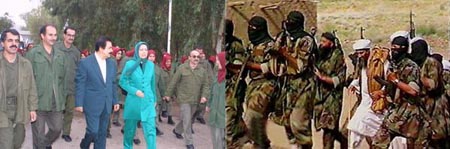 (Iranian Ben Ladan) the leader of the People Mojahedin Organization of Iran (PMOI) is more dangerous and vicious than Afghan Ben Lad an. The west should be on a high alert not to be decoyed by her new sham guise as an advertisement released via her recently under the title of “the ten- point platform for future Iran” in US daily news paper, the Washington Times in January 14 issue. Mr. President, please pay attention to my reasons as a live witness and her victim during last twenty years who has been under her authority and cage in Ashraf garrison situated in Iraq. Meanwhile, I have been separated from Mojahedin cult a year ago and came to France.
In her advertisement, she tries to express her dreams and illusions for “future Iran” with the ill-usage of the international norms and conventions. But, fortunately, she has even no place in her former Ashraf garrison, so, how she intends to make the history of Iran!?!
Let me explain an Iranian maxim which is appropriate for her conditions to make everybody snicker for a while. “A villager person was not allowed to enter the village, but she asked the address of the village bailiff home”. No doubt, Maryam Rajavi has the same story of the villager with her perpetrated crimes and deceits. So that, she has no permission to settle down in any state either USA or Europe, however, she has been indicted by international and local tribunals as such France and Iraq.
To know and understand her serial fobs and illusions, let’s focus on her contradictions in practical fields and her ten- point platform. To save time, let me compare only two of these articles of her platform with her present and past activities and thoughts. In the article 7 of her platform, she claims, ‘we are committed to the Universal Declaration of Human Rights and…’, but, the question arises how she interprets and replies the articles 12 and 16 of the Universal Declaration of Human Rights in comparison with her inhuman activities e.g. forceful ideological divorces of thousands impeccable men and women as well as wrecking and shattering the family foundation and….
Article 12: “no one shall be subjected to arbitrary interference with his privacy, family, home or correspondence, or to attacks upon his honor and reputation. Everyone has the right to the protection of the law against such interference or attacks.”
Article 16: “(1) men and women of full age, without any limitation due to race, nationality or religion, have the right to marry and to found a family. They are entitled to equal rights as to marriage, during marriage and at its dissolution.” “(2) Marriage shall be entered into only with the free and full consent of the intending spouses.” “(3) The family is the natural and fundamental group unit of society and is entitled to protection by society and the state.”
Mr. Mirek topolank, please ask Maryam Rajavi to answer the human conscience and the public opinion of the West regarding forceful and dictated divorces and illegal marriages in her cult by her husband Masood Rajavi who is the lifetime leader of the PMOI. I think a particle of her above mentioned crimes regarding dictated divorces and marriage is enough to prove high contradictions between her false platform and her practical activities.
Mr. President, please let’s check the article 9 of her platform to discern her mock intentions and goals regarding international problems and disasters, “our foreign policy will be based on peaceful coexistence…” as a matter of fact, as a live witness, I got shock of observing such a scene at the time of the occurring of “the September 11 disaster” when Masood rajavi made such speeches, “this is reactionary Islam did such an action, thus, we, the revolutionary Islam can do much better than them. And worse than such a sentence which exposes the nature of the Mojahedin cult’s ideology and thought, was that Maryam Rajavi confirmed his speeches with nodding and smiling.
Now, the question is that is it fair and justice and a just decision to stain the scene of parliament via her presence in the nation’s house?
Yours truly
Hamid Siah Mansouri, Paris, January 25, 2009
Iran devising plan to try Mojahedin Khalq members as EU ministers endorse the terrorist group
Iran is mulling over a plan to take terrorist MKO members to court following the European Union’s decision to lift a ban on the group.
Iranian lawmakers are devising a plan to try the Mujahedin Khalq Organization (MKO) members who have taken an active part in terrorist activities against the country.
“The plan was conceived after the European Union decided to remove the MKO from its blacklist, prompting the Islamic Republic to take the required steps on the issue,”Member of the Iranian Majlis (Parliament) Heshmatollah told Mehr news agency on Monday.
According to the lawmaker, the trials would be held either in the Islamic Republic or outside the country. The MKO members who have not participated in the organization’s terrorist activities are allowed to return home, he added.
Earlier on Monday the EU removed the group from its blacklist, although the organization is recognized as a terrorist group by much of the international community, including the US.
The MKO is responsible for numerous acts of violence against Iranian civilians and government officials. Iran has repeatedly called for the expulsion of the MKO members from Iraq, which has been housing them since 1986.
The Iraqi government, in response, has ordered the members to leave their headquarters, Camp Ashraf, and return to Iran or take refuge in a third country. Iraq blames the group for conducting a significant role in destabilizing the Baghdad government.
Several members of the group have now defected from the organization and returned to Iran. According to a May 2005 Human Rights Watch report, the outlawed group imprisons defectors and even tortures them.
Defectors accuse the group of resorting to mind control in an effort to brainwash supporters and to establish a cult mindset among members.