The recent rocket attack on Camp Liberty – the transient settlement facility of the terrorist Mojahedin-e Khalq
Organization in Iraq – unveiled the deep differences between the terrorist group and its American and European lobbyists.
According to a report by Didehban center, pro-MKO lobbyists, who are mostly retired European and American politicians, have recently concluded that the criminal activities of the MKO (also known as the MEK, PMOI and NCR) will definitely prove costly for them.
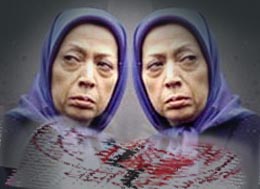
They have recently increased their criticism about the "irresponsible" remarks of MKO’s ringleader, Maryam Rajavi, and the negative impacts of her remarks.
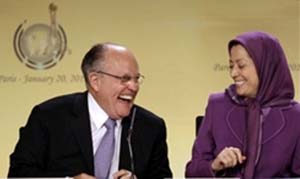
These lobbyists have realized that MKO ringleaders want to massacre the group’s members as they see such bloodshed as the only way to guarantee their longer stay in Iraq, while their lobbyists such as former New York mayor Rudy Giuliani have asked for the transfer of the MKO members to the US, said the Didehban report.
In Washington on Saturday, at a convention of Iranian-Americans, Giuliani called on the United States to take in the camp residents.
"These people can all be removed within hours," Giuliani said. "Planes can be sent immediately. They can be here within a day. We have done far more difficult things than that. It’s only about 3,000 people."
The report came after some media reports alleged that Katyusha rockets fired on the Camp Liberty have killed five members of the MKO. About 40 members of the terrorist group were reportedly wounded in Saturday’s attack, along with three Iraqi policemen, said the reports.
Meantime, a senior Iraqi lawmaker said that the recent rocket attack on Camp Liberty was a move to convince Iraq to allow the MKO to return to Camp Ashraf, but such actions are futile the grouplet’s return to its main training camp is impossible.
"Attack on the MKO aimed to rally the support of the international community’s public opinion for the MKO’s return to the Diyala province and Camp Ashraf," Abdullah al-Naeli said on Wednesday.
"But returning the MKO’s members to their previous position is not possible, specially given the fact that Diyala residents spent much efforts to expel them from their province," Naeli was quoted by Ashraf News as saying.
The Iraqi lawmaker added that the Baghdad government is seriously investigating the attack to find out the realities.
News on the MEK
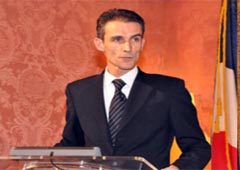
France expressed support over transferring members of the Mojahedin-e Khalq Organization outside Iraq, underlining its readiness to take part in coordination with the UN High Commissioner for Refugees (UNHCR).
Iranian Fars news agency quoted French Foreign Ministry Spokesman Philippe Lalliot as saying that his country supports the UN plan to move the MKO to a third country.
Head of an Iraqi human rights group had said that Iraq seeks to try in absentia the members of the Mojahedin-e Khalq Organization (MKO, also known as the MEK, NCR and PMOI) in Iraq.
He said the people of Tuz Khurmato, who are victims of the MKO and the trial is going to be held in their city, expressed happiness and satisfaction over the issue.
A senior Iraqi lawmaker said that the recent rocket attack on the terrorist Mojahedin-e Khalq Organization
transient settlement in Camp Liberty was a move to convince Iraq to allow the MKO to return to Camp Ashraf, but such actions are futile the group’s return to its main training camp is impossible.

"Attack on the MKO aimed to rally the support of the international community’s public opinion for the MKO’s return to the Diyala province and Camp Ashraf," Abdullah al-Naeli said on Wednesday.
"But returning the MKO’s members to their previous position is not possible, specially given the fact that Diyala residents spent much efforts to expel them from their province," Naeli was quoted by Ashraf News as saying.
The Iraqi lawmaker added that the Baghdad government is seriously investigating the attack to find out the realities.
Some media reports alleged that Katyusha rockets fired on the Camp Liberty, the transient settlement facility of the MKO (also known as the MEK, PMOI and NCR) in Iraq, have killed five members of the MKO. About 40 members of the terrorist group were reportedly wounded in Saturday’s attack, along with three Iraqi policemen.
Speaking to reporters here in Tehran on Tuesday, Iran’s Foreign Ministry Spokesman Ramin Mehman-Parast said that the move is part of the MKO’s efforts to portray itself as an oppressed community in a bid to postpone its expulsion from Iraq’s soil.
Mehman-Parast also called on the UN and Iraqi officials to rapidly implement the agreements on the expulsion of the MKO from Iraq.
Also on Tuesday, Iran’s Ambassador to Baghdad Hassan Danayeefar said that the attack is part of the MKO’s efforts to return to Camp Ashraf.
Head of an Iraqi human rights group says Iraq seeks to try in absentia the members of the terrorist Mujahedin-e
Khalq organization (MKO, a.k.a. MEK and PMOI) in Iraq.
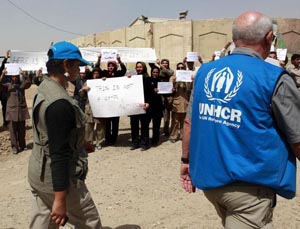
“The silence of the Iraqi government, international organizations, and the mass media regarding the martyrs and victims of Munafeqin (hypocrites, a term used in Iran and Iraq for the members of MKO) grouplet made us request the hearing in the absence of the Munafeqin,” head of the Association of Justice to Defend Iraqi Victims of MKO, Dr. Nafe al-Isa, told Habilian Association in an interview on Thursday.
He said the people of Tuz Khurmato, who are victims of the MKO and the trial is going to be held in their city, expressed happiness and satisfaction over the issue.
He added that the trial will be held as coordinated with the judicial system, and the witnesses will be heard in the first session.
Dr. Nafe al-Isa also called on Iranian media to cover the sessions, the first of which will be held on February 18, 2013.
Five deaths reported after mortars and rockets hit new transit camp housing members of opposition MEK
group.
Dozens of mortars and rockets fired on a camp housing Iranian dissidents near Baghdad have killed five members of the opposition group, Iraqi security officials say.
Five members of the Mujahedeen-e-Khalq (MEK) were killed in Saturday’s attack involving the mortars and rockets, two Iraqi security officials said on condition of anonymity.
Between 39 and 40 members of the group were wounded, along with three Iraqi policemen.
There was no immediate claim of responsibility for the attack on the transit camp, a former American military base known as Camp Liberty.
The United Nations called for an immediate investigation and said monitors were following up on the deaths, the first confirmed fatalities as a result of violence at the group’s new camp since they moved there last year.
The MEK, whose leadership is based in Paris, said in a statement that six people were killed and 50 wounded.
One Iraqi security official said around 40 rockets and mortars were fired into the camp, while the MEK said 35 were launched.
The UN said Martin Kobler, its special envoy, had asked Iraqi authorities to "promptly conduct an investigation into this," and added: "We have our monitors on the ground to follow up".
‘Hospitalised immediately’
Eliana Nabaa, spokeswoman for the UN mission in the country, said Iraqi officials had told the UN that "all those who were injured were hospitalised immediately".
Camp Liberty is home to about 3,000 residents from the MEK who were moved last year, on Iraq’s insistence, from their historic paramilitary camp of the 1980s – Camp Ashraf.
The MEK was founded in the 1960s to oppose the Shah of Iran, and after the 1979 Islamic revolution that overthrew him it took up arms against Iran’s rulers.
It says it has now laid down its arms and is working to overthrow the government in Tehran through peaceful means.
Britain struck the group off its terror list in June 2008, followed by the European Union in 2009 and the US in September 2012.
The US state department holds the group responsible, however, for the deaths of Iranians as well as US soldiers and civilians from the 1970s into 2001.
The MEK has no support in Iran, and no connection to domestic opposition groups.
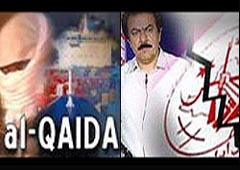
An Iraqi official says the terrorist Mujahedin-e Khalq Organization (MKO) had turned its Camp Ashraf into a base for training al-Qaeda operatives who carried out terrorist attacks against the Iraqi nation.
Head of the Security Committee of Diyala Province Meysam al-Tamimi noted that the MKO had transformed Camp Ashraf, situated about 120 kilometers (74 miles) west of the border with Iran, into a training camp for al-Qaeda members when they were in charge.
He said a large amount of money and weapons was also funneled through Camp Ashraf to al-Qaeda and Salafist extremist groups to help them target Iraqis in acts of terror.
The MKO fled to Iraq in 1986, where it enjoyed the support of Iraq’s executed dictator Saddam Hussein, and set up its camp near the Iranian border.
The group is also known to have cooperated with Saddam Hussein in suppressing the 1991 uprisings in southern Iraq and carrying out the massacre of Iraqi Kurds.
The MKO has carried out numerous acts of violence against Iranian civilians and government officials.
Iraqi officials announced on Sunday that they have found the bodies of a large number of Iraqi citizens and officials slain by the terrorist Mojahedin-e Khalq Organization (MKO, also known as the MEK, PMOI and NCR) in a mass grave in MKO’s Camp Ashraf in the Northern Diyala province.
"As proofs and evidence show, the corpses of Iraq’s Shiite citizens, officials, officers, sheikhs and religious scholars have been buried in the mass grave," a high-ranking Iraqi political source said in an interview with al-Mustaqbal al-Iraq news agency.
He said that the corpses belong to the people who were killed by the MKO from 2006 to 2009.
An Iraqi official had informed in early January that several mass graves had been unearthed in Camp New Iraq, formerly known as Camp Ashraf, in the Diyala Province, which was the headquarters of the terrorist MKO before a majority of the group members were transferred to Camp Liberty around Baghdad a few months ago.
Sadeq al-Husseini, the deputy chairman of Diyala’s provincial council, added that the Iraqi Ministry of Human Rights was in charge of determining the identities of the bodies and whether they were Kurds, the residents of southern provinces or from the town of Khalis in Diyala Province.
He said that the bodies were being examined in medical laboratories in Arbil Province, adding that human rights violations in the camp did not seem improbable.
The MKO is behind a slew of assassinations and bombings inside Iran, a number of EU parliamentarians said in a recent letter in which they slammed a British court decision to remove the MKO from the British terror list. The EU officials also added that the group has no public support within Iran because of their role in helping Saddam Hussein in the Iraqi imposed war on Iran (1980-1988.)
Many of the MKO members abandoned the terrorist organization while most of those still remaining in the grouplet are said to be willing to quit but are under pressure and torture not to do so.
A May 2005 Human Rights Watch report accused the MKO of running prison camps in Iraq and committing human rights violations.
According to the Human Rights Watch report, the outlawed group puts defectors under torture and jail terms.
The group, founded in the 1960s, blended elements of Islamism and Stalinism and participated in the overthrow of the US-backed Shah of Iran in 1979. Ahead of the revolution, the MKO conducted attacks and assassinations against both Iranian and Western targets.
The group started assassination of the citizens and officials after the revolution in a bid to take control of the newly established Islamic Republic. It killed several of Iran’s new leaders in the early years after the revolution, including the then President, Mohammad Ali Rajayee, Prime Minister, Mohammad Javad Bahonar and the Judiciary Chief, Mohammad Hossein Beheshti who were killed in bomb attacks by MKO members in 1981.
The group fled to Iraq in 1986, where it was protected by Saddam Hussein and where it helped the Iraqi dictator suppress Shiite and Kurd uprisings in the country.
The terrorist group joined Saddam’s army during the Iraqi imposed war on Iran (1980-1988) and helped Saddam and killed thousands of Iranian civilians and soldiers during the US-backed Iraqi imposed war on Iran.
Since the 2003 US invasion of Iraq, the group, which now adheres to a pro-free-market philosophy, has been strongly backed by neo-conservatives in the United States, who argued for the MKO to be taken off the US terror list.
The US formally removed the MKO from its list of terror organizations in early September, one week after Secretary of State Hillary Clinton sent the US Congress a classified communication about the move. The decision made by Clinton enabled the group to have its assets under US jurisdiction unfrozen and do business with American entities, the State Department said in a statement at the time.
Manama: Bahrain’s foreign minister has denied online reports that Manama was ready to host members of the Mujahedeen-e-Khalq (MEK) organisation, the Iranian dissident militant group.
“The report is baseless and lacks credibility and I am not at all aware of anything related to it,” Shaikh Khalid Bin Ahmad Al Khalifa told local Arabic daily Al Watan.
Websites claimed a United Nations official in the Iraqi capital Baghdad said that Bahrain had informed the US administration it was willing to host elements of the Iranian exiled opposition group currently staying in Camp Liberty, a former US base outside Baghdad, Al Watan reported on Monday.
MEK was taken off the US terror list in September after the US State Department said it had not committed terror for more than a decade.
The militant group had also complied with a US requirement that more than 3,000 of its once-armed members leave their Camp Ashraf base in the eastern province of Diyala in Iraq near the Iranian border and move to Camp Liberty.
The Iranians condemned the US decision to delist the group, saying that it was an “irresponsible move that is against the international and legal commitments of the US.”
MEK, as a guerrilla movement, fight Shah Mohammad Reza Pahlavi in the 1970s, but could not agree with the new Iranian regime of Ayatollah Ruhollah Khomeini when it came to power in 1979.
The group ended up teaming up with Iraq to battle Iran in the 1980s and won the protection of Iraqi former leader Saddam Husain.
However, the group was disarmed after the 2003 US invasion of Iraq and had difficult relations with the new Iraqi leadership.
Habib Toumi
No country in the world accepts to shelter members of the anti-Iran terrorist Mojahedin-e Khalq Organization (MKO), Iraqi Deputy Foreign Minister Labid al-Abawi stressed on Monday. 
"The UN is in talks with some immigrant-accepting countries to convince them to shelter the MKO members, but no country has yet accepted to shelter them," Abawi told FNA when asked about the latest developments in relation to the expulsion of the MKO members from Iraq.
"The grouplet is now in the transit Camp Liberty in Baghdad and the UN will start their transition as soon as a third country is found for them," he added.
Labawi said that the Iraqi government has complied with all its undertakings in this regard in a bid to ensure the rapid expulsion of the terrorist MKO from its soil.
The MKO is behind a slew of assassinations and bombings inside Iran, a number of EU parliamentarians said in a recent letter in which they slammed a British court decision to remove the MKO from the British terror list. The EU officials also added that the group has no public support within Iran because of their role in helping Saddam Hussein in the Iraqi imposed war on Iran (1980-1988).
Many of the MKO members abandoned the terrorist organization while most of those still remaining in the group are said to be willing to quit but are under pressure and torture not to do so.
A May 2005 Human Rights Watch report accused the MKO of running prison camps in Iraq and committing human rights violations.
According to the Human Rights Watch report, the outlawed group puts defectors under torture and jail terms.
The group, founded in the 1960s, blended elements of Islamism and Stalinism and participated in the overthrow of the US-backed Shah of Iran in 1979. Ahead of the revolution, the MKO conducted attacks and assassinations against both Iranian and Western targets.
The group started assassination of the citizens and officials after the revolution in a bid to take control of the newly established Islamic Republic. It killed several of Iran’s new leaders in the early years after the revolution, including the then President, Mohammad Ali Rajayee, Prime Minister, Mohammad Javad Bahonar and the Judiciary Chief, Mohammad Hossein Beheshti who were killed in bomb attacks by MKO members in 1981.
The group fled to Iraq in 1986, where it was protected by Saddam Hussein and where it helped the Iraqi dictator suppress Shiite and Kurd uprisings in the country.
The terrorist group joined Saddam’s army during the Iraqi imposed war on Iran (1980-1988) and helped Saddam and killed thousands of Iranian civilians and soldiers during the US-backed Iraqi imposed war on Iran.
Since the 2003 US invasion of Iraq, the group, which now adheres to a pro-free-market philosophy, has been strongly backed by neo-conservatives in the United States, who argued for the MKO to be taken off the US terror list.
The US formally removed the MKO from its list of terror organizations in early September, one week after Secretary of State Hillary Clinton sent the US Congress a classified communication about the move. The decision made by Clinton enabled the group to have its assets under US jurisdiction unfrozen and do business with American entities, the State Department said in a statement at the time.
Fars News, January 22 2013
http://english.farsnews.com/newstext.php?nn=9107137811
Iraqi officials announced that a number of al-Qaeda operatives have been trained in the main training camp of the terrorist Mojahedin-e Khalq Organization in Iraq’s Diyala province (Camp
Ashraf) to carry out terrorist attacks against the Iraqi people.
"When the MKO elements were still in Camp Ashraf, the al-Qaeda forces were trained in there and the camp had turned into a center for terrorism and killing," Head of the Security Committee of Diyala province Meysam al-Tamimi said.
According to Ashrafnews, Tamimi also said that the Iraqi security forces have found a secret cache of heavy weaponries in the Camp, adding that the MKO had been training the al-Qaeda members how to use these weaponries.
He said that the al-Qaeda members were trained to conduct terrorist operations in the province specially to force the people residing around Camp Ashraf to leave the area.
The mass graves which have recently been unearthed near the main training camp of the terrorist MKO in Iraq’s Diyala province also unveiled a strong bond between the MKO and the Al Qaeda terrorist group.
Speaking to FNA on Sunday, Udai al-Khadran, the governor of the city of Khalis in Diyala province, said Al Qadea and the MKO members cooperated to intensify unrests in Khalis.
He added that the MKO members are involved in Al Qaeda bombing plots and kidnappings in Diyala.
Khadran added that there exist documents substantiating that some Iraqi officials are collaborating with terrorists and have taken bribes to the very same end.
Earlier in January, an Iraqi official said several mass graves have been unearthed in Camp New Iraq, formerly known as Camp Ashraf, in Iraq’s Diyala Province, which was the headquarters of the terrorist MKO.
Sadeq al-Husseini, the deputy chairman of Diyala’s provincial council said that the Iraqi Ministry of Human Rights was in charge of determining the identities of the bodies and whether they were Kurds, the residents of southern provinces or from the town of Khalis in Diyala Province.
He said that the bodies were being examined in medical laboratories in Arbil Province, adding that human rights violations in the camp did not seem improbable.
The MKO is behind a slew of assassinations and bombings inside Iran, a number of EU parliamentarians said in a recent letter in which they slammed a British court decision to remove the MKO from the British terror list. The EU officials also added that the group has no public support within Iran because of their role in helping Saddam Hussein in the Iraqi imposed war on Iran (1980-1988).
Many of the MKO members abandoned the terrorist organization while most of those still remaining in the grouplet are said to be willing to quit but are under pressure and torture not to do so.
A May 2005 Human Rights Watch report accused the MKO of running prison camps in Iraq and committing human rights violations.
According to the Human Rights Watch report, the outlawed group puts defectors under torture and jail terms.
The group, founded in the 1960s, blended elements of Islamism and Stalinism and participated in the overthrow of the US-backed Shah of Iran in 1979. Ahead of the revolution, the MKO conducted attacks and assassinations against both Iranian and Western targets.
The group started assassination of the citizens and officials after the revolution in a bid to take control of the newly established Islamic Republic. It killed several of Iran’s new leaders in the early years after the revolution, including the then President, Mohammad Ali Rajayee, Prime Minister, Mohammad Javad Bahonar and the Judiciary Chief, Mohammad Hossein Beheshti who were killed in bomb attacks by MKO members in 1981.
The group fled to Iraq in 1986, where it was protected by Saddam Hussein and where it helped the Iraqi dictator suppress Shiite and Kurd uprisings in the country.
The terrorist group joined Saddam’s army during the Iraqi imposed war on Iran (1980-1988) and helped Saddam and killed thousands of Iranian civilians and soldiers during the US-backed Iraqi imposed war on Iran.
Since the 2003 US invasion of Iraq, the group, which now adheres to a pro-free-market philosophy, has been strongly backed by neo-conservatives in the United States, who argued for the MKO to be taken off the US terror list.
The US formally removed the MKO from its list of terror organizations in early September, one week after Secretary of State Hillary Clinton sent the US Congress a classified communication about the move. The decision made by Clinton enabled the group to have its assets under US jurisdiction unfrozen and do business with American entities, the State Department said in a statement at the time.