
The MKO, which seeks to destabilize the government in Tehran, is currently headed by Maryam Rajavi — who considers herself the president-elect of a supposed Iranian government-in-exile.
France has offered to take in members of the Mujahedin Khalq Organization (MKO) who are being forced to leave Iraq, sources claim.
The French government has volunteered to transport MKO members onboard its passenger aircraft to France as soon as possible, Iraqi sources told Tabnak on condition of anonymity.
The Iraqi officials also told the news agency that Israel has offered to recruit MKO members for its military.
The revelation comes after the European Union removed the exiled anti-Iran group from its list of terror organizations on Monday.
The MKO is notorious for having staged many attacks against Iranian and Iraqi civilians.
The 1981 murder of Judiciary chief Ayatollah Mohammad Beheshti along with 71 other senior Iranian officials is also attributed to the group.
Under the leadership of Massoud Rajavi, the MKO helped the Baath regime of Saddam Hussain in the suppression of the Iraqi Kurds in ‘Operation Morvarid’. Thousands of Iraqi civilians were brutally massacred in the operation.
After the 2003 regime change in Iraq and the 2009 interim security agreement between Baghdad and Washington, the responsibility for the security of Camp Ashraf — an MKO military training ground –, was transferred to Iraqi forces.
The Iraqi government has recently given MKO members a tight deadline to leave the camp, situated in Diyala province, and the country altogether.
Western countries claim that the lives of MKO members will be threatened if they return to Iran. Tehran, however, has promised to welcome the return of any member who has not taken part in any serious anti-Iran activity and is ready to leave the group.
"During the past few years, various MKO members have requested permission to return. Of course, if serious cases have not been filed against them, they can return to the country by handing themselves over," Iranian security official Alaeddin Boroujerdi said on Thursday.
The French proposal to take in the MKO members comes as a surprise, because Paris consistently opposed the motion to remove the group from the European list of terror organizations. France is, already, home to a large number of MKO activities.
MKO is known for the cult-like tactics it uses within the group and for the torture and murder of its defectors.
"There are many [MKO members] who have tried to flee the camp. They have contacted Iran and introduced themselves. But in the end the complicated system has entrapped them," said Boroujerdi.
Numerous articles and letters posted on the Internet by family members of MKO recruits confirm reports of the horrific abuse that the group inflicts on its own members and the alluring recruitment methods it uses.
The most shocking of such stories include accounts given by former British MKO member Ann Singleton and Mustafa Mohammadi — the father of an Iranian-Canadian girl who was drawn into the group during an MKO recruitment campaign in Canada.
Mohammadi gives an account of his desperate efforts to contact his daughter, who disappeared several years ago — a result of what the MKO called a ‘two-month tour’ of Camp Ashraf as a teenager.
He also explains how the group forces the families of its recruits to take part in MKO demonstrations in Western countries by threatening to kill their relatives.
Reports indicate that the banned terrorist group, which lacks a foothold in Iran, recruits ill-informed teens from the immigrant population of Western states, not allowing them to leave afterwards.
Unlike Europe, the US has not removed the group from its terror list.
The family members of victims of MKO terrorist attacks have cautioned the EU against becoming the organization’s “partner in crime”.
“As victims of MKO terrorism, we advise the European Union  not to turn into the group’s collaborator in their atrocities against the Iranian nation,” reads a statement from the family members.
The victims had gathered in front of the British embassy in Tehran in protest at a recent decision to remove the group known as the ‘Rajavi cult’ from a list of banned terrorist groups in the EU.
“When Masoud Rajavi and his group launched their terrorist attacks in Iran in 1981, European counties not only did not condemn their atrocities but also gave them refuge in their countries,” adds the statement.
The Mujahedin Khalq Organization (MKO), which identifies itself as a Marxist-Islamist guerilla army, was founded in Iran in the 1960s but was exiled some twenty years later for carrying out numerous acts of terrorism inside the country.
The terrorist group is especially notorious for the help it extended to former dictator Saddam Hussein during the war Iraq imposed on Iran (1980-1988).
The group masterminded a slew of assassinations and bombings inside Iran, one of which was the 1981 bombing of the offices of the Islamic Republic Party, in which more than 72 Iranian officials were killed, including then Judiciary chief Ayatollah Mohammad Beheshti.
“The Rajavi cult has conducted its campaign of terror in Iran with the support of the European governments and from their safe havens inside the European capitals,” the families said.
In recent months, high-ranking MKO members have been lobbying governments around the world to acknowledge the dissidents as those of a legitimate opposition group.
During the revolution in Iran, the group criticized Ayatollah Ruhollah Khomeini for releasing the American diplomats, arguing that they should have been executed instead.
The United States and Canada have refused to drop the MKO from their lists of terrorist organizations.
The group has also been engaged in cult-like activities such as psychological coercion techniques and physical abuse.
The group has also resorted to ‘forced sterilization’ as a strategy to prevent members from leaving the group.
Iran has filed a complaint to the UN on the recent EU decision to remove the Mujahedin Khalq Organization from its list of terror groups. 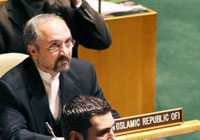
"The European Union must realize that a political approach to terrorism, which threatens the lives and security of people around the world, is totally unacceptable for the global public opinion," Iran’s permanent envoy to the United Nations, Mohammad Khazaei, wrote in a Wednesday letter to the UN Secretary General Ban Ki-moon.
"The EU’s politically motivated decision will not change the terrorist nature of the group. It will not ‘turn the page’ of history on the cult’s terrorist activities and massacre of innocent civilians, nor will it cleanse the terrorist group of its criminal past," he added.
Khazaei added that the removal of the group from the European list of terror organizations had caused great pain for over 14 thousand people who had lost their family members in MKO terror attacks.
The Iranian envoy called on the EU to revise its decision by sending a collection of evidence it has to European courts explaining the terrorist nature of the MKO, and resolving the technical objections that had led to the court ruling.
On Monday EU ministers removed the exiled anti-Iran group from their list of terror organizations, following a European court ruling in favor of the group, which has accepted responsibility for many deadly attacks against Iranian and Iraqi civilians and cooperated actively with the regime of former Iraqi dictator Saddam Hussein.
In one of their deadliest attacks, the MKO carried out a 1981 bombing that killed Iranian Judiciary chief Ayatollah Mohmmad Beheshti and 71 other senior officials.
Among their most recent terror activities is the 1999 assassination of the chief-of-staff of Iran’s Armed Forces, Ali Sayad Shirazi, just outside his house in the early hours of April 10th, as he was preparing to leave for work.
MKO is notorious for the cult like tactics it uses against its members, and the murder and torture of its defectors.
Numerous articles and letters posted on the internet by family members of MKO recruits confirm reports of the horrific abuse that the group inflicts on its own members and the luring recruitment methods it uses.
http://www.presstv.com/Detail.aspx?id=84026§ionid=351020101
A State Department Spokesman says the US administration will not change the terrorist status of the Mujahedin Khalq Organization (MKO).
“We’ve already done a review and it was determined that there would not be a revocation of that status for the Mujahedin-e Khalq, so nothing has changed from our standpoint,” Robert Wood said at a briefing on Monday, when asked if Washington would follow the action taken by the European Union.
The EU removed the MKO from its list of terrorist organizations on Monday. The move outraged the Iranian Foreign Ministry, which in a statement, called the decision incomprehensible.
Wood added that there had not been ‘any change at this point’ in the status of the MKO, suggesting that the new administration was unlikely to alter its stance on the outlawed group.
The US announced on Jan. 12 that labeling the MKO as a terrorist group was an appropriate act and that the group had to remain on the blacklist.
The MKO, blacklisted as a terrorist organization by many international entities and countries including the US, is responsible for numerous acts of violence against Iranian civilians and government officials.
The group also attempted an unsuccessful invasion of Iran in the last days of the Iraq-Iran war in 1988.The MKO was involved in the massacre of Iraqis under former Iraqi dictator Saddam Hussein.
G.P. Put on line 27/01/2009 – For Josy Dubié (Belgian MP), there is not a doubt that PMOI is "a sect". The Belgian senator draws from his memories ![Josy Dubié :"They[PMOI/MKO] are still as sectarian as before",](https://st.nejatngo.org/Image/Politician/Josy_Dubie/Josy_Dubie_Belgium_MP_1.jpg) international reporter to the RTBF to affirm it. At the end of the Iraq-Iran war, they are the combatants of this organization which Saddam Hussein had sent like "flesh with canon" at the time of the battle of Mehran, in 1989. The treatment that Moujahidine held for their own troops, the women like the men, and that they applied to their Iranian prisoners were abominable, explains in substance Josy Dubié. "I know them from inside" , continues the senator, " and I can say to you that their behavior is to be brought closer to that of the members of Scientologie". Didn’t they evolve since the Eighties? Josy Dubié does not believe in it at all. "They are still as sectarian as before", he ensures. "However, there is in Iran an opposition much more democratic than that of Moujahidine of the people, the laic opponents, the members of the Communist party Toudeh, the sympathizers of the former Prime Minister Mossadegh ". And Josy estimates that one should not count on OMPI, which " do not represent anything the whole in Iran".
international reporter to the RTBF to affirm it. At the end of the Iraq-Iran war, they are the combatants of this organization which Saddam Hussein had sent like "flesh with canon" at the time of the battle of Mehran, in 1989. The treatment that Moujahidine held for their own troops, the women like the men, and that they applied to their Iranian prisoners were abominable, explains in substance Josy Dubié. "I know them from inside" , continues the senator, " and I can say to you that their behavior is to be brought closer to that of the members of Scientologie". Didn’t they evolve since the Eighties? Josy Dubié does not believe in it at all. "They are still as sectarian as before", he ensures. "However, there is in Iran an opposition much more democratic than that of Moujahidine of the people, the laic opponents, the members of the Communist party Toudeh, the sympathizers of the former Prime Minister Mossadegh ". And Josy estimates that one should not count on OMPI, which " do not represent anything the whole in Iran".
Lalibre.be
TEHRAN – Germany’s Federal Intelligence Agency (BND) has released a report on the National Council of Resistance of Iran (NCRI), calling it a “fake parliament”. 
The NCRI is a part of the terrorist Mojehedin Khalq Organization (MKO) and is headed by Maryam Rajavi.
The BND also stated that the military wing of the MKO is “an army of insurgents”.
Not only are the MKO leadership’s claims to adherence to democratic values disingenuous, but they also follow the tenets of Stalinism and use brainwashing techniques, the report noted.
The report also stated that the MKO finances itself through activities such as economic fraud, the production of false documents, and using children to get donations from charity organizations.
The European Union removed the MKO from its blacklist of terrorist groups on Monday
http://www.tehrantimes.com/index_View.asp?code=188028
Iraqi government has asserted any decision against its policy to expel the terrorist Mojahedin Khalq Organization (MKO) has no impact on Baghdad decision, Iran’s ambassador to Baghdad told ISNA.
The moves and activates in Iraq show the government is serious about its decision for expulsion of the MKO, Hassan Kazemi Qomi said on Tuesday.
Since the Iraqi government believes the nature and activities of MKO are based on terrorism, it has informed the members that they must leave the country and it pursues the case, he added.
Iraq’s National Security Adviser Mowaffaq al-Rubaie on Tuesday held a meeting with ambassadors of 9 European countries, the US, Canada, Australia and Iran to ask them to accept the MKO members in their countries.
"We want to close all the files with our neighbors, and our eastern neighbor Iran sees this as a threat to their national security," Reuters cited al-Rubaie.
Qomi said in this regard that in the meeting with presence of Iraqi Human Rights Minister, Wijdan Michael, Baghdad officials insisted on their policy towards the MKO and called for other countries to aid Iraq implement this policy.
Iraq’s government asserted not only the MKO but also all terrorists must leave Iraq’s territory and Tehran is primed to aid Baghdad fulfill the task, he added.
European foreign ministers on Monday dropped the MKO from the EU terrorist blacklist but said the group may be put in the list in the future.
Head of MKO terrorist group Maryam Rajavi is expected to remain excluded from the UK despite the EU dropping the previously outlawed group from its proscribed list.
British Foreign Office said that although it does not discuss individual cases of exclusion, the government continues to believe that the MKO or MeK, as it prefers to call it, was ‘responsible for vile acts of terrorism over a long period’.
"If an individual has made public statements in the past supporting or condoning terrorism, and has not publicly and unambiguously apologized and refuted such statements, then this would constitute grounds for not admitting an individual into the UK," Foreign Office spokesman Barry Marston said.
"We are not satisfied that the MeK has done enough to distance itself from its past. There is no dispute about its previous terrorist activity: it claimed responsibility for a large number of violent attacks inside Iran for a number of years," Marston told IRNA.
Rajavi was subject to an exclusion order back in October 1997, which banned her entry to the UK on the grounds that the organization contained a large faction of terrorists. The Foreign Office at the time said her presence was ‘not conducive to the public good’.
The British government insists that the deproscription of the MKO was ‘a judicial and not a political decision’ both in the EU as it was earlier in the UK and that it opposed its removal.
"We have made it clear that we were disappointed by the verdict of the Proscribed Organizations Appeal Commission and of the Court of Appeal, but we had to comply with their decisions," Marston said about the British decision last July.
"Equally, given the clear judgement of the Court of First Instance on December 4, 2008, annulling the MeK’s listing in the EU, the EU had no choice but to observe and respect the court’s judgement," he added.
Asked whether the UK government still considered the MKO as a terrorist organization, he said that there were still ‘serious reservations about the MeK’s assertion that it represents a democratic opposition in exile’.
"We see no evidence of popular support for the MeK in Iran, because of its responsibility for terrorist attacks which resulted in the deaths of many Iranian citizens, and because it fought alongside Iraqi forces against Iran during the Iran-Iraq war," Marston said.
Regarding the potential that the controversial decision could have an adverse effect on Iran’s relations with the UK and the EU as a whole, he stressed that it should ‘not be seen as a political decision’.
"We would not hesitate to re-proscribe the MeK if circumstances changed and evidence emerged that it was concerned in terrorism," the spokesman said.
He also quoted Home Office Minister Tony McNulty insisting last June during the debate on the deproscription of the MKO that the UK government have ‘no plans to meet its representatives’.
Baghdad is determined over expulsion of the terrorist Mojahedin Khalq Organization (MKO) from Iraq despite the EU decision to remove the group from its blacklist, the Supreme Islamic Iraqi Council (SIIC) political adviser told ISNA on Monday.
The European Union decision over removal of the MKO from its terrorist blacklist has no impact on Iraqi government’s determination to expel the group, Mohsen Hakim said.
The MKO is a terrorist organization under the UN and Security Council resolutions before and after the 11 September attacks and according to Iraq’s constitutions support for terrorism is prohibited and illegal, he added.
The members of MKO are neither war captives nor refugees thus have no legal position in Iraq, he explained.
According to Hakim 500 of MKO members have returned to Iran and 914 have European countries’ residence permit and Iraq is negotiating to get them out of the country.
Iraqi National Security Adviser Mowaffaq al-Rubaie in his recent visit to Tehran emphasized Camp Ashraf, the MKO residential place, will be closed forever in two months and the members will leave to leave the country.
The EU countries have reached a preliminary agreement to remove (MKO) off an EU list of banned terrorist groups, their foreign ministers, however, meet on January 26 for a final approval on the issue.
The name of the guerilla has remained in the US and Canada blacklists.
The MKO founded in 1960s has carried out assassinations and terrorist attacks against Iranian high-ranking officials including Judiciary Chief Mohammad Hossein Beheshti, President Mohammad Ali Rajayee and Prime Minister Mohammad Javad Bahonar and also civilians. The terrorist efforts have killed 3000 in Iran in 1980s. It has also betrayed the nation by helping Saddam against Iran during 1980-88 Iraq’s imposed war.
The European Union has agreed to remove the notorious Mujahedin Khalq Organization (MKO) from its list of banned terrorist groups.
EU foreign ministers approved a decision to remove the outlawed terrorist group from a list that includes Palestinian Hamas and Sri Lanka’s Tamil Tigers, an unnamed European official was quoted by Reuters as saying.
The group also known as the”Rajavi cult”named after its leader Maryam Rajavi stepped up efforts to be excluded from the list in 2008.
In November Rajavi met with members of the German Parliament in a bid to rally support for the removal of the group from the European Union’s list of terrorist organizations.
The European Court in Luxembourg ruled in December that the EU was wrong to keep the group’s assets frozen.
“What we are doing today is abiding by the resolution of the European court,”EU foreign policy chief Javier Solana told reporters just before the ministers finalize the decision in a meeting in Brussels.
The MKO, which has been listed as a terrorist organization in Iran and the United States, has a long and bloody history of targeting Iranian civilians and government officials.
Incidents linked with the group include the June 1981 bombing of the offices of the Islamic Republic Party in which 72 high-ranking Iranian officials including judiciary chief, Ayatollah Mohmmad Beheshti, and tens of Majlis deputies were killed.
In the following August the group assassinated President Mohmmad Ali Rajae’i, Prime Minister Javad Bahonar and National Police Chief Ali Dastgerdi at the Prime Ministry building.
The MKO also assisted Iraqi dictator, Saddam Hussein, in the massacre of thousands of innocent Iraqis and is responsible for several acts of terror in Iran including the 1994 bombing of a revered Shia shrine in Mashhad, eastern Iran.
In 2003, French anti-terrorist police arrested 165 members in Paris, including Maryam Rajavi, for ‘associating with wrongdoers in relation with a terrorist undertaking.’
More recently, around 10 members of the notorious organization were arrested in France and Switzerland on charges of money laundering on September 29, 2008.