

Israeli Prime Minister Benjamin Netanyahu’s claim in his theatrical 20-minute presentation of an Israeli physical seizure of Iran’s “atomic archive” in Tehran would certainly have been the “great intelligence achievement” he boasted if it had actually happened. But the claim does not hold up under careful scrutiny, and his assertion that Israel now possesses a vast documentary record of a covert Iranian nuclear weapons program is certainly fraudulent.

Netanyahu’s tale of an Israeli intelligence raid right in Tehran that carted off 55,000 paper files and another 55,000 CDs from a “highly secret location” requires that we accept a proposition that is absurd on its face: that Iranian policymakers decided to store their most sensitive military secrets in a small tin-roofed hut with nothing to protect it from heat (thus almost certainly ensuring loss of data on CDs within a few years) and no sign of any security, based on the satellite image shown in the slide show. (As Steve Simon observed in The New York Times the door did not even appear to have a lock on it.)
The laughable explanation suggested by Israeli officials to The Daily Telegraph– that the Iranian government was afraid the files might be found by international inspectors if they remained at “major bases” — merely reveals the utter contempt that Netanyahu has for Western governments and news media. Even if Iran were pursuing nuclear weapons secretly, their files on the subject would be kept at the Ministry of Defense, not at military bases. And of course the alleged but wholly implausible move to an implausible new location came just as Netanyahu needed a dramatic new story to galvanize Trump to resist the European allies’ strong insistence on preserving the Joint Comprehensive Plan of Act (JCPOA) nuclear deal with Iran.
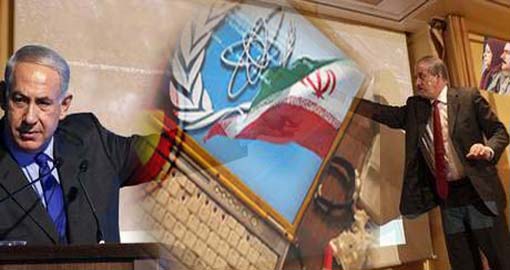
In fact, there is no massive treasure trove of secret files about an Iran “Manhattan Project.” The shelves of black binders and CDs that Netanyahu revealed with such a dramatic flourish date back to 2003 (after which a U.S. National Intelligence Estimate (NIE) said Iran had abandoned any nuclear weapons program) and became nothing more than stage props like the cartoon bomb that Netanyahu used at the United Nations in 2012.
Disinformation Campaign
Netanyahu’s claim about how Israel acquired this “atomic archive” is only the latest manifestation of a long-term disinformation campaign that the Israeli government began to work on in 2002-03. The documents to which Netanyahu referred in the presentation were introduced to the news media and the International Atomic Energy Agency (IAEA) beginning in 2005 as coming originally from a secret Iranian nuclear weapons research program. For many years US news media have accepted those documents as authentic. But despite the solid media united front behind that narrative, we now know with certainty that those earlier documents were fabrications and that they were created by Israel’s Mossad.
That evidence of fraud begins with the alleged origins of the entire collection of documents. Senior intelligence officials in the George W. Bush administration had told reporters that the documents came from “a stolen Iranian laptop computer”, as The New York Times reported in November 2005. The Times quoted unnamed intelligence officials as insisting that the documents had not come from an Iranian resistance group, which would cast serious doubt on their reliability.
But it turned that the assurances from those intelligence officials were part of an official dissimulation. The first reliable account of the documents’ path to the United States came only in 2013, when former senior German foreign office official Karsten Voigt, who retired from his longtime position as coordinator of German-North American cooperation, spoke with this writer on the record.
Voigt recalled how senior officials of the German foreign intelligence agency, the Bundesnachtrendeinst or BND, had explained to him in November 2004 that they were familiar with the documents on the alleged Iran nuclear weapons program, because a sometime source – but not an actual intelligence agent – had provided them earlier that year. Furthermore, the BND officials explained that they had viewed the source as “doubtful,” he recalled, because the source had belonged to the Mujahideen-E Khalq, the armed Iranian opposition group that had fought Iran on behalf of Iraq during the eight year war.
BND officials were concerned that the Bush administration had begun citing those documents as evidence against Iran, because of their experience with “Curveball” – the Iraqi engineer in Germany who had told stories of Iraqi mobile bioweapons labs that had turned to be false. As a result of that meeting with BND officials, Voigt had given an interview to TheWall Street Journal in which he had contradicted the assurance of the unnamed US intelligence officials to the Times and warned that the Bush administration should not base its policy on the documents it was beginning to cite as evidence of an Iranian nuclear weapons program, because they had indeed come from “an Iranian dissident group.”
Using the MEK
The Bush administration’s desire to steer press coverage of the supposedly internal Iranian documents away from the MEK is understandable: the truth about the MEK role would immediately lead to Israel, because it was well known, that Israel’s intelligence agency Mossad had used the MEK to make public information that the Israelis did not want attributed to itself – including the precise location of Iran’s Natanz enrichment facility. As Israeli journalists Yossi Melman and Meir Javadanfar observed in their 2007 book on the Iran nuclear program, based on U.S., British and Israeli officials, “Information is ‘filtered’ to the IAEA via Iranian opposition groups, especially the National Resistance Council of Iran.”
Mossad used the MEK repeatedly in the 1990s and the early 2000’s to get the IAEA to inspect any site the Israelis suspected might possibly be nuclear-related, earning their Iranian clients a very poor reputation at the IAEA. No one familiar with the record of the MEK could have believed that it was capable of creating the detailed documents that were passed to the German government. That required an organization with the expertise in nuclear weapons and experience in fabricating documents – both of which Israel’s Mossad had in abundance.
Bush administration officials had highlighted a set of 18 schematic drawings of the Shahab-3 missile’s reentry vehicle or nosecone of the missile in each of which there was a round shape representing a nuclear weapon. Those drawings were described to foreign governments and the International Atomic Energy Agency as 18 different attempts to integrate a nuclear weapon into the Shahab-3.
Netanyahu gave the public its first glimpse of one of those drawings Monday when he pointed to it triumphantly as visually striking evidence of Iranian nuclear perfidy. But that schematic drawing had a fundamental flaw that proved that it and others in the set could not have been genuine: it showed the “dunce cap” shaped reentry vehicle design of the original Shahab-3 missile that had been tested from 1998 to 2000. That was the shape that intelligence analysts outside Iran had assumed in 2002 and 2003 Iran would continue to use in its ballistic missile.
New Nose Cone
It is now well established, however, that Iran had begun redesigning the Shahab-3 missile with a conical reentry vehicle or nosecone as early as 2000 and replaced it with a completely different design that had a “triconic” or “baby bottle” shape. It made it a missile with very different flight capabilities and was ultimately called the Ghadr-1. Michael Elleman, the world’s leading expert on Iranian ballistic missiles, documented the redesign of the missile in his path-breaking 2010 study of Iran’s missile program.
Iran kept its newly-designed missile with the baby bottle reentry vehicle secret from the outside world until its first test in mid-2004. Elleman concluded that Iran was deliberately misleading the rest of the world – and especially the Israelis, who represented the most immediate threat of attack on Iran – to believe that the old model was the missile of the future while already shifting its planning to the new design, which would bring all of Israel within reach for the first time.
The authors of the drawings that Netanyahu displayed on the screen were thus in the dark about the change in the Iranian design. The earliest date of a document on the redesign of the reentry vehicle in the collection obtained by US intelligence was August 28, 2002 – about two years after the actual redesign had begun. That major error indicates unmistakably that the schematic drawings showing a nuclear weapon in a Shahab-3 reentry vehicle – what Netanyahu called “integrated warhead design” were fabrications.
Netanyahu’s slide show highlighted a series of alleged revelations that he said came from the newly acquired “atomic archive” concerning the so-called “Amad Plan” and the continuation of the activities of the Iranian who was said to have led that covert nuclear weapons project. But the single pages of Farsi language documents he flashed on the screen were also clearly from the same cache of documents that we now know came from the MEK-Israeli combination. Those documents were never authenticated, and IAEA Director-General Mohamed ElBaradei, who was skeptical of their authenticity, had insisted that without such authentication, he could not accuse Iran of having a nuclear weapons program.
More Fraud
There are other indications of fraud in that collection of documents as well. A second element of the supposed covert arms program given the name “Amad Plan” was a “process flow chart” of a bench-scale system for converting uranium ore for enrichment. It had the code name “Project 5.13”, according to a briefing by the IAEA Deputy Director Olli Heinonen, and was part of a larger so-called “Project 5”, according to an official IAEA report. Another sub-project under that rubric was “Project 5.15”, which involved ore processing at the Gchine Mine.” Both sub-projects were said to be carried out by a consulting firm named Kimia Maadan.
But documents that Iran later provided to the IAEA proved that, in fact, “Project 5.15” did exist, but was a civilian project of the Atomic Energy Organization of Iran, not part of a covert nuclear weapons program, and that the decision had been made in August 1999 – two years before the beginning of the alleged “Amad Plan” was said to have begun.
The role of Kimia Maadan in both sub-projects explains why an ore processing project would be included in the supposed secret nuclear weapons program. One of the very few documents included in the cache that could actually be verified as authentic was a letter from Kimia Maadan on another subject, which suggests that the authors of the documents were building the collection around a few documents that could be authenticated.
Netanyahu also lingered over Iran’s denial that it had done any work on “MPI” or (“Multi-Point Initiation”) technology “in hemispheric geometry”. He asserted that “the files” showed Iran had done “extensive work” or “MPI” experiments. He did not elaborate on the point. But Israel did discover the alleged evidence of such experiments in a tin-roofed shack in Tehran. The issue of whether Iran had done such experiments was a central issue in the IAEA’s inquiry after 2008. The agency described it in a September 2008 report, which purported to be about Iran’s “experimentation in connection with symmetrical initiation of a hemispherical high explosive charge suitable for an implosion type nuclear device.”
No Official Seals
The IAEA refused to reveal which member country had provided the document to the IAEA. But former Director-General ElBaradei revealed in his memoirs that Israel had passed a series of documents to the Agency in order to establish the case that Iran had continued its nuclear weapons experiments until “at least 2007.” ElBaradei was referring to convenient timing of the report’s appearance within a few months of the US NIE of November 2007 concluding that Iran had ended its nuclear weapons-related research in 2003.
Netanyahu pointed to a series of documents on the screen as well a number of drawings, photographs and technical figures, and even a grainy old black and white film, as evidence of Iran’s nuclear weapons work. But absolutely nothing about them provides an evidentiary link to the Iranian government. As Tariq Rauf, who was head of the IAEA’s Verification and Security Policy Coordination Office from 2002 to 2012, noted in an e-mail, none of the pages of text on the screen show official seals or marks that would identify them as actual Iranian government documents. The purported Iranian documents given to the IAEA in 2005 similarly lacked such official markings, as an IAEA official conceded to me in 2008.
Netanyahu’s slide show revealed more than just his over-the-top style of persuasion on the subject of Iran. It provided further evidence that the claims that had successfully swayed the US and Israeli allies to join in punishing Iran for having had a nuclear weapons program were based on fabricated documents that originated in the state that had the strongest motive to make that case – Israel.
Gareth Porter, an investigative historian and journalist specializing in US national security policy, received the UK-based Gellhorn Prize for journalism for 2011 for articles on the U.S. war in Afghanistan. His new book is Manufactured Crisis: the Untold Story of the Iran Nuclear Scare. He can be contacted at porter.gareth50@gmail.com. Reprinted from Consortium News with the author’s permission.
by Gareth Porter




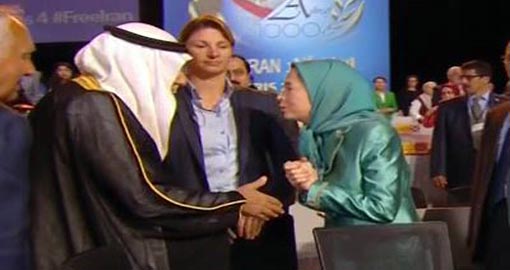
 behest. Instead it turned into a Grand Controversy of a different kind. This annual propaganda show advertises Rajavi’s propaganda skills in order to secure continued funding from regime change pundits. This year was dramatically different due to the unannounced presence of Prince Turki al-Faisal, former Saudi ambassador to the UK and US. Certainly not a person you invite from a list in a speakers’ agency.

 convicting him of spying for Tehran.