They say actions speak louder than words. Looking behind the Twitter storm which creates a smoke and mirrors effect to disguise the Trump administration’s true intents, one fact is blindingly clear; for this government, Iranians are first in the firing line.
This, of itself, is not unexpected. On the campaign trail Trump threatened to tear up the nuclear deal with Iran. So it was already clear he’s no fan of Iranians.
His first act as president has been to issue a direct and belligerent challenge to Iran – he included Iran in the Muslim ban and then declared that Iran is “on notice” after Iran test-fired a ballistic missile which it says is defensive. Iran is clearly in the crosshairs for Trump and his team.
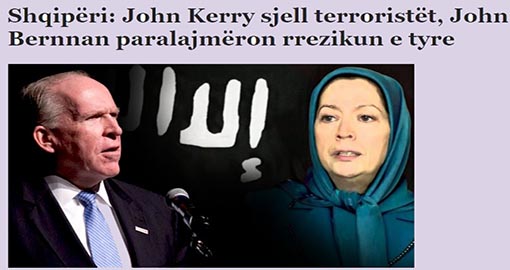
And the evidence stacks up. As a barometer for any individual or even government’s aggressive approach to Iran, support for the Mojahedin Khalq (MEK aka Rajavi cult) is as accurate an indicator as any. The group has advocated violent regime change against Iran for three decades. Its supporters are in doubt that this is a rallying cry for a US-led war.
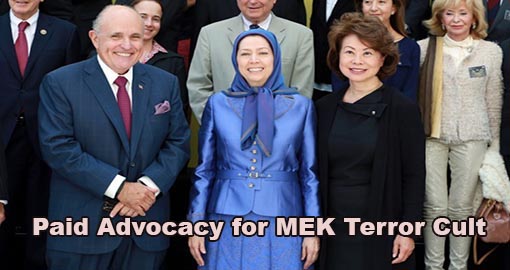
Even before taking office, revelations about potential Trump administration advisers and officials giving support to the terrorist MEK cult caused concern among foreign policy experts. After all, anti-Iran pundits can choose from literally thousands of civil groups and personalities to act as advisors and partners in challenging Iran. The MEK’s dirty past includes the anti-Imperialist inspired murder of six Americans in pre-revolution Iran which it later celebrated in songs and publications. (The family of U.S. Air Force Lt. Col. Jack Turner – “We were the first victims of terror before there was ever a war on terror” – is currently seeking redress for his death.) The new president has apparently brushed aside such concerns and has chosen to surround himself with people who have advocated for the MEK.
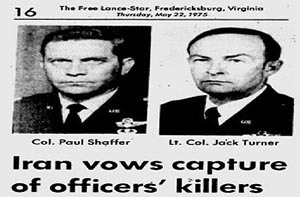
Col. Jack Turner and Col. Paul Shaffer victims of Mojahedin Khalq terror campaign
By not denouncing the MEK Trump has done several things. One is to signal that he is at war not with Iran but with Iranians. The MEK is hated more profoundly than any of Iran’s current political leaders by Iranians inside and outside the country.
He also signals that his war is not with ISIS but with the country Iran. Donald Trump rose to victory in part on the promise to take on ISIS and defeat the group. Yet ISIS cannot be defeated except by a coalition of forces that includes Iran. The facts on the ground in Syria and Iraq demonstrate unequivocally that ISIS forces in Aleppo and Mosul have been defeated largely due to the involvement of Iran. Trump clearly has no intention of defeating terrorism.
But most importantly, this tolerance, even warmth, shown toward the MEK in American foreign policy circles is a message that can be read from afar and by everyone else in the world: the American war box is virtually empty. Aside from a handful of puny sanctions, bringing the MEK into the equation means that not only does the America not have a stick to wave at Iran, it appears foolish enough, befuddled by ideological zeal perhaps, to tie its fate to the most unlucky and doom-laden group there ever was.
Laughably, parasitically, the MEK has consistently tied its fate to whichever it assumed was the winning side. However, the choice of MEK sponsors no longer looks so astute. Ayatollah Khomeini quickly saw through the MEK’s smarmy overtures to share power and promptly exiled them from Iran. The next step was to ally with Saddam Hussein against Iran during the Iran-Iraq war – a feat of spectacular treachery for which no Iranian will ever forgive them. After Saddam’s fall the MEK believed that the chaos in Iraq which gave rise to the insurrection of Al Qaida in Iraq would somehow carry them forward. The MEK even flirted with support for ISIS and the Syrian Free Army hoping they would find a home in the new Caliphate. Instead, the MEK were evicted from their base and sent into deeper exile in Albania, a country with no axe to grind against Iran. Long term sponsors have included Israel – which tasked MEK operatives with the assassination of Iranian nuclear scientists – and the anti-Shia Saudi Arabia. Both countries are bogged down with interminable troubles of their own. And now the MEK are hoping to cosy up with the Trump administration.
The Obama administration kept the MEK at arms’ length and never entertained direct support for the group. When the government of Iraq held the US, along with the UN, responsible for removing the MEK from Iraq to a third country, the then Secretary of State Hillary Clinton was forced to agree to remove the MEK from the US terrorism list before any third country would legally be able to accept them on their territory.
Since 2001 Trump’s predecessors have built up strong homeland defences and led counter-terrorism efforts particularly against the threat of ISIS to the US and Europe. It is now likely that this legacy will be squandered by an administration with an overriding hatred of Iran. Instead of understanding the benefit of developing strategic partnerships with countries like Iran and Iraq in the global fight against terrorism, the Trump administration would rather rain down terror on the Iranian people.
But the biggest delusion would be to believe that the MEK could be a reliable or effective partner in any sense. If Donald Trump has any insight into his own modus operandi – the erratic demands and refusal to take criticism – he will have a direct view of how the MEK operates. Aligning America’s foreign policy with the whims of a mind control cult will not secure victory over Iran. Instead, it will diminish America’s standing in the world, and it will certainly not make the world a better or safer place.
Massoud Khodabandeh , Director at Middle East Strategy Consultants.
 things do not look good. With the new Trump administration it is very likely that, in addition to the existing war zones – Syria, Iraq, Yemen, Bahrain … – we will see new areas of conflict and new attempts at regime change from above.
 Trump to work with the group!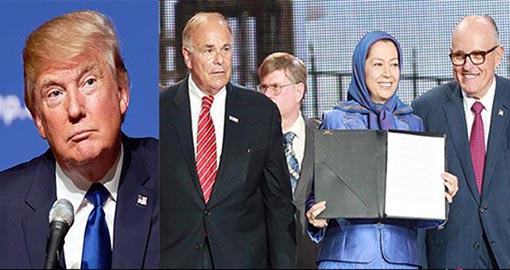
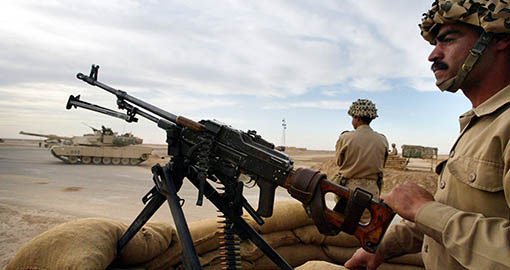
 The U.S. should sink Iranian ships, consider targeted killings of Iranian fighters in Syria, and ratchet up new non-nuclear sanctions on Iran under the Trump Administration, according to a panel of lawmakers and policymakers organized on Capitol Hill yesterday by the hawkish United Against Nuclear Iran organization.