At A SENATE Forei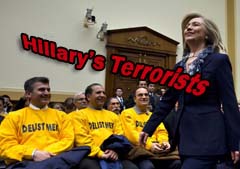 gn Relations Committee hearing on Iran’s nuclear program in October 2013, more than a dozen men and women in yellow rain jackets sat in the gallery seats of the wood-paneled room, a bright presence amid the standard-issue dark suits of Washington. It wasn’t raining.
They were supporters of the Iranian exile opposition group the Mojahedin-e Khalq, often referred to as the MEK, but known to most Iranians as the Mojahedin. Activists distribute all manner of yellow paraphernalia at the group’s demonstrations: hats, banners, flags, inflatable rubber clapper sticks, and, most of all, the jackets. The yellow jackets — often emblazoned with portraits of the group’s two co-leaders, Massoud and Maryam Rajavi — have become its calling card.
During the hearing, the powerful then-Foreign Relations Chairman Bob Menendez, a Democrat from New Jersey, spoke out for the Mojahedin. About an hour and a half into the proceedings, Menendez issued an explicit threat to Undersecretary of State Wendy Sherman over attacks against the group’s members in Iraq.
Another assault had been lodged against a camp in the Iraqi desert where former Mojahedin fighters were holed up — dozens of the unarmed, expatriate Iranians had died in the raid, with conflicting accounts of who was responsible. Menendez, a hard-line opponent of the Iranian regime and skeptic of nuclear negotiations led by Sherman, blamed Iran’s allies, the Iraqi government, for letting the attacks happen. He expressed preparedness to use his clout as chairman of the committee to pressure the Iraqis.
“One thing that this committee can do,” Menendez said, wagging his pencil at Sherman, “since it has jurisdiction over all weapons sales, is that I doubt very much that we are going to see any approval of any weapons sales to Iraq until we get this situation in a place in which people’s lives are saved.”
The threat sounded like a hypothetical, but it wasn’t: as Menendez spoke, he was blocking a major weapons deal with Iraq — a sale that would eventually be worth more than $6 billion in Apache helicopters and associated equipment and support, marking, perhaps, the first major Capitol Hill achievement for the Mojahedin since being removed from the U.S. list of designated terrorist organizations the year before.
On Capitol Hill, Mojahedin sympathizers clad in yellow jackets frequently appear at hearings dealing with Iran — or Iraq, where thousands of the groups’ fighters ended up in the 1980s, and where, beginning in the late 2000s, they came under a series of attacks that killed dozens. “You couldn’t show up at an Iraq hearing without lots of people wearing yellow jackets,” one former Congressional staffer said.
The group’s supporters try to arrive early to take their seats in hearing rooms, but “because people didn’t want every Iraq hearing to be a U.S. Ambassador with 40 people in yellow jackets sitting behind them,” the former staffer recalled, offices would dispatch interns to arrive before the Mojahedin followers “to fill those seats and push the MEK back.”
Not least because of the yellow jackets, the group’s many critics — including foreign policy-oriented Hill staffers — view the Mojahedin as “wacky”; they remain obscure beyond the Beltway and battle persistent criticisms that the group is a cult of personality, with adherents prone to blindly following the directives of the Rajavis. Already unpopular with Iranians, the Mojahedin’s international stock plummeted when the U.S. government officially designated them as a terrorist group in 1997, due to their history of attacks against Iranian government targets and, dating back to the Shah’s era, American civilian and military personnel stationed there. In the intervening years, even while constrained by their terrorism designation, the group and its affiliates poured millions of dollars into a sophisticated effort to rehab their image, creating an influential lobbying effort on Capitol Hill. Via an opaque network of Iranian-American community organizations, supporters circumvented anti-terrorism laws to garner many fans in Washington, at least in some quarters, where they quietly pressed their case for hard-line policies against the Iranian regime through meetings with sympathetic members of Congress. “It’s their Hill outreach strategy that accomplishes nearly everything they’re able to do,” the former staffer explained. “Given how small they are and how marginal they actually are, the amount of influence they wield is actually kind of amazing.”
Congressional hawks like Ileana Ros-Lehtinen, R-Fla., and the frequently eye-roll-worthy Dana Rohrabacher, R-Calif., and Ted Poe, R-Texas, could be counted on to bring up the Mojahedin again and again. But not everyone on the Hill was initially convinced. As long as the terrorist designation was in place, many influential members of Congress wouldn’t speak out for the group. In 2012, after that steady drumbeat and an intense public relations effort, the Mojahedin successfully overturned the terrorist designation.
Since being legitimized, the Mojahedin’s influence on Capitol Hill spread from the fringes of Congress to include more mainstream and respected Republicans and Democrats. Most of the group’s lobbying focuses on its members’ well-being in Iraq, said a current Hill staffer, who works in foreign policy. But, the staffer added, “undergirding this is all this neocon-friendly warmongering, this intense push for regime change, this intense hatred for [Iranian president Hassan] Rouhani — they’re not subtle about this at all.”
Menendez’s advocacy for the Mojahedin at the October hearing wasn’t new, but it signaled that by 2013 the group had come full circle: from an outlaw terrorist outfit to a player on Capitol Hill. How that happened is a classic story of money, politics and the enduring appeal of exile groups promising regime change.
T HROUGHOUT ITS 50-YEAR struggle, the Mojahedin has operated by the principle that the enemy of its enemy is its friend, giving rise to a past littered with ill-conceived alliances, tactical missteps and eventually, its designation as a terrorist group.
The group’s origins date to the mid-1960s, when a small circle of mostly middle class university students pored over revolutionary and religious tracts, creating a unique Islamo-Marxist ideology and eventually forming the Mojahedin-e Khalq, meaning “Holy warriors of the people.” After recruiting among young intellectuals, the Mojahedin sent some of its members to train in desert camps in Jordan and Lebanon belonging to the Palestinian Liberation Organization. In 1971, the group sought to launch its revolution by bombing a major power plant that supplied Tehran with electricity. But the Shah’s notorious security services foiled the plot, and around half the group’s early membership ended up in the Shah’s prisons. The next year, nine leaders were executed.
Yet the group continued its small-scale strikes against the monarchist regime and its allies. Between 1973 and 1976, the Mojahedin assassinated six Americans in Iran: three military men and three civilian contractors with the American manufacturing conglomerate Rockwell International. “Widely credited in Tehran for these attacks at the time, the Mojahedin themselves claimed responsibility for these murders in their publications,” said a 1994 State Department report on the group’s activities.
Initially, a “leadership cadre” ran the Mojahedin by committee, according to a 2009 Rand Corp. report about the group. By the late 1970s, however, the Mojahedin rallied around Massoud Rajavi, a charismatic figure sporting a thick mustache and coiffed black hair who was one of the group’s only surviving early leaders. YouTube videos of his old speeches capture a rousing orator, with thoughtful, soft-spoken passages punctuated by intense stem-winding that brings the crowd to applause, often chanting “Rajavi, Rajavi!”
With unrest percolating in Iran, Rajavi sought to cooperate with Ayatollah Ruhollah Khomeini, the revolution’s leader, but shortly after the Shah fell, Khomeini, a conservative cleric not fond of lay radicals, carried out a ruthless crackdown against the group. Rajavi and his followers fled into exile, initially to Paris, where his sway grew more authoritarian and he married his third wife, Maryam, appointing her co-leader.
By 1986, Rajavi began forging his next alliance, with Saddam Hussein. He relocated to Iraq and reorganized the 7,000 members who followed into an army, which Hussein supplied with heavy weapons and tracts of land, including a desert base that would be called Camp Ashraf. The group joined the Iraqi dictator’s bloody war against Iran, engendering much antipathy among Iranians. Out of favor with Khomeini and isolated in the Iraqi desert, the Marxism of the group’s early years began to dissipate, replaced by the singular goal of overthrowing the Islamic Republic and installing the Rajavis as Iran’s leaders. The group also turned further into cultish behavior; Rajavi and Maryam mandated divorces and celibacy for their soldiers, even as they elevated their own partnership. After the First Gulf War, Hussein reportedly used the Mojahedin as a militia to quell sectarian and ethnic uprisings, alienating many Iraqis. “Take the Kurds under your tanks, and save your bullets for the Iranian Revolutionary Guards,” Maryam Rajavi told her followers during the attacks, according to the The New York Times Magazine.
In the meantime, the Mojahedin turned to attacking the Iranian regime abroad. “In April 1992 the MEK carried out attacks on Iranian embassies in 13 different countries, demonstrating the group’s ability to mount large-scale operations overseas,” said a 1997 State Department report.
That year, then-Secretary of State Madeleine Albright designated the Mojahedin a Foreign Terrorist Organization, among 29 other groups, barring it from fundraising in the U.S. “We are aware that some of the designations made today may be challenged in court,” Albright said. “But we’re also confident that the designations are fully justified.”
Under pressure, Maryam Rajavi eventually sought to remake the Mojahedin’s image by renouncing violence; after being linked to 350 attacks between 2000 and 2001, according to Rand Corp., the group has not claimed responsibility for any subsequent violent offenses. That about-face did little good, at least in the eyes of the U.S. government. In the run-up to the 2003 invasion of Iraq, the White House cited the group’s presence in the country to buttress claims that Saddam Hussein was harboring terrorists.
But when the U.S. arrived at the Mojahedin’s camps, after conflicting reports of an initial skirmish, the group’s leadership waved a white flag, then signed a ceasefire — paving the way for its members to receive protection under the Geneva Conventions. Massoud Rajavi has not been publicly seen since, and Maryam Rajavi became the sole face of the group to the outside world.
For years, the Mojahedin languished at Camp Ashraf — guarded by U.S. forces — and refused to be moved, except en masse. The U.S. military eventually handed over control of its perimeter to the Iraqi government, and in July 2009, Iraqi security forces raided the camp, resulting in the deaths of at least nine refugees, according to Amnesty International. Dozens more were allegedly detained and tortured. Another raid took place in April 2011. The Mojahedin claimed 34 were killed and more than 300 injured. “With the threat of another Srebrenica looming in Ashraf, intervention is absolutely essential,” Maryam Rajavi said at the time. But no intervention came.
In September 2012, the U.S. agreed to remove the Mojahedin from the terrorist list; a key factor would be the group’s cooperation in relocating to a former U.S. military base called Camp Liberty, closer to Baghdad. The United Nations facilitated the move to Liberty, with plans for eventual third-country resettlement. Most of the few thousand remaining ex-fighters relocated, but about 100 stayed behind. In September 2013, according to Foreign Policy, Iranian-backed Shia militias reportedly killed at least 50 unarmed Mojahedin, about half of those still at Ashraf.
Pro-Mojahedin activists were outraged. Their exact numbers can be hard to divine: the Mojahedin themselves often won’t declare their membership. In the U.S. today, an umbrella organization of groups declaring allegiance to Maryam Rajavi — the innocuously named Organization of Iranian-American Communities — claims its network covers over 30 states. That does not include a bevy of small Washington-based pro-Mojahedin groups, or the organization’s official office, which, long-dormant, reopened near the White House after the 2012 de-listing. After the slaughter at Ashraf, the activists sprang into action.
“I remember the day of the attack at Camp Ashraf,” said Shirin Nariman, a pro-Mojahedin activist based in the Washington area. “Three of us, we just went to the Senate. We started going door to door. Nobody told us to do it. We were upset.” Not all the offices welcomed the activists. But “Menendez responded very well,” Nariman said, adding that Sen. John McCain, R-Az., also gave them time. “At least they are opening their ears and hearing us. But [the] White House is closing its ears and doesn’t want to hear.”
Not all Capitol Hill overtures by the group’s supporters have worked, however. In late 2013, Sen. Lindsey Graham, R-S.C., returned $2,600 from a supporter of the Mojahedin in Virginia. “During routine due diligence by campaign staff, it was discovered that a few donors had associations the campaign was uncomfortable with,” a spokesman for Graham’s campaign told Politico. “In an abundance of caution, the contributions were refunded.”
And some Hill staffers, while sympathetic to the Mojahedin’s plight in Iraq, remain wary of their broader agenda. “We should be concerned about human rights violations anywhere,” explained the Congressional staffer who works on foreign policy. “But a key tenet of President Obama’s foreign policy has been de-escalating our relationship and to get a peaceful resolution to the nuclear issue with Iran. And the MEK has been working against that agenda on the Hill.”
The staffer went on: “They lead with Camp Ashraf. Back in the day it was an immediate pivot to lets get them off the terrorist list.” Now, he said, they segue from the group’s situation at Camp Liberty into regime change in Iran.
While many Congressional aides may have viewed the yellow vest-wearing activists as shrill voices for regime change in Iran and an annoyance at hearings, the Mojahedin, over the course of nearly two decades, had cultivated a valuable relationship with Menendez, one of the Senate’s most influential foreign-policy voices.
IN THE EARLY days of the group’s efforts to be removed from the U.S. terrorist list, the most vocal support came from a few members of Congress who viewed the Mojahedin as a cudgel to use against the Islamic Republic, such as Poe and Rohrabacher, who joined longtime stalwart Ros-Lehtinen. (In 2011, a Congressional delegation chaired by Rohrabacher was reportedly asked by the Iraqi government to leave the country after raising the massacres against Mojahedin members in a meeting.)
Menendez remained largely silent on the Mojahedin while it was on the State Department’s terrorism list; during his first term as a Senator, from 2006 through 2012, he rarely, if ever, brought the group up.
Since the State Department took the Mojahedin off the list, however, Menendez has raised and defended the group, highlighting its efforts against the Iranian regime. Menendez spoke out most forcefully after the September 2013 attack on Camp Ashraf: “I hold the Iraqi government directly responsible to protect the community, to investigate this matter thoroughly, and to prosecute the perpetrators of this heinous act,” he said in statement. In June 2014, Menendez delivered a video address to a Mojahedin rally in Paris. He reassured Maryam Rajavi and her followers that aid to Iraq would depend on the country’s treatment of the several thousand former Mojahedin fighters left stranded there. “I told [then-Iraqi] Prime Minister Maliki in person last year that his commitment to the safety and security of the MEK members at Camp Liberty is a critical factor in my future support for any assistance to Iraq,” he said in the video, to the cheering, yellow-clad Mojahedin throngs.
The outspoken advocacy for the group coincided with the rise of campaign contributions from Mojahedin supporters to Menendez, according to an analysis conducted by The Intercept. Assisted in part by the work of independent researcher Joanne Stocker, The Intercept compiled a cross-section of political giving by supporters of the organization in the U.S. between 2009 — when the campaign to de-list the Mojahedin ramped up — and the present. The Intercept’s study examined giving by people listed by the pro-Mojahedin OIAC network, as well as supporters and activists identified by other news articles, and a former Congressional staffer who has tracked the group.
Never a pronounced player in campaign donations, Mojahedin supporters have nonetheless put hundreds of thousands of dollars into American electoral politics. Since 2009, those included in The Intercept study sent around $330,000 into politicians’ and election committees’ coffers.
Before de-listing, from the start of 2009 until September 2012, John McCain and Rep. Judy Chu, D-Calif., topped The Intercept’s survey of Mohajedin-related campaign contributions, receiving $11,350 and $11,150, respectively.
Menendez only received two donations from supporters tracked by The Intercept before September 2012, but after the State Department removed the group from the terrorist list, the money started to flow. In the past two years, Menendez took in more than $25,000 from donors with ties to the Mojahedin, making him the largest recipient in the study over this period. (The next two top recipients received less than half of Menendez’s total during the same period. McCain, still top recipient of the study’s Mojahedin-related donations after de-listing, received $10,800, and Rohrabacher received $10,300.)
But the campaign contributions alone don’t explain Menendez’s advocacy for the Mojahedin. The first former Hill staffer, who described efforts to move the Mojahedin back at hearings, said some Congressional offices were wary of the group, but described an alternative approach where “even if your constituent is crazy, you take the meeting and you listen carefully and you try to help them.”
The former staffer said of Menendez, “Sometimes it gets him into trouble when his staff doesn’t vet people well enough.” He also noted another dynamic at play: “Menendez is sort of known for these immigrant minority groups. He has a special place in his heart for them, based on his Cuban background, and I think sometimes it clouds his judgment — sometimes he doesn’t make the best decisions.”
Former U.S. Sen. Robert Torricelli (D-NJ) participates in a protest of the visit of Iraqi Prime Minister Nouri al-Maliki to the White House, November 1, 2013 in Washington, DC.
EVEN BEFORE THE group was put on the terrorist list, another prominent senator got involved with the Mojahedin. During the 1990s, first as a Democratic House member and then a Senator from New Jersey, Robert Torricelli had been an outspoken opponent of Iran’s Islamic regime and a supporter of the Mojahedin, hoping the latter would deliver a deadly blow to the former, an enemy government of the United States.
The advocacy attracted the attention of a Congressional staffer named Kenneth Timmerman, who had followed Iran issues before his time on the hill. “Torricelli was already one of a handful of people who were notorious for their support of the MEK,” Timmerman told The Intercept. “Torricelli’s involvement as a supporter of the MEK was very well known, certainly to people who work on the Hill.”
Timmerman described a robust Mojahedin lobbying operation at the time. “They would come to Congressional offices in a very intimidating fashion, to young staffers who were inexperienced and didn’t know who they were,” he said. The support they received rested on three pillars, Timmerman added: ignorance about the group, a handful of campaign contributions, and “a kind of widespread view that we really don’t like the Iranian regime, so let’s help anybody that’s against the Iranian regime.”
Timmerman’s description of yesteryear matched that of the current Congressional staffer who works on foreign policy. “They’ll send grassroots staffers to meet with you and then just wait in your office to ambush you,” the current staffer said. “They’d basically filibuster you for an hour.” He added that the “the lack of institutional knowledge on the Hill and turnover in staffs” left an opening for the group’s supporters.
Timmerman, for his part, wholeheartedly supports regime change in Iran, but nonetheless rejects the Mojahedin, whom he considers terrorists. When he left the House, Timmerman launched a foundation dedicated to democracy in Iran and wrote extensively on the subject, mostly for right-of-center outlets (his other writing has included raising questions about President Obama’s birth certificate). One of his pieces, published in 1998 in The American Spectator, focused on contributions to Torricelli’s campaigns from “MEK officers, supporters and sympathizers.” Using FEC records listing campaign contributions, Timmerman recalled, he compiled his own database and then queried it for people known to be affiliated with the Mojahedin, as well as those named by his sources.
According to Timmerman’s analysis, Torricelli received some $136,000 between April 1993 and November 1996 — before the Mojahedin was designated as a terrorist group. (In a 2002 Newsweek report, Torricelli’s aides dismissed the alleged amount as exaggerated.)
“In his House days,” Timmerman wrote in the American Spectator, Torricelli “sponsored more than a half-dozen resolutions and letters of support for the organization.” Timmerman also cited Mojahedin promotional materials that claimed Torricelli introduced several of the group’s members to President Bill Clinton during a fundraising dinner in late 1997.
Support for the Mojahedin caught up with Torricelli during his failed 2002 bid for reelection to the Senate. His Republican challenger, Douglas Forrester, attacked Torricelli during a debate for supporting the group’s removal from the terrorist list, and for taking money from the Mojahedin’s supporters. The embattled incumbent defended himself — justifying his support for “Iranians who oppose the Iranian government” — but backed down the next day. Torricelli told the New Jersey newspaper, The Star-Ledger that he wouldn’t continue to advocate for the group’s de-listing. “If the organization is engaging in activities against civilians that are of terrorist nature, the State Department has every right to ban their activities and have no contact with them,” he told the paper.
In an interview the following day with The New York Times, Torricelli elaborated. “Sometimes the enemy of my enemy is my friend,” he said.
Timmerman responded dryly when asked by The Intercept about Torricelli’s change of heart: “I’m not sure how sincere it was.”
By 2011, the law firm Mayer Brown retained Torricelli as part of the team working on the Mojahedin’s legal challenges to its place on the terrorist list. And Torricelli again took up vocal and active support for the Mojahedin, calling for the group to be de-listed at public forums organized by pro-Mojahedin American groups. “Does it have benefit that we continue to ostracize and label opponents of the regime as terrorists, when the facts say otherwise?” Torricelli said at a 2011 event on U.S. policy toward Iran. “Is it even possible to oppose a terrorist state, and be a terrorist yourself?”
The Intercept made several attempts to contact Torricelli for this article. When reached by phone, Torricelli declined to answer any questions about his relationship with the Mojahedin, and hung up the phone.
Dozens of former American officials, ranging from politicians to bureaucrats, have spoken at events organized by Mojahedin supporters. Some received staggering sums — as much as $40,000 — to give an address, and many called for the Mojahedin’s removal from the terrorism list, praising the organization as a viable democratic government in exile of Iran. According to data collected by the Huffington Post, the pro-Mojahedin roster included former New York mayor Rudy Giuliani, former Bush White House chief of staff Andy Card, former Vermont governor Howard Dean and former Rep. Patrick Kennedy, D-R.I., among many others.
By early 2013, after the Mojahedin was wiped from the terrorist list, Torricelli found new employment with the group — as its Washington lobbyist. Rosemont Associates LLC, the ex-Senator’s consulting firm, took up a contract with the Mojahedin’s Paris-based political wing, the National Council of Resistance of Iran. According to federal filings, Torricelli’s Capitol Hill lobbying for other clients ended between 2012 and 2013; only the Mojahedin were left. Disclosures for foreign lobbies indicate his firm planned to take in $35,000 per month for its work on behalf of the organization.
Most of Torricelli’s interactions with Washington, according to the filings, involved State Department offices that dealt with the Mojahedin or its areas of interest, frequently revolving around the refugees’ security in Iraq. But Torricelli also, however, made contact on Capitol Hill on the group’s behalf, though he didn’t cast a wide net: the lobbying disclosures reveal that as of late 2014, Torricelli had only reached out to a single Congressional office about the Mojahedin: that of former Senate Foreign Relations Chairman Bob Menendez.
“For 20 years,” Menendez said at a recent Senate hearing, “I have been working on the issue of Iran, when people were not paying attention.” Back in 1998, the two New Jersey politicians appeared at a Mojahedin demonstration at the U.N.’s New York headquarters, a year after the group was designated a terrorist organization. Torricelli was still in the Senate, and Menendez held a seat in the House. “At the rally,” the Associated Press reported at the time, Torricelli, Menendez and another lawmaker “supported the group’s call for a new democratic regime in Tehran.”
Between April 2013 and January 2014, Torricelli reached out to Menendez’s then-Chief of Staff Dan O’Brien seven times. Three separate contacts, however, were with Menendez himself: phone calls in April and August of 2013, and an in-person meeting last January — at the same time Menendez was coming under administration pressure to release his hold on the Apache helicopters.
DURING THE SUMMER of 2013, the Iraqi government faced growing sectarian strife. The militant group Islamic State — a Sunni radical outfit formed during the spring, and still going by the moniker Islamic State of Iraq and Syria (ISIS) — organized camps in Iraqi territory to expand their presence in the country and regroup for the fight in Syria.
The Mojahedin, perhaps chastened by their own labeling as terrorists, rely heavily on the word “extremism” in conjunction with ISIS, warning that the Iranian regime, with its “puppet” government in Iraq, represents the most significant terrorist threat.
Iraq, meanwhile, had been pushing its main military supplier, the United States, for more weapons to combat ISIS, specifically advanced attack helicopters called Apaches. The Obama administration advanced a proposal to supply Iraq with the Apaches — a deal that would eventually involve 24 by a sale and six by a lease that would allow the Iraqis to field the equipment more quickly.
When it comes to foreign military sales, the executive branch gives the Senate Foreign Relations and the House Foreign Affairs committees advance notification, and chairs and ranking members can object. After Obama officials apprised the relevant committees of its proposal, in July, several members blocked the sale over skepticism of then-Iraqi Prime Minister Nouri al-Maliki.
The administration launched a back-room offensive on Capitol Hill to clear the way for the deal. Officials from the Departments of State and Defense “in their briefings before Congress made it very clear that sending these Apaches to the Iraqis was crucial to beating back the threat coming from ISIS to Iraq from Syria,” said another former Hill aide, who attended the briefings. “State was terrified that without these helicopters,” the Iraqis “didn’t have the capability to kill these guys.”
Most would eventually be convinced to lift their holds, but Menendez held firm, creating palpable tension with the administration. Anonymous sniping between the Senator’s aides and White House officials appeared in the press, with Senate staffers telling Defense News the administration was failing to make Iraq a priority, and an administration official calling the accusation “offensive and incorrect.” Menendez’s public explanation centered around Maliki’s record of attacks against civilians and tacitly allowing Iran’s use of Iraqi airspace to support the Syrian regime; many in Washington at the time were sour on Maliki’s growing authoritarianism, sectarian patronage and failure to professionalize the Iraqi military.
“There are a lot of good reasons they” — Congress — “might have held up a sale,” said Sam Brannen, recently a fellow with the Center for Strategic and International Studies and a former Pentagon employee. But Brannen, who said he has no special insight into Menendez’s reasoning, added, “That there might be some more parochial reasons, that aren’t as good, would not surprise me.”
A U.S. official, who also wouldn’t speak to Menendez’s motivations, confirmed Congress’s focus on the Mojahedin. “The MEK issue was clearly a concern for members of Congress,” the official said. “Whether that played a role holding up the arms sales, I don’t know. But it was certainly an issue for Congress.”
Senators “raised lots of issues — among them the MEK — with the Apaches,” Lukman Faily, the Iraqi Ambassador to the U.S., told The Intercept. “The issue of the MEK,” Faily said, “came up in most of my meetings with the House and Senate, especially the Foreign [Relations Committee].”
Six months into the hold on the helicopter sale, in January 2014, ISIS forces swarmed Iraqi cities in the Sunni west, at least briefly holding two major urban areas. It’s doubtful the Apaches could have been in action soon enough to stave off ISIS’s territorial gains. “It would have taken months and months to train the Iraqis to use them,” said Brannen, the former CSIS fellow, of the helicopters intended for lease.
Michael Wahid Hanna, an expert at the Century Foundation with extensive experience on Iraq, explained, “I don’t know if [the Apaches] would have had a strategic effect, maybe a tactical one. Hitting, basically, IS camps obviously would’ve helped.”
After ISIS’s battlefield successes, Menendez consulted with the administration and received a letter from the Iraqi government. “He was looking for an out,” recalled the former Hill aide who attended the briefings. Menendez said he got assurances from the Obama administration promising oversight of the Apaches — and lifted his objections on January 25, leaving the Mojahedin in Camp Liberty under the ultimate control of the Iraqi government.
Adam Sharon, a spokesman for Menendez, did not respond to any questions about the senator’s relationship with the Mojahedin. “The direct concern with the Apaches was what safeguards were in place to ensure that minorities weren’t being attacked,” Sharon said.
The Apache deal, however, eventually stalled. The ISIS advances amplified Maliki’s largely self-induced political crisis. A State Department official, who asked not to be identified because he was not authorized to speak officially, cited fiscal and capacity issues on Iraq’s end, and said the U.S. was working it over with the new Iraqi government. (In August, Maliki’s party ousted him as prime minister.) “While we’re still supportive of the sale,” the State Department official told The Intercept, “Iraq hasn’t been in a position to accept the sale.”
ISIS took over more Iraqi cities starting last June, and the United States began its own air war to beat the group back in August. In October, the U.S. military ended up using its own Apache attack helicopters in raids against ISIS positions.
FOR THE MOJAHEDIN, stalling the Iraq Apache deal was just a small victory. The real goal has always been regime change in Tehran. Last September, the moderate Iranian president Hassan Rouhani arrived in New York for his second U.N. General Assembly, accompanied by nuclear negotiators to engage in another round of the now-extended talks. Mojahedin supporters organized a protest against Rouhani’s appearance.
Several hundred braved a sporadic rain in yellow ponchos distributed by organizers, holding aloft yellow umbrellas. (Mojahedin supporters have been known to recruit volunteers on expense-paid trips for such events.) The pro-Mojahedin demonstrators — some of them non-Iranian, with cursory knowledge of the group — listened to a morning of speeches at Dag Hammarskjold Plaza, nestled between demonstrations against the ouster of former Egyptian president Mohamed Morsi, and by devotees of the persecuted Chinese spiritual movement Falun Gong.
Along the barricades that sectioned off the protesters from the dignitaries on stage — which included former Democratic Senate Majority Leader Tom Daschle, and former U.N. Ambassador John Bolton, a frequent speaker at Mojahedin events — demonstrators held up a pair of cut-out placards. One, in black, read, “No 2 Rouhani”; the other, naturally in yellow, said, “Yes to Rajavi.” Massoud Rajavi still hasn’t been seen publicly since 2003.
For his part, Torricelli’s advocacy for the Mojahedin has only become more fervent. “My name is Bob Torricelli and I am a soldier in the liberation of Iran,” he thundered at a Mojahedin conference in Paris during the summer of 2014, to a huge crowd of yellow-clad supporters who interrupted his speech with applause and chants.
“First we gathered in Frankfurt, in London and Paris and New York by the hundreds. Then we came to Paris by the thousands. Hear me well, soon we will come to the streets of Tehran by the millions, and take back the future of the people of Iran.”
“The mullahs may talk to Merkel, or Obama or Hollande,” Torricelli continued, referring to three of the heads of state — Germany’s Angela Merkel, Obama and France’s François Hollande — now in nuclear negotiations with Iran. “They can talk all they want. We as a people of those nations know: There’s nothing left to say. The regime must go.”
Photo: Jose Luis Magana/AP; Jonathan Ernst/Reuters/Landov; Chip Somodevilla/Getty Images; Mark Wilson/Getty Images
– Ali Gharib and Eli Clifton are reporting fellows with The Investigative Fund at The Nation Institute
 endure as one of the longest-running militant groups opposing the Islamic Republic of Iran.
 of the AMIA Jewish community center in Buenos Aires, which killed 85 people and injured 300.
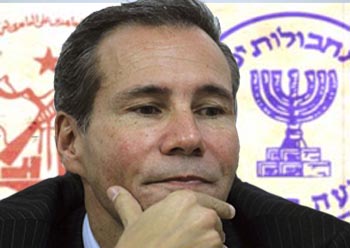
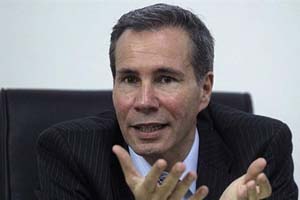 However Nisman died, his fate was deeply intertwined with that of Stiuso. From the time Nisman took over the AMIA investigation in 2004, he relied heavily on the shadowy intelligence official for secret information in putting together his indictment of Iran for the bombing. The story of Nisman’s reliance on Stiuso, which has shaped the narrative on the terror bombing, reveals both the enormous power that Stiuso has wielded over that narrative as well as the overweening influence of Israel’s foreign intelligence agency, Mossad, on Stiuso’s position on the issue.
 Refugees (UNHCR), David Neal Rights, the issue of Rafha refugee camp, Faili Kurds and displaced Kurds.
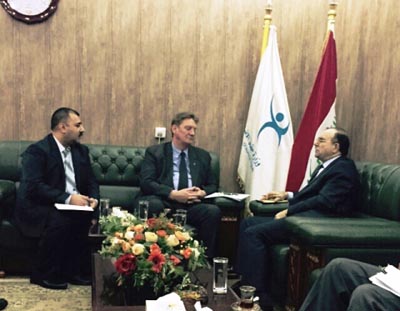 available information database of the residents of Rafha Camp about them who have been registered in the Red Cross when they entered Iran after leaving Saudi Arabia to verify it to include them with privileges granted to them under political prisoners Corporation Law.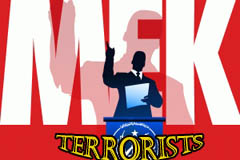
 affiliate in Syria, had seized territory adjacent to Israel? The “let’s intervene in Syria” crowd was up in arms: this supposedly proved the absolute necessity of going full-bore into the region, with US bombing raids and unrestrained support for “moderate” jihadists out to overthrow Syrian strongman Bashar al-Assad. After all, we can’t leave our loyal ally, Israel, at the mercy of Osama bin Laden’s heirs, can we?
 President Christina Fernández de Kirchner and her foreign minister, Héctor Timerman conspired to absolve Iran of the 1994 AMIA bombing and lift the Interpol red notices on the accused Iranians.
 decade-long attempts to prevent a negotiated settlement between Iran and the P5+1 (the United States, the United Kingdom, France, Russia, China, and Germany), on the former’s nuclear program. When the negotiations hit a difficult phase in Vienna in May 2014, Porter suggested in an article for Al Jazeera that “If the talks fail … it will be the result of the toxic combination of wilful U.S. self-deception and deliberate falsification of intelligence by the Israelis” (Porter, 2014a).
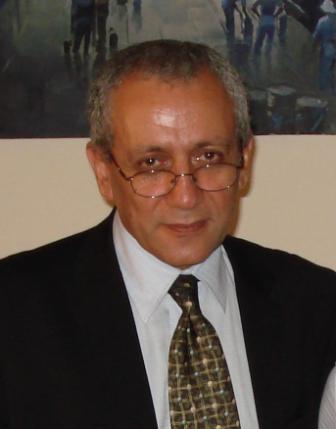 The MEK stands out as perhaps a unique example of a belligerent entity that exploits to the maximum a range of propaganda methods and outlets in the West to project itself in the international community as a constructive, almost benign, force. Far from avoiding publicity, the MEK has done everything in its power to maximize what can be described as its virtual presence. In addition to its native Farsi, the group disseminates information about and projects an image of itself in English, French, German and Arabic, in print, in broadcast and on Internet media. But insofar as it has no popular support among indigenous or diaspora Iranians, its image as a popular resistance movement has been largely invented.