
A son demands his father’s release

A son demands his father’s release
Mustafa Mohammadi, a Canadian-Iranian citizen stressed that the Iraqi Judicial force has issued the arrest warrant for three commandants of Mujahedin Organization.
Mustafa Mohammadi (whose daughter Somaye- A student at Etobicoke Collegiate Institute, dropped out of Grade 10 to join the rebels, and for the past several years her parents have done little else except try to get her back to Canada) in an interview with Al forat says : by the grace of God, I could take the arrest warrant for three leaders of his terrorist organization: Abbas Davari ,Sediqeh Husseini, the responsible of the so-called National Liberation Army. Somaye has been stolen and she asked me and her brother to try to return her home and country but the terrorist Mujahedin-e-Khalq Organization forces her to say:”I don’t want to return.”
An Iranian rebel group that is aggressively campaigning for Washington’s support as part of a "regime change" strategy in its homeland has committed serious abuses, including torture and prolonged isolation, against dissident members, according to a leading human rights watchdog.
The group, the Mujahedin-e-Khalq (MEK), insists that it should lead a U.S.-backed effort to bring what it has termed democratic rule to Iran. Last month, it organized a rally, attended by several powerful Republican lawmakers and billed as the "2005 National Convention for a Democratic, Secular Republic in Iran," at Washington’s historic Constitution Hall.
But MEK’s own human-rights record during its almost 20 years as an armed group sheltered and supported by former Iraqi President Saddam Hussein belies its professed commitment to democratic rule, Human Rights Watch (HRW) said in a 28-page report, "No Exit: Human Rights Abuses Inside the MEK Camps," released Thursday.
"The Iranian government has a dreadful record on human rights," said Joe Stork, Washington director of HRW’s Middle East division. "But it would be a huge mistake to promote an opposition group that is responsible for serious human rights abuses."
The report comes amid rising tensions between Washington and Tehran focused primarily on U.S. charges that Iran is building a nuclear weapon, a development that President George W. Bush has described as "unacceptable."
The U.S. administration has not yet explicitly endorsed "regime change" in Iran, but hardliners based primarily in Vice President Dick Cheney’s office and at the Defense Department have made little secret of their belief that such a policy should be adopted. Their only question is how best to achieve that goal.
Since the March, 2003 U.S.-led invasion of Iraq, where the MEK had been based since 1986, the group has tried to persuade Washington that it holds the key to overthrowing the Islamic Republic next door.
It has been backed in this quest by right-wing lawmakers, a group of hardline neoconservatives and retired military officers called the Iran Policy Committee (IPC), and some U.S. officials – particularly in the Pentagon – who believe that the MEK could be used to help destabilize the Iranian regime, if not eventually overthrow it in conjunction with U.S. military strikes against selected targets.
While the group’s supporters in the Pentagon so far have succeeded in protecting the several thousand MEK militants based at Camp Ashraf near the Iranian border from being dispersed or deported, they have failed to persuade the U.S. State Department to take the group off its terrorist list, to which it was added in 1997 based on its attacks during the 1970s against U.S. military contractors and its participation in the 1979 seizure of the U.S. embassy in Tehran. The European Union (EU) also cites the MEK as a terrorist organization.
After a year-long tug-of-war between the two U.S. agencies, a truce between State and the Pentagon was apparently worked out. MEK members at Camp Ashraf were designated "protected persons" under the Geneva Conventions.
Since then, the Pentagon has recruited individual members of the MEK to infiltrate Iran as part of an effort to locate secret nuclear installations, according to recent articles published in The New Yorker and Newsweek magazines. At the same time, nearly 300 members have taken advantage of an amnesty in Iran to return home, leaving a total of 3,534 MEK members inside Camp Ashraf as of mid-March, according to the HRW report.
In this context, the MEK and its supporters have been campaigning hard for the group to be "de-listed" by the State Department as a terrorist group. That appeared to be the principal demand of last month’s rally, which was addressed via video-conference by MEK’s co-president, Maryam Rajavi.
In another column published by the International Herald Tribune in January, Rajavi, who also heads the National Council of Resistance of Iran (NCRI), a MEK front group, stressed that she was "committed to holding free and fair elections within six months of regime change, to electing a constituent assembly and handing over affairs to the people’s elected representatives."
Those claims are likely to invite greater skepticism in light of the new HRW report, which is based on a series interviews between February and May 2005 with 12 former MEK members currently living in Europe.
They testified to a pattern of torture, beatings, and prolonged detention in solitary confinement at military camps in Iraq after they criticized the group’s policies and what they called its undemocratic practices, or indicated that they planned to leave the organization. Two of the interviewees said they had personally witnessed the deaths of two prisoners under interrogation.
Those who wished to leave the organization were held incommunicado in special units in the camps, they said. If they held a high rank in the MEK, they were held for years; one of the interviewees reportedly was held for a total of eight and a half years; another for five years.
The most brutal treatment was meted out to suspected dissidents in secret prisons located within the MEK camps, according to the report. Four of the witnesses, who were suspected of dissident views, testified that they had all been severely tortured and forced to sign false confessions asserting that they had links to Iranian intelligence agents.
Three of them witnessed the death of Parviz Ahmadi, a former unit commander, in February 1995, shortly after a particularly severe beating. His death was reported three years later in the MEK’s publication, Mojahed, which described him as a "martyr" killed by Iranian intelligence agents.
Five of the witnesses were eventually transferred to Abu Ghraib prison during the 1990s and released by Saddam Hussein’s government in 2001 or 2002.
The testimonies included in the report also lend weight to the view that the MEK is more of a cult than a political movement. They suggest that the group’s exile in the early 1980s, followed by the marriage of Masoud and Maryam Rajavi in 1985, set off a series of phases in what the husband-and-wife team declared was a permanent "ideological revolution" that the couple embodied.
These included compulsory divorce of married couples, regular self-criticism sessions, renunciation of sexuality, and absolute mental and physical dedication to the leadership. "The level of devotion expected of members was on stark display in 2003 when the French police arrested Maryam Rajavi in Paris," HRW said. "In protest, 10 MEK members and sympathizers set themselves on fire in various European cities; two of them subsequently died."
by Jim Lobe
Human Abduction within Ashraf Base
Since the presidency of Jimmy Carter up to now, one of the main factors the US relies on for any supposed alternative to assume another country’s political control is the least ostensible evidences of adhering to universal declaration of human rights. In fact, it has turned into a seemingly legal bound that the US has adopted when planning to interfere in internal affairs of a country or regimes’ change. For instance, the US invasion to Iraq was under the banner of combating terrorism and preventing violation of human rights by the ousted despotic there. As a result, a certain alternative has to be necessarily respecting the least accepted international conventions on human rights and be free of any stigma of human rights abuse.
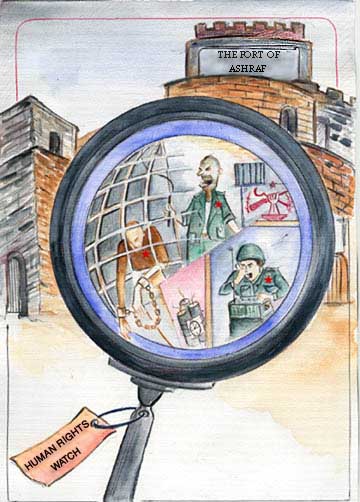 Considering itself an alternative, MKO, in spite of chanting slogans, hardly believes in and adheres to the principles of human rights. Reportedly, the organization is notoriously known to be abusing its insiders through a various instances of human rights violations. Reported by Human Rights Watch, “abuses carried out by MKO leaders against dissident members ranged from prolonged incommunicado and solitary confinement to beatings, verbal and psychological abuse, coerced confessions, threats of execution, and torture that in two cases led to death”. 1
The abuse techniques varied according to the group’s shift of policies. For instance, following the internal ideological revolution, divorce of married couples and gender revolutions became complementary. It is worth noting that before divorce revolution, members were said to marry each other to compensate for emotional problems of those members losing their partner in the military assault of the so-called Eternal Light. Moreover, in divorce revolution, couples were forced to give pledge never remarry. Such actions by MKO turned it into an extremist religious cult exceeding human rights. 
The US is well aware of the violation of human rights within Mojahedin as well as its terrorist inclinations and the fact that leftist groups cannot abide by the content of international conventions adopted to stop violations against human. The reason is that the universal human rights declaration is mainly based on liberalist and humanist thoughts and considers human rights regardless of the type of ideology, religion, nationality, ethnic characteristics, class, etc. Mojahedin can hardly adapt themselves to the thought since it is under heavy Marxist dogmatism explicitly apparent in its adopted eclectic ideology.
Beside evident instances of human rights violations, Mojahedin have abused strong humanistic sentiments of the Europeans under the cover of charity associations with the purported aim of supporting Iranian children and asylum seekers. By gaining the sympathy of ignorant people and extracting money from them, Mojahedin managed to collected considerable amount of money to finance its terrorist operations. Reported by the LA Times quoting the FBI:
MKO members in the name of a Charity Committee for the Defence of Human Rights collected money from passengers, mostly Asians, under the false pretences of helping refugees. They showed the photos of children suffering from hunger and apparently victims of mistreatment and torture in Iran. In this way, they gained the sympathy of passengers by telling them that they want the money to help the refugees.” 2
The main focus of MKO former members is on the organization’s false claims as to its adherence to human rights conventions and at the same time exploiting members. Ann Singleton, an MKO ex-member writes:
One of the main criticisms of former members of the Mojahedin, concerns the internal structure of the organisation. It is described as operating an iron discipline over its members, to the extent of practicing serious violations of human rights in an attempt to make members conform. 3
In some cases, responsible organizations have been denied to have access to accurate information of human abuses within MKO since it could face the organization with global challenges. Referring to Amnesty International Annual Report, Singleton writes:
Amnesty International in its 2002 Annual Report, being unable to investigate in the Mojahedin’s headquarters and camps in Iraq, the hundreds of accusations of human rights abuses which had reached its office, resigned itself to stating:”There were unconfirmed reports that the People’s Mojahedin Organization of Iran, an armed political group, ill-treated its own members at a base in Iraq. The reports were denied by the organization but it failed to provide substantive information to allay AI’s concerns. 4
MKO former members refer to the organizational and ideological structure of Mojahedin as a factor contributing to anti-humanistic actions of the organization. Their testimonies are well appraised evidences of disrespecting the least human rights principles within the group:
The greatest concerns then as regards the Mojahedin are firstly, that membership of any cult is damaging to the mental, physical and emotional health of all its members. In addition, membership of this particular cult deprives the person of every basic human right as defined in the Universal Declaration of Human Rights. 5
Singleton also expounds on the paradoxical nature of organization mottos on the one hand its activities resulting in the violation of absolute rights of the members on the other hand as the reason why many members separated from MKO:
These are surely disturbing reports concerning an organisation which presents itself as the foremost critic of Iran’s human rights record, and an organisation which purports to promote women’s rights and democracy. It has become clear that most of those who have left did so because they were loyal to their understanding of what the Mojahedin organization originally represented. The fact is that Rajavi moved the organisation away from its original form and made it into something unrecognisable for these people. It is they who have remained loyal to the Mojahedin, not Rajavi. 6
Human rights watch report, the US State Department announcement, former MKO member’s testimonies and many other unquestionable evidences indicate that Mojahedin do not recognize the content of universal human rights declaration neither ideologically nor practically. If such an organization that violates the basic human rights of its members under the banner of ideological revolution and cultist relations manages to assume power, not only the present challenges of the US and other European countries fail to be met but it may result in an overall political and social blockade.
References
1. No Exit: Human Rights Abuses in the MKO Camps, Human Rights Watch Report, May 2005
2. Nimrouz, No. 628, March 10, 2000, page 1 and 49.
3. Iran-Interlink; Anne Singleton’s Saddam Private Army.
4. ibid.
5. ibid.
6. ibid.
Mojahedin.ws, Research Bureau, May 14, 2008
http://www.mojahedin.ws/article/show_en.php?id=2708
Cult leaders decide the sell-by date and extent of misuse of their members The case of Hussein, Fatemeh and Hassan Daioleslam
A brief look at the literature produced together with the internal reports from a cult can clearly show the extent of danger that society is faced by vis-e-vis cults. A group or a political organisation which adopts armed struggle as a strategy will soon end up with cult characteristics rooted in its basic and fundamental relations. In this respect, the members of these organisations are themselves among the vast number of victims of such groups.
Cult leaders need obedient followers as the tools they use to push forward their violent ideological agenda. And in this way those who do or even could pose a threat to the execution of such orders, and especially who pose any threat to the position of the leader should be, and usually are, the first victims to be got rid of and silenced. This is particularly evident at every point of history of the Mojahedin Khalq Organisation following the Internal Ideological Revolution which began in 1985 and evolved to its peak with forced divorces in 1989. The leader made sure that no one would or could prevent him from changing a political organisation into a pure cult.
Now the internal relations inside Mojahedin Khalq Organisation has deteriorated to the point that people (members) have changed their use from creative elements to consumable elements. One such example could be Hussein Daioleslam.
Hussein Daioleslam (aka Ali Ghaderi) is a long serving executive member of the Mojahedin Khalq who had served prison sentences during the reign of the late Shah of Iran. He was released after the fall of the Shah and began his responsibilities in the Mojahedin’s newly created Social Department under Mohammed Zabeti.
After the failed coup by the Mojahedin Khalq in June 1981 and Massoud Rajavi’s escape from Iran, Daioleslam, together with Mehdi Fatolah Nejad (captured by US forces in Iraq during the fall of Saddam in 2003) and Mansour Bazargan (killed in an insurgence by the Mojahedin Khalq into Iran by order of Saddam Hussein) under the supervision of Ebrahim Zakeri (later the head of Mojahedin intelligence services who died of brain tumour), started the military wing of Mojahedin Khalq in Iranian Kurdistan and later went to Iraq. In 1985 he became the head of Mojahedin Khalq logistics under the command of Mehdi Abrishamchi (the first husband of Maryam Rajavi before she left him for the leader, Massoud Rajavi), who was the main contact between the Iraqi regime and the Mojahedin Khalq. The main office then was in Baghdad.
After the forced divorces in 1989 Daioleslam was placed under severe pressure by the leaders and was rapidly excluded from any serious position and/or creative role.
His shelf-life ended there and then. Hussein Daioleslam was demoted and his sister Fatemeh Daioleslam became a member of the Mojahedin’s Central Council, later to be promoted to the all-women Central Leadership Council. Hussein was demoted because he did not, or could not, convince his wife to love Rajavi more than her husband. (She refused to give in to the divorce orders in that time.) And Fatemeh was appointed to the Central Council as proof of Rajavi’s claims for his Ideological Revolution. She was a good example to show the ‘liberation of women” was a result of the forced divorce order, but the real reason was something that I may explain in a separate article.
Now after all these years, the claim for and the use of the concept ‘liberation of women’ has also lost its sell-by date and is no longer useful for the cult leader. Even the recently selected members, men or women, have been involved long enough and know enough not to be trusted any more. They usually end up in the kitchen or are used in construction and building work or similar positions.
After Hussein Daioleslam and Fatemeh Daioleslam now has come the turn for the consumption of their brother Hassan Daioleslam.
Hassan Daioleslam, who is also considered as a member of the Mojahedin Khalq Organisation (Rajavi Cult) had been under harsh criticism for a long time by the cult leader Massoud Rajavi because he would not leave the USA and join the cult under the rule of Saddam Hussein in Iraq. But now, in the new circumstances in which the remnants of the Rajavi cult after the fall of Saddam Hussein find themselves in western countries, Hassan’s social position and his ability to speak English has grabbed the attention of Rajavi. He seems to be next in line to be consumed. This time in the United State of America where both the Mojahedin Khalq Organisation and its alias the National Council of Resistance have been maintained on the list of dangerous terrorist entities for more than a decade.
This trend of using one-time sympathizers of the Mojahedin in western countries in the place of long serving executive members of the organisation who now have no skills which match the needs for consumption in western countries, is now evident in every European and North American country. Those who were under pressure and were demonised regularly under the pejorative label “Supporters”, are now the real executive members of the Mojahedin Khalq Organisation and are treated by Maryam Rajavi as such. This change of place, this change of use and this change of Rajavi’s relationship with both ex-executive members who now serve in the kitchen and ex-supporters in western countries who now run the cult’s offices in London, Washington and Paris, has one specific reason. That is, the fall of Rajavi’s benefactor Saddam Hussein and his new pursuit to find a new benefactor; this time in the west. The situation has changed so the consumable tools need to be changed accordingly.
No doubt the remains of Hassan Daioleslam, like his brother and sister and many before them, will be rejected after consumption by the cult leader. In the United States of America itself there are many examples of rejected consumed members and ex-members of the cult who at one time carried exciting titles like Doctors, Sport champions, Artists, Political Activists with Decades of History, and even National Heroes. People who now have nothing left for themselves and no energy even to be heard.
Certainly the future for Hassan Daioleslam and similar cult members is not bright. While the shelf-life of cult representatives in the USA, Alireza Jafarzadeh and Ali Safavi is reaching its end, Hassan Daioleslam is being presented as a “Religious, Nationalist Personality” in limited circles in the USA to be consumed under this label for a short time before these circles are forced to accept the revelations about him and his family and their membership of the blacklisted Mojahedin Khalq Cult. He will be used so much in the near future that his shelf-life will certainly not be more than a fraction of the shelf-life of his brother or his sister in the terrorist cult’s propaganda machine.
Mohammad Sobhani, Ghalam Association
Sobhani_m_h@hotmail.com
In her speech made on 30 June in Paris, Maryam Rajavi, Mojahedin’s cult she-guru, announced her group’s readiness to look after of 1,000 Iraqi orphans. The unexpected demand might be considered a humanitarian move unless you are familiar with MKO’s terrorist and cult nature. But those familiar with the group’s internal relation presuppose differently. Before going any further, it seems essential to reconsider the following issues:
*. Surveying the issue of family in Mojahedin’s organizational relations from the beginning until the ideological revolution.
*. Surveying condition of children in Mojahedin’s organizational relations from the beginning until the ideological revolution
It is not wrong to say that the family has been an issue of dispute in MKO that has challenged it from its very beginning. For Mojahedin, the legitimacy of any phenomenon is appraised according to its degree of accordance with the ideological and political ends of the organization. Since the family in itself necessitates certain responsibilities, then, any enforced responsibility out of the organizational command is deemed to be an impending element. In the history of the organization, we encounter countless instances of forced organizational marriage and divorce and in many cases, the group plotted tricks to debilitate the emotional attachments between the couples that resulted in divorce.
Unlike what is sought in conventional marriages, Mojahedin’s organizational marriages were prudent policies for the accomplishment of political objectives. In fact, none of these marriages rested on love and emotional infrastructure and the leaders weighed it as an appropriate means to gratify sexual needs of the members to expedite the fulfilment of the organization’s policies. Consequently, unbidden fruits of these marriages, namely the children, will have no better destiny than their parents.
Thus, looking at family and children as instruments to achieve power and political goals, MKO leader’s shedding crocodile tears for Iraqi children is supposed to be a bid to attain certain interests. Here are suppositions that prove Maryam Rajavi’s demand is a suspicious political tactic rather than a humanitarian move.
At the present, MKO has an unstable and unbearable position in Iraq. The Iraqi government is determined to expel the group as a terrorist group that is conspiring with insurgent dissidents against the Iraqi legal government. To frustrate terrorists’ plots, the Iraqi police are debarring Iraqis from visiting Camp Ashraf known as the den of conspiracy. Maryam Rajavi’s suggestion at such a critical juncture is a countermeasure tactic. In case the international humanitarian organizations welcome the offer for the wellbeing of the innocent children, and if we are cautiously optimistic of a good-will-prone offer, MKO’s expulsion from Iraq will be postponed.
MKO continue to maintain on the State Department and the EU terror list that has greatly undermined MKO’s political manoeuvre and has jammed it in a political cul-de-sac. In fact, it is big strategic failure for MKO that advertise to pose as an alternative for Iranian regime. Maryam Rajavi’s offer, supported by the group’s advocates that lobby Western parliaments, contributes to augment propagandistic pressures in an attempt to remove the terrorist label.
The Human Rights Watch report concerning human rights abuse within MKO and the group’s cult-like practices against the insiders is pressing the group to provide justifiable reasons for the insider and outsider critics. Maryam Rajavi’s offer is a futile struggle that implicitly challenges the HRW’s report and rebuts the critics.
The US State Department’s released list of designated terrorist organizations on April 30 highlighted unprecedented facts about MKO and announced that “In addition to its terrorist credentials, the MEK has also displayed cult-like characteristics”. It also asserted that MKO’s members are required to undertake a vow of "eternal divorce" and that children are reportedly separated from parents at a young age. MKO has so far dodged explaining away such allegations and Maryam Rajavi’s publicized proposal, if gains public acclaim, might partly challenge the accusations.
Maryam Rajavi’s offer that justifiably depicts the painful plight of Iraqi children draws support of many human rights activists to welcome the seemingly humanitarian move. It would be relatively a success for the group both in political stage and fundraising activities. Exploiting children for fundraising has its own long history in MKO. After separating children from their parents, these innocent children were sent to Western countries to take part in the street fund-raising activities under false pretences of being homeless Iranian children whose parents were executed by Iranian regime. For years Mojahedin were active in illegal fundraising activities through charities like Iran Aid in England; the funds were then spent in purchase of the arms. Possibly, the group seeks to establish a similar Iraq Aid charity in Iraq to cover the expenses of its terrorist and cult activities.
The ex-members’ increased counter-MKO activities to bring further secrets of manipulating cult-like techniques of the group into light has much frustrated the organization. The group’s manner of confronting the dissidents is typically violent. In his recent message issued from his hideout, Massoud Rajavi plainly threatened the dissidents and critics of the group. The harsh reaction provides cult-proven and undemocratic attitudes of MKO. Any positive reaction to Maryam Rajavi’s offer questions the accuracy of the ex-members’ disclosures and decreases the consequent psychological pressures exerted on MKO.
Inactivity and passiveness are dominating Camp Ashraf as a result of great disappointment of an uncertain destiny in Iraq. It has debilitated the morale of the forces in Camp Asharf to a great extent especially following the redesignation of the group as a terrorist group that works an inevitable impediment to seek asylum in any country. If Maryam Rajavi’s suggestion catches a global attention, it will give the forces encouragement of reconsidering their detachment and leave of Camp Ashraf.
The ex-member activists in European countries and especially in Iran centralized under Nejat Assossiation, established by the ex-members and the families of the members still held in MKO, is a big challenge for the group. The emotional impact of the families on the members who have been deprived of all emotional relations are inevitable. The families visit and contact with members in Camp Ashraf has jeopardised the group’s security and contribute to unveil what the organization prefers to remain concealed.
Thus, the real intention of MKO terrorist cult weighs on a globally acclaimed humanitarian move and proposal. That is enough to see children being victimized in a cult that respects not the least for their rights. Ideologically controlled context of MKO hardly leaves a suitable room for children to grow up and, frankly speaking, MKO lacks any standard concerning children, their rights, and even how to take care of them in the same way as the world outside. The process of mutation in Mojahedin cult is extraordinary; a lamb entering the cult comes out as a tiger.
Bahar Irani – Mojahedin.ws – August 5, 2007
The family and friends of Somayeh Mohammadi, forcefully kept in Camp Ashraf by MEK for the past ten years, have started a website in a campaign to save her and other Ashraf residents. With the motto of “LET SOMAYEH CHOOSE IN A FREE COUNTRY”, their objective is “Campaign for “The Right to Choose” for Somayeh and others, who are in Ashraf. The home page introduces the campaigners and represents a brief biography of Somayeh Mohammadi.
We are Family and Friends of Somayeh Mohammadi who are deeply concerned about her safety as she has been forcefully kept by Mojahedin-e Khalagh (MEK), Iranian guerrilla fighters in Iraq, for the past ten years. Somayeh is one of the many Canadian and American youth who were recruited to monthly camps when they were teenagers, only to be kept like hostages at the headquarters of the Organization of the Freedom Fighters of the Iranian People, Camp Ashraf, Iraq. This website is to raise awareness about Somayeh’s case and help us organize our campaign to save Somayeh.
Somayeh was only 17 when she met the recruiters of the Iranian opposition group Mojahedin-e Khalagh (MEK) in Toronto. Born into a family with sympathies towards the group and having already lost her favorite aunt in guerrilla fights against Islamic Republic of Iran, Somayeh decided to drop out of her grade 10 high school class at Etobicoke Collegiate Institute and attend a MEK camp in Iraq for a month. Most of all, she was thankful to MEK for offering to pay for her expanses to visit her aunt’s grave. On February, 1998 Somayeh left Toronto to spend a month in what later on turned to be a guerrilla compound called Camp Ashraf, the headquarters of the Organization of the Freedom Fighters of the Iranian People. Somayeh is a now a 25 year old, still living under harsh conditions of Ashraf, despite her parents’ restless tries to bring her back home. Somayeh is one of the many Canadian and American teenagers who were deceitfully recruited by MEK and send to Camp Ashraf, where they were trained for guerilla fights and forced to stay inevitably. In an independent letter sent to the Canadian embassy in Jordan, Somayeh asks for the Canadian government’s help to get her back to Toronto. Later however, she was forced by MEK in a court hearing to denounce her family and state that she wants to stay with MEK ‘holy worriers’, now a banned terrorist organization under Canadian law since 2005.
Somayeh’s life has been in great danger in the past 10 years and she is defiantly threatened to comply with MEK’s rules. Her story is very damaging to MEK and as a result the organization does not allow Somayeh to leave camp Ashraf in order to contact or meet with the Canadian Officials in private or in a 3rd party country. This has further complicated her case, as she officially told an immigration judge over satellite phone that she does not wish to return to Canada. Her family and friends know this to be a testimony made under pressure and therefore devoid of any truth. Somayeh is kept like a hostage at Camp Ashraf and must be treated like one.
9251 Yonge St. #219
Richmond Hill, ON
L4C 9T3 Canada
http://www.cdhriran.blogspot.com/
Centre for Thought, Dialogue and Human Rights in Iran – Toronto
CTDHR
Oct 2006
To the care of Royal Canadian Mounted Police
Re: Serious concern for the safety of our client and our directors
Dear Sir/Madam,
I am writing to you in order to express my deep concerns regarding the safety of our client Mr. Mohammad Mohammadi as well as two directors of our organization including myself.
As Human Right advocacy group it is our foremost duty to question and challenge any system/individual that violates the fundamentals of the charter that we all believe in. In the past few month we were working on behalf of a Canadian Citizen, Mr. Mustafa Mohammadi, and his family to facilitate the freedom of his young daughter from a military camp in Iraq that is under the control of this Iranian political organization known as “Mojahedin e Khalgh” or MEK.
Since the story of this family was picked up by national media and based on the interest expressed by National Post we collaborated with the NP reporter Mr. Stewart Bell, in various capacity from translator to mediator and the result was a five (5) part series that was published from September 23rd to September 28th on the front page of that paper with the mention to our Centre and repeated quotas from us. Needless to say, this report was not written in the favor of this organization.
Since this organization is active in Canada, as known by your office, the local members have informed their other pockets in North America and Europe hence an extensive campaign started against us. The regular attacks on their various media from TV/Radio programs to the papers and Websites accuses us as being the agents of Iranian Regime, a very old and overplayed rhetoric, and asks their members to “deal” with us.
Since the young Mohammad, he is the brother of the girl in camp Ashraf, was kept in that camp against his will for 4 years in the past he was the key witness in preparation of that article. In the recent days and after the continuation of the threats he is very scared about his own safety which makes us uncomfortable too. Since the clear instruction of this organization, as per their leader and stated in many of their publications, is to eliminate any individual who turns against the organization, defector, his concern for his safety is understandable. At the same time I and another director of our Centre Mr. Saeed Soltanpour, a well known journalist in our community, have been included in many of those threats and accusations.
Knowing the volume of the issues you are dealing with we are not requesting any particular protection at this time but merely to inform you about the situation.
Sincerely Yours
Niaz Salimi
Director, North American Divisions
CTDHR, October 31, 2006
TORONTO – An Iranian terrorist group recruited teenaged children out of Canada and sent them to a guerrilla camp in Iraq, an investigation by the National Post has found.
The Mujahedin-e Khalq sent recruiters to Toronto to entice youths of Iranian heritage into joining an armed resistance campaign aimed at overthrowing the Iranian government.
A banned terrorist organization under Canadian law since 2005, the MEK worked out of a base in residential homes in Toronto, former members of the group said in interviews.
While the bases looked like ordinary households from the outside, inside everyone wore military uniforms and the walls were decorated with MEK flags and portraits of guerrilla leaders, they said.
The Canadian MEK network raised money, staged protests against Iran and lobbied politicians, but it also recruited underage youths to travel to a desolate guerrilla outpost near the Iran-Iraq border called Camp Ashraf.
Former MEK activists said the Canadian base worked closely with a similar U.S. outfit in Sleepy Hollow, Va., called the Pirayesh. The Post was able to view videos of recruiting sessions conducted there.
A Toronto man who spent five years at Camp Ashraf, beginning when he was 16, said in an interview he underwent military training but was imprisoned when he asked to return home.
The account is consistent with a recent report by New York-based Human Rights Watch, which said the MEK had detained, tortured and killed "defectors" who had tried to leave the camp.
A Toronto human rights group, the Centre for Thought, Dialogue and Human Rights in Iran, says it has documented nine other cases in which children under the age of 18 were sent to Ashraf from Canada. They include youths from Toronto, Montreal and Ottawa.
Among them is Somayeh Mohamaddy, who was a 17-year-old Grade 10 student at Etobicoke Collegiate Institute when she was recruited into the MEK in 1998.
In a letter sent to the Canadian embassy in Jordan, she asked for the government’s help getting back to Toronto but she has since said she wants to stay with her fellow "holy warriors".
An immigration tribunal that looked into Mohamaddy case ruled this week that she had gone to the guerrilla camp "with her parents’ consent" and that she is a "committed member."
The family’s story is told in a five-part series that begins today in the National Post.
Camp Ashraf was captured and disarmed by the U.S. military following the 2003 invasion of Iraq. But most of the "children of the resistance" remain there, either unwilling or unable to leave.
Of the roughly 4,000 MEK guerrillas at the camp, about 300 have returned to Iran and 200 have "defected" to an American-run camp called the Temporary International Presence Facility.
sbell@nationalpost.com
National Post
Stewart Bell, CanWest News Service- 23/09/2006