
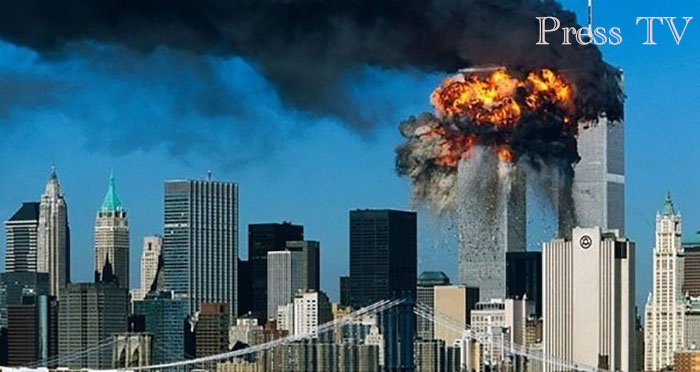
Today marks 25 years since the terrorist attacks of 11 September 2001. I want to honor all the innocent people who were killed, all the families who were shattered, and all the firefighters, police officers, and other fellow human beings who lost their lives as they tried to save others.
In their memory, I want to share part of my own story, which I write about in my upcoming autobiography, *Mojahedin Child*.
That day, I was seventeen years old and was at the People’s Mojahedin’s Bagherzadeh camp in Iraq.
After yet another long and exhausting leadership meeting, we had been given time for training. I was standing by a soccer field when one of our higher commanders, who was called Brother Kamal, came running with some papers in his hand. He was out of breath and excited. He gathered us and read aloud the news that a passenger plane had flown into one of the World Trade Center towers.
All around me, people began clapping their hands, whistling, and cheering.
When he returned with the news of the attack on the second tower, the cheering erupted again. Training was canceled. We were ordered to prepare for a celebration.
We put on our green uniforms and gathered in the hall called “40 Columns.” The tables were set with cakes and pastries. Music was playing. Some had started dancing Kurdish dances.
On TV screens around the hall, images were shown of the planes flying into the towers. The fire. The smoke. The same sequences, over and over again.
Every time the planes hit, people stood up, applauded, and cheered. Between the tables, others walked around offering cakes.
I myself felt no joy.
I was exhausted and numb after months of psychological pressure. I had grown up in Sweden and France. I felt no hatred toward the United States or the Western world. On the contrary, I liked American culture.
I stood there wondering what what had happened would mean for us. Up until then, I had believed that the Iranian regime was our real enemy. Now I saw a festive mood that I hadn’t even experienced after the Mojahedin’s most successful military operations. I hadn’t understood how deep the hatred toward the United States ran.
Toward evening, I left the celebration and went to the dormitory. The music and singing could be heard late into the night.
At a later meeting, I heard Massoud Rajavi describe the attacks as a “gift” to the Mojahedin members. He meant that the world’s attention would now shift from Iraq to Iran. I couldn’t understand his reasoning.
This is my own memory of what I saw, heard, and thought as a seventeen-year-old.
Today, twenty-five years later, I am also telling it to bear witness to what ideological hatred can do to people’s capacity for compassion. How people can be transformed into symbols of an enemy, until their death becomes something to celebrate.
But those who were killed that day were not “imperialism.” They were people. Each one had a name, a life, and people waiting for them.
Today, I want to let my memory of the cheering in that hall be met by something entirely different: sorrow for the victims, respect for those who tried to save others, and compassion for all who were left behind.
Their death was no victory. It was a human tragedy.
We must never forget.
Amir Yaghmai
