Nejat Society
  • Home
  • Articles
  • Media
    • Cartoons
    • NewsPics
    • Photo Gallery
    • Videos
  • Publications
    • Books
    • Nejat NewsLetter
    • Pars Brief
  • About Us
  • Contact us
  • Editions
    • عربي
    • فارسی
    • Shqip
Nejat Society
Nejat Society
  • Home
  • Articles
  • Media
    • Cartoons
    • NewsPics
    • Photo Gallery
    • Videos
  • Publications
    • Books
    • Nejat NewsLetter
    • Pars Brief
  • About Us
  • Contact us
  • Editions
    • عربي
    • فارسی
    • Shqip
© 2003 - 2024 NEJAT Society. nejatngo.org
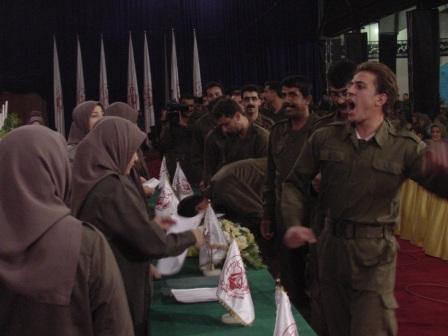
MEK Terrorists
Mujahedin Khalq Organization as a terrorist group

Has the MEK Re-Entered Its Military-Terrorist Phase?

Early on December 31, Iranian news sources, as well as some anti-Iran groups, reported an explosion in front of the building of a construction institute affiliated with the IRGC.

A few hours later, a spokesperson for the Mujahedin-e Khalq organization (MEK, a.k.a MKO, NCRI, PMOI, etc.) claimed responsibility for the attack in an announcement. Some Iranian sources released footage of the building showing it was intact and denied the bombing. Some others, quoting informed sources, described the incident as merely a biker throwing a lit firecracker near the building.

Regardless of whether or not the attack has occurred or how much damage it has caused, MEK claiming responsibility for the attack indicates the group’s plans and intentions to return to its violent phase.
MEK’s announcement reminds political observers and Iran analysts of the group’s bloody operations in the country and its brutal squad of assassins in different parts of Iran during the 1980s. Operations in which according to a 1994 US state department report on the MEK, thousands of civilians were murdered and various political, economic and military centers were damaged.
The MEK has adopted a violent approach against its opponents since it was established in 1965. The group’s harsh, violent and terrorist attitude, has been recruited in the face of domestic critics, the Shah’s government, and then the Islamic Republic of Iran. MEK’s military treatment of Iraqi ethnic minorities, especially Turkmen and Kurds, when the group was located in Iraq at the invitation of Saddam Hussein, was also part of a brutal approach taken by the group’s leaders from the outset. This procedure continued until 2003.
Following the US invasion of Iraq in 2003, the MEK which was listed by the US as a terrorist group, was forcibly disarmed by the US Army and the group’s military wing was forced to hand over its heavy and semi-heavy weapons to the US forces in Iraq.
The MEK has since tried to adapt its tactics to the new situation. So in order to get out of the terrorist lists in the UK, EU and US, a new approach was taken that was more like a tactical change than a strategical one; entering a phase of political and propaganda activities against Iran to persuade the West that the MEK is the only alternative to the Islamic Republic.
In the 16 years since the forced disarmament, the MEK has established extensive contacts with former Western political figures and launched massive propaganda efforts against Tehran. But none of these activities of the MEK could bring them their desired outcome, which is the acceptance of the group as an alternative to the Islamic Republic and the overthrow of the Iranian political system.
Therefore, in recent years, the MEK has sought to direct its regime-change activities within Iran by organizing its forces who are titled by the group as ‘insurgent cells’. In the past few years, the actions of these cells have been limited to installing images of the group’s leaders and burning pictures of Iranian high-ranking officials in low-lying, low-traffic areas. The MEK has not made any successful gains from the formation of these cells so far.
Although the December 31 operation caused neither casualties nor damage, it was a significant act in several respects.

The first issue is the use of a bomb in the operation and claiming responsibility for the blast by a MEK spokesperson in the group’s official media, a phenomenon that has been unprecedented in recent years since the MEK’s tactical shift and entering into the phase of political propaganda.

In a video released hours after the explosion on MEK’s website, the group claimed responsibility for the attack and attributed it to its own military branch, the National Liberation Army (NLA). The NLA was the MEK’s military wing in the Iraq-Iran war, which served alongside Saddam Hussein’s army and conducted cross-border raids into Iran during the last stages of the war. In addition to border attacks on Iran, the NLA served Saddam in the brutal repression of Iraqi Kurds during 1991.
Therefore, citing this infamous military branch and attributing the attack to it, means a shift in the MEK’s tactics and its re-entering to the armed and terrorist phase.
Another important point is the MEK spokesperson’s sharp statement, in which he spoke of the need to demolish the centers affiliated with the Islamic Revolutionary Guards. This threat resembles two deadly terrorist operations by the group in the offices of the Islamic Republic Party and Prime Minister in 1981.
This is probably why the spokesperson, for the first time since the group’s disarmament in 2003, has called upon (the US) for the return of their weapons.

It seems unlikely that the MEK’s spokesperson be unaware of the political and legal burden of these threats. It is clear that the MEK is seriously seeking to change its strategy and return to the phase of violent and terrorist acts.

This action, as it was said, stems from the MEK’s foundation which is based on achieving results through violent acts. It also demonstrates that the group’s decade-long political and propaganda activities to persuade Western governments to overthrow Iran’s political system have so far failed. So the MEK’s return to phase of terrorist acts could be its response to this failure.

It appears that continuation of this approach by the MEK, will put Western sponsors of the group in an unfavorable position and it will cause further damage to Iran’s relations with them. The MEK is turning from a refugee group in Albania to a group that, in addition to carrying out anti-Iranian actions, is now on its way into armed phase, an approach which could lead to Tirana’s direct confrontation with Tehran.
Tehran’s recent confrontations with Western powers such as Washington and London in the Persian Gulf in the battle of tankers and UAVs demonstrate that Iranians, who now benefit military balance in the West Asian region, do not easily overlook their security threats. Whether this threat is posed by the MEK through terrorist operations, similar to what they did during the 1980s and saw its consequences, or by its Western sponsors through providing facilities for the terrorist group.

BY Reza Alghurabi –  ahtribune.com

Reza Alghurabi is an Arab journalist who lives in Iran. He is a former researcher at the Beirut Center for Middle East Studies and an independent researcher and journalist writing in Iranian newspapers including the Khorasan daily.

January 21, 2020 0 comments
FacebookTwitterPinterestWhatsappTelegramSkypeEmail
Mujahedin Khalq; A proxy force

Twitter gives platform to MEK Terrorists misinfo. Campaign

Facebook is doubling down on censorship of anything less than villification of slain Iranian Major General Qassem Soleimani, deleting a clip showing his history of fighting terrorism – and demonetizing the account posting it.

The social media behemoth didn’t just remove independent journalist Dan Cohen’s ‘In the Now’ segment, “How ‘good guy’ Soleimani became US media’s ‘bad guy,” from the show’s page on Tuesday – it demonetized In the Now entirely, citing the typical unspecified violations of “community standards.” The move comes amid an alarming escalation in the platform’s crackdown on political speech that runs contrary to US foreign policy, a wave of censorship that has not been limited to Facebook.

Despite being 100% factually accurate, Facebook censored my video on how Soleimani led Iran’s fight against ISIS and demonetized @IntheNow_tweet’s account. Apparently the truth violated”Community Standards”. For now, you can watch the segment here: https://t.co/Z1qz11Ro9T pic.twitter.com/0qOCYKHq6E

— Dan Cohen (@dancohen3000) January 15, 2020

Cohen’s video calmly and accurately explains how Soleimani “saved the region from falling to ISIS,” fighting the terrorist group alongside the US and its Kurdish allies before he was recast posthumously by a complicit western media as “actually a huge terrorist and a ticking time bomb who was born to kill Americans.” The video exposes the ideological inconsistency of the outlets currently depicting the Quds Force commander as the devil incarnate, showcasing clips from those same outlets in recent years praising Soleimani’s battlefield performance.

Rania Khalek, who runs In the Now, tweeted in shock that a video merely stating facts about Soleimani had gotten her page demonetized, asking “where is the outrage” now that Facebook was so explicitly deleting material for ideological reasons.

Facebook is deleting political content at the behest of the US government. At the behest of a Trump-run government. They are deleting content that challenges the US drive for war. Where is the outrage????

— Rania Khalek (@RaniaKhalek) January 15, 2020

Facebook and its subsidiary Instagram have come under fire from independent journalists and media organizations like the International Federation of Journalists for embarking on a wholesale campaign to deplatform all support for Soleimani in the weeks following the US airstrike that killed him. The company has claimed the extensive US sanctions placed on Iran, including the designation of the Islamic Revolutionary Guard Corps as a terrorist organization, require it to censor such posts, though even legal experts quoted by CNN took a dim view of that rationale.

Facebook and Instagram not only remove accounts run by or for sanctioned individuals or groups, but also posts that (they claim) praise or seek to assist the people in question – making sanctions a convenient excuse for mass-deplatforming any user who holds a political view the US government has deemed heresy.

Iranians saw insult added to injury when over a dozen Iranian journalists, several state-run media organizations, and countless ordinary individuals and activists’ Instagram accounts were yanked entirely in the days following Soleimani’s assassination. Many more saw pro-Soleimani posts removed, even when they carefully avoided saying his name – one Lebanese researcher praised “Q*ssem S*leim*ni” for protecting Christians from ISIS and al-Qaeda, only to have his video removed anyway.

The rank ideological discrimination not only left them unable to publicly mourn for a leader beloved by the lion’s share of the people, but allowed pro-regime-change trolls to dominate the narrative. Facebook has recently taken flack from the US political establishment for refusing to “fact-check” political ads, but non-advertising content is more tightly controlled than ever.

Facebook and Instagram are far from alone in clamping down on the speech of Iranian users, however – YouTube briefly deleted state-backed PressTV’s channel earlier this week, only to reactivate it after an outpouring of popular support

BREAKING: Our Press TV UK account has been permanently disabled by #YouTube without explanation, amid US-led anti-Iran sanctions and hostility.@Presstvuk #PressTVUK #Censorship pic.twitter.com/WoH9nAYChK

— Press TV UK (@Presstvuk) January 13, 2020

Twitter removed state-backed media outlet Al-Alam News’ account, as well as that of the popular Iran-backed Spanish-language media outlet HispanTV, only reinstating the latter after a massive public backlash. Dozens of individual Iranians who supported their government were also deplatformed on Twitter, while anti-government users – many linked to notorious exile terror group Mujahedin e-Khalq (MEK) – were allowed to continue slinging hate against Soleimani and his supporters. Twitter even dished out a ban to Syrian President Bashar Assad, but restored the account after a few days.

Defend Democracy.press

January 19, 2020 0 comments
FacebookTwitterPinterestWhatsappTelegramSkypeEmail
Albania
Albania

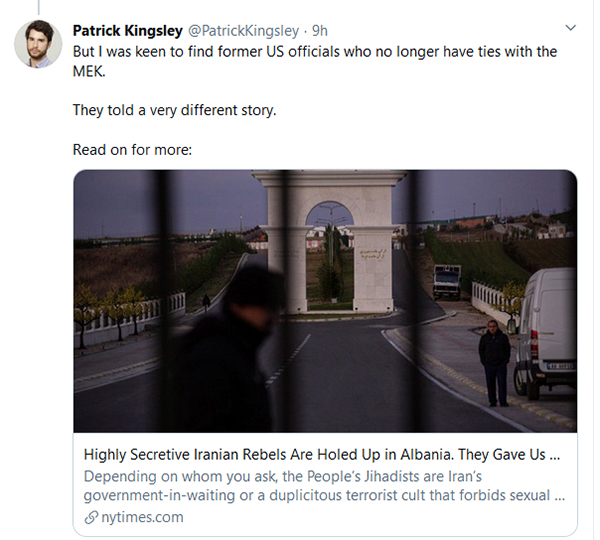
MEK in Albania, the potential threat against the country

By hosting the People’s Mujahedin of Iran (MEK) on behalf of the US, despite the group being labelled a terrorist organisation by Iran, Albania has drawn the ire of Supreme leader Ali Khamenei.

The acting Albanian foreign minister Gent Cakaj announced on his Facebook account that an additional two Iranian diplomats would be expelled from Albania. This follows a decision in 2018 which expelled the Iranian ambassador and has made Albania a frontline in a clash between the United States and Iran.

The decision to expel the Iranian diplomats seems likely a result of the comments made by Iran’s powerful Supreme Leader Ali Khamenei in the aftermath of Qasem Soleimani’s assassination at the hands of the US in which he said: “In a very small European country but an evil country in Europe, there are American elements with some Iranian traitors, they got together to conspire against the Islamic Republic.”

In 2014, under US pressure, Albania took in more than 4,000 members of the People’s Mujahedin of Iran (MEK) a secretive group formerly based Iraq.

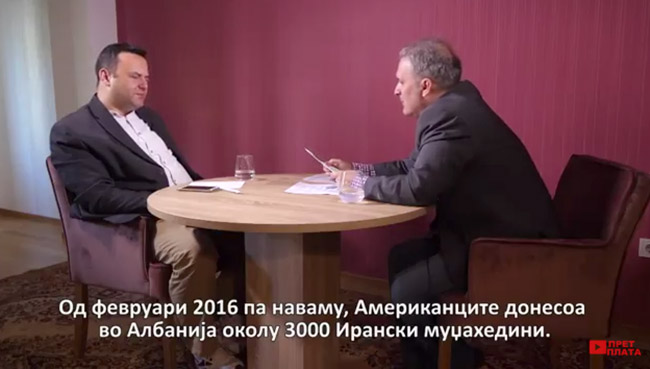
“Albania is hosting one of the most dangerous terrorist organisations on behalf of the United States,” says Dr Olsi Jazexhi, an Albanian academic and expert who has been tracking MEK activities in Albania.

“The Americans imposed them [MEK] on Albania and since Albania is a very fragile state they had to accept. The same thing was done by Prime Minister Edi Rama who is still hosting MEK in Albania,” Jazexhi tells TRT World.

Considered a terrorist group by Iran, the MEK was also listed as a terrorist organisation by the US State Department until 2012.

The Obama administration re-designated the group and formalised a relationship that the US had been cultivating covertly, protecting the group in Iraq at a US military base, then under American occupation.

“The reason for the MEK being brought to Albania is the general ignorance of Albanian politicians who do not understand the danger of international terrorism and the implications that this terrorism has on nation-states” added Jazexhi.

The MEK is a militant political organisation that subscribes to an unusual mixture of Marxist and Islamic ideology.

It has been accused of killing of American military personnel, bombing American companies and targeting innocent Iranian civilians during a campaign of terror over several decades.

A report by the US media outlet NBC News suggested that the group is being financed by Israeli intelligence and was also behind a string of assassinations targeting Iran’s nuclear scientists between 2007 and 2015.

“The MEK is deeply despised in Iran, they fought for Saddam Hussein against Iran for eight years. Then they spied for the Americans and the Israelis, they are mercenaries and a cult group,” said Seyed Mohammad Marandi, Professor of English Literature and Orientalism at the University of Tehran.

Former members of the MEK have spoken out about the oppressive cult-like rules enforced in the organisation, including marriages that have to be arranged by the leadership. There have been reports that the organisation has at times asked its followers to divorce en masse and locked up and even killed members who have criticised the dogma of Maryam Rajavi, the current head of the MEK.

“No one in Iran has any sympathy or respect for them [MEK], they are traitors to the country. They are tools of Western powers. Thousands of them are working as an online army in Albania,” said Marandi speaking to TRT World.

Earlier this year The Intercept, an online investigative publication reported on how the MEK had created a fake online persona called Heshmat Alavi in order to spread propaganda against the Iranian government, including advocating for regime change.

The so-called writer Alavi was managed in part from Albania and had fooled many American publications who had published the fake persona’s writing.

“Using different aliases on the internet, on Facebook as well as Twitter” they have managed to create a digital army, says Marandi, adding: “These social platforms do not block their activities because it is done in coordination with the US government and also they carry out spying activities in Iran.”

The US assassination of Iranian general Soleimani and the subsequent retaliation by Tehran in a series of rocket attacks on US bases underscores the dangerous manoeuvrings between the two powers and the potential to suck in other countries, including the small Balkan state of Albania.

“Albania has become the most dangerous country in the world for Iran after the United States and Israel,” says Jazexhi.

“While the United States and Israel are in open conflict with Iran, Albania by hosting MEK has become a major centre of anti-Iranian propaganda in the world.

The MEK doesn’t lack powerful friends in Washington and in particular enjoys close ties with the hawkish Trump administration. In 2017 the group paid National Security Adviser John Bolton and Trump’s personal lawyer Rudi Giuliani for speaking engagements.

With powerful friends like this, Albanian politicians don’t “dare to do anything” says Jazexhi even though “the majority of Albanians are appalled by what the government is doing.”

The MEK could also be acting against the Albanian penal code says Jazexhi.

“The Albanian penal code states very clearly that if a person or a group of people incites to fight against a foreign country or incites people or asks people to participate in a conflict in a foreign country they could be persecuted for this,” adds Jazexhi.

MEK actions in an impoverished country like Albania, which is still struggling to emerge from a communist dictatorship, doesn’t bode well for its long term stability or rule of law. Iraq has become a battleground of influence between the US and Iran, a faraway conflict for many Albanians.

“When you host terrorists and you aid terrorists than you should be afraid of suffering the consequences. These are not normal people,” says Marandi. “The Albanian government is foolish to cooperate in such a way with the Americans.”

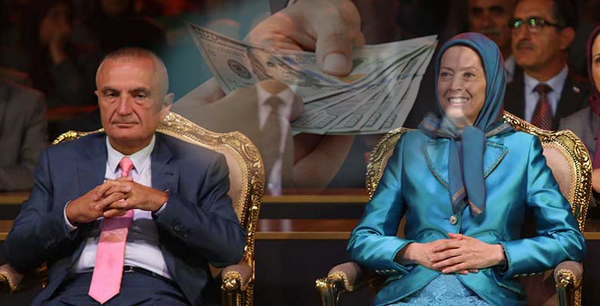
Albanian President Ilir Meta shot back at comments made by [Ayatollah] Khamenei saying: “Albania is not a devilish country, but a democratic one.” However, Meta made no mention of the lack of democratic structures within the MEK and the human rights violations it has been accused of.

“MEK with its paramilitary camps that they have in Manza, Albania has created a state within a state,” says Jazexhi and as tensions between Iran and the US continue to heat up the role that the MEK is playing in Albania could also make it another theatre of conflict.

Elis Gjevori ,TRT world

January 18, 2020 0 comments
FacebookTwitterPinterestWhatsappTelegramSkypeEmail
Pompeo
USA

US restricts its support for Regime change in Iran: What happened?

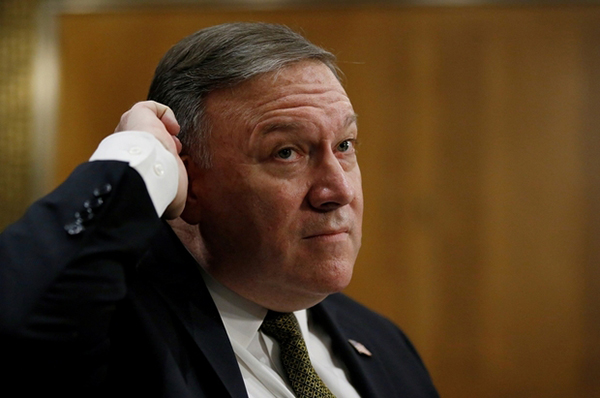
Mike Pompeo, a man who played an important role in General Soleimani’s assassination directed his diplomats to restrict their connections with forces that support a regime change in Iran. What changed in US policy towards Iran? What deal broke out between two arch-rivals?

An Iran hawk who advocated killing general Qasem Soleimani, US Secretary of State Mike Pompeo has ordered his diplomats to limit contacts with militant Iranian exile and opposition groups that support either regime change or greater rights for ethnic groups like Kurds and Arabs.
Coming on the back of the Soleimani killing, Mr. Pompeo’s directive appears to put an end to the Trump administration’s hinting that it covertly supports insurgent efforts to at the very least destabilize the Iranian government if not topple it.
A litmus test of the directive by Mr. Pompeo, known to have a close relationship with Donald J. Trump, is likely to be whether the president’s personal lawyer, Rudolph Giuliani, distances himself from the controversial National Council of Resistance of Iran (NCRI), an offshoot of the Mujahideen-e-Khalq, a group that was taken off the US Treasury’s list of designated terrorists several years ago.
Mr. Pompeo said that direct US government engagement with these groups could prove counterproductive to our policy goal of seeking a comprehensive deal with the Iranian regime that addresses its destabilizing behaviour.
Mr. Giuliani is a frequent, well-paid speaker at gatherings of the group that has built a significant network among Western political elites. The council and the Mujahideen openly call for regime change in Iran.
The Mujahideen were moved with US assistance from their exile base in Iraq to a reportedly Saudi-funded secretive facility in Albania.
A New Jersey-based lobbying firm hired by the NCRI, Rosemont Associates, reported last year in its filing as a foreign agent frequent email and telephone contact on behalf of its client with the US embassy in the Albanian capital of Tirana as well as Brian Hook, the US Special Representative for Iran, and Gabriel Noronha, an aide to Mr. Hook.
In his directive, Mr. Pompeo said that “direct US government engagement with these groups could prove counterproductive to our policy goal of seeking a comprehensive deal with the Iranian regime that addresses its destabilizing behavior.”

The secretary went on to say that Iranian opposition groups “try to engage US officials regularly to gain at least the appearance of tacit support and enhance their visibility and clout.”
Mr. Pompeo’s cable, while keeping a potential negotiated deal with Iran on the table, does not stop other US government agencies from covertly supporting the various groups, that also include Arab Struggle Movement for the Liberation of al-Ahwaz (AMLA), the Komala Party of Iranian Kurdistan, and the Kurdish Democratic Party of Iran (KDPI).

Iran, which has long believed that the United States, alongside Saudi Arabia and Israel, supported the Mujahideen as well as ethnic militants that intermittently launch attacks inside Iran, is likely to take a wait-and see-attitude towards Mr. Pompeo’s directive that could be seen as a signal that the Trump administration is not seeking regime change.
The timing of the directive is significant. Iran responded to the killing of Mr. Soleimani with carefully calibrated missile attacks on US facilities in Iraq in a bid to create an environment in which backchanneling potentially could steer the United States and Iran back to the negotiating table.
The appointment was followed by publication by a Riyadh-based think tank believed to be close to crown prince Mohammed bin Salman of a study for Saudi support for a low-level Baloch insurgency in Iran
While it was uncertain that one round of escalated tensions would do the trick, potential efforts were not helped by the death of Oman’s Sultan Qaboos bin Said al Said, a key interlocutor who has repeatedly helped resolve US-Iranian problems and initiated contacts that ultimately led to the 2015 international agreement that curbed Iran’s nuclear program.
In his directive, Mr. Pompeo, referring to Komala, acknowledged that “Iran’s regime appears to assess that the United States and/or Israel support this group of militant Kurds.”
Iranian perceptions were reinforced not only by calls for regime change by senior figures like Mr. Giuliani and Saudi prince Turki al-Faisal, a former head of the kingdom’s intelligence service and ex-ambassador to Britain and the United States, but also the appointment in 2018 of Steven Fagin as counsel general in Erbil in Iraqi Kurdistan.
Shortly before moving to Erbil, Mr. Fagin met In Washington as head of the State Department’s Office of Iranian Affairs, with Mustafa Hijri, leader of the KDPI as it stepped up its attacks in Iranian Kurdistan.
Iranian perceptions were further informed by the appointment of John Bolton, Mr. Trump’s since departed national security advisor and like Mr. Giuliani a frequent speaker at NCRI events, who publicly advocates support of ethnic insurgencies in Iran in a bid to change the regime.
As Mr. Trump’s first director of the Central Intelligence Agency, Mr. Pompeo named Michael D’Andrea, a hard-charging, chain-smoking covert operations officer, alternatively nicknamed the Dark Prince or Ayatollah Mike, whose track record includes overseeing the hunt for Osama Bin Laden, as head of the CIA’s Iran operations.
The appointment was followed by publication by a Riyadh-based think tank believed to be close to crown prince Mohammed bin Salman of a study for Saudi support for a low-level Baloch insurgency in Iran. Prince Mohammed vowed around the same time that “we will work so that the battle is for them in Iran, not in Saudi Arabia.”
Pakistani militants have claimed that Saudi Arabia had stepped up funding of militant madrassas or religious seminaries in the Pakistani province of Balochistan that allegedly serve as havens for anti-Iranian fighters.

The New York Times reported this week that aides to Prince Mohammed had in the past discussed with private businessmen the assassination of Mr. Soleimani, an architect of Iran’s regional network of proxies, and other Iranians as well as ways of sabotaging the country’s economy.
Mr. Pompeo’s directive is unlikely to persuade Iran that Washington has had a change of heart. Indeed, it hasn’t. Mr. Trump maintains his campaign of maximum pressure and this week imposed additional sanctions on Iran.
Nonetheless, potentially taking regime change off the table facilitates backchanneling that aims at getting the two nations to talk again.

Dr. James Dorsey –  Global Villagespace
Dr. James M. Dorsey is a senior fellow at the S. Rajaratnam School of International Studies, co-director of the University of Würzburg’s Institute for Fan Culture, and the author of The Turbulent World of Middle East Soccer blog. The views expressed in this article are the author’s own and do not necessarily reflect Global Village Space’s editorial policy.

January 16, 2020 0 comments
FacebookTwitterPinterestWhatsappTelegramSkypeEmail
The Trump Administration’s Iran Fiasco
Mujahedin Khalq; A proxy force

Trump Admin Walks Back Anti-MEK Memo

The State Department ordered employees days ago not to meet with an Iranian dissident outfit close to Rudy Giuliani and other Trump world figures. Now, the memo is being overridden.

At whiplash speed, the State Department is walking back an order barring American diplomats from meeting with controversial Iranian dissident groups—including one close with Trump World allies and previously designated as a terror group, the Mujahedeen-e-Khalq (MEK). The initial memo, greenlit by a career State Department employee, angered Congressional Iran hawks. And the Department’s move to change its guidance has drawn cheers from them.
The first memo, first reported by Bloomberg and reviewed by The Daily Beast, included sober warnings against meeting with the MEK, pointing to its terrorist past and saying most everyday Iranians have a low view of the group. The memo also warned about interactions with the Democratic Party of Iranian Kurdistan, highlighting its attacks on Iranian military targets; and directed diplomats to get permission from State Department headquarters before meeting with members of an Azeri separatist group. Secretary of State Mike Pompeo sent out the memo on January 7, and it cautioned that meetings with these groups could undermine U.S. efforts to reach a deal with Tehran. Joey Hood, a senior career State Department official, approved the memo, according to the document The Daily Beast reviewed.
But now, the memo is being overridden. The Daily Beast obtained a cable, sent to U.S. diplomats Sunday night, superseding the week-old directive.
“Posts should welcome opportunities to meet with and learn from members of the Iranian diaspora community,” said the cable, which explicitly noted it “supersedes” the January 7 missive. “After 40 years of repression and violence at the hands of the Ayatollahs, the Iranian people’s pride in their history has not diminished nor has their resolve to celebrate it in the face of the Islamic republic’s abuses.”
The cable went on to say that U.S. diplomats should consider hosting members of the diaspora for “Persian cultural events,” while noting that “not all Iranian opposition groups’ interests and objectives align with U.S. policy priorities.”
“While it is up to the Iranian people to determine the future course of their nation, the United States will continue to stand with them and echo their calls for justice and accountability,” the cable said.
While the new memo did not mention MEK or the other groups, it said diplomats should simply “use good judgement when receiving invitations or meeting with opposition groups” and should raise questions and concerns with senior State officials––an apparent revocation of the order that they only take such meetings with Foggy Bottom’s explicit approval. State Department spokespersons did not respond to multiple requests for comment on the cable.
Trump lawyer Rudy Giuliani—who the MEK hired to help it get off the U.S. list of foreign terrorist groups and who recently called the group “my MEK people”—welcomed the reversal. “[The MEK] is very supportive of a free…Iraq. It’s run by a great woman who is committed to ending suppression of women and in a non-nuclear Iran,” the president’s personal lawyer messaged The Daily Beast. “They were of great assistance to us during [the] Iraq invasion and are supported by a very non-partisan group of American former and present public officials.”
The MEK is close with several other hawkish Trumpworld figures, including retired Gen. Jack Keane and former National Security Adviser John Bolton. Former Attorney General Michael Mukasey, Giuliani’s longtime friend and former law partner, is a pro bono adviser to the group’s political wing.

“They’re undermining the president’s policy when nobody’s watching.”
— Hill staffer

The group has a controversial past. For, among other things, its alleged role in assassinating three U.S. Army officers and three more civilian contractors, the MEK found itself on the American government’s official list of foreign terrorist organizations. It’s also been accused of acting as a death squad for the late Iraqi dictator Saddam Hussein. A 2009 Rand Corporation paper described the MEK’s “near-religious devotion to [its leaders], public self-deprecation sessions, mandatory divorce, celibacy, enforced separation from family and friends, and gender segregation.” The group and its allies vehemently deny all these charges.

The fast-paced walk-back came after the initial State Department memo drew ire from Congressional Iran hawks. One noted that the memo went out to diplomats just days after a U.S. strike killed Soleimani, and as senior political officials at the State Department were presumably bracing for Tehran’s retaliation.
“It’s a pretty significant 180 for State,” said Christian Whiton, formerly a senior advisor to the Department under Presidents Trump and George W. Bush. “Even if it’s worded diplomatically, it’s not that common to have something issued and then rescinded almost immediately. And I think it just goes to show that the original statement was something done at a junior level that didn’t have support or buy-in from senior political officials.”
It was the second time in recent months that Hood, the career official who greenlit the memo, angered Hill hawks. In Congressional testimony on December 4, he had a tense exchange with Sen. Ted Cruz about funding for the Lebanese government and whether that money went to Hezbollah. A transcript of the hearing indicates that Hood laughed in response to a question from Cruz; the episode left raw nerves.
“They’re undermining the president’s policy when nobody’s watching,” said a Hill staffer for member pushing for a tougher policy toward Iran.
Others, meanwhile, pointed to the reversal as the latest struggle by the Trump administration to clearly explain its stance on conflict with Iran. A Congressional staffer working on Iran policy and who favored the reversal noted that it comes as the administration has sent mixed messages on the legal basis for the Soleimani strike and the number of U.S. embassies threatened by Iranian-allied Shiite militias.
“I think there’s a lot of fog of war-type messages that have come out,” said the staffer, who spoke anonymously to discuss the sensitive matter. “I think there’s still a lot of fog of war.”

The State Department reversal, as reflected in the cable, comes as Pompeo and other U.S. officials, including Defense Secretary Mark Esper, have struggled to publicly articulate the U.S.’ next steps after killing Soleimani and to reconcile their accounts of the intelligence that precipitated that strike.
For years, the Trump administration had maintained a campaign of “maximum pressure,” leveling crippling sanctions on Iran’s economy in an effort to re-open talks with Tehran on a nuclear deal. Since the Soleimani strike, Trump administration officials have struggled to define the administration’s Iran policy. Some have said the maximum pressure campaign always included a military option. Others say the U.S. has long communicated to the Iranians that if Tehran killed Americans, there would be military consequences.

“U.S. diplomats should not be meeting with MEK. They represent a dangerous cult. We should avoid all the mistakes of the Iraq war including being hoodwinked by purported diaspora opposition with no links at home.”
— former Obama administration official Jarret Blanc

Now, it seems, the State Department is shifting its thinking on how to approach Iran on a diplomatic level following the Soleimani strike. In the hours immediately following the assasination, U.S. officials, in an attempt to de-escalate, described the hit as a warning and insisted that America was still interested in working with Iran on conversations about the nuclear deal. The U.S. special representative for Iran Brian Hook appeared on BBC World, saying that killing Soleimani was designed to “advance the cause of peace.” Sunday’s cable, meanwhile, will cheer Iran hawks––and frustrate Obama administration alums.
“There are at least two problems with this reversal,” said Jarrett Blanc, a former Obama administration official who worked on Iran policy. “The first is that the policy is wrong. U.S. diplomats should not be meeting with MEK or its affiliates. They represent a dangerous cult. We should avoid all the mistakes of the Iraq war including being hoodwinked by purported diaspora opposition with no links at home. The second problem is that it reflects the total incompetence and chaos of this administration’s policy making —to send out an instruction and less than a week later countermand it. They just don’t know what they are doing.”
For years in the United States, lobbyists and advocates for the MEK have operated an aggressive, sustained, and successful campaign to have the group removed from the State Department’s terror list, a move that was finalized in the Obama era. The organization’s stateside backers also include Democratic figures such as retired Gen. Wesley Clark and Howard Dean, as well as attorneys Victoria Toensing and Joseph diGenova, two informal legal advisers to Trump.

Betsy Swan,Erin Banco,Asawin Suebsaeng, The Daily Beast

January 15, 2020 0 comments
FacebookTwitterPinterestWhatsappTelegramSkypeEmail
Nejat Publications

Nejat Newsletter No. 67

Inside This Issue:

– Happy New YearNejat Newsletter
– Iranian MEK Jihadis at Christmas Mass in Tirana like Pontius Pilate Who Crucified Jesus Christ
– MEK and fuel demonstrations in Iran
– Syranizing Iran Through Recent Unrest
– In the MEK’s black and white world, departure means expulsion
– Iran International TV interview with Massoud Khodabandeh
– MEK AND ISIS ALTERNATIVES FOR IRAN

To download the PDF file click here

January 14, 2020 0 comments
FacebookTwitterPinterestWhatsappTelegramSkypeEmail
MEK- Mujahedin khalq Organization
Mujahedin Khalq; A proxy force

Pompeo keeps MEK at arms length

An Iran hawk who advocated killing general Qassim Soleimani, US Secretary of State Mike Pompeo has ordered his diplomats to limit contacts with militant Iranian exile and opposition groups that support either regime change or greater rights for ethnic groups like Kurds and Arabs.
Coming on the back of the Soleimani killing, Mr. Pompeo’s directive appears to put an end to the Trump administration’s hinting that it covertly supports insurgent efforts to at the very least destabilize the Iranian government if not topple it.
A litmus test of the directive by Mr. Pompeo, known to have a close relationship with Donald J. Trump, is likely to be whether the president’s personal lawyer, Rudolph Giuliani, distances himself from the controversial National Council of Resistance of Iran (NCRI), an offshoot of the Mujahedeen-e-Khalq, a group that was taken off the US Treasury’s list of designated terrorists several years ago.
Mr. Giuliani is a frequent, well-paid speaker at gatherings of the group that has built a significant network among Western political elites. The council and the Mujahedeen openly call for regime change in Iran.
The Mujahedeen were moved with US assistance from their exile base in Iraq to a reportedly Saudi-funded secretive facility in Albania.
A New Jersey-based lobbying firm hired by the NCRI, Rosemont Associates, reported last year in its filing as a foreign agent frequent email and telephone contact on behalf of its client with the US embassy in the Albanian capital of Tirana as well as Brian Hook, the US Special Representative for Iran, and Gabriel Noronha, an aide to Mr. Hook.
In his directive, Mr. Pompeo said that “direct US government engagement with these groups could prove counterproductive to our policy goal of seeking a comprehensive deal with the Iranian regime that addresses its destabilizing behaviour.”
The secretary went on to say that Iranian opposition groups “try to engage US officials regularly to gain at least the appearance of tacit support and enhance their visibility and clout.”
Mr. Pompeo’s cable, while keeping a potential negotiated deal with Iran on the table, does not stop other US government agencies from covertly supporting the various groups, that also include Arab Struggle Movement for the Liberation of al-Ahwaz (AMLA), the Komala Party of Iranian Kurdistan, and the Kurdish Democratic Party of Iran (KDPI).
Iran, which has long believed that the United States, alongside Saudi Arabia and Israel, supported the Mujahedeen as well as ethnic militants that intermittently launch attacks inside Iran, is likely to take a wait-and see-attitude towards Mr. Pompeo’s directive that could be seen as a signal that the Trump administration is not seeking regime change.
The timing of the directive is significant. Iran responded to the killing of Mr. Soleimani with carefully calibrated missile attacks on US facilities in Iraq in a bid to create an environment in which backchanneling potentially could steer the United States and Iran back to the negotiating table.

While it was uncertain that one round of escalated tensions would do the trick, potential efforts were not helped by the death of Oman’s Sultan Qaboos bin Said al Said, a key interlocutor who has repeatedly helped resolve US-Iranian problems and initiated contacts that ultimately led to the 2015 international agreement that curbed Iran’s nuclear program.
In his directive, Mr. Pompeo, referring to Komala, acknowledged that “Iran’s regime appears to assess that the United States and/or Israel support this group of militant Kurds.”
Iranian perceptions were reinforced not only by calls for regime change by senior figures like Mr. Giuliani and Saudi prince Turki al-Faisal, a former head of the kingdom’s intelligence service and ex-ambassador to Britain and the United States, but also the appointment in 2018 of Steven Fagin as counsel general in Erbil in Iraqi Kurdistan.
Shortly before moving to Erbil, Mr. Fagin met In Washington as head of the State Department’s Office of Iranian Affairs, with Mustafa Hijri, leader of the KDPI as it stepped up its attacks in Iranian Kurdistan.
Iranian perceptions were further informed by the appointment of John Bolton, Mr. Trump’s since departed national security advisor and like Mr. Giuliani a frequent speaker at NCRI events, who publicly advocates support of ethnic insurgencies in Iran in a bid to change the regime.
As Mr. Trump’s first director of the Central Intelligence Agency, Mr. Pompeo named Michael D’Andrea, a hard-charging, chain-smoking covert operations officer, alternatively nicknamed the Dark Prince or Ayatollah Mike, whose track record includes overseeing the hunt for Osama Bin Laden, as head of the CIA’s Iran operations.
The appointment was followed by publication by a Riyadh-based think tank believed to be close to crown prince Mohammed bin Salman of a study for Saudi support for a low-level Baloch insurgency in Iran. Prince Mohammed vowed around the same time that “we will work so that the battle is for them in Iran, not in Saudi Arabia.”
Pakistani militants have claimed that Saudi Arabia had stepped up funding of militant madrassas or religious seminaries in the Pakistani province of Balochistan that allegedly serve as havens for anti-Iranian fighters.
The New York Times reported this week that aides to Prince Mohammed had in the past discussed with private businessmen the assassination of Mr. Soleimani, an architect of Iran’s regional network of proxies, and other Iranians as well as ways of sabotaging the country’s economy.
Mr. Pompeo’s directive is unlikely to persuade Iran that Washington has had a change of heart. Indeed, it hasn’t. Mr. Trump maintains his campaign of maximum pressure and this week imposed additional sanctions on Iran.
Nonetheless, potentially taking regime change off the table facilitates backchanneling that aims at getting the two nations to talk again.
Dr. James M. Dorsey is a senior fellow at Nanyang Technological University’s S. Rajaratnam School of International Studies, an adjunct senior research fellow at the National University of Singapore’s Middle East Institute and co-director of the University of Wuerzburg’s Institute of Fan Culture
James M. Dorsey, Euro-Asia Times,

January 13, 2020 0 comments
FacebookTwitterPinterestWhatsappTelegramSkypeEmail
Rudy Giuliani
Mujahedin Khalq; A proxy force

MEK terrorists and mercenary advocates

It was the day of President Trump’s long awaited meeting with Ukrainian President Volodymyr Zelensky at the United Nations in New York City — Sept. 24, 2019.

Trump’s attorney Rudy Giuliani was there at the U.N., too, but he was talking about something else.

“I am for regime change,” Giuliani told a crowd. “Down with the tyrants in Iran. Down with the ayatollah and the mullahs and all the crooks.”

Giuliani added that he was speaking in his “individual capacity,” a line he has used to describe a near-decade of apparent advocacy on behalf of the Mujahideen-e Khalq (MeK), an Iranian dissident group alternately described as a cult, terrorists, or the world’s only fusion of Marxist-Leninist thought and Islamism.

But at a time when relations between the U.S. and Iran have worsened to the brink of war, Giuliani’s advocacy for a group that the U.S. government said last year could serve as a potential successor to the current regime in Tehran can be viewed in a new light.

The Trump Administration’s Iran Fiasco

The Daily Beast reported on Tuesday that Trump has asked Giuliani for advice about Iran since ordering the strike that killed Iranian commander Qasem Soleimani last week.

Throughout the Ukraine scandal for which President Trump currently faces an impeachment trial in the Senate, Giuliani spoke with the President about foreign policy and that country’s willingness to supply dirt. Most recently, Trump reportedly spoke with Giuliani immediately after the former New York City mayor returned from his December trip to Kyiv.

Giuliani’s history with MeK extends as far back as his ties to Ukraine, and has shaped much of the former U.S. Attorney for the Southern District of New York’s post-government, buck-raking career over the past decade.

The group launched a lobbying and public relations blitz in 2011, paying dozens of prominent Americans — ranging from Giuliani to Gen. Wesley Clark to former Secretary of Homeland Security Tom Ridge — to advocate for the State Department to remove MeK from its list of state-sponsored terrorist groups.

The State Department had added the group to its list of terrorist organizations in 1997, saying that it had been responsible for killing Americans in the past.

But the lobbying efforts paid off; the State Department removed MeK from the list in September 2012.

Most of the group’s high-profile mercenary advocates dropped off; Giuliani stayed on.

He has traveled to Paris for the MeK’s annual meeting multiple times since first going in 2012, and has remained a consistent advocate for the movement since.

The MeK opposed the nuclear deal concluded with Iran under the Obama administration in part because it views itself as a potential successor to the current Iranian regime; Giuliani called the agreement “catastrophic” at the time it was signed.

He appeared at another MeK event in Warsaw in February 2019, which occurred at the same time as Secretary of State Mike Pompeo and Vice President Mike Pence hosted an international summit in the Polish capital regarding U.S. foreign policy on Iran.

It is not known if Giuliani met with Pompeo or Pence while on that trip; his presence reportedly annoyed U.S. officials managing the summit.

In July, in response to a TPM article about an event he was headlining at the MeK’s compound in Albania, Giuliani tweeted that criticism of MeK was “the false propaganda of the Iranian #RegimeOfTerror.”

Giuliani, Lieberman Attend Iran Cult Event |Talking Points Memo. The author is just ignorantly repeating the false propaganda of the Iranian #RegimeOfTerror. M.Rajavi is supported by leaders all over the world.Keep watching my tweets and dismiss #FAKE NEWS https://t.co/m7O3YBYSRa

— Rudy Giuliani (@RudyGiuliani) July 13, 2019

“Utmost respect for Albania,” Giuliani was quoted as saying after the event, where he met with MeK’s leader Maryam Rajavi.

FARA filings show that Giuliani’s Sept. 24 rally in support of MeK was preceded by a meeting with lobbyists for the group on Sept. 23 and followed by a meeting with the same lobbyists on Sept. 25.

And as the potential for open conflict between the U.S. and Iran has continued to percolate, Giuliani has used the same language around Iran that he has used when speaking on behalf of his MeK backers.

The Ayatollahs’ 40 year #REGIMEOFTERROR is, and has been throughout, the biggest sponsor of terrorism in the world.

The Obama-Biden administration practiced appeasement.

The Dems want to return to appeasement. The only way to avoid war is to stand up to them.

— Rudy Giuliani (@RudyGiuliani) January 8, 2020

By Josh Kovensky, talkingpointsmemo
Josh Kovensky is an investigative reporter for Talking Points Memo, based in New York. He previously worked for the Kyiv Post in Ukraine, covering politics, business, and corruption there.

January 12, 2020 0 comments
FacebookTwitterPinterestWhatsappTelegramSkypeEmail
Minister of Justice in Albania - Etilda Gjonaj
Albania

Open letter to Minister of Justice of Albania, Ms Etilda Gjonaj

Dear Madame,
We heard the news of some prisoners being pardoned on New Year’s Eve, and we hoped for justice in the light of your kindness.
Security and progress in human societies will be realized with more love and forgiveness because God loves the kind.
It takes courage to show kindness and you have shown that you have that courage. We congratulate you and your government for this courage and wish you success in serving your country and its people.
Madame Justice Secretary,
I would like to draw your attention to a case that appears to violate justice in your country, and which violates the rights of an innocent person and surely you will agree.

Ehsan Bidi

Last August, a friend of ours – Ehsan Bidi – was arrested and is being held in a closed camp in Mans. He has been denied access to a lawyer.
It should be noted that Ehsan Bidi has been in your country for six years already, has complied with all the rules and was given a ten-year residence permit by the government.
With his background, according to international laws and standards, he is recognised as a refugee. But unfortunately, he has been arrested and his human rights and asylum rights have been violated. He had chosen to remain in your country in the hope of finding a better and easier life because he believes he can have a good life in a law-abiding and civilized country, in line with international law, just like anyone else.
Madame Secretary, we look forward to seeing your courage in administering justice in this case. We urge you not to allow the violation of the rights of anyone who has sought refuge in your country and who has been bound by and has respected all the laws of the country since the time he arrived.
With the greatest respect
1- Mohammad Azim Mishmast
2- Hadi Sani Khani
3- Hassan Heyrani
4- Abdolrahman Mohammadian
5- Hassan Shahbaz
6- Ali Hajari
7- Ehsan Bidi
8- Gholam Mirzai
9- Malek bit Mashal
10- Moussa Damroudi
11- Gholamreza shekari
12- Parviz Heydarzade

January 12, 2020 0 comments
FacebookTwitterPinterestWhatsappTelegramSkypeEmail
The Trump Administration’s Iran Fiasco
Mujahedin Khalq; A proxy force

Trump Administration and the MEK terrorists

Former New York Mayor Rudolph Giuliani speaks in front of portraits of deceased members of the Iranian dissident group Mujahedeen-e-Khalq (MEK),

In the wake of the US assassination of Iranian commander Qassem Soleimani, an obscure group of Iranian dissidents once classified as a terrorist organisation by the US celebrated the news.

“In Tehran, Isfahan, Qom and Qaemshahr, among numerous other cities, MEK supporters were celebrating Soleimani’s death by throwing parties and handing out pastries,” the People’s Mujahideen of Iran tweeted, with pictures of jubilant supporters.

The MEK — officially the Mujahedeen-e-Khalq, or the People’s Mujahideen of Iran in English — has waged war against the Islamist regime in Iran since it seized power in 1979. Formerly based in Iraq, the group is believed to have killed thousands of Iranians in terror attacks.

In Tehran, Isfahan, Qom and Qaemshahr, among numerous other cities, MEK supporters were celebrating Soleimani’s death by throwing parties and handing out pastries.#Iranhttps://t.co/Xp7v6kDX07

— People’s Mojahedin Organization of Iran (PMOI/MEK) (@Mojahedineng) January 7, 2020

But far away from the battlefields of the Middle East, the MEK has also waged a campaign for influence in glossy functions at diplomatic events in western capitals, successfully cultivating powerful allies in western governments.

Among them are current and former officials in the top echelons of the Trump administration — including those who Trump regularly turns to advice on Iran, such as personal attorney, Rudy Giuliani.

Soleimani was “directly responsible for killing some of my MEK people,” Giuliani told The Daily Beast in an interview on Monday, making no attempt to disguise his closeness to the group.

“We don’t like him very much.”

And its not just Giuliani who has longstanding ties to the MEK.

In September, Secretary of State Mike Pompeo attended an event on the fringes of the United Nations assembly in New York alongside the MEK.

Hawkish national security adviser John Bolton, who departed the administration in September after reportedly pushing for Trump to launch strikes against Iran, also had links to the MEK. Bolton has attended the group’s conferences, and long served as its most powerful advocate in Washington DC.

Eli Clifton, an expert on US foreign policy at the Quincy Institute for Responsible Statecraft, told Business Insider that the MEK had long advocated the assassination of Iranian regime officials.

“The MEK clearly endorses the assassination of Iranian government officials and employees. In 2012, NBC News reported that the MEK was directly involved in the assassination of Iranian nuclear scientists,” Clifton wrote in an email Wednesday.

The MEK emerged in opposition to the then ruler of Iran, the Shah, in the late 1960s, inspired by a blend of Marxist ideology and Islamic theology.

When Islamist rivals seized control of the country after the Islamic Revolution in 1979, the MEK fled to neighboring Iraq, where it fought against Iran alongside then-president Saddam Hussein’s forces.

Defectors have claimed that the group seeks to brainwash members — forcing them to confess to sexual fantasies in bizarre public shaming rituals and to send away their children to be brought up by others. It has been described by several ex-members as a cult.

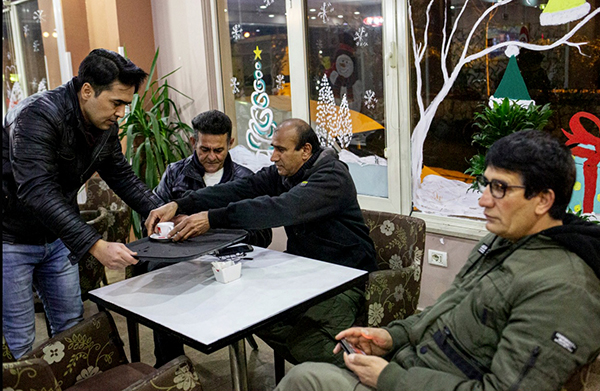
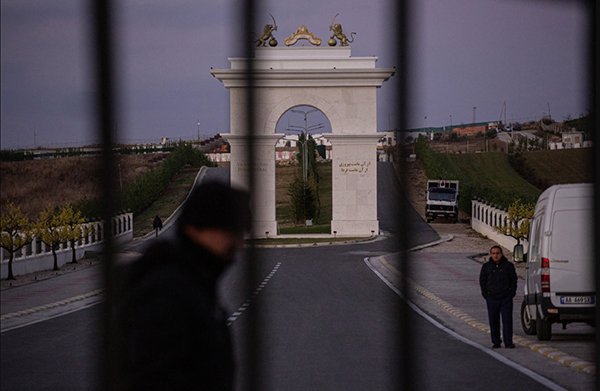
Several thousand MEK members live in a compound in Albania, where they reportedly spend their days on social media distributing anti-Iranian propaganda.

In Paris, where the MEK’s official headquarters is located, the group holds glitzy functions as it seeks to cultivate influential western officials. It has hired Iran hawks in Washington to speak at its events, paying them large speaking fees. It was eventually de-listed as a terror group by the US in 2012 following a long lobbying campaign.

Despite the rigid control it exerts over members, it has sought to portray itself as the only viable democratic alternative to the current Iranian regime.

“When the president’s personal attorney and former national security adviser have effectively endorsed the MEK as a legitimate opposition group and a viable government exile for Iran, it certainly raises serious questions about the extent to which the MEK is influencing the administration’s Iran policy,” Clifton told Business Insider.

The group’s activities in Europe have attracted the ire of Iran, with French officials in October 2018 accusing Iranian intelligence of being behind a plot to bomb a rally held by the MEK’s political arm in Paris. The rally was attended by Giuliani and Newt Gingrich, former House speaker and Trump ally.

And with the US now taking the hardline stance towards Iran it has long advocated, it will be likely seeking to consolidate its influence in Washington DC.

Tom Porter, Business Insider

January 11, 2020 0 comments
FacebookTwitterPinterestWhatsappTelegramSkypeEmail
Newer Posts
Older Posts

Recent Posts

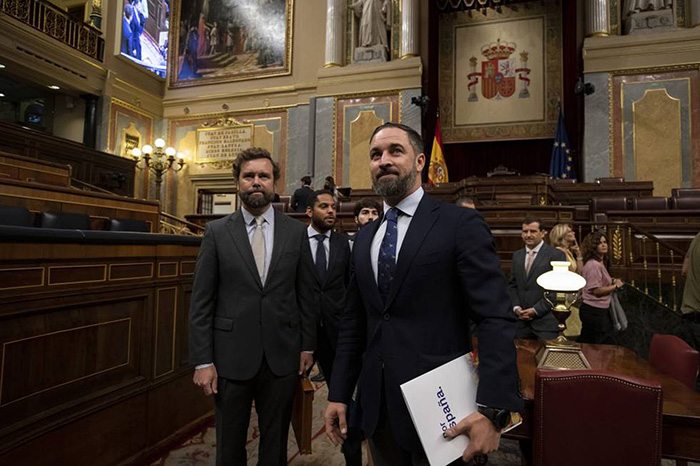
  • Slovenian PM Janez Janša, MEK & Israel promoter

    July 1, 2026
  • MKO Rally Dispersed by French Police in Humiliating Blow to Terrorist Group

    June 27, 2026
  • Nejat Society Albania’s Conference on June 20th

    June 22, 2026
  • Maryam Rajavi’s Stance, Peace or Survival Tactic?

    June 22, 2026
  • France’s foreign ministry denies asking for ban of MEK’s rally

    June 20, 2026
  • Facebook
  • Twitter
  • Instagram
  • Youtube

© 2003 - 2025 NEJAT Society . All Rights Reserved. NejatNGO.org


Back To Top
Nejat Society
  • Home
  • Articles
  • Media
    • Cartoons
    • NewsPics
    • Photo Gallery
    • Videos
  • Publications
    • Books
    • Nejat NewsLetter
    • Pars Brief
  • About Us
  • Contact us
  • Editions
    • عربي
    • فارسی
    • Shqip