Nejat Society
  • Home
  • Articles
  • Media
    • Cartoons
    • NewsPics
    • Photo Gallery
    • Videos
  • Publications
    • Books
    • Nejat NewsLetter
    • Pars Brief
  • About Us
  • Contact us
  • Editions
    • عربي
    • فارسی
    • Shqip
Nejat Society
Nejat Society
  • Home
  • Articles
  • Media
    • Cartoons
    • NewsPics
    • Photo Gallery
    • Videos
  • Publications
    • Books
    • Nejat NewsLetter
    • Pars Brief
  • About Us
  • Contact us
  • Editions
    • عربي
    • فارسی
    • Shqip
© 2003 - 2024 NEJAT Society. nejatngo.org
Mujahedin Khalq; A proxy force

The Moujahideens of the People funded Vox (Andalusia)

According to an investigation carried out by El País, the Moujahideens of the People made a contribution of 800 000 euro to fund the electoral campaign of the Andalusian party, Vox, in the 2004 European Elections [1].

The Socialist daily newspaper established the subsidiary used to transfer the money but it has not managed to shed light on its signification.

The Moujahideens of the People started out as an Iranian Marxist organization established at the end of the dictatorship of Shah Reza Pahlevi. Over time, it became a sect working on behalf of Israel and the United States against the anti-imperialist regime of the Islamic Revolutionaries.
The Founder of the Sect was Massoud Rajavi. He flees to France after organizing a bloody massacre of the Islamic government on 28 June 1981. He obtains the protection of President François Mitterrand (who secretly bombed Iran) before being expelled by Prime Minister Jacques Chirac. The sect then took refuge in Iraq (at the height of the war that President Saddam Hussein waged against Iran). It executes dirty tricks for the Hussein administration, taking on tasks that the Presidential Guard refuses. When the United States topples President Saddam Hussein, the CIA reluctantly recycles it. The sect develops a niche for attacks against civilians in Iran and participates in a campaign to assassinate Iranian scientists.
Finally in 2013, Albania accepts establishing a city near Tirana for 3 to 4 000 members of this sect. Today this city used as the base for carrying out cyber-attack actions against Iranian interests. According to the local press, the Albanian police does not have access to this camp where some members of the sect live as slaves.
It is likely that the investment of the Moujahideens of the People form part of the backdrop of Israel’s investment in European political parties classed as “the Extreme Right”. What happened was that the Moujahideens stopped directing their vengeance against the Jew, targeting the Muslim instead.
It was Alejo Vidal-Quadras (to the left in the photo) who established Vox in 2013. In 2009, he went as a European MP to Camp Ashraf (Iraq), camp of the Moujahideens of the People. At this time, Maryam Radjavi (right in the photo) was President of the Moujahideens. Alejo participated in at least 10 of the Sect’s Annual gatherings at Villepinte (France). At one time he was found on the side of the former Socialist Prime Minister José Luis Rodríguez Zapatero. More recently he has stood beside Rudy Giuliani and John Bolton.
According to El País, the transfer of money was organized by Alejo Vidal-Quadras when he was President of Vox. Alejo resigned following his failure in the 2014 European Elections. He had briefed his successor Santiago Abascal about it. It is not established that this funding continued after this.

Translation Anoosha Boralessa, voltairenet.org
[1] « El exilio iraní financió el 80% de la campaña de Vox de 2014 », Joaquín Gil y José María Irujo, El País, 13 de enero de 2019.« El exilio iraní financió el 80% de la campaña de Vox de 2014 », Joaquín Gil y José María Irujo, El País, 13 de enero de 2019.

January 27, 2019 0 comments
FacebookTwitterPinterestWhatsappTelegramSkypeEmail
Mujahedin Khalq; A proxy force

France, Yellow Vests and the MEK

No one today is surprised at the foreign policy of the United States. War, violation of international law and disdain for human rights are all characteristics of the criminal enterprise known as the U.S. government.
Most of the U.S.’s allies display some or all of these same vices, but some are often considered above such activities. One that is mistakenly believed to be better than the U.S. is France. A look at some of its current policies is instructive.

At present, there are two groups active in France. One is known as the ‘Yellow Vests’ an informal organization that started to protest an increase in fuel taxes, and expanded to oppose a wide range of practices of the government of President Emmanuel Macron that are seen as detrimental to the public. There was no well-established plan and no recognized leader.
The second organization is the MEK (Mujahideen-e Khalq), a terrorist organization that seeks the overthrow of the Iranian government. MEK members have been responsible for the deaths of thousands of innocent people.
One would think that a responsive government would react positively to protesters opposing government policies. Government officials would look at those policies; acknowledge the problems they cause, and work with the opposition, in this case, the Yellow Vests, to fully understand their concerns. Then they would work to resolve the issues.
One would also think that any reasonable government would condemn a well-organized and well-financed terrorist group, and offer no support to it in any form.
Unfortunately, this is not the case with the government of France. The reverse, unfortunately, is true. The Macron government works tirelessly and violently to end the Yellow Vest protests, while it welcomes and supports the MEK.

Why would this be? The explanation is not difficult to see.
Like most world leaders, Macron isn’t beholden to the people of France, but to keeping the rich where they are, with little or no consideration for those less fortunate. As in the United States, it is the middle class that bears the largest tax burden, while the poor lose entitlements such as assistance with buying food and paying for housing. The tax overhaul that was passed in the United States last year overwhelmingly benefited the rich, at the expense of everyone else. France seems to follow this model.
And what of French support for MEK? This follows the hypocrisy usually demonstrated by the United States. France, one of the signatories of the Joint Comprehensive Plan of Action (JCPOA), condemned the U.S. withdrawal from this international agreement, and French government officials are looking for a means to circumvent the threatened U.S. sanctions if its corporations continue to do business with Iran. Yet they support a terrorist organization whose sole purpose is the overthrow of the Iranian government.
What has Iran done to incur the wrath of France? The government of Iran worked with the Syrian government, one of its close allies, to defeat U.S.-backed rebels who were attempting the overthrow of the Syrian government. Iran also develops defensive weapons to protect its people from a possible attack by the U.S. or apartheid Israel.
Yet Iran hasn’t invaded another country since 1798; it occupies no countries, and its bombs only fell on terrorist-held sites in Syria, at the request of the Syrian government. Why would France object to a nation that honors international alliances, develops an effective defense system, and basically minds its own business on the global stage? And why would France work so diligently to destroy legitimate protests in its own cities?
The United States differs from Iran in many ways. Currently, the U.S. is bombing at least five countries. It continues to support anti-government rebels in Syria. Yet it gives unreserved support to the brutal apartheid Zionist regime, and has close ties with Saudi Arabia which, like Israel, has an abominable human rights record. Since the end of World War II, it is estimated that the U.S. has killed at least 20,000,000 people, by invading or supporting rebels in at least 30 countries. And the rebels it supports always oppose a democratically-elected government, and support a brutal and cruel dictator.
Domestically, the U.S. has the highest number of citizens per capita in its prisons, and hunger and poverty are among the highest for any industrialized nation.
Despite the clown-like Donald Trump inhabiting the White House, much of the world remains intimidated by the U.S.’s reckless use of its power. While Trump is bogged down in a ‘partial’ government shut-down, along with a variety of investigations into his questionable associations with foreign leaders and porn stars, he continues to control the most powerful military system, and the strongest economy, on the planet. France, like most other countries, bows and scrapes to the imperial U.S. master.
Yet all is not well on the French or U.S. fronts. The Yellow Vests aren’t showing any signs of going away anytime soon, and Trump’s bullying isn’t having the impact he would have liked. The fact that several nations are looking for ways around his threatened sanctions is in itself a good sign, one that is indicative of dwindling U.S. power and influence. While France praises the terrorist MEK, it also seeks ways of continuing to trade with Iran.
The United States is a world power in decline, as shown by the mixed signals that France is sending: support for an anti-Iran terrorist group, while also seeking to maintain the JCPOA. The leaders of any declining imperial nation will do all they can to stem the tide of their decreasing power, and this makes such nations even more dangerous, at least in the short-term. France’s government officials should be cautious about which other countries they align their policies with; short-term gains can result in disastrous long-term losses, and France, at this point, appears to be on the wrong side of history. It is hoped that it will soon change course, and seek domestic and international justice.

by Robert Fantina, counterpunch

January 27, 2019 0 comments
FacebookTwitterPinterestWhatsappTelegramSkypeEmail
Former members of the MEK

Parviz Heidarzadeh declares his defection from the MEK

Parvis Heidarzadeh Nashli who left the Mujahedin Khalq Organization (the MKO/ MEK/ PMOI) about a year ago formally announced his departure from the group in January 2019.

Parviz was a soldier in Iran-Iraq war when he was directly imprisoned by the MKO forces in 1987. Together with 27 of other Iranian soldiers, Parviz was being brainwashed under the command of Mehdi Eftekhari for 20 days. The group’s propaganda succeeded to radicalize Parviz.
He was then kept in the MKO for 30 years. “It was totally a prison. Every day was a repeated routine for us”, he writes. “Meeting after meeting, all words were repetitive. Everyone had to criticize himself, insulting himself and peers had to do the same. You were not permitted to defend yourself against the accusations and insults by the side of your peers.”
In the letter of declaration of defection, Parviz testifies about the incidents of 1994 inside the MKO in which a large number of the group members were accused of being the spy of the Iranian Intelligence and were eventually confined in solitary and tortured. Parviz recalls some comrades who were killed under torture and were buried secretly.
After the group’s relocation in Albania, the mind control system and isolating bars of the MKO collapsed when Parviz could manage to use the Internet in the Internet Room of the HCR. Thus he decided to leave the group for a new life in free world.
He asked the MKO authorities for permission to leave the group but he was jailed for 15 days under severe oppressive treatment. Finally he left the cult-like MKO in December 2nd, 2018.
“I am outside the MKO now. I formally declare that I have no connection with the MKO. I came out to rebuild my new life after 30 years,” he writes.

January 26, 2019 0 comments
FacebookTwitterPinterestWhatsappTelegramSkypeEmail
Mujahedin Khalq; A proxy force

Extreme right of Europe and Netanyahu’s new mission to Rajavi Cult

Alejo Vidal-Quadras: We (VOX) Received money from Mojahedin Khalq (MEK) terrorists

It’s years that extremist rightwing parties in Europe have found significant political power to the point that they have entered the parliaments of most European countries or either play a crucial role in making political decisions.

Today, Europe’s dominant extremist rightwing trends have moved a bit away from their origin, i.e. traditional fascism, and reject racism selectively as a result of an ideological transformation (denial of anti-Semitism and spreading Islamophobia). This is a factor which brings Zionist leaders closer to these parties.

But which sources finance these emerging parties?

A report published some days ago in an Italian newspaper which in part answers this question. The European newspaper wrote in its report: the Vox, the extreme right wing of Spain, has been funded by the MKO (the terrorist group of Mojahedin-e Khalq). The party received € 800,000 in their 2014 campaign from MKO; a group which was enlisted as a terrorist organization in the United States till 2012.

According to this report, it is necessary now to study the sources which fund MKO.

The Guardian recently issued in a detailed report addressing the history of this terrorist group, and describe it as a tool in the hands of the United States against Iran. The report also says that Saudis are probably the source of this group’s financing.

In this Op-Ed penned by Arron Merat, the members of MKO (before the Islamic Revolution) backed the revolution in Iran and then fought for Saddam. The United States and Britain used to condemn them for a time, but in the current situation, a group is a good option for the extremist policies of the Trump administration. John Bolton, the national security adviser to Trump and Mike Pompeo, the US Secretary of State, are among those who pursue such a policy.

Under the leadership of Maryam Rajavi, the Guardian writes, the MKO has won considerable support from sections of the US and European right, eager for allies in the fight against Tehran.

Ervand Abrahamian, a professor at the City University of New York and a historian of Middle Eastern and particularly Iranian history, says “the money definitely comes from Saudis. There is no one else who could be subsidising them with this level of finance.”

MKO’s relationship with the Israeli regime

According to the Guardian, between 2007 and 2012, a number of Iranian nuclear scientists were attacked. In 2012, NBC news, citing two unnamed US officials, reported that the attacks were planned by Israel’s foreign intelligence agency and executed by MKO agents inside Iran.

According to the western media, it seems that the financial support in recent years has largely come from Saudi Arabia and Israel (especially Saudi Arabia).

We have witnessed that Saudis have had a strong presence the meetings held by the hypocrites and their high-ranking figures have delivered several speeches supporting such groups and movements.

The Haaretz Newspaper reports Danny Yatom, the former head of the Mossad, that Israel can implement some of its anti-Iran plans through the MKO (Mojahedin-e Khalq Organization). Israel should consider all possibilities, including military conflict with Iran, but it should not exclude the capacity of intermediaries such as the MKO who have collaborated with Tel Aviv in assassinating Iranian nuclear scientists. Israel is training and providing this group.

The former head of the Mossad added that the organization is apparently linked to Saudi Arabia and can be used in two ways by the Jewish nation and Riyadh.

They worked as a source of information regarding Iran’s nuclear program. Israel can indirectly use the organization on social networks to influence the Iranian people.

Former Mossad head Meir Dagan, in an interview with CBS, revealed that Israel is helping the MKO and armed terrorist groups whose mission is to overthrow the Islamic Republic of Iran.

Saudi Arabia behind rapprochement between Israel and MEK

Saudi Arabia has for a long time been the main sponsor of MEK as it has been shown by the attendance of the influential figures of Saudi royal family in the meetings of the terrorist group in the European countries.

In recent years, the progress of Saudi Arabia’s relations with the Zionist regime and their common hostility towards Iran has become a factor for the Zionists to approach the MEK.

In the meantime, the Zionists deliver missions to the group in exchange for their financial and political support. The Rajavi group keeps an eye on Iran and spies on the country on behalf of the Israelis. Another mission that has been delivered to a group is infiltrating into the far right parties in Europe to secure their support.

Of course, the Zionists themselves have had their own separate relations with European far-right parties and are trying to advance their goals through the channel of the MEK. In this vein, the decline of anti-Semitism feeling among the far-right parties was also a change that resulted from Israel’s approach to these parties.

With regard to Israel’s rapprochement to the European far-right parties, “Orient XXI” (Socialist Revolution in Arabia) website wrote “it all began on 19 December 2010, when a sizeable delegation arrived in Tel Aviv, consisting of some 30 leaders of the European Alliance for Freedom. As its name fails to indicate, this was an organization comprised of a series of parties belonging to the radical right.

Orient XXI added, “it was the first time since the creation of Israel that the country had played host to such a sinister gathering, which included Geert Wilders of the Netherlands, Philip Dewinter from Belgium and Jorg Haider’s successor, Heinz-Christian Strache, from Austria.”

What were these neo-Fascists, who often denied the Holocaust and even worrying about the loss of the Third Reich, doing in Israel?

They [neo-Fascists] participated in a Conference organized by the right wing of Likud Party which was dedicated to fight against terrorism.

Despite the unofficial specification of this move, the then Israeli Foreign Minister Avigdor Lieberman had long negotiated with Wilders, known for his criticism of Islam, and he also compensated his blessing with the official visit of the settlements constructed on the West Bank of Jordan River.

According to the Air France Press (AFP), a man who had the dream of banning the Holy Quran in the Netherlands, “spoke against returning the occupied lands through making peace with Palestinians and raised the proposal of the voluntary settlement of Palestinians in Jordan” and then defended the settlements on West coast of Jordan River.

Everything is crystal clear that Israeli right- and right-extremism parties are ready in their “crusade” against the Palestinians to establish unity and amity even in the most unusual ones.

What is the reason for Israel to get closer to European extremist right-wing?

The obvious features of the emerging extremist parties in Europe are their opposition to traditional practices in European countries. For example, these parties weaken the convergence in Europe and undermined the position of the European Union in the international system.

Since the traditional European parties have a special look at democratic and human rights issues, they have always been critical of the Zionist regime’s actions against the Palestinians, and the European Union’s criticisms and condemnations of this regime has intensified in recent years. The Zionist regime is struggling to bring a deep divide between emerging and traditional parties through getting closer to the extremist right-wing parties in Europe, perhaps to reduce Brussels’s pressure on Tel Aviv.

Reducing Europe’s pressure on the Zionist regime means releasing Israel from a major dilemma. In other words, divisions among European countries and their challenge with emerging parties can be a factor in the advancement of the goals of the Zionist regime at a macro level. Therefore, given the financial support of the MKO for the European extremist right-wing and the link between the Cult of Rajavi with Saudi and Israeli channels, it (Cult) has become a factor used by Zionism to create a rift in Europe.

Hamid Bayati,

January 26, 2019 0 comments
FacebookTwitterPinterestWhatsappTelegramSkypeEmail
MKO making terror trolls in Albania
Mujahedin Khalq; A proxy force

Internet censorship bill and paving the way for the MEK propaganda

Puppet policies of Albania

Media experts and human rights organizations expressed concerns over two bills proposed by Edi Rama, Albania’s Prime Minister, that would empower the government to regulate online media outlets, under the threat of penalties and closure. The changes were presented by the office of PM at a public hearing in Tirana in mid-December last year, aiming at the creation of a registry of online publications and empower a new Complaints Council to sanction online media, based on third-party requests, ordering their closure or blocking access to such media in Albania. The office has proposed changes for a variety of reasons, including “biased” news, news that “damages public morale” and “publications that can incite penal offences.” Failure to uphold the law would result in fines of up to 1 million leks (around 8,000 euros) and even closure of websites.

MKO making terror trolls in Albania

The first draft aims to change the law on the Electronic and Postal Communications Authority (AKEP), the authority that supervises the communications market, transforming the institution from its current content-neutral status to being responsible for maintaining a “register of online media” and ensuring that “entrepreneurs respect their obligations toward national security, public safety, and other laws.” The law obliges the website of any physical or legal entity to have contact information and a physical address published on the site and orders the AKEP to close websites based on “Tax Authorities’ request.” The other proposal aims to transform the Audiovisual Media Authority (AMA) into a policing body, empowered to judge news quality and public morale. Under the proposal, the publishers should have to “respect the ethical and moral rules of the public and should not allow publication that can incite penal offences.” A body named the Complaints Council should receive complaints and fine media or order their closure if found in breach of the law. The proposal also states that fines and closure orders should be implemented immediately, regardless of whether the website chooses to send the matter before the courts. Generally, courts are notoriously slow in Albania, so it might take years to resolve such issues and reactivate closed websites.

PM Edi Rama has repeatedly complained of “defamation” of the government and has attacked critical media using a variety of epithets, calling some of them “charlatans, garbage bins, poison or public enemies.” Already in October, he declared that he was preparing an “anti-defamation package that would include heavy fines.” Speaking during the public consultation last month, Elira Kokona, a representative of the Prime Minister’s office, said that in most member countries of the Organization for Security and Co-operation in Europe (OSCE) libel is a penal offence, although she did not explain how libel relates to the proposed laws. Ilir Zela, the chairman of AKEP, said he saw the need to have a register for fast identification of website owners in cases of legal violations such as “terrorism or defamation.” Zela, who leads a nominally independent institution, is also a former Socialist Party member of parliament and is a member of National Assembly of the ruling Socialist Party, as PM Rama. Gentian Sala, chairman of the AMA, said the law was prepared by the Prime Minister’s office in collaboration with Ministry of Justice with aim of “disciplining” the ever-growing online media in Albania. Asked about his own stance, Sala said his institution could speak only after a board decision so he could not support or criticize the plans.

Media experts urged the authorities to drop the proposals, seeing them as potentially non-constitutional. Albania’s constitution allows the possibility of authorities licensing radios and televisions, but not newspapers or online publications. The proposed laws could also amount to censorship, critics say, because the entire content of a website may be banned if just part of it or a single story is deemed illegal. Due to the country’s authoritarian past, no parliamentary majority has attempted recently to write any law about the print media. The last such law was approved in 1993 and was criticized for being a censorship tool in the hands of the government, despite it stating that “the media is free” in its first article. It was repealed in 1997. The new AMA law also states that the proposal excludes print media. However, the government had apparently decided to consider online media as “multimedia” and not as “written media.” Technically, the AKEP can delist websites registered in Albania with the Albanian “.al” country code. The proposed law states also that it can ban access to Albania of websites registered elsewhere if the Complaints Council deems that such websites have broken the law.

There’s a reasonable doubt that these proposed legal changes are intended for internal politics, given that two major parties, the Socialist Party and the Democratic Party, dominate the government since the collapse of Communism in 1990, so it’s highly unlikely that the independent media can shake their political duopoly. On the other hand, the media censorship at international level seems to be much more useful. Following the news in recent weeks, we can notice that the Mujahedin-e Khalq (MEK or MKO) purchased 1,700 Lenovo brand computers and monitors from an Albanian firm. This terrorist cult, a darling of Washington conservatives, Israelis and Saudis, has set up a state within a state inside Albania and is used by its sponsors to implement a regime change policy in Iran.

In their own counter-terrorism propaganda campaign, an Iranian Human Rights NGO called Habilian Association has launched the first specialized website in the Albanian language, providing news, analysis and documents on crimes conducted by the MEK, but soon such websites for the Albanian audience can be legaly blocked. The Albanian government is openly following the US orders and plans, only three days ago they expelled the Iranian ambassador and another diplomat, and got praise by US President Donald Trump. Obviously, Albania is becoming the European hub for the promotion of MEK terrorist propaganda.

Filip Vuković is a Serbian politologist and investigative journalist from Belgrade, covering the western Balkan area for Serbian, English and Italian outlets. His focus is on nationalism, ethnic tensions and economic policy in the post-Yugoslav area. Currently, he is preparing a PhD dissertation at the University of Padua.
Filip Vuković, Balkans Post

January 26, 2019 0 comments
FacebookTwitterPinterestWhatsappTelegramSkypeEmail
ambassador of France, François Sénémaud
Mujahedin Khalq; A proxy force

Open letter from suffering families to the French ambassador in Iran

Embassy of the Republic of France in the Islamic Republic of Iran
85 avenue Neauphle-le-Chateau – Tehran

Honourable ambassador of France, François Sénémaud,
We learned that in an internal meeting in her headquarters in Paris, Maryam Rajavi announced that the MEK (aka NCR) are planning to hold a large gathering in Paris on February 8, 2019.
This day commemorates the deaths of the commander of the military wing of the Mojahedin-e Khalq (MEK) as well as Massoud Rajavi’s first wife in an armed clash in Tehran in 1982.
In those days, widespread terrorist activities were carried out inside Iran conducted directly by Massoud Rajavi from Paris.
The French policy of supporting this terrorist cult which, according to its own publicity, is responsible for the deaths of 12000 citizens inside Iran, and which is currently holding its members captive in an isolated remote and closed camp in Albania, is contrary to French claims of human rights advocacy.
When the French government in this way gives an open hand to the Rajavi terrorist cult for propaganda activity and gatherings on its soil, does it ask them why they deny families to visit with their loved ones inside the cult and why they have kept the members isolated and uninformed for so many years?

Your Excellency,
Our request is for an answer which would clarify the relationship of the French government to this terrorist cult and why the MEK have so much liberty inside France, while they do not give one per cent of it to their own members?

With regards,
Families of the members of the MEK in Iran

January 23, 2019 0 comments
FacebookTwitterPinterestWhatsappTelegramSkypeEmail
Mehdi Hasan on Bolton Warmongering efforts
Mujahedin Khalq; A proxy force

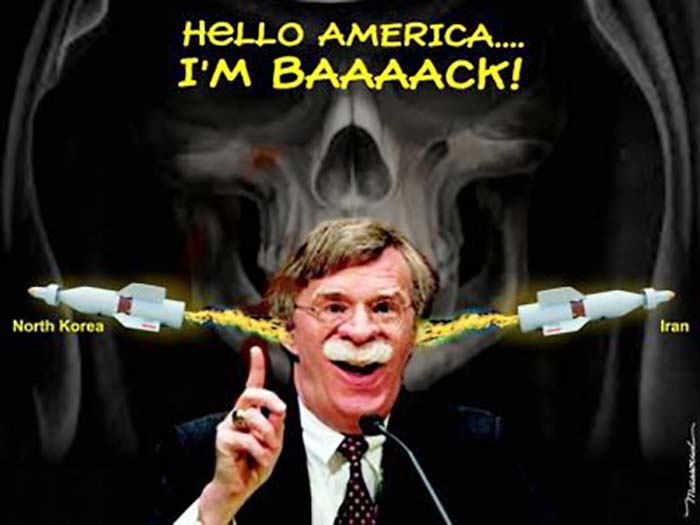
John Bolton Wants to Bomb Iran — and He May Get What He Wants

You underestimate John Bolton at your peril.
Remember when he was passed over for the job of secretary of state because, we were told, Donald Trump didn’t like his “brush-like mustache“? How we laughed. Yet less than 18 months later, after regular appearances on the Fox News casting couch, he was appointed national security adviser, with an office around the corner from the president’s.

Mehdi Hasan on Bolton Warmongering efforts

Remember when Defense Secretary James Mattis met with the new national security adviser on the steps of the Pentagon and joked that he was the “devil incarnate”? Mattis is gone. Bolton is still standing.
Remember when White House chief of staff John Kelly got into a “heated, profanity-laced shouting match” with Bolton, over immigration, right outside the Oval Office? Kelly is gone. Bolton is still standing.

Remember when Trump announced that the 2,000 U.S. troops in Syria were “all coming back, and they’re coming back now,” only a few weeks after Bolton had said they would be staying until all Iranian troops and proxies left the country? We were told that Bolton had been ignored, overruled, sidelined even. Not quite. Earlier this month, on a visit to Israel, the national security adviser confirmed that there was no timetable for pulling out the troops and it all would depend on the Turkish government guaranteeing the safety of U.S.-backed Kurdish fighters. “John Bolton puts brakes on Trump withdrawal from Syria,” read a headline in the Financial Times.
Trump’s national security adviser is a hard man to keep down.
In 2003, Bolton got the war he wanted with Iraq. As an influential, high-profile, hawkish member of the Bush administration, Bolton put pressure on intelligence analysts, threatened international officials, and told barefaced lies about weapons of mass destruction. He has never regretted his support for the illegal and catastrophic invasion of Iraq, which killed hundreds of thousands of people.
Now, he wants a war with Iran. So say State Department and Pentagon officials, according to the Wall Street Journal, who were “rattled” by his request to the Pentagon “to provide the White House with military options to strike Iran last year.” The New York Times also reported that “senior Pentagon officials are voicing deepening fears” that Bolton “could precipitate a conflict with Iran.”

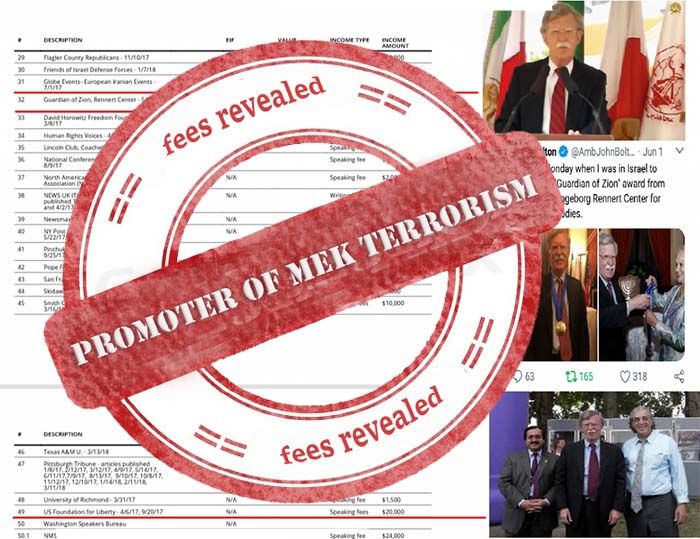
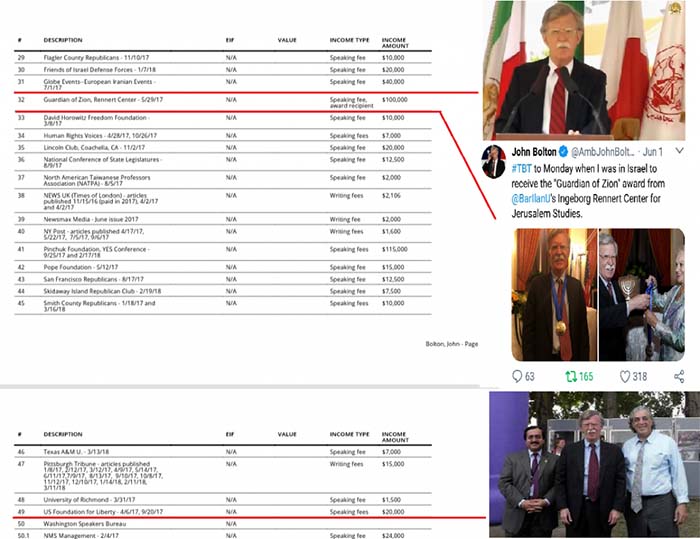
Should we be surprised? In March 2015, Bolton, then a private citizen, wrote an op-ed for the New York Times headlined, “To Stop Iran’s Bomb, Bomb Iran.” In July 2017, just eight months prior to joining the Trump administration, Bolton told a gathering of the cultish Iranian exile group Mujahedin-e-Khalq that “the declared policy of the United States of America should be the overthrow of the mullahs’ regime in Tehran” and that “before 2019, we here will celebrate in Tehran.”

Despite leaks to the press over the past few days from “rattled” but unnamed officials at the State Department and the Pentagon, Bolton is far from the only person close to Trump who is pushing a belligerent line on Iran. He has plenty of allies in the administration. As Vox reported on Monday, “Bolton has staffed up the NSC with people who share his views. Last week, he hired Richard Goldberg, a noted Iran hawk, to run the administration’s pressure campaign against the country.”
Outside of the Bolton-dominated National Security Council, there’s also the hawkish Secretary of State Mike Pompeo, who once suggested launching “2,000 sorties to destroy the Iranian nuclear capacity.” As I noted last week, in his recent speech on Middle East policy in Cairo, Pompeo made more than 20 references to “malevolent,” “oppressive” Iran and denounced “Iranian expansion” and “regional destruction,” while giving Saudi Arabia a big wet kiss. “Countries increasingly understand that we must confront the ayatollahs, not coddle them,” he declared. Pompeo then told Fox News, before leaving Cairo, that the United States would be hosting an international summit on Iran in Poland next month.
So how do these hawks plan to get their war with Tehran? Bolton, in particular, seems keen on two lines of attack. The first relates to the nuclear issue. “We have little doubt that Iran’s leadership is still strategically committed to achieving deliverable nuclear weapons,” the national security adviser told fellow Iran-hater Israeli Prime Minister Benjamin Netanyahu in Jerusalem earlier this month. There is, however, not a shred of evidence for Bolton’s claim; in fact, the U.S. intelligence community has flatly and repeatedly rejected it. “We do not know whether Iran will eventually decide to build nuclear weapons,” said Director of National Intelligence Dan Coats, in his 2017 “Worldwide Threat Assessment of the US Intelligence Community.”
The second line of attack relates to the activities of Tehran-backed groups in Iraq, Syria, and Lebanon. According to the New York Times, Bolton’s request for military options against Iran “came after Iranian-backed militants fired three mortars or rockets into an empty lot on the grounds of the United States Embassy in Baghdad in September.” To be clear: No one was killed or injured in this attack.

Also, how far does this retaliatory logic extend? The United States has been accused of supporting extremist, anti-government groups in Iran, as well as Israeli strikes on Iranian positions in Syria; does this mean that the Iranians have a right to launch retaliatory air strikes on U.S. soil? Do the Cubans have the right to bomb Miami, where a number of U.S.-supported anti-Castro groups reside and operate?
Logic, however, has never been Bolton’s strong suit. He is an ideologue. “It is a big mistake,” he once declaimed, “for us to grant any validity to international law even when it may seem in our short-term interest to do so — because, over the long term, the goal of those who think that international law really means anything are those who want to constrict the United States.”
To hell with international law. And the International Criminal Court. And civilian lives. The bellicose Bolton is going to spend much of 2019 making the case, both in public and in private, for war with Iran — a war that would make the invasion of Iraq look like a walk in the park. This is what makes the mustachioed national security adviser, with an office down the hallway from Trump, the most dangerous member of this reckless administration.
Devil incarnate? Perhaps that was an understatement.
Mehdi Hasan , The Intercept

January 22, 2019 0 comments
FacebookTwitterPinterestWhatsappTelegramSkypeEmail
Mujahedin Khalq; A proxy force

Inside the Beltway: Iran Hardliners vs. Iran Hardliners

Alarm bells went off last September in Washington’s corridors of power when John Bolton’s National Security Council asked the Pentagon for options for military strikes against Iran.
The council’s request was in response to three missiles fired by an Iranian-backed militia that landed in an empty lot close to the US embassy in Baghdad and the firing of rockets by unidentified militants close to the US consulate in the Iraqi port city of Basra.
“We have told the Islamic Republic of Iran that using a proxy force to attack an American interest will not prevent us from responding against the prime actor,” Mr. Bolton said at the time.
Commenting on the Council’s request, a former US official noted that, “people were shocked. It was mind-boggling how cavalier they were about hitting Iran.”
Jim Mattis, the then US Defense Secretary, who like Mr. Bolton is an Iran hawk, worried that military strikes would embroil the United States in a larger conflagration with Iran.
The request, moreover, seemed to call into question US President Donald J. Trump’s promise to America’s European allies that he would rein in Mr. Bolton who has a long track record of advocating military action against Iran.
Months before joining the Trump administration in the spring of 2018, Mr. Bolton drafted at the request of Mr. Trump’s then strategic advisor, Steve Bannon, a plan that envisioned US support “for the democratic Iranian opposition,” “Kurdish national aspirations in Iran, Iraq, and Syria,” and assistance for Iranian Arabs in the oil-rich Iranian province of Khuzestan and the Baloch who populate the Pakistani province of Balochistan and Iran’s neighbouring Sistan and Baluchistan province.
Frustrated by the Trump administration’s failure to respond to his suggestions, Mr. Bolton published the memo in December 2017.
Almost to the day two years after the publication and two months before the 40th anniversary of the Iranian revolution, Mr. Bolton asserted in a policy speech in Cairo, that the United States had “joined the Iranian people in calling for freedom and accountability…America’s economic sanctions against the (Iranian) regime are the strongest in history, and will keep getting tougher until Iran starts behaving like a normal country.” Mr. Bolton was referring to harsh US sanctions imposed in 2018 by Mr. Trump after withdrawing the United States from the 2015 international agreement that curbed Iran’s nuclear program.
Mr. Bolton’s plan stroked with Saudi thinking about the possibility of attempting to destabilize Iran by stirring unrest among its ethnic minorities. The thinking was made public in a November 2017 study by the International Institute for Iranian Studies, formerly known as the Arabian Gulf Centre for Iranian Studies, a Saudi government-backed think tank.
The study argued that Chabahar, the Indian-backed Iranian deep-sea port at the top of the Arabian Sea, posed “a direct threat to the Arab Gulf states” that called for “immediate countermeasures.” Pakistani militants claimed in 2017 that Saudi Arabia had stepped up funding of militant madrassas or religious seminaries in Balochistan that allegedly serves as havens for anti-Iranian, anti-Shiite fighters.
Mr. Bolton’s memo followed an article he wrote in The New York Times in 2015 headlined “To Stop Iran’s Bomb, Bomb Iran” at the time that President Barak Obama was negotiating the international agreement to curb Iran’s nuclear program.
Mr. Bolton argued in the op-ed that diplomacy would never prevent the Islamic Republic from acquiring nuclear weapons. “The inconvenient truth is that only military action like Israel’s 1981 attack on Saddam Hussein’s Osirak reactor in Iraq or its 2007 destruction of a Syrian reactor, designed and built by North Korea, can accomplish what is required. Time is terribly short, but a strike can still succeed,” Mr. Bolton wrote.

The memo was written at about the same time that Mr. Bolton told a gathering of the Iranian opposition group Mujahedin-e-Khalq that “the declared policy of the United States of America should be the overthrow of the mullahs’ regime in Tehran” and that “before 2019, we here will celebrate in Tehran.”

While Mr. Bolton has remained outspoken even if he has been careful in his wording as National Security Advisor, other past advocates of military action against Iran have taken a step back.
Mike Pompeo has since becoming Secretary of State hued far closer to the Trump administration’s official position that it is pursuing behavioral rather than regime change in Iran. But as a member of the House of Representatives, Mr. Pompeo suggested in 2014 launching “2,000 sorties to destroy the Iranian nuclear capacity.”
While the Trump administration has largely explained its hard line towards Iran as an effort to halt the country’s missile development, roll back its regional influence, and ensure that the Islamic Republic will never be able to develop a nuclear weapon, Mr. Bolton has suggested that it was also driven by alleged Iranian non-compliance with the nuclear accord.
“Report: Iran’s secret nuclear archive ‘provides substantial evidence that Iran’s declarations to IAEA (International Atomic Energy Agency) are incomplete & deliberately false.’ The President was right to end horrible Iran deal. Pressure on Iran to abandon nuclear ambitions will increase,” Mr. Bolton tweeted this month, endorsing a report by the Washington-based Institute for Science and International Security.
Based on Iranian documents obtained by Israel, the report identified an allegedly undeclared Iranian nuclear site. “Documentation seized in January 2018 by Israel from the Iranian ‘Nuclear Archive’ revealed key elements of Iran’s past nuclear weaponization program and the Amad program more broadly, aimed at development and production of nuclear weapons. The material extracted from the archives shows that the Amad program had the intention to build five nuclear warhead systems for missile delivery,” the report said.
Similarly, Mr. Bolton this month told Israeli Prime Minister Benjamin Netanyahu on a visit to Jerusalem that “we have little doubt that Iran’s leadership is still strategically committed to achieving deliverable nuclear weapons. The United States and Israel are strategically committed to making sure that doesn’t happen.”
Mr. Bolton’s assertion contrasted starkly with the Director of National Intelligence Dan Coats’ assessment in his 2017 Worldwide Threat Assessment of the US Intelligence Community that “we do not know whether Iran will eventually decide to build nuclear weapons.”
Mr. Bolton’s hardline position within the Trump administration could be cemented if Iran were to decide that upholding the nuclear agreement no longer served its interest. Anti-agreement momentum in Iran has been fueled by the European Union’s seeming inability or unwillingness to create a financial system that would evade US sanctions and facilitate trade with Europe.
Mr. Bolton’s hard line has also been bolstered by the imposition of European Union sanctions on Iran’s ministry of intelligence and two individuals on charges of plotting to kill leaders of an Iranian Arab separatist movement in Denmark and the Netherlands.
An Iranian abrogation of the nuclear agreement would likely lead to a reshuffle of the Iranian cabinet and the appointment of hardliners who would, in turn, bolster Mr. Bolton’s argument that the Iran issue has to be resolved before the United States can militarily truly disengage from the Middle East and South Asia.
Hardliners like Mr. Bolton may have one more development going for them: Disillusionment in Iran with the government of President Hassan Rouhani is mounting.
The disappointment is being fueled not only by the failure of the nuclear accord to drive economic growth and the government’s mismanagement of the economy and inability to take on nepotism, vested interests such as the Revolutionary Guards and the growing income gap accentuated by the elite’s public display of ostentatious wealth, but also the fact that Mr. Rouhani appears to have lost interest in reform and implementing change.
“Unfortunately, Mr. Rouhani’s second term has been extremely ignorant (about the demands) of the twenty-four million people who make up Iranian civil society. Most of the reformists believe that he no longer wants to interact (with the reform movement). All that concerns him is to emerge from the remaining two years (of his second term) undamaged, and thus maintain his privileged spot in the pyramid of power,” said Abdullah Naseri, a prominent reformist and adviser to the former President Mohammad Khatami. Mr. Naseri was referring to the 24 million people who voted for Mr. Rouhani.
A reformist himself, Mr. Khatami warned that “if the nezam (establishment) insists on its mistakes…(and) reform fails, the society will move toward overthrowing the system.”
The roots of Mr. Bolton’s thinking lie in a policy paper entitled US Defense Planning Guidance that has been in place since 1992. The paper stipulates that US policy is designed “to prevent any hostile power from dominating a region whose resources under consolidated control be sufficient to generate global power.” The paper goes a long way in explaining why the US and Saudi Arabia potentially would be interested in destabilizing Iran by stirring unrest among its ethnic minorities.

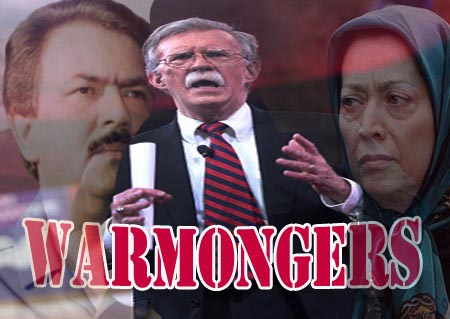
Iran scholar Shireen Hunter suggests that squashing Iran’s ambition of being a regional and global player may be one reason why senior Trump administration officials, including Mr. Bolton, Mr. Pompeo, and Rudolph Giuliani, the president’s personal lawyer, alongside the Saudis, support the Mujahedin e-Khalq even if its domestic support base is in question.
“The MEK was willing to support Saddam Hussein and cede Iran’s (oil-rich) Khuzestan province to Iraq. There is no reason to think that it won’t similarly follow U.S. bidding,” Ms. Hunter said referring to the Mujahedeen’s support of Iraq during the Iran-Iraq war in the 1980s.
Mr. Bolton appeared to be fortifying what amounted to the most hard-line approach towards Iran in an administration that was already determined to bring Iran to its knees by elevating Charles M. Kupperman, a long-time associate, and former Reagan administration official, to deputy National Security Adviser.

Mr. Kupperman, a former Boeing, and Lockheed Martin executive, previously served on the board for the Center for Security Policy, a far-right think tank advocating for a hawkish Iran policy founded by Frank Gaffney, a former US government official who is widely viewed as an Islamophobe and conspiracy theorist.
Similarly, Mr. Trump, reportedly on Mr. Bolton’s advice, hired this month Richard Goldberg as the National Security Council’s director for countering Iranian weapons of mass destruction.
As a staffer for former Senator Mark Kirk, Mr. Goldberg helped write legislation that served as the basis for the Obama administration’s sanctions regime on Tehran prior to the nuclear deal. He went on to work for the Washington-based Foundation for Defense of Democracies, which advocates a hard line towards Iran.
Earlier, Mr. Bolton hired Matthew C. Freedman, who in March 2018, together with Kupperman and Bolton registered the Institute for a Secure America as a non-profit organization on the day that Mr. Trump announced Mr. Bolton’s appointment as National Security Advisor.
A long-standing Bolton associate and one-time member of Mr. Trump’s transition team, Mr. Freedman worked in the 1980s and 1990s as a foreign lobbyist with Paul Manafort, who managed Mr. Trump’s election campaign for several months and was last year convicted as part of special counsel Robert Mueller’s investigation into alleged collusion between the Trump campaign and Russia to influence the outcome of the 2016 presidential election.
Bolton, Kupperman, and Freedman also established in 2015 the Foundation for American Security and Freedom to campaign against the Iran nuclear deal.
David J. Rothkopf, a former Clinton administration official who wrote a definitive history of the National Security Council described Mr. Bolton as a man “who has never crossed a bridge he hasn’t burned behind him, who is surrounding himself with what appears to be a second-tier group of advisers who have spent a disproportionate amount of time on the swamp side of things — as consultants or working on his extreme political projects.”
Said journalist and political commentator Mehdi Hasan: “You underestimate John Bolton at your peril…In 2003, Bolton got the war he wanted with Iraq. As an influential, high-profile, hawkish member of the Bush administration, Bolton put pressure on intelligence analysts, threatened international officials, and told barefaced lies about weapons of mass destruction. He has never regretted his support for the illegal and catastrophic invasion of Iraq, which killed hundreds of thousands of people. Now, he wants a war with Iran.”
Intpolicydigest

January 21, 2019 0 comments
FacebookTwitterPinterestWhatsappTelegramSkypeEmail
EU
Europe

Concerns over MEK’s threat in Europe

With the relocation of the Mujahedin Khalq Organization (the MKO/ MEK/ PMOI/ the Cult of Rajavi) in Albania Europe, concerns over the presence of a formerly terrorist designated group with cult-like attitudes has been increasing. From time to time, News outlets, TV channels shed light upon the matter of the MKO.
The most recent reference to the case of the MKO was posted on the Swiss newspaper New Zurich Zeitung. The author of the article Ulrich von Schwerin investigates the support by the side of US leading politicians for the MKO despite the fact that

“the history of the Iranian People’s Mujahedeen is bloody, turbulent and tragic, their method is controversial and their ideology is full of contradictions”. [1]

He finds the American support for the group as a contradiction too because it is the most hated opposition group among Iranian public.

“No Iranian opposition group polarizes like them, no one has so many critics, but no such prominent supporters,” he states. The contradiction leads him to wonder what role the MKO plays in Washington’s Iran policy is, and if it really is the right ally for the US government. [2]

To find out the answer, the author interviews or cites from several Western politicians, scholars and journalists including German Green MP Omid Nouripour.

“The People’s Mujahedeen have suffered an incredible amount of suffering, but also caused a lot of damage,” Nouripour says. He strongly advised against supporting the group because there are “huge questions about its ideology, its structure and its legitimacy” and because of its past it has little support in Iran. [3]

Thus, the author of NZZ concludes,

“For many, their commitment to democracy and human rights seems untrustworthy after alliance with Saddam Hussein. And even the pronounced leadership cult around the Rajavis makes many doubt on their democratic views.” [4]

Ulrich von Schwerin closes his article citing Daniel Benjamin of the New York Times who sees MKO’s multi-million dollar campaign to buy US politicians’ support as the main motivation for advocating the formerly terrorist designated group that has the blood of six US citizens in hand.

“It’s something when someone offers you $ 15,000 to $ 20,000 on the phone to join a panel discussion,” Benjamin says. “This does not happen to former diplomats every day.” [5]

Besides NZZ, there has been a post on the controversial presence of the MKO in Italian news website “Gli Occhi Della Guerra” based in Rome in the early January. The writer, Giovanni Giacalone focuses on the expulsion of the two Iranian diplomats by the Albanian government based on a false flag operation plotted by the Israeli Intelligence Mossad and the MKO.

“Apparently, the clash between the Shiite axis and the Salafite/Wahhabi galaxy, as well as between Israel and Iran, is now also taking place on Albanian soil and the MEK may play a major role in this scenario,” Giacalone suggests. “However, the Mojahedin base on the Adriatic threatens to increase destabilization in the Balkans, an area already characterized by strong ethnic-religious and political tensions, all to the detriment of Europe. Albania for its part is reconfirmed as among the most loyal allies of the United States and Israel.” [6]

The threat of the MKO is persistently confirmed by the Albanian-Canadian historian Dr. Olsi Jazexhi who was interviewed by the Balkan Post, last week. Albania is deriving no benefit but only headaches, scandals and bad name for what it is doing with MEK,” Dr Jazexhi tells Navid Nasr of the Balkan Post.

“The media in the Balkans and the region, from Serbia, to Greece, Macedonia and Italy, have reported with great concern the coming of MEK to Albania. Europeans are also upset with what Albania is doing.” [7]

He believes that the only people who are benefiting from hosting the MEK are organized criminals and some Albanian politicians who run gangs of drug dealers.

“Many Albanian politicians, like Prime Minister Edi Rama, Minister of Diaspora Pandeli Majko etc are building personal relationships with American politicians like John Bolton, Rudy Giuliani, Patrick Kennedy etc, who are opening their doors to Washington. In their yearly “Free Iran” meetings that MEK organizes in Paris, Maryam Rajavi is enabling many corrupt Albanian politicians to meet major European and American neocon politicians,”

he says.
He points out the destructive role of the MKO in the international relations particularly in the Europe considering the MKO as destructive as other Jihadist extremists like ISIS.

“The European Union, the Council of Europe and the Organization for Security and Cooperation in Europe, which are not happy with what Albania is doing, must be asked to raise their voice against the MEK’s activities,”

he suggests.

“These three organizations must extend their deradicalization programs over to the MEK and must not use their programs only against Albanian Muslims who want to do Jihad in Syria.”
“EU bodies must ask Albania and the Americans to come out with an action plan to deradicalize MEK in the same way that they are jailing and deradicalizing ISIS sympathizers. France must do the same,” he continues. “They must not allow Maryam Rajavi to use French soil as a base for violent Jihadi propaganda against Iran or any other country. The Europeans must ask MEK to open its camp, deradicalize its members, stop its Jihadi propaganda and its members must be allowed to marry, find jobs and start free civilian lives.”

By Mazda Parsi

References:
[1]Ulrich von Schwerin, Die Volksmujahedin sind fragwürdige Verbündete Washingtons in Iran, nzz.ch,January14,2019
[2]ibid
[3]ibid
[4]ibid
[5]ibid
[6]Giacalone,Giovanni,Gli iraniani erano davvero pronti
a fare un attentato in Europa? ,Gli Occhi Della Guerra, January6, 2019
[7]ibid

January 20, 2019 0 comments
FacebookTwitterPinterestWhatsappTelegramSkypeEmail
US training MEK members
Mujahedin Khalq; A proxy force

Iranian Mojahedin Train at U.S. Military Bases in Iraq, Says Iraqi MP

Some members of the People’s Mojahedin of Iran (MKO) have regrouped in Iraq with the help of U.S. military forces, the Islamic Republic News Agency (IRNA) reported on January 10.

The information was initially given four days earlier from Mohammed Al-Baldawi, a member of the Iraqi Parliament’s Security and Defense Committee, who said: “More than a dozen members of the MKO currently live and receive training at U.S. military bases in northern Iraq. U.S. forces in Iraqi Kurdistan have started arming and training the MKO members as soon as they arrived at the military bases.”

Mr. Al-Baldawi said “reorganizing the monafeghin [hypocrites, a reference to MKO members] was part of a sinister plot,” and called on the government to stop the U.S. from using Iraqi soil to launch operations against its neighbors.

Under pressure from the French government, the MKO moved its headquarters from Paris to Baghdad in 1987. President Saddam Hussein (1937-2006) allowed the MKO leader Massoud Rajavi and his organization to establish a base in Camp Ashraf in northeastern Iraq, 80 kilometers from the Iranian border.

Close to 3,000 members of the MKO lived in Camp Ashraf (1987-2012) and later at a U.S. military base known as Camp Liberty (2012-16) before relocating to Albania in 2016 with the help of the UN High Commissioner for Refugees.

There has been no official response to the news either from the Islamic Republic or the MKO. However, Ahmad Salek, a Majlis (Iranian Parliament) deputy representing Isfahan, recently said: “A string of military setbacks which led to a recent decision to pull the U.S. troops out of Syria has prompted Donald Trump to find other ways of maintaining U.S. influence in the region, including the reestablishment of the monafeghin in Iraqi Kurdistan.”
Keyhan, London,

January 19, 2019 0 comments
FacebookTwitterPinterestWhatsappTelegramSkypeEmail
Newer Posts
Older Posts

Recent Posts

  • Pregnancy was taboo in the MEK

    December 22, 2025
  • MEPs who lack awareness about the MEK’s nature

    December 20, 2025
  • Why did Massoud Rajavi enforce divorces in the MEK?

    December 15, 2025
  • Massoud Rajavi and widespread sexual abuse of female members

    December 10, 2025
  • Farman Shafabin, MEK member who committed suicide

    December 3, 2025
  • Facebook
  • Twitter
  • Instagram
  • Youtube

© 2003 - 2025 NEJAT Society . All Rights Reserved. NejatNGO.org


Back To Top
Nejat Society
  • Home
  • Articles
  • Media
    • Cartoons
    • NewsPics
    • Photo Gallery
    • Videos
  • Publications
    • Books
    • Nejat NewsLetter
    • Pars Brief
  • About Us
  • Contact us
  • Editions
    • عربي
    • فارسی
    • Shqip