Born on July 28, 1941, Michael Bernard Mukasey is a lawyer and former judge who served as the 81st Attorney General of the United States. He was appointed following the resignation of Alberto Gonzales. Mukasey also served for 18 years as a judge of the United States District Court for the Southern District of New York, six of those years as Chief Judge. He was the second Jewish U.S. Attorney General and currently he is a partner at the international law firm Debevoise & Plimpton.
On November 8, 2007, After two months of controversy, and a round of sporadically contentious Senate confirmation hearings, former judge Michael Mukasey narrowly won the Senate’s approval to become the next attorney general, by an almost-party line 53-40 vote. Musakey replaced Alberto Gonzales, who resigned under fire in September 2007. Many Democrats voted against Mukasey because of his refusal to categorize the interrogation technique of waterboarding as torture, and his refusal to say that he would oppose President Bush’s insistence on eavesdropping on US citizens. [CNN, 11/8/2007]
Notable issues and comments
Support for the MeK
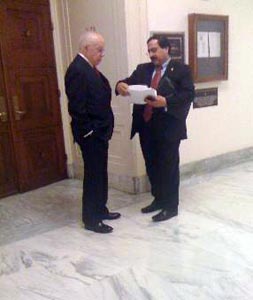 |
| Alireza Jafarzadeh, counseled former Bush Attorney General Michael Mukasey prior to his testimony |
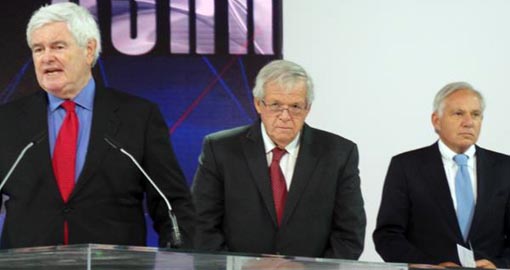
Mukasey is among the former high profile political officials who were apparently investigated over their financial transactions with the terrorists in the Mujahidin e Khalq aka “MEK” and paid advocacy on behalf of them. (Top Democrat’s speeches for terrorist group probed; The Washington Times – Friday, March 9, 2012)
Mukasey has admitted being paid by MEK and admitted he and his friends have helped the terrorist group by advocating for their removal from the FTO list. This admission by Mukasey contradicted his support for the 2009 Holder v Humanitarian Law Project Supreme Court Decision which held that such advice and assistance as he has admittedly provided in coordination with a designated foreign terrorist organization falls within “material support of terrorism” even if it is nothing but speech.
Mukasey has admitted he was paid handsomely by the MEK to advocate for them. He didn’t deny that his “expert advice and assistance” to MEK was coordinated, only that the designated terrorist group did not dictate what he said. He insisted that as long as the MEK did not write his speech, his acceptance of the terrorist organization’s money and his meetings with MEK members to coordinate his appearances and advocacy are not enough to get him into trouble.
Further, Mukasey accused the Treasury of improperly targeting him and his political friends by looking into the handsome amounts of money they have all been paid by the MEK. He claimed that the Treasury’s subpoenas looking into his and other high-level former politicians’ payments from MEK stemmed from the filing of their amicus brief arguing for MEK to be removed from the terrorist organization list.
What is worse is that Mukasey and his MEK-paid friends scoff at the laws and government terrorist designations they insist on applying to others. As Attorney General, Mukasey undoubtedly ordered prosecutions of many Muslims for financial transactions with FTOs involving far less money than he has been paid.
In their January 2011 opinion piece “MEK Is Not a Terrorist Group,” Mukasey’s group disclosed the perhaps bigger reason for their support of MEK than the thousands of dollars they were each paid, claiming that MEK “has provided valuable intelligence to the United States on Iranian nuclear plans.”
(Dear Department of Justice: Please Investigate Your Old Boss for Material Support of Terrorism! Coleen Rowley Former FBI Special Agent. Huffingtonpost, 03/20/2012 Updated May 20, 2012)
Eavesdropping
On December 12, 2007, Michael Mukasey, the new Attorney General, wrote an op-ed for the Los Angeles Times pushing for Congressional immunity for US telecommunications firms over their cooperation with the NSA’s warrantless wiretapping program. Mukasey supported the NSA program, echoing the administration’s long insistence that the surveillance program is “crucial” in protecting the country against terrorist attacks. He also reiterated the administration’s criticism of the “outdated” Foreign Intelligence Surveillance Act, which he said hampers the government’s ability to collect needed intelligence and does little to protect the privacy of US citizens. Mukasey called for Congress to pass a Senate bill that would grant the telecommunications firms retroactive immunity to civil lawsuits and criminal charges surrounding their cooperation with the NSA, and would no longer require court orders for the government to “direct surveillance at foreign targets overseas”—surveillance that would target US citizens. Mukasey also asked for full cooperation of private companies in intelligence activities and strongly opposed another Senate bill that would grant no immunity and would continue to require the government to obtain FISA Court warrants before wiretapping domestic communications. [LOS ANGELES TIMES, 12/12/2007]
Relationship with Giuliani
Mukasey and Giuliani have been friends since working at the same law firm in the early 1970s. [46] In 1985, when Rudolph W. Giuliani, the then U.S. ?????????, was coming under intense criticism for his aggressive tactics in prosecuting organized crime in attorney for the Southern District of New York, his former colleague, Michael B. Mukasey sprang to his defense. Mukasey wrote a strongly worded opinion piece in New York Times arguing that Giuliani’s tough tactics were justified to defeat “dangerous and powerful enemies”. Alec MacGillis, a senior editor at The New Republic magazine and former Washington Post staff writer, had described Mukasey’s public defense of Giuliani as “one example of the strong and lasting bond between President Bush’s nominee for attorney general and the man leading in the GOP polls to replace Bush.” In 1994, Giuliani selected Mukasey, then a federal judge, to preside over his inauguration as mayor. The ties only strengthened after Giuliani left City Hall. Mukasey’s son, Marc, a former assistant U.S. attorney himself, works as a partner at Giuliani’s consulting firm, and Giuliani named Mukasey and his son to one of his presidential campaign advisory committees. Dov Hikind, Democratic New York State Assemblyman has said about Mukasey and Giuliani that they “are two people who are extremely close — extremely, extremely close — and everybody knows that.” ]Washington Post [September 18, 2007
Waterboarding
On December 11, 2014, Mukasey publicly stated on CNN that he believed waterboarding could not be called torture. [ “Mukasey: Waterboarding is not torture”. YouTube. December 11, 2014.] In a 2008 hearing, he said waterboarding would feel like torture if he were subjected to it. [ “At Senate Hearing, Attorney General Michael Mukasey Refuses to Say if Waterboarding is Torture, Illegal”. Democracy Now!] In a letter to Senate Judiciary Chairman Patrick Leahy on January 29, 2008, Mukasey said he finished a review of Justice Department memos about the CIA’s current methods of interrogating terror suspects and finds them to be lawful. He claimed waterboarding currently is not used by the CIA. ]Chicago Tribune, January 30, 2008 [ Attorney General Mukasey on February 7, 2008 said he will Not investigate US government’s use of waterboarding [MOTHER JONES, 2/7/2008].
Remarks about pre-9/11 terrorist phone call
Speaking in San Francisco to the California Commonwealth Club on March 27, 2008, Mukasey defended President Bush’s program of wiretapping calls between Americans and suspected foreign terrorists without court authorization, and implied that the government might have been able to prevent the attacks of September 11, 2001, if it had been able to wiretap a specific call to the U.S. from Afghanistan. Before September 11, 2001, Mukasey said, “We knew that there had been a call from someplace that was known to be a safe house in Afghanistan, and we knew that it came to the United States. We didn’t know precisely where it went.” He paused, seemed to stifle tears or at least suppress emotion, then continued, “You’ve got 3,000 people who went to work that day, and didn’t come home, to show for that.” In a subsequent letter to Mukasey, House Judiciary Committee Chairman John Conyers questioned whether any such phone call had ever actually occurred and, if so, why the government hadn’t been able to use its then-existing legal authority and technological capabilities to monitor it. Also, Some media outlets pick up on the Mukasey’s claim. For example, the San Francisco Chronicle notes that Mukasey “did not explain why the government, if it knew of telephone calls from suspected foreign terrorists, hadn’t sought a wiretapping warrant from a court established by Congress to authorize terrorist surveillance, or hadn’t monitored all such calls without a warrant for 72 hours as allowed by law.” [SAN FRANCISCO CHRONICLE, 3/28/2008].
Boston College Law School Won’t Honor Mukasey
John Garvey, the dean of Boston College Law School announced on March 28, 2008 that the school will not award its highest honor to US Attorney General Michael B. Mukasey at its May commencement amid sharp criticism from some students, faculty, and alumni over his invitation as graduation speaker. The move reflects broad discontent with Mukasey’s controversial refusal to declare that a prison-interrogation technique known as waterboarding constitutes torture. [Huffington Post, 03/28/2008[
Violations of the law are not always crimes
On August 12, 2008, Mukasey told American Bar Association annual meeting delegates that “not every wrong, or even every violation of the law, is a crime,” with “only violations of the civil service laws” being found among hiring practices during Gonzales’ tenure as Attorney General.