Nejat Society
  • Home
  • Articles
  • Media
    • Cartoons
    • NewsPics
    • Photo Gallery
    • Videos
  • Publications
    • Books
    • Nejat NewsLetter
    • Pars Brief
  • About Us
  • Contact us
  • Editions
    • عربي
    • فارسی
    • Shqip
Nejat Society
Nejat Society
  • Home
  • Articles
  • Media
    • Cartoons
    • NewsPics
    • Photo Gallery
    • Videos
  • Publications
    • Books
    • Nejat NewsLetter
    • Pars Brief
  • About Us
  • Contact us
  • Editions
    • عربي
    • فارسی
    • Shqip
© 2003 - 2024 NEJAT Society. nejatngo.org
Iran

Iran Rejects MKO, Netanyahu’s Claims about Undeclared Nuclear Activities as Lies

Iranian Defense Minister Brigadier General Hossein Dehqan dismissed as “lies” the recent claims made by Israeli Prime Minister Benjamin Netanyahu and the terrorist Mojahedin-e Khalq Organization (MKO, also known as the MEK, NCRI and PMOI) that Iran has an “undeclared nuclear site” at one of its military facilities.

General Dehqan’s remarks came after MKO claimed that Iran has a nuclear site that it has not declared its presence to the International Atomic Energy Agency (IAEA). The Israeli prime minister has kept repeating MKO’s claims.

“Netanyahu and the terrorist MKO, that share treason and fabrication as their conspicuous characteristics, in a wicked coordination have forged this news report in a bid to undermine and influence the successful diplomacy of the Islamic Republic of Iran in their futile dreams,” Dehqan said.

He said the new plot and false claim by Netanyahu and MKO which will not be the last in its kind will be foiled like the previous ones, and reiterated that “such conspiracies can no way undermine Iran’s will to proceed with its peaceful nuclear objectives and continue its rational negotiations with the Group 5+1 (the five permanent UN Security Council members plus Germany).

Last week, Netanyahu warned the six world powers to give up their present approach in negotiations with Tehran, which diplomats of both Iran and the six world powers say, is much likely to end in an agreement soon.

As western diplomats said they have offered Tehran an ease in sanctions in return for Tehran stopping any further advancement in its nuclear enrichment activities, the Israeli premier said Tel Aviv is against an agreement with Iran that stops short of getting it to halt its uranium enrichment.

“Israel understands that there are proposals on the table in Geneva that would ease the pressure on Iran for concessions that are not concessions at all,” he said, during a speech to the Jewish Agency.

While a nuclear military capability needs uranium enriched more than 90% and Iran has succeeded in enriching uranium to a maximum 20% to feed its nuclear research reactor in Tehran which produces radioisotopes for medical purposes, including cancer treatment, the Israeli prime minister said the 20-percent enrichment capability enables Iran to build an atomic bomb.

“This proposal will allow Iran to preserve its ability to build a nuclear weapon. Israel is completely opposed to these proposals. I believe that adopting them would be a mistake of historic proportions and they should be completely rejected,” he said.

Netanyahu renewed his military threats against Iran, warning that if the present negotiations in Geneva between Iran and the six world powers end in an agreement undesirable to Israel, Tel Aviv might wage an attack on Iran.

He said “anything less” than a complete halt of Iran’s nuclear activities would decrease the chances of reaching an agreement through peaceful means. “Israel always reserves the right to defend itself, by itself, against any threat,” he asserted.

Iran, which says its nuclear program is a peaceful energy project, wants them to start lifting tightening sanctions on its economy.

Both Iran and the six world powers have described the talks as “positive”.

Iran’s Deputy Foreign Minister Seyed Abbas Araqchi said he hoped a deal could be struck but that the sides remained far apart.

November 20, 2013 0 comments
FacebookTwitterPinterestWhatsappTelegramSkypeEmail
Mujahedin Khalq Organization's Propaganda System

MKO to launch new propaganda against Iran’s nuclear program

 Media reports said on Sunday the Mojahedin-e Khalq Organization (MKO) is trying hard to create obstacles in the way of Iran- 5+1 group talks by staging new round of propaganda against the Islamic Republic.

According to IRNA, the Beirut-based Al-Dayar news website reported that MKO in line with serving the interests of Zionist regime is trying to repeat its baseless allegations about Iran’s peaceful nuclear program.

Al-Dayar reported “The MKO intends to provide certain media with fake and fabricated documents about Iran’s nuclear activities.”

MKO has a track record of making similar allegations before and it had propagated against Iran’s peaceful nuclear program by claiming that the Islamic Republic is trying to gain access to nuclear weapons.

None of MKO’s allegations has been approved by an international body.

The Zionist regime’s discontent with Iran’s gaining access to a limited understanding in Geneva negotiations in recent weeks is regarded the main reason for employing MKO in the new wave of Israel’s spread of lies and fabrications.

November 19, 2013 0 comments
FacebookTwitterPinterestWhatsappTelegramSkypeEmail
Iraqi Authorities' stance on the MEK

Iraqi PM urges MKO supporters to allow in members

A Senior Iraqi lawmaker says the supporters of the terrorist Mujahedin-e Khalq Organization (MKO) must relocate the group’s members to their own countries.

Abbas al-Bayati told Fars News Agency given the crimes committed by the MKO against the Iraqi people, the continuation of their presence in Iraq was unacceptable.

Referring to the support of a number of European states for the MKO, al-Bayati urged them to relocate the members of the terrorist group to their own countries.

The European Union removed the MKO from its list of terrorist organizations in 2009 after the group filed a petition against the blacklisting in 2008.

The Iraqi lawmaker noted there was no difference between the MKO and al-Qaeda or the terrorist group of “Islamic State of Iraq and the Levant (ISIL).

The MKO is not different from al-Qaeda and the ISIL and other terrorist groups that have killed the innocent people of Iraq, al-Bayati added.

He said some of the group’s members, who face prosecution for the crimes they have committed in several Iraqi cities, such as Karbala, Khanaqin and Tuz Khormato, must stand trial in the country’s courts.

The MKO fled to Iraq in the 1980s, where it received the support of executed Iraqi dictator Saddam Hussein and set up Camp Ashraf in the eastern province of Diyala, near the Iranian border.

The group also cooperated with Saddam in the massacres of Iraqi Kurds and in suppressing the 1991 uprisings in southern Iraq.

The MKO is listed as a terrorist organization by much of the international community and has committed numerous terrorist acts against Iranians and Iraqis.

In December 2011, the United Nations and Baghdad agreed to relocate some 3,000 MKO members from Camp New Iraq (formerly known as Camp Ashraf) to Camp Liberty.

The last group of MKO terrorists was evicted by the Iraqi government on September 11 to join the other members of the terrorist group at Camp Liberty near Baghdad International Airport and await relocation to other countries.

November 18, 2013 0 comments
FacebookTwitterPinterestWhatsappTelegramSkypeEmail
The MEK Expulsion from Iraq

Iraqi NGOs Urge Rapid Expulsion of Mojahedin Khalq

Iraq’s non-governmental organizations (NGOs) asked the Baghdad government to expedite expulsion of the members of the Mojahedin-e Khalq Organization (MKO, also known as MEK, NCRI and PMOI) from their country.

Several NGOs attending a conference in Baghdad urged the government of Iraqi Prime Minister Nuri Al-Maliki to expel the remaining MKO members from Iraq immediately.

Adnan Al-Shahmani, member of the Iraqi Parliament’s National and Defense Committee said that the Baghdad conference has been organized by NGOs in a bid to exert pressure on the government to accelerate expulsion of MKO members.

He noted that there are still more than 2,000 MKO members present in Iraq, although hundreds of others have been sent to other countries.

Abbas Al-Bayati, another participant in the conference, reiterated that MKO plays a dangerous role in Iraq and its presence poses a grave danger to the crisis-hit country.

The last group of MKO terrorists at Camp Ashraf, now called Camp New Iraq, was evicted by the Iraqi government on September 11 to join other members of the terrorist group in the former US-held Camp Liberty, now called Camp Hurriya, near Baghdad International Airport where they are awaiting relocation to other countries.

The MKO, founded in the 1960s, blended elements of Islamism and Stalinism and participated in the overthrow of the US-backed Shah of Iran in 1979. Ahead of the revolution, the MKO conducted attacks and assassinations against both Iranian and western targets.

The group started assassination of the citizens and officials after the revolution in a bid to take control of the newly-established Islamic Republic. It killed several of Iran’s new leaders in the early years after the revolution, including the then President, Mohammad Ali Rajayee, Prime Minister, Mohammad Javad Bahonar and the Judiciary Chief, Mohammad Hossein Beheshti who were killed in bomb attacks by the MKO members in 1981.

The group fled to Iraq in 1986, where it was protected by Saddam Hussein and where it helped the Iraqi dictator suppress Shiite and Kurd uprisings in the country.

The terrorist group joined Saddam’s army during the Iraqi imposed war on Iran (1980-1988) and helped Saddam and killed thousands of Iranian civilians and soldiers during the US-backed Iraqi imposed war on Iran.

Since the 2003 US invasion of Iraq, the group, which now adheres to a pro-free-market philosophy, has been strongly backed by neo-conservatives in the United States, who eventually took the MKO off the US terror list.

The US formally removed the MKO from its list of terror organizations in early September 2012, one week after the then Secretary of State, Hillary Clinton, sent the US Congress a classified communication about the move. The decision made by Clinton enabled the group to have its assets under the US jurisdiction unfrozen and do business with the American entities, the State Department said in a statement at the time.

November 18, 2013 0 comments
FacebookTwitterPinterestWhatsappTelegramSkypeEmail
Mujahedin Khalq Organization's Propaganda System

Starving MEK calls for democracy in Iraq: just for the LOLs

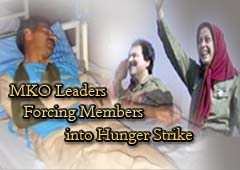
Massoud Rajavi apparently doesn’t know how long it takes for a normal human being to starve to death even on a diet of sugar and water. It is surely a lot sooner than 74 days; though perhaps these women have not quite used up their fat reserves yet. But then, since everything the MEK does and says seems to be based on fiction, it is no wonder the journalist completely misunderstood what message she was supposed to convey in her article – since when have the MEK been fighting for democracy in Iraq?! The only blessing for Rajavi is that this story only made it to the local free paper, location of yet another of the MEK’s western backed safe houses. And of course, the diplomats and the public at the American embassy can see for themselves what a joke this outfit is. We bring it to you ‘just for the LOLs’. (Iran Interlink editor)

Hunger strikers calling for democracy in Iraq: ‘I don’t know how long they can continue’

Natalie O’Neill, Hendon Times, November 16 2013

Hunger strikers camped outside the US Embassy are on their 74th day as they continue to campaign for the safety of hostages in Iraq.

The six Anglo-Iranians, five of whom are from Barnet, are drinking nothing but water and eating only sugar cubes in a desperate attempt to draw attention to their cause.

The group has been sleeping in a makeshift camp outside the US Embassy in Grosvenor Square since September 1, following news that 52 people were killed in Camp Ashraf and hostages taken.

Many Iranians living in Barnet had loved ones living in the camp which was home to the principal Iranian opposition movement, the People’s Mojahedin Organization of Iran (PMOI).

Laila Jazayeri, director of the Association of Anglo-Iranian Women in the UK said: “I don’t know how long the hunger strikers can continue. I think what they’re doing is a very brave thing – they are very determined but they are very ill and unwell.

“They are desperate to secure the protection of the hostages and the remainder of our people who are now living in Camp Liberty.”

Iran Interlink from Hendon Times,

November 17, 2013 0 comments
FacebookTwitterPinterestWhatsappTelegramSkypeEmail
Nejat Publications

Pars Brief – Issue No. 75

Inside this Issue:

  1. Britain may admit 17 Liberty residents with no links to terrorism
  2. U.S. Pledges Support to UN Trust Fund for Resettlement of Camp Hurriya Residents
  3. MEK Makes Desperate New Iran Nuclear Accusation, Reuters Yawns
  4. German authorities protest over MKO relocation in Koln
  5. Spy nabbed in Israel MKO agent: Ex-MKO member
  6. 5 Enemies of Diplomacy Hell-Bent On Sabotaging Peace Between America and Iran
  7. Just who has been killing Iran’s nuclear scientists?
  8. Meet The Weird, Super-Connected Group That’s Mucking Up U.S. Talks With Iraq

Download Pars Brief – Issue No. 75

November 16, 2013 0 comments
FacebookTwitterPinterestWhatsappTelegramSkypeEmail
Mujahedin Khalq Organization as a terrorist group

Mojahedin Khalq spending spree suffers backlash in Washington

Lindsey Graham returns donation to Iranian exile group

Masood Abooali contributed $2,600 in August to Sen. Lindsey Graham’s reelection campaign. The next month, the Iranian-American received a refund, along with a terse explanation: The campaign was “uncomfortable” with some of his associations and had rejected his contribution.Lindsey Graham returns donation to Iranian exile group

Abooali, a 56-year-old engineer who lives in Northern Virginia, left Iran 30 years ago and is now a U.S. citizen. He said in an interview he’s a former political prisoner — detained three times for a total of two years — of the regime in Iran that came to power in its 1979 revolution.

He’s also a supporter — but, he emphasized, not a member — of the Mujahedeen-e-Khalq, known as the MEK, a leftist group of Iranian exiles pushing for the overthrow of the regime.

Last year, the State Department removed the MEK from its list of designated terrorist organizations after a number of defense heavyweights spoke out on the group’s behalf, including former Homeland Security Secretary Tom Ridge and Frances Townsend, who was a homeland security adviser to President George W. Bush.

For his part, Abooali said his “past is clear of any violence or any activity against the United States, which I am proudly a citizen of.”

“I’m a hardworking family man concerned for my family that I left behind, concerned for my mother who I haven’t seen in 30 years,” he said, explaining that he contributed to Graham’s reelection campaign because of the South Carolina Republican’s hard-line stance on sanctions against the Iranian government and his denunciation of its human rights abuses.

“To me,” Abooali added, “the politics of appeasement is hurting us.”

Graham is very much a hard-liner on the issue. The outspoken member of the Senate Armed Services Committee, who faces several conservative primary challengers back home, is pressing for stepped-up sanctions against the Islamic Republic even as the Obama administration works to clinch a deal to curb the country’s nuclear program.

Graham’s push for tougher sanctions — an issue that could become a sticking point this week with the Senate expected to take up its annual defense authorization bill — has won him the backing of a number of supporters of the MEK.

His roster of donors last quarter includes two names that match those listed as having signed a 2011 letter urging then-Secretary of State Hillary Clinton to overturn the group’s terrorist designation. Others match the names of those listed as having commented in support of the group in online forums or signed pro-MEK petitions.

Each of the contributions was refunded.

“During routine due diligence by campaign staff, it was discovered that a few donors had associations the campaign was uncomfortable with,” said campaign spokesman Tate Zeigler, who declined to provide further details.

“In an abundance of caution,” he said, “the contributions were refunded.”

Last quarter, the Graham campaign sent refunds to 24 donors totaling $44,825 according to its latest filings with the Federal Election Commission. But not all of the refunds were because of the contributors’ associations, Zeigler said. A “significant number” were because the donors “had exceeded their federal limit.”

In all, Graham’s campaign hauled in $1.2 million in the past quarter and has raised $6.2 million this election cycle. His recent donors include the political action committees for a number of top defense contractors — Raytheon, General Atomics and BAE Systems, among others — along with a personal contribution from former President Bush.

Abooali said he had no hard feelings over his rejected contribution, noting that Graham never asked for his support. He also said he would donate again to “any politician who takes sides with the Iranian people” and works to strengthen sanctions against the regime.

Earlier this year, Abooali contributed to two other Iran hawks, giving $2,600 to Sen. Robert Menendez (D-N.J.), chairman of the Senate Foreign Relations Committee, and $1,000 to Rep. Ileana Ros-Lehtinen (R-Fla.), a senior member of the House Foreign Affairs Committee.

Neither campaign reported sending Abooali a refund, nor did either respond to questions about whether they have concerns about accepting donations from a supporter of the MEK.

The State Department revoked the group’s designation as a foreign terrorist organization in September 2012, saying its decision was based on three factors: The MEK had renounced violence, its members hadn’t committed any “confirmed acts of terrorism” in more than a decade and it had cooperated in “the peaceful closure of Camp Ashraf,” a refugee camp in Iraq where thousands of members of the MEK had lived in exile since the 1980s.

“The department does not overlook or forget the MEK’s past acts of terrorism, including its involvement in the killing of U.S. citizens in Iran in the 1970s and an attack on U.S. soil in 1992,” a senior State Department official said last year, speaking to reporters on background.

The decision came after a lobbying blitz — complete with television ads, speaking gigs and columns in a number of major newspapers — urging Clinton to overturn the terrorist designation, which dated to 1997.

Last year, for example, Ridge co-wrote a pro-MEK op-ed with retired Joint Chiefs of Staff Chairman Gen. Hugh Shelton and former Democratic Rep. Patrick Kennedy of Rhode Island.

“The regime in Tehran views MEK as an existential threat because MEK strives to replace the unelected, clerical regime with a liberal democracy that champions a non-nuclear Iranian future, equal rights for women and minorities, and a free press,” they wrote in the op-ed, published online by Fox News.

“But,” they continued, “the major opposition to the mullahs is being prevented from realizing these dreams of freedom for the Iranian people because both Iran and the U.S. designate them as a terrorist organization.”

Austin Wright, Politico

November 16, 2013 0 comments
FacebookTwitterPinterestWhatsappTelegramSkypeEmail
Albania

Albanians choke on MEK, Al Qaida, Chemicals dumped by America

‘We Are Not A Dustbin’: Albanians Balk At Reported Chemical Weapons Plan

Environmental activists protest against the proposed chemical weapons plan outside a government building in Tirana on November 13.

Albania has done the United States a lot of favors in recent years.

It has agreed to take in freed Guantanamo Bay prisoners and contributed to the U.S. military campaigns in Iraq and Afghanistan with little protest from society.

But with reports now surfacing that Syria’s chemical weapons may be dismantled in their country, Albanians’ generosity appears to have reached its limit.

Hundreds of protesters took to the streets in the capital, Tirana, on November 12, the second rally in less than a week.

Chanting “No To Chemical Weapons,” the demonstrators gathered in front of parliament before marching to the U.S. Embassy.

Sazan Guri of the Alliance Against Waste Imports, which organized the protest, stressed that Albanians remain very pro-American and that the demonstration was not against the United States. The goal, instead, was to spread the message that Albania should not be a “dustbin.”

“We are against the weapons and not against America. America is our big brother, always in cooperation with this nation and this country,” Guri said.

During the 20th century, there has been strong pro-U.S. sentiment in Albania, in particular in recent years after the U.S. intervention in the Kosovo war in the late 1990s and its commitment to Kosovo’s statehood.

Popular Opposition

After years of importing hazardous waste from its richer neighbors, the government of Prime Minister Edi Rama banned waste imports in October, weeks after coming to power. The ban followed a two-year grassroots campaign from environmentalists. Earlier this month, Albania’s parliament passed legislation allowing for the import of some nonhazardous waste.

Besar Likmeta, a Tirana-based editor for the Balkan Investigative Reporting Network, says there is opposition to taking in Syria’s chemical weapons from “all strata of society.”

“People are worried for their safety. There isn’t much information that is coming out of the government. Also there is this feeling that pro-Americanism has been taken for granted and we’re kind of saying yes to everything that is being put on our table,” Likmeta says.

Likmeta notes that Albania agreed to take in 11 former Guantanamo Bay prisoners and 210 members of an Iranian opposition group, the Mujahedin-e Khalq Organization (MKO). It also supported Washington in its military campaigns in Afghanistan and Iraq.

The Organization for the Prohibition of Chemical Weapons (OPCW) confirmed in October that Syria had destroyed all its declared equipment for the production of chemical weapons ahead of a November 1 deadline.

That represented the first step toward eliminating Syria’s arsenal by mid-2014 under a September United Nations Security Council resolution. But how that will be achieved has still not been determined.

After media reports surfaced that the United States had asked Albania to destroy the weapons on its soil, Prime Minister Rama confirmed on November 12 that he had indeed discussed the issue with U.S. Secretary of State John Kerry.

Rama stressed, however, that no final decision had been made.

A decision, however, could come as early as November 15, when the OPCW, the global chemical weapons watchdog, was due to discuss plans on eliminating Damascus’s arsenal.

The U.S. Embassy in Tirana declined comment on the reports.

But during a visit to the northern city of Shkoder last week, the U.S. ambassador to Tirana, Alexander Arvizu, said NATO-member Albania and “all the responsible international partners” must look for ways to contribute to disposing of Syria’s chemical weapons.

“It’s incumbent upon all responsible nations, certainly including the United States and Albania in that group, to find timely and effective ways to eliminate the menace that is posed by Syria’s chemical-weapons program,” Arvizu said.

Albania has recent experience in eliminating chemical weapons. With U.S. technical and financial assistance, Tirana destroyed its own 16-ton arsenal in 2007.

Albania’s geographical position on the Adriatic Sea would allow the transportation of the Syrian stockpiles by sea or by air without transiting another country.

Safety Concerns

But there are also concerns about safety.

Much of the hazardous waste from Albania’s own destroyed arsenal remains stored in containers at an army base near Tirana.

Likmeta recently visited that facility and was disturbed by what he saw.

“There was nobody to be seen, guarding these 25 containers of chemical waste and hazardous waste which remain from Albania’s stockpiles. I was standing and shouting for somebody to hear it, to meet somebody there at the gate of the base, but there was no one to answer,” Likmeta said.

Moreover, an attempt to dispose of Albania’s conventional weapons took a tragic turn in 2008, when 26 people were killed and more than 300 wounded in an explosion at a former army barracks outside Tirana where old artillery shells were being dismantled.

Parliamentary speaker Ilir Meta also raised questions about Tirana’s ability to dismantle the weapons in a television interview on November 7, saying, “Even other, much bigger and more developed countries do not accept it.”

Norway has already rejected the idea of dismantling Syria’s arsenal on its soil. Denmark and Sweden say they are prepared to help transport the weapons but not dismantle them.

France and Belgium have also been mentioned in press reports as possible sites for the dismantling of Syrian chemical weapons.

Ian Anthony, the director of the Arms Control and Nonproliferation Program at the Stockholm International Peace Research Institute, says that “both safety and security issues would have to be examined in the specific context of what it is that Albania was being asked to do. If the task that was given and that Albania agrees to accept was broadly comparable to what they’ve already done, then they have the experience and they have the facilities.”

“If they’re asked to do something which is of larger scale and a more complicated process, then I think there would be risks unless Albania receives significant assistance from outside parties,” Anthony says.

Likewise, Alastair Hay, professor of environmental toxicology at University of Leeds, says Albania won’t be asked to do something that the OPCW doesn’t think it is capable of doing.

Arbana Vidishiqi and Antoine Blua,

RFE/RL’s Balkan Service contributed to this report

November 16, 2013 0 comments
FacebookTwitterPinterestWhatsappTelegramSkypeEmail
Iran Interlink Weekly Digest

Iran Interlink Weekly Digest – 29

++This week’s guest on Mardom TV was Mohammad Hossein Sobhani. Among other issues he went into some detail about what it is that the Mojahedin Khalq do for MOSSAD. Expanding on this he reminded us of what various former CIA officials have said about the MEK – ‘they are useful because they do things we are ashamed to do ourselves’.

++ Hamed Sarrafpour’s Facebook this week mentioned the discovery of plutonium in the body of Yaser Arafat. He says that although 95% of the MEK’s websites praise Israel, this week Rajavi couldn’t resist re-publishing the picture of his wife posing with Arafat, but while claiming they are in grief over his death they still were very careful not to make any mention of Israel in this respect.

++ In reaction to the support which some European parliamentarians have given to the MEK and Al Hashemi (the fugitive from Iraq) in Brussels, there have been many reactions from Baghdad. Among them Karim Alivi a prominent MP for the Badr parliamentary bloc who said that in order to continue supporting the MEK, European countries must move them to their own countries and not foist them on Iraq. He said ‘we refuse to keep them in Iraq under any name, refugee or other, because they have killed our children and our people during the era of the tyrant Saddam’. Another is the head of the Commission for Foreign Affairs in Iraq who has issued a statement saying that ‘we have discussed the MEK with our foreign counterparts. The ambassador of the European Union assured us that the MEK had not been invited by parliament, but only by a media representation which has no relation with the EP or EC and that what Al Hashemi and MEK have been claiming about being invited by the EP is simply a lie’.

++ Irandidban website has published an article listing some of the MEK’s western supporters and some of their Iranian supporters in the west and asks, why is it the most disreputable people are gathered under one roof?

++ The saga of the hunger strike is continuing. Nejat Association in Tehran has published a short article explaining how Rajavi is trying to use this to force a response from western governments who are ignoring him and his demands – Rajavi’s theory is that he can open his way with other people’s blood. It is clear they can read his hand and so refuse to answer. But many critics within the sphere of influence of the MEK including Hadi Afshar and Saeed Jamaali address their fellow supporters and remind them that if anyone dies during this so-called hunger strike then their hands are dipped in their blood as well because they are the people who should get Rajavi to spare their lives rather than inciting them to carry on to their deaths.

++ Javad Firouzmand from Ariya Iran in Paris has written an Open Letter to Maryam Rajavi endorsing the claims of Hadi Afshar and his ongoing memoir. Firouzmand refers to the many women who have claimed Rajavi raped them in front of Maryam and says that with so many high ranking disaffected members making these claims and comparing this with what the MEK have themselves said about the relation of women to Massoud and Maryam Rajavi, it is necessary, once and for all for the Rajavis to come clean and either deny or confirm the accusations. This will not go away says Firouzmand, and ‘although I have my own doubts about these events, if you don’t answer we can only assume they are true’.

++ Atefeh Eghbal writes on the subject of the hunger strike. She says it is clear that in the near future the so-called president elect (for the past 16 years) will emerge to save the lives of the hunger strikers by giving a speech the same way she came out after the murder of 52 members in Camp Ashraf who were apparently there to protect her belongings. Everyone will be a winner except those who have genuinely starved who will suffer the ill effects for the rest of their lives.

++ Mohammad Reza Rowhani has published the fifth part of ‘The Smell of Joseph’s Shirt’. He examines specific concepts published under the name of Massoud Rajavi himself and relates these to the attacks against himself. Rowhani concludes that from this comparison it is clear that the attack on him was done by order and was not spontaneous. He also refers to incidents from before he had left, during and after, when the MEK’s intelligence operatives had been pretending to be his friend to investigate and try to gather information about his life in order to later fabricate lies about him.

++ Irandidban carries an article under the title, ‘Anti-Iranian policies and the future of Rajavi’. The article says that Israel, Saudi Arabia and their backing systems in the west have tried using terrorism in various ways, from Al Qaida to Jundullah to Jaish Al Adl even though they know that this doesn’t help but only brings hatred against them from among Iranians who know who is behind these things. Clearly after they failed in every other way they have had to resort to terrorism. But Rajavi knows, and his masters know, that the MEK has even lost the capacity for terrorism and is no longer of much use to the point that the MEK have become a rent-a-crowd carnival service. The MEK have become mere cheerleaders for terrorism so far have they been demoted in Washington and elsewhere.

++ Behzad Alishahi, from the Community of Independent Bloggers, has made a short video producing documents from throughout Rajavi and the MEK’s history. This demonstrates how the MEK have been betraying their country and their own members. How, from the start, they have been working as a mercenary force from initial collaboration with the Soviet Union and then inside Iran working for different factions, then helping western intelligence from France and then openly joining forces with Saddam up to now when they are openly working for Israel and western forces against Iran. They have no history when they were not mercenaries.

++ In English, Press TV has linked the recent position taken by France in the Geneva talks with the uncompromising stance of Israel and also the MEK. According to the article France snubbed Zarif during an official visit, the first such high-level meeting since 2009, The article claims that for years France has been the most anti-Iranian nation in the EU, and perhaps even more so than the US. It exposes France’s position, pointing out that “openly imperialist Zionists, on the other hand, occupy nearly all the top positions in Hollande’s cabinet: the interior, finance and, of course, the foreign minister. The prime minister and defense minister are the only two among the government’s top jobs who probably don’t have Israeli citizenship. … And the lack of pro-Iranian counterpoints in French society does not stop there: France is the second home of the terrorist Mujahedin Khalq Organization (MKO), a group of fifth columnists who have absolutely no legitimacy to any Iranian for reasons it takes only seconds to comprehend: they fought with Saddam Hussein against Iran during the Iran-Iraq war. But a poster of the ringleader of this bizarre cult, Marjane [sic] Rajavi, was recently all over Paris to advertise her new book. And they are supported by the French government to the extent that they have been mistakenly removed from the EU’s terrorist list. This is who has influence in France’s corridors of power – groups which care little for the average Iranian’s well-being, or for international justice that contradicts French interests. when you combine Iran’s economic rise and their opposition to France’s support for dozens of imperialist projects and illegitimate dictators, it’s no wonder that France and Iran are fighting tooth and nail.”

++ Politico reported that a contribution of $2,600 made by MEK supporter Masood Abooali in August to Sen. Lindsey Graham’s reelection campaign was refunded the following month with ‘a terse explanation: The campaign was “uncomfortable” with some of his associations and had rejected his contribution’.

November 15, 2013

November 16, 2013 0 comments
FacebookTwitterPinterestWhatsappTelegramSkypeEmail
Mujahedin Khalq Organization's Propaganda System

The MKO more isolated than ever

With the progress — although a little– made in Geneva talks, a few groups seem enraged by the results. Israeli Prime Minister was the first one to lash out against the deal. The other opponent to a normalized Iran-West relationship is the Mujahedin Khalq organization (the MKO) which is backed by Neo-con and Zionist politicians in the West.

Speaking before meeting John Kerry the US secretary of State, the Israeli Prime Minister Benjamin Netanyahu accused Western negotiators of caving in during talks in Geneva and handing Iran ”the deal of the century”.

Netanyahu’s anger when he calls the proposed short-term agreement "a very bad deal” that Israel “utterly rejects” is only comparable with comments and speeches by the MKO’s leaders Maryam and Massoud Rajavi who label any dealer with Iran as appeaser of “ Mullahs” and “ agent of the regime”. Such animosity against hopes for a historic deal is only provoked by the side of warmongers whose thirst for power never let them care for peace. [1]

The warning by the National Council of Resistance of Iran – the propaganda arm of the MKO — came hours after world powers failed to reach an agreement after the three-day talks in Geneva. "Any deal between world powers and Iran that does not demand a complete halt to uranium enrichment will give Tehran the opportunity to acquire nuclear weapons", reported AFP citing from NCRI. [2]

The leader of the MKO Maryam Rajavi accompanied with Netanyahu to obstruct nuclear negociations saying that a deal must also call for the end of “the production and installation of centrifuges, complete closure of the Arak heavy water site, accepting… open access for the International Atomic Energy Agency to all of the regime’s sites and experts”.[3]

Perhaps the leaders of the cult never expected that the IAEA was granted permission to visit two key nuclear sites in Iran only a few days after Geneva talks ended. Iran agreed to allow inspectors from the International Atomic Energy Agency to enter long-unseen nuclear sites, including the Gchine uranium mine and a heavy-water reactor in Arak, as part of a co-operation deal struck in Tehran. Ali Akbar Salehi, the head of Iran’s atomic energy organization, met the IAEA chief, Yukiya Amano, and agreed a roadmap for greater co-operation. A joint statement issued by the IAEA and Iran said both sides had agreed "to strengthen their co-operation and dialogue aimed at ensuring the exclusively peaceful nature of Iran’s nuclear programme". [4]

Saeed Kamali Dehghan of the Guardian reported that at the same time, the UK foreign secretary took pains to clarify the Geneva talks had not failed and there was still a deal to be done.[5]

Dehghan added, "While parallel talks in Geneva ended without agreement at the weekend, both sides stressed a great deal of progress had been made."[6]

Western governments including the United States and the United Kingdom sound to have admitted their past mistakes regarding Iranian nation and today they are trying not to lose the opened opportunity by the moderate newly elected Iranian administration. In August 2013, the US government admitted its role in Iran’s 1953 coup against the democratically elected Iranian president Dr. Mohammad Mossadeq. CIA released documents to acknowledge its role in the coup. However, it had been previously confirmed by some U.S. officials. [7]

 A few months later, exactly on the eve of the November nuclear talks in Geneva, the former British Foreign Minister Jack straw was interviewed in BBC Persian studio where he confessed about Britain colonial intentions in Iran. He called on UK and US administrations to apologize for he acts they committed against Iran in the past. [8]

Netanyahou’s awkward comments saying, ”Israel is not obliged by this agreement" demonstrate that he is not going to learn the lesson his allies have learned from the history. In his animosity against Iran, he does not hesitate to use the enemy of his enemy: the Mujahedin Khalq. [9]

Early this year, Jack straw described Iranians’ distrust against Britain in an informative article on the Telegraph. "Transcending their political divisions, Iranians have a strong and shared sense of national identity, and a yearning to be treated with respect , after decades in which  they feel (with justifications) that they have been systematically humiliated not least by the UK,” he wrote. [10]

Straw warns that resolving the current impasse over Iranian nuclear program requires statesmanship of a high order from both sides. The British former FM notes that Netanyahu- who sees his weakened position in the last elections in Israel – is standing on top of war mongers’ campaign."There has been no more belligerent cheerleader for the war party against Iran than Benjamin Netanyahu, Israel’s Prime Minister,” he stated. Straw ended his article with a peace making phrase:”War is not an option”. [11]

Bad news for the Israeli proxy in Iran the MKO is that today the world is seeking peace and even in Israel, the rival parties of Netanyahu’s party Likud, oppose his warmongering ideas. Definitely, the MKO–Israeli dream will not come true because the overthrow of the Islamic Republic is no more the desire of western powers – they have come to the conclusion that all options are Not on the table any more.

The MKO – which is widely dependent on Israel these days – is getting more and more isolated. Their only resort to survive amongst western politics is pouring more money into the pockets of their western advocates.

Karim Sajadpour, an Iran expert at the Carnegie Endowment for International Peace, told Foreign Policy that the MKO had little support in Iran because ordinary Iranians were nationalists troubled by both the group’s ambiguous ideology and its past partnership with Saddam Hussein as its main financial backer.  “What keeps them in the news are their deep pockets”, Sadjadpour told foreign Policy.”Once their pockets run out they’re basically going to be rendered irrelevant”. [12]

Once the MKO loses its financial resources its survival –in the Western politics, let alone Iranian politics – relies on the financial, military and intelligence support they get from their new sponsor Israel — despite the group’s past anti-Zionist, anti-imperialist ideology.

Mazda Parsi

Refrences:

[1] Tait, Robert & Foster, Peter& Blair, David, Iran nuclear talks: Benjamin Netanyahu lashes out against deals, The telegraph, November 8, 2013

[2] AFP, Iran opposition group warns against rushing into nuclear deal, November 10, 2013

[3] ibid

 [4]Kamali Dehghan, Saeed, Iran allows inspectors to visit two key nuclear sites, The Guardian, November 11,  2013

[5]ibid

[6]ibid

[7] BBC News, CIA documents acknowledge its role in Iran’s 1953 coup, 20 August, 2013

[8] Iranian.com, Former British foreign minister Jack Straw asks for forgiveness from Tehran in BBC Persian studio !, November6,2013

[9] Tait, Robert & Foster, Peter& Blair, David, Iran nuclear talks: Benjamin Netanyahu lashes out against deals, The telegraph, November 8, 2013

[10] Straw, Jack, Even if Iran gets the Bomb, it won’t be worth going to war , The Telegraph, February25, 2013 

[11] ibid

[12]Drezon, Yochi, Meet the weird, well-connected Ex-Terrorists, Foreign Policy, October30, 2013

November 12, 2013 0 comments
FacebookTwitterPinterestWhatsappTelegramSkypeEmail
Newer Posts
Older Posts

Recent Posts

  • National Pride of Iranians: Reject the Rajavis and their Patrons

    July 22, 2026
  • Italian legislators fooled by MEK’s polished presentations

    July 18, 2026
  • The Rhetorical Style and Polemical Language of the MEK

    July 15, 2026
  • Death of Lindsey Graham, notorious hardliner against Iran

    July 13, 2026
  • Nejat Society Albania’s 2026 Peace Delegation

    July 11, 2026
  • Facebook
  • Twitter
  • Instagram
  • Youtube

© 2003 - 2025 NEJAT Society . All Rights Reserved. NejatNGO.org


Back To Top
Nejat Society
  • Home
  • Articles
  • Media
    • Cartoons
    • NewsPics
    • Photo Gallery
    • Videos
  • Publications
    • Books
    • Nejat NewsLetter
    • Pars Brief
  • About Us
  • Contact us
  • Editions
    • عربي
    • فارسی
    • Shqip